Original citation:
Greenhalgh, Trisha, Wherton, Joseph, Papoutsi, Chrysanthi, Lynch, Jennifer, Hughes, Gemma, A'Court, Christine, Hinder, Susan, Fahy, Nick, Procter, Rob and Shaw, Sara. (2017) Beyond Adoption : a new framework for theorizing and evaluating nonadoption,
abandonment, and challenges to the scale-up, spread, and sustainability of health and care technologies. Journal of Medical Internet Research, 19 (11). e367.
Permanent WRAP URL:
http://wrap.warwick.ac.uk/96143
Copyright and reuse:
The Warwick Research Archive Portal (WRAP) makes this work of researchers of the University of Warwick available open access under the following conditions.
This article is made available under the Creative Commons Attribution 4.0 International license (CC BY 4.0) and may be reused according to the conditions of the license. For more details see: http://creativecommons.org/licenses/by/4.0/
A note on versions:
The version presented in WRAP is the published version, or, version of record, and may be cited as it appears here.
Original Paper
Beyond Adoption: A New Framework for Theorizing and Evaluating
Nonadoption, Abandonment, and Challenges to the Scale-Up,
Spread, and Sustainability of Health and Care Technologies
Trisha Greenhalgh1, FMedSci; Joseph Wherton1, PhD; Chrysanthi Papoutsi1, PhD; Jennifer Lynch2, PhD; Gemma Hughes1, MSc; Christine A'Court1, FRCGP (UK); Susan Hinder3, PhD; Nick Fahy1, BA, BSc; Rob Procter4, PhD; Sara Shaw1, PhD
1Department of Primary Care Health Sciences, University of Oxford, Oxford, United Kingdom 2School of Health and Social Work, University of Hertfordshire, Hatfield, United Kingdom 3RAFT Research and Consulting Ltd, Clitheroe, Lancs, United Kingdom
4Department of Computer Science, University of Warwick, Coventry, United Kingdom
Corresponding Author:
Trisha Greenhalgh, FMedSci
Department of Primary Care Health Sciences University of Oxford
Radcliffe Observatory Quarter Oxford, OX2 6GG
United Kingdom Phone: 44 1865 289294
Email: [email protected]
Abstract
Background: Many promising technological innovations in health and social care are characterized by nonadoption or abandonment by individuals or by failed attempts to scale up locally, spread distantly, or sustain the innovation long term at the organization or system level.
Objective: Our objective was to produce an evidence-based, theory-informed, and pragmatic framework to help predict and evaluate the success of a technology-supported health or social care program.
Methods: The study had 2 parallel components: (1) secondary research (hermeneutic systematic review) to identify key domains, and (2) empirical case studies of technology implementation to explore, test, and refine these domains. We studied 6 technology-supported programs—video outpatient consultations, global positioning system tracking for cognitive impairment, pendant alarm services, remote biomarker monitoring for heart failure, care organizing software, and integrated case management via data sharing—using longitudinal ethnography and action research for up to 3 years across more than 20 organizations. Data were collected at micro level (individual technology users), meso level (organizational processes and systems), and macro level (national policy and wider context). Analysis and synthesis was aided by sociotechnically informed theories of individual, organizational, and system change. The draft framework was shared with colleagues who were introducing or evaluating other technology-supported health or care programs and refined in response to feedback.
Conclusions: Subject to further empirical testing, NASSS could be applied across a range of technological innovations in health and social care. It has several potential uses: (1) to inform the design of a new technology; (2) to identify technological solutions that (perhaps despite policy or industry enthusiasm) have a limited chance of achieving large-scale, sustained adoption; (3) to plan the implementation, scale-up, or rollout of a technology program; and (4) to explain and learn from program failures.
(J Med Internet Res 2017;19(11):e367) doi:10.2196/jmir.8775 KEYWORDS
diffusion of innovation; scale-up; program sustainability; implementation; complexity of innovations; business planning; NASSS framework; nonadoption, abandonment, scale-up, spread, sustainability framework; innovation adoption
Background
In 2004 and 2005, Greenhalgh et al published a multilevel framework for studying diffusion of innovations in health care, based on a cross-disciplinary systematic literature review [1,2]. A key finding was that most empirical studies had focused on short-term adoption of simple innovations by individual adopters. Studies of complex innovations (especially those requiring an organizational- or system-level adoption decision and a recurrent budget line); of the nonadoption and abandonment of innovations by individuals; and of local scale-up, distant spread, and long-term sustainability were sparse.
An update of that review in 2010 focused explicitly on organizational-level adoption and mainstreaming of technological innovations [3]. It identified some new literature on organizational-level routinization [4], but little new evidence on scale-up, spread, or sustainability—a finding that has been confirmed by other reviews since [5-9].
In recent years, technological innovation has moved apace and is now widely viewed as a significant potential contributor to health and wealth [10]. Yet the track record of technology programs, especially those that require major changes in organizations or the wider care system, is poor because of the combined problems of nonadoption and abandonment by individuals and difficulties with scale-up and spread [11]. While there is a growing general literature on the long-term sustainability of technology-supported change [12], studies of the sustainability of health and social care programs remain sparse.
These problems are illustrated by the paradox of telehealth (a term with contested definitions [13] but, broadly speaking, remote health care to the patient’s home). Despite much policy-level talk of triggering a revolution in service delivery and many small-scale proof-of-concept examples, telehealth services are rarely mainstreamed or sustained [14]. Nonadoption and abandonment of telehealth technologies by their intended users is common [15-17]. A nationwide audit in Norway showed that, despite geographical remoteness, a history of early adoption of telehealth, a strong policy push, and adoption in principle by 75% of all hospitals, fewer than 1% of outpatient consultations in participating specialties were actually undertaken via telehealth in 2013 [18].
Poor uptake of technological innovations is often explained in terms of barriers and facilitators. In a recent review of telehealth in heart failure, for example, we identified technology barriers,
patient barriers, staff barriers, team barriers, business and financial barriers, and governance and regulatory barriers [13]. This list (and a reciprocal list of facilitators) resonates with other barriers-and-facilitators studies in the literature, including electronic patient record systems [7,19], electronic prescribing [20,21] and surgical safety checklists [22]. Such studies are a useful start, but they fall short of theorizingthe failure to adopt, scale up, spread, or sustain a technology-supported program. As our 2004 review of diffusion of innovations found, it is not individual factors that make or break a technology implementation effort but the dynamic interaction between them. The more complex an innovation or the setting in which it is introduced, the less likely it is to be successfully adopted, scaled up, spread, and sustained [7,23,24]. These interactions are unlikely to be elucidated by the randomized controlled trial design that still dominates much health technology research [25]. Rather, we need studies that are interdisciplinary, nondeterministic, locally situated, and designed to examine the recursive relationship between human action and the wider organizational and system context [25].
Among others, Lupton [26], May and Finch [27], Nicolini [28], Pols and Willems [29], Maniatopoulos et al [30], and our own team [31] have used different approaches to produce rich theorizations of the unfolding fortunes of technology-supported programs in health care. But such academic outputs are not directly accessible to the clinician on the ward, the manager in the office, or the executive in the boardroom—nor, indeed, to the patient in his or her home. Other authors (whose work is summarized in the Results section below) have drawn on such literature to produce unifying frameworks aimed at informing the work of implementation, although no previous framework has focused explicitly on nonadoption, abandonment, scale-up, spread, or sustainability.
We aimed to produce an evidence-based, theory-informed, but also accessible and usable framework that would enable those seeking to design, develop, implement, scale up, spread, and sustain technology-supported health or social care programs to identify and help address the key challenges in different domains and the interactions between them.
Methods
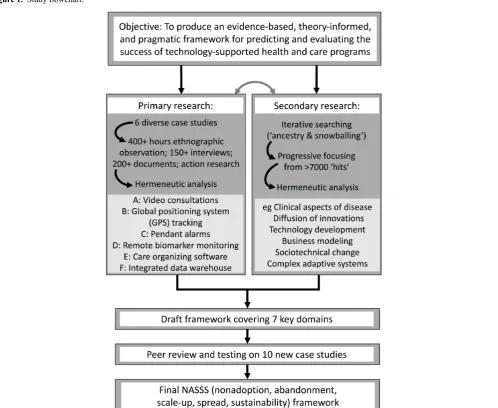
Study Design
explore, test, and refine these, followed by a synthesis phase, and peer review and refinement of the draft framework.
Primary Research: 6 Empirical Case Studies
We selected a diverse sample of case studies from 2 research programs: Virtual Online Consultations: Advantages and Limitations (VOCAL) and Studies in Co-creating Assisted Living Solutions (SCALS), whose detailed methodology and ethical approval have been described elsewhere [25,32]. VOCAL (2015-2017, with an earlier set-up phase from 2011) was an in-depth study of the development, introduction, and local rollout of remote (video) consultations across 3 contrasting clinical specialties in a large, multisite UK hospital trust [32]. SCALS (2015-2020, with some data collected from 2013) is an action research study of the challenges faced by UK health and social care organizations who introduce technology-supported new
service models; it includes examples from health care (eg, remote biomarker monitoring, video consultations, technologies for integrating care across organizations) and social care (safety alarms, global positioning system [GPS] tracking, care organizing apps) [25].
Case studies in VOCAL and SCALS involved qualitative interviews (with patients, clinicians, managers, technical designers, commercial partners, and—where relevant—investors), analysis of documents (correspondence, business plans, clinical records), ethnography (of technology use by patients or clients and staff, of meetings and events, and of technology design and functionality), and video recording of both ends of remote consultations [25,32]. Table 1
[image:4.595.52.551.273.681.2]summarizes the subset of data from VOCAL and SCALS used for this study.
Table 1. Summary of data sources used in this analysis.
Data sources Participants
Technology or technologies Study site or sites
Video outpatient consultations
35 formal semistructured views plus ~100 informal inter-views; ≥150 hours of ethnographic observation; 40 videotaped remote consultations (12 diabetes, 6 prena-tal diabetes, 12 cancer, 10 heart failure); ≥500 emails; 30 local documents such as business plans, protocols; 50 national-level docu-ments
1A. 24 staff (9 clinicians, 10 support staff, 5 managers); 30 patients 1B. 10 staff (8 nurses, 1 manager, 1 administrator); 8 patients
Plus 48 national stakeholders and wider informants on remote consult-ing
Skype (acute hospital) and Face-Time (community hospital) 1A. Acute hospital trust (3
special-ties—diabetes, prenatal diabetes, cancer—on different sites) 1B. Nurse-led heart failure service run from community hospital
GPSatracking for cognitive impairment
22 ethnographic visits and “go-along” interviews with index cases (~50 hours); 15 ethnographic visits with health and social care staff; 6 staff interviews; 5 team meetings; 3 local protocols
7 index cases; 8 lay caregivers; 5 formal caregivers; 3 social care staff; 3 health care staff; 3 call cen-ter staff
GPS tracking devices supplied by 5 different technology companies, includes GPS tracking with virtual map and geofence alert functions 2A. Social care organization in
de-prived borough in inner London, UK
Pendant alarms
50 semistructured and narrative interviews; 61 ethnographic visits (~80 hours of observation) includ-ing needs assessments and re-views; 20 hours of observation at team meetings
Site 3A. 8 index cases; 7 lay care-givers; 12 professional staff Site 3B. 11 index cases; 9 health and social care staff from frontline ser-vice delivery to senior board level; 3 representatives from telecare indus-try
In both sites, pendant alarms and base units were supplied by multi-ple different technology companies and supported by local councils, each with a different set of arrange-ments with providers and an “arms-length management organi-zation” alarm support service 3A. Health care commissioning
or-ganization in deprived borough in outer London, UK
3B. Social care organization in mixed borough in the Midlands, UK
Remote biomarker monitoring in heart failure
1 patient focus group; 8 patient interviews; 24 additional semistructured interviews; SUP-PORT-HF study protocol and ethics paperwork; material proper-ties and functionality of biomarker database
7 research staff, including principal investigator and research coordina-tor for SUPPORT-HFbtrial; 7 clini-cal staff involved in trial; 4 cliniclini-cal staff not involved in trial; (to date) 18 patient participants and 1 spouse Tablet computer and commercially
available sensing devices (blood pressure monitor, weighing scales, pulse oximeter)
Acute hospital trusts in 6 different cities in United Kingdom
Care organizing software
22 semistructured and narrative interviews; 16 hours’ ethnographic observations of meetings; au-toethnographic testing of function-ality and usability of devices; sec-ondary analysis of third-party evaluation of Product B Product A: 2 technology developers
and CEOcof technology company; 4 social care commissioners; 30 health and social care staff consider-ing usconsider-ing the device; 4 users of the device, 1 nonuser.
Product B (to date): 2 members of care charity (including CEO); 10 qualitative case studies of users un-dertaken by another academic team 5A. Web-based portal developed
by small technology company for use by families to help them orga-nize and coordinate the care of (typically) an older relative 5B. Smartphone app codesigned by caregiver support charity for same purpose
5A. Health care commissioning or-ganization in northern England 5B. National caregiver support charity in UK
Data warehouse for integrated case management
14 semistructured interviews; 50 ethnographic visits (~80 hours); 12 hours’ shadowing community staff; 4 hours’ observation of inter-disciplinary meetings; 12 local protocols or documents 14 staff; 20 patient participants
Integrated data warehouse incorpo-rating predictive risk modeling (in theory interoperable with record systems in participating organiza-tions)
1 acute hospital trust, 1 community health trust, 3 local councils, 3 health care commissioning organiza-tions
aGPS: global positioning system.
Secondary Research: Hermeneutic Literature Review
Articles describing technology implementation frameworks and their applications were eligible if they (1) studied a technology that was perceived as new by intended users, (2) aimed (through the uptake and use of the technology) to improve service efficiency, or patient or client outcomes in health or social care; and (3) offered some kind of conceptual or theoretical framework. We were particularly interested in patient-facing technologies such as telehealth, but we also assessed other frameworks (eg, for health information systems) for transferable insights.
We began by selecting relevant studies from our hermeneutic literature review of telehealth in heart failure (covering 32 previous systematic reviews and 60 additional articles, including many that covered conditions beyond heart failure) [13]. We searched the reference lists of key studies [33-41]; we also put their titles into Google Scholar to identify 160 articles (surprisingly few) that had cited them subsequently, and manually screened these titles for relevance. We chose this “ancestry and snowballing” approach because initial database searching proved neither sensitive nor specific [42].
Having obtained few hits, we extended our search to the wider literature by tracking our original 2004 diffusion of innovations review [1]; we manually screened the titles and abstracts of over 4500 publications that had cited it. We did the same with 8 other highly cited reviews on the broader topic of innovation in health care [4-9,27,43] (around 3000 additional hits), using progressive focusing to limit the dataset. We favored authoritative reviews and added selected primary studies (characterized by strong theory, naturalistic methods, and rich detail, and including a focus on technology implementation). Where articles cited a specific theory, we obtained the original article describing that theory.
We used a simple data extraction form to summarize key aspects of each study (both theoretical and empirical). Using the hermeneutic (interpretive) methodology described in detail previously [13], we combined the findings of primary studies and previous reviews to generate a preliminary list of domains, potential interactions, and theoretical mechanisms.
Synthesis and Framework Development
All 6 case studies generated large amounts of qualitative and quantitative data, not all of which was relevant to the objective of this study. Our first task was to delineate a more focused dataset of individual index cases (patients or clients) along with relevant staff interviews, field notes, and background documents (Table 1). For each case study, we analyzed qualitative data thematically and produced an initial narrative summary of the case, which we refined in the light of emerging theoretical evidence from the literature review. We conducted data analysis of the empirical case studies in parallel with progress on the hermeneutic literature review; each influenced the other. Findings broadly coalesced around key domains of influence (the patient, the technology, staff, and so on), which informed the development of an initial framework and raised further questions about the implementation process.
Refinement, Peer Review, and Testing
We developed initial versions of the nonadoption, abandonment, scale-up, spread, and sustainability (NASSS) diagram and framework part way through the empirical work to guide our action research and inform cross-case theorization. As we applied the framework to real cases, challenges occurred that were not covered by it (eg, patients unable to use technologies because of comorbidities), so we searched more specifically for articles to inform additional domains and questions. We shared a near-final version of the framework with colleagues involved in 10 further large-scale technology-supported change programs (including email and video consultations in primary care; an online peer support network for people with mental health needs; remote biomarker monitoring in transplant patients; and an online tool for people to identify local services appropriate to their health and care needs); we further refined the framework in the light of their feedback.
Results
Table 1shows the datasets for our empirical case studies. Below, we give a brief overview of the cases before summarizing our literature review and introducing the NASSS framework.
Empirical Case Studies
Case A: Video Outpatient Consultations
This case included 4 clinical services: 3 hospital-based services from VOCAL (young adult diabetes, prenatal diabetes, and cancer surgery, all using Skype; SS, unpublished data, 2017) and 1 community-based from SCALS (a nurse-led heart failure service run from 4 community hospitals, using predominantly FaceTime). In each, patients judged “appropriate” for video consultations by the doctor or nurse were offered this option. National policy makers viewed video consulting as a way of delivering health care efficiently to an aging population with rising rates of chronic illness. But the reality of establishing such services in busy and financially stretched public sector organizations proved far more complex and difficult than anticipated; progress was slow and required multiple organizational workarounds. Technical challenges in setting up video consultations with patients were typically mundane but potentially prohibitive (eg, forgotten passwords, poor connectivity, outdated software). When clinical, technical, and practical preconditions were met, video consultations appeared safe and were popular with both patients and staff, although only some clinicians agreed to participate.
edema) that the nurses considered essential was not easy in the remote environment (although sometimes possible with patient and caregiver assistance); multimorbidity and polypharmacy were common and in most cases the perceived risks and uncertainties associated with remote consulting were considered to outweigh the benefits.
Case B: GPS Tracking in Cognitive Impairment
Electronic tracking through GPS is used to monitor people with cognitive impairment who “wander” outside the home. We worked with a public sector social care organization to implement and adapt GPS tracking devices and a linked monitoring service for such individuals (of whom 11 were considered eligible and 7 assented). In what were typically very complex care contexts, GPS devices were useful to the extent that they aligned with a wider sociotechnical care network that included lay caregivers, call centers, and health and social care professionals. In this context, “safe” wandering was a collaborative accomplishment that depended on the technology’s material features, affordances, and aesthetic properties; a distributed knowledge of the individual and the places they wandered through; and a collective and dynamic interpretation of risk. Each index case required a high degree of tinkering (including customization of the device, liaison with the technology supplier, and adjustment of work routines) to achieve a solution that was acceptable. Despite this, only 3 individuals were still using the technology by the end of the 18-month study period.
Case C: Pendant Alarms
Pendant alarms (worn around the neck or on a wrist strap and connected to a remote call center) were the only patient-facing technology in widespread use in our dataset. Both study sites had a well-established sociotechnical infrastructure that included a named care team with expertise and local knowledge. Supply of a pendant alarm was typically initiated by a public sector organization and involved a local technology supplier to fit it, with or without support from an age charity. Clients could also self-refer. The setup usually depended on a network of lay caregivers available to respond to a summons; a safe box was usually installed containing a key so the rescuer could let themselves in, or an emergency response (eg, ambulance or 24/7 social care) was summoned as required. Users paid a set-up fee (around £25; US $40) plus a small weekly support fee (around £4.50; US $7), although some local care providers offered this service free of charge (eg, to people in receipt of welfare benefits). In almost all cases, the individual had multiple and complex needs (physical, cognitive, social) and was using multiple technologies in addition to the alarm [44].
In many but not all cases, activation of the pendant alarm led to help arriving promptly. On some occasions, there was a mismatch: the alarm was triggered when there was no objective need (perhaps by accident) or, more commonly, not triggered when caregivers felt it should have been—because the individual did not want to trouble anyone, did not believe the problem was serious or urgent or was unable to activate the device (eg, during a fit), or was not wearing the alarm at the time of the crisis. Sometimes, call center operators made judgments and put in “emotional work” to support the caller without alerting their
relative or reassured them while help was on its way [45]. In 1 site, use of pendant alarms had evolved in that some lonely people (especially those with cognitive impairment) were being
encouragedto press the alert button and talk to a call center operator even when there was no emergency, in order to reduce call-outs of the emergency services.
Case D: Remote Biomarker Monitoring (Telehealth)
This case study involved cardiology departments in 6 UK hospitals, each implementing biomarker monitoring (weight, blood pressure, heart rate) for heart failure as part of a multicenter randomized controlled trial (Seamless User-Centred Proactive Provision of Risk-Stratified Treatment for Heart Failure [SUPPORT-HF]). The tablet technology supplied to patient participants had been developed using a codesign methodology [46]. Participants in both arms of the trial received the technology and automated feedback messages (eg, if results went outside preset parameters); in the intervention arm, the patient’s family physician was alerted to out-of-range results and offered suggestions for changes in therapy, whereas in the control arm, results were made available on a Web portal for the patient’s physician to access if they chose to. Staff at the different SUPPORT-HF sites engaged variably with the study, sometimes leading to slower than predicted recruitment. A minority of clinicians were reluctant to refer patients or engage with the trial protocol, citing “previous bad experiences with telehealth,” concern that a remote monitoring service would threaten their jobs, or a perception that patients “deserved better.” Patient participants expressed a range of views about remote biomarker monitoring; some took an active interest in their readings, engaged enthusiastically with the feedback they received, and found this monitoring reassuring. Others found the experience confusing and did not know (or wish to know) what the numbers meant. In some cases, a research nurse known to the participants provided (unofficial) telephone support to maintain engagement. Another problem with the remote monitoring service was the variability of broadband speed outside the main cities, which meant that more than half of potentially eligible participants in 1 site could not be included in the study.
Case E: Care Organizing Software
This case study followed the very different fortunes of 2 software products, each designed to help relatives and friends (and sometimes professional staff as well) organize tasks and visits for someone with health or care needs. Product A, a Web portal, had been developed in-house by a small software company, based on a previous caring experience by one of the company staff. The business model was to sell the product to care organizations who would then provide it to their clients for free. The developer did not initially anticipate that either intended end users or participating care organizations would need any training or ongoing support to use the portal. Product A was not successful during the study period; fewer than 5 families were ever identified as actively using it.
for such software; they worked with a specialist app developer company and carefully selected pilot families. From the outset, the charity recognized that caregivers would need to be made aware of the product through mass mailing and to be actively invited and supported to use it, and that a helpdesk service would be needed. The app was made available commercially (via the App Store) for £2.99 (about US $5). Users signed up gradually but steadily; there was no tipping point, but at the time of writing over 1000 families are using the product through the care charity; in a preliminary evaluation, most spoke highly of it (and of the charity support).
Case F: Integrated Case Management Via Data Sharing
Case management is a way of organizing health and social care services through assessment and care planning by multidisciplinary teams with the aim of managing the growing challenge of emergency hospital admissions (and readmissions) in older people with multiple health and care needs. To avoid the high human and financial cost of such admissions, coordinated action and frequent dialogue between primary care providers, secondary care providers, and social care and other formal and informal caregivers is often needed. In the SCALS study, 1 site had introduced an integrated data warehouse incorporating a predictive risk modeling tool to automate the identification of people at high risk of hospital admissions through risk stratification, and to facilitate shared access to care plans in efforts to achieve integrated care. Although the data warehouse was part of business as usual in this site, in practice people at high risk of hospital admission were identified through a combination of risk stratification and clinical judgment. Care plans were shared in a range of ways, sometimes through the integrated data warehouse and sometimes bypassing it.
Literature Review
Our search for evidence-based approaches to guide our empirical work on the above case studies identified 28 technology implementation frameworks, informed by several theoretical perspectives, which we sorted into a simple taxonomy [13,43,47-72]; see Multimedia Appendix 1.
A key limitation of many previous frameworks was the lack of detailed analysis of the condition or problem for which a new technology was [part of] the intended solution. Some assumed a “textbook” condition—simple, isolated, easily characterized, and amenable to management by algorithm or protocol using a one-size-fits-all (or minimally customizable) technology. Yet there is much empirical evidence that the health and care needs of real people are extremely heterogeneous, even when they have the “same” condition. For example, Tait et al’s case-by-case analysis of patients in a heart failure clinic found that every one of them required significant customization and ongoing adaptation of the care package recommended in the guideline [73].
A prominent policy prediction, typically couched in the language of “empowerment,” is that remote technology will make care more efficient by encouraging self-management of chronic conditions [74]. But as May et al have pointed out in their burden of treatment theory, shifting the work of care from clinic to community places new demands on the sick (and hence raises
ethical questions) [75]. Depending on the condition, such work may also be physically or cognitively impossible. The anchored, realistic, cocreative, human, integrated, and evaluated (ARCHIE) framework derived from our earlier empirical work on assisted living technologies emphasized the diverse manifestations of multimorbidity and social care need; it recommends commencing with a realistic assessment of the nature (and likely progression) of the condition and a focus on what matters to the user [47].
No previous framework explicitly considered inequalities in access, uptake, and use of health and care technologies by age, sex, socioeconomic status, or ethnic group, although previous empirical studies have highlighted substantial differences across such groups [76]. Chronic health conditions and care needs are strongly patterned by social determinants. For example, type 2 diabetes, heart failure, depression, cognitive impairment, and general frailty are all more than twice as common in the poorest and least well-educated quintiles of society as in the richest and best educated [77]. The poor may also have less rich social networks, less reliable access to broadband, lower digital literacy, and greater likelihood of having problems such as debt or unsuitable housing [77,78].
Most previous frameworks addressed the material properties of the technology, such as its physical features, functionality, and interoperability. Few considered its symbolic properties (some technologies—such as mobile phones—have connotations of youth, progress, and friendship; others—such as GPS tracking devices or pendant alarms—symbolize dependence or external control). One or two frameworks considered what knowledge or skills (and hence training and support) were needed for intended users to be confident in operating the technology. A question addressed tangentially or not at all by previous frameworks was what kind of knowledgedoes the technology generate? For example, telehealth technologies fall into two broad categories. Remote monitoring devices transmit objective biomarkers such as weight, blood pressure, and oxygen saturation, and responses to closed questions on symptoms and compliance, and perhaps also transmit instructions or educational messages (what Pols has called “cold” telehealth [79]). Remote communication devices create the possibility for more conventional conversations between patients and clinicians by telephone or video (“warm” telehealth). These different technologies bring very different kinds of knowledge into play and, by design or default, exclude other knowledge and influences from the frame.
Lehoux et al distinguish between a health technology’s upstream value as viewed by investors (especially the business case for generating profits, further spin-offs, and highly qualified jobs), drug and device regulators (preliminary evidence of efficacy and safety), and financial regulators (auditable business processes and governance), and its downstream value as viewed by clinicians and policy makers (including its impact on patients and health care costs) [82,83]. Health technology development is often characterized by poor alignment between supply-side and demand-side value [82,84,85].
In previous frameworks, technology adoption by health care staff was most commonly theorized using Davis’s technology acceptance model, comprising perceived usefulness, perceived ease of use, and attitude toward the technology [86]; or Bandura’s social learning theory, the relevant aspect of which is that people learn by observing and imitating the behavior of others [87,88]. Critics of the technology acceptance model have argued that it fails to account for human and social change processes [89]. Sociological theories of technology adoption, which emphasize the norms and expectations associated with different social positions and professional groups [26,27,31], were not extensively used in previous frameworks, with the exception of May and Finch’s normalization process theory [27], of which relational integration—how the technology affects human relations such as the doctor-patient relationship—is one component.
In considering our own case studies, we were drawn to sociological theories because the new technologies often had implications for staff identity, professional commitments, and scope of practice. Acceptance by professional staff may be the single most important determinant of whether a new technology-supported service succeeds or fails at a local level [17,36,39,79,90,91]. Local champions appear key to persuading their peers that the technology-supported service is effective, safe, and “normal” (ie, professionally appropriate) [17,92]. We have previously developed a theoretical model of clinician resistance to new health care technology made up of 4 elements: resistance to the policyreflected in the technology (eg, a policy of shifting the work of disease management from professional to patient); resistance to the sociomaterial constraints (eg, clunkiness, dependability) of the new technology; resistance to
compromised professional practice(eg, less scope for exercising judgment); and resistance to compromised professional relationships(eg, a perception that a remote interaction is less professional than a face-to-face one) [93].
One framework in our sample addressed technology acceptance by patients. The digital health engagement model was based on both burden of treatment theory and normalization process theory [48]. It proposes 4 key influences on whether an individual will engage with a health technology: personal agency and motivation (which is affected by aspects of their illness); personal life and values; the engagement and recruitment approach taken by those seeking to promote the technology; and the quality of the health technology.
Two frameworks drew on DeLone and McLean’s classic theoretical model of information system success [94]. This considers system quality, information quality, usage attributes,
user satisfaction, individual impact, and organizational impact [49,50]. While this framework had some resonance with our empirical data, it did not address the patient-facing aspects of health and care technologies, nor did it address contextual influences or change over time (we classified it as a static framework), and hence did not help us with our study of scale-up, spread, and sustainability.
Surprisingly few frameworks considered the organizational setting. Some antecedent characteristics of organizations have been shown to support innovation at an organizational level [1]. These include a devolved organizational structure (with each department or unit able to make semiautonomous decisions), significant organizational slack (that is, spare resources that can be channeled into new projects), and strong leadership, good managerial relations, a risk-taking climate (staff are rewarded rather than punished for trying things out), opportunities for sense making (that is, collectively arguing out the meaning of an innovation [95]), and what is known as absorptive capacity: “a set of organizational routines and processes by which [organizations] acquire, assimilate, transform, and exploit knowledge to create a dynamic organizational capacity” [96]. These organizational determinants of innovation align with complexity theory’s emphasis on local adaptation and the need for creativity to address unique emerging issues [97]. A specific innovation is more likely to be taken up if there is strong tension for change, good innovation-system fit (that is, the innovation fits well with existing work and routines), widespread support for (and limited opposition to) the innovation, and systematic assessment of the implications [1].
Another important aspect of implementation omitted by most previous frameworks was the health or care organization’s business model for introducing the technology. This includes the resources to support the model, key partners and relationships, the transaction mechanism (how will the organization interact with the supplier?), the value structure (how and when will value, including benefits for patients, be created and investment costs recouped?), and organizational design issues (what changes in organizational structure and processes are required or presumed by the new technology?) [11,14]. A review by van Limburg et al highlighted the financial and business challenges associated with eHealth technologies, including their (typically) fragmented deployment, multiple stakeholders and interdependencies, lack of recognition of the ongoing work of implementation, and an overreliance on the results of experimental efficacy trials [11].
Work processes can be described in two ways: the way things are supposed to work and the way they do work. Software that is designed to support standard procedures can be too brittle.[page 25]
Cherns’ classic theory of sociotechnical design, originally developed in the 1970s, is built on the principle that introducing technologies in an organization is a social process that depends on values, mindsets, and engagement, as well as on clear and extensive communication about what changes are occurring and why [101]. It is also an evolutionary process (sociotechnical systems are grown, not built), hence best achieved by early and active input of frontline workers into the [re]design of work routines—a principle that has long been recognized (but rarely adequately applied) in health care [100,102]. Also highly relevant to the health and care environment is what Weick called “technology as equivoque” [103] and Orlikowski (drawing on earlier work on the social construction of technology) called “interpretive flexibility” [104]: a technology introduced into an organization is open to multiple interpretations; successful embedding will require opening up a space for dialogue, listening to concerns, and allowing people time to argue out the challenges and learn from the experiences of others before a “closure” over possible interpretations is reached [88,105]. As Stewart and Williams [105] stated,
Innovation is not restricted to the prior design of an artefact, but continues as artefacts are implemented and used (innofusion). Supplier offerings are inevitably incomplete in relation to the complex, heterogeneous and evolving requirements of users; work needs to be done by specific users to incorporate these generic solutions to their particular contexts and practices (domestication).[page 195]
Surprisingly, few previous frameworks in the health and social care literature have attempted to capture this insight, which partly explains why on-the-job training in technology use and ongoing helpdesk support are key to the implementation process [1].
A prominent theme in our empirical findings—but addressed tangentially or not at all by most previous frameworks—was that implementing health technology programs involves a great deal of work [106]. Normalization process theory unpacks implementation work into 4 categories: coherence (the work that people do to make sense of a practice), cognitive participation(work to enroll and engage other people in relation to that practice), collective action (work to enact the new practice, including efforts to bridge the model-practice gap described above), and reflexive monitoring(the work involved in assessing and adjusting a practice in use, including evaluating the impact of the technology and demonstrating its value to others) [27]. Implementation work may be particularly onerous in relation to health technologies because of the complexities and institutional challenges of addressing, for example, data security and patient privacy, interoperability across multiple information systems, resistance from health care professionals with a high degree of autonomy, and disruption to the critical granularity of clinical workflow [106]. First-order problems (such as slow technical performance) typically generate second-order problems, such as dramatically increased
workloads (sometimes necessitating safety-critical workarounds), and perhaps third-order ones, such as reputational damage [106]. Failures in all 4 of May and Finch’s work categories were evident in a systematic review of reasons for unsuccessful telemedicine implementation informed by normalization process theory [107].
Around half of the frameworks identified in this review included a question on the wider context for technology-supported care [108]. New technologies generate technical—and commercial and political—questions around interoperability standards, customer lock-in, customizability, substitutability, supplier relations, and the marketplace; policy questions about mainstreaming and funding new models of care; professional and managerial questions around standardization of algorithms and protocols; financial questions about who pays for which aspect of a networked service; legal questions around intellectual property; regulatory questions about safety, efficacy, and good business processes; and jurisdictional questions around liability, licensing, and the management of health information in shared environments [108-113]. The industry impetus of agile, rapid-iteration technology development and the “fail early, fail often” principle typically followed for software products contrasts with the risk-averse, highly regulated, and randomized trial-dominated context of much biomedical innovation [11,82,114].
While some implementation frameworks were designed around a rigid (and apparently systematic) logic model [51], we have previously argued that such an approach is counterproductive because eHealth technologies are typically introduced into a complex system in a turbulent and contested policy context [52]. Complexity principles distinguish simple phenomena (straightforward, predictable, few components) from complicated (multiple interacting components or issues) or complex (dynamic, unpredictable, not easily disaggregated into constituent components) ones [97]. Chambers et al’s dynamic sustainability framework recognizes that, in order to be sustained, an innovation must adapt to its unique local environment and evolve over time [115], echoing Hawe et al’s conceptualization of interventions as “events in [complex] systems” [116]. Several other recently published technology implementation frameworks have embraced complexity theory and argued strongly for a developmental, contextualized, and adaptive approach [43,47,53-60].
(although in our own classification, 3 of these were not actually frameworks) [43]. They produced a multilevel theorization including diffusion of innovations, technology acceptance, service improvement, and organizational development. Their holistic technology implementation framework, known as the Centre for eHealth & Wellbeing Research roadmap, comprises 5 overlapping stages undertaken by a multidisciplinary team with iterative formative evaluation of each: (1) contextual inquiry (information gathering about the users and the environment, including ethnography and the use of scenarios); (2) value specification (including economic, social, and behavioral dimensions); (3) design (building prototypes that fit with values and user requirements); (4) operationalization (introduction and employment of the technology, including implementing a business model); and (5) summative evaluation (of uptake and impact).
Van Dyk, writing from an industrial engineering background, produced a taxonomy of eHealth implementation frameworks based on several theories, including diffusion of innovations, technology acceptance and use, e-readiness of organizations, transactional economics, and the information system life cycle, as well as considering more pragmatic barriers-and-facilitators studies [59]. She proposed a holistic approach that includes “technology, organizational structures, change management, economic feasibility, societal impacts, perceptions, user-friendliness, evaluation and evidence, legislation, policy and governance.”
Van Dyk drew an important insight from organizational life cycle studies (including her own work on a telemedicine service maturity model for health care organizations [58])—that the challenges and constraints of technology-supported services vary with stage of development [59]. That is, (1) at the prototype stage, the main emphasis is on proof of concept and usability; (2) in small-scale pilots, it is on staff and societal acceptance (typically with an emphasis on the evidence base); (3) at the stage of wider local rollout—when financial support typically moves from external research grant to real set-up costs and a recurrent budget line—it is on financial and organizational considerations; and (4) when being considered for national rollout, it is on regulation, standardization, and security. One final concept, which appears key to organizational adaptation over time but was not explicitly addressed in any of the previous frameworks, is the notion of resilience, defined as “the intrinsic ability of a system to adjust its functioning prior to, during, or following changes and disturbances so that it can sustain required operations, even after a major mishap or in the presence of continued stress” [117]. Organizational psychologists emphasize the importance of macrocognition: that is, reflecting collectively and continuously about how the organization is responding to change, including ongoing sense making, detecting critical events, and coordinating adaptive actions [118,119]. Introduction of new health care information technology systems can lead to loss of system resilience, since
new technologies intended to automate work and assure safety may have the unintended effect of reducing time for collaborative dialogue, masking key trends in data (perhaps through information overload and loss of overview), making work routines brittle, and bypassing clinical judgment [118,120]. Cho et al have warned that the study of resilience in relation to new technologies requires multilevel analysis and is fraught with paradoxes (eg, that developing resilience in one part of the system may generate brittleness in another) [121].
In sum, we found the integrated frameworks of van Gemert-Pijnen et al [43] and Van Dyk [59] extremely helpful and used them as the starting point for analyzing our own dataset, modifying and refining them in the light of other high-quality frameworks published subsequently [53-55,60], and adding additional theoretical concepts (eg, burden of disease, health literacy, organizational resilience) and insights from our empirical data (especially our findings on the diverse and idiosyncratic nature of many conditions, which had received little attention in any previous framework).
Synthesis: The NASSS Framework
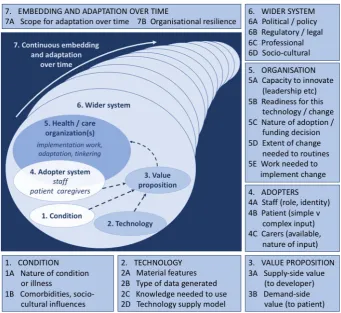
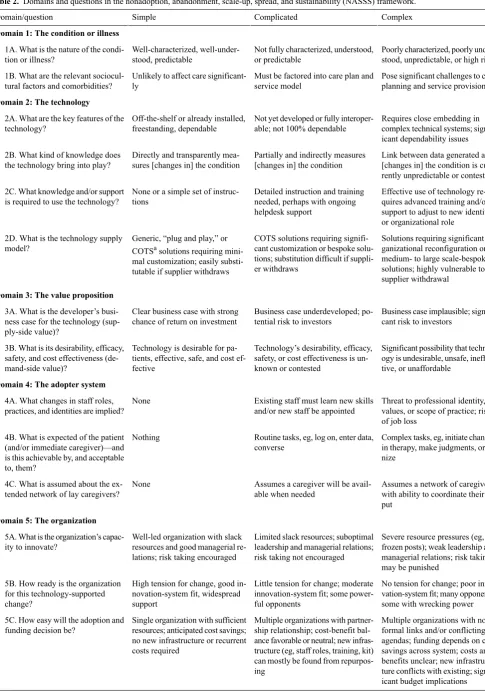
The final version of the NASSS technology implementation framework is shown in Figure 2and expanded in Table 2. It consists of 13 questions in 6 domains: the condition, the technology, the value proposition, the adopter system (staff, patient, and lay caregiver[s]), the health or care organization(s) (including attention to the work of implementation and adaptation), and the wider (institutional and societal) context. It also includes a seventh domain that considers interactions and adaptations over time. The framework is intended to be used reflexively to guide conversations and help generate ideas, not as a checklist.
Our case studies raised a variety of challenges across all 7 domains, each of which could be classified as simple (straightforward, predictable, few components), complicated (multiple interacting components or issues), or complex (dynamic, unpredictable, not easily disaggregated into constituent components) [97]. Programs characterized by complicatedness proved difficult but not impossible to implement. Those characterized by complexity in multiple NASSS domains rarely, if ever, became mainstreamed.
Multimedia Appendix 2gives examples from our case studies in each of the domains, which we consider in turn.
The Condition
Figure 2. The NASSS framework for considering influences on the adoption, nonadoption, abandonment, spread, scale-up, and sustainability of patient-facing health and care technologies.
The Technology or Technologies
Question 2A addresses material and technical features of the technology. The technologies in our case studies were more or less freestanding. In all cases, features such as size, sounds, aesthetics, and “clunkiness” had significant impact on the technology’s actual and perceived usability and appropriateness. Many were insufficiently prototyped. Dependability of technologies was key, especially in high-risk conditions or social situations.
Question 2B considers the knowledge generated or made visible by technology. This includes not only the accuracy of the data but also the extent to which those data are accepted, trusted, and considered sufficient for decision making. Engaging with the data generated by patient-facing technologies may inform, educate, and empower patients and lay caregivers. But data may also be misinterpreted by the patient or cause distress.
Question 2C addresses the knowledge and support needed to use the technology. Some technologies are much easier to operate than others; some require frequent troubleshooting; and some assume a different organizational role—or even an altered professional identity—for the user. Some patient-facing technologies require no knowledge form the patient; others require clinical knowledge, technical knowledge, and the ability to make judgments about (for example) what counts as urgent. Question 2D addresses issues for sustainability raised by the technology supply model—that is, how the technology was procured, the nature of the client-supplier relationship, and the level of potential substitutability via the marketplace. The
telehealth device marketplace is notorious for its lack of interoperability as companies attempt to retain their market share through lock-in of customers. The consequences for health and social care services—and their clients—of market withdrawal could be significant. While procurement options may not have immediate impact on scaling up and sustainability, they are likely to have significant impact in the long term and may influence decisions on whether to adopt an innovation in the first place. Customizable, off-the-shelf technologies (COTS) [113] offer relatively low cost (as they benefit from economies of scale) but may not be customizable to the extent that users really need (see domain 1). In contrast, bespoke solutions offer better fit with users’ needs but at higher cost (both developmental and ongoing). Both options may be subject to risks of supplier withdrawal from the marketplace, with small and medium-sized enterprises being especially vulnerable.
The Value Proposition
[image:12.595.126.468.92.405.2]Table 2. Domains and questions in the nonadoption, abandonment, scale-up, spread, and sustainability (NASSS) framework.
Complex Complicated
Simple Domain/question
Domain 1: The condition or illness
Poorly characterized, poorly under-stood, unpredictable, or high risk Not fully characterized, understood,
or predictable Well-characterized,
well-under-stood, predictable 1A. What is the nature of the
condi-tion or illness?
Pose significant challenges to care planning and service provision Must be factored into care plan and
service model Unlikely to affect care
significant-ly 1B. What are the relevant sociocul-tural factors and comorbidities?
Domain 2: The technology
Requires close embedding in complex technical systems; signif-icant dependability issues Not yet developed or fully
interoper-able; not 100% dependable Off-the-shelf or already installed,
freestanding, dependable 2A. What are the key features of the
technology?
Link between data generated and [changes in] the condition is cur-rently unpredictable or contested Partially and indirectly measures
[changes in] the condition Directly and transparently
mea-sures [changes in] the condition 2B. What kind of knowledge does
the technology bring into play?
Effective use of technology re-quires advanced training and/or Detailed instruction and training
needed, perhaps with ongoing helpdesk support
None or a simple set of instruc-tions
2C. What knowledge and/or support is required to use the technology?
support to adjust to new identity or organizational role
Solutions requiring significant or-ganizational reconfiguration or COTS solutions requiring
signifi-cant customization or bespoke solu-Generic, “plug and play,” or
COTSasolutions requiring mini-2D. What is the technology supply
model?
medium- to large scale-bespoke tions; substitution difficult if
suppli-er withdraws mal customization; easily
substi-tutable if supplier withdraws solutions; highly vulnerable to supplier withdrawal
Domain 3: The value proposition
Business case implausible; signifi-cant risk to investors
Business case underdeveloped; po-tential risk to investors
Clear business case with strong chance of return on investment 3A. What is the developer’s
busi-ness case for the technology (sup-ply-side value)?
Significant possibility that technol-ogy is undesirable, unsafe, ineffec-tive, or unaffordable
Technology’s desirability, efficacy, safety, or cost effectiveness is un-known or contested
Technology is desirable for pa-tients, effective, safe, and cost ef-fective
3B. What is its desirability, efficacy, safety, and cost effectiveness (de-mand-side value)?
Domain 4: The adopter system
Threat to professional identity, values, or scope of practice; risk of job loss
Existing staff must learn new skills and/or new staff be appointed None
4A. What changes in staff roles, practices, and identities are implied?
Complex tasks, eg, initiate changes in therapy, make judgments, orga-nize
Routine tasks, eg, log on, enter data, converse
Nothing 4B. What is expected of the patient
(and/or immediate caregiver)—and is this achievable by, and acceptable to, them?
Assumes a network of caregivers with ability to coordinate their in-put
Assumes a caregiver will be avail-able when needed
None 4C. What is assumed about the ex-tended network of lay caregivers?
Domain 5: The organization
Severe resource pressures (eg, frozen posts); weak leadership and Limited slack resources; suboptimal
leadership and managerial relations; risk taking not encouraged Well-led organization with slack
resources and good managerial re-lations; risk taking encouraged 5A. What is the organization’s
capac-ity to innovate?
managerial relations; risk taking may be punished
No tension for change; poor inno-vation-system fit; many opponents, some with wrecking power Little tension for change; moderate
innovation-system fit; some power-ful opponents
High tension for change, good in-novation-system fit, widespread support
5B. How ready is the organization for this technology-supported change?
Multiple organizations with no formal links and/or conflicting Multiple organizations with
partner-ship relationpartner-ship; cost-benefit bal-Single organization with sufficient
resources; anticipated cost savings; 5C. How easy will the adoption and
funding decision be?
agendas; funding depends on cost ance favorable or neutral; new
infras-no new infrastructure or recurrent
costs required savings across system; costs and benefits unclear; new infrastruc-tructure (eg, staff roles, training, kit)
can mostly be found from
Complex Complicated
Simple Domain/question
New team routines or care path-ways that conflict with established ones
New team routines or care pathways that align readily with established ones
No new team routines or care pathways needed
5D. What changes will be needed in team interactions and routines?
Significant work needed to build shared vision, engage staff, enact new practices, and monitor impact Some work needed to build shared
vision, engage staff, enact new practices, and monitor impact Established shared vision; few
simple tasks, uncontested and eas-ily monitored
5E. What work is involved in imple-mentation and who will do it?
Domain 6: The wider context
Financial and regulatory require-ments raise tricky legal or other challenges; professional bodies and lay stakeholders unsupportive or opposed
Financial and regulatory require-ments being negotiated nationally; professional and lay stakeholders not yet committed
Financial and regulatory require-ments already in place nationally; professional bodies and civil soci-ety supportive
6A. What is the political, economic, regulatory, professional (eg, medi-colegal), and sociocultural context for program rollout?
Domain 7: Embedding and adaptation over time
Significant barriers to further adaptation and/or coevolution of the technology or service Potential for adapting and
coevolv-ing the technology and service is limited or uncertain
Strong scope for adapting and em-bedding the technology as local need or context changes 7A. How much scope is there for
adapting and coevolving the technol-ogy and the service over time?
Sense making, collective reflec-tion, and adaptive action are dis-couraged in a rigid, inflexible im-plementation model
Sense making, collective reflection, and adaptive action are difficult and viewed as low priority
Sense making, collective reflec-tion, and adaptive action are ongo-ing and encouraged
7B. How resilient is the organization to handling critical events and adapting to unforeseen eventuali-ties?
aCOTS: customizable, off-the-shelf.
The Adopter System (Staff, Patient, Caregivers)
Question 4A is about adoption (and continued use) of the technology by staff. Reflecting the findings of previous studies reviewed above, some staff in each of our case studies simply did not engage with the program or use the technology. Nonadoption (or in some cases, abandonment) of the technology was occasionally explained by the technology’s attributes (such as usability or ease of use). More commonly, staff were concerned about threats to their scope of practice or to the safety and welfare of the patient—and even, in some cases, about a fear of job loss.
Question 4B addresses adoption by patients or clients, including acceptance (hence symbolic meaning and aesthetics) and the work required of them.
Question 4C addresses the assumptions that may be built into the technology (or the linked service model) about the availability and behavior of lay caregivers. We encountered many cases of nonuse of all patient-facing technologies that were explained by weak or absent social networks, limited information technology skills (and distrust of technology) among lay caregivers, or long-standing family conflicts, which the technology sometimes brought to the surface but never solved (see examples in Multimedia Appendix 2).
The Organization(s)
Questions 5A and 5B address the organization’s capacity (to embrace any service-level innovation) and readiness (for a specific technology), respectively. Our case studies included a wide range of antecedent conditions and levels of readiness that influenced uptake and internal scale-up of technology-supported programs (see examples in Multimedia Appendix 2).
Question 5C addresses the adoption decision, typically a board-level decision to allocate a budget line to support a
The Wider Context
Question 6A relates to the wider institutional and sociocultural context, which in our case studies was often key to explaining an organization’s failure to move from a successful demonstration project (heavily dependent on particular champions and informal workarounds) to a fully mainstreamed service (scale-up) that was widely transferable (spread) and that persisted long term (sustainability). Aspects of wider context that proved pivotal in our case studies included health policy (including which service models were formally approved for funding—see example in Multimedia Appendix 2 of the difficulties in securing a nationally approved tariff for remote consultations), fiscal policy (the overall amount of funding available locally and nationally for health and care provision), the position taken by professional bodies and defense societies (who de facto defined what was acceptable professional practice), and legal and regulatory aspects of patient-facing technology development.
Interaction Between Domains and Adaptation Over Time
While the domains above can be distinguished analytically, the reality of any technology implementation project is that at an empirical level they are inextricably interlinked and dynamically evolving, often against a rapidly shifting policy context or continued evolution of the technology (and, at an individual patient level, as the condition deteriorates or fluctuates over time).
Question 7A relates to the medium- and long-term feasibility of continuing to adapt the technology and the program. Some technologies were more amenable to adaptation than others. Adaptation of staff roles and care pathways was also difficult when organizations were in subcontractor relationships (sometimes with private providers).
Question 7B concerns organizational resilience, and particularly what May and Finch called “reflexive monitoring” [27] and Patterson et al called the “macrocognitive functions” of sense making, including in particular the ability to detect critical events or issues and respond to these through coordinated action [118]. While an adaptive and reflexive approach is essential for effective scale-up, spread, and sustainability, it is impossible to be prescriptive at the outset as to how to go about this. Both formative and summative evaluation of the program’s success will need to use imagination and multiple methods, along with a narrative account of what happened and why, in order to capture its multiple interdependencies, nonlinear effects, and unintended consequences [123].
Results of Prospectively Testing the NASSS Framework
Colleagues found our near-final NASSS framework helpful in considering challenges to implementation of a range of technology-supported health or care programs. While some used the framework (as we ourselves did) prospectively and in real time to predict and explore the challenges of implementing an existing technology to support a new program, some used it retrospectively to explain failures and partial successes in past projects. One group (a design company) suggested that the
NASSS framework might be used at an early (design) stage to focus attention first on the condition and adopter system domains (ie, the needs of intended users), which would then inform both the technology and value proposition domains.
Discussion
Principal Results
Building on previous work by other groups, this study has developed and applied a new framework for predicting and evaluating the success of technology-supported health and social care programs. Across a diverse sample of 6 empirical case studies followed (so far) for up to 3 years and tested briefly (for what might be called face validity) in a further sample of 10 additional case studies, we identified and explained numerous examples of nonadoption and abandonment of the technology by individuals or limited success in attempts to scale up, spread, and sustain the program within and beyond the organization. A striking finding that explained many such instances was a tendency to assume that the issues to be addressed were simple or complicated (hence knowable, predictable, and controllable) rather than complex (that is, inherently not knowable or predictable but dynamic and emergent). Common problems included the following:
• The technology and linked program had been designed around an oversimplified, textbook model of the condition.
• The technology was insufficiently prototyped, insufficiently customizable, insufficiently dependable, dependent on complex knowledge to use it, or designed to generate data or knowledge that was incomplete, inappropriate, or contested in the care context.
• The value proposition of the technology was unclear, in terms of a viable business venture for its developer or in terms of a clear benefit for patients and an affordable real-world service model.
• The intended users of the technology had plausible personal or professional reasons to resist or reject it.
• The organization(s) were inadequately set up for innovation, not ready for (or interested in) this particular innovation, unable to negotiate a viable business model with partner organizations, unable to shift to new ways of working, or unable to support the extensive work needed to implement and sustain the change (including the rhetorical “work” of making sense of an equivocal technology).
• Complexity in external (financial, regulatory, legal, policy) issues—of which reimbursement seemed to be particularly key—stalled the mainstreaming and spread of the program.
• The program was unable to adapt and evolve over time in a way that continued to meet the needs of its intended users and remain clinically, operationally, and financially viable.
Strengths and Limitations