I"
I
i
© AMPEX CORP. 1964
Special introductory offer: 1.8 microseconds for the price of a 6.
Introducing the Ampex RZ, up to 16,384 words
of core memory with a complete cycle time of
only 1.8 microseconds. And a price tag lower than
many 4 and 6 microsecond memories. The latest
in the highly successful Ampex R series (RVQ,
RQA, RQL, RVS), the RZ also offers a longer word
length: 8 to 56 bits. With no redundancy in drive
circuitry. Access time is faster: 650 nanoseconds.
And the RZ has a wide environmental range:
+ 10°C to +45°C. The RZ is fast, big a'nd flexible
enough to be used as a main-frame memory, an
auxiliary memory or for high-speed bulk storage.
AMPEX
Tripling data re-entry speed.
I'm a businessman, not an astronaut.
Videoscan is designed for businessmen -
profit-conscious businessmen. This unique, TV-based
optical character reader permits you to feed source
documents directly to a computer, without first
converting to punched
hol~sin cards or paper tape.
I still don't get the TV connection ...
Videoscan's sensing device is the famous
RCA-developed Vidicon tube. It reads characters
pass-ing before it like the beam-sweep on a TV screen.
I'm impressed ... but what does this buy me in
data processing power?
The ability to read live data directly into an
RCA computer at speeds up to 1500 characters
per second, or 90,000 documents an hour. Utility
bills, premium notices, coupons, tickets ...
Videoscan can read them faster, more
economi-cally, more reliably than any system ever
developed.
All because of a TV-camera?
Plus RCA electronics-a high-speed transport
system ... and the powerful performance of
RCA computers.
I'm interested. What channel do I dial?
Dial your local RCA EDP office, immediately
- for full details and a system evaluation. Or
just write.
RCA ELECTRONIC DATA PROCESSING, CHERRY HILL, NEW JERSEY.
~
The Most Trusted Name in Electronics
'. ®
Mct11y flrms are st811ed behind a communications barrier caused by incrccised paperwork. Thus, simpli-fying and speeding up communications \'1i11 help make operations more efficient and profitable. Firms, using Teletype page printers to handle routine communica-tions, could speed things up considerably by adding the versatility of automatic trcmsmission with punched
p:1pcr 1 ;qw.
Thrpc aclvanto.ges of autolnatic send-receh'e sets. Operators can punch messages allel data off-line providing errorless tape for later transrnission. Mes-sages and delta can be collected from many sources at different times and transmitted on-line more eco-nomically at maximum speed in one continuous mes-sage. Punched tape makes it possible to store messages or basic data that can be used again and even com-bined with variable data to save retyping.
Three models to choose iroIn. There are three different Teletype automatic send-receive sets to satisfy your communication needs. The !viodels 32 and
33 are the most economical to use where trnffic ranges from norm81 to light. The Model 3S is designed for handling a much larger volume of messages and dat8, as well as offering increased versatility for on-line and off-line communications.
Communicates with business n1achines. Actu-ally, punched paper tape prepared on a Teletype auto-matic send-receive set can do much to automate communication procedures. These ASR sets "speak" the same la.nguage as many business machines and computers because they operate all a.Il 8-1evd code, which conforms to the newly approved American Standard Code for information interchange.
RECEIVE AUTO MATI CALLV?
Steel manufacturers use a computer to analyze samples of high alloy steel during production runs to insure maintaining the proper percentage of elements. Teletype ASR sets provide rapid transmission of this information from the computer location to the steel making shops.
Auto manufacturers use ASR sets as well as other Teletype machines in their operations to alert each assembly point, insuring that proper equipment and accessories arrive where needed, when needed.
Other firms are using Teletype ASR sets in depart-ments throughout their company to send information or problems to a centralized computer, with answers sent back at maximum speeds.
Thus, you can see how essential this kind of equip-ment is· to fast, real-time 'data communications-and why it's made for Western Electric (our parent company), Bell System affiliates, and others who
require utmost reliability at the lowest possible cost.
When should you send and receive auto-matically? The answer more than likely is right now! Continually expanding companies need faster, more efficient communications to control the growing flow of paperwork. Write for a brochure telling how Teletype equipment not only speeds the flow of messages but also plays an important role as terminal equipment in integrated data processing systems. Teletype Corporation, Dept. 81G,5555 Touhy Avenue, Skokie, Illinois 60078.
CIRCLE 5 ON READER CARD
4
AN OFF-BIT HI.STORY OF
MA~NETIC
TAPE ...
one of a series
by
Cd~'~putape
As most any student of history will tell you, credit for - developing the first successful technique for
magnetiz-ing computer tape must go to Pulchr'itudinous Pau la Piltdown, whose sure-fire method is exhibited here. Merely by adjusting her seams she exerted sufficient di-,rectional magnetic force to turn a man's head at 56
paces - and permanently magnetize all the tape he was carrying at the same time.
I n the 546,312 years si nce, no one has devised a method for magnetizing tape that's half as, much fun.
But Computape has one that's even surer-fire. First, we clean the Mylar backing of the tape itself. Then, we apply a primer coat. Careful/y, (To just less
"DuPont trademark
than one one-millionth of an inch, to be exact.)
Then we apply Computape's exclusive, extra-heavy duty magnetic coating. Careful/y, (To a tolerance of 25 millionths of an inch to be exact.)
Then we test. Every inch of every reel - whether it's 7,8,9,10,16 channel or full-width. Careful/y. (Any defect large enough to cause even a 50% drop in signal of a single bit is cause for rejection, in fact.)
The result: Computape - computer tape so carefully made it gives you 556, or 800, or (if you want it) 1000 bits per inch. For the life of the tape.
Now. If Computape can write that kind of computer tape history, shouldn't you be using it?
(+J
CCMPUTRDN INC.
122 Calvary Streel, Waltham, Massachuselts
COMPUTAPE - product of the first ,company to manufacture magnetic tape for computers and instrumentation, exclusively.
CIRCLE 6 ON READER CARD
volume
10 number
~
Staff
President FRANK D. THOMPSON
Publisher GARDNER F. LANDON
Editor ROBERT B. FOREST
Managing Editor & Art Director
CLEVE MARIE BOUTELL
Assistant Editor EDWARD YASAKI
Washington Reporter
JAMES McCROHAN
Editorial Advisers
DANIEL D. McCRACKEN ROBERT L. PATRICK LOWELL AMDAHL
Technical Consultant DON B. PRELL
Production Manager
MARILEE PITMAN
Circulation Mgr. ALGENE TRAINA
Eastern District Managers
FELIX CHARNEY JAMES M. MORRIS 141 E. 44th St., New York N.Y. 10017 MUrray Hill 7-5180
New England District Manager
WARREN A. TIBBETTS 112 West Haven Rd., Manchester, N.H., NAtional 5-9498
Midwest District Manager
JOHN BRENNAN 205 West Wacker Drive, Chicago, III. 60606 Financial 6-1026
Western District Manager & Vice President
HAMILTON S. 'STYRON 1830 W. Olympic Blvd., Los Angeles, Cal., 90006 385-0474
EDITORIAL' OFFICES 1830 WEST OLYMPIC BLVD. LOS ANGELES, CALIF. 90006
Microfilm copies of DATAMATION may be obtained from University Microfilms, Inc., 313 No. First St., Ann .Arbor, Michigan.
the automatic handling of information
Feature Articles
24 Measuring Performance, by Robert L. Patrick
27 Measurement of Software Characteristics, by Ascher Opler
31 IBM's New Programming Language, by Daniel D. McCracken
40 Computer Characteristics: 18 More, by Charles W. Adams
42 Testing Real-Time Systems: Part I, by Robert V. Head
51 Evolution of the Programming System, by Mark Halpern
55 Non-Linear Programming, by E. Singer
61 The 925 and 92 from SDS
62 WESCON/64: Convention Preview
63 The ACM National Conference
Departments
10 12 17 21 23 67 71 77 79 83 89Datamation Calendar
Letters to the Editor
Datamation in Business & Science
Washington Report
The Editor's Readout
News Briefs in Datamation
Advertisers' Index
People in Datamation
New Products in Datamation
New Literature in Datamation
Datamation's Feature Index
THIS ISSUE -
46,952 COPIES
Cover
An industry which talks glibly about nanosec-ond cycle times, "real-time" and "throughput" still lacks the fundamental tools for measuring the power of the machines and systems it proudly produces. Two articles this month high-light the need for measurement in two critical arenas: system performance and software. Rep-resenting the basic theme of this month's issue is the cover, designed by Art Director Cleve Boutell.
Circulation audited by Business Publications Audit
Member, National Business Publications
DATAMATION is circulated without charge by name and title to individuals who qualify by our standards and are employed by manufacturers or users pf automatic information-handling equip-ment in all branches of business, industry, gov-ernment and the military. Available to others by subscription at the rate of $15.00 annually; single issues {when available} $1.50. Foreign subscriptions are on a paid basis only at a rate of $25.00 annually. No subscription agency is authorized by us to solicit or take orders for subscriptions. DATAMATION Is published monthly on or about the tenth day of every
month by F. D. Thompson Publications, Inc., Frank D. Thompson, president. Executive, Circulation and Advertising offices, 141 East 44th Stre~t,
New York, New York 10017 {MUrray Hill 7-5180}. Editorial offices, 1830 W. Olympic Blvd., Los Angeles, California 90006. Published at Chicago,
III. Controlled Circulation paid at Columbus, O. Form 3579 to be sent to F. D. Thompson Publications, Inc., 205 W. Wacker Dr., Chicago, III. 60606. Copyright 1964, F. D. Thompson Publications, Inc.
,I
"
;1
il
.
July 1964
Meet
The Problem Solvers
from General Electric
They can help you put
computers to work where they
will do the most good
~
at the main profit points.
Is your computer profit oriented? Or is it being used mainly on financial and accounting data-functions that in most industrial firms represent less than 5 percent of total operating expenses? General Electric's Problem Solvers, like those at the left, are helping more and more companies save money by pu·tting· corriputers to work in key profit areas such as inventory control, allocation of resources, materials handling, quality control, and distribution.
How would your management react to a 30 to 80 percent cut in inventory, or even perhaps closing a few warehouses? Perhaps they would like to cut the cost of raw materials' and parts by'S to 10 percent (who wouldn't). Or maybe . profit from an improvement in the effectiveness of key people - from faster reaction to customer needs, better quality control, automated design - from better scheduling, or better communi-cation. These things are not only possible - they're being done every day by Data Processing and Systems Managers working closely with The Problem Solvers from General Electric.
lO-million man-hours'
experience.
We not only make computers at General Electric. We use them. Today,we have 185 computers in operation. Altogether, we have far more than 10-millionman-hours' experience in applying computers to the real profit points of business. Let The Problem Solvers share this wealth of know-how with you.
When you and The Problem Solvers have defined the problem and found the best approach to a solution, they will recommend the right combination of
General Electric computers, peripheral equipment, ~nd programs to solve it profitably. But analysis of the problem comes first. Hardware second.
What's your problem? Distribution? Labor Jmachine baI"ance? Materials flow? Discuss it with a Problem Solver from General Electric. Call your nearest General Electric Computer Department office, or write to us here at Box 270, Section
J-4,
Phoenix, Arizona.GENERAL
e
ELECTRIC
CIRCLE 7 ON READER CARD
tHIS WILL CHANGE YOUR WAY OF THINKING!
.3
125
(5 50 mil 2ilmil 30mll CV1J(0IlC!)
Another breakthrough. -
A new IGC process automates the manufacture of FERRAMIC® memory cores
for coincident current memories.
illMakes possible all magnetic and physical property combinations
within nature's boundaries. •
Maintains core thresholds to within ±2%.
m
Permits sampling of any
core within two weeks. •
Send· for IGC's Memory Core Nomograph -
in minutes, select your core
size, switching speed and drive current. •
We told you it would change your way of thinking.
IINow
write to Indiana General Corporation, Electronics Division / Memory Products, Keasbey, New Jersey.
INDIANA GENERAL
CIRCLE 48 ON READER CARD
/uly 1964
Proof·transit configuration of the new Burroughs B 370 electronic data processing system.
What you see here is the most ad-vanced EDP system of its kind-the proof-transit configuration of the new Burroughs B 370, a general pur-pose bank data processing· system.
It
is the only system with sixteen sorter pockets, eighteen tape listers (one per pocket plus two control tapes), speeds up to 1,500/1,600 checks per minute, a far more pow-erful central processor that permits multiprocessing. In other words, the new B 370 costs less per item and outproduces any other system, by as much as 30%. Call us for details.Burroughs Corporation
Burroughs-TM . Detroit, Michigan 48232CIRCLE 49 ON READER CARD
RECOGNIZE THESE CHARACTERS?
High speed scanning equipment
c~i1if
each character impression is
free of edge irregularity, . voids, incomplete transfer, fill-ins, spatters,
smudging~flaking and feathering and
~assufficient density or
mag-netic amplitude.
In addition, the ribbon must perform on a wide variety of surfaces .••
on tab cards, safety papers and. various other types of documents.
Coiumbia EDP ribbons are built to meet the specifications for high
readout and low rejection rate. Get the most
butof your EDP
invest-ment with the ribbons that read best. There's a Columbia ribbon for
every EDP application machine.
~
DATA PROCESSING RIBBONS
r---.
FREE DEMONSTRATION
Columbia Ribbon 8. Carbon Mfg. Co., Inc.303-7 Herbhill Road, Glen Cove, New York
We'd like to see how Columbia ribbons can improve the performance of our EDP equipment. Name ____________________________________________ _____ Title ____________________________________ _ Company _________________________ _ Street _____________________________ _ City _ _ _ _ _ _ _ State _ _ _ ~
Type of Eq ui pme nt _____________________________ _ L _ _ _ _ _ _ _ _ _ _ _ _ _ _ _ _ ~
CIRCLE 50 ON READER CARD
10
DDD
DDDDDD
• The Engineering Extension of UCLA, Los Angeles, will conduct a course in Reliability and Industrial Statistics. Session I will be held August 3-14; session II will be held August 17-28.
• A special program on Language Data Processing will be held August 10-21 at the Harvard Summer School, Cambridge, Mass. TopiCs include survey of mathematical linguistics, formal languages and associated ma-chines, syntactic analysis of natural languages, automatic analysis of content and language processing applications.
• The third annual meeting of the Users of Automatic Information Dis-play Equipment will be held Aug. 12-i4 at the International Hotel, Los Angeles. UAIDE is an organization of SoC 4020 users.
• The Western Electronic Show and Convention will be held in Los An-geles, Aug. 25-28. Exhibits will be displayed in the L.A. Sports Arena and Hollywood Park racetrack.
• The Fourth International Ana-logue Computation Meetings will be held September 14-18, 1964, at the Technical College, Brighton, England. Sponsor is the British Computer So-ciety, under the sponsorship of the International Association for Analogue Computation. \
• The Northwest Computing Assn. will hold its seventh annual con-ference, Sept. 17-18. Co-sponsored by the Univ. of Washington Computing Center, the meeting will be held at the Univ. of Washington, Seattle.
• A seminar on the management of government contract research will be held Sept. 28-0ct. 2 at ·the Executive House in Wash., D.C. The institute is sponsored by American Univ.
• Papers on dp systems for state and local government are being ac-cepted for the conference which will be held Sept. 30-0ct. 2 in New York City. This event is co-sponsored by New York Univ. and System Develop-ment Corp.
CIRCLE 11 ON READER CARD
Wrapped up in a low-cost package.
12
In fact, we're all wrapped up in our RRS-102 Tape Reader/ Spooler, newest REMEX photoelectric unit ideal for a wide range of applications requiring small space and average tape capacity on reels.
If you're looking for a punched tape reader/spooler in the low to moderately high speed range -look into the RRS-102. It is precisely assembled and designed for long trouble-free operation.
In addition, the RRS-102 is available as a tape reader without reels and in a fan-fold tape model. More and more companies have switched to REMEX for quality and reliability unobtainable in other brands. And remember-REMEX covers a complete range of speeds up to 1000 characters per second for numerous applications such as automatic test equipment, numerical machine control, dig-ital computer input, data communications, process control and telemetry data analysis. There is a model just right for your requirements.
. Write today for details and specifications.
CIRCLE 12 ON READER CARD
0 0 0 0 0 0
0 0 0 0
0 0 0
0 0
non-decision plaudits
Sir:
David Bourland
Jf.
is to be con-gratulated for his very fundamental formulation ("Non-Decision Theory," May, p. 52) of an old subject which until now has eluded mathematical analysis.The article elicited the following comment from a high-level supervisor in a client's organization: "This paper confirms my belief that administration exists because of uncertainty-and if decisions were immediately forthcom-ing there would be no uncertainty."
It would now appear that Parkin-son's Law is derivable from non-de-cision theory. The proof is left for Mr. Bourland. (Please do not print my name lest the resulting number of milli-decisions diverge and over-come the strong law).
NAME WITHHELD
cybernation & enigma
Sir:
Plaudits are in order for your most lucid treatise in the May issue ,p. 83) entitled "Cybernation Featured in Triple Revolution Paper." As the article implies, the subject is enig-matic in nature, running the gamut "creation of the universe" through "the effects of frost on ferrite cores." We were led inexplicably to the true essence of the problem, your article a beacon of guiding light in the tortuous darkness of ignorance. (We really do know the word cryogenic).
JUDITH GREEN
DOUGLAS C. HARRISON
Newton Centre, Massachusetts
We're always suspicious of people who live in towns that spell "center" c-e-n-t-r-e. So take tongue from check, dear programmers, if that's where it is. That beacon you saw was meant to spotlight, not illuminate, the topic of cyberna-. tioncyberna-. And the story was written to arouse suf-ficient interest so that you'd write for a copy-and read it. We recommend it especially to those in the computre field.
The PB250 Computer
as a Digital System Control
Unit gives you:
• High speed at lowest cost
• High reliability-more than 150 in use • Stored program flexibility
• 51, scientific/systems commands • Standard peripheral equipment for
reduced systems engineering cost· Now you can take advantage of the speed and power of a rack-mounted 2 mc solid-state computer for $21,800. A 22-bit word means high accuracy for all your appli-cations, and 51 commands give control and computing capacity superior to com-puters costing up to twice as much.
PB250 instructions include add, sub-tract, multiply, divide and square root. Add and subtract are executed in 12 micro-seconds; multiply, divide and square root in 252 microseconds. These and many other powerful logic and arithmetic func-tions make the PB250 capable of perform-ing at high speed on complex control and computation system problems.
To match the speed, power and versa-tility of this small computer with custom-designed equipment will cost three to five times as much as the PB250 and not be as reliable. Consider the flexibility of the PB250. Last-minute changes before system delivery, or revised or added re-quirements after system installation, are handled quickly and economically by changes in PB250's stored program.
For systems operation, the PB250 pro-vides up to 29 control input and 32 con-. trol output lines for sensing, signalling and controlling. An optional high-speed buffer provides two-way communication between the PB250 and asynchronous system elements at up to 85,000 wps. Mem-ory expands from 1,040 words to 15,888.
You can easily expand your system with standard PB250 peripherals: magnetic tape, paper tape readers & punches, card readers, digital graph recorders, buffers, battery power supplies, memory modules, A/D and D/A converters. A full software library includes algebraic compilers, in-terpreters and many useful subroutines.
July 1964
A few current
systems applications:
Digital-analog simulation of space vehicle control and guidance systems
Control of digital system for recovery of satellite doppler data Real-time tracking and control of radar antennas
Rapid on-line monitoring in data acquisition system
Automatic checkout of space vehicles
Real-time satellite tracking, antenna control and visual display On-line performance analysis of steam cycles
Computer-controlled astronomical telescope system
Control of nylon filament manufacturing process Real-time, on-line simulation of inertial navigation systems Controlling data acquisition system for shock-tube wind tunnel Controlling mobile data
acquisition facility
Write for Data File C-26-7.
The CDS250 - a packaged
data system ready for use
The CDS250 includes the PB250 with 2320 words of memory and Flexowriter, plus a 64-channel multiplexer, 64 kc 12-bit AID converter, buffer and control unit ... all neatly mounted in a single rack that can be rolled from job to job. Up to 64 external devices (128 optional) and 32,000 input channels may be addressed directly. The CDS250 is delivered ready to plug in to transducers or test equipment or to serve as a prepackaged subsystem within a larger complex. All standard PB250 pe-ripheral gear and a 15-bit A/D converter are optional.Inputs tothe CDS250 mayoriginatefrom production test equipment, satellite and missile check stands, laboratory and proc-ess analytical instruments, tensile testers, etc. Output includes IBM-gapped mag-netic tape, paper tape, reduced and log-ged data, alarms, displays, plotters, or signals for system or process control.
Offered at no charge: programming package for system operation, two-week programming course, and three-week maintenance course.
2700 South Fairview Street· Santa Ana, California • Phone:·'(714) 546-7160
CIRCLE 13 ON JiEADj;JL~~RD
14
Wbo'd~>have
tbought
your-costly, -hard-working,
_ alDbitiousEDP systelD is
. actually lying dow,Donthe
.job'l
Because we've tested your high-speed printer. We know what it's capable of doing. The range of forms it can handle. The sizes. Plies. Carbons. Fastenings. Everything. Because we've worked with every high-speed printer
ma~ufacturerin the country. That's why we can help keep yours from lying down on the job. Act~ally
I
increase the productivity of your whole EDP system. No one knows more about forms for your machine.
That's why we ca1l ours Machine Mated. They',re just that. Tailor-made to meet your specific
require~
"-':.'._._... ®ments. Maybe even exceed them .. To get your high~speed printer back on its feet, ask us for a Machine Mated Forms Specification Chart. Justcall local representative orwrite us at Dayton, Ohio 45401.
MACHINE MATE
OM
FORMS BY STANDARD REGISTER
CIRCLE 14 ON READER CARD
~~
It says it's exactly one year old and wants
a
new
supply of tapes of MYLAR® for its birthday. "
What a coincidence ... "Mylar"* is having a birthday, too. It's ten years old. In the decade since it was first introduced as a base for recording tape, "Mylar" has consistently been the most used, most trusted tape base for all EDP applications. And why not? "Mylar"
is strong (a tensile strength of 20,000 psi), stable (unaffected by temperature or humidity changes) and durable (can't dry out or become brittle with age). Cele-brate the birthday of "Mylar" by giving yourself the gift of reliability. When reliability counts, count on "Mylar".
<[(j
PO
HJ)
;';g;~9:pu,~Qij!~~~
MY1AR®
July 1964
CliG.u.s."".Gffi. Better Things for Better living
••. through Chemisrry POLYESTER FILM
·Du Pont's registered trademark for its polyester film.
CIRCLE lS ON READER CARD
Until now, there were three ways
to break the digital computer speed/cost barrier:
SOS 910 16 JLsec. 248 JLsec. to 16,384 words $41,000
SOS 920 16 JLsec. 32 JLsec. to 16,384 words $83,000
SOS 9300 1.75.JLsec. 7 JLsec. to 32,768 words $215,000
The new SDS 930 makes four
The SDS 930 is the newest addition to Scientific Data Systems' line of high speed, general purpose computers. It has complete program compatibility with the SDS 910 and 920 (which are now operational in more than seventy-five installations). The 930 instruction list is identical to the 920's. The remarkable 930 speed includes 2 ~sec. cycle time and 20 ~sec. divide time.
with computation. All SDS 900 Series Computers share these features: all-silicon semi-conductors, buffered input/output, com-prehensive software including FORTRAN II and floating pOint and multi-precision operation. For all the facts about the 930, write ...
The SDS 930 has one standard and seven optional buffered input/
output channels and all I/O channels can operate simultaneously
S I I · l s 9 3 0
SCIENTIFIC DATA SYSTEMS 1649 Seventeenth St., Santa Monica, Calif.CIRCLE 16 ON READER CARD
ess ...
electronic memories inc.
12621 Chadron Avenue, Hawthorne, CaliforniaDATAMATION
-DATAMATION
BUSINESS
&
SCIENCE
UNIVAC'S ANSWER TO 360:
HOT-RODDEn 1107
Univac hopes that its hopped-up 1107 - the 1108,
scheduled for announcement in early July - will help
it cash in on the transition problem facing 7090/94
users stepping up to the 360. Reportedly sporting a
375-nanosecond cycle time, the 1108 should overcome
the processing sluggishness of the 1107,- which already
out-compiles the 94. At Boeing, Seattle, the 1107
offers a 6-7 FORTRAN compiling edge over the 94. In a
linear programming test, the 1107 reportedly took 2
hrs, 8 minutes to do a job which required five hours
on the 94.
COURTSHIP OF C-E-I-R, CDC
SEEMS ENDED
The rumors concerning negotiations between Control
Data and CEIR were true. But, for the second time in
recent weeks, the talks have been broken off •••
presumably for good this time. The last round of talks
in Minlieapolis followed by only a week a formal
statement from CEIR that "tentative talks"
had been
concluded. This time CEIR has notified its troops that
the talks were over, and the final CDC offer rejected.
It ends the delightful speculation on what Control
Data would have done with a slug of service bureaus
loaded with IBM hardware ••• and a $45-million order for
new 360 systems.
Now CEIR can turn its attention again to seeking
acquisitions. With some cash burning a hole in its
corporate pocket, the Washington, D.C., firm says it's
interested only in something it can easily digest •••
somebody with under $10 million gross.
AUSTRALIAN ACADEMICS
INDICATE INDEPENDENCE
All kinds of dreams were smashed in Australia recently
when the five universities· seeking computers went
their separate ways. Monash Univ. will get a large
3200 in cooperation with Control Data's data centres
organization; National U. is getting an IBM model 50;
New South Wales will probably do likewise; Western
Australia will probably go the PDP-6 route; a fifth
school is accepting a gift IBM
machine, we hear. The
selection of incompatibles ends hopes the universities
could tie into the big CSIRO network.
465L A FAILURE?
- - -WELL ••• NO
In answer to an ugly question raised in these pages
three months ago, it appears that 465L has not been
written off as a failure. DOD officials admit the
18
~
'A;;IEj0b
The simple truth is
ANELEX •
. ,diiliWtxill'§liilllill!iiti
If you want
the best printer system
with from 6 to 160 columns
operating at a speed
of more than 2000 lpm
or less than 200
and most anything in between
that prints clear and clean
can be precisely controllea
'with performance proven
around the clock
and around the world
since computers
emerged from the laboratories
then follo\v the example
of most computer manufacturers
buy Anelex printers
they'll cost you less
and
they're reliably yours.
Anelex Corporation
155 Cause\vay Street
Boston 14, Massachusetts
CIRCLE 17 ON READER CARD
CATRMRTICIN July 1964
PROGRAMMER:
ANALYSTS
ENGINEERS
SCIENTIS'
ETC - ETC - ETC
IN A
RUT~
Are friends, acquaintances, even enemies getting a~
quicker? Undoubtedly, they tacted
BENNET1
Hundreds have and many of t have found that
"GOLDEN OPPORTUNITY'
NO COST!
NO OBLIGATION
Our Client Companies gladly our fees.
Just send your business card ( home address of course). BI still a resume, will help
w
help you, quicker and better.
A quick card or ca II wi II star1 mediate' remedial action on career.
TRY IT - PICK UP THE PH
AND CALL US COLLECT
r
215 LOcust 3-4830BENNETT
DATA SYSTEMS PERSON SPECIALISTS
Entire 18th Floor Commerc Trust Bldg. Philadelphia, Pa. 19102
BUSINESS &. SCIENCE
,
,CDC MAKES SHARP
CLASS DISTINCTION
July 1964
RUMORS AND
RAW RANDOM DATA
.
,.
system will not live up to original. specifications,
which were evidently outside the pale of
"meetability.', But the big, big Strategic Air
Command system is now being installed despite its
share of developmental problems, and will be operating
early next year.
Taking issue with Datamation's interpretation that the
6600 market life would be shortened by the 360,
Control Data says that its machine and the mod 70 (top
of the announced line) aren't even in the same class.
Says CDC, the 6600 has a 7-12 speed ratio advantage
over the mod 70, and they expect a cost/performance
ratio of "better than 7-1."
for "typical
installations."
They also point to advantages in
one-usec core and high-speed channels for
multiprocessing. N6w it's IBM's trirn.
One peddler of mag tape drives estimates there are
maybe some 225,000 units installed ••• Inside scoop is
that Ivan Sutherland of MIT will succeed JCR Licklider
at the DOD Advanced Research Projects Agency post
which has funded a great deal of time-sharing research
(including Project MAC). Sutherland has done extensive
on-line research, so it appears that the Licklider
time-sharing legacy.at DOD will be safe •••
Quote-of-the-month from new ACM prexy George Forsythe,
answering a question from the floor concerning the
possibility of running FORTRAN algorithms in the
~CMCommunications: "The· trouble with FORTRAN -
there are
too many, and it's always changing. ALGOL is just a
better language for stating algorithms" ••• Control
Data claims it will have the world's biggest data
center at the old Bendix plant in
L~A.The complex
will include 32 ,34, 36 and 66 hundreds ••• That big,
multi-bank, on-line system for the Savings Banks Trust
Co., NYC (April, p. 17), is supposed to go to IBM.
Consultant Diebold is said to have recommended a 360
••• AFIPS chairman Don Madden is leaving IBM after a
little over a year there ••• U.S. flowchart standards
progress has slowed temporarily as X3 recommends that
they conform to international standards, requiring
some five changes ••• Almost ready for publication as
proposed standards: basic and full FORTRAN, a glossary
(now called a vocabulary), and optic character
recognition ••• Says one software consultant of life
since the 360: "I've never had it
~ogood" ••• The
Wadsworth VA hospital in Los Angeles is time-sharing
the Q-32 computer at System Development Corp. as part
of the Automated Hospital Information system study. So
far, it's only for communication of doctors' orders
for lab tests, and transmission of results back to the
ward ••• Didja hear what astronaut Wally Schirra said of
his thoughts just before lift-off for his six-orbit
flight: "All that gear beneath me was built by the
lowest bidder."
You can own the PDP·5 computer for what a core memory
alone used to cost: $27,000.
This general purpose computer is ideal
for scientific computations, system and process control, and data collection and reduction. .
Don't let the low price fool you. The PDP-5 has features and capabilities many higher
priced computers wish they had. A six-microsecond memory cycle and fully parallel processing,
for example, permit a 55,555 additions-per-second computation rate as well
as real4ime data compilation and processing or recording. Then there are
the 4096-word random access. magnetic core memory (or
1024-word memory for $3,000 less), 12-bit word length, and
24-bit arithmetic. Add to these
a
two-megacycle bit input
via built-in data channel, program interrupt for input-output
devices, and a complete software package- including
FORTRAN. Price includes keyboard-printer, paper tape reader,
and punch. Impressed? Then let's get together soon
and talk computers.
20 CIRCLE 18 ON READER CARD
EQUIPMENT
CORPORATION
MAYNARD, MASSACHUSETTS
Los Angeles • Palo Alto • Park Ridge, III. • Washington, D. C. • Parsippany, N. J. • Pittsburgh, Pa .• Ottawa, Canada • Munich, Germany • Sydney, Australia
BANKS
&: DP:
LONG, LONG TRAIL
MORE CASH
FOR DPT&\INYNG
NO WINDFALL,
NO PRATT FALL, SAYS DOD
July
1964REPORT
H.R. 9548, the proposal submitted by Rep. Multer of
New York to prevent banks from offering dp services to
non-bank users, has come in for some slight
alteration, although the main thrust of the bill is
unchanged. The language has been touched up so as not
to make illegal customary bank services for clients,
such as check reconcilement and other routine
tabulations. As amended, the bill is soon expected to
go before the full House Banking and Currency
committee.
Breakup up legislative logjam created by the civil
rights filibuster likely means a substantial chunk
of federal cash will soon be forthcoming for dp
training courses in the nation's high schools and
universities. Senatorial
~onsiderationof funds to
implement the Vocational Education Act of 1963, known
as the Perkins Act, has been stymied by the marathon
oratory, but now favorable action by the solons is
considered highly probable in the near future.
The appropriations measure, as it passed the House,
would allot $118.5 million in fiscal '65 for an
expanded vocational training program to be
admin-istered through the states, who would get· the federal
cash on a matching basis for approved training
curriculums. This new money is in addition to funds
now supplied under other measures for vocational
training. The Perkins Act also authorized $177.5
million for expanded vocational training in fiscal
'66, and $225 million for each fiscal year thereafter.
Dp and computer skills come into the act because the
bill establishes as a criterion for courses that
successful graduates be able to get employment in the
areas in which they have been trained. A healthy
change.
When funds are made available, the Health, Education
&: Welfare Dept.'s Technical Education section is ready
to embark on a greatly expanded dp training program.
Currently, from the almost $60 million now available
for vocational training, about $15 million is alloted
to technical education. Of this, about one-third has
gone into the establishment of pilot dp training
programs in 40 cooperating states ·and for related
projects.
Should the same formula be observed in alloting
funds under the Perkins Act, this would mean an
additional $10 million for dp training in fiscal '65,
$15 million in '66, . and $20 million thereafter. The
bill also provides for
th~use of funas for new
building construction and for research grants on new
training programs, which again could very well
involve dp skills.
The Defense Dept., which switched from a lease to a
purchase policy for computers only after
~everalyears
of guerrilla resistance in the bureaucratic jungles of
Washington, was first surprised, then irked at a
charge in Jack Anderson's Washington Merry-Go-Round
Continued on page 87
What's the connection?
Telephones are for
people talk . ..for
making appointments, planning meetings,
discussing problems, inquiring, informing,
announcing, explaining.
DATA-PHONE data sets are for
machine talk... for transmitting inventories, payrolls, sales
figures, receivables and other business data
at speeds of 100 to 2700 words per minute.
Combine the two services ... and you'll
have an
integratedinformation-handling
system that will help you save time, control
costs, reduce paperwork and sharpen service
to customers. Profitably.
Our Communications Consultant is ready
and able to plan and set up such a system for
you. Just call your Bell Telephone Business
Office and ask for his services.
Bell Telephone System
Serving you
o
DATAMATION
o
O~
EDITOR'S READOUT
luly 1964
THE HOUSE OF SCIENCE
The house of science is a splendid and many-hedroned thing, a sparkling ivory edifice without windows in which learned men ponder abstruse and esoteric imponderables.
According to the minstrels of science, it is from this all-encompassing dome that progress flows. This despite the fact that science has no specific goal, no tidy target. It is the sublime (if evasive) truth, the nagging gnat of curiosity which lures and drives men on, seeking knowledge for its own sake.
That's in the front wing. Way in the back, or maybe underground, men whose white coats are tattle-tale gray and just a little frayed think about other sorts of things. If their work is not too impractical, it's called Research.
In an annex, grubby people worry about petty, practical problems. They are shlonks and toads and their fingernails are dirty.
We're just kidding, of course. The editor of a magazine named Datamation
would have to be out of his skull to knock science. We're all for it, really. That and progress and motherhood.
But we
do
think there is a tendency to think of science as exclusively de-voted to the abstract and the mysterious. 'Tain't so. Science includes also some very basic and practical matters . . . measurement, for instance. How far is it from here to there? How much does this stuff weigh? And, more important, how do we know? Scientific pros like Archimedes and Calileo realized the im-portance of measurement.The young and teensy province of computerdom must realize it too. In its haste to catch up with all the work awaiting its magical powers, computing has overlooked or bypassed some rather critical matters of measuremeJ}t.
We still don't know exactly how to tell just how effective or efficient a computer system is. Who knows how to evaluate software? Or how to measure programmer aptitude . . . or productivity? Even plain old hardware evaluation -formerly a simple matter of comparing cycle and access times-is a tricky, sticky thing.
So . . . while we encourage and support the kind of modern metaphysics and far-out thinking that is ordinarily thought of as representing "true" scientific endeavor, let's not forget the fundamental importance of plain, down-to-earth problems like measurement. Even if we know where we're going, it would be nice to be able to know how to tell when we've gotten there.
MEASURING
PERFORMANCE
by ROBERT l. PATRICK
In man's brief but hectic history, many a debate has been held by participants spouting opinion as if it were fact. The even briefer and more hectic history of information processing is no exception; the pages of this very magazine have carried some of these airy arguments. The casual reader has been hard put to separate fact from fantasy. In the early days of the field, all was exploration, and considered opinion, of necessity, held sway. As the field matures, opinion must give way to analysis and analysis must be supporfed by measurement.
Recent new equipment announcements change all of our sacred comparative measures: cycle time, logical organization, word length, channel control; management is concerned about rising costs; the federal government is contemplating drastic steps to bring its costs under control; many new techniques are being discussed (e.g., time-sharing) in new research areas for which no ac-cepted measures exist; and some top management is feeling its ignorance and insisting on education and indoctrination such as that offered by the Univ. of California extension series and the Dept. of Defense Computer Institute. Clearly, the time for computer pro-fessionals to measure their own performance is at hand.
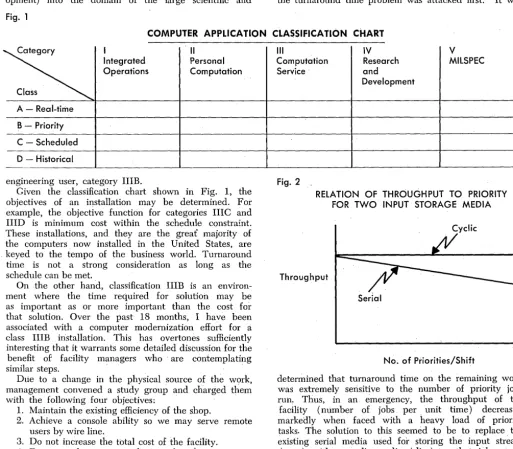
The essence of any measurement scheme is a series of written definitions. Fig. 1 shows a useful matrix for classifying computer operations by the type of environ-ment in which the computer is installed and the response dictated by the application. The five categories are:
I. Integrated Operations. The computer is built into some larger system and must be considered as a com-ponent of this larger system. Thus, it must carefully mesh with its environment.
II. Personal Computation. The user of the computing equipment is present at the time the computer is producing the solution.- The usual case involves the actual operation of the machinery by the person with the problem being solved.
III. Computation Service. The services of a computer are made available to many users, each for a short period of time. Usually the user prepares his run for the machine, submits it for computation, and returns later for the results. The machinery is run by professional operators.
IV. Research and Development. The computer is augmented by some spe~ial computer hardware or" modifi-cations to standard
com~ter
hardware for unique use in some researchactivit~
V. MILSPEC. Special purpose hardware required for the unique needs of the military or specialized versions of commercial equipment produced to meet more exacting requirements are especially packaged to make them amen-able to more adverse environment not usually encountered in the commercial field.
24
opinion
=F
fact
While some of the above' categories overlap, they are useful since a great majority of our computing installa-tions fall into one and only one of these environments. In addition, another complementary set of classifications can be devised for computer applications. These depend upon the time allowed for solution once the solution is requested and the input data is available. The four classes are:
A. Real-time. Whenever the computer is associated with a dynamic, on-going process, and the subsequent control of that process is heavily (or totally) dependent upon the computer's output, the process is said to be real-time. Thus, an answer is required in the instant following the avail-ability of the input data. In the usual case the computer is electrically connected into this system in such a manner that any unplanned delay in the computer solution results in adverse consequences, possibly of catastrophic pro-portions.
B. Priority. Frequently a computer is used in support of a project or test where the computer solution is required before the remainder of the work force can continue. In these cases the computer is not electrically connected to a process, but the input data are prepared by semi-automatic methods and presented for computer processing. If a priority run is significantly delayed, the consequences, while not catastrophic, are accompanied by an unusually high (relative) cost. Thus, it is desirable to complete priority runs as soon as possible in order to minimize the possibility that delays will cause excessive cost.
C. Scheduled. This type of application is characterized by a fixed completion time. A job may be deferred at the discretion of the facility manager as long as the completion schedule is fulfilled. Such allowable delays are usually of
A computer consultant in Northridge, Calif., Mr. Patrick. has been concerned with throughput and its measure-ment at both user and manu-facturer levels, as well as with
research firms and military development contractors. He
was recently acting director
of the newly-formed Defense
Dept. Computer Institutedur-ing its initial months, and ;s editorial adviser to Data-mation.
the magnitude of four to 24 hours.
D. Historical. Runs of the historical type are required for some future reporting purpose and, in general, do not involve critical time constraints. Delays of 12 to 72 hours can usually be tolerated provided the final completion schedule is met.
As with the categories described earlier, the classes of applications may overlap. Furthermore, some computer installations may operate in more than one mode. For instance, they may operate in a real-time environment for a few critical hours out of the day while the remainder of the day is spent processing applications whose completion has been scheduled.
The classification chart in Fig. 1 is useful for framing discussions. SHARE members principally fall into classifi-cation IlIB (user absent, professiomil operator; priority applications) . The commercial portion of the field occupies the majority of classifications IlIC and IlID (scheduled or historical; user absent, professional operator). The prolonged debate about time-sharing consists of the laudatory efforts of my research colleagues to transfer a technique which has been proven in the laboratory (classification IVB, priority, research and devel-opment) into the domain of the large scientific and
Fig. 1
then running through the shop. A 7090 and three 1401's were carrying the load. Two programming systems were in operation. Runs were batched. The mode of operation was tape to tape. A priority system existed which called for top priority jobs to be run as batches of one.
When the accounting records were scrutinized, it was found that 90% of the jobs (by count) ran less than 12 minutes, and 80% ot the jobs (by count) ran less than six minutes. These jobs accounted for approximately two-thirds of the usage, while a few very important long jobs accounted for the other third of the machine time used.
As the study proceeded, it was found that efficiency was easier to talk about than it was to measure. The computer is an interesting device since it is either running or isn't. Idle· time was rather easy to measure, but the efficiency of use when the computer was actually running was much more difficult to contemplate. As the study progressed, management added two more constraints. These were:
5. Minimize the changes to existing programs. 6. Consider only announced existing hardware.
As the study attempted to understand present operations, the turnaround time problem was attacked first. ~ It was
COMPUTER APPLICATION CLASSIFICATION CHART
~
I II Integrated Personal Operations Computation Class [image:27.626.64.578.292.741.2]A - Real-time B - Priority C - Scheduled D - Historical
engineering user, category IIlB.
Given the classification chart shown in Fig. 1, the objectives of an installation may be determined. For example, the objective function for categories IIlC and IlID is minimum cost within the schedule constraint. These installations, and they are the great majority of the computers now installed in the United States, are keyed to the tempo of the business world. Turnaround time is not a strong consideration as long as the schedule can be met.
On the other hand, classification IIIB is an environ-ment where the time required for solution may be as important as or more important than the cost for that solution. Over the past 18 months, I have been associated with a computer modernization effort for
a
class IIIB installation. This has overtones sufficiently interesting that it warrants some detailed discussion for the benefit of facilIty managers who· are contemplatingsimilar steps. .
Due to a change in the physical source of the work, management convened a study group and charged them with the following four objectives:
1. Maintain the existing efficiency of the shop.
2. Achieve a console ability so we may serve remote users by wire line.
3. Do not increase the total cost of the facility.
4. Decrease the turnaround time for· the remaining
work. '
The study crew set out to measure the work load
* Turnaround time has been the subject of many discussions in barrooms and the trade press. A. marketing manager for a major computer manu-facturer recently stated, liThe programmers all talk about turnaround
III IV V
Computation Research MILSPEC Service' and
Development
Fig. 2
RElATION OF THROUGHPUT TO PRIORITY FOR TWO INPUT STORAGE MEDIA
Cyclic
Throughput
Serial
No. of Priorities/Shift
determined that turnaround time on the remaining work was extremely serisitive to the number of priority jobs
run~ Thus, in an emergency, the throughput of the facility (number of jobs. per. unit time) decreased markedly when faced with a heavy load of priority tasks. The solution to this seemed to be to replace the existing serial media used for storing the· input stream ( tape) with· a cyclic media (disc) . so that jobs CQuid be rescheduled af~er they were submitted to the machine without loss of throughput; Fig .. 2 shows the relation
[image:27.626.308.573.315.639.2]MEASURING PERFORMANCE
of throughput to number of priorities per shift for the two types of storage media.
Being bound by a total cost constraint, we had to release existing equipment in order to obtain new devices. As the situation developed, it appeared that replacing the three peripheral processors with one larger machine would reduce the cost and concentrate our processing capacity in one mainframe where we could exploit it more fully. Several configurations were given preliminary inspection: shared discs, private discs, both disc and drum, shared drum, and electronic coupling of the two processors. During these studies, it became painfully apparent that the performance of the configurations being studied was extremely sensitive to the volume of input/ output being handled, the periodicity of this input/ output, and the volume of programming systems required to prepare a job for execution.
the hardware monitor
Just as our need for detailed data became acute, the manufacturer produced a measuring/instrument and offered to assist in its installation on the computer. This device is called a "hardware monitor." It connects to a 7090 so that channel usage, channel overlap, I/O device usage and unadulterated CPU processing time (no I/O in operation) can be tallied. An experiment was designed so that the load on the batch operated shop could be ac-curately described and measured. The hardware monitor was obtained, a crystal controlled millisecond clock was procured, and a computer controlled camera was set up to automatically record the data without stopping the com-puter. Over a four-day period, 500 jobs were run through the instrumented machine and 3,500 film frames were ex-posed. Data was gathered by job phase (compile, as-sembly, loading, and execution). It was then aggregated for the final report.
It was found that 90% of the available time was being profitably used, and that only 10% idle was ac-cumulated over the course of the four day test. It was found that many hours of the day were spent in the presence of a significant backlog so that the shop operated as a computer-limited installation. In this case, processing efficiency determines turnaround time. When the data from this experiment, together with volumes of cards read, lines printed, etc. for the same jobs were made available to the study team, the various competing configurations could be evaluated for both cost and performance. It was found that an average job could be characterized and, based on these fundamental measurements, its execution time could be broken down into the following functions: system I/O, primary input, useful computing, unit record, printing in process, final printing, programmer I/O - buffered, programmer 1/0-unbuffered.
Having actual measures for the above functions for the average job, we could then evaluate configurations by predicting the performance of the average job on the contending configuration. Once this had been achieved, we could divide by rental to obtain a measure of cost effectiveness.
The configuration finally chosen was a 7094 coupled to a 7040. A 1301' disc' supplied the file storage. Ten magnetic tapes supplied historical input and output ability, one card reader carried the input load, and three printers processed the output. Two 1014 remote input stations were provided for operator communication. It was decided that this configuration should be
in-26
stalled and operated successfully before the remote users were served.
The software required was significant. Performance was hard to achieve. In one recently measured case, a job which we thought typical required 122,000 words of system program to be transmitted between the two machines before execution could proceed. It appears that near optimum scheduling of the disc arm and allocation of space is required to .approximate the efficiency of a free-standing batch operated machine.
impr.oving the disc scheduling
At one time, the disc I/O was handled in less than optimum fashion and a collection of nine benchmark jobs ran in 15% longer time than on the batch operated equipment. Since the shop is compute limited, this loss of machine efficiency was directly reflected in longer turnaround time and a higher cost per solution. A rescue effort was immediately launched to improve the disc scheduling and regain the lost performance
increment. .
Since so many installations are now contemplating equipment modernization programs, a few conclusions are in order. Without clearly stated objectives, the modernization effort will be haphazard and opinionated. The clear statement of management's objectives allowed the study to proceed logically. Intellectual arguments were terminated rationally. In the case illustrated above; the contemplated configurations caused major' adjust-ments in the operational flavor of the shop, the distribu-tion of funcdistribu-tions between the two processors, the automation of functions which had heretofore been manual, and the response of the shop to change. Actual measurements of the load, broken dowri into its primary functions, were invaluable in achieving a con-figuration whose cost/performance matched the desired goals.
One measure of efficiency is time/job minus over-head/job both divided by time/job. Overhead is primarily non-productive system time. The frequency of
Fig. 3
Efficiency
3 Phose
Infinite
Botch
EFFICIENCY 's, COMMUTATION RATE
3 Phose
Finite
Botch
Commutation Rate
J,·S,
Arbitrary
Time
Slice
l
, 'I
system access can be expressed as a commutation rate. Investigations to date seem to indicate that we can tentatively class operational modes on an efficiency scale as a function of commutation rate as follows: three-phase with an infinite batch size, three-phase with a reasonable batch size (20 jobs), one-phase, the junior/senior configuration described above, and time-sharing with arbitrary time slices. Fig. 3 shows this empirical plot. The three-phase mode leads the list since the systems are referenced only once and each job proceeds to its final conclusion. The three-phase with reasonable batch size is less efficient (but gives better turnaround). The systems are referenced once per batch. "The one-phase system has many emotional attractions but the
PATRMATIQN