Effects of experience
in
a
developmental model of reading
Ya-Ning Chang ([email protected])
Padraic Monaghan ([email protected])
Department of Psychology, Lancaster University, Lancaster, LA1 4YF, UK
Stephen Welbourne ([email protected])
Neuroscience and Aphasia Research Unit (NARU), University of Manchester, Manchester, M13 9PL, UK
Abstract
There is considerable evidence showing that age of acquisition (AoA) is an important factor influencing lexical processing. Early-learned words tend to be processed more quickly compared to later-learned words. The effect could be due to the gradual reduction in plasticity as more words are learned. Alternatively, it could originate from differences within semantic representations. We implemented the triangle model of reading including orthographic, phonological and semantic processing layers, and trained it according to experience of a language learner to explore the AoA effects in both naming and lexical decision. Regression analyses on the model’s performance showed that AoA was a reliable predictor of naming and lexical decision performance, and the effect size was larger for lexical decision than for naming. The modelling results demonstrate that AoA operates differentially on concrete and abstract words, indicating that both the mapping and the representation accounts of AoA were contributing to the model’s performance.
Keywords: age of acquisition; language development; reading; computational modelling; visual word recognition.
Introduction
Age of acquisition (AoA) effects refer to observations that stimuli learned early in life are processed more quickly and accurately than stimuli learned later in life. These AoA effects have been observed in a variety of language tasks including word naming, lexical decision, picture naming and semantic related tasks (Brysbaert, Van Wijnendaele, De Deyne, 2000; Cortese & Khanna, 2007; Ghyselinck, Lewis, & Brysbaert, 2004; Monaghan & Ellis, 2002). When the magnitude of AoA across tasks was compared in a review by Juhasz (2005), the results showed that the effect size is largest in picture naming (125 ms), followed by lexical decision (56 ms) and naming (31 ms). These findings indicate that AoA is a strong factor influencing lexical processing across several domains.
However, there has been scepticism about AoA effects because AoA is naturally confounded with other lexical semantic variables such as frequency and concreteness (or imageability) (Strain, Patterson, & Seidenberg, 2002; Zevin & Seidenberg, 2004). Nevertheless, when all these variables were considered in predicting large naming and lexical decision datasets, Cortese and Khanna (2007) showed unique AoA effects for both naming and lexical decision, indicating the AoA effects are not spurious findings.
Theories of AoA Effects
Several hypotheses have been proposed to explain the origin of AoA effects (Brysbaert et al., 2000; Ellis &
Lambon Ralph, 2000; Lewis, Gerhand, & Ellis, 2001; Steyvers & Tenenbaum, 2005). One interpretation of the AoA effect is that early learned words have been encountered more times at the age that participants are tested than later learned words. This has been termed the cumulative frequency hypothesis (Lewis, 2001). On this view, cumulative frequency can be considered as a combined index by multiplying frequency and number of years that a stimulus is known to participants (i.e., age -AoA). However, most studies report additive effects of frequency and AoA (Ghyselinck, Lewis, & Brysbaert, 2004), suggesting the effects are distinct. In addition, the findings of the differential effect sizes of frequency and AoA in multi-task comparison studies (Ghyselinck, Lewis, & Brysbaert, 2004; Brysbaert & Ghyselinck, 2006) have been taken as evidence against the cumulative frequency hypothesis, because this theory would predict co-variance of frequency and AoA effects.
Another theory accounting for the AoA effect is the representation mapping theory (Ellis & Lambon Ralph, 2000). According to this computationally motivated account, the AoA effect is due to the gradual reduction in plasticity as more words are learned. Early learned words are privileged to easily adjust weight connections in the system; while later learned words can only cause small weight changes because of the reduced plasticity. Thus, an AoA effect is expected particularly when the mappings between inputs and outputs are arbitrary, because they require greater computational resources to resolve the mapping (Zevin & Seidenberg, 2002). This is also supported by behavioural data reported by Monaghan and Ellis (2002) where the AoA effect was stronger for low consistency words (e.g. break) than for high consistency words (e.g. block) in a word naming task.
addition, the magnitude of AoA effects can be related to the extent of involvement of semantics in the tasks (Ghyselinck, Lewis, & Brysbaert, 2004; Brysbaert & Ghyselinck, 2006).
These arguments have contributed to an emerging view that both the representation and semantic locus theories might contribute to the AoA effects (Catling & Johnston, 2009). For instance, the stronger AoA effects observed for low consistent words in naming might be explained by the semantic locus theory if one considers that semantics is differentially involved in naming according to the regularity of the orthography to phonology mapping (Strain & Seidenberg, 1995). On the other hand, the magnitude of AoA effects in different tasks is also compatible with the arbitrariness of the mappings between different representations, such that more arbitrary mappings elicit greater AoA effects. However, it remains unclear the extent to which AoA effects in a model of reading are required to be explained in terms of semantic locus or mapping effects.
AoA Models of Reading
Several computational models of reading have been developed to explore AoA effects (Ellis & Lambon Ralph, 2000; Monaghan & Ellis, 2010; Zevin & Seidenberg, 2002). Monaghan and Ellis (2010) developed a connectionist model that demonstrated clear AoA effects in naming in addition to cumulative frequency effects. The key for the model to capturing the AoA effects was that it was trained with a cumulative learning process. The model started to learn to read a small set of words, akin to a child beginning to learn to read, and gradually learned to build up an entire adult vocabulary. The process mimics the natural reading development that allows the model to capture the characteristics of AoA. Their findings provided evidence for the representation mapping theory. However, these models did not include semantic representations so they were limited in their ability to test the effect of the role of semantics in the size of AoA effects.
The primary aim of this study was to develop a large-scale developmental model of reading, trained cumulatively to simulate chronological language experience. The model comprised three key processing layers including orthography, phonology and semantics, and it was trained with a cumulative learning process to simulate different stages of reading development. We used the model to explore the AoA effects in both naming and lexical decision. In particular we attempted to examine the competing theories of AoA and investigate how semantic representations might implicate the emergence of AoA effects within the model.
Method
Network Architecture
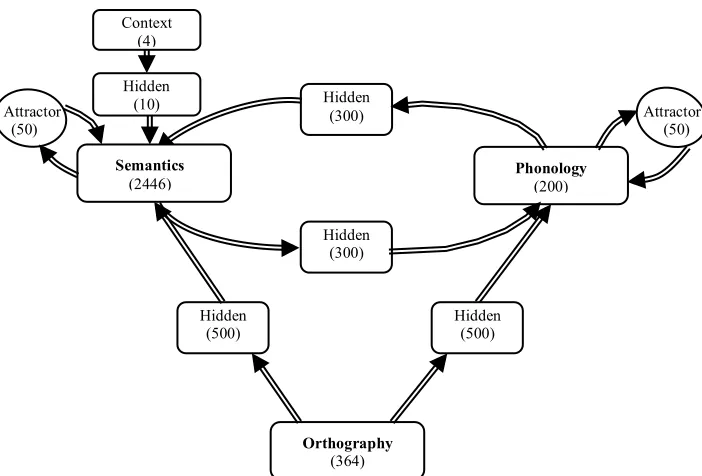
The architecture of the model is shown in Figure 1. The model was based on the triangle model of reading previously implemented by Harm and Seidenberg (2004).
The current model consisted of three processing layers including orthographic, phonological and semantic layers, one context layer, two attractor layers and five hidden layers for intermediation between the layers.
An attractor layer, which contained 50 units, was connected to and from the phonological layers. Similarly, there was a set of 50 attractor units for the semantic layer. The use of attractors was to help the model to reduce noise and develop stable phonological and semantic representations of words. There were also four context units connecting to the semantic layer via a set of ten hidden units. The context units provided additional information when presenting the model with homophones. One context unit was active for each homophone. But for words within the same homophone family, different context units were randomly assigned. In this way, each context unit was almost equally active across the training corpus. For non homophones, none of the context units were active. The semantic layer was connected to the phonological layer via a set of 300 hidden units, and the phonological layer was connected back to the semantic layer via another set of 300 hidden units. The orthographic layer was connected to both the phonological and semantic layers via different sets of 500 hidden units
Representations
The orthographic, phonological and semantic representations were similar to those used in Harm and Seidenberg’s (2004) model. The training corpus contained 6229 monosyllabic words, which covered most monosyllabic words, including their inflected forms, in English. Frequency of each word was derived from the Wall Street Journal corpus (Marcus, Santorini, & Marcinkiewicz, 1993), and the score was log-transformed. For orthography, each word was represented by 14 letter slots and each slot comprised 26 units with one for each 26 alphabetic letters. Words were positioned with their first vowel aligned on the fifth slot. For words having two vowels, the second vowel was placed on the sixth slot; otherwise all the units in that slot were not active. Consonants preceding or following the vowel(s) were positioned in adjacent slots to the vowel(s) (so yes was represented as _ _ _ y e _ s _ _ _ _ _ _ _, and
Figure 1. The architecture of the developmental model of reading.
Training Procedures
The training process had two phases. In pretraining, the model was trained with the mappings between phonology and semantics. This phase of training was an attempt to simulate the fact that children generally have developed some language skills (e.g. speaking and comprehension) before learning to read. In the reading development phase, the full reading model was trained.
In pretraining, the model was trained on both a speaking task (mapping from semantic to phonological representations) and a hearing task (mapping from phonological to semantic representations). The model also learned to develop a stable phonological attractor (mapping from phonological to phonological representations), and a stable semantic attractor (mapping from semantic to semantic representations). For both the speaking and hearing tasks, the input pattern of each word was clamped and presented for eight time steps, and in the last two time steps, the model was required to reproduce the target pattern of the word. Similarly, for both the phonological and semantic attractor training trials, the input pattern of each word was clamped for the first time step and in the last two time steps, the model had to reproduce the target pattern of the word. The input of context units was supplied only for the hearing task. During training, the four tasks were interleaved with 40% of trials for the speaking task, 40% of trails for the hearing task, 10% of trials for the phonological attractor and the remaining 10% for the semantic attractor.
During this stage of training, the model was trained on 2973 monosyllabic words, which were the most common words occurring in reading materials before age 18. Note that though several words in this set were unlikely to occur often in young children’s language exposure, yet due to the training by frequency these words were rare during
pretraining. The probability of a word being selected for training was determined by its logarithmic frequency. The model was trained with a learning rate of 0.05 using back-propagation through time algorithm. Error score was based on the cross-entropy error computed between the target and the actual activation of the output units. No error was recorded if the output unit’s activation was within 0.1 of the target.
In the reading development phase, the model was trained on the reading task, which was to learn the mappings from orthography to both semantics and phonology, along with the four tasks in the pretraining phase. Following Monaghan and Ellis (2010), the model was trained to read cumulatively, to reflect 14 reading stages, one for each year. The reading stage was based on the educator’s word frequency guide (WFG) by Zeno et al. (1995). The words in WFG were graded into 13 different grade levels by using readability measures, corresponding to the age range from 5-18 in the American and British schooling systems and the words appeared in adulthood were presented at the 14th stage. The model started to learn a small set of words and gradually more and more words were learned over time course of learning. The details of the staged training paradigm can be found in Monaghan and Ellis (2010) Table 1. For the reading task, the orthographic representation of a word along with its context layer representation were clamped and presented for 12 time steps, and for time steps six to 12, the model was required to produce the phonological and semantic representations for that word. All the five tasks were interleaved during training, but the training ratio for each task except the attractor tasks varied as the training proceeded. The training ratios for both the hearing task and speaking task gradually decreased from 40% to 20% in steps of 5%, while the training ratio for the reading task gradually increased from 10% to 50% in steps
Hidden (300)
Hidden (500)
Hidden (500)
Phonology (200) Hidden
(300)
Context (4)
Semantics (2446)
Orthography (364) Hidden
(10)
Attractor (50)
of 10% to simulate greater exposure to reading versus listening and speaking with development. All the other training procedures remained the same as in pretraining.
Testing Procedures
After pretraining, the model was tested on both the speaking and hearing tasks. For the speaking task, the semantic representation of each word in the training set was presented and the activation of units at the phonological layer at the end of the eight time steps was recorded. Error score was measured by the sum of the squared differences between the activation of each input unit and its target activation. The accuracy of the model’s phonological production was assessed by deciding whether for each phoneme slot the closest phoneme to the model’s actual production was the same as the target phoneme. For the hearing task, the phonological representation of each word was presented and the activation of units at the semantic layer at the end of the eight time steps was recorded. Error score was measured by the sum of squared differences over the semantic layer. The semantic accuracy was measured by computing the Euclidean distance between the model’s actual semantic representation and the semantic representation of each word in the training corpus. If the smallest distance was for the target representation then the model was correct.
After the reading training, the model’s reading performance was tested. The orthographic representation of each word was presented and the activation of units at both the semantic layer and the phonological layer at the end of the 12 time steps were recorded. The measurement of error score and accuracy for both semantic and phonological output were the same as in the pretraining phase.
Results
Pretraining was halted after 2 million epochs where the model achieved an accuracy rate of 90.7% on the speaking task and an accuracy rate of 91.7% on the hearing task. After 0.8 million epochs of reading training, the model accurately produced 99.4% of phonological representations and 93.3% of semantic representations on the reading task.
Exploring AoA effects in the model
Behavioural naming data and lexical decision data (Cortese & Khanna, 2007) were simulated by mappings from orthographic to phonological representations (Chang, Furber, & Welbourne, 2012; Monaghan & Ellis, 2010), and by mappings from orthographic to semantic representations (akin to polarity measure in Plaut, 1997), respectively. According to the representation mapping theory, we would expect to obtain a larger AoA effect in lexical decision (semantics) than in naming (phonology) whereas the semantic locus theory predicts an AoA effect mainly in lexical decision (semantics), although if considering the role of semantics in naming (Strain et al. 1995), we might obtain a small AoA effect in naming (phonology) as well.
Multiple regression analyses were conducted on the model’s phonological and semantic error scores to examine the AoA effects in the model. The predictor variables included: cumulative frequency (CF), orthographic neighbourhood size (OrthN), word length (Len), consistency (Cons), concreteness (Conc), and age of acquisition (AoA). Orthographic neighbourhood size was based on the number of words that can be made by changing one letter of the target word Coltheart (1977). The score of consistency was based on rime consistency, measuring the number of friends (sharing the same rime and pronunciation) divided by the total number of words sharing the same rime and weighted by their frequency values. The consistency score for each word was directly derived from the training corpus. The concreteness score was taken from Brysbaert, Warriner, and Kuperman (2014). AoA was taken as one of the 14 reading stages during training derived from the WFG.
All items in the training set were tested. Error items and outliers (3 standard deviations farther from the mean) were discarded and this removed about 3.7% of the items. In addition, words without measures for all psycholinguistic variables were removed, leaving 5272 words for analysis. Both the phonological and semantic error scores were log transformed to reduce the skew of performance distribution and all the predictor variables were centered in order to more clearly explore interaction terms.
Multiple Regression Results
Correlation analyses were conducted between the predictors. As expected, CF and AoA had a strong negative correlation, and AoA and Cons were positively correlated, suggesting early learned words tend to be high in frequency and inconsistent. OrthN was negatively correlated with Len, indicating that long words tend to have few neighbours.
To examine the unique contribution made by AoA to the model’s performance, hierarchical regression analyses were conducted. For the word naming task, in step 1 all variables were entered into the regression model except AoA. The results showed CF, OrthN, Cons, and Len all made significant contributions. When AoA was entered into the regression model in step 2, it was a significant predictor (see Table 1). Similar analyses were conducted for the lexical decision task. In step 1, CF, Conc and Len were significant predictors. Again, in step 2, AoA was a significant predictor. These results showed that the AoA effects were found in both naming and lexical decision. Also the standardized beta value (β) was larger for the lexical decision than for the naming task, replicating behavioural studies showing a stronger AoA effect in tasks involving semantics than phonology (Table 1). For all these regression models, collinearity diagnostic analyses showed all variance inflation factors (VIFs) smaller than 4, confirming no serious multicollinearity problem.
(Taraban & McClelland, 1987); AoA x Cons, to determine whether the model could reproduce the consistency by AoA effect (Monaghan & Ellis, 2002), thereby reflecting the mapping theory of AoA; and AoA x Conc, to determine whether AoA might have different effects depending on the semantic richness of the representation, reflecting the semantic locus theory of AoA.
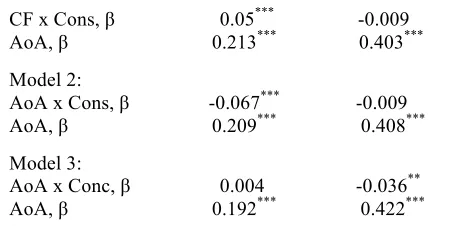
In step 1, all the variables including AoA were entered into the regression model, and in step 2, the interaction terms were entered into the model separately. The results are summarized in Table 2. For the naming task, both CF x Cons and AoA x Cons were significant predictors, reproducing key behavioural effects on word naming. For lexical decision, only AoA x Conc was significant. Thus, consistency effects were less pronounced for lexical decision, consistent with the behavioural data. The AoA x Conc interaction term indicated that the AoA effect is modulated by the richness of the semantic representations, as measured by concreteness of the word.
Table 1. Results from a two-block regression analyses for the exploration of AoA in predicting both naming and lexical decision model performance.
Naming Lexical Decision
Step 1 β β
CF -0.185*** -0.158***
OrthN -0.255** 0.019
Cons -0.247*** -0.015
Len -0.071*** -0.126***
Conc -0.001 -0.076***
R2(%) 21.94 24.14
Step 2
AoA 0.194*** ΔR2 = 0.99%
0.406***
ΔR2 = 4.33%
***p<.001; **p<.01; *p<.05; β is a standardized beta value
Table 2. Results from a two-block regression analyses for the exploration on three interaction terms in predicting both naming and lexical decision model performance.
Naming Lexical Decision
Step 1: Lexical Variables, R2 AoA, β
22.93
0.194*** 0.40628.47 ***
Step 2: Interactions
Model 1:
CF x Cons, β AoA, β
0.05*** 0.213***
-0.009 0.403***
Model 2: AoA x Cons, β AoA, β
-0.067*** 0.209***
-0.009 0.408***
Model 3: AoA x Conc, β AoA, β
0.004 0.192***
-0.036** 0.422***
***p<.001; **p<.01; *p<.05; β is a standardized beta value
General Discussion
This paper aimed to develop a large-scale computational model of reading including orthographic, phonological and semantic representations. Following Monaghan and Ellis (2010), the model was trained with a cumulative learning process. The model was able to produce correct phonological and semantic patterns for hearing, speaking, naming, and lexical decision tasks.
Multiple regression analyses on model performance demonstrated that the model was able to account for a range of standard word naming effects including cumulative frequency, orthographic neighbourhood size, consistency, concreteness and the interaction between cumulative frequency and consistency. More importantly, the results showed that AoA accounted for an additional 0.99% of variance in naming and 4.33% of variance in lexical decision, when other potentially confounding variables such as cumulative frequency and concreteness had been considered. Collectively, the regression results are consistent with the findings of previous regression analyses for behavioural (Cortese & Khanna, 2007) and computational (Monaghan & Ellis, 2010) studies.
So where in the model do the AoA effects derive? According to the representation mapping theory (Ellis & Lambon Ralph, 2000), the AoA effect could be observed when the mappings between input and output are more arbitrary. The significant interaction between AoA and consistency obtained in the regression analyses of naming in the model is consistent with the finding of Monaghan and Ellis (2002). In addition, the regression results also showed that the effect size of AoA (indexed by β) was larger for lexical decision than for naming (Table 1). This can be explained by the representation mapping theory in terms of different degrees of arbitrary mappings required for generating semantic versus phonological representations from orthography.
[image:5.612.317.546.72.185.2] [image:5.612.55.295.348.548.2]mappings between representations, and due to the semantic richness of the representations. So the present results provide evidence for the view that AoA effects arise from different sources according to task requirements.
The role of AoA in the reading system is profound, and effectively implementing these effects requires a computational model that can take into account the life history of the learner. We have shown that an implementation of the triangle model, involving orthographic, phonological, and semantic representations is able to take the chronology of experience and produce consequent effects in a mature reading system, resulting in AoA effects. We have replicated key behavioural data showing different sized effects of AoA depending on the lexical task (word naming or lexical decision), and linked this to the involvement of semantic representations in the task. For tasks primarily involving phonological representations, AoA effects are largely derived from the influence of experience on mapping between representations. For tasks that also involve semantics, the AoA effect is multicomponential. Experience affects mappings between representations but also the richness of the consequent representations. Happily, our model suggests that theorists with different views of the origin of effects of AoA are none of them wrong, but rather correct to varying degrees according to lexical task constraints.
Acknowledgments
This research was supported by ESRC grant RES-000-22-4049.
References
Brysbaert, M., Wijnendaele, I. V., & Deyne, S. D. (2000). Age-of-acquisition effects in semantic processing tasks. Acta Psychologica, 104(2), 215-226.
Brysbaert, M., & Ghyselinck, M. (2006). The effect of age of acquisition: Partly frequency related, partly frequency independent. Visual Cognition, 13(7-8), 992-1011. Brysbaert, M., Warriner, A. B., & Kuperman, V. (2014). Concreteness ratings for 40 thousand generally known English word lemmas. Behav Res Methods, 46(3), 904-911. Catling, J. C., & Johnston, R. A. (2009). The varying effects of age of acquisition. Q J Exp Psychol, 62(1), 50-62. Chang, Y. N., Furber, S., & Welbourne, S. (2012). "Serial" effects in parallel models of reading. Cognitive
Psychology, 64(4), 267-291.
Coltheart, M., Davelaar, E., Jonasson, J. T., & Besner, D. (1977). Access to the internal lexicon. In S. Dornic (Ed.), Attention and Performance VI (pp. 535-555). Hillsdale,
NJ: Lawrence Erlbaum Associates.
Cortese, M. J., & Khanna, M. M. (2007). Age of acquisition predicts naming and lexical-decision performance above and beyond 22 other predictor variables: an analysis of 2,342 words. Q J Exp Psychol, 60(8), 1072-1082.
Ellis, A. W., & Ralph, M. A. L. (2000). Age of acquisition effects in adult lexical processing reflect loss of plasticity in maturing systems: Insights from connectionist
networks. Journal of Experimental Psychology-Learning Memory and Cognition, 26(5), 1103-1123.
Ghyselinck, M., Lewis, M. B., & Brysbaert, M. (2004). Age of acquisition and the cumulative-frequency hypothesis: A review of the literature and a new multi-task investigation.
Acta Psychologica, 115(1), 43-67.
Harm, M. W., & Seidenberg, M. S. (2004). Computing the meanings of words in reading: Cooperative division of labor between visual and phonological processes.
Psychological Review, 111(3), 662-720.
Juhasz, B. J. (2005). Age-of-Acquisition Effects in Word and Picture Identification. Psychological Bulletin, 131(5), 684-712.
Lewis, M. B., Gerhand, S., & Ellis, H. D. (2001). Re-evaluating age-of-acquisition effects: are they simply cumulative-frequency effects? Cognition, 78(2), 189-205. Marcus, M. P., Marcinkiewicz, M. A., & Santorini, B. (1993). Building a large annotated corpus of English: the penn treebank. Comput. Linguist., 19(2), 313-330. Miller, G. A. (1990). WordNet: An on-line lexical database.
International Journal of Lexicography, 3, 235-312. Monaghan, J., & Ellis, A. W. (2002). What exactly interacts
with spelling--sound consistency in word naming? Journal of Experimental Psychology: Learning, Memory, and Cognition, 28(1), 183-206.
Monaghan, P., & Ellis, A. W. (2010). Modeling reading development: Cumulative, incremental learning in a computational model of word naming. Journal of Memory and Language, 63(4), 506-525.
Plaut, D. C. (1997). Structure and function in the lexical system: Insights from distributed models of word reading and lexical decision. Language and Cognitive Processes, 12(5-6), 765-805.
Steyvers, M., & Tenenbaum, J. B. (2005). The Large‐scale structure of semantic networks: Statistical analyses and a model of semantic growth. Cognitive science, 29(1), 41-78.
Strain, E., Patterson, K., & Seidenberg, M. S. (1995). Semantic effects in single-word naming. Journal of Experimental Psychology: Learning, Memory and Cognition, 21(5), 1140-1154.
Strain, E., Patterson, K., & Seidenberg, M. S. (2002). Theories of word naming interact with spelling--sound consistency. Journal of Experimental Psychology: Learning, Memory, and Cognition, 28(1), 207-214. Taraban, R., & McClelland, J. L. (1987). Conspiracy effects in word pronunciation. Journal of Memory and Language,
26(6), 608-631.
Zeno, S. (Ed.). (1995). The educator’ s word frequency guide. Brewster, NJ: Touchstone.
Zevin, J. D., & Seidenberg, M. S. (2002). Age of acquisition effects in word reading and other tasks. Journal of
Memory and Language, 47(1), 1-29.
Zevin, J. D., & Seidenberg, M. S. (2004). Age-of-acquisition effects in reading aloud: Tests of cumulative frequency and frequency trajectory. Memory & Cognition,