Reference-Aware Language Models
Zichao Yang1∗, Phil Blunsom2,3, Chris Dyer1,2, and Wang Ling2 1Carnegie Mellon University,2DeepMind, and3University of Oxford
[email protected], {pblunsom,cdyer,lingwang}@google.com
Abstract
We propose a general class of language models that treat reference as discrete stochastic latent variables. This decision allows for the creation of entity mentions by accessing external databases of refer-ents (required by, e.g., dialogue genera-tion) or past internal state (required to ex-plicitly model coreferentiality). Beyond simple copying, our coreference model can additionally refer to a referent using varied mention forms (e.g., a reference to “Jane” can be realized as “she”), a charac-teristic feature of reference in natural lan-guages. Experiments on three representa-tive applications show our model variants outperform models based on deterministic attention and standard language modeling baselines.
1 Introduction
Referring expressions (REs) in natural language are noun phrases (proper nouns, common nouns, and pronouns) that identify objects, entities, and events in an environment. REs occur frequently and they play a key role in communicating infor-mation efficiently. While REs are common in nat-ural language, most previous work does not model them explicitly, either treating REs as ordinary words in the model or replacing them with special tokens that are filled in with a post processing step (Wen et al., 2015; Luong et al., 2015). Here we propose a language modeling framework that ex-plicitly incorporates reference decisions. In part, this is based on the principle of pointer networks in which copies are made from another source (G¨ulc¸ehre et al., 2016; Gu et al., 2016; Ling et al.,
∗
Work completed at DeepMind.
dialogue recipe
coref
M: the nirala is a nice restuarant 1) soy milk
2) leaves 3) banana
Blend soy milk and …
[I]1 think…Go ahead [Linda]2 … thanks goes to [you]1 …
a) reference to a list
b) reference to a table
c) reference to document context
the nirala moderate lebanese ali baba moderate indian
[image:1.595.312.524.229.360.2]name price food
Figure 1: Reference-aware language models.
2016; Vinyals et al., 2015; Ahn et al., 2016; Mer-ity et al., 2016). However, in the full version of our model, we go beyond simple copying and enable coreferent mentions to have different forms, a key characteristic of natural language reference.
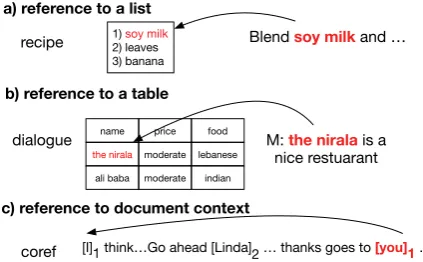
Figure 1 depicts examples of REs in the con-text of the three tasks that we consider in this work. First, many models need to refer to a list of items (Kiddon et al., 2016; Wen et al., 2015). In the task of recipe generation from a list of ingredients (Kiddon et al., 2016), the generation of the recipe will frequently refer to these items. As shown in Figure 1, in the recipe “Blend soy milkand . . . ”,soy milkrefers to the ingredi-ent summaries. Second, reference to a database is crucial in many applications. One example is in task oriented dialogue where access to a database is necessary to answer a user’s query (Young et al., 2013; Li et al., 2016; Vinyals and Le, 2015; Wen et al., 2015; Sordoni et al., 2015; Serban et al., 2016; Bordes and Weston, 2016; Williams and Zweig, 2016; Shang et al., 2015; Wen et al., 2016). Here we consider the domain of restaurant rec-ommendation where a system refers to restau-rants (name) and their attributes (address, phone number etc) in its responses. When the system
says “the niralais a nice restaurant”, it refers to the restaurant name the nirala from the database. Finally, we address references within a document (Mikolov et al., 2010; Ji et al., 2015; Wang and Cho, 2015), as the generation of words will often refer to previously generated words. For instance the same entity will often be referred to throughout a document. In Figure 1, the entity
you refers to I in a previous utterance. In this case, copying is insufficient– although the referent is the same, the form of the mention is different.
In this work we develop a language model that has a specific module for generating REs. A se-ries of decisions (should I generate a RE? If yes, which entity in the context should I refer to? How should the RE be rendered?) augment a traditional recurrent neural network language model and the two components are combined as a mixture model. Selecting an entity in context is similar to famil-iar models of attention (Bahdanau et al., 2014), but rather than being a soft decision that reweights representations of elements in the context, it is treated as a hard decision over contextual elements which are stochastically selected and then copied or, if the task warrants it, transformed (e.g., a pro-noun rather than a proper name is produced as out-put). In cases when the stochastic decision is not available in training, we treat it as a latent vari-able and marginalize it out. For each of the three tasks, we pick one representative application and demonstrate our reference aware model’s efficacy in evaluations against models that do not explicitly include a reference operation.
Our contributions are as follows:
• We propose a general framework to model reference in language. We consider refer-ence to entries in lists, tables, and document context. We instantiate these tasks into three specific applications: recipe generation, dia-logue modeling, and coreference based lan-guage models.
• We develop the first neural model of refer-ence that goes being copying and can model (conditional on context) how to form the mention.
• We perform comprehensive evaluation of our models on the three data sets and verify our proposed models perform better than strong baselines.
2 Reference-aware language models Here we propose a general framework for reference-aware language models.
We denote each document as a series of to-kensx1, . . . , xL, whereLis the number of tokens. Our goal is to maximize p(xi | ci), the proba-bility of each word xi given its previous context
ci = x1, . . . , xi−1. In contrast to traditional
neu-ral language models, we introduce a variable zi at each position, which controls the decision on which sourcexiis generated from. Then the con-ditional probability is given by:
p(xi, zi |ci) =p(xi |zi, ci)p(zi|ci), (1)
wherezi has different meanings in different con-texts. Ifxi is from a reference list or a database, thenziis one dimensional andzi= 1denotesxiis generated as a reference. zi can also model more complex decisions. In coreference based language model,zidenotes a series of sequential decisions, such as whetherxiis an entity, if yes, which entity
xirefers to. Whenziis not observed, we will train our model to maximize the marginal probability overzi, i.e.,p(xi|ci) =Pzip(xi|zi, ci)p(zi|ci). 2.1 Reference to lists
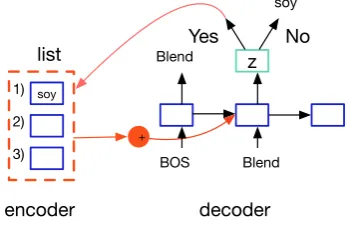
We begin to instantiate the framework by consid-ering reference to a list of items. Referring to a list of items has broad applications, such as gen-erating documents based on summaries etc. Here we specifically consider the application of recipe generation conditioning on the ingredient lists. Ta-ble. 1 illustrates the ingredient list and recipe for
Spinach and Banana Power Smoothie. We can see that the ingredientssoy milk, spinach
leaves, and bananaoccur in the recipe.
soy
decoder
list Yes z No
encoder
Blend soy
BOS Blend 1)
[image:2.595.330.505.586.700.2]2) 3)
Figure 2: Recipe pointer
Let the ingredients of a recipe beX={xi}Ti=1
Ingredients Recipe
1 cup plainsoy milk Blendsoy milkandspinach leaves
together in a blender until smooth. Add
bananaand pulse until thoroughly blended.
3/4 cup packed freshspinach leaves
[image:3.595.84.278.296.400.2]1 largebanana, sliced
Table 1: Ingredients and recipe forSpinach and Banana Power Smoothie.
{xij}Lj=1. The corresponding recipe is y = {yv}Kv=1. We would like to model p(y|X) = Πvp(yv|X, y<v).
We first use a LSTM (Hochreiter and Schmid-huber, 1997) to encode each ingredient: hi,j = LSTME(WExij, hi,j−1) ∀i. Then, we sum the
resulting final state of each ingredient to obtain the starting LSTM state of the decoder. We use an at-tention based decoder:
sv =LSTMD([WEyv−1, dv−1], sv−1), pcopy
v =ATTN({{hi,j}Ti=1}Lj=1, sv),
dv =
X
ij
pv,i,jhi,j,
p(zv|sv) =sigmoid(W[sv, dv]),
pvocabv =softmax(W[sv, dv]),
where ATTN(h, q) is the attention function that returns the probability distribution over the set of vectorsh, conditioned on any input represen-tation q. A full description of this operation is described in (Bahdanau et al., 2014). The deci-sion to copy from the ingredient list or generate a new word from the softmax is performed us-ing a switch, denoted as p(zv|sv). We can ob-tain a probability distribution of copying each of the words in the ingredients by computingpcopyv = ATTN({{hi,j}Ti=1}Lj=1, sv)in the attention mech-anism.
Objective: We can obtain the value ofzvthrough a string match of tokens in recipes with tokens in ingredients. If a token appears in the ingre-dients, we set zv = 1 and zv = 0 otherwise. We can train the model in a fully supervised fash-ion, i.e., we can obtain the probability of yv as
p(yv, zv|sv) = pcopyv (yv)p(1|sv) if zv = 1 and
pvocab
v (yv)(1−p(1|si,v))otherwise.
However, it may be not be accurate. In many cases, the tokens that appear in the ingredients do not specifically refer to ingredients tokens. For ex-amples, the recipe may start with “Prepare a cup of water”. The token “cup” does not refer to the “cup” in the ingredient list “1 cup plain soy milk”.
To solve this problem, we treatzi as a latent vari-able, we wish to maximize the marginal probabil-ity ofyvover all possible values ofzv. In this way, the model can automatically learn when to refer to tokens in the ingredients. Thus, the probability of generating tokenyv is defined as:
p(yv|sv) =pvocabv (yv)p(0|sv) +pcopyv (yv)p(1|sv)
=pvocab
v (yv)(1−p(1|sv)) +pcopyv (yv)p(1|sv). If no string match is found foryv, we simply set
pcopyv (yv) = 0in the above objective.
2.2 Reference to databases
We then consider the more complicated task of ref-erence to database entries. Referring to databases is quite common in question answering and di-alogue systems, in which databases are external knowledge and they are resorted to reply users’ query. In our paper, we consider the application of task-oriented dialogue systems in the domain of restaurant recommendations. Different from lists that are one dimensional, databases are two-dimensional and referring to table entries requires sophisticated model design.
To better understand the model, we first make a brief introduction of the data set. We use dia-logues from the second Dialogue State Tracking Challenge (DSTC2) (Henderson et al., 2014). Ta-ble. 3 is one example dialogue from this dataset.
ali baba moderate lebanese centre 59 Hills Road City Centre CB 2, 1 NT 01462 432565 the nirala moderate indian north 7 Milton Road Chesterton CB 4, 1 UY 01223 360966
Table 2: Fragment of database for dialogue system.
M: Hello, welcome to the Cambridge restaurant system? You can ask for restaurants byarea, price range
orfood type. How may I help you?
U: i want a moderately priced
restaurant in thenorthtown
M: the nirala is a nice restaurant in
the north of town in the moderate price range
U: what is theaddress
[image:4.595.73.295.357.421.2]M: Sure ,the niralais on7 Milton Road Chesterton
Table 3: Example dialogue, M stands for Machine and U stands for User
M U M U
sentence encoder turn encoder decoder
attn
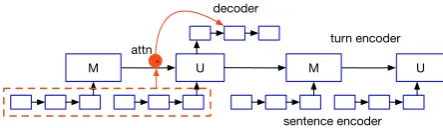
Figure 3: Hierarchical RNN Seq2Seq model. The red box denotes attention mechanism over the ut-terances in the previous turn.
column contains “indian”. Now, we describe how we deploy a model that fulfills these requirements. We first introduce the basic dialogue framework in which we incorporates the table reference module.
Basic Dialogue Framework: We build a basic dialogue model based on the hierarchical RNN model described in (Serban et al., 2016), as in di-alogues, the generation of the response is not only dependent on the previous sentence, but on all sen-tences leading to the response. We assume that a dialogue is alternated between a machine and a user. An illustration of the model is shown in Fig-ure 3.
Consider a dialogue with T turns, the utter-ances from a user and a machines are denoted asX = {xi}Ti=1 and Y = {yi}Ti=1 respectively,
where i is the i-th utterance. We define xi =
{xij}|xj=1i|,yi ={yiv}|yv=1i|, wherexij (yiv) denotes the j-th (v-th) token in the i-th utterance from the user (the machines). The dialogue sequence
starts with a machine utterance and is given by
{y1, x1, y2, x2, . . . , yT, xT}. We would like to model the utterances from the machine
p(y1, y2, . . . , yT|x1, x2, . . . , xT) =
Y
i
p(yi|y<i, x<i) =
Y
i,v
p(yi,v|yi,<v, y<i, x<i).
We encode y<i andx<i into continuous space in a hierarchical way with LSTM: Sentence En-coder: For a given utterancexi, We encode it as
hx
i,j = LSTME(WExi,j, hxi,j−1). The
representa-tion ofxi is given by thehxi = hxi,|xi|. The same
process is applied to obtain the machine utterance representationhyi = hyi,|yi|. Turn Encoder: We further encode the sequence {hy1, hx
1, ..., hyi, hxi} with another LSTM encoder. We shall refer the last hidden state asui, which can be seen as the hierarchical encoding of the previousiutterances.
Decoder: We use ui−1 as the initial state of
de-coder LSTM and decode each token inyi. We can express the decoder as:
syi,v =LSTMD(WEyi,v−1, si,v−1), pyi,v =softmax(W syi,v).
We can also incoroprate the attetionn mecha-nism in the decoder. As shown in Figure. 3, we use the attention mechanism over the utterance in the previous turn. Due to space limit, we don’t present the attention based decoder mathmatically and readers can refer to (Bahdanau et al., 2014) for details.
2.2.1 Incorporating Table Reference
We now extend the decoder in order to allow the model to condition the generation on a database.
Pointer Switch: We use zi,v ∈ {0,1}to denote the decision of whether to copy one cell from the table. We compute this probability as follows:
p(zi,v|si,v) =sigmoid(W si,v).
attributes
table z
Yes No
U
decoder Table Pointer
Step 1: attribute attn
Step 3: row attn
Step 5: column attn
pa pa pcopy
pcopy ppvocabvocab
pc pc
[image:5.595.364.470.126.252.2]pr pr
Figure 4: Decoder with table pointer.
We denote a table withRrows andC columns as{tr,c}, r ∈ [1, R], c ∈ [1, C], wheretr,c is the cell in rowr and columnc. The attribute of each column is denoted as sc, where c is the c-th at-tribute. tr,c andscare one-hot vector.
Table Encoding: To encode the table, we first build an attribute vector and then an encoding vec-tor for each cell. The attribute vecvec-tor is simply an embedding lookup gc = WEsc. For the encod-ing of each cell, we first concatenate embeddencod-ing lookup of the cell with the corresponding attribute vectorgcand then feed it through a one-layer MLP as follows: thener,c = tanh(W[WEtr,c, gc]).
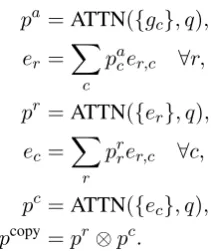
Table Pointer: The detailed process of calculating the probability distribution over the table is shown in Figure 4. The attention over cells in the table is conditioned on a given vectorq, similarly to the attention model for sequences. However, rather than a sequence of vectors, we now operate over a table.
Step 1: Attention over the attributes to find out the attributes that a user asks about, pa = ATTN({gc}, q). Suppose a user sayscheap, then we should focus on thepriceattribute.
Step 2: Conditional row representation calcula-tion,er=Pcpacer,c ∀r. So thater contains the price information of the restaurant in rowr.
Step 3: Attention over er to find out the restaurants that satisfy users’ query, pr = ATTN({er}, q). Restaurants with cheap price will be picked.
Step 4: Using the probabilities pr, we compute the weighted average over the all rows ec =
P
rprrer,c. {er} contains the information of
cheaprestaurant.
Step 5: Attention over columns{er}to compute the probabilities of copying each column pc = ATTN({ec}, q).
Step 6: To get the probability matrix of copying each cell, we simply compute the outer product
pcopy =pr⊗pc.
The overall process is as follows:
pa=ATTN({gc}, q),
er =
X
c
pa
cer,c ∀r,
pr =ATTN({er}, q),
ec=
X
r
pr
rer,c ∀c,
pc=ATTN({ec}, q),
pcopy =pr⊗pc.
Ifzi,v = 1, we embed the above attention pro-cess in the decoder by replacing the conditioned stateqwith the current decoder statesyi,v.
Objective: As in previous task, we can train the model in a fully supervised fashion, or we can treat the decision as a latent variable. We can get
p(yi,v|si,v)in a similar way.
2.3 Reference to document context
Finally, we address the references that happen in a document itself and build a language model that uses coreference links to point to previous enti-ties. Before generating a word, we first make the decision on whether it is an entity mention. If so, we decide which entity this mention belongs to, then we generate the word based on that en-tity. Denote the document asX = {xi}Li=1, and
the entities areE = {ei}Ni=1, each entity hasMi mentions, ei = {mij}jM=1i , such that {xmij}Mj=1i
refer to the same entity. We use a LSTM to model the document, the hidden state of each to-ken is hi = LSTM(WExi, hi−1). We use a set he = {he
0, he1, ..., heM}to keep track of the entity states, wherehe
j is the state of entityj.
Word generation: At each time step before gen-erating the next word, we predict whether the word is an entity mention:
pcoref(v
i|hi−1, he) =ATTN(he, hi−1), di =
X
vi
p(vi)hevi,
p(zi|hi−1) =sigmoid(W[hi−1, di]),
1 2
[you]1and to [the media]3to help [us]4...So [our]4hat is off to all of [you]5...
[I]1 um
entity state update process
I
[Linda]2
I Linda
[You]1
You Linda
update state push state
empty state
0 0
1
0 1 2
0 1 2
push state attn
… …
attn
and [I]1
of [You]1 new
[image:6.595.159.437.95.187.2]entity entity1
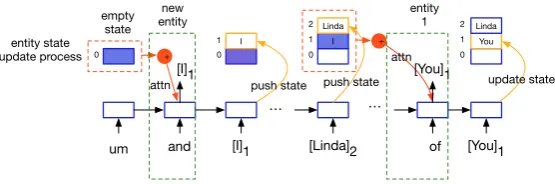
Figure 5: Coreference based language model, example taken from Wiseman et al. (2016).
softmax(W1tanh(W2[hi−1, hevi])) else p(xi|hi−1) =softmax(W1hi−1). Hence,
p(xi|x<i) =
p(xi|hi−1)p(zi|hi−1, he) if zi = 0.
p(xi|vi, hi−1, he)×
pcoref(vi|hi−1, he)p(zi|hi−1, he) if zi = 1.
Entity state update: Since there are multiple mentions for each entity and the mentions appear dynamically, we need to keep track of the entity state in order to use coreference information in en-tity mention prediction. We update the enen-tity state
heat each time step. In the beginning,he={he
0}, he
0 denotes the state of an virtual empty entity and
is a learnable variable. If zi = 1 and vi = 0, then it indicates the next word is a new entity men-tion, then in the next step, we appendhitohe, i.e.,
he = {he, h
i}, if zi = 1 and vi > 0, then we update the corresponding entity state with the new hidden state,he[vi] = hi. Another way to update the entity state is to use one LSTM to encode the mention states and get the new entity state. Here we use the latest entity mention state as the new entity state for simplicity. The detailed update pro-cess is shown in Figure 5.
Note that the stochastic decisions in this task are more complicated than previous two tasks. We need to make two sequential decisions: whether the next word is an entity mention, and if yes, which entity the mention corefers to. It is in-tractable to marginalize these decisions, so we train this model in a supervised fashion (refer to data preparation part on how we get coreference annotations).
3 Experiments
3.1 Data sets and preprocessing
Recipes: We crawled all recipes from www.
allrecipes.com. There are about 31,000
recipes in total, and every recipe has an ingredi-ent list and a corresponding recipe. We exclude the recipes that have less than 10 tokens or more than 500 tokens, those recipes take about 0.1% of all data set. On average each recipe has 118 to-kens and 9 ingredients. We random shuffle the whole data set and take 80% as training and 10% for validation and test. We use a vocabulary size of 10,000 in the model.
Dialogue: We use the DSTC2 data set. We only use the dialogue transcripts from the data set. There are about 3,200 dialogues in total. The ta-ble is not availata-ble from DSTC2. To reconstruct the table, we crawled TripAdvisor for restaurants in the Cambridge area, where the dialog dataset was collected. Then, we remove restaurants that do not appear in the data set and create a database with 109 restaurants and their attributes (e.g. food type). Since this is a small data set, we use 5-fold cross validation and report the average re-sult over the 5 partitions. There may be multi-ple tokens in each table cell, for exammulti-ple in Ta-ble. 2, the name, address, post code and phone number have multiple tokens, we replace them with one special token. For the name, address, post code and phone number of thej-th row, we replace the tokens in each cell with NAME j, ADDR j, POSTCODEj, PHONEj. If a table cell is empty, we replace it with an empty token EMPTY. We do a string match in the transcript and replace the corresponding tokens in transcripts from the table with the special tokens. Each dia-logue on average has 8 turns (16 sentences). We use a vocabulary size of 900, including about 400 table tokens and 500 words.
the documents to get coreference annotations and use the annotations, i.e.,zi, vi, in training. We take 80% as training and 10% as validation and test re-spectively. We ignore the entities that have only one mention and for the mentions that have multi-ple tokens, we take the token that is most frequent in the all the mentions for this entity. After prepro-cessing, tokens that are entity mentions take about 10% of all tokens. We use a vocabulary size of 50,000 in the model.
3.2 Baselines, model training and evaluation
We compare our model with baselines that do not model reference explicitly. For recipe generation and dialogue modeling, we compare our model with basic seq2seq and attention model. We also apply attention mechanism over the table for di-alogue modeling as a baseline. For coreference based language model, we compare our model with simple RNN language model.
We train all models with simple stochastic gra-dient descent with gragra-dient clipping. We use a one-layer LSTM for all RNN components. Hyper-parameters are selected using grid search based on the validation set.
Evaluation of our model is challenging since it involves three rather different applications. We fo-cus on evaluating the accuracy of predicting the reference tokens, which is the goal of our model. Specifically, we report the perplexity of all words, words that can be generated from reference and non-reference words. The perplexity is calcu-lated by multiplying the probability of decision at each step all together. Note that for non-reference words, they also appear in the vocabulary. So it is a fair comparison to models that do not model refer-ence explicitly. For the recipe task, we also gener-ate the recipes using beam size of 10 and evalugener-ate the generated recipes with BLEU. We didn’t use BLEU for dialogue generation since the database entries take only a very small part of all tokens in utterances.
3.3 Results and analysis
The results for recipe generation, dialogue and coref based language model are shown in Table 4, 5, and 6 respectively. The recipe results in Ta-ble 4 verifies that modeling reference explicitly improves performance. Latent and Pointer per-form better than Seq2Seq and Attn model. The La-tent model performs better than the Pointer model since tokens in ingredients that match with recipes
do not necessarily come from the ingredients. Im-posing a supervised signal gives wrong informa-tion to the model and hence makes the result worse. With latent decision, the model learns to when to copy and when to generate it from the vo-cabulary.
The findings for dialogue basically follow that of recipe generation, as shown in Table 5. Con-ditioning table performs better in predicting table tokens in general. Table Pointer has the lowest perplexity for tokens in the table. Since the table tokens appear rarely in the dialogue transcripts, the overall perplexity does not differ much and the non-table token perplexity are similar. With atten-tion mechanism over the table, the perplexity of table token improves over basic Seq2Seq model, but still not as good as directly pointing to cells in the table, which shows the advantage of mod-eling reference explicitly. As expected, using sen-tence attention improves significantly over mod-els without sentence attention. Surprisingly, Table Latent performs much worse than Table Pointer. We also measure the perplexity of table tokens that appear only in test set. For models other than Ta-ble Pointer, because the tokens never appear in the training set, the perplexity is quite high, while Ta-ble Pointer can predict these tokens much more accurately. This verifies our conjecture that our model can learn reasoning over databases.
The coref based LM results are shown in Ta-ble 6. We find that coref based LM performs much better on the entity perplexity, but is a little bit worse for non-entity words. We found it was an optimization problem and the model was stuck in a local optimum. So we initialize the Pointer model with the weights learned from LM, the Pointer model performs better than LM both for entity per-plexity and non-entity words perper-plexity.
In Appendix A, we also visualize the heat map of table reference and list items reference. The visualization shows that our model can correctly predict when to refer to which entries according to context.
4 Related Work
Model PPL BLEU PPL BLEU
All Ing Word All Ing Word
Seq2Seq 5.60 11.26 5.00 14.07 5.52 11.26 4.91 14.39 Attn 5.25 6.86 5.03 14.84 5.19 6.92 4.95 15.15 Pointer 5.15 5.86 5.04 15.06 5.11 6.04 4.98 15.29 Latent 5.02 5.10 5.01 14.87 4.97 5.19 4.94 15.41
Table 4: Recipe results, evaluated in perplexity and BLEU score. All means all tokens, Ing denotes tokens from recipes that appear in ingredients. Word means non-table tokens. Pointer and Latent differs in that for Pointer, we provide supervised signal on when to generate a reference token, while in Latent it is a latent decision.
Model All Table Table OOV Word
Seq2Seq 1.35±0.01 4.98±0.38 1.99E7±7.75E6 1.23±0.01 Table Attn 1.37±0.01 5.09±0.64 7.91E7±1.39E8 1.24±0.01 Table Pointer 1.33±0.01 3.99±0.36 1360±2600 1.23±0.01
Table Latent 1.36±0.01 4.99±0.20 3.78E7±6.08E7 1.24±0.01 +Sentence Attn
Seq2Seq 1.28±0.01 3.31±0.21 2.83E9±4.69E9 1.19±0.01
Table Attn 1.28±0.01 3.17±0.21 1.67E7±9.5E6 1.20±0.01 Table Pointer 1.27±0.01 2.99±0.19 82.86±110 1.20±0.01 Table Latent 1.28±0.01 3.26±0.25 1.27E7±1.41E7 1.20±0.01
Table 5: Dialogue perplexity results. Table means tokens from table, Table OOV denotes table tokens that do not appear in the training set.Sentence Attndenotes we use attention mechanism over tokens in utterances from the previous turn.
Model All Entityval Word All Entitytest Word LM 33.08 44.52 32.04 33.08 43.86 32.10 Pointer 32.57 32.07 32.62 32.62 32.07 32.69 Pointer
+ init 30.43 28.56 30.63 30.42 28.56 30.66 Table 6: Coreference based LM. Pointer + init means we initialize the model with the LM weights.
where the generation of each word can be condi-tioned on a particular entry in knowledge lists and previous words. In our work, we describe a model with broader applications, allowing us to condi-tion, on databases, lists and dynamic lists.
In terms of applications, our work is related to chit-chat dialogue (Li et al., 2016; Vinyals and Le, 2015; Sordoni et al., 2015; Serban et al., 2016; Shang et al., 2015) and task oriented dia-logue (Wen et al., 2015; Bordes and Weston, 2016; Williams and Zweig, 2016; Wen et al., 2016). Most of previous works on task oriented dialogues embed the seq2seq model in traditional dialogue systems, in which the table query part is not dif-ferentiable, while our model queries the database directly. Recipe generation was proposed in (Kid-don et al., 2016). They use attention mechanism over the checklists, whereas our work models
ex-plicit references to them. Context dependent lan-guage models (Mikolov et al., 2010; Jozefowicz et al., 2016; Mikolov et al., 2010; Ji et al., 2015; Wang and Cho, 2015) are proposed to capture long term dependency of text. There are also lots of works on coreference resolution (Haghighi and Klein, 2010; Wiseman et al., 2016). We are the first to combine coreference with language model-ing, to the best of our knowledge.
5 Conclusion
References
Sungjin Ahn, Heeyoul Choi, Tanel P¨arnamaa, and Yoshua Bengio. 2016. A neural knowledge lan-guage model.CoRR, abs/1608.00318.
Dzmitry Bahdanau, Kyunghyun Cho, and Yoshua Bengio. 2014. Neural machine translation by jointly learning to align and translate. CoRR, abs/1409.0473.
Antoine Bordes and Jason Weston. 2016. Learn-ing end-to-end goal-oriented dialog. arXiv preprint arXiv:1605.07683.
Jiatao Gu, Zhengdong Lu, Hang Li, and Victor O. K. Li. 2016. Incorporating copying mech-anism in sequence-to-sequence learning. CoRR, abs/1603.06393.
C¸aglar G¨ulc¸ehre, Sungjin Ahn, Ramesh Nallapati, Bowen Zhou, and Yoshua Bengio. 2016. Pointing the unknown words. CoRR, abs/1603.08148. Aria Haghighi and Dan Klein. 2010. Coreference
res-olution in a modular, entity-centered model. In
Human Language Technologies: The 2010 Annual Conference of the North American Chapter of the Association for Computational Linguistics, pages 385–393. Association for Computational Linguis-tics.
Matthew Henderson, Blaise Thomson, and Jason Williams. 2014. Dialog state tracking challenge 2 & 3.
Sepp Hochreiter and J¨urgen Schmidhuber. 1997. Long short-term memory. Neural computation, 9(8):1735–1780.
Yangfeng Ji, Trevor Cohn, Lingpeng Kong, Chris Dyer, and Jacob Eisenstein. 2015. Document context lan-guage models. arXiv preprint arXiv:1511.03962. Rafal Jozefowicz, Oriol Vinyals, Mike Schuster, Noam
Shazeer, and Yonghui Wu. 2016. Exploring
the limits of language modeling. arXiv preprint arXiv:1602.02410.
Chlo´e Kiddon, Luke Zettlemoyer, and Yejin Choi. 2016. Globally coherent text generation with neu-ral checklist models. InProc. EMNLP.
Jiwei Li, Will Monroe, Alan Ritter, Michel Galley, Jianfeng Gao, and Dan Jurafsky. 2016. Deep rein-forcement learning for dialogue generation. InProc. EMNLP.
Wang Ling, Edward Grefenstette, Karl Moritz Her-mann, Tom´aˇs Koˇcisk´y, Andrew Senior, Fumin Wang, and Phil Blunsom. 2016. Latent predictor networks for code generation. InProc. ACL. Thang Luong, Ilya Sutskever, Quoc V. Le, Oriol
Vinyals, and Wojciech Zaremba. 2015. Addressing the rare word problem in neural machine translation. In Proceedings of the 53rd Annual Meeting of the
Association for Computational Linguistics and the 7th International Joint Conference on Natural Lan-guage Processing of the Asian Federation of Natural Language Processing, ACL 2015, July 26-31, 2015, Beijing, China, Volume 1: Long Papers, pages 11– 19.
Stephen Merity, Caiming Xiong, James Bradbury, and Richard Socher. 2016. Pointer sentinel mixture models. arXiv preprint arXiv:1609.07843.
Tomas Mikolov, Martin Karafi´at, Lukas Burget, Jan Cernock`y, and Sanjeev Khudanpur. 2010. Recur-rent neural network based language model. In Inter-speech, volume 2, page 3.
Iulian V Serban, Alessandro Sordoni, Yoshua Bengio, Aaron Courville, and Joelle Pineau. 2016. Building end-to-end dialogue systems using generative hier-archical neural network models. InProceedings of the 30th AAAI Conference on Artificial Intelligence (AAAI-16).
Lifeng Shang, Zhengdong Lu, and Hang Li. 2015. Neural responding machine for short-text conversa-tion. arXiv preprint arXiv:1503.02364.
Alessandro Sordoni, Michel Galley, Michael Auli, Chris Brockett, Yangfeng Ji, Meg Mitchell, Jian-Yun Nie, Jianfeng Gao, and Bill Dolan. 2015. A neural network approach to context-sensitive generation of conversational responses. InProc. NAACL.
Oriol Vinyals, Meire Fortunato, and Navdeep Jaitly. 2015. Pointer networks. InProc. NIPS.
Oriol Vinyals and Quoc V. Le. 2015. A neural con-versational model. In Proc. ICML Deep Learning Workshop.
Tian Wang and Kyunghyun Cho. 2015.
Larger-context language modelling. arXiv preprint arXiv:1511.03729.
Tsung-Hsien Wen, Milica Gasic, Nikola Mrksic, Lina M Rojas-Barahona, Pei-Hao Su, Stefan Ultes, David Vandyke, and Steve Young. 2016. A network-based end-to-end trainable task-oriented dialogue system. arXiv preprint arXiv:1604.04562.
Tsung-Hsien Wen, Milica Gasic, Nikola Mrksic, Pei-hao Su, David Vandyke, and Steve J. Young. 2015. Semantically conditioned LSTM-based natural lan-guage generation for spoken dialogue systems. In
Proc. EMNLP.
Jason D Williams and Geoffrey Zweig. 2016. End-to-end lstm-based dialog control optimized with su-pervised and reinforcement learning. arXiv preprint arXiv:1606.01269.