Depression and Self-Harm Risk Assessment in Online Forums
Andrew Yates†∗ Arman Cohan‡∗ Nazli Goharian‡†Max Planck Institute for Informatics,
Saarland Informatics Campus Saarbruecken, Germany ‡Information Retrieval Lab, Department of Computer Science,
Georgetown University, Washington DC, USA [email protected]
{arman,nazli}@ir.cs.georgetown.edu
Abstract
Users suffering from mental health con-ditions often turn to online resources for support, including specialized online sup-port communities or general communities such as Twitter and Reddit. In this work, we present a framework for supporting and studying users in both types of communi-ties. We propose methods for identifying posts in support communities that may in-dicate a risk of self-harm, and demonstrate that our approach outperforms strong pre-viously proposed methods for identifying such posts. Self-harm is closely related to depression, which makes identifying de-pressed users on general forums a cru-cial related task. We introduce a large-scale general forum dataset consisting of users with self-reported depression diag-noses matched with control users. We show how our method can be applied to effectively identify depressed users from their use of language alone. We demon-strate that our method outperforms strong baselines on this general forum dataset.
1 Introduction
Mental health remains a major challenge in pub-lic health care. Depression is one of the most common mental disorders and 350 million peo-ple are estimated to suffer from depression world-wide (WHO,2010). In 2014 an estimated 7% of all U.S. adults had experienced at least one ma-jor depressive disorder (2015). Suicide and self-harm are major related concerns in public men-tal health. Suicide is one of the leading causes of death (CDC,2015), and each suicide case has major consequences on the physical and emotional
∗The first two authors contributed equally to this work.
well-being of families and on societies in general. Therefore identifying individuals at risk of self-harm and providing support to prevent it remains an important problem (Ferrari et al.,2014).
Social media is often used by people with men-tal health problems to express their menmen-tal is-sues and seek support. This makes social media a significant resource for studying language re-lated to depression, suicide, and self-harm, as well as understanding the authors’ reasons for mak-ing such posts, and identifymak-ing individuals at risk of harm (Coppersmith et al.,2014a). Depression and suicide are closely related given that depres-sion is the psychiatric diagnosis most commonly associated with suicide. Research has demon-strated that forums are powerful platforms for self-disclosure and social support seeking around men-tal health concerns (De Choudhury and De,2014;
Manikonda and De Choudhury,2017). Such sup-port forums are often staffed by moderators who are mental health experts, trained volunteers, or more experienced users whose role is to identify forum posts suggesting that a user is at risk of self-harm and to provide support.
Studies have shown that self expression and so-cial support are benefiso-cial in improving the indi-vidual’s state of the mind (Turner et al., 1983;
Choudhury and Kiciman, 2017) and thus such communities and interventions are important in suicide prevention. However, there are often thou-sands of user posts published in such support fo-rums daily, making it difficult to manually iden-tify individuals at risk of self-harm. Addition-ally, users in acute distress need prompt attention, and any delay in responding to these users could have adverse consequences. Therefore, identify-ing individuals at risk of self-harm in such sup-port forums is an imsup-portant challenge. Identifying signs of depression in general social media, on the other hand, is also a difficult task that has
cations for both better understanding the relation-ship between mental health and language use and for monitoring a specific user’s state (e.g., in the context of monitoring a user’s response to clini-cal care). In this work we propose and evaluate a framework for performing self-harm risk assess-ment and for identifying depression in online fo-rums.
We present a general neural network architec-ture for combining posts into a representation of a user’s activity that is used to classify the user. To address the challenge of depression risk as-sessment over the general forums, we introduce a large-scale novel Reddit dataset that is sub-stantially larger than the existing data and has a much more realistic number of control users. The dataset contains over 9,000 users with self-reported depression diagnoses matched with over 107,000 control users. We apply our approach to
(1) identify the users with depression on a gen-eral forum like Reddit, and to (2) estimate the risk of self-harm indicated by posts in a more spe-cific mental-health support forum. Our methods perform significantly better on both datasets than strong existing methods, demonstrating that our approach can be used both to identify depressed users and to estimate the risk of self-harm posed by individual posts.
2 Related Work
There is a growing body of related work analyz-ing mental health-related discourse and language usage in social media to better discover and un-derstand mental health related concerns (Resnik et al., 2013;De Choudhury et al.,2013; Copper-smith et al.,2014b,a;Mitchell et al.,2015; Tsug-awa et al., 2015; Coppersmith et al., 2015a; Al-thoff et al., 2016; Mowery et al., 2016; Benton et al., 2017b). To investigate NLP methods for identifying depression and PTSD users on Twit-ter, a shared task (Coppersmith et al., 2015b) at the 2nd Computational Linguistics and Clinical Psychology Workshop (CLPsych 2015) was intro-duced where the participants evaluated their meth-ods on a dataset of about 1800 Twitter users. Other work has used data from approximately 900 Red-dit.com users to support self-reported diagnosis detection (Losada and Crestani, 2016). Previ-ous work identifying depression and other men-tal health problems, including the methods par-ticipating in CLPsych 2015 (e.g. (Resnik et al.,
2015; Preot¸iuc-Pietro et al., 2015)) heavily rely on utilizing features such as LIWC (Pennebaker et al.,2015), topic modeling, manual lexicons, or other domain-dependent application-specific fea-tures. Aside from the effort required to design ef-fective features, these approaches usually model the problem with respect to the selected features and ignore other indicators and signals that can improve prediction. In contrast, our model only relies on text and is not dependent on any ex-ternal or domain-specific features. Previous self-reported diagnosis detection datasets contained a limited number of both control users and diag-nosed users. In contrast to this, we construct a new dataset with over 9,000 depressed users matched with a realistic number of control users.
In addition to general studies addressing men-tal health, related work has also specifically stud-ied suicide and self-harm through social me-dia (Jashinsky et al., 2014; Thompson et al.,
2014; Gunn and Lester, 2015; De Choudhury et al., 2016; Coppersmith et al., 2016). Re-cently, CLPsych 2016 (Hollingshead and Ungar,
2016) investigated approaches for detecting the self-harm risk of mental health forum posts (Milne et al.,2016). Most related work in this area uses variations of linear classifiers with some sort of feature engineering; successful methods have em-ployed: a combination of sparse (bag-of-words) and dense (doc2vec) representation of the target forum posts (Kim et al.,2016), a stack of feature-rich Random Forest and linear Support Vector Ma-chine (SVM) (Malmasi et al.,2016), an RBF SVM classifier utilizing similar sets of features (Brew,
2016), and various contextual and psycholinguis-tic features (Cohan et al., 2016, 2017). In con-trast to the above works, our model does not use any general or domain specific feature engineer-ing; it learns appropriate representations of docu-ments by considering only their textual content.
de-termine whether considering the ordinal nature of self-harm risk labels (i.e., green, amber, red, and crisis) can improve performance. Evaluation re-sults suggest that the model variant using this loss function is more robust than our other variants.
3 Data
3.1 Depression dataset construction.
We created a new dataset to support the task of identifying forum users with self-reported depres-sion diagnoses. The Reddit Self-reported Depres-sion Diagnosis (RSDD) dataset was created by annotating users from a publicly-available Red-dit dataset1. Users to annotate were selected by
identifying all users who made a post between January 2006 and October 2016 matching a high-precision diagnosis pattern.2 Users with fewer
than 100 posts made before their diagnosis post were discarded. Each of the remaining diagno-sis posts was then viewed by three layperson an-notators to decide whether the user was claim-ing to have been diagnosed with depression; the most common false positives included hypotheti-cals (e.g., “if I was diagnosed with depression”), negations (e.g., “it’s not like I’ve been diagnosed with depression”), and quotes (e.g., “my brother announced ‘I was just diagnosed with depres-sion’ ”). Only users with at least two positive an-notations were included in the final group of diag-nosed users.
A pool of potential control users was identified by selecting only those users who had (1) never posted in a subreddit related to mental health, and
(2)never used a term related to depression or men-tal health. These restrictions minimize the like-lihood that users with depression are included in the control group. In order to prevent the diag-nosed users from being easily identified by the us-age of specific keywords that are never used by the control users, we removed all posts by diag-nosed users that met either one of the aforemen-tioned conditions (i.e., that was posted in a mental health subreddit or included a depression term).
For each diagnosed user and potential control user, we calculated the probability that the user would post in each subreddit (while ignoring di-agnosed users’ posts made to mental health sub-reddits). Each diagnosed user was then greedily matched with the 12 control users who had the
1https://files.pushshift.io/reddit/
2e.g., “I was just diagnosed with depression.”
smallest Hellinger distance between the diagnosed user’s and the control user’s subreddit post prob-ability distributions, excluding control users with 10% more or fewer posts than the diagnosed user. This matching approach ensures that diagnosed users are matched with control users who are inter-ested in similar subreddits and have similar activ-ity levels, preventing biases based on the subred-dits users are involved in or based on how active the users are on Reddit. This yielded a dataset con-taining 9,210 diagnosed users and 107,274 control users. On average each user in the dataset has 969 posts (median 646). The mean post length is 148 tokens (median 74).
The Reddit Self-reported Depression Diagno-sis (RSDD) dataset differs from prior work cre-ating self-reported diagnoses datasets in several ways: it is an order of magnitude larger, posts were annotated to confirm that they contained claims of a diagnosis, and a realistic number of control users were matched with each diagnosed user. The lists of terms related to mental health, subreddits related to mental health, high-precision depres-sion diagnosis patterns, and further information are available3. We note that this dataset has some
(inevitable) caveats:(i)the method only captures a subpopulation of depressed people (i.e. those with self-reported diagnosis),(ii)Reddit users may not be a representative sample of the population as a whole, and(iii)there is no way to verify whether the users with self-reported diagnoses are truthful.
3.2 Self-harm assessment.
For self-harm risk assessment we use data from mental health forum posts from ReachOut.com, which is a successful Australian support forum for young people. In addition to providing peer-support, ReachOut moderators and trained volun-teers monitor and participate in the forum discus-sions. The NAACL 2016 Computational Linguis-tics and Clinical Psychology Workshop ( Holling-shead and Ungar,2016) released a Triage dataset containing 65,024 forum posts from ReachOut, with annotations for 1,227 posts indicating the au-thor’s risk of self-harm (Milne et al.,2016). The annotations consist of one of four labels: green (indicating no action is required from ReachOut’s moderators), amber (non-urgent attention is re-quired), red (urgent attention is rere-quired), and cri-sis (a risk that requires immediate attention).
N Dense Layers Input 1 Convolutional Layer
Input 2 Convolutional Layer
InputN Convolutional Layer
Merge Dense Layer Dropout Output
[image:4.595.346.486.61.173.2]...
Figure 1: The general neural network architec-ture shared among our user and post classification models. Each input (e.g., each of a user’s posts) is processed by a convolutional network and merged to create a vector representation of the user’s activ-ity. This vector representation is passed through one or more dense layers followed by an output layer that performs classification. The type of in-put received, merge operation, and outin-put layer vary with the specific model.
3.3 Ethical concerns.
Social media data are often sensitive, and even more so when the data are related to mental health. Privacy concerns and the risk to the in-dividuals in the data should always be considered (Hovy and Spruit,2016; ˇSuster et al.,2017; Ben-ton et al., 2017a). We note that the risks asso-ciated with the data used in this work are min-imal. This assessment is supported by previous work on the ReachOut dataset (Milne et al.,2016), on Twitter data (Coppersmith et al., 2015b), and on other Reddit data (Losada and Crestani,2016). The RSDD dataset contains only publicly avail-able Reddit posts. Annotators were shown only anonymized posts and agreed to make no attempts to deanonymize or contact them. The RSDD dataset will only be made available to researchers who agree to follow ethical guidelines, which in-clude requirements not to contact or attempt to deanonymize any of the users. Additionally, for the ReachOut forum data that was explicitly re-lated to mental health, the forum’s rules require the users to stay anonymous; moderators actively redact any user identifying information.
4 Methodology
We describe a general neural network architecture for performing text classification over multiple in-put texts. We propose models based on this ar-chitecture for performing two tasks in the social media and mental health domains that we call
self-harm risk classificationanddetecting depression.
The task of self-harm risk classification is estimat-ing a user’s current self-harm risk given the user’s
(a) (b) (c)
Input Region Pooled R
egion
Features Features
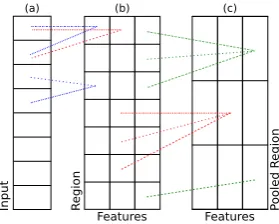
Figure 2: The convolutional network component of our architecture. A convolutional layer takes a series of terms as input(a)and applieslfilters to a k-term sliding window to derive feature values for each window or region(b);k = 2andl = 3 shown here. A max pooling layer considers non-overlapping region sequences of lengthn(b)and keeps the highest feature value for the sequence
(c);n= 3shown here.
post on a mental health support forum and the pre-vious posts in the thread. The task of detecting depressions in users is identifying Reddit users with self-reported depression diagnoses given the users’ post histories (excluding posts containing mental health keywords or posted in subreddits re-lated to mental health).
While both tasks are focused on predicting a user’s mental health status, they differ in both the type of classification performed (i.e., estimating severity on a four point scale vs. boolean classi-fication) and in the amount of data available. Our general architecture is based on a two step pro-cess: (1) identifying relevant features in each in-put text, and(2)combining the features observed in the model’s inputs to classify the user.
4.1 Shared Architecture
[image:4.595.74.289.62.112.2]methods, but also experiment with other loss func-tions when performing severity classification.
First, the model takes one or more posts as input and processes each post with a convolutional net-work containing a convolutional layer and a pool-ing layer. This process is illustrated with a max pooling layer in Figure2. The convolutional layer applies filters to a sliding window ofk terms(a)
and outputs a feature value for each sliding win-dow region and each filter(b). The same filters are applied to each window; each filter can be viewed as a feature detector and the overall process can be conceptualized as looking for windows of terms that contain specific features. The features are not specified a priori through feature engineering, but instead are learned automatically when the model is trained. After identifying the features present in each region (i.e., sliding window), a max pooling layer considers non-overlapping regions of length nand keeps the highest feature value for each re-gion(c). This step eliminates the regions (i.e., slid-ing windows) that do not contain useful features, which reduces the size of the convolutional net-work’s output. The same convolutional network is applied to each input post, meaning that the model learns to look for the same set of features in each. After each input post has been processed by a convolutional network, the output of each convo-lutional network is merged to create a represen-tation of the user’s activity across all input posts. This representation is processed by one or more dense layers (i.e., fully connected layers) with dropout (Srivastava et al.,2014) before being pro-cessed by a final output layer to perform classifica-tion. The type of output layer is dependent on the model variant. Our shared model architecture is illustrated in Figure1. The architecture’s hyperpa-rameters (e.g., the sliding window sizek, the num-ber of convolutional filters used, and type of pool-ing) also vary among models and are described in the supplemental material. Both the convolutional and dense layers use ReLU activations (Nair and Hinton,2010) in all model variants.
4.2 Models
4.2.1 Depression detection
Our model for depression detection takes a user’s posts as input and processes each post with a con-volutional network. Each concon-volutional network performs average pooling to produce its output. That is, the model considers non-overlapping
se-quences of nposts and keeps the average feature value across all sequences. These post representa-tions are then merged with a second convolutional layer to create a user representation; we found this approach led to more stable performance than us-ing a second average poolus-ing or max poolus-ing layer. The user representation created by the merge step is then passed to one or more dense layers before being passed to a dense output layer with a soft-max activation function to perform classification. The number of dense layers used is a hyperparam-eter described in§5. Categorical cross-entropy is used as the model’s loss function.
4.2.2 Self-harm risk assessment
Our model for self-harm risk classification takes two inputs: the target post being classified and the prior posts (if any) in the target post’s thread. The prior posts provide context and are thus useful for estimating the risk of self-harm present in the tar-get post. The two inputs are both processed by a convolutional network as in user-level classifica-tion, but in this case the convolutional network’s outputs correspond to a representation of the tar-get post and to a representation of the tartar-get post’s context (i.e., the prior posts in the thread). Given that these two outputs represent different aspects, they are merged by concatenating them together. This merged representation is then passed to one or more dense layers and to an output layer; the type of output layer depends on the loss function used. There are four self-harm risk assessment model variants in total:
Categorical Cross Ent. uses an output layer
with a softmax activation function, and categori-cal cross-entropy as its loss function. This mirrors the output layer and loss function used in the user level classification model.
MSE uses an output layer with a linear activa-tion funcactiva-tion, and mean squared error as its loss function. The model’s output is thus a single value; to perform classification, this output value is rounded to the nearest integer in the interval [0, t−1], wheretis the number of target classes.
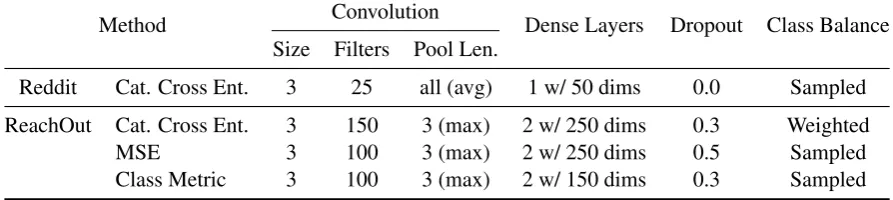
Method Convolution Dense Layers Dropout Class Balance Size Filters Pool Len.
Reddit Cat. Cross Ent. 3 25 all (avg) 1 w/ 50 dims 0.0 Sampled
ReachOut Cat. Cross Ent. 3 150 3 (max) 2 w/ 250 dims 0.3 Weighted
MSE 3 100 3 (max) 2 w/ 250 dims 0.5 Sampled
[image:6.595.75.522.67.167.2]Class Metric 3 100 3 (max) 2 w/ 150 dims 0.3 Sampled
Table 1: The hyperparameters used by each model.
Class Metric: Let d be the size of the output
layer andX be the layer’sd-dimensional output.
Class Metric learns a d-dimensional
representa-tion of each classCisuch that||X−Ci||2 is
min-imized for the correct classi; this is accomplished with the loss function: Li,p,n = max(0,||Xi −
Cp||2 − ||Xi −Cn||2 +α) where Cp is the
cor-rect (i.e., positive) class forXi,Cnis a randomly
chosen incorrect (i.e., negative) class, andα is a constant to enforce a minimum margin between classes. Classification is performed by computing the similarity betweenXiand each classCj.
Class Metric (Ordinal) extends Class Metric
to enforce a margin between ordinal classes as a function of the distance between classes. Given a ranked list of classes such that more similar classes have closer rankings, that is∀i sim(Ci, Ci±1) > sim(Ci, Ci±2), we incorporate the class distance
into the margin such that more distant incorrect class labels must be further away from the correct class label in the metric space. The loss function becomesLi,p,n = max(0,||Xi−Cp||2− ||Xi −
Cn||2+α|p−n|)where|p−n|causes the margin
to scale with the distance between classespandn.
5 Experiments
In this section we describe the model hyperparam-eters used and present our results on the depres-sion detection and self-harm risk assessment tasks. To facilitate reproducibility we provide our code and will provide the Reddit depression dataset to researchers who sign a data usage agreement4.
5.1 Experimental setup.
The hyperparameters used with our models are shown in Table 1. The severity risk assessment models’ hyperparameters were chosen using 10-fold cross validation on the 947 ReachOut training posts, with 15% of each fold used as validation
4http://ir.cs.georgetown.edu/data/reddit depression/
data. The depression identification model’s hy-perparameters were chosen using the Reddit val-idation set. The depression identification model’s second convolutional layer (i.e., the layer used to merge post representations) used filters of length 15, a stride of length 15, and the same number of filters as the first convolutional layer. All mod-els were trained using stochastic gradient descent with the Adam optimizer (Kingma and Ba,2014). The hyperparameters that varied across models are shown in Table1. The convolution size, number of convolutional filters, pooling type, pooling length, and number of dense layers was similar across all post models. Class balancing was performed with
Categorical Cross Ent. by weighting classes
in-versely proportional to their frequencies, whereas sampling an equal number of instances for each class worked best with the other methods.
performance, while using only the book corpus skip-thought vectors substantially decreased per-formance. As input the post models received the last 20 sentences in each target post and the last 20 sentences in the thread prior to the target post; any prior sentences are ignored.
5.2 Depression detection.
The data used for depression detection was de-scribed in §3. We compare our model against several baselines using MNB and SVM classi-fiers (Wang and Manning, 2012). Specifically, we consider two sets of features for the classi-fiers. The first set of features is the post con-tent itself represented as sparse bag of words fea-tures (BoW baselines). The second set of features
(feature-rich baselines) comprises a large set of
features including bag of words features encoded as sparse weighted vectors, external psycholin-guistic features captured by LIWC5 (2015), and
emotion lexicon features (Staiano and Guerini,
2014). Since our problem is identifying depres-sion among users, psycholinguistic signals and emotional attributes in the text are potentially im-portant features for the task. These features (as described in§2) have been also previously used by successful methods in the Twitter self-reported di-agnosis detection task (Coppersmith et al.,2015b). Thus, we argue that these are strong baselines for our self-reported diagnosis detection task. We ap-ply count based and tf-idf based feature weighting for bag of words features. We perform standard preprocessing by removing stopwords and lower-casing the input text.6
The data is split into training, validation, and testing datasets each containing approximately 3,000 diagnosed users and their matched control users. The validation set is used for tuning devel-opment and hyperparameter tuning of our models and the baselines. The reported results are on the test set. The depression detection models’ input consisted of raw terms encoded as one-hot vectors. We used an input layer to learn 50-dimensional representation of the terms. For each target user, the CNN received up to 400 posts containing up to 100 terms; experiments on the validation data indicated that increasing the maximum number of
5http://liwc.wpengine.com/
6During experimentation, we found tf-idf sparse feature weighting to be superior than other weighting schemes. Ad-ditional features such as LDA topics andχ2feature selection did not result in any further improvements.
Method Precision Recall F1
BoW - MNB 0.44 0.31 0.36
BoW - SVM 0.72 0.29 0.42
Feature-rich - MNB 0.69 0.32 0.44
Feature-rich - SVM 0.71 0.31 0.44
User model - CNN 0.59 0.45 0.51
Table 2: Performance identifying depressed users on the Reddit test set. The differences between the CNN and baselines are statistically significant (McNemar’s test,p <0.05).
posts did not significantly improve performance. Results. The results of identifying depressed users for our model and baselines are shown in Ta-ble2. Our proposed model outperforms the base-lines by a large margin in terms of recall and F1 on the diagnosed users (increases of 41% and 16%, respectively), but performs worse in terms of pre-cision. As described later in the analysis section, the CNN identifies language associated with neg-ative sentiment across a user’s posts.
5.3 Self-harm risk classification.
We train our methods to label the ReachOut posts and compare them against the top methods from CLPsych ’16. We use the same experimental pro-tocol as was used in CLPsych ’16; our methods were trained on the 947 training posts and evalu-ated on the remaining 280 testing posts. We used 15% of the 947 training posts as validation data.
We report results using the same metrics used in CLPsych, which were: the macro-averaged F1 for the amber, red, and crisis labels (
non-green posts); the macro-averaged F1 of green
posts vs. amber∪red∪crisis (flagged posts); and the macro-averaged F1 ofgreen∪ambervs. red∪crisis(urgentposts). Thenon-greenF1 was used as the official CLPsych metric with the in-tention of placing emphasis on classification per-formance for the non-green categories (i.e., those that required some response). The binaryflagged
meta-class was chosen to measure models’ abili-ties to differentiate between posts that require at-tention and posts that do not, and the binaryurgent
Method Non-green Flagged Urgent All
F1 F1 Acc. F1 Acc. F1 Acc.
Baseline (Milne et al.,2016) 0.31 0.78 0.86 0.38 0.89 -
-Kim et al.(2016) 0.42 0.85 0.91 0.62 0.91 0.55 0.85
Malmasi et al.(2016) 0.42 0.87 0.91 0.64 0.93 0.55 0.83
Brew(2016) 0.42 0.78 0.85 0.69 0.93 0.54 0.79
Cohan et al.(2016) 0.41 0.81 0.87 0.67 0.92 0.53 0.80
Categorical Cross Ent. 0.50 0.89 0.93 0.70 0.94 0.61 0.89
MSE 0.42 0.80 0.85 0.64 0.93 0.53 0.78
Class Metric 0.46 0.79 0.84 0.70 0.94 0.56 0.80
Class Metric (Ordinal) 0.47 0.88 0.93 0.72 0.93 0.59 0.87
Table 3: Self-harm risk assessment performance on the ReachOut test posts. F1 and accuracy are aggre-gated as specified by CLPsych ’16. The reported results for the other methods are the official numbers from (Milne et al.,2016). The differences in performance between the following method pairs are sta-tistically significant (McNemar’s test,p < 0.05): Categorical Cross Ent. andClass Metric,MSE and
Categorical Cross Ent.,MSEandClass Metric (Ordinal), andClass Metric (Ordinal)andClass Metric.
Method Non-green Flagged Urgent All
F1 F1 Acc. F1 Acc. F1 Acc.
Categorical Cross Ent. 0.54 0.87 0.89 0.69 0.91 0.63 0.80
MSE 0.87 0.95 0.96 0.91 0.98 0.89 0.93
Class Metric 0.73 0.90 0.91 0.81 0.94 0.78 0.86
Class Metric (Ordinal) 0.85 0.95 0.96 0.89 0.97 0.88 0.92
Table 4: Self-harm risk assessment performance on the ReachOut training set using 10-fold cross vali-dation. Categorical Cross Ent. performs substantially worse than on the test set, whileMSEperforms substantially better. Class Metric (Ordinal)continues to perform well. The difference in performance between the following method pairs are statistically significant (McNemar’s test,p <0.05):Categorical
Cross Ent.andMSE,Categorical Cross Ent.andClass Metric,Categorical Cross Ent.andClass Metric
(Ordinal),MSEandClass Metric, andClass MetricandClass Metric (Ordinal).
Results. The results on the self-harm risk as-sessment task for our models and for the current best-performing methods (briefly explained in§2) are shown in Table 3. We also report a baseline result which is based on a SVM classifier with bigram features. When measured by non-green
F1, the official metric of the CLPsych ’16 Triage Task, our proposed models perform up to 19% bet-ter than the best existing methods. Similarly, our models perform up to 11% better when measured with an F1 macro-averaged across all categories (i.e., all column) and up to 5% better with mea-sured accuracy across all categories. Categorical
Cross Ent. performs best in all of these cases,
though the difference between the performance of
Categorical Cross Ent. andClass Metricwith an
ordinal margin is not statistically significant.
We also evaluate the performance of our meth-ods on the training set using 10-fold cross
valida-tion to better observe the performance differences between our model variants (Table4). All mod-els’ perform substantially better on the training set than on the test set. This is partially explained by the fact that the models were tuned on the training set, but the large difference in some cases (e.g., the increase in the highest non-green F1 from 0.50 to 0.87) suggest there may be qualitative differ-ences between the training and testing sets. The best-performing method on the test set,
Categori-cal Cross Ent., performs the worst on the training
set. Similarly, the worst-performing method on the test set,MSE, performs the best on the training
set.Class Metric (Ordinal)performs well on both
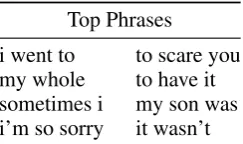
Top Phrases
i went to to scare you
my whole to have it
sometimes i my son was
i’m so sorry it wasn’t
Table 5: Example phrases that strongly con-tributed to a user’s depression classification on the RSDD dataset.
5.4 Analysis
In this section we analyze the language that strongly contributed to the identification of de-pressed users on the Reddit dataset. Note that it is impossible to show entire Reddit posts without compromising users’ anonymity; we found that even when a post is paraphrased, enough informa-tion remains that it can easily be identified using a Web search engine. For example, one Reddit post that strongly contributed to the author’s clas-sification as a depressed user contained the men-tion of a specific type of abuse and several com-ments vaguely related to this type of abuse. We at-tempted to paraphrase this post, but found that any paraphrase containing general language related to both the type of abuse and to the user’s comments was enough to identify the user. Thus, to protect the anonymity of the users in our dataset, we do not publish posts in any form.
Rather than publishing posts, we identify key phrases in posts from users who were correctly identified as being depressed. Phrases from eight self-reported depressed users are shown in Ta-ble 5; to prevent these phrases from being used to identify users, we retain only the top phrase from each user. These phrases were identified by using the model’s convolutional filter weights to identify posts in the validation dataset that are strongly contributing to the model’s classification decision, and then using the convolutional filter weights to identify the phrase within each post that most strongly contributed to the post’s classifica-tion (i.e., had the highest feature values).
In keeping with the design of our dataset, terms related to depression or diagnoses are not present. Instead, the model identifies phrases that often could be associated with a negative sentiment or outlook. For example, “my whole” could be part of a negative comment referring to the poster’s whole life. It should be noted that the model makes classification decisions based on the
occur-rence of phrases across many posts by the same user. Though one can imagine how the phrases shown here could be used to convey negative sen-timent, the presence of a single such phrase is not sufficient to cause the model to classify a user as depressed.
6 Conclusion
In this work we argued for the close connection between social media and mental health, and de-scribed a neural network architecture for perform-ing self-harm risk classification and depression de-tection on social media posts. We described the construction of the Reddit Self-reported Depres-sion Diagnosis (RSDD) dataset, containing over 9,000 users with self-reported depression diag-noses matched with over 107,000 similar control users; the dataset is available under a data us-age agreement. We applied our classification ap-proach to the task of identifying depressed users on this dataset and found that it substantially out-performed strong existing methods in terms of Re-call and F1. While these depression detection re-sults are encouraging, the absolute values of the metrics illustrate that this is a challenging task and worthy of further exploration. We also ap-plied our classification approach to the task of estimating the self-harm risk posed by posts on the ReachOut.com mental health support forum, and found that it substantially outperformed strong previously-proposed methods.
Our approach and results are significant from several perspectives: they provide a strong ap-proach to identifying posts indicating a risk of self-harm in social media; they demonstrate a means for large scale public mental health stud-ies surrounding the state of depression; and they demonstrate the possibility of sensitive applica-tions in the context of clinical care, where clini-cians could be notified if the activities of their pa-tients suggest they are at risk of self-harm. Fur-thermore, large-scale datasets such as the one presented in this paper can provide complemen-tary information to existing data on mental health which are generally relatively smaller collections.
References
[image:9.595.121.243.62.134.2]Anxiety and Depression Association of America. 2015.
Anxiety and depression, facts & statistics.
Adrian Benton, Glen Coppersmith, and Mark Dredze. 2017a. Ethical research protocols for social media health research. EACL 2017, page 94.
Adrian Benton, Margaret Mitchell, and Dirk Hovy. 2017b. Multitask learning for mental health condi-tions with limited social media data. In Proceed-ings of the 15th Conference of the European Chap-ter of the Association for Computational Linguistics: Volume 1, Long Papers, pages 152–162, Valencia, Spain. Association for Computational Linguistics. Steven Bird, Ewan Klein, and Edward Loper.
2009. Natural Language Processing with Python. O’Reilly Media.
Chris Brew. 2016.Classifying reachout posts with a ra-dial basis function svm. InProceedings of the Third Workshop on Computational Lingusitics and Clin-ical Psychology, pages 138–142, San Diego, CA, USA. Association for Computational Linguistics. CDC. 2015. Suicide fact sheet, suicide facts at a
glance. National Center for Injury Prevention and Control.
Munmun De Choudhury and Emre Kiciman. 2017.
The language of social support in social media and its effect on suicidal ideation risk. InProceedings of the International Conference onWeb and Social Media (ICWSM). AAAI.
Arman Cohan, Sydney Young, and Nazli Goharian. 2016. Triaging mental health forum posts. Proceed-ings of the 3rd Workshop on Computational Linguis-tics and Clinical Psychology: From Linguistic Sig-nal to Clinical Reality, pages 143–147.
Arman Cohan, Sydney Young, Andrew Yates, and Na-zli Goharian. 2017. Triaging content severity in on-line mental health forums. Journal of the Associa-tion for InformaAssocia-tion Science and Technology. Glen Coppersmith, Mark Dredze, and Craig Harman.
2014a. Quantifying mental health signals in Twitter. In Proceedings of the Workshop on Computational Linguistics and Clinical Psychology: From Linguis-tic Signal to Clinical Reality.
Glen Coppersmith, Mark Dredze, Craig Harman, and Kristy Hollingshead. 2015a. From adhd to sad: Analyzing the language of mental health on twitter through self-reported diagnoses. InCLPysch, pages 1–10.
Glen Coppersmith, Mark Dredze, Craig Harman, Kristy Hollingshead, and Margaret Mitchell. 2015b. Clpsych 2015 shared task: Depression and ptsd on twitter. NAACL HLT 2015, page 31.
Glen Coppersmith, Craig Harman, and Mark Dredze. 2014b. Measuring post traumatic stress disorder in twitter. InICWSM.
Glen Coppersmith, Kim Ngo, Ryan Leary, and An-thony Wood. 2016. Exploratory analysis of social media prior to a suicide attempt.
Munmun De Choudhury and Sushovan De. 2014. Mental health discourse on reddit: Self-disclosure, social support, and anonymity. InICWSM.
Munmun De Choudhury, Michael Gamon, Scott Counts, and Eric Horvitz. 2013. Predicting Depres-sion via Social Media. AAAI.
Munmun De Choudhury, Emre Kiciman, Mark Dredze, Glen Coppersmith, and Mrinal Kumar. 2016. Dis-covering shifts to suicidal ideation from mental health content in social media. InProceedings of the 34rd Annual ACM Conference on Human Factors in Computing Systems, CHI ’16. ACM.
Alize J Ferrari, Rosana E Norman, Greg Freedman, Amanda J Baxter, Jane E Pirkis, Meredith G Har-ris, Andrew Page, Emily Carnahan, Louisa Degen-hardt, Theo Vos, et al. 2014. The burden attributable to mental and substance use disorders as risk factors for suicide: findings from the global burden of dis-ease study 2010. PLoS One, 9(4):e91936.
John F Gunn and David Lester. 2015. Twitter postings and suicide: An analysis of the postings of a fatal suicide in the 24 hours prior to death. Suicidologi, 17(3).
Kristy Hollingshead and Lyle Ungar, editors. 2016.
Proceedings of the Third Workshop on Computa-tional Linguistics and Clinical Psychology. Associ-ation for ComputAssoci-ational Linguistics, San Diego, CA, USA.
Dirk Hovy and Shannon L Spruit. 2016. The social im-pact of natural language processing. InProceedings of the 54th Annual Meeting of the Association for Computational Linguistics, volume 2, pages 591– 598.
Jared Jashinsky, Scott H Burton, Carl L Hanson, Josh West, Christophe Giraud-Carrier, Michael D Barnes, and Trenton Argyle. 2014. Tracking suicide risk fac-tors through Twitter in the US. Crisis.
Nal Kalchbrenner, Edward Grefenstette, and Phil Blun-som. 2014. A convolutional neural network for modelling sentences. In Proceedings of the 52nd Annual Meeting of the Association for Computa-tional Linguistics (Volume 1: Long Papers), pages 655–665. Association for Computational Linguis-tics.
Yoon Kim. 2014. Convolutional neural networks for sentence classification. InProceedings of the 2014 Conference on Empirical Methods in Natural Lan-guage Processing (EMNLP), pages 1746–1751. Diederik P. Kingma and Jimmy Ba. 2014. Adam: A
method for stochastic optimization. arXiv preprints, arXiv:1412.6980.
Ryan Kiros, Yukun Zhu, Ruslan Salakhutdinov, Richard S. Zemel, Antonio Torralba, Raquel Urta-sun, and Sanja Fidler. 2015. Skip-thought vectors. InNIPS, Cambridge, MA, USA. MIT Press. Tibor Kiss and Jan Strunk. 2006. Unsupervised
multi-lingual sentence boundary detection. Comput. Lin-guist., 32(4).
David E Losada and Fabio Crestani. 2016. A test col-lection for research on depression and language use. InInternational Conference of the Cross-Language Evaluation Forum for European Languages, pages 28–39.
Shervin Malmasi, Marcos Zampieri, and Mark Dras. 2016. Predicting post severity in mental health fo-rums. In Proceedings of the Third Workshop on Computational Lingusitics and Clinical Psychology, pages 133–137, San Diego, CA, USA. Association for Computational Linguistics.
L Manikonda and M De Choudhury. 2017. Modeling and understanding visual attributes of mental health disclosures in social media. InCHI ’17.
David N. Milne, Glen Pink, Ben Hachey, and Rafael A. Calvo. 2016. Clpsych 2016 shared task: Triaging content in online peer-support forums. Proceedings of the 3rd Workshop on Computational Linguistics and Clinical Psychology: From Linguistic Signal to Clinical Reality, pages 118–127.
Margaret Mitchell, Kristy Hollingshead, and Glen Coppersmith. 2015. Quantifying the language of schizophrenia in social media. NAACL-HLT Work-shop on CLPsych 2015, page 11.
Danielle Mowery, Albert Park, Mike Conway, and Craig Bryan. 2016. Towards automatically classify-ing depressive symptoms from twitter data for pop-ulation health. In Proceedings of the Workshop on Computational Modeling of Peoples Opinions, Per-sonality, and Emotions in Social Media, pages 182– 191.
Vinod Nair and Geoffrey E. Hinton. 2010. Rectified linear units improve restricted boltzmann machines. InProceedings of the 27th International Conference on Machine Learning (ICML-10), pages 807–814. James W Pennebaker, Ryan L Boyd, Kayla Jordan,
and Kate Blackburn. 2015. The development and psychometric properties of liwc2015. UT Fac-ulty/Researcher Works.
Daniel Preot¸iuc-Pietro, Johannes Eichstaedt, Gregory Park, Maarten Sap, Laura Smith, Victoria Tobolsky,
H. Andrew Schwartz, and Lyle Ungar. 2015. The role of personality, age, and gender in tweeting about mental illness. InProceedings of the 2nd Workshop on Computational Linguistics and Clinical Psychol-ogy: From Linguistic Signal to Clinical Reality. Philip Resnik, William Armstrong, Leonardo
Claudino, and Thang Nguyen. 2015. The uni-versity of maryland clpsych 2015 shared task system. In Proceedings of the 2nd Workshop on Computational Linguistics and Clinical Psychol-ogy: From Linguistic Signal to Clinical Reality, pages 54–60.
Philip Resnik, Anderson Garron, and Rebecca Resnik. 2013. Using topic modeling to improve prediction of neuroticism and depression. In EMNLP, pages 1348–1353. Association for Computational Linguis-tics.
Nitish Srivastava, Geoffrey E Hinton, Alex Krizhevsky, Ilya Sutskever, and Ruslan Salakhutdinov. 2014. Dropout: a simple way to prevent neural networks from overfitting. Journal of Machine Learning Re-search, 15(1):1929–1958.
Jacopo Staiano and Marco Guerini. 2014. De-pechemood: a lexicon for emotion analysis from crowd-annotated news. arXiv preprints, arXiv:1405.1605.
Simon ˇSuster, St´ephan Tulkens, and Walter Daelemans. 2017. A short review of ethical challenges in clin-ical natural language processing. arXiv preprint arXiv:1703.10090.
Paul Thompson, Craig Bryan, and Chris Poulin. 2014.
Predicting military and veteran suicide risk: Cultural aspects. InProceedings of the Workshop on Compu-tational Linguistics and Clinical Psychology: From Linguistic Signal to Clinical Reality, pages 1–6, Bal-timore, Maryland, USA. Association for Computa-tional Linguistics.
Sho Tsugawa, Yusuke Kikuchi, Fumio Kishino, Ko-suke Nakajima, Yuichi Itoh, and Hiroyuki Ohsaki. 2015. Recognizing depression from twitter activity. InProceedings of the 33rd Annual ACM Conference on Human Factors in Computing Systems. ACM. R Jay Turner, B Gail Frankel, and Deborah M Levin.
1983. Social support: Conceptualization, measure-ment, and implications for mental health. Research in Community & Mental Health.
Sida Wang and Christopher D Manning. 2012. Base-lines and bigrams: Simple, good sentiment and topic classification. InACL ’12.
WHO. 2010. World Health Organization, World Health Statistics 2010. World Health Organization. Yijun Xiao and Kyunghyun Cho. 2016. Efficient