Polyglot: Distributed Word Representations for Multilingual NLP
Rami Al-Rfou’ Bryan Perozzi
Computer Science Dept. Stony Brook University Stony Brook, NY 11794
{ralrfou, bperozzi, skiena}@cs.stonybrook.edu
Steven Skiena
Abstract
Distributed word representations (word embeddings) have recently contributed to competitive performance in language modeling and several NLP tasks. In this work, we train word embeddings for more than 100 languages using their cor-responding Wikipedias. We quantitatively demonstrate the utility of our word em-beddings by using them as the sole fea-tures for training a part of speech tagger for a subset of these languages. We find their performance to be competitive with near state-of-art methods in English, Dan-ish and SwedDan-ish. Moreover, we inves-tigate the semantic features captured by these embeddings through the proximity of word groupings. We will release these embeddings publicly to help researchers in the development and enhancement of mul-tilingual applications.
1 Introduction
Building multilingual processing systems is a challenging task. Every NLP task involves dif-ferent stages of preprocessing and calculating in-termediate representations that will serve as fea-tures for later stages. These stages vary in com-plexity and requirements for each individual lan-guage. Despite recent momentum towards devel-oping multilingual tools (Nivre et al., 2007; Hajiˇc et al., 2009; Pradhan et al., 2012), most of NLP research still focuses on rich resource languages. Common NLP systems and tools rely heavily on English specific features and they are infrequently tested on multiple datasets. This makes them hard to port to new languages and tasks (Blitzer et al., 2006).
A serious bottleneck in the current approach for developing multilingual systems is the
require-ment of familiarity with each language under con-sideration. These systems are typically carefully tuned with hand-manufactured features designed by experts in a particular language. This approach can yield good performance, but tends to create complicated systems which have limited portabil-ity to new languages, in addition to being hard to enhance and maintain.
Recent advancements in unsupervised feature learning present an intriguing alternative. In-stead of relying on expert knowledge, these ap-proaches employ automatically generated task-independent features (or word embeddings) given large amounts of plain text. Recent developments have led to state-of-art performance in several NLP tasks such as language modeling (Bengio et al., 2006; Mikolov et al., 2010), and syntactic tasks such as sequence tagging (Collobert et al., 2011). These embeddings are generated as a result of training “deep” architectures, and it has been shown that such representations are well suited for domain adaptation tasks (Glorot et al., 2011; Chen et al., 2012).
We believe two problems have held back the research community’s adoption of these methods. The first is that learning representations of words involves huge computational costs. The process usually involves processing billions of words over weeks. The second is that so far, these systems have been built and tested mainly on English.
In this work we seek to remove these barriers to entry by generating word embeddings for over a hundred languages using state-of-the-art tech-niques. Specifically, our contributions include:
• Word embeddings - We will release word embeddings for the hundred and seventeen languages that have more than 10,000 ar-ticles on Wikipedia. Each language’s vo-cabulary will contain up to 100,000 words. The embeddings will be publicly available at
(www.cs.stonybrook.edu/˜dsl), for the research community to study their charac-teristics and build systems for new languages. We believe our embeddings represent a valu-able resource because they contain a minimal amount of normalization. For example, we do not lower case words for European lan-guages as other studies have done for En-glish. This preserves features of the under-lying language.
• Quantitative analysis - We investigate
the embedding’s performance on a part-of-speech (PoS) tagging task, and conduct qual-itative investigation of the syntactic and se-mantic features they capture. Our experi-ments represent a valuable chance to evalu-ate distributed word representations for NLP as the experiments are conducted in a consis-tent manner and a large number of languages are covered. As the embeddings capture in-teresting linguistic features, we believe the multilingual resource we are providing gives researchers a chance to create multilingual comparative experiments.
• Efficient implementation - Training these models was made possible by our contri-butions to Theano (machine learning library (Bergstra et al., 2010)). These optimizations empower researchers to produce word em-beddings under different settings or for dif-ferent corpora than Wikipedia.
The rest of this paper is as follows. In Section 2, we give an overview of semi-supervised learn-ing and learnlearn-ing representations related work. We then describe, in Section 3, the network used to generate the word embeddings and its characteris-tics. Section 4 discusses the details of the corpus collection and preparation steps we performed. Next, in Section 5, we discuss our experimental setup and the training progress over time. In Sec-tion 6 we discuss the semantic features captured by the embeddings by showing examples of the word groupings in multiple languages. Finally, in Section 7 we demonstrate the quality of our learned features by training a PoS tagger on sev-eral languages and then conclude.
2 Related Work
There is a large body of work regarding semi-supervised techniques which integrate
unsuper-vised feature learning with discriminative learning methods to improve the performance of NLP ap-plications. Word clustering has been used to learn classes of words that have similar semantic fea-tures to improve language modeling (Brown et al., 1992) and knowledge transfer across languages (T¨ackstr¨om et al., 2012). Dependency parsing and other NLP tasks have been shown to bene-fit from such a large unannotated corpus (Koo et al., 2008), and a variety of unsupervised feature learning methods have been shown to unilaterally improve the performance of supervised learning tasks (Turian et al., 2010). (Klementiev et al., 2012) induce distributed representations for a pair of languages jointly, where a learner can be trained on annotations present in one language and ap-plied to test data in another.
Learning distributed word representations is a way to learn effective and meaningful information about words and their usages. They are usually generated as a side effect of training parametric language models as probabilistic neural networks. Training these models is slow and takes a signif-icant amount of computational resources (Bengio et al., 2006; Dean et al., 2012). Several sugges-tions have been proposed to speed up the training procedure, either by changing the model architec-ture to exploit an algorithmic speedup (Mnih and Hinton, 2009; Morin and Bengio, 2005) or by esti-mating the error by sampling (Bengio and Senecal, 2008).
(Collobert and Weston, 2008) shows that word embeddings can almost substitute NLP common features on several tasks. The system they built, SENNA, offers part of speech tagging, chunking, named entity recognition, semantic role labeling and dependency parsing (Collobert, 2011). The system is built on top of word embeddings and per-forms competitively compared to state of art sys-tems. In addition to pure performance, the system has a faster execution speed than comparable NLP pipelines (Al-Rfou’ and Skiena, 2012).
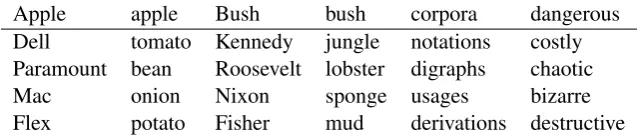
Apple apple Bush bush corpora dangerous Dell tomato Kennedy jungle notations costly Paramount bean Roosevelt lobster digraphs chaotic Mac onion Nixon sponge usages bizarre Flex potato Fisher mud derivations destructive
Table 1: Words nearest neighbors as they appear in the English embeddings.
perform well in a variety of term-based evaluation tasks. Given the training speed and prior perfor-mance on NLP tasks in English, we generate our multilingual embeddings using a similar network architecture to the one SENNA used.
However, our work differs from SENNA in the following ways. First, we do not limit our mod-els to English, we train embeddings for a hundred and seventeen languages. Next, we preserve lin-guistic features by avoiding excessive normaliza-tion to the text. For example, our English model places “Apple” closer to IT companies and “ap-ple” to fruits. More examples of linguistic fea-tures preserved by our model are shown in Table 1. This gives us the chance to evaluate the embed-dings performance over PoS tagging without the need for manufactured features. Finally, we re-lease the embeddings and the resources necessary to generate them to the community to eliminate any barriers.
Despite the progress made in creating dis-tributed representations, combining them to pro-duce meaning is still a challenging task. Sev-eral approaches have been proposed to address feature compositionality for semantic problems such as paraphrase detection (Socher et al., 2011), and sentiment analysis (Socher et al., 2012) using word embeddings.
3 Distributed Word Representation
Distributed word representations (word embed-dings) map the index of a word in a dictionary to a feature vector in high-dimension space. Every di-mension contributes to multiple concepts, and ev-ery concept is expressed by a combination of sub-set of dimensions. Such mapping is learned by back-propagating the error of a task through the model to update random initialized embeddings. The task is usually chosen such that examples can be automatically generated from unlabeled data (i.e so it is unsupervised). In case of language modeling, the task is to predict the last word of a phrase that consists ofnwords.
In our work, we start from the example con-struction method outlined in (Bengio et al., 2009). They train a model by requiring it to distinguish between the original phrase and a corrupted ver-sion of the phrase. If it does not score the original one higher than the corrupted one (by a margin), the model will be penalized. More precisely, for a given sequence of words S = [wi−n. . . wi. . . wi+n] observed in the corpus T,
we will construct another corrupted sequence S0
by replacing the word in the middlewiwith a word
wj chosen randomly from the vocabulary. The
neural network represents a function score that
scores each phrase, the model is penalized through the hinge loss functionJ(T)as shown in 1.
J(T) = 1
|T|
X
i∈T
|1−score(S0)+score(S)|+ (1)
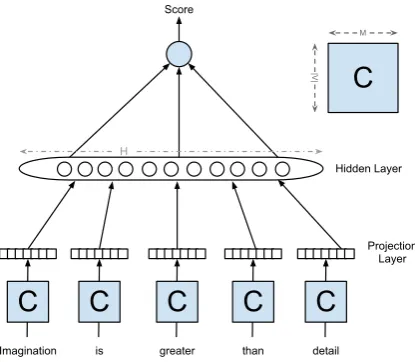
Figure 1 shows a neural network that takes a se-quence of words with size 2n+ 1 to compute a score. First, each word is mapped through a vo-cabulary dictionary with the size|V|to an index
that is used to index a shared matrix C with the size|V|∗MwhereMis the size of the vector
rep-resenting the word. Once the vectors are retrieved, they are concatenated into one vector called pro-jection layerP with size(2n+ 1)∗M. The
pro-jection layer plays the role of an input to a hidden layer with size|H|, the activationsAof which are
calculated according to equation 3, whereW1,b1
are the weights and bias of the hidden layer.
A=tanh(W1P +b1) (2)
To calculate the phrase score, a linear combina-tion of the hidden layer activacombina-tionsAis computed usingW2andb2.
score(P) =W2A+b2 (3)
Therefore, the five parameters that have to be learned areW1,W2,b1,b2,Cwith a total number
of parameters(2n+ 1)∗M∗H+H+H+ 1 +
C
Imagination
C
is
C
greater
C
than
C
detail Score
Hidden Layer H
C
M
|V|
[image:4.595.78.286.66.247.2]Projection Layer
Figure 1: Neural network architecture. Words are retrieved from embeddings matrixCand
concate-nated at the projection layer as an input to com-puter the hidden layer activation. The score is the linear combination of the activation values of the hidden layer. The scores of two phrases are ranked according to hinge loss to distinguish the corrupted phrase from the original one.
4 Corpus Preparation
We have chosen to generate our word embeddings from Wikipedia. In addition to size, there are other desirable properties that we wish for the source of our language model to have:
• Size and variety of languages - As of this writing (April, 2013), 42 languages had more than 100,000 article pages, and 117 lan-guages had more than 10,000 article pages.
• Well studied - Wikipedia is a prolific re-source in the literature, and has been used for a variety of problems. Particularly, Wikipedia is well suited for multilingual ap-plications (Navigli and Ponzetto, 2010).
• Quality - Wikipedians strive to write
arti-cles that are readable, accurate, and consist of good grammar.
• Openly accessible- Wikipedia is a resource
available for free use by researchers
• Growing- As technology becomes more
ac-cessible, the size and scope of the multilin-gual Wikipedia effort continues to expand. To process Wikipedia markup, we first extract the text using a modified version of the Bliki
en-gine1. Next we must tokenize the text. We rely on an OpenNLP probabilistic tokenizer whenever possible, and default to the Unicode text segmen-tation2algorithm offered by Lucene when we have no such OpenNLP model. After tokenization, we normalize the tokens to reduce their sparsity. We have two main normalization rules. The first re-places digits with the symbol #, so “1999” be-comes ####. In the second, we remove hyphens and brackets that appear in the middle of a token. As an additional rule for English, we map non-Latin characters to their unicode block groups.
In order to capture the syntactic and semantic features of words, we must observe each word sev-eral times in each of its valid contexts. This re-quirement, when combined with the Zipfian dis-tribution of words in natural language, implies that learning a meaningful representation of a language requires a huge amount of unstructured text. In practice we deal with this limitation by restricting ourselves to considering the most frequently oc-curring tokens in each language.
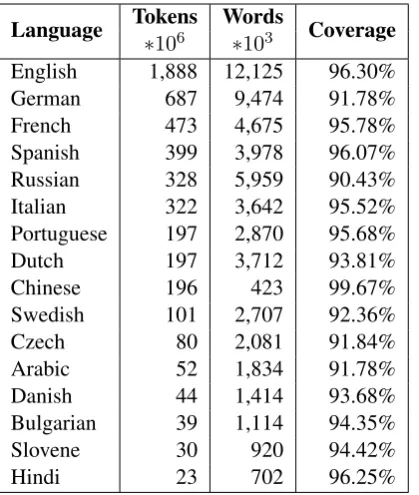
Table 2 shows the size of each language corpus in terms of tokens, number of word types and cov-erage of text achieved by building a vocabulary out of the most frequent 100,000 tokens,|V|. Out of vocabulary (OOV) words are replaced with a spe-cial tokenhUNKi.
While Wikipedia has 284 language specific en-cyclopedias, only five of them have more than a million articles. The size drops dramatically, such that the 42ndlargest Wikipedia, Hindi, has slightly above 100,000 articles and the 100th, Tatar, has slightly over 16,000 articles3.
Significant Wikipedias in size have a word cov-erage over 92% except for German, Russian, Ara-bic and Czech which shows the effect of heavy us-age of morphological forms in these languus-ages on the word usage distribution.
The highest word coverage we achieve is unsur-prisingly for Chinese. This is expected given the limited size vocabulary of the language - the num-ber of entries in the Contemporary Chinese Dictio-nary are estimated to be 65 thousand words (Shux-iang, 2004).
1Java Wikipedia API (Bliki engine) -http://code.
google.com/p/gwtwiki/
2http://www.unicode.org/reports/tr29/ 3http://meta.wikimedia.org/w/index.
Language Tokens Words Coverage ∗106 ∗103
English 1,888 12,125 96.30%
German 687 9,474 91.78%
French 473 4,675 95.78%
Spanish 399 3,978 96.07% Russian 328 5,959 90.43% Italian 322 3,642 95.52% Portuguese 197 2,870 95.68%
Dutch 197 3,712 93.81%
Chinese 196 423 99.67%
Swedish 101 2,707 92.36%
Czech 80 2,081 91.84%
Arabic 52 1,834 91.78%
Danish 44 1,414 93.68%
Bulgarian 39 1,114 94.35%
Slovene 30 920 94.42%
[image:5.595.73.283.61.309.2]Hindi 23 702 96.25%
Table 2: Statistics of a subset of the languages pro-cessed. The second column reports the number of tokens found in the corpus in millions while the third column reports the word types found in thou-sands. The coverage indicates the percentage of the corpus that will be matching words in a vocab-ulary consists of the most frequent 100 thousand words.
5 Training
For our experiments, we build a model as the one described in Section 3 using Theano (Bergstra et al., 2010). We choose the following parameters, context window size 2n + 1 = 5, vocabulary
|V| = 100,000, word embedding size M = 64,
and hidden layer sizeH= 32. The intuition, here,
is to maximize the relative size of the embeddings compared to the rest of the network. This might force the model to store the necessary information in the embeddings matrix instead of the hidden layer. Another benefit is that we will avoid over-fitting on the smaller Wikipedias. Increasing the window size or the embedding size slows down the training speed, making it harder to converge within a reasonable time.
The examples are generated by sweeping a win-dow over sentences. For each sentence in the cor-pus, all unknown words are replaced with a special tokenhUNKiand sentences are padded withhSi, h/Sitokens. In case the window exceeds the edges of a sentence, the missing slots are filled with our padding token,hPADi.
Figure 2: Training and test errors of the French model after 23 days of training. We did not notice any overfitting while training the model. The error curves are smoother the larger the language corpus is.
To train the model, we consider the data in mini-batches of size 16. Every 16 examples, we es-timate the gradient using stochastic gradient de-scent (Bottou, 1991), and update the parameters which contributed to the error using backpropaga-tion (Rumelhart et al., 2002). Calculating an exact gradient is prohibitive given that the dataset size is in millions of examples. We calculate the devel-opment error by sampling randomly 10000 mini-batches from the development dataset.
For each language, we set the batch size to 16 examples, and the learning rate to be 0.1. Follow-ing, (Collobert et al., 2011)’s advice, we divide each layer by thefan inof that layer, and we con-sider the embeddings layer to have a fan in of 1. We divide the corpus to three sets, training, devel-opment and testing with the following percentages 90, 5, 5 respectively.
[image:5.595.308.530.64.237.2]re-Word Translation Word Translation Word Word
Fr
ench
rouge red
Spanish
dentista dentist
English
Mumbai Bombay
juane yellow peluquero barber Chennai Madras
rose pink ginec´olog gynecologist Bangalore Shanghai
blanc white camionero truck driver Kolkata Calultta
orange orange oftalm´ologo ophthalmologist Cairo Bangkok
bleu blue telegrafista telegraphist Hyderabad Hyderabad
Arabic Arabic German
Jkr thanks ¤d two boys Eisenbahnbetrieb rail operations
¤Jkr and thanks nA two sons Fahrbetrieb driving
yA¨ greetings ¤d§ two boys Reisezugverkehr passenger trains
Jkr ¾ thanks + diacritic Vf® two children F¨ahrverkehr ferries ¤Jkr ¾ and thanks + diacritic ny two sons Handelsverkehr Trade
rbA hello ntA two daughters Sch¨ulerverkehr students Transport
Russian Chinese
Transliteration
Italian
Ïóòèí Putin dongzhi Winter Solstice papa Pope
ßíóêîâè÷ Yanukovych chunfen Vernal Equinox Papa Pope
Òðîöêèé Trotsky xiazhi Summer solstice pontefice pontiff
Ãèòëåð Hitler qiufen Autumnal Equinox basileus basileus
Ñòàëèí Stalin ziye Midnight canridnale cardinal
[image:6.595.91.512.61.237.2]Ìåäâåäåâ Medvedev chuxi New Year’s Eve frate friar
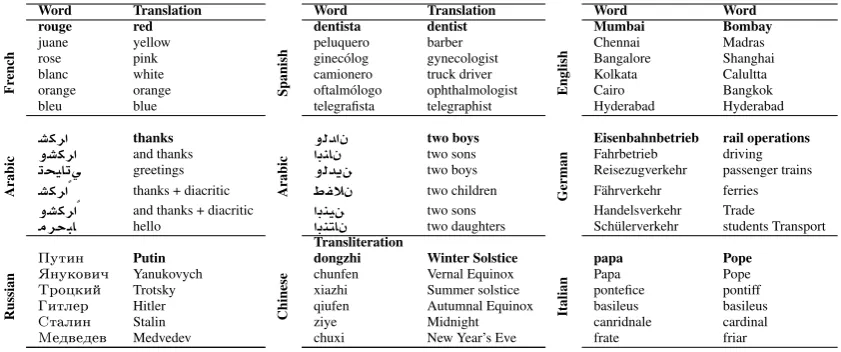
Table 3: Examples of the nearest five neighbors of every word in several languages. Translation is retrieved fromhttp://translate.google.com.
placement word in the corrupted phrase. Figure 2 shows a typical learning curve of the training. As the number of examples have been seen so far increased both the training error and the develop-ment error go down.
6 Qualitative Analysis
In order to understand how the embeddings space is organized, we examine the subtle information captured by the embeddings through investigating the proximity of word groups. This information has the potential to help researchers develop ap-plications that use such semantic and syntactic in-formation. The embeddings not only capture syn-tactic features, as we will demonstrate in Section 4, but also demonstrate the ability to capture in-teresting semantic information. Table 3 shows dif-ferent words in several languages. For each word on top of each list, we rank the vocabulary accord-ing to their Euclidean distance from that word and show the closest five neighboring words.
• French & Spanish- Expected groupings of
colors and professions is clearly observed.
• English - The example shows how the
em-bedding space is aware of the name change that happened to a group of Indian cities. “Mumbai” used to be called “Bombay”, “Chennai” used to be called “Madras and “Kolkata” used to be called “Calcutta”. On the other hand, “Hyderabad” stayed at a sim-ilar distance from both names as they point to the same conceptual meaning.
• Arabic - The first example shows the word “Thanks”. Despite not removing the
diacrit-ics from the text, the model learned that the two surface forms of the word mean similar things and, therefore, grouped them together. In Arabic, conjunction words do not get sepa-rated from the following word. Usually, ”and thanks” serves as a letter signature as “sin-cerely” is used in English. The model learned that both words {“and thanks”, “thanks” }
are similar, regardless their different forms. The second example illustrates a specific syn-tactic morphological feature of Arabic, where enumeration of couples has its own form.
• German- The example demonstrates that the compositional semantics of multi-unit words are still preserved.
• Russian- The model learned to group Rus-sian/Soviet leaders and other figures related to the Soviet history together.
• Chinese- The list contains three solar terms that are part of the traditional East Asian lu-nisolar calendars. The remaining two terms correspond to traditional holidays that occur at the same dates of these solar terms.
• Italian - The model learned that the lower
and upper cases of the word has similar meaning.
7 Sequence Tagging
Here we analyze the quality of the models we have generated. To test the quantitative performance of the embeddings, we use them as the sole features for a well studied NLP task, part of speech tag-ging.
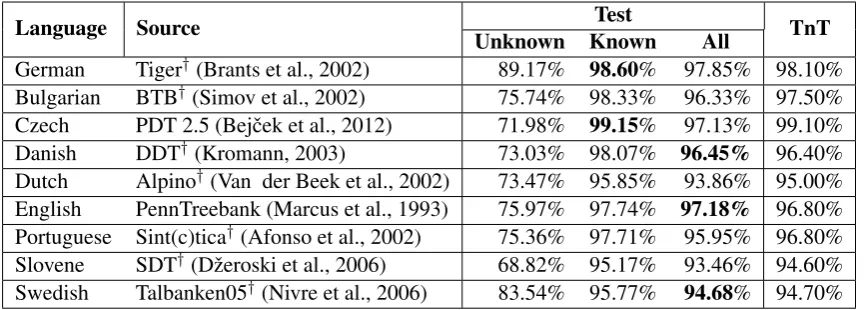
dis-Language Source Unknown KnownTest All TnT
German Tiger†(Brants et al., 2002) 89.17% 98.60% 97.85% 98.10%
Bulgarian BTB†(Simov et al., 2002) 75.74% 98.33% 96.33% 97.50%
Czech PDT 2.5 (Bejˇcek et al., 2012) 71.98% 99.15% 97.13% 99.10% Danish DDT†(Kromann, 2003) 73.03% 98.07% 96.45% 96.40%
Dutch Alpino†(Van der Beek et al., 2002) 73.47% 95.85% 93.86% 95.00%
English PennTreebank (Marcus et al., 1993) 75.97% 97.74% 97.18% 96.80% Portuguese Sint(c)tica†(Afonso et al., 2002) 75.36% 97.71% 95.95% 96.80%
Slovene SDT†(Dˇzeroski et al., 2006) 68.82% 95.17% 93.46% 94.60%
[image:7.595.84.518.62.217.2]Swedish Talbanken05†(Nivre et al., 2006) 83.54% 95.77% 94.68% 94.70%
Table 4: Results of our model against several PoS datasets. The performance is measured using accuracy over the test datasets. Third column represents the total accuracy of the tagger the former two columns reports the accuracy over known words and OOV words (unknown). The results are compared to the TnT tagger results reported by (Petrov et al., 2012).
†CoNLL 2006 dataset
tributed representations in extracting useful word features, we train a PoS tagger over the subset of languages that we were able to acquire free anno-tated resources for. We choose our tagger for this task to be a neural network because it has a fast convergence rate based on our initial experiments. The part of speech tagger has similar architec-ture to the one used for training the embeddings. However we have changed some of the network parameters, specifically, we use a hidden layer of size300and learning rate of0.3. The network is
trained by minimizing the negative of the log like-lihood of the labeled data. To tag a specific word
wi we consider a window with size 2n where n
in our experiment is equal to2. Equation 4 shows
how we construct a feature vectorF by
concate-nating (⊕) the embeddings of the words occurred
in the window, whereCis the matrix that contains
the embeddings of the language vocabulary.
F =
i+2
M
j=i−2
C[wj] (4)
The feature vector will be fed to the network and the error will back propagated back to the embed-dings.
The results of this experiment are presented in Table 4. We train and test our models on the uni-versal tagset proposed by (Petrov et al., 2012). This universal tagset maps each original tag in a treebank to one out of twelve general PoS tags. This simplifies the comparison of classifiers per-formance across languages. We compare our re-sults to a similar experiment conducted in their
work, where they trained a TnT tagger (Brants, 2000) on several treebanks. The TnT tagger is based on Markov models and depends on trigram counts observed in the labeled data. It was cho-sen for its fast speed and (near to) state-of-the-art accuracy, without language specific tuning.
The performance of embeddings is competitive in general. Surprisingly, it is doing better than the TnT tagger in English and Danish. Moreover, our performance is so close in the case of Swedish. This task is hard for our tagger for two reasons. The first is that we do not add OOV words seen during training of the tagger to our vocabulary. The second is that all OOV words are substituted with one representation, hUNKi and there is no
character level information used to inform the tag-ger about the characteristic of the OOV words.
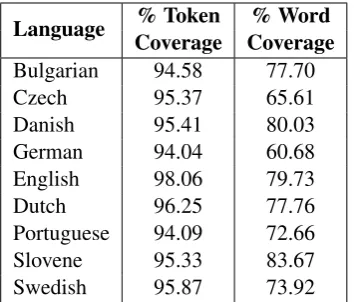
In Table 5, we present how well the vocabulary of each language’s embeddings covered the part of speech datasets. The datasets come from a differ-ent domain than Wikipedia, and this is reflected in the results.
In Table 6, we present the results of training the same neural network part of speech tagger with-out using our embeddings as initializations. We found that the embeddings benefited all the lan-guages we considered, and observed the greatest benefit in languages which had a small number of training examples. We believe that these results illustrate the performance
Language Coverage Coverage% Token % Word
Bulgarian 94.58 77.70
Czech 95.37 65.61
Danish 95.41 80.03
German 94.04 60.68
English 98.06 79.73
Dutch 96.25 77.76
[image:8.595.327.507.60.212.2]Portuguese 94.09 72.66 Slovene 95.33 83.67 Swedish 95.87 73.92
Table 5: Coverage statistics of the embedding’s vocabulary on the part of speech datasets after nor-malization. Token coverage is the raw percentage of words which were known, while the Word cov-erage ignores repeated words.
8 Conclusion
Distributed word representations represent a valu-able resource for any language, but particularly for resource-scarce languages. We have demonstrated how word embeddings can be used as off-the-shelf solution to reach near to state-of-art performance over a fundamental NLP task, and we believe that our embeddings will help researchers to develop tools in languages with which they have no exper-tise.
Moreover, we showed several examples of in-teresting semantic relations expressed in the em-beddings space that we believe will lead to inter-esting applications and improve tasks as semantic compositionality.
While we have only considered the properties of word embeddings as features in this work, it has been shown that using word embeddings in con-junction with traditional NLP features can
signifi-Language # Training AccuracyExamples Drop
[image:8.595.94.272.250.401.2]Bulgarian 200,049 -2.01% Czech 1,239,687 -0.86% Danish 96,581 -1.77% German 735,826 -0.89% English 950,561 -0.25% Dutch 208,418 -1.37% Portuguese 212,749 -0.91% Slovene 27,284 -2.68% Swedish 199,509 -0.82%
Table 6: Accuracy of randomly initialized tag-ger compared to our results. Using the embed-dings was generally helpful, especially in lan-guages where we did not have many training ex-amples. The scores presented are the best we found for each language (languages with more re-sources could afford to train longer before overfit-ting).
cantly improve results on NLP tasks (Turian et al., 2010; Collobert et al., 2011). With this in mind, we believe that the entire research community can benefit from our release of word embeddings for over 100 languages.
We hope that these resources will advance the study of possible pair-wise mappings between em-beddings of several languages and their relations. Our future work in this area includes improving the models by increasing the size of the context window and their domain adaptivity through in-corporating other sources of data. We will be investigating better strategies for modeling OOV words. We see improvements to OOV word han-dling as essential to ensure robust performance of the embeddings on real-world tasks.
Acknowledgments
This research was partially supported by NSF Grants DBI-1060572 and IIS-1017181, with ad-ditional support from TexelTek.
References
Susana Afonso, Eckhard Bick, Renato Haber, and Di-ana Santos. 2002. Floresta sint´a (c) tica”: a treebank for portuguese. InProc. of the Third Intern. Conf. on Language Resources and Evaluation (LREC), pages 1698–1703.
Pro-ceedings of the 24th International Conference on Computational Linguistics (Coling 2012), pages 53– 61, Mumbai, India, December. Coling 2012 Orga-nizing Committee.
Eduard Bejˇcek, Jarmila Panevov´a, Jan Popelka, Pavel Straˇn´ak, Magda ˇSevˇc´ıkov´a, Jan ˇStˇep´anek, and Zdenˇek ˇZabokrtsk´y. 2012. Prague Dependency Treebank 2.5 – a revisited version of PDT 2.0. In Proceedings of COLING 2012, pages 231–246, Mumbai, India, December. The COLING 2012 Or-ganizing Committee.
Yoshua Bengio and J-S Senecal. 2008. Adaptive im-portance sampling to accelerate training of a neu-ral probabilistic language model. Neural Networks, IEEE Transactions on, 19(4):713–722.
Y. Bengio, H. Schwenk, J.S. Sen´ecal, F. Morin, and J.L. Gauvain. 2006. Neural probabilistic language mod-els. Innovations in Machine Learning, pages 137– 186.
Y. Bengio, J. Louradour, R. Collobert, and J. Weston. 2009. Curriculum learning. In International Con-ference on Machine Learning, ICML.
James Bergstra, Olivier Breuleux, Fr´ed´eric Bastien, Pascal Lamblin, Razvan Pascanu, Guillaume Des-jardins, Joseph Turian, David Warde-Farley, and
Yoshua Bengio. 2010. Theano: a CPU and
GPU math expression compiler. In Proceedings of the Python for Scientific Computing Conference (SciPy), June. Oral Presentation.
John Blitzer, Ryan McDonald, and Fernando Pereira. 2006. Domain adaptation with structural correspon-dence learning. InConference on Empirical Meth-ods in Natural Language Processing, Sydney, Aus-tralia.
L´eon Bottou. 1991. Stochastic gradient learning in neural networks. In Proceedings of Neuro-Nˆımes 91, Nimes, France. EC2.
Sabine Brants, Stefanie Dipper, Silvia Hansen, Wolf-gang Lezius, and George Smith. 2002. The tiger
treebank. In IN PROCEEDINGS OF THE
WORK-SHOP ON TREEBANKS AND LINGUISTIC THEO-RIES, pages 24–41.
Thorsten Brants. 2000. Tnt: a statistical part-of-speech tagger. In Proceedings of the sixth confer-ence on Applied natural language processing, pages 224–231. Association for Computational Linguis-tics.
Peter F Brown, Peter V Desouza, Robert L Mercer, Vincent J Della Pietra, and Jenifer C Lai. 1992. Class-based n-gram models of natural language.
Computational linguistics, 18(4):467–479.
Minmin Chen, Zhixiang Xu, Kilian Weinberger, and Fei Sha. 2012. Marginalized denoising autoen-coders for domain adaptation. In John Langford and
Joelle Pineau, editors,Proceedings of the 29th Inter-national Conference on Machine Learning (ICML-12), ICML ’12, pages 767–774. ACM, New York, NY, USA, July.
Yanqing Chen, Bryan Perozzi, Rami Al-Rfou’, and Steven Skiena. 2013. The expressive power of word embeddings. CoRR, abs/1301.3226.
R. Collobert and J. Weston. 2008. A unified architec-ture for natural language processing: Deep neural networks with multitask learning. InInternational Conference on Machine Learning, ICML.
Ronan Collobert, Jason Weston, L´eon Bottou, Michael Karlen, Koray Kavukcuoglu, and Pavel Kuksa. 2011. Natural language processing (almost) from scratch. J. Mach. Learn. Res., 12:2493–2537, November.
Ronan Collobert. 2011. Deep learning for efficient discriminative parsing. InAISTATS.
Jeffrey Dean, Greg Corrado, Rajat Monga, Kai Chen, Matthieu Devin, Quoc Le, Mark Mao, Marc’Aurelio Ranzato, Andrew Senior, Paul Tucker, Ke Yang, and Andrew Ng. 2012. Large scale distributed deep net-works. In P. Bartlett, F.C.N. Pereira, C.J.C. Burges, L. Bottou, and K.Q. Weinberger, editors,Advances in Neural Information Processing Systems 25, pages 1232–1240.
Saˇso Dˇzeroski, Tomaˇz Erjavec, Nina Ledinek, Petr Pa-jas, Zdenek ˇZabokrtsky, and Andreja ˇZele. 2006. Towards a slovene dependency treebank. InProc. of the Fifth Intern. Conf. on Language Resources and Evaluation (LREC).
Xavier Glorot, Antoine Bordes, and Yoshua Bengio. 2011. Domain adaptation for large-scale sentiment classification: A deep learning approach. In Pro-ceedings of the Twenty-eight International Confer-ence on Machine Learning (ICML’11), volume 27, pages 97–110, June.
Jan Hajiˇc, Massimiliano Ciaramita, Richard Johans-son, Daisuke Kawahara, Maria Ant`onia Mart´ı, Llu´ıs M`arquez, Adam Meyers, Joakim Nivre, Sebastian Pad´o, Jan ˇStˇep´anek, Pavel Straˇn´ak, Mihai Surdeanu, Nianwen Xue, and Yi Zhang. 2009. The CoNLL-2009 shared task: Syntactic and semantic depen-dencies in multiple languages. In Proceedings of the 13th Conference on Computational Natural Lan-guage Learning (CoNLL-2009), June 4-5, Boulder, Colorado, USA.
Alexandre Klementiev, Ivan Titov, and Binod Bhat-tarai. 2012. Inducing crosslingual distributed rep-resentations of words. InProceedings of COLING 2012, pages 1459–1474, Mumbai, India, December. The COLING 2012 Organizing Committee.
Matthias Trautner Kromann. 2003. The danish depen-dency treebank and the dtag treebank tool. In Pro-ceedings of the Second Workshop on Treebanks and Linguistic Theories (TLT), page 217.
Mitchell P Marcus, Mary Ann Marcinkiewicz, and Beatrice Santorini. 1993. Building a large anno-tated corpus of english: The penn treebank. Compu-tational linguistics, 19(2):313–330.
T. Mikolov, M. Karafi´at, L. Burget, J. Cernocky, and S. Khudanpur. 2010. Recurrent neural network based language model.Proceedings of Interspeech.
Andriy Mnih and Geoffrey E Hinton. 2009. A scalable hierarchical distributed language model. Advances in neural information processing systems, 21:1081– 1088.
Frederic Morin and Yoshua Bengio. 2005. Hierarchi-cal probabilistic neural network language model. In
Proceedings of the international workshop on artifi-cial intelligence and statistics, pages 246–252.
Roberto Navigli and Simone Paolo Ponzetto. 2010. Babelnet: Building a very large multilingual seman-tic network. InProceedings of the 48th annual meet-ing of the association for computational lmeet-inguistics, pages 216–225. Association for Computational Lin-guistics.
Joakim Nivre, Jens Nilsson, and Johan Hall. 2006. Talbanken05: A swedish treebank with phrase struc-ture and dependency annotation. InProceedings of the fifth International Conference on Language Re-sources and Evaluation (LREC), pages 1392–1395.
Joakim Nivre, Johan Hall, Sandra K¨ubler, Ryan Mc-Donald, Jens Nilsson, Sebastian Riedel, and Deniz Yuret. 2007. The CoNLL 2007 shared task on de-pendency parsing. In Proceedings of the CoNLL Shared Task Session of EMNLP-CoNLL 2007, pages 915–932, Prague, Czech Republic, June. Associa-tion for ComputaAssocia-tional Linguistics.
Slav Petrov, Dipanjan Das, and Ryan McDonald. 2012. A universal part-of-speech tagset. In Nicoletta Cal-zolari (Conference Chair), Khalid Choukri, Thierry Declerck, Mehmet U˘gur Do˘gan, Bente Maegaard, Joseph Mariani, Jan Odijk, and Stelios Piperidis, ed-itors, Proceedings of the Eight International Con-ference on Language Resources and Evaluation (LREC’12), Istanbul, Turkey, may. European Lan-guage Resources Association (ELRA).
Sameer Pradhan, Alessandro Moschitti, Nianwen Xue, Olga Uryupina, and Yuchen Zhang. 2012. CoNLL-2012 shared task: Modeling multilingual unre-stricted coreference in OntoNotes. InProceedings of the Sixteenth Conference on Computational Natu-ral Language Learning (CoNLL 2012), Jeju, Korea.
David E Rumelhart, Geoffrey E Hinton, and Ronald J Williams. 2002. Learning representations by back-propagating errors.Cognitive modeling, 1:213.
Lu Shuxiang. 2004. The Contemporary Chinese Dic-tionary (Xiandai Hanyu Cidian). Commercial Press.
Kiril Simov, Petya Osenova, Milena Slavcheva, Sia Kolkovska, Elisaveta Balabanova, Dimitar Doikoff, Krassimira Ivanova, Er Simov, and Milen Kouylekov. 2002. Building a linguistically inter-preted corpus of bulgarian: the bultreebank. InIn: Proceedings of LREC 2002, Canary Islands.
Richard Socher, Eric H. Huang, Jeffrey Pennington, Andrew Y. Ng, and Christopher D. Manning. 2011. Dynamic pooling and unfolding recursive autoen-coders for paraphrase detection. In Advances in Neural Information Processing Systems 24.
Richard Socher, Brody Huval, Christopher D. Man-ning, and Andrew Y. Ng. 2012. Semantic com-positionality through recursive matrix-vector spaces. In Proceedings of the 2012 Conference on Em-pirical Methods in Natural Language Processing (EMNLP).
Oscar T¨ackstr¨om, Ryan McDonald, and Jakob Uszko-reit. 2012. Cross-lingual word clusters for direct transfer of linguistic structure. InProceedings of the 2012 Conference of the North American Chapter of the Association for Computational Linguistics: Hu-man Language Technologies, pages 477–487. Asso-ciation for Computational Linguistics.
J. Turian, L. Ratinov, and Y. Bengio. 2010. Word rep-resentations: a simple and general method for semi-supervised learning. InProceedings of the 48th An-nual Meeting of the Association for Computational Linguistics, pages 384–394. Association for Com-putational Linguistics.