Effectiveness and Efficiency of Open Relation Extraction
Filipe Mesquita Jordan Schmidek Denilson Barbosa
Department of Computing Science, University of Alberta, Canada {mesquita,schmidek,denilson}@ualberta.ca
Abstract
A large number of Open Relation Extrac-tion approaches have been proposed recently, covering a wide range of NLP machinery, from “shallow” (e.g., part-of-speech tagging) to “deep” (e.g., semantic role labeling–SRL). A natural question then is what is the trade-off between NLP depth (and associated com-putational cost) versus effectiveness. This pa-per presents a fair and objective expa-perimental comparison of 8 state-of-the-art approaches over 5 different datasets, and sheds some light on the issue. The paper also describes a novel method, EXEMPLAR, which adapts ideas from SRL to less costly NLP machinery, resulting in substantial gains both in efficiency and ef-fectiveness, over binary andn-ary relation ex-traction tasks.
1 Introduction
Open Relation Extraction (ORE) (Banko and Et-zioni, 2008) has become prevalent over traditional relation extraction methods, especially on the Web, because of the intrinsic difficulty in training indi-vidual extractors for every single relation. Broadly speaking, existing ORE approaches can be grouped according to the level of sophistication of the NLP techniques they rely upon: (1) shallow parsing, (2) dependency parsing and (3) semantic role labelling (SRL). Shallow methods annotate the sentences with part-of-speech (POS) tags and the ORE approaches in this category, such as ReVerb (Fader et al., 2011) and SONEX (Merhav et al., 2012), identify rela-tions by matching patterns over such tags. Depen-dency parsing gives unambiguous relations among
each word in the sentence, and the ORE approaches in this category such as PATTY (Nakashole et al., 2012), OLLIE (Mausam et al., 2012), and TreeK-ernel (Xu et al., 2013) identify whole subtrees con-necting the relation predicate and its arguments. Fi-nally, semantic annotators, such as Lund (Johans-son and Nugues, 2008) and SwiRL (Surdeanu et al., 2003), add roles to each node in a parse tree, en-abling ORE approaches that identify the precise con-nection between each argument and the predicate in a relation, independently.
The first contribution of the paper is an objec-tive and fair experimental comparison of the state-of-the-art in ORE, on 5 datasets with varying de-gree of “difficulty”. Of these, 4 datasets were an-notated manually, covering both well-formed sen-tences, from the New York Times (NYT) and the Penn Treebank, as well as mixed-quality sentences from a popular Web corpus. A much larger corpus with 12,000 sentences from NYT, automatically an-notated is also used. Another experiment focuses onn-ary relation extractions separately. The results show, as expected, that the three broad classes above are separated by orders of magnitude when it comes to throughput. Shallow methods handle ten times more sentences than dependency parsing methods, which in turn handle ten times more sentences than semantic parsing methods. Nevertheless, the cost-benefit trade-off is not as simple; and the higher computation cost of dependency or semantic parsing does not always pays off with higher effectiveness.
The second contribution of the paper is a new ORE method, called EXEMPLAR, which applies a key idea in semantic approaches (namely, to
tify the precise connection between the argument and the predicate words in a relation) over a depen-dency parse tree (i.e., without applying SRL). The goal is to achieve the higher accuracy of the seman-tic approaches at the lower computational cost of the dependency parsing approaches. EXEMPLAR is a rule-based system derived from a careful study of all dependency types identified by the Stanford parser. (Note, however, that other parsers can be used, as shown later on.) EXEMPLARworks for both binary and n-ary relations, and is evaluated separately in each case. For binary relations, EXEMPLAR outper-forms all previous methods in terms of accuracy, los-ing to the shallow methods only in terms of through-put. As forn-ary relations, EXEMPLARoutperforms the methods that support this kind of extraction.
2 Related Work
Others have pointed out the importance of under-standing the trade-off between “shallow” versus “deep” NLP in ORE. One side of the argument fa-vors shallow methods, claiming deep NLP costs or-ders of magnitude more and provide much less dra-matic gains in terms of effectiveness (Christensen et al., 2011). The counterpoint, illustrated with a re-cent analysis on a industrial-scale Web crawl (Dalvi et al., 2012), is that the diversity with which infor-mation is encoded in text is too high. Framing the debate as “shallow” versus “deep” is perhaps con-venient, but nevertheless an oversimplification. This paper sheds more light into the debate by compar-ing the state-of-the-art from three broad classes of approaches.
Shallow ORE. TextRunner (Banko and Etzioni, 2008) and its successor ReVerb (Fader et al., 2011) are based on the idea that most relations are pressed using few syntactic patterns. ReVerb, for ex-ample, detects only three types of relations (“verb”, “verb+preposition” and “verb+noun+preposition”). Following a similar approach, SONEX (Merhav et al., 2012) extends ReVerb by detecting patterns with appositions and possessives.
ORE via dependency parsing. PATTY (Nakas-hole et al., 2012) extracts textual patterns from sen-tences based on paths in the dependency graph. For all pairs of named entities, PATTY finds the shortest
Dataset Source # Sentences # Relations WEB-500 Search Snippets 500 461
NYT-500 New York Times 500 150
[image:2.612.311.539.64.110.2]PENN-100 Penn Treebank 100 51
Table 1: Binary relation datasets.
path in the dependency graph that connects the two named entities. They limit the search to only paths that start with one of these dependencies: nsubj, rc-mod and partrc-mod.
OLLIE (Mausam et al., 2012) also extracts rela-tions between two entities. It applies pattern tem-plates over the dependency subtree containing pairs of entities. Pattern templates are learned automat-ically from a large training set that is bootstrapped from high confidence extractions from ReVerb. OL-LIE merges binary relations that differ only in the preposition and second argument to produce n-ary extractions, as in: (A, “met with”, B) and (A, “met in”, C) leading to (A, “met”, [with B, in C]).
The TreeKernel (Xu et al., 2013) method uses a dependency tree kernel to classify whether candi-date tree paths are indeed instances of relations. The shortest path between the two entities along with the shortest path between relational words and an entity are used as input to the tree kernel. An expanded set of syntactic patterns based on those from ReVerb are used to generate relation candidates.
ORE via semantic parsing. Recently, a method based on SRL, called SRL-IE, has shown that the ef-fectiveness of ORE methods can be improved with semantic features (Christensen et al., 2011). We im-plemented our version of SRL-IE by relying on the output of two SRL systems: Lund (Johansson and Nugues, 2008) and SwiRL (Surdeanu et al., 2003). SwiRL is trained on PropBank and expands upon the syntactic features used in previous work. One of its major limitations is that it is only able to label ar-guments with verb predicates. Lund, on the other hand, is based on dependency parsing and is trained on both PropBank and NomBank, making it able to extract relations with both verb and noun predicates.
3 Experimental Study
Method NYT-500 WEB-500 PENN-100
Time P R F Time P R F Time P R F
ReVerb 0.02 0.70 0.11 0.18 0.01 0.92 0.29 0.44 0.02 0.78 0.14 0.23 SONEX 0.04 0.77 0.22 0.34 0.02 0.98 0.30 0.45 0.04 0.92 0.43 0.59 OLLIE 0.05 0.62 0.27 0.38 0.04 0.81 0.29 0.43 0.14 0.81 0.43 0.56 EXEMPLAR[M] 0.08 0.70 0.39 0.50 0.06 0.95 0.44 0.61 0.16 0.83 0.49 0.62
EXEMPLAR[S] 1.03 0.73 0.39 0.51 0.47 0.96 0.46 0.62 0.62 0.79 0.51 0.62
PATTY 1.18 0.49 0.23 0.32 0.48 0.71 0.48 0.57 0.66 0.46 0.24 0.31 SwiRL 2.96 0.63 0.10 0.17 1.73 0.97 0.34 0.50 2.17 0.89 0.16 0.27 Lund 11.40 0.78 0.24 0.37 2.69 0.91 0.37 0.52 5.21 0.86 0.35 0.50
[image:3.612.110.504.62.189.2]TreeKernel – – – – – – – – 0.85 0.85 0.33 0.48
Table 2: Results for the task of extracting binary relations. Methods are ordered by computing time per sentence (in seconds). Best results for each column are underlined and marked in bold, for clarity.
SONEX, OLLIE, PATTY, TreeKernel, SwiRL, Lund and our two variants of our method, EX
-EMPLAR, explained in detail in Appendix A: (1) EXEMPLAR[S] uses the Stanford parser (Klein and Manning, 2003) and (2) EXEMPLAR[M] uses the Malt parser (Nivre and Nilsson, 2004).
3.1 Binary Relations – Setup
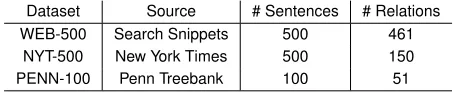
We start by evaluating the extraction of binary re-lations. Table 1 shows our experimental datasets. WEB-500 is a commonly used dataset, developed for the TextRunner experiments (Banko and Etzioni, 2008). These sentences are often incomplete and grammatically unsound, representing the challenges of dealing with web text. NYT-500 represents the other end of the spectrum with formal, well written new stories from the New York Times Corpus (Sand-haus, 2008). PENN-100 contains sentences from the Penn Treebank recently used in an evaluation of the TreeKernel method (Xu et al., 2013). We manu-ally annotated the relations for WEB-500 and NYT-500 and use the PENN-100 annotations provided by TreeKernel’s authors (Xu et al., 2013).
We annotate each sentence manually as follows. We identify exactly two entities and atrigger(a sin-gle token indicating a relation–see Section A.3) for the relation between them, if one exists. In addi-tion, we specify awindow of tokens allowed to be in a relation, including modifiers of the trigger and prepositions connecting triggers to their arguments. For each sentence annotated with two entities, a sys-tem must extract a string representing the relation between them. Our evaluation method deems an ex-traction as correct if it contains the trigger and
al-lowed tokens only.
In our annotated sentences, entities are enclosed in triple square brackets, triggers and enclosed in triple curly brackets and the window of allowed to-kens is defined by arrows (“--->” and “<---”), as in this example:
I’ve got a media call about [[[ORG Google]]] --->’s
{{{acquisition}}} of<--- [[[ORG YouTube]]] --->today<---.
where “Google” and “YouTube” are entities of the type organization, “acquisition” is the trigger and the allowed tokens are “acquisition”, “’s” and “of”. We include time and location modifiers (e.g., “today”, “here”) in the list of allowed tokens since OLLIE ex-tracts them as part of the relation. OLLIE’s extrac-tions may also include auxiliary verbs and preposi-tions that are not present in the original sentence. To be fair with OLLIE, we remove auxiliary verbs and prepositions from OLLIE extractions.
Our benchmarks are available upon request.
“Europe” and “Asia” in the original sentences that could conflict with our entity placeholders.
For methods that extract relations between noun phrases (ReVerb, OLLIE, SwiRL and Lund), there is the additional task of identifying whether a noun phrase containing additional words surround-ing “Europe” and “Asia” is still a reference to the an-notated entity. For example, “the beautiful Europe” refers to the entity, while “Europe’s enemy” does not. In our evaluation, we ignore noun phrases that do not reference the annotated entity. For SwiRL and Lund, we ignore any noun phrase that do not present “Europe” or “Asia” as its head word. For ReVerb and OLLIE, we ignore noun phrases that do not contain these words in the end of the phrase.
Metrics. Our evaluation focuses on sentence-level extractions. Therefore, we only apply the steps of each method that perform this task. Additional steps to merge relations and remove infrequent relations are not applied. In addition, we assume there is only one relation between a pair of entities in a sen-tence. The number of entity pairs with more than one relation was insignificant in our datasets (less than 0.5%).
The metrics used in this analysis are precision (P), recall (R) and f-measure (F), defined as usual:
P = # correct
# extractions, R=
# correct # relations, F =
2P R P +R
where “# correct” is the number of extractions deemed as correct.
We also measure the total computing time of each method, excluding initialization or loading any li-braries or models in memory. To ensure a fair com-parison, we make sure each method runs in a single-threaded mode, thus utilizing a single computing core at all times.
3.2 Binary Relations – Results
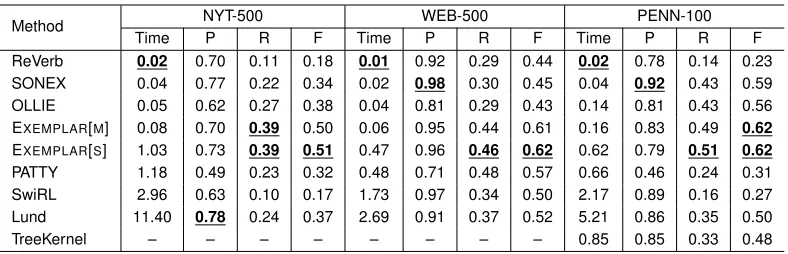
Table 2 presents the results for our experiment with binary relations. WEB-500 turned out to contain the easiest sentences as evidenced by the precision of all methods in this dataset. This is because WEB-500 sentences were collected by querying a search engine with known relation instances. The other two datasets, on the other hand, contain randomly chosen sentences. Although WEB-500 is a popular
0.2 0.3 0.4 0.5 0.6 0.7
0.01 0.1 1 10
f-measure
seconds per sentence
EXEMPLAR[S] EXEMPLAR[M]
REVERB SONEX
OLLIE LUND
[image:4.612.317.530.67.216.2]SWIRL PATTY
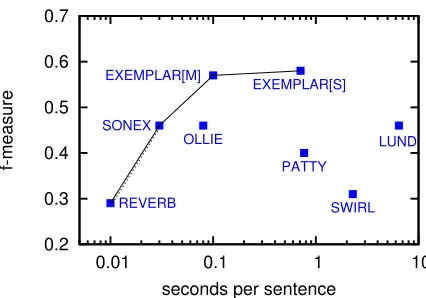
Figure 1: Average f-measure vs average time for NYT-500, WEB-500 and PEN-100.
0.5 0.6 0.7 0.8 0.9 1
0 0.1 0.2 0.3 0.4 0.5 0.6
precision
recall
EXEMPLAR[S]
EXEMPLAR[M] REVERB
SONEX
OLLIE LUND SWIRL
[image:4.612.316.534.278.425.2]PATTY
Figure 2: Average precision vs average recall for NYT-500, WEB-500 and PEN-100.
dataset, it perhaps does not represent the challenges found in web text.
We were unable to run TreeKernel for NYT-500 and WEB-500 for lack of training data. We ran TreeKernel, as trained by its authors, on the same test set used in their paper (Xu et al., 2013).
Comparing methods based on effectiveness (f-measure) or efficiency (computational cost) alone can be misleading. To do so, we compare methods in terms ofdominance. We say methodAdominates methodBifAis: (1)more effectiveand as efficient asB; (2)more efficientand as effective asB; or (3) both more effective and more efficient thanB. The methods that are not dominated by any other form the state-of-the-art.
all methods, averaged over all datasets (TreeKernel was not included due to missing results). For effi-ciency, there is a clear separation of approximately one order of magnitude among methods based on shallow parsing (ReVerb and SONEX), dependency parsing (OLLIE, EXEMPLAR[M], EXEMPLAR[S], and PATTY) and semantic parsing (SwiRL and Lund). The lines in the plot identify the state-of-the-art before (dashed) and after (solid) EXEMPLAR. (Note: Although not clear in the figure, OLLIE and Lund are dominated by SONEX as they tie in terms of effectiveness.)
In terms of efficiency, EXEMPLAR[M] and EX
-EMPLAR[S] closely match OLLIE and PATTY, re-spectively, since they use the same dependency parsers. EXEMPLAR outperforms both systems by covering a larger number of relational patterns. This is possible because EXEMPLARlooks at each
argu-ment separately, as opposed to the whole subtree connecting two arguments. As it turns out, this de-sign choice greatly simplifies the task of dede-signing good patterns.
The poor performance of PATTY is due to its rather permissive sentence-level extraction of rela-tions, which looks at the shortest path between argu-ments. PATTY relies on redundancy of extractions to normalize the produced relations in order to re-cover from mistakes done in the sentence-level.
Figure 2 illustrates the dominance relation dif-ferently, using precision versus recall. Again, the dashed line shows the previous state-of-the-art, and the solid line shows the current situation. SONEX dominates PATTY and Lund, since they tied in recall. OLLIE, however, achieved greater recall than SONEX. Somewhat surprisingly, EXEMPLAR
presents 44% more recall than the more sophisti-cated Lund, at a close level of precision. This can be explained by Lund’s dependency on training data, which contains only a subset of all possible pred-icates and roles. The importance of relations trig-gered by nouns is illustrated by the higher recall of SONEX and Lund when compared, respectively, to ReVerb and SwiRL, similar methods that handle verb triggers only.
3.3 Binary Relations – Discussion
Differences in annotation. It is worth noting some differences between our annotations
(WEB-500 and NYT-(WEB-500) and the annotations from PEN-100. The first difference concerns the definition of an entity. Consider the following sentence from PEN-100:
“. . . says Leslie Quick Jr., chairman of the Quick & Reilly discount brokerage firm.”
Unlike our annotation style, the original annotation defines that “Leslie Quick Jr.” is the chairman of “the Quick & Reilly discount brokerage firm”, as op-posed to “Quick & Reilly”. While we consider the words surrounding “Quick & Reilly” as apposition, the original consider them as part of the entity.
Another difference concerns the definition of the RE task. We assume that RE methods are respon-sible for resolving co-references when necessary to identify a relation. For example, consider the sen-tence:
“It also marks P&G’s growing concern that its Japanese rivals, such as Kao Corp., may bring their superconcentrates to the U.S.”
According to our annotation style, there is a rela-tion “rivals” between “P&G” and “Kao Corp.” in this sentence. On the other hand, the original an-notations for PENN-100 consider only the relation between “Kap Corp.” and the pronoun “it”, leav-ing the task of resolvleav-ing the coreference between “P&G” and “it” as a posterior step.
These differences in annotation illustrate the chal-lenges of producing a benchmark for open relation extraction.
Differences in evaluation methodology. A
sentence-levelevaluation like ours focuses on each sentence, separately. On the other hand, the evalua-tions of SONEX, ReVerb, PATTY, TreeKernel and OLLIE are performed atthe corpus level. Corpus-level evaluations consider an extracted relation as correct regardless of whether a method was able to identify one or all sentences that describe this relation.
Method NYTn-ary
Time P R F
EXEMPLAR[M] 0.11 0.94 0.40 0.56
OLLIE 0.12 0.87 0.14 0.25 EXEMPLAR[S] 0.88 0.92 0.39 0.55 SwiRL 2.90 0.94 0.30 0.45
[image:6.612.337.511.62.177.2]Lund 9.20 0.95 0.36 0.53
Table 3: Results forn-ary relations.
method’s extractions. This manual inspection mea-sures a method’s precision, but is unable to measure recall.
Other differences in methodology are as follows. PATTY’s evaluation concerns relation patterns (e.g., “wrote hits for”) and their type signatures (e.g. Musician–Musician), as opposed to the relation it-self, which includes its two arguments. The eval-uations of ReVerb and OLLIE consider any noun phrase as a potential argument, while the evaluations of TreeKernel and SONEX consider named entities only.
Due to the lack of a ground truth and differences in evaluation methodology, results from different pa-pers are usually not comparable. This work tries to alleviate this problem by providing reusable annota-tions that are flexible and can be used to evaluate a wide range of methods.
3.4 n-ary Relations
The goal of this experiment is to evaluate the accu-racy and performance of our method when extract-ingn-ary relations (n >2). For this experiment, we manually tagged 222 sentences withn-ary relations from the New York Times. Every sentence is anno-tated with a single relation trigger and its arguments. This experiment measures precision and recall over the extracted arguments. For each sentence, a system can extract a number of relations of the form r(a1, a2, . . . , an), whereris the relation name and ai is an argument. We only use the extracted rela-tion whose name contains the annotated trigger, if it exists. An argument of such relation is deemed a correct extraction if it is annotated in the sentence; otherwise, it is deemed incorrect.
Precision and recall are now defined as follows:
P = # correct
# extracted args, R=
# correct # annotated args.
Method NYT 12K
Time P R F
ReVerb 0.01 0.84 0.11 0.19 OLLIE 0.02 0.85 0.22 0.35 SONEX 0.03 0.87 0.20 0.32 EXEMPLAR[M] 0.05 0.87 0.26 0.40 EXEMPLAR[S] 1.20 0.86 0.29 0.43
[image:6.612.102.274.63.145.2]PATTY 1.29 0.86 0.18 0.30 SwiRL 3.58 0.87 0.16 0.27 Lund 11.28 0.86 0.21 0.33
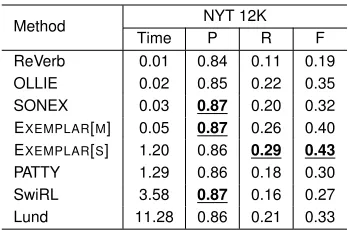
Table 4: Results for binary relations automatically annotated using Freebase and WordNet.
where “# correct” is the number of arguments deemed as correct. There are 765 annotated argu-ments in total. Table 3 reports the results for our experiment with n-ary relations. EXEMPLAR[M]
shows a 6% increase in f-measure over Lund, the second best system, while being almost two orders of magnitude faster.
3.5 Automatically Annotated Sentences
The creation of datasets for open RE is an extremely time-consuming task. In this section we investigate whether external data sources such as Freebase1and WordNet2 can be used to automatically annotate a dataset, leading to a useful benchmark.
Ourautomatic annotatoridentifies pairs of enti-ties and a trigger of the relation between them. It does so by first trying to link all entities to Wikipedia (and consequently to Freebase, since Freebase is linked to Wikipedia) by using the method proposed by (Cucerzan, 2007). Given two entities appearing within 10 tokens of each other in a sentence, our an-notator checks whether there is a relation connect-ing them in Freebase. If such a relation exists, the annotator looks for a trigger in the sentence. A trig-ger must be a synonym for the Freebase relation (ac-cording to WordNet) and its distance to the nearest entity cannot be more than 5 tokens.
We applied this method for the New York Times and were able to annotate over 60,000 sentences with over 13,000 distinct entity pairs. For our ex-periments, we randomly selected one sentence for each entity pair and separated a thousand for devel-opment and over 12,000 for test.
1http://www.freebase.com 2
Comparing with human annotators. Although we expect our automatic annotator to be less accu-rate than a human annotator, we are interested to measure the difference in accuracy between them. To do so, two authors of this paper looked at our de-velopment set and marked each sentence as correct or incorrect. The agreement (that is, the percent-age of matching answers) between the humans was 82%. On other hand, the agreement between our automatic annotator and each human was 71% and 72%. This shows that our annotator’s accuracy is not too far below human’s level of accuracy.
Table 4 shows the results for the test sentences. Both EXEMPLAR[S] and EXEMPLAR[M] outper-formed all systems in recall, while keeping the same level of precision.
4 Conclusion
This work presents a fair and objective evaluation of several ORE methods, shedding some light on the trade-offs between f-measure and computational as well as precision and recall. Our evaluation is able to assess the effectiveness of different methods by specifying a trigger and a window of allowed tokens for each relation.
EXEMPLAR’s promising results indicate that rule-based methods may still be very competitive, espe-cially if rules are applied to each argument sepa-rately. Looking at the recall levels of different meth-ods, we conjecture that EXEMPLAR outperforms machine learning methods like Ollie and TreeKer-nel, because its rules apply in cases not trained by these methods. From a pragmatic point of view, EX -EMPLARis also preferable because it doesn’t require training data.
An interesting research question is whether ma-chine learning can be used to learn more rules for EXEMPLARin order to improve recall without loss
in precision. Rules could be learned from both de-pendency parsing and shallow parsing, or just shal-low parsing if computing time is extremely limited.
The next step for our experimental study is to evaluate corpus-level extractions, where an auto-matic annotator is essential due to the massive num-ber of annotations required for even one relation, let alone thousands.
Acknowledgements
We thank the anonymous reviewers for useful sug-gestions to improve the paper, and the Natural Sci-ences and Engineering Council of Canada, through the NSERC Business Intelligence Network, for fi-nancial support.
A EXEMPLAR
ORE methods must recognize relations from the text alone. To do this, each method tries to model how relations are expressed in English. Banko and Et-zioni claim that more than 90% of binary relations are expressed through a few syntactic patterns, such as “verb” and “noun+preposition” (Banko and Et-zioni, 2008). It is unclear, however, whethern-ary relations follow.
This section presents a study focusing on how n-ary relations (n >2) are expressed in English, based on 100 distinct relations manually annotated from a random sample of 514 sentences in the New York Times Corpus (Sandhaus, 2008).
Table 5 shows six syntactic patterns that cover 86% of our n-ary relations. These patterns are slightly different from those used for binary rela-tions. In binary relations, the pattern implicitly de-fines the roles of the two arguments. For instance, a relation “met with” indicates that the first argu-ment is the subject and the second one is the object of “with”. In order to representn-ary relations, our patterns do not contain prepositions, possessives or any other word connecting the relation to the argu-ment. For instance, the sentence “Obama met with Putin in Russia” contains the relation “meet” along three arguments: “Obama” (subject), “Putin” (object of preposition with) and “Russia” (object of prepo-sition in).
Pattern Frequency Example
[image:8.612.126.488.65.131.2]Verb 30% HingisbeatSteffi Graf in the Italian Open two weeks ago. Apposition+noun 19% Jaden and Willow, thefamous childrenof Will Smith, ... Passive verb 14% Jumbo the Elephantwas exportedfrom Sudan to Paris. Verb+noun 14% D-League willmove its officesfrom Greenville to New York. Copula+noun 5% Kimballwas aFulbrightscholarat the University of Heidelberg. Nominalized verb 4% Thousands died in Saddam Hussein’sattackon Halabja in 1988.
Table 5: Patterns representing 86% of the relations with three or more arguments. Frequencies collected from 100 relations from the New York Times Corpus. Relation triggers are highlighted in bold.
Relation Type Freq. Example Variations
Verb 48% beat Pass. verb, nom. verb Copula+noun 24% is son Apposition+noun Verb+noun 14% sign deal –
Table 6: Relation types recognized by EXEMPLAR.
[image:8.612.325.520.305.380.2]andcopula+noun.
Table 6 present the relation types found through our analysis. We developed EXEMPLAR to specifi-cally recognize these relation types, including their variations.
Argument roles. An argument role defines how an argument participates in a relation. In ORE, the roles for each relation are not provided and must also be recognized from the text.
We use the following roles: subject, direct object and prep object. An argu-ment has a roleprep object when its connected to the relation by a preposition. The roles of prepositional objects consist of their preposition and the suffix “ object”, indicating that each preposition corresponds to a different role. In the sentence “Obama is the president of the U.S.”, “U.S.” is an object of the preposition “of” and has the role of object.
Multiple entities can play the same role in a relation instance. For instance, in the sentence “Obama and Putin discuss the Syria conflict”, both “Obama” and “Putin” have thesubjectrole. Fur-thermore, some relations accept less roles than oth-ers. Verb relations accept all three roles, while cop-ula+noun and verb+noun relations acceptsubject andprep objectonly.
Our roles are different from those used in SRL. SRL roles carry semantic information across differ-ent relations. This information is unavailable for ORE systems, and for this reason, we rely on syn-tactic roles. An open problem is to determine which
subject: “NFL”
relation: “approve new stadium”
of object: “Falcons”
in object: “Atlanta”
Figure 3: A relation instance extracted by EXEM
-PLARfor the sentence “NFL approves Falcons’ new stadium in Atlanta”.
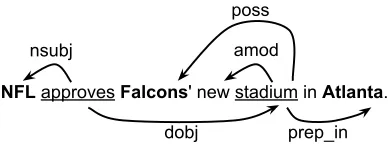
NFL approves Falcons' new stadium in Atlanta.
nsubj amod
poss
dobj prep_in
Figure 4: A input sentence after pre-processing. En-tities are in bold, triggers are underline and arrows represent dependencies.
syntactic roles correspond to the same semantic role across different relations (Chambers and Jurafsky, 2011). However, this problem is out of the scope of this work.
A.1 The method
EXEMPLARtakes a stream of textual documents and extracts instances ofn-ary relations as illustrated in Figure 3.
A.2 Preprocessing
such as the Malt parser (Nivre and Nilsson, 2004). Figure 4 illustrates our running example where each word is a token and arrows represent dependen-cies among tokens. In this example, “stadium” de-pends on “approves” and the arrow connecting them can be read as “the direct object ofapprovesis sta-dium”.
Extracting Named Entities. EXEMPLAR
em-ploys the Stanford NER (Finkel et al., 2005) to rec-ognize named entities. We consider these types of entities: people, organization, location, miscella-neous and date. Figure 4 shows entities highlighted in bold.
A.3 Detecting triggers
After recognizing entities, EXEMPLAR detects re-lation triggers. A trigger is a single token that in-dicates the presence of a relation. A relation may present one or two triggers. For instance, the rela-tion in our running example has two triggers. EX
-EMPLARalso uses triggers to determine the relation name, as discussed later.
A trigger can be any noun or verb that was not tagged as being part of an entity mention. Other re-quirements are enforced for each canonical pattern.
Verb relations. A verb relation is triggered by a verb that does not include a noun as its direct object. The name of the relation is the trigger’s lemma.
A noun must be a nominalized verb to be a trigger for verb relations. To identify nominalized verbs, EXEMPLARchecks if a noun is filed under the type
“event” in Wordnet’s Morphosemantic Database3. Doing so may generate false positives; however, EXEMPLAR has a filtering step to eliminate these false positives, as discussed later.
The name of a relation triggered by a nominalized verb is the trigger’s original verb (before nominal-ization). For instance, “donation” triggers the rela-tion “donate”.
Copula+noun relations. Only noun triggers are accepted for copula+noun relations. The copula used in the relation name can be a verb with cop-ula dependency to the trigger, or the verb “be” for
3
http://wordnetcode.princeton.edu/ standoff-files/morphosemantic-links.xls
appositions. The relation name is the concatena-tion of the copula’s lemma and the trigger’s lemma along its modifiers. For instance, the relation in the sentence “Jaden and Willow, the famous children of Will Smith” is “be famous child”.
Verb+noun relations. EXEMPLAR recognizes
two triggers for each verb+noun relation: a verb and a noun acting as its direct object. The relation name is defined by concatenating the verb’s lemma with the the noun and its modifiers. In our running example, “approves” and “stadium” trigger the relation “approve new stadium”.
A.4 Detecting candidate arguments
After relation triggers are identified, EXEMPLAR
proceeds to detect theircandidate arguments. For this, we look at the dependency between each entity and a trigger separately. EXEMPLAR relies on two observations: (1) an argument is often adjacent to a trigger in the dependency graph, and (2) the type of the dependency can accurately predict whether an entity is an argument for the relation or not.
Table 7 enumerates 12 types of dependencies (from a total of 53) that often connect arguments and triggers. EXEMPLARidentifies as a candidate argu-ment every entity that is connected to trigger, as long as their dependency type is listed in Table 7.
Our observations can be seen in our running ex-ample. The entities “NFL” and “Atlanta” depends on the trigger “approves” and “Falcons” depend on the trigger “stadium”. Since their dependency types are listed in Table 7, these entities are marked as can-didate arguments.
A.5 Role Detection
EXEMPLAR determines the role of an argument
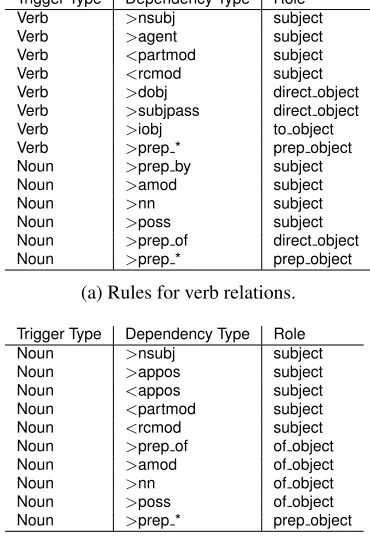
based on the trigger type (noun or verb), the type of dependency between the trigger and argument and the direction of the dependency. To take into ac-count the dependency direction, we prefix each de-pendency type with “>” when an entity depends on the trigger and “<” when the trigger depends on the entity.
Table 8 shows EXEMPLAR’s rules that assign
Dependency Example
nsubj (Subject) Romeoloves Juliet dobj (Direct Object) ThePrinceexiles Romeo nsubjpass (Pass. Subj.) Romeowas seen in Verona agent (Pass. Voice Obj.) Juliet is loved byRomeo
iobj (Indirect Object) Romeo gaveJulieta kiss poss (Possessive) Romeo’s father Montague appos (Apposition) Capulet, Juliet’s father, amod (Adj. Modifier) TheItaliancity of Verona nn (Noun Comp. Mod.) Romeo’s cousinBenvolio
prep * (Prep. Modifier) Romeo lived inVerona
[image:10.612.83.292.62.187.2]partmod (Participal Mod.) Romeo, born in Italy rcmod (Rel. Clause Mod.) Juliet, who loved Romeo
Table 7: Dependencies connecting arguments and triggers. Arguments are in bold and triggers are un-derlined.
If trigger type = trigger and dependency type =dependencythen assignrole.
For example, the first rule in Table 8a specifies that an argument must be assigned the role of a sub-jectif this argument depends on a verbtrigger and the dependency type is>nsubj.
Rules are ordered by descending priority in Ta-ble 8. In case several rules can be applied for an ar-gument, we apply only the rule with higher priority. If none of the rules applies to an argument, EXEM
-PLARremoves this argument from the relation.
Exceptions. There are three exceptions for the rules above. The first exception concerns argu-ments of verb relations whose dependency type is <partmod or<rcmod. EXEMPLARchooses the role of direct object(as oppose to subject) for these ar-guments when the verb trigger is in passive form. For instance, in the sentence “Barbie, (which was) invented by Handler”, “Barbie” has the role di-rect objectbecause “invented” is in passive form.
The second exception is for nominalized verbs followed by the preposition “by”, such as in “Geor-gian invasion by Russia”. Arguments of this type of trigger with dependency types >nn, >amod or >poss are assigned the roledirect object.
Finallly, there is an exception for copula+noun relations expressed with close appositions of the form: “determiner entity noun”. An example is “the Greenwood Heights section of Brooklyn”. Here, EXEMPLARassigns thesubjectrole to the entity be-tween the determiner and the noun.
Trigger Type Dependency Type Role
Verb >nsubj subject
Verb >agent subject
Verb <partmod subject
Verb <rcmod subject
Verb >dobj direct object Verb >subjpass direct object
Verb >iobj to object
Verb >prep * prep object Noun >prep by subject
Noun >amod subject
Noun >nn subject
Noun >poss subject
Noun >prep of direct object Noun >prep * prep object
(a) Rules for verb relations.
Trigger Type Dependency Type Role
Noun >nsubj subject
Noun >appos subject
Noun <appos subject
Noun <partmod subject
Noun <rcmod subject
Noun >prep of of object
Noun >amod of object
Noun >nn of object
Noun >poss of object
Noun >prep * prep object
(b) Rules for copula+noun relations.
Trigger Type Dependency Type Role
Verb >nsubj subject
Verb >agent subject
Verb <partmod subject
Verb <rcmod subject
Verb >iobj to object
Verb >prep * prep object
Noun >amod of object
Noun >nn of object
Noun >poss of object
Noun >prep * prep object
[image:10.612.330.515.69.340.2](c) Rules for verb+noun relations.
Table 8: Rules for assigning roles to arguments.
A.6 Filtering Relations
The final step in EXEMPLAR is to remove incom-plete relations. EXEMPLARremoves relations with less than two arguments and relations that do not presentsubjectanddirect object.
References
Michele Banko and Oren Etzioni. 2008. The tradeoffs between open and traditional relation extraction. In Proceedings of the Annual Meeting of the Association for Computational Linguistics, pages 28–36, Colum-bus, Ohio, June. Association for Computational Lin-guistics.
Nathanael Chambers and Dan Jurafsky. 2011. Template-based information extraction without the templates. In Proceedings of the 49th Annual Meeting of the Asso-ciation for Computational Linguistics: Human Lan-guage Technologies - Volume 1, HLT ’11, pages 976– 986, Stroudsburg, PA, USA. Association for Compu-tational Linguistics.
Janara Christensen, Mausam, Stephen Soderland, and Oren Etzioni. 2011. An analysis of open informa-tion extracinforma-tion based on semantic role labeling. In Proceedings of the Sixth International Conference on Knowledge Capture, pages 113–120. Association for Computational Linguistics.
Silviu Cucerzan. 2007. Large-scale named entity dis-ambiguation based on wikipedia data. In Proceed-ings of Conference on Empirical Methods in Natu-ral Language Processing and Computational NatuNatu-ral Language Learning, EMNLP-CoNLL’12, pages 708– 716.
Nilesh Dalvi, Ashwin Machanavajjhala, and Bo Pang. 2012. An analysis of structured data on the web.Proc. VLDB Endow., 5(7):680–691.
Anthony Fader, Stephen Soderland, and Oren Etzioni. 2011. Identifying Relations for Open Information Extraction. In Proceedings of Conference on Em-pirical Methods in Natural Language Processing, EMNLP’12.
Jenny Rose Finkel, Trond Grenager, and Christopher Manning. 2005. Incorporating non-local informa-tion into informainforma-tion extracinforma-tion systems by gibbs sam-pling. InProceedings of the 43rd Annual Meeting on Association for Computational Linguistics, ACL’05, pages 363–370, Stroudsburg, PA, USA. Association for Computational Linguistics.
Richard Johansson and Pierre Nugues. 2008. Dependency-based semantic role labeling of propbank. In Proceedings of the Conference on Empirical Methods in Natural Language Processing,
EMNLP’08, pages 69–78, Stroudsburg, PA, USA. Association for Computational Linguistics.
Dan Klein and Christopher D. Manning. 2003. Accurate unlexicalized parsing. InProceedings of the 41st An-nual Meeting on Association for Computational Lin-guistics - Volume 1, ACL’03, pages 423–430, Strouds-burg, PA, USA. Association for Computational Lin-guistics.
Mausam, Michael Schmitz, Robert Bart, Stephen Soder-land, and Oren Etzioni. 2012. Open language learning for information extraction. InProceedings of Confer-ence on Empirical Methods in Natural Language Pro-cessing and Computational Natural Language Learn-ing, EMNLP-CoNLL’12.
Yuval Merhav, Filipe de S´a Mesquita, Denilson Barbosa, Wai Gen Yee, and Ophir Frieder. 2012. Extracting information networks from the blogosphere. TWEB, 6(3):11.
Ndapandula Nakashole, Gerhard Weikum, and Fabian Suchanek. 2012. Patty: a taxonomy of relational patterns with semantic types. InProceedings of the 2012 Joint Conference on Empirical Methods in ural Language Processing and Computational Nat-ural Language Learning, EMNLP-CoNLL’12, pages 1135–1145, Stroudsburg, PA, USA. Association for Computational Linguistics.
Joakim Nivre and Jens Nilsson. 2004. Memory-based dependency parsing. InProceedings of Computational Natural Language Learning, CoNLL’04.
Evan Sandhaus. 2008. The new york times anno-tated corpus. http://www.ldc.upenn.edu/ Catalog/catalogEntry.jsp?catalogId= LDC2008T19.
Mihai Surdeanu, Sanda Harabagiu, John Williams, and Paul Aarseth. 2003. Using predicate-argument struc-tures for information extraction. In Proceedings of the 41st Annual Meeting on Association for Computa-tional Linguistics-Volume 1, pages 8–15. Association for Computational Linguistics.