A Walk-based Semantically Enriched Tree Kernel
Over Distributed Word Representations
Shashank Srivastava1 Dirk Hovy2 Eduard Hovy1 (1) Carnegie Mellon University, Pittsburgh
(2) Center for Language Technology, University of Copenhagen, Denmark {ssrivastava,hovy}@cmu.edu,[email protected]
Abstract
In this paper, we propose a walk-based graph kernel that generalizes the notion of tree-kernels to continuous spaces. Our proposed approach subsumes a general framework for word-similarity, and in particular, provides a flexible way to incorporate distributed repre-sentations. Using vector representations, such an approach captures both distributional se-mantic similarities among words as well as the structural relations between them (encoded as the structure of the parse tree). We show an ef-ficient formulation to compute this kernel us-ing simple matrix operations. We present our results on three diverse NLP tasks, showing state-of-the-art results.
1 Introduction
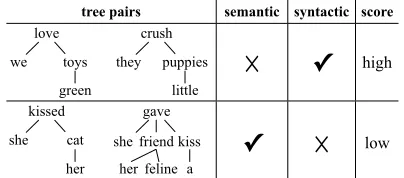
Capturing semantic similarity between sentences is a fundamental issue in NLP, with applications in a wide range of tasks. Previously, tree kernels based on common substructures have been used to model similarity between parse trees (Collins and Duffy, 2002; Moschitti, 2004; Moschitti, 2006b). These kernels encode a high number of latent syntactic features within a concise representation, and com-pute the similarity between two parse trees based on the matching of node-labels (words, POS tags, etc.), as well as the overlap of tree structures. While this is sufficient to capture syntactic similarity, it does not capturesemantic similarityvery well, even when using discrete semantic types as node labels. This constrains the utility of many traditional tree kernels in two ways: i) two sentences that are syntactically identical, but have no semantic similarity can receive a high matching score (see Table 1, top) while ii) two sentences with only local
syntactic overlap, but high semantic similarity can receive low scores (see Table 1, bottom).
tree pairs semantic syntactic score
ჴ
✓
high✓
ჴ
lowlove we toys
crush they puppies
kissed
she cat
gave
she her
kiss a friend
feline green little
[image:1.612.324.526.246.335.2]her
Table 1: Traditional tree kernels do not capture se-mantic similarity
In contrast, distributional vector representations of words have been successful in capturing fine-grained semantics, but lack syntactic knowledge. Resources such as Wordnet, dictionaries and on-tologies that encode different semantic perspectives can also provide additional knowledge infusion.
In this paper, we describe a generic walk-based graph kernel for dependency parse trees that sub-sumes general notions of word-similarity, while focusing on vector representations of words to capture lexical semantics. Through a convolutional framework, our approach takes into account the distributional semantic similarities between words in a sentence as well as the structure of the parse tree. Our main contributions are:
1. We present a new graph kernel for NLP that ex-tends to distributed word representations, and diverse word similarity measures.
2. Our proposed approach provides a flexible framework for incorporating both syntax and semantics of sentence level constructions.
3. Our generic kernel shows state-of-the-art per-formance on three eclectic NLP tasks.
2 Related Work
Tree kernels in NLP Tree kernels have been ex-tensively used to capture syntactic information about parse trees in tasks such as parsing (Collins and Duffy, 2002), NER (Wang et al., 2010; Cumby and Roth, 2003), SRL (Moschitti et al., 2008) and rela-tion extracrela-tion (Qian et al., 2008). These kernels are based on the paradigm that parse trees are similar if they contain many common substructures, consist-ing of nodes with identical labels (Vishwanathan and Smola, 2003; Collins and Duffy, 2002). Moschitti (2006a) proposed a partial tree kernel that adds flex-ibility in matching tree substructures. Croce et al. (2011) introduce a lexical semantic tree kernel that incorporates continuous similarity values between node labels, albeit with a different focus than ours and would not match words with different POS. This would miss the similarity of “feline friend” and “cat” in our examples, as it requires matching the adjective “feline” with “cat”, and verb “kissed” with “kiss”.
Walk based kernels Kernels for structured data derive from the seminal Convolution Kernel for-malism by Haussler (1999) for designing kernels for structured objects through local decompositions. Our proposed kernel for parse trees is most closely associated with the random walk-based kernels de-fined by Gartner et al. (2003) and Kashima et al. (2003). The walk-based graph kernels proposed by Gartner et al. (2003) count the common walks be-tween two input graphs, using the adjacency matrix of the product graph. This work extends to graphs with a finite set of edge and node labels by appro-priately modifying the adjacency matrix. Our kernel differs from these kernels in two significant ways: (i) Our method extends beyond label matching to con-tinuous similarity metrics (this conforms with the very general formalism for graph kernels in Vish-wanathan et al. (2010)). (ii) Rather than using the adjacency matrix to model edge-strengths, we mod-ify the product graph and the corresponding adja-cency matrix to model node similarities.
3 Vector Tree Kernels
In this section, we describe our kernel and an al-gorithm to compute it as a simple matrix multiplica-tion formulamultiplica-tion.
3.1 Kernel description
The similarity kernelKbetween two dependency trees can be defined as:
K(T1, T2) = X
h1⊆T1,h2⊆T2
len(h1)=len(h2)
k(h1, h2)
where the summation is over pairs of equal length walks h1 and h2 on the trees T1 and T2 respec-tively. The similarity between twonlength walks, k(h1, h2), is in turn given by the pairwise
similari-ties of the corresponding nodesvihin the respective
walks, measured via the node similarity kernelκ:
k(h1, h2) = n
Y
i:1
κ(vh1
i , v h2
i )
In the context of parse trees, nodesvh1
i andv
h2
i
cor-respond to words in the two parse trees, and thus can often be conveniently represented as vectors over distributional/dependency contexts. The vector rep-resentation allows us several choices for the node kernel functionκ. In particular, we consider:
1. Gaussian :κ(v1, v2) = exp −kv1−v2k
2
2σ2
2. Positive-Linear:κ(v1, v2) = max(vT1v2,0)
3. Sigmoid:κ(v1, v2) = 1 + tanh(αv1Tv2)
/2
We note that the kernels above take strictly non-negative values in[0,1](assuming word vector rep-resentations are normalized). Non-negativity is nec-essary, since we define the walk kernel to be the product of the individual kernels. As walk kernels are products of individual node-kernels, bounded-ness by 1ensures that the kernel contribution does not grow arbitrarily for longer length walks.
the tree-kernel. This is a more selective condition than the other two kernels, where mediocre walk combinations could also add small contributions to the score. The sigmoid kernel is also non-PSD, but is known to work well empirically (Boughorbel et al., 2005). We also observe while the summation in the kernel is over equal length walks, the formalism can allow comparisons over different length paths by including self-loops at nodes in the tree.
With a notion of similarity between words that defines the local node kernels, we need computa-tional machinery to enumerate all pairs of walks between two trees, and compute the summation over products in the kernel K(T1, T2) efficiently.
We now show a convenient way to compute this as a matrix geometric series.
3.2 Matrix Formulation for Kernel Computation
Walk-based kernels compute the number of com-mon walks using the adjacency matrix of the prod-uct graph (Gartner et al., 2003). In our case, this computation is complicated by the fact that instead ofcountingcommon walks, we need to compute a product of node-similarities for each walk. Since we compute similarity scores over nodes, rather than edges, the product for a walk of lengthn involves n+ 1factors.
However, we can still compute the tree kernelK as a simple sum of matrix products. Given two trees T(V, E)andT0(V0, E0), we define a modified prod-uct graphG(Vp, Ep) with an additional ghost node
uadded to the vertex set. The vertex and edge sets for the modified product graph are given as:
Vp:={(vi1, vj10) :vi1 ∈V, vj10 ∈V0} ∪u
Ep :={((vi1, vj10),(vi2, vj20)) : (vi1, vi2)∈E,
(vj10, vj20))∈E0}
[
{(u,(vi1, vj10)) :vi1 ∈V, vj10 ∈V0}
The modified product graph thus has additional edges connectingu to all other nodes. In our for-mulation,unow serves as a starting location for all random walks onG, and ak+ 1length walk of G corresponds to a pair ofklength walks onT andT0. We now define the weighted adjacency matrixWfor G, which incorporates the local node kernels.
W(vi1,vj10),(v
i2,vj20)=
(
0 :((vi1,vj10),(v
i2,vj20))∈/Ep κ(vi2, vj20) :otherwise
Wu,(vi1,vj10)=κ(vi1, vj10)
W(v,u)= 0 ∀v∈Vp
There is a straightforward bijective mapping from walks onGstarting from uto pairs of walks on T andT0. Restricting ourselves to the case when the first node of ak + 1 length walk is u, the next k steps allow us to efficiently compute the products of the node similarities along theknodes in the corre-spondingklength walks inT andT0. Given this ad-jacency matrix forG, the sum of values ofklength walk kernels is given by theuthrow of the(k+ 1)th
exponent of the weighted adjacency matrix (denoted asWk+1). This corresponds tok+1length walks on Gstarting fromu and ending at any node. Specif-ically,Wu,(vi,v0
j)corresponds to the sum of
similar-ities of all common walks of lengthninT and T0 that end invi inT andvj0 inT0. The kernelK for walks upto lengthN can now be calculated as :
K(T, T0) = |Vp| X
i
Su,i
where
S =W +W2+...WN+1
We note that in out formulation, longer walks are naturally discounted, since they involve products of more factors (generally all less than unity).
The above kernel provides a similarity measure between any two pairs of dependency parse-trees. Depending on whether we consider directional re-lations in the parse tree, the edge set Ep changes, while the procedure for the kernel computation re-mains the same. Finally, to avoid larger trees yield-ing larger values for the kernel, we normalize the kernel by the number of edges in the product graph.
4 Experiments
representations of words, while encoding distribu-tional semantic characteristics. We use LibSVM for classification. For sake of brevity, we only report results for the best performing kernel.
We first consider the Cornell Sentence Polarity dataset by Pang and Lee (2005). The task is to identify the polarity of a given sentence. The data consists of 5331 sentences from positive and negative movie reviews. Many phrases denoting sentiments are lexically ambiguous (cf. “terribly
entertaining” vs “terriblywritten”), so simple lexi-cal approaches are not expected to work well here, while syntactic context could help disambiguation.
Next, we try our approach on the MSR paraphrase corpus. The data contains a training set of 4077 pairs of sentences, annotated as paraphrases and non-paraphrases, and a test-set of 1726 sentence pairs. Each instance consists of a pair of sentences, so the VTK cannot be directly used by a kernel machine for classification. Instead, we generate 16 kernel values based for each pair on different parameter settings of the kernel, and feed these as features to a linear SVM.
We finally look at the annotated Metaphor corpus by (Hovy et al., 2013). The dataset consists of sen-tences with specified target phrases. The task here is to classify the target use as literal or metaphorical. We focus on target phrases by upweighting walks that pass through target nodes. This is done by simply multiplying the corresponding entries in the adjacency matrix by a constant factor.
5 Results
5.1 Sentence Polarity Dataset
Prec Rec F1 Acc
Albornoz et al 0.63 – – 0.63 WNA+synsets 0.61 – – 0.61
WNA 0.53 – – 0.51
DSM 0.54 0.55 0.55 0.54
SSTK 0.49 0.48 0.48 0.49
[image:4.612.329.512.166.257.2]VTK 0.65 0.58 0.62 0.67
Table 2: Results on Sentence Polarity dataset On the polarity data set, Vector Tree Kernel (VTK) significantly outperforms the state-of-the-art method by Carrillo de Albornoz et al. (2010), who use a hybrid model incorporating databases of af-fective lexicons, and also explicitly model the ef-fect of negation and quantifiers (see Table 2). Lex-ical approaches using pairwise semantic similarity
of SENNA embeddings (DSM), as well as Word-net Affective Database-based (WNA) labels perform poorly (Carrillo de Albornoz et al., 2010), showing the importance of syntax for this particular problem. On the other hand, a syntactic tree kernel (SSTK) that ignores distributional semantic similarity be-tween words, fails as expected.
5.2 MSR Paraphrase Dataset
Prec Rec F1 Acc
BASE 0.72 0.86 0.79 0.69
Zhang et al 0.74 0.88 0.81 0.72 Qiu et al 0.73 0.93 0.82 0.72 Malakasiotis 0.74 0.94 0.83 0.74 Finch 0.77 0.90 0.83 0.75
[image:4.612.333.508.461.525.2]VTK 0.72 0.95 0.82 0.72
Table 3: Results on MSR Paraphrase corpus
On the MSR paraphrase corpus, VTK performs competitively against state-of-the-art-methods. We expected paraphrasing to be challenging to our method, since it can involve little syntactic overlap. However, data analysis reveals that the corpus gener-ally contains sentence pairs with high syntactic sim-ilarity. Results for this task are encouraging since ours is a general approach, while other systems use multiple task-specific features like semantic role la-bels, active-passive voice conversion, and synonymy resolution. In the future, incorporating such features to VTK should further improve results for this task .
5.3 Metaphor Identification
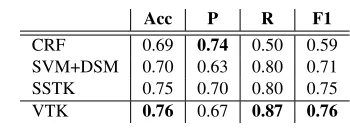
Acc P R F1
CRF 0.69 0.74 0.50 0.59
SVM+DSM 0.70 0.63 0.80 0.71 SSTK 0.75 0.70 0.80 0.75
VTK 0.76 0.67 0.87 0.76
Table 4: Results on Metaphor dataset On the Metaphor corpus, VTK improves the pre-vious score by Hovy et al. (2013), whose approach uses an conjunction of lexical and syntactic tree ker-nels (Moschitti, 2006b), and distributional vectors. VTK identified several templates of metaphor usage such as “warm heart” and “cold shoulder”. We look towards approaches for automatedly mining such metaphor patterns from a corpus.
6 Conclusion
[image:4.612.95.277.505.590.2]Our method generalizes tree kernels to take dis-tributed representations of nodes as input, and cap-ture both lexical semantics and syntactic struccap-tures of parse trees. Our approach has tunable parame-ters to look for larger or smaller syntactic constructs. Our experiments shows state-of-the-art performance on three diverse NLP tasks. The approach can gen-eralize to any task involving structural and local sim-ilarity, and arbitrary node similarity measures.
References
Sabri Boughorbel, Jean-Philippe Tarel, and Nozha Bouje-maa. 2005. Conditionally positive definite kernels for svm based image recognition. InICME, pages 113– 116.
Jorge Carrillo de Albornoz, Laura Plaza, and Pablo Gerv´as. 2010. A hybrid approach to emotional sen-tence polarity and intensity classification. In Proceed-ings of the Fourteenth Conference on Computational Natural Language Learning, pages 153–161. Associa-tion for ComputaAssocia-tional Linguistics.
Michael Collins and Nigel Duffy. 2002. New rank-ing algorithms for parsrank-ing and taggrank-ing: Kernels over discrete structures, and the voted perceptron. In Pro-ceedings of the 40th annual meeting on association for computational linguistics, pages 263–270. Association for Computational Linguistics.
Ronan Collobert, Jason Weston, L´eon Bottou, Michael Karlen, Koray Kavukcuoglu, and Pavel Kuksa. 2011. Natural language processing (almost) from scratch. Journal of Machine Learning Research, 12:2493– 2537.
Danilo Croce, Alessandro Moschitti, and Roberto Basili. 2011. Structured lexical similarity via convolution kernels on dependency trees. InProceedings of the Conference on Empirical Methods in Natural Lan-guage Processing, pages 1034–1046. Association for Computational Linguistics.
Chad Cumby and Dan Roth. 2003. On kernel methods for relational learning. InIn Proc. of the International Conference on Machine Learning, pages 107–114. Andrew Finch. 2005. Using machine translation
evalu-ation techniques to determine sentence-level semantic equivalence. InIn IWP2005.
Thomas Gartner, Peter Flach, and Stefan Wrobel. 2003. On graph kernels: Hardness results and efficient al-ternatives. InProceedings of the Annual Conference on Computational Learning Theory, pages 129–143. Springer.
David Haussler. 1999. Convolution kernels on discrete structures. Technical Report Technical Report UCS-CRL-99-10, UC Santa Cruz.
Dirk Hovy, Shashank Srivastava, Sujay Kumar Jauhar, Mrinmaya Sachan, Kartik Goyal, Huiying Li, Whit-ney Sanders, and Eduard Hovy. 2013. Identifying metaphorical word use with tree kernels. In Proceed-ings of NAACL HLT, Meta4NLP Workshop.
Hisashi Kashima, Koji Tsuda, and Akihiro Inokuchi. 2003. Marginalized kernels between labeled graphs. In Proceedings of the Twentieth International Con-ference on Machine Learning, pages 321–328. AAAI Press.
Prodromos Malakasiotis. 2009. Paraphrase recognition using machine learning to combine similarity mea-sures. InProceedings of the ACL-IJCNLP 2009 Stu-dent Research Workshop, ACLstudent ’09, pages 27– 35, Stroudsburg, PA, USA. Association for Computa-tional Linguistics.
Alessandro Moschitti, Daniele Pighin, and Roberto Basili. 2008. Tree kernels for semantic role labeling. Computational Linguistics, 34(2):193–224.
Alessandro Moschitti. 2004. A study on convolution kernels for shallow semantic parsing. InProceedings of the 42nd Annual Meeting on Association for Com-putational Linguistics, pages 335–es. Association for Computational Linguistics.
Alessandro Moschitti. 2006a. Efficient convolution ker-nels for dependency and constituent syntactic trees. In Machine Learning: ECML 2006, pages 318–329. Springer.
Alessandro Moschitti. 2006b. Making Tree Kernels Practical for Natural Language Learning. InIn Pro-ceedings of the 11th Conference of the European Chapter of the Association for Computational Linguis-tics.
Bo Pang and Lillian Lee. 2005. Seeing stars: Exploiting class relationships for sentiment categorization with respect to rating scales. InProceedings of the ACL. Longhua Qian, Guodong Zhou, Fang Kong, Qiaoming
Zhu, and Peide Qian. 2008. Exploiting constituent dependencies for tree kernel-based semantic relation extraction. InProceedings of the 22nd International Conference on Computational Linguistics-Volume 1, pages 697–704. Association for Computational Lin-guistics.
Long Qiu, Min-Yen Kan, and Tat-Seng Chua. 2006. Paraphrase recognition via dissimilarity significance classification. In Proceedings of the 2006 Confer-ence on Empirical Methods in Natural Language Pro-cessing, EMNLP ’06, pages 18–26, Stroudsburg, PA, USA. Association for Computational Linguistics. Chris Quirk, Chris Brockett, and William Dolan. 2004.
Stephen Tratz and Eduard Hovy. 2011. A fast, accu-rate, non-projective, semantically-enriched parser. In Proceedings of the Conference on Empirical Methods in Natural Language Processing, EMNLP ’11, pages 1257–1268, Stroudsburg, PA, USA. Association for Computational Linguistics.
S. V. N. Vishwanathan and Alexander J. Smola. 2003. Fast kernels for string and tree matching. InAdvances In Neural Information Processing Systems 15, pages 569–576. MIT Press.
S. V. N. Vishwanathan, Nicol N. Schraudolph, Risi Kon-dor, and Karsten M. Borgwardt. 2010. Graph kernels. J. Mach. Learn. Res., 99:1201–1242, August.
Xinglong Wang, Jun’ichi Tsujii, and Sophia Ananiadou. 2010. Disambiguating the species of biomedical named entities using natural language parsers. Bioin-formatics, 26(5):661–667.