Review Article
Differences between fresh embryo transfer and frozen
embryo transfer in Asian populations: a meta-analysis
Yezhou Su1,2,3,4, Ying Zhang1,2,3,4, Zuying Xu1,2,3,4, Xiaofeng Xu1,2,3,4, Qiong Xing1,2,3,4, Lixiang Zhang4, Huifeng Xiang1,2,3,4, Yunxia Cao1,2,3,4
1Reproductive Medicine Center, Department of Obstetrics and Gynecology, The First Affiliated Hospital of Anhui Medical University, Hefei, China; 2Anhui Provincial Key Laboratory of Reproductive Health and Genetics, Anhui Medical University, Hefei, China; 3Anhui Provincial Engineering Technology Research Center for Biopreservation and Artificial Organs, Hefei, China; 4Anhui Medical University, Hefei, Anhui, China
Received November 29, 2017; Accepted July 5, 2018; Epub September 15, 2018; Published September 30, 2018
Abstract: Objective: We appraise and identify the current evidence regarding the clinical outcomes in frozen embryo transfer and fresh embryo transfer to improve assisted reproductive technology in the Asian population. Methods: A literature search of the PubMed, Web of Science, and EMBASE databases was conducted for articles published from inception to August 13, 2017. The primary outcomes were clinical pregnancy, ectopic gestation, premature delivery, small-for-gestational-age infants, and large-for-gestational-age infants. The secondary outcomes were still-birth, very low birth weight, pregnancy-induced hypertension syndrome, placental accreta, and placental abruption. Results: Of 1660 screened records, nine eligible studies (431316 patients) met the inclusion criteria. The results demonstrated that frozen embryo transfer had lower risks of ectopic gestation (OR = 0.42; 95% CI = 0.37-0.49), pre-mature delivery (OR = 0.94; 95% CI = 0.91-0.97), small-for-gestational-age infants (OR = 0.60; 95% CI = 05.8-0.62), very low birth weight (OR = 0.76; 95% CI = 0.71-0.81), placental abruption (OR = 0.65; 95% CI = 0.53-0.78), and still birth (OR = 0.83; 95% CI = 0.73-0.95) than fresh embryo transfer. However, risks of large-for-gestational-age infants (OR = 1.66; 95% CI = 1.43-1.93), pregnancy-induced hypertension syndrome (OR = 1.52; 95% CI = 1.43-1.61), and placental accreta (OR = 2.27; 95% CI = 1.58-3.25) were high in frozen embryo transfer. We further found that there
were no significant differences in miscarriage (OR = 1.10; 95% CI = 0.91-1.31) when we compared frozen embryo
transfer and fresh embryo transfer protocols. Conclusion: For most Asians, frozen embryo transfer is a better choice than fresh embryo transfer, although the former has some side effects.
Keywords: Assisted reproductive techniques, fresh embryo transfer, frozen embryo transfer, abortion, infant, meta-analysis
Introduction
Since the birth of the first infant conceived by
frozen-thawed embryo transfer (T-ET, Frozen ET) in 1984 [1, 2], the proportion of thawed
embryo transfer has increased significantly, not only because of the refinement of laboratory
techniques, but also because protocols of fro-zen-thawed embryo transfer are simpler than fresh embryo transfer (Fresh ET). In frozen-thawed embryo transfer cycles, the main aim is to prepare suitable endometrium, giving time to the ovary to recover from controlled ovarian stimulation (COS), avoiding embryo transfer
into an adverse endocrinologic profile or endo -metrial cavity. Shifting fresh embryo transfer
perinatal outcomes [6, 7]. In addition, some meta-analyses proved that frozen-thawed ET had a better perinatal outcome than fresh in vitro fertilization/intracytoplasmic sperm injec-tion (IVF/ICSI) transfer [8, 9], although a meta-analysis of four randomized clinical trials dem-onstrated that the freeze-all strategy had a higher rate of pregnancy complications and no difference in cumulative live birth rate than the IVF/ICSI strategy [10].
Different researchers maintain different opin-ions when comparing the differences between Fresh ET and Frozen ET. Most of them ignored the impact of race on fertility. Racial disparities emerged in many aspects of female reproduc-tive health, such as spontaneous abortion, infertility, and pregnancy-related mortality. The current study shows that the fertility of diffe- rent races are not identical, and racial dispari-ties could have some effects on the outcomes of in vitro fertilization (IVF) [11, 12]. Thus, sev-eral eligible studies concerning Asian people were sought and analyzed, and this systematic review was performed to compare and assess the differences of pregnancy and perinatal out-comes between Fresh ET and Frozen-thawed ET in the Asian population.
Materials and methods
Search strategy
A systematic search of the Web of Science, PubMed, and EMBASE was conducted for arti-cles published from inception to August 13, 2017. We used the following key words and combined them variously: fresh embryo trans-fer, fresh ET, in vitro fertilization, intracytoplas-mic sperm injection, frozen embryo transfer, frozen-thawed embryo transfer, outcome, com-plication, IVF, ICSI, and FET. We scanned the reference lists of the included articles for any additional relevant studies.
Selection criteria and quality appraisal
The inclusion criteria were as follows: (1) origi-nal articles comparing pregnancy and neona- tal outcomes after fresh embryo transfer ver-sus frozen embryo transfer; (2) studies that
explored Asian-specific ethnicity; (3) the freez
-ing technique of the studies were vitrification
freezing; (4) the articles were published in English or Chinese language; (5) retrospective
study, cohort study, and randomized controll- ed trial. Because most of the included litera-
ture did not specify ethnicity, we classified
ra-ce based on the region and language. For example, if the study was conducted in China, we assumed all patients were Asian. The exclu-sion criteria were as follows: (1) case reports, editorials, letters, reviews, and meta-analyses; (2) duplication trials, subanalysis, substudies, and extension studies; (4) incomplete data.
Outcome measures
The primary outcomes were clinical pregnancy, ectopic gestation, miscarriage, premature de- livery, small-for-gestational-age infants (SGA), and large-for-gestational-age infants (LGA). The secondary outcomes were stillbirth, very low birth weight (VLBW), pregnancy-induced hyper-tension syndrome (PIH), placental accreta, and
placental abruption. We defined clinical preg -nancy as preg-nancy with gestational sac ob- served on ultrasound scan before the eighth week of gestation. Ectopic gestation was em- bryo implanting extra-uterus, diagnosed by laparoscopy or ultrasound. Miscarriage was
defined as spontaneous abortion before 20
weeks. Premature delivery was infants born before 37th week of gestation. According to the local standard of newborns’ weight, VLEW,
SGA, and LGA infants were defined as babies
with birth weight less than 1500 g, less than 10th percentile, and over 90th percentile of local standards.
Data extraction and quality assessment
According the inclusion criteria and exclusion criteria, all relevant data was extracted from each research process by two investigators (Yezhou Su, Ying Zhang); if they disagreed dur-ing this process, they discussed their differ-ences with the professional investigator (Yun- xia Cao) until a consistent opinion was reached. The article quality was evaluated by two autho- rs (Huifen Xiang and Zuying Xu) independent- ly, using Newcastle-Ottawa Quality Assess- ment Scales, and any disagreement would be solved by team discussion. If necessary, study authors were contacted for more information.
Statistical analysis
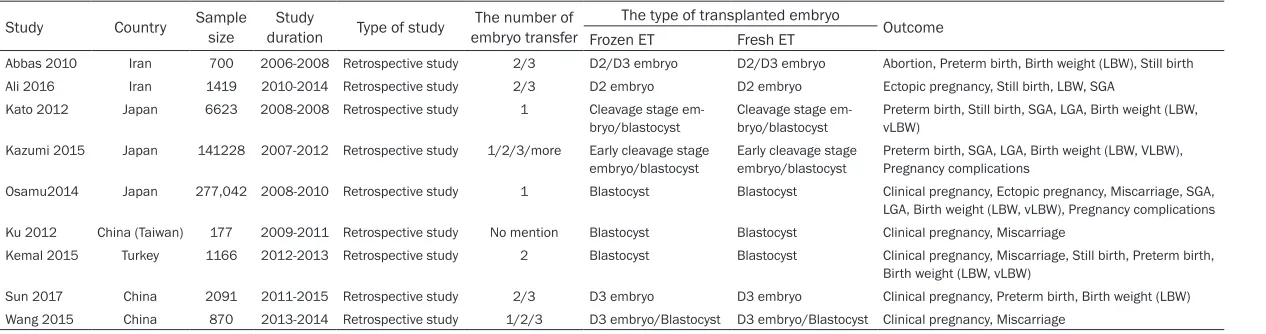
per-Table 1. The general characteristic of the included studies
Study Country Sample size durationStudy Type of study embryo transferThe number of The type of transplanted embryo Outcome Frozen ET Fresh ET
Abbas 2010 Iran 700 2006-2008 Retrospective study 2/3 D2/D3 embryo D2/D3 embryo Abortion, Preterm birth, Birth weight (LBW), Still birth Ali 2016 Iran 1419 2010-2014 Retrospective study 2/3 D2 embryo D2 embryo Ectopic pregnancy, Still birth, LBW, SGA
Kato 2012 Japan 6623 2008-2008 Retrospective study 1 Cleavage stage em-bryo/blastocyst
Cleavage stage em-bryo/blastocyst
Preterm birth, Still birth, SGA, LGA, Birth weight (LBW, vLBW)
Kazumi 2015 Japan 141228 2007-2012 Retrospective study 1/2/3/more Early cleavage stage embryo/blastocyst
Early cleavage stage embryo/blastocyst
Preterm birth, SGA, LGA, Birth weight (LBW, VLBW), Pregnancy complications
Osamu2014 Japan 277,042 2008-2010 Retrospective study 1 Blastocyst Blastocyst Clinical pregnancy, Ectopic pregnancy, Miscarriage, SGA, LGA, Birth weight (LBW, vLBW), Pregnancy complications Ku 2012 China (Taiwan) 177 2009-2011 Retrospective study No mention Blastocyst Blastocyst Clinical pregnancy, Miscarriage
Kemal 2015 Turkey 1166 2012-2013 Retrospective study 2 Blastocyst Blastocyst Clinical pregnancy, Miscarriage, Still birth, Preterm birth, Birth weight (LBW, vLBW)
[image:3.792.90.723.84.251.2]form the meta-analysis. Odds risk (ORs) and
95% confidence intervals were calculated to
describe the results. I2 and P-value were used to explore the heterogeneity; if I2 < 50% or P <
0.10, the ORs were pooled using the
fixed-effect model; if not, a random-fixed-effect model was considered. A P-value less than 0.05 was
sig-nificant. A forest plot and a funnel plot display
the results and publication bias.
Result
The search strategy yielded 1660 studies. Aft- er reading the titles, abstracts, and authors’ addresses, 1647 articles were excluded be- cause of unrelated study, repetition, and non-Asian studies. Among the remaining articl- es, one article was excluded because the da- ta had been reused, and the data for another one was incomplete; another two articles were excluded because their methods were not appropriate.
In the end, 9 papers [7, 12-19] (431316 pa- tients) were chosen for this meta-analysis. Mo-
Clinic pregnancy (Figure 2): Five studies were included to compare clinical pregnancy in Fro-
zen ET versus Fresh ET. No significant differ -ences were found (OR = 1.06; 95% CI = 0.63-1.76; P = 0.83). There was an important hetero-geneity (I2 = 97%, P < 0.00001).
Ectopic gestation rate (Figure 3): Four studies assessed ectopic gestation between Frozen ET
and Fresh ET, and there were no significant dif -ferences between the two groups (OR = 0.42; 95% CI = 0.37-0.49; P < 0.00001). Because heterogeneity was found in this comparison (I2 = 0%, P = 0.71), the fixed-effect model was
applied.
Miscarriage rate (Figure 4): Seven studies were enrolled in the comparison. Miscarriage rate of Frozen and Fresh ET was obtained from these
papers, and the data was pooled. No significant
differences of miscarriage were found between Frozen ET and Fresh ET, and there was no
sig-nificant heterogeneity in this comparison (OR =
[image:4.612.88.376.67.399.2]1.10, 95% CI = 0.91-1.31, P = 0.32; I2 = 44%; P = 0.1).
Figure 1. The results of lit-erature retrieval.
st of these articles have been published since 2014. The number of patients in each study ranged from 177 to 277,042. Three studies were from China, three from Ja- pan, two from Iran, and one from Turkey. Seven studies explored the rates of prema-ture delivery and miscarriage after Frozen ET and Fresh ET
in Asian women, six and five
papers investigated clinical pregnancy in Frozen and Fr- esh ET, respectively. Four eli-gible studies involved ectopic gestation, SGA infants, and VLBW after Frozen and Fresh ET. Three articles included LGA infants, and two articles compared differences of com-plications between Frozen and Fresh ET in Asian individ-uals. The detailed study char-acteristics were listed in Table 1. The flowchart was depicted
in Figure 1.
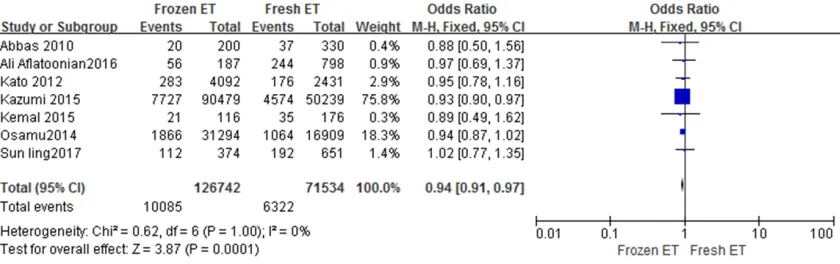
Premature delivery rate (Figure 5): Seven eli- gible studies evaluated the difference of pre-mature delivery rate in Frozen and Fresh ET,
and a significant difference was found
bet-ween the two groups (OR = 0.94, 95% CI = 0.91-0.97, P = 0.0001); this comparison had no heterogeneity (I2 = 0%, P = 1).
Stillbirth rate (Figure 6): We identified five
st-udies that reported on stillbirth. We found a
sig-nificant decline of stillbirth rate in Frozen ET
compared with Fresh ET (OR = 0.83; 95% CI = 0.73-0.95; P = 0.009). There was no heteroge-neity in the comparison (I2 = 0%, P = 0.97).
Large-for-gestation-age (LGA) infants (Figure
7): In the assessment of LGA from three
stud-ies, the risk of LGA after Frozen ET was higher than it was after Fresh ET (OR = 1.66, 95% CI = 1.43-1.93, P < 0.00001), and a remarkable heterogeneity should be noticed (I2 = 94%; P < 0.00001).
Small-for-gestation-age (SGA) infants (Figure
8): We enrolled four studies to compare SGA between Frozen ET and Fresh ET. The risk of SGA in Frozen ET was lower (OR = 0.60, 95% CI = 05.8-0.62, P < 0.00001), and he-
terogeneity was not significant (I2 = 45%, P = 0.14).
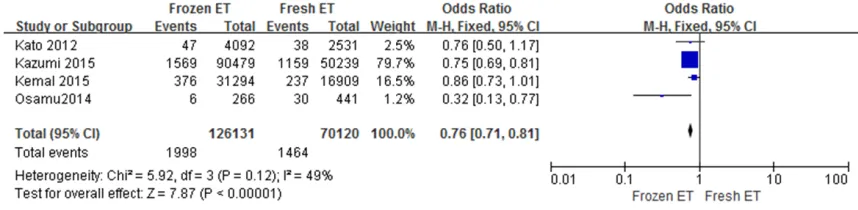
Very low birth weight (VLBW) infants (Figure 9):
[image:5.612.93.518.72.184.2] [image:5.612.102.517.220.330.2]Four studies were considered to analyze the risk of VLBW; we discovered that Frozen ET had Figure 2. Forest plot of study assessing clinical pregnancy rate of frozen ET and fresh ET.
Figure 3. Forest plot of study assessing ectopic gestation rate of frozen ET and fresh ET.
[image:5.612.100.517.364.498.2]a lower risk of VLBW than Fresh ET (OR = 0.76, 95% CI = 0.71-0.81, P < 0.00001), and
hetero-geneity was not significant (I2 = 49%,
P = 0.12).
Complications
[image:6.612.97.517.72.204.2] [image:6.612.95.520.240.359.2]Two articles compared complications (includ- ing pregnancy-induced hypertension syndrome, Figure 5. Forest plot of study assessing premature delivery rate of frozen ET and fresh ET.
Figure 6. Forest plot of study assessing stillbirth rate of frozen ET and fresh ET.
[image:6.612.96.522.323.645.2]Figure 7. Forest plot of study assessing LGA rate of frozen ET and fresh ET.
placenta previa, placenta abruption, and pla-centa accreta) between frozen single-embryo transfer and fresh single-embryo transfer. We found Frozen ET had a higher risk of pregnancy-induced hypertension syndrome (OR = 1.52, 95% CI = 1.43-1.61) (Figure 10) and placent- al accreta (OR = 2.27, 95% CI = 1.58-3.25) (Figure 11) and a lower risk of placental abrup-tion (OR = 0.65, 95% CI = 0.53-0.78) (Figure 12) than Fresh ET. The heterogeneity of these
comparisons was not significant. In addition,
there was no significant difference of placental
previa between Frozen ET and Fresh ET (OR = 0.77, 95% CI = 0.59-1.00) (Figure 13), but the result was not certain because the heterogene-ity was high (I2 = 79%, P = 0.03).
Publication bias
[image:7.612.88.533.61.458.2] [image:7.612.90.519.73.178.2]We performed funnel plots (not listed in this article) for every comparison to investigate whether most of the studies were on the same Figure 9. Forest plot of study assessing VLBL rate of frozen ET and fresh ET.
Figure 10. Forest plot of study assessing PIH rate of frozen ET and fresh ET.
[image:7.612.92.523.340.430.2]Figure 11. Forest plot of study assessing placental accreta rate of frozen ET and fresh ET.
[image:7.612.94.521.468.556.2]side of the plots, and we did not find significant
publication bias, according to each symmetri-cal shape.
Discussion
A meta-analysis is an important tool to solve a problem with an uncertain conclusion. It
syn-thesizes individual data, which is less influ -enced by authors, so it can provide unbiased conclusions. Between Frozen ET and Fresh ET, which one has better pregnancy and perinatal outcomes and what is the best way to choose the appropriate strategies? The reviewers hold different opinions. Although some meta-analy-ses have compared the outcomes between Frozen ET and Fresh ET [8, 9, 12, 20-22], few of them take into account racial disparities. Besides, different areas and racial disparities
could influence the results [11, 23]. Our
meta-analysis compared pregnancy and perinatal outcomes subsequent to Frozen ET and Fresh ET based on the Asian population, and we dem-onstrated that Frozen ET had lower risks of ectopic gestation, premature delivery, small-for-gestational-age infants, very low birth we- ight, placental abruption, and stillbirth than Fresh ET. However, risks of large-for-gestation-al-age, pregnancy-induced hypertension syn-drome, and placental accreta were high in Frozen ET. We further found that there were
no significant differences in the rate of
mis-carriage when we compared frozen embryo transfer and fresh embryo transfer protocols. In addition, the conclusions were uncertain about the differences of clinical pregnancy and pla-cental previa between Frozen ET and Fresh ET because of the obvious heterogeneity.
Our results provided strong evidence that the risk for ectopic pregnancy in the Frozen ET group was lower than in the Fresh ET group among the Asian population. It was consistent with some non-Asian studies [24-26]. The pos-sible explanation was that supraphysiologic hormone levels resulting from the controlled
ovarian stimulation (COS) could influence
en-dometrial receptivity [18, 19, 21-30], and uter-ine contractility [31]. Some authors suggest- ed COS might also induce endometrial mor-phology, biochemistry, and functional geno-
mic modifications [32, 33]. Furthermore,
so-me studies indicated oral contraceptives [34] or progestins 1071426 which were used to ini- tiate an ovarian stimulation cycle might have adverse effects on endometrial receptivity. Poor endometrial receptivity and uterine con-tractility may prevent normal intrauterine im- plantation in Asian individuals.
In terms of birth weight of Asian infants, the
risk of very low birth weight (VLBW) was signifi -cantly reduced with Frozen ET compared with Fresh ET. Similarly, the low risk of VLBW subse-quent to Frozen ET was reported in some cohort studies [5, 35, 36]. Because birth weight was associated tightly with gestational age, we also compared SGA and LGA and found decreased risk of SGA and increased risk of LGA with Frozen ET among Asian patients. Birth weight may affect some aspects of infants in their adulthood [37]. In clinic, when the couples want to have a child by using the Frozen ET tech-nique, they should know the child is likely to suffer obesity, insulin resistance, and other diseases; they should also be informed that infants born after Fresh ET are prone to minor
cognitive deficiencies, scholastic difficulties,
[image:8.612.88.522.71.158.2]ed oocytes cycle [5, 40]. Thus, we could sup-pose that it was the superovulation environ-ment, not the freezing process that affected the fetal birth weight. The stillbirth rate in Asian individuals was lower in the Frozen ET group than in the Fresh ET, according to our results. We speculated that low odds of stillbirth may be related to the decrease of SGA [41]. Another possible interpretation was that the process of freezing and thawing was a screening for embryos. High-quality embryos could be suc-cessfully frozen and thawed, whereas low-qual-ity embryos would be excluded in this process. Regarding pregnancy complications, Frozen ET
was significantly correlated with an increase
of placental accreta and pregnancy-induced hypertension (PIH). Another meta-analysis got the similar conclusion with ours [42]. Although placental accreta was an infrequent complica-tion, it could lead to serious consequences, such as heavy bleeding at the time of attempt-ed vaginal delivery, and even hysterectomy. The pathogenesis of placental accreta was absence of the decidua basalis and the Nitabuch layer. PIH was one of the most common disorders during pregnancy; it was also related to placen-ta. The actual reasons that placental accreta and PIH were associated with Frozen ET were unclear. One possible explanation was that all these placenta-related complications might be caused by abnormal placentation. Frozen ET might produce an environment that was not conducive to normal placenta formation. An earlier paper was compatible with our explana-tion; it suggested that Fresh ET had a lower risk of abnormal implantation than Frozen ET, and this abnormal implantation may be the early manifestation associated with abnormal pla-centation [24]. To our knowledge, PIH, especial-ly preeclampsia, was one of the major causes of placental abruption [43]. Paradoxically, lower odds of placental abruption were found with Frozen ET in Asian individuals, and we did not know the reason. In addition, differences in gene expression between fresh embryo and thaw embryo were reported in frozen-thawed embryos. These differences might result in the adverse pregnancy outcomes after Frozen ET [44]. However, there were only two independent studies of these comparisons; more clinical experiments should be investigat-ed and then includinvestigat-ed to certify these results. Our meta-analysis assessed the risk for
preg-nancy-specific disease of Asian individuals
between two strategies for the first time. This
study also had three limitations. First, the rele-vant studies in this article were searched using the English and Chinese languages; therefore, some potential non-English and non-Chinese publications may have been excluded. Second, the number of Fresh ET or Frozen-thawed ET in
some studies were not sufficient, with some
characteristics and outcomes not mentioned in some of them, so the comparison may have
exhibited biases. Last, some findings had sig
-nificant heterogeneity (I2 > 50% or P < 0.10). Conclusion
A frozen embryo transfer strategy could de- crease the risks of ectopic gestation, prema-ture delivery, SGA, VLBW, placental abruption, and stillbirth over those with a fresh embryo transfer strategy, whereas a fresh embryo tr- ansfer strategy could decrease the risks of LGA, PIH, and placental accreta over those with a frozen embryo transfer strategy in Asian peo-ple. Therefore, frozen embryo transfer is a bet-ter choice for most Asians. When the choice of frozen embryo transfer is selected by patients, they should be informed of the relevant risks in advance, especially of PIH.
Acknowledgements
This work was supported by National Natur- al Science Foundation of China (81501232) and Public Welfare Technology Application Research Linkage Project of Anhui Province (1704f0804022).
Disclosure of conflict of interest
None.
Address correspondence to: Yunxia Cao and Huifen Xiang, Reproductive Medicine Center, Department
of Obstetrics and Gynecology, The First Affiliated
Hospital of Anhui Medical University 81 Meishan Rode, Hefei 230022, China. Tel: +86 551 629220- 71; Fax: +86 62923241; E-mail: caoyunxia6@126. com (YXC); Tel: +86 551 62923715; Fax: +86 62923241; E-mail: [email protected] (HFX)
References
vitro fertilization. J Obstet Gynaecol Can 2010; 32: 363-377.
[2] Min JK, Claman P, Hughes E; Reproductive En-docrinology and Infertility Committee; Mater-nal-Fetal Medicine Committee. Guidelines for the number of embryos to transfer following in vitro fertilization. J Obstet Gynaecol Can 2006; 28: 799-813.
[3] Basile N and Garcia-Velasco JA. The state of “freeze-for-all” in human ARTs. J Assist Reprod Genet 2016; 33: 1543-1550.
[4] Luke B, Brown MB, Wantman E, Stern JE, Toner JP and Coddington CC 3rd. Increased risk of large-for-gestational age birthweight in single-ton siblings conceived with in vitro fertilization in frozen versus fresh cycles. J Assist Reprod Genet 2017; 34: 191-200.
[5] Vidal M, Vellve K, Gonzalez-Comadran M, Ro-bles A, Prat M, Torne M, Carreras R and Checa MA. Perinatal outcomes in children born after fresh or frozen embryo transfer: a Catalan co-hort study based on 14,262 newborns. Fertil Steril 2017; 107: 940-947.
[6] Wikland M, Hardarson T, Hillensjo T, Westin C, Westlander G, Wood M and Wennerholm UB.
Obstetric outcomes after transfer of vitrified
blastocysts. Hum Reprod 2010; 25: 1699-1707.
[7] Aflatoonian A, Mansoori Moghaddam F, Ma -shayekhy M and Mohamadian F. Comparison of early pregnancy and neonatal outcomes af-ter frozen and fresh embryo transfer in ART cycles. J Assist Reprod Genet 2010; 27: 695-700.
[8] Zhao J, Xu B, Zhang Q and Li YP. Which one has a better obstetric and perinatal outcome in singleton pregnancy, IVF/ICSI or FET?: a sys-tematic review and meta-analysis. Reprod Biol Endocrinol 2016; 14: 51.
[9] Maheshwari A, Pandey S, Shetty A, Hamilton M and Bhattacharya S. Obstetric and perinatal outcomes in singleton pregnancies resulting from the transfer of frozen thawed versus fresh embryos generated through in vitro fertilization treatment: a systematic review and meta-anal-ysis. Fertil Steril 2012; 98: 368-377, e361-369.
[10] Wong KM, van Wely M, Mol F, Repping S and Mastenbroek S. Fresh versus frozen embryo transfers in assisted reproduction. Cochrane Database Syst Rev 2017; 3: CD011184. [11] Crawford S, Joshi N, Boulet SL, Bailey MA,
Hood ME, Manning SE, McKane P, Kirby RS, Kissin DM, Jamieson DJ; States Monitoring As-sisted Reproductive Technology (SMART) Col-laborative. Maternal racial and ethnic dis- parities in neonatal birth outcomes with and without assisted reproduction. Obstet Gynecol 2017; 129: 1022-1030.
[12] Ishihara O, Araki R, Kuwahara A, Itakura A, Saito H and Adamson GD. Impact of
frozen-thawed single-blastocyst transfer on maternal and neonatal outcome: an analysis of 277,042 single-embryo transfer cycles from 2008 to 2010 in Japan. Fertil Steril 2014; 101: 128-133.
[13] Aflatoonian A, Karimzadeh Maybodi MA, Afla -toonian N, Tabibnejad N, Amir-Arjmand MH,
Soleimani M, Aflatoonian B and Aflatoonian A.
Perinatal outcome in fresh versus frozen em-bryo transfer in ART cycles. Int J Reprod Biomed (Yazd) 2016; 14: 167-172.
[14] Kato O, Kawasaki N, Bodri D, Kuroda T, Kawachiya S, Kato K and Takehara Y. Neonatal outcome and birth defects in 6623 singletons born following minimal ovarian stimulation and
vitrified versus fresh single embryo transfer.
Eur J Obstet Gynecol Reprod Biol 2012; 161: 46-50.
[15] Takeshima K, Jwa SC, Saito H, Nakaza A, Ku-wahara A, Ishihara O, Irahara M, Hirahara F, Yoshimura Y and Sakumoto T. Impact of single embryo transfer policy on perinatal outcomes in fresh and frozen cycles-analysis of the Japa-nese assisted reproduction technology registry between 2007 and 2012. Fertil Steril 2016; 105: 337-346 e333.
[16] Ku PY, Lee RK, Lin SY, Lin MH and Hwu YM. Comparison of the clinical outcomes between
fresh blastocyst and vitrified-thawed blastocyst
transfer. J Assist Reprod Genet 2012; 29: 1353-1356.
[17] Ozgur K, Berkkanoglu M, Bulut H, Isikli A and Coetzee K. Higher clinical pregnancy rates from frozen-thawed blastocyst transfers com-pared to fresh blastocyst transfers: a retro-spective matched-cohort study. J Assist Re-prod Genet 2015; 32: 1483-1490.
[18] Sun L, Chen ZH, Yin MN and Deng Y. Pregnancy and obstetric outcomes of fresh embryo trans-fer versus frozen-thawed embryo transtrans-fer in women below 35 years of age. Nan Fang Yi Ke Da Xue Xue Bao 2017; 37: 929-932.
[19] Wang J, Li R, Ouyang N, Zheng L, Ou S and Wang W. Comparison of clinical outcomes of
vitrified-thawed embryo transfer and fresh em -bryos transfer. Zhonghua Liu Xing Bing Xue Za Zhi 2015; 36: 176-180.
[20] Maheshwari A, Pandey S, Amalraj Raja E, Shet-ty A, Hamilton M and Bhattacharya S. Is frozen embryo transfer better for mothers and ba-bies? Can cumulative meta-analysis provide a
definitive answer? Hum Reprod Update 2018;
24: 35-58.
[21] Roque M, Lattes K, Serra S, Sola I, Geber S, Carreras R and Checa MA. Fresh embryo trans-fer versus frozen embryo transtrans-fer in in vitro fertilization cycles: a systematic review and meta-analysis. Fertil Steril 2013; 99: 156-162. [22] Dieamant FC, Petersen CG, Mauri AL, Comar V,
Mattila M, Vagnini LD, Renzi A, Petersen B,
Jr. Fresh embryos versus freeze-all embryos-transfer strategies: nuances of a meta-analy-sis. JBRA Assist Reprod 2017; 21: 260-272. [23] Wellons MF, Fujimoto VY, Baker VL, Barrington
DS, Broomfield D, Catherino WH, Richard-Da -vis G, Ryan M, Thornton K and Armstrong AY. Race matters: a systematic review of racial/ ethnic disparity in society for assisted repro-ductive technology reported outcomes. Fertil Steril 2012; 98: 406-409.
[24] Wang ET, Kathiresan ASQ, Bresee C, Greene N, Alexander C and Pisarska MD. Abnormal im-plantation after fresh and frozen in vitro fertil-ization cycles. Fertil Steril 2017; 107: 1153-1158.
[25] Londra L, Moreau C, Strobino D, Garcia J, Zacur H and Zhao Y. Ectopic pregnancy after in vitro fertilization: differences between fresh and frozen-thawed cycles. Fertil Steril 2015; 104: 110-118.
[26] Xiao S, Mo M, Hu X, Zhang H, Xu S, Wang Z and
Zeng Y. Study on the incidence and influences
on heterotopic pregnancy from embryo trans-fer of fresh cycles and frozen-thawed cycles. J Assist Reprod Genet 2018; 35: 677-681. [27] Polyzos NP and Devroey P. Significantly lower
ectopic pregnancy rates after frozen embryo transfer: implications toward segmentation of in vitro fertilization treatment. Fertil Steril 2012; 98: 1419-1420.
[28] Jun SH and Milki AA. Ectopic pregnancy rates with frozen compared with fresh blastocyst transfer. Fertil Steril 2007; 88: 629-631. [29] Jee BC, Suh CS and Kim SH. Ectopic pregnancy
rates after frozen versus fresh embryo trans-fer: a meta-analysis. Gynecol Obstet Invest 2009; 68: 53-57.
[30] Fang C, Huang R, Wei LN and Jia L. Frozen-thawed day 5 blastocyst transfer is associated with a lower risk of ectopic pregnancy than day 3 transfer and fresh transfer. Fertil Steril 2015; 103: 655-661, e653.
[31] Haouzi D, Assou S, Mahmoud K, Tondeur S, Reme T, Hedon B, De Vos J and Hamamah S.
Gene expression profile of human endometrial
receptivity: comparison between natural and stimulated cycles for the same patients. Hum Reprod 2009; 24: 1436-1445.
[32] Horcajadas JA, Minguez P, Dopazo J, Esteban FJ, Dominguez F, Giudice LC, Pellicer A and Si-mon C. Controlled ovarian stimulation induces a functional genomic delay of the endometri-um with potential clinical implications. J Clin Endocrinol Metab 2008; 93: 4500-4510. [33] Haouzi D, Assou S, Dechanet C, Anahory T,
Dechaud H, De Vos J and Hamamah S. Con-trolled ovarian hyperstimulation for in vitro fer-tilization alters endometrial receptivity in hu-mans: protocol effects. Biol Reprod 2010; 82: 679-686.
[34] Wei D, Shi Y, Li J, Wang Z, Zhang L, Sun Y, Zhou H, Xu Y, Wu C, Liu L, Wu Q, Zhuang L, Du Y, Li W, Zhang H, Legro RS, Chen ZJ. Effect of pretreat-ment with oral contraceptives and progestins on IVF outcomes in women with polycystic ova-ry syndrome. Hum Reprod 2017; 32: 354-361. [35] Pinborg A, Loft A, Aaris Henningsen AK, Ras-mussen S and Andersen AN. Infant outcome of 957 singletons born after frozen embryo re-placement: the Danish national cohort study 1995-2006. Fertil Steril 2010; 94: 1320-1327. [36] Wennerholm UB, Henningsen AK, Romunds-tad LB, Bergh C, Pinborg A, Skjaerven R, For-man J, Gissler M, Nygren KG and Tiitinen A. Perinatal outcomes of children born after fro-zen-thawed embryo transfer: a Nordic cohort study from the CoNARTaS group. Hum Reprod 2013; 28: 2545-2553.
[37] Flensborg-Madsen T and Mortensen EL. Birth weight and intelligence in young adulthood and midlife. Pediatrics 2017; 139.
[38] Gascoin G and Flamant C. Long-term outcome in context of intra uterine growth restriction and/or small for gestational age newborns. J Gynecol Obstet Biol Reprod (Paris) 2013; 42: 911-920.
[39] Weinerman R, Ord T, Bartolomei MS, Coutifaris C and Mainigi M. The superovulated
environ-ment, independent of embryo vitrification, re -sults in low birthweight in a mouse model. Biol Reprod 2017; 97: 133-142.
[40] Kalra SK, Ratcliffe SJ, Coutifaris C, Molinaro T and Barnhart KT. Ovarian stimulation and low birth weight in newborns conceived through in vitro fertilization. Obstet Gynecol 2011; 118: 863-871.
[41] Clausson B, Gardosi J, Francis A and Cnattin-gius S. Perinatal outcome in SGA births
de-fined by customised versus population-based
birthweight standards. BJOG 2001; 108: 830-834.
[42] Sha T, Yin X, Cheng W and Massey IY. Pregnan-cy-related complications and perinatal out-comes resulting from transfer of cryopreserved versus fresh embryos in vitro fertilization: a meta-analysis. Fertil Steril 2018; 109: 330-342, e339.
[43] Steegers-Theunissen RP, Van Iersel CA, Peer PG, Nelen WL and Steegers EA. Hyperhomo-cysteinemia, pregnancy complications, and the timing of investigation. Obstet Gynecol 2004; 104: 336-343.