Numerically Grounded Language Models for Semantic Error Correction
Georgios P. Spithourakis and Isabelle Augenstein and Sebastian Riedel Department of Computer Science
University College London
{g.spithourakis, i.augenstein, s.riedel}@cs.ucl.ac.uk
Abstract
Semantic error detection and correction is an important task for applications such as fact checking, speech-to-text or grammatical er-ror correction. Current approaches gener-ally focus on relatively shallow semantics and do not account for numeric quantities. Our approach uses language models grounded in numbers within the text. Such groundings are easily achieved for recurrent neural lan-guage model architectures, which can be fur-ther conditioned on incomplete background knowledge bases. Our evaluation on clinical reports shows that numerical grounding im-proves perplexity by 33% and F1 for semantic error correction by 5 points when compared to ungrounded approaches. Conditioning on a knowledge base yields further improvements.
1 Introduction
[image:1.612.317.539.236.455.2]In many real world scenarios it is important to de-tect and potentially correct semantic errors and in-consistencies in text. For example, when clinicians compose reports, some statements in the text may be inconsistent with measurements taken from the patient (Bowman, 2013). Error rates in clinical data range from 2.3% to 26.9% (Goldberg et al., 2008) and many of them are number-based errors (Arts et al., 2002). Likewise, a blog writer may make statistical claims that contradict facts recorded in databases (Munger, 2008). Numerical concepts constitute 29% of contradictions in Wikipedia and GoogleNews (De Marneffe et al., 2008) and 8.8% of contradictory pairs in entailment datasets (Dagan et al., 2006).
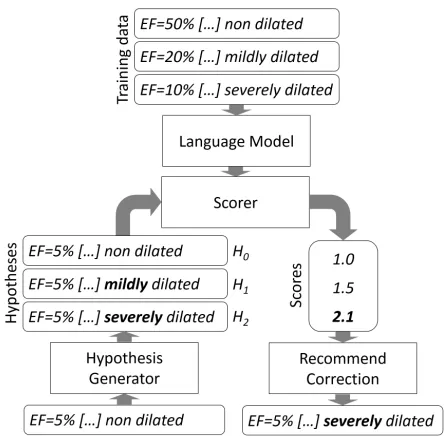
Figure 1: Semantic error correction using language models. “EF” is a clinical term and stands for “ejection fraction”.
These inconsistencies may stem from oversight, lack of reporting guidelines or negligence. In fact they may not even be errors at all, but point to inter-esting outliers or to errors in a reference database. In all cases, it is important to spot and possibly correct such inconsistencies. This task is known as semantic error correction (SEC) (Dahlmeier and Ng, 2011).
In this paper, we propose a SEC approach to sup-port clinicians with writing patient resup-ports. A SEC system reads a patient’s structured background in-formation from a knowledge base (KB) and their clinical report. Then it recommends improvements to the text of the report for semantic consistency. An example of an inconsistency is shown in Figure 1.
The SEC system has been trained on a dataset of records and learnt that the phrases “non dilated” and “severely dilated” correspond to high and low val-ues for “EF” (abbreviation for “ejection fraction”, a clinical measurement), respectively. If the system is then presented with the phrase “non dilated” in the context of a low value, it will detect a seman-tic inconsistency and correct the text to “severely di-lated”.
Our contributions are: 1) a straightforward ex-tension to recurrent neural network (RNN) language models forgroundingthem in numbers available in the text; 2) a simple method for modelling text con-ditioned onan incomplete KB by lexicalising it; 3) our evaluation on a semantic error correction task for clinical records shows that our method achieves F1 improvements of 5 and 6 percentage points with grounding and KB conditioning, respectively, over an ungrounded approach (F1 of 49%).
2 Methodology
Our approach to semantic error correction (Figure 1) starts with training a language model (LM), which can be grounded in numeric quantities mentioned in-line with text (Subsection 2.1) and/or conditioned on a potentially incomplete KB (Subsection 2.2). Given a document for semantic checking, a hypoth-esis generator proposes corrections, which are then scored using the trained language model (Subsec-tion 2.3). A final decision step involves accepting the best scoring hypothesis.
2.1 Numerically grounded language modelling
Let {w1, ..., wT} denote a document, where wt is
the one-hot representation of the t-th token and V
is the vocabulary size. A neural LM uses a ma-trix, Ein ∈ RD×V, to derive word embeddings, ew
t =Einwt. A hidden state from the previous time
step,ht−1, and the current word embedding,ewt, are
sequentially fed to an RNN’s recurrence function to produce the current hidden state,ht∈RD. The
con-ditional probability of the next word is estimated as
softmax(Eoutht), whereEout∈RV×D is an output
embeddings matrix.
We propose concatenating a representation,ent, of
the numeric value ofwtto the inputs of the RNN’s
[image:2.612.315.531.60.246.2]recurrence function at each time step. Through this
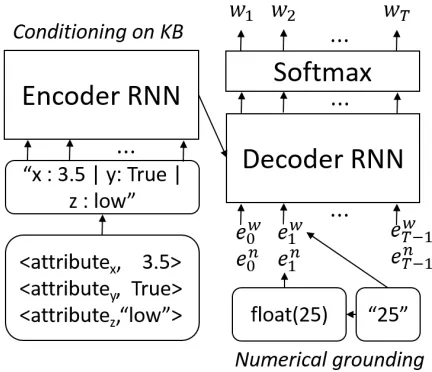
Figure 2:A language model that is numerically grounded and conditioned on a lexicalised KB. Examples of data in rounded rectangles.
numeric representation, the model can generalise to out-of-vocabulary numbers. A straightforward representation is defining ent = float(wt), where float(.)is a numeric conversion function that returns
a floating point number constructed from the string of its input. If conversion fails, it returns zero.
The proposed mechanism fornumerical ground-ing is shown in Figure 2. Now the probability of each next word depends on numbers that have ap-peared earlier in the text. We treat numbers as a separate modality that happens to share the same medium as natural language (text), but can convey exact measurements of properties of the real world. At training time, the numeric representations medi-ate to ground the language model in the real world.
2.2 Conditioning on incomplete KBs
The proposed extension can also be used in con-ditional language modelling of documents given a knowledge base. Consider a set of KB tuples accom-panying each document and describing its attributes in the form< attribute, value >, where attributes
train dev test
#documents 11,158 1,625 3,220
#tok
ens/
doc
all 204.9 204.4 202.2 words 95.7% 95.7% 95.7%
numeric 4.3% 4.3% 4.3%
#unique tok
ens wordsall 18,91647.8% 58.25%6,572 54.1%9,515 numeric 52.24% 41.9% 45.81%
OO
V
rate
all 5.0% 5.1% 5.2%
words 3.4% 3.5% 3.5%
[image:3.612.77.295.56.212.2]numeric 40.4% 40.8% 41.8%
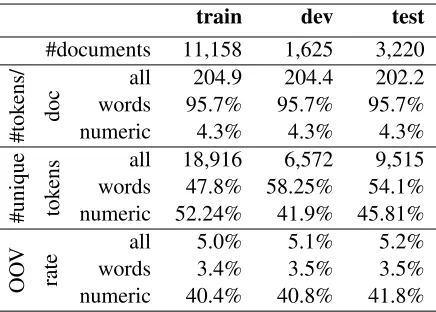
Table 1:Statistics for clinical dataset. Counts for non-numeric (words) andnumerictokens reported as percentage of counts for alltokens. Out-of-vocabulary (OOV) rates are for vocabulary of
1000most frequent words in the train data.
approach can incorporate KB tuples flexibly, even when values of some attributes are missing.
2.3 Semantic error correction
A statistical model chooses the most likely correc-tion from a set of possible correccorrec-tion choices. If the model scores a corrected hypothesis higher than the original document, the correction is accepted.
A hypothesis generator function, G, takes the
original document, H0, as input and generates a set of candidate corrected documents G(H0) = {H1, ..., HM}. A simple hypothesis generator uses
confusion sets of semantically related words to pro-duce all possible substitutions.
A scorer model, s, assigns a score s(Hi) ∈ R
to a hypothesisHi. The scorer is based on a
likeli-hood ratio test between the original document (null hypothesis, H0) and each candidate correction (al-ternative hypotheses,Hi), i.e. s(Hi) = p(Hi)
p(H0). The
assigned score represents how much more probable a correction is than the original document.
The probability of observing a document,p(Hi),
can be estimated using language models, or grounded and conditional variants thereof.
3 Data
Our dataset comprises 16,003 clinical records from the London Chest Hospital (Table 1). Each patient record consists of a text report and accompanying structured KB tuples. The latter describe 20 possible numeric attributes (age, gender, etc.), which are also
description confusion set
intensifiers (adv): non,mildly,severely
intensifiers (adj): mild,moderate,severe
units: cm,mm,ml,kg,bpm
viability: viable,non-viable
quartiles: 25,50,75,100
inequalities: <,> Table 2:Confusion sets.
partly contained in the report. On average,7.7tuples
are completed per record. Numeric tokens constitute only a small proportion of each sentence (4.3%), but account for a large part of the unique tokens vocab-ulary (>40%) and suffer from high OOV rates.
To evaluate SEC, we generate a “corrupted” dataset of semantic errors from the test part of the “trusted” dataset (Table 1, last column). We manu-ally build confusion sets (Table 2) by searching the development set for words related to numeric quanti-ties and grouping them if they appear in similar con-texts. Then, for each document in the trusted test set we generate an erroneous document by sampling a substitution from the confusion sets. Documents with no possible substitution are excluded. The re-sulting “corrupted” dataset is balanced, containing 2,926 correct and 2,926 incorrect documents.
4 Results and discussion
Ourbase LMis a single-layer long short-term mem-ory network (LSTM, Hochreiter and Schmidhuber (1997) with all latent dimensions (internal matrices, input and output embeddings) set to D = 50. We
extend this baseline to aconditionalvariant by con-ditioning on the lexicalised KB (see Section 2.2). We also derive a numerically grounded model by concatenating the numerical representation of each token to the inputs of the base LM model (see Sec-tion 2.1). Finally, we consider a model that is both grounded and conditional (g-conditional).
The vocabulary contains theV = 1000most
fre-quent tokens in the training set. Out-of-vocabulary tokens are substituted with <num unk>, if
nu-meric, and <unk>, otherwise. We extract the
[image:3.612.325.527.58.160.2]back-model tokens PP APP
base LM words 13.93all 14.96 22.1117.94 numeric 72.38 2289.47
conditional words 13.49all 14.52 21.4717.38 numeric 74.48 2355.77
grounded
all 9.91 14.66 words 9.28 11.96 numeric 42.67 1349.59
g-conditional wordsall 9.398.80 13.8811.33
[image:4.612.82.289.56.237.2]numeric 39.84 1260.28
Table 3:Language modelling evaluation results on the test set. We report perplexity (PP) and adjusted perplexity (APP). Best results inbold.
propagation and adaptive mini-batch gradient de-scent (AdaDelta) (Zeiler, 2012).
For SEC, we use an oracle hypothesis generator that has access to the groundtruth confusion sets (Ta-ble 2). We estimate the scorer (Section 2.3) using the trainedbase,conditional,groundedorg-conditional
LMs. As additional baselines we consider a scorer that assignsrandomscores from a uniform distribu-tion andalways(never) scorers that assign the low-est (highlow-est) score to the original document and uni-formly random scores to the corrections.
4.1 Experiment 1: Numerically grounded LM
We report perplexity and adjusted perplexity (Ue-berla, 1994) of our LMs on the test set for all tokens and token classes (Table 3). Adjusted perplexity is not sensitive to OOV-rates and thus allows for mean-ingful comparisons across token classes. Perplexi-ties are high for numeric tokens because they form a large proportion of the vocabulary. The grounded
and g-conditional models achieved a 33.3% and 36.9% improvement in perplexity, respectively, over thebase LM model. Conditioning without ground-ing yields only slight improvements, because most of the numerical values from the lexicalised KB are out-of-vocabulary.
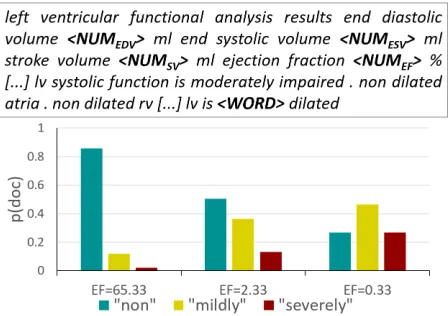
The qualitative example in Figure 3 demonstrates how numeric values influence the probability of to-kens given their history. We select a document from the development set and substitute its numeric
val-Figure 3:Qualitative example. Template document and docu-ment probabilities for<WORD>={‘non’, ‘mildly’, ‘severely’} and varying numbers. Probabilities are renormalised over the set of possible choices.
ues as we vary EF (the rest are set by solving
a known system of equations). The selected ex-act values were unseen in the training data. We calculate the probabilities for observing the docu-ment with different word choices{“non”, “mildly”, “severely”} under the grounded LM and find that “non dilated” is associated with higherEF values.
This shows that it has captured semantic dependen-cies on numbers.
4.2 Experiment 2: Semantic error correction
We evaluate SEC systems on the corrupted dataset (Section 3) for detection and correction.
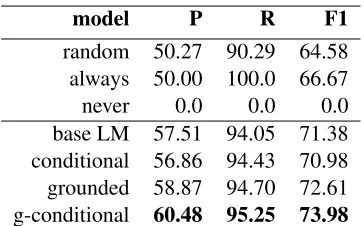
For detection, we report precision, recall and F1 scores in Table 4. Ourg-conditionalmodel achieves the best results, a total F1 improvement of 2 points over thebase LM model and 7 points over the best baseline. The conditional model without ground-ing performs slightly worse in the F1 metric than the base LM. Note that with more hypotheses the
randombaseline behaves more similarly toalways. Our hypothesis generator generated on average 12 hypotheses per document. The results ofnever are zero as it fails to detect any error.
[image:4.612.316.540.58.216.2]model P R F1
[image:5.612.95.277.55.168.2]random 50.27 90.29 64.58 always 50.00 100.0 66.67 never 0.0 0.0 0.0 base LM 57.51 94.05 71.38 conditional 56.86 94.43 70.98 grounded 58.87 94.70 72.61 g-conditional 60.48 95.25 73.98
Table 4:Error detection results on the test set. We report preci-sion (P), recall (R) and F1. Best results inbold.
yields the best results, achieving an improvement of 6 points in F1 and 5 points in MAP over the base LM model and an improvement of 47 points in F1 and 9 points in MAP over the best baseline. The
conditionalmodel without grounding has the worst performance among the LM-based models.
5 Related Work
Grounded language models represent the relation-ship between words and the non-linguistic con-text they refer to. Previous work grounds lan-guage on vision (Bruni et al., 2014; Socher et al., 2014; Silberer and Lapata, 2014), audio (Kiela and Clark, 2015), video (Fleischman and Roy, 2008), colour (McMahan and Stone, 2015), and olfactory perception (Kiela et al., 2015). However, no pre-vious approach has explored in-line numbers as a source of grounding.
Our language modelling approach to SEC is in-spired by LM approaches to grammatical error de-tection (GEC) (Ng et al., 2013; Felice et al., 2014). They similarly derive confusion sets of semantically related words, substitute the target words with al-ternatives and score them with an LM. Existing se-mantic error correction approaches aim at correct-ing word error choices (Dahlmeier and Ng, 2011), collocation errors (Kochmar, 2016), and semantic anomalies in adjective-noun combinations (Vecchi et al., 2011). So far, SEC approaches focus on short distance semantic agreement, whereas our ap-proach can detect errors which require to resolve long-range dependencies. Work on GEC and SEC shows that language models are useful for error cor-rection, however they neither ground in numeric quantities nor incorporate background KBs.
model MAP P R F1
random 27.75 5.73 10.29 7.36 always 20.39 6.13 12.26 8.18 never 60.06 0.0 0.0 0.0 base LM 64.37 39.54 64.66 49.07 conditional 62.76 37.46 62.20 46.76 grounded 68.21 44.25 71.19 54.58 g-conditional 69.14 45.36 71.43 55.48
Table 5:Error correction results on the test set. We report mean average precision (MAP), precision (P), recall (R) and F1. Best results inbold.
6 Conclusion
In this paper, we proposed a simple technique to model language in relation to numbers it refers to, as well as conditionally on incomplete knowledge bases. We found that the proposed techniques lead to performance improvements in the tasks of language modelling, and semantic error detection and correc-tion. Numerically grounded models make it possible to capture semantic dependencies of content words on numbers.
In future work, we will plan to apply numeri-cally grounded models to other tasks, such as nu-meric error correction. We will explore alternative ways for deriving the numeric representations, such as accounting for verbal descriptions of numbers. For SEC, a trainable hypothesis generator can po-tentially improve the coverage of the system.
Acknowledgments
The authors would like to thank the anonymous reviewers for their insightful comments. We also thank Steffen Petersen for providing the dataset and advising us on the clinical aspects of this work. This research was supported by the Farr Institute of Health Informatics Research, an Allen Distin-guished Investigator award and Elsevier.
References
[image:5.612.317.536.55.170.2]Sue Bowman. 2013. Impact of Electronic Health Record Systems on Information Integrity: Quality and Safety Implications. Perspectives in Health Informa-tion Management, page 1.
Elia Bruni, Nam-Khanh Tran, and Marco Baroni. 2014. Multimodal distributional semantics. J. Artif. Intell. Res.(JAIR), 49(1-47).
Ido Dagan, Oren Glickman, and Bernardo Magnini. 2006. The pascal recognising textual entailment challenge. In Machine learning challenges. evaluat-ing predictive uncertainty, visual object classification, and recognising tectual entailment, pages 177–190. Springer.
Daniel Dahlmeier and Hwee Tou Ng. 2011. Correcting Semantic Collocation Errors with L1-induced Para-phrases. InProceedings of EMNLP, pages 107–117. Marie-Catherine De Marneffe, Anna N Rafferty, and
Christopher D Manning. 2008. Finding Contradic-tions in Text. InACL, volume 8, pages 1039–1047. Mariano Felice, Zheng Yuan, Øistein E Andersen,
He-len Yannakoudakis, and Ekaterina Kochmar. 2014. Grammatical error correction using hybrid systems and type filtering. InCoNLL Shared Task, pages 15– 24.
Michael Fleischman and Deb Roy. 2008. Grounded Lan-guage Modeling for Automatic Speech Recognition of Sports Video. InProceedings of ACL, pages 121–129. Saveli Goldberg, Andrzej Niemierko, and Alexander Turchin. 2008. Analysis of data errors in clinical re-search databases. InAMIA. Citeseer.
Sepp Hochreiter and J¨urgen Schmidhuber. 1997. Long short-term memory. Neural computation, 9(8):1735– 1780.
Douwe Kiela and Stephen Clark. 2015. Multi- and Cross-Modal Semantics Beyond Vision: Grounding in Auditory Perception. In Proceedings of EMNLP, pages 2461–2470.
Douwe Kiela, Luana Bulat, and Stephen Clark. 2015. Grounding Semantics in Olfactory Perception. In Pro-ceedings of ACL, pages 231–236.
Ekaterina Kochmar. 2016. Error Detection in Content Word Combinations. Ph.D. thesis, University of Cam-bridge, Computer Laboratory.
Brian McMahan and Matthew Stone. 2015. A bayesian model of grounded color semantics. Transactions of the Association for Computational Linguistics, 3:103– 115.
Michael C Munger. 2008. Blogging and political infor-mation: truth or truthiness? Public Choice, 134(1-2):125–138.
Hwee Tou Ng, Siew Mei Wu, Yuanbin Wu, Christian Hadiwinoto, and Joel Tetreault. 2013. The CoNLL-2013 Shared Task on Grammatical Error Correction.
In Hwee Tou Ng, Joel Tetreault, Siew Mei Wu, Yuan-bin Wu, and Christian Hadiwinoto, editors, Proceed-ings of the CoNLL: Shared Task, pages 1–12.
Carina Silberer and Mirella Lapata. 2014. Learn-ing Grounded MeanLearn-ing Representations with Autoen-coders. InProceedings of ACL, pages 721–732. Richard Socher, Andrej Karpathy, Quoc V. Le,
Christo-pher D. Manning, and Andrew Y. Ng. 2014. Grounded Compositional Semantics for Finding and Describing Images with Sentences. TACL, 2:207–218. Joerg Ueberla. 1994. Analysing a simple language model·some general conclusions for language mod-els for speech recognition. Computer Speech & Lan-guage, 8(2):153–176.
Eva Maria Vecchi, Marco Baroni, and Roberto Zampar-elli. 2011. (Linear) Maps of the Impossible: Captur-ing semantic anomalies in distributional space. In Pro-ceedings of the Workshop on Distributional Semantics and Compositionality, pages 1–9.