40
On the Role of Text Preprocessing in Neural Network Architectures:
An Evaluation Study on Text Categorization and Sentiment Analysis
Jose Camacho-Collados
School of Computer Science and Informatics Cardiff University
Mohammad Taher Pilehvar
School of Computer Engineering Iran University of
Science and Technology [email protected]
Abstract
Text preprocessing is often the first step in the pipeline of a Natural Language Process-ing (NLP) system, with potential impact in its final performance. Despite its importance, text preprocessing has not received much at-tention in the deep learning literature. In this paper we investigate the impact of simple text preprocessing decisions (particularly tokeniz-ing, lemmatiztokeniz-ing, lowercasing and multiword grouping) on the performance of a standard neural text classifier. We perform an extensive evaluation on standard benchmarks from text categorization and sentiment analysis. While our experiments show that a simple tokeniza-tion of input text is generally adequate, they also highlight significant degrees of variabil-ity across preprocessing techniques. This re-veals the importance of paying attention to this usually-overlooked step in the pipeline, partic-ularly when comparing different models. Fi-nally, our evaluation provides insights into the best preprocessing practices for training word embeddings.
1 Introduction
Words are often considered as the basic con-stituents of texts for many languages, including English.1 The first module in an NLP pipeline is a tokenizer which transforms texts to sequences of words. However, in practise, other preprocessing techniques can be (and are) further used together with tokenization. These include lemmatization, lowercasing and multiword grouping, among oth-ers. Although these preprocessing decisions have
1
Note that although word-based models are mainstream in NLP in general and text classification in particular, recent work has also considered other linguistic units, such as char-acters (Kim et al.,2016;Xiao and Cho,2016) or word senses (Li and Jurafsky,2015;Flekova and Gurevych,2016; Pile-hvar et al.,2017). These techniques require a different kind of preprocessing and, while they have been shown effective in various settings, in this work we only focus on the main-stream word-based models.
been studied in the context of conventional text classification techniques (Leopold and
Kinder-mann, 2002; Uysal and Gunal, 2014), little
at-tention has been paid to them in the more recent neural-based models. The most similar study to ours isZhang and LeCun(2017), which analyzed different encoding levels for English and Asian languages such as Chinese, Japanese and Korean. As opposed to our work, their analysis was fo-cused on UTF-8 bytes, characters, words, roman-ized characters and romanroman-ized words as encoding levels, rather than the preprocessing techniques analyzed in this paper.
Additionally, word embeddings have been shown to play an important role in boosting the generalization capabilities of neural systems (Goldberg, 2016; Camacho-Collados and
Pile-hvar,2018). However, while some studies have
fo-cused on intrinsically analyzing the role of lemma-tization in their underlying training corpus (Ebert
et al.,2016;Kuznetsov and Gurevych,2018), the
impact on their extrinsic performance when inte-grated into a neural network architecture has re-mained understudied.2
In this paper we focus on the role of prepro-cessing the input text, particularly in how it is split into individual (meaning-bearing) tokens and how it affects the performance of standard neural text classification models based on Convolutional Neural Networks (LeCun et al.,2010;Kim,2014, CNN). CNNs have proven to be effective in a wide range of NLP applications, including text classifi-cation tasks such as topic categorization (Johnson
and Zhang,2015;Tang et al.,2015;Xiao and Cho,
2016;Conneau et al.,2017) and polarity detection
2
(Kalchbrenner et al.,2014;Kim,2014;Dos
San-tos and Gatti, 2014;Yin et al., 2017), which are
the tasks considered in this work. The goal of our evaluation study is to find answers to the following two questions:
1. Are neural network architectures (in particu-lar CNNs) affected by seemingly small pre-processing decisions in the input text?
2. Does the preprocessing of the embeddings’ underlying training corpus have an impact on the final performance of a state-of-the-art neural network text classifier?
According to our experiments in topic catego-rization and polarity detection, these decisions are important in certain cases. Moreover, we shed some light on the motivations of each preprocess-ing decision and provide some hints on how to nor-malize the input corpus to better suit each setting. The accompanying materials of this sub-mission can be downloaded at the follow-ing repository: https://github.com/pedrada88/ preproc-textclassification.
2 Text Preprocessing
Given an input text, words are gathered as input units of classification models through tokeniza-tion. We refer to the corpus which is only tok-enized asvanilla. For example, given the sentence “Apple is asking its manufacturers to move Mac-Book Air production to the United States.” (run-ning example), the vanilla tokenized text would be as follows (white spaces delimiting different word units):
Apple is asking its manufacturers to move MacBook Air production to the United States .
We additionally consider three simple prepro-cessing techniques to be applied to an input text: lowercasing (Section 2.1), lemmatizing (Section
2.2) and multiword grouping (Section2.3).
2.1 Lowercasing
This is the simplest preprocessing technique which consists of lowercasing each single token of the input text:
apple is asking its manufacturers to move macbook air production to the united states .
Due to its simplicity, lowercasing has been a popular practice in modules of deep learning li-braries and word embedding packages
(Penning-ton et al.,2014;Faruqui et al.,2015). Despite its
desirable property of reducing sparsity and vocab-ulary size, lowercasing may negatively impact sys-tem’s performance by increasing ambiguity. For instance, the Applecompany in our example and the apple fruit would be considered as identical entities.
2.2 Lemmatizing
The process of lemmatizing consists of replacing a given token with its corresponding lemma:
Apple be ask its manufacturer to move Mac-Book Air production to the United States .
Lemmatization has been traditionally a standard preprocessing technique for linear text classifica-tion systems (Mullen and Collier, 2004; Toman
et al., 2006; Hassan et al., 2007). However, it
is rarely used as a preprocessing stage in neural-based systems. The main idea behind lemmati-zation is to reduce sparsity, as different inflected forms of the same lemma may occur infrequently (or not at all) during training. However, this may come at the cost of neglecting important syntactic nuances.
2.3 Multiword grouping
This last preprocessing technique consists of grouping consecutive tokens together into a single token if found in a given inventory:
Apple is asking its manufacturers to move MacBook Air production to the United States .
The motivation behind this step lies in the id-iosyncratic nature of multiword expressions (Sag
et al., 2002), e.g. United States in the
3 Evaluation
We considered two tasks for our experiments: topic categorization, i.e. assigning a topic to a given document from a pre-defined set of topics, andpolarity detection, i.e. detecting if the senti-ment of a given piece of text is positive or negative (Dong et al., 2015). Two different settings were studied: (1) word embedding’s training corpus and the evaluation dataset were preprocessed in a simi-lar manner (Section3.2); and (2) the two were pre-processed differently (Section 3.3). In what fol-lows we describe the common experimental set-ting as well as the datasets and preprocessing used for the evaluation.
3.1 Experimental setup
We tried with two classification models. The first one is a standard CNN model similar to that of Kim(2014), using ReLU (Nair and Hinton,2010) as non-linear activation function. In the second model, we add a recurrent layer (specifically an LSTM (Hochreiter and Schmidhuber, 1997)) be-fore passing the pooled features directly to the fully connected softmax layer.3 The inclusion of this LSTM layer has been shown to be able to effectively replace multiple layers of convolu-tion and be beneficial particularly for large inputs (Xiao and Cho, 2016). These models were used for both topic categorization and polarity detection tasks, with slight hyperparameter variations given their different natures (mainly in their text size) which were fixed across all datasets. The embed-ding layer was initialized using 300-dimensional CBOW Word2vec embeddings (Mikolov et al., 2013a) trained on the 3B-word UMBC WebBase corpus (Han et al.,2013) with standard hyperpa-rameters4.
Evaluation datasets. For the topic categoriza-tion task we used theBBCnews dataset5(Greene
and Cunningham, 2006), 20News (Lang, 1995),
Reuters6 (Lewis et al., 2004) and Ohsumed7.
3The code for this CNN implementation is the same as
in (Pilehvar et al.,2017), which is available athttps://github. com/pilehvar/sensecnn
4
Context window of 5 words and hierarchical softmax.
5
http://mlg.ucd.ie/datasets/bbc.html
6Due to the large number of labels in the original Reuters
(i.e. 91) and to be consistent with the other datasets, we re-duce the dataset to its 8 most frequent labels, a reduction al-ready performed in previous works (Sebastiani,2002).
7ftp://medir.ohsu.edu/pub/ohsumed
Dataset Type Labels # of docs Eval.
T
OPIC
BBC News 5 2,225 10-cross
20News News 6 18,846 Train-test
Reuters News 8 9,178 10-cross
Ohsumed Medical 23 23,166 Train-test
POLARITY
RTC Snippets 2 438,000 Train-test IMDB Reviews 2 50,000 Train-test PL05 Snippets 2 10,662 10-cross
PL04 Reviews 2 2,000 10-cross
Stanford Phrases 2 119,783 10-cross
Table 1: Evaluation datasets for topic categoriza-tion and polarity deteccategoriza-tion.
PL04 (Pang and Lee, 2004), PL058 (Pang and
Lee,2005),RTC9,IMDB(Maas et al.,2011) and
the Stanford sentiment dataset10 (Socher et al.,
2013, SF) were considered for polarity
detec-tion. Statistics of the versions of the datasets used are displayed in Table 1.11 For both tasks the evaluation was carried out either by 10-fold cross-validation or using the train-test splits of the datasets, in case of availability.
Preprocessing. Four different techniques (see Section2) were used to preprocess the datasets as well as the corpus which was used to train word embeddings (i.e. UMBC). For tokenization and lemmatization we relied on Stanford CoreNLP (Manning et al., 2014). As for multiwords, we used the phrases from the pre-trained Google News Word2vec vectors, which were obtained us-ing a simple statistical approach (Mikolov et al.,
2013b).12
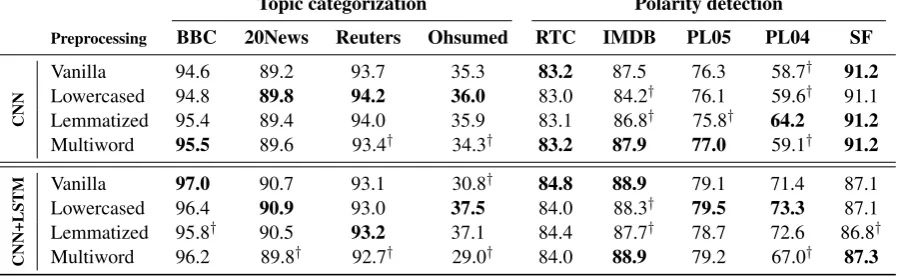
3.2 Experiment 1: Preprocessing effect
Table2shows the accuracy13 of the classification models using our four preprocessing techniques. We observe a certain variability of results depend-ing on the preprocessdepend-ing techniques used
(aver-8Both PL04 and PL05 were downloaded from http://
www.cs.cornell.edu/people/pabo/movie-review-data/
9
http://www.rottentomatoes.com
10
We mapped the numerical value of phrases to either neg-ative (from 0 to 0.4) or positive (from 0.6 to 1), removing the neutral phrases according to the scale (from 0.4 to 0.6).
11
For the datasets with train-test partitions, the sizes of the test sets are the following: 7,532 for 20News; 12,733 for Ohsumed; 25,000 for IMDb; and 1,000 for RTC.
12For future work it would be interesting to explore more
complex methods to learn embeddings for multiword expres-sions (Yin and Sch¨utze,2014;Poliak et al.,2017).
13Computed by averaging accuracy of two different runs.
Topic categorization Polarity detection
Preprocessing BBC 20News Reuters Ohsumed RTC IMDB PL05 PL04 SF
CNN
Vanilla 94.6 89.2 93.7 35.3 83.2 87.5 76.3 58.7† 91.2 Lowercased 94.8 89.8 94.2 36.0 83.0 84.2† 76.1 59.6† 91.1 Lemmatized 95.4 89.4 94.0 35.9 83.1 86.8† 75.8† 64.2 91.2 Multiword 95.5 89.6 93.4† 34.3† 83.2 87.9 77.0 59.1† 91.2
CNN+LSTM
[image:4.595.75.524.71.209.2]Vanilla 97.0 90.7 93.1 30.8† 84.8 88.9 79.1 71.4 87.1 Lowercased 96.4 90.9 93.0 37.5 84.0 88.3† 79.5 73.3 87.1 Lemmatized 95.8† 90.5 93.2 37.1 84.4 87.7† 78.7 72.6 86.8† Multiword 96.2 89.8† 92.7† 29.0† 84.0 88.9 79.2 67.0† 87.3
Table 2: Accuracy on the topic categorization and polarity detection tasks using various preprocessing techniques for the CNN and CNN+LSTM models.†indicates results that are statistically significant with respect to the top result.
age variability14 of ±2.4% for the CNN+LSTM model, including a statistical significance gap in seven of the nine datasets), which proves the in-fluence of preprocessing on the final results. It is perhaps not surprising that the lowest variance of results is seen in the datasets with the larger train-ing data (i.e. RTC and Stanford). This suggests that the preprocessing decisions are not so impor-tant when the training data is large enough, but they are indeed relevant in benchmarks where the training data is limited.
As far as the individual preprocessing tech-niques are concerned, the vanilla setting (tokeniza-tion only) proves to be consistent across datasets and tasks, as it performs in the same ballpark as the best result in 8 of the 9 datasets for both mod-els (with no noticeable differences between topic categorization and polarity detection). The only topic categorization dataset in which tokenization does not seem enough is Ohsumed, which, un-like the more general nature of other categoriza-tion datasets (news), belongs to a specialized do-main (medical) for which fine-grained distinctions are required to classify cardiovascular diseases. In particular for this dataset, word embeddings trained on a general-domain corpus like UMBC may not accurately capture the specialized mean-ing of medical terms and hence, sparsity becomes an issue. In fact, lowercasing and lemmatizing, which are mainly aimed at reducing sparsity, out-perform the vanilla setting by over six points in
14Average variability was the result of averaging the
vari-ability of each dataset, which was computed as the difference between the best and the worst preprocessing performances.
the CNN+LSTM setting and clearly outperform the other preprocessing techniques on the single CNN model as well.
Nevertheless, the use of more complex pre-processing techniques such as lemmatization and multiword grouping does not help in general. Even though lemmatization has proved useful in conventional linear models as an effective way to deal with sparsity (Mullen and Collier, 2004;
Toman et al.,2006), neural network architectures
seem to be more capable of overcoming sparsity thanks to the generalization power of word embed-dings.
3.3 Experiment 2: Cross-preprocessing
This experiment aims at studying the impact of using different word embeddings (with differ-ently preprocessed training corpora) on tokenized datasets (vanilla setting). Table 3 shows the re-sults for this experiment. In this experiment we observe a different trend, with multiword-enhanced vectors exhibiting a better performance both on the single CNN model (best overall per-formance in seven of the nine datasets) and on the CNN+LSTM model (best performance in four datasets and in the same ballpark as the best re-sults in four of the remaining five datasets). In this case the same set of words is learnt but sin-gle tokens inside multiword expressions are not trained. Instead, these single tokens are consid-ered in isolation only, without the added noise
Embedding Preprocessing
Topic categorization Polarity detection
BBC 20News Reuters Ohsumed RTC IMDB PL05 PL04 SF
CNN
Vanilla 94.6 89.2 93.7 35.3 83.2 87.5† 76.3 58.7† 91.2 Lowercased 93.9† 84.6† 93.9 36.2 83.2 85.4† 76.3 60.0† 91.1 Lemmatized 94.5 88.7† 93.8 35.4 83.0 86.8† 75.6 62.5 91.2 Multiword 95.6 89.7 93.9 35.2 83.3 88.1 75.9 63.1 91.2
CNN+LSTM
Vanilla 97.0 90.7† 93.1 30.8† 84.8 88.9 79.1 71.4 87.1† Lowercased 96.4 91.8 92.5† 30.2† 84.5 88.0† 79.0 74.2 87.4 Lemmatized 96.6 91.5 92.5† 31.7† 83.9 86.6† 78.4† 67.7† 87.3 Multiword 97.3 91.3 92.8 33.6 84.3 87.3† 79.5 71.8 87.5
Table 3: Cross-preprocessing evaluation: accuracy on the topic categorization and polarity detection tasks using different sets of word embeddings to initialize the embedding layer of the two classifiers. All datasets were preprocessed similarly according to the vanilla setting. † indicates results that are statistically significant with respect to the top result.
the multiword expressionBig Apple, hence it can be seen as beneficial not to train the word Ap-ple when part of this multiword expression. In-terestingly, using multiword-wise embeddings on the vanilla setting leads to consistently better re-sults than using them on the same multiword-grouped preprocessed dataset in eight of the nine datasets. This could provide hints on the excellent results provided by pre-trained Word2vec embed-dings trained on the Google News corpus, which learns multiwords similarly to our setting.
Apart from this somewhat surprising finding, the use of the embeddings trained on a simple to-kenized corpus (i.e. vanilla) proved again compet-itive, as different preprocessing techniques such as lowercasing and lemmatizing do not seem to help. In fact, the relatively weaker performance of lemmatization and lowercasing in this cross-processing experiment is somehow expected as the coverage of word embeddings in vanilla-tokenized datasets is limited, e.g., many entities which are capitalized in the datasets are not covered in the case of lowercasing, and inflected forms are miss-ing in the case of lemmatizmiss-ing.
4 Conclusions
In this paper we analyzed the impact of simple text preprocessing decisions on the performance of a standard word-based neural text classifier. Our evaluations highlight the importance of be-ing careful in the choice of how to preprocess our data and to be consistent when comparing differ-ent systems. In general, a simple tokenization works equally or better than more complex
pre-processing techniques such as lemmatization or multiword grouping, except for domain-specific datasets (such as the medical dataset in our ex-periments) in which sole tokenization performs poorly. Additionally, word embeddings trained on multiword-grouped corpora perform surprisingly well when applied to simple tokenized datasets. This property has often been overlooked and, to the best of our knowledge, we test the hy-pothesis for the first time. In fact, this finding could partially explain the long-lasting success of pre-trained Word2vec embeddings, which specifi-cally learn multiword embeddings as part of their pipeline (Mikolov et al.,2013b).
Acknowledgments
Jose Camacho-Collados is supported by the ERC Starting Grant 637277.
References
Jose Camacho-Collados and Mohammad Taher Pile-hvar. 2018. From word to sense embeddings: A sur-vey on vector representations of meaning. Journal of Artificial Intelligence Research (JAIR).
Alexis Conneau, Holger Schwenk, Lo¨ıc Barrault, and Yann Lecun. 2017. Very deep convolutional net-works for text classification. In Proceedings of EACL, pages 1107–1116, Valencia, Spain.
Li Dong, Furu Wei, Shujie Liu, Ming Zhou, and Ke Xu. 2015. A statistical parsing framework for sentiment classification. Computational Linguistics.
C´ıcero Nogueira Dos Santos and Maira Gatti. 2014. Deep convolutional neural networks for sentiment analysis of short texts. InProceedings of COLING, pages 69–78.
Sebastian Ebert, Thomas M¨uller, and Hinrich Sch¨utze. 2016. Lamb: A good shepherd of morphologically rich languages. In Proceedings of the 2016 Con-ference on Empirical Methods in Natural Language Processing, pages 742–752.
Manaal Faruqui, Jesse Dodge, Sujay K. Jauhar, Chris Dyer, Eduard Hovy, and Noah A. Smith. 2015. Retrofitting word vectors to semantic lexicons. In
Proceedings of NAACL, pages 1606–1615.
Lucie Flekova and Iryna Gurevych. 2016. Supersense embeddings: A unified model for supersense inter-pretation, prediction, and utilization. InProceedings of ACL, Berlin, Germany.
Yoav Goldberg. 2016. A primer on neural network models for natural language processing. Journal of Artificial Intelligence Research, 57:345–420.
Derek Greene and P´adraig Cunningham. 2006. Practi-cal solutions to the problem of diagonal dominance in kernel document clustering. InProceedings of the 23rd International conference on Machine learning, pages 377–384. ACM.
Lushan Han, Abhay Kashyap, Tim Finin, James May-field, and Jonathan Weese. 2013. UMBC ebiquity-core: Semantic textual similarity systems. In Pro-ceedings of the Second Joint Conference on Lexical and Computational Semantics, volume 1, pages 44– 52.
Samer Hassan, Rada Mihalcea, and Carmen Banea. 2007. Random walk term weighting for improved text classification. International Journal of Seman-tic Computing, 1(04):421–439.
Sepp Hochreiter and J¨urgen Schmidhuber. 1997. Long short-term memory. Neural computation, 9(8):1735–1780.
Rie Johnson and Tong Zhang. 2015. Effective use of word order for text categorization with convolu-tional neural networks. InProceedings of NAACL, pages 103–112, Denver, Colorado.
Nal Kalchbrenner, Edward Grefenstette, and Phil Blun-som. 2014. A convolutional neural network for modelling sentences. InProceedings of ACL, pages 655–665.
Yoon Kim. 2014. Convolutional neural networks for sentence classification. InProceedings of EMNLP.
Yoon Kim, Yacine Jernite, David Sontag, and Alexan-der M Rush. 2016. Character-aware neural language models. InProceedings of AAAI.
Ilia Kuznetsov and Iryna Gurevych. 2018. From text to lexicon: Bridging the gap between word em-beddings and lexical resources. InProceedings of the 27th International Conference on Computational Linguistics, pages 233–244.
Ken Lang. 1995. Newsweeder: Learning to filter net-news. InProceedings of the 12th international con-ference on machine learning, pages 331–339.
Yann LeCun, Koray Kavukcuoglu, and Cl´ement Fara-bet. 2010. Convolutional networks and applications in vision. In Circuits and Systems (ISCAS), Pro-ceedings of 2010 IEEE International Symposium on, pages 253–256. IEEE.
Edda Leopold and J¨org Kindermann. 2002. Text cat-egorization with support vector machines. how to represent texts in input space? Machine Learning, 46(1-3):423–444.
Omer Levy, Yoav Goldberg, and Ido Dagan. 2015. Im-proving distributional similarity with lessons learned from word embeddings. Transactions of the Associ-ation for ComputAssoci-ational Linguistics, 3:211–225.
David D. Lewis, Yiming Yang, Tony G Rose, and Fan Li. 2004. Rcv1: A new benchmark collection for text categorization research. Journal of machine learning research, 5(Apr):361–397.
Jiwei Li and Dan Jurafsky. 2015. Do multi-sense em-beddings improve natural language understanding? InProceedings of EMNLP, Lisbon, Portugal.
Andrew L. Maas, Raymond E. Daly, Peter T. Pham, Dan Huang, Andrew Y. Ng, and Christopher Potts. 2011. Learning word vectors for sentiment analysis. In Proceedings of ACL-HLT, pages 142–150, Port-land, Oregon, USA.
Tomas Mikolov, Kai Chen, Greg Corrado, and Jeffrey Dean. 2013a. Efficient estimation of word represen-tations in vector space.CoRR, abs/1301.3781.
Tomas Mikolov, Ilya Sutskever, Kai Chen, Greg S Cor-rado, and Jeff Dean. 2013b. Distributed representa-tions of words and phrases and their compositional-ity. InAdvances in neural information processing systems, pages 3111–3119.
Tony Mullen and Nigel Collier. 2004. Sentiment analy-sis using support vector machines with diverse infor-mation sources. InEMNLP, volume 4, pages 412– 418.
Vinod Nair and Geoffrey E. Hinton. 2010. Rectified linear units improve restricted boltzmann machines. InProceedings of the 27th International Conference on Machine Learning (ICML-10), pages 807–814. Omnipress.
Bo Pang and Lillian Lee. 2004. A sentimental educa-tion: Sentiment analysis using subjectivity summa-rization based on minimum cuts. InProceedings of the ACL.
Bo Pang and Lillian Lee. 2005. Seeing stars: Exploit-ing class relationships for sentiment categorization with respect to rating scales. InProceedings of the ACL.
Jeffrey Pennington, Richard Socher, and Christopher D Manning. 2014. GloVe: Global vectors for word representation. In Proceedings of EMNLP, pages 1532–1543.
Mohammad Taher Pilehvar, Jose Camacho-Collados, Roberto Navigli, and Nigel Collier. 2017. Towards a Seamless Integration of Word Senses into Down-stream NLP Applications. InProceedings of ACL, Vancouver, Canada.
Adam Poliak, Pushpendre Rastogi, M. Patrick Martin, and Benjamin Van Durme. 2017. Efficient, compo-sitional, order-sensitive n-gram embeddings. In Pro-ceedings of EACL.
Ivan A Sag, Timothy Baldwin, Francis Bond, Ann Copestake, and Dan Flickinger. 2002. Multiword expressions: A pain in the neck for nlp. In Interna-tional Conference on Intelligent Text Processing and Computational Linguistics, pages 1–15. Springer.
Fabrizio Sebastiani. 2002. Machine learning in auto-mated text categorization. ACM computing surveys (CSUR), 34(1):1–47.
Richard Socher, Alex Perelygin, Jean Wu, Jason Chuang, Christopher Manning, Andrew Ng, and Christopher Potts. 2013. Parsing With Composi-tional Vector Grammars. InProceedings of EMNLP.
Duyu Tang, Bing Qin, and Ting Liu. 2015. Document modeling with gated recurrent neural network for sentiment classification. In EMNLP, pages 1422– 1432.
Michal Toman, Roman Tesar, and Karel Jezek. 2006. Influence of word normalization on text classifica-tion. Proceedings of InSciT, 4:354–358.
Alper Kursat Uysal and Serkan Gunal. 2014. The im-pact of preprocessing on text classification. Infor-mation Processing & Management, 50(1):104–112.
Yijun Xiao and Kyunghyun Cho. 2016. Efficient character-level document classification by com-bining convolution and recurrent layers. CoRR, abs/1602.00367.
Wenpeng Yin, Katharina Kann, Mo Yu, and Hinrich Sch¨utze. 2017. Comparative study of cnn and rnn for natural language processing. arXiv preprint arXiv:1702.01923.
Wenpeng Yin and Hinrich Sch¨utze. 2014. An explo-ration of embeddings for generalized phrases. In
ACL (Student Research Workshop), pages 41–47.