1009
A Submodular Feature-Aware Framework for Label Subset Selection in
Extreme Classification Problems
Elham J. Barezi1,2,3, Ian D. Wood1, Pascale Fung1,2,4, Hamid R. Rabiee3
1Center for Artificial Intelligence Research (CAiRE)
2Department of Computer Science and Engineering,
The Hong Kong University of Science and Technology, Clear Water Bay, Hong Kong
3Department of Computer Engineering, Sharif University of Technology, Tehran, Iran
4EMOS Technologies Inc. HK Limited
[email protected], [email protected], [email protected]
Abstract
Extreme classification is a classification task on an extremely large number of labels (tags). User generated labels for any type of online data can be sparing per individual user but in-tractably large among all users. It would be useful to automatically select a smaller, stan-dard set of labels to represent the whole label set. We can then solve efficiently the prob-lem of multi-label learning with an intractably large number of interdependent labels, such as automatic tagging of Wikipedia pages. We propose a submodular maximization frame-work with linear cost to find informative la-bels which are most relevant to other lala-bels yet least redundant with each other. A simple pre-diction model can then be trained on this label subset. Our framework includes both label-label and label-label-feature dependencies, which aims to find the labels with the most repre-sentation and prediction ability. In addition, to avoid information loss, we extract and pre-dict outlier labels with weak dependency on other labels. We apply our model to four standard natural language data sets including Bibsonomy entries with users assigned tags, web pages with user assigned tags, legal texts with EUROVOC descriptors(A topic hierarchy with almost 4000 categories regarding differ-ent aspects of European law) and Wikipedia pages with tags from social bookmarking as well as news videos for automated label de-tection from a lexicon of semantic concepts. Experimental results show that our proposed approach improves label prediction quality, in terms of precision and nDCG, by 3% to 5% in three of the 5 tasks and is competitive in the others, even with a simple linear prediction model. An ablation study shows how different data sets benefit from different aspects of our model, with all aspects contributing substan-tially to at least one data set.
1 Introduction
Multi-label learning has recently attracted atten-tion in the research community due to an increase in applications such as semantic labeling of im-ages and videos, bio-informatics, genetic func-tions, and music categorization. In addition, multi-label learning can address machine learning prob-lems in web data mining, including recommender systems, multimedia sharing websites, and rank-ing (Zhang and Zhang,2010).
An important application of extreme multi-label learning is automatic tagging and social tagging of large information collections such as Wikipedia or the Web. A user can add their own keywords to a text, as if they were the keywords they would use to look for the article in a search engine. Since tags use an open vocabulary, the number of tags is in-creasing continually in order to adjust to the needs of new information. Moreover, different users can assign different tags to the same resource, result-ing in a great diversity of tags for that resource.
The biggest challenge of extreme multi-label learning is the dimension of the output space. As the number of output labels increases, the num-ber of output states increases exponentially. In order to overcome this exponential growth, it is necessary to use label dependencies to simplify the problem (Zhang and Zhang,2010;Tsoumakas et al.,2010).
We propose a submodular maximization ap-proach with a linear cost to find an informative set of labels. In contrast to the other similar ap-proaches (Balasubramanian and Lebanon, 2012;
Representation ability is equivalent to the power of the selected subset to reconstruct the remain-ing labels, and prediction ability is equivalent to training accuracy leading to less error propagation from predicted label subset to the remaining labels during reconstruction.
Submodular maximization approaches have proved very effective in many applications, such as finding the most influential nodes in social networks to maximize the spread of information (for applications such as advertising and market-ing (Kempe et al.,2003;Ohsaka et al.,2014)) and video and image collection summarization (Gygli et al.,2015;Tschiatschek et al.,2014). There are many effective algorithms such as (Mirzasoleiman et al.,2015) to make submodular optimization ap-proaches much faster or do them in a distributed way (Mirrokni and Zadimoghaddam,2015) to per-form faster parallel processing for very large scale datasets.
2 Related Work
Many of the early proposed multi-label learning approaches struggle with large-scale applications, as they learn each label separately or investigate the label dependencies in a way that leads to a costly and complicated model (Tsoumakas et al.,
2010).
The other research trends is to transform the la-bel space to a smaller space and map back the pre-dicted results in the compressed space to the orig-inal space. Hsu et al. (2009) presented the first approach targeting label space compression based on compressed sensing, which assumes sparsity of the label space. An expensive optimisation prob-lem has to be solved in the prediction step.Tai and Lin(2012);Chen and Lin(2012);Yu et al.(2014), and (Lin et al.,2014) used orthogonal projections and low-rank assumptions to extract a label matrix decomposition and find a low-dimensional embed-ding space. In (Bhatia et al.,2015b), the authors perform local embedding of the label vectors. To achieve stronger locality, they cluster the data into smaller regions, which is unstable and costly for high-dimensional spaces and one needs an ensem-ble of the learners to overcome this instability and achieve a good prediction accuracy.
Although the previously proposed approaches make the embedding space smaller and more tractable, they may lead to loss of information as a result of transforming the label space to
lower-dimensional spaces. Many of these approaches rely on low-rank assumptions which transform the sparse label space to a new dense embed-ding space resulting in even lower accuracy, with a higher prediction cost in the new complicated space (Bhatia et al.,2015a).
Balasubramanian and Lebanon (2012) and Bi and Kwok(2013) proposed to select a subset of the labels, and solve the problem in the original la-bel space, based on structure sparsity optimization and SVD decomposition, correspondingly. How-ever, these methods are not tractable for large scale data and not compatible for the real application data. In addition, they have ignored the training error in the label selection step which can lead to selection of the labels that are hard to predict re-sulting in training error propagation through the next steps.
Another recent thread of research includes the methods that partition the data into smaller groups: In the framework proposed byBarezi et al.(2017), the label space is divided into smaller independent groups, while Agrawal et al. (2013); Prabhu and Varma(2014);Prabhu et al.(2018) propose based methods which partition the data into tree-structured hierarchical groups. These partitioning-based approaches avoid information loss from di-mension reduction. However, finding a partition-ing tree is a very complicated and time-consumpartition-ing problem and these approaches require solving a complicated optimization problem to perform par-titioning at each node, which is expensive and needs many training samples. In addition, the tree-based approaches suffer from error propaga-tion through the hierarchy and need many training samples to avoid under-fitting in the lower levels of the partitioning tree (Liu et al.,2005).
Instead of making the structural assumption on the relation between the labels, Yen et al. (2016) assume the label space is highly sparse and has a strong correlation with the feature space. They ig-nore the label space correlation information. Yen et al.(2017) proposed the parallel version of (Yen et al.,2016).
3 Methodology
some global organizations (equivalent to the la-bels in our problem) given a history of the impact of previous events (equivalent to the features and training data in our problem). Instead of predict-ing the impact on each organization individually, we predict only the impact on a small number of organizations which are both easier to predict and analyze according to available data as well as be-ing more indicative of the economy and the other organizations. Being indicative means that if we know the impact of the new event on these organi-zations, it can help us to predict the reaction of the other organizations. More formally, we optimize the above set functionf(S)in Equation1.
The proposed method includes both label-label and label-feature dependencies in order to mini-mize both representation and training error. Pre-vious similar methods ignore label-feature depen-dencies in the subset selection step, allowing the training error for the selected subset of the labels to be propagated to the reconstructed labels and af-fecting the final predictions. In addition, to avoid information loss, we also extract and predict out-lier labels with weak dependency on other labels and treat them separately.
Our construction results in a monotone submod-ular function of label sets allowing us to use a maximization framework that benefits from a good theoretical bound by a fast greedy approach with linear cost (Nemhauser et al., 1978). We use a method based on Alternating Direction Method of Multipliers (ADMM) (Boyd, 2011) optimization to learn a linear mapping back to original label space. Therefore, during training, we can select and learn the most informative label subset using a submodular maximization framework of linear cost. During the prediction time, we can use the selected subset to represent the remaining labels using a linear equation with a linear cost in num-ber of the labels.
3.1 Overview of the Submodular
Maximization Theorem
Submodular functions have a natural diminishing property which makes them suitable for many ap-plications. A submodular function is a set function with the property that as the size of the selected subset increases, the incremental value of the func-tion by adding a new element to the selected subset does not increase.
The formal definition of a submodular function
is as follows:
Definition 1. For a set functionf(S) : 2V → R
defined for a finite ground setV = 1,2, ...n, the marginal gain of adding each new member can be computed as∆f(e|S) = f(e∪S)−f(S). The
functionf(.)is submodular, if for eachA ⊆B ⊆
V,e∈ V\A∩V\B, then∆f(e|A) ≥∆f(e|B).
Equivalently, the functionf(S) : 2V → Ris sub-modular if for any two setsA, B∈V,f(A∪B)+
f(A∩B)≤f(A) +f(B).
Monotony of sunmodular functions is a useful property which means that the value of the func-tion would not decrease by adding each new mem-ber to the input set, and can be defined as follow-ing.
Definition 2. A submodular function f(.) is
monotone (non-decreasing) if for every T ⊆ S, we have thatf(T)≤f(S).
A simple example of a submodular function is the setup cost in a factory. Suppose that a factory is capable of making any one of a large finite set V of products. In order to produce producte∈V, it is necessary to set up the machines needed to manufacturee, and this costs money. The setup cost is non-linear, and it depends on which other products you choose to produce. For example, if you are already producing iPhones, then the setup cost for also producing iPads is small, but if you are not producing iPhones, the setup cost for pro-ducing iPads is large.
We can find a good approximation of the op-timum answer for a monotone submodular max-imization problems by using the greedy approach and considering the selected subset size constraint. More formally:
Theorem 3. (Nemhauser et al.,1978) For a
non-negative, monotone submodular functionf, letS
be a set of size k obtained by the greedy strat-egy similar to Algorithm 1. Then, f(S) ≥ (1−
1/e)f(S∗), where S∗ is the optimum solution, andeis Euler’s constant approximately equal to 2.71828
3.2 Submodularity for Label Subset Selection
f(S) = (How members of set S are individually predictable) +
(How members of set S can represent the members not included in S) = (P rediction ability) + (Representation ability)
= (Label−F eature dependency) + (Label−Label dependency) (1)
Algorithm 1argmaxS f(S)s.t.kSk=k.
Input:V = 1,2, ...n
Initialization:S=∅.
Repeat:
1: a? =argmaxa∈V\Sf(S∪ {a})−f(S)
2: S=S∪ {a?}
Until|S|=k.
Output:S.
Equation 3). The graph is constructed using the labels as nodes and label correlations as weights for the graph edges. The second function scores the predictability of labels with respect to prob-lem input features (fscore in Equation5). Our
fi-nal function for identifying the optimal subset of labels is a weighted sum of these (Equation6).
We consider the label correlations as graph weightsw. The graph cut functionfcut(.)aims to
find a subset of the graph nodes (labels) with the highest weights (strongest dependencies) to the re-maining nodes (labels). This captures strong cor-relation of a label set to the other labels and thus its ability to reconstruct the other labels. The pe-nalised versionfpen(.)adds one more term to
in-crease the diversity of the selected labels and avoid choosing similar labels.
fcut(S) =
X
i∈V\S
X
j∈S
wi,j (2)
fpen(S) =fcut(S)−λ
X
i,j∈S i6=j
wi,j , λ≥0 (3)
Theorem 4. fcut(S) is a submodular function
and it is monotone for non-large values of |S|
(Nemhauser et al.,1978).
Theorem 5. fpen(S) is a submodular function
and it is monotone for non-large values ofλ(Lin et al.,2009).
The proofs for Theorem4and5is provided in supplementary Section.
It is important also to consider predictability, which is the training error for the selected subset
of the labels, in order to avoid the prediction error of labels with high training error being propagated to the whole label space.
As an estimate of predictability we use either a G2 orχ2 independence test for the discrete data, and Fishers Z or t test for the continuous data in order to reject or accept the null hypothesis of independence (Tsamardinos and Borboudakis,
2010). Since, this measures include an implicit normalization, the frequency of the classes in training data does not affect the sampling step.
A higher dependency score for each label and the input feature space means a stronger correla-tion of the label with the feature space and higher predictability. Given label predictability scoresfij
for labeliand input featurejandDinput features, we calculate dependency scoresfiof thei-th label
and the input features:
fi= D
X
j=1
fij (4)
Note thatfi ≥0. We then define the following set
function, which also is monotone and submodular (Theorem6):
fscore(S) =
X
i∈S
fi (5)
Theorem 6. fscore(S)is a submodular monotone
function.
Proof. For wi = the sum over the dependency
scores of the i-th label and the feature space, f(S) =P
i∈Swiis a linear function withwi ≥0.
Any linear function of the formf(S) = P
i∈Swi
is a submodular function. IfS ⊂ R, ∆f(k|S)− ∆f(k|R) = 0⇒ ∆f(k|S)≥∆f(k|R).
Additionally, if ∀i wi ≥ 0, then f is monotone,
becausef(S∪k)−f(S) =wk, wk≥0.
max|S|=kf(S) =max
P
i∈Swi. Thereforef(S)
is a monotone submodular function.
weights, which results in a new submodular func-tion that includes both representafunc-tion ability and prediction ability of the selected labels. We choose a model parameterγ >0giving us our final sub-modular function:
f(S) =fpen(S) +γ.fscore(S) (6)
3.3 Landmark Information Propagation
The main step of our proposed framework is to propagate the predicted value for the selected label subset to the full set of labels in order to recover the original space. Therefore, we aim to find a linear relation including the dependency of the se-lected labels and all the other labels. In the predic-tion step, this linear funcpredic-tion obtains the full label set by combining the subset (Ys) and outlier
pre-dictions (E) predicted by the regression functions discussed in next section3.4. Given 1-hot repre-sentationsYsover the reduced set of labels andY
the full set of labels, we seek matrices Z andE that recover the original labels:
Y =YsZ+E (7)
To find optimal Z and E, we solve the opti-mization problem Equation8, whereY andYsare
matrices populated with our training data. Note thatkEk2,1is theL1norm of theL2norms of the
columns ofE.
argmin
Z,E
(kZk1+αkEk2,1) (8)
s.t. Y =YsZ+E
The sparse matrixZis ak×Lmatrix which in-cludes a few representative labels (due to the spar-sity constraintkZk1) for each label (Y = YkZ).
The Z matrix includes the dependency informa-tion and performs propagainforma-tion of the predicted label subset to the full label set, while nonzero columns of matrixE show the outlier and tail la-bels set O, which cannot be computed perfectly through their relation to the other labels. The in-dex set of the nonzero columns of matrixE indi-cates the outlier labels.αis a model parameter.
The alternating direction method of multipliers (ADMM) method (Boyd, 2011; Nesterov, 2004;
Beck and Teboulle,2009) provides an efficient al-gorithm for solving this problem, achieving a con-vergence rate ofO(1/T2)(whereT is the number
of iterations). ADMM solves the problem with more than one unknown variable, (Z and E in
our case), by alternating between optimizing each variable using augmented Lagrangian. Please see the supplementary materials for more detail on the ADMM method and how it is applied in this case.
3.4 Prediction and Mapping Back to the
Original Label Space
We now train a linear classifier to predict labels in the reduced label setS ∪O and map back to the full label set. Given features of the training data X, corresponding labels from selected and outlier labels YS andYO, we learn linear regression
pa-rametersws, bsfor the selected labels andwe, be
for the outlier labels:
argmin
ws,bs
kYs−(X∗ws+bs)k+λ21kwsk2
argmin
we,be
kYo−(X∗we+be)k+λ22kwek2 (9)
Since all these training tasks are independent of each other, this step is highly parallelizable. The final values for the labels are computed by propa-gating the selected label subset through the linear relation7:
ˆ
Ys = X∗ws+bs ˆ
E = X∗we+be (10)
ˆ
Y = YˆsZ+ ˆE (11)
An overview of steps for training and prediction are shown in Algorithms2and3.
Algorithm 2Training Algorithm.
Input: Training DataXandY.
1: Find the best label subset by submodular op-timization over function6;
2: Find the linear propagation equation through ADMM optimization over problem8.
3: Find the linear regression models over small subset of labels and outliers by Equation9
Output: Label subset, outliers, propagation and
regression models.
4 Experiments
4.1 Datasets
Algorithm 3Prediction Algorithm.
Input: prediction samplesX.
1: Predict candidate label subset and outlier la-bels using regression model10.
2: Use11to produce full set of labels from can-didate subset and outlier labels.
Output: Full label set for inputX.
contains metadata for the bibtex items like the ti-tle of the paper, the authors, etc and extracts the features according to the term frequency. The “Mediamill” dataset is extracted from the Me-diamill contest datasets, which include low-level multimedia features (visual and textual features) extracted from 85 hours of international news videos from the TRECVID 2005/2006 benchmark datasets (Snoek et al., 2006) labeled using a lex-icon of 101 semantic concepts, like commercials, nature, and baseball.
The “Eurlex” dataset includes 19,348 legal doc-uments from European nations, containing several different types of documents, including treaties, legislation, case-law and legislative proposals, classified according to the EUROVOC descriptor using 3993 different classes, and 5000 features extracted using common TF-IDF term weight-ing (Mencia and F¨urnkranz, 2008). The “De-licious” dataset is a text dataset extracted from the del.icio.us social bookmarking site on the 1st of April 2007 and contains textual data of web pages along with their user defined tags (Tsoumakas et al., 2008). The content of web pages was represented using the Boolean bag-of-words model. “Wiki10-31K” is a collection of so-cial tags for given Wikipedia pages with TF-IDF features (Zubiaga, 2012). The statistics of these datasets are provided in Table1.
4.2 Experimental Setup
For the small datasets, “Bibtex”, “Mediamill”, “Delicious”, and “Eurlex”, the reported results are the average of 10 different experiments for random partitions of each dataset. For the larger dataset, “Wiki10-31K”, we did one experiment with the training and testing partition reported in Table1.
For all experiments we chose a label subset size of100, except for Mediamill where we chose 30
since100would represent all labels. Model tuning is done in two phases: first we tuneα for group sparsity (Equation8), andγ for weighting of the submodular functions (Equation6), then we tune
forλ1 andλ2, the regression parameters for
map-ping back to the original label set (Equation 9) with α and γ fixed. All parameters were cho-sen by measuring the precision of 10-fold cross validation and using a grid search over the values
{0,10−3,...,+3}for each dataset.
The proposed method was compared with sev-eral state-of-the-art methods with diverse ap-proaches. LEML (Yu et al.,2014), CPLST (Chen and Lin,2012), CS (Hsu et al.,2009) and SLEEC (Bhatia et al.,2015b) which are embedding based approaches with a low-rank or sparse assumption in the label space. ML-CSSP (Bi and Kwok,2013) which solves the problem in the original label space which ignores the training error in the sub-set selection step. FastXML (Prabhu and Varma,
2014), and PD-sparse (Yen et al.,2016) which do not use an embedding transformation and aim to solve the problem without using compression or sampling. We have used the reported results, if available, and otherwise tuned the parameters for the baseline algorithms by means of 10-fold cross validation.
5 Results and Discussion
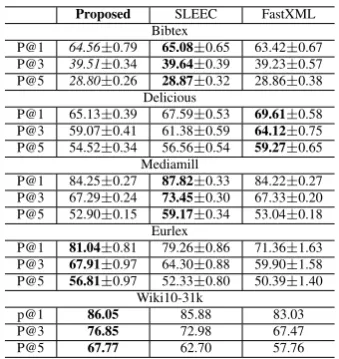
Table2shows the average and standard deviation of Precision@k for the four small-scale datasets, “Bibtex”, “Mediamill”, “Delicious”, and “Eu-rlex”, and the large-scale dataset “Wiki10-31k”. For ”Wiki10-31k”, results are reported only for those baselines that were tractable. The results for nDCG@k are included in supplementary Ma-terial, Table 5. Since the SLEEC and FastXML methods are ensemble-based, using multiple non-linear models, it is not fair to compare them with the single model methods such as our own. These methods partition the sample space into smaller tractable clusters and obtain separate classifiers for each partition. We compare our method with these in Table3.
The proposed approach in most cases has sig-nificantly better results than other methods on both measures. The embedding based approaches suffer from accumulation of the embedding and training error (Balasubramanian and Lebanon,
inter-Dataset Domain Number of Features Number of Labels Training Points Testing Points
Bibtex Text 1836 159 4880 2515
Delicious Text(Web) 500 983 12920 3185
Mediamill Video 120 101 30993 12914
Eurlex Text 5000 3993 17413 1935
[image:7.595.130.469.61.114.2]Wiki10-31K Text 101938 30938 14146 6616
Table 1: Dataset statistics
Proposed PD-sparse LEML CPLST CS ML-CSSP Bibtex
P@1 64.56±0.79 61.29±0.65 62.54±0.52 62.38±0.63 58.87±0.61 44.98±1.15 P@3 39.51±0.34 35.82±0.46 38.41±0.42 37.84±0.48 33.53±0.49 30.43±0.59 P@5 28.80±0.26 25.74±0.30 28.21±0.24 27.62±0.27 23.72±0.29 23.53±0.37
Delicious
p@1 65.13±0.39 51.82±1.40 65.67±0.73 65.31±0.88 61.36±0.38 63.04±1.28 P@3 59.07±0.41 44.18±1.04 60.55±0.48 59.95±0.43 56.46±0.33 56.26±1.13 P@5 54.52±0.34 38.95±0.94 56.08±0.43 55.31±0.50 52.07±0.30 50.16±0.83
Mediamill
P@1 84.25±0.27 81.86±4.08 84.01±0.31 83.35±0.33 83.82±5.92 78.95±0.23 P@3 67.29±0.24 62.52±2.31 67.20±0.23 66.18±0.22 67.32±4.42 60.93±0.24 P@5 52.90±0.15 45.11±1.14 52.80±0.18 51.46±0.20 52.80±2.61 44.27±0.20
Eurlex
P@1 81.04±0.81 76.43±1.04 63.40±1.58 72.28±0.99 58.52±1.06 62.09±2.12 P@3 67.91±0.97 60.37±0.74 50.35±1.44 58.16±1.11 45.51±0.71 48.39±1.31 P@5 56.81±0.97 49.72±0.74 41.28±1.07 47.73±0.97 32.47±0.58 40.11±1.10
Wiki10-31k
p@1 86.05 82.14 73.47 - -
-P@3 76.85 69.68 62.43 - -
-P@5 67.77 58.76 54.35 - -
-Table 2: Non-ensemble models with k=100 or 30 (Mediamill). Best inboldand not significantly different to best at p=0.05 initalics.
Proposed SLEEC FastXML Bibtex
P@1 64.56±0.79 65.08±0.65 63.42±0.67 P@3 39.51±0.34 39.64±0.39 39.23±0.57 P@5 28.80±0.26 28.87±0.32 28.86±0.38
Delicious
P@1 65.13±0.39 67.59±0.53 69.61±0.58 P@3 59.07±0.41 61.38±0.59 64.12±0.75 P@5 54.52±0.34 56.56±0.54 59.27±0.65
Mediamill
P@1 84.25±0.27 87.82±0.33 84.22±0.27 P@3 67.29±0.24 73.45±0.30 67.33±0.20 P@5 52.90±0.15 59.17±0.34 53.04±0.18
Eurlex
P@1 81.04±0.81 79.26±0.86 71.36±1.63 P@3 67.91±0.97 64.30±0.88 59.90±1.58 P@5 56.81±0.97 52.33±0.80 50.39±1.40
Wiki10-31k
p@1 86.05 85.88 83.03 P@3 76.85 72.98 67.47 P@5 67.77 62.70 57.76
Table 3: Ensemble-based nonlinear models. Best in
boldand not significantly different to best initalics.
dependency information which can be useful to improve the prediction accuracy for the labels which are not easy to predict only from input fea-tures.
ML-CSSP (Bi and Kwok,2013) and the work ofBalasubramanian and Lebanon(2012) attempt, like us, to find the most informative labels in or-der to perform label subset selection. However, our approach improves on their results, supporting the idea that considering only the label space formation (ignoring label-feature dependency
in-formation) in the label selection step can lead to label sets that are not easy to predict whose train-ing error will be propagated through to final model predictions.
The SLEEC and FastXML methods are ensemble-based methods using multiple nonlinear models and can be expected to outperform single model methods such as ours. SLEEC aims to par-tition the sample space into smaller tractable clus-ters to obtain a nonlinear embedding and trained model for each partition. FastXML finds a parti-tioning tree by using nonlinear binary classifiers to partition the samples at each node, which is a very complicated and unstable problem for high-dimensional spaces. Therefore, for both SLEEC and FastXML methods, they need an ensemble of the learners in order to overcome this instability and achieve a good prediction accuracy. Table3
[image:7.595.96.266.374.554.2]a single model approach.
5.1 Ablation study
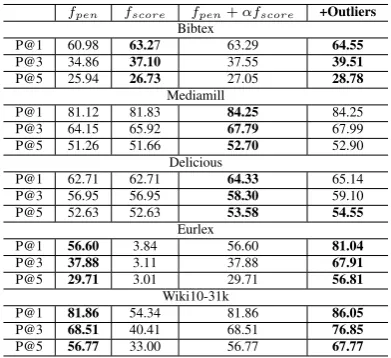
The ablation study results in Table4 shows how different data sets benefit from different parts of our proposed framework, with all parts contribut-ing substantially to at least one data set. We have reported the results by considering only label-label dependency information (fpen), label-feature
dependency information (fscore) and combining
all 3 parts (fpen, fscore and outlier information).
The results support the assertions that considering only the label space information (ignoring label-feature dependency information) in the label se-lection step causes prediction error of labels with high training error to be propagated to the whole label space and that it is important to also select outlier labels that are hard to predict from other selected labels.
fpen fscore fpen+αfscore +Outliers
Bibtex
P@1 60.98 63.27 63.29 64.55
P@3 34.86 37.10 37.55 39.51
P@5 25.94 26.73 27.05 28.78
Mediamill
P@1 81.12 81.83 84.25 84.25
P@3 64.15 65.92 67.79 67.99
P@5 51.26 51.66 52.70 52.90
Delicious
P@1 62.71 62.71 64.33 65.14
P@3 56.95 56.95 58.30 59.10
P@5 52.63 52.63 53.58 54.55
Eurlex
P@1 56.60 3.84 56.60 81.04
P@3 37.88 3.11 37.88 67.91
P@5 29.71 3.01 29.71 56.81
Wiki10-31k
P@1 81.86 54.34 81.86 86.05
P@3 68.51 40.41 68.51 76.85
[image:8.595.312.507.62.722.2]P@5 56.77 33.00 56.77 67.77
Table 4: Ablation Study. Bold indicates a difference of
≥0.8%
We also investigated the effect of changing the subset size S on the final prediction quality (we have ignored the outlier effect in these experi-ments). Figure1shows an initial marked increase in performance with subset size, however the re-sults gets more stable when the subset size gets larger. This observation, which is consistent with the submodular property, provides a clue that us-ing a more complicated trainus-ing model, like a non-linear model, for a smaller selected set of labels may lead to higher performance than increasing the subset size while using a linear model.
0 0.1 0.2 0.3 0.4 0.5 0.6 0.7
1 10 20 30 40 50 60 70 80 90 100
Pr
ec
isio
n
Selected Subset Size: |S| Bibtex
P@1 P@3 P@5
0 0.1 0.2 0.3 0.4 0.5 0.6 0.7
1 20 40 60 80 100 120 140 160 180 200
Pr
ec
isio
n
Selected Subset Size: |S| Delicious
P@1 P@3 P@5
0.65 0.67 0.69 0.71 0.73 0.75 0.77 0.79 0.81 0.83 0.85
1 5 10 20 30 40 50 60 70 80 90 100
Pr
ec
isi
o
n
Selected Subset Size: |S| Mediamill
P@1 P@3 P@5
0 0.1 0.2 0.3 0.4 0.5 0.6 0.7
1 20 40 60 80 100 120 140 160 180 200 220 240 260 280 300
Pr
ec
isi
o
n
Selected Subset Size: |S| Eurlex
P@1 P@3 P@5
0 0.1 0.2 0.3 0.4 0.5 0.6 0.7 0.8 0.9
1 10 50 100 200 300 400 500 600 700
P
re
cisio
n
Selected Subset Size: |S| Wiki10-31k
P@1 P@3 P@5
[image:8.595.83.279.366.545.2]6 Conclusion and Future Work
We propose a novel approach for extreme multi-label classification that simplifies the problem by selecting an informative and easily modelled sub-set of labels and subsequently mapping back to the full set of labels. While the method is very well applicable to text datasets, it is applicable as a gen-eral ML method for different domains. Our novel label selection mechanism follows three princi-ples: A new submodular maximisation frame-work that combines label-label dependencies and label training error together with a mechanism to identify outlier labels that are hard to recon-struct. Modelling only the most informative la-bels helps to avoid transforming the label space to a new embedding space leading to accumula-tion of training and embedding errors. We use a greedy approach for our monotone submodular framework with linear cost and good theoretical convergence. Extensive experiments using a lin-ear prediction model on selected labels conducted on five standard real-world datasets demonstrate that our method achieves better performance than single model approaches, and better or compara-ble performance to ensemcompara-ble based methods. In future, we can improve our model by using non-linear training model instead of a simple non-linear re-gression model for the selected subset of the la-bels. Moreover, ablation study results suggest that a nonlinear propagation model to reconstruct the full label set may be of benefit.
Acknowledgments
This work was partially funded by grants #16214415 and #16248016 of the Hong Kong Re-search Grants Council, ITS/319/16FP of Innova-tion Technology Commission, and RDC 1718050-0 of EMOS.AI.
References
Rahul Agrawal, Archit Gupta, Yashoteja Prabhu, and Manik Varma. 2013. Multi-label learning with millions of labels: Recommending advertiser bid phrases for web pages. InProceedings of WWW-13, pages 13–24, Seoul, Korea.
Krishnakumar Balasubramanian and Guy Lebanon. 2012. The landmark selection method for multi-ple output prediction. InProceedings of ICML-12, pages 983–990, Edinburgh, Scotland.
Elham J Barezi, James T Kwok, and Hamid R Rabiee.
2017. Multi-label learning in the independent label sub-spaces. Pattern Recognition Letters, 97:8–12.
Amir Beck and Marc Teboulle. 2009. A fast itera-tive shrinkage-thresholding algorithm for linear in-verse problems. SIAM journal on Imaging Sciences, 2(1):183–202.
Kush Bhatia, Himanshu Jain, Purushottam Kar, Pra-teek Jain, and Manik Varma. 2015a. Locally non-linear embeddings for extreme multi-label learning. InNIPS, Montreal, Canada.
Kush Bhatia, Himanshu Jain, Purushottam Kar, Manik Varma, and Prateek Jain. 2015b. Sparse local em-beddings for extreme multi-label classification. In NIPS, pages 730–738.
Wei Bi and James Kwok. 2013. Efficient multi-label classification with many labels. InProceedings of ICML-13, pages 405–413, Atlanta.
Stephen Boyd. 2011. Alternating direction method of multipliers. InTalk at NIPS workshop on optimiza-tion and machine learning.
Stephen Boyd, Neal Parikh, Eric Chu, Borja Peleato, and Jonathan Eckstein. 2011. Distributed optimiza-tion and statistical learning via the alternating di-rection method of multipliers. Foundations and TrendsR in Machine Learning, 3(1):1–122.
Yao-Nan Chen and Hsuan-Tien Lin. 2012. Feature-aware label space dimension reduction for multi-label classification. InNIPS, pages 1529–1537, Har-rahs and Harveys.
Michael Gygli, Helmut Grabner, and Luc Van Gool. 2015. Video summarization by learning submodular mixtures of objectives. InProceedings CVPR 2015, pages 3090–3098.
Bingsheng He and Xiaoming Yuan. 2012. On the o(1/n) convergence rate of the douglas–rachford al-ternating direction method. SIAM Journal on Nu-merical Analysis, 50(2):700–709.
Daniel Hsu, Sham Kakade, John Langford, and Tong Zhang. 2009. Multi-label prediction via compressed sensing. InNIPS, volume 22, pages 772–780, Van-couver CANADA.
Ioannis Katakis, Grigorios Tsoumakas, and Ioannis Vlahavas. 2008. Multilabel text classification for automated tag suggestion. In Proceedings of the ECML/PKDD, page 75.
David Kempe, Jon Kleinberg, and ´Eva Tardos. 2003. Maximizing the spread of influence through a social network. InProceedings of the ninth ACM SIGKDD international conference on Knowledge discovery and data mining, pages 137–146. ACM.
Zijia Lin, Guiguang Ding, Mingqing Hu, and Jianmin Wang. 2014. Multi-label classification via feature-aware implicit label space encoding. InProceedings of ICML-14, pages 325–333, Beijing, China.
Tie-Yan Liu, Yiming Yang, Hao Wan, Hua-Jun Zeng, Zheng Chen, and Wei-Ying Ma. 2005. Support vec-tor machines classification with a very large-scale taxonomy. Acm Sigkdd Explorations Newsletter, 7(1):36–43.
Eneldo Loza Mencia and Johannes F¨urnkranz. 2008. Efficient pairwise multilabel classification for large-scale problems in the legal domain. In Machine Learning and Knowledge Discovery in Databases, pages 50–65. Springer.
Vahab Mirrokni and Morteza Zadimoghaddam. 2015. Randomized composable core-sets for distributed submodular maximization. In Proceedings of the forty-seventh annual ACM symposium on Theory of computing, pages 153–162. ACM.
Baharan Mirzasoleiman, Ashwinkumar Badanidiyuru, Amin Karbasi, Jan Vondr´ak, and Andreas Krause. 2015. Lazier than lazy greedy. In AAAI, pages 1812–1818.
George L Nemhauser, Laurence A Wolsey, and Mar-shall L Fisher. 1978. An analysis of approximations for maximizing submodular set functionsi. Mathe-matical Programming, 14(1):265–294.
Y Nesterov. 2004. Introductory lectures on convex pro-gramming: a basic course, volume i.
Naoto Ohsaka, Takuya Akiba, Yuichi Yoshida, and Ken-ichi Kawarabayashi. 2014. Fast and accu-rate influence maximization on large networks with pruned monte-carlo simulations. In AAAI, pages 138–144.
Yashoteja Prabhu, Anil Kag, Shrutendra Harsola, Rahul Agrawal, and Manik Varma. 2018. Parabel: Partitioned label trees for extreme classification with application to dynamic search advertising. In Pro-ceedings of the 2018 World Wide Web Conference on World Wide Web, pages 993–1002. International World Wide Web Conferences Steering Committee.
Yashoteja Prabhu and Manik Varma. 2014. Fastxml: A fast, accurate and stable tree-classifier for extreme multi-label learning. In Proceedings of the 20th ACM SIGKDD International Conference on Knowl-edge Discovery and Data mining, pages 263–272, New York City. ACM.
Cees GM Snoek, Marcel Worring, Jan C Van Gemert, Jan-Mark Geusebroek, and Arnold WM Smeulders. 2006. The challenge problem for automated detec-tion of 101 semantic concepts in multimedia. In 14th Annual ACM International Conference on Mul-timedia, pages 421–430. ACM.
Farbound Tai and Hsuan-Tien Lin. 2012. Multilabel classification with principal label space transforma-tion. Neural Computation, 24(9):2508–2542.
Ioannis Tsamardinos and Giorgos Borboudakis. 2010. Permutation testing improves bayesian network learning. Machine Learning and Knowledge Dis-covery in Databases, pages 322–337.
Sebastian Tschiatschek, Rishabh K Iyer, Haochen Wei, and Jeff A Bilmes. 2014. Learning mixtures of sub-modular functions for image collection summariza-tion. InAdvances in neural information processing systems, pages 1413–1421.
G Tsoumakas, I Katakis, and I Vlahavas. 2008. Effec-tive and efficient multilabel classification in domains with large number of labels. InProc. ECML/PKDD 2008 Workshop on Mining Multidimensional Data (MMD08), pages 30–44.
Grigorios Tsoumakas, Ioannis Katakis, and Ioannis Vlahavas. 2010. Mining multi-label data. InData Mining and Knowledge Discovery Handbook, pages 667–685. Springer.
Ian EH Yen, Xiangru Huang, Wei Dai, Pradeep Ravikumar, Inderjit Dhillon, and Eric Xing. 2017. Ppdsparse: A parallel primal-dual sparse method for extreme classification. In Proceedings of the 23rd ACM SIGKDD International Conference on Knowl-edge Discovery and Data Mining, pages 545–553. ACM.
Ian EH Yen, Xiangru Huang, Kai Zhong, Pradeep Ravikumar, and Inderjit S Dhillon. 2016. Pd-sparse: A primal and dual sparse approach to extreme mul-ticlass and multilabel classification. InProceedings of ICML-16.
Hsiang-Fu Yu, Prateek Jain, Purushottam Kar, and Inderjit S Dhillon. 2014. Large-scale multi-label learning with missing labels. In Proceedings of ICML-14, volume 32, Beijing, China.
Min-Ling Zhang and Kun Zhang. 2010. Multi-label learning by exploiting label dependency. In 16th ACM SIGKDD International Conference on Knowl-edge Discovery and Data Mining, pages 999–1008. ACM.