1790
A Streamlined Method for Sourcing
Discourse-level Argumentation Annotations from the Crowd
Tristan Miller*† and Maria Sukhareva‡ and Iryna Gurevych*† *Ubiquitous Knowledge Processing Lab (UKP-TUDA)
Department of Computer Science, Technische Universität Darmstadt
https://www.ukp.tu-darmstadt.de/
†Research Training Group AIPHES
Department of Computer Science, Technische Universität Darmstadt
https://www.aiphes.tu-darmstadt.de/
‡
NLP Lab BMW Group, Munich
Abstract
The study of argumentation and the develop-ment of argudevelop-ment mining tools depends on the availability of annotated data, which is chal-lenging to obtain in sufficient quantity and qual-ity. We present a method that breaks down a popular but relatively complex discourse-level argument annotation scheme into a simpler, it-erative procedure that can be applied even by untrained annotators. We apply this method in a crowdsourcing setup and report on the relia-bility of the annotations obtained. The source code for a tool implementing our annotation method, as well as the sample data we ob-tained (4909 gold-standard annotations across 982 documents), are freely released to the re-search community. These are intended to serve the needs of qualitative research into argumen-tation, as well as of data-driven approaches to argument mining.
1 Introduction
Empirical study of argumentation requires exam-ples drawn from authentic, human-authored text. Likewise, the applications of computational argu-mentation, such as argument mining, can require significant amounts of argument-annotated data to achieve reasonable performance. However, this data can be challenging to obtain in sufficient quan-tity and quality, particularly for discourse-level argumentation. This is because discourse-level annotation schemes are necessarily complex with respect to discrimination and delimitation (i.e., the variety of markable elements in the text and how to define their boundaries), expressiveness (i.e.,
the need to tag relationships between annotated elements), and context weighting (i.e., the amount of context around markable units that needs to be considered) (Fort et al.,2012). Successfully apply-ing such schemes typically requires expensive and laborious work by expert-trained annotators.
In this paper, we present a method that facili-tates the application of one such discourse-level argument annotation scheme (Stab and Gurevych,
2014). This scheme has been widely cited and used in argumentation studies (e.g.,Lippi and Torroni,
2015;Persing and Ng,2015;Nguyen and Litman,
2015;Persing and Ng,2016;Ghosh et al., 2016;
Eger et al.,2017;Nguyen and Litman,2018), and while it is fairly coarse-grained, it is expensive to apply to new texts. Our method breaks down the annotation process into incremental, intuitive steps, each focusing on a small portion of the overall annotation scheme. We apply this method in a crowdsourcing setup with annotators who receive no training other than a brief set of annotation guidelines, as well as in a more traditional setup with extensively trained local annotators. We find that agreement between the two groups increases sublinearly with the number of crowd annotators, achieving up toαU =0.52 when using ten crowd
2 Background and Previous Mork
While there exists a great diversity of argumenta-tion theories in philosophy and logic (e.g.,Toulmin,
2003;Freeman,2011;Walton et al., 2012), they tend to agree that an argument can be decomposed into various interrelated components. Inspired by
Freeman’s (2011) theory of the macro-structure of argumentation,Stab and Gurevych(2014) broadly categorize these components as claims(the con-clusions that the audience is persuaded to accept or reject),premises(additional information offered to support or attack a given claim), and themajor claim(the one central claim that relates all other claims in an argument). Taken together, this can be conceptualized as a graph or tree structure, with vertices representing theargument components (ma-jor claims, claims, and premises) and the directed edges representing theargument relations(support and attack).
Stab and Gurevych(2014) annotate a collection of persuasive texts with this scheme, associating each argument component they identify with a con-tiguous span of text from the document. They report that the annotation process involved “several training sessions” with their annotators, including collaborative annotation of eight example docu-ments in order to obtain a common understanding of the task. This level of effort is in line with what has been reported for other discourse-level argumentation schemes. For example, annotation studies using the Freemanesque schemes of Peld-szus and Stede(2013),Li et al.(2017),Haddadan et al. (2018), andMusi et al.(2018) all required one or more lengthy training sessions guided by argumentation experts and up to six pages of written instructions.
Using existing methods to alleviate the knowl-edge acquisition bottleneck, such as incidental su-pervision (Roth,2017), or pre-annotation (Fort and Sagot,2010), could speed the work of annotators— possibly at the risk of introducing a training bias— but would not obviate the need for expert train-ing. (In any case, pre-annotation has never, to our knowledge, been successfully applied to hard discourse-level tasks such as annotating argumenta-tion structures.) The complexity of the annotaargumenta-tion scheme also seemingly rules out the use of crowd-sourcing (Howe,2006) and gamification (von Ahn,
2006), which are geared towards microtasks that are quick and easy for humans. Though one previous study has decomposed a discourse-level scheme for
use with crowdsourcing (Kawahara et al.,2014), the constraints it imposes (fixed-size annotations, maximum document length of three sentences) are too restrictive for argumentation annotation.
By contrast, the crowdsourcing approach of
Sukhareva et al.(2016), while not concerned with discourse-spanning annotations, employs a few mechanisms that are relevant for our own task. Their approach, intended for the labelling of seman-tic verb relations, breaks down the annotation work into a series of hierarchical, atomic microtasks. Only those parts of the annotation instructions rel-evant to the current microtask are shown to the annotator. Furthermore, annotators are encour-aged to think of connecting words (“specifically”, “generally speaking”, “in other words”, etc.) that justify their relation annotations. As described in the following section, we adapt and extend these mechanisms for our own annotation method.
3 Annotation Method
Our approach to mitigating the knowledge acqui-sition problem is an iterative procedure by which annotators apply a distinct subset of the annota-tion scheme at each step. In this manner, complex discourse-level annotations are built up piecemeal in simple steps. The iterative annotation process is supported by an online JavaScript-based interface. Taken together, this allows theStab and Gurevych
(2014) annotation scheme to be applied even by untrained annotators in a crowdsourcing setup.
In the first step of the annotation process, annota-tors are presented with the complete argumentative text and asked to select the one phrase (i.e., an arbitrary sequence of words) that best represents the major claim, or else to indicate that there is no such passage.1 In the second step, annotators are presented once again with the full argument, but with its major claim marked.2 The annotators then select the claims—that is, all phrases that directly speak to the major claim, as well as whether those passages support or attack the major claim—or else
1If the user indicates in any step that there is no text span corresponding to the argument component type, we ask them to perform a short alternative task. This is to prevent faithless workers from taking the easy way out of the annotation task, but also to collect further annotations of interest to us.
indicate that there are no such text spans. In the third step, annotators see the full argument with one of its claims marked. As with the previous step, annotators select text spans corresponding to the premises of the claim and indicate each premises’s stance; they also have the option of reporting that the claim has no premises.
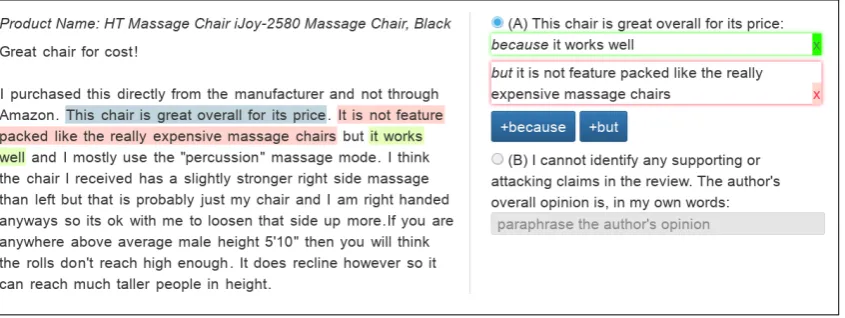
The annotation tool automatically enforces the restrictions that annotations must be contiguous, must begin and end on a word boundary, and cannot overlap with their siblings or ancestors. Crucially, the instructions given to annotators at each step of the process do not attempt to explain the en-tire annotation scheme but rather describe only the immediate annotation task in layman’s terms. Furthermore, the tool attempts to make this task more intuitive for users by framing the second and third steps as a sentence completion task. An ex-ample of this is the interface for annotating claims (see Fig. 1). The full argumentative text (in this case, a product review) is shown on the left half of the screen, with the major claim marked, and we separately show a copy of the major claim on the right half of the screen. The user is instructed to extend the major claim with additional supporting or attacking information by appending a “because” or “but” clause, respectively. The user does this by pressing the “but” or “because” button below the major claim and then highlighting a sentence or phrase from the review.
4 Annotation Study
To assess the suitability of our annotation procedure, we applied it in a crowdsourcing setup. Measuring interannotator agreement for crowdsourced anno-tations is problematic, however, because there are typically a huge number of annotators, most of whom annotate only a tiny fraction of the data set. To gauge the reliability of our crowdsourced anno-tations, we instead conducted an experiment that compared them to those produced by expert-trained annotators.
For the experiment, we randomly selected 40 Amazon product reviews from theMcAuley et al.
(2015) data set—four from each of ten product categories. Each review was annotated for ma-jor claims by ten crowd workers; all 40 reviews were also annotated for major claims by a fixed group of three locally recruited annotators trained by argumentation experts.3 We then converted the
3We engaged US-based workers from Amazon Mechanical
annotated reviews to BIO tokens (Ramshaw and Marcus,1995) and applied the annotation aggre-gation/denoising tool MACE (Hovy et al.,2013) to select at most two gold-standard major-claim annotations per review, one from the crowd (crowd) and one from the trained annotators (train).4 We then compared thecrowdandtraingold standards, one review at a time, usingKrippendorff’s (1995)
αU, a unitizing measure that considers the
token-level boundaries of the text spans marked by each annotator. We repeated this process to obtain and evaluatecrowdandtrainclaim annotations on the
trainmajor claims, and then again forcrowdand
trainpremise annotations on thetrainclaims. Note that in the gold standards for some reviews, there may be no major claim, no claims associated with the major claim, and/or no premises associ-ated with a given claim. In many cases this is because the annotators generally agreed that such argument components were not present in the text. However, in other cases the various annotatorsdid
identify such argument components, but the agree-ment among them was too low for MACE to output a gold-standard annotation. A quandary therefore arises when deciding how to treat reviews where nei-therthecrowdnor thetraingold standard contains a given type of argument component. There is no (easy) way of determining from the MACE output whether missing annotations are due to agreement or disagreement, and even if this information were available, it is not clear how it could be incorpo-rated into the calculation ofαU. For this reason, we
apply two different strategies for handling missing annotations, and provide separateαU calculations
for each. The first strategy,skip, disregards missing annotations, excluding them from the mean agree-ment calculation. The second strategy,agree, treats missing annotations as total agreement (αU =1).5
When using all ten crowdsourced annotations per review and theagreestrategy, we achieved mean
αUscores of 0.4104, 0.5231, and 0.4385 for major
claims, claims, and premises, respectively. With theskipstrategy, the respective scores are 0.4104, 0.4845, and 0.2201. As expected, these scores
Turk at the US federal minimum wage of $7.25/hour. Our expert-trained annotators were salaried research staff whose equivalent hourly rate was three to five times higher.
4MACE accepts a threshold value that is used to discard instances that cannot be confidently assigned a gold label; we set this to 0.9.
5It is not possible to treat the missing annotations as “total disagreement” because perKrippendorff(1995),αU has no
Figure 1: Annotation interface for the second step (claim annotation)
are lower than the agreement among extensively trained annotators reported byStab and Gurevych
(2014) (αU =0.7726,0.6033,0.7594).6 However,
they are broadly comparable to interannotator agree-ment scores reported in similar (and in some cases, even simpler) discourse-level argument annotation studies with expert-trained annotators, such as Aha-roni et al. (2014) (κ = 0.4), Musi et al. (2018) (κ=0.296), andLi et al.(2017) (αU =0.2452).
To measure how the number of crowd annota-tions impacts reliability, we performed an ablation study where we iteratively removed one crowd an-notation at random from each review and repeated the MACE distillation and αU calculation. The
study was repeated 100 times and the resultingαU
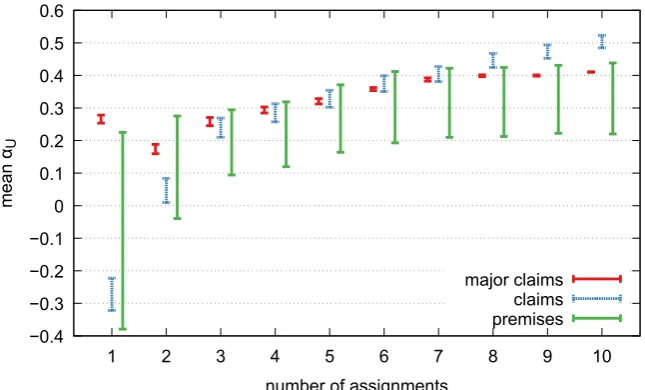
scores averaged. The results are shown in Fig.2, which plots the averageαUscores for major claims,
claims, and premises when using one to ten crowd annotations per review. The plots are shown as error bars, where the top of the bar is the average
agreescore and the bottom is the averageskipscore. Reliability scores start to be uniformly positive with three annotations, with agreement for major claims and premises plateauing around seven annotations. The difference between theagreeandskipscores is sizable only for premises.
5 Data Set and Software
Having satisfied ourselves that our method can pro-duce reliable annotations via crowdsourcing, we applied it to a much larger subset ofMcAuley et al.
(2015). The raw data consists of 982 English prod-uct reviews randomly sampled from the same ten product categories used in our evaluation study.
6Apart from the fact that we used untrained annotators, the difference in agreement may also be due in part to our use of online user-generated content as opposed to student essays.
For each argument component type in a review, we sourced annotations from five crowd workers, con-sidering this to be an acceptable trade-off between annotation quality and cost. The MACE-produced gold standard contains 4909 annotations (937 ma-jor claims, 1134 claims, 852 premises, and 1986 argument relations). Our data set is distinguished from the review corpora of García Villalba and Saint-Dizier(2012) andWyner et al.(2012) in that it is much larger, covers a broader range of product types, and is freely released under the CC BY 4.0 licence. It is comparable in size to but broader in scope than the Chinese-language hotel review corpus ofLi et al.(2017).
Our data is distributed7as a set of XML Metadata Interchange (XMI) files, one per review, containing stand-off argument annotations that cross-reference the original texts fromMcAuley et al.(2015). (Be-cause the original review texts are not available under a free licence, we do not include them in our distribution, but we provide a script for extracting them from the original corpus and merging them into our XMIs.) Also included is the JavaScript source for our annotation tool, as well as the Java source for preprocessing the raw data and postpro-cessing the annotations with MACE. This code can be used to crowdsource further annotated data sets using theMcAuley et al.(2015) data at the desired level of quality. It could also be adapted to work with other raw corpora and other Freemanesque annotation schemes.
6 Conclusion
We have presented a scalable, simplified, iterative method for sourcing the discourse-level
argumen-7
−0.4 −0.3 −0.2 −0.1 0 0.1 0.2 0.3 0.4 0.5 0.6
1 2 3 4 5 6 7 8 9 10
mean
αU
number of assignments
[image:5.595.134.457.68.263.2]major claims claims premises
Figure 2: Results of the reliability study
tation annotations of Stab and Gurevych (2014), which may be adaptable to other annotation schemes based onFreeman’s (2011) notion of argumentation. Our analysis shows that crowdsourced annotations obtained with our method yield substantial agree-ment with those obtained, with much greater effort, by expert-trained annotators. We have used our method to quickly and cheaply produce a large, argument-annotated data set of product reviews, which we freely release, along with the source code to our annotation interface and processing tools. Unlike with flat, context-free argument data such as that ofStab et al.(2018), training on our annota-tions would conceivably permit the identification not just of isolated argument components but of more complex argument structures. Our resources may also be of use for qualitative research on the linguistic features and rhetorical mechanisms of argumentative text (e.g.,Peldszus and Stede,2016).
For future work, we are investigating alternatives to MACE, which was designed for categorical an-notations rather than the sequence labelling of our task. In particular, we are looking into the Bayesian method ofSimpson and Gurevych(2018), which takes advantage of the sequential dependencies be-tween BIO tags, and works more robustly with noisy, subjective data such as ours.
Acknowledgments
The authors thank Johannes Daxenberger and Chris-tian Stab for many insightful discussions.
This work has been supported by the German Fed-eral Ministry of Education and Research (BMBF)
under the promotional references 03VP02540 (Ar-gumenText) and 01UG1816B (CEDIFOR), and by the DFG-funded research training group “Adaptive Preparation of Information form Heterogeneous Sources” (AIPHES, GRK 1994/1).
References
Ehud Aharoni, Anatoly Polnarov, Tamar Lavee, Daniel Hershcovich, Ran Levy, Ruty Rinott, Dan Gutfreund, and Noam Slonim. 2014. A benchmark dataset for automatic detection of claims and evidence in the
context of controversial topics. In Proceedings of
the 1st Workshop on Argumentation Mining, pages
64–68. Association for Computational Linguistics.
Luis von Ahn. 2006.Games with a purpose.Computer, 39(6):92–94.
Steffen Eger, Johannes Daxenberger, and Iryna Gurevych. 2017. Neural end-to-end learning for
com-putational argumentation mining. In Proceedings
of the 55th Annual Meeting of the Association for
Computational Linguistics, volume 1, pages 11–22.
Association for Computational Linguistics.
Karën Fort, Adeline Nazarenko, and Sophie Rosset. 2012. Modeling the complexity of manual
annota-tion tasks: A grid of analysis. In Proceedings of
the 24th International Conference on Computational
Linguistics, pages 895–910.
Karën Fort and Benoît Sagot. 2010. Influence of
pre-annotation on POS-tagged corpus development. In
Proceedings of the 4th Linguistic Annotation Work-shop, pages 56–63. Association for Computational Linguistics.
James B. Freeman. 2011. Argument Structure: Repre-sentation and Theory, volume 18 ofArgumentation
María Paz García Villalba and Patrick Saint-Dizier. 2012. Some facets of argument mining for
opin-ion analysis. In Bart Verheij, Stefan Szeider, and
Stefan Woltran, editors, Computational Models of
Argument, volume 245 ofFrontiers in Artificial
In-telligence and Applications, pages 23–34. IOS Press.
Debanjan Ghosh, Aquila Khanam, Yubo Han, and Smaranda Muresan. 2016. Coarse-grained
argumen-tation features for scoring persuasive essays. In
Proceedings of the 54th Annual Meeting of the
As-sociation for Computational Linguistics, volume 2,
pages 549–554. Association for Computational Lin-guistics.
Shohreh Haddadan, Elena Cabrio, and Serena Villata. 2018. Annotation of argument components in
polit-ical debates data. InProceedings of the Workshop
on Annotation in Digital Humanities, volume 2155,
pages 12–16.
Dirk Hovy, Taylor Berg-Kirkpatrick, Ashish Vaswani, and Eduard Ho vy. 2013. Learning whom to trust
with MACE. InProceedings of the 2013 Conference
of the North American Chapter of the Association for Computational Linguistics: Human Language
Tech-nologies, pages 1120–1130. Association for
Compu-tational Linguistics.
Jeff Howe. 2006. The rise of crowdsourcing. Wired, 14(6).
Daisuke Kawahara, Yuichiro Machida, Tomohide Shi-bata, Sadao Kurohashi, Hayato Kobayashi, and Man-abu Sassano. 2014. Rapid development of a corpus with discourse annotations using two-stage
crowd-sourcing. InProceedings of the 25th International
Conference on Computational Linguistics, pages
269–278. Dublin City University and Association for Computational Linguistics.
Klaus Krippendorff. 1995. On the reliability of
uni-tizing continuous data. Sociological Methodology,
25:7–76.
Mengxue Li, Shiqiang Geng, Yang Gao, Shuhua Peng, Haijing Liu, and Hao Wang. 2017. Crowdsourcing
argumentation structures in Chinese hotel reviews.
InProceedings of the 2017 IEEE International
Con-ference on Systems, Man, and Cybernetics, pages
87–92.
Marco Lippi and Paolo Torroni. 2015.
Context-independent claim detection for argument mining. In
Proceedings of the 24th International Joint
Confer-ence on Artificial IntelligConfer-ence, pages 185–191. AAAI
Press/International Joint Conferences on Artificial Intelligence.
Julian McAuley, Christopher Targett, Qinfeng “Javen” Shi, and Anton van den Hengel. 2015. Image-based
recommendations on styles and substitutes. In
Pro-ceedings of the 38th International ACM SIGIR Con-ference on Research and Development in Information
Retrieval, pages 43–52. ACM.
Elena Musi, Manfred Stede, Leonard Kriese, Smaranda Muresan, and Andrea Rocci. 2018. A multi-layer annotated corpus of argumentative text: From
argu-ment schemes to discourse relations. InProceedings
of the 11th International Conference on Language
Resources and Evaluation. European Language
Re-sources Association.
Huy Nguyen and Diane Litman. 2015. Extracting ar-gument and domain words for identifying arar-gument
components in texts. InProceedings of the 2nd
Work-shop on Argumentation Mining, pages 22–28.
Asso-ciation for Computational Linguistics.
Huy V. Nguyen and Diane J. Litman. 2018. Argument mining for improving the automated scoring of
per-suasive essays. In Proceedings of the 32nd AAAI
Conference on Artificial Intelligence, pages 5892–
5899. AAAI Press.
Andreas Peldszus and Manfred Stede. 2013. Ranking the annotators: An agreement study on
argumenta-tion structure. In Proceedings of the 7th
Linguis-tic Annotation Workshop and Interoperability with
Discourse, pages 196–204. Association for
Compu-tational Linguistics.
Andreas Peldszus and Manfred Stede. 2016. Rhetori-cal structure and argumentation structure in
mono-logue text. InProceedings of the 3rd Workshop on
Argument Mining, pages 103–112. Association for
Computational Linguistics.
Isaac Persing and Vincent Ng. 2015. Modeling
argu-ment strength in student essays. In Proceedings
of the 53rd Annual Meeting of the Association for Computational Linguistics and the 7th International
Joint Conference on Natural Language Processing,
volume 1, pages 543–552. Association for Computa-tional Linguistics.
Isaac Persing and Vincent Ng. 2016. End-to-end
argu-mentation mining in student essays. InProceedings
of the 2016 Conference of the North American Chap-ter of the Association for Computational Linguistics:
Human Language Technologies, pages 1384–1394.
Association for Computational Linguistics.
Lance A. Ramshaw and Mitchell P. Marcus. 1995.Text
chunking using transformation-based learning. In
Proceedings of the 3rd Workshop on Very Large Cor-pora, pages 82–94. Association for Computational Linguistics.
Dan Roth. 2017. Incidental supervision: Moving
be-yond supervised learning. InProceedings of the 31st
AAAI Conference on Artificial Intelligence, pages
4885–4890. AAAI Press.
Edwin Simpson and Iryna Gurevych. 2018. Bayesian ensembles of crowds and deep learners for sequence
Christian Stab and Iryna Gurevych. 2014. Annotating argument components and relations in persuasive
es-says. InProceedings of the 25th International
Con-ference on Computational Linguistics, pages 1501–
1510. Dublin City University and the Association for Computational Linguistics.
Christian Stab, Tristan Miller, Benjamin Schiller, Pranav Rai, and Iryna Gurevych. 2018. Cross-topic
argument mining from heterogeneous sources. In
Proceedings of the 2018 Conference on Empirical
Methods in Natural Language Processing, pages
3664–3674. Association for Computational Linguis-tics.
Maria Sukhareva, Judith Eckle-Kohler, Ivan Habernal, and Iryna Gurevych. 2016. Crowdsourcing a large dataset of domain-specific context-sensitive
seman-tic verb relations. InProceedings of the 10th
In-ternational Conference on Language Resources and
Evaluation, pages 2131–2137. European Language
Resources Association.
Stephen E. Toulmin. 2003. The Uses of Argument, 2nd edition. Cambridge University Press.
Douglas Walton, Christopher Reed, and Fabrizio Macagno. 2012.Argumentation Schemes, online edi-tion. Cambridge University Press.
Adam Wyner, Jodi Schneider, Katie Atkinson, and Trevor Bench-Capon. 2012. Semi-automated
argu-mentative analysis of online product reviews. In Bart
Verheij, Stefan Szeider, and Stefan Woltran, editors,
Computational Models of Argument, volume 245 of
Frontiers in Artificial Intelligence and Applications,