Proceedings of the 3rd Workshop on Neural Generation and Translation (WNGT 2019), pages 138–147 138
Unsupervised Evaluation Metrics and Learning Criteria
for Non-Parallel Textual Transfer
Richard Yuanzhe Pang1§ Kevin Gimpel2 1New York University, New York, NY 10011, USA
2Toyota Technological Institute at Chicago, Chicago, IL 60637, USA [email protected], [email protected]
Abstract
We consider the problem of automatically gen-erating textual paraphrases with modified at-tributes or properties, focusing on the setting without parallel data (Hu et al., 2017; Shen et al., 2017). This setting poses challenges for evaluation. We show that the metric of post-transfer classification accuracy is insuffi-cient on its own, and propose additional met-rics based on semantic preservation and flu-ency as well as a way to combine them into a single overall score. We contribute new loss functions and training strategies to address the different metrics. Semantic preservation is ad-dressed by adding a cyclic consistency loss and a loss based on paraphrase pairs, while flu-ency is improved by integrating losses based on style-specific language models. We experi-ment with a Yelp sentiexperi-ment dataset and a new literature dataset that we propose, using multi-ple models that extend prior work (Shen et al., 2017). We demonstrate that our metrics corre-late well with human judgments, at both the sentence-level and system-level. Automatic and manual evaluation also show large im-provements over the baseline method ofShen et al.(2017). We hope that our proposed met-rics can speed up system development for new textual transfer tasks while also encouraging the community to address our three comple-mentary aspects of transfer quality.
1 Introduction
We consider textual transfer, which we define as the capability of generating textual paraphrases with modified attributes or stylistic properties, such as politeness (Sennrich et al., 2016a), sen-timent (Hu et al., 2017; Shen et al., 2017), and formality (Rao and Tetreault, 2018). An effec-tive transfer system could benefit a range of
user-§
Work completed while the author was a student at the University of Chicago and a visiting student at Toyota Tech-nological Institute at Chicago.
facing text generation applications such as dia-logue (Ritter et al., 2011) and writing assistance (Heidorn,2000). It can also improve NLP systems via data augmentation and domain adaptation.
However, one factor that makes textual transfer difficult is the lack of parallel corpora. Advances have been made in developing transfer methods that do not require parallel corpora (see Section2), but issues remain with automatic evaluation met-rics.Li et al.(2018) used crowdsourcing to obtain manually-written references and used BLEU ( Pa-pineni et al.,2002) to evaluate sentiment transfer. However, this approach is costly and difficult to scale for arbitrary textual transfer tasks.
Researchers have thus turned to unsupervised
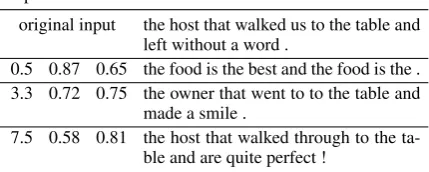
evaluation metrics that do not require references. The most widely-used unsupervised evaluation uses a pretrained style classifier and computes the fraction of times the classifier was convinced of transferred style (Shen et al.,2017). However, re-lying solely on this metric leads to models that completely distort the semantic content of the in-put sentence. Table1illustrates this tendency.
We address this deficiency by identifying two competing goals: preserving semantic content and producing fluent output. We contribute two cor-responding metrics. Since the metrics are un-supervised, they can be used directly for tun-ing and model selection, even on test data. The three metric categories are complementary and help us avoid degenerate behavior in model selec-tion. For particular applications, practitioners can choose the appropriate combination of our metrics to achieve the desired balance among transfer, se-mantic preservation, and fluency. It is often useful to summarize the three metrics into one number, which we discuss in Section3.3.
preserva-tion by adding a “cyclic consistency” loss (to en-sure that transfer is reversible) and a loss based on paraphrase pairs (to show the model exam-ples of content-preserving transformations). To encourage fluent outputs, we add losses based on pretrained corpus-specific language models. We also experiment with multiple, complemen-tary discriminators and find that they improve the trade-off between post-transfer accuracy and se-mantic preservation.
To demonstrate the effectiveness of our met-rics, we experiment with textual transfer models discussed above, using both their Yelp polarity dataset and a new literature dataset that we pro-pose. Across model variants, our metrics correlate well with human judgments, at both the sentence-level and system-sentence-level.
2 Related Work
Textual Transfer Evaluation Recent work has included human evaluation of the three categories (post-transfer style accuracy, semantic preserva-tion, fluency), but does not propose automatic evaluation metrics for all three (Li et al., 2018; Prabhumoye et al.,2018;Chen et al.,2018;Zhang et al., 2018). There have been recent proposals for supervised evaluation metrics (Li et al.,2018), but these require annotation and are therefore un-available for new textual transfer tasks. There is a great deal of recent work in textual transfer (Yang et al., 2018b; Santos et al., 2018; Zhang et al., 2018;Logeswaran et al.,2018;Nikolov and Hahn-loser,2018), but all either lack certain categories of unsupervised metric or lack human validation of them, which we contribute. Moreover, the tex-tual transfer community lacks discussion of early stopping criteria and methods of holistic model comparison. We propose a one-number summary for transfer quality, which can be used to select and compare models.
In contemporaneous work, Mir et al. (2019) similarly proposed three types of metrics for style transfer tasks. There are two main differences compared to our work: (1) They use a style-keyword masking procedure before evaluating se-mantic similarity, which works on the Yelp dataset (the only datasetMir et al.(2019) test on) but does not work on our Literature dataset or similarly complicated tasks, because the masking proce-dure goes against preserving content-specific non-style-related words. (2) They do not provide a
way of aggregating three metrics for the purpose of model selection and overall comparison. We address these two problems, and we also propose metrics that are simple in addition to being ef-fective, which is beneficial for ease of use and widespread adoption.
Textual Transfer Models In terms of generat-ing the transferred sentences, to address the lack of parallel data,Hu et al. (2017) used variational autoencoders to generate content representations devoid of style, which can be converted to sen-tences with a specific style. Ficler and Goldberg (2017) used conditional language models to gen-erate sentences where the desired content and style are conditioning contexts. Li et al.(2018) used a feature-based approach that deletes characteristic words from the original sentence, retrieves simi-lar sentences in the target corpus, and generates based on the original sentence and the character-istic words from the retrieved sentences. Xu et al. (2018) integrated reinforcement learning into the textual transfer problem. Another way to address the lack of parallel data is to use learning frame-works based on adversarial objectives ( Goodfel-low et al., 2014); several have done so for tex-tual transfer (Yu et al.,2017;Li et al.,2017;Yang et al., 2018a; Shen et al., 2017; Fu et al., 2018). Recent work uses target-domain language models as discriminators to provide more stable feedback in learning (Yang et al.,2018b).
To preserve semantics more explicitly,Fu et al. (2018) use a multi-decoder model to learn content representations that do not reflect styles. Shetty et al.(2017) use a cycle constraint that penalizes L1 distance between input and round-trip transfer
reconstruction. Our cycle consistency loss is in-spired by Shetty et al. (2017), together with the idea of back translation in unsupervised neural machine translation (Artetxe et al.,2017;Lample et al., 2017), and the idea of cycle constraints in image generation byZhu et al.(2017).
3 Evaluation
3.1 Issues with Most Existing Methods
#ep Acc Sim Sentence
original input the host that walked us to the table and left without a word .
0.5 0.87 0.65 the food is the best and the food is the . 3.3 0.72 0.75 the owner that went to to the table and
made a smile .
[image:3.595.74.289.74.160.2]7.5 0.58 0.81 the host that walked through to the ta-ble and are quite perfect !
Table 1: Examples showing why Acc is insufficient. The original sentence has negative sentiment, and the goal is to transfer to positive. #ep is number of epochs trained when generating the sentence and Sim (de-scribed below) is the semantic similarity to the original sentence. HighAccis associated with lowSim.
relying solely on this metric. Table1 shows ex-amples of transferred sentences at several points in training the model ofShen et al.(2017).Accis highest very early in training and decreases over time as the outputs become a stronger semantic match to the input, a trend we show in more detail in Section6. Thus transfer quality is inversely pro-portional to semantic similarity to the input sen-tence, meaning that these metrics are complemen-tary and difficult to optimize simultaneously.
We also identify a third category of metric, namely fluency of the transferred sentence, and similarly find it to be complementary to the first two. These three metrics can be used to eval-uate textual transfer systems and to do hyperpa-rameter tuning and early stopping. In our experi-ments, we found that training typically converges to a point that gives poor Acc. Intermediate re-sults are much better under a combination of all three unsupervised metrics. Stopping criteria are rarely discussed in prior work on textual transfer.
3.2 Unsupervised Evaluation Metrics
We now describe our proposals. We validate the metrics with human judgments in Section6.3.
Post-transfer classification accuracy (“Acc”):
This metric was mentioned above. We use a CNN (Kim,2014) trained to classify a sentence as be-ing fromX0orX1(two corpora corresponding to
different styles or attributes). ThenAccis the per-centage of transferred sentences that are classified as belonging to the transferred class.
Semantic Similarity (“Sim”): We compute se-mantic similarity between the input and trans-ferred sentences. We embed sentences by averag-ing their word embeddaverag-ings weighted by idf scores,
whereidf(q) = log(|C| · |{s∈C :q∈s}|−1)(q is a word,sis a sentence,C =X0∪X1). We use
300-dimensional GloVe word embeddings ( Pen-nington et al.,2014). Then,Simis the average of the cosine similarities over all original/transferred sentence pairs. Though this metric is quite simple, we show empirically that it is effective in captur-ing semantic similarity. Simplicity in evaluation metrics is beneficial for computational efficiency and widespread adoption. The quality of transfer evaluations will be significantly boosted with even such a simple metric. We also experimented with METEOR (Denkowski and Lavie, 2014). How-ever, given that we found it to be strongly corre-lated withSim(shown in supplemental materials), we adoptSim due to its computational efficiency and simplicity.
Different textual transfer tasks may require dif-ferent degrees of semantic preservation. Our sum-mary metric, described in Section 3.3, can be tailored by practitioners for various datasets and tasks which may require more or less weight on semantic preservation.
Fluency (“PP”): Transferred sentences can ex-hibit highAccandSimwhile still being ungram-matical. So we add a third unsupervised metric to target fluency. We compute perplexity (“PP”) of the transferred corpus, using a language model pretrained on the concatenation of X0 and X1.
We note that perplexity is distinct from fluency. However, certain measures based on perplexity have been shown to correlate with sentence-level human fluency judgments (Gamon et al., 2005; Kann et al., 2018). Furthermore, as discussed in Section 3.3, we punish abnormally small per-plexities, as transferred texts with such perplexi-ties typically consist entirely of words and phrases that do not result in meaningful sentences. Our summary metric, described in Section3.3, can be tailored by practitioners for various datasets and tasks which may require more or less weight on semantic preservation.
3.3 Summarizing Metrics into One Score
It is often useful to summarize multiple metrics into one number, for ease of tuning and model se-lection. To do so, we propose an adjusted geomet-ric mean (GM) of a generated sentenceq:
GMt(q) = [100·Acc−t1]+·[100·Sim−t2]+
·min{[t3−PP]+,[PP−t4]+} 13
wheret = (ti)i∈[4], and [·]+ = max(·,0). Note
that as discussed above, we punish abnormally small perplexities by settingt4.
When choosing models, different practition-ers may prefer different trade-offs of Acc, Sim, and PP. As one example, we provide a set of parameters based on our experiments: t = (63,71,97,−37). We sampled 300 pairs of trans-ferred sentences from a range of models from our two different tasks (Yelp and literature) and asked annotators which of the two sentences is better. We denote a pair of sentences by(y+, y−)where y+ is preferred. We train the parameterst using the following loss:
LGM(t) = max(0,−GMt(y+) + GMt(y−) + 1)
In future work, a richer functionf(Acc,Sim,PP) could be learned from additional annotated data, and more diverse textual transfer tasks can be in-tegrated into the parameter training.
4 Textual Transfer Models
The textual transfer systems introduced below are designed to target the metrics. These system vari-ants are also used for metric evaluation. Note that each variant of the textual transfer system uses dif-ferent components described below.
Our model is based on Shen et al.(2017). We define y ∈ R200 and z ∈ R500 to be latent style and content variables, respectively. X0 and
X1 are two corpora containing sentencesx(0i)and
x(1i) respectively, where the word embeddings are in R100. We transfer using an encoder-decoder framework. The encoder E : X × Y → Z (whereX,Y,Zare sentence domain, style space, and content space, respectively) is defined using an RNN with gated recurrent unit (GRU; Chung et al., 2014) cells. The decoder/generator G : Y × Z → X is defined also using a GRU RNN. We use xe to denote the style-transferred version
of x. We want ex (i)
t =G(y1−t, E(x(ti),yt)) for
t∈ {0,1}.
4.1 Reconstruction and Adversarial Losses
Shen et al. (2017) used two families of losses for training: reconstruction and adversarial losses. The reconstruction loss solely helps the encoder and decoder work well at encoding and generating natural language, without any attempt at transfer:
Lrec(θE, θG)
=P1 t=0Ext
−logpG(xt|yt, E(xt,yt))
(2)
The loss seeks to ensure that when a sentencextis
encoded to its content vector and then decoded to generate a sentence, the generated sentence should match xt. For their adversarial loss, Shen et al.
(2017) used a pair of discriminators: D0 tries to
distinguish between x0 and ex1, andD1 between
x1andex0. In particular, decoderG’s hidden states
are aligned instead of output words.
Ladvt(θE, θG, θDt) =− 1 k
Pk
i=1logDt(h(ti))
−1 k
Pk
i=1log(1−Dt(eh (i)
1−t)) (3)
where k is the size of a mini-batch. Dt outputs
the probability that its input is from styletwhere the classifiers are based on the convolutional neu-ral network fromKim(2014). The CNNs use fil-ter n-gram sizes of 3, 4, and 5, with 128 filters each. We obtain hidden states h by unfolding G from the initial state (yt,z(ti)) and feeding in
x(ti). We obtain hidden stateshe by unfoldingG
from(y1−t,z(ti))and feeding in the previous
out-put probability distributions.
4.2 Cyclic Consistency Loss
We use a “cyclic consistency” loss (Zhu et al., 2017) to encourage already-transferred sentences to be able to be recovered by transferring back again. This loss is similar toLrec except we now transfer style twice in the loss. Recall that we seek to transferxttoext. After successful transfer, we
expect ext to have styley1−t, andxeet (transferred
back fromext) to have styleyt. We wantxeetto be
very close to the original untransferred xt. The
loss is defined as
Lcyc(θE, θG)=P1t=0Ext
−logpG(xt|yt,ezt)
(4)
where ezt = E(G(y1−t, E(xt,yt)),y1−t) or,
more concisely,ezt=E(xet,y1−t).
To use this loss, the first step is to transfer sen-tencesxtfrom styletto1−tto getxet. The
sec-ond step is to transferxet of style1−tback tot
so that we can compute the loss of the words in xtusing probability distributions computed by the
4.3 Paraphrase Loss
While Lrec provides the model with one way to preserve style (i.e., simply reproduce the input), the model does not see any examples of style-preserving paraphrases. To address this, we add a paraphrase loss very similar to losses used in neu-ral machine translation. We define the loss on a sentential paraphrase pair hu,vi and assume that uandvhave the same style and content. The loss is the sum of token-level log losses for generating each word invconditioned on the encoding ofu:
Lpara(θE, θG)
=P1t=0Ehu,vi
−logpG(v|yt, E(u,yt))
(5)
For paraphrase pairs, we use the ParaNMT-50M dataset (Wieting and Gimpel,2018).1
4.4 Language Modeling Loss
We attempt to improve fluency (our third metric) and assist transfer with a loss based on matching a pretrained language model for the target style. The loss is the cross entropy (CE) between the proba-bility distribution from this language model and the distribution from the decoder:
Llang(θE, θG) =P1t=0Ext P
iCE(lt,i,gt,i)
(6)
wherelt,iandgt,iare distributions over the
vocab-ulary defined as follows:
lt,i =pLM1−t(· |ext1:(i−1))
gt,i =pG(· |xet1:(i−1),y1−t, E(xt,yt))
where·stands for all words in the vocabulary built from the corpora. When transferring from stylet to1−t,lt,i is the distribution under the language
modelpLM1−t pretrained on sentences from style
1−tandgt,iis the distribution under the decoder
G. The two distributions lt,i and gt,i are over
words at positionigiven thei−1words already predicted by the decoder. The two style-specific language models are pretrained on the corpora cor-responding to the two styles. They are GRU RNNs with a dropout probability of 0.5, and they are kept fixed during the training of the transfer network.
4.5 Multiple Discriminators
Note that each of the textual transfer system vari-ants uses different losses or components described
1We first filter out sentence pairs where one sentence is
the substring of another, and then randomly select 90K pairs.
in this section. To create more variants, we add a second pair of discriminators, D00 andD10, to the adversarial loss to address the possible mode col-lapse problem (Nguyen et al.,2017). In particular, we use CNNs withn-gram filter sizes of 3, 4, and 5 forD0 andD1, and we use CNNs withn-gram
sizes of 1, 2, and 3 forD00 andD01. Also, forD00 and D10, we use the Wasserstein GAN (WGAN) framework (Arjovsky et al.,2017). The adversar-ial loss takes the following form:
Ladv0
t(θE, θG, θD0t) = 1 k
Pk i=1
D0t(he (i) t )
−D0t(h(ti)) +ξ(k∇◦
h(i)t D
0
t( ◦
h(ti))k2−1)2
(7)
where
◦
ht(i) = iht(i) + (1 −i)eh (i)
t where i ∼
Uniform([0,1]) is sampled for each training in-stance. The adversarial loss is based onArjovsky et al.(2017),2 with the exception that we use the hidden states of the decoder instead of word dis-tributions as inputs toD0t, similar to Eq. (3).
We choose WGAN in the hope that its differen-tiability properties can help avoid vanishing gra-dient and mode collapse problems. We expect the generator to receive helpful gradients even if the discriminators perform well. This approach leads to much better outputs, as shown below.
4.6 Summary
We iteratively update (1)θD0, θD1,θD00, andθD10
by gradient descent on Ladv0, Ladv1, Ladv00, and
Ladv0
1, respectively, and (2)θE,θGby gradient
de-scent onLtotal =λ1Lrec +λ2Lpara +λ3Lcyc + λ4Llang−λ5(Ladv0+Ladv1)−λ6(Ladv00+Ladv01).
Depending on which model is being trained (see Table 2), the λi’s for the unused losses will be
zero. More details are shown in Section5. The appendix shows the full algorithm.
5 Experimental Setup
5.1 Datasets
Yelp sentiment. We use the same Yelp dataset as Shen et al.(2017), which uses corpora of positive and negative Yelp reviews. The goal of the transfer task is to generate rewritten sentences with similar content but inverted sentiment. We use the same train/development/test split asShen et al. (2017). The dataset has 268K, 38K, 76K positive train-ing, development, and test sentences, respectively, and 179K/25K/51K negative sentences. LikeShen
et al. (2017), we only use sentences with 15 or fewer words.
Literature. We consider two corpora of litera-ture. The first corpus contains works of Charles Dickens collected from Project Gutenberg. The second corpus is comprised of modern literature from the Toronto Books Corpus (Zhu et al.,2015). Sentences longer than 25 words are removed. Un-like the Yelp dataset, the two corpora have very different vocabularies. This dataset poses chal-lenges for the textual transfer task, and it provides diverse data for assessing quality of our evalua-tion system. Given the different and sizable vo-cabulary, we preprocess by using the named en-tity recognizer in Stanford CoreNLP (Manning et al.,2014) to replace names and locations with
-PERSON- and -LOCATION- tags, respectively. We also use byte-pair encoding (BPE), commonly used in generation tasks (Sennrich et al.,2016b). We only use sentences with lengths between 6 and 25. The resulting dataset has 156K, 5K, 5K Dick-ens training, development, and testing sentences, respectively, and 165K/5K/5K modern literature sentences.
5.2 Hyperparameter Settings
Section4.6requires setting theλweights for each component. Depending on which model is being trained (see Table2), theλi’s for the unused losses
will be zero. Otherwise, we setλ1 = 1,λ2 = 0.2,
λ3 = 5,λ4 = 10−3,λ5 = 1,λ6 = 2−epwhereep
is the number of epochs. For optimization we use Adam (Kingma and Ba,2014) with a learning rate of10−4. We implement our models using Tensor-Flow (et al.,2015).3 Code is available via the first author’s webpageyzpang.me.
5.3 Pretrained Evaluation Models
For the pretrained classifiers, the accuracies on the Yelp and Literature development sets are 0.974 and 0.933, respectively. For language models, the perplexities on the Yelp and Literature develop-ment sets are 27.4 and 40.8, respectively.
6 Results and Analysis
6.1 Analyzing Metric Relationships
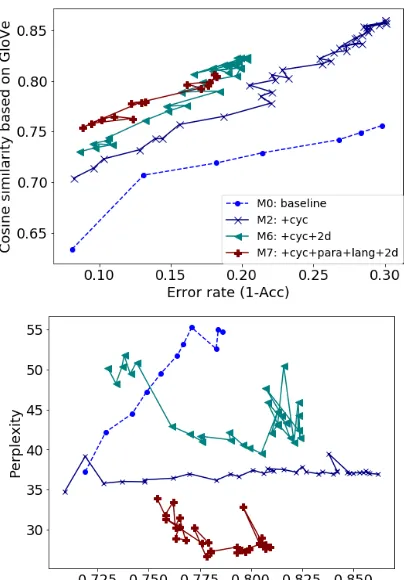
Table2shows results for the Yelp dataset and Fig-ure 1 plots learning trajectories of those models.
3Our implementation is based on code fromShen et al.
(2017).
Acc Sim PP GM
[image:6.595.310.527.215.308.2]M0:Shen et al.(2017) 0.818 0.719 37.3 10.0 M1: M0+para 0.819 0.734 26.3 14.2 M2: M0+cyc 0.813 0.770 36.4 18.8 M3: M0+cyc+lang 0.807 0.796 28.4 21.5 M4: M0+cyc+para 0.798 0.783 39.7 19.2 M5: M0+cyc+para+lang 0.804 0.785 27.1 20.3 M6: M0+cyc+2d 0.805 0.817 43.3 21.6 M7: M6+para+lang 0.818 0.805 29.0 22.8
Table 2: Yelp results with various systems and auto-matic metrics at a nearly-fixedAcc, with best scores in boldface. We use M0 to denoteShen et al.(2017).
Acc Sim PP GM
[image:6.595.315.517.367.657.2]M0:Shen et al.(2017) 0.694 0.728 22.3 8.81 M1: M0+para 0.702 0.747 23.6 11.7 M2: M0+cyc 0.692 0.781 49.9 12.8 M3: M0+cyc+lang 0.698 0.754 39.2 12.0 M4: M0+cyc+para 0.702 0.757 33.9 12.8 M5: M0+cyc+para+lang 0.688 0.753 28.6 11.8 M6: M0+cyc+2d 0.704 0.794 63.2 12.8 M7: M6+para+lang 0.706 0.768 49.0 12.8
Table 3: Literature results with various systems and au-tomatic metrics at a nearly-fixedAcc, with best scores in boldface. We use M0 to denoteShen et al.(2017).
Figure 1: Learning trajectories with models from Table 2. Metrics are computed on the dev sets. Figures for Literature (with similar trends) are in supplementary.
Models Transfer quality Semantic preservation Fluency
Dataset A B A>B B>A Tie A>B B>A Tie ∆Sim A>B B>A Tie ∆PP M0 M2 9.0 6.0 85.1 1.5 25.4 73.1 -0.05 10.4 23.9 65.7 0.9
Yelp M0 M7 9.6 14.7 75.8 2.5 54.5 42.9 -0.09 4.6 39.4 56.1 8.3 M6 M7 13.7 11.6 74.7 16.0 16.7 67.4 0.01 10.3 20.0 69.7 14.3 M2 M7 5.8 9.3 84.9 8.1 25.6 66.3 -0.04 14.0 26.7 59.3 7.4
[image:7.595.77.520.64.157.2]Literature M2 M6 4.2 6.7 89.2 16.7 20.8 62.5 0.01 40.8 13.3 45.8 -13.3 M6 M7 15.8 13.3 70.8 25.0 9.2 65.8 0.03 14.2 20.8 65.0 14.2
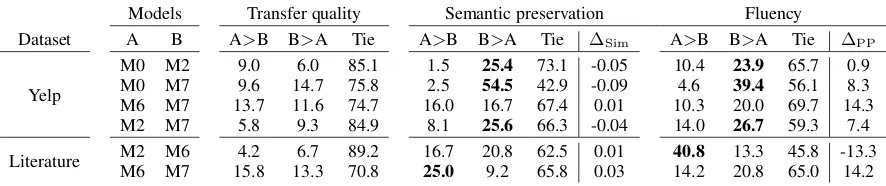
Table 4: Manual evaluation results (%) using models from Table2(i.e., with roughly fixedAcc).>means “better than”. ∆Sim = Sim(A)−Sim(B), and∆PP = PP(A)−PP(B)(note that lowerPPgenerally means better
fluency). Each row uses at least 120 sentence pairs. A cell is bold if it represents a model win of at least 10%.
trends. The figures show trajectories of statis-tics on corpora transferred/generated from the dev set during learning. Each two consecutive mark-ers deviate by half an epoch of training. Lower-left markers generally precede upper-right ones. In Figure 1(a), the plots of Sim by error rate (1−Acc) exhibit positive slopes, meaning that er-ror rate is positively correlated withSim. Curves to the upper-left corner represent better trade-off between error rate and Sim. In the plots of PP bySimin Figure1(b), the M0 curve exhibits large positive slope but the curves for other models do not, which indicates that M0 sacrifices PP for Sim. Other models maintain consistentPPasSim increases during training.
6.2 System-Level Validation
Annotators were shown the untransferred sen-tence, as well as sentences produced by two mod-els (which we refer to as A and B). They were asked to judge which better reflects the target style (A, B, or tie), which has better semantic preser-vation of the original (A, B, or tie), and which is more fluent (A, B, or tie). Results are shown in Table4.
Overall, the results show the same trends as our automatic metrics. For example, on Yelp, large differences in human judgments of semantic preservation (M2>M0, M7>M0, M7>M2) also show the largest differences inSim, while M6 and M7 have very similar human judgments and very similarSimscores.
6.3 Sentence-Level Validation of Metrics
We describe a human sentence-level validation of our metrics in Table5.
To validate Acc, human annotators were asked to judge the style of 100 transferred sentences (sampled equally from M0, M2, M6, M7). Note that it is a binary choice question (style 0 or style 1
Metric Method of validation Yelp Lit.
Acc % of machine and human judg-ments that match
94 84
Sim Spearman’sρb/wSimand human ratings of semantic preservation
0.79 0.75
PP Spearman’sρb/w negativePPand human ratings of fluency
0.81 0.67
Table 5: Human sentence-level validation of metrics; 100 examples for each dataset for validatingAcc; 150 each forSimandPP; see text for validation ofGM.
without “tie” option) so that human annotators had to make a choice. We then compute the percentage of machine and human judgments that match.
We validate Sim and PP by computing sentence-level Spearman’s ρ between the metric and human judgments (an integer score from 1 to 4) on 150 generated sentences (sampled equally from M0, M2, M6, M7). We presented pairs of original sentences and transferred sentences to human annotators. They were asked to rate the level of semantic similarity (and similarly for flu-ency) where 1 means “extremely bad”, 2 means “bad/ok/needs improvement”, 3 means “good”, and 4 means “very good.” They were also given 5 examples for each rating (i.e., a total of 20 for four levels) before annotating. From Table5, all validations show strong correlations on the Yelp dataset and reasonable correlations on Literature.
We validate GMby obtaining human pairwise preferences (without the “tie” option) of over-all transfer quality and measuring the fraction of pairs in which the GMscore agrees with the hu-man preference. Out of 300 pairs (150 from each dataset), 258 (86%) match.
the manual annotation, there is sufficient random-ization regarding model and textual transfer direc-tion.
6.4 Comparing Losses
Cyclic Consistency Loss. We compare the tra-jectories of the baseline model (M0) and the+cyc
model (M2). Table2and Figure1show that under similar Acc, M2 has much better semantic simi-larity for both Yelp and Literature. In fact, cyclic consistency loss proves to be the strongest driver of semantic preservation across all of our model configurations. The other losses do not constrain the semantic relationship across style transfer, so we include the cyclic loss in M3 to M7.
Paraphrase Loss. Table2shows that the model with paraphrase loss (M1) slightly improvesSim over M0 on both datasets under similarAcc. For Yelp, M1 has betterAccandPPthan M0 at com-parable semantic similarity. So, when used alone, the paraphrase loss helps. However, when com-bined with other losses (e.g., compare M2 to M4), its benefits are mixed. For Yelp, M4 is slightly bet-ter in preserving semantics and producing fluent output, but for Literature, M4 is slightly worse. A challenge in introducing an additional paraphrase dataset is that its notions of similarity may clash with those of content preservation in the transfer task. For Yelp, both corpora share a great deal of semantic content, but Literature shows systematic semantic differences even after preprocessing.
Language Modeling Loss. When comparing between M2 and M3, between M4 and M5, and between M6 and M7, we find that the addition of the language modeling loss reducesPP, some-times at a slight cost of semantic preservation.
6.5 Results based on Supervised Evaluation
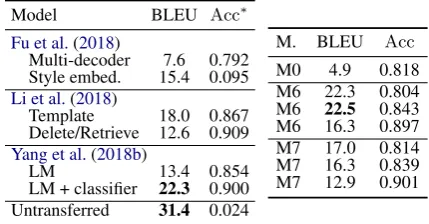
If we want to compare the models using one sin-gle number, GM is our unsupervised approach. We can also compute BLEU scores between our generated outputs and human-written gold stan-dard outputs using the 1000 Yelp references from Li et al. (2018). For BLEU scores reported for the methods of Li et al.(2018), we use the val-ues reported byYang et al. (2018b). We use the same BLEU implementation as used byYang et al. (2018b), i.e.,multi-bleu.perl. We compare three models selected during training from each of our M6 and M7 settings. We also report post-transfer accuracies reported by prior work, as well
Model BLEU Acc∗
Fu et al.(2018)
Multi-decoder 7.6 0.792 Style embed. 15.4 0.095
Li et al.(2018)
Template 18.0 0.867 Delete/Retrieve 12.6 0.909
Yang et al.(2018b)
LM 13.4 0.854 LM + classifier 22.3 0.900 Untransferred 31.4 0.024
M. BLEU Acc
M0 4.9 0.818 M6 22.3 0.804 M6 22.5 0.843 M6 16.3 0.897 M7 17.0 0.814 M7 16.3 0.839 M7 12.9 0.901
Table 6: Results on Yelp sentiment transfer, where BLEU is between 1000 transferred sentences and hu-man references, andAccis restricted to the same 1000 sentences. Our best models (right table) achieve higher BLEU than prior work at similar levels ofAcc, but un-transferred sentences achieve the highest BLEU.Acc∗: the definition ofAccvaries by row because of different classifiers in use. Other results fromLi et al.(2018) are not included as they are worse.
our own computed Accscores for M0, M6, M7, and the untransferred sentences. Though the clas-sifiers differ across models, their accuracy tends to be very high (>0.97), making it possible to make rough comparisons ofAccacross them.
BLEU scores and post-transfer accuracies are shown in Table6. The most striking result is that
untransferred sentences have the highest BLEU score by a large margin, suggesting that prior work for this task has not yet eclipsed the trivial baseline of returning the input sentence. However, at sim-ilar levels ofAcc, our models have higher BLEU scores than prior work. We additionally find that supervised BLEU shows a trade-off withAcc: for a single model type, higherAcc generally corre-sponds to lower BLEU.
7 Conclusion
We proposed three kinds of metrics for non-parallel textual transfer, studied their relation-ships, and developed learning criteria to address them. We emphasize that all three metrics are needed to make meaningful comparisons among models. We expect our components to be applica-ble to a broad range of generation tasks.
Acknowledgments
[image:8.595.307.522.63.175.2]References
Mart´ın Abadi et al. 2015. TensorFlow: Large-scale machine learning on heterogeneous systems. Soft-ware available from tensorflow.org.
Martin Arjovsky, Soumith Chintala, and L´eon Bot-tou. 2017. Wasserstein GAN. arXiv preprint arXiv:1701.07875.
Mikel Artetxe, Gorka Labaka, Eneko Agirre, and Kyunghyun Cho. 2017. Unsupervised neural ma-chine translation.arXiv preprint arXiv:1710.11041.
Liqun Chen, Shuyang Dai, Chenyang Tao, Haichao Zhang, Zhe Gan, Dinghan Shen, Yizhe Zhang, Guoyin Wang, Ruiyi Zhang, and Lawrence Carin. 2018. Adversarial text generation via feature-mover’s distance. InAdvances in Neural Informa-tion Processing Systems, pages 4671–4682.
Junyoung Chung, Caglar Gulcehre, KyungHyun Cho, and Yoshua Bengio. 2014. Empirical evaluation of gated recurrent neural networks on sequence model-ing. arXiv preprint arXiv:1412.3555.
Michael Denkowski and Alon Lavie. 2014. Meteor universal: Language specific translation evaluation for any target language. InProceedings of the EACL 2014 Workshop on Statistical Machine Translation.
Jessica Ficler and Yoav Goldberg. 2017. Controlling linguistic style aspects in neural language genera-tion. In Proceedings of the Workshop on Stylis-tic Variation, pages 94–104, Copenhagen, Denmark. Association for Computational Linguistics.
Zhenxin Fu, Xiaoye Tan, Nanyun Peng, Dongyan Zhao, and Rui Yan. 2018. Style transfer in text: ex-ploration and evaluation. In32nd AAAI Conference on Artificial Intelligence (AAAI-18).
Michael Gamon, Anthony Aue, and Martine Smets. 2005. Sentence-level MT evaluation without refer-ence translations: Beyond language modeling. In Proceedings of EAMT, pages 103–111.
Ian Goodfellow, Jean Pouget-Abadie, Mehdi Mirza, Bing Xu, David Warde-Farley, Sherjil Ozair, Aaron Courville, and Yoshua Bengio. 2014. Generative ad-versarial nets. In Advances in Neural Information Processing Systems, pages 2672–2680.
George Heidorn. 2000. Intelligent writing assistance. Handbook of natural language processing, pages 181–207.
Zhiting Hu, Zichao Yang, Xiaodan Liang, Ruslan Salakhutdinov, and Eric P. Xing. 2017. Toward con-trolled generation of text. In Proceedings of the 34th International Conference on Machine Learn-ing, volume 70 ofProceedings of Machine Learning Research, pages 1587–1596.
Katharina Kann, Sascha Rothe, and Katja Filippova. 2018. Sentence-level fluency evaluation: Refer-ences help, but can be spared! InProceedings of the 22nd Conference on Computational Natural Lan-guage Learning, CoNLL 2018, Brussels, Belgium, October 31 - November 1, 2018, pages 313–323.
Yoon Kim. 2014. Convolutional neural net-works for sentence classification. arXiv preprint arXiv:1408.5882.
Diederik P. Kingma and Jimmy Ba. 2014. Adam: A method for stochastic optimization. arXiv preprint arXiv:1412.6980.
Guillaume Lample, Ludovic Denoyer, and
Marc’Aurelio Ranzato. 2017. Unsupervised machine translation using monolingual corpora only.arXiv preprint arXiv:1711.00043.
Jiwei Li, Will Monroe, Tianlin Shi, S´ebastien Jean, Alan Ritter, and Dan Jurafsky. 2017. Adversarial learning for neural dialogue generation. In Proceed-ings of the Conference on Empirical Methods in Nat-ural Language Processing, pages 2147–2159. Asso-ciation for Computational Linguistics.
Juncen Li, Robin Jia, He He, and Percy Liang. 2018. Delete, retrieve, generate: a simple approach to sen-timent and style transfer. In Proceedings of the 2018 Conference of the North American Chapter of the Association for Computational Linguistics: Hu-man Language Technologies, Volume 1 (Long Pa-pers), pages 1865–1874. Association for Computa-tional Linguistics.
Lajanugen Logeswaran, Honglak Lee, and Samy Ben-gio. 2018. Content preserving text generation with attribute controls. InAdvances in Neural Informa-tion Processing Systems, pages 5103–5113.
Christopher Manning, Mihai Surdeanu, John Bauer, Jenny Finkel, Steven Bethard, and David McClosky. 2014. The Stanford CoreNLP natural language pro-cessing toolkit. In Proceedings of 52nd Annual Meeting of the Association for Computational Lin-guistics: System Demonstrations, pages 55–60, Bal-timore, Maryland. Association for Computational Linguistics.
Remi Mir, Bjarke Felbo, Nick Obradovich, and Iyad Rahwan. 2019. Evaluating style transfer for text. InProceedings of the 2019 Conference of the North American Chapter of the Association for Computa-tional Linguistics: Human Language Technologies, Volume 1 (Long and Short Papers), pages 495–504, Minneapolis, Minnesota. Association for Computa-tional Linguistics.
Tu Nguyen, Trung Le, Hung Vu, and Dinh Phung. 2017. Dual discriminator generative adversarial nets. In Advances in Neural Information Process-ing Systems, pages 2667–2677.
Kishore Papineni, Salim Roukos, Todd Ward, and Wei-Jing Zhu. 2002. Bleu: a method for automatic eval-uation of machine translation. InProceedings of the 40th Annual Meeting of the Association for Compu-tational Linguistics.
Jeffrey Pennington, Richard Socher, and Christopher Manning. 2014. Glove: Global vectors for word representation. In Proceedings of the 2014 Con-ference on Empirical Methods in Natural Language Processing. Association for Computational Linguis-tics.
Shrimai Prabhumoye, Yulia Tsvetkov, Ruslan Salakhutdinov, and Alan W Black. 2018. Style transfer through back-translation. In Proceedings of the 56th Annual Meeting of the Association for Computational Linguistics (Volume 1: Long Papers), pages 866–876, Melbourne, Australia. Association for Computational Linguistics.
Sudha Rao and Joel Tetreault. 2018. Dear sir or madam, may i introduce the gyafc dataset: Corpus, benchmarks and metrics for formality style transfer. arXiv preprint arXiv:1803.06535.
Alan Ritter, Colin Cherry, and William B Dolan. 2011. Data-driven response generation in social media. In Proceedings of the conference on empirical methods in natural language processing, pages 583–593. As-sociation for Computational Linguistics.
Cicero Nogueira dos Santos, Igor Melnyk, and Inkit Padhi. 2018. Fighting offensive language on social media with unsupervised text style transfer. arXiv preprint arXiv:1805.07685.
Rico Sennrich, Barry Haddow, and Alexandra Birch. 2016a. Controlling politeness in neural machine translation via side constraints. In Proceedings of the 2016 Conference of the North American Chap-ter of the Association for Computational Linguistics: Human Language Technologies, pages 35–40. Asso-ciation for Computational Linguistics.
Rico Sennrich, Barry Haddow, and Alexandra Birch. 2016b. Neural machine translation of rare words with subword units. InProceedings of the 54th An-nual Meeting of the Association for Computational Linguistics (Volume 1: Long Papers), pages 1715– 1725. Association for Computational Linguistics.
Tianxiao Shen, Tao Lei, Regina Barzilay, and Tommi Jaakkola. 2017. Style transfer from non-parallel text by cross-alignment. InAdvances in Neural Informa-tion Processing Systems 30, pages 6833–6844. Cur-ran Associates, Inc.
Rakshith Shetty, Bernt Schiele, and Mario Fritz. 2017. Author attribute anonymity by adversarial train-ing of neural machine translation. arXiv preprint arXiv:1711.01921.
John Wieting and Kevin Gimpel. 2018. ParaNMT-50M: Pushing the limits of paraphrastic sentence embeddings with millions of machine translations.
In Proceedings of the 56th Annual Meeting of the Association for Computational Linguistics. Associ-ation for ComputAssoci-ational Linguistics.
Jingjing Xu, Xu Sun, Qi Zeng, Xiaodong Zhang, Xu-ancheng Ren, Houfeng Wang, and Wenjie Li. 2018. Unpaired sentiment-to-sentiment translation: A cy-cled reinforcement learning approach. In Proceed-ings of the 56th Annual Meeting of the Association for Computational Linguistics (Volume 1: Long Pa-pers), pages 979–988, Melbourne, Australia. Asso-ciation for Computational Linguistics.
Zhen Yang, Wei Chen, Feng Wang, and Bo Xu. 2018a. Improving neural machine translation with condi-tional sequence generative adversarial nets. In Proceedings of the 2018 Conference of the North American Chapter of the Association for Computa-tional Linguistics: Human Language Technologies, Volume 1 (Long Papers), pages 1346–1355, New Orleans, Louisiana. Association for Computational Linguistics.
Zichao Yang, Zhiting Hu, Chris Dyer, Eric P Xing, and Taylor Berg-Kirkpatrick. 2018b. Unsupervised text style transfer using language models as discrimina-tors. arXiv preprint arXiv:1805.11749.
Lantao Yu, Weinan Zhang, Jun Wang, and Yong Yu. 2017. Seqgan: Sequence generative adversarial nets with policy gradient. InThirty-First AAAI Confer-ence on Artificial IntelligConfer-ence.
Yi Zhang, Jingjing Xu, Pengcheng Yang, and Xu Sun. 2018. Learning sentiment memories for sentiment modification without parallel data. InProceedings of the 2018 Conference on Empirical Methods in Natural Language Processing, pages 1103–1108, Brussels, Belgium. Association for Computational Linguistics.
Jun-Yan Zhu, Taesung Park, Phillip Isola, and Alexei A Efros. 2017. Unpaired image-to-image translation using cycle-consistent adversarial networks. arXiv preprint arXiv:1703.10593.