Proceedings of the 2019 Conference on Empirical Methods in Natural Language Processing 6203
An Improved Neural Baseline for Temporal Relation Extraction
Qiang Ning,1Sanjay Subramanian,2and Dan Roth1,2 1University of Illinois at Urbana-Champaign
2University of Pennsylvania
[email protected],{subs,danroth}@seas.upenn.edu
Abstract
Determining temporal relations (e.g., before
orafter) between events has been a challeng-ing natural language understandchalleng-ing task, partly due to the difficulty to generate large amounts of high-quality training data. Consequently, neural approaches have not been widely used on it, or showed only moderate improvements. This paper proposes a new neural system that achieves about 10% absolute improvement in accuracy over the previous best system (25% error reduction) on two benchmark datasets. The proposed system is trained on the state-of-the-art MATRES dataset and applies con-textualized word embeddings, a Siamese en-coder of a temporal common sense knowledge base, and global inference via integer linear programming (ILP). We suggest that the new approach could serve as a strong baseline for future research in this area.
1 Introduction
Temporal relation (TempRel) extraction has been considered as a major component of understand-ing time in natural language (Do et al.,2012; Uz-Zaman et al.,2013;Minard et al.,2015;Llorens et al.,2015;Ning et al.,2018a). However, the an-notation process for TempRels is known to be time consuming and difficult even for humans, and ex-isting datasets are usually small and/or have low inter-annotator agreements (IAA); e.g.,UzZaman et al. (2013);Chambers et al. (2014); O’Gorman et al.(2016) reported Kohen’sandF1in the 60’s. Albeit the significant progress in deep learning nowadays, neural approaches have not been used extensively for this task, or showed only moder-ate improvements (Dligach et al.,2017;Lin et al.,
2017;Meng and Rumshisky, 2018). We think it is important for to understand: is it because we missed a “magic” neural architecture, because the training dataset is small, or because the quality of the dataset should be improved?
Recently, Ning et al.(2018c) introduced a new dataset called Multi-Axis Temporal RElations for Start-points (MATRES). MATRES is still rela-tively small in its size (15K TempRels), but has a higher annotation quality from its improved task definition and annotation guideline. This paper uses MATRES to show that a long short-term memory (LSTM) (Hochreiter and Schmidhuber,
1997) system can readily outperform the previ-ous state-of-the-art system, CogCompTime (Ning et al.,2018d), by a large margin. The fact that a standard LSTM system can significantly improve over a feature-based system on MATRES indicates that neural approaches have been mainly dwarfed by the quality of annotation, instead of specific neural architectures or the small size of data.
To gain a better understanding of the standard LSTM method, we extensively compare the us-age of various word embedding techniques, in-cluding word2vec (Mikolov et al., 2013), GloVe (Pennington et al., 2014), FastText (Bojanowski et al., 2016), ELMo (Peters et al., 2018), and BERT (Devlin et al., 2018), and show their im-pact on TempRel extraction. Moreover, we further improve the LSTM system by injecting knowl-edge from an updated version of TEMPROB, an automatically induced temporal common sense knowledge base that provides typical TempRels between events1 (Ning et al.,2018b). Altogether, these components improve over CogCompTime by about 10% inF1 and accuracy. The proposed system is public2and can serve as a strong base-line for future research.
2 Related Work
Early computational attempts to TempRel extrac-tion include Mani et al. (2006); Chambers et al. 1For example, “explode” typically happensbefore“die”.
2https://cogcomp.org/page/publication_
(2007);Bethard et al.(2007);Verhagen and Puste-jovsky (2008), which aimed at building classic learning algorithms (e.g., perceptron, SVM, and logistic regression) using hand-engineered fea-turesextracted for each pair of events. The fron-tier was later pushed forward through continuous efforts in a series of SemEval workshops ( Ver-hagen et al., 2007, 2010;UzZaman et al., 2013;
Bethard et al., 2015, 2016, 2017), and signifi-cant progresses were made in terms of data an-notation (Styler IV et al., 2014; Cassidy et al.,
2014;Mostafazadeh et al.,2016;O’Gorman et al.,
2016), structured inference (Chambers and Juraf-sky,2008a;Do et al.,2012;Chambers et al.,2014;
Ning et al.,2018a), and structured machine learn-ing (Yoshikawa et al., 2009; Leeuwenberg and Moens,2017;Ning et al.,2017).
Since TempRel is a specific relation type, it is natural to borrow recent neural relation extraction approaches (Zeng et al.,2014;Zhang et al.,2015;
Zhang and Wang, 2015; Xu et al., 2016). There have indeed been such attempts, e.g., in clinical narratives (Dligach et al., 2017; Lin et al., 2017;
Tourille et al., 2017) and in newswire (Cheng and Miyao, 2017; Meng and Rumshisky, 2018;
Leeuwenberg and Moens, 2018). However, their improvements over feature-based methods were moderate (Lin et al.(2017) even showed negative results). Given the low IAAs in those datasets, it was unclear whether it was simply due to the low data quality or neural methods inherently do not work well for this task.
A recent annotation scheme, Ning et al.
(2018c), introduced the notion of multi-axis to represent the temporal structure of text, and iden-tified that one of the sources of confusions in hu-man annotation is asking annotators for TempRels across different axes. When annotating only same-axis TempRels, along with some other improve-ments to the annotation guidelines, MATRES was able to achieve much higher IAAs.3 This dataset opens up opportunities to study neural methods for this problem. In Sec.3, we will explain our pro-posed LSTM system, and also highlight the major differences from previous neural attempts.
3 Neural TempRel Extraction
One major disadvantage of feature-based systems is that errors occurred in feature extraction
prop-3Between experts: Kohen’s ⇡ 0.84. Among
crowd-sourcers: accuracy 88%. More details inNing et al.(2018c).
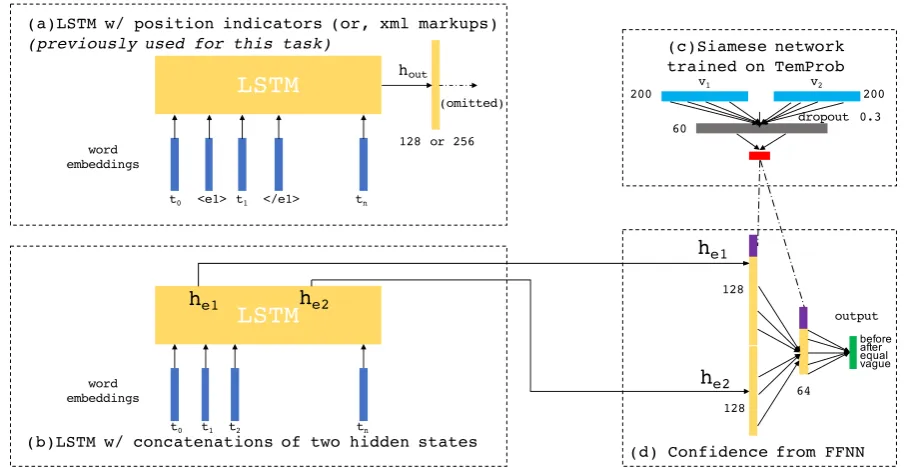
agate to subsequent modules. Here we study the usage of LSTM networks4on the TempRel extrac-tion problem as an end-to-end approach that only takes a sequence of word embeddings as input (assuming that the position of events are known). Conceptually, we need to feed those word embed-dings to LSTMs and obtain a vector representa-tion for a particular pair of events, which is fol-lowed by a fully-connected, feed-forward neural network (FFNN) to generate confidence scores for each output label. Based on the confidence scores, global inference is performed via integer linear programming (ILP), which is a standard procedure used in many existing works to enforce the tran-sitivity property of time (Chambers and Jurafsky,
2008b; Do et al., 2012; Ning et al., 2017). An overview of the proposed network structure and corresponding parameters can be found in Fig.1. Below we also explain the main components.
3.1 Handling Event Positions
Each TempRel is associated with two events, and for the same text, different pairs of events possess different relations, so it is critical to indicate the positions of those events when we train LSTMs for the task. The most straightforward way is to concatenate the hidden states from both time steps that correspond to the location of those events (Fig. 1b). Dligach et al. (2017) handled this is-sue differently, by adding XML tags immediately before and after each event (Fig.1a). For example, in the sentence,Aftereatingdinner, heslept com-fortably, where the two events are bold-faced, they will convert the sequence intoAfter<e1>eating </e1>dinner, he<e2>slept</e2>comfortably. The XML markups, which was initially proposed under the name ofposition indicatorsfor relation extraction (Zhang and Wang, 2015), uniquely in-dicate the event positions to LSTM, such that the final output of LSTM can be used as a represen-tation of those events and their context. We com-pare both methods in this paper, and as we show later, the straightforward concatenation method is already as good as XML tags for this task.
3.2 Common Sense Encoder (CSE)
In naturally occurring text that expresses TempRels, connective words such as since, 4We also tried convolutional neural networks but did not
LSTM
t0 <e1> t1 </e1> tn
(a)LSTM w/ position indicators (or, xml markups)
(previously used for this task)
word embeddings
(b)LSTM w/ concatenations of two hidden states
LSTM
t0 t1 t2 tn
word embeddings
hout
he1 he2
he2
he1
before after equal vague
output
v1 v2
200
60 128 or 256
128
128 64
200
(c)Siamese network trained on TemProb
(d) Confidence from FFNN
(omitted)
[image:3.595.67.520.61.295.2]dropout 0.3
Figure 1: Overview of the neural network structures studied in this paper. Networks (a) and (b) are two ways to handle event positions in LSTMs (Sec.3.1). (c) The Siamese network used to fit TemProb (Sec.3.2). Once trained on TemProb, the Siamese network is fixed when training other parts of the system. (d) The FFNN that generates confidence scores for each label. Sizes of hidden layers are already noted. Embeddings of the same color share the same matrix.
when, or until are often not explicit; never-theless, humans can still infer the TempRels using common sense with respect to the events. For example, even without context, we know that die is typically after explode and schedule
typically before attend. Ning et al. (2018b) was an initial attempt to acquire such knowledge, by aggregating automatically extracted TempRels from a large corpus. The resulting knowledge base, TEMPROB, contains observed frequencies of tuples (v1, v2, r) representing the probability of verb 1 and verb 2 having relationr and it was shown a useful resource for TempRel extraction.
However, TEMPROB is a simple counting model and fails (or is unreliable) for unseen (or rare) tuples. For example, we may see (ambush, die) less frequently than (attack, die) in a corpus, and the observed frequency of (ambush, die) be-ingbeforeorafteris thus less reliable. However, since “ambush” is semantically similar to “attack”, the statistics of (attack, die) can actually serve as an auxiliary signal to (ambush, die). Motivated by this idea, we introduce common sense encoder (CSE): We fit an updated version of TEMPROBvia a Siamese network (Bromley et al.,1994) that gen-eralizes to unseen tuples through the resulting em-beddings for each verb (Fig. 1c). Note that the TEMPROBwe use is reconstructed using the same
method described inNing et al.(2018b) with the base method changed to CogCompTime. Once trained, CSE will remain fixed when training the LSTM part (Fig.1a or b) and the feedforward neu-ral network part (Fig.1d). We only use CSE for its output. In the beginning, we tried to directly use the output (i.e., a scalar) and the influence on performance was negligible. Therefore, here we discretize the CSE output, change it to categori-cal embeddings, concatenate them with the LSTM output, and then produce the confidence scores (Fig.1d).
4 Experiments
4.1 Data
The MATRES dataset5contains 275 news articles from the TempEval3 workshop (UzZaman et al.,
2013) with newly annotated events and TempRels. It has 3 sections: TimeBank (TB), AQUAINT (AQ), and Platinum (PT). We followed the official split (i.e., TB+AQ for training and PT for testing), and further set aside 20% of the training data as the development set to tune learning rates and epochs. We also show our performance on another dataset,
5http://cogcomp.org/page/publication_
TCR6 (Ning et al., 2018a), which contains both temporal and causal relations and we only need the temporal part. The label set for both datasets arebefore,after,equal, andvague.
Purpose #Doc #Events #TempRels
TB+AQ Train 255 8K 13K
PT Test 20 537 837
TCR Test 25 1.3K 2.6K
Table 1: TimeBank (TB), AQUAINT (AQ), and Plat-inum (PT) are from MATRES (Ning et al.,2018c) and TCR fromNing et al.(2018a).
4.2 Results and Discussion
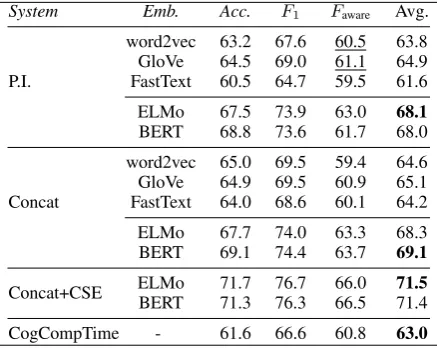
We compare with the most recent version of CogCompTime, the state-of-the-art on MATRES.7 Note that in Table 2, CogCompTime performed slightly different to Ning et al. (2018d): Cog-CompTime reportedly had F1=65.9 (Table 2 Line 3 therein) and here we obtained F1=66.6. In addition,Ning et al. (2018d) only reportedF1 scores, while we also use another two metrics for a more thorough comparison: classification accu-racy (acc.) and temporal awarenessFaware, where the awareness score is for the graphs represented by a group of related TempRels (more details in the appendix). We also report the average of those three metrics in our experiments.
Table2compares the two different ways to han-dle event positions discussed in Sec.3.1: position indicators (P.I.) and simple concatenation (Con-cat), both of which are followed by network (d) in Fig.1(i.e., without using Siamese yet). We exten-sively studied the usage of various pretrained word embeddings, including conventional embeddings (i.e., the medium versions of word2vec, GloVe, and FastText provided in the Magnitude package (Patel et al., 2018)) and contextualized embed-dings (i.e., the original ELMo and large uncased BERT, respectively); except for the input embed-dings, we kept all other parameters the same. We used cross-entropy loss and the StepLR optimizer in PyTorch that decays the learning rate by 0.5 ev-ery 10 epochs (performance not sensitive to it).
Comparing to the previously used P.I. (Dligach et al., 2017), we find that, with only two excep-tions (underlined in Table 2), the Concat system saw consistent gains under various embeddings
6http://cogcomp.org/page/publication_
view/835
7http://cogcomp.org/page/publication_
view/844
and metrics. In addition, contextualized embed-dings (ELMo and BERT) expectedly improved over the conventional ones significantly, although no statistical significance were observed between using ELMo or BERT (more significance tests in Appendix).
System Emb. Acc. F1 Faware Avg.
P.I.
word2vec 63.2 67.6 60.5 63.8 GloVe 64.5 69.0 61.1 64.9 FastText 60.5 64.7 59.5 61.6 ELMo 67.5 73.9 63.0 68.1 BERT 68.8 73.6 61.7 68.0
Concat
word2vec 65.0 69.5 59.4 64.6 GloVe 64.9 69.5 60.9 65.1 FastText 64.0 68.6 60.1 64.2 ELMo 67.7 74.0 63.3 68.3 BERT 69.1 74.4 63.7 69.1
Concat+CSE ELMoBERT 71.771.3 76.776.3 66.066.5 71.571.4
[image:4.595.309.528.156.330.2]CogCompTime - 61.6 66.6 60.8 63.0 Table 2: Performances on the MATRES test set (i.e., the PT section). CogCompTime (Ning et al.,2018d) is the previous state-of-the-art feature-based system. Position indicator (P.I.) and concatenation (Concat) are two ways to handle event positions in LSTMs (Sec.3.1). Concat+CSE achieves significant improve-ment over CogCompTime on MATRES.
sys-tem still outperformed CogCompTime by roughly 8% under the three-metric-average metric, consis-tent with our improvement on MATRES.
System Emb. Acc. F1 Faware Avg.
CogCompTime - 68.1 70.7 61.6 66.8
Concat+CSE ELMoBERT 80.878.4 78.677.0 69.969.0 76.474.9 Table 3: Further evaluation of the proposed system, i.e., Concat (Table3.1) plus CSE (Sec.3.2), on the TCR dataset (Ning et al.,2018a).
5 Conclusion
Temporal relation extraction has long been an im-portant yet challenging task in natural language processing. Lack of high-quality data and dif-ficulty in the learning problem defined by pre-vious annotation schemes inhibited performance of neural-based approaches. The discoveries that LSTMs readily improve the feature-based state-of-the-art CogCompTime on the MATRES and TCR datasets by a large margin not only give the community a strong baseline, but also indicate that the learning problem is probably better defined by MATRES and TCR. Therefore, we should move along that direction to collect more high-quality data, which can facilitate more advanced learning algorithms in the future.
Acknowledgements
This research is supported by a grant from the Allen Institute for Artificial Intelligence (al-lenai.org), the IBM-ILLINOIS Center for Cogni-tive Computing Systems Research (C3SR) - a re-search collaboration as part of the IBM AI Hori-zons Network, and contract HR0011-18-2-0052 with the US Defense Advanced Research Projects Agency (DARPA). Approved for Public Release, Distribution Unlimited. The views expressed are those of the authors and do not reflect the official policy or position of the Department of Defense or the U.S. Government.
References
Steven Bethard, Leon Derczynski, Guergana Savova, James Pustejovsky, and Marc Verhagen. 2015. SemEval-2015 Task 6: Clinical TempEval. In Pro-ceedings of the 9th International Workshop on Se-mantic Evaluation (SemEval 2015), pages 806–814. Steven Bethard, James H Martin, and Sara Klingen-stein. 2007. Timelines from text: Identification of
syntactic temporal relations. InSemantic Comput-ing, 2007. ICSC 2007. International Conference on, pages 11–18. IEEE.
Steven Bethard, Guergana Savova, Wei-Te Chen, Leon Derczynski, James Pustejovsky, and Marc Ver-hagen. 2016. SemEval-2016 Task 12: Clinical TempEval. InProceedings of the 10th International Workshop on Semantic Evaluation (SemEval-2016), pages 1052–1062.
Steven Bethard, Guergana Savova, Martha Palmer, and James Pustejovsky. 2017. Semeval-2017 task 12: Clinical tempeval. In Proceedings of the 11th International Workshop on Semantic Evalua-tion (SemEval-2017), pages 565–572. Association for Computational Linguistics.
Piotr Bojanowski, Edouard Grave, Armand Joulin, and Tomas Mikolov. 2016. Enriching word vec-tors with subword information. arXiv preprint arXiv:1607.04606.
Jane Bromley, Isabelle Guyon, Yann LeCun, Eduard S¨ackinger, and Roopak Shah. 1994. Signature ver-ification using a “siamese” time delay neural net-work. In The Conference on Advances in Neural Information Processing Systems (NIPS), pages 737– 744.
Taylor Cassidy, Bill McDowell, Nathanel Chambers, and Steven Bethard. 2014. An annotation frame-work for dense event ordering. InProc. of the An-nual Meeting of the Association of Computational Linguistics (ACL), pages 501–506.
Nathanael Chambers, Taylor Cassidy, Bill McDowell, and Steven Bethard. 2014. Dense event ordering with a multi-pass architecture. Transactions of the Association for Computational Linguistics, 2:273– 284.
Nathanael Chambers and Dan Jurafsky. 2008a. Jointly combining implicit constraints improves temporal ordering. In Proc. of the Conference on Em-pirical Methods for Natural Language Processing (EMNLP).
Nathanael Chambers and Daniel Jurafsky. 2008b. Un-supervised Learning of Narrative Event Chains. In
Proceedings of the 46th Annual Meeting of the As-sociation for Computational Linguistics, ACL 2008, pages 789–797.
Nathanael Chambers, Shan Wang, and Dan Juraf-sky. 2007. Classifying temporal relations between events. InProceedings of the 45th Annual Meeting of the ACL on Interactive Poster and Demonstration Sessions, pages 173–176. Association for Computa-tional Linguistics.
Jacob Devlin, Ming-Wei Chang, Kenton Lee, and Kristina Toutanova. 2018. BERT: Pre-training of deep bidirectional transformers for language under-standing. arXiv preprint arXiv:1810.04805.
Thomas G. Dietterich. 1998. Approximate statistical tests for comparing supervised classification learn-ing algorithms.Neural Computation.
Dmitriy Dligach, Timothy Miller, Chen Lin, Steven Bethard, and Guergana Savova. 2017. Neural tem-poral relation extraction. volume 2, pages 746–751.
Quang Do, Wei Lu, and Dan Roth. 2012. Joint infer-ence for event timeline construction. InProceedings of the Conference on Empirical Methods in Natural Language Processing (EMNLP).
Brian S Everitt. 1992. The analysis of contingency ta-bles.
Sepp Hochreiter and J¨urgen Schmidhuber. 1997. Long short-term memory. Neural computation, 9(8):1735–1780.
Diederik Kingma and Jimmy Ba. 2014. Adam: A method for stochastic optimization. arXiv preprint arXiv:1412.6980.
Artuur Leeuwenberg and Marie-Francine Moens. 2017. Structured learning for temporal relation ex-traction from clinical records. InProceedings of the 15th Conference of the European Chapter of the As-sociation for Computational Linguistics.
Artuur Leeuwenberg and Marie-Francine Moens. 2018. Temporal information extraction by predict-ing relative time-lines. Proc. of the Conference on Empirical Methods for Natural Language Process-ing (EMNLP).
Chen Lin, Timothy Miller, Dmitriy Dligach, Steven Bethard, and Guergana Savova. 2017. Repre-sentations of time expressions for temporal rela-tion extracrela-tion with convolurela-tional neural networks.
BioNLP 2017, pages 322–327.
Hector Llorens, Nathanael Chambers, Naushad UzZa-man, Nasrin Mostafazadeh, James Allen, and James Pustejovsky. 2015. SemEval-2015 Task 5: QA TEMPEVAL - evaluating temporal information un-derstanding with question answering. In Proceed-ings of the 9th International Workshop on Semantic Evaluation (SemEval 2015), pages 792–800.
Inderjeet Mani, Marc Verhagen, Ben Wellner, Chong Min Lee, and James Pustejovsky. 2006. Ma-chine learning of temporal relations. InProceedings of the 21st International Conference on Compu-tational Linguistics and the 44th annual meeting of the Association for Computational Linguistics, pages 753–760. Association for Computational Linguistics.
Yuanliang Meng and Anna Rumshisky. 2018. Context-aware neural model for temporal information extrac-tion. InProc. of the Annual Meeting of the Associa-tion of ComputaAssocia-tional Linguistics (ACL), volume 1, pages 527–536.
Tomas Mikolov, Kai Chen, Greg Corrado, and Jeffrey Dean. 2013. Distributed Representations of Words and Phrases and their Compositionality. In Proceed-ings of NIPS 2013, pages 1–9.
Anne-Lyse Minard, Manuela Speranza, Eneko Agirre, Itziar Aldabe, Marieke van Erp, Bernardo Magnini, German Rigau, Ruben Urizar, and Fon-dazione Bruno Kessler. 2015. SemEval-2015 Task 4: TimeLine: Cross-document event ordering. In
Proceedings of the 9th International Workshop on Semantic Evaluation (SemEval 2015), pages 778–786.
Nasrin Mostafazadeh, Alyson Grealish, Nathanael Chambers, James Allen, and Lucy Vanderwende. 2016. CaTeRS: Causal and temporal relation scheme for semantic annotation of event structures. InProceedings of the 4th Workshop on Events: Def-inition, Detection, Coreference, and Representation, pages 51–61.
Qiang Ning, Zhili Feng, and Dan Roth. 2017. A structured learning approach to temporal relation extraction. In Proceedings of the Conference on Empirical Methods for Natural Language Process-ing (EMNLP), pages 1038–1048, Copenhagen, Den-mark.
Qiang Ning, Zhili Feng, Hao Wu, and Dan Roth. 2018a. Joint reasoning for temporal and causal re-lations. In Proceedings of the Annual Meeting of the Association of Computational Linguistics (ACL), pages 2278–2288.
Qiang Ning, Hao Wu, Haoruo Peng, and Dan Roth. 2018b. Improving temporal relation extraction with a globally acquired statistical resource. In Proceed-ings of the Annual Meeting of the North American Association of Computational Linguistics (NAACL), pages 841–851.
Qiang Ning, Hao Wu, and Dan Roth. 2018c. A multi-axis annotation scheme for event temporal relations. In Proceedings of the Annual Meeting of the Asso-ciation of Computational Linguistics (ACL), pages 1318–1328.
Qiang Ning, Ben Zhou, Zhili Feng, Haoruo Peng, and Dan Roth. 2018d. Cogcomptime: A tool for under-standing time in natural language. InProceedings of the Conference on Empirical Methods for Natu-ral Language Processing (EMNLP).
pages 47–56, Austin, Texas. Association for Com-putational Linguistics.
Ajay Patel, Alexander Sands, Chris Callison-Burch, and Marianna Apidianaki. 2018. Magnitude: A fast, efficient universal vector embedding utility package.
Proc. of the Conference on Empirical Methods for Natural Language Processing (EMNLP).
Jeffrey Pennington, Richard Socher, and Christo-pher D. Manning. 2014. Glove: Global vectors for word representation. InEMNLP, pages 1532–1543.
Matthew E. Peters, Mark Neumann, Mohit Iyyer, Matt Gardner, Christopher Clark, Kenton Lee, and Luke Zettlemoyer. 2018. Deep contextualized word rep-resentations. InProc. of the Annual Meeting of the North American Association of Computational Lin-guistics (NAACL).
William F Styler IV, Steven Bethard, Sean Finan, Martha Palmer, Sameer Pradhan, Piet C de Groen, Brad Erickson, Timothy Miller, Chen Lin, Guergana Savova, et al. 2014. Temporal annotation in the clin-ical domain. Transactions of the Association for Computational Linguistics, 2:143.
Julien Tourille, Olivier Ferret, Aurelie Neveol, and Xavier Tannier. 2017. Neural architecture for tem-poral relation extraction: A bi-lstm approach for de-tecting narrative containers. InProc. of the Annual Meeting of the Association of Computational Lin-guistics (ACL), volume 2, pages 224–230.
Naushad UzZaman, Hector Llorens, James Allen, Leon Derczynski, Marc Verhagen, and James Pustejovsky. 2013. Sem2013 Task 1: TEMPEVAL-3: Eval-uating time expressions, events, and temporal rela-tions. *SEM, 2:1–9.
Marc Verhagen, Robert Gaizauskas, Frank Schilder, Mark Hepple, Graham Katz, and James Pustejovsky. 2007. SemEval-2007 Task 15: TempEval tempo-ral relation identification. InProceedings of the 4th International Workshop on Semantic Evaluations, pages 75–80. Association for Computational Lin-guistics.
Marc Verhagen and James Pustejovsky. 2008. Tem-poral processing with the TARSQI toolkit. In22nd International Conference on on Computational Lin-guistics: Demonstration Papers, pages 189–192. Association for Computational Linguistics.
Marc Verhagen, Roser Sauri, Tommaso Caselli, and James Pustejovsky. 2010. SemEval-2010 Task 13: TempEval-2. InProceedings of the 5th international workshop on semantic evaluation, pages 57–62. As-sociation for Computational Linguistics.
Zhenqi Xu, Jiani Hu, and Weihong Deng. 2016. Recur-rent convolutional neural network for video classifi-cation. InMultimedia and Expo (ICME), 2016 IEEE International Conference on, pages 1–6. IEEE.
Katsumasa Yoshikawa, Sebastian Riedel, Masayuki Asahara, and Yuji Matsumoto. 2009. Jointly identi-fying temporal relations with markov logic. In Pro-ceedings of the Joint Conference of the 47th Annual Meeting of the ACL and the 4th International Joint Conference on Natural Language Processing of the AFNLP: Volume 1-Volume 1, pages 405–413. Asso-ciation for Computational Linguistics.
Daojian Zeng, Kang Liu, Siwei Lai, Guangyou Zhou, and Jun Zhao. 2014. Relation classification via con-volutional deep neural network. InProc. the Inter-national Conference on Computational Linguistics (COLING), pages 2335–2344.
Dongxu Zhang and Dong Wang. 2015. Relation classi-fication via recurrent neural network.arXiv preprint arXiv:1508.01006.