Leave-one-out Word Alignment without Garbage Collector Effects
Xiaolin Wang Masao Utiyama Andrew Finch
Taro Watanabe∗ Eiichiro Sumita
Advanced Translation Research and Development Promotion Center National Institute of Information and Communications Technology, Japan
{xiaolin.wang,mutiyama,andrew.finch,eiichiro.sumita}@nict.go.jp [email protected]
Abstract
Expectation-maximization algorithms, such as those implemented in GIZA++ pervade the field of unsupervised word alignment. However, these algorithms have a problem of over-fitting, leading to “garbage collector effects,” where rare words tend to be erroneously aligned
to untranslated words. This paper
proposes a leave-one-out expectation-maximization algorithm for unsupervised word alignment to address this
prob-lem. The proposed method excludes
information derived from the alignment of a sentence pair from the alignment models used to align it. This prevents erroneous alignments within a sentence pair from supporting themselves. Ex-perimental results on Chinese-English and Japanese-English corpora show that the F1, precision and recall of alignment were consistently increased by 5.0% – 17.2%, and BLEU scores of end-to-end translation were raised by 0.03 – 1.30. The proposed method also outperformed l0-normalized GIZA++ and Kneser-Ney
smoothed GIZA++.
1 Introduction
Unsupervised word alignment (WA) on bilingual sentence pairs serves as an essential foundation for building most statistical machine translation (SMT) systems. A lot of methods have been pro-posed to raise the accuracy of WA in an effort to improve end-to-end translation quality. This pa-per contributes to this effort through refining the widely used expectation-maximization (EM) algo-rithm for WA (Dempster et al., 1977; Brown et al., 1993b; Och and Ney, 2000).
∗ The author now is affiliated with Google, Japan.
The EM algorithm for WA has a great influ-ence in SMT. Many well-known toolkits includ-ing GIZA++ (Och and Ney, 2003), the Berkeley Aligner (Liang et al., 2006; DeNero and Klein, 2007), Fast Align (Dyer et al., 2013) and SyM-GIZA++ (Junczys-Dowmunt and Sza, 2012), all employ this algorithm. GIZA++ in particular is frequently used in systems participating in many shared tasks (Goto et al., 2011; Cettolo et al., 2013; Bojar et al., 2013).
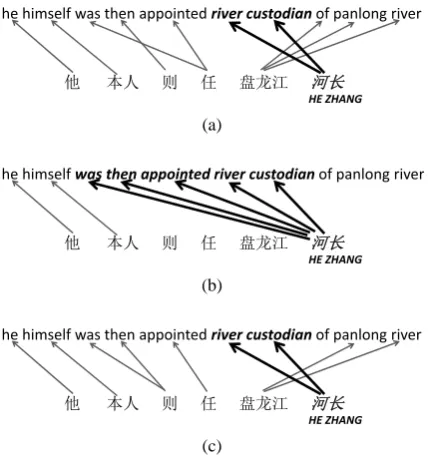
However, the EM algorithm for WA is well-known for introducing “garbage collector ef-fects.” Rare words have a tendency to collect garbage, that is they have a tendency to be erro-neously aligned to untranslated words (Brown et al., 1993a; Moore, 2004; Ganchev et al., 2008; V Grac¸a et al., 2010). Figure 1(a) shows a real sentence pair, denoteds, from the GALE Chinese-English Word Alignment and Tagging Training corpus (GALE WA corpus)1 with it’s human-annotated word alignment. The Chinese word “HE ZHANG,” denoted wr, which means river custodian, only occurs once in the whole corpus. We performed EM training using GIZA++ on this corpus concatenated with 442,967 training sen-tence pairs from the NIST Open Machine Trans-lation (OpenMT) 2006 evaluation2. The resulting alignment is shown in Figure 1(b). It can be seen thatwris erroneously aligned to multiple English words.
To find the cause of this, we checked the align-ments in each iteration i of s, denoted ais. We found that in a1s, wr together with the other source-side words were aligned with uniform probability to all the target-side words since the alignment models provided no prior information. However, ina2s ,wr became erroneously aligned,
1
Released by Linguistic Data Consortium, catalog number LDC2012T16, LDC2012T20, LDC2012T24 and LDC2013T05.
2http://www.itl.nist.gov/iad/mig/
tests/mt/2006/
because the alignment distribution3 of wr was only learned froma1s, thus consisted of non-zero values only for generating the target-side words in s. Therefore, the alignment probabilities from the rare wordwrto the unaligned words inswere ex-traordinarily high, since almost all of the proba-bility mass was distributed among them. In other words, the story behind these garbage collector ef-fects is that erroneous alignments are able to pro-vide support for themselves; the probability distri-bution learned only from s is re-applied to s. In this way, these “garbage collector effects” are a form of over-fitting.
Motivated by this observation, we propose a leave-one-out EM algorithm for WA in this pa-per. Recently this technique has been applied to avoid over-fitting in kernel density estima-tion (Roux and Bach, 2011); instead of performing maximum likelihood estimation, maximum leave-one-out likelihood estimation is performed. Fig-ure 1(c) shows the effect of using our technique on the example. The garbage collection has not occurred, and the alignment of the word “HE ZHANG” is identical to the human annotation.
2 Related Work
The most related work to this paper is train-ing phrase translation models with leave-one-out forced alignment (Wuebker et al., 2010; Wuebker et al., 2012). The differences are that their work operates at the phrase level, and their aim is to im-prove translation models; while our work operates at the word level, and our aim is to provide better word alignment. As word alignment is a founda-tion of most MT systems, our method have a wider application.
Recently, better estimation methods during the maximization step of EM have been proposed to avoid the over-fitting in WA, such as using Kneser-Ney Smoothing to back-off the expected counts (Zhang and Chiang, 2014) or integrating the smoothed l0 prior to the estimation of prob-ability (Vaswani et al., 2012). Our work differs from theirs by addressing the over-fitting directly in the EM algorithm by adopting a leave-one-out approach.
Bayesian methods (Gilks et al., 1996; Andrieu et al., 2003; DeNero et al., 2008; Neubig et al.,
3The probability distribution of generating target
lan-guage words fromwr. The description here is only based on IBM model1 for simplicity, and the other alignment models are similar.
(a)
(b)
[image:2.595.315.530.64.296.2]
(c)
Figure 1: Examples of supervised word alignment. (a) gold alignment; (b) standard EM (GIZA++); (c) Leave-one-out alignment (proposed).
2011), also attempt to address the issue of over-fitting, however EM algorithms related to the pro-posed method have been shown to be more effi-cient (Wang et al., 2014).
3 Methodology
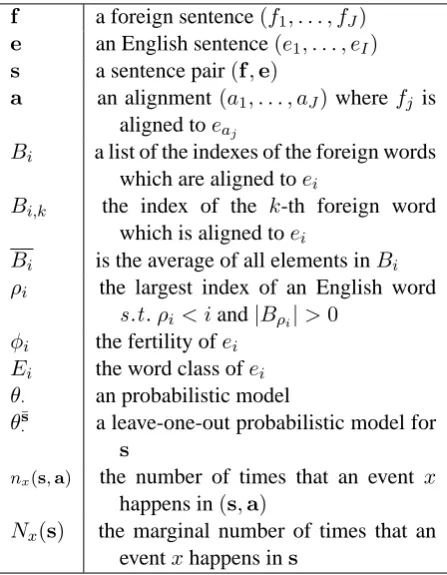
This section first formulates the standard EM for WA, then presents the leave-one-out EM for WA, and finally briefly discusses handling singletons and effecient implementation. The main notation used in this section is shown in Table 1.
3.1 Standard EM for IBM Models 1, 2 and HMM Model
To perform WA through EM, the parallel corpus is taken as observed data, the alignments are taken as latent data. In order to maximize the likelihood of the alignment modelθgiven the dataS, the fol-lowing two steps are conducted iteratively (Brown et al., 1993b; Och and Ney, 2000; Och and Ney, 2003),
Expectation Step (E step): calculating the con-ditional probability of alignments for each sen-tence pair,
P(a|s, θ) =QJj=1θali(aj|aj−1, I)θlex(fj|eaj),(1)
whereθali(i|i′, I)is the alignment probability and
f a foreign sentence(f1, . . . , fJ) e an English sentence(e1, . . . , eI) s a sentence pair(f,e)
a an alignment (a1, . . . , aJ)where fj is aligned toeaj
Bi a list of the indexes of the foreign words which are aligned toei
Bi,k the index of the k-th foreign word which is aligned toei
Bi is the average of all elements inBi
ρi the largest index of an English word s.t. ρi < iand|Bρi|>0
φi the fertility ofei
Ei the word class ofei θ· an probabilistic model θ¯s
· a leave-one-out probabilistic model for
s
nx(s,a) the number of times that an event x happens in(s,a)
[image:3.595.73.297.62.350.2]Nx(s) the marginal number of times that an eventxhappens ins
Table 1: Main Notation. Note that Nx(s) = P
anx(s,a)P(a|s). In practical calculation, for IBM models 1, 2 and HMM model, this summa-tion is performed by dynamic programming; for IBM model 4, it is performed approximately us-ing the best alignment and its neighbors.
(1) is a general form for IBM model 1, model 2 and the HMM model.
Maximization step (M step): re-estimating the probability models,
θali(i|i′, I)←
P
sNi|i′,I(s)
P
sNi′,I(s) (2)
θlex(f|e)←
P
sNf|e(s)
P
sne(s) (3)
whereNi′,I(s)is the marginal number of timesei′
is aligned to some foreign word if the length ofeis I, or0otherwise;Ni|i′,I(s)is the marginal number
of times the next alignment position afteri′ isiin aif the length ofeisI, or0otherwise;ne(s)is the count ofeine;Nf|e(s,a)is the marginal number of timeseis aligned tof.
3.2 Leave-one-out EM for IBM Models 1, 2 and HMM Model
Leave-one-out EM for WA differs from standard EM in the way the alignment and translation prob-abilities are calculated. Each sentence pair will
have its own alignment and translation probability models calculated by excluding the sentence pair itself. More formally, leave-one-out EM for WA are formulated as follows,
Leave-one-out E step: employing leave-one-out models for eachs to calculate the conditional probability of alignments
P(a|s, θ¯s) =QjJ=1θ¯alis (aj|aj−1, I)θ¯lexs (fj|eaj),(4)
where θali¯s (i|i′, I) and θ¯lexs (fj|eaj) are the leave-one-out alignment probability and translation probability, respectively.
Leave-one-out M step: re-estimating leave-one-out probability models,
θ¯alis (i|i′, I)←
P
s′6=sNi|i′,I(s′)
P
s′6=sNi′,I(s′) (5)
θ¯s
lex(f|e)←
P
s′6=sNf|e(s′)
P
s′6=sne(s′) . (6)
3.3 Standard EM for IBM Model 4
The framework of the standard EM for IBM Model 4 is similar with the one for IBM Models 1, 2 and HMM Model, but the calculation of align-ment probability is more complicated.
E step: calculating the conditional probabil-ity through the reverted alignment (Och and Ney, 2003),
P(a|s, θ) =P(B0|B1, . . . , BI)· I
Y
i=1
P(Bi|Bi−1, ei)· I
Y
i=1
Y
j∈Bi
θlex(fj|ei), (7)
whereB0 means the set of foreign words aligned with the empty word; P(B0|B1, . . . , BI) is as-sumed to be a binomial distribution for the size ofB0(Brown et al., 1993b) or an modified distri-bution to relieve deficiency (Och and Ney, 2003).
The distributionP(Bi|Bi−1, ei)is decomposed as
P(Bi|Bi−1, ei) =θfer(φi|ei)·
θhea(Bi,1−Bρi|Eρi)·
φi Y
k=2
θoth(Bi,k−Bi,k−1),
(8)
where θfer is a fertility model; θheais a
probabil-ity model for the head (first) aligned foreign word; θoth is a probability model for the other aligned
on the word class Eρi, following the paper of (Och and Ney, 2003) and the implementation of GIZA++ and CICADA.
M step: re-estimating the probability models,
θfer(φ|e)←
P
sNφ|e(s)
P
sPφ′Nφ′|e(s) (9)
θhea(∆i|E)←
P
sN∆heai|E(s)
P s
P
∆i′N∆heai′|E(s)
(10)
θoth(∆i)←
P
sN∆othi(s)
P
sP∆i′N∆othi′(s),
(11)
where∆iis a difference of the indexes of two for-eign words.
3.4 Leave-one-out EM for IBM Model 4
The leave-one-out treatment were applied to the three component probability modelsθfer,θheaand
θothof IBM model 4.
Leave-one-out E step: calculating the condi-tional probability through leave-one-out probabil-ity models
P(a|s, θ¯s) =P(B0|B1, . . . , BI)· I
Y
i=1
P¯s(Bi|Bi−1, ei)· I
Y
i=1
Y
j∈Bi θ¯s
lex(fj|ei), (12)
P¯s(B
i|Bi−1, ei) =θfers¯ (φi|ei)·
θ¯s
hea(Bi,1−Bρi|Eρi)·
φi Y
k=2
θ¯s
oth(Bi,k−Bi,k−1).
(13)
Leave-one-out M step: re-estimating the leave-one-out probability models,
θ¯fers (φ|e)←
P
s′6=sNφ|e(s′)
P
s′6=sPφ′Nφ′|e(s′) (14)
θ¯s
hea(∆i|E)←
P
s′6=sN∆heai|E(s′)
P
s′6=sP∆i′N∆heai′|E(s′)
(15)
θ¯soth(∆i)←
P
s′6=sN∆othi(s′)
P
s′6=sP∆i′N∆othi′(s′).
(16)
3.5 Handling Singletons
Singletons are the words that occur only once in corpora. Singletons cause problems when apply-ing leave-one-out to lexicalized models such as the translation modelθ¯slex and the fertility modelθ¯sfer. When calculating (6) and (14) for singletons, the
denominators become zero, thus the probabilities are undefined.
For singletons, there is no prior information to guide their alignment, so we back off to uniform distributions. In that case, the alignments are pri-marily determined by the rest of the sentence.
In addition, singletons can be in the target side of the translation modelθlex¯s . In that case, the prob-abilities become zero. This is handled by setting a minimum probability value of1.0×10−12, which was decided by pilot experiments.
3.6 Implementation Details
To alleviate memory requirements and increase speed, our implementation did not build or store the local alignment models explicitly for each sen-tence pair. The following formula was used to effi-ciently calculate (5), (6) and (14–16) to build tem-porary probability models,
X
s′6=s
Nx(s′) = (
X
s′
Nx(s′))−Nx(s), (17)
where x is a alignment event. Our implemen-tation maintained global counts of all alignment eventsPs′Nx(s′), and (considerably smaller) lo-cal countsNx(s)from each sentence pairs.
Take the translation modelθ¯slexfor example. For a sentence pairs= (f1. . . fJ, e1. . . eI), it is cau-clulated as,
θ¯slex(fj|ei) =
(Ps′N(fj|ei)(s′))−N(fj|ei)(s)
(Ps′nei(s′))−nei(s) .
(18)
The global counts to be maintained are P
s′N(fj|ei)(s′)andnei(s′), and the local counts are PsN(fj|ei)(s) and nei(s). Therefore the memory cost is,
|E| ·(|F|+ 1) +X s
Is(Js+ 1), (19)
where|E|is the size of English vocabulary,|F|is the size of foreign language vocabulary,Isis the length of the English sentence ofs, andJs is the length of the foreign sentence ofs.
The calculation of the leave-one-out translation model is performed for each English word and for-eign word ins. Therefore, the time cost is,
X
s
In addition, because the local countsN(fj|ei)(s) andnei(s)are read in order, storing them in a ex-ternal memory such as a hard disk will not slow down the running speed much. This will reduce the memory cost to
|E| ·(|F|+ 1). (21)
This cost is independent to the number of sentence pairs4.
The speed of the proposed method can be boosted through parallelism. These calculations on each sentence pair can be performed indepen-dently. We found empirically that when our im-plementation of the proposed method is run on a 16-core computer, it finishes the task earlier than GIZA++5.
4 Experiments
The proposed WA method was tested on two language pairs: Chinese-English and Japanese-English (Table 2). Performance was measured both directly using the agreement with reference to manual WA annotations, and indirectly using the BLEU score in end-to-end machine translation tasks. GIZA++ and our own implementation of standard EM were used as baselines.
4.1 Experimental Settings
The Chinese-English experimental data consisted of the GALE WA corpus and the OpenMT cor-pus. They are from the same domain, both con-tain newswire texts and web blogs. The OpenMT evaluation 2005 was used as a development set for MERT tuning (Och, 2003), and the OpenMT eval-uation 2006 was used as a test set. The Japanese-English experimental data was the Kyoto Free Translation Task (Neubig, 2011)6. The corpus contains a set of 1,235 sentence pairs that are man-ually word aligned.
The corpora were processed using a standard procedure for machine translation. The English texts were tokenized with the tokenization script released with Europarl corpus (Koehn, 2005) and converted to lowercase; the Chinese texts were segmented into words using the Stanford Word Segmenter (Xue et al., 2002)7; the Japanese texts
4We found the memory of our server is large enough, so
we did not implement it 5
We plan to make our code public available. 6
http://www.phontron.com/kftt/
7http://nlp.stanford.edu/software/
segmenter.shtml
were segmented into words using the Kyoto Text Analysis Toolkit (KyTea8). Sentences longer than 100 words or those with foreign/English word length ratios between larger than 9 were filtered out.
GIZA++ was run with the default Moses set-tings (Koehn et al., 2007). The IBM model 1, HMM model, IBM model 3 and IBM model 4 were run with 5, 5, 3 and 3 iterations. We imple-mented the proposed leave-one-out EM and stan-dard EM in IBM model 1, HMM model and IBM model 4. In the original work (Och and Ney, 2003) this combination of models achieved comparable performance to the default Moses settings. They were run with 5, 5 and 6 iterations.
The standard EM was re-implemented as a baseline to provide a solid basis for comparison, because GIZA++ contains many undocumented details. Our implementation is based on the toolkit of CICADA (Watanabe and Sumita, 2011; Watan-abe, 2012; Tamura et al., 2013)9. We named the implemented aligner AGRIPPA, to support our in-house decoders OCTAVIAN and AUGUSTUS.
In all experiments, WA was performed indepen-dently in two directions: from foreign languages to English, and from English to foreign languages. Then the grow-diag-final-and heuristic was used to combine the two alignments from both directions to yield the final alignments for evaluation (Och and Ney, 2000; Och and Ney, 2003).
4.2 Word Alignment Accuracy
Word alignment accuracy of the baseline and the proposed method is shown in Table 3 in terms of precision, recall and F1(Och and Ney, 2003). The proposed method gave rise to higher quality align-ments in all our experialign-ments. The improvement in F1, precision and recall based on IBM Model 4 is in the range 8.3% to 9.1% compared with the GIZA++ baseline, and in the range 5.0% to 17.2% compared with our own baseline.
The most meaningful result comes from the comparison of the models trained using standard EM log-likelihood training, and the proposed EM leave-one-out log-likelihood training. These mod-els are identical except for way in which the model likelihood is calculated. In all our experiments the proposed method gave rise to higher quality align-ments. The standard EM implementation achieved
8
http://www.phontron.com/kytea/
Corpus # Sent. pairs # Foreign Words # English Words Chinese-English (GALE WA, OpenMT)
WA 18,057 392,447 518,137
Train 442,967 12,265,072 13,444,927
Eval. 05 1,082† 29,688 138,952
Eval. 06 1,664† 37,827 189,059
Japanese-English (Kyoto Free Translation)
WA 1,235 34,403 30,822
Train 329,882 6,085,131 5,911,486
Develop 1,166 26,856 24,309
[image:6.595.156.442.61.217.2]Test 1,160 28,501 26,734
Table 2: Experimental Data. † Each consists of one foreign sentence and four English reference sen-tences.
Models standard EM (GIZA++) standard EM (ours) Leave-one-out(prop.)
F1 P R F1 P R F1 P R
Chinese-English (GALE WA, OpenMT)
Model 1 0.498 0.656 0.401 0.518 0.670 0.423 0.553 0.689 0.461
HMM 0.584 0.720 0.491 0.593 0.722 0.503 0.665 0.774 0.583
Model 4 0.624 0.698 0.565 0.593 0.688 0.522 0.677 0.756 0.612
Japanese-English (Kyoto Free Translation)
Model 1 0.508 0.601 0.439 0.513 0.606 0.444 0.535 0.618 0.471
HMM 0.573 0.667 0.502 0.579 0.665 0.512 0.626 0.687 0.575
Model 4 0.577 0.594 0.561 0.570 0.617 0.530 0.628 0.648 0.609
Table 3: Word alignment accuracy measured by F1, precision and recall.
alignment performance approximately compara-ble to GIZA++, whereas the proposed method ex-ceeded the performance of both implementations.
4.3 End-to-end Translation Quality
BLEU scores achieved by the phrase-based and hierachical SMT systems10 which were trained from different alignment results, are shown in Table 4. Each experiment was conducted three times to mitigate the variance in the results due to MERT. The results show that the proposed align-ment method achieved the highest BLEU score in all experiments. The improvement over the base-line is in range 0.03 to 1.03 for phrase-based sys-tems, and ranged from 0.43 to 1.30 for hierarchical systems.
Hierarchical systems benifit more from the pro-posed method than phrase-based systems. We think this is because that hierarchical systems are more sensitive to word alignment quality than phrase-based systems. Phrase-based systems only
10from the Moses toolkit
0.40
0.45
0.50
0.55
0.60
0.65
0.70
Size of training corpora (Log)
W
ord alignment F1
1k 4k 18k 64k 256k 461k
[image:6.595.309.522.513.680.2]Norm. EM (Giza++) Norm. EM (our) Leave−one−out EM (prop.)
SMT Systems standard EM (GIZA++) standard EM (ours) Leave-one-out (prop.) Chinese-English (GALE WA, OpenMT)
Phrase-based 31.85±0.26 31.01±0.18 32.04±0.08
Hierarchical 32.27±0.23 31.40±0.26 32.70±0.14
Japanese-English (Kyoto Free Translation)
Phrase-based 18.35±0.27 18.20±0.20 18.38±0.11
Hierarchical 19.48±0.08 19.39±0.02 20.10±0.07
Table 4: End-to-end translation quality measured by BLEU
Corpus size standard EM (GIZA++) standard EM (ours) Leave-one-out(prop.)
F1 P R F1 P R F1 P R
1K 0.429 0.466 0.397 0.419 0.463 0.382 0.470 0.568 0.402
4K 0.499 0.547 0.459 0.492 0.549 0.445 0.568 0.668 0.494
18K† 0.571 0.630 0.521 0.553 0.621 0.499 0.633 0.721 0.565
64K 0.588 0.659 0.531 0.555 0.638 0.492 0.645 0.712 0.590
256K 0.614 0.687 0.554 0.578 0.667 0.511 0.661 0.718 0.612
[image:7.595.149.450.366.573.2]461K 0.624 0.698 0.565 0.593 0.688 0.522 0.677 0.756 0.612
Table 5: Effect of training corpus size on word alignment accuracy measured by F1, precision and recall (Chinese-English).†the whole manually word aligned corpus
Corpus size stan.(GIZA++) stan.(ours) LOO(prop.) Gold Phrase-based
1k 7.86 7.66 9.38 10.01
4k 15.27 15.49 17.06 17.57
18K† 22.15 21.72 24.41 24.11
64K 28.10 27.91 29.23 NA
256K 31.05 30.82 31.51 NA
461K 31.85 31.01 32.04 NA
Hierarchical
1k 7.53 7.54 9.19 10.62
4k 14.89 15.51 17.91 18.31
18K† 22.85 22.56 24.66 24.52
64K 28.82 28.22 29.78 NA
256K 31.47 30.21 31.72 NA
[image:7.595.153.450.366.573.2]461K 32.27 31.04 32.70 NA
Table 6: Effect of training corpus size on end-to-end translation quality measured by BLEU (Chinese-English).†the whole manually word aligned corpus
take contiguous parallel phrase pairs as translation rules, while hierarchical systems also use patterns made by subtracting (inner) short parallel phrases from (outer) longer parallel phrases. Both the outer and inner phrases typically need to be noise-free in order to produce high quality rules. This puts a high demand on the alignment quality.
4.4 Effect of Training Corpus Size
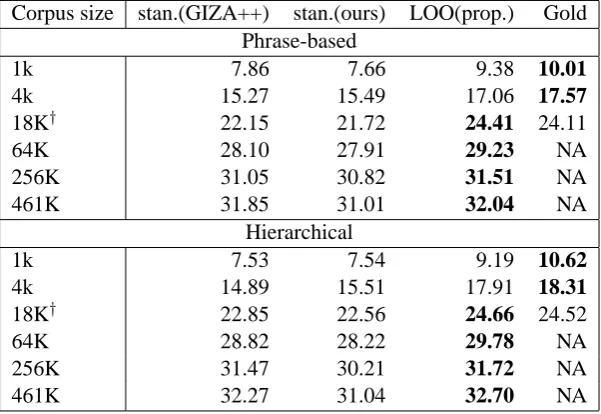
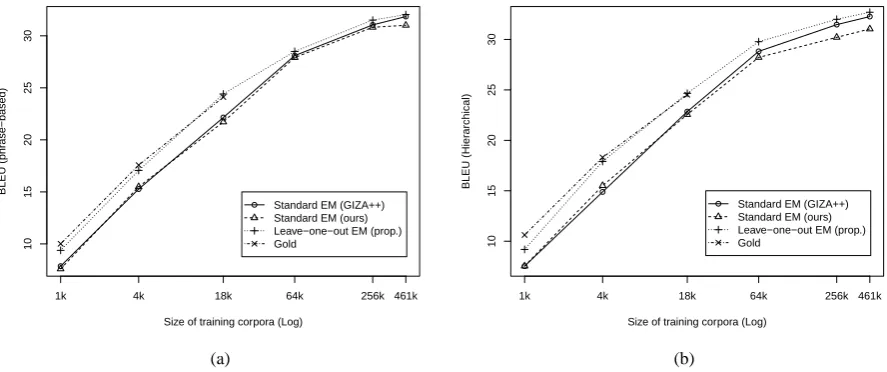
Training corpora of different sizes were employed to perform unsupervised WA experiments and MT experiments (see Tables 5 and 6).
experi-10
15
20
25
30
Size of training corpora (Log)
BLEU (phr
ase−based)
1k 4k 18k 64k 256k 461k
Standard EM (GIZA++) Standard EM (ours) Leave−one−out EM (prop.) Gold
(a)
10
15
20
25
30
Size of training corpora (Log)
BLEU (Hier
archical)
1k 4k 18k 64k 256k 461k
Standard EM (GIZA++) Standard EM (ours) Leave−one−out EM (prop.) Gold
[image:8.595.78.522.96.282.2](b)
Figure 3: Curves of translation quality (BLEU) under training corpora of different sizes. (a) Phrase-based MT; (b) Hierarchical MT.
ments.
The settings of the unsupervised WA experi-ments and the MT experiexperi-ments are the same with the previous experiments. In the WA experiments, GIZA++, our implemented standard EM and the proposed leave-one-out EM are applied to training corpora with the same parameter settings as the previous. In the MT experiments, the WA results of different methods and the gold WA (if available) are employed to extract translation rules; the rest settings including language models, development and test corpus, and parameters are the same as the previous.
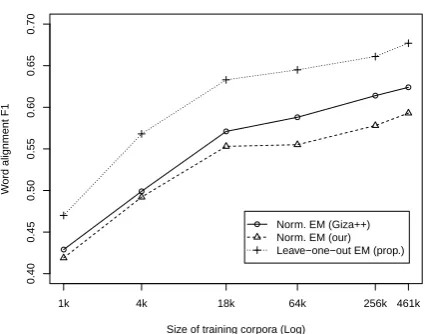
On word alignment accuracy, the proposed method achieved improvements ofF1from 0.041 to 0.090 under the different training corpora (Table 5. The maximum improvement compared with GIZA++ is 0.069 when the training corpus has 4,000 sentence pairs. The maximum improvement compared with our own implement is 0.090 when the training corpus has 64,000 sentence pairs.
Figure 2 shows that the extent of improvements slightly changes under different training corpora, but they are all quite stable and obvious.
On translation quality, the proposed method achieved improvements of BLEU under the dif-ferent training corpora. The improvements ranged from 0.19 to 1.72 for phrase-based MT and ranged from 0.25 to 3.02 (see Table 5). The improve-ments are larger under smaller training corpora (see Figure 3).
In addition, the BLEUs achieved by the pro-posed method is close to the ones achieved by gold WA annotations. The proposed method slightly outperforms the gold WA annotations when us-ing the full manual WA corpus of 18,057 sentence pairs.
4.5 Comparison tol0-Normalization and Kneser-Ney Smoothing Methods
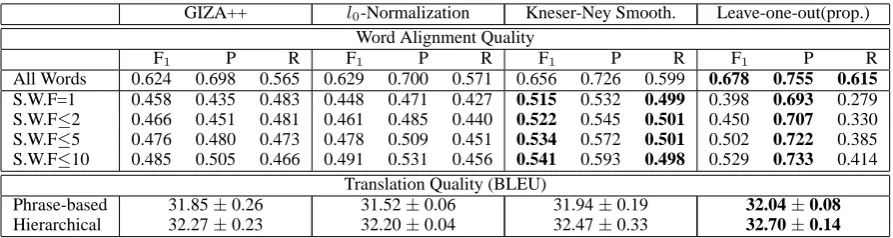
The proposed leave-one-word word align-ment method was empirically compared to l0-normalized GIZA++ (Vaswani et al., 2012)11 and Kneser-Ney smoothed GIZA++ (Zhang and Chiang, 2014)12. l0-normalization and Kneser-Ney smoothing methods are established methods to overcome the sparse problem. This enables the probability distributions on rare words to be estimated more effectively. In this way, these two GIZA++ variants are related to the proposed method.
l0-normalized GIZA++ and Kneser-Ney
smoothed GIZA++ were run with the same settings as GIZA++, which came from the default settings of MOSES. For the settings of l0-normalized GIZA++ that are not in common with GIZA++ were the default settings. As for
Kneser-Ney smoothed GIZA++, the smooth
switches of IBM models 1 – 4 and HMM model
11
http://www.isi.edu/˜avaswani/ giza-pp-l0.html
GIZA++ l0-Normalization Kneser-Ney Smooth. Leave-one-out(prop.) Word Alignment Quality
F1 P R F1 P R F1 P R F1 P R
All Words 0.624 0.698 0.565 0.629 0.700 0.571 0.656 0.726 0.599 0.678 0.755 0.615
S.W.F=1 0.458 0.435 0.483 0.448 0.471 0.427 0.515 0.532 0.499 0.398 0.693 0.279 S.W.F≤2 0.466 0.451 0.481 0.461 0.485 0.440 0.522 0.545 0.501 0.450 0.707 0.330 S.W.F≤5 0.476 0.480 0.473 0.478 0.509 0.451 0.534 0.572 0.501 0.502 0.722 0.385 S.W.F≤10 0.485 0.505 0.466 0.491 0.531 0.456 0.541 0.593 0.498 0.529 0.733 0.414
Translation Quality (BLEU)
Phrase-based 31.85±0.26 31.52±0.06 31.94±0.19 32.04±0.08
[image:9.595.76.523.61.180.2]Hierarchical 32.27±0.23 32.20±0.04 32.47±0.33 32.70±0.14
Table 7: Empirical Comparision withl0-Normalized and Kneser-Ney Smoothed GIZA++’s
were turned on.
The experimental results are presented in Ta-ble 7. The experiments were run on the Chinese-English language pair. The word alignment qual-ity was evaluated separately for all words and for various levels of rare words. The leave-one-out method outperformed related methods in terms of precision, recall and F1 when evaluated on all words.
Rare words were categorized based on the num-ber of occurences in the source-language text of the training data. The evaluations were carried out on the subset of alignment links that had a rare word on the source side. Table 7 presents the results for thresholds 1, 2, 5 and 10. The proposed method achieved much higher preci-sion on rare words than the other methods, but performed poorly on recall. The Kneser-Ney Smoothed GIZA++ had higher recall. The ex-planation might be that the leave-one-out method punishes rare words more than the Kneser-Ney smoothing method, by totally removing the de-rived expected counts of current sentence pair from the alignment models. This leads to rare words being passively aligned. In other words, the leave-one-out method would align rare words un-less the confidence is high. Therefore, we plan to seek a method to integrate Kneser-Ney smoothing into the proposed leave-one-out method in the fu-ture work.
The BLEU scores achieved by phrase-based SMT and hierarchical SMT for different align-ment methods are presented in Table 7. The proposed method outperforms the other methods. The Kneser-Ney Smoothed GIZA++ performed the second best. We tried to further analyze the relation between word alignment and BLEU, but found the analysis was obscured by the many processing stages. These stages include
paral-lel phrase extraction (or translation rule extraction from hierarchical SMT), log-linear model, MERT tuning and practical decoding where a lot of prun-ing happened.
5 Conclusion
This paper proposes a leave-one-out EM algo-rithm for WA to overcome the over-fitting prob-lem that occurs when using standard EM for WA. The experimental results on Chinese-English and Japanese-English corpora show that both the WA accuracy and the end-to-end translation are im-proved.
In addition, we have a interesting finding about the effect of manual WA annotations on train-ing MT systems. In a Chinese-English parallel training corpus of 18,057 sentence pairs, the man-ual WA annotation outperformed the unsupervised WA results produced by standard EM algorithms. However, the unsupervised WA results produced by proposed leave-one-out EM algorithm outper-formed the manual WA annotation.
Our future work will focus on increasing the gains in end-to-end translation quality through the proposed leave-one-out aligner. It is a interest-ing question why GIZA++ achieved competitive BLEU scores though its alignment accuracy mea-sured by F1 was substantially lower. The answer to this question which may reveal essence of good word alignment for MT and eventually help to im-prove MT. In addition, we plan to imim-prove the pro-posed method by integrating Kneser-Ney smooth-ing.
Acknowledgments
References
Christophe Andrieu, Nando De Freitas, Arnaud Doucet, and Michael I. Jordan. 2003. An intro-duction to MCMC for machine learning. Machine learning, 50(1-2):5–43.
Ondrej Bojar, Christian Buck, Chris Callison-Burch, Christian Federmann, Barry Haddow, Philipp Koehn, Christof Monz, Matt Post, Radu Soricut, and Lucia Specia. 2013. Findings of the 2013 workshop on statistical machine translation. In Proceedings of the Eighth Workshop on Statistical Machine Trans-lation, pages 1–44.
Peter F. Brown, Stephen A. Della Pietra, Vincent J. Della Pietra, Meredith J. Goldsmith, Jan Hajic, Robert L. Mercer, and Surya Mohanty. 1993a. But dictionaries are data too. In Proceedings of the Workshop on Human Language Technology, HLT ’93, pages 202–205, Stroudsburg, PA, USA. Asso-ciation for Computational Linguistics.
Peter F. Brown, Vincent J. Della Pietra, Stephen A. Della Pietra, and Robert L. Mercer. 1993b. The mathematics of statistical machine translation: parameter estimation. Computational linguistics, 19(2):263–311.
Mauro Cettolo, Jan Niehues, Sebastian St¨uker, Luisa Bentivogli, and Marcello Federico. 2013. Report on the 10th IWSLT evaluation campaign. In Pro-ceedings of the International Workshop on Spoken Language Translation, pages 29–38.
Arthur P. Dempster, Nan M. Laird, and Donald B. Ru-bin. 1977. Maximum likelihood from incomplete data via the EM algorithm. Journal of the Royal Statistical Society. Series B (Methodological), pages 1–38.
John DeNero and Dan Klein. 2007. Tailoring word alignments to syntactic machine translation. In Pro-ceedings of the 45th Annual Meeting on Association for Computational Linguistics, pages 17–24.
John DeNero, Alexandre Bouchard-Cˆot´e, and Dan Klein. 2008. Sampling alignment structure un-der a bayesian translation model. In Proceedings of the Conference on Empirical Methods in Natu-ral Language Processing, EMNLP ’08, pages 314– 323, Stroudsburg, PA, USA. Association for Com-putational Linguistics.
Chris Dyer, Victor Chahuneau, and Noah A Smith. 2013. A simple, fast, and effective reparameteriza-tion of ibm model 2. In Proceedings of the North American Chapter of the Association for Computa-tional Linguistics: Human Language Technologies, pages 644–648.
Kuzman Ganchev, Joao V. Grac¸a, and Ben Taskar. 2008. Better alignments = better translations? Pro-ceedings of the 46th Annual Meeting on Association for Computational Linguistics, page 42.
Walter R. Gilks, Sylvia Richardson, and David J. Spiegelhalter. 1996. Markov chain Monte Carlo in practice, volume 2. CRC press.
Isao Goto, Bin Lu, Ka Po Chow, Eiichiro Sumita, and Benjamin K Tsou. 2011. Overview of the patent machine translation task at the NTCIR-9 workshop. In Proceedings of NTCIR, volume 9, pages 559–578.
Marcin Junczys-Dowmunt and Arkadiusz Sza. 2012. Symgiza++: Symmetrized word alignment mod-els for machine translation. In Pascal Bouvry, Mieczyslaw A. Klopotek, Franck Leprvost, Malgo-rzata Marciniak, Agnieszka Mykowiecka, and Hen-ryk Rybinski, editors, Security and Intelligent In-formation Systems (SIIS), volume 7053 of Lecture Notes in Computer Science, pages 379–390, War-saw, Poland. Springer.
Philipp Koehn, Hieu Hoang, Alexandra Birch, Chris Callison-Burch, Marcello Federico, Nicola Bertoldi, Brooke Cowan, Wade Shen, Christine Moran, Richard Zens, et al. 2007. Moses: Open source toolkit for statistical machine translation. In Pro-ceedings of the 45th Annual Meeting of the Associ-ation for ComputAssoci-ational Linguistics on Interactive Poster and Demonstration Sessions, pages 177–180. Association for Computational Linguistics.
Philipp Koehn. 2005. Europarl: A parallel corpus for statistical machine translation. In Proceedings of MT Summit, volume 5, pages 79–86.
Percy Liang, Ben Taskar, and Dan Klein. 2006. Align-ment by agreeAlign-ment. In Proceedings of the North American Chapter of the Association of Computa-tional Linguistics: Human Language Technologies, pages 104–111. Association for Computational Lin-guistics.
Robert C. Moore. 2004. Improving IBM word-alignment model 1. In Proceedings of the 42nd An-nual Meeting on Association for Computational Lin-guistics, page 518. Association for Computational Linguistics.
Graham Neubig, Taro Watanabe, Eiichiro Sumita, Shinsuke Mori, and Tatsuya Kawahara. 2011. An unsupervised model for joint phrase alignment and extraction. In ACL, pages 632–641.
Graham Neubig. 2011. The Kyoto free translation task. http://www.phontron.com/kftt.
Franz Josef Och and Hermann Ney. 2000. A com-parison of alignment models for statistical machine translation. In Proceedings of the 18th confer-ence on Computational linguistics-Volume 2, pages 1086–1090. Association for Computational Linguis-tics.
Franz Josef Och. 2003. Minimum error rate training in statistical machine translation. In Proceedings of the 41st Annual Meeting on Association for Compu-tational Linguistics-Volume 1, pages 160–167. As-sociation for Computational Linguistics.
Nicolas Le Roux and Francis Bach. 2011. Local com-ponent analysis. Technical report.
Akihiro Tamura, Taro Watanabe, Eiichiro Sumita, Hi-roya Takamura, and Manabu Okumura. 2013. Part-of-speech induction in dependency trees for statisti-cal machine translation. In Proceedings of the 51th Annual Meeting of the Association for Computa-tional Linguistics, pages 841–851.
Jo˜ao V Grac¸a, Kuzman Ganchev, and Ben Taskar. 2010. Learning tractable word alignment models with complex constraints. Computational Linguis-tics, 36(3):481–504.
Ashish Vaswani, Liang Huang, and David Chiang. 2012. Smaller alignment models for better trans-lations: unsupervised word alignment with thel0 -norm. In Proceedings of the 50th Annual Meeting of the Association for Computational Linguistics: Long Papers-Volume 1, pages 311–319. Association for Computational Linguistics.
Xiaolin Wang, Masao Utiyama, Andrew Finch, and Ei-ichiro Sumita. 2014. Empirical study of unsuper-vised chinese word segmentation methods for smt on large-scale corpora. In Proceedings of the 52nd Annual Meeting of the Association for Computa-tional Linguistics (Volume 2: Short Papers), pages 752–758, Baltimore, Maryland, June. Association for Computational Linguistics.
Taro Watanabe and Eiichiro Sumita. 2011. Machine translation system combination by confusion forest. In Proceedings of the 49th Annual Meeting of the Association for Computational Linguistics: Human Language Technologies, pages 1249–1257. Associ-ation for ComputAssoci-ational Linguistics.
Taro Watanabe. 2012. Optimized online rank learning for machine translation. In Proceedings of the North American Chapter of the Association for Computa-tional Linguistics: Human Language Technologies, pages 253–262. Association for Computational Lin-guistics.
Joern Wuebker, Arne Mauser, and Hermann Ney. 2010. Training phrase translation models with leaving-one-out. In Proceedings of the 48th Annual Meeting of the Association for Computational Lin-guistics, pages 475–484. Association for Computa-tional Linguistics.
Joern Wuebker, Mei-Yuh Hwang, and Chris Quirk. 2012. Leave-one-out phrase model training for large-scale deployment. In Proceedings of the Sev-enth Workshop on Statistical Machine Translation, pages 460–467. Association for Computational Lin-guistics.
Nianwen Xue, Fu-Dong Chiou, and Martha Palmer. 2002. Building a large-scale annotated chinese cor-pus. In Proceedings of the 19th International Con-ference on Computational Linguistics, pages 1–8. Association for Computational Linguistics.