Unsupervised Models for Coreference Resolution
Vincent Ng
Human Language Technology Research Institute University of Texas at Dallas
Richardson, TX 75083-0688 [email protected]
Abstract
We present a generative model for unsuper-vised coreference resolution that views coref-erence as an EM clustering process. For comparison purposes, we revisit Haghighi and Klein’s (2007) fully-generative Bayesian model for unsupervised coreference resolu-tion, discuss its potential weaknesses and con-sequently propose three modifications to their model. Experimental results on the ACE data sets show that our model outperforms their original model by a large margin and com-pares favorably to the modified model.
1 Introduction
Coreference resolution is the problem of identifying which mentions (i.e., noun phrases) refer to which real-world entities. The availability of annotated coreference corpora produced as a result of the MUC conferences and the ACE evaluations has prompted the development of a variety of supervised machine learning approaches to coreference resolution in re-cent years. The focus of learning-based coreference research has also shifted from the acquisition of a pairwise model that determines whether two men-tions are co-referring (e.g., Soon et al. (2001), Ng and Cardie (2002), Yang et al. (2003)) to the de-velopment of rich linguistic features (e.g., Ji et al. (2005), Ponzetto and Strube (2006)) and the ex-ploitation of advanced techniques that involve joint learning (e.g., Daum´e III and Marcu (2005)) and joint inference (e.g., Denis and Baldridge (2007)) for coreference resolution and a related extraction task. The rich features, coupled with the increased
complexity of coreference models, have made these supervised approaches more dependent on labeled data and less applicable to languages for which lit-tle or no annotated data exists. Given the growing importance of multi-lingual processing in the NLP community, however, the development of unsuper-vised and weakly superunsuper-vised approaches for the au-tomatic processing of resource-scarce languages has become more important than ever.
In fact, several popular weakly supervised learn-ing algorithms such as self-trainlearn-ing, co-trainlearn-ing (Blum and Mitchell, 1998), and EM (Dempster et al., 1977) have been applied to coreference resolu-tion (Ng and Cardie, 2003) and the related task of pronoun resolution (M ¨uller et al., 2002; Kehler et al., 2004; Cherry and Bergsma, 2005). Given a small number of coreference-annotated documents and a large number of unlabeled documents, these weakly supervised learners aim to incrementally augment the labeled data by iteratively training a classifier1 on the labeled data and using it to label mention pairs randomly drawn from the unlabeled documents asCOREFERENT or NOT COREFERENT. However, classifying mention pairs using such iterative ap-proaches is undesirable for coreference resolution: since the non-coreferent mention pairs significantly outnumber their coreferent counterparts, the result-ing classifiers generally have an increasresult-ing tendency to (mis)label a pair as non-coreferent as bootstrap-ping progresses (see Ng and Cardie (2003)).
Motivated in part by these results, we present a generative, unsupervised model for probabilistically
1
For co-training, a pair of view classifiers are trained; and for EM, a generative model is trained instead.
inducing coreference partitions on unlabeled doc-uments, rather than classifying mention pairs, via EM clustering (Section 2). In fact, our model com-bines the best of two worlds: it operates at the document level, while exploiting essential linguistic constraints on coreferent mentions (e.g., gender and number agreement) provided by traditional pairwise classification models.
For comparison purposes, we revisit a fully-generative Bayesian model for unsupervised coref-erence resolution recently introduced by Haghighi and Klein (2007), discuss its potential weaknesses and consequently propose three modifications to their model (Section 3). Experimental results on the ACE data sets show that our model outperforms their original model by a large margin and compares fa-vorably to the modified model (Section 4).
2 Coreference as EM Clustering
In this section, we will explain how we recast un-supervised coreference resolution as EM clustering. We begin by introducing some of the definitions and notations that we will use in this paper.
2.1 Definitions and Notations
A mention can be a pronoun, a name (i.e., a proper noun), or a nominal (i.e., a common noun). An en-tity is a set of coreferent mentions. Given a docu-mentDconsisting ofnmentions,m1, . . . , mn, we
useP airs(D)to denote the set of n2
mention pairs, {mij | 1 ≤ i < j ≤ n}, where mij is formed
from mentions mi and mj. The pairwise
probabil-ity formed from mi and mj refers to the
probabil-ity that the pairmij is coreferent and is denoted as
Pcoref(mij). A clustering of nmentions is annx
nBoolean matrixC, whereCij (the (i,j)-th entry of
C) is 1 if and only if mentionsmiandmjare
coref-erent. An entry in C is relevant if it corresponds to a mention pair in P airs(D). A valid clustering is a clustering in which the relevant entries satisfy the transitivity constraint. In other words,Cis valid if and only if (Cij = 1 ∧ Cjk = 1) =⇒ Cik = 1
∀ 1 ≤ i < j < k ≤ n. Hence, a valid clustering corresponds to a partition of a given set of mentions, and the goal of coreference resolution is to produce a valid clustering in which each cluster corresponds to a distinct entity.
2.2 The Model
As mentioned previously, our generative model op-erates at the document level, inducing a valid clus-tering on a given document D. More specifically, our model consists of two steps. It first chooses a clustering C based on some clustering distribution
P(C), and then generatesDgivenC:
P(D, C) =P(C)P(D|C).
To facilitate the incorporation of linguistic con-straints defined on a pair of mentions, we represent
Dby its mention pairs,P airs(D). Now, assuming that these mention pairs are generated conditionally independently of each other givenCij,
P(D|C) = Y
mij∈P airs(D)
P(mij |Cij).
Next, we represent mij as a set of seven features
that is potentially useful for determining whethermi
andmjare coreferent (see Table 1).2 Hence, we can
rewriteP(D|C)as
Y
mij∈P airs(D)
P(m1ij, . . . , m7ij |Cij),
wheremkij is the value of thekth feature ofmij.
To reduce data sparseness and improve the es-timation of the above probabilities, we make con-ditional independence assumptions about the gen-eration of these feature values. Specifically, as shown in the first column of Table 1, we di-vide the seven features into three groups (namely, strong coreference indicators, linguistic constraints, and mention types), assuming that two feature values are conditionally independent if and only if the corresponding features belong to differ-ent groups. With this assumption, we can de-compose P(m1ij, . . . m7ij | Cij) into a product
of three probabilities: P(m1ij, mij2, m3ij | Cij),
P(m4ij, m5ij, m6ij |Cij), andP(m7ij |Cij). Each of
these distributions represents a pair of multinomial distributions, one for the coreferent mention pairs (Cij = 1) and the other for the non-coreferent
men-tion pairs (Cij = 0). Hence, the set of parameters
of our model, Θ, consists of P(m1, m2, m3 | c),
P(m4, m5, m6|c), andP(m7 |c).
2
Feature Type Feature ID Feature Description
Strong 1 STR MATCH T if neither of the two mentions is a pronoun and after discarding determiners, Coreference the string denoting mentionmiis identical to that of mentionmj; else F.
Indicators 2 ALIAS T if one mention is an acronym, an abbreviation, or a name variant of the other; else F. For instance, Bill Clinton and President Clinton are aliases, so are MIT and Massachusetts Institute of Technology.
3 APPOSITIVE T if the mentions are in an appositive relationship; else F.
Linguistic 4 GENDER T if the mentions agree in gender; F if they disagree; NA if gender information Constraints for one or both mentions cannot be determined.
5 NUMBER T if the mentions agree in number; F if they disagree; NA if number informa-tion for one or both meninforma-tions cannot be determined.
6 SEM CLASS T if the mentions have the same semantic class; F if they don’t; NA if the semantic class information for one or both mentions cannot be determined. Mention Types 7 NPTYPE the feature value is the concatenation of the mention type of the two mentions,
titj, whereti, tj∈ {PRONOUN,NAME,NOMINAL}.
Table 1: Feature set for representing a mention pair. The first six features are relational features that test whether some property P holds for the mention pair under consideration and indicate whether the mention pair is TRUEor FALSE
w.r.t. P; a value of NOTAPPLICABLEis used when property P does not apply.
2.3 The Induction Algorithm
To induce a clusteringC on a documentD, we run EM on our model, treating Das observed data and
C as hidden data. Specifically, we use EM to itera-tively estimate the model parameters, Θ, from doc-uments that are probabilistically labeled (with clus-terings) and apply the resulting model to probabilis-tically re-label a document (with clusterings). More formally, we employ the following EM algorithm:
E-step: Compute the posterior probabilities of the
clusterings,P(C|D,Θ), based on the currentΘ.
M-step: UsingP(C|D,Θ)computed in the E-step, find the Θ′ that maximizes the expected complete log likelihood,P
C P(C|D,Θ) logP(D, C|Θ′).
We begin the induction process at the M-step.3To find theΘthat maximizes the expected complete log likelihood, we use maximum likelihood estimation with add-one smoothing. Since P(C|D,Θ) is not available in the first EM iteration, we instead use an initial distribution over clusterings, P(C). The question, then, is: whichP(C)should we use? One possibility is the uniform distribution over all (possi-bly invalid) clusterings. Another, presuma(possi-bly better, choice is a distribution that assigns non-zero prob-ability mass to only the valid clusterings. Yet an-other possibility is to set P(C) based on a docu-ment labeled with coreference information. In our experiments, we employ this last method, assigning
3
Another possibility, of course, is to begin at the E-step by making an initial guess atΘ.
a probability of one to the correct clustering of the labeled document (see Section 4.1 for details).
After (re-)estimatingΘin the M-step, we proceed to the E-step, where the goal is to find the condi-tional clustering probabilities. Given a document
D, the number of coreference clusterings is expo-nential in the number of mentions in D, even if we limit our attention to those that are valid. To cope with this computational complexity, we ap-proximate the E-step by computing only the condi-tional probabilities that correspond to the N most probable coreference clusterings given the current
Θ. We identify theN most probable clusterings and compute their probabilities as follows. First, using the current Θ, we reverse the generative model and compute Pcoref(mij) for each mention pair mij in
P airs(D). Next, using these pairwise probabilities, we apply Luo et al.’s (2004) Bell tree approach to coreference resolution to compute theN-best clus-terings and their probabilities (see Section 2.4 for details). Finally, to obtain the required conditional clustering probabilities for the E-step, we normalize the probabilities assigned to theN-best clusterings so that they sum to one.
2.4 Computing the N-Best Partitions
As described above, given the pairwise probabilities, we use Luo et al.’s (2004) algorithm to heuristically compute theN-best clusterings (or, more precisely,
N-best partitions4) and their probabilities based on
4
Input:M ={m1, ..., mn}: mentions,N: no. of best partitions
Output:N-best partitions
1: // initialize the data structures that store partial partitions 2: H1:={P P:={[m1]}},S(P P)= 1
3: H2, ..., Hn=∅ 4: fori= 2 ton
5: // process each partial partition
6: foreachP P ∈Hi−1
7: // process each cluster in PP
8: foreachC∈P P
9: ExtendP PtoP P′by linkingm
itoC 10: ComputeS(P P′)
11: Hi:=Hi∪ {P P′}
12: ExtendP PtoP Pδby puttingmiinto a new cluster 13: ComputeS(P Pδ)
14: Hi:=Hi∪ {P Pδ}
[image:4.612.75.300.64.236.2]15: returnNmost probable partitions inHn
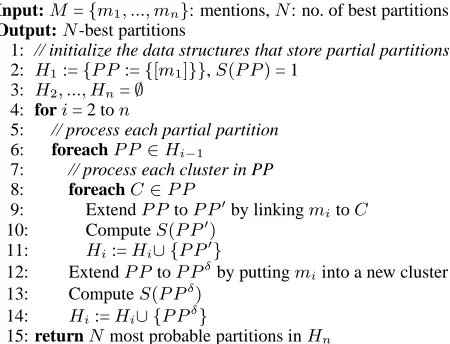
Figure 1: Our implementation of Luo et al.’s algorithm
the Bell tree. Informally, each node in a Bell tree corresponds to an ith-order partial partition (i.e., a partition of the first i mentions of the given docu-ment), and theith level of the tree contains all possi-bleith-order partial partitions. Hence, the set of leaf nodes constitutes all possible partitions of all of the mentions. The search for theNmost probable parti-tions starts at the root, and a partitioning of the men-tions is incrementally constructed as we move down the tree. Since an exhaustive search is computation-ally infeasible, Luo et al. employ a beam search pro-cedure to explore only the most probable paths at each step of the search process. Figure 1 shows our implementation of this heuristic search algorithm.
The algorithm takes as input a set ofnmentions (and their pairwise probabilities), and returns theN
most probable partitionings of the mentions. It uses data structures Sand the Hi’s to store intermediate
results. Specifically, S(P P)stores the score of the partial partition P P. Hi is associated with the ith
level of the Bell tree, and is used to store the most probableith-order partial partitions. Each Hi has a
maximum size of 2N: if more than 2N partitions are inserted into a givenHi, then only the 2N most
probable ones will be stored. This amounts to prun-ing the search space by employprun-ing a beam size of 2N (i.e., expanding only the 2N most probable par-tial partitions) at each step of the search.
The algorithm begins by initializing H1 with the only partial partition of order one, {[m1]}, which
indeed partitions. This is desirable, as there is no reason for us to put non-zero probability mass on invalid clusterings.
has a score of one (line 2). Then it processes the mentions sequentially, starting with m2 (line 4). When processingmi, it takes each partial partition
P P in Hi−1 and creates a set of ith-order parti-tions by extendingP P withmiin all possible ways.
Specifically, for each clusterC (formed by a subset of the firsti–1 mentions) inP P, the algorithm gen-erates a newith-order partition,P P′, by linkingmi
toC (line 9), and stores P P′ inHi (line 11). The
score of P P′, S(P P′), is computed by using the pairwise coreference probabilities as follows:
S(P P′) =S(P P)· max
mk∈CPcoref(mki).
Of course,P P can also be extended by puttingmi
into a new cluster (line 12). This yields P Pδ, an-other partition to be inserted intoHi(line 14), and
S(P Pδ) =δ·S(P P)·(1− max
k∈{1,...,i−1}Pcoref(mki)),
whereδ (the start penalty) is a positive constant (<
1) used to penalize partitions that start a new clus-ter. After processing each of the nmentions using the above steps, the algorithm returns the N most probable partitions inHn(line 15).
Our implementation of Luo et al.’s search algo-rithm differs from their original algoalgo-rithm only in terms of the number of pruning strategies adopted. Specifically, Luo et al. introduce a number of heuris-tics to prune the search space in order to speed up the search. We employ only the beam search heuristic, with a beam size that is five times larger than theirs. Our larger beam size, together with the fact that we do not use other pruning strategies, implies that we are searching through a larger part of the space than them, thus potentially yielding better partitions.
3 Haghighi and Klein’s Coreference Model
To gauge the performance of our model, we com-pare it with a Bayesian model for unsupervised coreference resolution that was recently proposed by Haghighi and Klein (2007). In this section, we will give an overview of their model, discuss its weak-nesses and propose three modifications to the model.
3.1 Notations
that refer to (indices of) entities. φz is the set of
parameters associated with entity z. φis the entire set of model parameters, which includes all theφz’s.
Finally, X is the set of observed variables (e.g., the head of a mention). Given a document, the goal is to find the most probable assignment of entity in-dices to its mentions given the observed values. In other words, we want to maximize P(Z|X). In a Bayesian approach, we compute this probability by integrating out all the parameters. Specifically,
P(Z|X) =
Z
P(Z|X, φ)P(φ|X)dφ.
3.2 The Original H&K Model
The original H&K model is composed of a set of models: the basic model and two other models (namely, the pronoun head model and the salience model) that aim to improve the basic model.5
3.2.1 Basic Model
The basic model generates a mention in a two-step process. First, an entity index is chosen according to an entity distribution, and then the head of the men-tion is generated given the entity index based on an entity-specific head distribution. Here, we assume that (1) all headsHare observed and (2) a mention is represented solely by its head noun, so nothing other than the head is generated. Furthermore, we assume that the head distribution is drawn from a symmetric Dirichlet with concentration λH. Hence,
P(Hi,j =h|Z,H−i,j)∝nh,z+λH
where Hi,j is the head of mention j in document
i, andnh,z is the number of times head h is
emit-ted by entity index z in (Z,H−i,j).6 On the other hand, since the number of entities in a document is not known a priori, we draw the entity distribution from a Dirichlet process with concentration α, ef-fectively yielding a model with an infinite number of mixture components. Using the Chinese restau-rant process representation (see Teh et al. (2006)),
P(Zij =z|Z−i,j)∝
(
α , ifz=znew
nz , otherwise
5
H&K also present a cross-document coreference model, but since it focuses primarily on cross-document coreference and improves within-document coreference performance by only 1.5% in F-score, we will not consider this model here.
6 H−i,j
is used as a shorthand for H –{Hi,j}.
wherenzis the number of mentions in Z−i,jlabeled
with entity indexz, andznew is a new entity index
not already in Z−i,j. To perform inference, we use Gibbs sampling (Geman and Geman, 1984) to gen-erate samples from this conditional distribution:
P(Zi,j|Z−i,j,H)∝P(Zi,j|Z−i,j)P(Hi,j|Z,H−i,j)
where the two distributions on the right are defined as above. Starting with a random assignment of en-tity indices to mentions, the Gibbs sampler itera-tively re-samples an entity index according to this posterior distribution given the current assignment.
3.2.2 Pronoun Head Model
Head generation in the basic model is too simplis-tic: it has a strong tendency to assign the same en-tity index to mentions having the same head. This is particularly inappropriate for pronouns. Hence, we need a different model for generating pronouns.
Before introducing this pronoun head model, we need to augment the set of entity-specific param-eters, which currently contains only a distribution over heads (φhZ). Specifically, we add distributions
φt Z, φ
g
Z, and φnZ over entity properties: φtZ is a
distribution over semantic types (PER, ORG, LOC, MISC), φgZ over gender (MALE, FEMALE, EITHER, NEUTER), andφnZover number (SG,PL). We assume that each of these distributions is drawn from a sym-metric Dirichlet. A small concentration parameter is used, since each entity should have a dominating value for each of these properties.
Now, to estimate φtZ, φgZ, and φnZ, we need to know the gender, number, and semantic type of each mention. For some mentions (e.g., “he”), these properties are easy to compute; for others (e.g., “it”), they are not. Whenever a mention has unobserved properties, we need to fill in the missing values. We could resort to sampling, but sampling these prop-erties is fairly inefficient. So, following H&K, we keep soft counts for each of these properties and use them rather than perform hard sampling.
When an entityzgenerates a pronounhusing the pronoun head model,7it first generates a genderg, a numbern, and a semantic typetindependently from the distributionsφgz,φnz, andφtz; and then generates
h using the distribution P(H = h|G = g, N =
7
n, T = t, θ). Note that this last distribution is a global distribution that is independent of the chosen entity index.θis a parameter drawn from a symmet-ric Disymmet-richlet (with concentration λP) that encodes
our prior knowledge of the relationship between a semantic type and a pronoun. For instance, given the typePERSON, there is a higher probability of
gener-ating “he” than “it”. As a result, we maintain a list of compatible semantic types for each pronoun, and give a pronoun a count of (1 +λP) if it is compatible
with the drawn semantic type; otherwise, we give it a count ofλP. In essence, we use this prior to prefer
the generation of pronouns that are compatible with the chosen semantic type.
3.2.3 Salience Model
Pronouns typically refer to salient entities, so the basic model could be improved by incorporating salience. We start by assuming that each entity has an activity score that is initially set to zero. Given a set of mentions and an assignment of entity in-dices to mentions, Z, we process the mentions in a left-to-right manner. When a mention,m, is encoun-tered, we multiply the activity score of each entity by 0.5 and add one to the activity score of the entity to whichmbelongs. This captures the intuitive notion that frequency and recency both play a role in deter-mining salience. Next, we rank the entities based on their activity scores and discretize the ranks into five “salience” bucketsS:TOP(1),HIGH(2–3),MID(4– 6), LOW(7+), and NONE. Finally, this salience in-formation is used to modify the entity distribution:8
P(Zij =z|Z−i,j)∝nz·P(Mi,j|Si,j,Z)
where Si,j is the salience value of the jth mention
in document i, and Mi,j is its mention type, which
can take on one of three values: pronoun, name, and nominal. P(Mi,j|Si,j,Z), the distribution of
men-tion type given salience, was computed from H&K’s development corpus (see Table 2). According to the table, pronouns are preferred for salient entities, whereas names and nominals are preferred for enti-ties that are less active.
8
Rather than having just one probability term on the right hand side of the sampling equation, H&K actually have a prod-uct of probability terms, one for each mention that appears later than mentionjin the given document. However, they acknowl-edge that having the product makes sampling inefficient, and decided to simplify the equation to this form in their evaluation.
Salience Feature Pronoun Name Nominal
TOP 0.75 0.17 0.08
HIGH 0.55 0.28 0.17
MID 0.39 0.40 0.21
LOW 0.20 0.45 0.35
[image:6.612.330.525.61.125.2]NONE 0.00 0.88 0.12
Table 2: Posterior distribution of mention type given salience (taken from Haghighi and Klein (2007))
3.3 Modifications to the H&K Model
Next, we discuss the potential weaknesses of H&K’s model and propose three modifications to it.
Relaxed head generation. The basic model fo-cuses on head matching, and is therefore likely to (incorrectly) posit the large airport and the small airport as coreferent, for instance. In fact, head matching is a relatively inaccurate indicator of coref-erence, in comparison to the “strong coreference in-dicators” shown in the first three rows of Table 1. To improve H&K’s model, we replace head matching with these three strong indicators as follows. Given a document, we assign each of its mentions a head index, such that two mentions have the same head index if and only if at least one of the three strong indicators returns a value of True. Now, instead of generating a head, the head model generates a head index, thus increasing the likelihood that aliases are assigned the same entity index, for instance. Note that this modification is applied only to the basic model. In particular, pronoun generation continues to be handled by the pronoun head model and will not be affected. We hypothesize that this modifica-tion would improve precision, as the strong indica-tors are presumably more precise than head match.
Agreement constraints. While the pronoun head model naturally prefers that a pronoun be generated by an entity whose gender and number are compati-ble with those of the pronoun, the entity (index) that is re-sampled for a pronoun according to the sam-pling equation forP(Zi,j|Z−i,j,H)may still not be
large. To eliminate this possibility, we enforce the agreement constraints at the global level. Specifi-cally, we sample an entity index for a given mention with a non-zero probability if and only if the corre-sponding entity and the head of the mention agree in gender and number. We hypothesize that this modi-fication would improve precision.
Pronoun-only salience. In Section 3.2.3, we mo-tivate the need for salience using pronouns only, since proper names can to a large extent be resolved using string-matching facilities and are not particu-larly sensitive to salience. Nominals (especially def-inite descriptions), though more sensitive to salience than names, can also be resolved by simple string-matching heuristics in many cases (Vieira and Poe-sio, 2000; Strube et al., 2002). Hence, we hypothe-size that the use of salience for names and nominals would adversely affect their resolution performance, as incorporating salience could diminish the role of string match in the resolution process, according to the sampling equations. Consequently, we modify H&K’s model by limiting the application of salience to the resolution of pronouns only. We hypothesize that this change would improve precision.
4 Evaluation
4.1 Experimental Setup
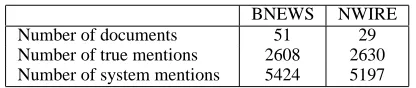
To evaluate our EM-based model and H&K’s model, we use the ACE 2003 coreference corpus, which is composed of three sections: Broadcast News (BNEWS), Newswire (NWIRE), and Newspaper (NPAPER). Each section is in turn composed of a training set and a test set. Due to space limitations, we will present evaluation results only for the test sets of BNEWS and NWIRE, but verified that the same performance trends can be observed on NPA-PER as well. Unlike H&K, who report results us-ing only true mentions (extracted from the answer keys), we show results for true mentions as well as system mentions that were extracted by an in-house noun phrase chunker. The relevant statistics of the BNEWS and NWIRE test sets are shown in Table 3.
Scoring programs. To score the output of the coreference models, we employ the commonly-used MUC scoring program (Vilain et al., 1995) and the recently-developed CEAF scoring program (Luo, 2005). In the MUC scorer, recall is computed as
BNEWS NWIRE
Number of documents 51 29
[image:7.612.323.531.61.105.2]Number of true mentions 2608 2630 Number of system mentions 5424 5197
Table 3: Statistics of the BNEWS and NWIRE test sets
the percentage of coreference links in the reference partition that appear in the system partition; preci-sion is computed in the same fashion as recall, ex-cept that the roles of the reference partition and the system partition are reversed. As a link-based scor-ing program, the MUC scorer (1) does not reward successful identification of singleton entities and (2) tends to under-penalize partitions that have too few entities. The entity-based CEAF scorer was pro-posed in response to these two weaknesses. Specif-ically, it operates by computing the optimal align-ment between the set of reference entities and the set of system entities. CEAF precision and recall are both positively correlated with the score of this optimal alignment, which is computed by summing over each aligned entity pair the number of mentions that appear in both entities of that pair. As a conse-quence, a system that proposes too many entities or too few entities will have low precision and recall.
Parameter initialization. We use a small amount of labeled data for parameter initialization for the two models. Specifically, for evaluations on the BNEWS test data, we use as labeled data one randomly-chosen document from the BNEWS train-ing set, which has 58 true mentions and 102 system mentions. Similarly for NWIRE, where the chosen document has 42 true mentions and 72 system men-tions. For our model, we use the labeled document to initialize the parameters. Also, we set N (the number of most probable partitions) to 50 andδ(the start penalty used in the Bell tree) to 0.8, the latter being recommended by Luo et al. (2004).
set toe−4, following H&K. In addition, as is com-monly done in Bayesian approaches, we do not sam-ple entities directly from the conditional distribution
P(Z|X); rather, we sample from this distribution raised to the power expkci−1, wherec=1.5, i is the current iteration number that starts at 0, and k (the number of sampling iterations) is set to 20. Finally, due to sampling and the fact that the initial assign-ment of entity indices to assign-mentions is random, all the reported results for H&K’s model are averaged over five runs.
4.2 Results and Discussions
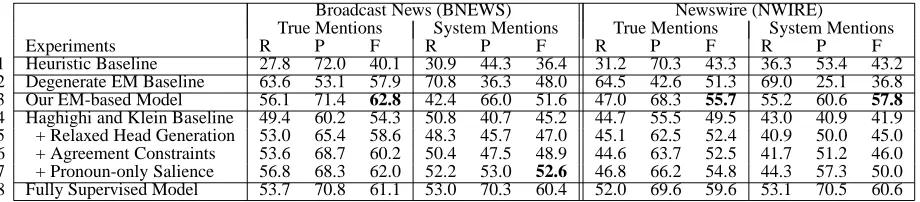
The Heuristic baseline. As our first baseline, we employ a simple rule-based system that posits two mentions as coreferent if and only if at least one of the three strong coreference indicators listed in Ta-ble 1 returns True. Results of this baseline, reported in terms of recall (R), precision (P), and F-score (F) using the MUC scorer and the CEAF scorer, are shown in row 1 of Tables 4 and 5, respectively. Each row in these tables shows performance using true mentions and system mentions for the BNEWS and NWIRE data sets. As we can see, (1) recall is gen-erally low, since this simple heuristic can only iden-tify a small fraction of the coreference relations; (2) CEAF recall is consistently higher than MUC recall, since CEAF also rewards successful identification of non-coreference relations; and (3) precision for true mentions is higher than that for system mentions, since the number of non-coreferent pairs that satisfy the heuristic is larger for system mentions.
The Degenerate EM baseline. Our second base-line is obtained by running only one iteration of our EM-based coreference model. Specifically, it starts with the M-step by initializing the model parame-ters using the labeled document, and ends with the E-step by applying the resulting model (in combi-nation with the Bell tree search algorithm) to ob-tain the most probable coreference partition for each test document. Since there is no parameter re-estimation, this baseline is effectively a purely su-pervised system trained on one (labeled) document.
Results are shown in row 2 of Tables 4 and 5. As we can see, recall is consistently much higher than precision, suggesting that the model has pro-duced fewer entities than it should. Perhaps more interestingly, in comparison to the Heuristic
base-line, Degenerate EM performs consistently worse according to CEAF but generally better according to MUC. This discrepancy stems from the aforemen-tioned properties that MUC under-penalizes parti-tions with too few entities, whereas CEAF lowers both recall and precision when given such partitions.
Our EM-based coreference model. Our model operates in the same way as the Degenerate EM baseline, except that EM is run until convergence, with the test set being used as unlabeled data for pa-rameter re-estimation. Any performance difference between our model and Degenerate EM can thus be attributed to EM’s exploitation of the unlabeled data. Results of our model are shown in row 3 of Tables 4 and 5. In comparison to Degenerate EM, MUC F-score increases by 4-5% for BNEWS and 4-21% for NWIRE; CEAF F-score increases even more dra-matically, by 10-17% for BNEWS and 16-27% for NWIRE. Improvements stem primarily from large gains in precision and comparatively smaller loss in recall. Such improvements suggest that our model has effectively exploited the unlabeled data.
In comparison to the Heuristic baseline, we gener-ally see increases in both recall and precision when system mentions are used, and as a result, F-score improves substantially by 7-15%. When true men-tions are used, we still see gains in recall, but these gains are accompanied by loss in precision. F-score generally increases (by 2-22%), except for the case with NWIRE where we see a 0.5% drop in CEAF F-score as a result of a larger decrease in precision.
The Original H&K model. We use as our third baseline the Original H&K model (see Section 3.2). Results of this model are shown in row 4 of Tables 4 and 5.9 Overall, it underperforms our model by 6-16% in MUC F-score and 6-14% in CEAF F-score, due primarily to considerable drop in both recall and precision in almost all cases.
The Modified H&K model. Next, we incorporate our three modifications into the Original H&K base-line one after the other. Results are shown in rows 5-7 of Tables 4 and 5. Several points deserve men-tioning. First, the addition of each modification im-proves the F-score for both true and system mentions
9The H&K results shown here are not directly comparable
Broadcast News (BNEWS) Newswire (NWIRE)
True Mentions System Mentions True Mentions System Mentions
Experiments R P F R P F R P F R P F
1 Heuristic Baseline 27.8 72.0 40.1 30.9 44.3 36.4 31.2 70.3 43.3 36.3 53.4 43.2 2 Degenerate EM Baseline 63.6 53.1 57.9 70.8 36.3 48.0 64.5 42.6 51.3 69.0 25.1 36.8 3 Our EM-based Model 56.1 71.4 62.8 42.4 66.0 51.6 47.0 68.3 55.7 55.2 60.6 57.8
4 Haghighi and Klein Baseline 49.4 60.2 54.3 50.8 40.7 45.2 44.7 55.5 49.5 43.0 40.9 41.9 5 + Relaxed Head Generation 53.0 65.4 58.6 48.3 45.7 47.0 45.1 62.5 52.4 40.9 50.0 45.0 6 + Agreement Constraints 53.6 68.7 60.2 50.4 47.5 48.9 44.6 63.7 52.5 41.7 51.2 46.0 7 + Pronoun-only Salience 56.8 68.3 62.0 52.2 53.0 52.6 46.8 66.2 54.8 44.3 57.3 50.0 8 Fully Supervised Model 53.7 70.8 61.1 53.0 70.3 60.4 52.0 69.6 59.6 53.1 70.5 60.6
Table 4: Results obtained using the MUC scoring program for the Broadcast News and Newswire data sets
Broadcast News (BNEWS) Newswire (NWIRE)
True Mentions System Mentions True Mentions System Mentions
Experiments R P F R P F R P F R P F
1 Heuristic Baseline 42.1 75.8 54.1 44.2 48.7 46.3 43.9 73.4 54.9 47.5 53.4 50.3 2 Degenerate EM Baseline 51.2 43.1 46.8 53.7 26.8 35.8 51.0 30.5 38.2 45.1 18.6 26.3 3 Our EM-based Model 53.3 60.5 56.7 47.5 59.6 52.9 49.2 60.7 54.4 53.5 52.1 52.8
[image:9.612.80.540.62.163.2]4 Haghighi and Klein Baseline 43.7 48.8 46.1 46.0 33.9 39.0 45.5 51.7 48.4 44.6 39.2 41.7 5 + Relaxed Head Generation 45.8 52.4 48.9 45.4 39.6 42.3 46.0 57.0 50.9 44.5 48.3 46.3 6 + Agreement Constraints 51.8 60.5 55.8 50.6 43.8 47.0 47.8 60.1 53.2 46.5 50.4 48.4 7 + Pronoun-only Salience 53.9 59.9 56.7 52.3 49.9 51.1 49.6 62.8 55.4 47.4 55.7 51.2 8 Fully Supervised Model 55.0 63.3 58.8 56.2 64.2 59.9 54.7 64.7 59.3 56.5 65.4 60.6
Table 5: Results obtained using the CEAF scoring program for the Broadcast News and Newswire data sets
in both data sets using both scorers. These results provide suggestive evidence that our modifications are highly beneficial. The three modifications, when applied in combination, improve Original H&K sub-stantially by 5-8% in MUC F-score and 7-12% in CEAF F-score, yielding results that compare favor-ably to those of our model in almost all cases.
Second, the use of agreement constraints yields larger improvements with CEAF than with MUC. This discrepancy can be attributed to the fact that CEAF rewards the correct identification of non-coreference relations, whereas MUC does not. Since agreement constraints are intended primarily for dis-allowing coreference, they contribute to the success-ful identification of non-coreference relations and as a result yield gains in CEAF recall and precision.
Third, the results are largely consistent with our hypothesis that these modifications enhance preci-sion. Together, they improve the precision of the Original H&K baseline by 8-16% (MUC) and 11-16% (CEAF), yielding a coreference model that compares favorably with our EM-based approach.
Comparison with a supervised model. Finally, we compare our EM-based model with a fully super-vised coreference resolver. Inspired by state-of-the-art resolvers, we create our supervised classification model by training a discriminative learner (the C4.5 decision tree induction system (Quinlan, 1993)) with
a diverse set of features (the 34 features described in Ng (2007)) on a large training set (the entire ACE 2003 coreference training corpus), and cluster using the Bell tree search algorithm. The fully supervised results shown in row 8 of Tables 4 and 5 suggest that our EM-based model has room for improvements, especially when system mentions are used.
5 Conclusions
We have presented a generative model for unsuper-vised coreference resolution that views coreference as an EM clustering process. Experimental results indicate that our model outperforms Haghighi and Klein’s (2007) coreference model by a large margin on the ACE data sets and compares favorably to a modified version of their model. Despite these im-provements, its performance is still not comparable to that of a fully supervised coreference resolver.
Acknowledgments
We thank the three anonymous reviewers for their comments on an earlier draft of the paper. This work was supported in part by NSF Grant 0812261.
References
Avrim Blum and Tom Mitchell. 1998. Combining la-beled and unlala-beled data with co-training. In Proceed-ings of COLT, pages 92–100.
Colin Cherry and Shane Bergsma. 2005. An expecta-tion maximizaexpecta-tion approach to pronoun resoluexpecta-tion. In Proceedings of CoNLL, pages 88–95.
Hal Daum´e III and Daniel Marcu. 2005. A large-scale exploration of effective global features for a joint en-tity detection and tracking model. In Proceedings of HLT/EMNLP, pages 97–104.
Arthur P. Dempster, Nan M. Laird, and Donald B. Ru-bin. 1977. Maximum likelihood from incomplete data via the EM algorithm. Journal of the Royal Statistical Society, Series B, 39(1):1–38.
Pascal Denis and Jason Baldridge. 2007. Global, joint determination of anaphoricity and coreference resolu-tion using integer programming. In Proceedings of NAACL/HLT, pages 236–243.
Stuart Geman and Donald Geman. 1984. Stochastic re-laxation, Gibbs distributions and the Bayesian restora-tion of images. IEEE Transacrestora-tions on Pattern Analysis and Machine Intelligence, 6:721–741.
Aria Haghighi and Dan Klein. 2007. Unsupervised coreference resolution in a nonparametric Bayesian model. In Proceedings of the ACL, pages 848–855. Heng Ji, David Westbrook, and Ralph Grishman. 2005.
Using semantic relations to refine coreference deci-sions. In Proceedings of HLT/EMNLP, pages 17–24. Andrew Kehler, Douglas Appelt, Lara Taylor, and
Alek-sandr Simma. 2004. Competitive self-trained pronoun interpretation In Proceedings of HLT-NAACL 2004: Short Papers, pages 33–36.
Xiaoqiang Luo, Abe Ittycheriah, Hongyan Jing, Nanda Kambhatla, and Salim Roukos. 2004. A mention-synchronous coreference resolution algorithm based on the Bell tree. In Proceedings of the ACL, pages 135–142.
Xiaoqiang Luo. 2005. On coreference resolution perfor-mance metrics. In Proceedings of HLT/EMNLP, pages 25–32.
Christoph M ¨uller, Stefan Rapp, and Michael Strube. 2002. Applying co-training to reference resolution. In Proceedings of the ACL, pages 352–359.
Vincent Ng. 2007. Shallow semantics for coreference resolution. In Proceedings of IJCAI, pages 1689– 1694.
Vincent Ng and Claire Cardie. 2002. Improving machine learning approaches to coreference resolution. In Pro-ceedings of the ACL, pages 104–111.
Vincent Ng and Claire Cardie. 2003. Weakly supervised natural language learning without redundant views. In HLT-NAACL: Main Proceedings, pages 173–180. Simone Paolo Ponzetto and Michael Strube. 2006.
Exploiting semantic role labeling, WordNet and Wikipedia for coreference resolution. In Proceedings of HLT/NAACL, pages 192–199.
J. Ross Quinlan. 1993. C4.5: Programs for Machine Learning. Morgan Kaufmann.
Wee Meng Soon, Hwee Tou Ng, and Daniel Chung Yong Lim. 2001. A machine learning approach to corefer-ence resolution of noun phrases. Computational Lin-guistics, 27(4):521–544.
Michael Strube, Stefan Rapp, and Christoph M ¨uller. 2002. The influence of minimum edit distance on ref-erence resolution. In Proceedings of EMNLP, pages 312–319.
Yee Whye Teh, Michael Jordan, Matthew Beal, and David Blei. 2006. Hierarchical Dirichlet pro-cesses. Journal of the American Statistical Associa-tion, 101(476):1527–1554.
Renata Vieira and Massimo Poesio. 2000. An empirically-based system for processing definite de-scriptions. Computational Linguistics, 26(4):539– 593.
Marc Vilain, John Burger, John Aberdeen, Dennis Con-nolly, and Lynette Hirschman. 1995. A model-theoretic coreference scoring scheme. In Proceedings of MUC-6, pages 45–52.