warwick.ac.uk/lib-publications
Original citation:
Sampath, Karuna and Ephrussi, Anne. (2016) CncRNAs : RNAs with both coding and
non-coding roles in development. Development, 143 (8). pp. 1234-1241.
Permanent WRAP URL:
http://wrap.warwick.ac.uk/80135
Copyright and reuse:
The Warwick Research Archive Portal (WRAP) makes this work of researchers of the
University of Warwick available open access under the following conditions.
This article is made available under the Creative Commons Attribution 3.0 (CC BY 3.0) license
and may be reused according to the conditions of the license. For more details see:
http://creativecommons.org/licenses/by/3.0/
A note on versions:
The version presented in WRAP is the published version, or, version of record, and may be
cited as it appears here.
PRIMER
CncRNAs: RNAs with both coding and non-coding roles in
development
Karuna Sampath1,* and Anne Ephrussi2,*
ABSTRACT
RNAs are known to regulate diverse biological processes, either as protein-encoding molecules or as non-coding RNAs. However, a third class that comprises RNAs endowed with both protein coding and non-coding functions has recently emerged. Such bi-functional ‘coding and non-coding RNAs’(cncRNAs) have been shown to play important roles in distinct developmental processes in plants and animals. Here, we discuss key examples of cncRNAs and review their roles, regulation and mechanisms of action during development.
KEY WORDS: Bifunctional RNA, CncRNAs, Coding RNA, Development, Non-coding RNA, Regulatory RNA
Introduction
Ribonucleic acids (RNAs) serve important roles, most notably as intermediaries in the flow of genetic information from DNA to proteins. They can be found in various forms, for example as protein-coding messenger RNAs, as recruiters and machines for protein synthesis (e.g. transfer RNAs, ribosomal RNAs), as modifiers of ribosomal RNAs, and as regulators of RNA splicing, RNA stability and protein synthesis (e.g. small nuclear RNAs, small nucleolar RNAs and microRNAs). Other small RNAs function in epigenetic regulation and post-transcriptional gene silencing, and protect the genome from transposons (e.g. piwi-interacting RNAs). In addition to these well-studied groups of RNAs, transcriptomic analyses in a variety of organisms have identified hundreds of other RNAs (e.g. long non-coding RNAs) that are thought to function in numerous cellular and developmental processes (Bushati and Cohen, 2007; Houwing et al., 2007; Mercer et al., 2009; Pauli et al., 2011; Rinn and Chang, 2012; Ulitsky and Bartel, 2013; Weick and Miska, 2014; Hezroni et al., 2015).
Until recently, most RNAs were presumed to be exclusively protein coding or non-coding. However, studies of many bacteria, animals and plants have revealed an unusual group of RNAs that have both protein coding and non-coding roles. These RNAs have been referred to as‘dual function’or‘bi-functional’RNAs (Dinger et al., 2008; Ulveling et al., 2011b); we refer to them hereafter as
‘coding and non-coding RNAs’(cncRNAs) (Kumari and Sampath, 2015). The identification of such cncRNAs raises several interesting questions and poses a challenge to RNA classification. Here, we summarize the known features of a few exemplary cncRNAs and discuss their roles and regulation during plant and animal development.
cncRNAs in animal development
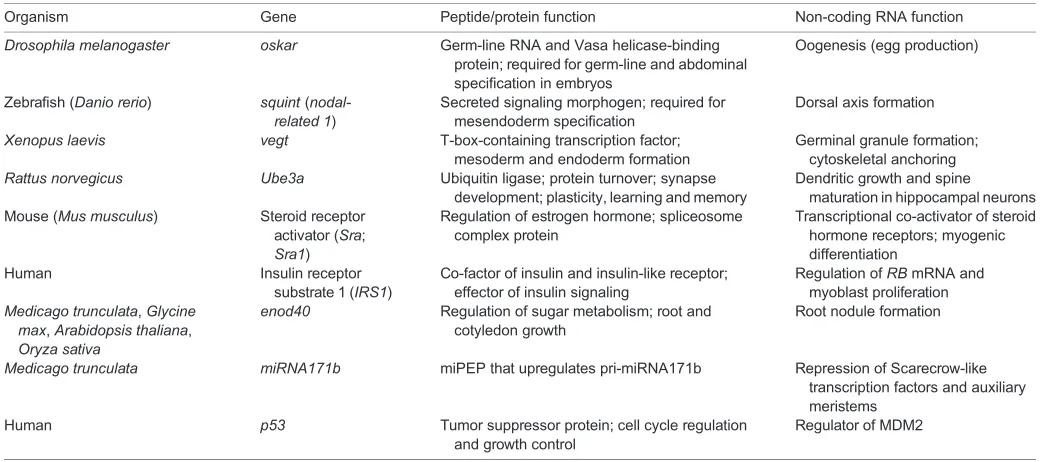
A number of cncRNAs that function in differentiation and development in animals have been identified (Table 1). The dual functionality of these RNAs was often revealed serendipitously by comparing RNA-null and protein-null mutant alleles, by disrupting RNA elements, by overexpression assays and via antisense-mediated depletion.
Oskar
TheDrosophila melanogasterprotein Oskar (Osk) plays essential roles during germline and abdominal segment formation in the developing fly embryo (Lehmann and Nusslein-Volhard, 1986; Ephrussi et al., 1991; Kim-Ha et al., 1991). Osk protein is produced at the posterior pole of theDrosophilaoocyte, where it recruits the germline specific RNA helicase Vasa in the process of germ plasm assembly; Osk has also been shown to bind to germline RNAs and Vasain vivoandin vitro(Breitwieser et al., 1996; Jeske et al., 2015; Yang et al., 2015). Interestingly,oskRNA has roles independent of Osk protein in early oocytes. This non-coding activity ofoskRNA was initially deduced from the distinct behaviors of classical EMS-induced osk nonsense mutants that produce osk mRNA but no detectable Osk protein (Lehmann and Nusslein-Volhard, 1986) and transposon-inducedoskRNA-null mutants (Jenny et al., 2006).osk
is a maternal effect gene, expression of which is required in the female germline for proper development. However, lack of the mRNA and lack of the protein lead to two very different outcomes: in the absence of Osk protein, the progeny embryo fails to form germ cells and abdominal segments (Ephrussi et al., 1991; Kim-Ha et al., 1991), whereas the complete absence ofoskmRNA causes an arrest in oogenesis, and no eggs are produced (Jenny et al., 2006). It was further shown that transgenes expressing mutantoskRNAs that cannot make functional Osk protein, as well as those harboring only the osk 3′ untranslated region (3′UTR), can overcome the early oogenesis defects ofoskRNA-null mutants. This suggested thatosk
RNA harbors a non-coding activity in its 3′UTR that functions during oogenesis (Jenny et al., 2006).
A more recent study showed, remarkably, that the expression of a transgenic 191-nucleotide segment of theosk3′UTR is sufficient to rescue the oogenesis arrest ofoskRNA null oocytes, as long as the RNA is fused to a stem-loop structure that promotes its dynein-dependent import into the oocyte (Kanke et al., 2015). It was further shown that mutations in theosk3′UTR that abolish binding of the translational regulator Bruno (Bru; Aret–FlyBase) to Bru response elements (BREs) in osk also affect egg laying (Kanke et al., 2015). The comparison of egg-laying by females lacking endogenous osk RNA with those expressing osk transgenes that disrupt some or all the BREs showed that the mutation of any BRE reduces egg-laying to some extent, with the strongest effect observed when all BREs are lost. The reduction in egg-laying appears to be due to disruption of the non-coding function ofosk
RNA (Kanke et al., 2015). 1
Division of Biomedical Sciences, Warwick Medical School, University of Warwick, Coventry CV4 7AJ, UK.2Developmental Biology Unit, European Molecular Biology Laboratory, Meyerhofstraße 1, Heidelberg 69117, Germany.
*Authors for correspondence ([email protected]; [email protected])
This is an Open Access article distributed under the terms of the Creative Commons Attribution License (http://creativecommons.org/licenses/by/3.0), which permits unrestricted use,
distribution and reproduction in any medium provided that the original work is properly attributed.
DEVEL
O
The non-coding activity of osk could be mediated either by sequestering an oogenesis inhibitory factor, or by a scaffolding function for a ribonucleoprotein (RNP) that assembles onoskRNA and promotes oogenesis. Evidence that the osk 3′UTR acts via sequestration was provided by mutations affecting Bru, which binds to Osk; mis-sense mutations inbruthat reduce Bru levels suppress theosknull mutant phenotype, and this effect is even stronger with
brunonsense mutant alleles. However, mutations in regions ofosk
mRNA that are not involved in Bru binding also affect egg-laying, indicating that additional unknown factors contribute to the non-coding functions ofosk(Kanke et al., 2015).
Squint
The zebrafish protein Squint (Sqt; Nodal-related 1 – Zebrafish Information Network) is a secreted signaling morphogen that is essential for formation of the embryonic organizer and for specification of mesendoderm during gastrulation (Erter et al., 1998; Feldman et al., 1998; Rebagliati et al., 1998; Chen and Schier, 2001). However, maternal sqt RNA has an earlier non-coding function, independent of Sqt/Nodal signaling, during the formation of the zebrafish dorsal axis (Gore et al., 2005, 2007; Bennett et al., 2007; Lim et al., 2012). This non-coding activity was identified by overexpression and antisense knockdown studies: overexpression of mutant zebrafishsqtRNA that is incapable of encoding functional Sqt/Nodal protein expands the expression domains of dorsal progenitor genes such asgoosecoidandchordin. Furthermore, the dorsal-inducing activity ofsqtRNA does not require the Sqt-coding exons, and the 3′UTR ofsqtRNA is sufficient for its dorsalizing activity.
It was also found that targeting maternalsqtRNA with antisense morpholinos that reproduce zygoticsqtmutant phenotypes causes mislocalization of sqt RNA and the complete loss of embryonic dorsal structures. This is in contrast to insertion mutations in thesqt
locus that disrupt Sqt protein coding sequences but do not affectsqt
RNA (Feldman et al., 1998; Feldman and Stemple, 2001; Aoki et al., 2002; Amsterdam et al., 2004; Gore et al., 2005; Lim et al., 2012). The precise molecular mechanism by which non-codingsqt
RNA elicits its role is not known. Systematic analysis of mutants
lackingsqtRNA can help address this question (Lim et al., 2013). Interestingly, the UTR-mediated non-coding activity ofsqtRNA is independent of microRNA (miRNA) target sequences and the function of the miRNA processing genedicer(dicer1–Zebrafish Information Network) (Lim et al., 2012). Therefore, binding to miRNA negative regulators of dorsal identity is unlikely to be the mode of action of non-codingsqtRNA. However, a requirement for the Wnt/β-Catenin pathway raises the possibility that sqt RNA might act as a scaffold for a factor that promotes nuclear accumulation of β-Catenin in dorsal progenitors. Alternatively, non-codingsqtRNA might sequester a negative regulator of dorsal identity.
VegT
VegT is a T-box family transcription factor that functions in mesoderm and endoderm formation during gastrulation inXenopus laevisembryos (Zhang et al., 1998; Heasman et al., 2001; Kloc et al., 2005). However, inXenopus laevisoocytes,vegtRNA plays an additional role in the organization of cytokeratin filaments and germinal granules. Accordingly, depletion ofvegtRNA inXenopus
oocytes by phosphorothioate antisense oligonucleotides results in disruption of the cytokeratin network, mislocalization of maternal RNAs, and blocked formation of germinal granules (Heasman et al., 2001; Kloc et al., 2005). Exogenously provided vegt RNA was found to reconstitute and rescue the disrupted cytokeratin network (Kloc et al., 2005). Based on these lines of evidence,vegtRNA is thought to be a structural matrix that stabilizes cytokeratin filaments and anchors vegetal RNAs in frog eggs.
Steroid receptor activator RNA
[image:3.612.46.566.68.299.2]The mammalian steroid receptor RNA activator (SRA; also known as SRA1) promotes myogenic differentiation and the conversion of non-muscle cells to myocytes by co-activation of the myogenic differentiation factor MYOD (also known as MYOD1). In addition to MYOD, SRA transcripts are believed to co-activate numerous nuclear receptors, and potentially regulate the proliferation and differentiation of a variety of cell types.SRARNA has been found associated with the PRC2 Polycomb group and TrxG trithorax
Table 1. Coding and non-coding roles of known cncRNAs
Organism Gene Peptide/protein function Non-coding RNA function
Drosophila melanogaster oskar Germ-line RNA and Vasa helicase-binding protein; required for germ-line and abdominal specification in embryos
Oogenesis (egg production)
Zebrafish (Danio rerio) squint( nodal-related 1)
Secreted signaling morphogen; required for mesendoderm specification
Dorsal axis formation
Xenopus laevis vegt T-box-containing transcription factor; mesoderm and endoderm formation
Germinal granule formation; cytoskeletal anchoring
Rattus norvegicus Ube3a Ubiquitin ligase; protein turnover; synapse development; plasticity, learning and memory
Dendritic growth and spine maturation in hippocampal neurons Mouse (Mus musculus) Steroid receptor
activator (Sra;
Sra1)
Regulation of estrogen hormone; spliceosome complex protein
Transcriptional co-activator of steroid hormone receptors; myogenic differentiation
Human Insulin receptor
substrate 1 (IRS1)
Co-factor of insulin and insulin-like receptor; effector of insulin signaling
Regulation ofRBmRNA and myoblast proliferation
Medicago trunculata,Glycine max,Arabidopsis thaliana,
Oryza sativa
enod40 Regulation of sugar metabolism; root and cotyledon growth
Root nodule formation
Medicago trunculata miRNA171b miPEP that upregulates pri-miRNA171b Repression of Scarecrow-like transcription factors and auxiliary meristems
Human p53 Tumor suppressor protein; cell cycle regulation
and growth control
Regulator of MDM2
PRIMER Development (2016) 143, 1234-1241 doi:10.1242/dev.133298
DEVEL
O
transcriptional repressor complexes, and it directly interacts with the stem cell pluripotency factor NANOG (Wongtrakoongate et al., 2015). By contrast, SRA protein (SRAP) prevents SRA RNA-mediated co-activation and differentiation (Lanz et al., 1999; Hube et al., 2011), and is thought to act as a trans-activator of steroid hormone receptors in mammalian cell culture assays.
The activity ofSRARNA as a trans-activator of steroid hormone receptors and as a co-activator of MYOD was identified by studying
SRA transcripts lacking a methionine initiation codon. Initial attempts to identifySRAtranscripts with an extended 5′sequence were unsuccessful, leading to the hypothesis that SRA functions as a non-coding RNA in this context. Subsequently, mutations inSRA
revealed that its co-activator function resides in the transcript (Lanz et al., 2002). It was also shown that introducing multiple stop codons inSRARNA did not abolish steroid receptor co-activation, and RNA activity was detected even in the presence of the translation inhibitor cycloheximide. Together, these findings suggested that SRA RNA has functions independent of SRAP (Lanz et al., 1999).
A recent study reporting the crystal structure of human SRAP suggests that the protein does not harbor a predicted RNA-recognition motif (RRM) but rather resembles the spliceosome complex protein PRP18 (also known as PRPF18) (McKay et al., 2014). Biochemical binding assays performedin vitrodid not find a specific interaction between SRAP and SRA, nor was a specific response on estrogen receptor targets observed in cell culture assays. These observations have led to the proposal of an alternative model wherein SRAP is thought to stabilize intermolecular interactions within a nuclear splicing complex, rather than directly binding and regulatingSRARNA (McKay et al., 2014). Genetic analysis of the
sra locus with mutations that disrupt specific SRA RNA versus SRAP domains, which could resolve the roles and mechanisms by which the RNA and protein function during development, differentiation and homeostasis, is currently lacking.
p53
The tumor suppressor protein p53 (TP53) plays crucial roles in cell cycle regulation and in preventing mutations arising from DNA damage in the genome (Lane and Crawford, 1979). However, in addition to the well-known roles of p53 in protecting the genome,
p53 mRNA was found to regulate the ubiquitin ligase MDM2, which is a negative regulator of p53 (Candeias et al., 2008). p53
mRNA directly interacts with the N-terminus of MDM2 to prevent its E3 ubiquitin ligase activity and thereby controls MDM2-mediated regulation of p53. Interfering with thep53mRNA-MDM2 interaction following DNA damage prevents p53 stabilization and activation (Gajjar et al., 2012). Thus, p53 mRNA-MDM2 interactions are key for the genotoxic stress response. Interestingly, the sequences of p53 mRNA that interact with the N-terminus of MDM2 protein also encode the amino acids in TP53 that interact with and are poly-ubiquitylated by the MDM2 RING domain (Naski et al., 2009). Silent point mutations in this region of
p53weaken its interactions with MDM2, and reduce TP53 activity. This suggests that structural elements inp53mRNA might harbor its non-coding activity.
IRS1
Insulin receptor substrate 1 (IRS1) is a major substrate and cytoplasmic docking protein for the insulin receptor and insulin-like growth factor receptor. IRS1 is thought to be an effector of insulin signaling, with roles in cell growth and proliferation. Deletion ofIrs1by conventional knockout strategies in mice led to
growth retardation and compensated insulin resistance (Kido et al., 2000). IRS1 levels are generally low or absent in differentiating cells, and elevated IRS1 levels have been associated with cancers in mice and humans. Interestingly, a recent study found that Irs1
mRNA has a function in myoblasts that is independent of IRS1 protein (Nagano et al., 2015). The 5′UTR ofIrs1mRNA harbors sequences complementary to RNA encoding the cell cycle regulator retinoblastoma (RB; RB1). Overexpression of the 5′UTR region of
Irs1led to reducedRbmRNA expression, whereas knockdown of
Irs1mRNA harboring the 5′UTR complementarity region led to increasedRbmRNA levels and enhanced myoblast differentiation. These findings suggest that Irs1 RNA has a novel role as a regulatory RNA that is independent of IRS1 protein (Nagano et al., 2015). It is not known whetherIrs1mRNA regulation is restricted to myoblasts, and what controls Irs1 RNA versus IRS1 protein functions is also unknown.
UBE3A
Finally, a recent study reports that transcripts encoding the E3 ubiquitin ligase UBE3A have a non-coding role in dendrite growth and spine maturation in hippocampal neurons; by contrast, UBE3A protein plays crucial roles in activity-dependent synapse development, plasticity, learning and memory (Sun et al., 2015; Valluy et al., 2015). This role was discovered using antisense short hairpin RNAs (shRNAs) that target Ube3a 3′UTR variants in rat hippocampal neurons: the neurons showed significantly increased dendrite growth and complexity upon knockdown of the non-translated and intron-retaining Ube3a1 RNA, whereas shRNAs targeting the spliced codingUbe3a2/3isoforms reduced dendrite complexity (Valluy et al., 2015). Antisense oligonucleotides can have off-target effects or, alternatively, they can uncover novel mechanisms not identified by protein-disrupting mutants. Therefore, it is crucial that the non-coding activities of cncRNAs identified by antisense approaches (e.g. shRNA, antisense morpholinos, phosphorothioate oligonculeotides) are independently validated by assays such as overexpression of non-translatable RNA, and by analysis of mutations that specifically disrupt the RNA (Lim et al., 2012, 2013; Kok et al., 2015; Rossi et al., 2015).
Plant cncRNAs
A number of cncRNAs have also been identified in plants (Table 1). Transcripts of the geneearly nodulin 40(enod40) in the legume
Medicago trunculata contain two short open reading frames (ORFs), the products of which are required for cortical cell divisions in root cells (Yang et al., 1993; Crespi et al., 1994). A region of RNA secondary structure separates the twoenod40ORFs. This RNA segment is essential forenod40activity and has a non-coding role in root nodule formation (Girard et al., 2003; Campalans et al., 2004). It was also shown that, in alfalfa,enod40 RNA is essential for a growth response in the root cortex (Sousa et al., 2001).
In soybean plants, ENOD40 peptides have been shown to regulate the turnover of the enzyme sucrose synthase (SUC1), which functions in sugar metabolism in roots and cotyledons. By using a combination of RNA structure prediction, comparison and structure probing, various regions of soybeanenod40RNA were identified to be key for root nodule formation. Of these, five domains are conserved amongst leguminous plants and are presumed to be required for the non-coding activity ofenod40RNA (Girard et al., 2003). Indeed, the deletion of an inter-ORF RNA region with predicted structure resulted in reduced activity of alfalfa enod40
DEVEL
O
without affecting the production of ENOD40 peptides (Sousa et al., 2001).
Analyses inArabidopsis thalianaand rice have identified RNAs similar toenod40suggesting that cncRNAs exist in these plants as well (Kouchi et al., 1999). Furthermore, at least 50 miRNAs in the
Arabidopsistranscriptome are predicted to encode short peptides (microRNA-encoded peptides; miPEPs) that appear to regulate the transcription of primary transcript ( pri-)miRNA. For example, precursor ( pre-)miRNA forMedicago trunculatamiR171b encodes a short peptide expression of which leads to transcriptional upregulation of the corresponding pri-miRNA, which in turn controls target genes involved in root development (Lauressergues et al., 2015). Interestingly, all the identified miPEPs were found to be conserved across flowering plants and are associated with ancient miRNA families. It is not known if miRNA-encoded peptides are present in animals.
cncRNA functions and mechanisms of action
The precise function and molecular mechanism of action is known for only a few cncRNAs. Nonetheless, it is emerging that all the mechanisms deployed by conventional non-coding RNAs are also represented amongst this hybrid class of RNAs.
Base pairing and roles as decoy and regulatory RNAs
Base pairing is a fundamental property of nucleic acids that is essential for processes such as codon-anticodon recognition during protein synthesis and microRNA recognition of target RNA sequences. Nucleotide complementarity also forms the basis for RNAs that function as‘molecular sponges’,‘decoys’or
‘target mimics’, such as competing endogenous RNAs (ceRNAs) that share miRNA recognition sequences. ceRNAs bind to complementary sequences in miRNAs and prevent interactions between miRNAs and their bona fide targets (Franco-Zorrilla et al., 2007). For instance, the pseudogenePTENP1harbors sequences in its 3′UTR that are complementary to miRNAs that target and repress
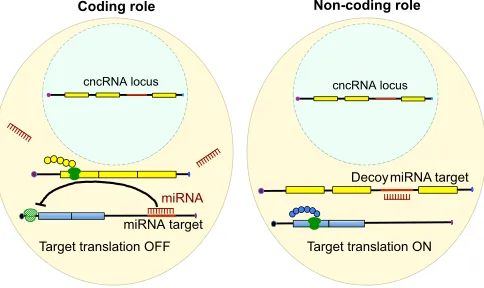
PTENmRNA (Poliseno et al., 2010). Indeed, cncRNAs can also function by base pairing with target RNAs and behave as decoys (Fig. 1). For example, non-codingUbe3a1RNA retains an intron and is thought to act as a decoy or molecular sponge for miRNA-134 (MIRmiRNA-134) that would otherwise target the splicedUbe3a2/3
transcripts and downregulate UBE3A ubiquitin ligase protein expression in dendrites (Valluy et al., 2015).
Some cncRNAs appear to target and regulate other mRNA sequences directly (Fig. 2). For example, the 5′UTR of mammalian
Irs1RNA can base pair withRbmRNA. The overexpression ofIrs1
RNA, which contains a sequence element complementary to Rb
mRNA, reduces RB levels by a mechanism independent of DICER or UPF1 (i.e. independently of miRNAs or nonsense-mediated decay), and suppresses the differentiation of cultured skeletal muscle cells (Nagano et al., 2015). Interestingly, some bacterial small regulatory RNAs (sRNAs) also function in a similar manner. For example, Escherichia coli SgrS RNA regulates the glucose-phosphate stress response by base pairing with and blocking the translation of PtsG mRNA, which encodes a sugar phosphate transporter.SgrSis a cncRNA as it also encodes a short 43 amino acid peptide, SgrT, which inhibits the activity of the PtsG transporter protein (Wadler and Vanderpool, 2007; Rice and Vanderpool, 2011).
Structural roles, sequestration and scaffolding
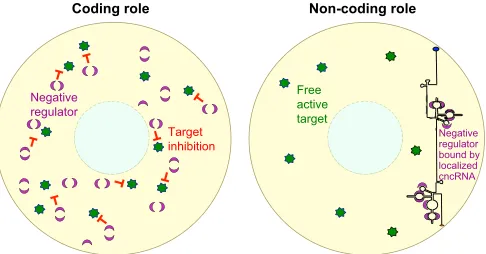
Structural features in RNAs play crucial roles in their activity. RNA structural elements can either sequester or bind and deliver protein complexes (Figs 3 and 4).SRARNA co-activation of MYOD, for example, is mediated via interactions betweenSRARNA and the p68/p72 RNA helicases (Caretti et al., 2006). A sequestration and scaffolding function has also been proposed for osk 3′UTR sequences during early oogenesis, via their binding to Bru and some unknown factors (Kanke et al., 2015). InXenopuseggs,vegt
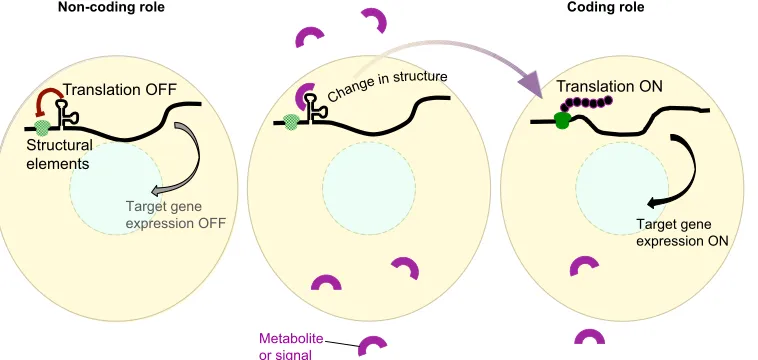
RNA forms aggregates that colocalize with cytokeratin filaments, and the depletion ofvegtdestabilizes the cytokeratin network and disrupts the anchoring of vegetal RNAs (Heasman et al., 2001; Kloc et al., 2005), suggesting thatvegtRNA also plays a scaffolding or sequestering role. Finally, it was shown that the RNA sequence separating the two ORFs withinenod40RNA harbors a region of highly stable secondary structure that binds to the RNA-binding protein MtRBP1, which is presumed to be a translational regulator (Crespi et al., 1994; Sousa et al., 2001; Campalans et al., 2004). Structural elements in RNAs can also act as sensors for environmental stimuli, as observed in some bacterial RNAs: these RNAs function as inactive nascent transcripts with secondary structures that are released upon binding of the RNA to ligands or metabolites, or upon increase in temperature, leading to activation of downstream gene expression. One such example is the S-adenosylmethionone-sensing S-box riboswitch in Bacillus subtilis (Henkin, 2008; Gottesman and Storz, 2011). Structural RNA sensors could facilitate rapid changes in gene expression in response to external signals during developmental transitions (Fig. 5).
Feedback regulation
Some cncRNAs mediate feedback regulation of the same pathway or process in which their protein product functions. This type of feedback is exemplified by the p53-MDM2 pathway (Candeias et al., 2008). A region ofp53mRNA binds to and regulates the E3 ubiquitin ligase and p53 tumor protein regulator MDM2, which inhibits p53 activity by controlling p53 translation, poly-ubiquitylation and degradation. The binding of p53 mRNA to MDM2 leads to accumulation of MDM2 at polysomes, stimulation of p53 synthesis, and inhibition of the E3 ligase activity of MDM2. Accordingly, mutations inp53that reduce the affinity ofp53mRNA for MDM2 enhance the suppression of p53 activity by MDM2. Thus,p53mRNA acts as a feedback switch that controls MDM2-mediated regulation of p53 by directly interacting with MDM2 (Candeias et al., 2008). Such regulation is also seen in the context of Non-coding role
cncRNA locus
Target translation ON
Coding role
cncRNA locus
miRNA target
miRNA
Target translation OFF
[image:5.612.54.296.513.657.2]Decoy miRNA target
Fig. 1. cncRNAs as decoys.Some cncRNAs can function in a both coding role (left), being translated into protein (yellow chain) and having no effect on target genes, and a non-coding manner (right), by base pairing with and hence acting as decoys for small regulatory RNAs (e.g. miRNAs) that repress target translation. In the example shown, intron retention leads to the presence of a decoy miRNA target site in the cncRNA that can bind to an miRNA (red comb) and allow translation of the target of this miRNA (blue chain). Ribosomes are shown in green.
PRIMER Development (2016) 143, 1234-1241 doi:10.1242/dev.133298
DEVEL
O
MYOD activation: SRAncRNA acts as a co-activator of MYOD during myogenic differentiation, whereas the protein SRAP has an inhibitory effect on SRA RNA and hence MYOD co-activation. SRAP is thought to exert its inhibitory effect by binding to SRA
RNA (Hube et al., 2011). In both of these examples, feedback regulation is achieved by the cncRNA binding to a protein that functions in the same developmental or cellular process as does the cncRNA.
The regulation of coding versus non-coding roles
A unique feature of cncRNAs that sets them apart from other RNA classes is the exquisite regulation and partitioning of their coding and non-coding functions. This can be in the form of: (1) temporal separation of the coding and non-coding activities to different developmental stages; (2) spatial segregation of the coding and non-coding roles to distinct subcellular or cellular domains; or (3) activation of one function under particular physiological/ environmental conditions via specific RNA elements.
How might segregation of the coding and non-coding functions be achieved? The analysis of some cncRNAs suggests that such partitioning requires extensive transcriptional and post-transcriptional regulation of the RNAs. For instance, two major
SRAP isoforms of 224 or 236 amino acids, respectively, are generated by an additional upstream exon inSRARNA that contains two initiating methionine residues, from alternative transcriptional start sites. Alternative splicing can also generate different RNA isoforms, some of which may retain the coding activity whereas others might function as non-coding RNAs. This has been observed forSRARNA andUBE3RNA, whereby alternative splicing leads to retention of an intron and disruption of the ORF, generating the non-coding version of these transcripts (Lanz et al., 1999; Hube et al., 2011; Valluy et al., 2015). Thus, in addition to increasing the protein-coding capacity of genomes by generating peptide isoforms, alternative splicing can also generate a variety of non-coding RNA isoforms. In addition, isoform abundance can change as development and differentiation progress, and this can influence cell fate specification. For example, the ratio of coding and non-coding SRA RNA isoforms changes during muscle cell differentiation, with myotubes expressing two to five times higher levels of non-codingSRARNA in comparison with myoblasts. This balance between the non-coding and codingSRA RNA isoforms influences MYOD activity and myogenic differentiation (Hube et al., 2011).
Temporal segregation of the coding and non-coding activities of cncRNAs is also evident, and has been found forosk,vegtandsqt
RNAs, with the non-coding activity detected at earlier developmental stages: during early oogenesis forosk, in oocytes for vegt, and in early embryos for sqt. Post-transcriptional mechanisms, such as regulated polyadenylation, splicing and translational regulation, enable this precise temporal control of RNA activity. An example of a cncRNA that undergoes extensive post-transcriptional regulation issqt. Unprocessedsqtpre-mRNA is found in zebrafish eggs and early embryos, whereas processedsqt
RNA that is poly-adenylated and spliced is detected later, from the 16-cell stage (Gore et al., 2007; Lim et al., 2012; Kumari et al., 2013). In addition, maternalsqtRNA is translationally repressed in early zebrafish embryos by the RNA-binding protein Ybx1, which interacts with thesqt 3′UTR and the eIF4E translation initiation complex. The signaling activity of Sqt/Nodal protein is detected only from the 256-cell stage (Kumari et al., 2013), suggesting that the non-coding and coding activities of sqt are temporally segregated by post-transcriptional regulation of the RNA. In
Drosophilaoocytes, poly-adenylation ofoskRNA also stimulates Osk protein translation and is regulated by the Orb and cytoplasmic polyadenylation element binding (CPEB) proteins (Castagnetti and Ephrussi, 2003). By contrast, translation of Osk protein is repressed during early oogenesis by Bru, which binds to BREs in theosk3′ UTR sequences and recruits Cup, an eIF4E-binding protein (Nakamura et al., 2004; Chekulaeva et al., 2006). Remarkably, one cluster of BREs also mediates translational activation, and both BRE-dependent repression and activation can occur in trans, presumably by co-assembly of osk mRNAs in cytoplasmic complexes (Reveal et al., 2010).
Spatial restriction of cncRNA activity can be achieved by the localization of RNA to distinct cellular or subcellular domains, as observed forsqt,oskandvegt. MaternalsqtRNA localizes to dorsal progenitor cells by the four-cell stage in zebrafish embryos (Gore et al., 2005). Sequences in thesqt3′UTR and an intact microtubule cytoskeleton are required for localization of maternalsqtRNA in early embryos where it carries out its non-coding role in dorsal axis formation (Gore and Sampath, 2002; Gore et al., 2005; Gilligan et al., 2011; Lim et al., 2012). Interestingly, the sqt dorsal localization element (DLE) overlaps with the region of thesqt 3′ UTR that is required for Ybx1-binding, ensuring that the coding Negative
regulator
Free active target
Negative regulator bound by localized cncRNA
Coding role Non-coding role
[image:6.612.53.296.57.202.2]Target inhibition
Fig. 3. cncRNAs as sequestering molecules.Structural elements in cncRNAs can sequester negative regulators. A hypothetical negative regulator (magenta half-moon) inhibits the activity of a hypothetical target (green star). However, structural features in the cncRNA (which in this case is localized to one side of the cell) allow it to bind to and sequester the negative regulator thereby enabling target activity.
Non-coding role
cncRNA locus
Coding role
cncRNA locus
Target expression OFF Complementary element
[image:6.612.54.297.547.674.2]Target expression ON
Fig. 2. cncRNAs as regulatory RNAs.Complementary sequence elements in cncRNAs can bind directly to other mRNAs and control their expression. In the example shown, the coding cncRNA is transcribed from one transcription start site (orange circle) and translated (left; yellow chain), whereas the non-coding cncRNA (right) is generated from an alternative transcription start site (magenta circle) such that the 5′UTR now includes a region of complementarity (red comb) to the target mRNA. Ribosomes are shown in green.
DEVEL
O
potential of localized maternalsqtis shut off (Gilligan et al., 2011; Kumari et al., 2013). Drosophila osk RNA is localized at the posterior pole of the oocyte; this localization depends on a secondary structure formed from exonic sequences in the coding region upon splicing and on Osk protein itself (Ghosh et al., 2012; Ephrussi et al., 1991; Markussen et al., 1995; Rongo et al., 1995).
vegtRNA also shows a distinct localization pattern, being localized to the vegetal pole ofXenopusoocytes in a manner that depends upon sequences in the 3′UTR and the protein Igf2BP3 (also known as Vg1-RBP and Vera) (Zhang and King, 1996; Bubunenko et al., 2002; Kwon et al., 2002).
Specific regions or elements of RNA also appear to play crucial roles in determining coding versus non-coding functions. For example, the non-coding activity ofsqtandoskresides in elements within the 3′UTR of these RNAs (Jenny et al., 2006; Lim et al., 2012), whereas an RNA element located between the two ORFs of
enod40harbors its non-coding activity (Girard et al., 2003). In each of these RNAs, the coding and non-coding roles can be clearly ascribed to distinct RNA segments. However, the non-coding activity of other cncRNAs appears not to be restricted to a discrete
RNA region, but, instead, is intermingled with coding sequences and dispersed throughout the transcript, as in the case ofSRARNA (Lanz et al., 2002). In such RNAs, the protein-coding role may rely upon the primary sequence whereas RNA secondary/tertiary structure could engender non-coding activity. Distinguishing the coding and non-coding activities of such RNAs can be challenging.
Perspectives
The examples discussed above demonstrate that cncRNAs are emerging as key regulators of distinct developmental processes in animals and plants. It is noteworthy that all the known cncRNAs in multicellular organisms have been found in cells that are plastic, respond rapidly to their environment, and function in developmental processes (e.g. oocytes/early embryos, neurons in animals, root cells in plants). A recent study found that a significant proportion of non-coding RNAs are evolutionarily conserved and expressed in early embryos, suggesting that they might be involved in developmental processes (Necsulea et al., 2014). These observations lead to some key questions. For example, do cncRNAs represent an evolutionary link between non-coding and coding RNAs, or are they a more recent, derived group that arose independently in various clades? Which function of cncRNAs emerged first–non-coding or coding? Did these RNAs acquire new functions whilst retaining their original role? Interestingly, the non-coding RNAXist, which mediates X-chromosome inactivation in placental mammals, is proposed to have evolved by pseudogenization of an ancestral protein-coding mRNA and loss of protein function (Duret et al., 2006), which is distinct from cncRNA genes that have either retained or acquired both coding and non-coding roles. Furthermore, it is known that riboswitches and sRNAs in bacteria act as sensors that regulate gene expression under specific environmental conditions and control key processes such as vegetative versus dormant spore formation, or motile versus sessile biofilm states (Horler and Vanderpool, 2009). This suggests that cncRNAs constitute an ancient RNA class. It is not known how many cncRNAs are present in bacterial or other genomes. Predictions based upon splice variants suggest that ∼300 cncRNAs exist in the human transcriptome (Dinger et al., 2008; Ulveling et al., 2011a). However, this is likely to be an underestimate, because, in addition to intron retention and alternative splicing, other post-transcriptional mechanisms (e.g. differential poly-adenylation, RNA modifications or decorations) and differential RNA structures can also bring about cncRNA activity.
Metabolite or signal
Non-coding role Coding role
Translation OFF
Structural elements
Translation ON
Target gene expression ON Target gene
expression OFF
Chang
[image:7.612.67.278.56.208.2]e in structure
Fig. 5. cncRNAs as sensors. Structural elements in cncRNAs can act as sensors for metabolites, nutrients or other signals (magenta horseshoe), and regulate translation and downstream gene expression via alterations in RNA structure upon signal binding to the RNA.
Transport on cytoskeletal tracks
cncRNP granules
LE
NCE NCE
Localized cncRNA with cell fate determinant
NCE
Cell fate determinant
Translational control
[image:7.612.51.430.555.735.2]5⬘ 3⬘
Fig. 4. cncRNAs as scaffolds.Structural elements in cncRNAs can act as scaffolds that carry ribonucleoprotein (RNP) complexes. The figure illustrates cncRNAs that act as a matrix or carrier to assemble and transport protein complexes (cncRNP granules) to specific subcellular locations via cytoskeletal transport tracks (green line). The elements that carry out the non-coding activity (NCE) are distinct from elements required for RNA localization (LE). Translational control of the cncRNA regulates the coding versus non-coding activities.
PRIMER Development (2016) 143, 1234-1241 doi:10.1242/dev.133298
DEVEL
O
To identify novel cncRNAs and determine their functions, systematic analyses of mutants that specifically disrupt the transcript versus those that affect the protein-coding capacity of genes needs to be performed. Determining the features shared by dual function RNAs (similar to those found in miRNAs and long intergenic non-coding RNAs) will also facilitate the identification of novel cncRNAs. Some of these characteristics might be spatially or temporally regulated, exemplified by the presence of structural features at specific developmental stages, in certain cell types, or under particular physiological and environmental conditions. For most cncRNAs, how the features or activities of the RNAs (coding and non-coding) are regulated, and how the RNAs switch from one role to the other is largely unclear. Teasing apart the coding and non-coding activities of cncRNAs and determining how they are regulated will be challenging, but should be facilitated by mutagenesis with conventional as well as new genome editing methods.
Recent work has shown that some metabolic enzymes also have
‘moonlighting’ roles, functioning in their normal, well-characterized capacity but also in an unrelated and unexpected role. For example, in addition to its well-established function in glycolysis, the enzyme glyceraldehyde 3-phosphate dehydrogenase (GAPDH) was recently shown to have RNA-binding activity (Castello et al., 2012). In summary, these findings highlight that transcriptomes and genomes are far more complex than previously appreciated. Understanding the functions and mechanisms of action of cncRNAs will provide new insights into gene regulation. Finally, although the analysis of human diseases focuses primarily on the protein-coding capacity of the genome, it is plausible that mutations that affect non-coding functions of such cncRNAs could lead to disease states. Genome-wide analyses across phyla and throughout developmental stages, together with functional validation by classical mutagenesis, novel genome editing and RNA interrogation methods will hopefully identify novel cncRNAs and the mechanisms by which they function during plant and animal development.
Acknowledgements
We thank the members of our labs and many colleagues for discussions; Aniket Gore and Pooja Kumari for suggestions to improve the manuscript; and Jonathan Millar for coining the term‘cncRNA’.
Competing interests
The authors declare no competing or financial interests.
Funding
K.S. is supported by Warwick Medical School and the Biotechnology and Biological Sciences Research Council; and A.E. by the European Molecular Biology Laboratory.
References
Amsterdam, A., Nissen, R. M., Sun, Z., Swindell, E. C., Farrington, S. and Hopkins, N. (2004). Identification of 315 genes essential for early zebrafish development.Proc. Natl. Acad. Sci. USA101, 12792-12797.
Aoki, T. O., Mathieu, J., Saint-Etienne, L., Rebagliati, M. R., Peyriéras, N. and Rosa, F. M.(2002). Regulation of nodal signalling and mesendoderm formation by TARAM-A, a TGFbeta-related type I receptor.Dev. Biol.241, 273-288. Bennett, J. T., Stickney, H. L., Choi, W.-Y., Ciruna, B., Talbot, W. S. and Schier,
A. F.(2007). Maternal nodal and zebrafish embryogenesis.Nature450, E1-E2; discussion E2-4.
Breitwieser, W., Markussen, F. H., Horstmann, H. and Ephrussi, A.(1996). Oskar protein interaction with Vasa represents an essential step in polar granule assembly.Genes Dev.10, 2179-2188.
Bubunenko, M., Kress, T. L., Vempati, U. D., Mowry, K. L. and King, M. L.(2002). A consensus RNA signal that directs germ layer determinants to the vegetal cortex of Xenopus oocytes.Dev. Biol.248, 82-92.
Bushati, N. and Cohen, S. M.(2007). microRNA functions.Annu. Rev. Cell Dev. Biol.23, 175-205.
Campalans, A., Kondorosi, A. and Crespi, M.(2004). Enod40, a short open reading frame-containing mRNA, induces cytoplasmic localization of a nuclear RNA binding protein in Medicago truncatula.Plant Cell16, 1047-1059. Candeias, M. M., Malbert-Colas, L., Powell, D. J., Daskalogianni, C., Maslon,
M. M., Naski, N., Bourougaa, K., Calvo, F. and Fåhraeus, R.(2008). P53 mRNA controls p53 activity by managing Mdm2 functions.Nat. Cell Biol.10, 1098-1105. Caretti, G., Schiltz, R. L., Dilworth, F. J., Di Padova, M., Zhao, P., Ogryzko, V., Fuller-Pace, F. V., Hoffman, E. P., Tapscott, S. J. and Sartorelli, V.(2006). The RNA helicases p68/p72 and the noncoding RNA SRA are coregulators of MyoD and skeletal muscle differentiation.Dev. Cell11, 547-560.
Castagnetti, S. and Ephrussi, A.(2003). Orb and a long poly(A) tail are required for efficient oskar translation at the posterior pole of the Drosophila oocyte.
Development130, 835-843.
Castello, A., Fischer, B., Eichelbaum, K., Horos, R., Beckmann, B. M., Strein, C., Davey, N. E., Humphreys, D. T., Preiss, T., Steinmetz, LM et al.(2012). Insights into RNA biology from an atlas of mammalian mRNA-binding proteins.
Cell149, 1393-1406.
Chekulaeva, M., Hentze, M. W. and Ephrussi, A.(2006). Bruno acts as a dual repressor of oskar translation, promoting mRNA oligomerization and formation of silencing particles.Cell124, 521-533.
Chen, Y. and Schier, A. F.(2001). The zebrafish Nodal signal Squint functions as a morphogen.Nature411, 607-610.
Crespi, M. D., Jurkevitch, E., Poiret, M., d’Aubenton-Carafa, Y., Petrovics, G., Kondorosi, E. and Kondorosi, A.(1994). enod40, a gene expressed during nodule organogenesis, codes for a non-translatable RNA involved in plant growth.
EMBO J.13, 5099-5112.
Dinger, M. E., Pang, K. C., Mercer, T. R. and Mattick, J. S.(2008). Differentiating protein-coding and noncoding RNA: challenges and ambiguities.PLoS Comput. Biol.4, e1000176.
Duret, L., Chureau, C., Samain, S., Weissenbach, J. and Avner, P.(2006). The Xist RNA gene evolved in eutherians by pseudogenization of a protein-coding gene.Science312, 1653-1655.
Ephrussi, A., Dickinson, L. K. and Lehmann, R.(1991). Oskar organizes the germ plasm and directs localization of the posterior determinant nanos.Cell66, 37-50. Erter, C. E., Solnica-Krezel, L. and Wright, C. V. E.(1998). Zebrafish nodal-related 2 encodes an early mesendodermal inducer signaling from the extraembryonic yolk syncytial layer.Dev. Biol.204, 361-372.
Feldman, B. and Stemple, D. L.(2001). Morpholino phenocopies of sqt, oep, and ntl mutations.Genesis30, 175-177.
Feldman, B., Gates, M. A., Egan, E. S., Dougan, S. T., Rennebeck, G., Sirotkin, H. I., Schier, A. F. and Talbot, W. S.(1998). Zebrafish organizer development and germ-layer formation require nodal-related signals.Nature395, 181-185. Franco-Zorrilla, J. M., Valli, A., Todesco, M., Mateos, I., Puga, M. I.,
Rubio-Somoza, I., Leyva, A., Weigel, D., Garcı́a, J. A. and Paz-Ares, J.(2007). Target mimicry provides a new mechanism for regulation of microRNA activity.Nat. Genet.39, 1033-1037.
Gajjar, M., Candeias, M. M., Malbert-Colas, L., Mazars, A., Fujita, J., Olivares-Illana, V. and Fåhraeus, R.(2012). The p53 mRNA-Mdm2 interaction controls Mdm2 nuclear trafficking and is required for p53 activation following DNA damage.
Cancer Cell21, 25-35.
Ghosh, S., Marchand, V., Gaspar, I. and Ephrussi, A.(2012). Control of RNP motility and localization by a splicing-dependent structure inoskarmRNA.Nat. Struct. Mol. Biol.19, 441-449.
Gilligan, P. C., Kumari, P., Lim, S., Cheong, A., Chang, A. and Sampath, K. (2011). Conservation defines functional motifs in the squint/nodal-related 1 RNA dorsal localization element.Nucleic Acids Res.39, 3340-3349.
Girard, G., Roussis, A., Gultyaev, A. P., Pleij, C. W. and Spaink, H. P.(2003). Structural motifs in the RNA encoded by the early nodulation gene enod40 of soybean.Nucleic Acids Res.31, 5003-5015.
Gore, A. V. and Sampath, K.(2002). Localization of transcripts of the zebrafish morphogen Squint is dependent on egg activation and the microtubule cytoskeleton.Mech. Dev.112, 153-156.
Gore, A. V., Maegawa, S., Cheong, A., Gilligan, P. C., Weinberg, E. S. and Sampath, K.(2005). The zebrafish dorsal axis is apparent at the four-cell stage.
Nature438, 1030-1035.
Gore, A. V., Cheong, A., Gilligan, P. C., and Sampath, K.(2007). Gore et al. reply.
Nature450, E2-E4.
Gottesman, S. and Storz, G.(2011). Bacterial small RNA regulators: versatile roles and rapidly evolving variations.Cold Spring Harb. Perspect. Biol.3, a003798 . Heasman, J., Wessely, O., Langland, R., Craig, E. J. and Kessler, D. S.(2001).
Vegetal localization of maternal mRNAs is disrupted by VegT depletion.Dev. Biol. 240, 377-386.
Henkin, T. M.(2008). Riboswitch RNAs: using RNA to sense cellular metabolism.
Genes Dev.22, 3383-3390.
Hezroni, H., Koppstein, D., Schwartz, M. G., Avrutin, A., Bartel, D. P. and Ulitsky, I.(2015). Principles of long noncoding RNA evolution derived from direct comparison of transcriptomes in 17 species.Cell Rep.11, 1110-1122. Horler, R. S. P. and Vanderpool, C. K.(2009). Homologs of the small RNA SgrS
are broadly distributed in enteric bacteria but have diverged in size and sequence.
Nucleic Acids Res.37, 5465-5476.
DEVEL
O
Houwing, S., Kamminga, L. M., Berezikov, E., Cronembold, D., Girard, A., van den Elst, H., Filippov, D. V., Blaser, H., Raz, E., Moens, CB et al.(2007). A role for Piwi and piRNAs in germ cell maintenance and transposon silencing in Zebrafish.Cell129, 69-82.
Hube, F., Velasco, G., Rollin, J., Furling, D. and Francastel, C.(2011). Steroid receptor RNA activator protein binds to and counteracts SRA RNA-mediated activation of MyoD and muscle differentiation.Nucleic Acids Res.39, 513-525. Jenny, A., Hachet, O., Závorszky, P., Cyrklaff, A., Weston, M. D. J., St Johnston,
D., Erdélyi, M. and Ephrussi, A.(2006). A translation-independent role of oskar RNA in early Drosophila oogenesis.Development133, 2827-2833.
Jeske, M., Bordi, M., Glatt, S., Müller, S., Rybin, V., Müller, C. W. and Ephrussi, A.(2015). The crystal structure of the drosophila germline inducer oskar identifies two domains with distinct vasa helicase- and RNA-binding activities.Cell Rep.12, 587-598.
Kanke, M., Jambor, H., Reich, J., Marches, B., Gstir, R., Ryu, Y. H., Ephrussi, A. and Macdonald, P. M. (2015). oskar RNA plays multiple noncoding roles to support oogenesis and maintain integrity of the germline/soma distinction.RNA 21, 1096-1109.
Kido, Y., Burks, D. J., Withers, D., Bruning, J. C., Kahn, C. R., White, M. F. and Accili, D.(2000). Tissue-specific insulin resistance in mice with mutations in the insulin receptor, IRS-1, and IRS-2.J. Clin. Invest.105, 199-205.
Kim-Ha, J., Smith, J. L. and Macdonald, P. M.(1991). oskar mRNA is localized to the posterior pole of the Drosophila oocyte.Cell66, 23-35.
Kloc, M., Wilk, K., Vargas, D., Shirato, Y., Bilinski, S. and Etkin, L. D.(2005). Potential structural role of non-coding and coding RNAs in the organization of the cytoskeleton at the vegetal cortex of Xenopus oocytes. Development 132, 3445-3457.
Kok, F. O., Shin, M., Ni, C.-W., Gupta, A., Grosse, A. S., van Impel, A., Kirchmaier, B. C., Peterson-Maduro, J., Kourkoulis, G., Male, I. et al.(2015). Reverse genetic screening reveals poor correlation between morpholino-induced and mutant phenotypes in zebrafish.Dev. Cell32, 97-108.
Kouchi, H., Takane, K.-i., So, R. B., Ladha, J. K. and Reddy, P. M.(1999). Rice ENOD40: isolation and expression analysis in rice and transgenic soybean root nodules.Plant J.18, 121-129.
Kumari, P. and Sampath, K.(2015). cncRNAs: Bi-functional RNAs with protein coding and non-coding functions.Semin. Cell Dev. Biol.47-48, 40-51. Kumari, P., Gilligan, P. C., Lim, S., Tran, L. D., Winkler, S., Philp, R. and
Sampath, K.(2013). An essential role for maternal control of Nodal signaling.
eLife2, e00683.
Kwon, S., Abramson, T., Munro, T. P., John, C. M., Köhrmann, M. and Schnapp, B. J.(2002). UUCAC- and vera-dependent localization of VegT RNA in Xenopus oocytes.Curr. Biol.12, 558-564.
Lane, D. P. and Crawford, L. V.(1979). T antigen is bound to a host protein in SY40-transformed cells.Nature278, 261-263.
Lanz, R. B., McKenna, N. J., Onate, S. A., Albrecht, U., Wong, J., Tsai, S. Y., Tsai, M.-J. and O’Malley, B. W.(1999). A steroid receptor coactivator, SRA, functions as an RNA and is present in an SRC-1 complex.Cell97, 17-27.
Lanz, R. B., Razani, B., Goldberg, A. D. and O’Malley, B. W.(2002). Distinct RNA motifs are important for coactivation of steroid hormone receptors by steroid receptor RNA activator (SRA).Proc. Natl. Acad. Sci. USA99, 16081-16086. Lauressergues, D., Couzigou, J.-M., Clemente, H. S., Martinez, Y., Dunand, C.,
Bécard, G. and Combier, J.-P.(2015). Primary transcripts of microRNAs encode regulatory peptides.Nature520, 90-93.
Lehmann, R. and Nüsslein-Volhard, C.(1986). Abdominal segmentation, pole cell formation, and embryonic polarity require the localized activity of oskar, a maternal gene in Drosophila.Cell47, 141-152.
Lim, S., Kumari, P., Gilligan, P., Quach, H. N. B., Mathavan, S. and Sampath, K. (2012). Dorsal activity of maternal squint is mediated by a non-coding function of the RNA.Development139, 2903-2915.
Lim, S., Wang, Y., Yu, X., Huang, Y., Featherstone, M. S. and Sampath, K.(2013). A simple strategy for heritable chromosomal deletions in zebrafish via the combinatorial action of targeting nucleases.Genome Biol.14, R69.
Markussen, F.-H., Michon, A.-M., Breitwieser, W. and Ephrussi, A.(1995). Translational control of oskar generates Short OSK, the isoform that induces pole plasm assembly.Development121, 3723-3783.
McKay, D. B., Xi, L., Barthel, K. K. B. and Cech, T. R.(2014). Structure and function of steroid receptor RNA activator protein, the proposed partner of SRA noncoding RNA.J. Mol. Biol.426, 1766-1785.
Mercer, T. R., Dinger, M. E. and Mattick, J. S.(2009). Long non-coding RNAs: insights into functions.Nat. Rev. Genet.10, 155-159.
Nagano, H., Yamagishi, N., Tomida, C., Yano, C., Aibara, K., Kohno, S., Abe, T., Ohno, A., Hirasaka, K., Okumura, Y. et al.(2015). A novel myogenic function
residing in the 5′ non-coding region of Insulin receptor substrate-1 (Irs-1) transcript.BMC Cell Biol.16, 473.
Nakamura, A., Sato, K. and Hanyu-Nakamura, K.(2004). Drosophila cup is an eIF4E binding protein that associates with Bruno and regulates oskar mRNA translation in oogenesis.Dev. Cell6, 69-78.
Naski, N., Gajjar, M., Bourougaa, K., Malbert-Colas, L., Fåhraeus, R. and Candeias, M. M.(2009). The p53 mRNA-Mdm2 interaction.Cell Cycle8, 31-34. Necsulea, A., Soumillon, M., Warnefors, M., Liechti, A., Daish, T., Zeller, U., Baker, J. C., Grützner, F. and Kaessmann, H.(2014). The evolution of lncRNA repertoires and expression patterns in tetrapods.Nature505, 635-640. Pauli, A., Rinn, J. L. and Schier, A. F.(2011). Non-coding RNAs as regulators of
embryogenesis.Nat. Rev. Genet.12, 136-149.
Poliseno, L., Salmena, L., Zhang, J., Carver, B., Haveman, W. J. and Pandolfi, P. P.(2010). A coding-independent function of gene and pseudogene mRNAs regulates tumour biology.Nature465, 1033-1038.
Rebagliati, M. R., Toyama, R., Fricke, C., Haffter, P. and Dawid, I. B.(1998). Zebrafish nodal-related genes are implicated in axial patterning and establishing left–right asymmetry.Dev. Biol.199, 261-272.
Reveal, B., Yan, N., Snee, M. J., Pai, C.-I., Gim, Y. and Macdonald, P. M.(2010). BREs mediate both repression and activation of oskar mRNA translation and act in trans.Dev. Cell18, 496-502.
Rice, J. B. and Vanderpool, C. K.(2011). The small RNA SgrS controls sugar-phosphate accumulation by regulating multiple PTS genes.Nucleic Acids Res. 39, 3806-3819.
Rinn, J. L. and Chang, H. Y.(2012). Genome regulation by long noncoding RNAs.
Annu. Rev. Biochem.81, 145-166.
Rongo, C., Gavis, E. R. and Lehmann, R.(1995). Localization of oskar RNA regulates oskar translation and requires Oskar protein. Development 121, 2737-2746.
Rossi, A., Kontarakis, Z., Gerri, C., Nolte, H., Holper, S., Krüger, M. and Stainier, D. Y. R.(2015). Genetic compensation induced by deleterious mutations but not gene knockdowns.Nature524, 230-233.
Sousa, C., Johansson, C., Charon, C., Manyani, H., Sautter, C., Kondorosi, A. and Crespi, M.(2001). Translational and structural requirements of the early nodulin gene enod40, a short-open reading frame-containing RNA, for elicitation of a cell-specific growth response in the alfalfa root cortex.Mol. Cell. Biol.21, 354-366.
Sun, J., Zhu, G., Liu, Y., Standley, S., Ji, A., Tunuguntla, R., Wang, Y., Claus, C., Luo, Y., Baudry, M. et al.(2015). UBE3A regulates synaptic plasticity and learning and memory by controlling SK2 channel endocytosis.Cell Rep. 12, 449-461.
Ulitsky, I. and Bartel, D. P. (2013). lincRNAs: genomics, evolution, and mechanisms.Cell154, 26-46.
Ulveling, D., Francastel, C. and Hubé, F.(2011a). Identification of potentially new bifunctional RNA based on genome-wide data-mining of alternative splicing events.Biochimie93, 2024-2027.
Ulveling, D., Francastel, C. and Hubé, F.(2011b). When one is better than two: RNA with dual functions.Biochimie93, 633-644.
Valluy, J., Bicker, S., Aksoy-Aksel, A., Lackinger, M., Sumer, S., Fiore, R., Wüst, T., Seffer, D., Metge, F., Dieterich, C. et al.(2015). A coding-independent function of an alternative Ube3a transcript during neuronal development.Nat. Neurosci.18, 666-673.
Wadler, C. S. and Vanderpool, C. K.(2007). A dual function for a bacterial small RNA: SgrS performs base pairing-dependent regulation and encodes a functional polypeptide.Proc. Natl. Acad. Sci. USA104, 20454-20459.
Weick, E.-M. and Miska, E. A. (2014). piRNAs: from biogenesis to function.
Development141, 3458-3471.
Wongtrakoongate, P., Riddick, G., Fucharoen, S. and Felsenfeld, G.(2015). Association of the long non-coding RNA steroid receptor RNA activator (SRA) with TrxG and PRC2 complexes.PLoS Genet.11, e1005615.
Yang, W.-C., Katinakis, P., Hendriks, P., Smolders, A., de Vries, F., Spee, J., van Kammen, A., Bisseling, T. and Franssen, H.(1993). Characterization of GmENOD40, a gene showing novel patterns of cell-specific expression during soybean nodule development.Plant J.3, 573-585.
Yang, N., Yu, Z., Hu, M., Wang, M., Lehmann, R. and Xu, R. M.(2015). Structure of Drosophila oskar reveals a novel RNA binding protein.Proc. Natl. Acad. Sci. USA 112, 11541-11546.
Zhang, J. and King, M. L.(1996). Xenopus VegT RNA is localized to the vegetal cortex during oogenesis and encodes a novel T-box transcription factor involved in mesodermal patterning.Development122, 4119-4129.
Zhang, J., Houston, D. W., King, M. L., Payne, C., Wylie, C. and Heasman, J. (1998). The role of maternal VegT in establishing the primary germ layers in Xenopus embryos.Cell94, 515-524.
PRIMER Development (2016) 143, 1234-1241 doi:10.1242/dev.133298