http://wrap.warwick.ac.uk/
Original citation:
LHCb Collaboration (Including: Back, John J., Craik, Daniel, Dossett, D., Gershon,
Timothy J., Kreps, Michal, Latham, Thomas, Pilar, T., Poluektov, Anton, Reid, Matthew
M., Silva Coutinho, R., Wallace, Charlotte, Whitehead, M. (Mark) and Williams, M. P.).
(2013) Observation of B0s→χc1ϕ decay and study of B0→χc1,2K∗0 decays. Nuclear
Physics B - Proceedings Supplements, Volume 874 (Number 3). pp. 663-678.
Permanent WRAP url:
http://wrap.warwick.ac.uk/59618
Copyright and reuse:
The Warwick Research Archive Portal (WRAP) makes this work of researchers of the
University of Warwick available open access under the following conditions.
This article is made available under the Creative Commons Attribution- 3.0 Unported
(CC BY 3.0) license and may be reused according to the conditions of the license. For
more details see
http://creativecommons.org/licenses/by/3.0/
A note on versions:
The version presented in WRAP is the published version, or, version of record, and may
be cited as it appears here.
Nuclear Physics B 874 (2013) 663–678
www.elsevier.com/locate/nuclphysb
Observation of B
0
s
→
χ
c1
φ
decay and study of
B
0
→
χ
c1
,
2
K
∗
0
decays
✩.
LHCb Collaboration
Received 30 May 2013; accepted 11 June 2013Available online 14 June 2013
Abstract
The first observation of the decay B0s →χc1φand a study of B0→χc1,2K∗0decays are presented. The
analysis is performed using a dataset, corresponding to an integrated luminosity of 1.0 fb−1, collected by the LHCb experiment in pp collisions at a centre-of-mass energy of 7 TeV. The following ratios of branching fractions are measured:
B(B0s →χc1φ)
B(B0s→J/ψ φ)
=18.9±1.8 (stat)±1.3 (syst) ±0.8(B)×10−2,
B(B0→χc1K∗0)
B(B0→J/ψK∗0)=
19.8±1.1 (stat) ±1.2 (syst) ±0.9(B)×10−2, B(B0→χc2K∗0)
B(B0→χ c1K∗0)
=17.1±5.0 (stat)±1.7 (syst)±1.1(B)×10−2,
where the third uncertainty is due to the limited knowledge of the branching fractions ofχc→J/ψ γmodes.
©2013 CERN. Published by Elsevier B.V. All rights reserved.
1. Introduction
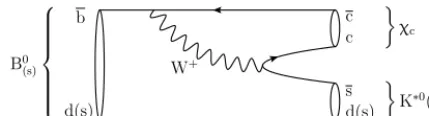
Two-body B-meson decays into a final states containing charmonium meson have played a crucial role in the observation of CP violation in the B-meson system. These decay modes also provide a sensitive laboratory for studying the effects of the strong interaction. Such de-cays are expected to proceed predominantly via the colour-suppressed tree diagram involving b→ccs transition shown in Fig. 1. Under the factorization hypothesis the branching ratios of the B0(s)→χc0,2X decays, where X denotes a K∗0 or aφ meson, are expected to be small
✩ © CERN for the benefit of the LHCb Collaboration.
Fig. 1. Leading-order tree level diagram for the B0(s)→χcX decays.
in comparison to B0(s)→ χc1X decays [1]. However, non-factorizable contributions may be
large[1]; the branching fraction for the B0→χc0K∗0decay was measured by the BaBar
Col-laboration to be(1.7±0.3±0.2)×10−4[2]while the branching fraction for the B0→χc1K∗0
decay was measured by the BaBar and Belle Collaborations to be(2.5±0.2±0.2)×10−4[3] and(1.73−+00..1512−+00..3422)×10−4[4], respectively. The branching fraction for the decay B0→χc2K∗0
has been measured by the BaBar Collaboration to be (6.6±1.8±0.5)×10−5[3]and, unlike the branching fraction for the B0→χc0K∗0decay, can still be explained in the factorization
ap-proach[5]. Therefore, future measurements of the branching fractions of both B0→χc1K∗0and
B0→χc2K∗0decays can provide valuable information for the understanding of the production
ofχcstates in B meson decays, whereχcdenotesχc1andχc2states. The decay modes B0s →χcφ
have not been observed previously.
In this paper, the first observation of the decay B0s →χc1φand a study of the B0→χc1,2K∗0
decays are presented. The analysis is based on a data sample, corresponding to an integrated luminosity of 1.0 fb−1, collected with the LHCb detector in pp collisions at a centre-of-mass energy of 7 TeV.
2. LHCb detector
The LHCb detector [6] is a single-arm forward spectrometer covering the pseudorapidity range 2< η <5, designed for the study of particles containing b or c quarks. The detector in-cludes a high precision tracking system consisting of a silicon-strip vertex detector surrounding the pp interaction region, a large-area silicon-strip detector located upstream of a dipole mag-net with a bending power of about 4 Tm, and three stations of silicon-strip detectors and straw drift tubes placed downstream. The combined tracking system has momentum resolutionp/p that varies from 0.4% at 5 GeV/cto 0.6% at 100 GeV/c, and impact parameter resolution of 20 µm for tracks with high transverse momentum (pT). Charged hadrons are identified using two
ring-imaging Cherenkov detectors[7]. Photon, electron and hadron candidates are identified by a calorimeter system consisting of scintillating-pad and preshower detectors, an electromagnetic calorimeter and a hadronic calorimeter. Muons are identified by a system composed of alternating layers of iron and multiwire proportional chambers[8].
The trigger [9] consists of a hardware stage, based on information from the calorimeter and muon systems, followed by a software stage where a full event reconstruction is ap-plied. Candidate events are first required to pass a hardware trigger which selects muons with pT>1.48 GeV/c. In the subsequent software trigger, at least one of the muons is required to
have bothpT>0.8 GeV/cand impact parameter larger than 100 µm with respect to all of the
primary pp interaction vertices (PVs) in the event. Finally, the two final state muons are required to form a vertex that is significantly displaced from the PVs.
of hadronic particles are described by EVTGEN[12]in which final state radiation is generated using PHOTOS[13]. The interaction of the generated particles with the detector and its response are implemented using the GEANT4 toolkit[14,15]as described in Ref.[16].
3. Event selection
The decays B0→χcK∗0 and B0s → χcφ (the inclusion of charged conjugate processes
is implied throughout) are reconstructed using the χc → J/ψ γ decay mode. The decays
B0→J/ψK∗0and B0s→J/ψ φare used as normalization channels. The intermediate resonances
are reconstructed in the J/ψ→μ+μ−, K∗0→K+π−andφ→K+K−final states.
As in Refs. [17–19], pairs of oppositely-charged tracks identified as muons, each having pT>0.55 GeV/cand originating from a common vertex, are combined to form J/ψ→μ+μ−
candidates. Track quality is ensured by requiring the χ2 per number of degrees of freedom (χ2/ndf) provided by the track fit to be less than 5. Well identified muons are selected by re-quiring that the difference in logarithms of the likelihood of the muon hypothesis with respect to the hadron hypothesis is larger than zero[8]. The fit of the common two-prong vertex is required to satisfyχ2/ndf<20. The vertex is required to be well separated from the reconstructed pri-mary vertex of any of the pp interactions by requiring the decay length to be at least three times its uncertainty. Finally, the invariant mass of the dimuon combination is required to be between 3.020 and 3.135 GeV/c2.
To create χc candidates, the selected J/ψ candidates are combined with a photon that has
been reconstructed using clusters in the electromagnetic calorimeter that have transverse energy greater than 0.7 GeV. To suppress the large combinatorial background fromπ0→γ γ decays, photons that can form part of aπ0→γ γ candidate with invariant mass within 10 MeV/c2of the knownπ0 mass[20]are not used for reconstruction ofχccandidates. To be considered as
aχc, the J/ψ γ combination needs to have a transverse momentum larger than 3 GeV/cand an
invariant mass in the range 3.4–3.7 GeV/c2.
The selectedχcand J/ψcandidates are then combined with K+π−or K+K−pairs to create
B0(s) meson candidates. To identify kaons (pions), the difference in logarithm of the likelihood of the kaon and pion hypotheses[7] is required to be greater than (less than) zero. The track χ2/ndf provided by the track fit is required to be less than 5. The kaons and pions are required to have transverse momentum larger than 0.8 GeV/cand to have an impact parameterχ2, de-fined as the difference between theχ2of the reconstructed pp collision vertex formed with and without the considered track, larger than 4. The invariant mass of the kaon and pion system, MK+π−, is required to be 0.675< MK+π−<1.215 GeV/c2and the invariant mass of the kaon pair,MK+K−, is required to be 0.999< MK+K−<1.051 GeV/c2. In the reconstruction of K∗0
candidates, a possible background arises fromφ→K+K−decays when a kaon is misidentified as a pion. To suppress this contribution, the invariant mass of the kaon and pion system, calcu-lated under the kaon mass hypothesis for the pion track, is required to be outside the range from 1.01 to 1.03 GeV/c2.
In addition, the decay time of B candidates is required to be larger than 150 µm/cto reduce the large combinatorial background from particles produced in the primary pp interaction. To im-prove the invariant mass resolution of the B0(s)meson candidate a kinematic fit[21]is performed. In this fit, constraints are applied to the masses of the intermediate J/ψandχcresonances[20]
Fig. 2. Invariant mass distributions for: (a) B0→χcK∗0 and (b) B0s→χc1φcandidates withχc1mass constraint; (c) B0→χcK∗0and (d) Bs0→χc1φcandidates withχc2mass constraint. The total fitted function (thick solid blue), signal for theχc1andχc2modes (thin green solid and dotted, respectively) and the combinatorial background (dashed blue) are shown.
4. B0→χcK∗0and B0s →χc1φdecays
The invariant mass distributions after selecting B0→χcK∗0and B0s→χc1φcandidates,
sep-arately with aχc1 andχc2 mass constraints, are shown inFig. 2. The signal is modelled by a
single Gaussian function and the combinatorial background is modelled by an exponential func-tion. In the B0channel (Figs. 2(a) and (c)), the right peak in the mass distributions corresponds
to theχc1mode and the left one to theχc2 mode. Owing to the smallχc0→J/ψ γ branching
fraction[20]the contribution from theχc0mode is negligible. As the B0candidate mass is
cal-culated with the J/ψ γ invariant mass constrained to theχc1(χc2) known mass, the signal peak
corresponding to theχc2(χc1) mode is shifted to a lower (higher) value with respect to the B0
mass. The same effect is observed in simulation. The ratio of the mass resolutions of these two signal peaks is fixed to the value obtained from simulation. In the B0s channel no significant
con-tribution from theχc2decay mode is expected and therefore it is not considered in the fit. The
statistical significance for the observed signal is determined as S=
−2 ln LB
LS+B, whereLS+B
andLBdenote the likelihood of the signal plus background hypothesis and the background only
hypothesis, respectively. The statistical significance of the B0s →χc1φsignal is found to be larger
than 9 standard deviations.
The positions and resolutions of the signal peaks are consistent with the expectations from simulation. To investigate the different signal yields obtained with the χc1andχc2 mass
con-straints, a simplified simulation study was performed, which accounts for correlations, differ-ences in selection efficiencies and background fluctuations. This study demonstrates that the yields are in agreement within the statistical uncertainty.
To examine the resonance structure of the B0→χcK∗0 and B0s →χc1φ decays, the sPlot
Fig. 3. Background-subtracted invariant mass distributions for: (a) J/ψ γand (b) K+π−final states from B0→χc1K∗0 decays obtained with theχc1mass constraint applied to the B0(s)candidate invariant mass; (c) J/ψ γand (d) K+π−final
states from B0→χc2K∗0decays obtained with theχc2mass constraint applied to the B0(s)candidate invariant mass;
(e) J/ψ γ and (f) K+K−final states from B0s→χc1φdecays obtained with theχc1mass constraint applied to the B0(s) candidate invariant mass. The total fitted function (solid) and the non-resonant contribution (dotted) are shown.
J/ψ γ invariant mass distributions the requirement on the invariant mass of the K+π−(K+K−) system is tightened to be within 50(10)MeV/c2around the known K∗0(φ)mass to reduce back-ground.
The resulting invariant mass distributions for J/ψ γ, K+π− and K+K− from B0→χcK∗0
and B0s →χc1φcandidates are shown inFig. 3. The J/ψ γ invariant mass distributions are
mod-elled with the sum of a constant and a Crystal Ball function[23]with tail parameters fixed to simulation. In the χc2 mode the signal peak position is fixed to the sum of theχc1 peak
po-sition and the known difference betweenχc1 andχc2 masses[20]. Theχc2mass resolution is
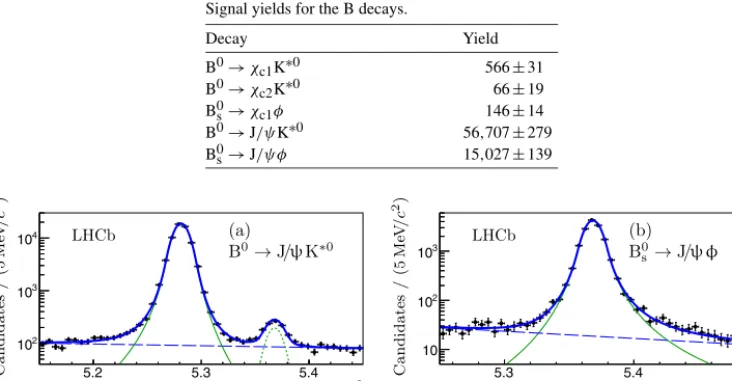
Table 1
Signal yields for the B decays.
Decay Yield
B0→χc1K∗0 566±31
B0→χc2K∗0 66±19
B0s→χc1φ 146±14
B0→J/ψK∗0 56,707±279
B0s→J/ψ φ 15,027±139
Fig. 4. Invariant mass distributions for (a) B0→J/ψK∗0and (b) B0s→J/ψ φ. The total fitted function (thick solid blue), signal (thin solid green), the B0s→J/ψK∗0(green dotted) and the combinatorial background (dashed blue) are shown.
K+π−and K+K−invariant mass distributions are modelled with the sum of a relativistic P-wave Breit–Wigner function with the natural width fixed to the known value[20]and a non-resonant component modelled with the LASS parametrization[24]. For the K+K−case the relativistic P-wave Breit–Wigner function is convolved with a Gaussian function for the detector resolution. The signal peak positions are consistent with the known masses of the mesons while the invari-ant mass resolutions are consistent with the expectation from simulation. In the J/ψ γ invariant mass distributions, the non-resonant contribution is consistent with zero. The resonant contribu-tions for the B0→χc1K∗0and B0s →χc1φdecays are determined with theχc1mass constraint
while the resonant contribution for the B0→χc2K∗0decay is determined with theχc2mass
con-straint. The resulting resonant yields, obtained from the fits to the background-subtracted K+π− and K+K−distributions, are shown inTable 1.
5. B0→J/ψK∗0and B0s→J/ψφdecays
The B0→ χcK∗0 and B0s →χc1φ branching fractions are measured with respect to the
B0→J/ψK∗0and B0s →J/ψφdecays to reduce the systematic uncertainties. The invariant mass
distributions for the B0→J/ψK∗0and B0s →J/ψφcandidates after selection requirements are
shown inFig. 4. The signal and the B0s →J/ψK∗0invariant mass distributions are modelled by
a double-sided Crystal Ball function and the combinatorial background is modelled by an ex-ponential function. The parameters of the B0s peak are fixed to be the same as those of the B0 peak except the position and yield. The difference between the B0→J/ψK∗0and B0s →J/ψK∗0 peak positions is fixed to the world average[20]. The positions of the signal peaks are consis-tent with the known masses of the B0(s)mesons[20]and the mass resolutions are consistent with expectations from simulation.
Fig. 5. Background-subtracted invariant mass distributions for (a) K+π−combinations from B0→J/ψK∗0decays and (b) K+K−combination from B0s→J/ψφdecays. The total fitted function (solid) and the non-resonant contribution (dotted) are shown.
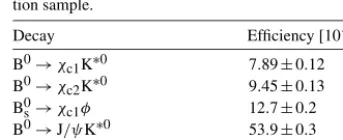
Table 2
Total efficiencies for all decay modes. Uncertainties are statistical only and reflect the size of the simula-tion sample.
Decay Efficiency[10−4]
B0→χc1K∗0 7.89±0.12 B0→χc2K∗0 9.45±0.13 B0s→χc1φ 12.7±0.2 B0→J/ψK∗0 53.9±0.3 B0s→J/ψ φ 85.1±0.4
decays. The resulting K+π−and K+K− invariant mass distributions from B0→J/ψK∗0and B0
s→J/ψ φcandidates are shown inFig. 5. The resulting resonant yields are summarized in Ta-ble 1. The S-wave contributions are consistent with those considered in other analyses[17,25,26].
6. Efficiencies and systematic uncertainties
The branching fraction ratios are calculated using the formulas B(B→χc1X)
B(B→J/ψX)=
NB→χc1X
NB→J/ψX×
εB→J/ψX εB→χc1X
×B 1
(χc1→J/ψ γ ) ,
B(B→χc2X) B(B→χc1X)=
NB→χc2X
NB→χc1X
×εB→χc1X
εB→χc2X
×B(χc1→J/ψ γ ) B(χc2→J/ψ γ )
, (1)
whereN represents the measured yield andεrepresents the total efficiency. The total efficiency is the product of the geometrical acceptance, the detection, reconstruction, selection and trigger efficiencies. The efficiencies are derived using simulation and are presented inTable 2.
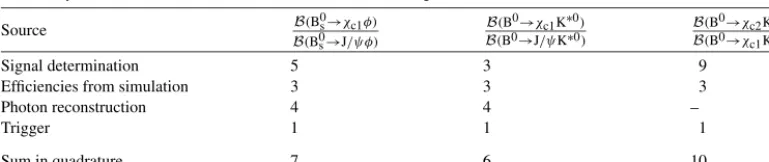
Most potential sources of systematic uncertainty cancel in the ratio, in particular, those related to the muon and J/ψreconstruction and identification. The remaining systematic uncertainties are summarized inTable 3and each is now discussed in turn.
Table 3
Relative systematic uncertainties (in %) on the ratio of branching fractions.
Source B(B
0 s→χc1φ)
B(B0s→J/ψφ)
B(B0→χc1K∗0)
B(B0→J/ψK∗0) B
(B0→χc2K∗0)
B(B0→χ c1K∗0)
Signal determination 5 3 9
Efficiencies from simulation 3 3 3
Photon reconstruction 4 4 –
Trigger 1 1 1
Sum in quadrature 7 6 10
polynomial for the combinatorial background description, a fit with a Crystal Ball[23]function for the signal peaks and fit over different ranges of invariant mass are used. In the B0s channel
a fit including theχc2decay mode is also performed. For the K+π−and K+K− combinations
the fits are repeated, modelling the background with an S-wave two-body phase-space function or an S-wave two-body phase-space function multiplied by a linear function. The K+π− and K+K− invariant mass ranges and the bin size are also varied. The resulting uncertainties are 3% onB(B0→χ
c1K∗0)/B(B0→J/ψK∗0), 5% onB(B0s →χc1φ)/B(B0s →J/ψφ), and 9% on B(B0→χc2K∗0)/B(B0→χc1K∗0).
Another important source of systematic uncertainty arises from the potential disagreement between data and simulation in the estimation of efficiencies. To study this source of uncertainty, the selection criteria are varied in ranges corresponding to as much as 30% change in the signal yields and the ratios of the selection and reconstruction efficiencies are compared between data and simulation. The largest difference (3%) is assigned as a systematic uncertainty in each mode. A further source of possible disagreement between data and simulation is the photon re-construction efficiency. As in Ref. [18], the photon reconstruction efficiency has been stud-ied using B+→ J/ψK∗+, followed by K∗+ →K+π0 and π0 →γ γ decays. For photons with transverse momentum greater than 0.7 GeV/c the agreement between data and sim-ulation is at the level of 4%, which is assigned as a systematic uncertainty to the ratios B(B0→χc1K∗0)/B(B0→J/ψK∗0)andB(B0s →χc1φ)/B(B0s →J/ψφ). As the transverse
mo-mentum spectra of photons are similar in B0→χc1K∗0and B0→χc2K∗0decays, this systematic
uncertainty cancels in the ratioB(B0→χc2K∗0)/B(B0→χc1K∗0).
The systematic uncertainty related to the trigger efficiency has been obtained by comparing the trigger efficiency ratios in data and simulation for the high yield decay modes B+→J/ψK+ and B+→ψ (2S)K+ which have similar kinematics and the same trigger requirements as the channels under study in this analysis[17]. An agreement within 1% is found, which is assigned as systematic uncertainty.
The uncertainty due to the finite simulation sample size is included in the statistical uncer-tainty of the result by adding it in quadrature to the statistical unceruncer-tainty on the ratio of yields.
7. Results and summary
The first observation of the B0
s→χc1φdecay has been made with a data sample,
correspond-ing to an integrated luminosity of 1.0 fb−1of pp collisions at a centre-of-mass energy of 7 TeV, collected with the LHCb detector. Its branching fraction, normalized to that of the B0s→J/ψ φ
B(B0s→χc1φ) B(B0
s →J/ψ φ)
=6.51±0.64 (stat)±0.46 (syst)×10−2× 1 B(χc1→J/ψ γ )
=18.9±1.8 (stat)±1.3 (syst)±0.8(B)×10−2,
where the third uncertainty corresponds to the uncertainty on the branching fraction of theχc1→
J/ψ γ decay. Using the same dataset, the ratio of the branching fractions of the B0→χc1K∗0
and B0→J/ψK∗0 modes and the ratio of the branching fractions of the B0→χc2K∗0 and
B0→χc1K∗0modes have been measured. The ratios are determined using Eq.(1)and the known
valueB(χc1→J/ψγ )
B(χc2→J/ψγ )=
(34.4±1.5)%
(19.5±0.8)%=1.76±0.11[20]and are
B(B0→χc1K∗0) B(B0→J/ψK∗0)=
6.82 ±0.39 (stat)±0.41 (syst)×10−2× 1 B(χc1→J/ψ γ )
=19.8±1.1 (stat)±1.2 (syst)±0.9(B)×10−2, B(B0→χc2K∗0)
B(B0→χ
c1K∗0) =
9.74±2.86 (stat)±0.97 (syst)×10−2×B(χc1→J/ψ γ ) B(χc2→J/ψ γ )
=17.1 ±5.0 (stat)±1.7 (syst)±1.1(B)×10−2,
where the third uncertainty is due to the uncertainty on the branching fractions of theχc→J/ψ γ
modes.
The ratioB(B0→χc1K∗0)/B(B0→J/ψK∗0)obtained in this paper is compatible with, but
more precise than, the previous best value of(17.2−+33..60)×10−2 determined from the world av-erage valueB(B0→χc1K∗0)=(2.22+−00..4031)×10−4 [20]and the branching fraction B(B0→
J/ψK∗0)=(1.29±0.05±0.13)×10−3measured by the Belle Collaboration[27]. Other mea-surements ofB(B0→J/ψK∗0)are not considered as they do not take into account the K+π− S-wave component. The ratioB(B0→χc2K∗0)/B(B0→χc1K∗0)obtained in this paper is
com-patible with the value derived from BaBar measurements,(26±7(stat))×10−2[3], taking only the statistical uncertainties into account.
Acknowledgements
Open access
This article is published Open Access atsciencedirect.com. It is distributed under the terms of the Creative Commons Attribution License 3.0, which permits unrestricted use, distribution, and reproduction in any medium, provided the original authors and source are credited.
References
[1]C. Meng, Y.-J. Gao, K.-T. Chao, Puzzles in B→hc(χc)2K decays and QCD factorization, arXiv:hep-ph/0607221.
[2]BaBar Collaboration, B. Aubert, et al., Observation of B0→χc0K∗0and evidence for B+→χc0K∗+, Phys. Rev.
D 78 (2008) 091101, arXiv:0808.1487.
[3]BaBar Collaboration, B. Aubert, et al., Evidence for X(3872)→ψ (2S)γ in B±→X(3872)K±decays, and a study of B→cc¯γK, Phys. Rev. Lett. 102 (2009) 132001, arXiv:0809.0042.
[4]Belle Collaboration, R. Mizuk, et al., Observation of two resonance-like structures in theπ±χc1mass distribution
in exclusive B0→K−π+χc1decays, Phys. Rev. D 78 (2008) 072004, arXiv:0806.4098.
[5]M. Beneke, L. Vernazza, B→χcJK decays revisited, Nucl. Phys. B 811 (2009) 155, arXiv:0810.3575.
[6]LHCb Collaboration, A.A. Alves, et al., The LHCb detector at the LHC, JINST 3 (2008) S08005.
[7]M. Adinolfi, et al., Performance of the LHCb RICH detector at the LHC, Eur. Phys. J. C 73 (2013) 2431, arXiv:1211.6759.
[8]A.A. Alves, et al., Performance of the LHCb muon system, JINST 8 (2013) P02022, arXiv:1211.1346. [9]R. Aaij, et al., The LHCb trigger and its performance in 2011, JINST 8 (2013) P04022, arXiv:1211.3055. [10]T. Sjöstrand, S. Mrenna, P. Skands, PYTHIA 6.4 physics and manual, JHEP 0605 (2006) 026,
arXiv:hep-ph/0603175.
[11]I. Belyaev, et al., Handling of the generation of primary events in GAUSS, the LHCb simulation framework, in: Nuclear Science Symposium Conference Record (NSS/MIC), IEEE, 2010, p. 1155.
[12]D.J. Lange, The EVTGENparticle decay simulation package, Nucl. Instrum. Meth. A 462 (2001) 152.
[13]P. Golonka, Z. Was, PHOTOSMonte Carlo: a precision tool for QED corrections inZandW decays, Eur. Phys. J. C 45 (2006) 97, arXiv:hep-ph/0506026.
[14]GEANT4 Collaboration, S. Agostinelli, et al., GEANT4: A simulation toolkit, Nucl. Instrum. Meth. A 506 (2003) 250.
[15]GEANT4 Collaboration, J. Allison, et al., GEANT4 developments and applications, IEEE Trans. Nucl. Sci. 53 (2006) 270.
[16]M. Clemencic, et al., The LHCb simulation application, GAUSS: design, evolution and experience, J. Phys. Conf. Ser. 331 (2011) 032023.
[17]LHCb Collaboration, R. Aaij, et al., Measurement of relative branching fractions of B decays toψ (2S)and J/ψ mesons, Eur. Phys. J. C 72 (2012) 2118, arXiv:1205.0918.
[18]LHCb Collaboration, R. Aaij, et al., Evidence for the decay B0→J/ψ ωand measurement of the relative branching fractions of B0smeson decays to J/ψ ηand J/ψ η, Nucl. Phys. B 867 (2013) 547, arXiv:1210.2631.
[19]LHCb Collaboration, R. Aaij, et al., Observation of the B0s→ψ (2S)ηand B0s→ψ (2S)π+π−decays, Nucl. Phys. B 871 (2013) 403, arXiv:1302.6354.
[20]Particle Data Group, J. Beringer, et al., Phys. Rev. D 86 (2012) 010001.
[21]W.D. Hulsbergen, Decay chain fitting with a Kalman filter, Nucl. Instrum. Meth. A 552 (2005) 566, arXiv: physics/0503191.
[22]M. Pivk, F.R. Le, Diberder, sPlot: a statistical tool to unfold data distributions, Nucl. Instrum. Meth. A 555 (2005) 356, arXiv:physics/0402083.
[23]T. Skwarnicki, A study of the radiative cascade transitions between the Upsilon-prime and Upsilon resonances, PhD thesis, Institute of Nuclear Physics, Krakow, 1986.
[24]D. Aston, et al., A study of K−π+scattering in the reaction K−π+→K−π+n at 11 GeV/c, Nucl. Phys. B 296 (1988) 493.
[25]LHCb Collaboration, R. Aaij, et al., Measurement of the B0s→J/ψK∗0branching fraction and angular amplitudes,
Phys. Rev. D 86 (2012) 071102, arXiv:1208.0738.
[26]LHCbcollaboration, R. Aaij, et al., Measurement ofCPviolation and the B0s-meson decay width difference with B0s→J/ψK+K−and B0s→J/ψ π+π−decays, Phys. Rev. D 87 (2013) 112010, arXiv:1304.2600.
LHCb Collaboration
R. Aaij
40, B. Adeva
36, M. Adinolfi
45, C. Adrover
6, A. Affolder
51,
Z. Ajaltouni
5, J. Albrecht
9, F. Alessio
37, M. Alexander
50, S. Ali
40,
G. Alkhazov
29, P. Alvarez Cartelle
36, A.A. Alves Jr
24,37, S. Amato
2,
S. Amerio
21, Y. Amhis
7, L. Anderlini
17,f, J. Anderson
39,
R. Andreassen
56, J.E. Andrews
57, R.B. Appleby
53,
O. Aquines Gutierrez
10, F. Archilli
18, A. Artamonov
34, M. Artuso
58,
E. Aslanides
6, G. Auriemma
24,m, M. Baalouch
5, S. Bachmann
11,
J.J. Back
47, C. Baesso
59, V. Balagura
30, W. Baldini
16, R.J. Barlow
53,
C. Barschel
37, S. Barsuk
7, W. Barter
46, Th. Bauer
40, A. Bay
38,
J. Beddow
50, F. Bedeschi
22, I. Bediaga
1, S. Belogurov
30, K. Belous
34,
I. Belyaev
30,∗, E. Ben-Haim
8, G. Bencivenni
18, S. Benson
49, J. Benton
45,
A. Berezhnoy
31, R. Bernet
39, M.-O. Bettler
46, M. van Beuzekom
40,
A. Bien
11, S. Bifani
44, T. Bird
53, A. Bizzeti
17,h, P.M. Bjørnstad
53,
T. Blake
37, F. Blanc
38, J. Blouw
11, S. Blusk
58, V. Bocci
24, A. Bondar
33,
N. Bondar
29, W. Bonivento
15, S. Borghi
53, A. Borgia
58,
T.J.V. Bowcock
51, E. Bowen
39, C. Bozzi
16, T. Brambach
9,
J. van den Brand
41, J. Bressieux
38, D. Brett
53, M. Britsch
10, T. Britton
58,
N.H. Brook
45, H. Brown
51, I. Burducea
28, A. Bursche
39, G. Busetto
21,q,
J. Buytaert
37, S. Cadeddu
15, O. Callot
7, M. Calvi
20,j,
M. Calvo Gomez
35,n, A. Camboni
35, P. Campana
18,37,
D. Campora Perez
37, A. Carbone
14,c, G. Carboni
23,k, R. Cardinale
19,i,
A. Cardini
15, H. Carranza-Mejia
49, L. Carson
52, K. Carvalho Akiba
2,
G. Casse
51, L. Castillo Garcia
37, M. Cattaneo
37, Ch. Cauet
9, R. Cenci
57,
M. Charles
54, Ph. Charpentier
37, P. Chen
3,38, N. Chiapolini
39,
M. Chrzaszcz
25, K. Ciba
37, X. Cid Vidal
37, G. Ciezarek
52,
P.E.L. Clarke
49, M. Clemencic
37, H.V. Cliff
46, J. Closier
37, C. Coca
28,
V. Coco
40, J. Cogan
6, E. Cogneras
5, P. Collins
37,
A. Comerma-Montells
35, A. Contu
15,37, A. Cook
45, M. Coombes
45,
S. Coquereau
8, G. Corti
37, B. Couturier
37, G.A. Cowan
49, D.C. Craik
47,
S. Cunliffe
52, R. Currie
49, C. D’Ambrosio
37, P. David
8, P.N.Y. David
40,
A. Davis
56, I. De Bonis
4, K. De Bruyn
40, S. De Capua
53, M. De Cian
39,
J.M. De Miranda
1, L. De Paula
2, W. De Silva
56, P. De Simone
18,
D. Decamp
4, M. Deckenhoff
9, L. Del Buono
8, N. Déléage
4,
D. Derkach
54, O. Deschamps
5, F. Dettori
41, A. Di Canto
11,
F. Di Ruscio
23,k, H. Dijkstra
37, M. Dogaru
28, S. Donleavy
51, F. Dordei
11,
R. Dzhelyadin
34, A. Dziurda
25, A. Dzyuba
29, S. Easo
48,37, U. Egede
52,
V. Egorychev
30, S. Eidelman
33, D. van Eijk
40, S. Eisenhardt
49,
U. Eitschberger
9, R. Ekelhof
9, L. Eklund
50,37, I. El Rifai
5,
Ch. Elsasser
39, D. Elsby
44, A. Falabella
14,e, C. Färber
11, G. Fardell
49,
C. Farinelli
40, S. Farry
51, V. Fave
38, D. Ferguson
49,
V. Fernandez Albor
36, F. Ferreira Rodrigues
1, M. Ferro-Luzzi
37,
S. Filippov
32, M. Fiore
16, C. Fitzpatrick
37, M. Fontana
10,
F. Fontanelli
19,i, R. Forty
37, O. Francisco
2, M. Frank
37, C. Frei
37,
M. Frosini
17,f, S. Furcas
20, E. Furfaro
23,k, A. Gallas Torreira
36,
D. Galli
14,c, M. Gandelman
2, P. Gandini
58, Y. Gao
3, J. Garofoli
58,
P. Garosi
53, J. Garra Tico
46, L. Garrido
35, C. Gaspar
37, R. Gauld
54,
E. Gersabeck
11, M. Gersabeck
53, T. Gershon
47,37, Ph. Ghez
4,
V. Gibson
46, L. Giubega
28, V.V. Gligorov
37, C. Göbel
59, D. Golubkov
30,
A. Golutvin
52,30,37, A. Gomes
2, H. Gordon
54, M. Grabalosa Gándara
5,
R. Graciani Diaz
35, L.A. Granado Cardoso
37, E. Graugés
35,
G. Graziani
17, A. Grecu
28, E. Greening
54, S. Gregson
46, P. Griffith
44,
O. Grünberg
60, B. Gui
58, E. Gushchin
32, Yu. Guz
34,37, T. Gys
37,
C. Hadjivasiliou
58, G. Haefeli
38, C. Haen
37, S.C. Haines
46, S. Hall
52,
B. Hamilton
57, T. Hampson
45, S. Hansmann-Menzemer
11, N. Harnew
54,
S.T. Harnew
45, J. Harrison
53, T. Hartmann
60, J. He
37, T. Head
37,
V. Heijne
40, K. Hennessy
51, P. Henrard
5, J.A. Hernando Morata
36,
E. van Herwijnen
37, A. Hicheur
1, E. Hicks
51, D. Hill
54, M. Hoballah
5,
M. Holtrop
40, C. Hombach
53, P. Hopchev
4, W. Hulsbergen
40, P. Hunt
54,
T. Huse
51, N. Hussain
54, D. Hutchcroft
51, D. Hynds
50, V. Iakovenko
43,
M. Idzik
26, P. Ilten
12, R. Jacobsson
37, A. Jaeger
11, E. Jans
40, P. Jaton
38,
A. Jawahery
57, F. Jing
3, M. John
54, D. Johnson
54, C.R. Jones
46,
C. Joram
37, B. Jost
37, M. Kaballo
9, S. Kandybei
42, W. Kanso
6,
M. Karacson
37, T.M. Karbach
37, I.R. Kenyon
44, T. Ketel
41, A. Keune
38,
B. Khanji
20, O. Kochebina
7, I. Komarov
38, R.F. Koopman
41,
P. Koppenburg
40, M. Korolev
31, A. Kozlinskiy
40, L. Kravchuk
32,
K. Kreplin
11, M. Kreps
47, G. Krocker
11, P. Krokovny
33, F. Kruse
9,
M. Kucharczyk
20,25,j, V. Kudryavtsev
33, T. Kvaratskheliya
30,37,
V.N. La Thi
38, D. Lacarrere
37, G. Lafferty
53, A. Lai
15, D. Lambert
49,
R.W. Lambert
41, E. Lanciotti
37, G. Lanfranchi
18, C. Langenbruch
37,
T. Latham
47, C. Lazzeroni
44, R. Le Gac
6, J. van Leerdam
40, J.-P. Lees
4,
R. Lefèvre
5, A. Leflat
31, J. Lefrançois
7, S. Leo
22, O. Leroy
6, T. Lesiak
25,
C. Linn
11, B. Liu
3, G. Liu
37, S. Lohn
37, I. Longstaff
50, J.H. Lopes
2,
N. Lopez-March
38, H. Lu
3, D. Lucchesi
21,q, J. Luisier
38, H. Luo
49,
F. Machefert
7, I.V. Machikhiliyan
4,30, F. Maciuc
28, O. Maev
29,37,
S. Malde
54, G. Manca
15,d, G. Mancinelli
6, U. Marconi
14, R. Märki
38,
J. Marks
11, G. Martellotti
24, A. Martens
8, A. Martín Sánchez
7,
M. Martinelli
40, D. Martinez Santos
41, D. Martins Tostes
2,
A. Massafferri
1, R. Matev
37, Z. Mathe
37, C. Matteuzzi
20, E. Maurice
6,
A. Mazurov
16,32,37,e, B. McSkelly
51, J. McCarthy
44, A. McNab
53,
R. McNulty
12, B. Meadows
56,54, F. Meier
9, M. Meissner
11, M. Merk
40,
D.A. Milanes
8, M.-N. Minard
4, J. Molina Rodriguez
59, S. Monteil
5,
D. Moran
53, P. Morawski
25, A. Mordà
6, M.J. Morello
22,s,
R. Mountain
58, I. Mous
40, F. Muheim
49, K. Müller
39, R. Muresan
28,
B. Muryn
26, B. Muster
38, P. Naik
45, T. Nakada
38, R. Nandakumar
48,
I. Nasteva
1, M. Needham
49, S. Neubert
37, N. Neufeld
37, A.D. Nguyen
38,
T.D. Nguyen
38, C. Nguyen-Mau
38,o, M. Nicol
7, V. Niess
5, R. Niet
9,
N. Nikitin
31, T. Nikodem
11, A. Nomerotski
54, A. Novoselov
34,
A. Oblakowska-Mucha
26, V. Obraztsov
34, S. Oggero
40, S. Ogilvy
50,
O. Okhrimenko
43, R. Oldeman
15,d, M. Orlandea
28,
J.M. Otalora Goicochea
2, P. Owen
52, A. Oyanguren
35, B.K. Pal
58,
A. Palano
13,b, M. Palutan
18, J. Panman
37, A. Papanestis
48,
M. Pappagallo
50, C. Parkes
53, C.J. Parkinson
52, G. Passaleva
17,
G.D. Patel
51, M. Patel
52, G.N. Patrick
48, C. Patrignani
19,i,
C. Pavel-Nicorescu
28, A. Pazos Alvarez
36, A. Pellegrino
40, G. Penso
24,l,
M. Pepe Altarelli
37, S. Perazzini
14,c, E. Perez Trigo
36,
A. Pérez-Calero Yzquierdo
35, P. Perret
5, M. Perrin-Terrin
6, G. Pessina
20,
K. Petridis
52, A. Petrolini
19,i, A. Phan
58, E. Picatoste Olloqui
35,
B. Pietrzyk
4, T. Pilaˇr
47, D. Pinci
24, S. Playfer
49, M. Plo Casasus
36,
F. Polci
8, G. Polok
25, A. Poluektov
47,33, I. Polyakov
30, E. Polycarpo
2,
A. Popov
34, D. Popov
10, B. Popovici
28, C. Potterat
35, A. Powell
54,
J. Prisciandaro
38, A. Pritchard
51, C. Prouve
7, V. Pugatch
43,
A. Puig Navarro
38, G. Punzi
22,r, W. Qian
4, J.H. Rademacker
45,
B. Rakotomiaramanana
38, M.S. Rangel
2, I. Raniuk
42, N. Rauschmayr
37,
G. Raven
41, S. Redford
54, M.M. Reid
47, A.C. dos Reis
1, S. Ricciardi
48,
A. Richards
52, K. Rinnert
51, V. Rives Molina
35, D.A. Roa Romero
5,
P. Robbe
7, E. Rodrigues
53, P. Rodriguez Perez
36, S. Roiser
37,
V. Romanovsky
34, A. Romero Vidal
36, J. Rouvinet
38, T. Ruf
37,
J.J. Saborido Silva
36, N. Sagidova
29, P. Sail
50, B. Saitta
15,d,
V. Salustino Guimaraes
2, C. Salzmann
39, B. Sanmartin Sedes
36,
M. Sannino
19,i, R. Santacesaria
24, C. Santamarina Rios
36,
E. Santovetti
23,k, M. Sapunov
6, A. Sarti
18,l, C. Satriano
24,m, A. Satta
23,
M. Savrie
16,e, D. Savrina
30,31, P. Schaack
52, M. Schiller
41,
H. Schindler
37, M. Schlupp
9, M. Schmelling
10, B. Schmidt
37,
O. Schneider
38, A. Schopper
37, M.-H. Schune
7, R. Schwemmer
37,
B. Sciascia
18, A. Sciubba
24, M. Seco
36, A. Semennikov
30, I. Sepp
52,
N. Serra
39, J. Serrano
6, P. Seyfert
11, M. Shapkin
34, I. Shapoval
16,42,
P. Shatalov
30, Y. Shcheglov
29, T. Shears
51,37, L. Shekhtman
33,
O. Shevchenko
42, V. Shevchenko
30, A. Shires
52, R. Silva Coutinho
47,
M. Sirendi
46, T. Skwarnicki
58, N.A. Smith
51, E. Smith
54,48, J. Smith
46,
M. Smith
53, M.D. Sokoloff
56, F.J.P. Soler
50, F. Soomro
18, D. Souza
45,
B. Souza De Paula
2, B. Spaan
9, A. Sparkes
49, P. Spradlin
50, F. Stagni
37,
S. Stahl
11, O. Steinkamp
39, S. Stoica
28, S. Stone
58, B. Storaci
39,
M. Straticiuc
28, U. Straumann
39, V.K. Subbiah
37, L. Sun
56,
S. Swientek
9, V. Syropoulos
41, M. Szczekowski
27, P. Szczypka
38,37,
T. Szumlak
26, S. T’Jampens
4, M. Teklishyn
7, E. Teodorescu
28,
F. Teubert
37, C. Thomas
54, E. Thomas
37, J. van Tilburg
11, V. Tisserand
4,
M. Tobin
38, S. Tolk
41, D. Tonelli
37, S. Topp-Joergensen
54, N. Torr
54,
E. Tournefier
4,52, S. Tourneur
38, M.T. Tran
38, M. Tresch
39,
A. Tsaregorodtsev
6, P. Tsopelas
40, N. Tuning
40, M. Ubeda Garcia
37,
A. Ukleja
27, D. Urner
53, A. Ustyuzhanin
52,p, U. Uwer
11, V. Vagnoni
14,
G. Valenti
14, A. Vallier
7, M. Van Dijk
45, R. Vazquez Gomez
18,
P. Vazquez Regueiro
36, C. Vázquez Sierra
36, S. Vecchi
16, J.J. Velthuis
45,
M. Veltri
17,g, G. Veneziano
38, M. Vesterinen
37, B. Viaud
7, D. Vieira
2,
X. Vilasis-Cardona
35,n, A. Vollhardt
39, D. Volyanskyy
10, D. Voong
45,
A. Vorobyev
29, V. Vorobyev
33, C. Voß
60, H. Voss
10, R. Waldi
60,
C. Wallace
47, R. Wallace
12, S. Wandernoth
11, J. Wang
58, D.R. Ward
46,
N.K. Watson
44, A.D. Webber
53, D. Websdale
52, M. Whitehead
47,
J. Wicht
37, J. Wiechczynski
25, D. Wiedner
11, L. Wiggers
40,
G. Wilkinson
54, M.P. Williams
47,48, M. Williams
55, F.F. Wilson
48,
J. Wimberley
57, J. Wishahi
9, M. Witek
25, S.A. Wotton
46, S. Wright
46,
S. Wu
3, K. Wyllie
37, Y. Xie
49,37, Z. Xing
58, Z. Yang
3, R. Young
49,
X. Yuan
3, O. Yushchenko
34, M. Zangoli
14, M. Zavertyaev
10,a, F. Zhang
3,
L. Zhang
58, W.C. Zhang
12, Y. Zhang
3, A. Zhelezov
11, A. Zhokhov
30,
1Centro Brasileiro de Pesquisas Físicas (CBPF), Rio de Janeiro, Brazil 2Universidade Federal do Rio de Janeiro (UFRJ), Rio de Janeiro, Brazil 3Center for High Energy Physics, Tsinghua University, Beijing, China 4LAPP, Université de Savoie, CNRS/IN2P3, Annecy-Le-Vieux, France
5Clermont Université, Université Blaise Pascal, CNRS/IN2P3, LPC, Clermont-Ferrand, France 6CPPM, Aix-Marseille Université, CNRS/IN2P3, Marseille, France
7LAL, Université Paris-Sud, CNRS/IN2P3, Orsay, France
8LPNHE, Université Pierre et Marie Curie, Université Paris Diderot, CNRS/IN2P3, Paris, France 9Fakultät Physik, Technische Universität Dortmund, Dortmund, Germany
10Max-Planck-Institut für Kernphysik (MPIK), Heidelberg, Germany
11Physikalisches Institut, Ruprecht-Karls-Universität Heidelberg, Heidelberg, Germany 12School of Physics, University College Dublin, Dublin, Ireland
13Sezione INFN di Bari, Bari, Italy 14Sezione INFN di Bologna, Bologna, Italy 15Sezione INFN di Cagliari, Cagliari, Italy 16Sezione INFN di Ferrara, Ferrara, Italy 17Sezione INFN di Firenze, Firenze, Italy
18Laboratori Nazionali dell’INFN di Frascati, Frascati, Italy 19Sezione INFN di Genova, Genova, Italy
20Sezione INFN di Milano Bicocca, Milano, Italy 21Sezione INFN di Padova, Padova, Italy 22Sezione INFN di Pisa, Pisa, Italy
23Sezione INFN di Roma Tor Vergata, Roma, Italy 24Sezione INFN di Roma La Sapienza, Roma, Italy
25Henryk Niewodniczanski Institute of Nuclear Physics, Polish Academy of Sciences, Kraków, Poland
26AGH – University of Science and Technology, Faculty of Physics and Applied Computer Science, Kraków, Poland 27National Center for Nuclear Research (NCBJ), Warsaw, Poland
28Horia Hulubei National Institute of Physics and Nuclear Engineering, Bucharest-Magurele, Romania 29Petersburg Nuclear Physics Institute (PNPI), Gatchina, Russia
30Institute of Theoretical and Experimental Physics (ITEP), Moscow, Russia 31Institute of Nuclear Physics, Moscow State University (SINP MSU), Moscow, Russia
32Institute for Nuclear Research of the Russian Academy of Sciences (INR RAN), Moscow, Russia 33Budker Institute of Nuclear Physics (SB RAS) and Novosibirsk State University, Novosibirsk, Russia 34Institute for High Energy Physics (IHEP), Protvino, Russia
35Universitat de Barcelona, Barcelona, Spain
36Universidad de Santiago de Compostela, Santiago de Compostela, Spain 37European Organization for Nuclear Research (CERN), Geneva, Switzerland 38Ecole Polytechnique Fédérale de Lausanne (EPFL), Lausanne, Switzerland 39Physik-Institut, Universität Zürich, Zürich, Switzerland
40Nikhef National Institute for Subatomic Physics, Amsterdam, The Netherlands
41Nikhef National Institute for Subatomic Physics and VU University Amsterdam, Amsterdam, The Netherlands 42NSC Kharkiv Institute of Physics and Technology (NSC KIPT), Kharkiv, Ukraine
43Institute for Nuclear Research of the National Academy of Sciences (KINR), Kyiv, Ukraine 44University of Birmingham, Birmingham, United Kingdom
45H.H. Wills Physics Laboratory, University of Bristol, Bristol, United Kingdom 46Cavendish Laboratory, University of Cambridge, Cambridge, United Kingdom 47Department of Physics, University of Warwick, Coventry, United Kingdom 48STFC, Rutherford Appleton Laboratory, Didcot, United Kingdom
49School of Physics and Astronomy, University of Edinburgh, Edinburgh, United Kingdom 50School of Physics and Astronomy, University of Glasgow, Glasgow, United Kingdom 51Oliver Lodge Laboratory, University of Liverpool, Liverpool, United Kingdom 52Imperial College London, London, United Kingdom
53School of Physics and Astronomy, University of Manchester, Manchester, United Kingdom 54Department of Physics, University of Oxford, Oxford, United Kingdom
56University of Cincinnati, Cincinnati, OH, United States 57University of Maryland, College Park, MD, United States 58Syracuse University, Syracuse, NY, United States
59Pontifícia Universidade Católica do Rio de Janeiro (PUC-Rio), Rio de Janeiro, Brazilt 60Institut für Physik, Universität Rostock, Rostock, Germanyu
* Corresponding author.
E-mail address:[email protected](I. Belyaev).
a P.N. Lebedev Physical Institute, Russian Academy of Science (LPI RAS), Moscow, Russia.
b Università di Bari, Bari, Italy. c Università di Bologna, Bologna, Italy.
d Università di Cagliari, Cagliari, Italy. e Università di Ferrara, Ferrara, Italy.
f Università di Firenze, Firenze, Italy. g Università di Urbino, Urbino, Italy.
h Università di Modena e Reggio Emilia, Modena, Italy.
i Università di Genova, Genova, Italy.
j Università di Milano Bicocca, Milano, Italy.
k Università di Roma Tor Vergata, Roma, Italy.
l Università di Roma La Sapienza, Roma, Italy. m Università della Basilicata, Potenza, Italy.
n LIFAELS, La Salle, Universitat Ramon Llull, Barcelona, Spain. o Hanoi University of Science, Hanoi, Viet Nam.
p Institute of Physics and Technology, Moscow, Russia. q Università di Padova, Padova, Italy.
r Università di Pisa, Pisa, Italy. s Scuola Normale Superiore, Pisa, Italy.
t Associated to: Universidade Federal do Rio de Janeiro (UFRJ), Rio de Janeiro, Brazil.