The overlap between well-being and recovery: A systematic
comparison
Tatjana Holschneider S1585525
University of Twente Psychology - PPT
01.03.2019
Table of contents
1. Introduction……….4
1.1. Well-being………...……….…...…..8
1.2. Recovery………...……….………....11
1.3. Aims of Research and Research Questions………....17
2. Methods……….19
2.1. Selection process………..………...19
2.1.1. Six-factor model of PWB and the CHIME model………..……….19
2.1.2. RSPWB and the QPR………….…....…….………..…….….21
2.1.3. WBT and the RI……….……….………..…...23
2.2. Analysis...………...24
2.2.1. Six-factor model of PWB and the CHIME model…………...………....24
2.2.2. RSPWB and the QPR……...………….………..25
2.2.3. WBT and the RI……….……….26
3. Results...………...……….26
3.1. Six-factor model of PWB and the CHIME model……….…….……...…………27
3.2. RSPWB and the QPR……….………...……….………....34
3.3. WBT and the RI………...………...43
4. Discussion……….………50
4.1. Limitations………..………...56
4.2. Implications and Future Directions……….………...57
5. Conclusion...…….………60
Abstract
Background.
Increasing confusion around the concepts of well-being and recovery has emerged in
literature and clinical practice. Mental health care users demand more recovery-oriented
practice but treatment, as clinicians call for, also needs to be scientifically validated. To clear
some of this confusion, this paper aims at exploring the differences and overlaps between the
approaches of psychological well-being (PWB) and personal recovery (PR) and how they
might be combinable in clinical practice.
Methods.
A systematic comparison was conducted. Three aspects of PWB and PR were considered: (1)
existing models (2) measurement tools (3) treatment programmes. For each aspect two
representing materials were compared.
Results and Discussion.
A great overlap between the approaches of PWB and PR was found in underlying values
toward the meaning and expression of well-being. Yet, differences dominated, and the
approaches were not interchangeable. Historically, PWB originated from researchers and
clinicians. In contrast, PR emerged through the empowerment movement led by mental health
care users demanding more holistic treatment. The PWB approach corresponds to clinical
recovery and cultivates the traditional gap in power relations between the “patient” and
therapist, while in the PR approaches the “patient” is called “mental health care service user”,
who is seen as on par with health care workers. PR advocates the possibility living and being
well without complete symptom remission, while in the PWB approach mental illness is seen
as incompatible with PWB.
Research is needed to explore how the service users’ demand for a more holistic and
recovery-oriented care, and the need of scientifically validated guidelines on the other hand,
can be integrated best in clinical practice. Together, the approaches could work towards a
future that is less pathology-focused and more person-centered, to enable all individuals to
1. Introduction
For a long time, the phenomenon of positive mental health was not seen as a research
worthy topic and mental health was generally regarded as the mere absence of mental illness
(Ryff, 1995, Anthony, 1993; Maddux, 2012). This is mirrored by the traditional treatment
objectives being symptom remission and relapse prevention (American Psychiatric
Association, 2013; Anthony, 1993; Maddux, 2012; Gladis, Gosch, Dishuk & Critis-Christoph,
1999). However, lots of research has since been done to explore positive mental health (e.g.
Keyes, 2002; 2005; 2006; 2007; Maddux, 2012; Hanlon & Carlisle, 2008). The current notion
of mental health does not equal the mere absence of illness (Keyes, 2002; 2005; 2007) but
further includes the presence of positive functioning and a positive state of capacities, or:
mental health as a complete state of well-being. Being mentally healthy means to flourish and
lead a meaningful life (Keyes, 2006; 2007, WHO, 2005; Cowen, 1991).
In the last two decades, nurturing positive mental health and promoting well-being
instead of only treating mental illness has become a more popular subject matter in research
and clinical practice (Slade, 2010; Keyes, 2006; 2007; WHO, 2004; Jeste, 2005; Hanlon &
Carlisle, 2008; Maddux, 2012; Slade, Oades & Jarden, 2017). Correspondingly, the former
president of the American Psychiatric Association, D. V. Jest, M. D. (2015), said the
following at the end of his presidency in 2013: ‘I expect that the future role of psychiatry will
be much broader than treating psychiatric symptoms. It will seek to enhance well-being of
people with mental or physical illnesses. [...] and we will seek new ways to promote
resilience, optimism, and wisdom through psychotherapeutic interventions.’. Hence, the
fundamental shift in how mental illness and mental health are approached in professional
environments have reached more global acceptance.
Next to the professional faction in mental health care and research, a movement from
care services were fighting forced and inhumane treatment, stigma, and discrimination and
questioning the medical model. They were demanding a more holistic approach to recovery
and alternatives to traditional mental health care services, as for example peer support and
self-help. The assumption was that patients could recover in a more holistic way and (re)learn
to lead a meaningful and satisfying life integrated into the community (Chamberline, 1990;
Frese & Davis, 1997; Tomes, 2006). Simultaneously, the deinstitutionalization process began,
allowing patients to leave large institutions and get treatment in their neighborhood, where
also daytime treatment was offered by teams including social workers and physicians. In
general, their degree of freedom massively increased and so did quality of life (Chamberline,
1990; Frese & Davis, 1997; Tomes, 2006; Nolen-Hoeksema, 2014).
Today, the descendants of the so-called consumer movement, empowerment
movement or patients’ right movement does not only aim at ending stigma and changing
health-care systems, but mainly focuses on empowering mental health care users (Kersting,
2005; Tomes, 2006). By using the term empowering here, it is referred to having the right to
make one’s own mental health care choices (Tomes, 2006). Since the beginning of the
movement, many ex-patient-/user-run services have emerged, such as the National
Empowerment Center which allows users to find all sorts of information about topics related
to mental health, empowerment and illness related issues, help and support, links to other
empowerment websites. They state their mission to be carrying “[...] a message of recovery,
empowerment, hope and healing to people with lived experience with mental health issues,
trauma, and and/or extreme states.”(National Empowerment Center, 2018).
With the understanding that mental illness is not necessarily permanent (Davidson &
Roe, 2007) and that mental health is a concept distinct and independent of mental illness
(Keyes, 2002; 2005; 2007), the interest in recovery aroused (Resnick, Fontana, Lehman &
Roseneck, 2005). Well-being and its achievement has become a popular research field which
well-being or positive psychology, for example The Bradford University (2019) or the University
College London (2019). While newer research shares the view that mental health is more than
the absence of illness, concise ideas about guiding definitions, values and measurements of
well-being and recovery are still lacking (e.g. Keyes, 2002; Slade, Oades & Jarden, 2017;
Forrest, 2014; NIMHE, 2004).
Despite the general development moving away from a pure pathogenic approach, the
general treatment approach in clinical practice is still often very pathology-focused, especially
in inpatient settings (Tsai & Salyers, 2008; Sainsbury Centre for Mental Health, 2006;
Bartholomew & Kensler, 2010; Hyde, Bowles & Pawar, 2015) and the idea of
recovery-oriented care is still far from being adapted in the most psychiatric institutions (Leonhardt,
Huling, Hamm, Roe, Hasson-Ohayon, McLeod & Lysaker, 2017). Despite persistent effort to
implement new practice approaches, various factors, such as limited resources (e.g. staff,
beds..), violence or poor leadership (Brennan, Flood & Bowers, 2006; Cleary, 2004), hinder
the integration of new evidence-based findings and innovations into practice, resulting in poor
uptake of new approaches in practice. (Grol & Grimshaw, 2003; Grol, Bosch, Hulscher,
Eccles & Wensing, 2007; May, Finch, Mair, Ballini, Dowrick, Eccles, Grask, … & Heaven,
2007).
There seems to exist a gap in the view of what recovery is and what it means for clinicians
and service users respectively and how well-being can be achieved in service users. While in
clinical practice the focus lies on the reduction of symptoms and complaints, service users
demand that recovery encompasses more than the reduction of symptoms and complaints
(Aston & Coffey, 2012; Empowerment Center, 2018). Further, conceptual confusion around
the definitions of well-being and recovery remains (Slade, Oarden & Jarden, 2017). Till now,
literature on how the relation between recovery and well-being behaves and how they interact,
is quite rare. The questions is how those two approaches may overlap and could jointly
of view. Hence, the goal of this research is to explore this relation and compare the two
approaches to each other. In the following, the approach of well-being and recovery will be
introduced and the research questions guiding this study will be formulated.
1.1. Well-being
The WHO provides a definition of mental health as ‘a state of well-being in which the
individual realizes his or her own abilities, can cope with the normal stresses of life, can work
productively and fruitfully, and is able to contribute to his or her community’ (WHO, 2004).
Hence, well-being is introduced as the fundamental element of mental health and a
multidimensional concept. Researchers have been interested in the concept of human
well-being for a long time and accordingly rich and diverse are conceptualizations and general
literature about well-being (McGillivray, 2007; Keyes, 2006). The multifactorial concept of
well-being as introduced by Keyes (2006), encompasses two dimensions - the hedonic and the
eudaemonic tradition, which can be traced back to the Greek (Ryff, 2014). The eudaemonic
tradition follows the pursuit of positive functioning, while the hedonic tradition focuses on
happiness, e.g. maximizing happiness/pleasure and minimizing pain (Veenhoven, 2003; Ryan
& Deci, 2001; Waterman, 1993). Moreover, Keyes (2006), splits well-being into three
components - emotional, psychological and social well-being. Thereby, psychological and
social well-being fit in the eudaimonic tradition, while emotional well-being fits the hedonic
tradition.
Thence, Keyes (2005a, 2006) strongly argues that a society needs to enable its individuals
to develop their eudaemonic capacities, instead of merely encouraging them to seek hedonic
well-being in order to assist the development of a prosperous and flourishing society. This
view on mental health as a complete state is generally referred to as the two continua model,
Klooster, Bohlmeijer & Westerhof, 2017). In this paper, the term dual continua model will be
used.
Dual continua model
In agreement with the WHO (2004) definition of mental health, Keyes (2005; 2006;
2007) also highlights the individual’s well-being in the definition of positive mental health.
He describes mental health as a syndrome expressing itself through the symptoms of
well-being, meaning how individuals perceive and evaluate their overall quality of life, their
affective states and the level of positive functioning (Keyes, 2002). Thus, according to Keyes
(2002; 2005; 2007), mental health and mental illness are not opposite ends of one single
continuum, but two highly correlated phenomena, which can, but must not, coexist.
According to the model, one can also be experiencing mental illness and well-being at the
same time (struggling), not experiencing mental illness nor well-being (languishing) or
experiencing mental illness and the absence of well-being (floundering) (Keyes, 2002; 2005;
Franken, Lamers, Ten Klooster, Bohlmeijer & Westerhof, 2017). Complete mental health
(flourishing) should be regarded as a complete state of high well-being and the absence of
mental disorders (Keyes, 2006; Cowen, 1991).
Despite the acknowledged importance and growing interest in positive mental health
(e.g. Keyes, 2002; 2005; 2006; 2007; Maddux, 2012; Hanlon & Carlisle, 2008) lots of
research still dismisses to study the presence and absence of mental health and well-being
independent from mental illness (Keyes & Grzywacz, 2005). Correspondingly, Keyes (2002;
2007) points out to the often overseen phenomenon languishing and its detrimental effects.
Languishing could be understood as a state of stagnation, emptiness, despair and generally
poor emotional health. It was shown to be as prevalent as pure episodes of depression and
limitations in daily activities, such as work cut back and increased rate of lost work days
(Keyes, 2002).
The six-factor model of Psychological Well-being
While Keyes includes emotional, social and psychological well-being in this complete
state model of mental health, Ryff (1989) did research on psychological well-being as an
independent concept. As there existed no guiding theory in successful ageing or well-being in
the later years in the 1980s, Ryff (1989) aimed at generating a model for well-being based on
existing theories and developed the six-factor model of PWB, which includes six dimensions
that constitute positive functioning. In this sense, she followed the eudaimonic tradition and
highlights that human well-being is more than feeling happy (Ryff & Keyes, 1995, Ryff,
2014). The six dimensions (Autonomy, Environmental Mastery, Personal Growth, Positive
Relations with Others, Purpose in Life, Self-Acceptance) , and elements that constitute the
dimensions,are presented in Table 1 after the following paragraph.
The six-factor model of PWB has been widely used and applied in the field of
well-being research (i.e. Ryff et al., 2017; Clarke, Marshall, Ryff & Wheaton, 2001; Gao &
McLellan, 2018; Gigantesco,Stazi, Alessandri, Medda, Tarolla & Fagnani, 2011; Fava,
1999). To measure PWB, Ryff (1989a) developed a scale corresponding to the PWB model -
the six-factor model of PWB. It consists of six subscales that match the six dimensions of the
six-factor model of PWB (Ryff, 1989a). Its psychometric quality has been proven and
adjudged to be good (Ryff & Singer, 2006). Further, it has also been used for clinical practice
and has been stated as being easy to applicate to clinical populations (Rafanelli, Park, Ruini,
Ottolini, Cazzaro & Fava, 2000; Fava, Rafanelli, Ottolini, Ruini, Cazzaro & Grandi, 2001). In
that would enhance PWB (Fava & Ruini, 2003). This therapy is called the Well-being
Therapy and was developed by Giovanni A. Fava (1999). At the heart of the therapy lies the
technique of self-observation, which takes place by using a structured diary and the
patient-therapist interaction (Fava & Ruini, 2003; Fava, 2016). The six-factor model of PWB
adequately reflects the concept of well-being which is to be explored and compared to the
[image:11.595.79.552.295.569.2]concept of PR in the following.
Table 1
Dimension of the Six-factor model of PWB (Ryff, 1989; Ryff & Keyes, 1995; Ryff, 2014)
Self-Acceptance Positive attitude towards self, (self-acceptance, self-confidence, self-reliance) acknowledges and accepts multiple aspects of self (good and bad) qualities, feels good about past life
Positive Relations with others
Warm, satisfying, trusting relationships with others; concerned about welfare of others, capable of strong empathy, affection and intimacy; understands give and take of human relationships
Autonomy Self-determining and independent; able to resist social pressures to think and act in certain ways; regulates behavior from within; evaluates self by personal standards
Environmental Mastery
Sense of mastery and competence in managing the environment; controls complex array of external activities; makes effective use of surrounding opportunities; able to create or choose contexts suitable to personal needs and values
Purpose in Life Goals in life and sense of directedness; feels there is meaning to present and past life; holds beliefs that give life purpose; has aims and objectives for living
Personal Growth Feeling of continued development; sees self as growing and expanding; open to new experiences; sense of realizing his/her potential; sees improvement in self and behavior over time; is changing in ways that reflects more self-knowledge and effectiveness
Note. Adapted from “Beyond Ponce de Leon and life satisfaction: New directions in quest of successful ageing”, by C. D. Ryff, 1989, International Journal of Behavioral Development, 12(1), p. 35-55. “Psychological Well-Being Revisited: Advances in Science and Practice”, by C. D. Ryff, 2014, Psychotherapy and Psychosomatics, 83(1), p. 10–28. “The Structure of Psychological Well-Being Revisited”, by C. D. Ryff and C. L. M. Keyes, 1995, Journal of Personality and Social Psychology, 69(4), p. 719-727.
1.2. Recovery
The American Psychiatric Association defines recovery from mental disorder as “a
self-directed life, and strive to reach their full potential.” (American Psychiatric Association, 2018). Unfortunately, this is no universally accepted definition. In relation to mental illness,
the term recovery has been interpreted in many ways and even though many reviews have
delivered useful definitions (e.g. Davidson & Roe, 2007; Leamy, Bird, Le Boutillier, Williams
& Slade, 2011; Slade, 2010; Onken, Craig, Cook, Ralph and Ridgway, 2007; Noordsy,
Torrey, Mueser, Mead, O’Keefe & Fox, 2002), no concise definition exists (Forrest, 2014;
NIMHE, 2004). Recovery has been conceptualized as functional improvement or
regeneration, symptom reduction, which corresponds to the view of the medical model and
DSM-5 guidelines (American Psychiatric Association, 2013), or as a social process or a
personal and individual journey (Onken, Craig, Ridgway, Ralph, & Cook, 2007). While the
perceived inability to agree on a concise definition of recovery complicates research in the
mental health field (Onken, Craig, Ridgway, Ralph, & Cook, 2007), attempts to find a
solution for this are made. A reason for the present confusion and ambiguity of the recovery
term has been offered by Davidson and Roe (2007). They identified two main complementary
meanings of recovery, which derive from two different backgrounds. The first and older
concept recovery from mental illness emerged when it became clear that mental illness was
not always permanent and some people even returned to their pre-illness functioning levels,
while others did partly and some not at all. Thus, there seemed to be a way of recovering from
mental illnesses in a similar way as recovering from physical illnesses or disturbances, for
example, a broken hip. Hence, recovery from mental illness is described as ‘the amelioration
of symptoms and the person’s returning to a healthy state following onset of the illness”. This
definition presents recovery as a rather linear, clear process with a relatively easily
measurable outcome. Therefore, it is comfortable for clinicians and researchers to accept this
concept. The second concept, described as recovery in mental illness appeared later, when
personally affected individuals proved the black and white thinking of traditional diagnostic
process. In this view, recovery is not dependent on the remission of symptoms, neither does it
guarantee a return to normal functioning. In this sense, mental illness is just seen as a part of
an individual's life, affecting daily activities and other personal life areas. Hence, two
different meanings of recovery have been developed till today, but because both are referred
to as recovery, it contributed to the inconsistency in which the term recovery is described by
different people (Davidson & Roe, 2007).
However, researchers, clinicians and other health service practitioners nowadays focus
more on promoting well-being and mental health than on merely fighting mental illness (Ryff,
1995), thus distancing themselves from the recovery from approach. Among the difficulty
around the ongoing attempts to find a concise definition of recovery, the concept of personal
recovery (PR) has emerged and offers a rather new approach to treating people affected by
mental illness (Leamy, Bird, Le Boutillier, Williams & Slade, 2011).
Personal recovery
Literature on PR is mostly based on qualitative methods, using narratives syntheses
(e.g. John, Jeffries, Acuna-Rivera, Warren & Simonds, 2015; Gillard, Turner & Neffgen,
2015), which might add to the existing diversity of definitions. This also highlights, that
recovery simply seems to mean distinct things to different individuals who experienced
mental illness. Experience experts, meaning individuals who have experienced mental illness
themselves, generally highlight the regain of lost potential and control over personal and
social activities and life roles (Ramon, Healy, & Renouf, 2007), strengthening one’s
self-concept, being hopeful concerning future stressors and engage in social roles and activities
(Pitt, Kilbride, Nothard, Welford, & Morrison, 2007). The most common concept definition
feelings, goals, skills and/or roles . . . a way of living a satisfying, hopeful and contributing
life even with the limitations caused by illness (Anthony, 1993). In line with that, the recovery
researcher Mike Slade (2010) point out to the importance of one’s individuality and thus
individual way of recovering. He describes the core idea as that individuals aspire and
actively work towards mental health despite the ongoing presence of mental illness (Slade,
2010). In such wise, PR is, in contrast to clinical recovery, a process or a continuum, rather
than an outcome. It is subjectively defined by the individual who is in recovery and should
therefore should also be “rated” by him-or herself. Hence, because of those many individual
meanings of recovery, it is not easy to provide a shared and clear definition of PR, even
though there are aspects that are shared by many different people (Slade, Oades & Jarden,
2017).
Regarding its historical development, the earlier described empowerment movement,
which started in the 1960/70s, paved the way for the development of today's concept of PR,
by a returning power to mental health service users. Till today, this movement fights for the
empowerment of service users and can be said to be patient advocates in the mental health
field (Tomes, 2006). Thence, this movement enabled what is known today as PR. In addition
to that PR has a lot in common with the older concept of recovery in, which views recovery as
a multidimensional, not black and white, process. Hence, it can further be assumed, that PR
has developed from the recovery in approach and not the recovery from approach, which
mainly focuses on the remission of symptoms (Davidson & Roe, 2007) and describes what
clinical recovery is about. So, in this paper, the approach of PR will be explored.
Hence, a crucial value in PR is that there is no correct prescribed path to follow, but
one chooses her or his own pace and way according to individual needs, desires, goals and
circumstances. PR in the long-term view, might also include a change in identity, for example
in the recovery from addictive behaviors. For instance, recovery might not only mean to
satisfying and authentic ways of living and finding meaning in life. Personal growth and
reorienting in life in general can often mean a fundamental shift of one’s values, preferred
activities, relationships to others and the self, which in the end leads to a change in identity
(Koski-Jännes, 2002).
In line with this view, individuals who have experienced mental illness themselves
demand the acknowledgment that a life beyond illness, even with ongoing illness, is possible
(Empowerment Center, 2018). Those people demand alternatives to traditional care. Indeed,
such alternative or additional institutions and organization have started to emerge, building on
the concept of peer support (Delman, Delman, Vezina & Piselli, 2014; Slade, Oades &
Jarden, 2017). Peer support comprises, amongst other, mutual support groups, creating
user-run programmes and hiring people with experiences of mental illness as mental health care
providers (UPSIDES, 2019; Slade, Oades & Jarden, 2017).
CHIME Model
In order to clarify what PR means and to provide a framework of PR, a systematic
review was undertaken (Leamy, Bird, Le Boutillier, Williams and Slade, 2011). The result of
this review and narrative synthesis was the the CHIME model. It provides a conceptual
framework for the recovery process, consisting of five dimensions: Connectedness, Hope and
optimism about the future, Identity, Meaning in life and Empowerment; building the acronym
CHIME (Leamy, Bird, Le Boutillier, Williams & Slade, 2011). The five dimensions, and the
various elements the dimensions encompass, are illustrated in Table 2 at the end of this
section.
Hence, by demonstrating how and which elements are included in the recovery
stages in recovery and finding accurate measurement instruments for recovery. The model
reflects the broad concept of PR, that is explored and compared to the concept of PWB in this
paper. The CHIME model has been sufficiently assessed and shown to be a valid and relevant
conceptual framework for the use in practice as well as research (Bird, Leamy, Tew, Le
Boutillier, Williams & Slade, 2014). Further, the CHIME model applied in a review that
aimed to identify and analyze recovery measures in relation to their fir with recovery and their
psychometric quality. The criteria for determining their fit with recovery was assessed
according to their fit with the CHIME framework. The scale which mapped most closely to
the CHIME model, thus best measuring PR according to the CHIME model, was the
Questionnaire about the Process of Recovery (QPR) (Shanks, Williams, Leamy, Bird, Le
Boutillier & Slade, 2013). The QPR will also be used in this study.
Among others, the QPR was also used in the development and evaluation of the
REFOCUS programme (RP) and REFOCUS Intervention (RI). This programme also used the
CHIME model as theoretical base and framework (Slade et al., 2017). The so-called RP
started, in 2009, as a five-year research programme. The original aim of this research was to
identify means to turn the practice in the community-based adult mental health services in
England more recovery-oriented. As part of the programme, the RI consists of two main
components. The first component focuses on the working relationship between staff and
service users, which is central to PR, by skills training in coaching. The second component
aims at supporting personally-defined recovery. This is done by providing training and
supporting behavior change of staff in different working practices. Ultimately, service users
should benefit from the attitude and behavior change of mental health care workers and their
mental health outcomes improved. The RI was implemented, evaluated and a manual created.
The manual is written for all those who are willing to start embedding a recovery-oriented
approach into their daily practice. The manual describes the intervention, which how to
Table 2
Dimensions of the CHIME model
Connectedness Peer support & support groups (availability and/or becoming a peer support worker or advocate), (intimate) relationships, support from others (professionals und private, being part of the community)
Hope and Optimism about the Future
Belief in possibility of recovery, motivation to change, hope-inspiring relationships (role models), positive thinking (and valuing success), having dreams and aspirations
Identity Dimensions of identity (ethnic, sexual and collectivistic notions of identity, culturally specific factors), rebuilding/redefining positive sense of self (self-esteem, self-acceptance, self-belief, self-confidence), overcoming stigma (self-stigma and stigma at a societal level)
Meaning in Life Meaning of mental illness experience (accepting or normalizing illness), spirituality (including development of spirituality, quality of life (well-being, meeting basic needs, education, work, leisure activities), meaningful life and social roles (Identification and active pursuit of previous or new roles), meaningful life and social goals (Identification and active pursuit of previous or new goals), Rebuilding life (daily activities and routine, developing new skills)
Empowerment Personal responsibility (self-management: coping skills, self-help, resilience, managing symptoms, maintaining good physical health and well-being, crisis planning, goal setting, positive risk-taking), control over life (choice; knowledge about illness and treatments, regaining independence and autonomy, access to services and interventions), focusing on strengths
Note. Adapted from “Conceptual framework for personal recovery in mental health: systematic review and narrative synthesis,” by M. Leamy, V. Bird, C. Le Bouttilier, J. Williams & M. Slade, 2011, The British Journal of Psychiatry, 199, p. 445-452.
1.3. Aim of Research and Research Questions
Hence, a common base of the approaches of PWB and PR is their shared holistic view
on the individual and the provision of means for a more holistic approach towards mental
health. In the introduction, both of approaches were described independently from each other,
but it appeared that some mentioned characteristics of one approach could also be used to
describe the other approach, as for instance, the importance of personal growth, which in the
end often leads to a change in identity (Koski-Jännes, 2002). This was mentioned in the
recovery section, but it also applies to PWB. Therefore, a systematic comparison would be
And even though mental health care services in general are more holistic and recovery
oriented nowadays, they still often do not match the service user’s needs and expectations as a
person. Different views on what recovery is exist between patient and professional
perspective, but what are those differences between the approach of PWB and PR? Or might
the concepts in fact share more than assumed? Even though there are literature reviews
covering similar topics (i.e. by Leamy, Bird, Le Boutillier, Williams and Slade (2011) or
Onken, Craig, Cook, Ralph and Ridgway (2007), there has - to current knowledge - no
research been done to provide a holistic overview of the interplay of those approaches. In this
way, it is hoped to clear some confusion about the concepts and provide a base for more
recovery- and patient-oriented service in mental health care.
Thence, this research aims at clearly delineating overlaps, differences and the nature
of relations by executing a systematic comparison. By that, aspects might be uncovered which
might lead to mutual benefit in how they provide service to mental health care users. The aim
is to explore what values they share and if or how they might be combinable in practice. This
is the driving force behind this research. So more precise, the questions aimed to be answered
are the following:
Main Research Question: What are the overlaps and differences between the approaches of
personal recovery (PR) and psychological well-being (PWB)?
Research Question 1 (RQ 1): What are the conceptual overlaps and differences between the
Research Question 2 (RQ 2): What are the overlaps and differences between the used
instruments and measurement methods in Ryff’s scales of Psychological Well-Being
(RSPWB) and the Questionnaire about the Process of Recovery (QPR)?
Research Question 3 (RQ3): What are the overlaps and differences between the REFOCUS
Intervention (RI) and Well-Being Therapy (WBT)?
2. Methods
In order to answer the research questions (RQs), for each sub question, different
literature for each of the approaches of PWB and PR, was selected and compared to each
other. A systematic comparison was executed.
2.1. Selection process
To find target articles that adequately represent the respective approaches, searches
were carried out on the searching platform Scopus. Matching articles were then screened for
their adequacy by relevance, number of citations, and fit with the approaches of PWB and PR.
2.1.1. Six-factor model of PWB and the CHIME model
To explore the conceptual overlaps and differences of PWB and PR, two models were
chosen. For PR, the CHIME model by Leamy et al. (2011) has been selected, while the
six-factor model of PWB by Ryff (1989) was picked for PWB. Both are popular models and
Psychological Well-being
Applying the search terms “well-being” AND “mental health”, in title, abstract and
keywords, AND “Ryff”, in authors, on the platform Scopus, the article by Ryff (1989)
appeared as the oldest article and has been cited 317 times since its publication (Scopus,
2018a). Other articles written or co-written by Ryff came up as well, some having been cited
more frequently than the original study of 1989. An article by Ryff and Singer (1993) has
been cited 476 times for instance. Still, the first article by Ryff (1989) does not only provide
the content definitions of the six dimensions but also describes the whole development
process, the background and the original sources of the model. To explore the six-factor
model of PWB the original article by Ryff (1989) has been selected because of its superior
ability to provide first-hand information. In addition to the main article by Ryff (1989), two
other articles by Ryff (Ryff & Keyes, 1995; Ryff, 2014) were taken into consideration,
although solely to gain further understanding of the dimensions of the model.
Personal Recovery
Applying the search terms “personal recovery” AND “mental health” AND
“CHIME”, for title, abstract and keywords on the platform Scopus, the article by Leamy et al.
(2011) appeared as the oldest article. Alongside other articles containing the CHIME model,
the article by Leamy et al. (2011) is the original article, which provides all the background
and development process of the CHIME model. Additionally, with 565 citations, it was the
most cited article on Scopus using those search terms (Scopus, 2018). The CHIME model has
been applied by various researchers (e.g. Brijnath, 2015; Piat, Seida & Sabetti, 2017; Slade et
al., 2014; Neil, Kilibride, Pitt, Nothard, Welford, Sellwood & Morrison, 2009; Stuart, Tansey
2.1.2. Ryff’s scales of Psychological Well-Being (RSPWB) and the Questionnaire about the
Process of Recovery (QPR)
For the second RQ, material regarding the measurement tools and practices for each
concept was needed. Regarding the chosen models for RQ1 - the six-factor model of PWB
and the CHIME model - the chosen scales should represent those concepts. By this, coherence
in the analysis and results should be generated.
Psychological Well-being
For PWB, the 42-item version of the Ryff’s scales of Psychological well-being
(RSPWB) was chosen. Besides the 42-item version, a shortened 18-item version (Ryff &
Keyes, 1995) exists. As the 42-item version is more statistically sound than the 18-item
version (Ryff et al., 2007), the 42-item version will be used for this study. The RSPWB are
based on the six-factor model of PWB and accurately measure PWB (Ryff & Singer, 2006;
Abbott, Ploubidis, Huppert, Kuh, Wadsworth & Croudace, 2006; Abbott, Ploubidis, Huppert,
Kuh & Croudace, 2010). Nevertheless, the model has also received some criticism (Springer,
Hauser & Freese, 2006; Ryff & Singer, 2006). Also, the RSPWB seem to be most valuable
for measuring average levels of PWB and less valuable for discriminating between high levels
PWB (Abbott, Ploubidis, Huppert, Kuh & Croudace, 2010). Moreover, it has been claimed
that the model does in fact not measure six distinct dimensions of PWB (Springer & Hauser,
2006). Yet, Ryff and Singer (2006) argue that researchers who have substantive interest in the
topic of well-being trust and use the RSPWB. There is no better alternative to the six-factor
model of PWB has emerged till now and the RSPWB do measure PWB and is therefore an
in many studies (e.g. Clarke, Marshall, Ryff & Wheaton, 2001; Gao & McLellan, 2018;
Gigantesco,Stazi, Alessandri, Medda, Tarolla & Fagnani, 2011; Ryff et al., 2007).
Personal Recovery
For PR, the Questionnaire about the Process of Recovery (QPR), which evaluates the
PR process, was chosen. A systematic review (Shanks, Williams, Leamy, Bird, Le Boutillier
& Slade, 2013) identified, analyzed, and compared different measures of recovery in relation
to their fit to the CHIME recovery processes and their psychometric adequacy. It was shown
that although the QPR was not the most widely used or published scale among the 13
identified scales, it most closely maps to the CHIME model of recovery. After all, all items of
the QPR reflect the dimensions of the CHIME model. In turn, the Recovery Assessment Scale
(RAS) was used and published most (Shanks, Williams, Leamy, Bird, Le Boutillier & Slade,
2013; Corrigan, Salzer, Ralph, Sangster & Keck, 2004), but did not match all items of the
CHIME model. Both scales met four out of nine possible psychometric properties (Shanks,
Williams, Leamy, Bird, Le Boutillier & Slade, 2013). Even though the QPR was developed
with individuals experiencing psychosis and was mainly constructed for measuring recovery
in/from psychosis (Neil, Likibride, Pitt, Nothard, Welford, Sellwood & Morrison, 2009), it
has been acknowledged by other researchers as useful for assessing PR in general (Argentzell,
Hultqvist, Neil & Eklund, 2017; Chien & Chan, 2013).
Furthermore, the QPR shows good internal consistency as well as good construct
validity and reliability (Neil, Kilibride, Pitt, Nothard, Welford, Sellwood & Morrison, 2009;
Law, Neil, Dunn & Morrison, 2014; Shanks, Williams, Leamy, Bird, Le Boutillier & Slade,
2013).
In addition to the 22-item version, a 15-item version has been developed (Law, Neil,
robust than the 22-item version (Williams, Leamy, Pesola, Bird, Le Boutillier & Slade, 2015).
Nevertheless, the 22-item version still showed adequate psychometric properties (Williams,
Leamy, Pesola, Bird, Le Boutillier & Slade, 2015; Argentzell, Hultqvist, Neil & Eklund,
2017; Chien & Chan, 2013). Thence, because the 22-item version provides more data to
analyze, it makes it more suitable for comparing it to the 42-item version of the RSPWB and
the chance of getting more nuanced results increases. Therefore, the 22-item version was
chosen over the 15-item version in this research.
2.1.3. Well-Being Therapy (WBT) and the REFOCUS Intervention (RI)
Well-being
For the PWB, the Well-Being Therapy (WBT) by Fava (1999) was selected. The WBT
is built upon Ryff’s six-factor model of PWB (Fava & Ruini, 2003; Fava, 1999). Searching on
the platform Scopus, using the search terms “well-being” AND “therapy” and sorting on
relevance, the first 18 articles listed are about the WBT by Fava (1999) (Scopus, 2018b). For
this study, the main used sources about the WBT are the original article by Fava (1999)
describing the WBT and its conceptual and technical issues as well as the book “Well-Being
Therapy” (Fava, 2016), which provides all information about the background of the WBT as
well as how to embed the WBT in practice.
Personal Recovery
For PR, the RI has been chosen. The RI was part of the RP (2009-2014) (Bird, Leamy,
mental health services to become more recovery-oriented. The RP is also responsible for
initiating research that led to the systematic review, carried out by Leamy et al. (2011), which
resulted in the CHIME framework (Slade et al., 2017). As the theoretical basis of the RI is
built upon the CHIME model and additionally uses the QPR as primary evaluation assessment
method, the RI is viewed as a suitable practice form to analyze in this research. Regarding a
search on the platform Scopus, using the search terms “REFOCUS Programme” OR
“REFOCUS Intervention”, 11 matches showed up, but only one actually was about the RI,
written by researchers working for the RP. Hence, research on or including the RI, external to
the RP, was not available. Nevertheless, the RI adequately reflects the concept of PR that is to
be explored in this paper and is therefore used in this study.
2.2. Analysis
2.2.1. Six-factor model of PWB and the CHIME model
To get an overview of the articles providing the respective models, the articles were
scanned and the information about the general aim of the research, the used methods and the
results were summarized in Table 3. This information was subsequently described in the text
and the aims, methods and results were respectively compared to each other.
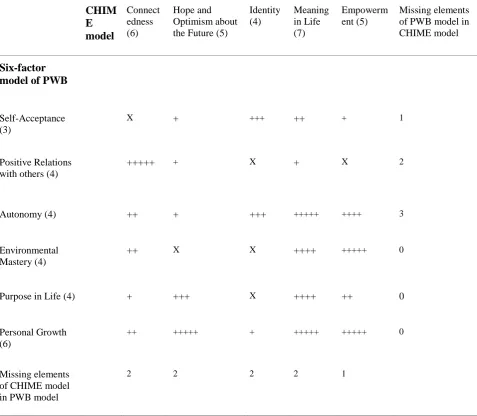
To compare the dimensions of the six-factor model of PWB and CHIME model to
each other, Table 4 was created. All elements, meaning the elements belonging the
dimensions, were each screened for overlaps with the other model respectively. Furthermore,
elements of each dimension of the models that were not included in the other model were
Six categories were generated. No overlap was signed as “X”. For an overlap of one to
five or more matches between two elements of each model was signed as “+” to “+++++”.
The number of possible matches was not limited. An overlap was defined as such if the
wording was very similar or when the underlying concepts were similar, which was then
described in more detail in the text below. The sections that indicated that elements that were
not included in the other model at all were signed with “0” , for no missing elements, till ”3” ,
for three missing elements. For no dimension, more than three elements were missing.
Moreover, the CHIME model sometimes listed several sub elements that were very
similar regarding content, as for instance managing symptoms, coping skills and self-help,
which are sub elements of the element care planning. Those sub elements were then handled
as one element, i.e. care planning.
2.2.2. Ryff’s Scales of PWB (RSPWB) and the Questionnaire about the Process of Recovery
(QPR)
Two broad aspects of the RSPWB and QPR were held as relevant to explore: (1) How
the two scales were constructed, their objectives and focus groups and formal characteristics,
and (2) their content and meaning, thus the meaning of each item. Thence, a first table
described all formal characteristics of the QPR and RSPWB - for example, what response
format was used. Each category was either assigned with a “+”, indicating overlap, or a “-”,
indicating no overlap between the scales. Because of their lengths, the generation of the scales
and their items and their sample validation studies were only analyzed in text, where details
were described and all comparisons between the two scales were made.
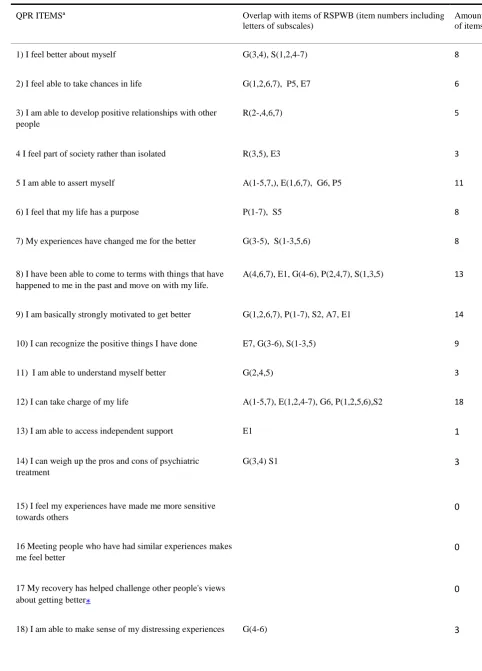
For the comparison of the content and meaning of the items, a second table listed all
items of the QPR. The items of RSPWB that overlapped with items of the QPR were then
the RWPWB item and/ or a similarity in wording of an RSPWB item to the corresponding
QPR item. Each item of the RSPWB could be matched to more than one item of the QPR. For
instance, the RSPWB item “I have the sense that I have developed a lot as a person over time”
matched 7 QPR items, for example “I feel better about myself.” or “I can recognize the
positive things I have done.”.How many items overlapped with each of the items of the QPR
was indicated as well. In order to match the items of the two scales adequately, all negative
items of the RSPWB were read positively, meaning that the formulation was reversed for the
analysis. For example, item P7 “I sometimes feel as if I've done all there is to do in life” was
read as “I feel as if there is still a lot to do in life”.
Finally, a last table was created to get an overview of the results from the perspective of the
overlap of QPR items with the RSPWB items. This table can be found under appendix D.
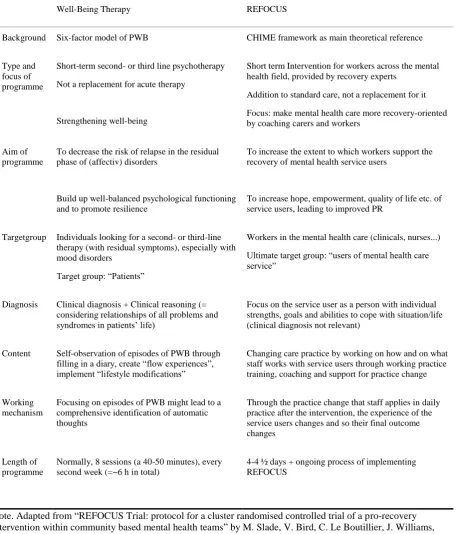
2.2.3. Well-Being Therapy (WBT) and the REFOCUS Intervention (RI)
To demonstrate the overlaps and differences between the WBT by Fava (1999) and the
RI (Slade et al., 2017) all information about the WBT and the RI was put in a table by
creating categories which were arranged in accordance with the gathered information. For
example, after having gathered information about the diagnosis procedure in the WBT, the
category “diagnosis” was added, and the information filled in. Eight categories could be
generated, for example “Target group” and “Working mechanism”. The comparison of the
WBT and the RI was accomplished per categories, for instance in the category “Target
group”, the target groups of the WBT and RI were compared to each other in a text below the
table and it was stated whether there was more overlap or difference in this category and why
this might be the case.
The results are displayed in the order of the three RQs. To make this section more
comprehensible, each of the three comparisons is introduced by a compendious answer to the
respective RQ. After the answer to the RQ, the table(s) are illustrated, a description of the
table and the analysis follow – explaining how the answers to each RQ were developed.
3.1. Six-Factor model of PWB and the CHIME model
Answer to RQ1: “What are the conceptual overlaps and differences between the
dimensions of the CHIME model and the dimensions of the six-factor model of psychological
well-being?”
All in all, the overlap in wording and specific behavior descriptions between elements
is rather low and elements of both models are spread out among various dimensions.
However, there is a lot of latent overlap, especially the content of the PWB model is reflected
in the CHIME model, whose elements are mostly applied to recovery specific topics and
specific behaviors or attitudes. Thence, the six-factor model of PWB is kept more general
than the CHIME model which could be said to build upon the elements described in the PWB
model, but adjusted for people in recovery, who search well-being, just as every individual
does. Nevertheless, the models are not interchangeable.
Comparison between the Six-Factor model of PWB and the CHIME model
To establish an overview and to have a baseline for comparison between the six-factor
model of PWB and the CHIME model, a comparison of the research aims, methods and
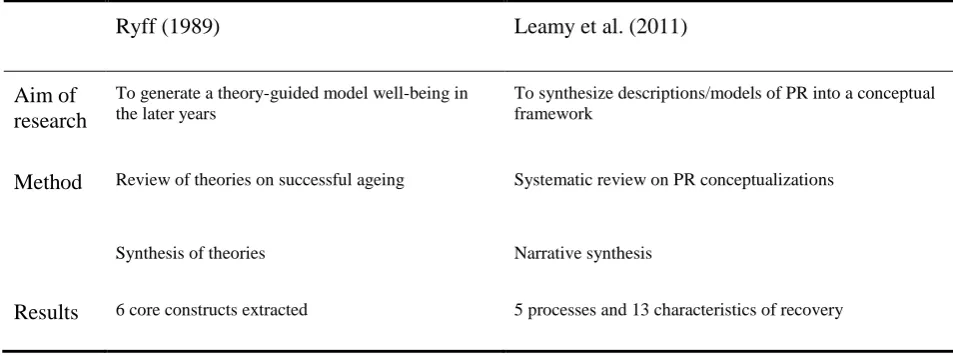
are presented in Table 3. After the description and analysis of Table 3, the comparison of the
[image:28.595.65.542.209.387.2]models’ dimensions is made and presented and Table 4.
Table 3
General overview of articles by Ryff (1989) and Leamy, Bird, Le Boutillier, Williams and Slade (2011)
Ryff (1989) Leamy et al. (2011)
Aim of research
To generate a theory-guided model well-being in the later years
To synthesize descriptions/models of PR into a conceptual framework
Method Review of theories on successful ageing
Synthesis of theories
Systematic review on PR conceptualizations
Narrative synthesis
Results 6 core constructs extracted 5 processes and 13 characteristics of recovery
The aim of research of the six-factor model of PWB and CHIME model are similar.
Both aimed at generating a new model or framework on the base of literature. Further, both
name the absence of an existing framework/model in their topic of research as a reason for
their investigation; there was no guiding theory in successful aging or theory providing an
adequate basis for defining well-being in the later years at that time (Ryff, 1989), neither a
clear and empirically based conceptualization for (personal) recovery (Leamy, Bird, Le
Boutillier, Williams & Slade, 2011). Still, the specific content of the models is different. Ryff
(1989) aimed at creating a model for successful aging and Leamy, Bird, Le Boutillier,
Williams and Slade (2011) wanted to build a framework for PR.
With regard to the used methods, both synthesized existing literature. For the
six-factor model of PWB, existing theories were gathered through a review of previous
approaches to the study of successful ageing. Those theories came from the fields of mental
maturity (Allport, 1961) and developmental lifespan (Buhler, 1935; Erikson, 1959; Galbraith,
Strauss, Jordan-Viola & Cross, 1974; Neugarten, 1968; 1973). Ryff (1989) then summarized
those theories and integrated those different theoretical perspectives into a new model of
well-being in the later years. She called it the six-factor model of PWB (Ryff, 1989).
The development of the framework for PR started by executing a systematic literature
review on research papers which described or developed conceptualizations of PR from
mental illness. Those conceptualizations had to be either a visual or narrative model of
recovery, or themes of recovery that emerged from an analysis of primary data or
a synthesis of secondary data. From 5,208 identified papers and 366 reviewed, 97 papers were
included in the execution of a narrative synthesis. After developing a preliminary synthesis,
relationships within and between studies were explored. In the end, the robustness of the
synthesis was assessed (Leamy, Bird, Le Boutillier, Williams & Slade, 2011).
Hence, even though both reviewed existing literature and subsequently synthesized existing
theories or conceptualizations, Leamy et al. (2011) gave more concrete information about the
gathering of information and the approach to literature and theory. Their general approach
gives a more objective impression than Ryff’s (1989) approach, as Leamy et al (2011)
followed certain guidelines. In Ryff’s (1989) article, it is not clarified how the selection of
certain theories took place, which election criteria were determined or on what basis other
theories were excluded.
Moreover, Ryff (1989) based her model of PWB exclusively on theories, while Leamy
et al. (2011) included only articles containing primary analyses or articles about theories
which were based on empirical studies.
In the end, Ryff (1989) could extract six core constructs out of the theories in the
fields mentioned above. Those core constructs were self-acceptance, positive relations with
Leamy et al. (2011) generated a conceptual framework out of the synthesis. The framework of
PR consists of (1) 13 characteristics of the recovery journey and (2) five recovery processes;
connectedness, hope and optimism about the future, identity, meaning in life, and
empowerment and (3) recovery stage descriptions which mapped onto the transtheoretical
model of change. Those five processes of PR build the acronym CHIME and the five
[image:30.595.61.539.324.740.2]dimensions of the CHIME model.
Table 4
Chime model dimensions and dimensions of six-factor model of PWB compared
CHIM E model Connect edness (6) Hope and Optimism about the Future (5)
Identity (4) Meaning in Life (7) Empowerm ent (5) Missing elements of PWB model in CHIME model
Six-factor model of PWB
Self-Acceptance (3)
X + +++ ++ + 1
Positive Relations with others (4)
+++++ + X + X 2
Autonomy (4) ++ + +++ +++++ ++++ 3
Environmental Mastery (4)
++ X X ++++ +++++ 0
Purpose in Life (4) + +++ X ++++ ++ 0
Personal Growth (6)
++ +++++ + +++++ +++++ 0
Missing elements of CHIME model in PWB model
2 2 2 2 1
+++++ = five or more matches; 0 = no elements missing; 1 = one elements missing; 2 = two elements missing; 3 = three elements missing
To start, an example is given that illustrates what an overlap (+) looks like. The
overlap between the dimension Autonomy of the PWB model and Hope and Optimism about
the Future of the CHIME model is found between the elements Evaluating self by personal
standards, being independent and self-determining (PWB model) and the element Positive
thinking and valuing Process (CHIME model). This example illustrates that overlaps were not
always obvious or exact overlaps regarding the wording, but often more about underlying
motives or values. When not even underlying values or motives were found between any
elements of dimension, the respective field was marked by a “X”, as for instance between the
dimensions Self-acceptance (PWB) and Connectedness (CHIME).
Overlap
Generally, there exists a predominant overlap between the dimensions of the two
models. In total, 24 out of 30 possible overlaps between different dimensions were found. The
overlaps varied in their level of overlap, indicated through the number of pluses, each
representing one overlap between two elements of dimensions. Out of the 24 overlaps
between dimensions, nine showed a high level of overlap (i.e. four or five pluses) and 15 a
lower level of overlap (i.e. three and less pluses).
The CHIME model dimension Meaning in Life shows the highest overlap with the
dimensions of the six-factor model of PWB. It has overlap with all dimension of the PWB
model. Of the PWB model, the dimension Personal Growth has overlap with all dimensions
of the CHIME model. Its substantial overlap is suggested to be due to the character of the
whole recovery journey which is naturally tied to personal growth, as in recovery one grows
this, elements of the Personal Growth dimension are, amongst others, the Feeling of
continued development and Changing in ways that reflects more self-knowledge and
effectiveness. Many elements of the CHIME model are recovery-related, like for example
positive thinking and valuing success, Personal responsibility (self-management: coping
skills, crisis planning, goal setting) and reflect the Personal-Growth dimension.
No overlap and Missing elements
No overlap between dimensions was found a total of six times, of which three times
the dimension Identity of the CHIME model was involved. Moreover, more elements of the
CHIME model were missing in the PWB model than vice versa. In total, eight dimensions,
out of the total 11 dimensions, were missing one to three elements in the other model
respectively, while the other three dimensions did not miss any element. All elements of those
three dimensions (Environmental Mastery, Personal Growth and Purpose in Life of the PWB
model) were covered in the CHIME model.
Half of dimensions of the six-factor model of PWB missed one or more elements in
the CHIME model. In contrast, each dimension of the CHIME model missed at least one
element in the PWB model. The reason for this might be that the elements of the CHIME
model were often very specific and recovery-related and therefore naturally not included in
the PWB model, as for instance the element knowledge about illness and treatment. As the
six-factor model of PWB is about PWB, mental illness and recovery are not relevant for this
model. Still, the underlying motivations, feelings and characteristics of the elements of the
CHIME model dimensions are described in the PWB model. To illustrate this; Feeling good
about the past (PWB) is not explicitly mentioned in the CHIME model, but another element
(accepting and normalizing it). Hence, in the CHIME model any other negative, or positive,
past events that are not related to mental illness are not considered.
As the element accepting or normalizing illness experience (CHIME model), might
lead to feeling good or better about the past, but must not, the element Feeling good about the
past (PWM model) is also an example of an element that was not exactly represented in the
CHIME model and was therefore marked as missing and as overlap at the same time. One
might accept the mental illness experience but accepting something about the past does not
equal feeling good about it. Because of such an equivocal character of some items, about half
of the items marked as not having a match, were also marked as overlaps.
An element which was missing completely in the CHIME model was the element
Spirituality or the development of it of the dimension Meaning in Life in the PWB model.
Mode of overlap
Hence, as stated in the beginning, overlap was not always exact but could also be
latent, for example when elements did reflect the same concept but were either applied to different situations or behaviors or formulated more specific than the other. For example,
overlaps between the elements of the dimensions purpose in life and meaning in life, which are similar concepts, were different from overlaps between purpose in life and connectedness, which were not that similar. In relation to this, an overlap between those dimensions was
found between the elements Being a part of the community (=active citizen, contributing to community) (CHIME) and the element sense of directedness in life and holding beliefs that
give life purpose (PWB). There was no exact overlap, but being an active citizen and
contributing to community, as stated in the CHIME model, probably reflects that a person is
holding the belief that being an active citizen is beneficial and important, so the individual has
dimensions Purpose in Life and Meaning in Life are, for example, more exact, because all
elements highlight similar values, such as finding meaning in life, the importance of goals in
life, purpose giving beliefs or spirituality and goal-directed living.
Further, many CHIME model elements were not formulated in the general form as the
elements in the six-factor model of PWB were. The CHIME model elements were formulated
more as concrete applications and descriptions, mostly applied to the recovery journey. Thus,
for example, instead of having aims and objectives for living, in the Purpose in Life
dimension, the CHIME model points out to the Identification and active pursuit of previous
or new life or social goals in the dimension Meaning in Life.
Moreover, the elements of both models are spread out among various dimensions of
the other model respectively, instead of mapping to only one dimension. For instance, can
Purpose in Life, of the PWB model, be found in the CHIME model dimension
Connectedness, Meaning in Life and Empowerment.
Another outcome was the different view on relationships described in the two models,
mostly in the dimension Positive Relations with others (PWB model) and Connectedness
(CHIME model). For instance, the dimension Positive Relations with others lists the
importance of positive feelings in and towards relationships and positive and caring feelings
about others. The CHIME model mentions intimate relationships in the dimension
Connectedness, but in general, the focus lies on receiving support (in recovering) from family,
professionals or groups. In opposition to this, the PWB model focuses on giving as well as
taking, includes the intrinsic motivation to help and the involvement and capacity of feeling.
Still, those two dimensions have substantial overlap.
3.2. Ryff’s scales of Psychological Well-Being (RSPWB) and the Questionnaire about the
Answer to RQ2: “What are the overlaps and differences between the used instruments
and measurement methods in Ryff’s scales of Psychological Well-Being (RSPWB) and the
Questionnaire about the Process of Recovery (QPR)?”
The QPR cannot be used interchangeably, as items did not match to specific subscales
and many QPR items were recovery-related. Still, they share the same underlying values and
attitudes. Regarding the set up and development of the scales the overlaps are outweighed by
the differences. The general set up and approach of the QPR, as for example the inclusion of
experience experts in the scale construction process, fits well to the spirit of recovery. Hence,
it can be said that the QPR was developed “with” possible respondents, while the RSPWB
were developed “from above” for possible respondents, as it was derived from theory and the
scale was only constructed by experts.
Comparison between the RSPWB and the QPR
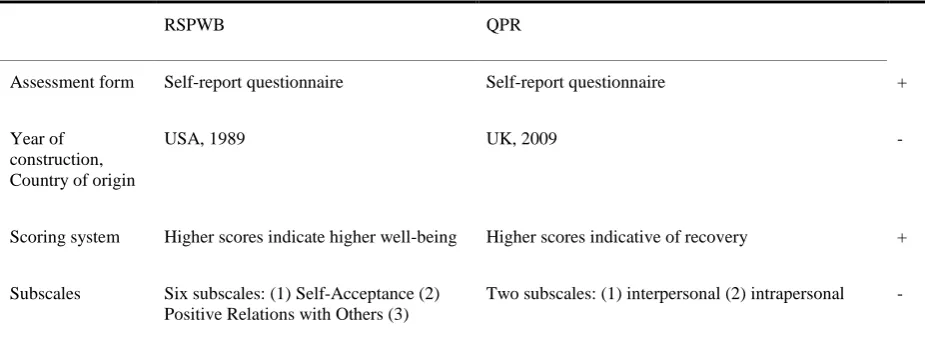
For this analysis, two tables were created, Table 5 and 6. Table 5 will be described and
[image:35.595.76.539.611.785.2]analyzed first, then Table 6 will be presented, followed by a description and analysis.
Table 5
Comparison of formal characteristics between the RSPWB and the QPR
RSPWB QPR
Assessment form Self-report questionnaire Self-report questionnaire +
Year of construction, Country of origin
USA, 1989 UK, 2009 -
Scoring system Higher scores indicate higher well-being Higher scores indicative of recovery +
Subscales Six subscales: (1) Self-Acceptance (2) Positive Relations with Others (3)
Autonomy (4) Environmental Mastery (5) Purpose in Life (6) Personal Growth
Quantity of Items 42 22 -
Positive and negative items
20 positive items, 22 negative items (reversed)
22 positive items, 0 negative items -
Response format Ordinal; Six-point Likert Scale Ordinal; Five-point Likert Scale +
Response categories
(1) strongly disagree; (2) moderately disagree; (3) slightly disagree; (4) slightly agree; (5) moderately agree; (6) strongly agree
(1) strongly disagree; (2) disagree; (3) neither agree nor disagree; (4) agree; (5) strongly agree
+
Shortest/Longest item regarding amount of words
7/20 5/24 +
Mean amount of words per item
~14 ~10 -
Language complexity
Flesch Reading Ease: 80,19* (equals reading level in the 6th grade in the US; easy to read)
Flesch Reading Ease: 81,87* (equals reading level in the 6th grade in the US;, easy to read)
+
Note. *Scores range between 0 and 100, higher scores indicate higher readability of texts. Adapted from
“Beyond Ponce de Leon and life satisfaction: New directions in quest of successful ageing”, by C. D. Ryff, 1989,
International Journal of Behavioral Development, 12(1), p. 35-55. “The Structure of Psychological Well-Being Revisited”, by C. D. Ryff and C. L. M. Keyes, 1995, Journal of Personality and Social Psychology, 69(4), p. 719-727. “Psychometric evaluation of the questionnaire about the process of recovery (QPR)”, by J. Williams, M. Leamy, F. Pesola, V. Bird, C. Le Boutillier and M. Slade, 2015, British Journal of Psychiatry, 207(6), p. 551–5. “The questionnaire about the process of recovery (QPR): A measurement tool developed in collaboration with service users”, by S. T. Neil, M. Kilibride, L. Pitt, S. Nothard, M. Welford, W. Sellwood and A. P.
Morrison, 2009, Psychosis, 1(2), p. 145-155.
At first sight, the amount of overlaps and differences seem to be equally distributed,
but the scale construction processes and validation studies are not included in the table.
Taking those aspects into account, there are more differences than overlaps. Because the scale
construction processes and validation studies were not included in the table, they are
described in more detail after the description of the table.
The first overlap of the RSPWB and the QPR is the used assessment form and scoring
system. The first major difference is that the RSPWB was developed in the US, 20 years
that map the six dimensions of Ryff’s six-factor model of PWB, while the two subscales of
the QPR developed from an exploratory factor analysis of the 22-item version of the QPR.
Two factors were identified; intrapersonal and interpersonal, which constitute the subscales.
Five items are interpersonal, which relate to individuals’ ability to reflect on their meaning in
their environment and on how external processes and relationships facilitate recovery. The
other 17 items are intrapersonal and relate to tasks one is responsible for carrying out and
necessary to complete in order to rebuild their life.
Moreover, the 42 items of the RSPWB are equally split into positive and negative
items. In contrast, the QPR consists of 22 exclusively positively formulated items, possibly
because it might be less distressing for the respondents to respond to positive than to negative
items which might trigger negative emotions.
Regarding the response format and the longest and shortest sentence of items, the
scales are similar. Nevertheless, the RSPWB possess a higher mean number of words per item
than the QPR. However, the language complexity of both scales is similar. Language
complexity was measured by applying the Flesch Reading Ease Test (Flesch, 1948), which is
still popular today (Readable, 2019). Scores range between zero and 100. The higher the
score, the easier a text is to read. Both, for the scales calculated, scores correspond to the US
reading ability of a sixth grader and are easy to read.
Scale construction process, item generation and validation sample study
The scale construction process and item generation of the RSPWB and the QPR were
carried out rather differently. The RSPWB are based on a theoretical model, the six-factor
model of PWB. The scale was constructed to have a measurement that accesses the construct
as described in the PWB model. The items were written, by three individuals, based on the