molecules
ISSN 1420-3049
www.mdpi.com/journal/molecules Article
The X-Ray Crystal Structures of Primary Aryl Substituted
Selenoamides
Yang Li, Guo-Xiong Hua, Alexandra M. Z. Slawin and J. Derek Woollins *
School of Chemistry, University of St Andrews, St Andrews, Fife, Scotland, KY16 9ST, UK
* Author to whom correspondence should be addressed; Email: [email protected].
Received: 18 December 2009; in revised form: 13 February 2009 / Accepted: 19 February 2009 / Published: 23 February 2009
Abstract: The X-ray structures of 12 primary selenoamides are reported. Metric parameters are provided, together with an illustration of the range of hydrogen bonding motifs.
Keywords: Woollins reagent; Primary selenoamides; X-ray structures.
Introduction
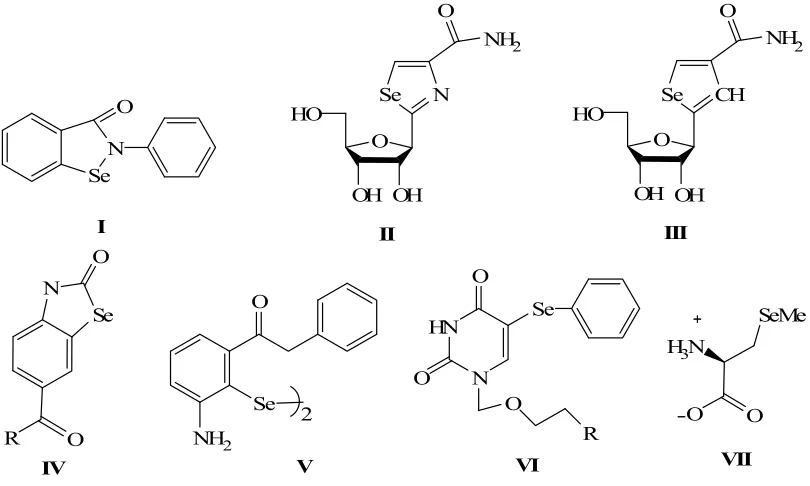
Selenium is an essential element for life; e.g, selenocysteine is recognised as the 21st amino acid and the importance of selenium containing enzymes in redox processes has is now recognized [1-3]. Many organoselenium compounds have been studied as biological models that simulate catalytic functions demonstrated by natural enzymes [4-14]. For example, ebselen (I, Figure 1) acts as a glutathione peroxidase (GPx) mimic and as a scavenger of peroxinitrite and the activity of the sulfur
analogue of ebselen was 15-fold lower than that of ebselen [5,6]. Selenazofurin (II) has been reported to be a potent inhibitor of phlebovirus infections [10]. Selenophenfurin (III) exhibits antiproliferative and inosine 5’-monophosphate dehydrogenase (IMPDH)-inhibition activity. Leukotrienes such as leukotriene B4 (LTB4) are important mediators of asthma, allergy, arthritis, psoriasis, and
inflammatory bowel disease [11,12]. Galet et al. showed that benzoselenazolinones of type IV and the corresponding diselenides V dramatically decrease the formation of LTB4 [13].
Phenylseleno-substituted pyrimidines of type VI exhibit significant inhibitory properties on Urd Pase and TMS.
methyl selenocysteine (VII) was found to be an antitumor agent, and it has been shown that β -elimination reaction is important for this activity [14].
Figure 1.Some biologically active selenium compounds.
Se N
O
O HO
OH OH N Se
NH2 O
Se O
NH2
2
HN
N O
O
Se
O
R O O
SeMe H3N
O HO
OH OH CH Se
NH2 O
Se N
O
R O
I II III
IV V VI VII
We have a long term interest in selenium chemistry [15-20]. Woollins reagent (WR, 2,4-bis(phenyl)-1,3-diselenadiphosphetane-2,4-diselenide, [PhP(Se)(µ-Se)]2), which is isostructural with
the thionation agent [(p-MeOC6H4)P(S)(µ-S)]2 (Lawesson’s reagent), and may be obtained readily
from PhPCl2, Na2Se and Se [21], is an excellent selenation reagent for converting a range of
unsaturated organic substrates into unusual phosphorus containing heterocycles [22-31]. We have recently reported the use of WR for organic transformations and for the facile synthesis of primary arylselenoamides from WR and ArCN [32]. Although the X-ray crystal structures of some tertiary and secondary selenoamides have been documented [33-39], surprisingly, no structural information has been published on primary arylselenoamides ArC(Se)NH2. We here provide a comparative study of a
range of these systems.
Results and Discussion
Selected metric parameters for compounds A - L are given in Table 1. The C=Se bond lengths range from 1.822(5) to 1.856(4) Å whilst the C-N bond lengths are in the range 1.270(7) to 1.324(8) Å. This compares with literature values from the Cambridge Database for amide C-Se distances of 1.787-1.885 and C-N of 1.29-1.34 Å. The amide functionality is not particularly coplanar with the aryl backbone, with the selenium atom lying up to 1.406 Å from the aryl ring mean plane with the C(7)-N(7)-Se(7) plane being up to 87o from the aryl mean plane in this case. This maximum deviation from coplanarity may be a function of the presence of two ortho chlorine substituents in compound L
molecules have quite different degrees of coplanarity for the selenoamide functional group and the aryl ring suggesting that there is little electronic reason for coplanarity.
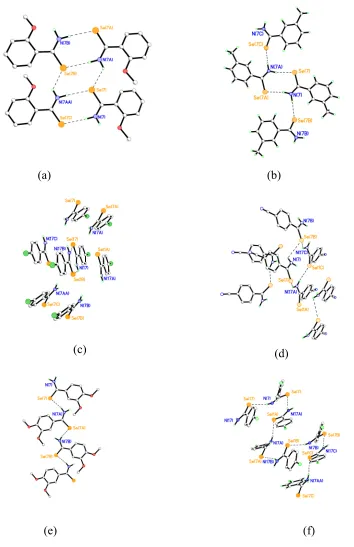
Figure 2. Examples of H-bonding motifs. (a) 1 ladder (b) 2 linked dimer (c) 7 Herring-bone dimers (d) 6 tetrameric sheets (e) 10 Chains (f) 9 Helical Chains.
(a) (b)
(e) (f)
Although hydrogen bonding is well understood for N-H···O and N-H···S systems, there is less data available for N-H···Se systems. We have previously noted that Ph2P(Se)NHP(Se)Ph2 forms dimers via
N-H···Se hydrogen bonds (Se···N 3.19, Se···H 2.52 Å) [40] and it is interesting to note the range of (d)
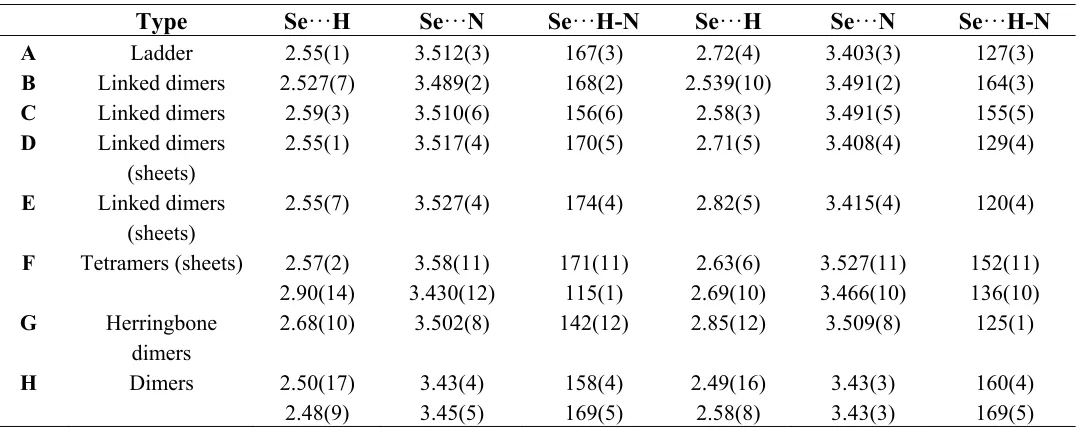
motifs that we have observed in compounds A – L (Figure 2). We have broadly classified the pattern of hydrogen bonding in compounds A - L and give selected parameters in Table 2 and provide illustrative examples in Figure 1. It is clear that N-H···Se hydrogen bonding is an important feature of the solid state packing of these molecules and may be a significant influence in biological systems.
Table 1. Selected 77Se NMR data, bond lengths (Å) and angles (o) (Rows containing
multiple entries are a.consequence of the presence of more than one independent molecule in the asymmetric unit).
δSe (ppm*) C=Se (Å) C-N (Å) Aryl/Scene interplanar angle (°)
Deviation of Se from aryl Mean plane (°)
A 602.1 1.856(4) 1.311(5) 21 0.469
B 641.2 1.848(3) 1.314(3) 36 1.118
C 628.6 1.829(7) 1.318(9) 27 0.619
D 608.7 1.843(5) 1.316(7) 14 0.343
E 579.5 1.848(5) 1.317(6) 17 0.576
F 703.7 1.840(11)
1.846(14) 1.292(15) 1.332(17) 7 40 0.157 1.087
G 646.5 1.855(10)
1.844(12) 1.310(13) 1.295(17) 10 3 0.173 0.104
H* 647.2 1.81(5) 1.27(7) 8-32 0.299 [-0.963]
[image:4.595.32.570.545.760.2]I 629.6 1.829(6)
[1.838(6)]
1.324(8) [1.305(8)]
37 [18] 1.018 [0.361]
J 529.0 1.829(6) 1.324(10) 39 0.786
K 649.9 1.838(3) 1.317(4) 48 1.346
L 715.8 1.822(5) 1.298(7) 87 1.406
*Five independent molecules in the asymmetric unit, average bond lengths and ranges of Se deviations/interplanar angles are given.
Table 2. Major N-H···Se hydrogen bonding distances (Å).
Type Se···H Se···N Se···H-N Se···H Se···N Se···H-N
A Ladder 2.55(1) 3.512(3) 167(3) 2.72(4) 3.403(3) 127(3)
B Linked dimers 2.527(7) 3.489(2) 168(2) 2.539(10) 3.491(2) 164(3)
C Linked dimers 2.59(3) 3.510(6) 156(6) 2.58(3) 3.491(5) 155(5)
D Linked dimers (sheets)
2.55(1) 3.517(4) 170(5) 2.71(5) 3.408(4) 129(4)
E Linked dimers (sheets)
2.55(7) 3.527(4) 174(4) 2.82(5) 3.415(4) 120(4)
F Tetramers (sheets) 2.57(2) 2.90(14) 3.58(11) 3.430(12) 171(11) 115(1) 2.63(6) 2.69(10) 3.527(11) 3.466(10) 152(11) 136(10)
G Herringbone
dimers
2.68(10) 3.502(8) 142(12) 2.85(12) 3.509(8) 125(1)
H Dimers 2.50(17)
Table 2.Cont.
I Helical chain 2.63(3)
2.74(4) 3.513(5) 3.566(5) 150(4) 143(5) 2.97(3) 2.62(3) 3.628(5) 3.512(5) 125(4) 151(5)
J Chain 2.52(2) 3.483(6) 168(6)
K Dimers 2.69(1) 3.63(3) 162(3)
L Linked dimers 2.535(8) 3.511(4) 174(5) 2.579(14) 3.533(4) 165(4)
N-H···O hydrogen bonding: a H···O 2.09(4) Å, N…O 3.016(7) Å, N-H…O 156(7) Å; bH···O
2.32(3) Å, 2.24(3) Å; N···O 3.076(4), 2.923(3) Å; N-H···O 133(3), 126(3) Å.
Experimental
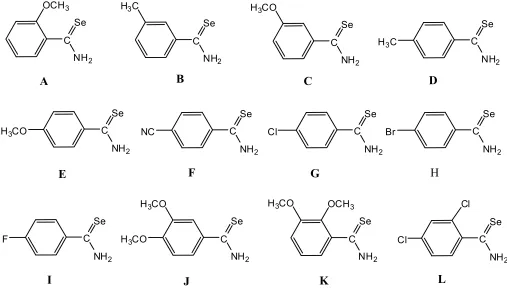
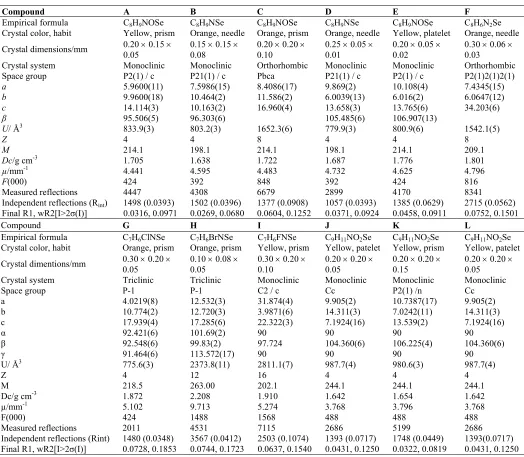
[image:5.595.51.558.447.738.2]Primary arylselenoamides A – L (Figure 3) were prepared as described previously [32]. Their X-ray crystal data (Table 3) were collected at 93 K by using a Rigaku MM007 High brilliance RA generator/confocal optics and Mercury CCD system. Intensities were corrected for Lorentz-polarisation and for absorption. The structures were solved by direct methods. Hydrogen atoms bound to carbon were idealised. Structural refinements were obtained with full-matrix least-squares based on F2 by using the program SHELXTL [41]. CCDC 611494 & 611495 CCDC 713559 - 713568 contain the supplementary crystallographic data for this paper. These data can be obtained free of charge via www.ccdc.cam.ac.uk/conts/retrieving.html or from the Cambridge Crystallographic Data centre, 12 Union Road, Cambridge CB2 1EZ, UK; fax (+44) 1223-336-033; E-mail: [email protected].
Figure 3. The chemical structures of primary arylselenoamides A – L.
C Se NH2 OCH3 C Se NH2 H3CO
C Se
NH2 H3C
C Se
NH2 H3C
C Se
NH2 H3CO
A B C D
E C Se NH2 NC F C Se NH2 Cl C Se NH2 Br G H C Se NH2 F I C Se NH2 H3CO
J
H3CO C
Se
NH2 OCH3 H3CO
Table 3. Details of data collections and refinements for A - L.
Compound A B C D E F
Empirical formula C8H9NOSe C8H9NSe C8H9NOSe C8H9NSe C8H9NOSe C8H6N2Se
Crystal color, habit Yellow, prism Orange, needle Orange, prism Orange, needle Yellow, platelet Orange, needle
Crystal dimensions/mm 0.20 × 0.15 ×
0.05
0.15 × 0.15 ×
0.08
0.20 × 0.20 ×
0.10
0.25 × 0.05 ×
0.01
0.20 × 0.05 ×
0.02
0.30 × 0.06 ×
0.03
Crystal system Monoclinic Monoclinic Orthorhombic Monoclinic Monoclinic Orthorhombic
Space group P2(1) / c P21(1) / c Pbca P21(1) / c P2(1) / c P2(1)2(1)2(1)
a 5.9600(11) 7.5986(15) 8.4086(17) 9.869(2) 10.108(4) 7.4345(15)
b 9.9600(18) 10.464(2) 11.586(2) 6.0039(13) 6.016(2) 6.0647(12)
c 14.114(3) 10.163(2) 16.960(4) 13.658(3) 13.765(6) 34.203(6)
β 95.506(5) 96.303(6) 105.485(6) 106.907(13)
U/ Å3 833.9(3) 803.2(3) 1652.3(6) 779.9(3) 800.9(6) 1542.1(5)
Z 4 4 8 4 4 8
M 214.1 198.1 214.1 198.1 214.1 209.1
Dc/g cm-3 1.705 1.638 1.722 1.687 1.776 1.801
µ/mm-1 4.441 4.595 4.483 4.732 4.625 4.796
F(000) 424 392 848 392 424 816
Measured reflections 4447 4308 6679 2899 4170 8341
Independent reflections (Rint) 1498 (0.0393) 1502 (0.0396) 1377 (0.0908) 1057 (0.0393) 1385 (0.0629) 2715 (0.0562)
Final R1, wR2[I>2σ(I)] 0.0316, 0.0971 0.0269, 0.0680 0.0604, 0.1252 0.0371, 0.0924 0.0458, 0.0911 0.0752, 0.1501
Compound G H I J K L
Empirical formula C7H6ClNSe C7H6BrNSe C7H6FNSe C9H11NO2Se C9H11NO2Se C9H11NO2Se
Crystal color, habit Orange, prism Orange, prism Yellow, prism Yellow, patelet Yellow, prism Yellow, patelet
Crystal dimentions/mm 0.30 0.05 × 0.20 × 0.10 0.05 × 0.08 × 0.10 0.30 × 0.20 × 0.20 0.05 × 0.20 × 0.15 0.20 × 0.20 × 0.20 0.05 × 0.20 ×
Crystal system Triclinic Triclinic Monoclinic Monoclinic Monoclinic Monoclinic
Space group P-1 P-1 C2 / c Cc P2(1) /n Cc
a 4.0219(8) 12.532(3) 31.874(4) 9.905(2) 10.7387(17) 9.905(2)
b 10.774(2) 12.720(3) 3.9871(6) 14.311(3) 7.0242(11) 14.311(3)
c 17.939(4) 17.285(6) 22.322(3) 7.1924(16) 13.539(2) 7.1924(16)
α 92.421(6) 101.69(2) 90 90 90 90
β 92.548(6) 99.83(2) 97.724 104.360(6) 106.225(4) 104.360(6)
γ 91.464(6) 113.572(17) 90 90 90 90
U/ Å3 775.6(3) 2373.8(11) 2811.1(7) 987.7(4) 980.6(3) 987.7(4)
Z 4 12 16 4 4 4
M 218.5 263.00 202.1 244.1 244.1 244.1
Dc/g cm-3 1.872 2.208 1.910 1.642 1.654 1.642
µ/mm-1 5.102 9.713 5.274 3.768 3.796 3.768
F(000) 424 1488 1568 488 488 488
Measured reflections 2011 4531 7115 2686 5199 2686
Independent reflections (Rint) 1480 (0.0348) 3567 (0.0412) 2503 (0.1074) 1393 (0.0717) 1748 (0.0449) 1393(0.0717)
Final R1, wR2[I>2σ(I)] 0.0728, 0.1853 0.0744, 0.1723 0.0637, 0.1540 0.0431, 0.1250 0.0322, 0.0819 0.0431, 0.1250
Acknowledgements
The authors are grateful to the University of St Andrews and the Engineering and Physical Science Research Council (EPSRC, U.K.) for financial support.
References
1. May, S.W.; Pollock, S.H. Selenium-Based Antihypertensives: Rationale and Potential. Drugs
1998, 56, 959-964.
3. Metanis, N.; Keinan, E.; Dawson, P.E. Synthetic Seleno-Glutaredoxin 3 Analogues Are Highly Reducing Oxidoreductases with Enhanced Catalytic Efficiency. J. Am. Chem. Soc. 2006, 128, 16684-16691.
4. Mugesh, G.; Du Mont, W.W.; Sies, H. Chemistry of Biologically Important Synthetic Organoselenium Compounds. Chem. Rev. 2001, 101, 2125-2180.
5. Ganther, H.E. Selenium-containing complexes of arginine and lysine.Bioorg. Med. Chem. 2001, 9, 1459-1466.
6. Sies, H.; Masumoto, H. Antioxidant Potential of Dimethyl Lithospermate Isolated from Salvia miltiorrhiza (Red Sage) Against Peroxynitrite. Adv. Pharmacol. 1997, 38, 2229-2246.
7. Detty, M.R.; Merkel, P.B.; Gibson, S.L.; Hilf, R. Chalcogenapyrylium dyes as dual-action sensitizers for photodynamic therapy. Oncology Res.1992, 4, 367-373.
8. Bellnier, D.A.; Young, D.N.; Detty, M.R.; Camacho, S.; Oseroff, A.R. pH-Dependent Chalcogenopyrylium Dyes as Potential Sensitizers for Photodynamic Therapy: Selective Retention in Tumors by Exploiting pH Differences between Tumor and Normal Tissue.
Photochem. Photobiol.1999, 70, 630-636.
9. Leonard, K.A.; Hall, J.P.; Nelen, M.I.; Davies, S.R.; Gollnick, S.O.; Camacho, S.; Oseroff, A.R.; Gibson, S.L.; Hilf, R.; Detty, M.R. A Selenopyrylium Photosensitizer for Photodynamic Therapy Related in Structure to the Antitumor Agent AA1 with Potent in Vivo Activity and No Long-Term Skin Photosensitization. J. Med. Chem. 2000, 43, 4488-4498.
10. Smee, D.F.; Huffman, J.H.; Hall, L.L.; Huggins, J.W.; Sidwell, R.W. Inhibition of Phlebovirus infections in vivo by tiazofurin and selenazofurin.Antiviral Chem. Chemother. 1990, 1, 211-220. 11. Franchetti, P.; Cappellacci, L.; Grifantini, M.; Barzi, A.; Nocentini, G.; Yang, H.; O’Connor, A.; Jayaram, H.N.; Carrell, C.; Goldstein, B.M. Furanfurin and Thiophenfurin: Two Novel Tiazofurin Analogs. Synthesis, Structure, Antitumor Activity, and Interactions with Inosine Monophosphate Dehydrogenase. J. Med. Chem. 1995, 38, 3829-3837.
12. Franchetti, P.; Cappellacci, L.; Abu Sheikha, G.; Jayaram, H.N.; Gurudutt, V.V.; Sint, T.; Schneider, B.P.; Jones, W.D.; Goldstein, B.M.; Petra, G.; De Montis, A.; Loi, A.G.; La Colla, P.; Grifantini, M. Synthesis, Structure, and Antiproliferative Activity of Selenophenfurin, an Inosine 5‘-Monophosphate Dehydrogenase Inhibitor Analogue of Selenazofurin. J. Med. Chem. 1997, 40, 1731-1737.
13. Galet, V.; Bernier, J.L.; Hénichart, J.P.; Lesieur, D.; Abadie, C.; Rochette, L.; Lindenbaum, A.; Chalas, J.; Renaud de la Faverie, J.F.; Pfeiffer, B.; Reinard, P. Benzoselenazolinone Derivatives Designed To Be Glutathione Peroxidase Mimetics Feature Inhibition of Cyclooxygenase/5-Lipoxygenase Pathways and Anti-inflammatory Activity. J. Med. Chem.1994, 37, 2903-2911. 14. Ip, C.; Hayes, C.; Budnick, R.M.; Ganther, H.E. Chemical Form of Selenium, Critical
Metabolites, and Cancer Prevention. Cancer Res.1991, 51, 595-600.
15. Fitzmaurice, J.C.; Williams, D.J.; Wood, P.T.; Woollins, J.D. Organo-phosphorus–selenium heterocycles. J. Chem. Soc., Chem. Commun. 1988, 741-743.
16. Wood, P.T.; Woollins, J.D. J. Chem. Soc., Phosphorus–selenium heterocycles. Chem. Commun.
17. Wood, P.T.; Woollins, J.D. New Phosphorus-Selenium Heterocycles. Phosphorus Sulfur Relat. Elem.1989, 41, 51-56.
18. Pilkington, M.J.; Slawin, A.M.Z.; Williams, D.J.; Wood, P.T.; Woollins, J.D. The preparation and characterization of binary phosphorus-selenium rings. Heteroatom Chem.1990, 1, 351-355. 19. Hall, S.W.; Pilkington, M.J.; Slawin, A.M.Z.; Williams, D.J.; Woollins, J.D. The preparation and
x-ray crystal structure of (PMe)4Se3. Polyhedron1991, 10, 261-265.
20. Pilkington, M.J.; Slawin, A.M.Z.; Williams, D.J.; Woollins, J.D. Phosphorus-selenium heterocycles. Phosphorus, Sulfur Silicon Relat. Elem.1992, 65, 111.
21. Gray, I.P.; Bhattacharyya, P.; Slawin, A.M.Z.; Woollins, J.D. A New Synthesis of (PhPSe2)2
(Woollins Reagent) and Its Use in the Synthesis of Novel P-Se Heterocycles. Chem. Eur. J.
2005, 11, 6221-6227.
22. Bhattacharyya, P.; Woollins, J.D. Selenocarbonyl synthesis using Woollins reagent. Tetrahedron Lett. 2001, 42, 5949-5951.
23. Bhattacharyya, P.; Slawin, A.M.Z.; Woollins, J.D. The X-ray crystal structure of 2-tert -butylindolizine-3-selenoaldehyde. Inorg. Chem. Commun. 2004, 7, 1171-1173.
24. Bhattacharyya, P.; Slawin, A.M.Z.; Woollins, J.D. The Reactivity of [PhP(Se)( -Se)]2 and
(PhP)3Se2 Towards Acetylenes and Cyanamides: X-ray Crystal Structures of Some P-Se-C and
P-Se-C-N Heterocycles. Chem. Eur. J.2002, 8, 2705-2711.
25. Bhattacharyya, P; Slawin, A.M.Z.; Woollins, J.D. Reaction of [{PhP(Se)( -Se)}2] with Dialkyl
Cyanamides: X-ray Crystal Structures of the Phosphorus-Containing Triselenapentalenes [Me2N-C(Se)=N]2P(Se)Ph and [O(CH2CH2)2N-C(Se)=N]2P(Se)Ph. Angew. Chem., Int. Ed. 2000,
39, 1973-1975.
26. Bhattacharyya, P.; Slawin, A.M.Z.; Woollins, J.D. Bridge cleavage of [{PhP(Se)(μ-Se)}2] by
1,2-C6H4(EH)(E′H) (E, E′=O or NH). X-ray crystal structure of PhP(Se)(NHC6H4NH-1,2). J.
Organomet. Chem. 2001, 623, 116-119.
27. Gray, I.P.; Slawin, A.M.Z.; Woollins, J.D. Synthesis and structure of [Fc(RO)PS2]– complexes.
Dalton Trans. 2003, 3450-3457.
28. Gray, I.P.; Slawin, A.M.Z.; Woollins, J.D. Synthesis and characterisation of disulfides and esters derived from their sodium organodithiophosphonate salts. New J. Chem. 2004, 1383-1389. 29. Gray, I.P.; Slawin, A.M.Z.; Woollins, J.D. Synthesis and structure of [An(RO)PS2]– complexes.
Dalton Trans. 2004, 2477-2486.
30. Hua, G.; Li, Y.; Slawin, A.M.Z.; Woollins, J.D. Stereoselective synthesis of olefins by a reductive coupling reaction. Dalton Trans.2007, 1477-1480.
31. Hua, G.; Woollins, J.D. The syntheses of sulfides by deoxygenation of sulfoxides using Woollins’ reagent. Tetrahedron Lett.2007, 48, 3677-3679.
32. Hua, G.; Li, Y.; Slawin, A.M.Z.; Woollins, J.D. Synthesis of Primary Arylselenoamides by Reaction of Aryl Nitriles with Woollins' Reagent.Org. Lett. 2006, 8, 5251-5254.
33. Otten, P.A.; Gorter, S.; Van der Gen, A. A Structural Study of Selenobenzamides: Crystal Structures and Dynamic 13C NMR.Chem. Ber. 1997, 130, 49-54.
35. Fischer, H.; Triliomis, A.; Gerbing, U.; Huber, B.; Mueller, G. Thio- and seleno-acrylamide derivatives from ynamines and transition metal-co-ordinated thio- and seleno-aldehydes and – ketones. J. Chem. Soc., Chem. Commun. 1987, 559-560.
36. Fischer, H.; Gerbing, U.; Triliomis, A.; Mueller, G.; Huber, B.; Riede, J.; Hofmann, J.; Burger, P. Übergangsmetall-koordinierte Heteroolefine als Synthesebausteine: Thio- und Selenoacrylamide aus 1-(Diethylamino)-1-propin und Heteroaldehyd- und -keton-Komplexen. Chem. Ber. 1988, 121, 2095.
37. Murai, T.; Mizutani, T.; Kanda, T.; Kato, S. Reactions of diselenoic acid esters with amines and X-ray crystal structure analyses of aromatic selenoamides.HeteroatamChem. 1995, 6, 241-246. 38. Blau, H.; Grobe, J.; Le Van, D.; Krebs, B.; Lage, M. Reactive E=C [p-p] Systems, 46
Syntheses and X-ray Crystal-Structure Analyses of Trifluoromethyl-Substituted Ketiminodiselanes, Selenoamides and Selenoacrylamides. Chem. Ber. 1997, 130, 913-922;
39. Murai, T.; Niwa, N.; Ezaka, T.; Kato, S. Structure of N-Aryl Selenoacetamides in Solutions and in the Solid State. J. Org. Chem. 1998, 63, 374-376.
40. Bhattacharyya, P.; Novosad, J.; Phillips, J.; Slawin, A.M.Z.; Williams, D. J.; Woollins, J. D. Bis(bidentate) complexes of iminobis(diphenylphosphine chalcogenides)[M{N(XPPh2)2-X,X
}2](X = S or Se; M = Ni, Pd or Pt). J. Chem. Soc., Dalton Trans. 1995, 1607-1613.
41. SHELXTL 6.11. Bruker AXS: Madison, WI, USA, 2004.
Sample Availability: Available from the authors.