Int. J. Communications, Network and System Sciences, 2010, 3, 59-65
doi:10.4236/ijcns.2010.31008 Published Online January 2010 (http://www.SciRP.org/journal/ijcns/).
Hierarchical Resource Load Balancing Based on
Multi-Agent in ServiceBSP Model
Bin CHENG1,2, Yan JIANG1, Weiqin TONG1
1
School of Computer Engineering and Science, Shanghai University, Shanghai, China
2
College of Mathematics, Physics and Information Engineering, Zhejiang Normal University,Jinhua, China Email: [email protected], jiangyan_2273@163.com, [email protected]
Received September 18,2009; revised October 20,2009; accepted November 26,2009
Abstract
Based on ServiceBSP model, a hierarchical resource load balancing algorithm with Multi-Agent is put for-ward in this paper which achieves the goal of dynamic load balancing and favorable Fault-tolerant. The
algo-rithm calculates the load value according to the attributes of resourceand scheduling tasks relies on the load
value, while updating the load information dynamically depending on Multi-Agent. The method avoids fre-quent communications on load information. Furthermore, the paper introduces the function of agents, rela-tions and communicarela-tions among agents in details. Finally, by comparing response time and distribution of load using proposed method with other available methods such as without no load balancing and load bal-ancing only giving regards to CPU, the experimental simulation shows that the load balbal-ancing based on Multi-Agent possesses superior performance on response time and load balancing.
Keywords: ServiceBSP Model, Multi-Agent, Load Balancing
1. Introduction
The problem of load balancing often occurs in some ap-plications of parallel computing. Reasonable load bal-ancing algorithm should be able to improve system throughout and reduce task response time. Many load balancing algorithms designed to support distributed system have been proposed and reviewed in the literature [1–4], only a few have been designed, or are scalable to support load balancing of all types of resource and con-sider the characteristics of different tasks, which are in-clined to cause the occurrence of unbalance of different types of resources in a node (mainly mean the computer). In the distributed system, the arrival of task is a dynamic process that sometimes can not be predicted, which indi-cates that the status of load balancing of nodes is not static and dynamic load balancing is required. Mean-while, we should know the point that nodes have free-dom to choose to join in or leave the queue providing services. So adopting effective method of dynamic load balancing bearing ability of providing reliable resources is a significant research.
ServiceBSP model combines the characteristic of su-perstep of parallel computing model-BSP and the con-cept of service in currently popular technology of web service [5]. In the model, we abstract all the resources
(mainly computing resources) to services. In the refer-ence [6], the author propounds a ServiceBSP model based on QoS (quality of service) that can satisfy the needs of users.
In this paper, we have developed a load balancing al-gorithm based on Multi-agent which successfully bal-ances the usage of all the types of resources. The algo-rithm not only considers the usage ratio of CPU and other types of resources in the precondition of satisfying the needs of users, but also solves the problem of ro-bustness in the process of providing services, avoiding frequent information transfer which would bring extra communication cost.
The rest of this paper is organized as follows: Ser-viceBSP model is shown in Section 2. In Section 3, the load balancing algorithm is proposed and described in details. The application of Multi-agent in hierarchical load balancing is introduced in Section 4. Section 5 pre-sent experimental simulation results, and Section 6 con-cludes the paper.
2. ServiceBSP Model
B. CHENG ET AL. 60
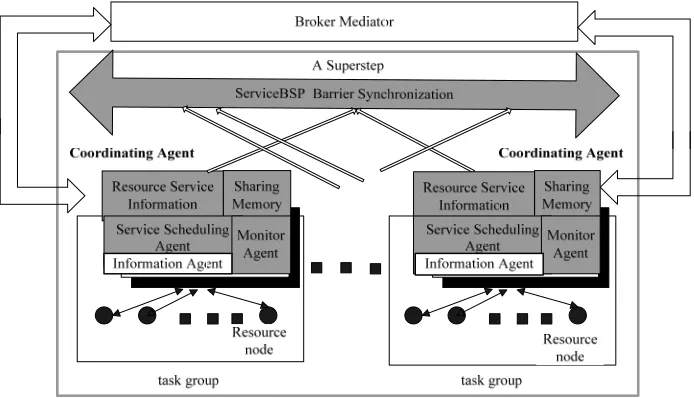
Figure 1. A superstep of ServiceBSP model
viceBSP model which introduces the concept of service to BSP model effectively [5,7]. An application is firstly divided into several tasks according to their intrinsic properties because of its loose coupled characteristic. Tasks are executed in parallel and a little communica-tions occurs between tasks.
All nodes providing services should publish the in-formation of their services to a searchable registry of services description and update it. Such information in-cludes functional performance, physical location, and healthy qualities such as available, and also price.
Figure 1 shows a superstep of the model.
In the Figure 1, Broker Mediator is responsible to in-teract with Coordinating Agent. Broker assumes the re-sponsibility to select services satisfying needs of users from the center of service registry while giving consid-eration to the physical location and pertinence among services. Then Broker maps the information of selected services to correspondently initialized Coordinating Agent with the help of Mediator.
3. Resources Load Balancing Algorithm in
ServiceBSP Model
Resource Oriented Load Balancing Algorithm (ROLBA) is a dynamic load balancing algorithm, which is based on a load rank of nodes. The load of all nodes is assessed by the dynamic load value which takes such factors into account as CPU, memory, network bandwidth [8–10]. ROLBA is based on the characteristic of the superstep of ServiceBSP. It is that the time of superstep is composed of the time of local job (including the calculating and memory exchange), the time of global communication and the time of barrier synchronization.
ROLBA is divided into 3 stages, like Figure 2. The first stage is information collection, which includes the
static information and dynamic information of the node. The information can be used to check the imbalance of the nodes. The second stage is prediction. Predicting the time of local job of every node is based on the informa-tion collected in the first stage. Then the distribuinforma-tion of the threads can be made for the nodes. The third stage is thread migration. It is based on the distribution of the threads and the communication cost between the threads.
ROLBA can make node calculate the threshold value by means of investigating the local job finishing time of another nodes and estimate the balance quality itself. The Agent in the node can be used to finish the local job, broadcast the finish time all of the nodes, receive the time information from other nodes and estimate the bal-ance quality of the node. If it is imbalbal-ance, the node will send the dynamic information to the load balancer. The responsiveness of Agent simplifies these operations.
4. Application of Multi-Agent in Load
Balancing
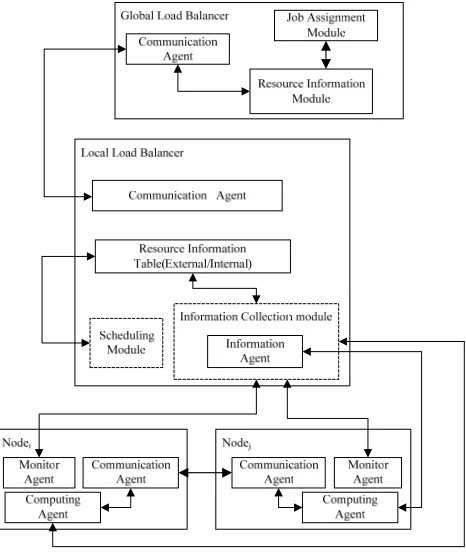
In the Figure 1, we have a general description of Coor-dinating Agent. The relations among agents and of these agents with other modules in one task group are illus-trated in Figure 3.
4.1. Hierarchical Load Balancing Based on
Multi-Agent
B. CHENG ET AL. 61
Figure 2. Resource oriented load balancing algorithm.
Figure 3. Relation of multi-agent.
among them are expressed in Figure 3. The scheduling process is completed by the cooperation of Global Load Balancer and Local Load Balancer. And the Monitor Agents in each node supply the local information to up-per level Information Agent. The interpretation of de-tailed function in Figure 3 is as follows:
[image:3.595.175.408.354.633.2]B. CHENG ET AL. 62
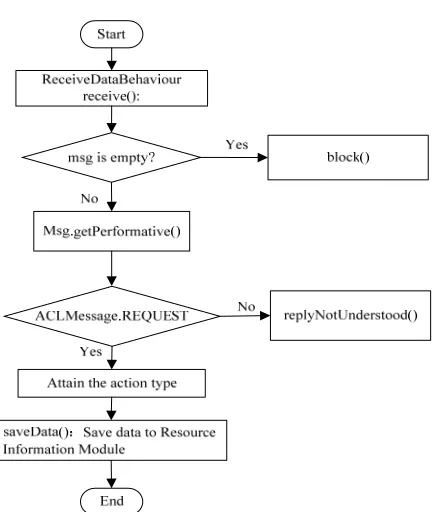
Figure 4. Work flow chart of communication agent in global load balancer.
wise, saveData() stores the received information in Re-source Information Module. The information is the foundation to allocate job.
2) Local Load Balancer has Communication Agent and Information Agent.
Communication Agent sends the load information to the agent in Local Load Balancer similar to the Communication Agent in Global Load Balancer. Besides the action classes ReceiveDataBehaviour, SendDataBehaviour is the main work. ReceiveDa-taBehaviour gets the data by readData(). And SendDataBehaviour sends these data by SendMes-sage(), after attaining the Agent list which will re-ceive the information.
The works of receiving the load value of a node and monitoring the information on whether the node is alive or not are assigned to Information Agent. In order to get the valid load value Information Agent should update Internal Resource Information Table timely when monitoring changes. The function principle is simple. If the IP of the node, which has the Information Agent to send information, is in the Internal Resource Information Table, the informa-tion of this node can be updated by the received in-formation NodeInfo. Otherwise, the inin-formation of this node should be added to the table.
The Internal Resource Information Table stores the information of all the nodes in the task group including the physical location, logic ID, capabil-ity, AgentID, port and load value etc. And the
Ex-formation of other Coordinating Agent and makes preparing information of targets for the global communication following a local computation in a superstep.
3) Each node
ternal Resource Information Table stores the
in-has 3 kinds of Agent. They are Monitor A
s
e of the
gent, Communication Agent and Computing Agent.
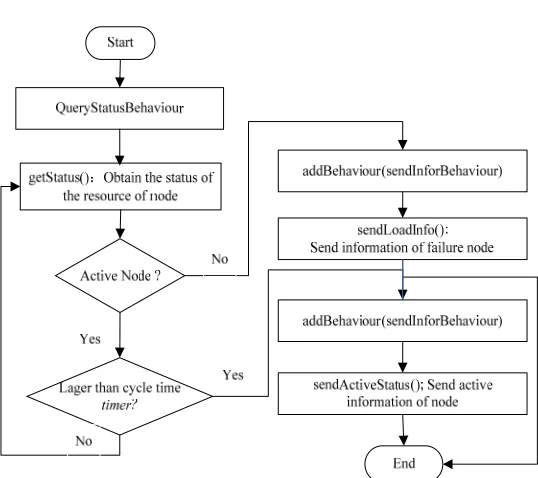
Monitoring Agent is designed to monitor the statu of node for supporting robustness in ServiceBSP model. If nodes encounter abrupt failure or apply to leave the queue of providing services, Monitoring Agent would gain this information by getStatus() and then update Internal Information Table by sendLoadInfo() and sendActiveStatus(). Finally, it selects an alternative with lightest load for failed node to execute the discontinued task. Figure 7 ex-presses the flowchart of Monitor Agent.
Communication Agent broadcasts the tim
local job after the completeness of local computing and receives the time information of other nodes. Two object entities, SendAgent() and ReceiveAgent (), compose the Communication Agent. Their reali- zation process is similar to the Communication Agent in Global/Local Load Balancer.
Computing Agent calculates ave
, where
2 1 ( - ) N i n ave N
and 1
N i i n ave N
, and estiwheth the thresho
.2. Agent Communication
In ServieBSP model based on Multi-Agent, we suggest
first mode of communication mainly consists of fo
ode of communication adopts the Know- ledge Query and Manipulation Language (KQML)
mates
er it is more than ld or not. If it is, Local Load Balancer will receive the dynamic in-formation of the job implement situation of this node.
4
two modes of communications among agents [11]. One mode concerning agents in the same task group occurs in Sharing Memory. Global communication is attributable to another mode relative to different task groups, mean-ing direct communication from one point to another point.
The
ur operations: read data, write data, delete data and modify data. All the operations are supervised by Moni-toring Agent. Up to the point, we have assumed that load value of nodes serves as the criteria for scheduling task in order to acquire the goal of load balancing. The load value will update with a new task coming in. The Task Agent of such node that receives a new task assumes the duty to inform the dynamic load value to Internal Infor-mation Table immediately, which actually ensures the load balancing.
B. CHENG ET AL. 63
Figure 5. Work flow chart of monitor agent in node.
Table 1. Task queues.
Queue NO.
(bid,mid,small)tasks number High CPU value High memory value
S0
(5,5,5) (5,5,5) (0,0,0)
S1 ( 5,5,20 ) (1,2,5)(4,3,15)
S2 (5,5,2)( 5,10,15 ) (0,0,13)
S3
(5,15,10 (4,5,6)) (1,10,4)
S4
( ( 5,20,5 )
(3,6,1) (2,14,4)
S5
(5,20,20 1,13,14))
( (4,7,6)
S6 (0,0,0)( 15,5,15 ) 15,5,15)
S7
( (10,7,6)15,10,10) (5,3,4)
S8 (16,3,3)( 20,5,5 ) (4,2,2)
2], a new language and protocol for exchanging
ID of Task Agent Agent
ht V) ( result) )
:In-reply-to L
Discussion
ured with nine task ueues, illustrated by the set shown in Table1.These task
three catego-rie
[1
mation and knowledge, to support comparatively mas-sive communications among Coordinating Agents. The communications among those agents need to know those information concerning AgentID, physical resource ID and corresponding physical address that assist the com-pletion of searching communication targets. We argue for an XML encoding of KQML and expressing commu-nications content. We deal with technologies enabling Agents to manage the document of XML finally. The XML Schema describing syntax principle of KQML is specified for this purpose. It is required that the KQML messages parsed by the Information Encapsulation and Parse Module in Coordinating Agent of target, are sepa-rated from XML document, so we can analyze and un-derstand the meaning of these messages. The following is an example of a Task Agent sending load value to In-formation Agent:
(tell :Sender
:Receiver ID of Information :language KIF
:content (= (weig
:ontology Value)
5. Simulation and
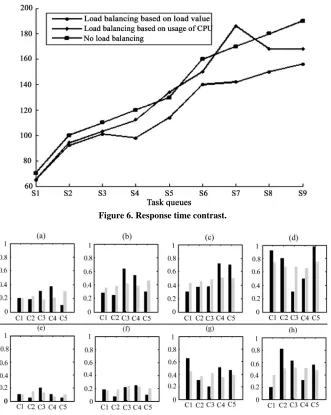
The experimental simulation is config q
queues are named S0,S1……S8 and represent different queues with different characteristics containing different number of big, middle and small tasks giving more or less emphasis to CPU or memory. The characteristics of these task queues are found in Table 1. The task with higher CPU value represents the one giving more em-phasis on CPU than memory, whereas, the task with higher memory value emphasizes memory.
We made several measurements of response time of task execution, which can be divided into
[image:5.595.98.497.346.442.2]B. CHENG ET AL. 64
Figure 6. Response time contrast.
Figure 7. Load of CPU and memory contrast.
alancing algorithm. The results of simulation are shown
ined through Figure 6 and Fig-ur
onstrates the distribution of memory and C
tion of model with load balancing algorithm based on load
proposed a load balancing algo-rithm based on Multi-Agent in ServiceBSP model. It b
in Figure 6 and Figure 7. We present results obta
e 7. Figure 6 illustrates how the load balancing algo-rithm performed by contrasting response time. The re-sults obtained in such model with load balancing algo-rithm based on load value illustrates less response time compared with adopting no balancing algorithm and only based on usage of CPU. Commonly, system with no load balancing algorithm needs longer response time than with load balancing algorithm only based on the usage of CPU commonly. However, if most tasks in task queue with high memory value, sometimes it is better to use no balancing algorithm than the algorithm only based the usage of CPU.
Figure 7 dem
PU load. In the figure, the black and the grey cylinders respectively represent the load distribution in the
condi-value and with no load balancing. (a),(b),(c),.(d) represent the distribution of CPU load in five nodes named C1,C2, C3,C4,C5 in picture while task queues S0,S2,S4,S7 assign-ing to a task group includassign-ing five nodes. (e),(f),(g),(h) pre-sent the distribution of memory load. Apparently, a system adopting load balancing algorithm based on load value en-sures the balancing distribution of CPU and memory load in five nodes. So it can cut down response time.
6. Conclusions
In this paper, we have
B. CHENG ET AL. 65
by National Natural Scien oundation of China under grant number 60573109
d R. J. T. Morris, “Load sharing in distrib-uted systems,” IEEE Transactions on Computers, Vol.
hypercube,” California
scheduling of tasks with deadlines and resource
mputer system with m
ith QoS-aware in
ent assisted
and X. L. Zhi, “QoS-based
pro-iu, X. S. Lpro-iu, and C. -S. Zuo, “A task differenced
, M. X. Zhang, and X. K. Miao, “Study on load
M. Zheng, and G. W. Yang, “Adaptive
s,”
and T. Finin, “A semantics approach for technology of Multi-agent when aiming at the goal of
dynamic load balancing. The experimental simulation shows that it can solve the problem of load balancing and speed up response tasks.
7. Acknowledgment
This work is supported ce
F and gramming method in grid environment,” Computer Ap-plication and Software, Vol. 23, No. 8, pp. 37–41, August 2006.
[8] K. -J. L 90412010 and Shanghai Municipal Committee of
Sci-ence and Technology under grant number 05dz15005.
8. References
[1] Y. T. Wang an
C-34, pp. 204–211, March 1985.
[2] G. C. Fox, “A review of automatic load balancing and decomposition methods for the
Institute of Technology, Vol. 13, pp. 380–385, November 1986.
[3] K. Ramamritham, J. A. Stankovic, and W. Zhao, “Dis-tributed
requirements,” IEEE Transactions on Computers, Vol. 38, pp. 1110–1123, August 1989.
[4] K. M. Baumgartner and B. W. Wah, “GAMMON: A load
balancing strategy for local co ul- K tiaccess networks,” IEEE Transactions on Computers,
Vol. 38, pp. 1098–1109, August 1989.
[5] Y. Jiang, W. Q. Tong, and W. T. Zhao, “A services selec-tion policy for ServiceBSP model w
grids,” International Conference on Convergence Infor-mation Technology, ICCIT2007 Conference, IEEE Com-puter Society, pp. 382–386, September 2007.
[6] J. Q. Zhu, W. Q. Tong, and X. J. Dong, “Ag
ServiceBSP model in grids,” In the Fifth International Conference of Grid and Cooperative Computing 2006, pp. 17–21, October 2006.
[7] J. Song, W. Q. Tong,
scheduling algorithm(TDSA) on resource’s load-balanc-ing,” Journal of University of Electronic Science and Technology of China, Vol. 33, No. 5, pp. 562–565, May 2004.
[9] J. Jiang
balancing algorithms based on multiple resources,” Acta Electronica Sinica, Vol. 30, No. 8, pp. 1148–1152, Au-gust 2002.
[10] J. X. Zhou, W.
dual-threshold dynamic load balancing system based on migrating,” Vol. 40, No. 3, pp. 121–125, March 2000. [11] M. R. Genesereth and S. P. Katchpel, “Software agent
Communications of the ACM, Vol. 37, No. 7, pp. 48–53, July 1994.
[12] Y. Labrou