Subspace Analysis Of Arbitrarily Many Linear Filter Responses with an
application to Face Tracking
Stefanos Zafeiriou
†Georgios Tzimiropoulos
† †Dept. of Computing,
Imperial College London
180 Queen’s Gate
London SW7 2AZ, U.K.
{s.zafeiriou,gt204,m.pantic}@imperial.ac.uk
Maja Pantic
†,∗∗
EEMCS
University of Twente
Drienerlolaan 5
7522 NB Enschede
The Netherlands
[email protected]Abstract
Multi-scale/orientation local image analysis methods are valuable tools for obtaining highly distinctive image-based representations. Very often, these features are gen-erated from the responses of a bank of linear filters corre-sponding to different scales and orientations. Naturally, as the number of filters increases, so does the feature dimen-sionality. Further processing is often feasible only when di-mensionality reduction is performed by subspace learning techniques, such as Principal Component analysis (PCA) or Linear Discriminant Analysis (LDA). The major prob-lem stems from the fact that as the number of features increases, so does the computational complexity of these methods which, in turn, limits the number of scales and orientations examined. In this paper, we show how linear subspace analysis on features generated by the response of linear filter banks can be efficiently re-formulated such that complexity does not depend on the number of filters used. We describe computationally efficient and exact versions of PCA while the extension to other subspace learning algo-rithms is straightforward. Finally, we show how the pro-posed methods can boost the performance of algorithms for appearance based tracking.
1. Introduction
A significant amount of research in computer vision has revolved around providing efficient solutions to the follow-ing problem: given samples of a high-dimensional space estimate a low-dimensional space which preserves the trinsic structure of the input data. The assumption that in-put data points are actually samples from a low-dimensional manifold embedded in a high-dimensional space is not un-reasonable since large amounts of collected visual data
of-ten result from changes in very few degrees of freedom. This, in turn, attributes input data with a well-defined and probably predictable structure. Subspace learning methods perform dimensionality reduction with the goal of finding this underlying structure.
The necessity for dimensionality reduction in computer vision becomes more evident if we consider standard fea-ture extraction techniques based on multi-scale/orientation local image analysis. Typically, the application of such methods generates highly redundant representations which, in turn, results in a further increase in dimensionality. As an example, due to their excellent localization properties in space and frequency as well as orientation selectivity prop-erties, Gabor filters have become one of the defacto choices for feature extraction in many applications such as face recognition, action and gait recognition as well as facial ex-pression analysis [13, 3, 20,10, 19,23, 24, 5, 7, 22,1]. Applying a set of 40 Gabor filters to64×64images, as for example suggested in [9,11,12], results in a feature space of dimensionality equal to 163840. Therefore, further pro-cessing is feasible only after dimensionality reduction has been performed.
Nevertheless, the application of dimensionality reduc-tion techniques poses serious computareduc-tional concerns. Pop-ular subspace learning methods, such as PCA or LDA and their kernel-based counterparts (Kernel PCA and Kernel FDA [9,10]), require operations such as matrix multipli-cations and eigen-analysis of covariance matrices which not only require a huge amount of memory but also be-come computationally intractable for very high dimensional spaces. Thus, practical approaches either perform feature extraction in region of interests only or decrease the num-ber of features using approximations such as downsampling [9,11,12].
A recent work [1] has shown how a bank of linear
ters can be used to manipulate the margin in linear support vector machines. Inspired by [1], we show how linear sub-space analysis on features generated by the response of lin-ear filter banks can be efficiently re-formulated such that complexity does not depend on the number of filters used. Our approach touches upon classical results from linear al-gebra previously used for the efficient implementation of PCA and the efficient calculation of inner products in the Fourier domain [15]. We show how these results can be used in order to formulate computationally efficient and ex-act versions of PCA. Finally, we show how the proposed methods can boost the performance of algorithms for ap-pearance based face tracking.
Summarizing, the contributions of this paper are
• An exact complex PCA of arbitrarily many linear fil-ter responses. Our complex formulation applies PCA to both the magnitude and the phase of the filter re-sponses. On the contrary, previously proposed algo-rithms do not scale well with the number of filters, are inexact and make use of magnitude information only [3,20,9,11, 12,10]. Note that recent papers have shown that the phase of linear filter responses conveys useful information for recognition [18,25].
• A general framework for incremental PCA of arbitrar-ily many linear filter responses. We show how to ap-ply this framework in order to formulate an appearance based tracking algorithm using arbitrarily many linear filter responses [17].
2. Principal Component Analysis
We assume that we are given a population of N im-ages {f1, . . . , fN} withfi(n) : D ⊆ Z2 → $, where
Z and$are the sets of integers and real numbers respec-tively. We denote byfi be the F-dimensional vector
ob-tained by writing imagefiin lexicographic ordering and by
F= [f1| · · · |fN]∈ $F×N the data matrix. Let us also
de-note by¯f = 1
N
!N
i=1fi andF the sample mean and the
centralized data matrix, respectively. PCA finds a set of p < F (usually,p&F) basesU = [u1| · · · |up]∈ $F×p
by solving the following optimization problem
Uo= arg maxUtr"UTSfU#
subject toUTU=I (1)
where tr[A]is the trace of matrixAandSf is the covari-ance matrixSf =F ¯¯FT. The solution is given by the
eigen-vectors corresponding to theplargest eigenvalues obtained from the eigen-decomposition ofSf. The low dimensional
representation ofF¯is given byC=UTF.¯
3. PCA Of Arbitrarily Many Linear Filter
Re-sponses (AMLFR-PCA)
We denote by{h1(n), . . . , hm(n)}a set ofmfilters with
hl(n) : D → C where C is the set of complex
num-bers. Using this filter bank, we build a set of responses {g1(n), . . . , gm(n)}
gl(n) =f(n)! hl(n), l= 1, . . . , m (2)
where ! is the convolution operation. Let gl be the
lex-icographic ordering of gl(n) and x = [gT1 . . .gTm]T ∈
CmF the vector that contains the responses of the m
fil-ters. The total scatter matrix is Sx = X ¯¯XH1 where ¯
X = [¯x1|. . .|¯xN] andx¯i = xi −x. Finally, the PCA¯
bases are obtained from the eigen-analysis ofSx. This has
a costO(m3F3)which, as the number of filters increases,
becomes prohibitive.
To obtain an efficient algorithm, we start by consider-ing the efficient implementation of PCA (O(N3)instead of
O(m3F3)) proposed in [21]. Rather than computing the
eigen-analysis ofX ¯¯XH, we compute the eigen-analysis of
XHXand make use of the following theorem [4]2
Theorem I. Define matricesAandBsuch thatA=ΓΓH
andB =ΓHΓwithΓ
∈ Cm×r. LetU
AandUB be the
eigenvectors corresponding to the non-zero eigenvaluesΛA
andΛB of AandB, respectively. Then, ΛA = ΛB and
UA=ΓUBΛ−
1 2
A .
The application of Theorem I requires the computation of X¯HX¯ which has a costO(mF N). To reduce this to
O(N F), we make use of the properties of the Fourier trans-form [15, 18,1] which enables the computation of inner products in the Fourier domain. Let us first denote by D ∈ CF×F the matrix of the Discrete Fourier Transform
(DFT) [18]. SinceDis a unitary, we haveD−1=DHand
we can write (2) as
gl=D−1(Df(Dhl) =DH(HlDf) (3)
wherehlis the lexicographic ordering of filterhσl,Hlis an
F×F diagonal matrix with diagonal elementsDhland(
is the Hadamard product. Using the above we have (based on the Parseval’s theorem, the authors in [1] derived a very similar result)
¯
xHi ¯xj = (xi−¯x)H(xj−¯x)
=!nl=1(gil−¯gl)H(gjl−¯gl)
=!nl=1(DH(HlDfi−HlD¯f))H
×DH(HlDfi−HlD¯f)
= (Dfi−D¯f)H!nl=1H2l(Dfj−D¯f)
=$H1/2D¯f
i% H
H1/2D¯f
j
=¯zH i ¯zj
(4)
1Tdenotes matrix transposition andHdenotes conjugate matrix trans-position.
whereH=!nl=1H2
l and¯ziis given by
¯
zi=H1/2D¯fi. (5)
The vectors¯zican be computed very efficiently from the
Hadamard product of the diagonal ofH1/2and the 2D DFT
offiwhich can be computed fast using the FFT (for
exam-ple for square images the FFT has a costO(Flog(√F))).
This product does not depend on the number of the fil-ters while H can be pre-computed. Finally, if we write ¯
Z = [¯z1|. . .|¯zN], then, from (4), we haveX¯HX¯ =Z¯HZ¯
whose computation has a costO(F N).
Let us denote by Vp the eigenvectors corresponding
to the plargest eigenvalues Λp obtained from the
eigen-decomposition ofZ¯HZ. Then, according to Theorem I, the¯
PCA bases are given by Up = XV¯ pΛ−
1 2
p . As we may
easily observe, this calculation is still very computationally expensive. Note however that, in order to find the low di-mensional embedding, the explicit computation ofUpis not
necessary. Let us denote byfy a test image and by¯ythe
concatenation of the filter responses after the subtraction of the mean¯x. To compute its low-dimensional representation cp∈Cpefficiently, we expand
cp =UHpy
=Λ−p1/2VHpX¯Hy¯
=Λ−p1/2VHp[x¯Hi ¯y, . . . ,¯xHN¯y]T
=Λ−p1/2VHp[¯ziH¯zy, . . . ,¯zHN¯zy]T
=Λ−p1/2VHpZ¯H¯zy
(6)
where¯zy = H1/2D¯y. Finally, the reconstruction error
"x(U
p)is given by
"x(U
p) =||X¯−UpUHpX¯||2F
=tr[(X¯−UpUHp X¯)H(X¯−UpUHp X¯)]
=tr[X¯HX¯
−X¯HU pUHp X¯]
=tr[Z¯HZ¯−Z¯HQ pQHp ¯Z]
=||Z¯−QpQHpZ¯||2F
="z(Q p)
(7)
where||.||F is the Frobenius norm andQp=ZV¯ pΛ−p1/2.
Algorithm1summarizes the steps of our efficient algo-rithm. Note that steps 1-3 are computed only once.
4. Experimental Results
We evaluated the performance of our subspace learning algorithms for the applications of appearance based face tracking. We used multi-scale/orientation Gabor filters and multi-scale derivatives of the Gaussian. In the spatial do-main(x, y), a Gabor filter is a complex exponential
modu-Algorithm 1AMLFR-PCA
Inputs: A set ofN imagesfi,i = 1, . . . , n, ofF pixels,
the matrixH=!nl=1H2
l, the numberpof principal
com-ponents and a test imagefyofF pixels.
Step 1. Compute¯zi = H1/2D¯yi, form the matrix of the
transformed dataZ¯ = [¯z1| · · · |¯zN] ∈ CF×n and compute
the matrixK=ZHZ
∈CN×N.
Step 3. Compute the eigen-decompositionK = VΛVT
and denote byVp ∈ $N×pandΛp ∈ $p×pthep-reduced
set.
Step 4.Computezy =H1/2D¯y.
Step 5.Compute the embeddingcp=Λp−1/2VpHZ¯H¯zy.
lated by a Gaussian function defined as
ψω,θ(x, y) =2πσ12e−
((xcosθ+ysinθ)2 +(−xsinθ+ycosθ)2) 2σ2
·&eiω(xcosθ+ysinθ)
−e−ω2σ2
2
'
(8) whereωis the radial center frequency of the complex ex-ponential,θis the orientation of the Gabor wavelet, andσ is the standard deviation of the Gaussian function. The first derivative Gaussian filter bank is defined as [16,6]
ψσ(x, y) =−σ(x−yi)e−σ(x
2+y2)
. (9)
whereσ is the scale of the filter. In all experiments, we used Gabor filters with 16scales and 16orientations and
Gaussian filters of 16 scales.
The appearance-based approach to tracking has been one of the de facto choices for tracking objects in image se-quences. Prominent examples of such an approach include subspace-based techniques [2,14,17]. Here, we propose a subspace-based tracking algorithm closely related to the incremental visual tracker in [17]. As such, our tracker can deal with drastic appearance changes, does not require off-line training, continually updates a compact object repre-sentation and uses the Condensation algorithm to robustly estimate the object’s location [17].
Similarly to [17], the proposed tracker is essentially an eigen-tracker [2], where the eigen-space is adaptively learned and updated online. The key element which makes our approach equally fast but significantly more robust, is how the eigen-space is generated. The method in [17] uses the incremental version of standard intensity-based PCA. On the contrary, the proposed tracker is based on the eigen-space generated by the responses of a bank of Gabor and Gaussian filters. In the following, we show how this sub-space can be learned and updated using an approach which is as computationally efficient as the incremental version of intensity-based PCA.
Let us assume that given N images {f1, . . . , fN}, we
Algorithm 2INCREMENTALAMLFR-PCA
Inputs: The Qp andΣp from SVD ofZ¯N (Qp andΣp
can be calculated by the application of Algorithm1 since Qp is the principal subspace and Σp is Λ1p/2) and mean
vector zN, a set of new images {fN+1, . . . , fN+M} and
the numberpof principal components
Step 1. From set {fN+1, . . . , fN+M} compute the
matrix of the transformed dataZM = [zN+1|. . .|zN+M]
and the meanzM.
Step 3. Compute the new mean vector zN+M = N
N+MzN+ M
N+MzM and form the matrix
G=&(zN+1−zM)|. . .|(zM+N −zM)|
(
N M
N+M(zM −zN)
'
Step 4.ComputeG˜ =orth(G−QpQH p G)and
R=
)
Σp QpHG
0 G˜H(G−Q
pQHpG)
*
(where orth performs orthogonalization)
Step 5. ComputeR svd= UΣ˜ N+MV˜H(whereΣN+M are
new singular values).
Step 6. Compute the new principal subspace UN+M = [U
p G˜]U.˜
the mean vector zN, the eigenvalues Λp and the matrix
Qp=Z¯NVpΛp−1/2, where we have made the dependency
of the quantities onNexplicit. Then, given a new image set {fN+1, . . . , fN+M}, our target is to obtainUN+M,ΛM+N
andzN+M corresponding to {f1, . . . , fN+M}without
re-applying Algorithm1. Based on our analysis in Section3 and the derivations in [8,17], Algorithm2summarizes the steps of our efficient incremental PCA of arbitrarily many linear filter responses (Incremental AMLFR-PCA).
Finally, the proposed tracker combines our incremental AMLFR-PCA with a variant of the Condensation algorithm for dynamical estimation of the object’s location [17].
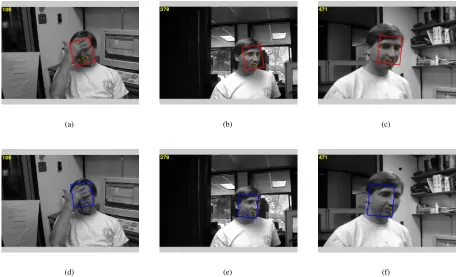
To evaluate the performance of our tracker quantita-tively, we used the ground truth provided for the position of seven facial fiducial points for the popular Dudek video sequence3. We used the proposed tracker as well as the orig-inal implementation in [17] to track a face region manually defined by a rectangle in the first frame. We then used the tracked region to estimate an affine transformation for all subsequent frames and used this transformation in order to obtain an estimate of the new position of the fiducial points. Finally, we evaluated the tracking accuracy from the mean value of the root mean square (RMS) error between the lo-cations of the points as given by the ground truth and the estimated transformation. Table1summarizes the obtained results, while Fig. 1 shows representative examples
illus-3The Dudek video sequence with annotations is available from: http://www.cs.toronto.edu/˜dross/ivt/
trating the tracking process for the case of the Gaussian fil-ter bank. As we may observe, the proposed tracker performs significantly better at no further computational cost.
Intensity Gabor Gaussian RMS ERROR 7.44 7.12 6.32 Table 1. Mean RMS Error on Dudek Video Sequence.
5. Conclusion
We proposed an exact and very efficient framework for subspace analysis of features generated by arbitrarily many linear filter responses such as Gabor and Gaussian filter banks. Previously proposed methods [20, 9, 11, 12, 10] are based on approximations and do not scale well with the number of filters. Thus, compared to previous work, our formulation is not only exact but also significantly faster. We showed how the proposed framework can boost the per-formance of appearance based algorithms for tracking.
6. Acknowledgements
This work has been funded by the European Research Council under the ERC Starting Grant agreement no. ERC-2007-StG-203143 (MAHNOB).
References
[1] A. Ashraf, S. Lucey, and T. Chen. Re-interpreting the appli-cation of gabor filters as a manipulation of the margin in lin-ear support vector machines. IEEE transactions on pattern analysis and machine intelligence, pages 1335–1341, 2010.
1,2
[2] M. Black and A. Jepson. Eigentracking: Robust match-ing and trackmatch-ing of articulated objects usmatch-ing a view-based representation. International Journal of Computer Vision, 26(1):63–84, 1998. 3
[3] B. Duc, S. Fischer, and J. Bigun. Face authentication with Gabor information on deformable graphs. IEEE Transac-tions on Image Processing, 8(4):504–516, 1999.1,2
[4] G. Golub and C. Van Loan. Matrix computations. Johns Hopkins Univ Pr, 1996.2
[5] G. Goudelis, S. Zafeiriou, A. Tefas, and I. Pitas. Class-Specific Kernel-Discriminant Analysis for Face Verification. IEEE Transactions on Information Forensics and Security, 2(3 Part 2):570–587, 2007.1
[6] J. Koenderink and A. Van Doorn. Receptive field families. Biological cybernetics, 63(4):291–297, 1990.3
[7] I. Kotsia, I. Buciu, and I. Pitas. An analysis of facial expres-sion recognition under partial facial image occluexpres-sion.Image and Vision Computing, 26(7):1052–1067, 2008.1
[8] A. Levey and M. Lindenbaum. Sequential Karhunen-Loeve basis extraction and its application to images. IEEE Trans-actions on Image Processing, 9:1371–1374, 2000.4
(a) (b) (c)
[image:5.612.69.528.81.358.2](d) (e) (f)
Figure 1. Appearance-based tracking using incremental PCA. (a)-(c) Tracking using a bank of multi-scale Gaussian filters. (d)-(f) Tracking using pixel intensities.
Pattern Analysis and Machine Intelligence, 26(5):572 – 581, May 2004.1,2,4
[10] C. Liu. Capitalize on dimensionality increasing techniques for improving face recognition grand challenge performance. IEEE transactions on pattern analysis and machine intelli-gence, pages 725–737, 2006.1,2,4
[11] C. Liu and H. Wechsler. Gabor feature based classifica-tion using the enhanced Fisher linear discriminant model for face recognition. IEEE Transactions on Image Processing, 11(4):467 – 476, Apr. 2002.1,2,4
[12] C. Liu and H. Wechsler. Independent component analysis of gabor features for face recognition. IEEE Transactions on Neural Networks, 14(4):919–928, July 2003. 1,2,4
[13] M. Lyons, J. Budynek, and S. Akamatsu. Automatic classi-fication of single facial images. IEEE Transactions on Pat-tern Analysis and Machine Intelligence, 21(12):1357–1362, 2002.1
[14] I. Matthews and S. Baker. Active appearance models revis-ited. International Journal of Computer Vision, 60(2):135– 164, 2004.3
[15] A. Oppenheim and R. Schafer. Discrete-time signal process-ing.Prentice Hall Signal Processing, page 1120, 2009.2
[16] M. Reisert and H. Burkhardt. Complex derivative filters. Im-age Processing, IEEE Transactions on, 17(12):2265–2274, 2008.3
[17] D. Ross, J. Lim, R. Lin, and M. Yang. Incremental learning for robust visual tracking.International Journal of Computer
Vision, 77(1):125–141, 2008.2,3,4
[18] M. Savvides, B. Kumar, and P. Khosla. Eigenphases vs eigenfaces. InProceedings of the 17th International Confer-ence on Pattern Recognition, 2004 (ICPR 2004), volume 3, 2004.2
[19] D. Tao, X. Li, X. Wu, and S. Maybank. General tensor dis-criminant analysis and gabor features for gait recognition. IEEE Transactions on Pattern Analysis and Machine Intelli-gence, pages 1700–1715, 2007.1
[20] Y. Tian, T. Kanade, and J. Cohn. Recognizing action units for facial expression analysis.IEEE Transactions on Pattern Analysis and Machine Intelligence, 23(2):97–115, 2002. 1,
2,4
[21] M. Turk and A. P. Pentland. Eigenfaces for recognition. Journal of Cognitive Neuroscience, 3(1):71–86, 1991.2
[22] J. Whitehill, G. Littlewort, I. Fasel, M. Bartlett, and J. Movel-lan. Toward practical smile detection.IEEE transactions on pattern analysis and machine intelligence, pages 2106–2111, 2009.1
[23] S. Zafeiriou and I. Pitas. Discriminant graph structures for facial expression recognition. IEEE Transactions on Multi-media, 10(8):1528–1540, 2008.1
[24] S. Zafeiriou, A. Tefas, and I. Pitas. Minimum class variance support vector machines. Image Processing, IEEE Transac-tions on, 16(10):2551–2564, 2007.1