KNOWLEDGE-HOW: LINGUISTIC AND PHILOSOPHICAL
CONSIDERATIONS
Joshua Habgood-Coote
A Thesis Submitted for the Degree of PhD at the
University of St Andrews
2017
Full metadata for this item is available in St Andrews Research Repository
at:
http://research-repository.st-andrews.ac.uk/
Please use this identifier to cite or link to this item:
http://hdl.handle.net/10023/11566
This item is protected by original copyright
Knowledge-How: Linguistic and Philosophical
Considerations
Joshua Habgood-Coote
This thesis is submitted in partial fulfilment for the degree of PhD
at the
University of St Andrews
Department of Philosophy
School of Philosophical, Anthropological and Film Studies
University of St Andrews
1. Candidate’s declarations:
I, Joshua Habgood-Coote hereby certify that this thesis, which is approximately 79,900 words in length, has been written by me, and that it is the record of work carried out by me, or principally by myself in collaboration with others as acknowledged, and that it has not been submitted in any previous application for a higher degree. I was admitted as a research student in September 2013 and as a candidate for the degree of Doctor of Philosophy in September 2013; the higher study for which this is a record was carried out in the University of St Andrews between 2013 and 2017.
Date...signature of candidate ...
2. Supervisor’s declaration:
I hereby certify that the candidate has fulfilled the conditions of the Resolution and Regulations appropriate for the degree of Doctor of Philosophy in the University of St Andrews and that the candidate is qualified to submit this thesis in application for that degree.
Date...signature of supervisor ...
3. Permission for publication: (to be signed by both candidate and supervisor)
In submitting this thesis to the University of St Andrews I understand that I am giving permission for it to be made available for use in accordance with the regulations of the University Library for the time being in force, subject to any copyright vested in the work not being affected thereby. I also understand that the title and the abstract will be published, and that a copy of the work may be made and supplied to any bona fide library or research worker, that my thesis will be electronically accessible for personal or research use unless exempt by award of an embargo as requested below, and that the library has the right to migrate my thesis into new electronic forms as required to ensure continued access to the thesis. I have obtained any third-party copyright permissions that may be required in order to allow such access and migration, or have requested the appropriate embargo below. The following is an agreed request by candidate and supervisor regarding the publication of this thesis: PRINTED COPY
a) No embargo on print copy
ELECTRONIC COPY
a) No embargo on electronic copy
ABSTRACT AND TITLE EMBARGOES
An embargo on the full text copy of your thesis in the electronic and printed formats will be granted automatically in the first instance. This embargo includes the abstract and title except that the title will be used in the
graduation booklet.
If you have selected an embargo option indicate below if you wish to allow the thesis abstract and/or title to be published. If you do not complete the section below the title and abstract will remain embargoed along with the text of the thesis.
a) I agree to the title and abstract being published YES b) I require an embargo on abstract NO c) I require an embargo on title NO
Date...
Abstract
This thesis concerns the nature of knowledge-how, in particular the question of how we ought to combine philosophical and linguistic considerations to understand what it is to know how to do something. Part 1 concerns the significance of linguistic evidence. In chapter 1, I consider the range of linguistic arguments that have been used in favour of the Intellectualist claim that knowledge-how is a species of propositional knowledge. Chapter 2 considers the idea that sentences of the form ‘S knows how to V’ involve a free relative complement, and the relation between this claim and the Objectualist claim that
knowledge-how is a kind of objectual knowledge. Chapter 3 argues that Intellectualism about knowledge-how faces a problem of generality in accounting for the kinds of propositions that are known in knowledge-how, which is analogous to the generality problem for Reliabilism. Part 2 turns to philosophical considerations, offering an extended inquiry into the point of thinking and talking about knowledge-how. Chapter 4 considers why we should want to work with a concept of knowledge, isolating two hypotheses: i) that thinking and talking about knowledge-how helps us to pool skills, and ii) that thinking and talking about knowledge-how helps us to engage in responsible practices of
co-operation. Chapter 5 criticises the former hypothesis by arguing against the suggestion that there is a knowledge-how norm on teaching. Chapter 6 offers an indirect argument for the latter hypothesis, arguing for a knowledge-how norm on intending. Part 3, which consists of chapter 7, offers a positive account of knowledge-how which takes into account both philosophical and linguistic considerations. According to what I will call the
Acknowledgements
Thanks to: Fatema Amijee, Sebastian Becker, Corine Besson, Dylan Bianchi, Mark Bowker, Jessica Brown, Matthew Cameron, Lucy Campbell, Niel Conradie, Nilanjan Das, Josh Dever, Philip Ebert, Katalin Farkas, Elizabeth Fricker, Ellen Fridland, Mikkel Gerken, Ephraim Glick, Adrian Haddock, Natalia Waights Hickman, Jennifer Hornsby, Bruno Jacinto, Abby Everett Jacques, Brendan De Kenessey, Aidan McGlynn, Matthew McGrath, Matthew McKeever, Robin McKenna, Eliot Michaelson, Jennifer Nagel, Carlotta Pavese, Sarah Paul, Andrew Peet, Evan Riley, Alexander Sandgren, Mona Simion, Kieran Setiya, Justin Snedegar, Maja Spener, Jay Spitzley, Fenner Tanswell, Caroline Toubourg, Marissa Wallin, Brian Weatherson, Mike Wheeler, Timothy Williamson, Quinn White, and Daniel Whiting. Thanks to Sebastian Becker, Jack George, Caroline Touborg, and Alper Yavuz for assistance with the translations in the introduction. Thanks to an anonymous reviewer for Episteme for comments on chapter 2, an anonymous reviewer for Philosophical Studies for comments on chapter 3, and two
anonymous reviewers for Synthese for comments on chapter 5. Material from chapter 1 was presented at the St Andrews Prize seminar 2016 ‘Knowing How and Mathematical Proof’
which I co-taught with Fenner Tanswell. Thanks to the participants in that course. I presented a version of chapter 3 at the Edinburgh graduate conference 2015, where Mikkel Gerken gave helpful comments. A version of chapter 7 was featured on the Minds Online conference 2016, where I benefitted greatly from commentaries from Carlotta Pavese, Evan Riley, and Jay Spitzley (commentaries available at
http://mindsonline.philosophyofbrains.com/2016/2016-1/knowledge-how-abilities-and-questions/). I also presented this chapter at the third PLM workshop in London where Timothy Williamson gave very useful comments.
Katherine Hawley deserves special thanks for being the best that I could have hoped for in a supervisor. Thanks to Ruth for walking beside me, and to Christine and Mike for having my back.
Chapter 2 is forthcoming in Episteme as Knowledge-How: Free Relatives and Interrogatives, a version of chapter 5 is forthcoming in Synthese as Knowing-how, Showing, and Epistemic Norms,
Contents
Introduction 1
Part 1: Linguistic Evidence 7
Chapter 1: Linguistic Arguments about knowledge-how 8
Introduction 8
1. Set-up of the Rylean Debate 8
2. Ryle's Discussion of Knowledge-How 11
3. The ‘Standard View’ and Linguistic Evidence 19
4. Linguistic Arguments for Intellectualism 25
4.1. The Argument from Linguistic Uniformity 26
4.2. The Argument from Truth-Conditional Semantics 28
4.2.1. Is Linguistics Relevant to Intellectualism? 35
4.2.2. Metaphysics or Linguistics First? 36
4.2.3. Which Language Should we Prioritise? 38
4.2.4. Alternative Semantics for English 40
4.2.5. Objects and Relations 42
4.3. The Semantic Implementability Constraint 43
Chapter 2: Knowledge-How: Free Relatives and Interrogatives 47
Introduction 47
1. Interrogatives and Free Relatives 48
2. Free Relative Semantics for ‘S knows how to V’ 50
3. Evidence that 'how to V' is a Free Relative 53
4. Tests for Distinguishing Free Relatives from Interrogatives 60
5. Conclusion 66
Chapter 3: The Generality Problem for Intellectualism 67
Introduction 67
1. Intellectualism and Ways of Acting 68
2. Generality Problems 72
2.1. Reliabilism 72
2.2. Intellectualism 74
3. Responses to the Generality Problem 77
3.1. Giving an Account of Relevant Ways of Acting 78
3.2. Appeal to Sets of Propositions 79
3.3. Contextualism 81
3.4. Practical Modes of Presentation 86
3.5. Counterfactual Success Condition 89
4. Conclusion 91
Part 2: A Genealogy of Knowledge-How 95
Introduction 96
1. Function-first Methodology 97
1.1. Why think that Concepts have Interesting Functions 100
1.2. How Should we Assess a Hypothesis about the Function of
KNOWS? 100
1.3. What does it Mean to Talk about the Function of KNOWS? 101 1.4. What is the Significance of the Genealogical Element in Craig's
Account? 103
1.5 Comparison to Other Accounts 104
2. The Function of KNOWS-THAT 107
3. The Function of KNOWS-HOW 110
4. Knowledge-how and Mutual Reliance 115
4.1. Knowing How to Do and Knowing How to Teach 115
4.2. Clients and Collaborators 117
5. On the Inconsistency of KNOWS-HOW 120
Chapter 5: Knowledge-how is not the Norm of Teaching 124
Introduction 124
1. The Knowledge-How Norm of Teaching 125
1.1. Conversational Evidence for KNT 128
2. Alternatives to KNT 130
2.1. What are the Alternatives to Knowledge 130
2.2. What is Teaching Anyway? 134
3. Against Knowledge Norms for Teaching 135
3.1. Generative Teaching 135
3.1.1. Response 1: Teachers Have Know-how 139
3.1.2. Response 2: Teaching is not Generative 142
3.1.3. Response 3: Generative Teaching is Inappropriate 143
3.1.4 Summing Up 144
3.2. Generative Instruction 144
3.3. Demonstrating, Knowing How, and Intentional Action 147
4. Conclusion 151
Chapter 6: Knowledge-how is the Norm of Intention 153
Introduction 153
1 The Case for the Knowledge-how Norm of Intention 155
1.1. Evaluative Knowledge Ascriptions 156
1.2. Conversational Dynamics 157
1.2.1. Challenging Intentions 157
1.2.2. Excuses 160
1.2.3. Soliciting Intentions 160
1.2.4. Moorean Sentences 161
1.3. Lottery Intentions 162
2. The Knowledge-How Norm of Intention 165
2.1. Problem Cases for KNI 165
2.2 Potential fixes for KNI 167
2.3. Know-how and Partial Plans 169
3. The Knowledge-how Norm is not Reducible 171
3.1. Ought Implies Can 172
3.2. Instrumental Rationality 173
3.3. Knowledge-That Norm of Action 176
4. Alternative Norms on Intention 181
4.1. Success 181
4.1. Safety 182
4.3. Belief 183
4.4. Justification 184
4.4. Ability 185
4.5. Higher-Order Norms 186
5. Conclusion 188
Part 3: Bringing Linguistics and Philosophical Considerations Together 190
Chapter 7: Knowledge-how, Abilities, and Questions 191
Introduction 191
1 Linguistics and Practicality 191
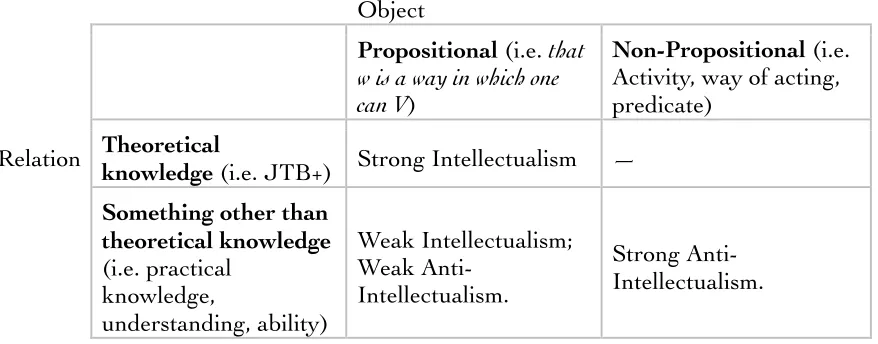
2 Objects and Relations 194
3. The Interrogative Capacity View 199
4. Benefits of the Interrogative Capacity View 204
5. Comparison 209
6. Conclusion 215
Introduction
When we consider questions in philosophy we often find ourselves answering two questions at the same time: a first-order question about some philosophical issue and a second-order methodological question about how to resolve this issue. To answer a question like what are numbers?1we would need to first ask a series of metaphilosophical
questions. For starters: what does it mean to ask ‘what are numbers?’?. The recent debate about the nature of knowledge-how provides a good example of how first-order philosophical questions interact with methodological issues. This debate encompasses first-order, and methodological disputes. On the one hand, we have Intellectualist views of knowledge-how, which argue that knowledge-how is a species of propositional knowledge on the basis of primarily linguistic evidence. And on the other hand, we have Anti-Intellectualist views of knowledge-how, which argue that knowledge-how is not a species of propositional knowledge on the basis of primarily non-linguistic evidence.
This thesis investigates two questions: the first-order question what is the correct account of knowledge-how? and the methodological question how ought we to balance linguistic and philosophical considerations in understanding the nature of knowledge-how?. On both questions, my approach is conciliatory. At the metaphilosophical level, I will be arguing for a framework that allows us to bring philosophical and linguistic considerations together in our
understanding of knowledge-how. I advocate for a picture on which the relationship between linguistics and philosophy is a two way street: philosophical considerations can feed into our account of the best semantics for natural language sentences, and linguistic considerations constrain the accounts of phenomena which are picked out by sentences of natural language. And at the first-order, I will be arguing for a compromise position between the standard versions of Intellectualism and Anti-Intellectualism, according to which knowledge-how is both a kind of ability, and a relation to a question. According to
1 I will use ‘question’ to pick out a metaphysical category – questions – and ‘interrogative’ to pick
out a linguistic category – sentences and phrases in the interrogative mood. These should not be confused with the speech act of asking a question. I will use wh-phrases with single quotes to refer to interrogative phrases, and italics with question marks to refer to the questions that are expressed by interrogative phrases. On this convention the interrogative phrase ‘what’s for dinner?’
what I will call the Interrogative Capacity view, knowing how to do something consists in a certain kind of ability to activate knowledge of the answers to a question.
I will address these questions from a number of different directions, but there are three central themes to this thesis.
The first theme is that the best — perhaps the only — way to engage with
metaphilosophical questions is by doing a lot of first-order philosophy. When I started to think about the connection between knowledge-how and metaphilosophical issues, I thought that it would be possible to first resolve the metaphilosophical issues about the nature of philosophical inquiry, and with those issues safely resolved take on the first-order questions about the nature of knowledge-how equipped with the right philosophical tools.2 Over time, I came to realise that it is rather difficult to get traction on the
metaphilosophical questions without thinking through particular philosophical issues in considerable detail, meaning that making claims about philosophical methodology requires a correspondingly broad overview of first-order philosophy. My approach in this thesis will be to start with first-order philosophical questions that have metaphilosophical significance. Once I’ve made some progress on these first-order issues, I will try to draw out some of the metaphilosophical implications.
The second theme is that the knowledge-how debate has neglected epistemic questions about the nature of knowledge-how. Putting to one side the question of whether knowledge-how is a species of propositional knowledge I take it that knowledge-how is interesting qua species of knowledge (Hawley 2003: 19). One might have thought that we can only get straight on the epistemic properties of knowledge-how once we’ve settled the question of whether knowledge-how is a species of propositional knowledge. I think that this attitude is mistaken: there are a great many questions about the properties of
knowledge-how that are orthogonal to the issue of whether it has a propositional or non-propositional object. For example, we can consider the question of why knowledge-how is a species of knowledge (Setiya, 2008, p. 407, 2012, pp. 304–5) independently of the question of what kind of knowledge it is. Part 2 of this thesis is an extended enquiry into the epistemological properties of knowledge-how, which — following (Craig 1990) —
considers what the point of having a concept of knowledge-how is and what different pictures of its point can tell us about the role of knowledge-how in the mental economy.
The third thought is that to the extent that we have an ordinary concept of knowledge-how, it is messy, contradictory, and context-sensitive in a way that makes it unsuitable for serious philosophical theorising. Consider the attitudes of ordinary speakers toward the relation between knowledge-how and ability. Almost without exception, when I describe my academic work to non-philosophers, they will make the suggestion that knowing how to do something is just being able to do that thing — or some related suggestion involving muscle memory, skill, or some kind of bodily knowledge. However, when we consider the relation between knowledge-how and ability more carefully, it becomes clear that there are many cases in which we pre-theoretically judge that it is possible to have knowledge-how without ability, or ability without knowledge-how. Our intuitions about the intension and extension of knowledge-how appear to be in conflict.
Another indication of the messiness of the concept of knowledge-how comes from cross-linguistic evidence concerning the grammatical constructions used to pick out this kind of knowledge. A brief survey shows that the translations for the English phrase ’S knows how to V’3 involve importantly different constructions. Here is a representative
(but certainly not exhaustive) survey:
(1) Ruth knows how to swim (English)
(2) Ruth sait nager (French)
(3) Ruth sabe nadar (Portuguese)
(4) Рут умеет плавать (Rut umeyet plavat’) (Russian)
(5) (lau6 si1 wui5 jau4 wing6) (Cantonese)
(6) Ruth tietää miten uida/Ruth osaa uida (Finnish)
(7) Ruth yüzmeyi biliyor (Turkish)
(8) Ruth kann schwimmen (German)4
(9) Ruth kan svømme (Danish)
3 Throughout ’S’ will denote an agent, and ‘V’ an activity.
4 Stanley claims that German has no translation for ’S knows how to V’, because it doesn’t allow
(10)I Ruth kseri kolimbi (Modern Greek)
To ascribe knowledge-how English (1) employs the embedded question construction with the same verb used to ascribe propositional knowledge. Romance languages like French (2) and Portuguese (3) employ an infinitival construction with no question-word, but the same verb (Rumfitt, 2003, pp. 161–3). By contrast, Russian (4) employs different verbs to pick out knowledge-how and knowledge-that and the verb for practical knowledge (umeyet/умеет) can only take an infinitival complement with no
question-word (Rumfitt, 2003, pp. 164–5; Ditter, 2016, pp. 5–6). We find the same pattern in Cantonese (5), which employs no question word in the knowledge-how construction,
and uses different verbs — (wui5) and ( jing6 sik1) for know-how and know-that,
which correspond to connaître and savoir in French (Stanley, 2011c, p. 233). Interestingly Finnish (6) allows both the embedded question construction and the infinitival
construction, but uses different verbs for each construction (tietää/osaa) (Stanley, 2011b, p. 137). Turkish (7) uses the propositional knowledge verb (bilmek), but combines this with a finite verb with no question-word (Ditter, 2016, pp. 6–7). German (8) (Ditter, 2016, p. 7) and Danish (9) uses a construction for ascribing knowledge-how which involves a verb which can also mean ‘can’ (können and kan respectively). Modern Greek employs various constructions for ascribing knowledge-how, including a construction involving a noun phrase with no question word which literally means ‘Ruth knows swimming’ (10)
(Douskos, 2013, p. 2329) (for examples of this construction in English, see (Glick, 2012, pp. 125–6)). I don’t want to draw any very grand conclusions out of this lightning survey, except to point out that from a linguistic point of view, things are just really messy.
Rather than assuming that we have a clear concept of knowledge-how already in our language, I will make the case that our ordinary concept of knowledge-how, and our ordinary language constructions for picking out knowledge-how are in important ways flawed and unsuitable for systematic philosophical theorising. The account of knowledge how which I develop in chapters 6 and 7 can be understood as an ameliorative proposal giving us a way to change our concept of knowledge-how in order to facilitate clearer thinking and talking about practical knowledge.5
Looking forward, here’s a plan of the structure of this thesis.
Part 1 considers a range of linguistic arguments for various views about the nature of knowledge-how. The methodological line will be conciliatory: I will argue that linguistic evidence concerning the semantics of ‘knows how’ ascriptions is relevant for philosophical debates about the nature of knowledge-how, but that we cannot read a complete account of knowledge-how off of the semantics offered by contemporary linguistics, and that linguistic considerations do not necessarily overrule philosophical considerations. Chapter 1 sets out the context of this debate, focusing on the linguistic case for Intellectualism. I distinguish a number of versions of the linguistic argument for Intellectualism, and argue that the interesting role of the linguistic evidence in this debate is in telling us which accounts of the nature of knowledge-how can be semantically implemented. Chapter 2 applies the idea of semantic implementability to Objectualist accounts of knowledge-how (Bengson & Moffett, 2011a) showing that these accounts are not semantically
implementable because a free relative semantics for ‘S knows how to V’ is not linguistically plausible. Chapter 3 argues that there is an in-principle challenge to reading an
Intellectualist account of the nature of knowledge-how off of the semantics for ‘knows how’ constructions in English, since the standard semantics does not offer an account of the generality of the propositions involved in knowledge-how. I argue that this leads to a kind of generality problem for Intellectualism, consider a number of ways to resolve this problem, and argue that they are unsatisfactory.
Part 3 brings linguistic and philosophical considerations together. Chapter 7 argues that the conflict between linguistic and philosophical evidence concerning knowledge-how has been overstated and that there is a way to account for both kinds of evidence by claiming that knowledge-how is a certain kind of capacity to answer a question, which I call the Interrogative Capacity view.
I cannot hope to address all of the topics in the knowledge-how debate, so some questions will inevitably be put to one side:
• Whether there is a legitimate notion of a practical mode of presentation (Stanley, 2011b, Chapter 4; Zardini, 2013; Glick, 2015; Pavese, 2015b);
• Whether there is a species of ability which co-ordinates with knowledge-how (Rosefeldt, 2004; Noë, 2005; Fantl, 2008; Lihoreau, 2008; Glick, 2012; Carter & Czarnecki, 2016);
• How knowledge-how connects to skill (Stanley & Krakauer, 2013; Dreyfus, 2014; Pavese, 2016a, 2016b; Stanley & Williamson, 2016);
• What the epistemic properties of knowledge-how are (Poston 2009; 2016; Cath
2015; Carter and Pritchard 2015a; 2015b; Brownstein and Michaelson 2016);
• What the relationship between knowledge-how and agents’ knowledge is (Setiya,
2008, 2009, 2012; Small, 2012; Hornsby, 2013);
Chapter 1: Linguistic Arguments about Knowledge-How
Introduction
In this chapter, I untangle various linguistic arguments that have been used in the knowledge-how debate, and argue for a conciliatory attitude about the significance of linguistic evidence. I argue that linguistic arguments are a legitimate source of evidence about the nature of knowledge-how, but maintain that there might be non-linguistic
reasons to prefer an account of knowledge-how that is not consistent with the best theories of contemporary linguistics. In §1, I set out the main contours of the debate about the nature of knowledge-how. In §2 I discuss Ryle’s contribution to this debate, before in §3 considering some linguistic problems for the Ryle-inspired ‘Standard View’ of knowledge-how. In §4, I dive into Stanley and Williamson’s linguistic case for Intellectualism, using their discussion as a jumping off point for a wider discussion of the significance of linguistic evidence in this debate.
1. Set-up of the Rylean Debate
The distinction between knowledge-that and knowledge-how seems like an
important feature of our folk epistemological framework. It is natural to trace back certain kinds of failing to the lack of one or other kind of knowledge. When someone has read all of the books she can get about running, but still struggles to pace herself or come up with a sensible training plan, she lacks a kind of practical grasp of running. When an experienced runner produces excellent results, but can’t say anything about how they train, or what rules they are following while they are running, she lacks a certain kind of theoretical grasp of running. We might say that the former runner has a great deal of factual
knowledge, but doesn’t know how to run; whereas the latter runner knows how to run, but cannot convert this knowledge into informative factual knowledge.
theoretically important distinction between knowing that something is the case, and knowing how to do something. Let’s call this claim Anti-Intellectualism:6
Anti-Intellectualism: knowledge-how is distinct from knowledge-that.
Anti-Intellectualism is true if there are some states of knowledge-how that are not states of knowledge-that, and there are some states of knowledge-that which are not states of knowledge-how. Anti-Intellectualism would be true if all states of knowledge-how and knowledge-that were disjoint — so that no state of knowledge-how was a state of
knowledge-that and vice versa — but it does not rule out the possibility of there being states which are both knowledge-how and knowledge-that,7 nor does it rule out the
possibility that knowledge-how relies on various pieces of knowledge-that (Hornsby, 2005, 2011; Wiggins, 2012, pp. 115–6). Even if the two kinds of knowledge are disjoint, any reasonable Anti-intellectualist will admit that both are species of knowledge, meaning that both share whatever properties are essential to knowledge.
Anti-Intellectualism is a thesis about the relation between knowledge-that and knowledge-how, and not a theory of knowledge-how. In itself it does not tell us what the extension of these two species of knowledge are, or what their properties are. Anti-Intellectualism can be combined with a number of different accounts of the nature of knowledge-how:
Abilityism: S knows how to V iff S is able to V.8
Actism: S knows how to V iff S knows V-ing.9
Objectualism: S knows how to V iff S knows O, and O is F.10
Predicativism: S knows how to V iff S knows x is P, and P is F.11
6 On the history of the distinction between Intellectualism and Anti-Intellectualism, see (Kremer,
forthcoming).
7 An analogy: courage and kindness are distinct, but certain character traits — such as a
disposition to care for someone with severe mental illness — can make a person both courageous and kind.
8 (Rosefeldt, 2004; Glick, 2012).
9 (Carr, 1979, 1981; Hornsby, 2011; Wiggins, 2012).
10 (Michaelson, MS; Bengson & Moffett, 2011a). Bengson and Moffett call their view
Non-propositional Intellectualism, but their terminology is rather different from mine (see footnote 26).
(Here and below, I’ll use F as a placeholder for property standing for an account of the distinctive kind of activity, proposition, object and so on which is employed in the analysis of knowledge-how or knowledge-that.)
Anti-Intellectualism is falsified if all cases of how are cases of knowledge-that, or if all cases of knowledge-that are cases of knowledge-how. Lets call the first view
Intellectualism, and the second view Practicalism12:
Intellectualism: Knowledge-how is a species of knowledge-that Practicalism: Knowledge-that is a species of knowledge-how
Like Anti-Intellectualism, both Intellectualism and Practicalism are claims about the relation between knowledge-how and knowledge-that, and not accounts of the nature of knowledge-how. However, in both cases commitment to the thesis about the relation between the two kinds of knowledge will likely be driven by theories of knowledge-that and knowledge-how respectively. Practicalism is likely to be motivated by an analysis of knowledge-that as a kind of ability (Hartland-Swann 1956; Roland 1958; Hetherington 2011). Let’s call this kind of account of knowledge-that Praxism:
Praxism: S knows that p iff S knows how to V and V is F.
Similarly, the Intellectualist’s claim that how is a species of knowledge-that is likely to be motivated by a specific propositional account of knowledge-how (Stanley & Williamson, 2001; Stanley, 2011b). Let’s call this claim Propositionalism:
Propositionalism: S knows how to V iff S knows that p, and Fp.
One central concern of this chapter will be whether one can establish Intellectualism via linguistic support for Propositionalism.13
12 I take the term ‘Practicalism’ from (Hetherington, 2011).
13 In the X-first terminology, Intellectualism is a knowledge-that-first theory, and Practicalism is a
2 Ryle’s Discussion of Knowledge-How
Contemporary discussions of knowledge-how have their source in Ryle’s mid-century discussions (Ryle 1945; 1949/2009).14 Ryle employs the distinction between
knowledge-how and knowledge-that as a tool in his wider polemic against dualism. Ryle’s Dualist splits the life of an agent into two: her outer physical life, and her inner mental life, and claims that behaviours inherit mental predicates from internal mental acts.15 In these
two essays Ryle’s target is the application of dualism to intelligence, which he calls Intellectualism. The Intellectualist claims that intelligent action can be divided into inner acts of thought, and physical behaviours, and claims that the intelligence of both our mental and practical activities is due to the consideration of appropriate propositions (Ryle, 1945, p. 1, 2009b, pp. 15–16). On this view, if we apply an adverb of (positive) intelligence to someone’s action — for example saying that an agent acted cleverly, sensibly, or wittily — this adverb picks out some private, silent, and internal act of
considering an appropriate proposition.16 Ryle’s use of ‘Intellectualist’ differs from the use
set out in the previous section, so I will call this view Rylean Intellectualism. Ryle’s aim in these papers is to upset the Rylean Intellectualist’s paradigm for understanding intelligence and to put forward an alternative picture of intelligence adverbs, according to which they pick out a procedure or manner of those acts (1945, p. 3, 2009b, p. 20) stemming from a dispositional state (1945, p. 3, 2009b, pp. 33–9).17
The point of appealing to the knowledge-how in this dialectic is to use our everyday inclination toward Anti-Intellectualism (in the sense of §1) as a tool against the Rylean Intellectualist:
knowledge, we might think they also endorse a knowledge-how-first epistemology. This worry is distinct from the concern that virtue epistemologists need to construe the relevant kind of competence as a competence to knowthat p (Kelp, forthcoming; Millar, 2009; Miracchi, 2015; Pavese, 2016a, pp. 642–3), which concerns whether virtue epistemology can avoid being a knowledge-that-first theory.
14 Page references to The Concept of Mind are to the 2009 edition. 15 (Small, forthcoming; Hornsby, 2011).
16 It’s not obvious what the Rylean Intellectualist thinks about negative intelligence adverbs, such
as ‘stupidly’, ‘recklessly’, or ‘dully’. Do these acts involve considering the wrong proposition or failing to consider any proposition?
17 There is some controversy about whether this view is behaviourist, see (Stanley, 2011b, Chapter
Philosophers have not done justice to the distinction which is quite familiar to us all between knowing that something is the case and knowing how to do things. In their theories of knowledge they concentrate on the discovery of truths or facts, and they either ignore the discovery of ways and methods of doing things or else they try to reduce it to the discovery of facts. They assume that intelligence equates with the contemplation of propositions and is exhausted in this contemplation (Ryle, 1945, p. 4)
Ryle’s thought seems to be that philosophers have gone along with Rylean Intellectualism by focusing on the role of knowledge-that in producing intelligent acts, thereby neglecting the role of knowledge-how in producing intelligent acts. Knowledge-how is not a natural fit for the Rylean Intellectualist’s picture of intelligence, in part because the exercise of knowledge-how does not seem to involve the contemplation of propositions, and in part because the possession of knowledge-how does not seem to consist in a relation to a proposition. In order to account for the role of knowledge-how in producing intelligent action, the Rylean Intellectualist needs to identify knowledge-how with knowledge-that, endorsing Intellectualism, applying their model of intelligence to the various practical activities which we know how to do, such as reasoning, fishing, and playing chess.18
Ryle gives a number of arguments against Intellectualism about knowledge-how. First, he points out that knowledge-how and knowledge-that have different epistemic properties. Knowledge-that entails belief and justification, and knowledge-how does not (Ryle, 2009b, p. 17; see also: Glick, 2011; Brownstein & Michaelson, 2016). Knowledge-how ascriptions are gradable — we can say that Raj knows in part how to swim, or that Tahlia knows how to swim better than Raj — whilst knowledge-that ascriptions are not (Ryle, 2009b, p. 46; see also: Pavese, 2017). Secondly, Ryle observes that knowledge-how and knowledge-that seem to be associated with different kinds of learning. Whereas that can be imparted at once, for example by an act of testimony, knowledge-how can only be inculcated via a gradual process of practice meaning that when we learn a practical skill we learn to, rather than learning that (Ryle 1945, 15; Ryle 2009b, 30–31, 46;
Ryle 1971; Ryle 2009a; see also: Hawley 2010; Dickie 2012; Glick 2012). Thirdly, Ryle raises the challenge to the Intellectualist to say which body of propositions a given piece of knowledge-how is identical to; asking which propositions one would need to know in order to know how to play chess (Ryle, 1945, p. 5).
Ryle’s central argument against the Rylean Intellectualist is a series of regress arguments. The regress arguments are tricky: they are not easy to understand, and it is controversial whether these argument is successful against Intellectualism.19 I will present
a version of what I take to be the central regress which I take to be pretty faithful to Ryle’s text, and at least somewhat plausible, following (Bengson & Moffett, 2011b, p. 10).
I take the regress argument to have three premises:
1. An act is intelligent in virtue of the manifestation of propositional states (definition of Rylean Intellectualism);20
2. The manifestation of a propositional state is an act which is assessable for intelligence;21
3. An act inherits its intelligence from the intelligence of the manifestation of the propositional states that underlie that act.22
Some clarifications: In this argument, ‘intelligent’ picks out positive intelligence adverbs, putting negative intelligence adverbs to one side. Although Ryle frequently talks about the manifestation of propositional states as involving the contemplation or consideration
of propositions, talking about contemplation can make it sound like Ryle’s Intellectualist thinks that every intelligent act requires a conscious mental act of thinking about a
19 (Stanley & Williamson, 2001, pp. 214–6; Hornsby, 2005, 2011; Fantl, 2011; Stanley, 2011b;
Cath, 2013; Weatherson, 2016).
20 “The prevailing doctrine […] holds: […] that practical activities merit their titles "intelligent,"
"clever," and the rest only because they are accompanied by some such internal acts of considering propositions.” (1945, p. 1).
21 “The consideration of propositions is itself an operation the execution of which can be more or
less intelligent, less or more stupid” (2009b, p. 19).
22 “The absurd assumption made by the intellectualist legend is this, that a performance of any sort
relevant proposition. Although it might be true that Ryle’s targets did endorse that claim,23
endorsing this claim might make one think that one can avoid the regress argument by giving a different account of how propositional knowledge manifests in action (Stanley, 2011b, pp. 14–6). Moving to a premise concerning manifestation in general blocks off this move.24 Some versions of the regress omit premise 3 (Weatherson, 2016) but I think it is
crucial. Premises 1 and 2 are compatible with an act being intelligent whilst the thought underlying the act is stupid. If (some) stupid acts are unintelligent because they are not the manifestation of propositional states at all (see footnote 16) then an intelligent act that is grounded in a stupid thought can block the regress, since that stupid thought need not be accompanied by the activation of a distinct propositional state. Including premise 3 blocks off this move.
The regress argument goes like this. Take some intelligent act: such a clever foot-swap made whilst climbing. According to the Rylean Intellectualist, this act is intelligent in virtue of being the manifestation of some propositional state or states: say, the agent’s knowledge that she needs to adjust her balance. But her manifestation of that propositional state is also assessable for intelligence: we can ask whether she ought to have been
thinking about balance, or focusing on other features of her situation. And the intelligence of the action depends on the intelligence of the thought. The act of performing the foot-swap can only be clever if it was also intelligent to consider the issue of balance at that time. If balance isn’t a big deal in the current situation, then thinking about balance is stupid, and the foot-swap was not a clever move to make. But if the manifestation of propositional knowledge is itself an intelligent act, then by the Rylean Intellectualist’s lights we need to explain the intelligence of this manifestation in terms of the manifestation of some other propositional state. This explanatory demand goes on indefinitely, meaning that the Rylean Intellectualist ends up positing an infinite series of propositional states in order to explain the intelligence of any action. This regress suggests that something is seriously amiss with the Rylean Intellectualist’s explanation of intelligence.
23 Bengson and Moffett find this kind of view in Husserl, Cook Wilson, and Frege (Bengson &
Moffett, 2011b, n. 13), and Kremer finds it in G.F. Stout and Stebbing (Kremer, forthcoming).
24 One might think that premise 2 is only plausible when a propositional state manifests via a
Unlike most formulations of the regress argument (and closely following Ryle), this argument makes no mention of knowledge-how. There are two ways in which Ryle might connect this regress to Intellectualism about knowledge-how. One might see the regress as a reductio of Rylean Intellectualism, and think that Ryle proposes an alternative picture of intelligence, in which knowledge-that plays no role (Bengson & Moffett, 2011b, pp. 14– 16). Alternatively one might think that knowledge-how is introduced to play the role of regress-stopper (Hornsby, 2011, p. 83)25.
The first interpretation seems problematic. It is just obvious that we sometimes activate propositional states before acting (Bengson & Moffett, 2011b, pp. 15–6), a fact which Ryle was well aware of:
Now very often we do go through such a process of planning what to do, and, if we are silly, our planning is silly, if shrewd, our planning is shrewd. (Ryle, 2009b, p. 20)
As we shall see below, Ryle also has an important role for propositional thought in his account of intelligent action.
On the second interpretation, knowledge-how plays the regress-stopper role, providing a fundamental explanation of what makes acts intelligent. This interpretation leaves some space for propositional knowledge in the explanation of the intelligence of action. When Ryle says that intelligence adverbs pick out manners of performance which are grounded in the dispositions which are manifested in those acts, it would be a mistake to interpret him as saying that the states which are involved in the production of
intelligence are exclusively non-propositional.26 His point is that when propositional states
25 (Hornsby, 2005) sees knowledge-how playing a similar regress-stopping role for a regress
relating to intentional action, (see also (Fantl, 2011)).
26 This means that when Bengson and Moffett are mistaken to ascribe to Ryle the view that
intelligent action is due to some kind of ability or disposition, rather than a propositional attitude (Bengson & Moffett, 2011b, p. 15). In their set-up of the logical space the Intellectualist can appeal to both propositional states, and to other kinds of states in explaining intelligence and giving an account of the conditions which ground knowledge-how (Bengson & Moffett, 2011b, pp. 7–8) but the Anti-Intellectualist theory of intelligence can only appeal to dispositional states. One might think that the default Anti-Intellectualist theory of intelligence is that states of intelligence involve
both dispositional states, and propositional states, a position which Bengson and Moffett call
play a role in explaining the intelligence of action, it can only be with the assistance of an underlying state of knowledge-how (Hornsby 2005; Wiggins 2012, §9-11)
What kind of picture of knowledge-how does Ryle need to have in order for knowledge-how to play the regress-stopping role? Ryle needs to be committed to the falsity of Intellectualism, since a position which identified knowledge-how with a species of knowledge-that would lead to the regress above. Beyond this things get a little murky. It is common to claim that Ryle identifies knowing how to do something with the ability to do it,27 but we also find interpreters claiming that Ryle has no positive account of
knowledge-how (Hornsby, 2011, p. 82). I think it is clear that Ryle does not endorse Abilityism, but I think that by connecting some hints we can extract a positive account of knowledge-how.28
Ryle does make some comments which suggest an identification of knowing how with ability.29 For example:
What is involved in our descriptions of people as knowing how to make and appreciate jokes, to talk grammatically, to play chess, to fish, or to argue? Part of what is meant is that, when they perform these operations, they tend to perform them well, i.e. correctly or efficiently or successfully (Ryle, 2009b, p. 17).
In this passage and others Ryle is certainly suggesting that knowing how to do something is a kind of dispositional state, in line with his general dispositional account of knowledge, (Ryle, 2009b, pp. 116–7; Kremer, 2016a), and his dispositional picture of intelligence. However, Ryle himself warns against the over-simplistic picture of these dispositions involved in knowing-how:
Epistemologists, among others, often fall into the trap of expecting dispositions to have uniform exercises. For instance, when they recognise that the verbs ‘know’
27 (Stanley & Williamson, 2001, p. 416; Snowdon, 2004; Noë, 2005, p. 283; Kotzee, 2016, p. 219;
Santorio, 2016, p. 36).
28 See (Gustafsson & Backstrom, forthcoming; Kremer, forthcoming; Small, forthcoming) who
share a picture of Ryle as offering a third way between a picture which explains intelligence in terms of thought (Rylean Intellectualism), and a picture which explains intelligence in terms of automation and associations (a position we might call Rylean Anti-Intellectualism).
29 Here I gloss over the distinction between abilities and dispositions, as I will throughout this
and ‘believe’ are ordinarily used dispositionally, they assume that there must therefore exist one-pattern intellectual processes in which these cognitive dispositions are actualised. (2009b, p. 32).
Following his own advice, Ryle claims that knowledge-how involves a multi-track
disposition to perform a heterogeneous range of actions. He claims that knowing how can be exercised in i) appreciating others’ performances of the relevant activity,30 ii) explaining
why a particular act succeeded or failed, iii) advising and teaching others, iv) imagining performing the activity, and v) predicting whether an attempt will succeed (Ryle 2009b, 33, 42–43 especially the discussion of the marksman, and tying a clove-hitch knot). In his discussion of the distinction between skills and habits, Ryle contrasts the kind of automatic unthinking disposition which involved in a habit (such as reciting a multiplication table), with the kind of controlled thoughtful intelligent disposition which is associated with a skill or a piece of knowledge-how (2009b, p. 30). In these passages, Ryle clearly distinguishes knowing how from the wider class of abilities to do.31
Ryle offers a positive picture of the kind of activity which is involved in knowing how:
Knowing how, then, is a disposition, but not a single-track disposition like a reflex or a habit. Its exercises are observances of rules or canons or the applications of criteria, but they are not tandem operations of theoretically avowing maxims and then putting them into practice. (2009b, p. 30)
If we thought that Ryle had no role for propositional states in his account of
intelligence, it would be strange to see him glossing the kind of disposition associated with knowledge-how as involving the observances or rules or canons, and the applications of criteria. However, on the interpretation I am pursuing, Ryle is not opposed to rules, canons, or regulative propositions playing a role in intelligent or skilful activity, so long as the application of those rules is driven by a non-propositional dispositional state, such as the disposition to apply criteria to action.32
30 For more on the receptive dimension of knowledge-how, see (Montero, 2012). 31 (Gustafsson & Backstrom, forthcoming; Small, forthcoming).
On this interpretation, Ryle is interested in offering a non-dualist picture of the role of thought in action. Ryle agrees with everyday language that intelligent or skilled action involves what he calls ‘thinking what one is doing’ (2009b, pp. 18, 30) but rather than positing an inner act of thought he claims that thinking what one is doing is an external manner of performing. As Hornsby puts the point, Ryle wants to ‘exteriorise’ the concept of thinking (2011, p. 87). Consider the following passage which characterises skilled activity:
A mountaineer walking over ice-covered rocks in a high wind in the dark does not move his limbs by blind habit; he thinks what he is doing, he is ready for emergencies, he economises in effort, he makes tests and experiments; in short he walks with some degree of skill and judgment. If he makes a mistake, he is inclined not to repeat it, and if he finds a new trick effective he is inclined to continue to use it and to improve on it. He is concomitantly walking and teaching himself how to walk in conditions of this sort. (2009b, p. 30 italics added)
On Ryle’s view, thinking what one is doing is a way of attending to one’s activity by comparing it to regulative criteria, adjusting one’s action to the particularities of the
situation (Ryle, 1976), and teaching oneself how to act as one goes along.33 The connection
between improvement in skilled activity and thinking is made especially clear in a later essay Thinking and Self-Teaching, which argues that thinking just isa kind of self-teaching process, in which agents apply general purpose problem-solving techniques to deal with practical problems (Ryle, 1971, see also: 2009a). The appeals to learning by doing,
applying regulative criteria, and self-teaching can all be understood as unpacking what it is to act intelligently without needing to appeal to inner acts of thinking, and hence as
lending specificity to the account of what kind of activities one is disposed to engage in when one knows how to do something.34
33 For connected interpretations of Ryle, which stress the importance of regulative criteria in Ryle’s
account of intelligence see (Löwenstein, 2014; Elzinga, 2016). For discussions of the nature of regulative criteria, see (Bianchi, MS; Waights Hickman, MS).
Let’s sum up. Ryle’s principal target is Rylean Intellectualism — the view that intelligence stems from inner acts of thinking — and the need for a non-propositional notion of knowledge-how emerges from his criticism of this view. Because knowledge-how needs to be non-propositional in order to play the regress-stopping role, Ryle is committed to Anti-Intellectualism. His discussion does suggest a positive account of knowledge-how, which claims that knowing how to do something is a matter of being disposed to think what one is doing by applying criteria to that kind of activity in a distinctive way that involves a process of self-teaching. Ryle did not hold that knowing how to do something is identical to the ability to do it.
3 The ‘Standard View’ and Linguistic Evidence
Before we consider the linguistic arguments for Intellectualism, I want to consider the way that linguistic evidence interacts with the post-Ryle consensus position, which — following Snowdon — I’ll call the Standard View. A good deal of the criticism of the
Standard view was linguistic, and these criticisms point to a legitimate use of linguistic evidence.
In the second half of the twentieth century, the consensus position seems to have been that Ryle established that knowledge-how and knowledge-that are distinct states. In addition to Anti-Intellectualism, this consensus endorsed a number of further claims:
• Linguistic distinction: the contrast between knowledge-how and knowledge-that matches the linguistic distinction between the knowledge picked out by ‘knows how’ and ‘knows that’ ascriptions;
• Abilityism: Knowing how to V is identical to being able to V;35
35 Abilityismis distinct from what we might call Ability Correlation: S knows how to V iff S is able to
V. Abilityismis a non-propositional theory of knowledge-how, whereas Ability Correlation just states a necessary and sufficient condition for knowledge-how. An Intellectualist can endorse Ability Correlation, and some appear to do so (Pavese, 2015b). Glick argues that Stanley and
• Logical structure: sentences of the form ’S knows how to V’ involve the logical structure — S (knows how (to V)).
Let’s call the combination of Anti-Intellectualism with these claims the Standard view. There are two important linguistic elements of this view. First, this view replaces Ryle’s philosophical characterisation of the distinction between how and knowledge-that — something like the kind of knowledge which plays the regress stopper role and grounds application of intelligence adverbs versus the kind of knowledge which does not play this pair of roles — with a linguistic characterisation of this distinction — the kind of knowledge which is ascribed using the ‘knows how’ construction, versus the kind of knowledge which is picked out using the ‘knows that’ construction. Secondly, as we shall see below, the primary motivation for Logical Structure is linguistic, stemming from the fact that ‘knows how’ ascriptions involve an infinitival verb phrase, rather than an indicative that-clause.
It is difficult to find authors defending all of Linguistic Distinction, Abilityism, and
Logical Structure in print36, but it is fairly clear that a number of critics of received opinion
have this combination of views in their targets.
Snowdon identifies the Standard View as the view that:
That there are at least two types of knowledge (or to put it in a slightly different way, two types of states ascribed by knowledge ascriptions) identified, on the one hand, as the knowledge (or state) which is expressed in the 'knowing that' construction […] and, on the other, as the knowledge (or state) which is ascribed in the 'knowing how' construction. (Snowdon, 2004, p. 1 italics added)
In this quotation knowledge-how is identified with the linguistic category of knowledge picked out by ‘knows how’ ascriptions, demonstrating that Snowdon’s opponent is committed to linguistic distinction. He also claims that this view is also
36 Carr defends Logical Structure explicitly (Carr, 1979, pp. 399–400) but doesn’t endorse Abilityism
committed to Abilityism, casting this claim as one of the central parts of his opponent’s position (Snowdon 2004: 2).
Moore also puts a linguistically motivated Anti-Intellectualist view into the mouth of his interlocutor:
We long ago learned to accept that “knowledge how” and “knowledge that” are entirely disparate kinds of knowledge. To know that something is the case is to be apprised of some truth. To know how to do something, by contrast, is to have a capacity. This is related to the fact that states of “knowledge how”, unlike states of “knowledge that”, are not states of belief, a fact which is evidenced in our language. (Moore, 1997, p. 167)
As in the quote from Snowdon, the quotation marks alert us to the fact that the view is interested primarily in a linguistic distinction, suggesting a commitment to
Linguistic distinction.
Stanley and Williamson also claim that the target of their paper is Logical Structure
(2001, pp. 416–7) and motivate this view by appealing to linguistic considerations that presuppose Linguistic Distinction. They identify their target by quoting a passage from Bechtel and Abrahamsen:
In general, the expression 'knowing that' requires completion by a proposition, whereas the expression 'knowing how' is completed by an infinitive (e.g. 'to ride') specifying an activity. (Bechtel & Abrahamsen, 1991, p. 151 quoted in Stanley and Williamson 2001, p. 417)
This quote demonstrates a commitment to Linguistic Distinction. Additionally, Stanley and Williamson take Bechtel and Abhrahamsen to be offering a linguistic argument for Logical Structure:
‘knows’, and denotes a proposition which is the object of the knowledge relation (Stanley & Williamson 2001, p. 417)
In this passage, the Anti-Intellectualist argues that the fact that ‘knows how’ ascriptions involve a relation to an infinitival verb phrase provides evidence that these ascriptions pick out relations to something non-propositional.
The Standard View faces three main criticisms, the first concerning Abilityism, the second concerning Linguistic Distinction, and the third concerning the linguistic argument for Logical Structure.
The most famous criticism of the Standard view stems from counterexamples to
Abilityism. This argument is non-linguistic, and it would take us rather far astray to discuss all of these counterexamples at length, so I will just note the basic contours of this debate.
Against the necessity of ability for knowing-how we find the following examples:
• Cases of agents who know how to do something, but lack a internal physical condition required to succeed (See Hawley’s Legless cyclist (2003, p. 23), Snowdon’s Raymond Blanc (2004, p. 8), Stanley and Williamson’s handless pianist (2001, p. 416).
• Cases of agents who know how to do something, but are in an environment
which prevents them from succeeding (See: Snowdon’s sugar case (2004, p. 8)).
• Cases of agents know how to do something which is impossible for them to complete (See Bengson and Moffett’s π case (2011a, p. 170)).
Against the sufficiency of ability for knowing-how, we find the following examples:
• Cases of agents who are able to do something, but do not realise that they are (see Snowdon’s crack in the rock case (2004, p. 11)).
• Cases of agents how are able to do something in virtue of being in a position to work out how to do it as they go along, but do not know how to do it (see Bengson and Moffett’s Kytoon case (2011a, pp. 172–3)) and Snowdon’s improvisation case, (2004, p. 11).
There is a pretty sizeable literature on whether it is possible to rescue Abilityism from these counterexamples, but assessing which side of this debate comes out on top is beyond the scope of this thesis.
Let’s now turn to the linguistic problems with the standard view.
One problem with Linguistic Distinction is that there are many sentences involving ‘knows’ and ‘how’ which ascribe propositional knowledge. There are many finite ‘knows how’ ascriptions which pick out propositional knowledge: ‘Pico knows how coffee smells’, ‘Ines knows how Hilary climbed Everest’, and ‘Rain knows how the getaway was made’ all ascribe propositional knowledge (D. G. Brown, 1970, p. 216; Hintikka, 1999, p. 14;
Hornsby, 1980, p. 84; Moore, 1997, p. 168; Sgaravatti & Zardini, 2008, n. 4; Snowdon, 2004, p. 7; Glick, 2011, p. 427). The existence of these sentences demonstrates that the philosophically interesting distinction is not between the species of knowledge picked out with the words ‘how’ and ‘that’. One might think that it is possible to recover a linguistic distinction by focusing in on the knowledge picked out in sentences with an infinitival ‘how’ complement, leaving us with the distinction between ‘knows that’ and ‘knows how to’ (Hornsby, 1980, p. 84). However, this distinction is also problematic: the sentence ‘Vida knows how to spell ‘comma’’ seems to pick out a state of knowledge-that (Moore, 1997, p. 171; Sgaravatti & Zardini, 2008, n. 4; Glick, 2011, p. 427), and ‘Idris knows how to write’ has several readings which pick out propositional knowledge (about how writing is done, how one writes, and how he ought to write) (Brown, 1970, p. 235; Vendler, 1972, p. 104; Hornsby, 1980, p. 84; Stanley & Williamson, 2001, p. 424). Contra Linguistic Distinction,
the distinction between practical and theoretical knowledge does not seem to be tracked by a linguistic distinction in English.37
A second problem with the Standard view concerns the linguistic motivation for
Logical Structure. It is true that sentences of the form ’S knows that p’, and ’S knows how to
37 Perhaps this distinction might show up better in another language, perhaps correlating with the
V’ have important linguistic differences. ‘Knows how’ ascriptions involve i) a complement in the interrogative mood, ii) an infinitival verb, and iii) the word ‘how’. However, these differences do not point toward ’S knows how to V’ picking out a state of
non-propositional knowledge because the linguistic differentia are possessed by other kinds of knowledge ascriptions involving an interrogative complement: what I will call ‘knows-wh’38 (Moore, 1997, pp. 167–73; Stanley & Williamson, 2001, pp. 417–8). Consider the
following sentences:
(1)Ruth knows how to swim.
(2)Shawn knows that Theresa May is the Prime minister.
(3)Aliya knows where the coffee shop is.
(4)Brunhilda knows where to dance.
Although there are differences between (1) and (2), they are the same differences which we find when we compare (2) to (3) and (4). Sentence 3 involves a grammatical complement in the interrogative mood — ‘where the coffee shop is’ — but what Aliya knows is plausibly just that the coffee shop is in such-and-such a place. Similarly, sentence 4 involves an infinitival interrogative phrase — ‘where to dance’— but again this sentence seems to pick out propositional knowledge. So, involving an interrogative complement or an infinitival interrogative are not sufficient grounds for a knowledge-ascription to pick out non-propositional knowledge. What about the third difference - the word ‘how’? We’ve already seen that there are many knowledge ascriptions involving ‘how’ picking out states of propositional knowledge.
These considerations establish that there is no basis in the linguistic structure of ‘knows how’ ascriptions for thinking that they pick out a non-propositional state (Stanley & Williamson, 2001, p. 19). Although it might be right that knowledge-how is a species of non-propositional knowledge — and perhaps even some English sentences of the form ‘S knows how to V’ pick out this knowledge — the linguistic evidence does not to point towards this result. I do not think that these linguistic considerations demonstrate any of the following theses: i) that we should endorse a propositional theory of knowledge-how,
38 Throughout this thesis I will treat knowledge-how as a species of knowledge-wh, and ‘knows
ii) that all Anti-Intellectualist accounts of knowledge-how are untenable, or even iii) that the standard view is untenable.39 The arguments above target one non-propositional theory
of knowledge-how, and point out that the linguistic evidence which the supporters of this view appeal to is implausible. These are linguistic considerations against one argument for the Standard view, and not in favour of Intellectualism. The fact that there is no linguistic evidence for the Standard View does not mean that there are not non-linguistic motivations for this view, or for elements within this view. The point of this section is to get some linguistic considerations on the table, in the hope that all participants in the debate about the nature of knowledge-how ought to be able to accept that these linguistic considerations knock out a bad argument for the Standard view.
4 Linguistic Arguments for Intellectualism
In the previous section, I set out one use of linguistic evidence against the Standard view. In this section we will consider the more ambitious use of linguistic evidence in favour of Propositionalism. I will distinguish three ways in which linguistic evidence might be used to argue for a Propositionalist account of knowledge-how: i) the argument from uniformity, ii) the argument from truth-conditional semantics, and iii) the argument from semantic implementability. I will argue that the first and second arguments do not provide compelling arguments for Intellectualism, and that although the third argument does provide some evidence in favour of an Intellectualist-friendly treatment of knowledge-how, it does not rules out the possibility of there being compelling non-linguistic evidence
against Intellectualism.40
4.1. The Argument from Linguistic Uniformity
39 This point is especially clear in Moore’s discussion, which goes on to endorse a non-propositional
account of knowledge-how on non-linguistic grounds. (Moore, 1997, pp. 70–6). Williamson’s review of Points of View is helpful as an example of the distinction between Moore’s negative use of linguistic evidence against argument for the standard view, and his own use of linguistic evidence in favour of Intellectualism (Williamson, 1999, p. 44).
The first kind of argument for Intellectualism appeals to the linguistic similarities between ‘knows how’ ascriptions, and other ‘knows wh’ ascriptions. Stanley sets out this argument extremely clearly:
In English, we say that people know how to do things via the construction “knows how + infinitive”. The fact that we speak of knowing how in this way in English raises a problem for the Rylean that has long been exploited by Intellectualists about knowing how (Brown, 1970, Stanley and Williamson, 2001). It is a common assumption between the Rylean and the Intellectualist that sentences involving constructions like “know where + infinitive”, “know when + infinitive”, “know why + infinitive”, etc. all can be defined in terms of propositional knowledge. But given that ascriptions of knowing-how in English look so similar to such ascriptions, it is hard to see how they could ascribe a different kind of mental state. This provides a powerful argument in favor of the conclusion that our ordinary folk notion of knowing-how is a species of propositional knowledge. (Stanley, 2011c, p. 208)
Let’s call this the argument from Linguistic Uniformity.41 The core idea of this
argument is that a grammatical uniformity in a class of sentences is ceteris paribus
evidence of those sentences having an underlying structural uniformity, meaning that they pick out a uniform class of entities in the world (Bengson & Moffett, 2011b, p. 179).
Although the uniform view of knowledge-wh ascriptions has an appealing
simplicity, considerations of linguistic simplicity do not provide a compelling argument for Intellectualism.
First, this kind of argument is neutral on what the underlying structure is, leaving open the possibility that linguistic uniformity is being generated by some non-propositional structure. For example, Bengson and Moffett (2011a, p. 180) suggest that the underlying linguistic structure might relate agents to non-propositional objects, meaning that
knowledge-wh ascriptions pick out states of Objectual knowledge. Insofar as an Objectualist
41 The argument from Uniformity is explicitly endorsed by (D. G. Brown, 1970, pp. 221–3;
and a Propositionalist account of knowledge-wh equally explain the linguistic uniformity, both can claim equal support from this kind of uniformity consideration.42
Secondly, there are some pretty clear exceptions to the idea that surface
grammatical uniformities are generated by uniformities in underlying structure. Consider the following example (from (Bengson & Moffett, 2011b, p. 42) attributed to Michaelis, (see also: Michaelis, 2011, p. 262)):
(5)S tried to φ
(6)S knew to φ
(7)S understood to φ (8)S learned to φ
Although these sentences are grammatically similar they pick out different kinds of relations. In 5 S is related to an activity, whereas in 6 and 7 S is related to a proposition about how one ought to engage in some activity, and 8 has both deontic and activity-relating readings. This counterexample brings home the important point that linguistic uniformity is at best a ceteris paribus consideration which can be overruled by other considerations.
A closer look at knowledge-how suggests that there are compelling non-linguistic differences between these species of knowledge which mean that the ceteris paribus consideration is not met. We can find Anti-Intellectualists arguing that knowledge-how fails to possess pretty much all one of the conditions which are thought to be necessary for knowledge-that:
• Justification: (Glick, 2011, pp. 408–9)
• Associated true belief: (Wallis, 2008, pp. 133, 139–40; Cath, 2011; Glick, 2011, p. 409; Brownstein & Michaelson, 2016)
• Gettierisability: (Poston, 2009)
• Sensitivity to defeaters: (Cath, 2011; Weatherson, 2016)
42 Although it’s worth noting that an objectualist account of all ‘knows wh’ ascriptions is extremely
• Safety: (Hills, 2009; Poston, 2009; Cath, 2011; Carter & Pritchard, 2015a, 2015b)
• Linguistic expressibility: (Schiffer, 2002; Wallis, 2008, pp. 132–3)
• KK principle: (Wallis, 2008, p. 140)
• Conscious accessibility: (Wallis, 2008, pp. 132–3; Devitt, 2011, pp. 210–2; Kumar, 2011, p. 146)
• Availability for reasoning: (Moore, 1997; Sgaravatti & Zardini, 2008, pp. 244– 52; Glick, 2011, p. 410; Kumar, 2011, p. 146)
Perhaps not all of these arguments are successful. But the cumulative case seems overwhelming: we only need knowledge-how to differ in a few epistemic properties to have a philosophical difference between know-how and know-that to contrast with the linguistic similarities between ‘knows how’ and other ‘knows wh’ ascriptions.
Although the argument from Linguistic Uniformity provides some prima facie reason for thinking that knowledge-how of a kind with other kinds of knowledge-wh, it
underdetermines the nature of the underlying uniformity, and the non-linguistic differences between knowledge-how and other kinds of knowledge-wh mean that the ceteris paribus consideration that this argument relies upon is not met. The argument from Linguistic Uniformity is not a compelling argument for Intellectualism.
4.2. The Argument From Truth-Conditional Semantics
The most famous linguistic argument for Intellectualism comes from an appeal to a truth-conditional semantics for sentences of the form ’S knows how to V’ derived from the standard syntax and semantics for interrogative complements. Stanley and Williamson present their account as being motivated by this kind of consideration: