
ORIGINAL RESEARCH
BRAIN
Quantitative Susceptibility Mapping of Human Brain at 3T:
A Multisite Reproducibility Study
P.-Y. Lin, T.-C. Chao, and M.-L. Wu
ABSTRACT
BACKGROUND AND PURPOSE:Quantitative susceptibility mapping of the human brain has demonstrated strong potential in examining iron deposition, which may help in investigating possible brain pathology. This study assesses the reproducibility of quantitative suscep-tibility mapping across different imaging sites.
MATERIALS AND METHODS: In this study, the susceptibility values of 5 regions of interest in the human brain were measured on 9 healthy subjects following calibration by using phantom experiments. Each of the subjects was imaged 5 times on 1 scanner with the same procedure repeated on 3 different 3T systems so that both within-site and cross-site quantitative susceptibility mapping precision levels could be assessed. Two quantitative susceptibility mapping algorithms, similar in principle, one by using iterative regularization (iterative quantitative susceptibility mapping) and the other with analytic optimal solutions (deterministic quantitative susceptibility mapping), were implemented, and their performances were compared.
RESULTS:Results show that while deterministic quantitative susceptibility mapping had nearly 700 times faster computation speed, residual streaking artifacts seem to be more prominent compared with iterative quantitative susceptibility mapping. With quantitative susceptibility mapping, the putamen, globus pallidus, and caudate nucleus showed smaller imprecision on the order of 0.005 ppm, whereas the red nucleus and substantia nigra, closer to the skull base, had a somewhat larger imprecision of approximately 0.01 ppm. Cross-site errors were not significantly larger than within-site errors. Possible sources of estimation errors are discussed.
CONCLUSIONS: The reproducibility of quantitative susceptibility mapping in the human brain in vivo is regionally dependent, and the precision levels achieved with quantitative susceptibility mapping should allow longitudinal and multisite studies such as aging-related changes in brain tissue magnetic susceptibility.
ABBREVIATIONS:PDF⫽projection onto dipole fields; QSM⫽quantitative susceptibility mapping; SHARP⫽sophisticated harmonic artifact reduction for phase data
Q
uantitative susceptibility mapping (QSM) of the human brain has recently drawn increasing research interest because of its strong potential in neurologic applications.1-12The magneticsusceptibility reflects the amount of induced magnetization in a cer-tain tissue when placed in an external magnetic field such as that of an
MR imaging scanner.11As a result, measurements of magnetic
sus-ceptibility allow an examination of the difference in tissue ion con-tent in the generally diamagnetic brain parenchyma. Previous reports by using QSM in the brain have demonstrated its capability to quan-tify cerebral iron deposition and, therefore, to assess brain pathology, including Parkinson disease and multiple sclerosis.2,13,14
Theprocedurestoreconstructthesusceptibilitymapscomprisemul-tiple data-processing steps, each of which could contribute to variations in the numeric results. For instance, the effectiveness of background gra-dient removal may be variable on different shimming conditions before image acquisition, and the convergence condition in the iterative regu-larization may be prone to parameter-selection bias. Consequently, it would be useful to assess the reproducibility and consistency of QSM results on a cross-site and within-subject basis so that the QSM ap-proaches could be extended for longitudinal investigations of brain dis-eases with an increased patient pool.
In this study, we aimed to investigate the reproducibility of Received March 19, 2014; accepted after revision August 28.
From the Department of Computer Science and Information Engineering (P.-Y.L., T.-C.C., M.-L.W.) and Institute of Medical Informatics (T.-C.C., M.-L.W.), National Cheng Kung University, Tainan, Taiwan.
The authors were supported in part under grant Nos. NSC-101-2221-E-006-063-MY2 (P.-Y.L. and M.-L.W.), NSC-100-2218-E-006-038-MY2 (T.-C.C.), and MOST-102-2221-E-006-017 (T.-C.C.) from the National Science Council, Taiwan; and the Aim for the Top University Project to the National Cheng Kung University, Ministry of Educa-tion, Taiwan (M.-L.W.).
Please address correspondence to Ming-Long Wu, PhD, Department of Computer Science and Information Engineering, National Cheng Kung University, No. 1, Uni-versity Rd, Tainan 70101, Taiwan; e-mail: [email protected]
Indicates open access to non-subscribers at www.ajnr.org
QSM within healthy adult subjects and the consistency of QSM among multiple sites in different brain regions. The results would provide implications regarding the precision levels of QSM before being widely applied in clinical brain studies. We compared re-sults from both the iterative and deterministic methods, showing opportunities for higher computation efficiency by using fewer freely adjustable parameters, along with its possible limits. In all, this study is expected to increase the practicality of QSM for clin-ical neurologic applications, especially those in multisite and lon-gitudinal studies.
MATERIALS AND METHODS
Phantom Experiment ValidationA cylindric phantom (diameter⫽20 cm, height⫽16 cm) con-taining water was made with 6 test tubes (diameter⫽1.8 cm, height⫽20 cm) inserted into the container. Gadolinium, gado-pentetate dimeglumine solution (Magnevist; Bayer HealthCare, Wayne, New Jersey), was prepared at 0%, 0.25%, 0.5%, 0.75, 1%, and 1.25% of the raw solution. The test tubes were placed parallel to the main magnetic field in the cylindric container and were filled with gadolinium solution, generating susceptibility changes of 0, 0.41, 0.82, 1.22, 1.63, and 2.04 ppm, respectively.15
Phantom scans were performed on the 3T MR imaging scanners used for human subject experiments (to be detailed in the next sec-tion). Data were acquired by using multichannel head coils identical to those used in human experiments, with a 3D multiecho gradient-echo sequence (axial slices: matrix size⫽224⫻216⫻92; voxel⫽ 1⫻1⫻2 mm3; flip angle⫽30°; TR⫽30 ms; unipolar readout
gradient, TE⫽2.6, 6.6, 10.6, 14.6, 18.6, and 22.6 ms).
Human Subject Experiments
Nine healthy subjects (7 men, 2 women; age range, 23–37 years; mean, 28⫾5 years) participated in the MR imaging brain scans of this study. Each subject underwent 15 QSM scans, with 5 scans in each of the three 3T scanners tested in this study. The 5 scans in each scanner were acquired in the same scan session for all sub-jects. For each subject, the time span to complete the scans at 3 sites ranged from 3 to 68 days. Subject scans were performed following an institutional review board protocol. One hundred thirty-five datasets were collected and analyzed.
Three 3T MR imaging scanners (site A and site B: Magnetom Skyra; Siemens, Erlangen, Germany; Site C: Discovery MR750; GE Healthcare, Milwaukee, Wisconsin) at 3 sites separated from one another by 40 –350 km were used in this multisite study. Mul-tiecho gradient-echo images (axial slices: matrix size⫽256⫻ 256⫻64; FOV⫽256 mm; slice thickness⫽2 mm; TR/TE1⫽ 45/6 ms; echo spacing⫽6 ms; 6 echoes with unipolar readout; flip angle⫽5°; bandwidth⫽31.25 KHz; 16-channel head coil at sites A and B; 8-channel head coil at site C) were acquired for QSM reconstruction. The scanning time for each single scan was ap-proximately 12 minutes. Typical values of the signal-to-noise ra-tio for the first TE images were approximately 185, 165, and 260 for sites A, B, and C, respectively.
All datasets were first preprocessed and then went through the QSM computation algorithms. Susceptibility maps from iterative QSM and deterministic QSM were compared both in phantom and in human subject data. For region-of-interest analysis, 15 sets
of susceptibility maps from each subject were registered in SPM8 software (http://www.fil.ion.ucl.ac.uk/spm/software/spm8). Five ROIs, including the caudate nucleus, putamen, globus pallidus, red nucleus, and substantia nigra, were then manually selected in all subjects to calculate the mean susceptibility values in each re-gion of interest. Within-subject variability of the susceptibility values was then calculated with data from both a single site and 3 sites. As a result, 3 within-site variability values (each correspond-ing to the SD in a particular site) and 5 cross-site variability values (each corresponding to the SD from 1 of the 5 scans in 3 scanners) were obtained for each subject. Within-site and cross-site impre-cision levels were calculated by averaging 3 within-site and 5 cross-site variability values, separately. Subsequently, within-site and cross-site imprecision levels were tested for significance of the difference in 5 ROIs by using paired Studentttests with a Bonfer-roni correction (P⫽.05/5⫽.01).
In addition, susceptibility values in the 5 ROIs, with reference to those of the CSF in the lateral ventricles, were plotted versus ages of the recruited subjects. To examine whether the precision level of QSM allows an investigation of possible correlation of susceptibility values with age, we performed linear regression with average suscep-tibility values obtained from iterative QSM versus subject ages in each region of interest. One hundred thirty-five datasets were included.
Data-Preprocessing Procedures
Multiecho gradient-echo images were used for calculating quantita-tive susceptibility maps. In the data-preprocessing stage, 3D phase unwrapping was first applied for images obtained at each TE.16
Sub-sequently, magnetic field distribution was estimated by weighted least-squares fitting of the phase values versus the TE on a voxel-by-voxel basis.17The background magnetic field was removed from the
total magnetic field by using the projection onto dipole fields (PDF) method.18
Quantitative Susceptibility Mapping
In susceptibility mapping, a magnetic dipole model was used to model the magnetic fieldBlocalcontributed from all tiny magnetic
substances with susceptibility distribution of local in a 3D
space.2,15,19-22An inverse problem was solved from the magnetic
fieldBlocalby using a regularized equation to obtain the tissue
susceptibility distributionlocal. Two QSM methods, iterative and
deterministic, by using similar regularized equations, were com-pared in this study.1,23
Iterative QSM
Regularization was applied so that the optimal solution converged under the constraint of consistency with the magnitude image as in the following equation1:
1) minlocal共储共FHDFlocal⫺Blocal兲储
2 2⫹2储W
eGlocal储22兲,
whereFis the Fourier transform operator,Dis the matrix expres-sion of the dipole model,Blocaldenotes the local magnetic field
obtained from the PDF method,is the associated regularization parameter;Grepresents a gradient operator; andWeis a binary
In equation 1, the first term储共FHDFlocal⫺Blocal兲储22was used to ensure the fidelity between the magnetic field gener-ated fromlocaland the local magnetic fieldBlocal. To reduce
streaking artifacts inlocalmaps, we added
2
储WeGlocal储22as the regularization term, in which edges in susceptibility maps 共Glocal兲were suppressed when appearing at nonedge regions of the magnitude image (We).
To determine the optimalvalue from a given range, for each , we recorded the fitted error储共FHDFlocal⫺Blocal兲储22. The opti-malwas chosen so that the fitted error reached the expected noise variance.24
Deterministic QSM
In addition to the iterative method, a deterministic QSM method has been proposed to calculate the susceptibility maps with improved computational efficiency.23Similar to the iterative QSM, the
deter-ministic QSM involves minimization of the following equation:
2) minlocal共储共FHDFlocal⫺Blocal兲储
2
2⫹2储Glocal储 2 2兲,
whereFis the Fourier transform operator,Dis the matrix expres-sion of the dipole model,Blocaldenotes the local magnetic field
obtained from the PDF method,is the associated regularization parameter, andGrepresents a gradient operator, respectively. The minimization equation in deterministic QSM is similar to that of iterative QSM except that the edge information from magnitude images (ie, Weof equation 1) is not included. Through
math-ematic derivation, when equation 2 is minimized, an analytic so-lution forlocalcan be obtained as in the following23:
3) local⫽FH关D2⫹2共E
x
2⫹E
y
2⫹E
z
2兴⫺1DFB
local,
whereEx,Ey, andEzare alternative forms of the gradient operator
Gin equation 2, expressed in 3 directions. Equation 3 shows that the optimal solution oflocalcan be calculated by using Fourier
transform and matrix multiplication, which greatly reduce com-putation time compared with the iterative approach. The optimal was determined in a manner identical to that used in iterative QSM as stated above.
Minimization problems in iterative and deterministic QSM were solved by using Matlab (MathWorks, Natick, Massachusetts) R2012a (central processing unit: Intel i7–3930K; RAM 64GB; Microsoft Windows 7). The computation time for calculating susceptibility maps was recorded to compare the 2 QSM methods.
RESULTS
Phantom Experiment
Results from the phantom scan comparing the experimental sus-ceptibility values in the 6 tubes against the ideal sussus-ceptibility values predicted from the concentrations of the gadolinium solu-tions15are shown in Fig 1. Good linearity exists between the
mea-sured susceptibility and the true values (R2⫽0.999). The fitted
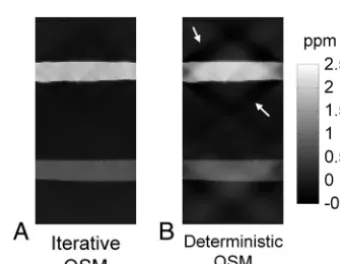
line between the 2 susceptibility values has a slope of 0.91 and an intercept of⫺0.04 ppm, respectively. Due to excellent linearity, the regression equation is used as calibration to adjust the suscep-tibility values obtained in subsequent in vivo studies. Figure 2 shows the susceptibility maps in a view plane covering the long axes of 2 tubes to compare the results from both the iterative (Fig 2A) and the deterministic (Fig 2B) QSM. The susceptibility map
from deterministic QSM presents a visually higher level of streak-ing artifacts, as indicated by white arrows in FigB, than that from the iterative QSM in Fig 2A. Further adjustments of thevalue in deterministic QSM show that the reconstructed susceptibility map exhibits either streaking at a small(under-regularized) or blurring at a large(over-regularized). At thevalue chosen in our study, the presence of both artifacts albeit at lower levels is visually discernible (not shown).
Human Subject Experiments
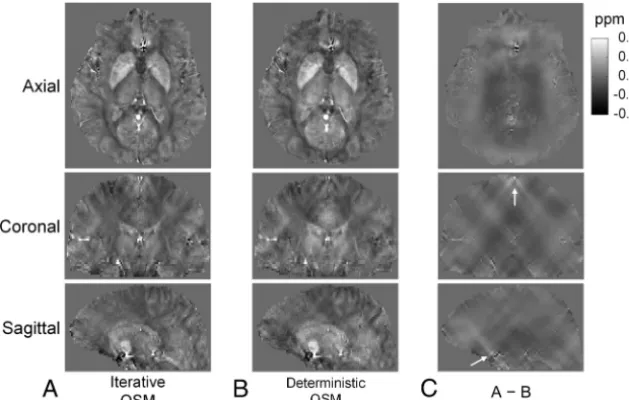
Susceptibility maps from a human subject reconstructed by iter-ative QSM and deterministic QSM are shown in Fig 3A, -B, re-spectively. In 3 displayed views, both image contrast and brain structures are very similar in the susceptibility maps of Fig 3A, -B, for which no visually prominent streaking artifacts are present. For examining the difference in susceptibility maps generated from the 2 QSM methods more closely, Fig 3Cshows subtraction of Fig 3A, -B.Note that most of the streaking patterns are centered at locations with highly distinct susceptibility values from the vi-cinity, such as the superior sagittal sinus and regions close to the skull base, as indicated by white arrows. The average reconstruc-FIG 1. Measured susceptibility versus the phantom susceptibility val-ues. Good linearity exists between measured susceptibility values and phantom susceptibility values in 6 test tubes of the phantom. The regression line has a slope of 0.91.
FIG 2. Comparison of iterative QSM and deterministic QSM in a sag-ittal view of the phantom. The susceptibility map from deterministic QSM presents a higher level of streaking artifacts as indicated by the
[image:3.594.300.532.47.244.2] [image:3.594.331.501.298.430.2]tion durations for a dataset using iterative QSM and deterministic QSM are 123 seconds and 0.17 seconds, respectively.
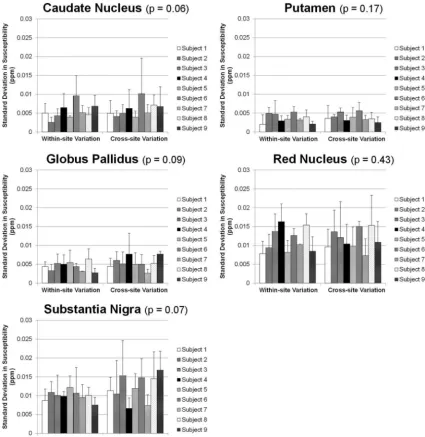
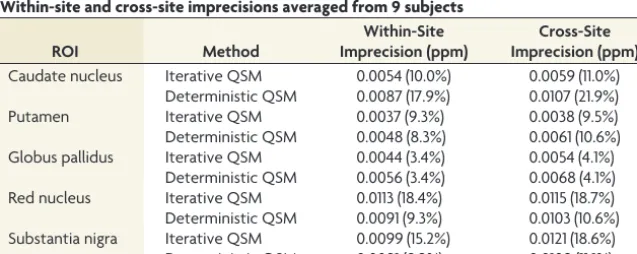
Data from multiple sites are also compared in all subjects. Figure 4 shows the susceptibility maps of another subject reconstructed with data from 3 tested scanners at sites A, B, and C by using iterative QSM. Figure 4 presents good consistency in brain structures and susceptibility values. Some difference can be observed at the frontal lobe as indicated by white arrows in Fig 4B, -C. Figures 5 and 6 show the region-of-interest analysis results from iterative QSM and deter-ministic QSM, respectively, of the within-site and cross-site varia-tions for all 9 subjects. Among the 5 ROIs, the putamen and globus pallidus show comparably less imprecision in the susceptibility val-ues, whereas the red nucleus and substantia nigra exhibit relatively larger imprecision (P⬍.001 for all pairs of comparison). Generally, for each subject, cross-site variation of susceptibility values is no larger than within-site variation in all ROIs statistically (P⬎.01 after Bonferroni correction). The Table summarizes results in Figs 5 and 6 by showing within-site and cross-site imprecisions averaged from 9 subjects. Iterative QSM and deterministic QSM perform equally well in these regions. The caudate nucleus is the only exception among the 5 ROIs, in which iterative QSM (0.0054 and 0.0059 ppm for within-site and cross-within-site imprecisions, respectively) is found to outperform
[image:4.594.54.369.48.248.2]deterministic QSM (0.0087 and 0.0107 ppm for within-site and cross-site impreci-sions, respectively).
Figure 7 plots the susceptibility values versus age with the preliminary linear re-gression results. Among the 5 selected ROIs, the putamen, globus pallidus, and red nucleus present correlation coeffi-cients of 0.40, 0.35, and 0.47 (P⬍.001), respectively, which reach statistical signif-icance. The caudate nucleus, on the other hand, shows no age association (P⬎.5). The substantia nigra exhibits marginal as-sociation with age, showing a correlation coefficient of 0.20 and P ⫽ .02, which does not reach statistical significance after Bonferroni correction.
DISCUSSION
Quantitative susceptibility mapping pro-vides an important opportunity for mea-suring pathologic changes in iron content to improve the diagnosis of brain dis-eases.25Before one fully uses the potential
of QSM, it should be understood that set-tings of the parameters in the data-pre-processing procedures and the suscepti-bility-mapping algorithms could both lead to variations in the quantitative re-sults. Therefore, it is essential to establish the precision level of QSM in terms of both within-site and cross-site reproduc-ibility before wide application of this technique to clinical studies.
The results from our study show that while within-site and cross-site yield sim-ilar reproducibility levels in general, the caudate nucleus, putamen, and globus pallidus show significantly higher precision in suscepti-bility values (average variations on the order of 0.005 ppm) than the red nucleus and substantia nigra (average variations on the order of 0.01 ppm) when computed by using iterative QSM. This regional dependency of QSM precision is anticipated to arise from the influ-ences of air-tissue interfaces. In fact, the shimming condition is expected to alter in different scans particularly near the air-tissue interfaces, which in turn, could cause inconsistencies in back-ground field removal via the PDF method. Moreover, the PDF approach, though relatively robust compared with the high-pass-filtering approach, is known to exhibit difficulties in the object boundaries, which also correspond to regions adjacent to the air cavities.18Our experimental observation of the somewhat larger
cross-site discrepancy in the frontal region, as shown in Fig 4, is also consistent with the inference that boundaries of large suscep-tibility changes remain the major challenging regions for QSM. The red nucleus and substantia nigra are 2 examples of tissues at the skull base level, hence exhibiting relatively lower precision than other regions investigated in this study.
One recent study reported aging-related increases in suscepti-FIG 3. Susceptibility maps reconstructed by iterative QSM (A) and deterministic QSM (B) in 3
different views. Susceptibility maps from both methods are very similar in contrast and brain structures.C, The difference images ofAandB. Note that most streaking patterns inCare centered at locations with high susceptibility values, such as the sagittal sinus and regions close to the skull base, as indicated bywhite arrows.
[image:4.594.55.373.320.414.2]bility values in healthy human subjects, with stronger statistical significance found in the putamen, globus pallidus, and red nu-cleus than in the substantia nigra, and insignificant changes in the caudate nucleus,7all in very good agreement with findings from
our study. In the study by Bilgic et al,7the analysis was performed
on 2 groups of subjects whose age ranges were far separated (21–29 years for the young population versus 64 – 86 years for the elderly population, respectively), as opposed to our preliminary investigation in which the subject age range was relatively narrow (23–37 years). Nevertheless, the ranges of the numeric values of the magnetic susceptibility found for these brain regions in our data are consistent with those in previous investigations.7,26More
important, with the levels of precision achieved in our study, fu-ture examinations of the aging-related susceptibility changes on the basis of regression analysis as opposed to categoric analysis should be highly feasible.
In the phantom experiment, the slope between measured and expected susceptibility values in Fig 1 is 0.91, which reveals 9% of the inaccuracy in QSM. The inaccuracy of QSM in this study was found to be at a level similar to that found in another study (Fig 2 in de Rochefort et al, slope⫽0.93).1Although the slope is found
to deviate from the ideal value of unity, theR2value of 0.9999
between measured and expected susceptibility values demon-strates the high linearity of susceptibility mapping within the range of 0 –2.04 ppm. Thus, the precision and reproducibility are not affected, even if the nonunity slope currently remains an un-solved issue if absolute accuracy is required.
Comparison of iterative and deterministic QSM shows that both algorithms are capable of solving the inverse problem of susceptibil-ity mapping with good consistency, at least for region-of-interest-based analysis. However, deterministic QSM may be more suscepti-ble to streaking artifacts at regions surrounding strong susceptibility FIG 5. Within-site (left) and cross-site (right) imprecisions shown as SDs from multiple measurements on the 9 subjects by using the iterative QSM algorithm. ThePvalues shown in the subplot titles stand for the difference between within-site and cross-site precisions (paired Student
[image:5.594.83.509.47.484.2]changes, as shown in the phantom images. This susceptibility could also explain the somewhat inferior reproducibility of deterministic QSM to iterative QSM in the caudate nucleus. An examination of
equations 1 and 2 suggests that the inclusion of the edge mask from the magnitude image in the regularization term is the major cause for the difference in the performance for the 2 QSM algorithms. Most interesting, on hu-man brain susceptibility maps obtained in vivo by using deterministic QSM, streaking artifacts are not as visually prominent as on the phantom images, where the possible presence of the streaking artifacts may have been masked by the texture of brain tissues. While for these human data, the compara-tive superiority of the 2 QSM algorithms cannot be assessed because no ground truth could be obtained for validation, causing difficulty in determining which of the 2 QSM methods gives a lower level of streaking artifacts in Fig 3, the FIG 6. Within-site (left) and cross-site (right) imprecisions shown as SDs from multiple measurements on the 9 subjects by using the determin-istic QSM algorithm. ThePvalues shown in the subplot titles stand for the difference between within-site and cross-site precisions (paired Studentttest). For all 5 regions, cross-site variations are not larger than within-site variations. The putamen and globus pallidus show the highest precision, followed by the caudate nucleus, red nucleus, and substantia nigra.
Within-site and cross-site imprecisions averaged from 9 subjects
ROI Method
Within-Site Imprecision (ppm)
Cross-Site Imprecision (ppm) Caudate nucleus Iterative QSM 0.0054 (10.0%) 0.0059 (11.0%)
Deterministic QSM 0.0087 (17.9%) 0.0107 (21.9%)
Putamen Iterative QSM 0.0037 (9.3%) 0.0038 (9.5%)
Deterministic QSM 0.0048 (8.3%) 0.0061 (10.6%) Globus pallidus Iterative QSM 0.0044 (3.4%) 0.0054 (4.1%)
Deterministic QSM 0.0056 (3.4%) 0.0068 (4.1%)
Red nucleus Iterative QSM 0.0113 (18.4%) 0.0115 (18.7%)
Deterministic QSM 0.0091 (9.3%) 0.0103 (10.6%) Substantia nigra Iterative QSM 0.0099 (15.2%) 0.0121 (18.6%)
[image:6.594.54.373.549.676.2]phantom results are certainly in favor of iterative QSM. Conse-quently, although the deterministic QSM is found to be at least 700 times faster than iterative QSM and thus opening an opportunity for on-line reconstruction of susceptibility maps at the MR imaging con-sole, for detailed quantitative analysis such as aging-related changes, the iterative QSM approach is still recommended.
In data preprocessing, the purpose of background field removal is to extract local magnetic field variation generated by brain tissues, which is subsequently used for QSM. The high-pass filtering method is not preferred for quantitative susceptibility mapping, even though it is one of the most frequently used methods for background field removal in MR imaging (eg, in susceptibility-weighted imaging). One of the major limitations of applying high-pass filtering in QSM is that part of the local field information could be mistakenly filtered out, because the distributions of spatial frequency in local field and in background field cannot be cleanly separated by a single high-pass-filtering kernel size. Therefore, new methods, including the PDF18
and the sophisticated harmonic artifact reduction for phase data (SHARP)22methods, have been proposed for background field
removal in QSM. The idea of both the PDF and the SHARP methods is to decom-pose local field and background field by using their physical properties. While the PDF method uses a projection theorem, the SHARP method applies the Laplace equation to separate background field. In previous studies, both the PDF and the SHARP methods have been demon-strated to be superior to the high-pass-filtering method for background field removal in QSM.18,22From numeric
sim-ulation, we have also confirmed that local field obtained by the PDF method pre-serves subtle field changes from brain tis-sues better than that obtained by the high-pass-filtering method (data not shown). We, therefore, think that both the PDF and the SHARP methods are adequate for background field removal in QSM. The comparison between the PDF and the SHARP methods, however, is beyond the scope of this study.
This study is limited by the absence of flow compensation to reduce flow-related phase accumulations in vessels and the ven-tricles. Because our study used commercial 3D multiecho gradient-echo sequences on the tested scanners, full flow compensation for all echoes was unavailable at the time of this study. This scenario may have affected the reference susceptibility values calculated for the flowing CSF in the lateral ventricles. Nonetheless, this minor weakness influ-ences only the absolute susceptibility values reported for the 5 ROIs and is relatively un-important to our investigation focused on within-site and cross-site precision assess-ment. Some investigators used the splenium as a reference7instead of
using CSF.26Yet in our experience, the regional variations of
suscep-tibility in the splenium are no smaller than those found for the lateral ventricles. This potential limitation of uncertain susceptibility values for the CSF could be alleviated with pulse sequence modifications to include flow compensation for all echoes.17,27As a last note, the
sta-tistical sensitivity of cross-site imprecisions may be somewhat limited by the derivation of SDs by using only 3 numbers. However, this limitation is because we could only access the three 3T scanners. Moreover, even with this statistical limitation, results from this study could still serve as a reference for the imprecision level to be expected in future multisite QSM studies.
CONCLUSIONS
In summary, quantitative susceptibility mapping is a technique of high potential to measure changes in iron content in human brain tissues. This study demonstrates that an average imprecision level of approximately 0.005– 0.01 ppm, depending on the location FIG 7. Linear regression results comparing susceptibility values versus age by using 135 datasets
collected in this study. Among the 5 ROIs, the putamen, globus pallidus, and red nucleus present correlation coefficients of 0.40, 0.35, and 0.47, respectively (P⬍.001). The caudate nucleus shows no age association (P⬎.5), and the substantia nigra exhibits a marginal association that does not reach statistical significance after Bonferroni correction (P⫽.02). The vertical error bars shown on theleft
[image:7.594.45.372.50.428.2]within the brain, could be achieved at 3T for QSM when used with careful control, even on different scanners. Results from our study may further increase the practicality and applicability of QSM in longitudinal and cross-site human brain studies.
ACKNOWLEDGMENTS
The authors thank the following institutions for their research support: Research Center for Mind, Brain & Learning, National Chengchi University; Mind Research and Imaging Center, Na-tional Cheng Kung University; and the Department of Radiology, Kaohsiung Veterans General Hospital.
Disclosures: Po-Yu Lin, Tzu-Cheng Chao, Ming-Long Wu—RELATED:Grant: This study was partially supported by research funding from the National Science Coun-cil, Taiwan;Support for Travel to Meetings for the Study or Other Purposes: Na-tional Science Council, Taiwan,Comments: The traveling expense among multiple MRI sites to collect data was supported by research grants from the National Science Council, Taiwan.
REFERENCES
1. de Rochefort L, Liu T, Kressler B, et al.Quantitative susceptibility map reconstruction from MR phase data using Bayesian regularization: val-idation and application to brain imaging.Magn Reson Med2010;63: 194 –206
2. Liu T, Liu J, de Rochefort L, et al.Morphology enabled dipole inversion (MEDI) from a single-angle acquisition: comparison with COSMOS in human brain imaging.Magn Reson Med2011;66:777– 83
3. Schweser F, Deistung A, Sommer K, et al.Toward online reconstruc-tion of quantitative susceptibility maps: superfast dipole inversion.
Magn Reson Med2013;69:1582–94
4. Shmueli K, de Zwart JA, van Gelderen P, et al.Magnetic susceptibil-ity mapping of brain tissue in vivo using MRI phase data.Magn Reson Med2009;62:1510 –22
5. Wharton S, Schafer A, Bowtell R.Susceptibility mapping in the hu-man brain using threshold-based k-space division.Magn Reson Med
2010;63:1292–304
6. Wu B, Li W, Guidon A, et al.Whole brain susceptibility mapping using compressed sensing.Magn Reson Med2012;67:137– 47 7. Bilgic B, Pfefferbaum A, Rohlfing T, et al.MRI estimates of brain iron
concentration in normal aging using quantitative susceptibility mapping.Neuroimage2012;59:2625–35
8. Deistung A, Schafer A, Schweser F, et al.Toward in vivo histology: a comparison of quantitative susceptibility mapping (QSM) with magnitude-, phase-, and R2*-imaging at ultra-high magnetic field strength.Neuroimage2013;65:299 –314
9. Li W, Wu B, Liu C.Quantitative susceptibility mapping of human brain reflects spatial variation in tissue composition.Neuroimage
2011;55:1645–56
10. Lim IA, Faria AV, Li X, et al.Human brain atlas for automated region of interest selection in quantitative susceptibility mapping: application to determine iron content in deep gray matter struc-tures.Neuroimage2013;82:449 – 69
11. Liu J, Liu T, de Rochefort L, et al.Morphology enabled dipole inver-sion for quantitative susceptibility mapping using structural con-sistency between the magnitude image and the susceptibility map.
Neuroimage2012;59:2560 – 68
12. Wu B, Li W, Avram AV, et al.Fast and tissue-optimized mapping of magnetic susceptibility and T2* with multi-echo and multi-shot spirals.Neuroimage2012;59:297–305
13. Langkammer C, Schweser F, Krebs N, et al.Quantitative susceptibil-ity mapping (QSM) as a means to measure brain iron? A post mor-tem validation study.Neuroimage2012;62:1593–99
14. Zheng W, Nichol H, Liu S, et al.Measuring iron in the brain using quantitative susceptibility mapping and X-ray fluorescence imag-ing.Neuroimage2013;78:68 –74
15. de Rochefort L, Brown R, Prince MR, et al.Quantitative MR suscep-tibility mapping using piece-wise constant regularized inversion of the magnetic field.Magn Reson Med2008;60:1003– 09
16. Cusack R, Papadakis N. New robust 3-D phase unwrapping algorithms: application to magnetic field mapping and undistort-ing echoplanar images.Neuroimage2002;16:754 – 64
17. Gilbert G, Savard G, Bard C, et al.Quantitative comparison between a multiecho sequence and a single-echo sequence for susceptibility-weighted phase imaging.Magn Reson Imaging2012;30:722–30 18. Liu T, Khalidov I, de Rochefort L, et al.A novel background field
removal method for MRI using projection onto dipole fields (PDF).
NMR Biomed2011;24:1129 –36
19. Cheng YC, Neelavalli J, Haacke EM.Limitations of calculating field distributions and magnetic susceptibilities in MRI using a Fourier based method.Phys Med Boil2009;54:1169 – 89
20. Haacke EM, Tang J, Neelavalli J, et al.Susceptibility mapping as a means to visualize veins and quantify oxygen saturation.J Magn Reson Imaging2010;32:663–76
21. Liu T, Spincemaille P, de Rochefort L, et al.Calculation of suscepti-bility through multiple orientation sampling (COSMOS): a method for conditioning the inverse problem from measured magnetic field map to susceptibility source image in MRI.Magn Reson Med
2009;61:196 –204
22. Schweser F, Deistung A, Lehr BW, et al.Quantitative imaging of intrin-sic magnetic tissue properties using MRI signal phase: an approach to in vivo brain iron metabolism?Neuroimage2011;54:2789 – 807 23. Bilgic B, Chatnuntawech I, Fan AP, et al.Fast image reconstruction
with L2-regularization.J Magn Reson Imaging2014;40:181–91 24. Kressler B, de Rochefort L, Liu T, et al.Nonlinear regularization for
per voxel estimation of magnetic susceptibility distributions from MRI field maps.IEEE Trans Med Imaging2010;29:273– 81 25. Wang S, Lou M, Liu T, et al.Hematoma volume measurement in
gradient echo MRI using quantitative susceptibility mapping.
Stroke2013;44:2315–17
26. Wharton S, Bowtell R.Whole-brain susceptibility mapping at high field: a comparison of multiple- and single-orientation methods.
Neuroimage2010;53:515–25

![Bis{di μ isobutyrato bis[cis diammineplatinum(II)]} tetraperchlorate](data:image/gif;base64,R0lGODlhAQABAIAAAP///wAAACH5BAEAAAAALAAAAAABAAEAAAICRAEAOw==)