warwick.ac.uk/lib-publications
A Thesis Submitted for the Degree of PhD at the University of Warwick
Permanent WRAP URL:
http://wrap.warwick.ac.uk/108324
Copyright and reuse:
This thesis is made available online and is protected by original copyright.
Please scroll down to view the document itself.
Please refer to the repository record for this item for information to help you to cite it.
Our policy information is available from the repository home page.
STUDIES TOWARDS THE DEVELOPMENT OF A HOST:VECTOR
SYSTEM FOR THE GENUS
By
JOHN K. BREHM, B.SC., M.SC.
This thesis is presented for the degree of
Doctor of Philosophy in the Department of
THE BRITISH LIBRARY
D O C U M E N T SUPPLY C E N T R EBRITISH THESES
N O T I C E
The quality of this reproduction is heavily dependent upon the quality of the original thesis submitted for microfilming. Every effort has been made to ensure the highest quality of reproduction possible.
If pages are missing, contact the university which granted the degree.
Some pages may have indistinct print, especially If the original pages were poorly produced o r if the university sent us an inferior copy.
Previously copyrighted materials (journal articles, published texts, etc.) are not filmed.
Reproduction of this thesis, other than as permitted under the United Kingdom Copyright Designs and Patents Act 1988, or under specific agreement with the copyright holder, is prohibited.
T H IS THESIS H A S BEEN M IC R O FILM E D EX A C T L Y A S R E C E IV E D
T H E B R IT IS H f L I B R A R Y
D O C U M E N T SUPPLY C EN TR E Boston Spa, Wetherby W est Yorkshire, LS23 7BQ
DECLARATION
The work contained in this thesis was the result of origi nal research conducted by myself under the supervision of
Dr. N.P. Minton and Dr. G.P.C. Salmond. All sources of
information have been specifically acknowledged by means of reference.
None of the work contained in this thesis has been used in
any previous application for a degree.
CONTENTS
DEDICATION
DECLARATION CONTENTS LIST OF FIGURES LIST OF TABLES
ABBREVIATIONS ACKNOWLEDGEMENTS SUMMARY
CHAPTER ONE___ GENERAL INTRODUCTION SECTION I: THE GENUS CLOSTRIDIUM
1.1. INTRODUCTION TO THE GENUS
1.1.1. The butyric acid bacteria
1.1.2. The amino acid dissimilating bacteria
1.1.3. The nitrogen-containing ring compound
fermenting clostridia
1.1.4. The carbohydrate fermenting clostridia
that do not yield butyrate
1.1.5. The ethanol-acetate fermenting clostridia
1.2. INDUSTRIAL APPLICATIONS OF CLOSTRIDIA
1.2.1. Solventogenic fermentation
1.2.2. Future potential
1.3. THE GENETICS OF CLOSTRIDIUM
1.3.1 Clostridial plasmids
1.3.1.1. Bacteriocinogenic plasmids
1.3.1.2. Conjugal plasmids
1.3.1.3. Toxigenic plasmids of C. perfrinaens
1.3.1.4. Toxigenic plasmids of C. tetani
1.3.1.5. Plasmids of g. botUljnum
1.3.1.6. Plasmids of C. difficile and C. novvi
1.3.1.7. Plasmids of the saccharolytic Clostridia
1.3.2. Clostridial bacteriophages
1.3.3. Genetic transfer in the absence of plasmids
1.3.4. Cloning in clostridia
1.3.5. Expression of clostridial genes in other
SECTION IIï DEVELOPMENT OF A HOST/VECTOR SYSTEM FOR THE SACCHAROLYTIC CLOSTRIDIA
1.4. INTRODUCTION 28
1.5. VECTOR DELIVERY SYSTEMS 28
1.5.1. Transformation 28
1.5.1.1. transformation of naturally competent cells 29
1.5.1.2. Peg-dependent, whole cell transformation 29
1.5.1.3. Protoplast transformation 30
1.5.1.4. Electroporation 32
1.5.1.5. Transformation of saccharolytic clostridia 33
1.5.2. Conjugal transfer 34
1.5.2.1. Cointegrate conjugal plasmid transfer 34
1.5.2.2. Mobilisation 35
1.6. VECTOR COMPONENTS 36
1.6.1. Replication of Gram-positive plasmids 36
1.6.1.1. Mode of replication 37
1.6.1.2. Initiation of lagging strand synthesis 40
1.6.1.3. Control of replication 41
1.6.2. Promoter system 4 2
1.6.2.1. Promoters 42
1.6.2.2. The "Gram-barrier” 4 4
1.6.2.3. Other promoter specificities in B. subtilis 45
1.6.2.4. Transcriptional control by specific o- 46
factors: a barrier to heterologous gene expression?
1.6.3. Translational control of gene expression in 47
B. subtilis
1.6.3.1. Translation initiation 47
1.6.3.4. Translation elongation 49
1.6.4. Antibiotic resistance genes 51
1.7. AIMS OF THE THESIS 53
CHAPTER TWO__ MATERIALS AMP METHPPS
2.1. MATERIALS 54
2.1.1. Chemicals and materials 54
2.1.2. Enzymes 55
2.1.3. Media 55
2.1.3.1. Routine growth media 56
2.1.3.2. Bacillus transformation media 59
2.1.3.3. Antibiotics 60
2.1.4. Buffers and solutions 61
2.1.5. Bacterial strains plasmids and phages 67
2.2. METHODS 70
2.2.1. Storage and growth of bacterial strains 70
2.2.1.1. E. coli 70
2.2.1.2. B. subtilis 70
2.2.1.3. Clostridia 70
2.2.2. Transformation of bacterial strains 71
2.2.2.1. Transformation and transfection of 71
competent E. coli cells
2.2.2.2. Transformation of naturally competent 71
B. subtilis cells
2.2.3. Plasmid and M13 RF DNA isolations 72
2.2.3.1. Large scale isolation of plasmid DNA 72
from E. coli
2.2.3.2. Small scale isolation of plasmid DNA 73
from E.coli
2.2.3.3. Small scale isolation of plasmid DNA 74
from B... subtilis
2.2.3.4. Large scale isolation of plasmid DNA 74
from butyrigum
2.2.3.5. Large scale isolation of M13 RF DNA 75
2.2.4. Isopycnic centrifugation of plasmid and 75
M l 3 RF DNA
2.2.4.1. Preparation of dialysis tubing 77
2.2.5. Chromosomal DNA isolations 77
2.2.6. Treatment of DNA with enzymes 7 9
2.2.6.1. Restriction endonucleases 7 9
2.2.6.2. T4 polynucleotide ligase 7 9
2.2.6.3. T4 DNA polymerase (Klenow fragment) 80
2.2.6.5. Calf intestinal phosphatase (CIP) 80
2.2.6.6. DNAase— free RNAase 81
2.2.7. Establishment of conditions for partial 81
digestion of chromosome DNA with
restriction endonucleases
2.2.8. Radio-labelling of DNA 82
2.2.8.1. Nick-translation of double-stranded DNA 82
2.2.8.2. 5'-end labelling of oligonucleotides 82
2.2.8.3. "Reverse primer" labelling of M13 .,83
single-stranded template DNA
A > I
2.2.8.4. End-labelling of lambda/Hindlll DNA 83 size markers
2.2.9. Scintillation counting of labelled DNA 84
2.2.10. Electrophoresis 84
2.2.10.1. Agarose gel electrophoresis 84
2.2.10.2. Denaturing polyacrylamide gel 85
electrophoresis
2.2.10.3. SDS-polyacrylamide gel electrophoresis 86
2.2.11. Recovery of DNA from agarose by electro- 87
elution
2.2.12. "Southern" transfer of DNA 88
2.2.12.1. Transfer to nitrocellulose membrane 88
2.2.12.2. Transfer to nylon membrane 89
2.2.13. DNA—DNA hybridisations and autoradiography 89
2.2.13.1. In situ colony hybridisation 89
2.2.13.2. DNA-DNA hybridisations 90
2.2.13.3. Rehybridisation of membranes 92
2.2.13.4. Autoradiography 92
2.2.14. Quantitation of DNA 93
2.2.14.1. Spectrophotometric quantitation 93
2.2.14.2. Ethidium bromide fluorescent 93
quantitation
2.2.15. Precipitation of DNA 94
2.2.15.1. Ethanol precipitation 94
2.2.15.2. Isopropranol precipitation 95
2.2.16. Phenol extraction of DNA 95
2.2.17. DNA sequencing 95
2.2.17.1. Sub-cloning of DNA into M13 vectors 96
2.2.17.2. Sonication of DNA 96
2.2.17.3. Preparation of template DNA 97
2.2.17.4. Annealing of template and primer 98
2.2.17.5. Sequencing reactions (polymerisation) 98
2.2.17.6. Loading and running of sequence gels 99
2.2.17.7. Compilation and analysis of sequence 99
data
2.2.18. Synthetic oligonucleotides 100
2.2.18.1. Synthesis of oligonucleotides 100
2.2.18.2. Deprotection of oligonucleotides 100
2.2.18.3. Gel analysis of oligonucleotides 101
2.2.18.4. Purification of oligonucleotides 101
2.2.19. Site-directed mutagenesis 102
2.2.19.1. Phosphorylation of mutant 103
oligonucleotides
2.2.19.2. Extension reactions and trans- 103
formation of E. coli BMH71-18
2.2.19.3. Colony screening of mutants 104
2.2.19.4. Plaque purification and DNA 105
sequencing
2.2.20. Detection of single-stranded plasmid DNA 105
in B. gnfrt i U ?
2.2.21. Filter mating procedure 107
2.2.22. In vitro transcription/translation assays 107
2.2.23. Catechol 2,3-dioxegenase (C230) assays 108
2.2.23.1. Agar plate detection method 108
2.2.23.2. Spectrophotometric assay 108
2.2.24. Carboxypeptidase G 2 plate assay 109
2.2.25. Protein determination 109
CHAPTER THEEg--CHARACTERISATION OF A CLOSTRIDIAL REPLICON
3.1. INTRODUCTION 110
3.2. RESULTS 112
3.2.1. Sub-cloning of the minimal replicon of 112
pCBlOl
3.2.2. Nucleotide sequence determination of the 117
minimal replicon of pCBlOl 1 1 7
3.2.3. Nucleotide sequence analysis of pRBlAl-4 117
3.2.4. Nucleotide sequence determination of the 119
remainder of pCBlOl
3.2.4.1. Construction of pCB2 119
3.2.4.2. Sequencing of the Clal fragment of pCB2 120
3.2.4.3. Sequencing over the Clal junction of pCB2 122
3.2.5. Features of the pCBlOl sequence 123
3.2.5.1. The pCBlOl DNA sequence 123
3.2.5.2. Genetic organisation of pCBlOl 130
3.2.5.3. Translational signals 130
3.2.5.4. Putative transcriptional regulatory 137
signals
3.2.5.5. Additional sequence features 137
3.2.6. Further characterisation of the pCBlOl 144
minimal replicon
3.2.6.1. Site-directed mutagenesis of the pCBlOl 144 minimal replicon
3.2.6.2. Construction of the ORF C frame-shift 150
mutant, pM21C127
3.2.6.3. Construction of pM21C128 1 5 7
3.2.6.4. "Nick-site" search analysis 159
3.2.6.5. Search for a minus origin of replication 161
3.2.6.6. Analysis of pCBlOl for a single-stranded 161
replication intermediate
3.2.7. Analysis of the pCBlOl ORF products 162
3.2.7.1. Analysis of the hydropathic character 162
of the ORF products
3.2.7.2.. Amino acid sequence comparisons 162
3.2.7.3. In vitro transcription and translation 166
of the pCBlOl ORFs
3.2.7.4. Analysis of the pCBlOl ORFs for 171
DNA-binding regions
3.3. DISCUSSION 173
CHAPTER FOUR THE CONSTRUCTION AND USE OF AN EXPRESSION CARTBIP9E__ BASED ON THE FERREPOXIN GENE OF CLOSTRIDIUM PASTEURIANUM
4.1. INTRODUCTION 181
4.2. RESULTS 183
4.2.1. Cloning of the ferredoxin gene from 183
C. pggfgurianum
4.2.1.1. Isolation of the Fd-encoding genomic DNA 183
4.2.1.2. Attempted cloning of the Fd gene directly 183
into M13
4.2.1.3. Cloning of the Fd gene in pAT153 184
4.2.1.4. DNA sequence determination of pFdl 185
and pFdlll Sau3A inserts
4.2.2. Construction of the ferredoxin expression 189
cartridge
4.2.2.1. Site-directed mutagenesis of the 189
ferredoxin gene
4.2.2.2. Construction of the cartridge 1 9 0
4.2.3. Construction of the shuttle vectors pMTL33 198
and pMTL34
4.2.3.1. Construction of pMTL33 1 9 8
4.2.3.2. Construction Of pMTL34 200
4.2.4. Isolation of the xvlE gene 200
4.2.5. Expression of xylE in E. coli and 203
p T gyfrtjljs
4.2.5.1. Sub-cloning of FdCART/xvlE into pMTL34 203
4.2.5.2. Sub-cloning xvlE into pMTL34 205
4.2.5.3. Sub-cloning xvlE into PMTL33 206
4.2.5.4. Expression studies in E. coli and 206
p, gubtiljs
4.2.5.5. Confirmation of the Fd sequence 209
4.2.5.6. Analysis of the sequence upstream of xvlE 210
4.3. DISCUSSION 212
CHAPTER FIVE____ TRANSFER AND EXPRESSION OF THE XYLE SENE IN C. ACETOBUTVLICUH
5.1. INTRODUCTION 218
5.2. RESULTS 219
5.2.1. Cloning and seguenceing of the erythromycin
resistance determinant of pAMjgl
219
5.2.1.1. Sub-cloning of the Emr determinant
of pAM01
220
5.2.1.2. DNA sequence determination of the Emr
determinant of pAM/3l
222
5.2.2. Construction of the pODl analog, pMTL21EC 223
5.2.2.1. Construction of pMTL2lE 226
5.2.2.2. Construction of pMTL21EC 226
5.2.3. Conjugal cointegrate transfer ofthe xvlE
gene to C ,.. flcetPfrMty 1 icum
228
5.2.3.1. 5.2.3.2.
Sub-cloning of the xvlE gene into pMTL21EC Conjugal cointegrate transfer of xvlE
to c, apetpfrutvlicuro
228
5.2.4. Expression of XYlE in C. acetobutvlicum 230
5.3. DISCUSSION 234
CHAPTER -SIX____ GENERAL DISCUSSION 236
BIBLIOGRAPHY 239
LIST QT FIGURES
FIGURE PAGE
3a Derivation of the chimaeric plasmid pRBl 1 1 3
3b Restriction endonuclease map of pRBlAl-4 1 1 5
3c Restriction endonuclease map of pCBl 116
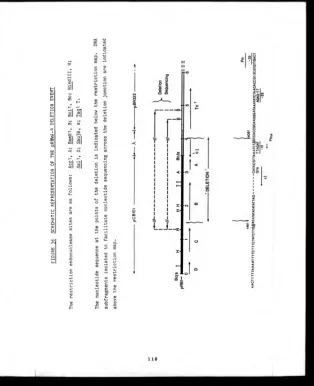
3d Schematic representation of the pRBlAl-4 1 1 8
deletion event
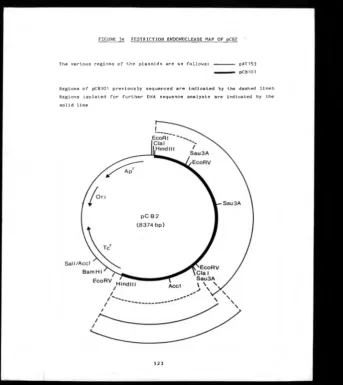
3e Restriction endonuclease map of pCB2 1 21
3 f Complete nucleotide sequence of pCBlOl 124
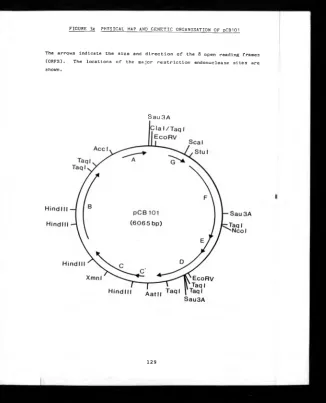
3g Physical map and genetic organisation of
pCBlOl
3h The pCBlOl sequence: secondary structure 141
prediction
3 i The pCBlOl sequence: secondary structure 142
prediction
3j The pCBlOl sequence: secondary structure 143
prediction
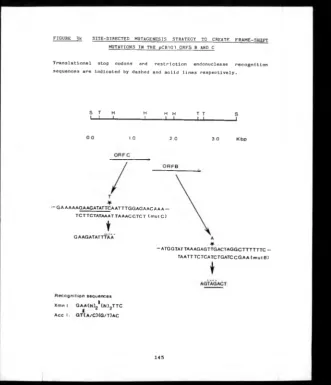
3k Site-directed mutagenesis strategy to create 145
frame-shift mutations in the pCBlOl ORFs B and C
31 Schematic representation of DNA sequence 149
analysis of the pCBlOl ORF B and C mutants
3m Diagramatic representation of the 3.48 Kb 152
Sau3A subclones
3n Derivation of pMTL21C 1 5 3
3o Derivation of pM21C125 154
3p Derivation of pM21C126 155
3q Derivation of pM21C127 156
3r Derivation of pM21C128 158
3s Nick-site sequence homologies 160
3t Detection of single stranded pCBlOl DNA 163
3u Hydropathic character of the putative ORF 164
products of pCBlOl
3v Hydropathy plot comparisons 165
3w Amino acid alignment of pCBlOl, pC194, and 167
p U B H O replication proteins
3x Amino acid alignment of pCBlOl ORF C' and 168
pLSl ORF A
170
3y Protein synthesis in an E. coli based in vitro
transcription/translation system
3z Comparison of the putative DNA-binding region 172
o f ORF B with DNA binding regions of other reported DNA binding proteins
4a Autoradiogram of plasmid DNA derived from
clones Fdl, Fdll, and Fdlll.
4b Nucleotide sequence of the ferredoxin gene of 188
Clostridium pasteurianum
4c Fd mutagenic oligonucleotides 191
4d Hybridisation screening of successful mutants 192
4e Restriction enzyme analysis of Fd double 194
mutants
4 f Derivation of the Fd expression cartridge 196
4g Nucleotide sequence of the portable Fd 197
expression cartridge
4h Derivation of shuttle vectors pMTL33 and 199
pMTL34 and the construction of chimaeras w i t h the Fd expression cartridge and the
x vlE gene.
4i Isolation of the xvlE gene 202
4j Secondary structure prediction of sequence
upstream of xvlE
5a T h e chimaeric plasmid pUC8/Em 221
5b Sequence of the adenine methylase gene of the 224
Streptococcus faecal is plasmid pAMßl.
5c Derivation of pMTL21EC 227
5d Derivation of the chimaeric plasmids p21ECXl, 229
p 2 1 E C X 2 , p21ECFX1, and p21ECFX2
5e Strategy for cointegrate conjugal transfer 232
of xyl£ into c. acetobutvlicum
5f Catechol plate assay for the xvlE gene product 233
TABLE
1 . 1
1.2
1
2
LIST 9¥ TABLES
PAGE
Summary of cloned clostridial genes 25
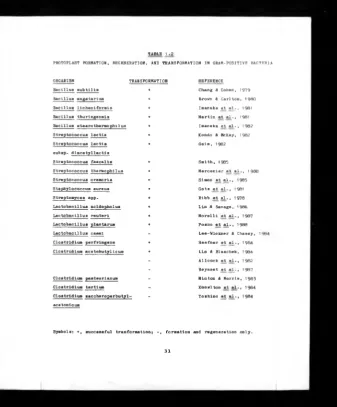
Protoplast formation, regeneration, and 31
transformation in Gram-positive bacteria
Bacterial strains 68
Plasmids and phages 69
Calculated molecular weights of the putative 132
pCBlOl ORF products
Location of regions upstream of the open 133
reading frames of pCBlOl and putative
translation initiation signals
Codon utilisation of the ORFs of pCBlOl and 134
comparison with pIP404, E. c o l i . and B. subtilis
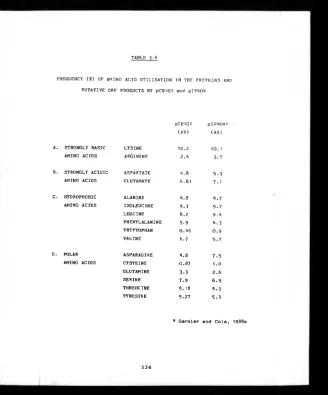
Frequency (%) of amino acid utilisation in the 136
proteins and putative ORF products by pCBlOl and pIP404.
Putative promoter sequences of pCBlOl 138
Potential transcriptional terminators 139
List of custom synthesised oligonucleotide primers
Expression levels of catechol 2,3-dioxygenase (C230)
Comparison of the codon utilisation of the 214
xxi£ gene of Eseudomonas putida with
that of Escherichia coli and Bacillus subtilis
ABBREVIATIONS
A Adenine
aa Amino acid
Ap ATP
Ampicillin
Adenosine 5'-triphosphate
Av Average bp C Base pairs Cytidine C. Approximately
CIP Calf intestinal phosphatase
ccc Covalently closed circular
Cl Clindamycin
cm Centimetre
Cm Chloramphenicol
cpm C230
Counts per minute
Catechol 2,3-dioxegenase Da dATP dCTP dGTP dTTP dNTPs DM F
DNA
Dalton
Deoxyadenosine 5'-triphosphate
Deoxycytosine 5•-triphosphate Deoxyguanosine 5'-triphosphate Deoxythymine 5'-triphosphate Deoxyribonucleoside 5'—triphosphates Dimethylformamide
Deoxyribonucleic acid
DNAase Deoxyribonuclease
DTT DL-Dithiothreitol
EDTA Ethylenediaminetetraacetic acid
Em Erythromycin g G Gram Guanine fmet Formylmethionine IPTG kb kDa
Isopropyl thio-/3-galactoside
Kilobase Kilodaltons Km 1 Kanamycin Litre mA Milliampères MLS Md
Macrolide, Lincosamide, Streptogrammin Megadalton
mg min Milligrams Minute ml Millilitres mM Millimolar M r mRNA Molecular weight Messenger RNA NC Nitrocellulose nt Nucleotide nt pos ODn ORF Nucleotide position
Optical density at wavelength n Open reading frame
PEG Polyethylene glycol
po p.s.i.
(r )
Promoter/operator region Pounds per square inch Resistant
ROM Reinforced clostridial medium
RNA Ribonucleic acid
RF Replicative form
rRNA Ribosomal RNA
RNAase Ribonuclease
r.p.m.
(s )
Revolutions per minute Sensitive
SDS Sodium dodecyl sulphate
sec Second
Sm Streptomycin
Spp.
SSB
Species (pleural)
Single strand binding protein
T Thymine
Tc Tetracycline
TEMED -N,N.N',N '-tetramethylethylenediamine
Temp U Temperature Uracil ÜV Ultraviolet V Volts u Unit H9 Ml wt Microgram Microlitre Wild type
X-gal
5-bromo-4-chloro-3-indolyl-/J-D-galactopyranoside
ACKNOWLEDGEMENTS
I should like to thank my supervisors Dr. Nigel Minton and Dr. George Salmond for their invaluable advice and enthusi
astic encouragement throughout the course of this work. in
addition, thanks are also due to Dr. John Oultram, Dr. John
Stephenson, and Professor Tony Atkinson for critical
reading of the manuscript.
Special thanks are due to Professor Tony Atkinson for
providing facilities and arranging the finance that made
this study possible.
I would also like to thank Mrs Kate Oultram for her en thusiastic assistance in the preparation of figures.
Thanks are also due to Roy Hartwell for oligonucleotide
synthesis.
I gratefully acknowledge receipt of the the volume "Clos
tridia" from Dr. Nigel Minton and Dr. David Clarke (eds.)
prior to publication.
SUMMARY
Clostridia are widely recognised as organisms of biotechno
logical importance. This potential, however, cannot be
fully exploited until reliable methods have been developed for the transfer of genetic information into and between members of the genus. As with other Gram-positive bacteria,
attempts to develop host:vector systems have focused on
protoplast transformation procedures. This approach, howev
er, has been hampered by the lack of suitable plasmid
vectors. Studies have been initiated to construct such a
vector.
As a potential source of a clostridial replicon, the cryp
tic plasmid of C. butvricum NCIB 7423 (pCBlOl, 6.05 kb) has been examined. The complete nucleotide sequence of pCBlOl
was determined and it's minimal replicon characterised
together with the elucidation of some of the mechanisms
involved in it's replication.
The erythromycin resistance determinant (Emr) of the Gram positive R-factor pAM/3l was chosen as a selectable marker
and the entire nucleotide sequence of this gene was deter mined. The Ferredoxin (Fd) gene of Clostridium pasteurianum was cloned and employed in the construction of an expres
sion cartridge. The effectiveness of this cartridge in
promoting the expression of heterologous genes was examined using a promoter-less xvlE gene.
The conjugative Streptococcus faecalis plasmid pAM/Jl was used to mobilise vectors carrying the xvlE gene (under the transcriptional control of the Fd promoter) into Clostridi um acetobutvlicum where the gene was expressed. This repre sents one of the first reports of directed gene expres
sion in ç,
SECTION I
lili__ INTEQPPgTIQH-TO THE SEEPS
First described by Prazmowski (1880), the genus Clostridium
has grown to one of the largest genera amongst procaryotes.
A total of 83 species are listed in Bergey's Manual of
Systemic Bacteriology (Cato et a l ., 1986). For inclusion
in the genus, the following criteria must be met: "anaero
bic or microaerophilic spore-forming rods that do not form
spores in the presence of air, are usually Gram-positive,
and do not carry out d i s s i m i l a t o r y sulphate reduction"
(Cato & Stackebrandt, 1989). As a result of these rather
loose r e q u i r e m e n t s t h e g e n u s c o m p r i s e s a v e r y diverse
collection of Gram-positive bacteria with a wide range of
mol% G + C values, 21 to 54 %, (Gottschalk et a l .. 1981),
which is reflected by the h i ghly diverse me c h a n i s m s of
dissimilatory metabolism encountered. This latter feature
lends a probable basis for the taxonomic subdivision of the
genus; the group will be presented here primarily in terms
of these properties.
1.1.1. THE BUTYRIC ACID BACTERIA
Many Clostridia perform a fermentation of soluble carbohy
drates, starch, or pectin, with the formation of acetic and
butyric acids, C0 2 , and H 2 • These "butyric acid bacteria"
grow poorly (if at all) in complex media devoid of a fer
mentable carbohydrate. Two other characteristics are dis
tinctive of this subgroup: the y synthesise as cellular
reserve material a starch-like polysaccharide, granulose;
and many fix atmospheric nitrogen. Examples of this group
include C, butyricimu C. butvllcum. C. beiierinckii.
and C. saccharobutvlpropvlicum (Cummins & Johnson, 1971).
Other members of this group produce neutral solvents (such
as butanol, acetone, isopropranol, and ethanol from sugars.
The fermentative production of acetone and butanol has been
exploited on an industrial level and the strains generally
employed are classified as C. a c e t o b u t v l i c u m . although
numerous specific names have been applied to these organ
isms in the past (Beesch, 1952? McCutchan & Hickey, 1954;
Ross, 1961). In addition, a number of different species of
butanol-producing C l o s tridia are now recognised, based
mainly on differences in the type and ratio of the solvents
produced. C. beiierinkii (C. butvlicum) produces solvents
in approximately the same ratio as C. acetobutvlicum. but
isopropranol is p r o duced in place of acetone, while c.
aurantibutvricum produces both acetone and isopropranol in
addition to butanol (George & Chen, 1983). C. tetanomorphum
is a newly isolated species which produces almost equimolar
a m o u n t s of b u t a n o l a n d e t h a n o l b u t no o t h e r s o l v e n t s
(Gottwald et a l .. 1984).
1.1.2. THE AMINO ACID DISSIMILATING BACTERIA
A large number of Clostridium spp. can grow well in complex
media containing peptones or yeast extract, in the absence
of a fermentable carbohydrate. These organisms are collec
tively responsible for the putrefactive decomposition of
nitrogenous compounds in nature, and include the principal
pathogenic Clostridia (C. b o t u l i n u m . C. t e t a n i . and
perfrinoens) . Growth in complex media is accompanied by the
formation of ammonia, C02 , H 2S, fatty acids, and a variety
of o t h e r v o l a t i l e substances, often h a v i n g u n p l easant
odours (for review, see Barker, 1961). Although a consid
erable number of Clostridia that ferment amino acids can
also f e r m e n t carbo h y d r a t e s , by a typ i c a l butyric acid
fermentation, many are wholly unable to ferment carbohy
drates; such organisms are exemplified by C. tetani and C.
histolvticum. Similarly, although the majority of the amino
acid dissimilating clostridia produce proteases, certain
species are non-proteolytic. Organisms of this latter type
are therefore dependent on the availability of free amino
acids as g r o w t h substrates, as opposed to proteinaceous
material.
1.1.3. THE NITROGEN-CONTAINING RING COMPOUND FERMENTING
CLOSTRIDIA
Some Clostridia can obtain energy by the fermentation of
ring compounds including purines, pyrimidines, and nicotin
ic acid. The fermentation of purines (guanine, uric acid,
hypoxanthine, xanthine) is carried out by C. acidiurici and
C. cylindrosporum. nutritionally highly specialised spe
cies, which a r e unable to ferment other substrates. The
fermentation products consist of acetate, glycine, formate,
C02 , and other precursors.
1.1.4. THE CARBOHYDRATE FERMENTING CLOSTRIDIA THAT DO NOT
YIELD BUTYRATE
A number of clostridia utilising carbohydrates as energy
sources dissimilate them by pathways other than the butyric
acid pathway. These organisms include cellulose fermenting
Clostridia, m o s t of w h i c h a r e high l y s p e c i a l i s e d with
respect to substrates; some species can ferment only cellu
lose. The p r o d u c t s i nclude ethanol, formate, acetate,
lactate, and succinate. T h e s p e c i e s C. t h e r m o a c e t i c u m
ferments glucose and other soluble sugars w ith the forma
tion of acetate as the sole end-product.
1.1.5 THE ETHANOL-ACETATE FERMENTING CLOSTRIDIA
The most remarkable of all the clostridial fermentations is
that performed by C. k l u w e r i . This organism grows only at
the expense of ethanol and acetate as it's energy sources.
The m a i n o r g a n i c p r o d u c t s of the f e r m e n t a t i o n a r e two
h i g h e r fatty acids, b u t y r a t e and caproate; in addition,
some H 2 is produced.
__ INDUSTRIAL APPLICATIONS OF CLOSTRIDIA
A n u m b e r of commercial applications for Clostridium spp.
have been investigated. These include hydrogen production
by C. butv r i c u m (Karube et a l .. 1981? Suzu k i & Karube,
1980), the p r o d u c t i o n of o r g a n i c a c i d s (i.e., acetic,
acrylic, butyric, fumaric, propionic and succinic acid) by
acetogenic and acidogenic Clostridia (see Wiegel & Ljungd-
hal, 1986) and the potential of certain species as biocata
lysts in the synthesis of chiral compounds (see Simon et
a l . , 1985; Morris, 1989). Other Clostridia are proving to
be of medical value. Thus the discovery of specific onco
lytic activity elaborated by some strains of C. butvricum
has led to their use in tumour treatment (Schlechte et a l .,
1982), while the neurotoxin of C. botulinum is now finding
use as a t h e r a p e u t i c d r u g in the t r e a t m e n t of c e r t a i n
aberrant muscular functions (see Hambleton et a l .. 1987).
However, the most successful industrial application of a
clostridial-based process is still the production of sol
vents.
1.2.1. SOLVENTOGENIC FERMENTATION
The production of butanol in a microbial fermentation was
first reported by Pasteur in 1861. During the latter part
bacteria was studied by a number of investigators; later,
in 1905 the production of acetone was reported by Schard-
inger (for reviews, see: McCutchan & Hickey, 1954; Zeikus,
1980; J o n e s & Woods, 1986). Interest in commercialising
but a n o l production was initiated in 1909 as a means to
obtain butadiene, used in the synthesis of rubber. In 1912
Weizmann isolated an organism that was capable of ferment
ing starch to acetone, butanol, and ethanol. This organism
was named C. acetobutvlicum strain Weizmann (McCoy et a l ..
1926). The production of acetone was of great interest
duri n g W o r l d War I as a chemical feedstock used for the
manufacture of explosives (i.e., cordite) and airplane wing
dope. The demands for acetone decreased dramatically after
the war, but the fermentation process continued as other
needs for acetone and butanol developed. The acetone-buta
nol fermentation process ceased to operate in the 1960's in
the U.S. because of unfavourable ecomomics caused by chemi
cal s y n t h e s i s of these products from p etroleum derived
feedstocks. However, until 1983 acetone and butanol were
still p r o d u c e d f rom corn s t a r c h and m o l a s s e s in South
Africa using C. acetobutvlicum. This was a consequence of
an abundant feedstock supply combined with the absence of a
r e a d i l y avai l a b l e source of ch e a p p e t r oleum. However,
subsequent shortages of molasses caused the plant to shut
down.
The potential of optimising the acetone/butanol fermenta
tion h a s been recognised (Gibbs, 1983) and has played an
important part since Weizmann's early strain selection and
the e a r l y preference for, and hence selection of, strains
of C._acetobutvlicum which are both highly solventogenic
and highly solvent resistant (Jones et a l . . 1982; Jones &
Woods, 1986; Long et a l .. 1984).
The a c e t o n e / b u t a n o l f e r m e n t a t i o n h a s r e c e i v e d renewed
interest in Japan (Ogata & Kongo, 1979). Studies with a
newly isolated strain, named C. saccharoperbutvlacetonicum.
which produ c e s higher levels of butanol than does C. ace-
t o b u t v l i c u m . are now underway. C. madisonii has also been
employed in industrial fermentations.
1.2.2. FUTURE POTENTIAL
The industrial uses of Clostridia cited in the preceding
section are based upon existing physiological properties of
the strains involved. The creation of new and unique physi
ological s t r a i n types by m u t a t i o n or gene m a n i pulation
would be of great value to the fermentation industry. This
could be performed either by mutation and selection experi
ments to identify improved strains for existing processes
(Gibbs, 1983) or by the introduction of advantageous genes
into suitable clostridial hosts by gene transfer experi
ments. The former strategy has been used with some success
to date, par t i c u l a r l y with C. a c e t o b u t v l i c u m . Examples
include auxotrophic mutants (Bowring & Morris, 1985; Jones
et a l .. 1985), antibiotic r e s i stance mutants (Bowring &
Morris, 1985; Long et a l .. 1984), granulose mutants (Jones
et a l .. 1982), capsule mutants (Jones et a l .. 1982), phage
resistant mutants (Ogata & Hongo, 1979), and sporulation
mutants (Jones et a l .. 1985; Long et a l .. 1984).
The alternative method employing gene transfer technology
would enable the use of Clostridia of interest as hosts for
foreign genes, so that appropriately prepared DNA from any
source could be introduced into them. Such a cloning facil
ity would therefore be useful in strain improvement, allow
ing greater flexibility than is possible by mutation alone,
and presenting the possibility of introducing biologically
active mole c u l e s (e.g., enzymes) into a new host. Such a
cloning f a c ility would also make it possible to introduce
genes into clostridial hosts, whose products are of value
in their o w n right, len d i n g itself to the pr o d u c t i o n of
microbial enzymes and proteins.
A fact largely overlooked is that Clostridia are potential
ly ideal f e r m e n t a t i o n o r g a n i s m s as the m a j o r costs of
industrial fermentation (i.e., cooling and aeration) would
be v i r t u a l l y negated by using t h e r m o p h i l i c Clostridia.
Furthermore, while Cl o s t r i d i a n a t u r a l l y fe r m e n t a wide
variety of carbon sources, their nitrogen requirements can
also be h i ghly cost-effective as certain strains are capa
ble of e x c e l l e n t growth on minimal media containing only
inorganic nitrogen. An additional virtue of Clostridia is
that many s p e c i e s pr o d u c e an e x t r a c e l l u l a r cellulolytic
complex comprised of a multitude of endoglucanases (Bisaria
& Ghose, 1981) rendering them capable of hydrolysing insol
uble nati v e cellulose, in a d d ition to sol u b l e cellulose
derivatives such as carboxymethylcellulose. This therefore
gives potential for the use of low cost feedstocks such as
industrial w a s t e s w h i c h w o u l d o t h e r w i s e be u n s u i t a b l e
substrates (Gibbs, 1983). Also, many of the cellulolytic
Clostridia, w h i c h are cap a b l e of c o n v e r t i n g cellulosic
substrates t o organic solvents, are thermophilic e.g., C.
thermocellum (Zeikus, 1980). The use of these organisms as
fermentation hosts would permit an elevated rate of fermen
tation and p r o t e i n pr o d u c t i o n w i t h o u t a requir e m e n t for
cooling as is the case with mesophilic aerobic fermenta
tions. Furthermore, such thermophilic fermentations would
enhance the vaporation, and hence easy recovery, of vola
tile solvents (T. Atkinson, personal communication).
The Clostridia are also able to secrete a variety of p r o
teins into t h e external medium. Examples include the cellu
beta-amylase from C. thermosulphurogones (Hyun & Zeikus,
1985) , t h e xylanase of C. acetobutvlicum (Lee & Forsberg,
1987), the inulase of C. acetobutvlicum (Efstathiou et a 1 ..
1986) , a n d the thermostable alpha-amylase and pullulanase
of C. thermohvdrosulphuricum (Antranikian et a l .. 1987).
This natu r a l l y occurring property may be exploited if the
correct clo n i n g procedures can be developed (e.g., fusion
of a suitable secretory signal to the amino terminus of the
protein t o be s e c r e t e d ) . In s t r a i n s w h i c h p r o d u c e few
secreted p r o ducts (or non-pr o d u c i n g mutant strains) and
which u t i l i s e low-protein or protein-free substrates, the
isolation of the desired product from culture effluents
should be simple. The use of a clostridial s t r a i n which
does not p r o d u c e external proteases would a l l o w maximal
recovery of secreted protein products during fermentation.
__ THE ggEPTtSS QF CLOPTP I P U M
Until very recently there were virtually no genetic studies
with the Clostridia. Current understanding of the genetics
of G r a m - p o s i t i v e bacteria is largely restricted to B.
subtilis. although genetic studies have been initiated with
other commercially significant Gram-positive bacteria such
as certain Streptomvces spp., the lactic streptococci, and
certain Lactobacillus spp. More recently, however, geneti-
cal studies have commenced with the Clostridia; initially
with the medically important members of the genus (i.e., C.
perfrinoens. C. tetani), and more recently with the indus
trially important saccharolytic Clostridia (i.e., C. ace
tobut v l i c u m . C. thermocellum. etc.). The primary driving
force behind this change has been an increase in awareness
of the potential of the exploitation of these species in
industrial biotechnology (for reviews, see Jones 6 Woods,
1986; M i n t o n & Thompson, 1989; Rogers, 1986; S n e decor &
Gomez, 1983; Walker, 1983).
1.3.1. CLOSTRIDIAL PLASMIDS
Screening o f various Clostridium spp. for extrachromosomal
DNA has revealed a ubiquitous distribution of plasmid DNA.
In the vas t majority of cases, however, the plasmids iden
tified h a v e proved to be cryptic (for reviews, see Minton
and Thompson, 1989; Rogers, 1986). In certain instances,
however, pl a s m i d encoded functions have been assigned. In
this respect current knowledge of the plasmids of C. per-
frinoens is far superior than that for any other Clostrid
ia. This is probably the direct consequence of the longer
research h i s t o r y devoted to this species and the discovery,
at a very e a r l y stage, of selectable genetic markers on a
number of plasmids found in this species. Even so, plasmids
have been isolated from other pathogenic Clostridia and in
some cases linked to toxin production or some other marker.
1.3.1.1. BACTERIOCINOGENIC PLASMIDS
The e a r l i e s t report of a c l ostridial p lasmid c ame from
Ionesco a n d Bouanchaud (1973) who correlated the presence
of a 5.7 M d (8.7 kb) plasmid in a strain of C. perfrinaens
with the p r o d u c t i o n of a U V light indu c i b l e bacter i o c i n
(BC5). T h i s plasmid, pIP404, was l a t e r dem o n s t r a t e d to
also encode for immunity to BC5 and to be transferred to
BC5-sensitive strains by a process requiring cell-to-cell
contact (Brefort et a l .. 1977). These authors were unable
to ascertain whether a larger co-resident cryptic plasmid
(pIP405, 3 2 . 4 Md, 49.6 kb) was r e s p o n s i b l e for t h e ob
served mobi l i s a t i o n of pIP404. Similar plasmids hav e been
identified in two other bacteriocinogenic C. perfrinaens
strains (Mihlec et a l .. 1978? Li et a l .. 1980). The com
plete n u c l e o t i d e s e q u e n c e of pIP4 0 4 h a s r e c e n t l y been
reported ( G a m i e r & Cole, 1988a) , and functions assigned to
Cole, 1986, 1988a, 1988b, 1988c; G a m i e r et a l . . 1987).
This represents the first report of a complete nucleotide
sequence for a clostridial plasmid.
1.3.1.2. CONJUGAL PLASMIDS
The p r e s e n c e of conjugal R-factors in C. perfrinaens ap
pears t o be widespread, and in particular plasmids encoding
r e s i s t a n c e (r ) to t e t r a c y c l i n e ( T c ) . S u c h a plasmid,
pIP401 (54 kb), was first described by Sebald and co-work
ers (Sebald et a l .. 1975? Brefort et a l .. 1977). A similar
plasmid, pCW3 (30.6 Md, 46.5 kb) was also isolated by Rood
et a l . (1978). Mor e recent stu d i e s by thi s g r o u p (Rood,
1983; Ab r a h a m & Rood, 1985a) have involved the restriction
enzyme a n a l y s i s of a number of c o n j u g a t i v e tetracycline
r e s i s t a n c e plasmids isolated from C .p e r f r i n a e n s from a
number of porcine origins. These workers reported that many
of the isolates contained a 29 kb DNA region in common with
p C W 3 , a n d proposed that many conjugative resistance plas
mids of C. perfringens may contain a pCW3-like core. Abra
ham & R o o d (1985b) further characterised pCW3 by mapping
and cloning the inducible tetracycline resistance determi
nant of t h e plasmid.
The p l a s m i d pIP401 isolated by Sebald et a l . (1975) also
encoded resistance to chloramphenicol (Cm), in addition to
tetracycline (Tc). During in vivo conjugal transfer exper
iments w i t h pIP401 (Tcr , C m r ) B refort et a l . (1977) o b
served frequent segregation of the two resistance markers
with the concomitant loss of 6 kb of DNA and the Cmr pheno
type, y i e l d i n g the derivative, plP406. It is noteworthy
that the size of pIP406 was reported to be similar to that
d e t e rmined for pCW3 (Rood et a l . . 1978). The deletion in
pIP401 w h i c h yielded pIP406 was later mapped to lie within
a 10.55 k b EcoRI fragment during restriction endonuclease
mapping studies on pIP401 (Magot, 1984). The suggestion
t h a t this C m r element resides on a transposable element
(Magot, 1984) has now been conf i r m e d by Ab r a h a m & Rood
(1987).
Another pathogenic species shown to carry a conjugal plas
mid is C. cochlearium. Pan-Hou et a l . (1980) reported that
a plasmid of undetermined size was responsible for organo-
m ercury resistance, more specifically for methyl mercury
decomposition with the concomitant generation of hydrogen
sulphide and inorganic mercury. The observed organo-mercury
resistance was lost with curing of one of the two plasmids
r e s i d e n t in the strain used. Interestingly, the cured
derivative strains were capable of methylating inorganic
m ercury with the formation of it's methyl derivative. The
p lasmid was also found to be transmissible, by a conjuga
tion like process, to a mutant derivative of the cured wild
t y p e strain. This recipient s t r a i n retained the second,
cryptic, plasmid from the original strain, and hence the
conjugative activity could not be unequivocally assigned to
either plasmid.
1.3.1.3. TOXIGENIC PLASMIDS OF C. PERFRINGENS
A p l a s m i d b o r n e locat i o n f o r t h e genes e n c o d i n g toxin
p r o d u c t i o n in C. p e r f r i n o e n s h a s been o b t a i n e d in two
separate studies. An examination of 22 strains of five
t o x i g e n i c types of C. perfr i n a e n s A - E (Rokos et a l .,
1978; Duncan et a l .. 1978) revealed plasmids (up to nine in
a single isolate) in 18 strains. The possession of a 75 Md
(114 kb) plasmid was correlated to the elaboration of beta
t o x i n in a type C strain; a lethal dermonecrotic toxin
involved in diarrheal disease, mainly in domestic animals.
In another study Blaschek & Solberg (1981), demonstrated
(elaboration of lambda toxin) accompanied the loss of a
small 2.1 Md (3.2 kb) plasmid, pHBlOl. This strain, which
also harbours a larger 9.4 Md (14.3 kb) cryptic plasmid,
pHB102, did not appear to donate pHBlOl to other strains by
a conjugation-like process. These w orkers also reported
that, c o ncomitant w ith the loss of pHBlOl and c aesinase
activity, t h e cells underwent a morphology change from a
rod shape to a coccoid or bacillary-coccoid form (Solberg
et a l .. 1981).
1.3.1.4. TOXIGENIC PLASMIDS OF C. TETANI
In C, t e t a n i . a plasmid has been firmly implicated in the
production of tetanus toxin. Early studies by Laird et a l .
(1980) indicated a close association between toxigenicity
and the presence of a large plasmid element. In a subse
quent study (Finn et a l .. 1984) this same group of workers
demonstrated that a pool of synthetic o l i g o n u cleotides
(based on t h e amino-terminal amino acid sequence of the
tetanus toxin) specifically hybridised to plasmids derived
from three toxigenic strains in the absence of hybridisa
tion to plasmid DNA derived from non-toxigenic strains. One
of the toxigenic plasmids identified (pCLl) was observed to
spontaneously delete some 22 kb DNA r e sulting in a non-
toxigenic phenotype. This derivative (pCL2), however, was
still hybridisation positive suggesting that not all the
toxin coding sequence had been deleted. More recently, the
tetanus t o x i n gene has b een c l o n e d in E. coli a n d its
complete n u c l eotide sequence determined (Fairweather £t
a l .. 1986; Fairweather & Lyness, 1986).
1.3.1.5. PLASMIDS OF C. BOTULINUM
Evidence for the presence of plasmids in C. botulinum was
first presented by Scott & Duncan (1978). They reported the
presence of three 2-5 Md (3.0-7.6 kb) plasmids in E-like
bacteriocinogenic (boticinogenic) strains of C. botulinum.
a n d suggested their involvement in the production of boti-
c i n E. However, as no curing experiments were performed,
p l a s m i d - m e d i a t e d pr o d u c t i o n of b o t i c i n E has yet to be
established. Other researchers (Strom et a l .. 1984; Weick-
e r t et a l .. 1986) have screened a large number of toxigenic
C. botulinum strains (types A through G) and C. botulinum-
like non-toxigenic strains (C. sporoaenes and C. subtermi-
n a l e l for p l a s m i d s that m i g h t be involved in n e u r otoxin
production. St r a i n s of n o n - t o x i g e n i c C. sporoaenes were
foc u s e d on for c o m p a r a t i v e studies as this o r g anism is
t hought to be a non-toxigenic counterpart of C. botulinum
t y p e A (P. Hambleton, personal c ommunication). Many pla s
m i d s were identified in both toxigenic and non-toxigenic
strains, ranging in size from 2.1 to 81 Md (3.2-123 kb)
(Strom et a l .. 1984), but no phenotypic functions could be
assigned. Weickert et a l . (1986) further failed to corre
late toxigenicity with the presence of any one plasmid, and
a l s o d e m o n s t r a t e d the p r o d u c t i o n of t o x i n by a t ype A
strain which had been cured of plasmids.
1.3.1.6. PLASMIDS OF C. DIFFICILE AND C. NOVYI
T h e apparent linkage between antibiotic-associated pseudo
membranous colitis (Bartlett et a l . . 1980), a severe diar
r h e a l disease, and C. d i f f i c i l e p r o mpted Mu l d r o w et a l .
(1982) to screen a number of clinical isolates of C. diffi
c i l e for the presence of plasmids that might be responsible
f o r the observed toxigenicity. However, no correlation was
found between plasmid content and either cytopathogenic
e f f e c t or resistance to the various antimicrobial agents
tested. Again, no plasmid species could be correlated with
t h e s e resistances. A s i m i l a r con c l u s i o n was reached in
s e p a r a t e s t u d i e s by o t h e r w o r k e r s (Arai et a l .. 1984;
Hayter & Dale, 1984).
Another pathogenic species, C. novvi type A, elaborates a
lethal and necrotising alpha-toxin, the production of
which is dependent on the presence of a specific temperate
bacteriophage (NAltox+) . Schallehn & Kramer (1981) examined
the plasmid content of two toxigenic and two non-toxigenic
strains of C. novvi (type A) and reported that all four
s t r a i n s c o n t a i n e d a n u m b e r of plasmids. T h e t o x i g e n i c
strains appeared to contain a greater proportion of smaller
plasmids (2.5-5 Md, 3 .8-7.6 kb) t han the non-toxigenic
s t r a i n s wh i c h were u n i q u e in tha t t hey c o n t a i n e d some
larger plasmid species. This observation led Schallehn &
Kramer (1981) to suggest a tentative role for the smaller
plasmids in toxigenicity.
1.3.1.7. PLASMIDS OF THE SACCHAROLYTIC CLOSTRIDIA
In more recent years, with the increasing awareness of the
biotechnological importance of the non-pathogenic saccharo-
ly t i c C l ostridia, c e r t a i n l a b o r a t o r i e s hav e i nitiated
studies toward the isolation and characterisation of plas
m i d s from v a r i o u s species. All the plasmids isolated to
dat e have proved to be cryptic (for reviews, see Minton &
Thompson, 1989; Rogers, 1986). Truffaut and Sebald (1983)
screened 21 strains of C. acetobutvlicum. C. butvlicum. and
C. saccharoperbutvlacetonicum (acetone-butanol producing
strains) for the presence of extrachromosomal DNA m o l e
cules. Seven of the st r a i n s examined contained plasmids
w h i c h ranged in size from 2.6 to mor e than 50 Md (3.9-
76.0). However, no att e m p t was made to correlate these
plasmids with any phenotypic trait.
M i n t o n & Morris (1981) w ere the first to demonstrate the
presence of cryptic plasmids in four out of seven strains
o f C. b utvricum. Three of the strains (SA1, SA2, and NCTC
6084) contained an apparently identical plasmid, designated
pCB103 (4.3 Md, 6.2 kb), on the basis of restriction endo
nuclease analysis. The fourth strain, a bacteriocinogenic
s t r a i n (C. butvricum N C I B 7423) cont a i n e d two plasmids,
designated pCBlOl (3.9 Md, 5.6 kb) and pCB102 (5.2 Md, 7.4
k b ) . These were differentiated by restriction endonuclease
analysis. However, b u t y r i c i n (a bacteriocin) production
could not be unequivocally attributed to the possession of
either or both of the two plasmids. More recent studies by
L u c z a k et a l . (1985) w ith strains of C. b utvricum have
demonstrated the presence of the same plasmids reported by
Minton & Morris (1981); pCBUl, 6.4 kb (pCB103), pCBU2, 6.3
k b (pCBlOl), and pCBU3, 8.4 kb (pCB102). However, there
s e e m s to b e s ome c o n f u s i o n as to t h e e x a c t p l a s m i d s
ascribed to the bacteriocinogenic host C. butvricum NCIB
7423; Luczak et a l . (1985) reported that this strain har
boured the single plasmid species, pCBUl (pCB103), whereas
Minton & Morris (1981) reported that this strain harboured
b o t h pCBlOl (pCBU2) and pCB102 (pCBU3). Additional studies
b y the former group (Collins et a l ., 1985), with pCBlOl and
p C B 1 0 2 , hav e id e n t i f i e d r e s t r i c t i o n f r a g m e n t s of each
p lasmid that promote the establishment of a Gram-positive
replication-deficient plasmid (pJABl) in B. subtilis. A 3.3
kb Sau3A fragment of pCBlOl conferred upon the vector the
a b i l i t y to t r a n s f o r m b o t h R e c + and R ec" st r a i n s of B.
s u b t i l i s . A r e c o m b i n a n t p l a s m i d c a r r y i n g a 2 kb S a u 3A
fragment of pCB102 underwent integration into the B. subti-
1I s chromosome.
U r a n o et a l . (1983) hav e reported the presence of both
small and large plasmids (pSSKl, 51 Md, 77.5 kb; pSSK2, 32
Md, 48.6 kb; pSSK3, 9.4 Md, 14 kb) in the hydrogen-evolving
b a c t e r i u m C. b utvricum IFO 3847. T h e y further partially
characterised these plasmids by restriction endonuclease
a n a l y s i s and reported that the two larger plasmids (pSSKl
and p S S K 2 ) were clo s e l y related by v i r t u e of c o m m o n re
striction fragments. By performing curing experiments, they
a lso t r i e d to e s t a b l i s h w h e t h e r the g e n e s i n v o l v e d in
hydrogen evolution, or any possible resistance genes, were
located on the plasmids or not. They concluded that neither
h y d r o g e n a s e genes n o r a n t i b i o t i c r e s i s t a n c e g e n e s are
located on any of the three plasmids.
P o poff & Truffaut (1985) s c r eened some 50 C. butv r i c u m
str a i n s from clinical and non clinical sources, and 14 C.
beiierinkii strains originating from dairy products, for
p l a s m i d content, antibiotic resistance, and bacteriocino-
genic activity. The incidence of antibiotic resistance and
presence of plasmid DNA was more widespread amongst the C.
butvricum strains from a clinical source than among the C.
beiierinkii strains. In many of the C. butvricum strains, a
small 4 . 5 Md (6.8 kb) p lasmid w a s encountered. However,
these workers were unable to establish any relationship
b e t w e e n plasmid p a t t e r n and ant i b i o t i c resistance, g e o
g r a p h i c l o c a l i s a t i o n of the isolates, o r the c l i n i c a l
condition of patients from which some strains originated.
The m o s t extensive plasmid screening exercise to date is
that recently reported by Lee et a l . (1987) . These workers
reported the screening of some 150 strains of non-pathogen-
ic Clostridia. However, they only discovered 26 strains,
r e p r e s e n t i n g 21 s p e c i e s , t h a t c o n t a i n e d at l e a s t one
(maximum of five) plasmid. This was considered to be an
u n d e r e s t i m a t e b e c a u s e of d i f f i c u l t i e s w i t h cel l lysis
c o n d i t i o n s and e x o n u c l e a s e p r o d u c t i o n , w h i c h m a y hav e
a l l o w e d many p l a smids to escape detection. High DNAase
activity associated with many clostridial species has been
p r e v i o u s l y reported (Blaschek & Klacik, 1984; L u c z a k fit
fii., 1985; Urano et a l .. 1983) and may be responsible for
the l o w frequency of plasmid isolation reported by Lee gt
a l . (1987).
1.3.2. CLOSTRIDIAL BACTERIOPHAGES
Cowles (1934) was the first to isolate a bacteriophage from
a m e m b e r of the genus Clostridium. Since then a number of
b a c t e r i o p h a g e s (and defective bacteriophages) have been
desc r i b e d (for review, see Ogata & Hongo, 1979) . The vast
majority of these phages have been isolated from pathogenic
species, and no bacteriophage to date has proven to possess
transducing activity. Lytic phage infections, however, have
presented serious problems in the acetone/butanol industry
(Jones & Woods, 1986; Ogata & Hongo, 1979). It was first
e s t a b l i s h e d by McCoy et a l . (1944, cited Ogata et a l ..
1981) a n d later confirmed by Hongo (1965, cited Ogata gt
a l - , 1981) that sluggish fermentations by C. acetobutvlicum
were a consequence of lytic bacteriophage infection.
Some of the more interesting bacteriophages identified have
been implicated in the mediation of pathogenicity, being
r e s p o n s i b l e for t o x i n p r oduction, amo n g s t some of the
species, particularly in the case of the species C. botuli-
n u m . A s e r i e s of studies have established that toxin pro
d uction b y both C. botu l i n u m types C and D required the
specific participation of bacteriophages (Eklund et a l .,
1971, 1972). Toxin serotype conversion was also possible.
C, b o t u l i n u m serotypes C and D (which comprise a single
group) co u l d be interconverted by the infection of a bacte
riophage-cured derivative of type C or D with the bacterio
phage i s o l a t e d from t h e c o m plementary toxigenic strain
(Eklund & Poysky, 1974) . Further studies by Eklund et a l .
(1974) demonstrated that non-toxigenic cured cells of C.
b o tulinum type C could also be converted to another toxi
genic b a cterial species, C. novvi type A, after infection
with phage NA1 from C. novvi type A. Thus three immunologi-
cally distinct toxins can be produced by a common bacterial
strain following infection with specific bacteriophages.
More recently, on the basis of DNA-DNA hybridisation and
other physiol o g i c a l parameters, Nakamura et a l . (1983)
studied t h e taxanomic relationships among C. novvi Types A
and B, C. h aero<?lyti<?mn, and C. botulinum type C. The 17
strains studied were sorted into three groups: I, C. novvi
type A; II, C. novvi type B, C. haemolvticum. and one C.
botulinum type C strain; III, the remaining C. botulinum
type C strains. Schallehn and Eklund (1980) demonstrated
that C. no v v i type D (C. haeroolvticum) could be converted
to the production of alpha-toxin by infection with phage
from C. novvi type A. This observation together with the
data used to establish the three homology groups mentioned
above and the phage-mediated conversion of toxin production
between C. botulinuro type C and C. novvi type A, would seem
to indicate that the host specificities of phages involved
are not r e s t r i c t e d to a set of g e n e t i c a l l y h o m o l o g o u s
strains a n d that true interspecific transfer of phage is
demonstrable within the genus. Similar interspecific phage
transfer h a s also been reported for other Gram-positive
bacteria s uch as Bacillus (Ruhfel et a l . . 1984) and Strep-
tomvces (Chater & Carter, 1979).
1.3.3. GENETIC TRANSFER IN THE ABSENCE OF PLASMIDS
Within Gram-positive bacteria, and in particular the strep
tococci, it is becoming increasingly apparent t hat drug
resistance genes frequently form large parts of non-homol-
ogous i n s e r t i o n s in the host chromosome. Many of these
elements a r e capable of conjugal transfer, in the absence
of detectable extrachromosomal DNA, to suitable recipient
strains, a n d are therefore termed "conjugal transposons"
(for reviews, see Clewell & Gawron-Burke, 1986; Minton &
Thompson, 1989).
The first h i n t that conjugal transposons occur in Clostrid
ia came from the studies of Ionesco (1980) when the conju
gal transfer of low level tetracycline resistance (Tcr ) was
demonstrated among antibiotic-resistant strains of patho
genic C. d i f f i c i l e in the absence of plasmid DNA. These
f i n dings w e r e s u b s e q u e n t l y c o n f i r m e d by S m i t h et a l .
(1981), who further reported that this transfer phenomenon
was i n sensitive to DNAase and reminiscent of a transfer
mechanism in Pneumococcus (Shoemaker et a l . , 1980). Even
though the d o n o r strains contained two plasmids, the T c r
progeny c o n t a i n e d no d e t e ctable p l a s m i d s and wer e t h e m
selves c a p a b l e of acting as donors. In addition, tetracy
cline-sensitive (Tcs ) colonies, which arose spontaneously
from the T c r parents at frequencies up to three per thou
sand, still retained the parental plasmid profile. This T c r
loss a p p eared to be irreversible leading these authors to
propose t h e hy p o t h e s i s tha t this r e s i stance t r a n s f e r is
mediated by a chromosomally located transposable element
which carries the Tcr determinant.
A similar transfer phenomenon was reported for clindamycin
(Cl) and erythromycin (Em) resistances, occurring between
C. innocuum a n d a range of other clostridial species, and
in particular, to C. perfrinaens (Magot, 1983). Linkage of
Emr and C l r in transconjugants led to the suggestion that
the two resistances were resident on the same transferable
element. In the case of antibiotic resistance strains of
C. d i f f i c i l e , donors were capable of transferring resist
ance to Cl, Em, and s t r e ptomycin (Sm) jointly, and T c r
independently, in a sim i l a r n o n - p l a s m i d mediated manner
(Must & Hardegger, 1983). These authors proposed that the
Cl-Em-Sm a n d T c resistance d e t e r m i n a n t s are par t of two
separate conjugal transposons. Interestingly Hachler
a l . (1987a, 1987b) have recently demo n s t r a t e d that the
t r a n s ferable Tc and Em (e r m Z ) resistances of pathogenic
strains of C. difficile share homology with the correspond
ing resistance determinants of the Streptococcus faecalis
transposon Tn916 and the Staphylococcus aureus transposon
Tn551 respectively.
Most s i g n i f i c a n t l y , the r e l a t i v e l y well c h a r a c t e r i s e d
streptococcal transposons Tn916 (Franke & Clewell, 1981)
and Tnl545 (Courvalin & earlier, 1987) have now been shown
to be c a p a b l e of u n d e r g o i n g c o n j u g a l t r a n s f e r from S .
faecalis to C. acetobutvlicum (Davies et a l ., 1988). Since
the DNA of Clostridia exhibits a very low G+C content (Cato
et a l ., 1986) and the consensus target site for insertion
is AT-rich (Caillaud and Courvalin, 1987; Caillaud et a l ..
1987; Senghas et a l .. 1988), these elements are likely to
prove extremely useful as tools for transposon mutagenesis.
Indeed, recent data has shown that they both integrate at a
multitude of sites within the C. acetobutvlicum genome (M.
Young, personal communication) . Similar results have now
been obtained with C. tetani (Volk et a l .. 1988). Further
more, as both transposons excise precisely in E. coli. the
extremely powerful cloning strategy suggested by Gawron-
Burke & C l e w e l l (1984) may be applied to the cloning of
clostridial genes.
1.3.4. CLONING IN CLOSTRIDIA
Several g r o u p s have embarked on ge n e t i c analysis of the
Clostridia, but reliable and widely applicable procedures
for p r o m o t i n g g e n e transfer have, until recently, been
lacking. R e c e n t advances have focused on both natural and
artificial means of gene transfer with both pathogenic and
non-pathogenic species of Clostridia, namely C.
gens, C, agetobytYlicum, and c. thermohvdrosulphuricum.
P r o c edures for g e n e t i c e x c h a n g e e m p l o y i n g c l o s t r i d i a l
protoplasts are now being developed in several laborato
ries. Procedures for the regeneration of clostridial proto
plasts back to the bacillary form has been reported for C.
a c e t o b u t v l i c u m ( A l lcock et a l .. 1982; R e y s s e t et a l ..
1987), C , _pasteurianum (Minton & Morris, 1983), C. saccha-
roperbotvlacetonium (Yoshino et a l .. 1984), C. perfrinaens
(Heefner et a l .. 1984), and C.tertium (Knowlton et a l ..
1984). However, protoplast transformation with exogenous
DNA is limited to reports of bacteriophage transfection of
C. acetobutvlicum (Reid et a l . . 1983), and plasmid trans
formation of C. acetobutvlicum (Lin & Blaschek, 1984) and
Cj_p e r f r i n o e n s (Heef n e r et a l .. 1984 ; S q u i r e s et a l ..
1984) .
The protoplast mediated transformation of C. perfr i n a e n s .
together with the development of a family of bifunctional
vectors, reported by Heefner et a l . (1984) and Squires et
al. (1984) is particularly interesting as it required a two
stage process. Initially, heterologous DNA from E. coli was
used to transform stable L-form variants of C. perfrinoens.
DNA re-extracted from these L-forms was then used to trans
form autoplasts which can revert to bacillary form. The two
stage procedure was necessary because (a) the efficiency of
transformation of autoplasts with heterologous DNA was very
poor (perhaps d u e to r e s triction?) , a n d (b) b a c i l l a r y
colonies could n o t be o b t a i n e d from the s t a b l e L - form
variants. These reports firmly established the protoplast
transformation of C,
PCrfringing-The transfection process for C. acetobutvlicum reported by
Reid et a l . (1983) showed several unusual features, one of
which was a need for prolonged incubation with transfecting
DNA. These authors were also unable to detect plaques in