c
COMPILER SUPPORT FOR PRODUCTIVE MESSAGE-DRIVEN PARALLEL PROGRAMMING
BY
AARON KARL BECKER
DISSERTATION
Submitted in partial fulfillment of the requirements for the degree of Doctor of Philosophy in Computer Science
in the Graduate College of the
University of Illinois at Urbana-Champaign, 2012
Urbana, Illinois Doctoral Committee:
Professor Laxmikant V. Kal´e, Chair
Research Assistant Professor Maria Garzaran Professor David Padua
ABSTRACT
Historically, the creators of parallel programming models have employed two different approaches to make their models available to developers: either by providing a library with hooks for common programming languages, by developing a new language and associated infrastructure altogether. Despite the flexibility of the language approach and the great number of parallel languages that have been created, the library approach, as exemplified by the Message Passing Interface, has dominated large-scale high performance computing.
It is our hypothesis that the combination of a rich runtime system and a rel-atively simple compiler infrastructure can significantly improve programmer productivity without compromising performance. In this work, we examine this hypothesis through the lens of Charj, a simple language based on the Charm++ runtime system. We consider the effect that the addition of a compiler has on user experience in terms of the ways in which features are exposed to the programmer and in opportunities for optimization, and code simplification, and the integration of multiple programming models, drawing from our experiences developing the Charm++ runtime and the Charj lan-guage. We substantiate our conclusions through the development of Charj applications that are significantly more simple than their Charm++ equiva-lents without sacrificing performance.
To my family.
ACKNOWLEDGMENTS
The work in this dissertation is a small part of a decades-long research agenda carried out by the members of the Parallel Programming Laboratory. As such, I owe a great debt to my friends and colleagues in the lab who have collaborated with me and provided invaluable feedback and advice over the years that I have spent there.
In particular, I would like to thank Pritish Jetley, Jonathan Lifflander, Philip Miller, and Minas Charalambides for their help during the process of designing and implementing Charj and applications based on Charj. I would also like to thank David Kunzman and Chao Mei for their support in the process of actually writing this dissertation. I am also very thankful to my dissertation committee for their valuable suggestions and comments. Finally, I owe a great debt of gratitude to my advisor, Laxmikant Kal´e, who always seems to have several solutions to every problem I encounter.
I would also like to acknowledge the use of the parallel computing resource provided by the Computational Science and Engineering Program at the University of Illinois. I performed performance testing for Charj applications and their Charm++ equivalents using the Taub cluster, which is part of the CSE computing resource.
Finally, I would like to thank my family and friends, who kept me mostly sane during the process of writing and researching, put up with my com-plaints, and who convinced me that I would eventually succeed. I don’t trust myself to list your names without forgetting anyone, but I couldn’t have done it without you.
TABLE OF CONTENTS
CHAPTER 1 INTRODUCTION . . . 1
CHAPTER 2 METHODOLOGY . . . 4
2.1 Objectives . . . 5
2.2 Libraries versus Languages . . . 10
2.3 Infrastructure . . . 11
CHAPTER 3 THE CHARJ LANGUAGE . . . 14
3.1 The Charj Programming Model . . . 14
3.2 Charj Syntax . . . 16
3.3 Comparing Charm Applications with Charj Applications . . . 29
3.4 Example Application . . . 31
3.5 Summary . . . 35
CHAPTER 4 THE CHARJ COMPILER . . . 37
4.1 Software Ecosystem . . . 37
4.2 Compiler Architecture . . . 40
4.3 Summary . . . 47
CHAPTER 5 EMBEDDING DIVERSE PROGRAMMING MODELS . . . 48
5.1 Related Work . . . 49
5.2 Supporting Multiple Programming Models . . . 51
5.3 Structured Dagger . . . 52
5.4 Multiphase Shared Arrays . . . 65
5.5 Heterogeneous Computing . . . 83
CHAPTER 6 OPTIMIZATIONS . . . 89
6.1 Loop Optimizations for MSA . . . 91
6.2 Optimizing Data Exchange . . . 97
6.3 Summary . . . 106
CHAPTER 7 WRITING APPLICATIONS IN CHARJ . . . 108
7.1 Measuring Productivity . . . 109 7.2 Selecting Applications . . . 112 7.3 Jacobi Relaxation . . . 114 7.4 Molecular Dynamics . . . 119 7.5 LU Decomposition . . . 124 7.6 Summary . . . 134
CHAPTER 8 FUTURE WORK . . . 135
APPENDIX A CHARJ LANGUAGE GRAMMAR . . . 138
CHAPTER 1
INTRODUCTION
In many ways, high performance computing (HPC) remains the wild west of the programming world. While ever-growing performance and the inevitable march of Moore’s Law has led to the increasing popularity of managed code, garbage collection, and dynamic typing in mainstream programming, the developers of high performance parallel applications make very few conces-sions to speed, and as a result they pay a high price in development and maintenance time.
Considering the intrinsic difficulties of HPC and the demands upon HPC programmers, it can be no surprise that programmer productivity in this area is notoriously poor [1–4]. Sadly, no dramatic solution to this problem has been found, and none seems likely to present itself in the near future. Indeed, even measuring exactly what one means by productivity in HPC can be a difficult problem to solve [5–7].
Under these circumstances, we must strive to relieve the programmer of as many burdens as is practically possible. The Message Passing Interface (MPI) takes the approach of giving the programmer maximal control, to the point that it has been called the assembly language of parallel computing [8]. While this approach makes it possible to write extremely successful paral-lel programs, it is also widely blamed in the computer science community, whether fairly or not, for creating many of the productivity problems that we aim to remedy [9]. On the other end of the spectrum, parallelizing compilers have promised to automatically extract parallelism, giving the programmer
little or no control over the parallel structure of their code. While this ap-proach sounds appealing, in practice attaining real performance and scalabil-ity outside of narrow problem domains has not been possible without a real investment of time and effort by human programmers [10–12]. Although the intrinsic complexities of HPC software may always remain, we can at least aim to remove as much of the tiresome drudgery of programming as we can. We cannot expose the programmer to all of the overwhelming complexity of a modern HPC execution environment, nor can we hide all of the complexity behind abstractions and automation. We must rather seek a productive di-vision of labor between the programmer and the system that provides useful abstractions without taking away the programmer’s control.
This raises a natural question: how can we make it easier to write high performance parallel code? Many years of research has been dedicated to this question, and many answers have been provided, some successful and others not. Research in parallel applications has yielded a wide variety of programming models, dozens of languages, auto-parallelizing compilers, and a variety of parallel runtime systems. However, it is often difficult to see how these pieces fit together to improve the experience of actual application developers, or if in fact the pieces can be made to fit at all.
Thus far, the bulk of HPC programmers have been indifferent to the great variety of research at least partially dedicated to improving their lives. This fact argues for an approach that is more focused on the practical aspects of HPC application development and on minimizing the difficulties of adopting new tools and techniques.
It is our hypothesis that the combination of a rich runtime system and a relatively simple compiler infrastructure can significantly improve program-mer productivity without compromising performance. We believe that well-known compiler techniques can be applied to carefully targeted areas to significantly simplify the development process for high performance paral-lel applications, and that this process need not produce less efficient code. In particular, the features exposed by a rich parallel runtime system can be made simpler, more user-friendly, and less error-prone while maintaining high performance. Rather than attempting to use the compiler to apply sophis-ticated optimizations or dramatic restructuring of the developer’s code, we will identify areas in which we can simplify common tasks, facilitate interop-erability between program modules, and support such high-level application
features as load balancing and fault tolerance through compiler support. It is our hope that by focusing on such practical considerations on a platform that is already widely used in the real world that we really can reduce the amount of blood, sweat, and tears that HPC developers must pour into their creations.
CHAPTER 2
METHODOLOGY
The primary goal of this research is to investigate the ways in which program-ming language and compiler support can improve programmer productivity when writing parallel HPC applications. We pursue this goal by creating a new language called Charj and an associated compiler which incorporate syntax, semantic analysis, and optimizations targeted at HPC code. We then use Charj to develop small-scale but fully functional HPC codes that are representative of a variety of common problem domains, and compare the resulting code to equivalents written using popular existing frameworks. However, to demonstrate the usefulness of applying compiler technology to parallel-specific productivity problems, one must first decide what pro-gramming environment to target. Endless choices are possible. The type of language, the particular language syntax, the compiler framework, the optimizations to pursue–there are a huge number of variables.
Our solution space is highly constrained because of the nature of our goals. For example, if we want to create a programming environment that is broadly acceptable to current HPC programmers and that can leverage existing run-time infrastructure, it would be very problematic to create a purely func-tional programming language. For many of these variables, however, there is no provably right or wrong choice to be made, and so we must be guided by our notion of what will prove most expedient and practical in the demon-stration of our thesis. However, even though we cannot provide logical proof that our choices are correct, we can at least provide our rationale, in the form
of guiding principles that we have used when designing the Charj language and its compiler infrastructure.
2.1
Objectives
In this chapter we discuss our goals in creating a new parallel programming environment and the ways in which our goals have informed our choices about the nature of the Charj programming language, its runtime, and its compiler infrastructure. Broadly, we aim to develop a programming environment that has four key features. First, it must have practical utility for working HPC developers. When we are faced with a choice between theoretically inter-esting features and practically useful features, we opt for practical utility. Second, it must effectively integrate high-level parallel features, giving the programmer simple and elegant access to complex tasks like load balancing and fault tolerance. Third, it should provide a concise and elegant syntax for expressing parallelism. Parallel operations should be smoothly integrated into the language design and not be tacked on as second-class citizens. Fi-nally, Charj should reduce the burden on the programmer by automating tasks that are routine but effort-intensive or error-prone, especially when those tasks are related to communication.
2.1.1
Practical Utility
With Charj, we set out to create a programming language that is useful to the HPC community in practice, not only in theory. Usefulness ultimately depends on a large number of factors with little or no connection to our research agenda, such as the development of a vibrant user community and adoption by prominent users and applications, so of course our work is not and cannot be sufficient to guarantee that Charj will be practically useful.
Conscientious design is nevertheless necessary to allow the possibility that Charj could be broadly adopted in the HPC community. HPC programmers are known for being relatively conservative in their adoption of new technol-ogy. The Message Passing Interface (MPI), the most broadly used library for enabling parallelism in HPC applications, dates back over twenty years, and the mathematical kernels relied on by many scientific HPC applications
are still written in Fortran [13]. If Charj were to represent a complete break with existing HPC programming practice then it would have slim hopes for practical use.
Of course, in order to increase productivity in a significant way, Charj must differentiate itself from the alternatives it aims to supplant. Indeed, we must aggressively pursue opportunities to improve on the status quo. However, an appreciation for the comfort of existing HPC programmers will tend to lead us to make changes which primarily simplify or eliminate common HPC development tasks rather than making wholesale structural changes to the practice of HPC programming. Therefore, to facilitate acceptance by the existing community of HPC programmers, Charj must have familiar and easily recognizable syntax.
Syntax is a common sticking point for programmers, and minor differences in programming language syntax can lead to endless debate over aesthetics. For example, the inclusion of significant whitespace in Python has spawned reams of debate, ranting, and discussion by both Python supporters and detractors, over the years. Discussion on this topic has far outweighed dis-cussion on more consequential matters of expressiveness and performance. This is not to say that significant whitespace is good or bad, only that this type of concern over aesthetics is important to programmers, sometimes even more important than more ostensibly substantive issues1. Where possible,
we adopt familiar, recognizable syntax, and make as few changes as possible relative to the most widely known and used languages, which in the case of Charj means that the syntax is very similar to Java, or a subset of C++.
If HPC programmers are conservative with regard to technology choices, they are far more conservative (and understandably so) when it comes to performance. A huge amount of time and effort goes into optimizing HPC codes, and programmers are extremely reluctant to trade away any of their performance gains. This points to two key characteristics that Charj must have. First, it must produce efficient baseline code. That is, straightforward 1It is difficult to compare the volume of discussion on significant whitespace in Python
versus the volume of discussion on more substantive Python language issues in any rigorous way. However, it is suggestive that on the c2.com wiki, a popular site for programming-related discussions, the combined size of the pages “Python Language”, “Python Phi-losophy”, and “Python Discussion” is 5764 words as of May 2012, while the combined size of “Python White Space Discussion” and the related page “Syntactically Significant Whitespace Considered Harmful” is 11072 works.
Charj code that performs basic communication must have high performance. The infrastructure must be sound. Second, Charj must accommodate pro-grammers who wish to optimize performance-critical code by hand. It must have a reasonably transparent programming model and it should allow pro-grammers who want to invest significant time and effort into optimization to do so effectively.
The requirement for high performance dictates that Charj must have a well-optimized messaging infrastructure. Building a high performance mes-saging subsystem that works across the variety of specialized networking hardware found in modern supercomputers is a very difficult undertaking in itself, and one that is largely orthogonal to the issues that we wish to address in Charj. Therefore it is much more efficient to adopt an existing messaging infrastructure for Charj.
Selecting a well-established communication framework has an additional benefit: compatibility with existing code. A large amount of time and ef-fort has been sunk into creating highly tuned parallel code using existing frameworks, and the ability to take advantage of this code is an important factor in determining the acceptability of Charj in practical use. By sharing a common foundation with a body of existing code, Charj applications can more easily integrate with existing applications and libraries.
2.1.2
Integrating High-Level Parallel Features
HPC applications are constantly growing larger and more complex. At the same time, supercomputers are themselves growing larger and more compli-cated, becoming more heterogeneous and more topologically differentiated even as their increasing size drives down mean time to failure to the point where applications must have a strategy for gracefully recovering from errors. In this environment, application developers must struggle to implement fea-tures like fault tolerance and dynamic load balancing in their applications.
Although each individual application will have its own unique needs, the prerequisites for implementing such features are typically similar. They in-volve the need to identify key application data structures and relocate them, with sensitivity to the parallel structure of the application. By integrating these tasks into the Charj programming environment so that the compiler
has some understanding of the high-level tasks that the programmer may be attempting to perform, we believe that we can significantly improve the ease with which a programmer can produce a successful implementation.
2.1.3
Concise and Elegant Syntax
We have already claimed that Charj should have familiar syntax, because familiar syntax makes it easier to use for the existing community of HPC programmers. However, this proviso mainly applies to the syntax of serial code implemented in Charj. Nearly all HPC code is written in a language with no syntactic support for parallelism, typically C, C++, or Fortran. Although there are exceptions to this rule, such as Co-Array Fortran, they have not yet been widely adopted. In order for Charj to look and feel familiar, sequential Charj code should resemble existing sequential code to the extent possible.
However, most parallel operations in existing HPC applications are per-formed via library calls. There is no parallel-specific syntax for Charj to emulate. In these cases Charj should provide the simplest possible interface to the parallel functionality. Ideally all new parallel syntax should feel like part of an organic whole with the familiar serial syntax. Redundancy should be minimized.
At the same time, it is important to be able to easily distinguish serial op-erations from parallel opop-erations. Especially as application and machine sizes grow, the performance implications of each parallel task can be enormous, and it is essential that the programmer can easily discern which sections of the code are purely local and which sections involve communication.
While it is important to pursue simple, elegant expressions of the program-mer’s intent, we must be careful not to unduly degrade performance for the sake of elegance. Often, the complexity of HPC programs are due to the need for careful performance optimizations, and while they can be simplified significantly, these simplifications come at the cost of their speed [14]. While there is often a trade-off to be made between elegance and performance, in the world of high performance computing we must err on the side of perfor-mance and carefully justify any slowdowns or inefficiencies that we introduce in the name of simplicity.
Performance
Pro
d
u
ct
ivi
ty
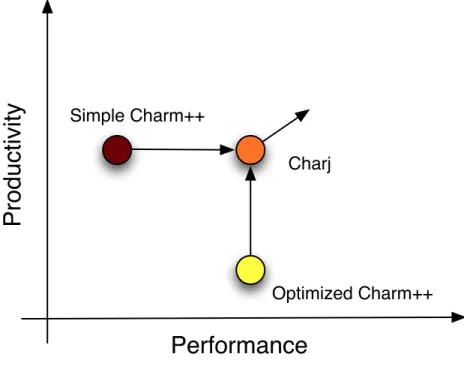
Simple Charm++ Optimized Charm++ CharjFigure 2.1: Charj aims to combine the performance associated with a well-optimized, sophisticated Charm++ application with the productivity asso-ciated with a more na¨ıve, unoptimized approach.
2.1.4
Reducing Programmer Burden
Ultimately, each goal that we have described for Charj can be considered a part of a larger, more encompassing goal: that of reducing burden on the programmer. Programmers experience many kinds of burdens in the course of developing an application, and much of the history of the compiler could be summarized as an attempt to alleviate these burdens. Generally, we aim to reduce or eliminate programming tasks that are repetitive, mechanical, and error-prone, via syntactic analysis and code generation.
With Charj, we aim to allow programmers to achieve the performance associated with carefully written, hand-optimized Charm++ applications, but with much less time and effort. If effect, we hope to combine the productivity that programmers experience when writing relatively simple, na¨ıveapplications while enjoying performance that would normally require a much greater investment of time, effort, and expertise, as shown in figure 2.1. Eventually we hope to use sophisticated optimizations that would be ex-tremely cumbersome to apply by hand to extend the performance that Charj applications can realize beyond the level of even well-optimized Charm++
applications.
2.2
Libraries versus Languages
For any software environment for parallel programming, there is a question of whether it is best implemented as a language, or as a library for an ex-isting language. There are substantial benefits to a library-based approach, especially in terms of likelihood of adoption and effort required by users. Cer-tainly MPI, the most successful parallel programming model yet developed, makes a strong case for implementation via libraries. Its ubiquity is bolstered by the fact that programmers can use it directly in programs of a wide vari-ety of languages. Similarly, Intel’s Threaded Building Blocks (TBB) [15] and Concurrent Collections (CnC) [16] aim to attract existing C++ program-mers, and their implementation as C++ libraries gives them a much lower barrier to entry than a new programming language which implemented the same parallel programming model would have.
In the case of Charj, we are building a language on top of an existing runtime library, and it is important to justify the time and effort overhead associated with that decision. This overhead manifests itself both in the development cost of the Charj language, compiler, and associated infrastruc-ture, and in the costs incurred by programmers who must learn the Charj language in order to make use of it. In order to justify this overhead, we must provide convincing features that could not be delivered if we simply spent more time improving upon the Charm++ runtime libraries.
Charj aims to provide value that cannot be delivered via library in three key areas: syntax, safety, and speed. The first area, syntax, is an area where a new language has a decided advantage over a library-based approach, es-pecially for libraries in commonly used HPC languages such as C, C++, and Fortran. We can provide syntax that maps directly onto key programming model concepts, and are not limited by syntax developed with only sequential execution in mind. This allows us to make parallel operations visually dis-tinct from serial operations, where in a library-based approach, the calling of a function which invokes parallel behavior will look no different syntactically than the calling of a function which is purely sequential. Some languages are more conducive to the introduction of new syntax specific to some particular
task. For example, Ruby libraries and applications can introduce new syntax embedded into the core language transparently, and thereby gain some of the advantages that we experience in using a new language [17]. However, since Ruby is unsuitable for HPC programming, and commonly-used HPC pro-gramming languages do not easily allow for the introduction of new syntax, this feature has little practical importance for us.
In the area of safety, languages allow for more flexible compile-time check-ing of programmcheck-ing model semantics than are possible with a library. For example, MPI communication takes place using void pointers which discard type information, which prevents the programmer from enforcing consistent types across messaging boundaries. Compiler writers for sequential languages spend enormous time and effort on the automated detection of sequential er-rors: incorrect function signatures, inappropriate use of pointers, the misuse of constant variables, and so on. This kind of detection can be equally useful in the case of parallel-specific errors. In particular, we discuss the detection of errors in readonly variables in section 3.3 and the detection of phase vi-olations in multiphase shared arrays in section 5.4. Charj also benefits from the extension of the type system to cover situations like ensuring that the input and output types of a reduction match appropriately. This kind of static checking gives valuable compile-time information to the programmer which cannot be easily duplicated in a library-based approach.
Finally, the use of a language as opposed to a library gives increased op-portunity for optimization. While library code itself can be highly optimized and tuned, it generally does not take unoptimized user code and improve it in the way that a compiler can. In some cases, well-designed libraries can in fact deliver the kind of optimization that is usually only associated with compilers (see, for example, the discussion of iterator-based loop tiling in section 6.1), but a compiler offers greater freedom to transform user code and thereby improve it.
2.3
Infrastructure
Given these guiding principles, we can select the existing software infras-tructure on which Charj will be built. Our goals of practical utility and compatibility with existing HPC code point in the direction of established
and successful frameworks. This already narrows our options considerably. Given our desire for tight integration with sophisticated parallel services like load balancing and fault tolerance, we also prefer systems that are feature rich. Moreover, systems that have a rich runtime environment for Charj to interface with provide more interesting opportunities for novel optimizations and syntactic improvements.
With these requirements in mind, we have decided to build Charj on the Charm++ adaptive runtime system. Charm is already widely used and Charm applications account for a significant fraction of total usage at many of the largest clusters in the world. It achieves high performance on a variety of platforms, and there is a pre-existing community of Charm programmers to draw upon. This makes it an attractive target for productivity-enhancing efforts relative to less widely-used systems. It also presents significant com-plexity to a programmer who wishes to make good use of all its features. In addition to basic messaging capabilities, Charm provides functionality for load balancing [18, 19], semi-automated marshalling and unmarshalling of messages, fault tolerance [20, 21], power management [22], use of accelerator architectures [23], control points [24], and many other features.
In addition, multiple programming models already target the Charm run-time [25–28]. Their existence allows for inquiry into techniques for integrat-ing multiple programmintegrat-ing models effectively into a sintegrat-ingle application. Also, Charm already includes an associated translator which generates messaging code from a programmer-provided interface file. This allows us to compare the advantages of a minimalist approach (generating supplemental interface code only and developing the main application code in C++) to a more thoroughgoing approach in which the compiler for the parallel language has access to method bodies and class structure information. Were we deciding on a platform based solely on popularity and ubiquity we would certainly have built on MPI instead, but given comparative richness and complexity of the Charm runtime system, we claim that Charm is a better environment in which to demonstrate the merits of our approach.
Our goals also influenced our choice of compiler construction tools. Charj is built using the ANTLR LL(*) parser generator [29], discussed further in chapter 4. Its LL(*) parsing algorithm allows for straightforward definition of the language grammar. ANTLR uses a common notation for specify-ing the language lexer, parser, and abstract syntax tree (AST) traversals,
which substantially simplifies the process of writing the compiler. ANTLR provides a domain-specific language for recognizing and modifying AST sub-trees, which we use for simple program transformations and recognition oper-ations. ANTLR also provides us the freedom to build explicit representations of the program outside of its infrastructure, which we use to for more complex analysis.
CHAPTER 3
THE CHARJ LANGUAGE
This chapter describes the Charj programming environment and its rela-tionship to the Charm runtime system. It describes Charj program seman-tics, syntax and program structure, and gives simple example programs that demonstrate the advantages of Charj programs over their Charm equivalents in terms of concision, safety, and convenience.
3.1
The Charj Programming Model
Charj programs consist of collections of objects which interact via asyn-chronous method invocation. These objects are calledchares. Chares can be collected into chare arrays or groups, or can stand alone. Each chare has a globally unique identifier called aproxy, which can be used by other chares to communicate with it. The programmer addresses chares via proxies, rather than by specifying the processor on which the chare resides. This allows the programmer to delegate responsibility for mapping chares onto physical hardware to the runtime system.
Chare objects are specified much as ordinary objects in C++ or Java would be, in terms of their data members and methods. Chares can also inherit from other chares, as is typical in object-oriented design. However, chares contain one or more remotely invocable methods, known as entry methods. These methods can be called using only the chare’s proxy, even if the caller
resides in a different address space from the callee. Entry methods can take arguments just as normal functions do. These arguments are serialized by the sender, sent to the receiver in a message, and deserialized and used by the receiver. The constructor of a chare class is also considered an entry method, but rather than being sent to an existing instance of the class, it results in the creation of a new instance.
Chare objects can be part of a collection, in which each element has the same chare type. The most common of these is an indexed chare array. Entry methods can be invoked on individual array elements, on the entire array, or on a section of the array. Arguments to entry methods that are sent to multiple array elements are duplicated (except for special cases where dupli-cation may be avoided as an optimization which does not affect the results of a computation), so that a message is sent for each individual receiving chare. The programmer can also conduct asynchronous reductions over the elements of a chare array. Each array element contributes one or more data elements to the reduction, specifying a reducing function and a callback to be called with the result data. The values are combined using the reducing function, and the result is delivered using the specified callback. One spe-cial case of chare collections is the group, which is a collection where each physical processor is home to exactly one member of the group. Groups are commonly used to implement application services such as caching and IO.
In a typical application, each processor core will be home to multiple chares. Generally in the Charj programming model, the programmer ad-dresses only individual cores and does not directly program at the level of a multicore node. Throughout this dissertation, when we refer to a processor we mean a single core of a possibly multicore processor node, unless other-wise specified. Messages received by that processor correspond to an entry method invocation on one of the chares located there. Because there may be many such messages outstanding on a processor at any given time, a per-processor scheduler maintains a queue of pending entry method invocations to be processed. The scheduler selects a queue entry and invokes the specified method on the target object using the provided data arguments. The method then runs non-preemptively (and may spawn new entry method invocations of its own). When the method completes, control returns to the scheduler. The scheduler is not guaranteed to use any particular queueing policy, and in-order receipt of messages is not guaranteed. Because application control
flow is driven by the receipt of messages, we refer to this as amessage-driven
programming model.
The message-driven programming model has several important features that make it suitable for large-scale parallel applications. First, it provides a natural way of overlapping communication and computation. Because mes-sages are sent asynchronously, chares do not block execution while waiting to receive data. Instead, the scheduler can select other available messages to process, so that a processor will only go idle if no messages for any of its chares are available. Second, it allows for runtime control of features that would otherwise have to be tightly integrated into application-level code. For example, consider adaptive load balancing. In a model where the program-mer addresses application components by their location, the application logic must be explicitly aware of any dynamic movement of those components. In Charj’s model, application logic can be more effectively decoupled from the physical location of components, giving us the opportunity to more effec-tively integrate features like adaptive load balancing and checkpointing into the language itself. The message-driven execution model also effectively sup-ports multi-paradigm parallel applications. As long as each paradigm can be expressed in terms of asynchronous remote method invocations, the code from many distinct paradigms can coexist, mediated by the scheduler. This avoids partitioning of hardware resources between program modules or in-efficient time partitioning where an application cannot use multiple models concurrently. We make use of this capability to effectively support a variety of programming model within Charj, as detailed in Chapter 5.
3.2
Charj Syntax
In designing a language targeted at the Charm runtime, we were guided by the principle that new syntax must match the underlying programming model and must always provide a concrete benefit that justifies its inclusion in the language. It is our goal to minimize the time and effort required for a programmer to learn Charj, and to make Charj programs look familiar to anyone acquainted with Charm. To this end, we have adopted a simple Java-like base syntax for serial language constructs and added a small number of new language keywords to support Charm-specific constructs like readonly
variables, entry methods, and chare arrays. Invocations of remote methods and proxies for remote objects are marked with a ‘@’ sigil that allows the programmer to easily distinguish between local and remote operations. Our overarching goal is designing Charj syntax is to make familiar constructs and operations look familiar while drawing attention to Charj-specific features in a consistent and logical way.
A full grammar for the Charj language is provided in Appendix A. In the following sections we highlight language constructs that embody key compo-nents of the programming model or which enable particular improvements compared to C++-based Charm++ applications.
3.2.1
Charj Keywords
Several Charj keywords exist primarily to denote the varieties of message-driven entities that are central to Charj programs but which have no di-rect corresponding concept in other parallel programming models such as MPI and OpenMP. Foremost among these are the keywords for declaring the parallel objects described in section 3.1: chare, group, nodegroup, and
chare array. The simplest of these is chare, which indicates a parallel ob-ject with no particular relationship to other chares in the program or to the hardware on which the application is run.
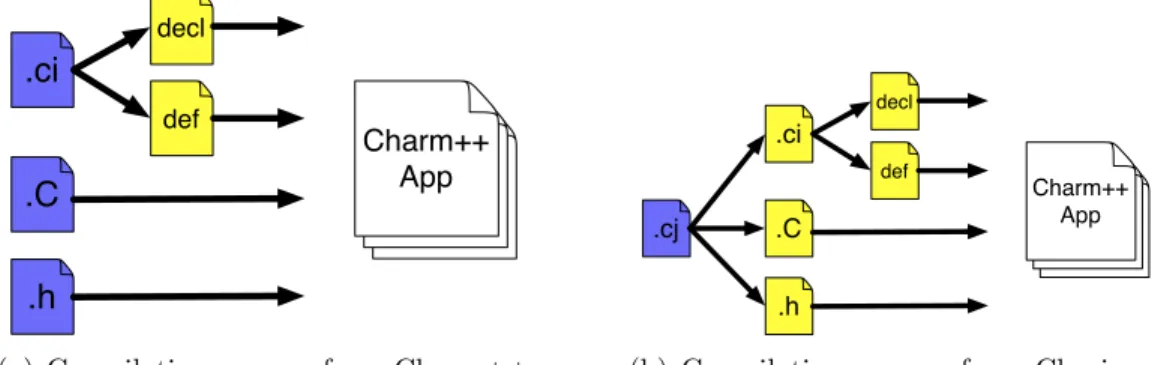
Whereas in a Charm++ application the programmer creates a normal C++ class and identifies that class as a chare in a separate interface (.ci) file, in Charj chares are declared and defined in the same way that classes and other user-defined data types are, simply using the chare keyword instead of class. Similarly, programmers can specify parallel collections of objects that are mapped one per physical processing element (groups), or one per physical node (nodegroups) using the group and nodegroup keywords.
While single chares and per-node and per-processor groups of chares suffice to express many application communication patterns effectively, it is often convenient to create a collection of chares whose elements have a predeter-mined relationship to one another defined by a characteristic index object associated with each chare element of the collection. These more general indexed collections of chares can be defined using the chare arraykeyword, which takes an optional dimension argument that specifies the
dimensional-ity of the array’s index set. Chare arrays provide a flexible way of creating collections of chares with a well-defined relationship between one another.
Entry Methods
Charj introduces another set of keywords that specify the behavior of the methods of a chare class. First and most important is entry, which indicates that a method is remotely invocable via proxy objects. Any attempt to call a non-entry method via a proxy results in a compile-time error. However, entry methods can still be invoked locally in the usual way. The entry keyword is used in the declaration of a function, and comes after any visibility specifiers such as “public” or “private” and before the return type of the function. It is mutually exclusive with the “static” keyword, which indicates that a method belongs to the class as a whole rather than to any particular instance. This is because entry methods are inherently concerned with the particular place where the object corresponding to a proxy resides. Since classes as a whole do not reside in any one location, remote invocation of class methods has no obvious meaning and is disallowed.
Threaded Entry Methods
Any entry method can be designated as a threaded method. Threaded methods execute in their own user-level non-preemptible threads. This al-lows threaded methods to execute blocking operations and return control to the runtime scheduler, which will re-enqueue the blocked method and per-form other pending work before resuming the thread. This allows the use of blocking operations in Charj code.
Generally, it is undesirable to make the programmer explicitly specify that a method needs its own thread. If the programmer does not use the threaded keyword on a method that blocks, it results in a runtime error, and errors of this sort are among the problems that Charj aims at ameliorating. However, since it is possible for the programmer to invoke arbitrary code from an entry method and the Charj compiler has no way of determining whether or not that code might block, it is impossible to be sure at compile time whether or not a method needs to be threaded.
rejected this option because threading imposes some extra overhead, and one of our foremost design principles is to avoid any mandatory performance penalties in favor of highly optimizable code. However, this doesn’t mean that the programmer is stuck identifying all methods that could potentially block by hand. In practice, most methods that require their own thread need it because they use one of several common runtime features. For example, any method that uses a Multiphase Shared Array (see section 5.4) which changes phase must be threaded. For common cases like this, we can build knowledge into the compiler indicating that particular function calls require that the containing entry method be threaded.
To identify entry methods which must be threaded, we first create a table of expressions which are known to potentially invoke blocking operations. These are typically the invocation of top-level functions, such as the CthYield()
function which explicitly blocks the current thread and yields control to the scheduler, or methods of known datatypes, such as phase-change functions of the aforementioned multiphase shared arrays. Any of these expressions can be identified in the program’s AST using tree pattern matching as described in chapter 4, and the method containing the expression is marked as poten-tially blocking. Then all callers of that method are also marked potenpoten-tially blocking, continuing recursively until all potential callers have been marked. We are left with a set of methods known to be potentially blocking (although they may not ever block in actual practice).
Armed with this knowledge, we have two potential courses of action. We can either automatically promote all potentially blocking methods to be threaded, or we can check that the programmer has marked all potentially blocking methods as threaded him- or herself and provide warning or error messages if he or she has not. The advantage of the first option is that it automates as much as possible for the programmer. If we can definitely learn that a method should be threaded, why should we require the programmer to provide that information redundantly? However, consistency argues for the second approach. We must allow the programmer to explicitly specify that a method is threaded to accommodate the invocation of external code not visible to the Charj compiler, which suggests that methods which are not marked “threaded” are indeed not threaded. Automatically threading potentially blocking methods without requiring the use of the “threaded” keyword also makes the threading behavior of the application more opaque
Listing 3.1: Charj source for a generic Node chare class, with one threaded entry method and one local method. All relevant data is located together in a single file.
1 // Charj source file (.cj) 2 chare Node {
3 entry Node() {...}
4 threaded entry void receiveData(Data d) {...} 5 void sendData() {...}
6 }
to the programmer and increases the difficulty of identifying places in the application which can potentially block.
Since blocking mid-method goes against the normal operating assumptions of a Charj application and provides opportunities for synchronization errors, identifying these places may be relevant when debugging an application. For these reasons, we simply notify the programmer when a potentially blocking method is not marked threaded, rather than promoting the method to its own thread behind the scenes.
The compiler’s knowledge about potentially blocking operations can also be used in the opposite direction. Rather than just verifying that the pro-grammer has correctly marked potentially blocking methods as such, it could also identify methods which have been marked as threaded but which con-tain no potentially blocking calls. This may happen due to code refactoring in which blocking calls are relocated from one threaded method to another or simply due to conservative practices on the part of the programmer. In either case, the compiler can notify the programmer to eliminate the unnec-essary overhead caused by threading a method which has no need for its own thread.
Sample Code
To summarize and clarify the relationship between Charj language constructs and their Charm++ equivalents, we present a brief example of the high-level structure of Charj code for a generic chare class called Node, with a threaded entry method receiveData and a local method sendData. List-ing 3.1 presents the Charj definitions for such a class, and listList-ing 3.4 gives a Charm++ equivalent.
Listing 3.2: Charm++ equivalent code to the Charj code in listing 3.4. The same information and program constructs are present, but are split across multiple files without any unifying syntax. This listing gives the Charm++ header file (.h).
1 // Charm++ header file (.h) 2 class Node {
3 Node();
4 void sendData();
5 void receiveData(Data d); 6 };
Listing 3.3: The Charm++ implementation file (.cc).
1 Node::Node() {...}
2 void Node::receiveData(Data d) {...} 3 void Node::sendData() {...}
Listing 3.4: The Charm++ interface file (.ci).
1 chare Node { 2 entry Node();
3 entry [threaded] void receiveData(Data d); 4 };
In Charj, chares are declared in the same way as serial classes, but using the
chare keyword instead ofclass. Entry methods and threaded entry meth-ods are indicated by the use of the corresponding keywords in the method declaration. The declarations and definitions are all grouped together in a common source file, typically with file extension .cj.
In Charm++ applications, chares are declared by creating standard C++ classes and identifying them as chares in a separate interface (.ci) file. List-ing 3.4 provides a Charm++ equivalent to the Charj code in listList-ing 3.1. There is a direct correspondence of program constructs between the two listings, but the Charj version benefits from consolidating all relevant program infor-mation into a single file with a unified syntax, while the Charm++ version splits this data into separate header, implementation, and interface definition files, significantly increasing the size of the code and requiring the program-mer to deal with non-local information when working with any one of those files.
Readonly Variables
Applications commonly have need for data which is not known until after the program is running, but which remains unchanged over the life of the program once it is calculated at startup. Typically this data might include proxies to important application chares and program parameters which are read out of configuration files or command line arguments. It is convenient to make this data globally available, but in many parallel programming models the means of providing this data are unnecessarily complex and error-prone. For example, consider an MPI application that needs to make several pa-rameters from a configuration file available to all ranks. First, to distribute the data, one might use MPI Broadcast to send the variables to all ranks. However, this approach requires either a separate call for each variable to be sent. In fact, if any of the data is of a user-defined type that is not contiguous in memory, it will require even more than that. Particularly if there is a lot of data to share, the distribution of data requires a large number of mostly redundant broadcast calls. Alternatively, the programmer could manually pack the variables into a single buffer and then unpack them on the receiving side. This can increase efficiency by reducing the number of messages sent and received, but introduces more complexity and new opportunities for bugs at the point where buffers are packed and unpacked.
Furthermore, if the programmer forgets to broadcast one of the variables, an uninitialized value will be used, potentially creating bugs. Once the data has been received, the programmer must ensure that the application never assigns to any of the broadcast variables, or else the values held by each rank will no longer be in agreement. This is an important semantic restriction on the program that is not communicated anywhere within the program text and which is invisible to the compiler. The desired behavior is similar to that provided by the “const” keyword, but because the variables must be assigned to during the initialization phase, const variables can’t be used without the use of casting tricks.
To address this common need in Charj, we provide “readonly” variables. A readonly variable is declared in the top-level scope using thereadonly modi-fier keyword. Readonly variables have special assignment behavior. They can be assigned to freely during the startup phase of the program, in the main chare’s constructor. At that time, configuration files can be read, proxies
generated, and so on. When the constructor finishes, all readonly variables are broadcast and made available on every processor. At that time, they become read-only variables, and any assignment to them is an error. This provides increased convenience for the programmer in that they do not have to explicitly broadcast each piece of readonly data. It also provides increased safety by guaranteeing that readonly values remain identical on each proces-sor and are never overwritten.
Readonly variables are not original to Charj. They were first implemented for the Charm runtime system. However, the addition of compiler support in Charj allows for much greater safety and usability of readonly variables. Consider the key property of a readonly variable: after the program’s startup phase is complete, the only access allowed to such a variable is read access. In the original Charm implementation of readonly types, this restriction is completely unenforceable. Because the user’s application is simply C++, which has no notion of readonly types, the semantic restrictions on read-only variables are up to the programmer to enforce. The Charm++ runtime system does provide a valuable service to the programmer by automating the broadcast of readonly variables at the end of the initialization phase. However, just in terms of safety and enforcement of programming model semantics, this state of affairs is little different from the MPI situation in which the programmer must simply be careful not to overwrite global data and receives no specific help from the system. The Charm++ manual [30] simply states “The current Charm++ translator cannot prevent assignments to read-only variables. The user must make sure that no assignments occur in the program.” In fact, it is common to see variable declarations in Charm++ applications annotated with a comment indicating that the variable is read-only, since otherwise that information is available on in the interface file, and the variable cannot be made const.
In contrast, the Charj compiler is aware of readonly types and their seman-tics. Since the user specifies all readonly variables and the program’s startup phase is well-defined by the main chare’s constructor, the compiler can verify both that every readonly variable has been assigned to before the end of the startup phase and that no readonly variable is assigned to after the startup phase concludes. Thus, in Charj the semantics of readonly types are directly enforced, whereas in other programming models or in the base Charm model with no compiler support, the burden of ensuring correctness falls only on
the programmer, who receives little or no help from the compiler.
It is important to note that this analysis is not precise, in the sense that there are programs which can never assign to a readonly variable outside of the initialization phase, but which will nevertheless be flagged by the Charj compiler as problematic. Consider, for instance, a function which takes a boolean variable as an argument, and in its body assigns to a readonly variable if and only if that variable is true. If this function is only ever called with a true argument during the initialization phase, then the program is correct. However, in general it is not possible to prove this condition at compile time, and the compiler will conservatively warn the programmer about the assignment. The programmer is then free to evaluate the function in question using their independent knowledge of the program and determine whether or not the assignment in question represents a bug.
Proxy Objects
Proxies are local representatives of remote objects. They consist of a unique identifier that the runtime system can use to local the object in question. A proxy to an object of type T has type “proxy to T,” which is roughly equivalent to “pointer to T” with the restriction that a proxy can only be used to invoke entry methods on its referent, and not, for example, to access its member variables or invoke other methods. In the same way that the syntax T* indicates a pointer to T, T@ denotes a proxy to T. Entry methods are also invoked using the @ operator (in contrast to -> for pointers). The use of a separate operator for proxies and remote invocation serves to clearly delineate remote objects and operations in application code.
Applications can also make use of proxies to collections of chares, includ-ing chare arrays, groups, and nodegroups. Proxies to chare collections are also denoted by a @, but messages sent through them are sent to the entire collection. Alternatively, messages can be sent to a single element of a chare array by indexing it.
Proxies allow for a clear expression of the program’s parallel structure in a way that can be understood by the compiler. In particular, for any message, the compiler can determine the type of the receiver, the signature of the entry method being invoked, and the types of all arguments to that method. This allows for a significant degree of static checking to be done at compile time.
The compiler verifies that messages are only sent through proxy objects, that the proxies involved expose the intended entry methods, and that the entry methods in question take the appropriate arguments. Compare this to an MPI-style application, where messages are sent to processors rather than objects, and message payloads are all untyped memory buffers. In a well-written program, the programmer’s intentions may be clear, and the parallel structure of the application may be readily apparent. However, there is little opportunity for the static detection of programmer errors, and the type system is effectively non-existent for the purposes of checking communication between nodes.
Collectives
Collectives are one of the building blocks that parallel applications are con-structed from. Collectives in Charj largely take the form of operations on chare arrays. Broadcasts are handled in much the same way as point-to-point entry method invocations via proxy: an invocation made using a proxy to a chare array (rather than using one of the indexed members of that array) indicates a broadcast to all array members. The type checking described in the previous section applies equally well to broadcasts over chare arrays.
Now, consider reduction operations. The nature of a reduction operation guarantees that the inputs share a common type, that the result of the re-duction shares the same type, and that the types of the arguments and result of the reducing operation are also of that type.
Consider the functions used to contribute to a reduction in Charm or MPI, as shown in listing 3.5. The input and output types are unspecified, and there is no guarantee that the types accepted by the reduction operation matches the type of the contributed data. The need to support a wide variety of input types and reduction functions, including user-defined data types and reducers, precludes library designers from effectively encoding the type rules of reductions into their API.
However, by extending knowledge of programming model semantics into the compiler, we can use the type system to catch errors that are not de-tected by a library approach. The Charj reduction function (also shown in listing 3.5) can verify that the relevant types all match, eliminating the pos-sibility for a reduction operation that doesn’t match the contributed data or
Listing 3.5: Function prototypes for reductions on an array of data, in MPI, Charm, and Charj.
1 // MPI Reduction
2 int MPI_Reduce(void* sendbuf, void* recvbuf, int count,
3 MPI_Datatype datatype, MPI_Op op, int root, MPI_Comm comm); 4 // Charm reduction
5 void contribute(int nBytes, void* data,
6 CkReduction::reducerType type, CkCallback cb); 7 // Charj reduction
8 void contribute(Array<T> data, Reducer reducer, Callback cb);
contributed data of mismatched types.
Charj provides an even more pronounced improvement versus Charm++ in the case of custom reduction operations. These are reductions in which the data items are of a user-defined type with its own reduction operation. Sample code for supporting custom reductions for a hypothetical MyType
type, with its own reduce function, is given in listing 3.6. Considering that the definition of the type in question and its reduction function are both omitted, the size and complexity of the implementation are notable.
The programmer must engage in non-trivial memory management of run-time data structures associated with reduction trees, and must arrange to register the custom reduction function with the runtime at startup. Beyond the code provided here, the register my reducer function which adds the custom reduction to the list of reductions that the runtime system knows about must be specified in the Charm++ interface file as an “initcall” func-tion, meaning that it will be executed by the runtime at startup before the main application is started.
In contrast, the equivalent Charj custom reduction code in listing 3.7 is quite brief. Charj custom reducers have an implicit accum variable which is used to accumulate new values via the reduce method. Reduction registra-tion and runtime reducregistra-tion message handling code equivalent to the Charm listing are produced from this definition by the Charj compiler, thereby sub-stantially reducing both the length and the complexity of the Charj imple-mentation.
Listing 3.6: Charm++ implementation of a custom reducer for the type
MyType, which has its own reduce function already defined elsewhere. The requirements for explicit handling of system reduction messages and regis-tration of the reduction function with the runtime at startup add significant complexity to the implementation.
1 CkReductionMsg* reduceMyType(int nMsg, CkReductionMsg** msgs) 2 {
3 MyType* accum = new MyType(); 4 for (int i=0; i<nMsg; ++i) { 5 MyType* x;
6 PUP::fromMem p(msgs[i]->getData());
7 p | *x;
8 accum->reduce(x);
9 }
10 return CkReductionMsg::buildNew(sizeof(MyType), accum); 11 } 12 13 CkReduction::reducerType _my_reducer_type; 14 void register_my_reducer(void) 15 { 16 _my_reducer_type = 17 CkReduction::addReducer(reduceMyType); 18 }
Listing 3.7: Charj implementation of a custom reducer equivalent to the Charm++ code in listing 3.6. Function registration with the runtime and handling of system reduction messages is handled transparently by code gen-erated by the Charj compiler.
1 reducer<MyType> my_reducer {
2 my_reducer() { accum = new MyType(); } 3 reduce(MyType x) { accum.reduce(x); } 4 }
Generics and Sequential Arrays
While the primary focus of Charj is on expressing parallelism, some of its features are aimed primarily at producing effective serial code. Our goal is to provide the tools necessary for efficient, concise serial code that integrates seamlessly with the parallel-specific features of Charj while maintaining fa-miliar syntax.
One example is the implementation of generic types in Charj. Generic types are important for re-usability and are widely used in both Java and C++. However, their implementations are very different. C++ generics are built on a full template metaprogramming system, which is complex and sophisticated enough that it is Turing complete in itself [31]. In contrast, Java generics work via type erasure and include no metaprogramming facilities. In Charj we need to support generic types, but the complexity of C++ template metaprogramming is a poor fit for Charj’s focus on simplicity, particularly in serial code. However, C++ templates have a key performance advantage over Java’s type erasure approach, which depends on universal inheritance from the Object class. While recent advances in Java compilers have ameliorated this problem [32], this work falls outside the scope of what we can reasonably include in the Charj compiler.
As a result of these constraints, in Charj we have adopted a generic system whose syntax is substantially similar to Java’s, but whose implementation is based on C++ templates. This approach provides the straightforward syntax of Java without sacrificing performance to boxing and unboxing of primitive types, allowing high-performance generics to be used in computational ker-nels.
The most widely used generic type in Charj is the array. The Array type in Charj denotes the sequential container used within the scope of a single chare object. Arrays in Charj are one of its largest departures from C++-based Charm++ applications. The C and C++ approach, in which array elements are accessed through arithmetic on raw pointers, causes several issues that we wish to avoid. It prevents reliable array bounds-checking, increasing the difficulty of debugging. It makes points-to compiler analysis more difficult by conflating pointers and arrays. It translates poorly to two dimensions and higher, relying on convention to establish layout and, in the case of ar-rays of arar-rays, gives up memory locality in exchange for convenient syntax.
Although Java eliminates many of the safety and elegance problems of the C++ approach, typical Java array implementations offer extremely poor per-formance on HPC workloads, and extensive sophisticated optimizations are required to achieve good performance [33].
To address these problems, we introduce our own generic array type in Charj, simply named Array. It is built into the compiler, and translates to a templatized C++ class implementing the relevant features. Array ac-cesses can be bounds-checked for debugging purposes or left unchecked for maximum performance based on compile-time options. The user can select from row-major, column-major, or block-cyclic data distributions, and re-distribute data on the fly as needed.
Charj also provides syntax for specifying ranges over arrays, which allows clear and concise expression of looping constructs. These ranges can also be used to extract contiguous sub-regions of arrays, treating them as indepen-dent entities that can be processed without incurring copy overhead.
3.3
Comparing Charm Applications with Charj
Applications
It is often the case in discussions of programming languages that any syntax becomes the foremost issue and semantics are neglected. Indeed, according to Wadler’s Law1,
In any language design, the total time spent discussing a feature in this list is proportional to two raised to the power of its position in the following list:
1. Semantics 2. Syntax
3. Lexical syntax
4. Lexical syntax of comments
More seriously, it does seem that language discussion is often tightly fo-cused on syntax, perhaps because the syntax is the most obvious feature of
any new language. However, many of the most tedious and most error-prone programming tasks in parallel computing have nothing to do with syntax, but are rather matters of semantics.
By incorporating knowledge of the Charm programming model’s seman-tics, Charj greatly simplifies the creation of message-driven applications as compared to a C++ program targeting the Charm runtime. The C++ ap-plication must specify type and visibility information for remotely invocable functions and global read only data via an interface file, which the Charm translator uses to generate wrapper code for sending and receiving data. This separates important semantic information about remotely invocable func-tions from the implementation of those funcfunc-tions, both needlessly duplicating data and making it more difficult for the programmer to get a comprehensive view of the way an application works. A C++ application developer must also be very careful about the semantics of runtime system constructs. For example, Charm provides “readonly” variables which can be assigned only at program startup. There is no facility for enforcing this rule, however, since the application code which accesses these variables is standard C++. Charj resolves these problems simply by eliminating the need for external in-terface specifications and understanding the semantics of readonly variables, which allows the compiler to enforce their access rules with appropriate error messages.
This basic language and infrastructure serve as the foundation for our work to demonstrate our hypothesis. Even without adding analysis or optimiza-tion, this language already provides important productivity benefits relative to using Charm as a C++ library. It eliminates the need for separate inter-face files which specify which methods may be invoked remotely by cleanly integrating this information into the main body of the program. Standard Charm programs are split into implementation code, headers, and interface files, producing redundancy that can lead to simple errors and inconsisten-cies. By consolidating the information from these files, Charj presents a unified view of the program that is more concise and can be understood more quickly.
3.4
Example Application
To illustrate the use of Charj in the context of a real program and to highlight differences between equivalent Charj and Charm++ implementations, we present a simple tree-based computation that calculates the Nth Fibonacci number, f ib(N). The program consists of a driver main chare class named
Main(lines 3-17 of listing 3.8 in the Charj version, and lines 4-7 of listing 3.9, lines 3-10 of listing 3.10, and lines 4-16 of listing 3.11 in the Charm++ ver-sion. The driver reads from the command line to determine which Fibonacci number to compute, then creates a Fib chare to perform the actual com-putation. The program terminates when the Fib chare invokes the driver’s
done method.
The actual computation of the Fibonacci number is performed recursively by the Fib class. To compute the f ib(N), as long as N is greater than a given threshold value, two new Fib chares are spawned, one to calculate
f ib(N−1) and one to calculatef ib(N−2). When they have finished their own computations, they pass their partial results to their parent via the passUp
method. The parent waits for responses from both children before passing up its own value in turn. The threshold value acts as grainsize control for the application and limits the number of new chares which are spawned. Listing 3.8: Charj implementation of a simple tree-based Fibonacci applica-tion.
1 readonly Main@ main; 2
3 public mainchare Main { 4 int n;
5
6 public entry Main(CkArgMsg m) { 7 if (m.argc < 2) n = 16; 8 else n = atoi(m.argv[1]); 9 main = thisProxy;
10 Fib@ fib = new Fib@(true, n, thishandle);
11 }
12
13 public entry void done(int value) { 14 CkPrintf("Fib(%d) = %d\n", n, value); 15 CkExit();
17 } 18
19 public chare Fib { 20 Fib@ parent; 21 boolean root; 22 int n;
23 int partialResult; 24 int pendingChildren; 25 const int threshold = 16; 26
27 private int seq_fib(int n) { 28 if (n < 2) return n;
29 return seq_fib(n-1) + seq_fib(n-2);
30 }
31
32 public entry Fib(boolean root_, int n_, Fib@ parent_) {
33 n = n_; 34 root = root_; 35 parent = parent_; 36 37 if (n <= threshold) { 38 partialResult = seq_fib(n); 39 passUp(); 40 } else {
41 Fib@ child1 = new Fib@(false, n-1, thisProxy); 42 Fib@ child2 = new Fib@(false, n-2, thisProxy); 43 partialResult = 0;
44 pendingChildren = 2;
45 }
46 }
47
48 public entry void gather(int value) { 49 partialResult += value;
50 if (--pendingChildren == 0) passUp();
51 }
52
53 public void passUp() {
54 if (root) main@done(partialResult); 55 else parent@gather(partialResult); 56 delete this;
57 }
Listing 3.9: Charm++ interface file for the simple Fibonacci application.
1 mainmodule pgm {
2 readonly CProxy_Main main; 3
4 mainchare Main { 5 entry Main();
6 entry void done(int value);
7 };
8
9 chare Fib {
10 entry fib(bool root_, int n_, CProxy_fib parent_); 11 entry void gather(int value);
12 };
13 };
Listing 3.10: Charm++ header file for the simple Fibonacci application.
1 #include "pgm.decl.h" 2
3 class Main : public CBase_Main 4 {
5 public:
6 int n;
7 Main(CkMigrateMessage *m) {} 8 Main(CkArgMsg *m);
9 void done(int value); 10 };
11
12 class Fib : public CBase_Fib 13 { 14 private: 15 int n; 16 int partialResult; 17 int pendingChildren; 18 bool parent; 19 CProxy_fib parent; 20 int seq_fib(int n); 21 public: 22 Fib(CkMigrateMessage *m) {}
23 Fib(bool root_, int n_, CProxy_fib parent_); 24 void gather(int value);
25 void passUp(); 26 };
Listing 3.11: Charm++ implementation file for the simple Fibonacci appli-cation. 1 #include "pgm.h" 2 #define THRESHOLD 10 3 4 Main::Main(CkArgMsg* m) 5 { 6 if(m->argc < 2) n = 16; 7 else n = atoi(m->argv[1]); 8 main = thisProxy; 9 CProxy_Fib::ckNew(true, n, thishandle); 10 } 11
12 void Main::done(int value) 13 {
14 CkPrintf("Fib(%d) = %d\n", n, value); 15 CkExit();
16 } 17
18 Fib::Fib(bool root_, int n_, CProxy_Fib parent_) 19 { 20 root = root_; 21 n = n_; 22 parent = parent_; 23 24 if (n < THRESHOLD) { 25 result = seqFib(n); 26 passUp(); 27 } else { 28 CProxy_Fib::ckNew(false, n-1, thishandle); 29 CProxy_Fib::ckNew(false, n-2, thishandle); 30 partialResult = 0; 31 pendingChildren = 2; 32 } 33 } 34 35 int Fib::seqFib(int n) { 36 if (n < 2) return n;
37 return seqFib(n-1) + seqFib(n-2); 38 }
39
40 void Fib::gather(int value) { 41 partialResult += value;
42 if (--pendingChildren == 0) passUp(); 43 } 44 45 void Fib::passUp() 46 { 47 if (root) main.done(partialResult); 48 else parent.gather(partialResult); 49 delete this; 50 } 51 52 #include "pgm.def.h"
Despite the brief and simple nature of this example code, many impor-tant differences between Charm++ and Charj are apparent in these listings. First, and perhaps most importantly, the Charm++ version is significantly more verbose. Despite the identical structure of the two implementations and the fact that no particularly space-saving Charj features such as custom reductions are used in the code, the Charj version weighs in at 58 lines, com-pared to the Charm++ version, which takes 92 lines spread over three files. The Charm++ version is over 1.5 times as long, mostly due to replication of information across the interface file, header file, and implementation file.
The bodies of the functions which perform the actual work are largely iden-tical between versions. The biggest exceptions to this rule are in the use of parallel-specific features, specifically the invocation of entry methods, which are marked by the @ symbol in Charj as opposed to a period in Charm++, and the creation of new Fib chare objects, which are created via new Fib@
in Charj, and via CProxy Fib::ckNewin Charm++. The similarity in serial code serves to lower the barrier to entry for new Charj programmers, while the new parallel-specific syntax calls attention to explicitly parallel opera-tions and distinguishes them from operaopera-tions on local objects.
3.5
Summary
In this chapter we have described the structure of the Charj language and its relationship to the Charm++ runtime system and programming model. Charj aims to ease the process of writing message-driven applications by providing language constructs well-suited to the task and more tightly
inte-grating the language with key programming model concepts. This approach allows for greater concision and simplicity, while also facilitating greater type safety and opening up the possibility for better feedback to the program-mer in the form of meaningful warnings and error messages. It also creates the opportunity for compile-time optimizations that are not possible with a library-based approach.