ANALYSIS AND DESIGN OF ADVANCED CACHING
SOLUTIONS FOR THE MODERN WEB
A Dissertation
Presented to the Faculty of the Graduate School of Cornell University
in Partial Fulfillment of the Requirements for the Degree of Doctor of Philosophy
by Qi Huang August 2014
©2014 Qi Huang ALL RIGHTS RESERVED
ANALYSIS AND DESIGN OF ADVANCED CACHING SOLUTIONS FOR THE MODERN WEB
Qi Huang, Ph.D. Cornell University 2014
The rise of modern Web applications has seen a surge in the quantity of digital con-tent — photos, videos, and user interactions — stored, accessed, and transmitted by Internet services. To better handle such content, popular Web services, such as Face-book, have deployed large cache tiers within their serving stacks to lessen the load on backend systems and to decrease the data-request latency for users.
Designing such cache infrastructures exposes challenges across three dimensions: (1) Modern Web workloads differ from earlier traditional workloads, due to the large amount of user-created content, as well as the frequency of updates due to user inter-actions; therefore, more advanced cache-replacement policies are required to provide sustained high hit-ratios, the key metric for caching performance. (2)Flash devices are extensively used due to their cost advantage over DRAM and their significantly higher I/O performance than magnetic disks; however, flash often yields low performance and high wearing costs with the small random writes that advanced caching algorithms tend to generate.(3)Load balance is critical for the scalability of an entire cache-server tier; however, different content within the modern Web may have disparate popularities, and the dependent data-partition mechanism is often used to co-locate relative data in favor of advanced application queries. Both scenarios exacerbate the imbalance.
In this dissertation, we use two existing cache systems within the Facebook infras-tructure — the photo-cache as a representative of static-content cache, and the Taocache as an example of in-memory cache solutions — to address the three challenges
men-tioned above.
First, we examine the workload caused by accessing photos on Facebook and the effectiveness of the many layers of photo caches that have been deployed. By analyzing an event stream covering almost 80 million requests for more than 1 million unique photos, we are able to study cache-access patterns, evaluate current cache efficacy, and explore the potential performance benefits of certain advanced eviction algorithms at multiple cache layers.
Second, when building advanced cache on flash devices, in order to address the performance degradation caused by small random writes, we propose the novel RIPQ (Restricted Insertion Priority Queue) framework. RIPQ allows for advanced caching algorithms with large cache sizes, high throughput, and long device lifetime. RIPQ maintains an approximate priority queue efficiently on flash by aggregating small ran-dom writes into large writes to a restricted set of insertion points, lazily moving items, and co-locating items with similar priorities. We show that two families of advanced caching algorithms, Segmented-LRU and GDSF (Greedy-Dual-Size-Frequency), can be easily implemented with RIPQ. Our evaluation builds on traces from Facebook’s photo-serving stack shows that GDSF algorithms with RIPQ can improve cache hit ratios by
~20% over the current production system, while incurring low overhead and achieving high throughput.
Third, we investigate the principal causes of load imbalance — including data co-location, non-ideal hashing scenario, and hot-spot temporal effects. We analyze Face-book’s runtime traffic against the partitioned cache tier in front of Tao, a subsystem that stores objects associated with Facebook’s social graph. As part of this investigation, we also employ trace-drive analytics to study the benefits and limitations of current load-balancing methods — including consistent hashing and hot-partition replication (with front-end caching as a special case) — and we suggest areas for future research.
BIOGRAPHICAL SKETCH
Qi Huang grew up in Wuhan, China; he spent the first 25 years of his life there, during which he attended a 4-year undergraduate school, as well as a 3-year taste of graduate school at Huazhong University of Science and Technology (HUST). Qi’s initial attrac-tion to a major in Computer Science centered around his raattrac-tionalizaattrac-tion of computer-game time, but later the joy of programming real software for his college mates drove him toward his first graduate-school adventure at Cluster and Grid Computing Lab (CGCL) & Services Computing Technology and System Lab (SCTS). Working with Prof. Hai Jin, Prof. Zhongfen Han, and Prof. Xiaofei Liao, Qi took a ride on the early wave of Peer-to-Peer (P2P) streaming technologies in China, helping to develop a pop-ular streaming service used by thousands of China Education and Research Network (CERNET) users and Internet Protocol Television (IPTV) providers including Samsung, Intel, and UTStarcom.
In 2008, after completing his P2P efforts, Qi took a leave-of-absence from HUST to visit Prof. Ken Birman and Dr. Robbert van Renesse’s research group in the Com-puter Science department of Cornell University. In Spring, 2011, he became a full-time Ph.D. student at Cornell in order to pursue distributed-system studies in the burgeoning sub-field of data-center- and cloud-computing. Since 2012, Qi has collaborated with Facebook to analyze and design distributed caching systems for static content and graph data. That effort has defined the three primary research achievement that comprise the caching story in this dissertation. Qi successfully defended his Ph.D. dissertation in July, 2014.
ACKNOWLEDGEMENTS
I am forever indebted to my advisers, Ken Birman and Robbert van Renesse, from whom I learned much about the art and philosophy of systems research, as well as principles for many other aspects of life. Ken pushed me to be an independent researcher from day one, and he always maintained faith in my abilities, even when I doubted myself. His seemingly bottomless well of ideas and energy has made his office my very first stop when I face hurdles. Robbert is an oracle of systems wisdom and a pillar of warm-hearted support. His persistent precision and focus on quality results has forever shaped my work attitude. I leave Cornell with a warm feeling of gratitude for their tutorship.
The Ph.D. journey has been an adventure with many characters and I owe a big debt to my two senior collaborators: Ymir Vigfusson and Daniel A. Freedman. Ymir and Daniel have mentored me on every graduate-school skill hand-in-hand: how to choose research topics, how to plan projects, how to evaluate experimental results, how to struc-ture research papers, how to deliver academic presentations, how to efficiently juggle multiple research demands, and even how to interact with colleagues at conferences. As I reflect back on my graduate years, I can think of many moments where thoughtful feedback and encouraging words from them have helped me steer my course. I would also like to acknowledge Wyatt Lloyd, who was the third senior student mentor I had to-wards the end of my graduate study. His foundational work on Facebook’s photo tracing enabled our later full-stack analysis paper, and his endless assistance ensured that the resulting talk was the most professional and polished presentation I have yet delivered.
Systems research cannot be done in isolation, and I am honored to have had stel-lar collaborators lending me a helping hand on this dissertation. Linpeng Tang led the cache-on-flash project with amazing diligence and impressive creativity. Helga Gud-mundsdottir has played an important role in our load-balance study by implementing the streaming algorithm and running simulations that correspond to very diverse
scenar-ios.
It takes significant effort behind-the-scenes for an industry internship to become a fruitful academic collaboration. I am grateful that I had three great mentors at Facebook who made this happen. All three pieces of work presented in this dissertation truly benefited from their tremendous support: Sanjeev Kumar, Yee Jiun Song, and Philippe Ajoux. I also want to thank the academic duo at Facebook who bridged the connection between Cornell and Facebook: Harry C. Li, and Jessica Taylor.
I come now to my best friend, Lu Cui, who also happens to be my wife. I would never have been able to undertake a Ph.D., or let alone complete it, had it not been for her encouragement and selfless support throughout the entire graduate study period. She made me brave when I felt timid, and confident when I doubted myself; she added her unique love of life to my perspective of the world. With her, my life is enriched every day. Thank you.
I would not have come thus far without the freedom and support given to me by my loving parents, Kanglin Huang and Huilan Tang, who ensured that schooling did not get in the way of my education. I also deeply appreciate my aunt and uncle, Jiulin Huang and Yimei Wu, who raised me for six years as their own child when I had to be away from home for school. Last, but certainly not least, I extend my gratitude to my friends in Ithaca who made my stay at Cornell in every aspect more welcoming, exciting, and enjoyable. I am honored to have had your company.
TABLE OF CONTENTS
Biographical Sketch . . . iii
Dedication . . . iv
Acknowledgements . . . v
Table of Contents . . . vii
List of Tables . . . ix
List of Figures . . . x
1 Introduction 1 1.1 Static-Content Caching Analysis and Design . . . 1
1.2 In-Memory Caching Analysis and Design . . . 4
1.3 Contribution . . . 5
2 Background & Related Work 9 2.1 Modern Web Architecture . . . 9
2.2 Static-Content Cache . . . 12
2.3 In-Memory Cache . . . 14
2.4 Related Work . . . 16
2.4.1 Static-Content Stack Analysis . . . 16
2.4.2 Flash-aware Cache and Storage . . . 17
2.4.3 Load Balance of Distributed Cache and Storage . . . 20
3 Analysis of Facebook’s Photo Caching 23 3.1 Introduction . . . 23
3.2 Facebook’s Photo-Serving Stack . . . 25
3.2.1 The Facebook Photo-Caching Stack . . . 26
3.2.2 Photo Transformations . . . 28
3.2.3 Objective of the Caching Stack . . . 29
3.3 Methodology . . . 29
3.3.1 Multi-Point Data Collection . . . 29
3.3.2 Correlating Requests . . . 32 3.3.3 Sampling Bias . . . 33 3.3.4 Privacy Preservation . . . 34 3.4 Workload Characteristics . . . 34 3.4.1 Popularity Distribution . . . 37 3.4.2 Hit Ratio . . . 39
3.5 Geographic Traffic Distribution . . . 42
3.5.1 Client To Edge Cache Traffic . . . 43
3.5.2 Edge Cache to Origin Cache Traffic . . . 45
3.5.3 Cross-Region Traffic at Backend . . . 45
3.6 Social-Network Analysis . . . 47
3.6.1 Content Age Effect . . . 47
3.7 Potential Improvements . . . 51
3.7.1 Browser Cache . . . 51
3.7.2 Edge Cache . . . 53
3.7.3 Origin Cache . . . 58
4 Efficient and Advanced Static-Content Caching on Flash 60 4.1 Introduction . . . 60
4.2 Flash Performance Study . . . 63
4.2.1 Random Write Experiments . . . 64
4.2.2 Sequential Write Experiment . . . 66
4.3 RIPQ . . . 66
4.3.1 Priority Queue Abstraction . . . 67
4.3.2 Design of RIPQ . . . 68
4.3.3 Implementing Caching Algorithms . . . 70
4.3.4 Implementation of Basic Operations . . . 72
4.3.5 Other Implementation Details . . . 75
4.4 SIPQ . . . 78
4.4.1 Design of SIPQ . . . 78
4.4.2 Implementation . . . 79
4.5 Evaluation . . . 81
4.5.1 Experimental Setup . . . 81
4.5.2 Results of Facebook Trace . . . 83
5 Characterizing Load Imbalance in Graph Cache 89 5.1 Introduction . . . 89
5.2 Analyzing Load Imbalance . . . 91
5.2.1 Environment . . . 91
5.2.2 Analysis . . . 94
5.3 Mitigating Load Imbalance . . . 98
5.3.1 Trace Preparation . . . 99
5.3.2 Current Techniques . . . 100
5.3.3 Comparison and Evaluation . . . 104
6 Future Work & Conclusion 107 6.1 Open Questions for Future Work . . . 107
6.2 Conclusion . . . 109
LIST OF TABLES
3.1 Workload characteristics: broken down by different layers across the photo-serving stack where traffic was observed;Client IPsrefers to the number of distinct IP addresses identified on the requester side at each layer, andClient geolocationsrefers to the number of distinct geograph-ical regions to which those IPs map. . . 35 3.2 Access statistics for selected groups. “Viral” photos are accessed by
massive numbers of clients, rather than accessed many times by few clients, so browser caching is of only limited utility. . . 42 3.3 Origin Cache to Backend traffic. Most Origin traffic stays within the
same data center, with an exception for Origin in California, where the data center was being decommissioned during the period of our study. . 46 3.4 Descriptions of the simulated caching algorithms. . . 54 4.1 Flash performance summary. Read/write are all 128KiB. Write results
are the stable throughput after writing data 4 times the capacity of the device. Max-Throughput Write Size is the smallest write size (in the power of 2 series) required to achieve sustained maximum throughput at maximum capacity. . . 64 4.2 Segmented-LRU and Greedy-Dual-Size-Frequency with the priority
queue interface provided by RIPQ. . . 70 4.3 Key Parameters for RIPQ . . . 77 5.1 Taotrace summary: TopShardsreports hot contents traffic. ReqSample
samples requests from Web servers. ServerTrafficcontains cache load snapshots. . . 93
LIST OF FIGURES
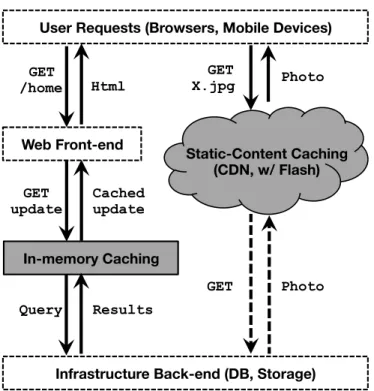
2.1 Modern Web architecture. When the Web front-end receives a user request, it starts to generate a response to include the most recent dates for that user. The in-memory cache keeps the most popular up-date query results so that the fetching operation does not always hit the back-end. For static content, Web front-ends would redirect the client to go through a dedicated stack that is often composed of flash-equipped caching layers. . . 10 2.2 A typical static-content serving stack. Requests are directed through
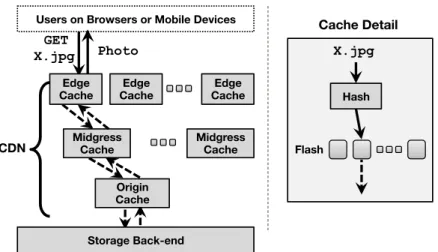
a CDN with layers of caches. Each cache hashes objects to a bucket associated with a flash equipped server. . . 13 2.3 Cache architecture. Left shows how read-through cache operates
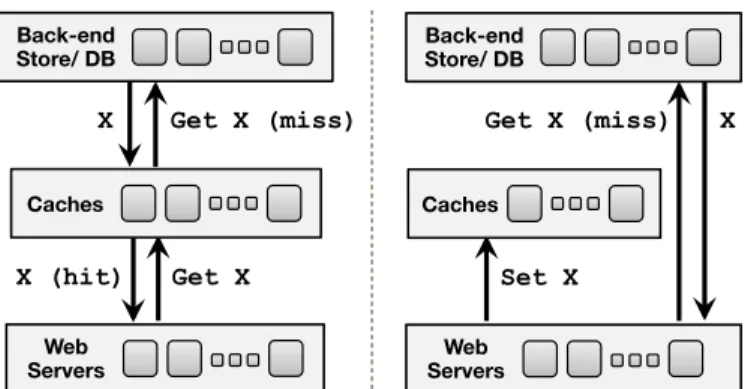
be-tween the front-end Web servers and the back-end; right shows how miss is handled for the read-aside cache. . . 15 3.1 Facebook photo serving stack: components are linked to show the
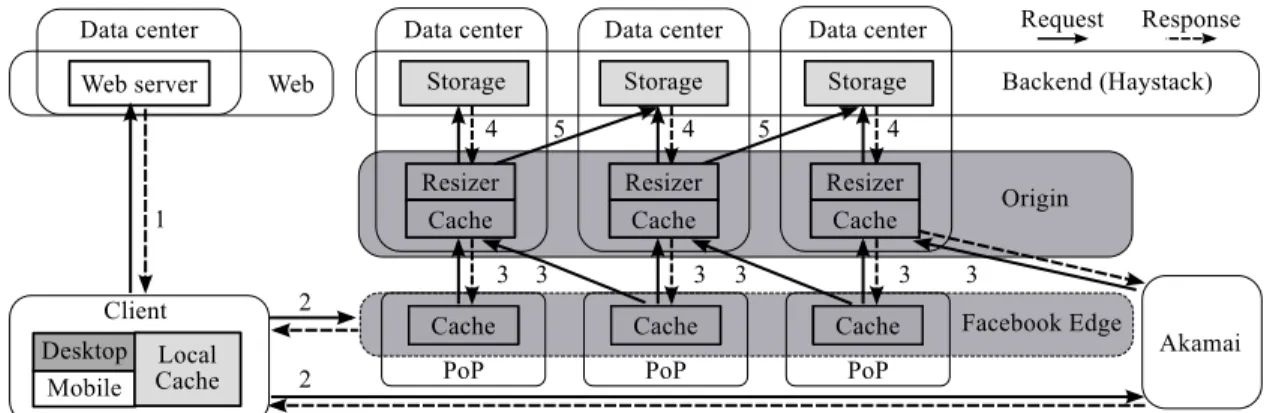
photo retrieval work-flow. DesktopandMobileclients initiate request traffic, which routes either directly to the Facebook Edge or via Aka-mai depending on the fetch path. The Origin Cache collects traffic from both paths, serving images from its cache and resizing them if needed. The Haystack backend holds the actual image content. Shading high-lights components tracked directly (dark) or indirectly (light) in our measurement infrastructure. . . 25 3.2 Cumulative distribution function (CDF) on object size being transferred
through the Origin cache. . . 37 3.3 Popularity distribution. Top: Number of requests to unique photos at
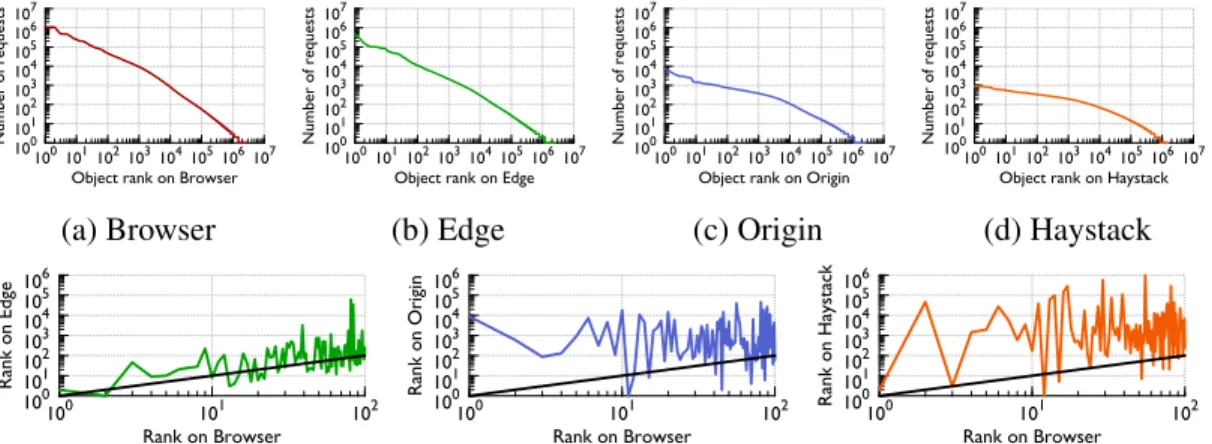
each layer, ordered from the most popular to the least. Bottom: a com-parison of popularity of items in each layer to popularity in the client browser, with the exact match shown as a straight line. Shifting popu-larity rankings are thus evident as spikes. Notice in (a)-(d) that as we move deeper into the stack, these distributions flatten in a significant way. 38 3.4 Traffic distribution. Percent of photo requests served by each layer, (a)
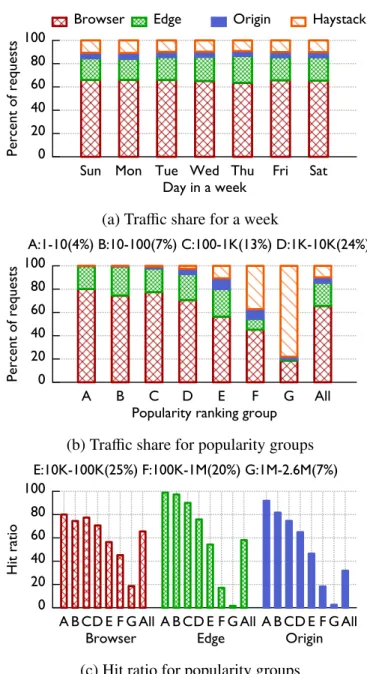
aggregated daily for a week; (b) binned by image popularity rank on a single day. For (b), 1-10 represent the 10 most popular photos, 10-100 the 90 next most popular, etc. (c) shows the hit ratios for each cache layer binned by the same popularity group, along with each group’s traffic share. . . 40 3.5 Traffic share from 13 large cities to Edge Caches (identified in legend
at right). . . 43 3.6 Traffic from major Edge Caches to the data centers that comprise the
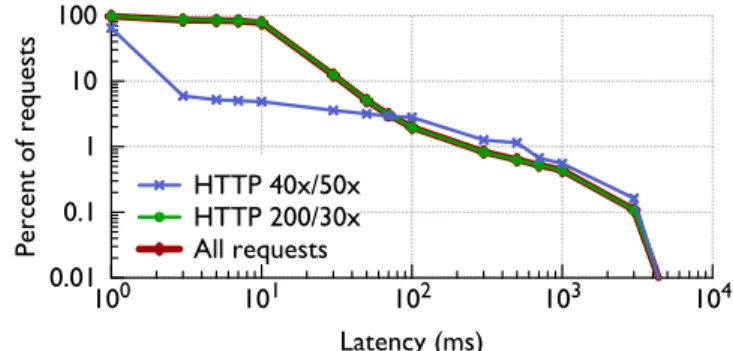
Origin Cache. . . 44 3.7 Complementary cumulative distribution function (CCDF) on latency of
3.8 Traffic popularity and requests served by layer for photos at different age. The number of requests to each image, categorized by age of requested photos in hours, broken down at every layer across the stack. 48 3.9 Photo popularity organized owner popularity. (a) Requests per photo
categorized by the number of followers for the photo’s owner. (b)
Traf-fic distribution by layer for different social activity groups. . . 50
3.10 Measured, ideal, and resize-enabled hit ratios for clients grouped by activity. 1-10 groups clients with ≤ 10 requests, 10-100 groups those reporting 11 to 100 requests, etc.Allgroups all clients. . . 52
3.11 Measured, ideal, and resize-enabled hit ratios for the nine largest Edge Caches. Allis the aggregated hit ratio for all regions. Coordgives the results for a hypothetical collaborative Edge Cache. . . 53
3.12 Simulation of Edge Caches with different cache algorithms and sizes. The object-hit ratio and byte-hit ratio are shown for the San Jose Edge Cache in (a) and (b), respectively. The byte-hit ratio for a collaborative Edge Cache is given in (c). The gray bar gives the observed hit ratio and size xapproximates the current size of the cache. . . 56
3.13 Simulation of Origin Cache with different cache algorithms and sizes. . 58
4.1 Random write experiment on FusionIO and Intel flash. . . 65
4.2 Overall structure of RIPQ. . . 68
4.3 Insertion, update, and delete-min operations in RIPQ. . . 72
4.4 RIPQ internal operations. . . 73
4.5 How SIPQ works. . . 79
4.6 Exact algorithm hit ratios on Facebook trace. . . 83
4.7 Performance of RIPQ, SIPQ, and RocksDB on Origin. . . 85
4.8 Performance of RIPQ, SIPQ, and RocksDB on Edge. . . 86
5.1 Cache architecture. Left shows how read-through cache serves be-tween the front-end Web servers and the backend; right shows how Facebook’s Taocache is organized. . . 92
5.2 Dependent sharding on a directional graph: edges are co-located with their source vertex within the same shard. . . 93
5.3 Load distribution (a cluster). . . 94
5.4 Load disparity within a day. . . 94
5.5 Content popularity. . . 94
5.6 Traffic for hottest object. . . 97
5.7 Traffic for hottest shards. . . 97
5.8 Taoreaction for surged shard. . . 97
5.9 Load imbalance impact from shard placement. . . 101
5.10 Cache load as hashing mechanism is modified. . . 105
CHAPTER 1 INTRODUCTION
Since the late 90s, the interface of World Wide Web has shifted increasingly from static hypertext pages to a dynamic content exchange platform. The switch favors mod-ern applications, such as social networking, wikipedia, and video sharing sites. In these new generation of Web portals, users are not limited to the passive viewing of pre-generated content, instead they are able to interact and collaborate with one another. As a consequence the rise of modern Web applications has also seen a surge in the amount of digital content — static content including photos, and videos, as well as dynamic content such as user interactions — stored and served by the Web. To better serve this content, modern Web providers have designed and deployed large caching tiers within their serving stack (including static-content cache for media binaries, and in-memory cache for dynamic user interactions) to lessen the load on their backend systems and to decrease the data request latency for users. As the caching infrastructure becomes criti-cal to scriti-cale a modern Web application, this dissertation seeks to analyze current caching performance and to explore solutions for subsequent caching designs. In this study, we analyze the runtime behavior of a static-content caching stack, and an in-memory caching solution; using existing systems that serve production traffic for a large modern Web site. Through analysis, we reveal valuable insights on the modern Web caching workload, evaluate their performance efficacy, and propose novel designs to build ad-vanced caching solution for both static-content cache and in-memory cache.
1.1
Static-Content Caching Analysis and Design
Among the many forms of digital contents that users upload and access on modern Web applications, the media binary large objects (BLOBs) are the most prevalent in terms
of storage footprint and bandwidth consumption on the Internet. As a result, the eff ec-tiveness of the stacks that store and deliver static-content has become an important issue for the Web provider community [16, 17]. Although there has been a large collection of studies on content-serving in other settings [15, 25, 36, 39, 41, 81, 70, 77, 84, 86], workload within the new generation Web applications remains mysterious for much of the academic community, and the lack of insights prevents further studies on system designs.
To better understand the impact of modern Web application workloads on the static-content serving system, especially the caching tier, this dissertation first explores the dynamics of a full content-serving stack in production, Facebook’s photo-serving stack. Facebook’s photo-serving stack is complex and geographically distributed. It includes; browser caches for every client, Edge Caches at ~20 PoPs, an Origin Cache, and an underlying storage layer that is widely distributed across multiple data centers. We modified every Facebook-controlled layer of the stack and sampled the resulting event stream to obtain traces covering over 77 million requests for more than 1 million unique photos. This permits us to study the cache access patterns, geolocation of clients and servers; explore the potential performance benefits of coordinating Edge caches as well as adopting advanced eviction algorithms at both Edge and Origin layers.
Our results (1) quantify the overall traffic percentages served by different layers: 65.5% browser cache, 20.0% Edge Cache, 4.6% Origin Cache, and 9.9% Backend stor-age, (2) reveal that a significant portion of photo requests are routed to remote PoPs and data centers as a consequence both of load-balancing and peering policy, (3) show that the popularity of photos is highly dependent on content age and conditionally depen-dent on the social-networking metrics we considered, and (4) demonstrate the potential performance benefits of coordinating Edge Caches and adopting advanced eviction
al-gorithms at both Edge and Origin layers. The detailed analysis study is presented further in Chapter 3.
While adopting advanced caching eviction algorithms can directly improve the caching performance, the underlying caching media — flash device — makes this chal-lenging because advanced caching algorithms generate many small random writes. Even though all photo requests from users are reads, each miss in the caching tier triggers a request to the backend to generate the requested content, which in turn causes a write operation. With moderate hit ratios reported by Facebook’s photo cache, the workload on cache can be considered write-heavy. Unfortunately, the Flash Translation Layer (FTL) on modern flash device performs poorly with such workloads, resulting in lower throughput and decreased device lifespan. For these reasons, the production system at Facebook employs a First-In-First-Out (FIFO) caching algorithm, for which the replace-ment policy generates sequential writes.
To resolve this challenge, this dissertation presents a flash cache design, named Re-stricted Insertion Priority Queue (RIPQ), which allows advanced caching algorithms without paying the device penalty. RIPQ provides an approximate priority queue interface; a convenient abstraction for implementing several advanced caching algo-rithms [22, 87]. Through key mechanisms of limiting insertion points, lazily moving items, and co-locating items with similar priorities, RIPQ is able to support the priority queue interface with mostly consolidated large writes to flash.
With RIPQ support, the evaluation of Facebook’s photo workloads shows that both Segmented Least-Recently-Used (LRU) algorithm [54] and Greedy-Dual-Size-Frequency (GDSF) algorithm implementations achieve significantly higher hit ratios than the FIFO cache at Facebook. Specifically, GDFS algorithms with RIPQ improves the hit ratio by 16.7-20% at Origin cache. Such improvements translate to 22.5-30%
I/O-Operations-Per-Second (IOPS) reduction to the backend storage tier. RIPQ also ef-ficiently and faithfully implements these two algorithms on flash with 90% utilization of the device, incurs 1.2X write amplification, and achieves over 12K req/sec throughput. The detailed study of RIPQ is further presented in Chapter 4.
1.2
In-Memory Caching Analysis and Design
Caches for dynamic content are also important for the scalability of modern Web ser-vices because they can decrease request latency for users and relieve load on storage and database servers. There is a key distinction between the data that is cached in these scenarios: static-content caches mainly store larger BLOBs with simple read and write operations, whereas caches for dynamic content are built for shorter structural data that is derived from database queries and application transformations. Therefore while static-content caches can generally afford to look up data on slower secondary storage like a magnetic disk or a flash device, caches for dynamic content require low latency and are thus generally stored in DRAM. We will call the latter in-memory caches for short.
In addition, the complexity of in-memory caches has grown in tandem with their popularity among various storage solutions. Today’s high-performance storage systems have borrowed a rich set of features from traditional databases, including: transactions, consistency guarantees, richer data types [33], as well as operations such as joins [57] and range queries [20]. In order to support such diverse features, the design of in-memory cache has also become increasingly complicated.
In this dissertation, we focus on one common issue, load imbalance, which is shared among in-memory caching systems with advanced operation support. To prevent the
ag-gregate request volume at a modern Web site from overwhelming a single cache server, cached data is normally partitioned among hundreds or thousands of cache servers. However, partitions confronted with real-world workloads often sustain variable and dynamic request rates that can contribute to significant load imbalance.
Although there are many options for general load balancing, to the best of our knowl-edge no comprehensive study to date permits online analysis of the key culprits based on a real workload, or provides justifications on the limit of each approach. To fill this knowledge gap, we characterize the load imbalance status at Facebook’s social-graph cache, Tao, where data have skewed access popularity and cannot randomly be sep-arated due to the range query interface. We also explore how different categories of approaches — fine-tuned consistent hashing and hot content replication (including a special case for front-end cache) — might help to mitigate their impact and investigate the limitation of each approach category. Chapter 5 will further explore the detailed load imbalance study on in-memory cache.
1.3
Contribution
In this dissertation we analyze two important types of caching infrastructures — a static-content cache for media binaries, and an in-memory cache for dynamic user interactions — that are critical to support and scale modern Web applications. We then propose novel design solutions for each.
For static-content caching solutions, our study addresses two issues: (1) a lack of understanding of workload patterns within the new generation Web, and (2) a caching design that takes full benefit of modern hardware (such as flash devices), without losing the flexibility to be optimized for certain workloads. In this study, we use Facebook’s
photo-serving stack as a real-world study case. However, our contributions also apply to a broader domain of modern Web that serves static content, including photo and video.
For in-memory caching solutions, our study focuses on the issue of load imbalance, which is widely reported as a critical hurdle to scale Web traffic in terms of number of requests. In this work, we use Facebook’s Tao, a cached storage that stores user inter-actions on the social network graph, as another real-world study case. Results from this study also apply to other in-memory caching deployments that store data of disparate popularity and co-locate dependent data favored by advanced features including range queries.
Our contributions include:
• We conduct a full-stack analysis on a modern Website’s photo-serving stack. To the best of our knowledge, this analysis is the first study to examine an entire Internet image-serving infrastructure at a massive scale.
– Through the analysis, we are able to quantify a layer-by-layer traffic pattern towards a large collection of photos and its performance impact on different caching tiers.
– Moreover, we determine that the caching performance in terms of hit ratio can be significantly improved by collaborating geographic-scale caches and adopting advanced caching algorithms such as Segmented LRU.
– By examining the relationship between content access and associated meta-data in the social network application, we also find that content popularity is strongly correlated with age and is conditionally dependent on the owner’s social connectivity. It points to an interesting direction for building even better caching policies with the help of application knowledge.
• We propose a novel design on Restricted-Insertion-Priority-Queue (RIPQ), an ap-proximate priority queue that can support advanced caching algorithms efficiently on modern flash devices.
– We demonstrate the flexibility of approximate priority queue interface by implementing two advanced caching algorithm families — Segmented LRU, and GDSF — on top of RIPQ.
– We evaluate RIPQ-based caching performance gain on the FusionIO device with the photo-serving trace we collected from the previous analysis. With RIPQ, advanced caching algorithms can be implemented on modern flash devices with high algorithm fidelity, high space utilization, while still achiev-ing full write performance and low device overhead.
– To overcome the memory constraint of RIPQ, we also provide a simplified Single-Insertion-Priority-Queue (SIPQ) design, which consumes much less memory than RIPQ, and is capable to support simple caching algorithms like LRU.
– The design of RIPQ, as well as its simplified version with single insertion (SIPQ), are both novel in the unexplored space of flash-based advanced caching for static-content.
• We also investigate load imbalance within a cluster of in-memory caching servers, where data have skewed access popularity and cannot be randomly separated.
– We determine that the existing load imbalance among in-memory caching servers can stem from a combination of load-insensitive partitioning, ex-tremely hot shards, and random temporal effects.
– In contrast, the popularity skewness among different objects is not a major cause of cache load imbalance.
traces simulation. Our results would help guide the direction of future re-search regarding in-memory caching load balancing.
This dissertation continues with background and related work in Chapter 2. We demonstrate the analysis study on Facebook’s photo-serving stack, which is a large-scale static-content serving system with multiple caching tiers, in Chapter 3. We then present the design of RIPQ, an advanced static-content caching framework for modern flash devices, in Chapter 4. The investigation effort on characterizing in-memory cache load-imbalance is included in Chapter 5. We discuss future work on open questions and conclude in Chapter 6.
CHAPTER 2
BACKGROUND & RELATED WORK
2.1
Modern Web Architecture
Starting from the late 90s, the interface of World Wide Web has evolved from static hypertext pages to a dynamic content exchange platform. The switch favors modern ap-plications, such as social networking, wikipedia, and video sharing sites. In these new generation Web portals, users are not limited to the passive viewing of pre-generated content, instead they are able to interact and collaborate with one another. As a conse-quence the complexity of Web architecture design has grown together with the demand of infrastructure support for today’s modern Web applications. Figure 2.1 demonstrates a typical modern Web application’s architecture and its work flow.
Web Front-End. When a client — browser, or mobile application — accesses a Web service, it sends out a HTTP request and the first tier of servers on the receiving side is Web front-end. A Web server equipped with Apache [2], Nginx [6], or other cus-tomized Web language execution engine such as HHVM [3], is responsible for serving this request. It decodes the request information, triggers appropriate application logic to fetch content updates, and then renders a Web response to send back to the client. A modern website often tailors its content experience for each specific user, and it requires additional platform information provided by the client, such as the device location and screen size. Once the client embeds this information in the user request, Web front-end is responsible for extracting it for the later application logic. Moreover, modern web-sites are often composed of multiple application modules to provide a set of features useful for its clients. For instance, Facebook’s homepage contains Newsfeed, People
Web Front-end
User Requests (Browsers, Mobile Devices)
GET
/home Html X.jpg GET Photo
GET Photo
Static-Content Caching (CDN, w/ Flash)
In-memory Caching
Infrastructure Back-end (DB, Storage)
GET
update Cached update
Query Results
Figure 2.1: Modern Web architecture. When the Web front-end receives a user request, it starts to generate a response to include the most recent updates for that user. The in-memory cache keeps the most popular update query results so that the fetching operation does not always hit the back-end. For static content, Web front-ends would redirect the client to go through a dedicated stack that is often composed of flash-equipped caching layers.
You May Know, Messenger, and Notification; each operates separately based on the different social-network activities from the same user. While some applications are sim-ple enough to be purely executed on the Web front-end itself, others depend on further content that Web servers need to fetch from in-memory caches or even back-end storage.
Infrastructure Back-End. Some complicated application modules may have their own back-ends, each as an additional mini website built to support a single function. However, common needs for the entire Web application are better addressed by a shared infrastructure, which can be further optimized at scale. A typical infrastructure back-end is the distributed BLOB storage, which stores non-structural media content such as photos and videos. Although different application modules may process this content in
various manners, the access interface towards the raw data remains similar. It allows all BLOBs to be maintained by a single system that only focuses on efficient data fetching for the common interface. With an efficient infrastructure back-end in place, application back-ends are free from common concerns, such as data loss for media content, and can be simplified to cater the sole need from a single application.
In-Memory Cache. In order to reduce data fetching latency and back-end database querying overhead, Web servers’ requests are first directed to a tier of caches, where popular content results reside in DRAM. Only if the requested data does not reside in the caching space would a data request reach the back-end. Based on the manner in which the data is queried, there are two categories of caching interfaces: key-value and advanced query. With key-value interface, query results from the back-end are cached as independent objects and indexed with hashed keys. Only a request with the exact key can be satisfied with a hit. To support advanced queries, the data must retain richer semantic structure than simply a key and a value. However, the additional metadata could allow data in the cache to be subjected to different queries and thereby avoid additional cache misses. memcached [5] and Tao [20] (the graph storage solution at Facebook) are examples of these two styles, respectively.
Static-Content Cache. The popularity of modern Web services has driven a dramatic surge in the amount of user-created content, especially static media binaries, stored by Web portals. As a result, the effectiveness of the Web architecture that delivers static content has become an important issue for the Web service provider. In contrast to dy-namic Web response that has to be generated on the fly by Web servers, static content rarely changes and as a result can be served further away from the Web server as long as a copy of the data is in place. To reduce the user-perceived latency for downloading
static content, the Content Delivery Network (CDN) is often deployed as a static-content caching solution, which stores popular content at geographically distributed caching fa-cilities that are close to users. When a client requests a photo, or a video, it first tries to fetch the data from CDN, which in turn fetches the data from the infrastructure back-end when the content is absent. Comparing to the structural data, media binaries have larger storage footprint, thus static-content caching solutions use flash devices extensively be-cause of its cost advantages over DRAM and higher I/O performance than magnetic disks.
In particular, this dissertation focus on the analysis and design of advanced caching solutions, which include both the static-content caching and the in-memory caching components within the modern Web architecture. These two components have also been highlighted with grey in Figure 2.1.
2.2
Static-Content Cache
A static-content serving stack often deploys multiple caching layers that are organized as a CDN) to reduce back-end load and content delivery latency. Figure 2.2 shows a typ-ical, simplified stack that contains three layers of caches: Edge, Midgress, and Origin. At each cache site, individual cache objects are hashed to different caching machines according to their URI. Each caching machine then functions as an independent cache for its subset of objects.
Edge Cache. The Edge cache layer operates at the edge of the Internet. It consists of caching facilities that are deployed at geographically distributed Internet Points of Presences (PoPs), and serves as the front caching tier to which clients’ requests are
Storage Back-end
Users on Browsers or Mobile Devices GET X.jpg Photo CDN X.jpg Hash Flash Midgress Cache Edge Cache Cache Detail Edge
Cache CacheEdge Midgress Cache Origin
Cache
Figure 2.2: A typical static-content serving stack. Requests are directed through a CDN with layers of caches. Each cache hashes objects to a bucket associated with a flash equipped server.
routed. Although edge caches from different locations can collaborate with one another, a typical deployment operates the cache site within each PoP as an independent caching component. Within each PoP, individual cache objects are hashed to different caching machines according to their Uniform-Resource-Identifier (URI), and each caching ma-chine functions for its subset of objects. The main objective of each Edge cache site is to place the popular content at a place, such as PoP, that is close to the end user in terms of the routing distance on the Internet. It helps to reduce the latency of delivering such content from a further location, as well as the bandwidth consumption between the user-end network and Web application provider’s network. As a result, the major metric for the edge cache performance is its byte-wise hit ratio: the bandwidth consumed by serving content in cache versus the bandwidth consumed by serving all requests to the cache. When the edge cache receives a request for a content not in cache, it serves as a proxy to fetch the data from downstream.
Midgress Cache. When the edge cache deployment grows beyond the continent limit, some sites become too remote that every miss at the edge cache takes an unacceptable
amount of time. Deploying an entire data center with full stack of Web front-ends and infrastructure back-ends to backup these Edges can be unnecessarily expensive; thus a more appealing alternative is to deploy a Midgress cache layer. The midgress cache is very similar to the edge cache site in terms of function and performance metric, and sometimes a large edge cache can be used as a midgress for other smaller edge sites nearby. In contrast to edge caches, the midgress layer is often optional.
Origin Cache. The Origin cache layer serves as the last resort to protect the disk-based storage back-end. As this layer is often co-located with the storage system, origin cache servers are built to shelter the excessive I/O load that magnetic disks could be throttled by. As a result, the major performance metric for the origin is object-wise hit ratio: the number of requests served by the content in cache versus the total number of requests sent to the cache. Even when machines are distributed at geographically distant locations, the orign cache layer is operated as a single cache component in order to maximize the object-wise hit ratio.
Facing high request rates for a large set of objects, all three caching layers are of-ten equipped with enterprise-level flash drives. Flash offers much higher capacity than DRAM and far higher IOPS performance than magnetic disks
2.3
In-Memory Cache
When a front-end Web server receives Web clients’ HTTP requests, it often spawns nu-merous data fetching requests to generate a content-rich response. To reduce the latency of data fetching and database querying overhead, such data fetches are first directed to a tier of caches, where popular content results reside in DRAM. Only if the requested
X Get X (miss) Caches Web Servers Back-end Store/ DB Get X X (hit) X Caches Web Servers Back-end Store/ DB Set X Get X (miss)
Figure 2.3: Cache architecture. Left shows how read-through cache operates between the front-end Web servers and the back-end; right shows how miss is handled for the read-aside cache.
data does not reside in the caching space would a data request reach the back-end. Based on the manner in which the back-end request is redirected, there are two categories of caching tiers: read-through and read-aside. Figure 2.3 demonstrates the request flow of both styles: the left plot follows the read-through style, within which the cache serves as the proxy to fetch data from the back-end while caching is on the way; the right plot fol-lows the read-aside style, within which the Web server takes the responsibility to request the data from back-end servers and fills the content in cache later. Tao(the graph storage solution at Facebook) organizes its cache tier as read-through caches, and specifically has two layers of caches: follower and leader. The follower cluster co-locates with each Web front-end cluster, while a leader tier cluster serves an entire region’s followers.
2.4
Related Work
2.4.1
Static-Content Stack Analysis
Many measurement studies have examined web access patterns for services associated with content delivery, storage, and web hosting. To the best of our knowledge, our study is the first to systematically instrument and analyze a real-world workload at the scale as large as that of Facebook, and to successfully trace such a high volume of events throughout a massively distributed stack. The most closely related prior work that we identified is a classic study by Saroiu et al. [77] that compared the characteristics of four different Internet content delivery mechanisms using a network trace captured between University of Washington and the rest of the Internet. That work was undertaken some time ago, however, during a period when peer-to-peer networks were a dominant source of Internet traffic. A follow-on paper [39] took the analysis further, comparing the media popularity distribution seen in the campus trace with that associated with traditional web traffic. Our focus on BLOB traffic induced by social networking thus looks at a different question, and on a much larger scale.
Additional work involved studies of theflash crowd phenomenonin content delivery networks (CDNs) [86, 52, 78]. These efforts focused on data obtained by monitoring aggregated network traffic. Such work yields broad statistics, but we gain only limited insight into application properties that gave rise to the phenomena observed. An ex-ception is Freedman’s investigation [36] of a 5-year system log of the Coral CDN [37], studying its behavior with detailed insight into its operational properties and architec-ture. Our work covers both sides, enabling us to break behaviors down in a manner not previously possible.
Whereas our focus here was on the network side of the image-processing stack, the lowest layer we considered is the back-end storage server. Here, one can point to many classic studies [15, 25, 41, 70, 84] and also to the recent detailed architecture and performance evaluation of Haystack, the Facebook BLOB storage server [16]. Detailed network and caching traffic traces can inform the design of future storage systems, just as they enabled us to study how different caching policies might reduce loads within the Facebook infrastructure. However, constraints of length and focus forced us to limit the scope of the present study, and we leave this for future investigation.
Numerous research projects have explored the modelling of web workload, and sev-eral recent papers [47, 21] monitor web traffic over extended time periods, to the extent of evaluating workload changes as the web itself evolved. Breslau et al. [19] explores the impact of Zipf’s law with respect to web caching, showing that Zipf-like popularity distributions cause cache hit rates to grow logarithmically with population size, as well as other effects. In contrast, Guo et al. [40] argues that access to media content often has a significantly distorted head and tail relative to a classic Zipf distribution. We found that caches closest to the client browser have a purely Zipf popularity distribution, but that deep within the Facebook architecture, the Haystack back-end experiences a workload that is similar to that which characterizes a stretched exponential distribution [40].
2.4.2
Flash-aware Cache and Storage
To the best of our knowledge, there is no existing work that provides a flexible frame-work for efficiently implementing advanced static-content caching on flash. However, RIPQ sits at the intersection of several heavily-researched fields: RAM-based caching, Flash-based storage, Flash performance studies, and priority queues.
RAM-based Caching Caching has been an important research topic since the early days of computer science and many algorithms have been proposed to better capture the characteristics of different workloads. Some well-known features include recency (LRU, MRU) [27], frequency (LFU) [65], inter-reference time (LIRS) [49], and size (SIZE) [8]. There have also been a plethora of more advanced algorithms that consider multiple features, such as Multi-Queue [89] and Segmented LRU [54] for both recency and frequency, Greedy-Dual [88] and its variants like Greedy-Dual-Size [22] (GDS) and Greedy-Dual-Size-Frequency [26] (GDSF) for a more general method to compose the expected miss cost and minimize it.
While more advanced algorithms can potentially yield significant performance im-provements, such as Segmented-LRU and GDSF for Facebook photo workload, a gap still remains for efficient implementations on top of flash devices because most algo-rithms are hardware-agnostic: they implicitly assume data can be moved and overwritten with little overhead. Such assumptions do not hold on modern flash due to its asymmet-ric costs for reads and writes and the performance deterioration caused by its internal garbage collection.
Recently more flash-aware caching algorithms have also been proposed [74, 58, 59, 83, 45]. While most of them still treat flash as the back-end storage of a RAM cache and focus on shaping the cache-storage workload to be more flash-friendly, a few can only implement a single algorithm on flash with no flexibility. Other recent work has used flash as a write-back block cache [60]. Our work on RIPQ and SIPQ provides an efficient way to directly manage the entire flash capacity as the caching space, which is crucial for scenarios such as static-content delivery systems with large working-sets, and also provides flexibility in the choice of caching algorithm.
Flash-based Store Many flash-based storage systems, especially key-value stores have been recently proposed to work efficiently on flash hardware. Systems such as FAWN-KV [12], SILT [64], LevelDB [4], and RocksDB [7] group write operations from an upper layer and only flush to the device using sequential writes. However, being de-signed to cater to read-heavy workloads and other performance/application metrics such as memory footprints and range-query efficiencies, these systems make trade-offs (such as conducting on-flash data sorting and merges), that would yield high device overhead for write-heavy workloads. In contrast, RIPQ and SIPQ are specifically optimized for a (random) write-heavy workload and only support caching-required interfaces. Our nar-rowly scoped scenario gives RIPQ and SIPQ great flexibility to avoid device overhead as demonstrated in the dissertation.
Because caching algorithms can be built on top of more general flash-based storage systems, we chose RocksDB [7] as a sample baseline in evaluation to demonstrate its disadvantages for our scenario explicitly: (1) items are not grouped by their caching priorities like RIPQ, and (2) the key-value store interface does not provide the flexibility to access items that are marked removable but not removed yet as in SIPQ. These two disadvantages result in a worse trade-offspace between caching performance and write-amplification compared to the RIPQ and SIPQ frameworks.
Study on Flash Performance and Interface While flash hardware itself is also an im-portant topic, studies that examine the application perceived performance and interface are more related to our work. For instance, previous research [53, 18, 80, 67] that reports the random write performance deterioration on flash helps verify our observations in the flash performance study.
proposed at different levels, such as separating the treatment of cold and hot data in the FTL by LAST [62], and the similar technique in filesystem by SFS [67]. These ap-proaches work well for skewed write workloads where only a small subset of the data is hot and updated often, and thus can be grouped together for garbage collection with lower overhead. In RIPQ, cached contents are explicitly tagged with priority values that indicate their hotness, and are co-located within the same device block if their prior-ity values are close. In a sense, such priorities provide a priorfor identifying content hotness.
Recently, a more holistic approach known as Software-Defined Flash [71] (SDF) has also been proposed to improve the performance of flash hardware for specialized workloads. SDF takes a step back from the FTL and exposes the internal flash structure to make explicit data arrangement controllable by the application. Leveraging SDF-like interfaces would enable RIPQ to further reduce its memory consumption.
Priority Queue Both RIPQ and SIPQ rely on the priority queue abstract data type and the design of priority queues with different performance characteristics have been a classic topic in theoretical computer science as well [10, 35, 24]. Instead of building an exact priority queue, RIPQ uses an approximation to trade algorithm fidelity for flash-aware optimization.
2.4.3
Load Balance of Distributed Cache and Storage
As modern Web application becomes more data intensive, its infrastructure back-end — such as distributed cache and storage — also grows in scale. These back-end systems scale using a combination of partitioning (spreading data or requests across multiple
servers, where each server handles a subset of the overall load requirement) and replica-tion. In the case of Web application logic that relies on the data from multiple servers, the data-fetching overhead, in terms of time, is equal to the data-response time of the slowest server. And as a result, the capacity threshold of an entire caching or storage tier to meet its latency and throughput goals is often determined by the busiest server. For this reason, a good load balance is necessary to ensure that no server’s resource is underutilized when the entire tier is considered overloaded.
There are two components of the load within a distributed cache or storage sys-tem: the storage capacity measured in terms of the number of objects, and the traf-fic load measured in terms of the number of requests. Ideally, data should be spread uniformly among servers, and no server should be responsible for more requests than another server.
Capacity is typically load-balanced by striping the data [75], or by hashing the ID space of all stored objects. The latter option, especially consistent hashing [55] is pop-ular due to its simplicity and stability in the presence of server dynamics. Consistent hashing is often used together with virtual nodes, where each physical server acts as several different servers in the consistent hashing ring [30] to improve the quality of capacity load balance.
Request load is typically load-balanced in one of three ways. First, some systems dynamically shift data from busy servers to less busy servers to balance the request load [79]. Second, front-end caching is also proved to be efficient in smoothening a popularity skewed workload towards a distributed storage system behind the cache [34]. Systems using the third method, such as Mitzenmacher’s well-known “power of two choices” load balancing, rely upon replication to be able to direct data requests to the least-loaded of two or more replicas, substantially improving load balance in the
pro-cess [68]. A recent study tackling the load-imbalance inmemcachedapplies the repli-cation technique [42].
Some large scale systems have also applied combinations of these mechanisms, e.g., Facebook’s Tao[20] uses front-end caching, consistent hashing, virtual nodes, and repli-cation. However, our study finds that the busiest server has more than 2 times the load of the least busy server within the same cluster. Load imbalance remains an important challenge for partitioned services [31].
CHAPTER 3
ANALYSIS OF FACEBOOK’S PHOTO CACHING
3.1
Introduction
In this chapter, we present the detailed analysis on Facebook’s photo-serving stack, from the client browser to Facebook’s Haystack storage server, looking both at the per-formance of each layer and at interactions between multiple system layers. The goal of this study is to gain insights that can inform design decisions for future content caching, storage, and delivery systems. Specifically, we ask (1) how much of the access traffic is ultimately served by the Backend storage server, as opposed to the many caching lay-ers between the browser and the Backend, (2) how requests travel through the overall photo-serving stack, (3) how different cache sizes and eviction algorithms would affect the current performance, and (4) what object meta data is most predictive of subsequent access patterns.
Our study addresses these questions by collecting and correlating access records from multiple layers of the Facebook Internet hierarchy between clients and Backend storage servers. The instrumented components include client browsers running on all desktops and laptops accessing the social network website, all Edge cache hosts de-ployed at geographically distributed points of presence (PoP), the Origin cache in US data centers, and Backend servers residing in US data centers. This enabled us to study the traffic distribution at each layer, and the relationship between the events observed and such factors as cache effects, geographical location (for client, Edge PoP and data center) and content properties such as content age and the owner’s social connectivity. This data set also enables us to simulate caching performance with various cache sizes and eviction algorithms. We focus on what we identified as key questions in shaping a
new generation of static-content serving infrastructure solutions.
1. To the best of our knowledge, our analysis is the first study to examine an entire Internet image-serving infrastructure at a massive scale.
2. By quantifying layer-by-layer cache effectiveness, we find that browser caches, Edge caches and the Origin cache handle an aggregated 90% of the traffic. For the most-popular 0.03% of content, cache hit rates neared 100%. This narrow but high success rate reshapes the load patterns for Backend servers, which see approximately Zipfian traffic but with Zipf coefficientαdiminishing deeper in the stack.
3. By looking at geographical traffic flow from clients to Backend, we find that con-tent is often served across a large distance rather than locally.
4. We identify opportunities to improve cache hit ratios using geographic-scale col-laborative caching at Edge servers, and by adopting advanced eviction algorithms such as S4LRU in the Edge and Origin.
5. By examining the relationship between image access and associated meta-data, we find that content popularity rapidly drops with age following a Pareto distribution and is conditionally dependent on the owner’s social connectivity.
The chapter is organized as follows. Section 3.2 presents an overview of the Face-book photo serving-stack, highlighting our instrumentation points. Section 3.3 describes our sampling methodology. After giving a high level overview of the workload charac-teristics and current caching performance in Section 3.4, Sections 3.5, 3.7, and 3.6 fur-ther break down the analysis in three categories: geographical traffic distribution, traffic association with content age and the content owners’ social connectivity, and potential improvements.
Figure 3.1: Facebook photo serving stack: components are linked to show the photo re-trieval work-flow. DesktopandMobileclients initiate request traffic, which routes either directly to the Facebook Edge or via Akamai depending on the fetch path. The Origin Cache collects traffic from both paths, serving images from its cache and resizing them if needed. The Haystack backend holds the actual image content. Shading highlights components tracked directly (dark) or indirectly (light) in our measurement infrastructure.
3.2
Facebook’s Photo-Serving Stack
As today’s largest social-networking provider, Facebook stores and serves billions of photos on behalf of users. To deliver this content efficiently, with high availability and low latency, Facebook operates a massive photo-serving stack distributed at geographic scale. The sheer size of the resulting infrastructure and the high loads it continuously serves make it challenging to instrument. At a typical moment in time there may be hun-dreds of millions of clients interacting with Facebook Edge Caches. These are backed by Origin Cache and Haystack storage systems running in data centers located worldwide. To maximize availability and give Facebook’s routing infrastructure as much freedom as possible, all of these components are capable of responding to any photo-access re-quest. This architecture and the full life cycle of a photo request are shown in Figure 3.1; shaded elements designate the components accessible in this study.
3.2.1
The Facebook Photo-Caching Stack
When a user receives an HTML file from Facebook’s front-end web servers (step 1), a browser or mobile client app begins downloading photos based on the embedded URLs in that file. These URLs are custom-generated by web servers to control traffic distribu-tion across the serving stack: they include a unique photo identifier, specify the display dimensions of the image, and encode thefetch path, which specifies where a request that misses at each layer of cache should be directed next. Once there is a hit at any layer, the photo is sent back in reverse along the fetch path and then returned to the client.
There are two parallel stacks that cache photos, one run by Akamai and one by Face-book. For this study, we focus on accesses originating at locations for which Facebook’s infrastructure serves all requests, ensuring that the data reported here has no bias asso-ciated with our lack of instrumentation for the Akamai stack. The remainder of this section describes Facebook’s stack.
There are three layers of caches in front of the backend servers that store the actual photos. These caches, ordered by their proximity to clients, are the client browser’s cache, an Edge Cache, and the Origin Cache.
Browser The first cache layer is in the client’s browser. The typical browser cache is co-located with the client, uses an in-memory hash table to test for existence in the cache, stores objects on disk, and uses the LRU eviction algorithm. There are, however, many variations on the typical browser cache. If a request misses at the browser cache, the browser sends an HTTP request out to the Internet (step 2). The fetch path dictates whether that request is sent to the Akamai CDN or the Facebook Edge.
Edge The Facebook Edge is comprised of a set of Edge Caches that each run inside points of presence (PoPs) close to end users. There are a small number of Edge Caches spread across the US that all function independently. (As of this study there are nine high-volume Edge Caches, though this number is growing and they are being expanded internationally.) The particular Edge Cache that a request encounters is determined by its fetch path. Each Edge Cache has an in-memory hash table that holds metadata about stored photos and large amounts of flash memory that store the actual photos [38]. If a request hits, it is retrieved from the flash and returned to the client browser. If it misses, the photo is fetched from Facebook’s Origin Cache (step 3) and inserted into this Edge Cache. The Edge caches currently all use a FIFO cache replacement policy.
Origin Requests are routed from Edge Caches to servers in the Origin Cache using a hash mapping based on the unique id of the photo being accessed. Like the Edge Caches, each Origin Cache server has an in-memory hash table that holds metadata about stored photos and a large flash memory that stores the actual photos. It uses a FIFO eviction policy.
Haystack The backend, or Haystack, layer is accessed when there is a miss in the Origin cache. Because Origin servers are co-located with storage servers, the image can often be retrieved from a local Haystack server (step 4). If the local copy is held by an overloaded storage server or is unavailable due to system failures, maintenance, or some other issue, the Origin will instead fetch the information from a local replica if one is available. Should there be no locally available replica, the Origin redirects the request to a remote data center.
Haystack resides at the lowest level of the photo serving stack and uses a com-pact blob representation, storing images within larger segments that are kept on
log-structured volumes. The architecture is optimized to minimize I/O: the system keeps photo volume ids and offsets in memory, performing a single seek and a single disk read to retrieve desired data [16].
3.2.2
Photo Transformations
Facebook serves photos in many different forms to many different users. For instance, a desktop user with a big window will see larger photos than a desktop users with a smaller window who in turn sees larger photos than a mobile user. The resizing and cropping of photos complicates the simple picture of the caching stack we have painted thus far.
In the current architecture all transformations are done between the backend and caching layers, and thus all transformations of an image are treated as independent blobs. As a result, a single cache may have many transformation of the same photo. These transformations are done by Resizers (shown closest to the backend server in Figure 3.1), which are co-located with Origin Cache servers. The Resizers also transform photos that are requested by the Akamai CDN, though the results of those transformations are not stored in the Origin Cache.
When photos are first uploaded to Facebook they are scaled to a small number of common, known sizes, and copies at each of these sizes are saved to the backend Haystack machines. Requests for photos include not only the exact size and cropping requested, but also the original size from which it should be derived. The caching in-frastructure treats all of these transformed and cropped photos as separate objects. One opportunity created by our instrumentation is that it lets us explore hypothetical alterna-tives to this architecture. For example, we evaluated the impact of a redesign that pushes
all resizing actions to the client systems in Section 3.7.
3.2.3
Objective of the Caching Stack
The goals of the Facebook photo-caching stack differ by layer. The primary goal of the Edge cache is to reduce bandwidth between the Edge and Origin datacenters, whereas the main goal for other caches is traffic sheltering for its backend Haystack servers, which are I/O bound. This prioritization drives a number of decisions throughout the stack. For example, Facebook opted to treat the Origin cache as a single entity spread across multiple data centers. Doing so maximizes hit rate, and thus the degree of traffic sheltering, even though the design sometimes requires Edge Caches on the East Coast to request data from Origin Cache servers on the West Coast, which increases latency.
3.3
Methodology
We instrumented Facebook’s photo-serving infrastructure, gathered a month-long trace, and then analyzed that trace using batch processing. This section presents our data gathering process, explains our sampling methodology, and addresses privacy consider-ations.
3.3.1
Multi-Point Data Collection
In order to track events through all the layers of the Facebook stack it is necessary to start by independently instrumenting the various components of the stack, collecting a representative sample in a manner that permits correlation of events related to the
same request even when they occur at widely distributed locations in the hierarchy (Fig-ure 3.1). The ability to correlate events across different layers provides new types of insights:
• Traffic sheltering: We are able to quantify the degree to which each layer of cache shelters the systems downstream from it. Our data set enables us to distin-guish hits, misses, and the corresponding network traffic from the browser caches resident with millions of users down through the Edge Caches, the Origin Cache, and finally to the Backend servers. This type of analysis would not be possible with instrumentation solely at the browser or on the Facebook Edge.
• Geographical flow: We can map the geographical flow of requests as they are routed from clients to the layer that resolves them. In some cases requests follow surprisingly remote routes: for example, we found that a significant percentage of requests are routed across the US. Our methodology enables us to evaluate the effectiveness of geoscale load balancing and of the caching hierarchy in light of the observed pattern of traffic.
Client To track requests with minimal code changes, we limit our instrumentation to desktop clients and exclude mobile platforms: (1) all browsers use the same web code base, hence there is no need to write separate code for different platforms; and (2) after a code rollout through Facebook’s web servers, all desktop users will start running that new code; an app update takes effect far more slowly. Our client-side component is a fragment of javascript that records when browsers load specific photos that are selected based on a tunable sampling rate. Periodically, the javascript uploads its records to a remote web server and then deletes them locally.
Scribe [51], a distributed logging service. Because our instrumentation has no visibility into the Akamai infrastructure, we limit data collection to requests for which Facebook serves all traffic; selected to generate a fully representative workload. By correlating the client logs with the logs collected on the Edge cache, we can now trace requests through the entire system.
Edge Cache Much like the client systems, each Edge host reports sampled events to Scribe whenever an HTTP response is sent back to the client. This allows us to learn whether the associated request is a hit or a miss on the Edge, along with other details. When a miss happens, the downstream protocol requires that the hit/miss status at Origin servers should also be sent back to the Edge. The report from the Edge cache contains all this information.
Origin Cache While the Edge trace already contains the hit/miss status at Origin servers, it does not provide details about communication between the Origin servers and the Backend. Therefore, we also have each Origin host report sampled events to Scribe when a request to the Backend is completed.
To ensure that the same photos are sampled in all three traces, our sampling strategy is based on hashing: we sample a tunable percentage of events by means of a determin-istic test on the photoId. We explore this further in Section 3.3.3.
Scribe aggregates logs and loads them into Hive [82], Facebook’s data warehouse. Scripts then perform statistical analyses yielding the graphs shown below.
3.3.2
Correlating Requests
By correlating traces between the different layers of the stack we accomplish several goals. First, we can ask what percentage of requests result in cache hits within the client browser. Additionally, we can study the paths taken by individual requests as they work their way down the stack. Our task would be trivial if we could add unique request-IDs to every photo request at the browser and then piggyback that information on the request as it travels along the stack, such an approach would be disruptive to the existing Facebook code base. This forces us to detect correlations in ways that are sometimes indirect, and that are accurate but not always perfectly so.
The first challenge arises in the client, where the detection of client-side cache hits is complicated by a technicality: although we do know which URLs are accessed, if a photo request is served by the browser cache our Javascript instrumentation has no way to determine that this was the case. For example, we can’t infer that a local cache hit occured by measuring the time delay between photo fetch and completion: some clients are so close to Edge Caches that an Edge response could be faster than the local disk. Accordingly, we infer the aggregated cache performance for client object requests by comparing the number of requests seen at the browser with the number seen in the Edge for the same URL.
To determine the geographical flow between clients and PoPs, we correlate browser traces and Edge traces on a per request basis. If a client requests a URL and then an Edge Cache receives a request for that URL from the client’s IP address, then we assume a miss in the browser cache triggered an Edge request. If the client issues multiple requests for a URL in a short time period and there is one request to an Edge Cache, then we assume the first request was a miss at browser but all subsequent requests were hits.