SCALABLE ACCESS CONTROL FOR SECURE
MULTI-TENANT FILESYSTEMS
MASTER OF SCIENCE THESIS
Submitted to the
Department of Computer Science and Engineering
from
Georgios Kappes
as a part of the Requirements for the Degree of
MASTER IN INFORMATICS
WITH SPECIALIZATION IN
COMPUTER SYSTEMS
ÊËÉÌÁÊÙÓÉÌÏÓ ÅËÅÃ×ÏÓ ÐÑÏÓÂÁÓÇÓ ÃÉÁ
ÁÓÖÁËÇ ÐÏËÕÌÉÓÈÙÔÉÊÁ ÓÕÓÔÇÌÁÔÁ
ÁÑ×ÅÉÙÍ
Ç ÌÅÔÁÐÔÕ×ÉÁÊÇ ÅÑÃÁÓÉÁ ÅÎÅÉÄÉÊÅÕÓÇÓ
õðïâÜëëåôáé óôçí
ïñéóèåßóá áðü ôçí ÃåíéêÞ ÓõíÝëåõóç ÅéäéêÞò Óýíèåóçò
ôïõ ÔìÞìáôïò Ìç÷áíéêþí Ç/Õ êáé ÐëçñïöïñéêÞò
ÅîåôáóôéêÞ ÅðéôñïðÞ
áðü ôïí
Ãåþñãéï ÊáððÝ
ùò ìÝñïò ôùí Õðï÷ñåþóåùí ãéá ôç ëÞøç ôïõ
ÌÅÔÁÐÔÕ×ÉÁÊÏÕ ÄÉÐËÙÌÁÔÏÓ ÓÔÇÍ ÐËÇÑÏÖÏÑÉÊÇ
ÌÅ ÅÎÅÉÄÉÊÅÕÓÇ
ÓÔÁ ÕÐËÏÃÉÓÔÉÊÁ ÓÕÓÔÇÌÁÔÁ
Ïêôþâñéïò 2013
Dedication
To my parents Lefteris and Areti, and my beloved sister Antonia.
Acknowledgements
I would like to express my deepest gratitude to all those people that I have been fortunate to be with, and oered me advice, support, encouragement, and friendship.
First and foremost, I would like to express my sincere gratitude to my advisor Prof. Stergios Anastasiadis for his invaluable assistance and guidance at every stage of my graduate career. From the early stages of this thesis to the last ones, he was always willing to help with any problem I was facing. With his deep knowledge on the eld of computer systems, he not only guided me through this project, but taught me the invaluable process of conducting computer systems research.
I am also grateful to all my friends who each in his way helped me to complete this thesis. Especially, Andromachi Hatzieleftheriou, through endless hours of brainstorming sessions, provided me with precious feedback at several points of my thesis. Not to mention the delicious meals she oered us. Giorgos Margaritis provided tea, bread-sticks, and jokes. The multiple laps we had together around the Zosimades stadium helped me to mentally relax after a full day of work. Nikolaos Papanikos was always coming at the oce on the right moment to break the routine. Finally, Eirini Micheli suggested me the \LyX" text-editor in which I wrote this thesis. But more importantly, she provided me with warmness, help, and encouragement throughout my studies at the University of Ioannina. She was listening with patience every kind of problem I was facing, and it was her who encouraged me to begin my graduate studies. Eirini was always there for me.
Above all, however, I would like to express my deepest love and gratitude to my family for the support they provided me through my entire life. Their love and warmness give me courage to pursue my interests and satisfy my curiosities.
Finally, it should be noted that this work was in part supported by an \AWS in Education Research grant" award.
Table of Contents
1 Introduction 1 1.1 Motivation . . . 2 1.2 Research objectives . . . 3 1.3 Contributions . . . 4 1.4 Roadmap . . . 5 2 Background 6 2.1 Cloud environments . . . 7 2.2 Virtualization . . . 82.3 Core security mechanisms . . . 10
2.4 Storage management . . . 11
2.4.1 Object-based distributed lesystems . . . 12
2.4.2 An outline of Ceph . . . 13
2.5 Storage interfaces . . . 14
2.5.1 Sharing and manageability . . . 15
2.5.2 Performance . . . 16
2.6 Secure storage multitenancy . . . 17
2.7 Access control on multitenant storage systems . . . 18
2.7.1 Access control on block-level storage systems . . . 18
2.7.2 Multitenancy challenges of a le-level storage interface . . . 19
2.8 Summary . . . 20
3 Design requirements 22 3.1 Security requirements of multitenant storage systems . . . 22
3.2.1 Isolation . . . 24
3.2.2 Sharing . . . 25
3.2.3 Eciency . . . 25
3.2.4 Compatibility . . . 26
3.2.5 Manageability . . . 26
3.3 Trust and threat model . . . 27
3.4 Summary . . . 27
4 System design 29 4.1 Secure multitenancy . . . 29
4.1.1 Tenant isolation with centralized identication . . . 30
4.1.2 Tenant isolation with public-key identication . . . 31
4.1.3 Tenant isolation with identity mapping techniques . . . 32
4.1.4 An outline of our approach . . . 34
4.2 Architectural overview . . . 34
4.2.1 Tenant Authentication Server . . . 35
4.2.2 Client . . . 36
4.2.3 Object Storage Server . . . 36
4.2.4 Metadata Server . . . 37
4.2.5 Filesystem Authentication Server . . . 37
4.3 Authentication . . . 38 4.4 Authorization . . . 39 4.5 Optimizations . . . 41 4.6 Security analysis . . . 43 4.7 Summary . . . 45 5 Implementation details 47 5.1 Implementation overview . . . 47
5.2 Key structures of Ceph . . . 48
5.3 Multitenant access control . . . 50
5.4 Optimizations . . . 52
6 Experimental evaluation 54
6.1 Experimentation environment . . . 54
6.1.1 Local testbed . . . 55
6.1.2 Cloud computing platform . . . 56
6.2 Methodology . . . 57
6.3 Microbenchmarks . . . 58
6.3.1 Optimal number of processes per client . . . 58
6.3.2 Scalability with number of les . . . 60
6.3.3 Scalability with number of clients . . . 61
6.3.4 Comparison with other multitenancy solutions . . . 63
6.4 Application-oriented benchmarks . . . 68
6.4.1 MapReduce application . . . 68
6.4.2 Comparison of Ceph and Dike with MapReduce . . . 68
6.4.3 Impact of ACL size . . . 69
6.4.4 Comparison with other multitenancy solutions . . . 74
6.4.5 Linux compilation . . . 76
6.5 Summary . . . 77
7 Related research 79 7.1 Multitenancy in lesystem storage clouds . . . 79
7.1.1 Hypervisor-level multitenancy . . . 79
7.1.2 Operating system-level multitenancy . . . 81
7.1.3 Trusted multitenant storage . . . 81
7.2 Access control in multitenant lesystems . . . 82
7.2.1 Access control in lesystems for cloud and grid environments . . . . 82
7.2.2 Access control in lesystems for virtualization environments . . . . 83
7.2.3 Cloud collaboration and data sharing . . . 85
7.3 Access control in distributed lesystems . . . 86
7.3.1 Centralized access control . . . 86
7.3.2 Decentralized access control . . . 87
8 Conclusions and future work 91 8.1 Conclusions . . . 91 8.2 Future work . . . 92
List of Figures
2.1 The ID collision problem when a single namesapace is shared between
dif-ferent tenants and the provider. . . 20
3.1 Attributes of a shared multitenant lesystem. . . 23
3.2 The architecture of an object-based, distributed lesystem and its access control mechanism. . . 25
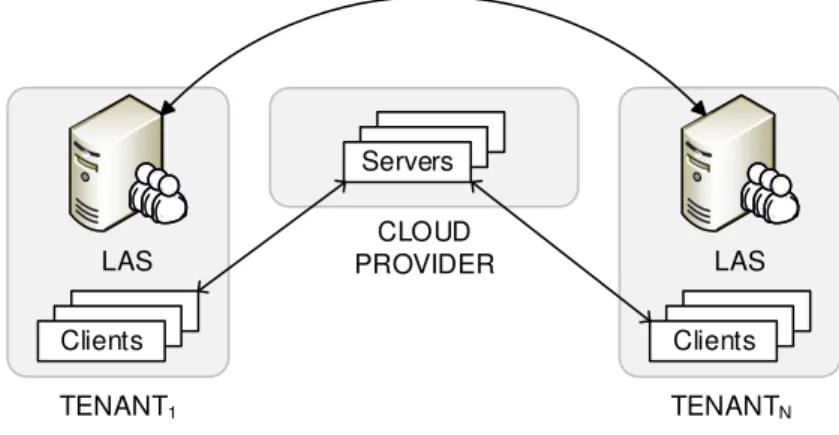
4.1 The centralized approach: All principals are registered to a central directory. 30 4.2 Decentralized authentication with local authentication servers (LAS). . . . 31
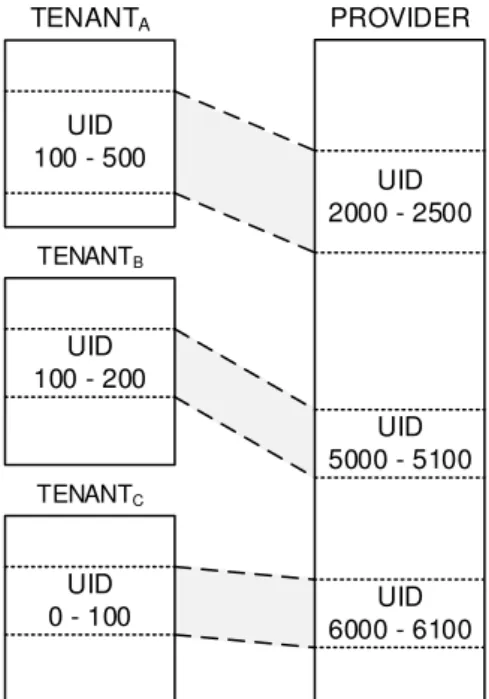
4.3 The identity mapping technique: The local identity space of each tenant is mapped to a dierent range of the provider's identity space. . . 33
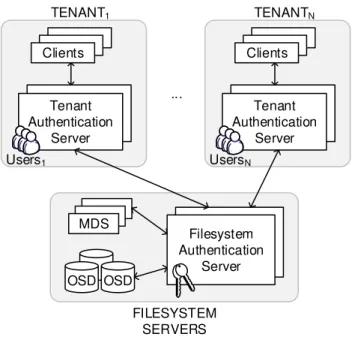
4.4 An architectural overview of our proposed system. . . 35
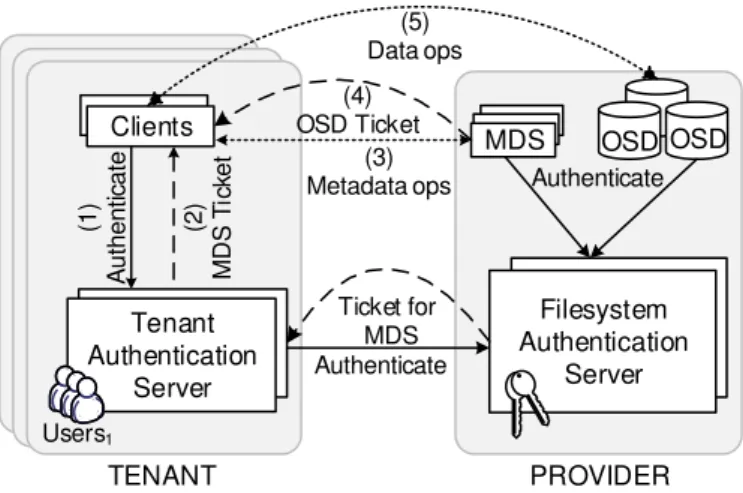
4.5 The authentication architecture. . . 39
4.6 The authorization architecture. . . 40
4.7 Namespace tlering: admin and tenant view of the lesystem metadata. . . 41
4.8 ACL sharing with tree ACLs. . . 42
5.1 Key structures of Ceph that are used to process data in memory. . . 49
5.2 Prototype implementation of the proposed multitenant access control ar-chitecture. . . 52
6.1 Finding the optimal number of processes per client for the mdtest mi-crobenchmark on the local tesdbed. . . 59
6.2 Finding the optimal number of processes per client for the mdtest mi-crobenchmark on AWS. . . 60
6.3 Ceph vs Dike with dierent number of total les and folders. Dike supports 36 tenants. . . 61
6.4 Performance comparison of Ceph and Dike across dierent number of clients. Dike supports 36 tenants. . . 62 6.5 Performance comparison of Dike and HekaFS across dierent number of
clients and supported tenants with mdtest. . . 64 6.6 Multitenancy overhead comparison between HekaFS and Dike. . . 67 6.7 Comparison of Ceph and Dike with MapReduce across dierent number of
clients. Dike supports 36 tenants. . . 69 6.8 Impact of long ACLs on the overall system performance. Dike supports
100 tenants. . . 70 6.9 The benets of ACL sharing when ACLs tend to become very long. Dike
supports 100 tenants. . . 72 6.10 CPU and disk utilization of leserver nodes. . . 73 6.11 Performance comparison of Dike and HekaFS across dierent number of
supported tenants with MapReduce. We use a single client (c1.medium EC2 instance). . . 75 6.12 Linux compilation. Dike supports 100 tenants. . . 77
List of Tables
5.1 Number of added and modied lines of source code in dierent parts of Ceph. 48 5.2 The methods that we added into the class CInode to manage the tenant
permissions of an Inode. . . 51
6.1 Local experimentation environment. . . 55
6.2 Cloud computing environment (Amazon Web Services). . . 56
Abstract
Georgios E. Kappes, MSc, Computer Science and Engineering Department, University of Ioannina, Greece. October, 2013. Scalable Access Control for Secure Multi-Tenant Filesystems.
Thesis Supervisor: Stergios V. Anastasiadis.
In a virtualization environment that serves multiple customers (or tenants), storage con-solidation at the lesystem level is desirable because it enables data sharing, adminis-tration eciency, and performance improvements. However, accessing storage at the le level leads to a reconsideration of the access control techniques used to isolate dierent tenants. Existing solutions require intermediate translation layers for purposes of net-worked le access or identity management. Nevertheless, such translations hinder the le sharing between dierent tenants, complicate manageability, and degrade performance.
In the present study we emphasize the need for a new access control architecture in collaborative multitenant virtualization environments to achieve (i) ne-granularity access control, (ii) storage eciency, (iii) data sharing, and (iv) administration exibility. In this context, we analyze the security requirements of multitenant lesystems. Then we introduce a system architecture that is backwards compatible to object-based lesystems, and combines native access control with namespace isolation. Our architecture securely isolates dierent tenants, and enables exible le sharing both within and among tenants. It also oers more manageability opportunities with respect to the existing solutions.
Based on our design, we developed a system prototype over a mature distributed lesystem. We experimentally evaluate our software implementation with synthetic bench-marks and application-level workloads using a local cluster and the Amazon public cloud. Thus, we show that our approach incurs limited performance overhead in comparison to traditional single-tenant lesystems, achieves better performance than existing solutions
based on intermediate translation layers, and also we provide better scalability for a large number of tenants.
ÅêôåôáìÝíç Ðåñßëçøç óôá ÅëëçíéêÜ
Ãåþñãéïò ÊáððÝò ôïõ Åëåõèåñßïõ êáé ôçò ÁñåôÞò. MSc, ÔìÞìá Ìç÷áíéêþí Ç/Õ êáé ÐëçñïöïñéêÞò, ÐáíåðéóôÞìéï Éùáííßíùí, Ïêôþâñéïò, 2013. Êëéìáêþóéìïò Ýëåã÷ïò ðñüóâá-óçò ãéá áóöáëÞ ðïëõìéóèùôéêÜ óõóôÞìáôá áñ÷åßùí. ÅðéâëÝðïíôáò: ÓôÝñãéïò Â. ÁíáóôáóéÜäçò. Óå Ýíá ðåñéâÜëëïí åéêïíéêïðïßçóçò ðïõ åîõðçñåôåß ðïëëáðëïýò ðåëÜôåò (Þ ìéóèùôÝò), ç åíïðïßçóç ôùí áðïèçêåõôéêþí ðüñùí áíåîÜñôçôùí ìéóèùôþí óôï åðßðåäï ôïõ óõóôÞìáôïò áñ÷åßùí ìðïñåß íá áðïôåëÝóåé ôç âÜóç ãéá ôçí áíÜðôõîç åíüò áðïäïôéêïý êáé áóöáëïýò ðåñéâÜëëïíôïò óõíåñãáóßáò. Ìéá ôÝôïéá åíïðïßçóç ðñïûðïèÝôåé ôç ÷ñÞóç ìéáò äéåðáöÞò ðñüóâáóçò óå åðßðåäï áñ÷åßùí, ç ïðïßá êáèéóôÜ åöéêôÞ ôçí êïéíÞ ÷ñÞóç áñ÷åßùí, åðéôñÝðåé ôçí áðïôåëåóìáôéêüôåñç äéá÷åßñéóç ôïõ óõíïëéêïý óõóôÞìáôïò êáé âåëôéþíåé ôçí áðüäïóç. Ùóôüóï, ç ðñüóâáóç óôïõò áðïèçêåõôéêïýò ðüñïõò ìå ÷ñÞóç ìéáò äéåðáöÞò åðéðÝäïõ áñ÷åßùí êáèéóôÜ áíáãêáßá ôçí åðáíåîÝôáóç ôùí ôå÷íéêþí åëÝã÷ïõ ðñüóâáóçò ðïõ ÷ñçóéìï-ðïéïýíôáé áðü ôï óýóôçìá áðïèÞêåõóçò þóôå íá ðáñÝ÷åé áóöÜëåéá êáé áðïìüíùóç óôïõò ìéóèùôÝò. Ïé õðÜñ÷ïõóåò ëýóåéò áðáéôïýí åíäéÜìåóá åðßðåäá ìåôÜöñáóçò ãéá íá ðáñÝ÷ïõí áóöáëÞ ðñüóâáóç óå Ýíá äéêôõáêü óýóôçìá áñ÷åßùí êáé íá äéá÷åéñßæïíôáé ôéò ôáõôüôçôåò ôùí ÷ñçóôþí ðïõ Ý÷ïõí ðñüóâáóç óôï óýóôçìá. Åíôïýôïéò, ç ÷ñÞóç ðïëëáðëþí åðéðÝäùí ìåôÜöñáóçò äõó÷åñáßíåé ôçí êïéíÞ ÷ñÞóç áñ÷åßùí ìåôáîý ÷ñçóôþí ðïõ áíÞêïõí óå äéáöïñå-ôéêïýò ìéóèùôÝò, äõóêïëåýåé ôç äéá÷åßñéóç ôïõ óõóôÞìáôïò êáé ìåéþíåé ôç óõíïëéêÞ ôïõ áðüäïóç. Óôçí ðáñïýóá åñãáóßá ôïíßæïõìå ôçí áíÜãêç ãéá ìéá íÝá áñ÷éôåêôïíéêÞ åëÝã÷ïõ ðñüóâá-óçò óå óõíåñãáôéêÜ ðïëõìéóèùôéêÜ ðåñéâÜëëïíôá ãéá ëüãïõò (1) åëÝã÷ïõ ðñüóâáðñüóâá-óçò ìå õøçëüôåñï âáèìü áíäñïìÝñåéáò, (2) áðïäïôéêüôåñçò áðïèÞêåõóçò, (3) êïéíÞò ÷ñÞóçò áñ÷åß-ùí, (4) êáëýôåñçò êáé åõêïëüôåñçò äéá÷åßñéóçò. Óôï ðëáßóéï áõôü, áíáëýïõìå ôéò áðáéôÞóåéò óå áóöÜëåéá ôùí ðïëõìéóèùôéêþí óõóôçìÜôùí áñ÷åßùí êáé åéóÜãïõìå ìéá íÝá áñ÷éôåêôïíéêÞåëÝã÷ïõ ðñüóâáóçò. Ç áñ÷éôåêôïíéêÞ ðïõ ðñïôåßíïõìå óõíäõÜæåé ôïí åããåíÞ Ýëåã÷ï ðñüóâáóçò ìå ôçí áóöáëÞ áðïìüíùóç ôïõ ÷þñïõ ïíïìÜôùí êÜèå ìéóèùôÞ êáé åßíáé óõìâáôÞ ìå ïðïéïäÞðïôå óýóôçìá áñ÷åßùí ðïõ âáóßæåôáé óôá áíôéêåßìåíá. ÅðéðëÝïí, äéá÷ùñßæåé áðïôåëåóìáôéêÜ ôïõò ÷þñïõò ïíïìÜôùí äéáöïñåôéêþí ìéóèùôþí, êáé ôáõôü÷ñïíá êáèéóôÜ åöéêôÞ ôçí êïéíÞ ÷ñÞóç áñ÷åßùí ìåôáîý ÷ñçóôþí ðïõ áíÞêïõí óôïí ßäéï Þ óå äéáöïñåôéêïýò ìéóèùôÝò. ÔÝëïò, ðáñÝ÷åé åõêïëüôåñç êáé áðïôåëåóìáôéêüôåñç äéá÷åßñéóç ôïõ óõóôÞìáôïò. Ìå áíáëõôéêÜ áðïôåëÝóìáôá êáé ðåéñÜìáôá óå ðñùôüôõðç õëïðïßçóç äåß÷íïõìå üôé ç ëýóç ìáò åéóÜãåé ðåñéïñéóìÝíç åðéâÜñõíóç óå ó÷Ýóç ìå ðáñáäïóéáêÜ óõóôÞìáôá áðïèÞêåõ-óçò åíüò ìéóèùôÞ. ÅðéðëÝïí, äåß÷íïõìå üôé ç ëýóç ìáò åéóÜãåé ÷áìçëüôåñç åðéâÜñõíóç óå ó÷Ýóç ìå õðÜñ÷ïõóåò ëýóåéò ðïõ áðáéôïýí åíäéÜìåóá åðßðåäá ìåôÜöñáóçò, êáé ðáñÝ÷åé êáëýôåñç êëéìáêùóéìüôçôá ãéá ìåãÜëï áñéèìü áðü ìéóèùôÝò.
Chapter 1
Introduction
1.1 Motivation 1.2 Research objectives 1.3 Contributions 1.4 RoadmapIn recent years, the cloud computing paradigm has enabled enterprises to dramatically improve how they organize their infrastructure and operate their business, taking advan-tage of the scalability and exibility of a cloud environment. The increasing popularity of cloud environments poses ever greater demands on the scalability, and security of the underlying storage systems.
Whether providing services to the public or serving internal customers, cloud plat-forms typically allow multiple customers to share the same physical server and network infrastructure, as well as to use common platform services. Cloud customers could be independent organizations or business groups and they are known as tenants [6, 9]. The consolidation of resources into a shared resource pool is a prominent feature of cloud computing in order to improve eciency, scalability, and reduce costs.
While multitenancy on cloud environments provides seemingly limitless scalability, it raises new security and privacy issues, because it hands the processing and storage tasks over to third parties and involves an enormous number of tenants that share the same
challenging problem due to the enormous number of end users involved and the required isolation of the security administration across dierent organizations. Distributed autho-rization has already been extensively studied in the context of networked services, e.g., distributed lesystems [40]. However, a cloud environment introduces unique character-istics that warrant reconsideration of the assumptions and solution properties.
1.1 Motivation
In the present study we are particularly interested to take advantage of service co-location in the datacenter to better consolidate the storage infrastructure used by common data les at the application (e.g. collaboration documents) or system level (e.g. root im-ages). Secure storage consolidation at the lesystem level is increasingly advocated as the preferred multitenancy paradigm for cloud environments [43, 36, 21, 11, 64]. Although virtual disks are attractive for their versioning, isolation, and migration properties, a le-based interface can additionally support ne-grained controlled sharing, easy resource administration, and le-level performance optimizations. Below, we examine scenaria of virtualization environments in which le based storage consolidation makes sense for rea-sons of (i) ne-granularity access control, (ii) storage eciency, (iii) data sharing, and (iv) administration exibility.
Scientic data: Collaborative research groups require to share scientic data across teams that span multiple institutions. Data owners should be able to easily share their data with users that belong to dierent institutions without requiring them to have ac-counts on the storage servers where the data resides. In addition, a tenant's identity should be veried before making shared data available and only users that belong to this tenant should be able to access the data. Data providers must have full control over both the data that may be shared and the permissions that may be granted to external users. Virtual Desktops: An enterprise stores the desktop lesystems of personal thin clients. Each desktop root lesystem is stored as a separate folder with access limited to a single client. As an optimization, there is a shared folder that is branched into the private folder of each client. Hence, clients can use the shared folder to collaborate on a project. A similar approach can also be applied to manage the home folders of users. In
this scenario, the root folder of each client is branched into a shared but read-only folder. In addition, each user is given its own private home folder, where she can store private les.
Software-as-a-service: A software-as-a-service provider supports dierent business customers with separate end users. The lesystem treats each business customer as a tenant with separate application les in writable mode (e.g. databases), but possibly shared system les in read-only mode (e.g. conguration scripts).
Software Repository: A public provider oers a shared software repository that dierent groups of developers can fork into separate branches. The members of a group obtain writable access to their own branch, and read-only access to the branches of other groups. A simpler scheme without branches could be used for sharing scientic datasets.
1.2 Research objectives
Accessing shared storage through a block-level interface completely hides le-level access control. Read from or writing to storage devices happens at the granularity of blocks and hence le semantics are completely hidden. On the other hand, when a le-level interface is employed to access shared storage, the leserver is ultimately in charge of access control. The adoption of a le-based solution in a multitenant environment, where multiple customers share a single lesystem namespace, raises the need to reconsider the access control techniques used in order to eectively isolate the principals of dierent tenants.
Existing le-based solutions face scalability limitations because they either lack sup-port for multiple guest tenants, rely on global-to-local identity mapping to manage the users of dierent tenants [11], or have the guests and a centralized lesystem (or proxy) running at the same host [43, 21, 12]. In addition, they hinder support for le sharing among principals that belong to dierent tenants and complicate administrative tasks.
In the present study we set as our primary goal to securely manage the shared lesys-tem namespace, in order to provide each tenant with an isolated private view. However, in contrast to previous approaches, our solution should permit principals of the same or dierent tenants to share les and collaborate on a shared project. In addition, it shall
provide system administrators with more manageability opportunities, and nally, it shall maintain high performance and scalability by natively supporting multitenancy.
1.3 Contributions
Secure access control is a challenging problem that organizations face in collaborative virtual environments, which has prevented many of them from migrating critical data or applications into such environments. In our research we examine approaches for ecient and eective support of multitenancy in lesystems used by virtual machines. We require that each client directly mounts the lesystem instead of having the lesystem mounted by an intermediate proxy. Trusted computing techniques are used to certify the integrity of tenants that wish to access the shared lesystem. Tenants are then responsible for authenticating and authorizing principals operating on their behalf to provide access to the lesystem. The lesystem natively manages the access control metadata of each tenant, and ensures that each tenant can only access its own namespace. Controlled le sharing is relatively straightforward as a result of the le-level access to a common lesystem with le-granularity access control.
We provide prototype implementation of the above approach in the Ceph production-grade, distributed lesystem. With microbenchmarks and application-level experiments we quantitatively demonstrate the limited performance overhead of our design.
We can summarize our contributions as follows:
• Analysis of access control requirements in le-level consolidated storage for
virtual-ization.
• Architectural design of native access control in a multitenant lesystem with
back-wards compatibility to object-based storage.
• Prototype implementation over a production-grade distributed lesystem. • Experimental performance evaluation of multitenancy overheads.
1.4 Roadmap
In chapter 2 initially we present the basic features of cloud environments and virtualiza-tion, and the core security primitives for securing data in large-scale distributed storage systems. Then, we delve deeper into storage management in virtualized environments and we summarize the dierent multitenancy architectures for lesystem storage clouds that have been proposed until now. Finally, we discuss why a le-level storage interface makes multitenancy challenging.
In chapter 3 we rst analyze the security requirements in multitenant lesystems. Then, we list the goals that we have set for our proposed access control architecture. Furthermore, we provide details about our trust and threat model.
In chapter 4 we introduce a new access control architecture for multitenant shared storage at the le level. Our architecture combines tenant isolation with native access control and is backwards compatible to object-based lesystems.
In chapter 5 we describe our implementation of the proposed multitenant access control over a distributed, object-based lesystem. In addition, we explain important implemen-tation decisions.
In chapter 6 we experimentally evaluate our prototype implementation and give rea-sons for the limited added performance overhead of our solution. Furthermore, we compare it with existing techniques that aim to enable multitenancy.
In chapter 7 we review the state-of-the-art multitenancy architectures for lesystem storage clouds, and we outline recent works that aim to provide trusted cloud storage. Furthermore, we present an overview of the related literature in the eld of access control in distributed lesystems.
Finally, in chapter 8 we summarize the conclusions of our work and highlight oppor-tunities for future research.
Chapter 2
Background
2.1 Cloud environments 2.2 Virtualization
2.3 Core security mechanisms 2.4 Storage management 2.5 Storage interfaces
2.6 Secure storage multitenancy
2.7 Access control on multitenant storage systems 2.8 Summary
In this chapter we rst present an introduction to the basic concepts of cloud environ-ments and virtualization. We also present the core security primitives for securing data in large-scale distributed storage systems. Then, we concentrate on storage management and we briey introduce the architecture of object-based distributed lesystems and its advantages over traditional distributed lesystems. Furthermore, we compare the block-level interface with the le-block-level interface in terms of sharing and manageability eciency, as well as performance. Finally, we summarize the dierent multitenancy architectures for lesystem storage clouds that have been proposed until now and we highlight why a le-level storage interface makes multitenancy challenging.
2.1 Cloud environments
Cloud infrastructures are increasingly used for a broad range of computational needs in private and public organizations. Cloud computing aims at allowing access to large amounts of computing power in a fully virtualized manner, by aggregating resources and oering a single system view. The deployment of cloud infrastructures can be performed in dierent ways, depending on the organizational structure and the provisioning location [35].
Four deployment models are usually distinguished, public, private, community, and hybrid. The deployment of a public cloud infrastructure is characterized by the public availability of the cloud service oering. It may be owned, managed, and operated by a business, academic, or government organization, or some combination of them and is oered to the public through a public network. On the other hand, in a private cloud de-ployment, the cloud infrastructure is provisioned for exclusive use by a single organization comprising of multiple customers. It is owned, managed, and operated by the organiza-tion, a trusted third party, or a combination of them. The main advantage of this kind of deployment is that the organization retains full control over corporate data, security guidelines and system performance. While a private cloud is only accessible by a single organization, a variant of this deployment, which is known as a community cloud, enables organizations with similar requirements (projects, security requirements, policies) to share a cloud infrastructure in order to collaborate. The infrastructure could be managed and hosted by one or more of the organizations in the community, or by a third-party. Finally, in a hybrid cloud deployment the cloud infrastructure is a composition of two or more distinct cloud infrastructures (public, private, or community) that remain unique entities. A hybrid deployment allows an organization to maintain sensitive data behind its rewall, while taking advantage of the lower cost and exibility of a public cloud.
The main idea behind cloud computing is to deliver a huge amount of computing re-sources as services through a public network such as the Internet. Cloud services can be divided into three categories according to the abstraction level of the resource provided, namely: (1) Software as a Service, (2) Platform as a Service, and (3) Infrastructure as a Service. In the rst model, Software as a Service, one or more applications and the computational resources to run them are provided for use on demand as a service. On
the other hand, Platform as a Service is a model of service delivery whereby the com-puting platform (typically including operating system, programming language, execution environment, database, and web server) is provided as a service to software developers. Finally, Infrastructure as a Service is a service model where the cloud provider oers virtualized resources (computation, storage, and network) on demand. To deploy their applications and services, customers install operating system images and their applications on the cloud infrastructure. The focus of this study lies in this nal model.
Cloud computing services are usually backed by large-scale datacenters. Modern dat-acenters are heavily virtualized, thereby, computing, storage, and network resources of each physical server are multiplexed across a large number of dierent applications and tenants. Thus, cloud platforms allow multiple tenants to share the same resources. This leads to multiple benets. On the one hand, higher resource utilizations are achieved and on the other, resource sharing can lead to a great reduction of energy consumption and cut costs. In fact, most datacenters often utilize virtualization and distributed services to manage resources and provide a scalable computing platform [31], making virtualization a fundamental component of cloud computing.
2.2 Virtualization
Virtualization is a broad term of computer systems that refers to an abstraction mecha-nism which hides the physical characteristics of certain computational resources in order to simplify the way in which other systems, applications or end users interact with them. Thus, virtualization enables sharing the resources of a computer system in multiple exe-cution environments.
The concept of virtualization has its roots in the mid 1960's, when it was used by IBM as a method for logical partitioning of large centralized systems (mainframes) into separate virtual machines. The virtual computers were distributed to users of the system, allowing each user to work in an isolated environment without aecting other users. To make this sharing possible, IBM introduced a new feature called Virtual Machine Monitor (VMM).
hard-ware layer and has direct access to hardhard-ware resources. Its main objective is to manage and allocate system resources to one or more virtual machines in order to make virtu-alization possible. Virtuvirtu-alization follows various approaches that are directly related to the architecture of the Virtual Machine Monitor. In the hosted architecture the VMM runs as an application on the host operating system and relies on it for resource manage-ment, system memory, and device drivers. In the autonomous architecture the VMM is placed directly above the hardware. Thus, it is responsible for managing system resources and their allocation to dierent virtual machines. This last architecture is more ecient because the VMM has direct access to system resources.
Guest operating systems run with limited privileges and they don't have direct access to hardware. Thus, it is dicult to virtualize some critical operating system instructions because their implementation requires higher privileges. Two approaches were followed to solve this problem: full virtualization and paravirtualization.
Full virtualization provides a virtual environment that simulates the real hardware. Specically, each virtual machine is provided with all the services of the real system, such as full command set of the real processor, virtual appliances, and virtual memory management. The major dierence from other virtualization techniques lies in operating system's awareness that it runs under a virtualized environment. Thus, any software that is capable to run in the real system can run without changes in the virtualized environ-ment. In order to make the execution of critical instructions possible, a technique known as binary translation was introduced. According to this approach, the software is patched at runtime. The critical instructions that cannot run in the virtual environment are re-placed by dierent instructions that can run safely. However, the continuous scanning and emulation of critical instructions reduces performance. VMware's Workstation [63] follows the above approach.
On the other hand, paravirtualization provides to the virtual machines a software interface that is similar but not identical to that of the real system. The main purpose of paravirtualization is to reduce the proportion of time spent in performing critical patches on the guest's unsafe instructions. Instead of using the binary translation technique, the client software is modied and communicates directly with the VMM, when it needs to execute a critical instruction. Then, the VMM undertakes responsibility to execute the instruction. As a consequence, the guest operating system must be altered slightly in order
to run in a paravirtualized environment. A system that follows the paravirtualization approach is Xen [7].
As the benets of virtualization are tremendous, manufacturers of processors have reviewed the instruction set of their products by making them virtualization-friendly. Thus, virtualization of critical operating system instructions can be solved directly using the new instruction set.
2.3 Core security mechanisms
In a distributed lesystem, client is typically a process that provides local lesystem access to a node and servers the processes that implement lesystem action across the network. Principal is an entity that accesses the lesystem through the client. This entity can be a process, a person, or a role. A principal can also be a compound of other principals, for example a group of users [40].
Reliability and security in a large-scale storage system can be enforced with a combi-nation of four dierent techniques, including Encryption, Identication, Authentication, and Authorization.
Encryption is the process of encoding information in such a way that eavesdroppers cannot read it, while authorized parties can. A secure cloud storage system requires two kinds of encryption: For data that is being transferred over the network and for data \at rest" on disk. Usually, when cloud tenants don't entrust the cloud provider with their data, they can provide condentiality to themselves by encrypting the data they store on the cloud.
Identication is the process in which an entity supplies information to identify itself to an authentication service. Some examples of identication mechanisms are usernames, memory cards, and public keys.
Authentication is the activity of verication of an entity's identity. It can be performed using passphrases, passwords, cryptographic keys, and tokens. It conrms the identity of an individual, but says nothing about its access rights. Authentication often involves verifying the validity of at least one form of identication.
can actually access and what operations it can carry on this information. Authorization is normally preceded by authentication for user identity verication.
Most access control systems need also to limit the actions of application processes. In particular, they must prevent a process from reading or overwriting memory that it may not access. One solution to this problem is to use sandboxing techniques. A sandbox is a security mechanism for separating running programs (e.g. SELinux [30]). However, sandboxing techniques are often too restrictive for general computing environments. An-other solution to the above problem is to use mechanisms like segment addressing, which integrate hardware access control with the memory management functions [5].
A secure environment must also ensure the integrity of computing platforms. In fact, users must be sure that a given program runs on a machine with a given specication; that is, the software has not been modied and the hardware conguration has not been changed. A typical mechanism that provides such assurances is the Trusted Platform Module or TPM. The TPM is actually a secure co-processor which monitors a system at boot time and reports its state to the operating system. In fact, it generates a crypto-graphic key that depends on the current system's state, as well as a ngerprint (hash) of the software stack that booted on the system and provides them to the operating system. Thus, if a modication is made to the system's conguration, the TPM chip will generate a dierent cryptographic key and the previously encrypted material will not be made available. A system can also use the TPM to certify the identity of a remote system. This process is called remote attestation. Furthermore, TPM can also be used for disk encryption. It oers two primitives, seal and unseal to encrypt and decrypt information respectively. Seal encrypts data and species a state in which the TPM must be in order for the data to be decrypted (unsealed) [5, 52].
2.4 Storage management
File and storage systems used in virtualization environments have proved critical to the overall performance of an exceedingly broad class of applications. Storage systems can be distinguished in three dierent categories depending on how data is stored on the underly-ing system: block-based storage, le-based storage, and object-based storage. The storage
in the block-based approach is conceptually modeled as a long stream of bytes divided into equally sized blocks. All accesses to the storage devices are performed by reading or writing blocks. Examples of this type of storage include Amazon Elastic Block Store (EBS) [1], Ceph RBD [20], and iSCSI [53]. In the second form of storage a lesystem is layered on top of a block storage device. The lesystem is a a higher-level logical structure that maps higher-level objects, which are typically called les (such as documents, pic-tures, and videos), onto disk blocks. Some examples of le-based storage systems include NFS [55] and CIFS [38]. In the latter form of storage, which is known as object storage, the storage system uses objects to store information. Object-based distributed storage systems emphasize the scalability of secure data and metadata management. Some typ-ical examples of object-based storage systems include Amazon S3 [3], Rackspace Cloud les [49], and Ceph Storage [67].
2.4.1 Object-based distributed lesystems
An object-based distributed le system separates the management of le metadata1 from
le data. File metadata is managed by metadata servers, while a dierent form of servers, which are known as object storage servers, manage le data. Both data and metadata are split into objects which are stored on object storage servers. The lesystem client employs metadata and object storage servers to present a full lesystem abstraction to the users [67].
A signicant advantage of the object-based le system architecture is the elimination of the potential bottleneck of the metadata server and the parallelization of all le I/O. In fact, a client needs to contact the metadata server only once, for example when it opens a new le. Another benet of this architecture is that by grouping data into objects allows the object storage server to optimize access to related blocks, because data that resides in the same object is related and potentially dierent from data in a dierent object. What is more, data can be split to multiple objects in order to keep the size of an object under a specic limit. These objects are then stored to dierent object storage servers (data striping). This allows the stripe width to be adapted to the access properties of an individual le.
2.4.2 An outline of Ceph
Ceph is a distributed object-based lesystem developed by Weil et al [67]. It consists of four components: The clients provide access to the lesystem, the metadata servers (MDSs) manage the namespace hierarchy, the object-storage devices (OSDs) reliably store data in the form of objects, and the monitors (MONs) manage the server cluster map. Both data and metadata are stored on OSDs, but they are separately managed for greater scalability. The metadata is dynamically partitioned across the MDSs to preserve locality and achieve load balancing.
Metadata management
The MDS is responsible to manage metadata for les and folders. A Ceph folder is stored as a single object, or as a collection of fragments, with each fragment on a dierent object. When a folder is divided into multiple fragments, the Ceph client is responsible to request the correct fragments from the MDS. If the client needs the whole folder, it iteratively requests the next folder fragment from the MDS, until it forms up the whole folder. A folder entry includes the name, the inode, and the extended attributes of a le. Every MDS maintains a journal [47] of recently-updated metadata. Incoming metadata updates are labeled as projected while written to the journal but not yet to the in-memory cache, committing while queued to disk, and committed when written in stable storage. Metadata journaling allows the MDS to serve recent metadata back to clients. In addition, the journal is also useful for failure recovery.
Data and metadata storage
Ceph stores le data and metadata as objects. Each object is stored as a le in the underlying lesystem of an OSD. An object has an identier, binary data, and object metadata consisting of a set of key/value pairs. Note that the actual le metadata (the le inode) is stored in a dierent object.
Objects are mapped into Placement Groups (PGs). Grouping objects to PGs helps ensure performance and scalability, as tracking metadata for each individual object would be too costly. The PGs are then mapped to one or more OSDs. Replication is done at the PG layer. However, the degree of replication is specied higher, at the pool level, and all
PGs in a pool will replicate stored objects into multiple OSDs. A pool is a collection of PGs and thus a collection of objects. Objects are mapped to PGs and PGs to OSDs with the help of a pseudo-random data distribution function [68]. This function allows Ceph to re-balance dynamically when the OSD map changes. Furthermore, it ensures that object replicas do not end up on the same disk or host.
2.5 Storage interfaces
Storage systems can be accessed through dierent types of storage interfaces which can be distinguished in three dierent categories: a block-level interface, an object-level interface and a le-level interface. A block-level interfaces exposes a block device to the user and allows the writing and reading of xed-size blocks. On the other hand, with an object-level interface users can access objects typically through a REST API [13]. Finally, a le-level interface exposes the le and folder structure to clients. Then, clients ask the server to read or write a consecutive range of bytes within a particular le in each request and the server maps this request to the storage devices.
Existing virtualization environments primarily apply storage consolidation at the block level [37, 18, 54, 62]. Guests access virtual disk images which are typically stored in a central location. They are oered to guests as direct attached disks through a block I/O interface, or as volumes through a storage area network mounted by the host. This ap-proach incurs important benets, such as high availability of data, easier administration, and optimal usage of storage capacity. The block-level interface provides a narrow inter-face to storage and yields an agnostic and simple implementation. Furthermore, it oers the system compatibility of a standalone machine. Moreover, a block-level interface is useful for supporting heterogeneous clients and client applications.
An alternative approach is the design of a virtualization-aware distributed lesystem [43, 21, 12]. This architectural design goes one step further beyond virtual disks and attempts to provide storage virtualization at the le level. In fact, it combines the sharing opportunities oered from distributed systems with the intrinsic features of virtual disks such as isolation, versioning, and mobility.
2.5.1 Sharing and manageability
The semantic gap introduced by virtualizing the system at a low level obscures higher-level information that could aid in identifying opportunities for sharing among dierent VMs, complicating the eciency of storage management, and making collaboration tasks im-possible. Furthermore, it hides the storage structure and thus complicates administrative tasks.
File level access of consolidated storage oers more manageability opportunities than block level access. Stored data is directly accessible through a standard le-level interface at the server without requiring shutting down the virtual machines which access the storage.
A block-level interface oers no opportunities to share read and write access between multiple parties, which complicates virtual machine management. Concurrent access can only be enabled with the help of a secondary protocol, or the usage of a traditional network or distributed lesystem to export specic parts of the lesystem. However, such solutions incur extra manageability eort because they involve either the design of extra protocols, or the maintenance of multiple administrative domains.
In addition, lesystem administrative tasks, such as data searching and software in-stallations or updates, can be performed more eciently and globally through a le-level interface. With a block-level interface instead, the administrator would be forced to shut-down all the aected virtual machines in order to mount their images and perform the required task in one image at a time. In fact, a le-level interface increases administration exibility and eciency because it enforces a granularity of individual les rather than entire disk or blocks.
Another potential manageability benet from using a le-level interface lies to its ability to provide an ephemeral and highly composable storage. A lesystem can be synthesized from a set of le trees, each of which contains related les. In addition, a le tree can be shared among multiple users or can be private. For example, there might be a collection of le trees, each of which may contain the root lesystem of a dierent operating system. Another collection may contain le trees that hold each user's home folder. A last one would have le trees that have specialized applications installed. Let's suppose that Alice is a developer who uses the Eclipse Integrated Development
Environment (IDE) and prefers the Debian Linux distribution. With composable storage enabled she has the exibility to synthesize her lesystem by choosing the Debian le tree from the operating systems collection and combine it with probably a shared le tree that contains the Eclipse IDE and a private le tree for storing personal les.
The above discussion makes it clear that a le-level interface oers signicant manage-ability benets in comparison to a block-level interface. A recent study [4] tries to mitigate these limitations of block-level storage by storing images in a format that indexes their storage structure, instead of as opaque disk images. Thus, by providing a le-aware for-mat this approach allows administrative operations such as searching, patching, and virus scanning to execute online.
2.5.2 Performance
File-level access of consolidated storage may improve performance because of its potential to reduce the number of levels to a storage stack traversed by an I/O request. On the other hand, when a VM guest operating system accesses storage through a virtualized block device, le access traverses the guest operating system's lesystem and its block device stack, and then it traverses a similar block device stack in the VMM. Even if the guest operating system accesses storage through a pass-through block device, the le I/O request needs to be translated to a block request and then back to a le request. However, such translations can reduce performance [21].
Hildebrand et al. [19] study the eects of having multiple layers in the storage stack of a virtualization environment. They are particularly interested to investigate the eects of layering a virtual disk on top of a NAS store. In this scenario, a VM's le request is translated to a block request by the hypervisor's storage controller emulator, which in turn translates the block request back to a le request and sends it to the disk image via the NAS client. This large number of layers in the storage stack increases the amount of processing that each request needs and hence increases the I/O latency. In addition, the caching of entire blocks by the block-layer causes read-modify-write operations over the NAS protocol which degrades performance. Having these observations in mind and conducting several experiments the authors state that the layering of the guest block-layer on top of a le-level layer can dramatically reduce performance. As a possible solution,
they suggest the guest VMs to consolidate storage directly at the le level by mounting a network-based lesystem.
The performance implications of nested lesystems in a virtualized environment are investigated by Le et al. [27]. They focus on the scenario in which a guest VM accesses a local virtual disk image. Their main observation is that the choice of nested lesystems on both hypervisor and guest levels has a signicant performance impact on guest's I/O performance. In addition, they realize that system administrators should carefully choose a combination of guest-hypervisor lesystems according to the type of the anticipated workload. What is more, they demonstrate that there are cases where nested lesystems should be completely avoided.
2.6 Secure storage multitenancy
Secure multitenancy in cloud storage supports multiple customers at low cost [25]. How-ever, maintaining security and access control in cloud environments is a challenging prob-lem and has prevented many organizations from moving critical data or applications to such environments.
Cloud storage systems must address challenges that are not addressed by traditional distributed lesystems. These challenges mostly revolve around isolation, identity man-agement, and privacy. Cloud tenants do not trust each other, and in the case of a public cloud they even do not trust the cloud provider. A cloud storage system must ensure that tenants are isolated from each other, while it oers them opportunities for a secure and collaborative le sharing. Tenant isolation in a lesystem storage cloud can generally be performed in four dierent levels: hardware level, hypervisor level, operating-system level, and application level.
Tenant isolation can be performed at the hardware level by using a dedicated server per tenant. However, this solution does not scale well, wastes hardware resources, and dramatically increases operating costs.
A second approach is to isolate a tenant at the hypervisor level by using a shared hypervisor and separate virtual machines to host each tenant's leservers [41, 44, 25]. In this case, the hypervisor enforces isolation by ensuring that the data from one tenant is not
propagated to untrusted locations outside the tenant. Although this architecture securely isolates tenants, it hinders the benets of a shared lesystem, such as data sharing, group collaboration, and data processing scalability.
In contrast to the above approach, the operating-system multitenancy architecture uses shared server hardware and operating system, and relies on the leserver kernel to isolate the resources of dierent tenants leading to lower execution overhead [48, 25]. However, this architecture shares the same disadvantages with the previous one regarding the inability for le sharing and collaboration, as well as the poor scalability, because each client has its own dedicated le-service.
Finally, tenant isolation can be performed at the application level, by using shared server hardware, operating system, and leserver among tenants. This form of multite-nancy is also referred as native multitemultite-nancy and is considered as the cleanest way to isolate multiple tenants [25]. Despite the fact that achieving multitenancy at this level is a challenging task, this architecture enables all the benets of the deployment of a shared lesystem, including data sharing, group collaboration, and high scalability.
2.7 Access control on multitenant storage systems
When a storage system is shared across multiple customers, it is critical to control how the access is dierentiated so that only the permitted principals to be able to access the data of each tenant. Below, we initially discuss how access control is handled in block-level multitenant storage systems. Then, we highlight the multitenancy challenges that are introduced by storage consolidation at the le level.
2.7.1 Access control on block-level storage systems
Existing cloud environments primarily apply storage consolidation at the block level. Guests access virtual disk images either directly as volumes of a storage-area network (SAN), or indirectly as les of network-attached storage (NAS) mounted by the host. In fact, virtual disk images provide the same block-level interface as physical disks and they have no access control responsibility. Therefore, if a tenant accesses its own collection of virtual disk images, its namespace is strongly isolated from others. While le-level
access control is completely hidden by the block-level interface, tenants instead of sharing individual les with each other can share the whole virtual disk image.
The secure sharing of virtual machine images in a cloud environment has been re-searched by Wei et al. [66]. They propose a virtual disk image management system that controls secure access to images by dierent tenants, tracks the provenance of images, and provides tenants and administrators with ecient image management tools that detect and prevent security violations. However, a ner-grained sharing at the level of les is more desirable, but a block-level interface can not support it.
2.7.2 Multitenancy challenges of a le-level storage interface
File-based access of consolidated storage has been advocated to improve data sharing, manageability, and performance. Unfortunately, the access control model that is used when a virtual machine accesses storage through a block-level interface cannot be used when the lesystem must be deployed as a shared service and tenants access it through a le-level interface. The main problem in such a shared deployment is that the namespaces of dierent tenants are no longer isolated from each other. Thus, the lesystem needs to securely support and isolate dierent administrative domains.
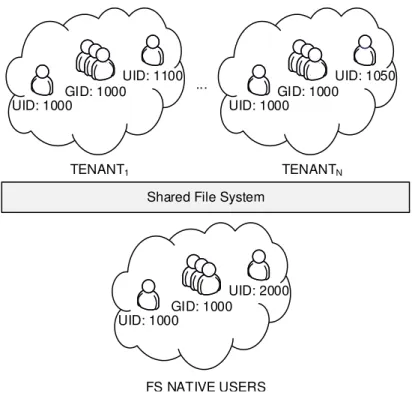
An interesting example is how the isolation of principals is aected in such a deploy-ment. In fact, each tenant contains its own pool of users (see Figure 2.1). Each user is represented by an identity which is called the User ID (UID). The UID is a projection of an actual individual or service into the system. Establishing a unique UID for each individual who will access resources in a shared deployment is critical for security. How-ever, the use of a shared lesystem introduces a possibility of conict involving the use of the same UID by users belonging to dierent tenants. As a result, a user who belongs to a particular tenant can access the les of a user with the same UID who belongs to a dierent tenant. To make the situation worse, the storage server contains its own identity space. As a consequence, a tenant user can gain extra privileges on the leserver with catastrophic results.
At the same time, other problems related to le permissions and special les are arising when a shared lesystem deployment is used. File permissions assigned to a le by a tenant's user not only aect other users of the same tenant, but they also mistakenly
FS NATIVE USERS UID: 1000
GID: 1000
UID: 2000 Shared File System TENANT1 UID: 1000 GID: 1000 UID: 1100 UID: 1000 GID: 1000 UID: 1050 ... TENANTN
Figure 2.1: The ID collision problem when a single namesapace is shared between dierent tenants and the provider.
aect the users of dierent tenants. This situation is unacceptable and is driven by the fact that the dierent namespaces are not properly isolated from each other. A similar situation arises when a user creates a new special le (e.g. symlink or device le). This le is also presented as a special le on the leserver. However, a special le has a specic meaning only in the space where it is created. When such les are presented as special les on outer spaces, they may impose a serious impact on system's security. For example, an intruder can use them as backdoor to read or even modify kernel memory, les, disk drives, and other critical devices. Thus, it is critical for a multitenant lesystem to prevent identity collisions and isolate the dierent tenant namespaces.
2.8 Summary
Cloud computing is a new computing paradigm that provides software, platform, and infrastructure services on demand to customers around the world. A cloud environment may be public, private, community, or hybrid, each with its own distinct constraints. In order to eciently support an enormous number of customers at low cost, cloud
environ-ments rely on sharing of computing resources. A key technology that enables resource sharing is virtualization. The Virtual Machine Monitor is a critical component of virtu-alization. It may run directly as an application on the host, or it may be placed directly above hardware. A challenge that virtualization faces is how to virtualize critical oper-ating system instructions. This challenge can be solved either with full virtualization or with paravirtualization.
File and storage systems used in virtualization environments are a critical component for the overall performance of hosted applications. Storage systems are distinguished into dierent categories depending on how data is stored and accessed. Existing virtualization environments apply storage consolidation at the block level. Although the block-level access provides many benets, such as support for versioning, isolation, and migration, it precludes le sharing, hinders manageability, complicates resource administration, and reduces performance. For these reasons, a le-level interface is more desirable in envi-ronments that target collaboration, easy resource administration, and high performance. However, a le-level interface leads to a reconsideration of the access control mechanisms used to securely isolate dierent customers.
Chapter 3
Design requirements
3.1 Security requirements of multitenant storage systems 3.2 Architectural goals
3.3 Trust and threat model 3.4 Summary
In this chapter we explain the security requirements in multitenant storage systems and we list the goals that we have set for our proposed access control architecture. We also give details about our trust and threat model. In the next chapter, we propose a design to meet the specied requirements and goals.
3.1 Security requirements of multitenant storage systems
The idea of multitenancy is fundamental to cloud computing. Especially in a storage cloud, service providers are able to build storage architectures that are very ecient and highly scalable to serve the needs of the large numbers of customers that share them. However, in a multitenant storage system, data of dierent tenants is stored in the same underlying storage devices. Thus, the primary requirement for multitenant storage is to ensure the security of tenant data.
Shared File System TENANT1 VM Unique Tenant ID Local Users TENANT2 VM Unique Tenant ID Local Users
Tenant1 ID space Tenant2 ID space
Identity space
Tenant1 names Tenant2 names
File name space
Data TENANT1 TENANT2
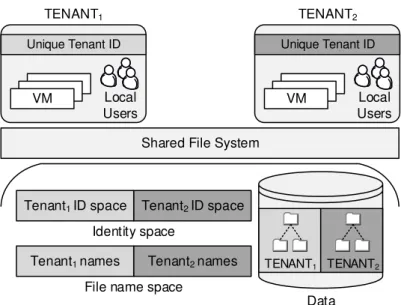
Figure 3.1: Attributes of a shared multitenant lesystem.
When the storage system oers a block-level interface, each tenant accesses its own virtual disks and hence it is hard for a particular tenant to access the data of another tenant. On the other hand, when tenants access the shared storage with a le-level interface, they share a single lesystem namespace. In this case, the risks of multitenancy become more severe.
As shown in Figure 3.1, the lesystem itself must securely separate, protect, and isolate a tenant's data from other tenants. This separation must be complete and secure. However, it must not aect the management, sharing, and exibility benets of a shared lesystem. As we have explained earlier in subsection 2.7.2, the access control mechanism must take into account the fact that a single namespace is shared between multiple parties and properly prevent namespace collisions. All in all, if an attacker manage to gain access to a tenant's local account, then his attack must be conned within that tenant and he should be unable to access data of another tenant.
In a multitenant storage system, the tenant ID is what distinguishes one tenant from the others. Authentication mechanisms must ensure that no other tenant can assume a tenant's identity to gain data access. Furthermore, the lesystem must take into account how the access is authorized and dierentiated, so that only the right principals can view and manage a tenant's data.
In addition, care must be taken to protect tenant data at rest and obstruct deletion or corruption (accidental or malicious) of it. In the present work we assume that the storage
provider and the lesystem servers are trusted. However, there are known techniques, like encryption of data at rest, that can provide an option to meet the security concerns of the most sensitive tenants.
Finally, tenant data access must not be disrupted by denial of service attacks against the lesystem servers and by the normal or abnormal activities of other tenants. However, in this thesis we do not attempt to provide solutions for these kinds of attacks.
3.2 Architectural goals
The following goals guided the design of the proposed scheme of lesystem access control:
• Isolation: Securely isolate dierent tenants and prevent namespace collisions. • Sharing: Enable collaboration by providing exible le sharing among the
princi-pals of the same and dierent tenants.
• Eciency: Provide fast data access with native support of multitenant access
control for lesystem performance and scalability.
• Compatibility: Ensure architectural compatibility with existing scalable and
re-liable lesystems.
• Manageability: Provide more manageability opportunities to facilitate
adminis-trative tasks.
3.2.1 Isolation
We assume that each tenant has its own identity space and operates a group of virtual machines with an identical pool of principals and with identical access rights to a set of les. We further assume that two identity spaces of dierent tenants can collide. In fact, a tenant should not be aware of how other tenants manage their identities. The lesystem should properly isolate the identity space and access control of principals from dierent tenants.
Client OSD OSD MDS MON Au th Auth Auth (a) Architecture Client MDS OSD OSD (1) Authorization Request (2) Capability (b) Access control
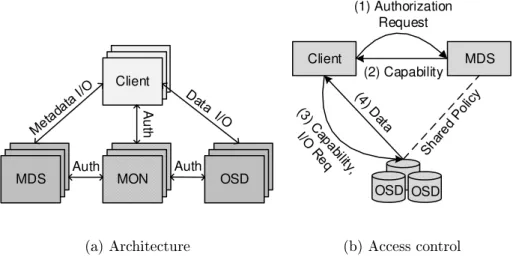
Figure 3.2: The architecture of an object-based, distributed lesystem and its access control mechanism.
3.2.2 Sharing
In addition to tenant isolation, our architecture must provide opportunities for ne granu-larity intra-tenant and inter-tenant le sharing. For this reason, we use a le-level storage interface that enables sharing, in contrast to a block-level interface. Furthermore, we rely on access control lists and tenant-issued credentials in order to natively authorize le access and we avoid techniques that complicate le sharing.
3.2.3 Eciency
Our architecture must also be scalable and maintain high performance standards. Thus, we rely on an object-based distributed lesystem to handle the storage requirements of clients (e.g. virtual machines) belonging to dierent tenants.
As shown in Figure 3.2(a), a collection of object storage servers (OSDs) are respon-sible to redundantly store the data and metadata in object form. In order to provide scalability to metadata operations, metadata management is separated from the storage of data. Multiple metadata servers (MDSs) manage metadata, and achieve locality and load balancing by partitioning over the object servers the name, data index, and access permissions of dierent les. Each metadata server can manage a dierent portion of the namespace for better scalability. Namespace portions can also overlap to the same MDS for better redundancy. Finally, multiple monitors (MONs) are used to manage the whole
system, identify component failures, and authenticate the dierent system components. The system can exible manage secure access to stored objects with help of the operating system at each object server [67, 70].
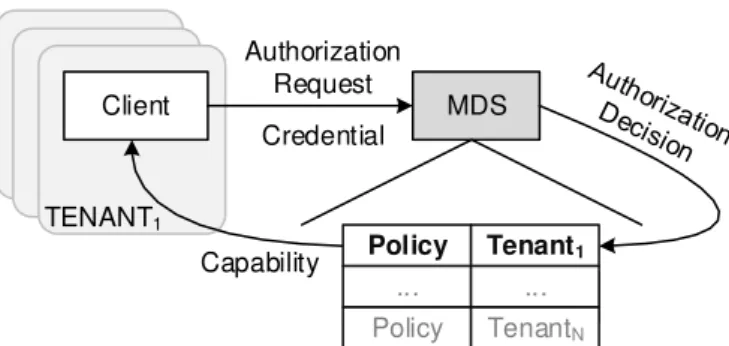
Access control decisions happen at the MDS. Object storage servers have no implicit knowledge of access privileges or authorizations. Thus, the MDS authorizes a client request and provides the client with a capability [29]. A capability is a token of authority that species the access rights that a particular principal has over a particular system resource (e.g. a le). The client presents the capability to the OSD, which according to the policy that is specied on the received capability replies to the client with the appropriate data (see Figure 3.2(b)).
Existing security solutions that rely on capabilities for access control have been crit-icized for their limited scalability: the number of security operations is strongly tied to the number of users, les, and requests. However, a recent work from Leung et al. [28] solves this problem with the Maat protocol. More specically, for a single tenant, the extended capability of the Maat protocol authorizes I/O for any number of users and les in petabyte lesystems, is cryptographically secure, and maintains xed size capabilities through Merkle hash trees. Our proposed architecture is compatible with such extended capabilities.
3.2.4 Compatibility
Our architecture must be compatible with existing scalable and reliable lesystems. For this reason, we use traditional structures and mechanisms that are made available in the most of the current widely used distributed lesystems.
3.2.5 Manageability
Finally, our architecture should permit system administrators to eciently manage the lesystem in terms of performing administrative tasks, managing tenants, and specifying access control policies for dierent tenants. Thus, we rely on a le-level interface, which provides more manageability opportunities in comparison to a block-level interface. In addition, we avoid techniques that complicate manageability tasks.
3.3 Trust and threat model
The clients and servers of the lesystem all run in one datacenter that is physically protected and operated by an independent provider. A secure co-processor certies the software stack on each physical host1. A central monitor establishes the trust of the
in-frastructure from the integrity of the participating nodes. Public keys (or hashes thereof) uniquely identify tenants, principals, and services. The nodes securely communicate over temporary symmetric keys dynamically agreed upon via public-key cryptography. The private keys of principals and services are permanently stored in encrypted form and only appear in clear-text form at the volatile memory of authorized nodes. Before the realloca-tion of host memory across dierent nodes, the memory contents are scrubbed to prevent information leakage.
The lesystem protects the condentiality and integrity of stored data and metadata by restricting access to authorized principals. We assume that the provider has no malicious intent to compromise the system security. However, there may be other reasons (e.g. poor security practices) for which the provider is not trusted for particular applications. In that case, the tenant may externally apply known techniques of encryption, hashing, and auditing to achieve end-to-end condentiality, integrity, and freshness [42]. Our present study targets lesystem access control without any explicit attempt to provide solutions for public-key distribution, denial of service, and trac analysis. Finally, we do not address general distributed processing, which involves multitenant sharing of resources other than storage (e.g. computation).
3.4 Summary
In the present study we are particularly interested to design a more ecient access control architecture for multitenant shared storage at the le level. On the one hand, our proposed architecture must securely isolate the identity space and access control of principals from dierent tenants, while on the other should provide opportunities for exible le sharing, more ecient manageability, and high scalability. In addition, our proposed architecture
must be compatible with existing scalable lesystems. For performance reasons we rely on an object-based distributed lesystem. In the next chapter we introduce an access control architecture for multitenant lesystems that meets the specied criteria.
Chapter 4
System design
4.1 Secure multitenancy 4.2 Architectural overview 4.3 Authentication 4.4 Authorization 4.5 Optimizations 4.6 Security analysis 4.7 SummaryIn this chapter we introduce a more ecient architecture for multitenant shared storage at the le level that combines tenant isolation with native access control. Our architecture is backwards compatible to object-based lesystems and meets the goals that we set in the previous chapter.
4.1 Secure multitenancy
A primary objective in a multitenant environment is to securely isolate the namespaces of dierent tenants. Tenant isolation is explicitly associated with the mechanisms used to
Servers CAS Clients TENANT1 Clients TENANTN CLOUD PROVIDER
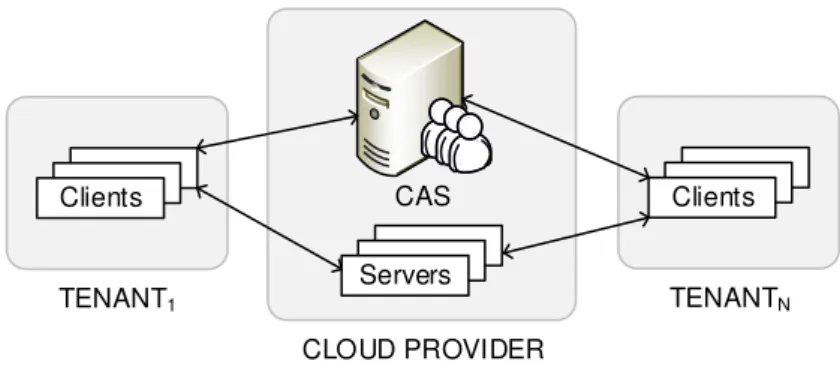
Figure 4.1: The centralized approach: All principals are registered to a central directory. identify tenants and principals. Identication is the process in which an entity establishes its identity and is securely identied by an authentication server. Identication names-paces can be local or global in scope and each identity has a valid meaning only in the namespace where it is dened. In addition, depending on their scope, identities must be locally or globally unique. In traditional decentralized, distributed lesystems principals are identied by their corresponding public keys. However, a principal's public key needs to be certied1. A common approach to certifying a principal's public key is for a
certi-cation authority (CA) to issue a certicate that contains the principal's name, its public key, and other attributes, such as the certicate's starting date and time, a signature verication key, and the issuer. The CA might be run by a local system administrator; or it might be a remote trusted service.
First, in the following three subsections, we describe possible approaches to add sup-port for secure multitenancy in a le-level storage system. Then, in subsection 4.1.4 we present an outline of our approach.
4.1.1 Tenant isolation with centralized identication
Identity collisions that described in subsection 2.7.2 can be prevented by delegating the identity management to a shared service like Kerberos [59], establishing a new centrally administered ID space which can be shared between clients and services. Thus, instead of relying to their local identication services, tenants are required to register their principals to the provider's identity service, as shown in Figure 4.1.
Inter-tenant le sharing is straightforward when a central directory is used. The