Procedia Engineering 67 ( 2013 ) 457 – 466
1877-7058 © 2013 The Authors. Published by Elsevier Ltd.
Selection and peer-review under responsibility of the National Chiao Tung University doi: 10.1016/j.proeng.2013.12.046
ScienceDirect
7th Asian-Pacific Conference on Aerospace Technology and Science, 7th APCATS 2013
An optimization algorithm for multi-objective optimization
problem by using envelope-dual method
X. H. Wang
a,*, C. H. Wan
a, C. C. Sun
a, R. W. Xia
aaSchool of Astronautics, Beihang University ,Beijing, 100191
Abstract
In this paper, Envelope Dual Method (EDM) is utilized to solve the optimization problem with objective, multi-constraints and multi-variable for the large complex engineering system optimization design. The problem is first converted into a single objective optimization based on the min-max algorithm, then into the quasi-unconstrained optimization problem with only one dual variable and its non-negative constraints based on the envelope dual theory. The conversion process is given and the quasi-analytical expression is obtained for the optimal solution.The proposed algorithm is applied to some illustrative examples to demonstrate its high computational efficiency.
© 2013 The Authors. Published by Elsevier Ltd.
Selection and peer-review under responsibility of the National Chiao Tung University.
Keywords: Multi-objective optimization problems (MOPs); min-max problem;envelope-dual method; optimization design.
Nomenclature
x design variable
X vector of design variables H the Hessian matrix
i the iteration times of the approximation Greek symbols
Ȝ dual variable
the gradient operator
İ A small enough positive number
* Corresponding author. Tel.: 86-10-82338763. E-mail address: [email protected]
© 2013 The Authors. Published by Elsevier Ltd. Open access underCC BY-NC-ND license.
Selection and peer-review under responsibility of the National Chiao Tung University
1.Introduction
Complex engineering systems are such systems which consist of multiple subsystems (or parts) with different functions. The systems and subsystems all have their corresponding design objectives, variables and constraints. Although the types and attribute of the respective disciplines to which these subsystems belong could be completely different, there are complex couplings among them. Therefore, it is difficult to obtain the optimal design of the whole system by seeking the optimal solutions of each subsystem independently. Furthermore, these objectives might be in conflict with each other, that is, there is no one optimized design making all the objectives optimal at the same time [1]. In fact, improving the performance of a target is always at the cost of the reduction of one or more targets. Mathematically, the solution of the multi-objective optimization problem is usually a solution set (Pareto set) [2-4], and it is the optimal solution obtained after comprehensive consideration of all the objective functions.
For multi-objective optimization, the practical approaches usually are linear weighting method, min-max method and so on. In specific, linear weighting method is an effective approach by converting the multi-objective optimization problem into a single objective problem directly. However the different weight coefficients lead to different optimal solutions. While the min-max method converts the multi-objectives problem into the single objective one [5,6]. The difference between the former method and linear weighting method is that it does not have manually chosen weight coefficients, but in the iterative optimization process, the objective function with the maximum value is automatically chosen as the optimization goal.
The focus of this paper is on the conversion of the optimization problem with objectives, multi-constraints and multi-variables to the one with single objective by using the min-max method, and EDM. Moreover the EDM is suitable to solve large and complex engineering optimization problems.
The rest of the paper is organized as follows. In Section 2 the conversion of the optimization problem by the min-max method and EDM is given. In Section 3, the proposed method is applied for some illustrative examples to validate the effectiveness of the method followed by conclusions.
2.The envelope dual model of the multi-objective optimization problem
A multi-objective optimization problem can be expressed as finding a variable set in a feasible space to minimize the objective function. Define the optimization problem as
min
. . 0
F x
s t G x d (1)
where x
Rn is the vector of design variables, and F(x)=(f1(x), f2(x),…, fs(x)) is the vector of objective functions to be minimized, and G(x)=(g1(x),g2(x),…,gj(x))is the vector of constraints. Equation (1) is a typical expression of the optimization problem with multi-objectives, multi-constraints and multi-variables.
With min-max algorithm, set
^
`
^
`
max max1r s r , 1, 2, , .
f x f x r s
d d (2)
Then the mathematical model of Equation (1) can be rewritten as
max
min
. . 0
x f x
It turns out that Equation (3) represents an optimization problem with single-objective, multi-constraints, and multi-variables. Furthermore by setting
^
`
^
`
max max1 j t j , 1, 2, ,
g x g x j t
d d (4)
Equation (3) can be rewritten as
max max min . . 0 x f x s t g x d (5)
Note that Equation (5) represents an optimization problem with single-objective, single-constraint and multi-variables, where the constraint set of the original Equation (1) is replaced by its maximum constraint. Based on the nonlinear programming duality theory [5], the above formula can be further converted to its dual problem as follows:
max d O (6)
where d(Ȝ)=min{fmax(x)+Ȝ·gmax(x)} and Ȝ 0 is the dual variable. Obviously, Equation (6) is a quasi-unconstrained
optimization problem with a single dual variable and its non-negative constraint. In the min-max condition, the original Equation (1) with a number of objectives, constraints and design variables, can be converted into the Equation (6). In the case of continuous functions fmax(x) and gmax(x) but discontinuous derivatives, we replace
them by some smooth envelope functions Ep(x) and Eq(x) respectively to make the problem easier to solve. As a result, the envelope dual optimization model for the multi-objectives problem is obtained as follows:
0 maxd Ot O (7) where
^
`
minx p q d O E x O E x (8) and 1 1 ln exp ( 1) s p r r E x p¦
p f x pt (9) and 1 1 ln t exp 1 . q j j E x q¦
q g x qt (10) Note that it can be proved that Ep(x) ı fmax(x) with plim Ep fmax( )xof , and Eq(x) ı gmax(x) with
max
lim q ( )
qofE g x .
So far, the original optimization Equation (1) with multi-objectives, multi-variable and multi-constraints is converted into a differentiable optimization problem with single objective, single variable and its non-negative constraint, that is, its envelope-dual problem. It is worth noting that the envelope-dual Equation (7) is a quasi-unconstrained optimization problem which contains only one dual variable, the solution is well described in [7, 8], the quasi - analytical solution of the Equation (7) can be given in the following expressions [8]:
1 1 ( ) i i i i i i q i p i X X H X O E X E X ª¬ º¼, (11)
where Ȝi=[Eiq(Xi)TāHi(Xi)-1āEiq(Xi)]-1āEiq(Xi) ϋEiq(Xi)TāHi(Xi)-1āEip(Xi)].i is the iteration times of the approximation and Ep(Xi)ǃEp(Xi)ǃH(Xi) are the value, the gradient and the Hessian matrix of the enveloped objective functions Ep(Xi) at Xi respectively. And Eq(Xi) and Eq(Xi) are the value and the gradient of the enveloped constraints functions Eq(Xi).
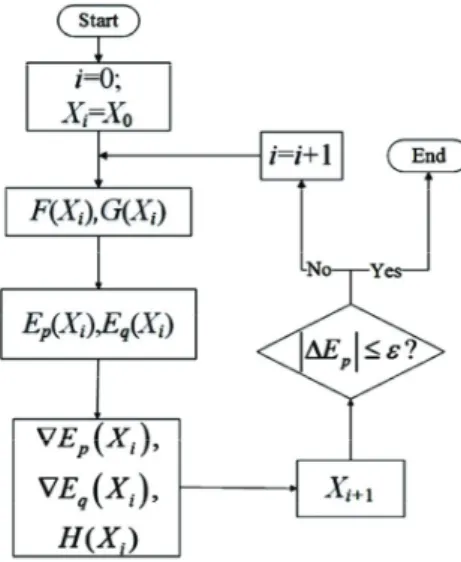
The calculation flow of the envelope-dual method is shown in Fig 1.
Fig. 1 The main calculation process of the envelope dual method.
Note that
1 p i p i p p i E X E X E E X ' . (12)The reasons why the envelope-dual method has advantage of high computational efficiency lie in: 1) neither the solving strategy nor the optimization operator in the EDM is dependent of the specific problem after the conversion; 2) the simple analytical formula functions the optimization operator in EDM to obtain the optimal solution without optimizing the problem in high-dimensional variable space; 3) the high-precision approximation function ensures the effectiveness of the solution of nonlinear implicit optimization problems [9, 10, 11].
3.Illustrative Examples
In this section,we solve a numerical example and an engineering problem by using EDM to verify its high computational efficiency.
3.1. Numerical Examples
We consider the numerical problem which admits the following form
^
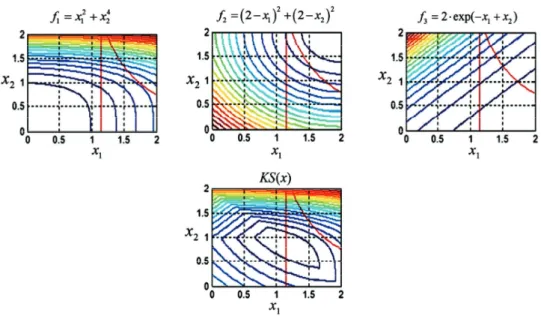
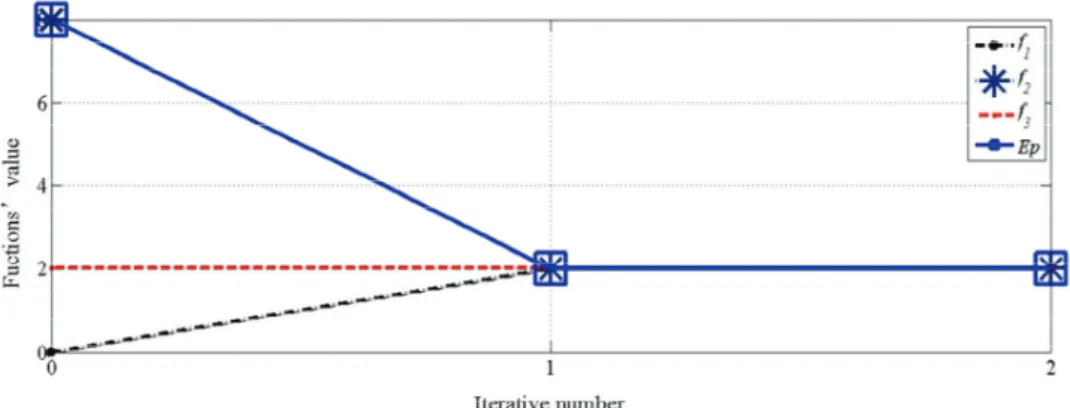
2 2 1 1 2 min ( ) 0 . . 3 0 F x x x s t x x d d (13) where F(x) = min{f1(x), f2(x), f3(x)}, 1( ) 14 22, ( ) (22 1)2 (2 1) , ( ) 22 3 1 2 x x f x x x f x x x f x e .The initial condition of(x1, x2) Tis (0, 0) T, and the optimal solution is obtained as (0.9999561, 0.9999122)T, and the optimal value is 2.00107195. While the optimal solution in [12] is (0.9999511, 0.9998760) Tand the optimal value is 2.00000041. The above results show the effeteness of envelope-dual method. Based on the approximation functions, the optimal solution is obtained after 2 iterations. The iterative process is shown in Table 1. We can obtain the change of values of design variables and objective functions along the iterative process from Table 1. The plot of the objective function and its envelope function are shown in Fig. 2. The subplots (a), (b), (c) and (d) in Fig. 2 show the feasible regions of f1(x), f2(x), f3(x), and Ep(x)respectively. The iterative processes of the objective function and its envelope function in optimization process are shown in Fig. 3.
Fig. 2 The graphic interpretation of the objective function and its envelope function. Table 1 The Iterative process
Iterative number x1 x2 E xp( ) E xq( )
0 0 0 8 0
1 0.99967406 0.99967406 2.00157391 -0.00032583 2 0.99995618 0.99991228 2.00107195 0.00000008
Fig. 3 The iteration process of every objective function and its envelope function.
3.2.The optimization design of beam welding attribute
This example is the optimization design of the welding attribute of beam [13,14]. The design objectives are minimizing the cost and the deflection of the free end of beam. The constraints consist of the shear stress, bending stress and buckling load. There are four design variables, that is, h, l, t and b, which are respectively corresponding to thex x x x1, , ,2 3 4 in following formula. They respectively stand for the height (width), length of the
welding area and the height, length of beam section, as shown in Fig 4.
h h L l t b P
Fig. 4 The schematic diagram of the welding beam.
The mathematical model of the optimization problem is described as follows:
' 2 1 1 2 3 4 2 ' 2 ( ) 1.10471 0.04811 (14.0 ) ( ) ( min : ) f x x x x x x f x G x (14) max max 1 4 ( ) 0 ( ) : 0 ( 0 0 ) C Subjec x x x x P o x t t P W W V V d ° d ° ® d ° d °¯ (15)
where 3 4 3 ( ) 4x PL Ex x G , x=[x1,x2,x3,x4]
R4, ' 2 ' '' '' 2 2 ( )x ( ) 2 x 2R ( ) W W W W W , ' 1 2 2 P x x W , '' MR J W ,M P L x( 2 2), 2 2 2 4 ( 1 3) 4 R x x x ,^
2 2`
2 1 3 1 2 2 12 ( ) 4 2 J ª¬x x x º¼x x , 2 4 3 ( ) 6x PL x x( ) V , 2 2 2 6 2 3 3 4 ( ) 1 (16 ) 4.013 36 C P x ª Ex GL º EGx x L ¬ ¼ , and 1 2 3 40.125
x
10.0, 0.1
x
10.0, 0.1
x
10.0, 0.125
x
10.0
The constants in the model are:
2 max 6 2 2 max max
30000 /
,
30
60
10
/
,
0.25 ,
1360
00 , 14 ,
0 /
lb in
E
lb in
P
in
lb
lb L
in
in
V
G
W
u
In the case that one target (constraint) is 10 times larger than the others in EDM, they should be normalized, otherwise, after enveloped the smaller numerical goals cannot be optimized, and the smaller numerical constraints have no effect on objectives. This is the case for the example, where the magnitudes of the two objectives have a large difference, so the two objectives are dealt with as follows:
1 1 2 2
( / , / )
f f c f c (16)
where c1=4, c2=0.005 are the normalization coefficients of the two objectives respectively in this example. It is
worth mentioning that when processed with the envelope-dual method each constraint needs to be normalized so that it has the same magnitude, in order to avoid that the constraint with smaller absolute value has no effect. The constraint is shown as follow:
max
( )x 0
W W d (17)
and it can be converted to
max ( ) 1 0 x W W d . (18)
Similarly other constraints are dealt in this way. The mathematical model can be rewritten as follows:
2 1 2 3 4 2 1 1 2 2 1.10471 0.04811 (14.0 ) ( mi ) n ) ) ( : ( x x x x x f x c x f x c G (19)
max max 1 4 4 ( ) 1 0, ( ) 1 0, 0, 1 0. ( ) C Sub x x x x x P ject o P x t W W V V d ° ° ° d ° ® ° d ° ° d ° ¯ (20) where 3
3
4 3 ( )x 4PL Ex x G , x=[x1,x2,x3,x4]
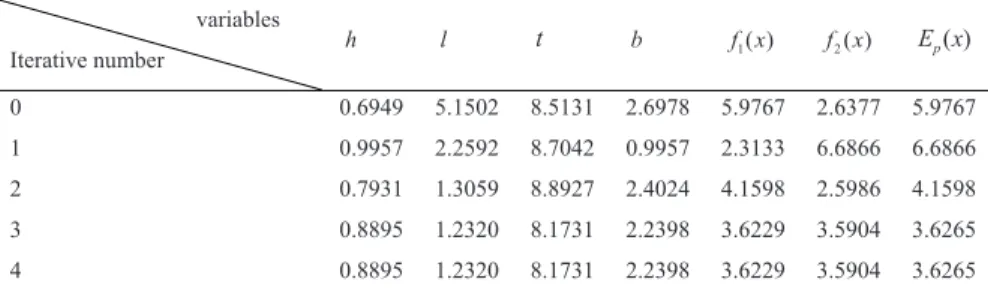
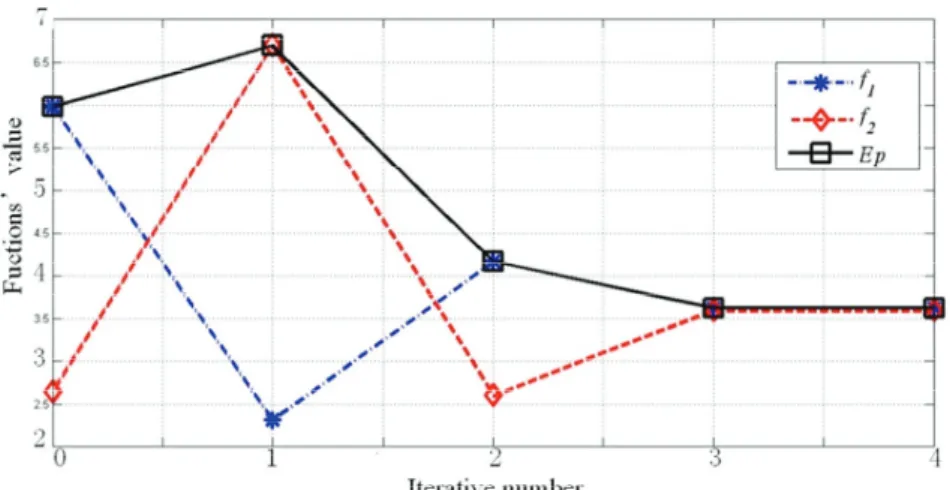
R4.The values of the constant parameters in the model are the same as previous model. Obviously, the optimal solution of the multi-objectives problem can be obtained through a relatively small number of iterations in this algorithm, based on the min-max method. The process of optimal solution is shown in Fig. 5. We can obtain the formula Ep(x) = max (f(x1), f(x2)) in this example. The two objectives converge to their optimal solutions. The variation of the design variables, objective functions and constraints in the iterative process are shown in Table 2 and Table 3. And the variations of the cost and deflection of beam are shown in Table 4.
Table 2 The Iterative process of variables and objective functions variables Iterative number h l t b f x1( ) f x2( ) E xp( ) 0 0.6949 5.1502 8.5131 2.6978 5.9767 2.6377 5.9767 1 0.9957 2.2592 8.7042 0.9957 2.3133 6.6866 6.6866 2 0.7931 1.3059 8.8927 2.4024 4.1598 2.5986 4.1598 3 0.8895 1.2320 8.1731 2.2398 3.6229 3.5904 3.6265 4 0.8895 1.2320 8.1731 2.2398 3.6229 3.5904 3.6265
Table 3 The Iterative process of constraints variables Iterative number g x1( ) g x2( ) g x3( ) g x4( ) E xq( ) 0 -0.6241 -0.9899 -0.7424 -1369.2 -0.6241 1 -0.5131 -0.9744 0.0000 -0068.9 0.0000 2 -0.0001 -0.9901 -0.6699 -0995.5 -1.0407e-4 3 0.0000 -0.9863 -0.6029 -0761.3 0.0000 4 0.0000 -0.9863 -0.6029 -0761.3 0.0000
Table 4 The Iterative process of cost and deflection Iterative number Cost Deflection
0 23.9068 0.0013 1 9.2533 0.0033 2 16.6394 0.0013 3 14.4915 0.0018 4 14.4915 0.0018
Fig. 5 The iteration process of every objective function and its envelope function
From these results, we obtain the optimal solution through 4 iterations. Solving with EDM the optimization design is h 0.89,l 1.23, t 8.17,b 2.24and the lowest cost is 14.4915 and the least deflection is 0.0018.
4.Conclusion
In the paper, we have proposed the EDM to solve the multi-objective optimization problems. Based on the min-max theory and envelope duel theory, the original optimization problem is converted to a quasi-unconstrained optimization problem with only one dual variable and its non-negative constraints. The proposed method is then applied to illustrative examples to show its high computational efficiency.
Acknowledgements
This work is supported by the Fundamental Research Funds for the China Central Universities of China under grant No.YWF-13-ZY-02.
References
[1] Omkar S.N., Venkatesh A., Mudigere M., 2012. MPI-based parallel synchronous vector evaluated particle swarm optimization for multi-objective design optimization of composite structures [J]. Engineering Applications of Artificial Intelligence, Vol.25, No 8, pp. 1611-1627. [2] Liu S., 2005. Some Theories and Methods for Multi-objective Programming Problems. Dalian University of Technology, Aug. (in Chinese) [3] Ursem R.K., Justesen P.D., 2012. Multi-objective Distinct Candidates Optimization: Locating a few highly different solutions in a circuit
component sizing problem [J]. Applied Soft Computing. Vol.12, No 1, pp. 255-265.
[4] Deb K., Tiwari S., 2008. Omni-optimizer: A generic evolutionary algorithm for single and multi-objective optimization [J]. European Journal of Operational Research. Vol.185, No 3, pp. 1062-1087.
[5] Hu Y., 1994. Multi-objective programming efficiency theory. Shanghai Scientific & Technical Publishers. (in Chinese)
[6] Barbosa H. J. C., 1996. A genetic algorithm for min-max problems. In Proceedings of the 1st international conference on evolutionary computation and its applications Moscow, Russia. pp. 99-109.
[7] Bracken J., McGill T., 1973. Mathematical programs with optimization problems in the constraints. Operations Research, Vol.21, pp.37-44. [8] Xia R., Chen S., 1998. A quasi-analytic method for structural optimization. Communications in Numerical Methods in Engineering, Vol.14,
No. 6, pp.569-580.
[9] Wang X., Lin Z., Xia R., 2013. SIMP based Topology Optimization of a Folding Wing with Mixed Design Variables. In Proceedings of the 17th IEEE International Conference on Computer Supported Cooperative Work in Design, Whistler, BC, Canada.
Structural Optimization.
[11] Wang X., Xia R., 2006. A novel MDO method and its testing results, In Proceedings of Asian-Pacific Conference Aerospace Technology and Science, Guilin, China.
[12] Li X., 1991. An effective solution for nonlinear min-max problem. Chinese Science Bulletin, Vol.36, No.19, pp.1448-1450. (in Chinese) [13] Coello C. A. C., Lamont G. B., 2004. Applications of Multi-objective Evolutionary algorithms. World Scientific Publishing Co. Pte. Ltd. [14] Rao n SS., 1996. Engineering optimization: theory and practice. 3rd ed. Chichester, UK: John Wiley and Son.