Towards a Discipline of
Performance Engineering:
Lessons Learned from Stencil
Kernel Benchmarks
Inauguraldissertation
zur
Erlangung der W¨urde eines Doktors der Philosophie vorgelegt der
Philosophisch-Naturwissenschaftlichen Fakult¨at der Universit¨at Basel
von
Danilo Guerrera
aus ItalienBasel, 2019
Originaldokument gespeichert auf dem Dokumentenserver der Universit¨at Basel:
edoc.unibas.ch.
This work is licensed under a Creative Commons Attribution-NonCommercial 4.0 International License.
Prof. Em. Dr. Helmar Burkhart Prof. Dr. Gerhard Wellein
Basel, den 13. November 2018
Prof. Dr. Martin Spiess, Dekan
To my family, who encouraged me to pursue my dreams and finish my dissertation.
Abstract
High performance computing systems are characterized by a high level of complexity both on their hardware and software side. The hardware has evolved offering a lot of compute power, at the cost of an increas-ing effort needed to program the systems, whose software stack can be correctly managed only by means of ad-hoc tools.
Reproducibility has always been one of the cornerstones of science, but it is highly challenged by the complex ecosystem of software pack-ages that run on HPC platforms, and also by some malpractices in the description of the configurations adopted in the experiments.
In this work, we first characterize the factor that affects the repro-ducibility of experiments in the field of high performance computing and then we define a taxonomy of the experiments and levels of reproducibil-ity that can be achieved, following the guidelines of a framework that is presented.
A tool that implements said framework is described and used to con-duct Performance Engineering experiments on kernels containing the sten-cil (structured grids) computational pattern. Due to the trends in archi-tectural complexity of the new compute systems and the complexity of the software that runs on them, the gap between expected and achieved performance is widening. Performance engineering is critical to address such a gap, with its cycle of prediction, reproducible measurement and optimization.
A selection of stencil kernels is first modeled and their performance predicted through a grey box analysis and then compared against the reproducible measurements. The prediction is then used to validate the measured performance and vice-versa, resulting in a “Gold Standard” that draws a path towards a discipline of performance engineering.
Contents
Contents i
1 Introduction 3
1.1 Research Questions . . . 6
1.2 Related Work. . . 6
1.3 Organization of This Work . . . 11
I Reproducibility Challenges
13
2 Reproducibility Challenges: Hardware Complexity 15 2.1 Moore’s Law . . . 152.2 From Single Core to Multicore, Manycore, and Accelerators 19 2.2.1 Pipelining . . . 21 2.2.2 Out-of-Order Execution . . . 23 2.2.3 SIMD . . . 23 2.2.4 Superscalarity . . . 25 2.2.5 Parallel Computers . . . 25 2.2.6 Simultaneous Multi-Threading . . . 26
2.2.7 Dynamic Frequency Scaling . . . 27
2.3 Memory Subsystem . . . 27
2.3.1 Shared Memory Computers . . . 28
2.3.2 Real Life Intermezzo . . . 32
2.4 Network Subsystem. . . 33
3 Reproducibility Challenges: Software Complexity 35 3.1 Amdahl’s and Gustafson’s Laws . . . 35
3.3 Compilers . . . 39 3.3.1 Basic Optimizations. . . 39 3.3.2 Loop Optimizations . . . 40 3.4 Software Stack . . . 42 3.4.1 Environment . . . 42 3.4.2 Build Process . . . 43
II The PROVA! Approach to Reproducible HPC
Re-search
45
4 Proposed Framework 47 4.1 Taxonomy of Experiments . . . 504.2 Reproducibility Levels . . . 51
4.3 Goals of the PROVA! Project . . . 52
4.3.1 Contributions to the Project . . . 54
5 Overview of the PROVA! Tool 55 5.1 Addressing Complexity . . . 56 5.1.1 Implementation Phase . . . 57 5.1.2 Compilation Phase . . . 57 5.1.3 Execution Phase . . . 57 5.2 Walkthrough . . . 58 6 Implementation Aspects 63 6.1 Architecture . . . 63
6.2 Mapping of the Experiment Taxonomy . . . 66
6.2.1 Projects . . . 66
6.2.2 Methods . . . 67
6.3 Likwid Interface . . . 67
6.4 Empirical Roofline. . . 70
III Experimental Evaluation
73
7 Parallel Stencil Codes 75 7.1 Motifs . . . 757.2 Stencils Classification . . . 77
7.3 Stencil TEMPlating Engineering Library . . . 80
CONTENTS iii 7.4.1 PLUTO . . . 82 7.4.2 PATUS . . . 83 8 Performance Evaluation 85 8.1 Performance Analysis. . . 85 8.1.1 Performance Models . . . 86
8.1.2 Grey Box Modeling . . . 90
8.2 Performance Measurement. . . 92
8.2.1 Cache Misses . . . 93
8.2.2 Code Structure and Parallelism . . . 94
8.2.3 Memory Access Pattern and Data Locality. . . 94
8.2.4 Optimization of Stencil Codes . . . 96
9 Experimental Testbeds 99 9.1 Systems . . . 100
9.1.1 Validation Macro-Experiment . . . 100
9.1.2 Performance Engineering Cycle Macro-Experiment 100 9.1.3 Emmy . . . 101
9.1.4 MiniHPC . . . 101
9.2 Problems . . . 107
9.2.1 Kernels Used in the Validation Macro-Experiment . 107 9.2.2 Kernels Used in the Performance Engineering Cycle 108 9.3 Methods . . . 109
9.3.1 Methods Used in the Validation Macro-Experiment 109 9.3.2 Methods Used in the Performance Engineering Cy-cle Macro-Experiment . . . 109
10 Performance Benchmarking Experiments 111 10.1 Stencil Compilers . . . 111
10.1.1 Metric used for Compilers Evaluation and Compar-ison . . . 112
10.2 Discussion of the Results . . . 121
10.2.1 Validation Experiment . . . 121
10.2.2 Performance Engineering Cycle Experiment . . . . 123
IV Conclusions & Future Work
133
11 Conclusions and Future Work 135 11.1 Contributions and Relevance to the Community . . . 13711.2 Future Work . . . 138
Bibliography 141 Appendices 155 A Stencils Source Code 157 A.1 2d-1r-iso-const-box . . . 157 A.1.1 PATUS . . . 157 A.1.2 PLUTO . . . 158 A.1.3 OpenMP . . . 159 A.2 2d-4r-iso-const-box . . . 160 A.2.1 PATUS . . . 160 A.2.2 PLUTO . . . 162 A.2.3 OpenMP . . . 164 B Creation of a MethodType 167
C Walkthrough of STEMPEL: Kerncraft and PROVA! Interfaces 171
List of Figures 175
List of Tables 181
Acknowledgments
The Ph.D. is a major phase of the academic life. I am very glad and thank-ful to Prof. Em. Dr. Helmar Burkhart for having given me the opportu-nity to work with him on this project, for his guidance and for sharing with me and the whole High Performance and Web Computing (HPWC) group his passion for research.
I would like to thank also Prof. Dr. Gerhard Wellein, who hosted me in his group at the Friedrich-Alexander-Universit¨at Erlangen-N ¨urnberg as a temporary researcher, and for accepting to act as co-referee in the thesis committee. He has taught me a lot regarding performance engi-neering.
I wish to thank all the members of the (wide) HPWC group: Dr. Martin Guggisberg, for his optimism and valuable ideas and sugges-tions, Alexander Gr ¨oflin who always had a joke ready for every situa-tion, Robert Frank for the stimulating discussions, Bas Kin for his sup-port (mostly on the pitch), Dominic Bosch for the inspiring conversations, Yvonne Wegm ¨uller who helped to solve all the administrative issues I ever faced. A special thanks goes to Antonio Maffia, who shared with me a long path: we started the bachelor together at the University of San-nio, in Italy, shared a lot of good and also hard moments in this run until the completion of the Ph.D process. Thanks for your help all over these years.
I would like to express my gratitude to Prof. Dr. Florina Ciorba, for accepting me in her group and always motivating me, and to all the members of the HPC group: Ali Mohammed, Aur´elien Cavelan, Ahmed Eleliemy, and Jonas Kornd ¨orfer.
I am grateful for having met and worked with: Alexander Ugolini, Dr. Georg Hager, Dr. Jan Eitzinger, Thomas R ¨ol, and Julian Hammer.
Finally, I would like to thank my parents and my brother, for their constant support, even though during the time of the Ph.D. they have been far away from me. I hope you can all be proud of me.
Thanks to my aunts and uncles Maria, Angelo, Antonietta, Anna, Lu-ciano, and my cousins Sara, Joele, and Mattia, who love me and motivate me anytime and anyway they can.
Thanks to Winnie, for staying by my side also in the awkward mo-ments that the path I walk sometimes makes me face, I love you.
Chapter 1
Introduction
Modern architectures are characterized by a high level of complexity, due to the limits the producers have been facing by 2007 when the natural scaling of the performance was provided for free by the scaling in the frequency of the chips. Said limits forced the vendors to find a differ-ent way to deliver performance, i.e., alternative circuits and usage of the transistors: the switch between single core and multicore happened. The architectures have been developing following this trend since then: accel-erators and many-core architectures also came out. To properly exploit these architectures, the parallelism must be present in the source code of the applications, at a fine grain. Developers are required to know ex-tremely good how the microprocessors work. This way they can tune their codes and exploit the architectural features of their machines. This kind of optimization is extremely error-prone, and performance portabil-ity can suffer out of it.
State of the art in performance reporting in the High Performance Computing (HPC) field is omitting details that are important to be able to test and reuse the proposed approaches, affecting what is considered
to be a pillar of science since the 17th century: the scientific method [136].
Every scientist must be able to understand and extend the work of an-other.
In the HPC field, we refer to the computing environment and its setup both in terms of hardware and software configurations. Modern archi-tectures are incredibly complex, and scientists often focus their efforts on what they are pursuing, ignoring the importance of making their sci-ence reproducible. We acknowledge the lack of time and the effort
nec-essary to follow good practices in conducting/doing research in com-putational science, yet consider reproducibility to be extremely impor-tant. We present a taxonomy of reproducibility: it is tricky to use the terms consistently in this field since there is no universal agreement on
them [83]. Recently ACM defined the 3 Rs of the Research, and their
description is mostly overlapping our taxonomy. This work takes over such discussion and proposes three levels of reproducibility with an ex-planation of what they mean and what they provide if research fulfills their constraints. Moreover, we propose a standardized way of describ-ing an experiment, which extrapolates a minimum amount of informa-tion needed for reproducibility purposes and a workflow to follow in or-der to carry out an experiment and achieve reproducible results properly. Starting from our experience and the proposed approach to reproducible
research, we implemented PROVA!, a distributed workflow and system
management tool, that helps scientists in their study allowing them to fo-cus on their core business and taking care of its reproducibility, and then used it in our own research on benchmarking of parallel stencil codes. Stencil codes are an essential and widely used pattern in computational science. The stencil computational pattern is representative of many nu-merical codes, from PDE to multi-grid solvers, and discrete simulations, including image filtering. Usually, the stencil computation represents a significant part of the overall execution time of an application. There-fore, it is crucial to achieving good performance in calculating them. Be-cause of their low arithmetic intensity, i.e., the small number of floating point operations per transferred data element, stencil computations typ-ically are limited by the available bandwidth to the memory subsystem. Thus, it is essential to efficiently use the caches, by optimizing data lo-cality (both spatial and temporal). Bandwidth-saving schemes like cache blocking techniques and methods to block across multiple time steps are used to increase the arithmetic intensity. Hardware-aware programming techniques can also help: NUMA-aware data initialization, software pre-fetching, or cache bypassing represent a way to reduce bandwidth usage further. All the listed concepts make the optimization of stencil codes a tough challenge. Lately, several approaches to stencil computation have been proposed, and several stencil compilers have been implemented.
Focusing on the problem of stencil computation we consider both manually optimized codes and stencil compilers. When comparing the results obtained we must acknowledge that there are many factors in-volved that can affect the performance of a code, starting from the stencil
5
itself. Real stencil applications span in a rich domain of characteristics, 2-dimensional vs. 3-dimensional, high vs. low order, dense vs. sparse matrices, aligned vs. staggered grids, widely varying in arithmetic in-tensity. Another factor involved is the system used for running a code: both the different hardware and different software environment, e.g., a different compiler or set of flags. Performance models are, thus, required to evaluate the expected performance of a code on a specific architecture, thus highlighting the parameters that can affect its performance, i.e., ex-pose the bottlenecks that limit the performance of a code on a machine. For this purpose, we plan to interpret the performance data employing models such as the Execution-Cache-Memory (ECM) and the Roofline Model, evaluate how performance is affected by explicitly pinning the threads, following different pinning strategies (core, socket, node). The goal is to verify that modeling and execution match and to understand how compilers and manually optimized code behave concerning a spe-cific architecture. An important aspect resides into the solution used to evaluate them while changing both the stencil to compute and the sys-tem: usually the developers of a stencil compiler focus either on a partic-ular architecture or a particpartic-ular stencil (or class of stencil computations).
Using PROVA! it is possible to achieve a fair and reproducible
compari-son of the same stencil on different systems, or different stencils on both the same and different systems. Nonetheless, it is needed to provide a clear and standardized way of describing an architecture, to carry on comparisons. Studying the performance of a code, verifying it empiri-cally, while taking care of its reproducibility, strengthen and gives credi-bility to research: the proposed framework aims to ease the road towards a discipline of performance engineering. Furthermore, making available the source code is a minimum pre-requisite for reproducibility, i.e., it is necessary but not sufficient. It is crucial to have a detailed description and provision of: dependencies, automated build process, environment, execution scripts post-processing scripts, and secondary data generating published figures.
Conducting research in such a way has several positive effects: first, the author of the study remains with complete documentation of the work. Additionally, it helps the follow-up of studies allowing to build upon existing work and, if there are discrepancies in the case of a replica-tion attempt by another scientist, it helps in identifying and addressing the root of the problem.
1.1
Research Questions
• What are the factors that affect reproducibility in the context of per-formance benchmarking experiments and how is it possible to con-trol them, thus sharing with the scientific community trusted and reproducible research?
• Performance models are needed to expose the bottlenecks of high performance architectures and to verify that the code implemen-tations exploit the available hardware feature properly. How is it possible, to validate a performance model against a reproducible execution and vice-versa?
• Is it possible to fairly compare different approaches to the paral-lelization of stencil codes across different architectures?
1.2
Related Work
The Oxford English Dictionary [35] defines Reproducibility as “the
ex-tent to which consisex-tent results are obtained when an experiment is re-peated”. It is usually expected a scientific experiment to be reproducible, but scientists have been bored in trying themselves to reproduce some-one else’s work or read about it. Journals do not accept the attempt of reproducing published findings driving to published science rarely be
tested. As described in [24], “the assumption that science must be
re-producible is implicit yet seldom tested, and in many systems, the exact reproducibility of experimental data is unknown or has not been rigor-ously investigated in a systematic fashion”. The meaning of the terms reproducibility and replicability is highly discussed and questioned. In the biology field, scientists tend to believe that the reproducibility of an experiment coincides with the ability to replicate it. Drummond believes that these two terms are distinct and he argues that while reproducibility
requires change, replicability avoids it [38]. In fact, according to
Drum-mond, reproducibility is related to a phenomenon that can be predicted to recur even when there is a certain degree of variability in the experi-mental conditions, whereas replicability describes the ability to obtain an identical result when an experiment is performed under identical
con-ditions. As stated in [28], “the principal goal of scientific publications
is to teach new concepts, show the resulting implications of those con-cepts in an illustration, and provide enough detail to make the work
re-1.2. RELATED WORK 7
producible”. Claerbout and Karrenbach define reproducibility in com-putational sciences as a nametag attached to every figure caption in a manuscript: said tag could be used to recalculate the figures from all the data, parameters and programs.
According to Liberman [83] it is inside the human nature to wonder
whether or not an experiment would adequately work when performed by someone else than the original scientist, following a similar recipe. Between 1990 and 2006, people began to use terms like replication, repli-cable, replicability, to refer to the process of completely re-running an ex-periment, with all the permutations of new researchers, new equipment, new subjects or other raw materials. An outlook of the terminologies
used for Reproducible Research is given by [13], trying to organize all
the words used by different research groups or communities while refer-ring to the broad topic of reproducibility.
Science gathers knowledge about the universe, organizes and merges
it into testable laws and theories [82]. Its success and credibility are
strictly related to the willingness of the scientists to test and replicate independently the work done by others. In order to do so, the complete exchange of procedures, materials, and data is needed. The desirability of reproducibility leads to the practical question of how many times an experiment should be reproduced before publication. By using the words of Karl Popper: “Non-reproducible single occurrences are of no signifi-cance to science”. Reproducibility assures that the effect is not due to chance or an experimental artifact resulting in a one-time event.
The ability of a researcher to confirm an experimental result is essen-tial to science, inherently assuming its reproducibility. It must be noted that there are practical limits to the reproducibility of findings. Although this question has not been formally studied, reproducibility is likely to be inversely proportional to the complexity of an experiment. The value and importance of reproducibility have been demonstrated by studies
show-ing impossibility or difficulty to replicate published results [74], failed
clinical trials [104] [14].
“It is impossible to believe most of the computational results pre-sented at conferences and in published papers today. Even mature bran-ches of science, despite all their efforts, suffer severely from the problem
of errors in final published conclusions” [126]. Over the past few years,
various researchers have made systematic attempts to reproduce some of the more widely cited priming experiments. Many of these attempts have failed. A recent paper reported that only a minority of published
microarray results could be repeated [74]. In 2011, Florian Prinz and his colleagues at Bayer HealthCare, a German pharmaceutical company, reported in Nature Reviews Drug Discovery that they had successfully reproduced the published results in just a quarter of 67 seminal studies
[104]. Unfortunately, such findings are consistent with those of others
sci-entists at Amgen, an American drug company, that tried to replicate 53 studies that they considered landmarks in the basic science of cancer, of-ten co-operating closely with the original researchers to ensure that their experimental technique matched the one used in the original study.
Ac-cording to a piece they wrote in Nature [14], a leading scientific journal,
they were able to reproduce the original results in just six cases. Such ob-servations have even led some to question the validity of the requirement
for reproducibility in science [133].
Experimental reproducibility remains a standard and accepted crite-rion for publication. As a consequence, researchers should endeavor to obtain information about the reproducibility of their works. The num-ber of times that an experiment is performed should be clearly stated in a manuscript, and a new finding should preferably be reproduced more times. In general, an experiment that challenges existing assumptions is going to be inquired more cautiously than one matching the estab-lished models and paradigms. Thus, we can argue that reproducibility acquires greater value and importance proportionally to the importance of the new ideas or methodologies. The availability of new tools and technologies, the increased amount of data (Big Data Science), together with the development of more interdisciplinary approaches and thus the complexity of the questions being asked, contribute to making any
repli-cation effort more complicated [75]. In [100] Peng suggests to build up a
minimum standard of reproducibility, believing that methods and code should be made available. Thus, other researchers may obtain consis-tent results and confirm the original work. Therefore, the papers should sufficiently describe not only the results but also the configuration of the experiment and the chain of steps that drove to specific outcomes,
start-ing from the given input data [12,94,123,125].
Nowadays researchers have the burden of publishing, catching up on the deadlines and do not have enough time to devolve into ensuring reproducibility. Even if a good practice with respect to the reproducibility may slow down research in the short term, it is necessary in order to allow previously developed methodologies to be effectively applied on new data, or to enable the reuse of code and results for new projects.
1.2. RELATED WORK 9
Additionally, it has been proven that sharing detailed research data is
associated with an increased citation rate [102].
In the last years a movement promoting reproducible research through tools and best practices is emerging. The tools mostly target the
repro-ducibility of the data analysis [124]. In the bioinformatics field, there are
plenty of tools that make the researcher’s life more comfortable and
en-sure reproducibility of their approach, such as Taverna [98], VisTRails [43,
117], Galaxy [50], GenePattern [108]. In our classification of
reproducibil-ity, we start from the basis, i.e., one must be able to ensure at least the reproducibility of his work.
Reference [115] presents ten simple rules for reproducibility of
com-putational research. A researcher should keep always track of how a result was produced, avoiding manual manipulation of the data, while recording intermediate results in a standardized format: every detail that may influence the execution should be noted. In computational sciences, the critical details include names and versions of the programs used, as well as the parameters and their values. The format can range from a
makefile to a shell script [118], to the complete workflow [50,98,52, 34].
Additionally one may want to use version control for the custom scripts or his code since even a slight modification to a computer program can al-ter its output significantly: backtracking to the code state that generated certain results may be an endless task. Version control systems like Git or Mercurial represent the state of the art solution for tracking the evolution of code. Last, all the information should be published and made publicly accessible. Most journals allow articles to be supplemented with online material.
Opening up access to the data and software, not just the final publi-cation, is one of the goals of the open science movement, thus allowing to build upon existing work, either to test it or to develop new ideas. A correct sharing of data and code, together with a manuscript, may be beneficial. Consequently, scientists should share their artifacts, with li-censes that if on one side protect the original author, on the other allow fair use of their work. Besides the ethical and social challenges, there is the practical one of how to give a comprehensive overview of one’s work. Every scientist makes use of version control in his work: from the Software Engineering, we can leverage the long lasting solution of using Version Control Systems. A common feature of all types of VCS is the ability to save several versions of a file, together with a descriptive mes-sage, during the development phase. All the changes and messages are
stored cumulatively, avoiding the need of several copies (a homemade strategy used before the VCSs). A description of VCS can be found in
[107].
There have been attempts by some researchers [29, 30] to measure
the extent of the problem. They focused on verifying the availability of code and data first, and then if said code would build with reasonable effort. Out of the 613 papers they took into account, 515 were considered potentially reproducible, but the authors managed to run only 102 (circa 20%). It is worth noting that the authors simply attempted to run the code, without checking either its correctness, i.e., if a code implements what is claimed in the paper or if it produces correct output or the extent at which the results obtained in the original study were reproducible.
An attempt to reproduce the results of a paper can be found in [129].
The authors tried to reproduce the results obtained using a model from computational neuroscience. Few pieces of information were available: no source code, neither as a complement to the paper nor in a publicly accessible repository. After contacting the authors of the original study, they could obtain the source code, only to discover that it could not be compiled and, in any case, it would be challenging to reuse it.
Recently, an initiative towards reproducible and sustainable Compu-tational Science has been launched in the form of a peer-reviewed
jour-nal, ReScience [114], targeting computational research. ReScience
en-courages replication of already published research, this way enabling re-implementations to assess whether the original work can be replicated or not.
A typical practice, usually followed by scientists, is to write down the sequence of steps done or even implement some scripts to automate part of the tasks of executing experiments and then analyze the results. Sev-eral tools have been developed to help in exactly this task, focusing on the workflow of an application, i.e., interconnection of input/output and
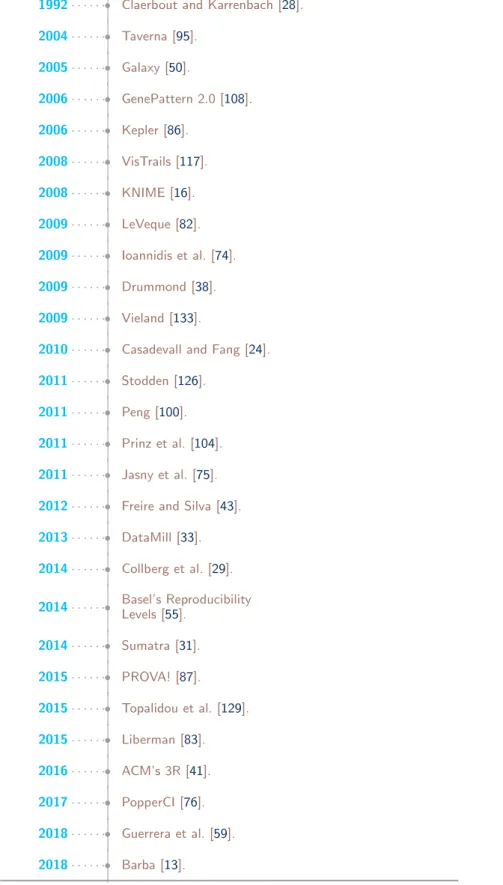
computation modules. As described by Maffia et al. [87], Taverna [95]
and VisTrails [117] integrate data acquisition, derivation, analysis, and
visualization as executable components throughout the scientific explo-ration process. The evolution of the software components used in the workflow is controlled by the organizations that design the tool. This
ap-proach is shared by other WFMS such as Kepler [86] and Knime [16], an
open-source workflow-based integration platform for data analytics. All the tools listed are mostly oriented towards natural sciences but are not well suited for an HPC environment. There has been an effort to adapt
1.3. ORGANIZATION OF THIS WORK 11
Taverna to the HPC context, through the OnlineHPC project [6], but the
website is not reachable since middle 2016. Pathway [101] is a tool for
designing and executing performance engineering workflows for HPC
applications. DataMill [33] is a community-based easy-to-use
services-oriented open benchmarking infrastructure for performance evaluation, which facilitates producing robust, reliable, and reproducible results. It provides a platform for investigating interactions and composition of hidden factors affecting the performance measurements, such as binary link order, process environment size, compiler generated randomized symbol names, or group scheduler assignments. Versioning systems such as git and GitHub are successfully applied in daily software
engineer-ing and document preparation. Sumatra [31] is a tool for managing and
tracking projects based on numerical simulation and/or analysis, with the aim of supporting reproducible research: it can be thought of as an automated electronic lab notebook for computational projects. Even though versioning systems allow to share the code, its availability does not necessarily turn into reproducibility, due to the complexity of the
soft-ware stack. PROVA! [57] overcomes this problem by taking care not only
of the code, but also of the system, meant as a combination of hardware and software, and the metadata of an experiment (compilation flags, ex-periment parameters and results, that are fundamental contextual infor-mation for re-executing the experiment). Additionally, ACM has recently
defined the 3 Rs of the Research [41] and their description overlaps with
our three levels of reproducibility, first introduced in Guerrera et al. [55].
Moreover, we propose a standardized way of describing an experiment, which extrapolates a minimum amount of information needed for repro-ducibility purposes and a workflow to follow in order to carry out an experiment and achieve reproducible results properly.
1.3
Organization of This Work
This work has been structured into four parts. The first part includes an overview of the current computer architectures available, with all their
peculiarities and limiting factors (Chapter2), and the software
character-istics and trends that have an impact on the reproducibility (Chapter3).
The second part offers an overview of the proposed framework to address the challenges emerged in the first part. Having highlighted the factors that affect the reproducibility of the research in computational
sci-ences, a characterization of the experiments and an overview of how it
can be coupled with reproducibility is offered (Chapter 4). Section 5.1
shows how to address the complexity, both at software and hardware level, for moving towards reproducible research. Follows an overview of
the tool PROVA!, in Chapter5.
The third part comprises the experimental evaluation of the concepts presented in the previous chapters of this work. First, the problem of stencil computation is introduced together with a tool to generate
syn-thetic stencil benchmarks (Chapter7). In Chapter8the concept of
Perfor-mance modeling and evaluation are presented and after having
charac-terized and described both hardware and software ((Chapter9) used,
ac-cording to the taxonomy introduced in Section4.1, results of experiments
in performance prediction are presented, with focus on the matching of said predictions and experimental performance results. Then, an in-depth analysis of a complete cycle of performance engineering is shown,
following the approach proposed in PartII.
The fourth part, Chapter11, draws the conclusions of this work,
Part I
Chapter 2
Reproducibility Challenges:
Hardware Complexity
While at the beginning of the supercomputing era the systems were cus-tom made by producers like Cray, NEC, Fujitsu and were completely dif-ferent by the standard computers both in terms of price and performance, since the beginning of the ’90s single-chip general purpose microproces-sors flooded the HPC market. At the time of writing, most of the micro-processors available in the supercomputers use off-the-shelf solutions, not explicitly designed for scientific computing, with few exceptions.
Turing has defined the paradigm at the basis of each modern micro-processor at the end of the ’30s: the instructions, stored in memory, are read and decoded by a control unit, before being executed by a different unit responsible of the computation and manipulation of the data. Writ-ing a program corresponds to save instructions into memory and make them available to the Central Processing Unit (CPU). Such an architec-tural model is still used in modern computers.
2.1
Moore’s Law
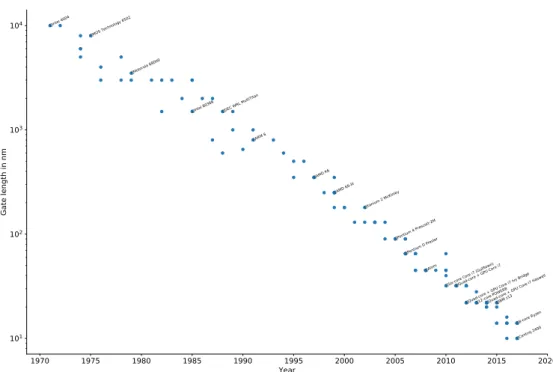
Since the beginning of the digital computing era, the microprocessors have seen their capabilities (performance in a broader sense) doubling at regular intervals. Moore, observed in 1965 that the transistors count,
on an integrated circuit, doubles every 18-24 months [96]. It is important

![Figure 3.1: Amdhal’s law [10]: parallel speedup vs sequential fraction, for ranges of the parallel fraction between 0.5 and 1.](https://thumb-us.123doks.com/thumbv2/123dok_us/10121909.2912811/46.892.171.718.158.557/figure-amdhal-parallel-speedup-sequential-fraction-parallel-fraction.webp)
![Figure 3.2: Speedup as a function of the number of cores for the ranges of the parallel fraction 0.5 to 1 assuming Gustafson’s law [60].](https://thumb-us.123doks.com/thumbv2/123dok_us/10121909.2912811/47.892.172.720.151.555/figure-speedup-function-number-parallel-fraction-assuming-gustafson.webp)