Mining Visual Knowledge for Multi-Lingual Image Retrieval
Masashi Inoue
National Institute of Informatics
Tokyo, Japan
Email: [email protected]
Abstract
Users commonly rely just on scarce textual annotation when their searches for images are semantic or concep-tual based. Rich visual information is often thrown away in basic annotation-based image retrieval because its re-lationship to the semantic content is not always clear. To ensure that appropriate visual information is included, we propose using visual clustering within pre-processing and post-processing steps of text-based retrieval. A clustering algorithm finds pairs of images that are nearly identical and are, therefore, presumed semantically similar. The output from basic retrieval systems is a ranked list of images based only on lexical term matching. The obtained cluster knowl-edge is then used to modify the ranking result during the post-processing step. Low ranked images considered nearly identical to more highly ranked images are then pulled up. The modularity of this architecture allows us to integrate a data mining process without having to change core infor-mation retrieval systems. Evaluation on a cross-language image retrieval test collection showed that this method im-proved retrieval performance for certain queries in multi-lingual settings.
1
Introduction
1.1
Requirements for image retrieval
The retrieval of visual documents is a rapidly growing area of information access. We use image retrieval systems according to the various information needs. As a result, the desired image set differs for different tasks. For exam-ple, when creating a brochure for a beach resort to attract tourists, it is quite important to select some eye-catching and enticing pictures. Relevant images may include the photos of the resort, people enjoying whatever activities are available, or beautifully prepared dishes. However, a brochure containing such only topically relevant images may not be appealing enough to attract potential tourists.
We may want to find the best photos because visually quite similar images sometimes create a completely different im-pression. That is, details do matter in visual communica-tion. For this reason, we may want to have as many dif-ferent candidate images as possible to select the best photo that matches the required context the best.
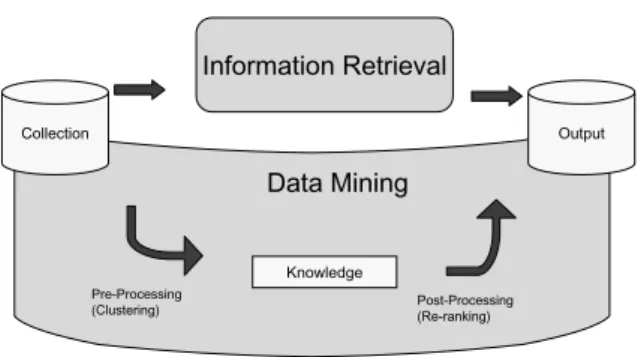
Current image retrieval systems experience some diffi-culties when performing comprehensive searches for ap-propriate images. When images are semantically retrieved based on their associated textual annotations, such as key-words or file names, some ideal images lacking usable tex-tual annotations will not be considered relevant by the sys-tems. One such important example is when the annotation is assigned in a language different from the query language. To avoid such ‘misses’, we used a nearly identical image clustering technique as a pre-processing step before the ac-tual retrieval. Once we know which images are linked to which images, the retrieved images and un-retrieved images lacking appropriate annotations can be connected by using knowledge. Figure 1 is a schematic diagram of this retrieval process. The knowledge extracted from the visual informa-tion is later used to re-rank the initial outputs from the in-formation retrieval (IR) systems. The modular nature of this architecture allows us to use existing IR systems without the need for big changes.
1.2
Finding nearly identical image pairs
Similarities between images are commonly exploited during visual content-based retrieval. However, visual simi-larity is unsuitable for enhancing ranked lists. Visually sim-ilar images are not always semantically simsim-ilar and this dif-fers from text, whose semantic content can adequately be represented by using words. For example, a photo of sun-set can easily be confused with a photo of an apple because visually they are both perceived as red circles by machines. By only using nearly identical images, we can avoid includ-ing unwanted noise from unrelated images.
In Section 2, we explain our data mining method us-ing pre- and post-processus-ing steps and the IR system used.
Information Retrieval Collection Output Knowledge Pre-Processing (Clustering) Post-Processing (Re-ranking) Data Mining
Figure 1. Combination of data mining (pand post-processing) (pand information re-trieval.
In Section 3, we show the experimental results on the Im-ageCLEFphoto 2006 ad hoc test collection in multi-lingual setting. In Section 4, we discuss the characteristics of our approach and its relationship with other retrieval methods. Section 5 concludes the paper.
2
System description
2.1
Data mining procedure
The first step of our framework is to extract visual knowl-edge by clustering. Clustering algorithms can be catego-rized into two types: macro-clustering, or global partition-ing, and micro-clusterpartition-ing, or local pairing. The entire fea-ture space is divided into sub-regions in macro-clustering. Whereas, in micro-clustering, the data points that are nearby are linked so that they form a small group in a restricted re-gion of the feature space. Since we only considered nearly identical image pairs, the resulting clusters became micro-clusters that only contained considerably close neighbors. The micro-clustering technique has been tested for text pro-cessing in which terms were used in calculating similarities [1]. We used micro-clustering on visual features and a sim-ilarity measure suitable for them.
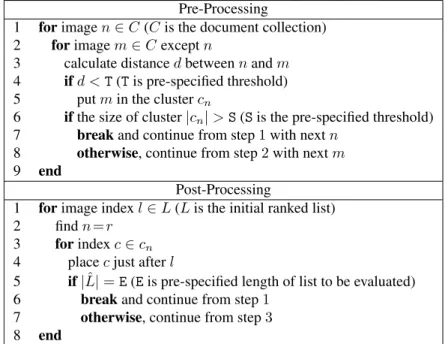
The process of clustering is explained in the top half of Table 1. First, nearly identical images are sought for each image. They are then placed into a cluster that is associ-ated with a seed image. The resulting cluster information is stored as metadata of each image for later use. Then, usual IR is conducted. After retrieval, the ranked image lists of images produced by the retrieval engine are modified using the cluster information. The post-processing is explained in the bottom half of Table 1. A ranked list is searched from the top, and when an image belonging to a cluster is found,
all other members in the cluster will be given the same po-sition as its highly ranked one. This process is continued until the number of images in the new list exceeds a pre-specified number. Note that the retrieval results are evalu-ated on a certain number of top-ranked documents and not on the entire ranked list.
2.2
Features and similarity metric
Visual feature values were extracted from all images in the target collection. Simple color histograms were used as the feature. Images we used were provided in true color JPEG format, and this enabled histograms to be created for the red (R), green (G), and blue (B) elements in the images. This results in each image having three vectors:xr,xg, and
xb. The length of each vector, or the size of the histogram,
i= 256. These parameters are combined and used to define a single feature matrix for each image: X = [xr,xg,xb].
Thus, the size of feature matrix isibyjwherej= 3. Similarities between images were calculated using the above feature values. The similarity measure used was a two-dimensional correlation coefficient,r, between the ma-trices. If matrices A andB are assumed, the correlation coefficient is given as r = i j(Aij−A¯)(Bij−B¯) (i j(Aij−A¯)2)(i j(Bij−B¯)2)
whereA¯andB¯are the mean values ofAandBrespectively. The image pairs whoseris larger than the thresholdT
are considered identical and grouped into the same cluster. That is, the actual threshold d < T in Table 1 was per-formed asr > T for the similarity measure. The thresh-old is determined manually by inspecting the distribution of similarity scores so that only a relatively small group of im-ages constitute each separate cluster. The important point of this processing is to avoid including unrelated images in the same cluster.
2.3
Retrieval engine
Our method is unique solely in the combination of data mining with image retrieval. The basic ranking was con-ducted using an existing text search engine. We used an information retrieval toolkit, the Lemur Toolkit, for that purpose1. As for the configuration, we used a unigram language-modeling algorithm for building the document models, and Kullback-Leibler divergence for ranking. The document models were smoothed using Dirichlet prior [8].
Table 1. Procedures for pre-processing (knowledge extraction by clustering) and post-processing (knowledge injection by re-ranking)
Pre-Processing
1 forimagen∈C(Cis the document collection) 2 forimagem∈Cexceptn
3 calculate distancedbetweennandm
4 ifd <T(Tis pre-specified threshold)
5 putmin the clustercn
6 ifthe size of cluster|cn|>S(Sis the pre-specified threshold)
7 breakand continue from step1with nextn
8 otherwise, continue from step2with nextm
9 end
Post-Processing
1 forimage indexl∈L(Lis the initial ranked list) 2 findn=r
3 forindexc∈cn
4 placecjust afterl
5 if|Lˆ|=E(Eis pre-specified length of list to be evaluated) 6 breakand continue from step1
7 otherwise, continue from step3 8 end
3
Experimental setup and results
3.1
Task and test collection
Our experimental task was ad-hoc image retrieval based on text: the document collection to be searched was known, but query topics were unknown to the system in advance. In addition, the collection was linguistically heterogeneous or multi-lingual. The goal was to find as many relevant images as possible in a given document collection.
We used the ImageCLEFphoto 2006 test collection. It consisted of the document set, the query set, and the relevant assessment to the queries. The document set is called the IAPR TC-12 Benchmark that contains20,000photos taken at various locations around the world. Subjects of the pic-tures in this collection include accommodation, facilities, and ongoing social projects. The illumination, viewing an-gle and background in each image varies, even when taken of the same content. Details of the data creation process are given elsewhere [3]. Each annotation has seven fields, but only the title and description fields corresponding to the image contents were used in the current experiment.
To simulate users’ search needs, a total of60topics were provided. Half of the topics were semantic,20were neutral, and10were visual. A title field that described the search topic in a few words, either in English or German, was used as a query. The complete list of topics can be found in the
first table of the Appendix. A list of relevant images was provided for each search topic, and its size differed from topic to topic.
3.2
Cross-language experiment
Baseline runs conducted involved cross-language re-trieval against linguistically homogeneous collections. The query and collection languages were English and German. When the query language and the collection language were different, we employed a query translation procedure to enable lexical matching. The Systran machine translation (MT) system2was applied to queries.
The results of these runs are summarized in Table 2. The mean average precision (MAP) scores were used to evalu-ate performance. The average precision is the mean ratio of relevant documents at each occurrence of relevant doc-ument to the total number of docdoc-uments from the top list. The MAP score summarizes the average precision over all 60topics. The collection language in the baselines runs was used to determine retrieval performance, as shown in the table. The results show that searching in the English col-lection was better for both query languages. The translated queries from German to English in the English collection performed better than mono-lingual German queries in the German collection.
Table 2. Summary of runs using linguistically homogeneous collection (MAP scores).
Query Language English Collection German Collection
English 0.1193 0.0634
German 0.1069 0.0892
3.3
Multilingual experiment
The advantage of using visual similarity based pre-clustering will become clearer when considering the ap-plication in linguistically heterogeneous image collections. Without translations, images annotated using different lan-guage from the query lanlan-guage can only be accessed using the visual linkages provided by the clustering. To simulate the retrieval of a linguistically heterogeneous collection, in-stead of viewing the collection as a single bilingual collec-tion of20,000 English and German documents, a mixed collection was constructed by taking10,000randomly cho-sen images from each of the English and German annota-tions. There was no overlapping of images that came with both English and German annotations. English and German queries without translation were tested on this single col-lection with or without the micro-clustering pre-processing and the re-ranking post-processing. The thresholdTused to determine nearly identical images was set to0.9. The cluster sizeSwas limited to10. The size of the ranked list
Eused for evaluations was 1,000in our study. The same configuration was used in all runs.
The generated clusters were small and often contained two images; a cluster being formed by a pair of images. We obtained many quite small yet highly restricted micro-clusters. The unlimited sized cluster had a mean of12.72, a standard deviation of43.81, a minimum of0, a median of368, and a maximum of0. Some clusters originally con-tained more than100members but were truncated toS=10. Such non-micro clusters were not considered ideal because when one of their members appeared at the top of the list, the cluster dominated the entire list after re-ranking.
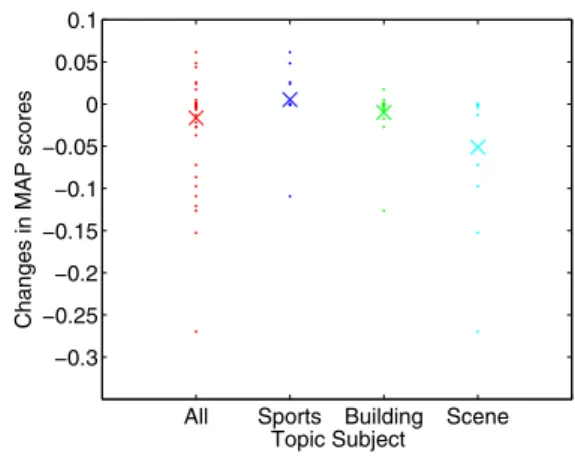
Table 3 lists the experimental results. The results show that there was no improvement with visual knowledge in terms of MAP scores. However, interesting trends can be seen when we look closely at the changes given by the pre-and post-processing steps for the different groups of search topics. We considered three categories of queries. The first one was “Sports”, which contains photos of people doing sports or watching sports. The second one was “Build-ing”, which contains photos of various types of architec-ture and the interiors or exteriors of buildings. The third one was “Scene”, which contains photos of various natural scenes and natural landmarks, such as deserts and moun-tains. The actual queries in these categories are listed in the Appendix. Figure 2 shows a plot of the difference in MAP
All Sports Building Scene
−0.3 −0.25 −0.2 −0.15 −0.1 −0.05 0 0.05 0.1 Topic Subject
Changes in MAP scores
Figure 2. Changes in retrieval performance when clustering pre-processing was applied. Dots represent variation in mean average precision. If dots are placed above zero, re-sults have improved. Crosses indicate the mean of variations for all queries on subjects.
scores between baseline retrieval and retrieval with the data mining processes. The dots represent the value for individ-ual queries, and the crosses represent the mean values in the categories. A0value on the vertical axis means that there was no change in performance. If a dot is placed in the pos-itive region, the performance improved for that query, and if a dot is found in the negative region, there was a corrup-tion in the retrieval. As the results show in the figure, the changes of performance vary among different query sub-jects. Extracted visual knowledge by micro-clustering was helpful for the “Sports” category, did not effect either way the “Building” category, but severely deteriorated the effec-tiveness of the “Scene” category. The mean MAP changes for these categories were0.0054,−0.0098, and−0.0510, respectively.
4
Discussion
4.1
Limitations and promises
At this point, improved average performance over all queries was not possible by incorporating visual
pre-Table 3. Summary of runs using linguistically heterogeneous collection (MAP scores).
Half English and Half German Collection Query Language
Without visual knowledge With visual knowledge
English 0.0838 0.0586
German 0.0509 0.0374
processing. This failure might be because the clusters of topically irrelevant images were used. The baseline IR per-formance may influence the result. If the initial ranked list contains many irrelevant images in its top-ranked images, post-processing may introduce additional irrelevant images. Examining the influence of the initial quality of ranked lists is the basis of our future work. Also, our visual features and similarity metrics were simple; therefore we might be able to change them so that it only captures the image pairs in the categories, such as the “Sports” category in which pre-processing is proven as useful.
A limitation of using visual information in its current form is that the linkage information obtained is only for part of the collections. Our method affects only top-ranked images having multiple nearly identical images. However, there were many clusters that only contained one image. Thus, we cannot expect significant improvement in per-formance unless the target collection contains many nearly identical but textually different images. A trade-off exists between the quality of clustering and the degree of expand-ing the search target, and the threshold we used may have been conservative to avoid including any unwanted noise images. Additional investigation is needed to clarify the ef-fect of threshold values.
A promising fact is that our method improved retrieval performance for some queries despite the above-mentioned limitations. If we can use query classification (e.g., [7]) successfully, it may be possible to use the extracted vi-sual knowledge only on queries that have properties suit-able for re-ranking. By not applying re-ranking method for the query categories such as the “Scene” in the current re-search, the average overall performance will be improved by re-ranking.
4.2
Related methods
Research has been performed in image retrieval that uti-lizes clustering. For example, Chen et al. applied an im-age clustering method to present visually similar imim-ages as groups rather than a list [2]. Their method is different from our method because clustering was used after querying and not as a pre-processing step for annotation-based retrieval.
Various image retrieval methods have been examined that combine complementary properties of visual informa-tion and textual informainforma-tion, mostly for interactive image
retrieval (e.g., [4]). As for annotation-based ad hoc re-trieval, the similarity between images have been utilized where the visual knowledge is transferred into the word as-sociation knowledge [5]. This approach integrates the ob-tained knowledge into the retrieval model. In contrast, our method separates the knowledge extraction and knowledge injection stages from the core IR processes?. Jing et al. con-sidered the use of visual information in both interaction and pre-processing [6]. However, their pre-processing on visual clustering was used for automatic annotation of images and not for retrieval.
For a multi-lingual document collection, it is possible to use a query translation method. The advantage of using a translation method as compared to our method is that once the query has been translated, users can access all images annotated in the translated language. Our method only al-lows access to clustered images when one of them is an-notated in the query language. A disadvantage of the query translation method is the difficulty in combining the outputs from the retrieval systems for different languages. Integrat-ing multiple rankIntegrat-ings into a sIntegrat-ingle rank may require careful weighting. Another disadvantage is errors in machine trans-lations. Inclusion of additional images by machine transla-tion may have adverse effect on retrieval performance for some languages.
5
Conclusion
The use of visual information in annotation-based image retrieval is challenging. We developed a method that uses nearly identical visual knowledge obtained from data min-ing pre-processmin-ing in the re-rankmin-ing of retrieval results.
Visual information is independent of languages and can be used to link the images annotated by different languages. Results using the multi-lingual photo collection showed that our method improved the retrieval effectiveness for some queries when they were categorized. More detailed experi-ments may be needed to verify this finding.
Refinement of our approach may be possible in the fol-lowing directions: the use of more sophisticated visual fea-tures, the use of collection dependent metrics for comparing images, developing more advanced clustering techniques, and making the threshold values in the data mining process adaptive.
Acknowledgment
This research was partly supported by a MEXT Grant-in-Aid for Scientific Research on Priority Areas (Cyber Infras-tructure for the Information-explosion Era) and a Grant-in-Aid for Scientific Research from the Japan Society for the Promotion of Science (17700166).
References
[1] Akiko Aizawa. An approach to microscopic cluster-ing of terms and documents. InProceedings of PRICAI 2002: Trends in Artificial Intelligence : 7th Pacific Rim International Conference on Artificial Intelligence, vol-ume 2417 ofLecture Notes in Computer Science, pages 404–413, 2002.
[2] Yixin Chen, James Z. Wang, and Robert Krovetz. CLUE: Cluster-based retrieval of images by unsuper-vised learning. IEEE Transactions on Image Process-ing, 14(8):1187–1201, Aug. 2005.
[3] Paul Clough, Michael Grubinger, Thomas Deselaers, Allan Hanbury, and Henning M¨uller. Overview of the ImageCLEF 2006 photo retrieval and object annota-tion tasks. In CLEF working notes, Alicante, Spain, September 2006.
[4] Marin Ferecatu, Nozha Boujemaa, and Michel Cru-cianu. Hybrid visual and conceptual image represen-tation within active relevance feedback context. InMIR ’05: Proceedings of the 7th ACM SIGMM international workshop on Multimedia information retrieval, pages 209–216, 2005.
[5] Masashi Inoue and Naonori Ueda. Retrieving lightly annotated images using image similarities. InSAC ’05: Proceedings of the 2005 ACM symposium on Applied computing, pages 1031–1037, March 2005.
[6] F. Jing, M. Li, H.-J. Zhang, and B. Zhang. A unified framework for image retrieval using keyword and vi-sual features.IEEE Transactions on Image Processing, 14(7):979–989, July 2005.
[7] Dou Shen, Rong Pan, Jian-Tao Sun, Jeffrey Jun-feng Pan, Kangheng Wu, Jie Yin, and Qiang Yang. Q2c@ust: our winning solution to query classification in kddcup 2005. SIGKDD Explor. Newsl., 7(2):100– 110, 2005.
[8] Chengxiang Zhai and John Lafferty. A study of smooth-ing methods for language models applied to informa-tion retrieval. ACM Trans. Inf. Syst., 22(2):179–214, 2004.
Appendix
List of Sports queries
ID Topic Title
12 people observing football match 14 scenes of footballers in action 18 sport stadium outside Australia 19 exterior view of sport stadia 22 tennis player during rally 23 sport photos from California 27 motorcyclists racing
at the Australian Motorcycle Grand Prix 33 people on surfboards
52 sports people with prizes
List of Building queries
ID Topic Title
1 accommodation with swimming pool 2 church with more than two towers 9 tourist accommodation near Lake Titicaca 13 exterior view of school building
15 night shots of cathedrals 17 lighthouses at the sea
18 sport stadium outside Australia 19 exterior view of sport stadia
21 accommodation provided by host families 24 snowcapped buildings in Europe
28 cathedrals in Ecuador
29 views of Sydney’s world-famous landmarks 30 room with more than two beds
50 indoor photos of churches or cathedrals 53 views of walls with unsymmetric stones
54 famous television (and telecommunication) towers 57 photos of radio telescopes
List of Scene queries
ID Topic Title
6 straight road in the USA 10 destinations in Venezuela 31 volcanos around Quito
36 photos with Machu Picchu in the background 37 sights along the Inka-Trail
38 Machu Picchu and Huayna Picchu in bad weather 40 tourist destinations in bad weather
41 winter landscape in South America 42 pictures taken on Ayers Rock 43 sunset over water
44 mountains on mainland Australia 60 salt heaps in salt pan