For Review Only
Integration of Action and Language Knowledge: A Roadmap
for Developmental Robotics
Journal: Transactions on Autonomous Mental Development
Manuscript ID: Draft Manuscript Type: Regular Date Submitted by the
Author:
Complete List of Authors: Cangelosi, Angelo; University of Plymouth, School of Computing and Mathematics
Metta, Giorgio; Italian Institute of Technology, RBCS; University of Genoa, DIST
Sagerer, Gerhard; Bielefeld University, CITEC Nolfi, Stefano; National Reserach Council, ISTC
Nehaniv, Chrystopher; University of Hertfordshire, School of Computer Science
Fischer, Kerstin; University of Southern Denmark, Department of Business Communication and Information Science
Tani, Jun; RIKEN, BSI
Sandini, Giulio; Italian Institute of Technology, RBCS Fadiga, Luciano; Italian Institute of Technology, RBCS Wrede, Britta; Bielefeld University, CITEC
Rohlfing, Katharina; Bielefeld University, CITEC Tuci, Elio; National Reserach Council, ISTC
Dautenhahn, Kerstin; University of Hertfordshire, School of Computer Science
Saunders, Joe; University of Hertfordshire, Computer Science; University of Hertfordshire, School of Computer Science Zeschel, Arne; University of Southern Denmark, Department of Business Communication and Information Science
Keywords: language acquisition through development, motor system and development
For Review Only
Abstract— This position paper proposes that the study ofembodied cognitive agents, such as humanoid robots, can advance our understanding of the cognitive development of complex sensorimotor, linguistic and social learning skills. This in turn will benefit the design of cognitive robots capable of learning to handle and manipulate objects and tools autonomously, to cooperate and communicate with other robots and humans, and to adapt their abilities to changing internal, environmental, and social conditions. Four key areas of research challenges are discussed, specifically for the issues related to the understanding of: (i) how agents learn and represent compositional actions; (ii) how agents learn and represent compositional lexicons; (iii) the dynamics of social interaction and learning; and (iv) how compositional action and language representations are integrated to bootstrap the cognitive system. The review of specific issues and progress in these areas is then translated into a practical roadmap based on a series of milestones. These milestones provide a possible set of cognitive robotics goals and test-scenarios, thus acting as a research roadmap for future work on cognitive developmental robotics.
Index Terms— Action learning, Humanoid robot, Language
development, Social Learning, Roadmap
Manuscript received March 2, 2010. This work was supported by the EU Integrating Project “ITALK (214886) within the FP7 ICT programme “Cognitive Systems, Interaction and Robotics”.
A. Cangelosi and T. Belpaeme are with the Centre for Robotics and Neural System of the University of Plymouth, Drake Circus, Plymouth, PL4 8AA, UK (Tel.: +44-1752-586217; fax: +44-1752-586300; e-mail: {acangelosi; tbelpaeme}@plymouth.ac.uk). Contact author is Angelo Cangelosi.
G. Metta, G. Sandini and L. Fadiga are with the Italian Institute of Technology, Genoa, Italy. e-mail: {giorgio.metta;giulio.sandining; luciano.fadiga}@iit.it
G. Sagerer, B. Wrede and K. Rohlfing are with the Applied Computer Science Group at the University of Bielefeld, Germany; e-mail: {sagerer;bwrede;rohlfing}@techfak.uni-bielefeld.de
S. Nolfi and E. Tuci are with the Institute of Cognitive Science and Technology at the National Research Council, Rome, Italy; e-mail: {stefano.nolfi;elio.tuci}@istc.crn.it
C. L. Nehaniv, K. Dautenhahn and J. Saunders are with the Adaptive Systems Research Grout at the University of Hertfordshire, Hatfield, UK; e-mail: {c.l.nehaniv;k.dautenhahn;j.2.saunders}@herts.ac.uk
K. Fischer and A. Zeschel are with the Department of Business Communication and Information Science, University of Southern Denmark , Denmark; e-mail: {kerstin;zeschel}@sitkom.sdu.dk
Jun Tani is with the at Brains Science Institute of RIKEN, Japan; e-mail: [email protected]
I. INTRODUCTION
HIS paper proposes a developmental robotics approach to the investigation of action and language integration in embodied agents and a research roadmap for future work on the design of sensorimotor, social and linguistic capabilities in humanoid robots. The paper presents a vision of cognitive development in interactive robots that is strongly influenced by recent theoretical and empirical investigations of action and language processing within the fields of neuroscience, psychology, cognitive linguistics. Relying on such evidence on language and action integration in natural cognitive systems, and on the current state of the art in cognitive robotics, the paper identifies and analyses in detail the key research challenges on action learning, language development and social interaction, as well as the issue of how such capabilities are fully integrated. Although the primary target audience of the paper is the cognitive robotics community, as it provides a detailed roadmap for future robotics developments, the article is also relevant to readers from the empirical neural and cognitive sciences, as developmental robotics can serve as a modeling tool to validate theoretical hypothesis (Cangelosi and Parisi, 2002).
The vision proposed in this paper is that research on the integration of action and language knowledge in natural and artificial cognitive systems can benefit from a developmental cognitive robotics approach, as this permits the re-enactment of the gradual process of acquisition of cognitive skills and their integration into an interacting cognitive system. Developmental robotics, also known as epigenetic robotics, or autonomous mental development methodology, is a novel approach to the study of cognitive robots that takes direct inspiration from developmental mechanisms and phenomena studied in children (Lungarella et al. 2003; Cangelosi and Riga 2006; Weng et al. 2001). The methodologies for cognitive development in robots are used to overcome current limitations in robot design. To advance our understanding of cognitive development, this approach proposes the study of artificial embodied agents (e.g. either robots, or simulated robotic agents) able to acquire complex behavioral, cognitive, and linguistic/communicative skills through individual and social learning. Specifically, to investigate action/language integration, it is possible to design cognitive robotic agents
Integration of Action and Language Knowledge:
A Roadmap for Developmental Robotics
Angelo Cangelosi, Giorgio Metta, Gerhard Sagerer, Stefano Nolfi, Chrystopher Nehaniv, Kerstin
Fischer, Jun Tani, Giulio Sandini, Luciano Fadiga, Britta Wrede, Katharina Rohlfing, Elio Tuci,
Kerstin Dautenhahn, Joe Saunders, Arne Zeschel
T
1 2 3 4 5 6 7 8 9 10 11 12 13 14 15 16 17 18 19 20 21 22 23 24 25 26 27 28 29 30 31 32 33 34 35 36 37 38 39 40 41 42 43 44 45 46 47 48 49 50 51 52 53 54 55 56 57 58 59 60For Review Only
capable of learning how to handle and manipulate objects andtools autonomously, to cooperate and communicate with other robots and humans, and to adapt their abilities to changing internal, environmental, and social conditions. The design of object manipulation and communication capabilities should be inspired by interdisciplinary empirical and theoretical investigations of linguistic and cognitive development in children and adults, as well as of experiments with humanoid robots. Such an approach is centered on one main theoretical hypothesis: action, interaction and language develop in parallel and have an impact on each other thus favoring the parallel development of action and social interaction permits the bootstrapping of cognitive development (e.g. Rizzolatti and Arbib 1998). This is possible through the integration and transfer of knowledge and cognitive processes involved in sensorimotor learning and the construction of action categories, imitation and other forms of social learning, the acquisition of grounded conceptual representations and the development of the grammatical structure of language. In addition to advancing our understanding of natural cognition, such a developmental approach towards the integration of action, conceptualization, social interaction and language can have fundamental technological implications for designing communication in robots and overcoming current limitations of natural language interfaces and human-robot communication systems.
This developmental robotics approach to action and language integration is also consistent with related brain-inspired approaches to mental development. For example, computational neuroscience approaches to cognitive development invoke the simultaneous consideration of neural development constraints and how these affect embodiment and cognition factors (Mareschal et al. 2007; Westermann et al. 2006; Weng and Hwang 2006; Weng 2007). For example, Sporns (2007) discusses in detail neurocomputational approaches to studying the role of neuromodulation and value system in developmental robotics.
In short, a complete, embodied cognitive system is needed in order to develop communication skills. The array of skills that are necessary to achieve this goal spans the range from sensorimotor coordination, manipulation, affordance learning to eventually social competencies like imitation, understanding of the goals of others, etc. Any smaller subset of these competencies is not sufficient to develop proper language/communication skills, and further, the development of language clearly bootstraps better motor and affordance learning and/or social learning. The fact that the agent communicates with others improves the acquisition of other skills. By interacting with others agents receive more structured input for learning (imagine a scenario of learning about the use of tools). Generalization across domains is also facilitated by the ability of associating symbolic structures such as those of language.
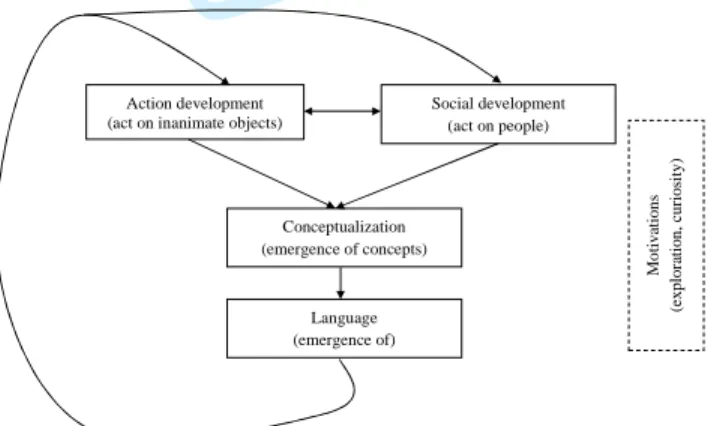
To follow such a vision, it is necessary to aim at the development of cognitive robotic agents endowed with the
following abilities (see also Fig. 1):
• Agents learn to handle objects, individually and collaboratively, through the development of sensorimotor coordination skills and thereby to acquire complex object manipulation capabilities such as making artifacts (tools) and using them to act on other objects and the environment.
• Agents develop an ability to create and use embodied concepts. By embodied concepts we mean internal states grounded in sensory-motor experiences that identify crucial aspects of the environment or of the agent/environmental interaction. Such concepts mediate the agents’ motor reactions and are used in communication with other agents. They can be organized in hierarchical representations, such as embodied semiotic schemata, used to plan interaction with the environment. Furthermore, embodied concepts can also be influenced through social and linguistic interaction.
• Agents develop social, behavioral and communicative skills through mechanisms of social learning such as imitation. Interacting with other agents enables the agents to share attention on a particular object or situation in order to cooperate, and to benefit from social adaptation of the partner in order to learn new skills and acquire embodied concepts.
• Agents develop linguistic abilities that allow them to represent situations and to communicate complex meaning via language. They learn relationships between sounds, actions and entities in the world. These relations will facilitate the discovery of word meaning and are a precursor to grammatical comprehension and production. More advanced communication skills develop based on the combination of previously-developed embodied concepts and the development of symbolic and syntactic structures.
• Agents are able to integrate and transfer knowledge acquired from different cognitive domains (perception, action, conceptual and social representations) to support the development of linguistic communication. The co-development, transfer, and integration of knowledge between domains will permit the bootstrapping of the agent’s cognitive system.
Action development (act on inanimate objects)
Social development (act on people) Conceptualization (emergence of concepts) Language (emergence of) M o ti v at io n s (e x p lo ra ti o n , c u ri o si ty )
Fig. 1. Connections between the various skills of a developmental cognitive agent. The focus on this paper will be on the aspects more closely related to language and action development (boxes with continuous lines). The diagram also acknowledges the additional contribution of other capabilities related to motivation and affective behavior (dotted box), though they will not be part 1 2 3 4 5 6 7 8 9 10 11 12 13 14 15 16 17 18 19 20 21 22 23 24 25 26 27 28 29 30 31 32 33 34 35 36 37 38 39 40 41 42 43 44 45 46 47 48 49 50 51 52 53 54 55 56 57 58 59 60
For Review Only
of the core discussion in this paper.Research on the further understanding and design of the above cognitive abilities in natural (children and adults) and artificial (robots) cognitive agents can be centered around four key challenges:
(1) Understanding how agents learn and represent compositional actions
(2) Understanding how agents learn and represent compositional lexicons
(3) Understanding dynamics of social interaction and learning
(4) Understanding how compositional action and language representations are integrated
In the following section (section 2) we first provide a brief overview of the state of the art in experimental disciplines investigating embodied cognition and action/language processing in natural cognitive systems (humans and animals) and the state of the art in artificial cognitive systems (robots) models of language learning. This evidence on action language integration has important implications for the design of communication and linguistic capabilities in cognitive systems and robots (Cangelosi et al. 2005, 2008) to progress beyond the state of the art. Sections 3-6 will analyze in detail the specific issues on the four sets of key challenges respectively for action, language, and social learning and for cognitive integration. Additional review of literature on the specific theoretical and empirical work on action, language and social learning will be included within the key challenge sections 3-7. This will further support specific claims and proposals for future developmental robotics investigations in the field. The paper then concludes with the presentation of the research roadmap and a description of key milestones.
II. RELATION TO THE STATE OF THE ART
A. Action and Language Processing in Natural Cognitive
Systems
Recent theoretical and experimental research on action and language processing in humans and animals clearly demonstrates the strict interaction and co-dependence between language and action (e.g. Cappa and Perani, 2003; Glenberg and Kaschak, 2002; Pulvermuller et al. 2003; Rizzolatti and Arbib, 1998). In neuroscience, neurophysiology investigations of the mirror neurons system (Fadiga et al., 2000; Gallese et al, 1996) and brain imaging studies on language processing provide an abundance of evidence for intertwined language-action integration. For example, Hauk et al. (2004) used fMRI to show that action words referring to face, arm or leg actions (e.g. to lick, pick, or kick) differentially activate areas along the motor cortex that either were directly adjacent to or overlapped with areas activated by actual movement of the tongue, fingers, or feet. This demonstrates that the referential meaning of action words has a correlate in the somatotopic activation of the motor and premotor cortex. Cappa and Perani
(2003) review neuroscience evidence on neural correlates of nouns and verbs. They found a general agreement on the fact that the left temporal neocortex plays a crucial role in lexical-semantic tasks related to the processing of nouns whereas the processing of words related to actions (verbs) involves additional regions of the left dorsolateral prefrontal cortex. Overall, neuroscientific evidence supports a dynamic view of language according to which lexical and grammatical structures of language are processed by distributed neuronal assemblies with cortical topographies that reflect lexical semantics (Pulvermuller 2003). The mastery of fine motor control, such as non-repetitive action sequences involved in making complex tools, is also seen as an ability related to the precursor of Broca’s area in the modern brain, which is adjacent to the area that governs fine motor control in the hand. This is consistent with Rizzolatti and Arbib’s (1998) hypothesis that area F5 of the monkey’s brain, where mirror neurons for manual motor activity have been identified, is homologous to a precursor of Broca’s area involved in language processing and speech production and comprehension.
This neuroscience evidence is consistent with growing experimental and theoretical evidence on the role of grounding of language in action and perception (Pecher and Zwaan, 2005; Glenberg and Kashack 2002; Barsalou 1999). Glenberg proposed that the meaning of a sentence is constructed by indexing words or phrases to real objects or perceptual analog symbols for those objects, deriving affordances from the objects and symbols and then meshing the affordances under the guidance of syntax. The direct grounding of language in action knowledge has been recently linked to the mirror neuron system (Glenberg and Gallese, in press). Barsalou (1999) places similar emphasis on perceptual representation for objects and words in his “Perceptual Symbol Systems” account of cognition. For Barsalou, words are associated with schematic memories extracted from perceptual states which become integrated through mental simulators.
Developmental psychology studies based on emergentist and constructivist approaches (e.g. Bowerman and Levinson, 2001; MacWhinney, 2005; Tomasello, 2003) also support a view of cognitive development strongly dependent on the contribution of various cognitive capabilities. They demonstrate the gradual emergence of linguistic constructs built through the child’s experience with her social and physical environment. This is consistent with cognitive linguistics approaches (cf. Lakoff, 1987; Langacker, 1987) where syntactic structures and functions, that is, symbolic structures in both lexicon and grammar, are constructed in reference to other cognitive representations.
Another area at the intersection between developmental psychology and cognitive neuroscience that is relevant to cognitive and linguistic development is neuroconstructivism (Sirois et al. 2008; Westermann et al. 2007; Quartz and Sejnowski 1997). This theoretical and experimental framework puts a strong focus on the role of embodiment and brain
co-1 2 3 4 5 6 7 8 9 10 11 12 13 14 15 16 17 18 19 20 21 22 23 24 25 26 27 28 29 30 31 32 33 34 35 36 37 38 39 40 41 42 43 44 45 46 47 48 49 50 51 52 53 54 55 56 57 58 59 60
For Review Only
development during cognitive development. It considers theconstraints that operate on the development of neural structures that support mental representations and explains cognitive development as a trajectory emerging from the interplay of these constraints. This brain-inspired approach has also been supported by computational models, that have the potential to offer explanations of the interactions between brain and cognitive development (Mareschal et al. 2007; Westermann et al. 2006).
All these studies on action-language integration have important implications for the design of communication and linguistic capabilities in cognitive systems and robots (Cangelosi et al. 2005, 2008). Amongst the various approaches to design communication capabilities in interactive agents, some provide a more integrative vision of language and treat it as an integral part of the whole cognitive system (Cangelosi and Harnad 2000). The agent’s linguistic abilities are strictly dependent on, and grounded in, other behaviors and skills. Such a strict action-language interaction supports the bootstrapping of the agent’s cognitive system, e.g. through the transfer of properties of action knowledge to that of linguistic representations (and vice versa).
B. Action and Language Learning in Robots
Recent models from cognitive robotics research have addressed some of the issues described above, and contributed to the identification of the open research challenges in language and action research. Before we discuss in detail the key challenges, we review a few of the most interesting contributions.
Deb Roy (2005; Roy et al. 2004) propose the use of conversational robots able to translate complex spoken commands such us “hand me the blue one on your right” into situated actions. These robots are provided with a control architecture that includes a three-dimensional model of the environment (which is updated by the robot on the basis of linguistic, visual, or haptic input) and sensory-motor control programs. This model is consistent with the notion of schemas proposed by Piaget (1954), in which the meaning of words is associated with both perceptual features and motor program. For example, the word ‘red’ is grounded in the motor program for directing active gaze towards red objects. Similarly, the word ‘heavy’ is grounded in haptic expectations associated with lifting actions. Objects are represented as bundles of properties tied to a particular location along with encodings of motor affordances for affecting the future location of the bundle.
Dominey, Mallet and Yoshida (2009) designed robotic experiments with robots that, in addition to reacting to language commands issued by the user (which trigger predesigned control programs), are able to acquire on the fly the meaning of new linguistic instructions, as well as new behavioral skills, by grounding the new commands in combinations of pre-existing motor skills. This is achieved during experimental sessions in which the human user and a robot try to cooperatively achieve a shared goal. During these
sessions the interaction between the human user and the robot is mediated by two types of linguistic information: (i) linguistic commands (e.g. “open right-hand”, “take object-x”, “give-me object-y”, etc) that trigger contextually independent or dependent behaviors, and (ii) ‘meta’ commands (e.g. “learn macro-x”, “ok”, “wait”) that structure what the robot is to learn or regulate the human-robot interaction. In another experiment, Dominey and Warneken (2009) designed robots able to cooperate with a human user by sharing intentions with her in a restricted experimental setting. This is achieved by allowing the robot to observe the goal-directed behavior exhibited by a human and then to adopt the plan demonstrated by the user. The robot thus shows both an ability to determine and recognize the intentions of other agents, and an ability to share intentions with the human user. These two skills are at the basis of social learning and imitation in humans, as proposed by Tomasello et al. (2005). These abilities have been realized by providing the robot with a model of the environment, the possibility to represent intentional plans constituted by sequences of actions producing specific effects, and the ability to recognize actions and to attribute them to the robot itself or to a human agent.
Weng (2004) designed a developmental learning architecture that allows a robot to progressively expand its behavioral repertoire while interacting with a human trainer that shapes its behavior. Different learning methods are used, including learning by demonstration (in which the robot learns while the trainer drives the robot’s actuators), reinforcement learning (in which the robot learns through a form of trial and error process guided by the positive or negative feedback provided by the trainer), and language learning (in which the robot learns to associate the current sensory states to the action triggered by the trainer through language commands, and also learns to anticipate the next sensations and actions). The approach proposed by Weng is inspired by animal learning, neuroscience evidence, and cognitive science models, aiming to be general enough to be task independent (i.e. to allow the robot to learn any type of task through the same learning methods). This architecture has been successfully implemented, for example, in an humanoid robot that first learns to associate four language commands to four corresponding context-independent behaviors, then learns to associate a fifth language command to a composite action consisting of the execution of the four behaviors acquired previously in sequence (thanks to the mediation of the user that trains the robot by producing the four corresponding language commands after the fifth command), and (eventually) to be able to extinct one of the previously acquired reactions to language commands as a result of negative feedbacks provided by the user (Zhang and Weng, 2007).
Sugita and Tani (2005) developed a model in which a robot acquires the ability to both translate a linguistic command into context-dependent behaviors, and an ability to map sequences of sensory-motor state experienced while producing a given behavior into the corresponding verbal descriptions. More
1 2 3 4 5 6 7 8 9 10 11 12 13 14 15 16 17 18 19 20 21 22 23 24 25 26 27 28 29 30 31 32 33 34 35 36 37 38 39 40 41 42 43 44 45 46 47 48 49 50 51 52 53 54 55 56 57 58 59 60
For Review Only
specifically a wheeled robot, provided with a 2DOF arm and aCTRNN controller, is trained through a learning by demonstration method to carry out behavioral and linguistic tasks that consist respectively in: (i) interacting with the three objects presented in its environment through the execution of three different types of behaviors such as “indicate object-x”, “touch object-x”, and “push object-x”, and (ii) processing the corresponding language commands such as predicting the next word forming the corresponding sentence. The two tasks are carried out by two different modules of the neural controller. However these modules co-influence each other through some shared neurons (called parametric bias) that are forced to assume similar states during the execution of the two related tasks. At the end of the training process the robot shows an ability to translate the language commands into the corresponding situated actions as well as an ability to generate the right language output when the robot is forced to produce a given behavior. The fact that the robot reacts appropriately to sentences never experienced during the training process, moreover, demonstrates how it is able to represent the meaning of words and the corresponding behavior in a compositional manner.
Steels, Kaplan and Oudeyer have studied the acquisition of language in both developmental contexts (Steels and Kaplan 2000; Oudeyer and Kaplan 2006) and evolutionary scenarios (Steels 2005b). For example, Oudeyer and Kaplan (2006) investigated the hypothesis that children discover communication as a result of exploring and playing with their environment using a pet robot (Sony AIBO robot) scenario. As a consequence of its own intrinsic motivation, the robot explores this environment by focusing first on non-communicative activities and then discovering the learning potential of certain types of interactive behavior. This motivational capability results in robots acquiring communication skills through vocal interactions without having a specific drive for communication.
The following sections will discuss in detail the key research challenges for cognitive robotics models of action and language integration, also referring to additional literature work addressing the specific research issues.
III. KEY CHALLENGE 1:LEARNING AND REPRESENTATION OF
COMPOSITIONAL ACTIONS
The investigation of grasp-related functions in the brain and the successive discovery of the mirror neurons system have changed the perception of the importance of manipulation and its relationship to speech (Rizzolatti and Arbib 1998). Although, the mirror neuron system is the quintessential example of this changed understanding of the neurophysiology of action, the study of the control of action in its entirety revealed modularity and compositionality as key elements of flexible and adaptable behavior generation (Mussa-Ivaldi and Giszter 1992; Mussa-Ivaldi and Bizzi 2000; Rizzolatti et al. 1997; Graziano et al. 1997). The important point here is that areas of the brain that were considered as mere sensorimotor
transformation circuits (i.e. changing coordinates or frame of reference) revealed a deeper structure with peculiar characteristics. This deeper structure includes multisensory neurons (e.g. visuo-motor in F5, visuo-haptic-proprioceptive in F4), generalization (the same neuron fires irrespective of the effector used), and compositionality (different areas specialize to different goals –reaching, grasping, etc.– rather than just reflecting a generic somatotopy. This is not a single homunculus, but rather multiple representations of the body with respect to the different action goals. Modularity was discovered in the cerebral cortex but also down to the spinal cord. In a recent experiment (Borroni et al. 2005) the so-called “motor resonance” effect has been demonstrated using the H-reflex technique of the peripheral nerves and transcranial magnetic stimulation (TMS). Additional experiments, such as those in Sakata et al. (1995) showed a link between the “shape” of objects and the actions that can successfully manipulate these objects. Further Gallese et al. (1996) observed neurons in the premotor cortex (area F5) which fire selectively for certain combinations of grasp type and object shape (F5 canonical neurons). It seems that the brain stores a “vocabulary” of actions that can be applied to objects and the mere fixation of a given object activates potential motor acts even if, the monkey in this case, did not move.
This new evidence generated a surge of interest including the cognitive sciences on one side and, the robotics community on the other (see Clark 2001 for a summary). Concepts like that of Gibsonian affordances started to be considered and modeled in robotics (Metta and Fitzpatrick 2003) and the links between imitation and manipulation were explored (Simmons and Demiris 2006; Metta et al. 2006). In this respect, the link between internal models, prediction, and the activation of a mirror-like system was approached in many different ways by using most disparate models (Oztop et al. 2006, Ito et al. 2006, to name a few). Clearly, this effort is even more relevant given the special relationship between mirror neurons, manipulation and language (Fadiga et al. 2002). In the experiment by Fadiga and colleagues (2002), it was possible to measure motor effects when listening to words of different categories in strict congruence with the muscular activation required to pronounce the same set of words, which provides evidence for the presence of a speech-mirror system in humans akin to the grasp mirror system of the monkey. A more recent experiment confirms these findings and enters into the details of the motor resonance effect depending on the phonology versus the frequency of words (Roy et al. 2008). The results indicate that rare words require a stronger activation of the premotor cortex as if the increased difficulty of the task requires reliance on the premotor activation and, conversely, common words are recognized because of a consolidated and larger number of cues which lower the premotor cortex activation.
Further, evidence has accumulated demonstrating the pervasiveness of this principle in several domains, including reaching (e.g. Graziano et al. 1997; Fogassi et al. 1996), attention (Craighero et al. 1999), and motor imagery
1 2 3 4 5 6 7 8 9 10 11 12 13 14 15 16 17 18 19 20 21 22 23 24 25 26 27 28 29 30 31 32 33 34 35 36 37 38 39 40 41 42 43 44 45 46 47 48 49 50 51 52 53 54 55 56 57 58 59 60
For Review Only
(Jeannerod 1997) to name a few. It remains to be consideredthat none of these skills is innate, but rather they develop through experience and in many cases require several years before reaching maturity (von Hofsten 2004). Aspects like prediction (prospective behavior) and explorative and social motives have to be considered in motor learning since they seem to be crucial also for the engineering of adaptive systems in any meaningful sense. In this respect, it seems that newborns are sensitive to their own and other’s motor movements and use these to assess social cues. For example, motion during eye gaze and human facial expressions are used in judging social interaction (Moore et al. 1997; Farroni et al. 2004). Children use these early sensory commodities to bootstrap cognitive development, which includes motor skills. They subsequently go through an extensive period of exploration and development guided by various motivations (including the motivation of exercising the motor system, known as “motor babbling”). This leads to the acquisition of several motor skills like the ability of directing gaze, of coordinating head and eye movements, of coordinating gaze and attention together with reaching and eventually of manipulating the external world via grasping (von Hofsten 2004).
In the light of these results, modular motor control for articulation is a prerequisite for speech in humans, and it can be certainly considered as a prerequisite for speech also in artificial systems. This follows in some sense the approach of Liberman and Mattingly (1985) who first formulated the so called “motor theory of speech perception”, which was exactly proposed because of the difficulty of performing artificial speech recognition (ASR) entirely on acoustic analysis. Motor activation and sensory processing seem to be deeply intertwined in the brain (not only in the premotor cortex). Conversely, in robotics, it was possible to demonstrate an improvement due to learning in multisensory (sensorimotor) environments (Metta et al. 2006; Hinton and Nair 2006). Manipulation plays a pivotal role in this picture, sharing a similar “grammatical/hierarchical” structure with language but also owing to the close homology between F5 in the monkey and Broca’s in humans (Rizzolatti and Arbib 1998).
The next sections will highlight and discuss some of the main open research issues in action learning that are highly relevant to future cognitive robotics research. Specifically, the focus will be on (i) the properties of generalization and compositionality in action development, (ii) the issues of recursive and (iii) hierarchical motor representations, (iv) the issues in embodied concept representation and (v) the mental representation of concepts during development. These research issues will then be used to identify specific milestones on action learning in the roadmap.
A. Generalization and Compositionality
The development of complex action and manipulation capabilities constitute the foundation for the synchronous development of motor, social and linguistic skills. For this it is fundamental to identify the characteristics of action
development that are compatible with this scenario and reject those that are mere engineering shortcuts. In particular, two core properties of biological motor control systems are considered: compositionality and generalization.
Compositionality refers to the ability of exploiting the combinatorial explosion of possible actions for creating a space of expressive possibilities that grows exponentially with the number of motor primitives. The human motor system is known to be hierarchically organized (with primitives implemented as low as at the spinal cord level) and it is simultaneously adaptive in recombining the basic primitives into solutions to novel tasks (via sequencing, summation, etc.). The hierarchy is implemented in the brain by exploiting muscle synergies as well as parallel controllers reaching different degrees of sophistication apt to either address the global aspects of a motor task or the fine control required for the use of tools (Rizzolatti and Luppino 2001).
The aspect of generalization is equally crucial. It refers, in this context, to the ability of acquiring (read learning) motor tasks by various means, using any of the body effectors, and even via imagination of the motor execution itself (as for example in Jeannerod 1997). Naïvely, one could assume a common representational framework defined in some task independent system of coordinates. However, at the same time, neuroscience seems to be indicating that representation is effector-dependent (Fogassi et al. 1996). This is clearly a question that needs to be addressed with links to many different aspects of the representation of linguistic constructs (e.g. actions vs. the description of actions).
In artificial systems, this translates into the realization of a modular controller which, on the one hand, combines a limited set of motor primitives in realizing global control strategies, and on the other, learns to finely move single degrees of freedom to affect particular complex motor mappings (similar to what happens in the brain between the control effected by the premotor cortex versus that generated by the primary motor cortex). Simultaneously, the adaptation and estimation of bodily parameters must be considered both on the developmental and on the single task/session timescale. It is then particularly important that artificial systems show these properties if their motor controller has to form a suitable basis for further development in more higher-order cognitive scenarios such as language.
One interesting topic of research concerns the selection of a generic endpoint for subsequent actions (motor invariance) and fast adaptation to disturbances (changes in dynamics, weight, etc.). One example of flexibility in humans is the possibility of dynamically select the end point for subsequent tasks and reducing/increasing the number of degrees of freedom employed given the precision, noise, and other parameters required (e.g. imagine how humans reduce the number of degrees of freedom by laying objects on a table when precision is required such as in inserting a thread into a needle). This flexibility in choosing the effector to use seems fundamental to adaptability and relates to the existence of a
1 2 3 4 5 6 7 8 9 10 11 12 13 14 15 16 17 18 19 20 21 22 23 24 25 26 27 28 29 30 31 32 33 34 35 36 37 38 39 40 41 42 43 44 45 46 47 48 49 50 51 52 53 54 55 56 57 58 59 60
For Review Only
peripersonal sensorimotor space (Fogassi et al. 1996). Anotherexample of flexibility in humans is in adapting to added perturbations (e.g. increased weight or changed dynamics). In the latter case, the motor system adapts after a few dozen trials and does it by estimating and modeling the change of dynamics maintaining a very energetically efficient control strategy (for example see Lackner and DiZio 1998).
B. Recursive and Hierarchical Primitives
As previously pointed out, motor and linguistic skills share a relevant structure. Specifically, the modular organization of biological motor systems has been shown to be based on hierarchical recursive structures which have linguistic analogues in grammatical/syntactical structures.
Primitives have been identified in the spinal cord of frogs and rats, thus revealing that a modular structure exists at the movement execution level (the lowest level in the motor hierarchical structure). Interestingly these modules have very simple combinatorial rules (linear superposition) which have led to interesting applications (Wolpert and Kawato 1998).
Higher hierarchical structures seem to play a crucial role in movement planning while still preserving a substantial modularity. As to this concern, there is evidence for the existence of individual cortical substructures which code increasingly higher movement related abstractions. There is evidence supporting the existence of structures coding (1) hand kinematics (Georgopoulos et al. 1982), (2) specific action goal, timing and execution (Rizzolatti et al. 1988), (3) movement sequencing (Carpenter et al. 1999), (4) virtual action descriptions (i.e. actions which do not have a concrete goal yet) (Nakayama et al. 2008) (5) object affordance in terms of correspondences between object and motor prototypes (Murata et al. 1997) and (6) movement recognition (Gallese et al. 1996) (Rizzolatti et al. 1996).
At present, the rules governing the combination of different action executions have been widely studied and have been successfully applied in the area of motor control. Conversely, the rules governing the combination of goals in action planning appear to be more complex and not yet completely understood. Remarkably, these rules seem to be fundamental in order to fully exploit the properties of compositionality and generalization embedded in a modular architecture. Moreover, the “definition” (here to be understood as “development”) of suitable compositional rules appears to be an ideal candidate for providing theoretical insights into the integration of action, social and linguistic skills
C. Hierarchical Learning
The observation that the brain uses hierarchical organizations in various sensory and motor systems has inspired the development of similarly organized artificial systems. Essentially, two different approaches have been followed within this context: a bottom-up approach which falls within the mathematical framework of function approximation and a top-down approach based on the properties of the motor output.
As to bottom up approaches, one of the first to mention is LeNet, which uses a convolution network with multiple layers for handwritten digit recognition (LeCun et al. 1990). More recently, Serre et al. (2007) have developed a computational model of the lower levels of the visual cortex. This model alternates levels of template matching and maximum pooling operations, similar to the role of simple and complex cells as found in the visual cortex (Hubel and Wiesel 1962). This model has shown excellent performance on immediate recognition benchmark problems, whereas extensions have been used for action recognition (Jhuang et al. 2007) and facial expression recognition (Meyers and Wolf 2008). The underlying principle of these systems is to gradually increase both the selectivity of neurons to stimuli along with their invariance to (2D) transformations in a series of processing levels (Giese and Poggio 2003). Further, the receptive field of the neurons increases along the hierarchy. In effect, these hierarchies serve to extract relevant features from the data stream and to combine these in compact, high level representations.
Besides having a biological foundation, hierarchical architectures are also believed to have computational advantages over single layered architectures. Hierarchical architectures trade breadth for depth and can theoretically achieve a logarithmic decrease in the number of neurons needed to learn certain tasks (Bengio and LeCun 2007, Mnih and Hinton 2009). However, hierarchical architectures are notoriously hard to train and may therefore not reach up to their full potential. Hinton et al. proposed a novel learning method for deep belief networks, which is a variant of a multi-layered neural network, to address this problem (Hinton et al. 2006). In this method each layer is trained separately to output a compact and sparse representation of its input distribution. Only the most relevant aspects of the input distribution remain at the top level, therefore facilitating generalization. If used in the opposite direction, i.e. from output to input, then each layer will attempt to reconstruct the original input from the compact output representation. An interesting direction for novel research is to apply these hierarchical learning methods for motor control.
In contrast to bottom up approaches, top down approaches are based on the input/output properties of the motor system. As to this concern, one of the most interesting theoretical results has been proposed by D. M. Wolpert in the framework of multiple paired forward and inverse models (Wolpert and Kawato, 1998). By devising a modular structure which has strong similarities with the modularity present in the cerebellum, it was proposed that multiple forward and inverse models can be simultaneously learnt in order to approximate complex sensory motor mappings (module learning problem). Interestingly it was observed that the problem of choosing the correct subset of inverse models to handle the current context (module selection problem) can initially be solved by exploiting forward model predictions. Simultaneously, these predictions can be used to train suitable responsibility
1 2 3 4 5 6 7 8 9 10 11 12 13 14 15 16 17 18 19 20 21 22 23 24 25 26 27 28 29 30 31 32 33 34 35 36 37 38 39 40 41 42 43 44 45 46 47 48 49 50 51 52 53 54 55 56 57 58 59 60
For Review Only
predictors which can be used later to solve the selectionproblem by exploiting contextual cues only.
New research in cognitive robotics should focus on the acquisition of hierarchical and compositional actions. Typical experimental scenarios might involve robotic agents that use proprioceptive and visual information to actively explore the environment. This will allow agents to build embodied sensorimotor categories of object-body interactions. Actually, such trials have been demonstrated in (Yamashita and Tani 2008). It was shown that a humanoid robot can learn to generate object manipulation behaviors in a compositional way by self-organizing functional hierarchy by which the lower level primitives such as touch/lift/move objects are sequentially combined in the higher level by utilizing inherent time constant differences in the employed dynamic neural network model. However, the experiment was limited in its scalability and lacked developmental aspects. New studies should include more advanced experiments to look at developmental processes of acquiring manipulation action patterns based on combination and sequences of movements. For example, new robotics experiment might start from situations in which robot agent learns to use a tool (e.g. “stick”) to push an object. Other tasks might include a cascade of inter-dependent actions, such as making a composite tool (e.g. combine a stick with a cuboid object – as with the handle and head of a “hammer”) and using this tool on a third object (e.g. to crack open a spherical object – “nut”). Tasks can be inspired by object manipulation and tool making/use observed abilities in primates and humanoids, and their relationship with the development of linguistic capabilities (e.g. Corballis 2002; Greenfield 1991). A possible starting point could be to attempt object manipulation in order to get an agent to relate one object with another in a particular combination, as a young infant would (Tanaka and Tanaka 1982). In conjunction with the research undertaken by Hayashi and Matsuzawa (2003) on the development of spontaneous object manipulation in apes and children, language experiments can focus on the following tasks: (i) Inserting objects into corresponding holes in a box; (ii) Serializing nested cups; (iii) Inserting variously shaped objects into corresponding holes; (iv) Stacking up wooden blocks. A first instance of the experiments could be able to isolate the agent from the human, so as to let it calibrate its joints and hand-eye coordination, recognizing color, form/shapes and moving objects. The second part would be to introduce the agent to a “face to face” situation where a user would use linguistic instructions in order to expand the object “knowledge acquisition”, taking the form of some kind of symbolic play.
D. Embodied Learning of Representation and Concepts
A fundamental skill of any cognitive system is the ability to produce a variety of behaviors and to display the behavior that is appropriate to the current individual, social, cultural and environmental circumstances. This will require agents: (1) to reason about past, present and future events, (2) to mediate their motor actions based on this reasoning process and (3) to
communicate using a communication system that shares properties with natural language. In order to do this, robots will need to develop and maintain internal categorical states, i.e. ways to store and classify sensory-motor information. To properly interact with the objects and entities in the environment, agents should possess a categorical perception ability which allows them to transform continuous signals perceived by sensory organs into internal states or internal dynamics in which members of the same category resemble one another more than they resemble members of other categories (Harnad 1990). These internal states can be called “embodied concepts” and can be considered as representations grounded in sensory-motor experiences that identify crucial aspects of the environment and/or of the agent/environmental interaction.
In the literature there are two orthogonal approaches to representing concepts in artificial systems: one commonly known as the symbolic approach, the other as the subsymbolic approach. In the symbolic approach, conceptual information is represented as a symbolic expression containing recursive expressions and logical connectors, while in the subsymbolic approach concepts are represented in a continuous domain, for example in connectionist networks or semantic spaces (cf. Gärdenfors, 2000). Both approaches serve their purpose, but none seems to resonate well with human conceptualization. Humans use symbolic knowledge in representations for communication and reasoning (Deacon, 1997), but these symbols are implemented on a neural substrate, which is non-symbolic and imprecise. There have been few attempts to reconcile both, and new research should focus at the design of a conceptual representation which has the precision of logic symbols, but the plasticity of human concepts. This representation should also support the acquisition of concepts through embodied sensorimotor interactions.
Embodied concepts can be immediately related to sensory or motor experiences, such as motor action concepts or visual shape/object concepts, in which case we call them perceptual concepts. On the other hand, concepts can also be indirectly related to perceptual input, in which case we call them abstract embodied concepts (e.g. Wiemer-Hastings and Xu 2005; Barsalou 1999). These concepts are typically hierarchical constructs based on other abstract concepts and perceptual concepts. Categories, in our approach, will be based on commonalities and structure of concepts that exists among items (cf. Rakison and Oakes 2003).
In line with a dynamical system view of cognitive development (Thelen and Smith, 1994), embodied concepts should be conceived at the same time as pre-requisites for the development of behavioral, social, and communicative skill and as the result of the development and co-development of such skills. In this respect, the development of embodied concepts might play the role of a scaffold which enables the development of progressively more complex skills.
An important challenge for cognitive robotics thus consists in identifying how embodied agents can develop and
1 2 3 4 5 6 7 8 9 10 11 12 13 14 15 16 17 18 19 20 21 22 23 24 25 26 27 28 29 30 31 32 33 34 35 36 37 38 39 40 41 42 43 44 45 46 47 48 49 50 51 52 53 54 55 56 57 58 59 60
For Review Only
progressively transform their embodied conceptsautonomously while they interact directly with the physical and social environment (without human intervention) and while they attempt to develop the requested behavioral skills. This objective can be achieved through experiments studying different aspects of categorization and concept formation, with the goal of progressively integrating into a single setup categorization aspects previously studied in isolation. These experiments require that the robot is left completely free to determine how they interact with the environment in order to perform the categorization task. For example, a robot placed in front of objects (one at a time) varying with respect to their shape, size, and orientation will be trained for the ability to categorize the shape of the object by producing different labels for objects with different shapes. The robot will be rewarded on the basis of its ability to label the shape of the object and will not be asked to produce any specific behavior (i.e. it will be left free to determine how to interact with the objects).
The goal of this research methodology is twofold. On one side, these experiments can pose the basis for the investigation of more complex experimental scenarios in which the development of an ability to linguistically categorize selected features of the environment will be integrated with the development of an ability to display certain behavioral and social skills. On the other side, these experimental scenarios can be used to study the role of active categorical perception and the role of the integration of sensory-motor information over time.
Active categorical perception refers to the fact that in agents which are embodied and situated, the stimuli which are sensed do not depends only on the structure of the environment but also on the agents’ motor behavior. This implies that categorization is an active process that requires: (a) the exhibition of a behavior which allows the agents to experience the stimuli that provide the necessary regularities to perceptually categorize the current agent/environmental state, and (b) the development of an ability to internally elaborate the experienced sensory states. The ability to coordinate the sensory and motor process, however, does not only represent a necessity but also an opportunity, since the possibility to alter the experienced sensory stimuli might significantly simplify the perceptual categorization process or might lead to the generation of the regularities that are necessary to perceptually categorize functionally different agent/environmental situation. The goal of this set of experiments, therefore, will be that to identify how such possibility can be exploited, Although pioneering research in this area has provided important theoretical contributions (Chiel and Beer 1997; Scheier et al. 1998; Pfeifer and Scheier 1999; Nolfi and Floreano 2000; O’Regan and Noë 2001; Keijzer, 2001) as well as few preliminary demonstrations of how artificial embodied agents can develop active categorization skills (Nolfi and Marocco 2002; Beer 2003; Nolfi 2005), some themes still deserve substantial further investigations. In particular, open questions concern: (i) the identification of the modalities with which
action can facilitate or enable categorical perception, (ii) the identification of how internal categories can be represented, (iii) the identification of the adaptive mechanisms which can lead to the development of two interdependent skills (the ability to act so to favor categorical perception and the ability to categorize perceived sensory-motor information codetermined by agents’ motor behavior).
Another important focus of future research on embodied concept learning and representation regards the development of abstract perceptual categories based on regularities distributed over time. The regularities that can be used to categorize functionally different agent/environmental circumstances are not necessarily available within a single sensory pattern and often require an ability to integrate sensory-motor information through time. Consider for example the problem of grasping objects of different shapes on the basis of tactile information or the problem visually recognizing an object by visually exploring it through eye movements. To functionally categorize the nature of these agent/environmental situations, the agent should take into account aspects such as the duration of an event or the sequence with which different events occur. This problem is further complicated by the fact that regularities that should be integrated over time might be distributed at different time scales (e.g. ranging from milliseconds, to seconds or minutes). Recent research in this area has demonstrated how robotic agents can successfully develop categorization abilities and abstract perceptual categories provided that certain pre-requisites are met (Wolpert and Kawato 1998; Nolfi and Tani 1999; Tani and Nolfi 1999; Beer 2003; Sugita and Tani, 2005; Ito et al. 2006; Gigliotta and Nolfi 2008; Yamashita and Tani, 2008). These studies also provide useful hints which might help us to identify the characteristics of the developmental process and of the robots which represent a pre-requisite for the ability to develop abstract concepts. However, whether and how these models can be scaled to more complex scenarios remains an open question which deserves further investigations.
E. Social Learning of Concepts
In order to understand how humans represent knowledge, much can be learned from studying how infants and young children acquire concepts. There are many experimental studies and theories on concept acquisition in young children (Rakison and Oakes, 2003). Children, for example, employ a number of strategies to facilitate concept acquisition, such as mutual exclusivity, where a word is only related to one object in a context and not to others (Markman, 1989), or the preference to bind unfamiliar words with unfamiliar perceptual input: the novel name novel category principle (Mervis and Bertrand, 1994). Also, language seems to play a crucial role in concept acquisition. Although linguistic relativism —the interaction between language and thought— used to be controversial, recent studies have convincingly shown that language and conceptualization do interact in a number of different domains, such as time, space and color (for example (Boroditsky 2001; Gilbert et al., 2006; Gumperz and
1 2 3 4 5 6 7 8 9 10 11 12 13 14 15 16 17 18 19 20 21 22 23 24 25 26 27 28 29 30 31 32 33 34 35 36 37 38 39 40 41 42 43 44 45 46 47 48 49 50 51 52 53 54 55 56 57 58 59 60
For Review Only
Levinson, 1997; Roberson et al., 2005; Winawer et al., 2007),but see Pinker (2007) for a critical note. Although the evidence for the interaction between language and concepts is convincing, it is only recently that the importance of language for the acquisition of concepts has been noted. Choi et al. (1999), for example, show how young children (18-23 months) are already sensitive to linguistic concepts for space (see also Majid et al., 2004). This does not tell whether children actively use language to acquire concepts. However, Xu (2002) shows how 9-month olds use of language can play an important role in learning object concepts and more recently, Plunkett, Hu and Cohen (2008) show how linguistic labels play a causal role in concept learning of 10-month olds.
In the tightly controlled experimental settings of above mentioned psychological studies, children are exposed to unidirectional communication: objects and linguistic labels are presented to the infants and they induce concepts from these experiences. These experimental conditions however do not reflect reality, where children and caretakers engage in a rich interaction with joint attention, referential and indexical pointing, and implicit and explicit feedback. It is expected that rich, cultural interaction is essential to cognition (Tomasello, 1999). New research should explore the influence of rich interaction on the mental development of robots. It has been argued and, to a certain extent, it has been experimentally shown that this tight interaction is bi-modal, involving both language and action and that this occurs from an early age. Locke (2007) reports how 16.5-month old infants significantly join vocalizations and referential points, which would suggest an integrated system.
Concerning the mental representation of categories and concepts, it is important to first distinguish between categories and concepts. For the pragmatic purposes of developmental robotics and cognitive systems, categories are seen as directly related to perceptual experiences and concepts as higher-level representations, based on categories, but possibly also deduced from contextual information without necessarily being related to perceptually grounded categories. Categorization in artificial intelligence and by extension in recent cognitive systems work has often been considered to be a supervised learning task (e.g. Ponce, 2006), whereby pairs of stimuli (often images) and labels are offered to a learning algorithm. In recent years progress has been made in the representation of images, using either local or global features, and in the learning algorithms. However, nearly all focus on passive learning of categories and concepts from annotated data (cf. however (Oudeyer, 2006)). Future research in developmental robotics could explore active learning, in which the learner (in this case the robot or cognitive system) engages in a dyad with its caretaker and actively invites the caretaker to offer it learning experiences while at the same time using the caretaker to refine categorical and conceptual knowledge. This is an extension of classical symbol grounding (see Harnad, 1990). Instead of meaning only being defined in perception of objects in the environment, social and cultural interaction has an
equally important influence on meaning. This is known as extended symbol grounding (Belpaeme and Cowley, 2007). The cultural acquisition of categories has been explored in simulation and robotic environments (see for example Steels, 2006; Vogt, 2003) and close parallels have been noted between simulated cultural learning of words and categories and human category acquisition (Belpaeme and Bleys, 2005; Steels and Belpaeme, 2005). However, while extended symbol grounding has not been explored in environments involving both humans and robots (although see Roy, 2005b; Seabra-Lopes and Chauhan, 2007), this offers an exciting opportunity for cognitive systems research, with a possible impact on other disciplines, such as semantic web research and information search technology.
IV. KEY CHALLENGE 2:LEARNING AND REPRESENTATION OF
COMPOSITIONAL LEXICONS
In this section we outline what we see as the most important challenges for automatic language learning in cognitive robots. Amongst the various aspects and level of analyses of language (e.g. phonetics, lexical-semantic, syntactic and pragmatics), the discussion below will mostly focus on the issues related to the acquisition of meaning and words and the developmental emergence of syntactic constructs. This restricted focus is justified by the main aim of the paper on the modeling of lexicons acquisition in developmental robots. We begin with a necessarily brief sketch of what needs to be modeled, drawing on state-of-the-art accounts of language acquisition in cognitive linguistics and developmental psychology (IV.A). In section IV.B, we turn to the question of how these findings can inform experimental research in developmental robotics. Section IV.C then presents theoretical and experimental issues on acoustic packaging of action and language knowledge in robot-directed speech, as well as adult- and child-directed speech.
A. Language Acquisition: Insights from Linguistics and
Psychology
Recent empiricist approaches to language acquisition (cf. Tomasello 2003 and Goldberg 2006 for surveys) have amassed considerable evidence that natural languages may be learnable without the aid of substantial language-specific cognitive hardwiring (‘Universal Grammar’). Key findings of this ‘usage-based’ approach to language acquisition relate to:
• the crucial role of general cognitive skills of cultural learning and intention reading;
• the grounding of language in both sensorimotor embodiment and social interaction;
• the significance of statistical learning and the distributional structure of children’s linguistic input; • the item-based nature of early child language;
• the gradual emergence of grammatical abstractions through processes of schematization.
1 2 3 4 5 6 7 8 9 10 11 12 13 14 15 16 17 18 19 20 21 22 23 24 25 26 27 28 29 30 31 32 33 34 35 36 37 38 39 40 41 42 43 44 45 46 47 48 49 50 51 52 53 54 55 56 57 58 59 60