THE
TURKISH ONLINE
JOURNAL
OF
EDUCATIONAL
TECHNOLOGY
APRIL 2010
Volume 9 - Issue 2
Prof. Dr. Aytekin İşman
Editor-in-Chief
Prof. Dr. Jerry Willis
Editor
Fahme Dabaj
Associate Editor
ISSN: 1303 - 6521
Indexed by
Scocial Science Citation Index - SSCI
Education Resources Information Center - ERIC
Copyright © 2001 - THE TURKISH ONLINE JOURNAL OF EDUCATIONAL TECHNOLOGY All rights reserved. No part of TOJET's articles may be reproduced or utilized in any form or by any means, electronic or mechanical, including photocopying, recording, or by any information storage and retrival system, without permission in writing from the publisher.
Published in TURKEY Contact Address: Prof. Dr. Aytekin İŞMAN TOJET, Editor in Chief Sakarya-Turkey
Message from the Editor-in-Chief
Dear Readers,The Turkish Online Journal of Educational Technology (TOJET) is a refereed academic journal publishing educational technology related research and review articles. TOJET has two steps for review process. During the first step, the Editor-in-Chief makes screening review on the candidate articles. In this review process, the candidate articles could be sent to two reviewers or rejected. TOJET has a 'double blind' review process. TOJET doesn’t give the names and institutional affiliations of the authors to reviewers and authors’ name to authors. TOJET tries to get helpful and formative feedback for authors. Reviewers are given review form and write their recommendations on the form. The review project usually takes six to twelve months because of receiving many candidate articles. It shows us TOJET is respected by international academicians.
The Turkish Online Journal of Educational Technology is online journal and published only through internet. In online system, accessing articles is available in one place are delivered to all over the world using internet. TOJET`s quality research papers on theory, applications and development of educational technology can be reached easily from Asia, America, Europe, Australia, and others through internet.
The Turkish Online Journal of Educational Technology is the center of research about educational technology used in instruction. The main goal of TOJET is to establish a bridge for the gap between theory and practice. To help bridge the gap, TOJET provides readers with the new developments in educational technology world-wide and a main source for academics and professionals in the expanding fields of educational technology. Articles consist of all kinds of quality research on theory, applications and development of educational technology. TOJET is interested in academic articles on the issues of educational technology. The articles should talk about using educational technology in classroom, how educational technology impacts learning, and the perspectives of students, teachers, school administrators and communities on educational technology. These articles will help researchers to increase the quality of both theory and practice in the field of educational technology.
I am always honored to be the editor in chief of TOJET. I am always proud of TOJET for its valuable contributions to the field of educational technology.
The guest editor of this issue was Prof. Dr. Hüseyin EKİZ. TOJET thanks and appreciate the guest editor and the editorial board who have acted as reviewers for one or more submissions of this issue for their valuable contributions. TOJET's reviewers are drawn quite widely from all over the world.
TOJET and Bogazici University will organize the 10th International Educational Technology Conference (IETC 2010) in April 2010 in Istanbul - Turkey. The web page of IETC is “www.iet-c.net”.
We are pleased to announce that TOJET has commissioned two special issues (July, 2010 and October, 2010) for the presented papers at the International Educational Technology Conference 2010. The guest editor of these issues is Prof. Dr. Yavuz AKPINAR from Bogazici University. TOJET thanks Prof. Dr. Yavuz AKPINAR to organize IETC-2010 conference and special issues for TOJET.
Call for Papers
TOJET invites article contributions. Submitted articles should be about all aspects of educational technology and may address assessment, attitudes, beliefs, curriculum, equity, research, translating research into practice, learning theory, alternative conceptions, socio-cultural issues, special populations, and integration of subjects. The articles should also discuss the perspectives of students, teachers, school administrators and communities. The articles should be original, unpublished, and not in consideration for publication elsewhere at the time of submission to TOJET.
Prof. Dr. Aytekin İŞMAN Sakarya University
President
Prof. Dr. Mehmet DURMAN (Sakarya University, Turkey) Editors
Prof. Dr. Aytekin İŞMAN (Sakarya University, Turkey) Prof. Dr. Jerry WILLIS (Manhattanville College, USA) Associate Editor
Senior Instructor Fahme DABAJ (Eastern Mediterranean University, TRNC) Editorial Board
Prof. Dr. Aytekin İŞMAN (Sakarya University, Turkey)
Prof. Dr. Brent G. WILSON (University of Colorado at Denver, USA) Prof. Dr. Enver Tahir RIZA (Dokuz Eylül University, Turkey) Prof. Dr. Petek AŞKAR (Hacettepe University, Turkey) Prof. Dr. Ülkü KÖYMEN (Çukurova University, Turkey) Prof. Dr. Ali Ekrem ÖZKUL (Anadolu University, Turkey) Prof. Dr. Jerry WİLLİS (Manhattanville College, USA) Prof. Dr. Asaf VAROL (Fırat University, Turkey) Prof. Dr. Murat BARKAN (Yaşar University, Turkey) Prof. Dr. Ali ŞİMŞEK (Anadolu University, Turkey) Prof. Dr. Uğur DEMİRAY (Anadolu University, Turkey)
Prof. Dr. Marina Stock MCISAAC (Arizona State University, USA)
Prof. Dr. Charlotte N. (Lani) GUNAWARDENA (University of New Mexico, USA) Prof. Dr. Francine Shuchat SHAW (New York University, USA)
Prof. Dr. Don M. FLOURNOY (Ohio University, USA) Prof. Dr. Akif ERGIN (Başkent University, Turkey) Prof. Dr. Arvind SINGHAL (University of Texas, USA) Prof. Dr. Mehmet GÜROL (Fırat University, Turkey)
Prof. Dr. Buket AKKOYUNLU (Hacettepe University, Turkey) Prof. Dr. Colleen SEXTON (Governor State University, USA) Prof. Dr. Ferhan ODABAŞI (Anadolu University, Turkey) Prof. Dr. Hafize KESER (Ankara University, Turkey)
Prof. Dr. Stefan AUFENANGER (University of Mainz, Germany) Prof. Dr. Antoinette J. MUNTJEWERFF (University of Amsterdam) Prof. Dr. Ali Rıza AKADENİZ (Karadeniz Teknik University, Turkey) Prof. Dr. Ali Paşa AYAS (Karadeniz Teknik University, Turkey) Prof. Dr. Adnan BAKİ (Karadeniz Teknik University, Turkey) Prof. Dr. Salih ÇEPNİ (Karadeniz Teknik University, Turkey) Prof. Dr. Servet BAYRAM (Marmara University, Turkey) Prof. Dr. Hasan AMCA (Eastern Mediterranean University, TRNC) Prof. Dr. Ing. Giovanni ADORNI (University of Genova, Italy) Prof. Dr. Gianni Viardo VERCELLI (University of Genova, Italy) Prof. Dr. Heli RUOKAMO (University of Lapland, Finland) Prof. Dr. Halil İbrahim YALIN (Gazi University, Turkey) Prof. Dr. Rauf YILDIZ (Çanakkale 19 Mart University, Turkey) Prof. Dr. Colin LATCHEM (Open Learning Consultant, Australia) Prof. Dr. Zeki KAYA (Gazi University, Turkey)
Prof. Dr. Mehmet KESİM (Anadolu University, Turkey)
Prof. Dr. Mustafa Şahin DÜNDAR (Sakarya University, Turkey) Prof. Dr. Yavuz AKPINAR (Boğaziçi University, Turkey) Prof. Dr. Hüseyin Ekiz (Sakarya University, Turkey) Associate Prof. Dr. Eralp ALTUN (Ege University, Turkey)
Associate Prof. Dr. Larysa M. MYTSYK (Gogol State University, Ukraine)
Associate Prof. Dr. Rozhan Hj. Mohammed IDRUS (Universiti Sains Malaysia, Malaysia) Associate Prof. Dr. C. Hakan AYDIN (Anadolu University, Turkey)
Associate Prof. Dr. Ahmet Zeki SAKA (Karadeniz Technical University, Turkey) Associate Prof. Dr. Arif ALTUN (Hacettepe University, Turkey)
Associate Prof. Dr. Mehmet ÇAĞLAR (Near East University, TRNC) Associate Prof. Dr. Hüseyin UZUNBOYLU (Near East University, TRNC)
Associate Prof. Dr. Hasan Hüseyin ÖNDER (Eastern Mediterranean University, TRNC) Associate Prof. Dr. Teressa FRANKLIN (Ohio University, USA)
Associate Prof. Dr. Galip AKAYDIN (Hacettepe University, Turkey) Associate Prof. Dr. Selahattin GELBAL (Hacettepe University, Turkey)) Assistant Prof. Dr. Mustafa Murat INCEOGLU (Ege University, Turkey) Assistant Prof. Dr. Pamela EWELL (Central College of IOWA, USA) Assistant Prof. Dr. Aaron L. DAVENPORT (Grand View College, USA) Assistant Prof. Dr. Paula FITZGIBBON (University of Victoria, Canada) Assistant Prof. Dr. Betül ÖZKAN (University of Arizona, USA)
Assistant Prof. Dr. Hamit CANER (Eastern Mediterranean University, TRNC) Assistant Prof. Dr. Dale HAVILL (Dhofar University, Sultanate of Oman)
Assistant Prof. Dr. Hüseyin YARATAN (Eastern Mediterranean University, TRNC) Assistant Prof. Dr. Erkan TEKİNARSLAN (Bolu Abant İzzet Baysal University, Turkey) Assistant Prof. Dr. Murat ATAİZİ (Anadolu University, Turkey)
Assistant Prof. Dr. Hasan ÇALIŞKAN (Anadolu University, Turkey)
Assistant Prof. Dr. Muhammet DEMİRBİLEK (Süleyman Demirel University, Turkey) Assistant Prof. Dr. Selma KOÇ Vonderwell (Cleveland State University, Cleveland) Assistant Prof. Dr. Jagannath. K DANGE (Kuvempu University, India)
Dr. İsmail İPEK (Bilkent University, Turkey)
Dr. Manoj Kumar SAXENA (Advance Institute of Management - India) Dr. Fahriye ALTINAY (Eastern Mediterranean University, TRNC) Dr. Zehra ALTINAY (Eastern Mediterranean University, TRNC) Fahme DABAJ (Eastern Mediterranean University, TRNC) John FITZGIBBON (Ministry of Education, Jordan)
Table of Contents
A Board Game about Space and Solar System for Primary School StudentsEsma Buluş KIRIKKAYA, Şebnem İŞERİ, Gurbet VURKAYA
1 A Comparison between the Occurrence of Pauses, Repetitions and Recasts Under Conditions of
Face-to-Face and Computer-Mediated Communication: A Preliminary Study
Nese CABAROGLU, Suleyman BASARAN, Jon ROBERTS
14
An Investigation of Factors Affecting Student Participation Level in an Online Discussion Forum
Erman YUKSELTURK 24
Application of ICTS in Teaching and Learning at University Level: The Case of Shahid Beheshti University
Kourosh Fathi VAJARGAH, Sheida JAHANI, Nahid AZADMANESH
33
Assistive Technologies for Students with Disabilities: A Survey of Access and Use in Turkish Universities
Ismahan Arslan ARI, Fethi A. INAN
40
Attitudes of Pre-Service Teachers from the Department of Elementary Education towards the Effects of Materials Use on Learning
Şendil CAN
46
Comparative Usefulness of Online and Traditional Vocabulary Learning
Ferit KILIÇKAYA, Jaroslaw KRAJKA
55 Enhancing Negotiation of Meaning Through Task Familiarity Using Subtitled Videos in an Online TBLL Environment
Abdurrahman ARSLANYILMAZ, Susan PEDERSEN
64
Ethics in E-Learning
Elif TOPRAK, Berrin ÖZKANAL, Sinan AYDIN, Seçil KAYA 78
Evaluation of An International Blended Learning Cooperation Project in Biology Teacher Education
Melek YAMAN, Dittmar GRAF 87
Factors Impacting Adult Learner Achievement in a Technology Certificate Program on Computer Networks
Omer DELIALIOGLU, Hasan CAKIR, Barbara A. BICHELMEYER, Alan R. DENNIS, Thomas M. DUFFY, Barbara JACOBS
97
Impacts of Learning Styles and Computer Skills on Adult Students’ Learning Online
Salih RAKAP
108 Information and Communication Technology (ICT) Usage and Achivement of Turkish Students in Pisa
2006
Ahmet AYPAY
116
Instructional Strategy in the Teaching of Computer Programming: A Need Assessment Analyses
Mohd Nasir ISMAIL, Nor Azilah NGAH, Irfan Naufal UMAR 125
Investigating the Usage of Blogs in Educational Settings from Multiple Intelligences Perspective
Filiz KALELİOGLU, Yasemin GULBAHAR 132
Investigation of Pre-Service Teachers’ Perceptions about Concept of Technology through Metaphor Analysis
Bilge GÖK, Tolga ERDOĞAN
Middle School English Language Teachers’ Perceptions of Instructional Technology Implementation in North Cyprus
Hüseyin YARATAN, Ceyda KURAL
161
Open Source Learning Management Systems in Distance Learning Cansu Cigdem AYDIN, Guzin TIRKES
175
The Definitions and Preferences of Science Teacher Candidates Concerning Web 2.0 Tools: A Phenomenological Research Study
Fatime Balkan KIYICI
185
The Effects of Internet Cafes on Social Change in Turkey: The Case of Hendek
Ahmet ESKİCUMALI 196
The Paradigm Shift in Educational Management: An Evaluation of Distributed Learning as Future Approach
Unsal SIGRI
205
The Problems Encountered in Designing Constructivist Learning Environments in Science Education and Practical Suggestions
M. Bahaddin ACAT, Huseyin ANILAN, Sengul S. ANAGUN
212
The Survey Study of Mathematics Motivated Strategies for Learning Questionnaire (MMSLQ) for Grade 10–12 Taiwanese Students
Eric Zhi Feng LIU, Chun Hung LIN
221
The Use of Internet Resources by University Students During their Course Projects Elicitation: A Case Study
Yasar Guneri SAHIN, Sabah BALTA, Tuncay ERCAN
234
The Use of the Internet in Media Education Bahire Efe ÖZAD, Ülfet KUTOĞLU
245
Towards Rigor of Online Interaction Research: Implication For Future Distance Learning Research
Hyo-Jeong SO 256
University Students’ Computer Skills: A Comparative Analysis
A BOARD GAME ABOUT SPACE AND SOLAR SYSTEM FOR PRIMARY SCHOOL
STUDENTS
Esma Buluş KIRIKKAYA
Kocaeli University Faculty of Education Primary Education Department [email protected]
Şebnem İŞERİ
Kocaeli University Natural Sciences Institute Elementary Science Education Programme Gurbet VURKAYA
Kocaeli University Natural Sciences Institute Elementary Science Education Programme
ABSTRACT
Visual elements that used in lessons are necessary because they make learning more permanent. Also the visuals that used in evaluation part of the lesson should decrease the anxiety of students and provide them with correct evaluation. The board games among the visuals which can be used in evaluation part are quite effective for getting feedback immediately. Standardizing and increasing the frequency of using games like this in evaluation part will provide evaluation more correct and more effective. In this direction with the aims of recognizing celestial objects in the space, universe, searchings about space, optical tools that used for observing space and evaluating the students’ understanding level for planets’ attributes.
In this study, there are parts such as preparation of the game, usage of it and the data gathered from semi-structured interviews. With this aim, interviews were conducted with 16 Science and Technology teachers and 40 7th grade primary school students. It was determined that teachers thought that the game activity in this study would increase the motivation of students and it could be used as an evaluation activity, also students enjoyed this game.
Key Words: Evaluation, board game, space and solar system, 7th grade students INTRODUCTION
Games were described according to their different properties by different researchers. Dewey (1938) described the game as unconscious behaviors that weren’t intended for a result. After all, Huizinga (1938) described the game as activities which were voluntary and in accordance with rules at a particular time and in a particular place. Game is preparation for later phases of life according to Gross (1919) and doing what is desired to do according to Gulick (1920). James and Mc Daugal indicated that games rely on instinctive motivations and for Patrick, it is activities that are done freely and spontaneously (as cited in Ergün, 1980). Accordingly, game can be described as pleasurable activities that are performed within particular rules, for a limited time and in place, in which individuals participate voluntarily, carried out with mental and physical abilities and gained some social behaviors.
Games are very important for physical, mental and emotional development (Egemen, Yılmaz&Akil, 2004). Children’s abilities such as memorizing remembering, naming, matching and classifying develop while playing a game. They learn reasoning, relating cause and effect. Also they learn focusing, directing themselves to an aim, realizing the problems that appear in the game and finding solutions to these problems (Dağbaşı, 2007). Also children will recognize obeying the rules, learn winning, loosing and communicating with the other people. Some games which require certain moves, will help physical development (Altunay, 2004). Romine (2004) conducted a research study that compared the lessons thought by traditional methods and the lessons thought by using the games. Using games in lessons increases students’ motivation as well as social and academic abilities. If teacher turns learning into a play, students are naturally motivated to participate (Baines&Slutsky, 2009). Games which were used for foreign language education had positive effects in different studies that were done with different age groups. Students who were taught with games were more successful than the students who were taught with traditional methods (Susüzer, 2006; Kaya, 2007). And it was found in another study that, games made foreign languages easy to learn and students enjoyed the lessons because of the games (Fırat, 2007). Different researchers developed different games for educational use and investigated how effective they could be. Aycan et al. (2002) used two games for teaching periodic table and elements and compared these games in a research study. It observed that students didn’t get bored and they had fun through applications. Smith (2002) designed an educational card game for children between the ages 9-13 and intended to increase students’
knowledge about satellites with this game. After implementing this game in three schools, positive results were gained. Opinions were positive about using a game similar to this one for educational purposes and participants enjoyed this game. Also it was seen that most of the students’ keeping information about satellites in mind rate increased. A board game about cell topic was used in a study which was done in Switzerland with high school students. Again the students enjoyed playing the game. Furthermore 56% of the students stated they learned new information that they didn’t know (Cardoso et al., 2008). Cordona et al. (2007) adapted a game about cell to DNA topic, performed it with high school students in another study and afterwards they invoked teacher and student opinions. Participant teachers and students accepted the game and the researchers reached the result of the game can be used for educating complex topics. Moğol and Özçifçi (2003) have the opinion that the card game they developed for using to educate basic formulas in physics would make boring topics like this more enjoyable and would make learning them easier. Altunay (2004) found in her research that, lessons thought with games would increase the achievement of students and while students in the control group forgot the information that they learned, experiment group didn’t forget what they learned with games. Also, Şaşmaz-Ören and Erduran-Avcı (2004) reached results as the games are more effective on students’ academic achievement in science and technology course. It was found in Songur’s (2006) research, students’ remembrance level, attitudes and interests towards Maths lessons and their Maths achievement increased by the lessons which were taught with games.
Measurement and evaluation is an important part of the education process. Besides showing how effective the education was, evaluation helps to make decisions about students and informs about the way that would be used for changing the behaviours of them (Şimşek, 2000). When applications are taken into account, it is seen that evaluation is more devoted to product. So evaluation devoted to grade is kept in the foreground (Yelken, 2006). In this direction, traditional methods are used while evaluation activities actualized in our country. Gelbal and Kelecioğlu (2007) stated that teachers mostly preferred traditional methods for recognizing students and determining their achievement rates in their study which they intended to determine the evaluation tools and methods that teachers prefer to use. Şimşek (2007) investigated the strategies, methods and techniques that teacher candidates used for designing activities and found that very few of them prefers to use teaching with game method and they rarely use games in activities they designed.
Students’ anxiety of getting a grade causes them to perceive evaluation as a threat and apprehension tool and to tend learning the information superficially (Gürses et al., 2002). For this reason, while the evaluation activity has to provide feedback for teacher and student, students can’t express themselves exactly and we move away from realistic results. Using games as evaluation activities will provide to get more realistic results. Because there is a different field every student can be more successful and some of them will prove their knowledge while they are playing (Yelken, 2006). In a study that was done by Özsevgeç (2006) the result gained as games and puzzles that are used in evaluation stage attract students’ attention and positively affects their learning.
In this direction, the aim of this study is to design a game that can be used in evaluation part of the education, to make inferences about availability of this game by gaining teachers and students’ thoughts about it. Based on this basic aim the following problem and sub-problem statements defined:
Problem: What are the teachers’ and students’ opinions about designed board game? Sub-problems
1. What are the teachers’ opinions about using the game as an evaluation activity? 2. What are the teachers’ opinions about the context of the game?
3. What are the students’ opinions about using the game as an evaluation activity? 4. What are the students’ opinions about the context of the game?
The Importance of the Study
As the literature analysing pointed out there are a few number of researches about this field in our country. Especially researches about using games as evaluation activities weren’t found. However, if the benefits of using games as activities in education take into account, it will be realized the requirement of making studies about increasing the frequency of using games. For providing this, researchers have to develop game samples that teachers can use and to present the games as activities. This study has been done for supplying mentioned requirements.
METHODOLOGY
Qualitative methods were used, while gathering and analysing data in this study which was done for investigating 7th grade students’ and Science and Technology teachers’ opinions about the prepared game for
using in evaluation part of the lesson. A board game designed as containing all acquisition of the Solar System and the Further of It unit which was 7th grade curriculum programme. The game was applied after the unit was completed because of it was designed as evaluation activity and it contains all topics of the unit. While preparing the game, we benefited by an activity about cell in Walker and Wood’s (1994) handbook which they gave place to science activities. Prepared game was introduced to teachers and their opinions were received by an interview. Also students had an interview after they played the game.
Information about the Game
There are a board that players move on it, a dice, 45 question cards, 10 puzzle parts that will be given the players if they answer the questions correctly, totally 4 puzzles for each of the players and 4 player pawns in the game which designed as board game (see figures 1and 2 in appendix).
“Space Hunters” (Turkish name; Gezegen Avcıları) is a board game which designed for evaluating students’ recognizing level of celestial objects in the space, universe, searchings about space, optical tools that used for observing space and the understanding level for planets’ attributes. Game was designed for 5 players. Questions of the game were formed by analysing the acquisitions of the Solar System and the Further of It unit and the activities in the textbooks.
Before starting the game,
1. Each player selects a spaceship (pawn) and put it on the space base (start) cell.
2. A player selected as space wise apart from the other 4 players. Space wise asks the randomly selected questions and gives the puzzle part, if the correct answer is given.
3. Each player throws the dice. The player who throws the highest number starts the game and the game continues at the clockwise.
While game starts, players throw the dice one by one and move their pawns as the number of dice. If there is a celestial object on the cell which one of the player’s pawn stops, space wise asks a randomly selected space question. If player gives the correct answer, space wise will give the puzzle part which has the celestial object that players pawn on. Celestial object is put on the puzzle by player. If the player can’t answer the question correctly, he/she won’t be punished and it will be the other players’ turn. If the celestial object was won before by a player, question isn’t selected and again it will be the other players turn. According to the cell that player stops, one of the following must be done if the player stops on a cell:
• Giving one of the celestial objects to the player on the left • Giving one of the celestial objects to the space wise • Giving all of the celestial objects to the space wise
• Taking one of the celestial objects from the player on the right
• Taking a celestial object without answering a question from the space wise • Waiting for two turns
When all of the puzzle parts are taken by players, the player who takes the most number of parts will be the winner and the game is over.
Pilot Study
The game was tried before the research with a group of students in a school apart from the sample for determining the problems that can appear and making a decision about the game time. After the applications we decided the time that game takes. The game takes average 20 minutes and a lesson time will be enough for completing game twice. When the game directed well, evaluating all of the students completes in a lesson time. Also some rules were added for organizing the playing process such as selecting space wise. During the pilot study, to be space wise was linked to the student's request. But most of the students wanted to be space wise. It was be difficult to select from among them. Therefore, it was thought that, it would be suitable to select students by chance. For the next applications, it was decided that students throw dice before starting the game. And the students that threw the highest number were selected as space wise. In this way, equal opportunities will have been given to all students.
Universe and Sample of the Study
This study’s universe is 7th grade students who go to primary schools in Kocaeli and Science and Technology teachers who work in these schools. The teacher sample of the study is 16 Science and Technology teachers who
teach 7th grade and they were selected from ten primary schools that randomly selected through the central primary schools. The unit included to study, was the last unit of curriculum and most of the students didn’t prefer going to school due to studying for SBS (Test of Determining Level). For defining student sample, two schools were selected among the ten schools which were selected before and 40 students were included to study from these schools. Because, these two schools could provide students to come to school, time for playing and evaluating the game.
Gathering Data
For gathering teachers’ and students’ opinions, two different interviews were prepared. Teacher opinions were got by 7 questions about the game, rules of the game, possible effects of it and their suggestions. Student interview consists of 8 questions about the evaluation activities they have done before, this game and the rules of it, the lessons and the units they wanted to play similar games. Prepared questions checked by an authority if they were relevant to and sufficient for the aim of this study. It was asked 16 teachers, if they accept the interview voluntary and different interview times and dates were determined, after the aim of the interview was explained and it was assured to be hidden their identities. Everything they said was recorded by using different enumeration forms for each teacher. All of the interviews were completed in 2007-2008 Education years, between 21st May and 5th June. Fist the game was introduced and then teacher opinions were taken during the interviews. Information was given about the game and the study and the meeting days with the students determined by going to schools before. When we went to schools in the days and at the times that determined, first the game was introduced to students and information about the game was given to them, and then game was started with the groups of five. After the game completed, semi-structured interview method was used and students’ opinions were recorded by two different researchers.
Analysing the Data
While analysing the data, descriptive analysis method was used. The enumeration forms that were used during the interviews investigated one by one and similar answers were gathered in writing for each question. Afterwards, a coding key created by writing every different answer was under each question. For determining the reliability of the coding key, 5 forms were randomly selected from enumeration forms that fillet out while interweaving with 16 teachers and 40 students. Selected forms and coding keys were given to two different researchers for reading and analysing. It was found that there was an agreement between the researchers who carried out the study and the other researchers.
FINDINGS AND COMMENTS
There are findings obtained from the study which teachers’ and students’ opinions about the designed game were investigated in it.
Findings Obtained From Teacher Opinions
Because of the number of teachers who participated the research was very few, teacher opinions in the interviews were tried to be given as they were.
When it was asked to teachers that the difficulty ratio of the game rules, and if they would have difficulty in explaining the game rules to students, only 1 teacher said that she would have difficulty in understanding the rues, so it would take time students to understand them. Some teachers’ statements about this finding are like these;
“(Rules are) Easy. It won’t take time to explain them to students. Students are familiar to games. They always play games in computers.”
“Children already accustomed to this type of games. I think it will attract their attention and they won’t have difficulties”
“We have to explain the game. It can be played after explaining it in a lesson time. Even I have difficulty in understanding it.
When their opinions about using the game as an evaluation activity were asked, 13 teachers stated that it could be used as evaluation activity, 2 teachers said that it could be used but it would be difficult to give a grade and 1 teacher said it wouldn’t be suitable to use it as evaluation activity. Some teachers’ answers to this question listed below.
“It is interesting as an evaluation activity, but we can have difficulties. It is difficult to give grade.” “It is also funny for me; I think children will enjoy it. But I had indecisions about giving grades. How the wise will be evaluated? Will it separately (be evaluated)?”
“I’m not committed to give grades to things like this. We use the evaluation activities at the end of the unit in the textbook for evaluating. I think (game activity) won’t truth to life. Students who like playing games will be more successful.”
When it was asked teachers to evaluate the activity with regard to time, availability of students’ qualifications and quantities, problems that can appear while controlling the class and the cost of the game, almost all of them thought there wouldn’t be any problems about time, but 1 teacher expressed it wouldn’t be suitable in point of time. While 11 teachers stated, students’ qualifications and quantities were suitable for the game, the others expressed their concerns like these.
“May be they can’t cognize the placement and will place (the part) where they want.” “Students’ playing qualification will change up to groups in class.”
14 of the teachers expressed that they wouldn’t have any problem and 2 of them said that they would have a little problem with controlling the class.
“Class control won’t be a problem, anyway they prefer playing game.”
“There will be a little chaos while controlling class, but it can be at any times. It is a thing that they can like, so there won’t be a problem.”
“I group the students and make little contests and there is loud noise. When I say if they were quiet they would get point, there isn’t a problem. When there is a normal game, there is noise.”
All of the teachers stated it is appropriate.
“It can be made with cheaper materials. I can prepare it with a pasteboard and a pen.”
When their thoughts about preparing and making students to prepare a game like this asked, 10 teachers said that they could prepare, and they could make students to prepare it. 4 teachers said that they could prepare but they would prefer to make students to prepare it, 1 teacher said she could make students with a support and 1 teacher said she can’t prepare and can’t make students to prepare. Some teachers’ thoughts about these are below:
“We prepare game cards sometimes. We prepared a card game about magnetizing. They prepare puzzles more.”
“I prepare. I find it more appropriate making students to prepare it. They are more curious about thing like this.”
“I do but I would prefer to make students to do. There isn’t much time to do an extra thing.” “I can make student to do it by taking a support from technology teacher.”
“I can’t do it by myself. I will use it if it is ready-made. It seems loosing time to make students to prepare it. Anyway curriculum isn’t finished in time.”
When it was asked if the game was ready-made they could use it, all teachers answered as they would use the game.
“If I have chance, I will use. I won’t do one of the evaluation activities and I can pull it ahead the other.” “If it comes ready-made, it will be easier. It will be an example for preparing mew material. But everybody can’t reach it and doesn’t try to.”
“It is better, if it is ready-made. At least I will show it as an example and I will say to students that they can prepare it like this.”
“It is difficult to prepare. It will take up time. If it is ready-made, it will be better.” “I don’t believe that this game come to us ready-made.”
When their thoughts asked about if it was a beneficial activity for students, all of the teachers stated it would be beneficial. But a teacher explained it would be more appropriate for smaller students.
“It will be beneficial, because they can learn easier when they see.”
“It will be beneficial for students. Everything that is visual and relies on information is beneficial.” “They can be disinterested towards end of the year. It can attract their attention. There are troubles at school. Children are searching for differences. Games attract attention.”
“Especially it is appropriate for smaller classes. It is a game that I can buy to my child if I see it in toy shop.”
Teachers’ suggestions about game are given below with their statements; “Puzzle parts and pawns can be tree dimensional.”
“An evaluation metric as rubric must be prepared for evaluating. It can be applied as performance assignment. A question bank can be started to prepare before.”
“It can be used for activating the lesson. It can be used for reinforcement. Some of the students can distract after 15-20 minutes. After all, some of the students’ level will be higher. It can be reduced for 4th, 5th and 6th grade students.”
“Its parts are small, they can lose. They can be magnetic.”
“Cards are always mixed thereby the rate of listening increases. If the number of the unknown questions noted, they can be checked over later. If unknown cards collected, they can be used for another activity. Also a different activity has to be prepared for the missing ones.”
“While selecting wise, we must be careful. Students who are leader minded must be selected. Students (who will be space wise) can be changed.”
Findings Obtained From Student Opinions
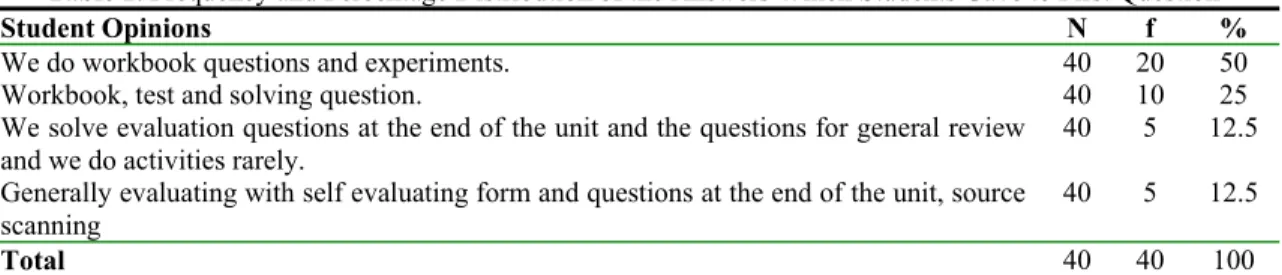
Eight questions were asked to students for determining students’ opinions about the game. Students’ answers were categorised according to their similarities and the tables below were arranged: Table 1 shows frequency and percentage distribution of the given answers to question by the students: “1. Which evaluation activities do your teacher use at the end of the topic?”
Table 1. Frequency and Percentage Distribution of the Answers Which Students Gave to First Question
Student Opinions N f %
We do workbook questions and experiments. 40 20 50
Workbook, test and solving question. 40 10 25
We solve evaluation questions at the end of the unit and the questions for general review and we do activities rarely.
40 5 12.5 Generally evaluating with self evaluating form and questions at the end of the unit, source
scanning 40 5 12.5
Total 40 40 100
When the answers that students gave to the “Which evaluation activities does your teacher use at the end of the topic?” question investigated, as seen on Table 1; 50% (f=20) of the students said they are evaluated with the questions in the workbook and with the experiments and 25% (f=10) of them said they are evaluated with the activities in the workbook, tests which were prepared by teachers and the solution of the questions. While 12.5% (f=5) of the students stated that they are evaluated by solving the questions for general review and rarely doing activities, 12.5% (f=5) of them stated that they are evaluated with self evaluating form and questions at the end of the unit. When the answer percentages were investigated, it is seen that traditional evaluation methods are used more.
Table 2 shows frequency and percentage distribution of the given answers to question; “2. How do you feel during the evaluation activities at school? Are you generally relaxed or do you feel anxious?” by the students.
Table 2. Frequency and Percentage Distribution of the Answers Which Students Gave To 2nd Question
Student Opinions N F %
We want to be asked question. 40 13 32.5
We are very relaxed; we don’t have anxiety of exam. 40 12 30 In order to I can’t answer the question, I will get nervous. 40 8 20 I want to be asked question and also I am afraid for answering it wrong. 40 6 15
I feel anxious. 40 1 2.5
Total 40 40 100
On Table 2, according to distribution of the answers which students gave to “How do you feel during the evaluation activities at school? Are you generally relaxed or do you feel anxious?” question, 32.5% (f=13) of the students stated that they didn’t feel disturbed to be asked question and they are willing to answer the questions. Also 30% (f=12) of them said they didn’t feel anxiety of exam and they felt relax during the activities. On the other end, 20% (f=8) of them said they would get nervous in order to thought they couldn’t answer the question, 15% (f=6) of them said they wanted to be asked question but they were afraid for answering it wrong and 2.5% (f=1) of them stated he feel anxious during the activities. Findings points out most of the students feel relaxed during the activities in class. But it is seen that 37.5% (f=15) of the students have negative emotions during the evaluation activities. When the answers are analyzed, it is conspicuous that students are evaluated with questioning activities.
Frequency and percentage distribution of the given answers by the students to question; “3.You were evaluated with “Space Hunters” game. How differences appeared between the feelings during the other evaluation activities and this one? Can you compare?” are shown on Table 3.
Table 3. Frequency and Percentage Distribution of the Answers Which Students Gave To 3rd Question
Student Opinions N f %
We didn’t feel anxious; we wanted the turn came to us quickly. 40 20 50 We weren’t afraid of can’t answering questions; we understood the topic much better. 40 7 17.5
It is relaxed and beautiful, it looks like Monopoly. 40 5 12.5
It is visual and enjoyable, it’s not like exam. 40 5 12.5
I felt anxious in order to can’t answering questions. 40 2 5
I didn’t fell anxious, because there isn’t any punishment. 40 1 2.5
Total 40 40 100
According to distribution of the answers -as seen from Table 3- which students gave to “You were evaluated with “Space Hunters” game. How differences appeared between the feelings during the other evaluation activities and this one? Can you compare?” question, 50% (f=20) of the students said they hadn’t felt anxious and they had wanted the turn had come to them quickly. 17.5% (f=7) of them expressed they hadn’t been afraid of answering questions and they had understood the topic much better, 12.5% (f=5) of them said they had been relaxed while they had played the game, the game was beautiful and looked like Monopoly, 12.5% (f=5) of them thought it was visual and enjoyable, it wasn’t like having exam and 2.5% (f=5) of them she hadn’t felt anxious because there weren’t any punishment in the game. It is seen that 95% (f=38) of the students didn’t have any negative emotion. But 5% (f=2) of them expressed that they feel anxious about can’t answering the questions correctly.
Table 4 shows frequency and percentage distribution of the given answers to “4. Do you have difficulty in understanding the game rules? Which rules you don’t like?” question by the students.
Table 4. Frequency and Percentage Distribution of the Answers Which Students Gave to 4th Question
Student Opinions N f %
The rules were easy but I didn’t like to give parts. 40 20 50 Rules are easy, giving parts is bad but taking them is good. 40 10 25
I didn’t have any problem. 40 7 17.5
Easy. Giving parts and waiting for two turns are bad. 40 3 7.5
Total 40 40 100
According to answers that students gave to “Do you have difficulty in understanding the game rules? Which rules you don’t like” question, it is seen on table 4 that students didn’t have difficulties in understanding the rules. On the other hand 50% (f=20) of the students didn’t like the traps which they have to give puzzle parts, 25% (f=10) of them didn’t like giving parts but like taking them and 7.5% (f=3) of them again didn’t like giving puzzle parts and waiting for two turns. 17.5% (f=7) of the students stated that they didn’t have any difficulties in understanding the rules.
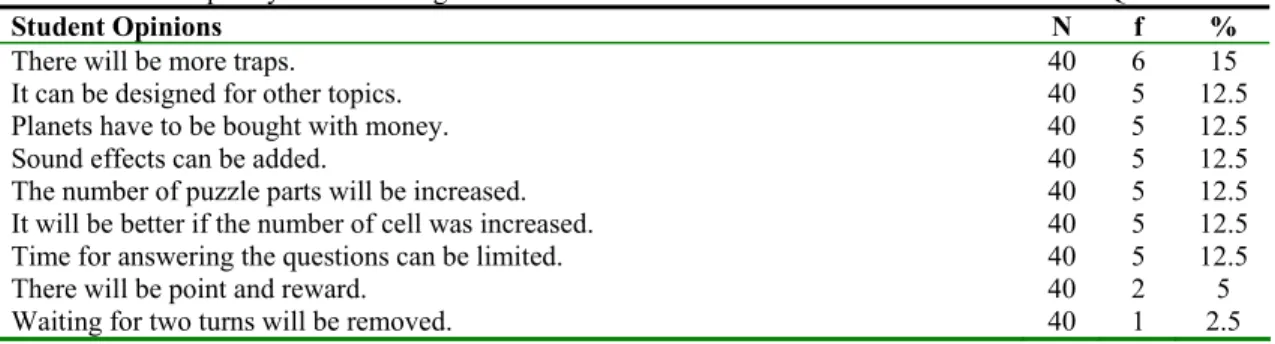
Frequency and percentage distribution of the given answers to “5. Do you have suggestions for the game?” question by the students are displayed on Table 5.
Table 5. Frequency and Percentage Distribution of the Answers Which Students Gave to 5th Question
Student Opinions N f %
There will be more traps. 40 6 15
It can be designed for other topics. 40 5 12.5
Planets have to be bought with money. 40 5 12.5
Sound effects can be added. 40 5 12.5
The number of puzzle parts will be increased. 40 5 12.5
It will be better if the number of cell was increased. 40 5 12.5
Time for answering the questions can be limited. 40 5 12.5
There will be point and reward. 40 2 5
Every planet will have point and the one who falls in black hole go down to zero point. 40 1 2.5
Total 40 40 100
According to answers, that students gave for “Do you have suggestions for the game?” question, as seen on Table 5; while 15% (f=6) of the students suggested increasing the number of traps, 12.5% (f=5) of them said it can be prepared for other topics. 12.5% (f=5) of students suggested that some money would be added to game and planets had to be bought with money, 12%.5 (f=5) of them suggested that it could be sound effects which players would use when they wanted to answer the questions or when the answer wasn’t right, 12.5% (f=5) of them wanted number of puzzle parts to be increased and 12.5% (f=5) of them wanted number of cells to be increased, 12.5% (f=5) of them thought that time had to be limited for answering, 5% (f=2) of them thought there would be point or reward in the game, 2.5% (f=1) of them suggested the trap which they have to wait for two turns would be removed and 2.5% (f=1) of them suggested that every planet would have a particular point and the player who fell in black hole would go down to zero point.
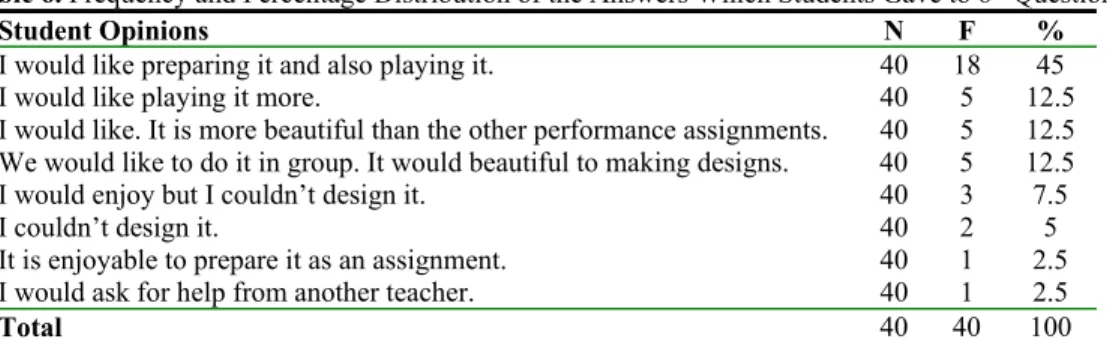
They are shown on Table 6 that; frequency and percentage distribution of the given answers to “6. Would you like to do it if this game is given you as a performance assignment?” question by the students.
Table 6. Frequency and Percentage Distribution of the Answers Which Students Gave to 6th Question
Student Opinions N F %
I would like preparing it and also playing it. 40 18 45
I would like playing it more. 40 5 12.5
I would like. It is more beautiful than the other performance assignments. 40 5 12.5 We would like to do it in group. It would beautiful to making designs. 40 5 12.5
I would enjoy but I couldn’t design it. 40 3 7.5
I couldn’t design it. 40 2 5
It is enjoyable to prepare it as an assignment. 40 1 2.5
I would ask for help from another teacher. 40 1 2.5
Total 40 40 100
For the “Would you like to do it if this game is given you as a performance assignment?” question, 45% (f=18) of the students stated that they would like to prepare the game as assignment and also would like to play it as seen from Table 6. While 12.5% (f=5) of them said they would more like to play, 2.5% (f=1) of them said that preparing as an assignment would be more funny. 12.5% (f=5) of the students expressed if it was compared with the other assignments, this would attract their attention more, 12.5% (f=5) of them stated that if they had an assignment like this, they would more like to do it in groups, 7.5% (f=3) of them said they would enjoy it but they couldn’t design it and 2.5% (f=1) of them said that while preparing it he could ask for help from another teacher.
Table 7 shows frequency and percentage distribution of the given answers to “7. Is this game have to be used in the lessons in your opinion?” question by the students.
Table 7. Frequency and Percentage Distribution of the Answers Which Students Gave to 7th Question
Student Opinions N f %
It will be noisy but it is enjoyable and we can understand much better. 40 15 37.5
It will be noisy; it will be difficult to teach lesson. 40 5 12.5
If the total of class is less, it will be good. If not there will be noise and it can’t be
controlled. 40 5 12.5
It has to be used absolutely. 40 5 12.5
It must be lesson and after lesson game in order. 40 5 12.5
It can be applied at the end of the unit. Otherwise it is boring to play game always. 40 5 12.5
Total 40 40 100
When the answers of the students that they given for “Is this game have to be used in the lessons in your opinion?” question were investigated, it is seen on the Table 7 that; 37.5% (f=15) of the students said it would be noisy while playing the game in class but it would be enjoyable and they could understand the topics much better. 12.5% (f=5) of them thought it would difficult to teach lesson, because it would be noisy and 12.5% (f=5) of them said if the total of class was less the application would be easier, because there would be less noise.
12.5% (f=5) of the students thought that games like this absolutely had to be used, 12.5% (f=5) of them thought that they had to do a revising lesson before the lesson that they would play the game and 12.5% (f=5) of them thought that it would be boring when they played it except at the end of the units.
Table 8 shows frequency and percentage distribution of the given answers to question by the students; “8. Would you like this game to be applied to other units? Which units will it be applied to in your opinion? Why?”
Table 8. Frequency and Percentage Distribution of the Answers Which Students Gave to 8th Question
Student Opinions N F %
Physics is already boring; it will be more enjoyable. It can be applied all of the lessons. 40 10 25
Physics, because it is difficult. 40 6 15
Human and Nature, The Structure of The Matter and Physics; because they are enjoyable
and attractive. 40 5 12.5
Physics, because it is boring. 40 5 12.5
Human and Nature, Electricity, Acid- Base, Atom; because there are conceptions which
need information. 40 4 10
Chemistry; it is difficult, because there are formulas. 40 4 10
Ecosystem, Maths and the other lessons, because it is largely about conceptions. 40 4 10
Biology; because it attracts my attention. 40 1 2.5
Chemistry; because it is enjoyable. 40 1 2.5
Total 40 40 100
On Table 8; according to distribution of the answers that students gave to “Would you like this game to be applied to other units? Which units will it be applied to in your opinion? Why?” question, it was found that 37.5% (f=15) of the students wanted it to be designed for Physics because they thought this lesson was boring and they also thought it would be good to design games like this about the other lessons. And it was found that 15% (f=6) of them wanted a game about Physics because it was difficult, 12.5% (f=5) of them wanted games about Human and Nature, The Structure of The Matter and Physics topics; because they thought these topics were enjoyable and attractive, 10% (f=4) of them wanted games about Human and Nature, Electricity, Acid-Base and Atom topics; because they thought there were conceptions which need information in these topics, 12.5% (f=5) of them wanted games about Chemistry for making easy to understand chemical formulas and finding this lesson enjoyable, 10% (f=4) of the students wanted games about Ecosystem topic and the lessons like Maths and 2.5% (f=1) of them wanted a game about Biology; because it attracted her attention.
RESULTS AND DISCUSSION
In this study, following results were gotten by gathering teachers’ and students’ thoughts about the “Space Hunters” game.
• It was found that teachers’ opinions were similar about the evaluation activity which took place in this study would increase the students’ motivation. Also Pinder (2008) determined that board games were very effective to increase students’ motivation according to teacher thoughts in a study.
• Most of the teachers stated that this game could be applied during the lesson and be used for reinforcement. According to Güllü, Bozkurt and Bali’s (2009) study, teachers thought that educational games could be used in lessons.
• Participating teachers stated that they didn’t have difficulties in understanding games like this. But some teachers expressed they hesitated about how they could use it as an evaluation activity. It can be planned to develop a grading key for putting away teachers’ this problem.
• It was found that presenting a game like this ready-made would increase the rate of usage. Then correspondents’ attention must be called to this subject as soon as possible.
• It was found that traditional evaluating methods were usually used at lessons and some of the students couldn’t express themselves because of their negative emotions during these activities. But it is seen that these negative emotions decreased during the activity with the game in this study.
• It was seen that students who played this game didn’t have difficulty in understanding the rules and they quite enjoyed this game. It is the most important indication of this situation that students wanted the number of puzzle parts and the number of cells to be increased. Also in the other studies it was found that students were enjoy the game activities (Aycan et. al., 2002, Smith, 2002, Cordona et. al., 2008)
• While it was determined that most students weren’t like some traps in the game, some students suggested to increasing the number of traps. This seems inconsistent, but it can be explained as students liked taking puzzle parts and didn’t like giving them through the traps.
• The game can be adapted to the other topics and the other units in Science and Technology course as well as similar games can be prepared for other lessons. Especially preparing games for the units and topics that contains lots of abstract conceptions will make easy to teach these conceptions (Tatar & Cansüngü Koray, 2005). Also it will be beneficial that looking to students opinions while preparing the game.
It is the subject of further studies to develop the game according to teacher and student suggestions and to compare students’ achievements in the game activity with their achievements in the other activities. Also, for making easier to evaluate student achievements, it can be thought to develop a rubric in other studies. It was seen that games increased the student motivation and results of a study about its effects on examination anxiety would be important.
ACKNOWLEDGEMENT
Synopsis of this study was presented in VIII. National Science and Mathematics Education Congress in Bolu, Turkey.
REFERENCES
Altunay, D. (2004). Oyunla Desteklenmiş Matematik Öğretiminin Öğrenci Erişisine ve Kalıcılığa Etkisi. Yüksek Lisans Tezi. Ankara: Gazi Üniversitesi.
Aycan, Ş., Türkoğuz, S., Arı, E., & Kaynar, Ü. (2002). Periyodik Cetvelin ve Elementlerin Tombala Oyun Tekniği ile Öğretimi ve Bellekte Kalıcılığının Saptanması. V. Ulusal Fen Bilimleri ve Matematik Eğitimi Kogresinde Sunulmuş Bildiri.
Baines, L. A., Slutsky, R. (2009). Developing the Sixth Sense: Play. Educational Horizons, 87(2), 97-101. Cardoso, F. S., Dumpel, R., Gomes da Silva, L. B., Rodrigues, C. R., Santos, D. O., Cabral, L. M., Castro, H. C.
(2008). Just Working With The Cellular Machine. Biochemistry and Molecular Biology Education, 36(2) 120-124.
Cordona, S., Spiegel, N. C., Alves, G. G., Ducommun, J., Pons, A. H., Arau’jo- Jorge, T. C. (2007). Introducing DNA Concepts to Swiss High School Students Based on a Brazilian Educational Game. Biochemistry and Molecular Biology Education, 35(6), 416-421.
Dağbaşı, G. (2007). Oyun Tekniği ve Arapça Öğretiminde Kullanımı. Yüksek Lisans Tezi . Ankara: Gazi Üniversitesi.
Dewey, J. (1998, originally published in 1938). Experience and Education. Kappa Delta Pi, Indiana.
Egemen, A., Yılmaz Ö., & Akil, İ. (2004). Oyun, Oyuncak ve Çocuk. ADU Tıp Fakültesi Dergisi, 5(2), 39-42. Ergün, M. (1980). Oyun ve Oyuncak Üzerine-I. Retrieved July 17, 2008 from http://egitim.aku.edu.tr/oyun.pdf Fırat, M. (2007). Yabancı Dil Öğretiminde Oyunun Kullanımı. Yüksek Lisans Tezi. Erzurum: Atatürk
Üniversitesi
Gelbal, S., & Kelecioğlu, H. (2007). Öğretmenlerin Ölçme ve Değerlendirme Yöntemleri Hakkındaki Yeterlik Algıları ve Karşılaştıkları Sorunlar. Hacettepe Üniversitesi Eğitim Fakültesi Dergisi, 33, 135-145. Gulick, L. H. (1920). Philosophy of Play. Association Press, USA.
Güllü, D., Bozkurt, E., Bali, G. (2009). Ortaöğretim 12. Sınıf Öğrencileri İçin Kimya Derslerinde Oyun ile Eğitim: Organik Bileşiklerin Adlandırılması Oyunu. Uluslar arası V. Balkan Eğitim ve Bilim Kongresinde Sunulmuş Bildiri.
Gürses, A., Doğar, Ç., & Yalçın, M. (2002). Isı ve Sıcaklık Konusunun Öğretiminde Sürekli Değerlendirmeye Dayalı Öğretimin Etkinliğinin İncelenmesi. V. Ulusal Fen Bilimleri ve Matematik Eğitimi Kogresinde Sunulmuş Bildiri.
Groos, K. (1919). The Play of Man. Appleton, Minnesota.
Huizinga, J. (2003, originally published in 1938). Homo Ludens: A Study of the Play Element in Culture. Routledge, London.
Kaya, Ü. Ü. (2007). İlköğretim I. Kademe Derslerinde Oyun Tekniğinin Erişiye Etkisi. Yüksek Lisans Tezi. Afyonkarahisar: Kocatepe Üniversitesi.
Moğol, S., & Özçifçi, S. (2003). Fizikte Bazı Denklemlerin Öğretimi İçin Kart Oyunu. Retrieved July 03, 2008 from http://yayim.meb.gov.tr/dergiler/157/mogol.htm
Özsevgeç, T. (2006). Kuvvet ve Hareket Ünitesine Yönelik 5E Modeline Göre Geliştirilen Öğrenci Rehber Materyalinin Etkililiğinin Değerlendirilmesi. Türk Fen Eğitimi Dergisi. 3(2), 36-48.
Pinder, P. J. (2008). Utilizing Instructional Games to Improve Students' Conceptualization of Science Concepts: Comparing K Students Results with Grade 1 Students, Are There Differences? Regional Eastern Educational Research Association Conference. Hilton Head Island.
Romine, X. (2004). Using Games in the Classroom to Enhance Motivation, Participation, and Retention: A Pre-test and Post-Pre-test Evaluation. Culminating Experience Action Research Projects, 5, 283-295.
Smith, D. R. (2003). "Voyager" an Educational Card game. Phsics Education, 38(1), 47-51. Songur, A. (2006). Harfli İfadeler ve Denklemler Konusunun Oyun ve Bulmacalarla Öğrenilmesinin
Öğrencilerin Matematik Başarı Düzeylerine Etkisi. Yüksek Lisans Tezi. İstanbul: Marmara Üniversitesi Susüzer, K. (2006). Oyun Yoluyla Fransızca Öğretimi. Yüksek Lisans Tezi. Adana: Çukurova Üniversitesi. Şaşmaz Ören, F., Erduran Avcı, D. (2004). Eğitimsel Oyunla Öğretimin Fen Bilgisi Dersi “Güneş Sistemi Ve
Gezegenler” Konusunda Akademik Başarı Üzerine Etkisi. Ondokuz Mayıs Üniversitesi Eğitim Fakültesi Dergisi. 18, 67-76.
Şimşek, A. (2007). Sınıf Öğretmenliği Öğrencilerinin Sosyal Bilgiler İçin Tasarladıkları Etkinliklerde
Kullandıkları Strateji, Yöntem, Teknik ve Öğretim Materyalleri ve Bunları Tercih Nedenleri. VI. Ulusal Sınıf Öğretmenliği Sempozyumunda Sunulmuş Bildiri.
Şimşek, S. (Güz 2000). Fen Bilimlerinde Değerlendirmenin Önemi. Retrieved July 20, 2008 from http://yayim.meb.gov.tr/dergiler/148/7.htm
Tatar, N., & Cansüngü Koray, Ö. (2005). İlköğretim Sekizinci Sınıf Öğrencilerinin “Genetik” Ünitesi Hakkındaki Kavram Yanılgılarının Belirlenmesi. Kastamonu Eğitim Dergisi, 13(2), 415-426 Yelken, T. Y. (2006). İlköğretim Sınıf Öğretmeni Adaylarının Sosyal Bilgiler Dersinde Tamamlayıcı
Değerlendirme Yaklaşımları Konusundaki Görüşleri. Sosyal Bilimler Araştırmaları Dergisi, 2, 58-75. Walker, P., & Wood, E. (1994). Hands on General Science Activities; With Real Life Applications. A Wiley
APPENDIX A
A COMPARISON BETWEEN THE OCCURRENCE OF PAUSES, REPETITIONS
AND RECASTS UNDER CONDITIONS OF FACE-TO-FACE AND
COMPUTER-MEDIATED COMMUNICATION: A PRELIMINARY STUDY
Nese CABAROGLUFaculty of Education, Cukurova University, Turkey Email: [email protected]
Suleyman BASARAN
Faculty of Education, University of Gaziantep, Turkey
Corresponding Author, Email: [email protected] , Tel: (+90) 5065361921 Institute of Education, University of Reading, UK
Email: [email protected] ABSTRACT
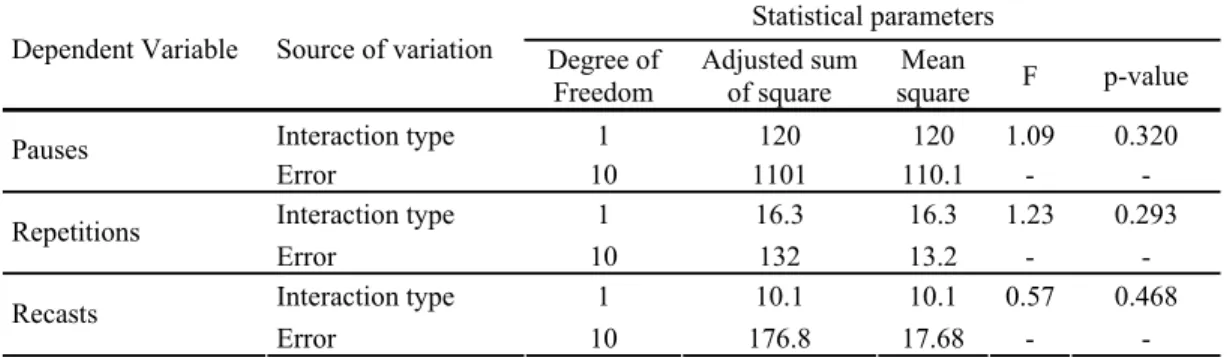
This study compares pauses, repetitions and recasts in matched task interactions under face-to-face and computer-mediated conditions. Six first-year English undergraduates at a Turkish University took part in Skype-based voice chat with a native speaker and face-to-face with their instructor. Preliminary quantitative analysis of transcripts showed that there were frequent instances of pauses, repetitions and recasts under both conditions. One-way variance analysis of the data demonstrated that the comparative frequency of pauses, repetitions and recasts did not differ statistically significantly under the two conditions. A semi-structured interview with the participants on perceived causes of such frequent elements suggested social and emotional reasons for hesitation, pauses, recasts and repetitions. These small-scale and preliminary findings suggest that further exploration of these modes of communication is merited, and that social and emotional factors may exert a common influence on the linguistic elements studied under both conditions.
Keywords: Computer-mediated communication, Learning English as a foreign language, Pause, Recast, Repetition, Social and emotional factors
INTRODUCTION
Claimed benefits of computer-mediated communication (CMC)
There is evidence that computer-mediated communication benefits “English as a foreign language” students’ communication skills. Dietz-Uhler and Bishop-Clark (2001) affirm positive effects of both synchronous and asynchronous CMC on consecutive face-to-face discussions. Heins et.al. (2007) report improved student participation, better use of the target language and higher degree of tutor control in computer-mediated communication in comparison with face-to-face interaction in language tutorials. Positive effect of CMC in reducing communication apprehension (Arnold, 2007) and improving the quality of language output (Keller-Lally, 2006) has also been reported. CMC literature also indicates positive learning outcomes such as enhanced motivation (Cabaroglu & Roberts, 2007), increased learner autonomy (Schwienhorst, 2003; Kötter, 2003), reflective interaction (Lamy and Goodfellow, 1999), self-paced language instruction (Yang and Chen, 2006; Godwin-Jones, 2007), enhanced student-centeredness and collaboration (Warchauer, 1996) and consciousness of learning objectives (Yamada & Akahori, 2007). Also reported are positive effects for syntactic complexity (Tammelin (2004) and grammatical accuracy (Warchauer, 1996; Shang, 2007) and productive performance ( Yamada & Akahori, ibid.). Payne and Whitney’s (2002) study indicated that participants in the experimental condition (synchronous computer-mediated communication) scored significantly higher in L2 oral proficiency assessments than the participants in the control condition.
CMC as a distinctive mode of communication
The extent to which CMC communication differs from face-to-face is under debate. Böhlke (2000), describing language produced in chat rooms and face-to-face discussion groups, asserts that the output produced in synchronous computer-mediated communication constitutes “a new type of orality, a hybrid between spoken and written discourse” (p.1) In contrast, Fischer (1992) claims that “basic social patterns are not easily altered by new technologies and that they are resilient even to widespread innovations” (p.260). Fischer (1997) further asserts that effects of technology for community are: “(a) modest; (b) different for different devices, so that one cannot make blanket statements about “technology”; and (c) complex, indirect and even contradictory” (p.113). This is supported by Weisband (1995) who found that status effects persist in both face-to-face and electronic groups and that status labels and impressions have a larger impact on participation and influence than communication mode.
CMC as an opportunity for intercultural contact
In contexts where teachers and learners of English as a foreign language have limited direct access to native speakers and target language and culture, as in many parts of Turkey, CMC can offer authentic opportunities for the acquisition of target language skills and intercultural awareness (Shulman, 2001; Chapelle, 2003; Hamzah, 2004). Egbert (2005:5) asserts that “computer tools, particularly Internet support for computer-mediated communication (CMC), give us different opportunities than afforded by other tools.” Meskill, (2005) and Levy (2007) argue that it provides support for effective acquisition.
Pauses, repetitions and recasts
In our preliminary small study we focus on conversational gaps to explore the effects of different interactional conditions. Conversational gaps can be either hesitation pauses, switching pauses or initiative time latencies. Following Kalman, et al. (2006) we define ‘hesitation pauses’ as within-turn pauses by the speaker and ‘switching pauses’ as silences followed by turn-taking. Initiative time latencies are the gaps left by a speaker to terminate his turn, and thus allowing the interlocutor to initiate his.
Repetitions are defined as a simple form of recasts, which entail an elaborated grammatical or lexical change (Gass, 2003). Recasts are defined by Gass (2003, p. 239) as “instances in which an interlocutor rephrases an incorrect utterance with a corrected version, while maintaining the integrity of the original meaning.” A number of studies have focused on recasts as implicit negative feedback by an interlocutor (e.g. Lyster & Ranta, 1997; Lyster, 1998). On the other hand, Doughty (2003) asserts that especially concentrated simple recasts, in other words ‘repetitions’, for which learners are developmentally ready, are beneficial to learners. In the present study, we take any repetition of words that involve partial or complete change as a recast. Here, the term “recast” does not mean corrections done by the instructor, but rather, it is taken to mean corrective or allegedly corrective re-wording or, in some instances, paraphrasing strategy used by learners that participated in the communication tasks, despite the fact that the term is commonly used for the correction done by the interlocutor (e.g. Hauser, 2005).
Previous research has focused on pauses, repetitions and recasts as evidence for the learner to enhance either his comprehension or production of linguistic forms. This study takes another perspective. We focus on utilization of these elements by the learner himself/herself, excluding the role of these elements in turn-taking. We take them as possible indicators of fluency, of the emotional and interpersonal barriers a learner has to overcome during face-to-face and computer-mediated communication tasks when communicating with highly fluent and competent native-speaker and non-native speaker interlocutors. We therefore hypothesized that the relative frequency of such elements in computer-mediated and face-to-face communication tasks should improve our understanding of the effects of these conditions on participants’ performance, and of the social and emotional dynamics at work. The critical need to improve the training of undergraduate English teachers, which motivates the present study, is shown in the following section.
Context of the study: limited communication skills of English teachers in Turkey
The six undergraduate students in our study were embarking on a four-year teacher training program. In contemporary Turkey, where foreign language teacher training is quite problematic (Demirel, 1999; Toktar; 2000; Özyar, 2003), the employment of sufficient numbers of competent and proficient teachers of English is a critical issue for the Ministry of Education (Üstüner, 2004). Most English teaching vacancies are filled, but application rates are so low that university graduates do not have to compete for employment, and also The Ministry fills some vacancies with non-specialists (see Table 1). Additionally, the professional development of teachers is limited since the Ministry of Education does not have an effective control and inspection system and in-service training programs are scarce and ineffective (Karaata, 2007).
Table 1 English teachers’ field of study and the number of teachers graduated from each field
Field of Study Number
English Language Teaching (Faculty of Education) 7654
British and/or American Literature, Translation, Linguistics, etc. 2788
Other Fields 23526
Total 33968
Source: English and Computer Literacy Report (ÖBBS, 2006), Turkish Ministry of Education.
Furthermore, the Ministry’s English and Computer Literacy Report (ÖBBS, 2006) on the self-perceived qualifications and proficiency level of 855 teachers of English working in randomly selected 492 state primary schools indicates that 36.4 % of those surveyed state that they do not understand what they read in English and