Citation: de Vries, Reinout, Tybur, Joshua, Pollet, Thomas and van Vugt, Mark (2016) Evolution, situational affordances, and the HEXACO model of personality. Evolution and Human Behavior, 37 (5). pp. 407-421. ISSN 1090-5138
Published by: Elsevier
URL: https://doi.org/10.1016/j.evolhumbehav.2016.04.001
<https://doi.org/10.1016/j.evolhumbehav.2016.04.001>
This version was downloaded from Northumbria Research Link: http://nrl.northumbria.ac.uk/31932/
Northumbria University has developed Northumbria Research Link (NRL) to enable users to access the University’s research output. Copyright © and moral rights for items on NRL are retained by the individual author(s) and/or other copyright owners. Single copies of full items can be reproduced, displayed or performed, and given to third parties in any format or medium for personal research or study, educational, or not-for-profit purposes without prior permission or charge, provided the authors, title and full bibliographic details are given, as well as a hyperlink and/or URL to the original metadata page. The content must not be changed in any way. Full items must not be sold commercially in any format or medium without formal permission of the copyright holder. The full policy is available online: http://nrl.northumbria.ac.uk/pol i cies.html
This document may differ from the final, published version of the research and has been made available online in accordance with publisher policies. To read and/or cite from the published version of the research, please visit the publisher’s website (a subscription may be required.)
Article in Evolution and Human Behavior · April 2016 DOI: 10.1016/j.evolhumbehav.2016.04.001 CITATIONS 30 READS 1,402 4 authors:
Some of the authors of this publication are also working on these related projects:
Eyes Wide Open View project
Personality and LeadershipView project Reinout E. de Vries
Vrije Universiteit Amsterdam
112PUBLICATIONS 3,128CITATIONS SEE PROFILE
Joshua Tybur
Vrije Universiteit Amsterdam
73PUBLICATIONS 4,062CITATIONS SEE PROFILE Thomas Pollet Northumbria University 134PUBLICATIONS 2,356CITATIONS SEE PROFILE
Mark Van Vugt
VU University Amsterdam and University of Oxford
191PUBLICATIONS 7,628CITATIONS SEE PROFILE
All content following this page was uploaded by Reinout E. de Vries on 12 April 2016.
Reinout E. de Vries, Joshua M. Tybur, Thomas V. Pollet, Mark van Vugt
PII: S1090-5138(16)30038-1
DOI: doi:10.1016/j.evolhumbehav.2016.04.001
Reference: ENS 6044
To appear in: Evolution and Human Behavior
Received date: 7 June 2015
Revised date: 21 March 2016
Accepted date: 3 April 2016
Please cite this article as: de Vries, R.E., Tybur, J.M., Pollet, T.V. & van Vugt, M.,
Evolution, situational affordances, and the HEXACO model of personality,Evolution and
Human Behavior (2016), doi: 10.1016/j.evolhumbehav.2016.04.001
This is a PDF file of an unedited manuscript that has been accepted for publication. As a service to our customers we are providing this early version of the manuscript. The manuscript will undergo copyediting, typesetting, and review of the resulting proof before it is published in its final form. Please note that during the production process errors may be discovered which could affect the content, and all legal disclaimers that apply to the journal pertain.
ACCEPTED MANUSCRIPT
Running head: EVOLUTION, SITUATIONS, AND HEXACO PERSONALITY
Evolution, Situational Affordances, and the HEXACO Model of Personality
Reinout E. de Vries, Joshua M. Tybur, Thomas V. Pollet, & Mark van Vugt Vrije Universiteit Amsterdam
Main text: 11,521 Footnotes: 452 Tables: 1,125
Correspondence concerning this article may be addressed to Reinout E. de Vries, Vrije Universiteit Amsterdam, Department of Experimental and Applied Psychology, Van der
ACCEPTED MANUSCRIPT
Boechorststraat 1, 1081 BT, Amsterdam, The Netherlands, tel: +31-20-5988718, e-mail: [email protected]
ACCEPTED MANUSCRIPT
Abstract
The existence of individual differences in personality can be puzzling from an evolutionary perspective. This paper offers a general framework for addressing this puzzle by combining insights from evolutionary, situational, and personality perspectives. To arrive at this framework, we first discuss three key evolutionary models for explaining personality variation: (1) selective neutrality, (2) mutation-selection balance, and (3) balancing selection. Second, we review four models of personality: (1) the General Factor of Personality, (2) The Big Two, (3) the Big Five, and (4) the six-dimensional HEXACO model. Third, we use situational affordances and trait activation perspectives to offer an integrative model of HEXACO domain-specific situational affordances. Finally, we use these perspectives to provide 18 propositions about situation, trait, and outcome activation (STOA) mechanisms which may help explain the maintenance of individual differences in six dimensions of personality.
ACCEPTED MANUSCRIPT
Evolution, Situational Affordances, and the HEXACO Model of Personality Individual differences lie at the heart of many evolutionary psychological theories and research programs. In laboratory settings, experimental evolutionary psychologists frequently find that individual differences interact with experimental manipulations—i.e., that particular ecological factors are associated with specific responses in certain individuals (e.g., Ainsworth & Maner, 2012; Maner et al. 2007; Mortensen et al., 2010; Park et al., 2003). Outside of the
laboratory, individual differences in personality have been found both to affect the selection of environments that afford the expression of certain behaviors (e.g., Camperio Ciani & Capiluppi, 2011; Camperio Ciani et al., 2007; Chen et al., 1999; Matthews & Butler, 2011), and to relate to fitness-relevant outcomes, including mortality, physical health, divorce rates, and occupational success (e.g., Booth-Kewley & Vickers, 1994; Ozer & Benet-Martínez, 2006; Roberts et al., 2007). Laboratory and field findings thus seem to suggest that individual differences in
personality influence the situations people encounter and select, how people react to situations, and what outcomes people obtain. Given the potential implications of these findings for our understanding of the evolution of human behavior, it is unsurprising that scholars have called for integrations between evolutionary and personality perspectives (e.g., Buss, 1991; Buss, 2009; Buss & Hawley, 2010; MacDonald, 1995; Michalski & Shackelford, 2010; Nettle, 2006; Nettle & Penke, 2010; Penke et al., 2007). Although progress has been made in this respect (e.g., MacDonald, 1995; Nettle, 2006), the last 10 years have seen critical developments in not only personality but also in situational psychology—a topic highly relevant to our understanding of the evolution of personality. Hence, now is an opportune time to reappraise where we stand, what we know, and what questions remain.
ACCEPTED MANUSCRIPT
integrating (1) a balancing selection account (Penke et al., 2007), (2) the HEXACO model of personality (Ashton et al., 2014), (3) domain-specific situational affordances (DSSA) based on the DIAMONDS situations model (Rauthman et al., 2014; Reis, 2008), and (4) situation, trait, and outcome activation (STOA) mechanisms (e.g., Buss, 1987; Tett & Burnett, 2003). To
accomplish this, we first review different perspectives on the origins of personality variation. We then provide an overview of prominent models of personality, including the General Factor of Personality model (Musek, 2007), the Big Two model (DeYoung, 2006), the Big Five model (Goldberg, 1990), and the six-factor HEXACO model (Ashton et al., 2014). Subsequently, we use a balancing selection account to inform our thinking about trade-offs between high and low levels of the HEXACO personality dimensions. Furthermore, we combine insights from
balancing selection and the HEXACO model with recent work on situational affordances (Rauthman et al., 2014; Sherman et al., 2015) and situation, trait, and outcome activation mechanisms (Buss, 1987; Tett & Burnett, 2003), which allow us to more fully specify in what way different traits (i.e., personality factors) may yield functional benefits. We conclude by detailing a number of propositions implied by this proposed integration between evolutionary, personality, and situational perspectives.
1. The enigma of personality variation1
From an evolutionary perspective, the existence of individual differences in human personality can be enigmatic. All else being equal, natural selection tends to weed out variation that deviates from optimal adaptations to the local environment (Tooby & Cosmides, 1990). Variability in personality should thus result from either selective neutrality (i.e., the absence of optimal traits in a given environment) or mutation-selection balance (i.e., a high rate of mutation, offsetting selection pressures). Empirically, however, selective neutrality and mutation-selection
ACCEPTED MANUSCRIPT
balance appear to offer inadequate—or at least incomplete—explanations of personality
variation. That is, the presence of fitness consequences (Ozer & Benet-Martínez, 2006; Roberts
et al., 2007) and the preponderance of non-additive genetic variance (VNA) relative to additive
genetic variance (VA) in personality traits (Penke et al., 2007; Verweij et al., 2012)2 seem to run
counter to selective neutrality predictions. Similarly, small and often counterbalancing effects of mutations in coding Single Nucleotide Polymorphisms (SNPs) on personality seem inconsistent with predictions based only on mutation-selection balance (e.g., McCrae et al., 2010).
Balancing selection, which posits that genetic polymorphisms are maintained because the fitness pay-offs of resulting phenotypes vary across time and place, offers one potential solution to the personality puzzle (Penke et al., 2007). Two special cases of balancing selection include frequency-dependent selection (Buss, 2009; Dall et al., 2004; Nettle, 2006) and niche
specialization (Bergmüller & Taborsky, 2007; Montiglio et al., 2013). Under
frequency-dependent selection, the fitness of alternate genotypes varies as a function of their prevalence in the population (Ayala & Campbell, 1974; Gangestad & Simpson, 1990; Wilson, 1998). In contrast, niche specialization (or: environmental heterogeneity) refers to conditions under which the fitness of alternate genotypes varies as a function of different pay-offs in different
environments (Bergmüller & Taborsky, 2007; Montiglio et al., 2013; Penke et al., 2007). Whereas fitness pay-offs vary with the prevalence of alternate genotypes under frequency
dependent selection, fitness pay-offs are not dependent on the prevalence of an alternate
genotype under niche specialization, but rather result from the ‗match‘ between the genotype and the environment. According to Penke et al. (2007), both niche specialization and frequency-dependent selection result in allele variants, which result in individual differences in
ACCEPTED MANUSCRIPT
result in characteristic reactions to different situations. In combination, these are referred to as personality traits.
This view of personality is not uncontested. Based on SNP data from a sample of more than 8,000 individuals from Finland and Australia, Verweij et al. (2012) concluded that personality variation reflects mutation-selection balance instead of balancing selection or selective neutrality. However, these findings are limited by the fact that, until now, it has been impossible to explain more than 21% of personality variation using SNP data (Penke & Jokela, 2016; Power & Pluess, 2015). Only a handful of SNPs have been found to relate to personality, and questions remain regarding the robustness and replicability of these findings (Plomin, 2013). That is, although most scholars agree that personality is heritable (e.g., Bouchard & Loehlin, 2001; Jang et al., 1998), the genetic loci and mechanisms influencing personality have yet to be identified for most if not all of heritable personality variation (what is known as the ‗missing heritability‘ mystery; James, 2014). Hence, until it is possible to explain a greater amount of heritable personality, findings based on SNP data, including those reported by Verweij et al. (2012), have a limited ability to confirm or falsify selective neutrality, mutation-selection balance, or balancing selection accounts of personality.
With the current state of knowledge, it is reasonable to assume that each process
contributes to the maintenance of personality variation. Selective neutrality maintains variability in personality by allowing for relatively high levels of mutation load due to an absence of optimal trait levels, whereas mutation-selection restricts some of this variability but still causes non-optimal trait levels to be maintained in the population (Ozaki et al., 2003). Balancing selection ensures that relatively large individual differences co-exist in populations because of fluctuating, time and place dependent, optimal trait levels (Penke et al., 2007). In line with others
ACCEPTED MANUSCRIPT
(e.g., Nettle, 2006), we believe that balancing selection probably best explains the origin and maintenance of personality. That is, variation in personality is likely to have arisen because situations differed in the extent to which they benefited individuals with different levels of traits. But what are these traits that vary across individuals? Different models categorize personality variation along different dimensions, and differences between models have important
implications for how we understand the situations that might have given rise to personality variation. Next, then, we turn to this topic: the content of personality trait variation.
2. Competing models of personality
Around the time that Charles Darwin (1871) speculated about the origins of individual differences, Francis Galton (1884), his half-cousin, pondered their structure. Galton‘s (1884) ―lexical‖ approach—counting the number and type of words used to express character—laid the foundation for modern personality research. Research using the lexical method is predicated on the lexical hypothesis (Goldberg, 1981), which is based on the following four assumptions: 1) individual differences that are important in human interactions have been encoded in language, 2) the more important an individual difference is, the more languages have one or more words for it, 3) sufficiently encompassing dictionaries of a language provide a repository of words related to individual differences, and 4) cross-cultural factor analytic studies of dictionary words (most often adjectives) that refer to individual differences in behaviors will reveal the most important dimensions of personality.
The lexical method has led to the emergence of the Big Five (B5; Goldberg, 1990) or Five-Factor Model (FFM; Costa & McCrae, 1992), which comprises the dimensions
Extraversion, Emotional Stability/Neuroticism (B5/FFM), Agreeableness, Conscientiousness, and Intellect/ Openness to Experience (B5/FFM). After the development of the Big Five, the
ACCEPTED MANUSCRIPT
field reached a virtual (if brief) consensus about the structure of personality—a consensus that resulted in an explosion of Big Five research from the 1990s onwards. However, the Big Five is contested by two streams of research. On the one hand, researchers have claimed that the Big Five are not at the apex of personality, but that either one higher-order factor, called the ‗General Factor of Personality‘ (GFP; Musek, 2007) or two higher-order factors (DeYoung, 2006;
Digman, 1997) underlie the Big Five personality dimensions. The GFP model has had an especially strong impact on the evolutionary psychology community, with researchers arguing that the GFP reflects variability in life history strategies, with one pole of the GFP corresponding
with a slow (K-selected) life history strategy, and the other pole corresponding with a fast (r
-selected) life history strategy (Figueredo & Rushton, 2009; Rushton et al., 2008). On the other hand, studies using the exact same lexical data that have yielded the Big Five dimensions have revealed an additional sixth factor of personality—Honesty-Humility—while additionally
resulting in a different interpretation of two Big Five personality dimensions, Emotional Stability and Agreeableness (Ashton et al., 2014; Ashton et al., 2004b).
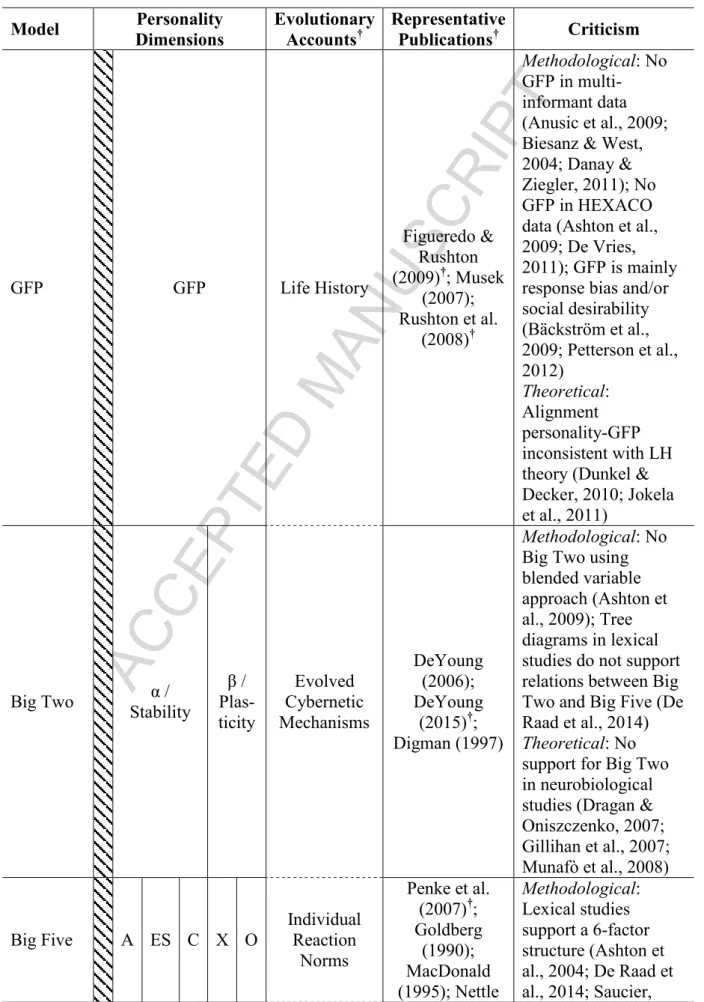
The different positions taken by personality psychologists (i.e., one-, two-, five-, and six-factor solutions) have often bewildered the broader scientific community, leading some— confided in personal communications to the first author—to turn away from the personality structure debate altogether. We believe this to be an unfortunate turn of events. A proper understanding and use of the main personality dimensions is of paramount importance in the exploration of its evolutionary origins and understanding of present-day behavior. To facilitate this understanding, we further discuss each of these four models—which are summarized in Table 1—with a focus on the theoretical and empirical implications for evolution and human behavior.
ACCEPTED MANUSCRIPT
2.1. The General Factor of Personality (GFP)
Findings of a GFP based on Big Five data sparked a great amount of research—especially among psychologists using a Life History (LH) perspective—because of a putative resemblance
between the GFP and the fast (r) versus slow (K) life history dimension proposed by Rushton
(1985). In fact, from a GFP perspective, Rushton‘s (1985) argument that ―An exciting if open-ended possibility is that one basic dimension—K—underlies much of the field of personality‖ (p.
445) can seem prescient. The r/K—or fast/slow—LH continuum has been hypothesized to
underlie several behaviors. Fast (r-selected) LH strategies are associated with earlier and faster
development, earlier sexual debut and more sexual partners, and greater impulsivity and risk
taking. In contrast, slow (K-selected) LH strategies are associated with slower and later
development, later sexual debut and fewer sexual partners, and less impulsivity and risk taking (see Figueredo et al., 2005; Griskevicius et al., 2013; Nettle, 2010).
According to researchers who use LH theory as a framework for understanding
personality (e.g., Figueredo & Rushton, 2009; Rushton et al., 2008), the GFP is well aligned with the LH continuum. Higher scores on the GFP, and thus higher scores on Conscientiousness, Emotional Stability, Agreeableness, Extraversion, and Openness to Experience, putatively reflect
a slow LH (K) strategy. For instance, Figueredo et al. (2007) found that a higher order factor
(posited to reflect LH strategy) extracted from a subset of items of the National Survey of
Midlife Development in the United States correlated strongly (r=.66) with another higher order
factor (posited to reflect the GFP) extracted from a subset of personality items from the same survey.
However, the GFP perspective—and its alignment with the K factor—has received a
ACCEPTED MANUSCRIPT
yield a GFP (Bäckström et al., 2009; De Vries, 2011). Second, trait terms that are similar in meaning, but opposite in valence (e.g., stingy and thrifty) load on opposite poles of a GFP, whereas trait terms that are opposite in meaning, but similar in valence (e.g., thrifty and generous) load on the same pole, which suggests that the GFP represents response bias rather than content (Petterson et al., 2012). Third, when using a Correlated-Traits Correlated Methods (CTCM) approach in a Multi-Trait Multi-Method (MTMM) design, a GFP based on self-ratings was uncorrelated to a GFP based on peer-ratings (Anusic et al., 2009; Biesanz & West, 2004; Danay & Ziegler, 2011). All three points strongly suggest that the GFP reflects instrument variance rather than a real construct.
Finally, personality—unlike cognitive ability—is not a positive manifold. That is, adjectives in the personality sphere are often ‗blends‘ of two or more personality factors, and such blends cannot be consistently associated with either low or high GFP scores—as would be true if the GFP would be the main personality factor. Ashton et al. (2009) showed that models that do not allow for cross-loadings of personality facets on more than one personality factor are more likely to yield a GFP, whereas blended-variable models that do allow for such cross-loadings (and, hence, more accurately reflect personality space) not only provide a better fit to the data, but also show that no higher-order factors exist in both Big Five and HEXACO data. Apart from the evidence suggesting that the GFP does not exist, loadings of Big Five factors on a putative GFP are inconsistent with LH interpretations. Extraversion and Openness to Experience are positively related to offspring number (Jokela et al., 2011), which is arguably
indicative of a fast (r) rather than slow (K) LH strategy. Similarly, sensation seeking and risk
taking, which are posited to reflect a fast LH strategy (Figueredo et al., 2005), are positively related to both Extraversion and Openness to Experience (De Vries et al., 2009c). However, in
ACCEPTED MANUSCRIPT
contrast to the fast LH interpretation, Extraversion and Openness to Experience are positive GFP indicators (i.e., a slow LH strategy). Additionally, sociosexuality, which has been used as an indicator of a fast LH strategy (Van der Linden et al., 2015), is unrelated to a putative GFP (Dunkel & Decker, 2010). In sum, both the existence of the GFP and the proposed alignment between the GFP and LH strategy should be viewed with doubt.
2.2. Two higher-order factors of personality
Instead of arguing for one higher order factor, some scholars suggest that two factors lie at the apex of personality space (DeYoung, Peterson, & Higgins, 2002, Digman, 1997). For instance, in a multi-informant sample DeYoung (2006) found evidence of two uncorrelated higher-order factors in Big Five data. These two factors have been labeled α and β by Digman (1997) and Stability and Plasticity by DeYoung et al. (2002). Stability (α), which is thought to underlie the regulation of disruptive emotions and behaviors, refers to Emotional Stability, Agreeableness, and Conscientiousness, whereas Plasticity (β), which is thought to underlie exploration and proactive behaviors, refers to Extraversion and Openness to Experience.
DeYoung (2015) suggests that these two broad meta-traits constitute ‗Evolved Cybernetic Mechanisms,‘ which allow individuals to adapt their responses to achieve survival and
reproductive goals. According to DeYoung (2010), each of the higher-order factors has an important neurobiological substrate, which can be linked to evolutionary processes. Stability is hypothesized to relate to the serotonin system, which has an inhibiting effect on affect, behavior, and cognition, whereas Plasticity is hypothesized to relate to the dopamine brain system, which has an activating effect on affect, behaviors and cognitions (DeYoung, 2013). That is, in so far as individual differences in the regulation of inhibition and activation have been important in our
ACCEPTED MANUSCRIPT
evolutionary past, individual differences in neurobiological substrates and cybernetic parameters associated with these two brain systems may have become more prevalent.
However, the Big Two model of personality may suffer from similar methodological problems as the GFP model. That is, a higher-order model of Stability and Plasticity implies that it should be difficult to construct circumplexes from their lower-order (Big Five or HEXACO) factors. As shown by Hofstee et al. (1992), circumplexes based on the three Stability factors— Agreeableness, Emotional Stability, and Conscientiousness—and a circumplex based on the two Plasticity factors—Extraversion and Openness to Experience—can be constructed, negating the
central claim of the Big Two model.3 Furthermore, blended-variable models—indicative of five
or six independent factors—show a better fit to Big Five or HEXACO data than models
incorporating two higher-order factors (Ashton et al., 2009). Finally, in a multi-informant sample of 1,126 persons—constituting 563 dyads—who provided self- and other-ratings on the
HEXACO, no evidence of higher-order factors resembling Stability and Plasticity was present after removing source factors (Ashton & Lee, 2010).
Theoretically, the link between neurobiology and personality is incredibly complex, involving more than 100 neurotransmitters and hormones, each of which react to a wide variety of stimuli and each of which in turn act, counteract, and interact on a wide variety of behaviors. Meta-analyses suggest that the link between 5-HTTLPR and Neuroticism/Anxiety is tenuous (Munafò et al., 2005; Munafò et al., 2009). Although polymorphisms of the Dopamine Receptor D4 (DRD4) gene have been linked to individual differences in one putative Plasticity/β factor (Openness to Experience/Novelty Seeking) (DeYoung et al., 2011; Munafò et al., 2008), they have not been found to be associated to another Plasticity/β factor (Extraversion) (Munafò et al., 2008). Additionally, no relationship has been found between Extraversion and resting frontal
ACCEPTED MANUSCRIPT
asymmetry in EEGs alpha band (8-13 Hz), an indicator of dopaminergic signaling strength (Wacker et al., 2010). In fact, in contrast with the Big Two serotonin-dopamine theory,
serotonergic 5-HTTLPR instead of dopaminergic DRD4 polymorphisms have been found to be associated with Extraversion (Gillihan et al., 2007) and dopaminergic DRD4 polymorphisms have been found to be associated with Conscientiousness instead of with Extraversion (Dragan & Oniszczenko, 2007). Consequently, evidence regarding serotonergic and dopaminergic genetic polymorphisms appears inconsistent with key propositions underlying Big Two personality models.
2.3. The Big Five model
In contrast with GFP and Big Two advocates, Big Five and FFM scholars (e.g., McCrae et al., 2008) maintain that Extraversion, Emotional Stability (versus Neuroticism),
Agreeableness, Conscientiousness, and Openness to Experience are at the ‗apex‘ of personality structure. Given its paradigmatic status, most evolutionary-minded scholars have adopted the Big Five personality framework (e.g., Buss, 1991, 2009; MacDonald, 1995; Nettle, 2006; Penke & Denissen, 2007) and most have tried to explain Big Five dimensions using a balancing selection account. For instance, both Nettle (2006) and Penke and Denissen (2007) proposed that all of the Big Five dimensions can be thought of in terms of trade-offs. That is, both high and low levels of a trait can yield benefits to and impose costs on an individual. In some environments and at some times, benefits for high or low levels of a trait may have outweighed subsequent costs, which may have resulted in fluctuating and situation-specific fitness pay-offs for the trait in question. To provide two examples of benefits and costs of Big Five dimensions, Nettle (2006)
hypothesized that Extraversion delivers benefits through higher mating success, a greater network of social allies, and environmental exploration, and costs through higher levels of
ACCEPTED MANUSCRIPT
physical risks and family instability. Neuroticism (or: low Emotional Stability) is hypothesized to deliver benefits through higher levels of vigilance and competitiveness and costs through higher levels of stress and depression, possibly resulting in negative interpersonal and health outcomes.
Empirically, the Big Five model does not suffer from the same problems that plague the GFP and Big Two models. That is, lexical studies, multi-informant samples, evaluatively neutral questionnaires, and blended variable models regularly reveal the existence of at least five
independent factors of personality (Ashton & Lee, 2010; Ashton et al., 2009; Bäckström et al., 2009; De Raad et al., 2014). Theoretically, the Big Five personality traits have been described in terms of ‗Individual Reaction Norms,‘ which refer to relatively stable contingencies between genotypes, environments, and phenotypic outcomes, resulting in environment-contingent fitness consequences. An approach that considers environment-contingent fitness consequences has several strengths. It is able to provide a balancing selection account for different personality traits, something which has not been argued for previously. Furthermore, this framework can generate predictions regarding fitness pay-offs associated with each Big Five dimension. Some of these trade-offs have received empirical support, such as the positive relation between Extraversion and—on the one hand—number of offspring (Jokela et al., 2011; Nettle, 2005; Skirbekk & Blekesaune, 2014) and—on the other hand—involvement in traffic accidents (Clarke & Robertson, 2005). However, some features of the trade-off model are inconsistent with the nature of the dimensions in the Big Five model. For instance, whereas Nettle (2006) argues that Neuroticism is associated with higher competitiveness, research on the Big Five shows that competitiveness is almost exclusively associated with Extraversion and Agreeableness (Fletcher & Nusbaum, 2008; Goldberg, 1990; Graziano et al., 1997; Hofstee et al., 1992). Furthermore, in
ACCEPTED MANUSCRIPT
contrast with suggestions by Nettle (2006), criminality or antisocial tendencies have not been linked to Extraversion. Indeed, most research shows that Extraversion and criminal behavior or psychopathy are unrelated (De Vries et al, 2008; Van Gelder & De Vries, 2012).
This latter finding is critical. Although traits aligned with delinquency, psychopathy, sociosexuality, self-enhancement, narcissism, egoism, Machiavellianism, anti-social behaviors, criminal behaviors, and tendencies to lie and cheat have fitness consequences (Gangestad & Simpson, 1990; Gladden, Figueredo, & Jacobs, 2009; Glenn, Kurzban, & Raine, 2011; Mealey, 1995), they are not captured well by the Big Five model. These types of traits are better aligned with evidence from lexical studies that indicate the existence of six—instead of five—
independent factors of personality. This shortcoming has led to the development of a new model of personality: the six-dimensional HEXACO model (Ashton & Lee, 2007; Ashton et al., 2014). 2.4. The HEXACO model of personality
Like Big Five advocates, HEXACO researchers (e.g., Ashton et al., 2009) suggest that higher-order factors such as the GFP or the Big Two are not at the apex of personality structure. In contrast with Big Five advocates, though, HEXACO researchers argue that a six—rather than a five—factor structure best describes personality variation. Support for the six-dimensional perspective of personality is based on the same lexical data that have uncovered the Big Five (Ashton et al., 2004b). Lexical studies using English (Ashton et al., 2004a), Turkish (Wasti et al., 2008), Polish (Szarota et al., 2007; Gorbaniuk et al., 2013), Greek (Lee & Ashton, 2009), and Filipino and Croatian (Lee & Ashton, 2008) indicate that the largest cross-culturally replicable factor space of personality can best be described by six instead of five dimensions. This same set of six personality dimensions has independently been verified in studies using respectively seven (Saucier, 2009) and 11 (De Raad et al., 2014) different languages.
ACCEPTED MANUSCRIPT
The six dimensions described by the HEXACO acronym (Lee & Ashton, 2004) are in some ways similar to and in some ways different from the Big Five personality factors. The HEXACO dimensions Extraversion (X), Conscientiousness (C), and Openness to Experience (O), correspond well to the similarly named Big Five or FFM dimensions, with correlations between HEXACO and Big Five and/or FFM Extraversion, Conscientiousness, and Openness to Experience ranging between .70 and .82 (Ashton et al., 2014; De Vries et al., 2009b); correcting these correlations for attenuation shows that the HEXACO and Big Five operationalizations of these three constructs are virtually indistinguishable.
The three remaining HEXACO dimensions differ markedly from the Big Five. The sixth HEXACO dimension—Honesty-Humility (H)—is the most important distinction between the two models. Honesty-Humility is defined by traits pertaining to sincerity, fairness, greed avoidance, and modesty versus deceitfulness, slyness, greediness, and pretentiousness—traits that are largely absent from the Big Five (Ashton et al., 2014).
Agreeableness (A) and Emotionality (E) partially—but incompletely—overlap with Big Five Agreeableness and Emotional Stability. Similar to Big Five Emotional Stability and FFM Neuroticism, Emotionality in the HEXACO model contains references to anxiety, fearfulness, and dependence. However, HEXACO Emotionality does not contain the ‗hostility‘ component characterizing Big Five low Emotional Stability/FFM high Neuroticism. Instead, content
associated with hostility (e.g., anger and irritability) is associated with low Agreeableness in the HEXACO model. In turn, content associated with ‗sentimentality,‘ which is associated with Big Five/FFM Agreeableness, is associated with HEXACO Emotionality instead. Consequently, high levels of HEXACO Emotionality are associated with low levels of Big Five Emotional Stability (e.g., anxiety) and high levels of Big Five Agreeableness (e.g., sentimentality), whereas high
ACCEPTED MANUSCRIPT
levels of HEXACO Agreeableness are associated with high levels of Big Five Agreeableness (e.g., gentleness) and high levels of Big Five Emotional Stability (e.g., patience). These differences have implications for both the predictive validity of Big Five versus HEXACO models, and for the theoretical accounts of the evolution of both personality models (Ashton & Lee, 2007).
The six HEXACO domains are virtually independent from each other in factor analyses (Lee & Ashton, 2004), which further undermines arguments for higher-order factors (e.g., GFP or Big Two) (De Vries, 2011). Investigations aimed at uncovering personality dimensions ‗beyond the Big Five‘ have generally revealed a sixth dimension similar to Honesty-Humility (e.g., Becker, 1999; Lee et al., 2005; Saucier & Goldberg, 1998; Paunonen & Jackson, 2000; Paunonen et al., 2003). Honesty-Humility has also been found to offer incremental validity on top of the Big Five in a number of behaviors and constructs, such as cooperativeness (Hilbig et al., 2012; Thielmann & Hilbig, 2014; Zettler et al., 2013), likelihood to sexually harass (Lee et al., 2003), sociosexuality (Ashton & Lee, 2008), unethical leadership (De Vries, 2012), and delinquency and criminality (De Vries & Van Gelder, 2013; Dunlop et al., 2012; Van Gelder & De Vries, 2012, 2014). More importantly, in direct comparisons with the Big Five, the HEXACO model—through its inclusion of Honesty-Humility— has been able to explain unique variance in a number of antisocial criteria, such as psychopathy, Machiavellianism, narcissism (Lee & Ashton, 2005, 2014), and egoism (De Vries et al., 2009b), and prosocial criteria such as
cooperation (Zettler et al., 2013), even when HEXACO personality was assessed using observer ratings (Ashton & Lee, 2008). In sum, when compared to the Big Five model, the HEXACO model (1) has offered a better description of the largest set of replicable factors that have
ACCEPTED MANUSCRIPT
number of important criteria, including counterproductive, delinquent, and outright criminal behaviors, sexual exploitative behaviors, and prosocial behaviors such as cooperation.
That said, the HEXACO model has not been universally embraced by the personality community. Criticisms include (1) that in lexical studies based on adjectives, Honesty-Humility is one of the smallest dimensions of personality (De Raad et al., 2014), and (2) that a broad Agreeableness dimension encompasses Honesty-Humility (De Young, 2015, footnote 3). The first criticism objects to the importance, rather than existence, of Honesty-Humility as a factor unaccounted for by the Big Five, and hence does not claim that the HEXACO is an inaccurate representation of personality. Furthermore, this criticism rests uneasily with findings that a Honesty-Humility factor may actually be the largest, rather than smallest, factor of personality when using an expansive set of lexical terms (Barelds & De Raad, 2015).
Indeed, a wealth of research shows that HEXACO instruments, partially by virtue of the addition of Honesty-Humility, account for much more variance in criterion variables than Big Five instruments. In a direct comparison of the Five Factor Model (NEO-PI-R; Costa & McCrae, 1992) and the HEXACO model, observer ratings of the HEXACO-PI-R showed statistically significant and large improvements in the criterion-related validity of variables such as
materialism (Multiple RFMM=.28 versus RHEXACO=.46), sexual quid pro quos (RFMM=.22 versus
RHEXACO=.35), and unethical business decisions (RFMM=.40 versus RHEXACO=.50), improvements
that are largely due to the addition of Honesty-Humility in the HEXACO model (Ashton & Lee, 2008). Further, when added to the 5-Dimensional Personality Test (5DPT), a measure that shows strong convergent correlations with Five Factor Model instruments but which captures
psychopathological aspects of personality (Van Kampen, 2012), Honesty-Humility explained more than 50% of the explained variance in psychopathy, egoism, immorality, and
ACCEPTED MANUSCRIPT
pretentiousness (De Vries & Van Kampen, 2010), a fact that is remarkable given the HEXACO model captures ‗normal‘ rather than psychopathological variation in personality.
The second criticism, that Agreeableness encompasses Honesty-Humility (and, hence, the six-dimensional HEXACO is essentially the Big Five) resonates with the fact that some
questionnaires, such as the NEO-PI-R, do incorporate Honesty-Humility facets in the
operationalization of Agreeableness. However, factor analyses show that these facets are actually indicative of an Honesty-Humility factor (Ashton & Lee, 2005), and that Honesty-Humility and Agreeableness factors demonstrate distinct predictive validity. For example, Agreeableness relates to higher acceptance of unfair options in ultimatum games, whereas Honesty-Humility does not (Hilbig et al., 2013; Thielmann & Hilbig, 2014). At the same time, Honesty-Humility relates to more generous proposals in dictator games, whereas Agreeableness does not (Hilbig et al., 2013). Finally, and more importantly, lexically based Big Five Agreeableness is virtually uncorrelated with Honesty-Humility (Ashton et al., 2014). In sum, then, the current state of the personality literature suggests that the HEXACO model seems to most optimally describe
variation in human personality and seems to explain important criteria that are less well-captured by the other three personality models.
Although the abovementioned theoretical perspectives associated with the GFP, the Big Two, and the Big Five—i.e., Life History (Rushton et al., 2008), Evolved Cybernetic
Mechanisms (DeYoung, 2015), and Individual Reaction Norms (Penke et al., 2007)—describe
and explain the origins of personality variation,4 they fail to address a critical question: what
circumstances might have led to the emergence of one, two, five, or six dimensions? In order to address this issue, we propose a domain-specific situational affordances account, which allows for environment-contingent personality traits to emerge. In the following, we will argue—based
ACCEPTED MANUSCRIPT
on findings of recent situational studies—that evidence suggests that six personality-relevant situational domains promoted the emergence and expression of six personality dimensions. 3. Domain-specific situational affordances (DSSA)
Throughout their lives, people come across a wide range of situations—they find themselves in different environments, they interact with different conspecifics, and, ultimately,
they face different threats and opportunities. Each situation has a potentially distinct affordance
(Reis, 2008)—that is, a different opportunity to express behavior, and, consequently, to express (or constrain) aspects of personality (Rauthman, 2012; Ten Berge & De Raad, 1999; Tett & Burnett, 2003). If situations reliably vary across time and location, then different traits that fit well (or poorly) with these situations can emerge. Considerations of domain-specific situational affordances align well with a balancing selection account (i.e., niche specialization and
frequency-dependency). That is, certain traits perform better in environments in which the trait can be expressed (niche specialization) and in which its expression reaps net benefits contingent upon other variants in the population (frequency-dependency). In other words, different
situations have distinct situational affordances that allow different aspects of personality to be expressed (or ―activated‖), which, in turn, result in different benefits and costs.
3.1 Situation, trait, and outcome activation (STOA)
The domain-specific situational affordances perspective distinguishes between three mechanisms that are believed to underlie situation, trait, and outcome variation: 1) a situation activation mechanism, 2) a trait activation mechanism, and 3) an outcome activation mechanism.
The situation activation mechanism of personality entails that personality shapes situations, i.e.,
that people are likely to consciously or unconsciously perceive, select, evoke, and/or manipulate situations to fit their personality (Buss, 1987, 2009). Support for this proposition is found in
ACCEPTED MANUSCRIPT
research showing high convergence between personality traits and the perceived frequency of occurrence of situational allowances matching those traits (Rauthmann, 2012). For instance, people are more likely to be attracted to jobs and to join organizations that match their
personality (Schneider, 1987); e.g., ideas-oriented jobs are more likely to attract those high on Openness to Experience and people-oriented jobs are more likely to attract those high on Extraversion (Holtrop et al., 2015). Ancestrally, situation activation mechanisms may have fed back on itself, increasing niche specialization. Small ancestral differences in Honesty-Humility, for example, may have expanded situations that allow for Exploitation (e.g., status hierarchies and material resources exploitation), which in turn may have increased differences in Honesty-Humility. Consequently, the situation activation mechanism may have been an important driver for both situational and trait diversity.
The trait activation mechanism resonates with another perspective within the personality
literature: Trait Activation Theory (TAT; Tett & Burnett, 2003). According to the TAT, situations are characterized by cues to affordances. The presence of a cue influences the likelihood that one (aspect of a) trait is expressed rather than another. Trait-relevant situational cues come in two kinds: ones that restrict trait expression and ones that allow for trait expression. For instance, features of social events such as a party allow the expression of Extraversion more than they allow the expression of Conscientiousness. In contrast, features of work (e.g., the presence of a task to be done or others working) allow individuals to express the extent to which they are conscientious more than the extent to which they are extraverted (although some might still also be able to express their Extraversion). Support for the trait activation mechanism is found in research showing that observer ratings of a trait converged better in situations that activate this trait than in situations that do not activate it (Lievens et al., 2006), and—feeding
ACCEPTED MANUSCRIPT
back into situation activation—that people are more attracted to settings in which their traits can be activated (Van Hoye & Turban, 2015). That is, people are more likely to select situations in which they can activate their traits and, in these situations that activate their traits, people are more likely to behave in accordance to their given trait level. What is more, by being able to observe trait variance in others when situations allow for it, people are better able to select a partner based on their personality, which in turn may act as a further driver of trait variation (cf. Krueger et al., 1998).
Trait-relevant situational features may also determine whether the expression of a trait has positive, negative, or no effects. For instance, at least in a Western context, extraverted behaviors are generally appreciated when shown by leaders, but may be less appreciated when shown by subordinates. That is, situational affordances not only allow (or restrict) trait
activation, but also determine—when activated—trait outcomes, i.e., the effectsof high or low
levels of trait expression. This outcome activation mechanism of situational affordances may
explain why researchers have found bidirectional (both positive and negative) effects of personality (e.g., Tett et al., 1999). The TAT framework thus suggests that in some situations, higher levels of an expressed trait have positive effects and lower levels have negative effects, whereas the reverse is true in other situations. Outcome activation may be especially relevant for frequency-dependent selection. That is, situations may vary in the extent to which they offer positive, negative, or no effects, depending on the distribution of traits of others in that situation (cf. Nowak et al., 2004).
In sum, the domain-specific situational affordances perspective implies that situation-selection takes place due to differences in personality, that situations, in turn, allow personality traits to be expressed, and that the same traits can have positive outcomes in some situations and
ACCEPTED MANUSCRIPT
negative outcomes in other situations. If situational features reliably differ across time and ecology, then variability in traits that are activated (and differentially afford benefits) across
situations could evolve.5 This insight alone, though, does not imply that one, two, five, or six
dimensions of personality should emerge. Any fit between personality and situational
affordances perspectives requires a taxonomy of the types of situation that humans reliably find themselves in. Developing such taxonomies has vexed social and personality psychologists for decades (Rauthmann et al., 2014; Ten Berge & De Raad, 1999; Van Heck, 1984; Yang et al., 2009). However, a recently developed taxonomy of situations offers a novel perspective for understanding the situational affordances that could have given rise to personality.
3.2 Mapping situational affordances on personality
Compared with the amount of discussion on the optimal structure of personality, there has been a surprising lack of research and discussion—and even less consensus—on the structure of situations. Recent work, however, seems to offer an outline of what a situational (affordances) model may entail. That is, factor-analyses on the Revised Riverside Situational Q-sort (RSQ) (Sherman, Nave, & Funder, 2012), which contains 81 items that describe psychologically salient elements of a range of situations (e.g., ―Minor details are important,‖ ―Social interaction is possible,‖ ―Success requires cooperation‖), suggests that eight dimensions underlie these situations (Rauthman et al., 2014). The eight situational affordances dimensions (referred to as DIAMONDS) describe the extent to which people perceive a situation (1) to contain a task to be done (Duty), (2) to engage themselves intellectually (Intellect), (3) to contain conflict
(Adversity), (4) to be romantically or sexually charged (Mating), (5) to be pleasant (pOsitivity), (6) to be unpleasant (Negativity), (7) to contain an opportunity to deceive someone (Deception), and (8) to entail social interaction (Sociality). If these features are reliable aspects of situations,
ACCEPTED MANUSCRIPT
then personality traits activated by these situations might emerge, and costs and benefits of different levels of traits within situations might maintain personality variation.
As it happens, the DIAMONDS dimensions and the HEXACO personality model appear to correspond to a great extent (and, indeed, better than the DIAMONDS dimensions correspond with the GFP, Big Two, or Big Five), a fact that has been picked up in recent research on the DIAMONDS dimensions (Sherman et al., 2015). Honesty-Humility corresponds with Deception, a situational characteristic that affords exploitation. Emotionality corresponds with Negativity and, in a reverse manner, Positivity—situational characteristics that afford insecurity.
Extraversion corresponds with Sociality and, potentially, Positivity and Mating—situational characteristics that afford sociality. Agreeableness corresponds (negatively) with Adversity, a situational characteristic that affords obstruction. Conscientiousness corresponds with Duty, and Openness to Experience corresponds with Intellect, a situational characteristic that affords exploration. In Table 2, we detail how these six situational affordances map onto the six
HEXACO dimensions.6
4. HEXACO domain-specific effects
In the following section, we take a closer look at each of the dimensions of our HEXACO domain-specific situational affordances model. In doing so, we provide examples of studies suggesting situation activation, trait activation, and outcome activation, and we offer some propositions that may provide further guidance to research on situational affordances and personality effects.
3.2.1. Honesty-Humility and situations that allow for Exploitation.
Some situations allow for personal gain at the expense of others or allow for behaviors that are beneficial to others. Examples of situations which involve (possible) exploitation include
ACCEPTED MANUSCRIPT
public goods dilemmas, short-term mating opportunities, and situations that provide ‗easy‘ (i.e.,
undeserved) access to resources (e.g., money, power, status). Evidence supports the situation
activation of Exploitation link with Honesty-Humility, i.e., that people low on Honesty-Humility
are more likely to activate situations that allow for exploitation. For instance, Honesty-Humility has been found to be negatively related to situations that allow for the deception of others
(Sherman et al., 2015)7, and criminals are more likely to associate with delinquent peers
(Bernburg et al., 2006) and to select and marry criminal partners (Krueger et al., 1998; Van Schellen et al., 2011).
Trait activation of Honesty-Humility, in turn, is more likely in situations that allow for
exploitation. For instance, individuals scoring low on Honesty-Humility are more likely to make selfish choices in public good games when punishment is unlikely, but not when punishment is likely (Hilbig & Zettler, 2009; Hilbig et al., 2012). When the opportunity arises, psychopaths and—more generally—people low on Honesty-Humility (De Vries et al., 2008; De Vries & Van Kampen, 2010) are more likely to use exploitative sexual strategies (Ashton & Lee, 2008; Lee et al., 2003). Furthermore, people low on Honesty-Humility are more likely to be preoccupied with obtaining money, power, and status (Lee et al., 2013), as well as material goods that are more easily obtained in low surveillance work domains (Babiak et al., 2010).
Research also suggests that outcome activation of Honesty-Humility varies across
situations. For instance, people low on Honesty-Humility—which is strongly related to the dark triad traits psychopathy, Machiavellianism, and Narcissism (Lee & Ashton, 2014)—may be more successful in some professional domains, such as in corporate finance (Babiak et al., 2010) or in positions of leadership in unsupervised environments with conforming and/or colluding
ACCEPTED MANUSCRIPT
Honesty-Humility are more likely to be punished in more stable or supervised situations. These potential outcomes may explain why—compared to the community at large—psychopathy is more prevalent not only in prison but also in executive boardrooms (Babiak et al., 2010).
Based on the above, we offer three propositions (H1, H2, and H3) for Honesty-Humility (Table 3). According to these propositions (1) people low on Honesty-Humility are more likely to seek out situations that offer easy access to casual sex, money, and status, such as brothels (e.g., pimps), criminal neighborhoods (e.g., street gangs), political movements (e.g., fast-growing political parties), and highly volatile businesses (e.g., fast-growing financial and technological organizations); (2) people low on Honesty-Humility are more likely to behave in manipulative, unfair, self-enhancing, or exploitative manners in these situations; and (3) low Honesty-Humility offers material and status benefits or costs, depending on the strength of countervailing
situational forces. People high on Honesty-Humility, in contrast, are less likely to seek out situations that allow for exploitation and are less likely to act exploitative in these situations, which may result in reputational and cooperation gains instead.
3.2.2. Emotionality and situations that allow for Insecurity.
Some situations allow individuals to avoid or seek support against threats to self and/or kin, whereas other situations allow individuals to actively approach threats. The common denominator of these situations is that they are characterized by insecurity, i.e., they regularly provoke emotions such as fear, anxiety, (self-)doubt, helplessness, and worry because they may pose a threat to the self and/or related others. People higher on Emotionality are more likely to perceive situations as insecure and to avoid situational insecurity (cf. Rauthmann, 2012; Sherman
et al., 2015). Situation activationof Insecurity is thus more likely for people low on
ACCEPTED MANUSCRIPT
problem in seeking out—thrill seeking, risky, or outright dangerous situations (De Vries et al., 2009c) such as freestyle climbing, car racing, bungee jumping, big game hunts, and visiting dangerous neighborhoods or countries. In turn, situations that threaten oneself or close others
(e.g., kin) may induce trait activation of Emotionality. Phobic responses, such as fear of animals,
bodily harm, blood and injections, and confinement, have been found to strongly relate to
HEXACO Emotionality (Ashton et al., 2008),8 and thus people high on Emotionality are more
likely to respond to these kinds of situations with fear, anxiety, and dependent behaviors.
Emotionality is the most sex-differentiated personality trait, with women scoring close to a standard deviation higher than men on Emotionality (De Vries et al., 2009a; Lee & Ashton, 2004). Relatedly, women are almost twice as likely to be diagnosed with mood or anxiety disorders than men do (Costello et al., 2003; Lewinsohn et al., 1998; Martel, 2013). This large
sex difference in reported Emotionality is most likely related to the outcome activation of
Emotionality. High levels of anxiety/fearfulness and dependence/sentimentality in insecure or
threatening situations likely offer more benefits to women than to men. For instance, women are more likely to seek help when facing physical or mental problems (Addis & Mahalik, 2003). Seeking help may be more beneficial to women than to men, because help-seeking may result in lower levels of social status for men rather than for women. Similarly, fear of war has been found to be higher in women than in men (Boehnke & Schwartz, 1997; Van Vugt, 2009). Especially during intercoalitional conflict, fear and anxiety may have offered stronger survival value for women. That is, fearfulness and anxiety may have led women to avoid situations that may have resulted in rape, death, and/or loss of a child; for men, fearfulness may have had negative consequences in terms of stigmatization and loss of social status (Mathew & Boyd, 2011). Male war heroes—but not female war heroes—have been found to be considered more
ACCEPTED MANUSCRIPT
sexually attractive than regular veterans (Rusch et al., 2015). Thus, low Emotionality may have offered reproductive advantages for men more than for women whereas high Emotionality may have offered survival advantages for women more than for men.
Based on the above, the propositions E1 through E3 (Table 3) suggest that: (1) people low on Emotionality are more likely to seek activities that involve physical or material risks (e.g., military operations, dangerous sports, ventures that may involve financial/material risks); (2) people high on Emotionality are more likely to react with fear, anxiety, worry, and
dependence in insecure situations than people low on Emotionality; and (3) Emotionality has a positive or negative effect on outcomes, depending on gender, actual risks, and visibility of behaviors involved. That is, observed fearless behaviors among men—but not among women— are more likely to be associated with high (physical and material) risks and high (material, status, and reproductive) returns.
3.2.3. Extraversion and situations that allow for Sociality.
Situations vary in the degree to which they allow for group versus solitary activities. Sociality situations include social gatherings, leadership opportunities, encounters with strangers, and group membership. As Ashton et al. (2002) show, the core of Extraversion is social
attention, rather than general reward sensitivity, and consequently, extraverted individuals are more likely to participate in social interactions than are introverted individuals (Srivastava et al., 2008) and are more likely to emigrate from close-knit (island or countryside) communities
(Camperio Ciani & Capiluppi, 2011; Rentfrow et al., 2015). Thus, situation activationof
Sociality is more likely for people high in Extraversion. Extraversion is also considered the most
visible personality trait because of its association with verbal and nonverbal behaviors in social situations (Borkenau et al., 2009; Funder & Colvin, 1988). That is, situations that allow for
ACCEPTED MANUSCRIPT
sociality are also more likely to induce trait activation of Extraversion.
Outcome activation of Extraversion may depend on the type of exposure that a highly
extraverted individual receives. Extraversion has been linked to a number of outcomes, such as having a dominant position in a group (Ilies et al., 2004; Judge et al., 2002), a larger social network (Selfhout et al., 2010), greater sexual attractiveness (Bourdage et al., 2007; Schmitt & Buss, 2000), and more offspring (Jokela et al., 2011; see Lukaszewski and von Rueden, 2015, for a review). However, some of these outcomes may also be associated with costs, including greater scrutiny and vulnerability to potentially (lethal) challenges, intrigues, and conspiracies if in leadership positions (Anderson & Shirako, 2008; Pinker, 2011) and lower levels of (sexual) relationship exclusivity (Bourdage et al., 2007; Schmitt & Buss, 2000), and consequently less time to devote to offspring and to members of the support network. Extraversion may be
especially beneficial in situations that require the formation of new contacts and the maintenance of existing ones, but less beneficial or even costly when groups are already established and networks are small, such as in small, close-knit communities (Camperio Ciani & Capiluppi, 2011; Camperio Ciani et al., 2007).
With respect to Extraversion and situations that allow for Sociality, the propositions X1 through X3 (Table 3) suggest that: (1) Extraverts are more likely to seek out social situations and positions, such as social gatherings, parties, chairing meetings, arranging outings, and situations in which they can meet new people; (2) Extraverts are more likely to react to social situations with enthusiasm, liveliness, and social boldness; and (3) Extraversion has positive or negative consequences depending on network size and social scrutiny. For instance, when involved in competitive social situations, extraverts—because of their higher visibility in- and outside a group (i.e., they tend to ‗stand out from the crowd‘)—more often face scrutiny and potentially
ACCEPTED MANUSCRIPT
harmful challenges than introverts.
3.2.4. Agreeableness and situations that allow for Obstruction.
Situations vary in the degree to which they allow for retaliation and revenge versus tolerance and forgiveness. People high on Agreeableness are more likely to be nominated by peers as a friend (Selfhout et al., 2010) and are less likely to be involved in relationship conflict (Bono et al., 2002). Although people low on Agreeableness may not consciously select
conflictual situations, situation activation of Obstruction does seem to more often occur for
people low on Agreeableness. Situations that may induce trait activation of Agreeableness
include interpersonal conflicts, transgressions or provocations by others, and dealing with interpersonal obstacles that hinder goal achievement. Compared to people high on
Agreeableness, people low on Agreeableness are more likely to have immediate aggressive and vengeful reactions to transgressions and provocations (Lee & Ashton, 2012) and may thus end up with more frequent and hostile relationship conflicts. An important distinction between Honesty-Humility and Agreeableness is that Agreeableness—but not Honesty-Humility—is associated with acceptance of unfair offers in ultimatum games, showing that Agreeableness has to do with reactive—instead of proactive—prosocial cooperative attitudes (Hilbig et al., 2013; Thielmann & Hilbig, 2014; Zhao & Smillie, 2015).
Outcome activation of Agreeableness may depend on the nature of the relationship and
the intentions of an adversary. Individuals low on Agreeableness are more inclined to assert their power during a conflict than individuals high on Agreeableness (Graziano et al., 1996) and, consequently, low Agreeableness may work well as a conflict strategy when a disagreeable individual has sufficient power and status (Sell et al., 2009). If the intentions of the adversary are costly for the actor, low Agreeableness may be beneficial for another reason: during physical
ACCEPTED MANUSCRIPT
conflicts, being the first to strike may be advantageous. However, less agreeable behaviors may be costly during cooperative or peaceful interactions. Through its association with friendship (Selfhout et al., 2010), highly agreeable individuals may be less likely to be rejected or expelled from support networks relative to less agreeable individuals. Evidence from a meta-analysis on the relation between personality and marital satisfaction suggests that both Big Five Emotional Stability and Agreeableness are positively related to intimate relationship (e.g., marital)
satisfaction (Malouff et al., 2010), a result that aligns well with the perspective that HEXACO Agreeableness (which is associated with both Big Five Agreeableness and Emotional Stability) is
the main predictor of intimate relationship satisfaction.9
In sum, and in line with propositions A1 through A3 detailed in Table 3: (1) disagreeable people more often get into (relational) conflicts, physical and verbal fights, and are more likely to have relational break-ups; (2) an individual‘s level of Agreeableness is most noticeable in offensive, provoking, or outright conflictual situations; and (3) disagreeable or outright
aggressive reactions may be beneficial or costly, depending on the power and interdependencies of the parties involved. For instance, in dyads in which the disagreeable person has more power, when s/he is less dependent on the other than the other is on him/her, and when the other is unable to enlist countervailing forces, disagreeableness is more likely to pay off.
3.2.5. Conscientiousness and situations that allow for Duty.
Whereas some situations allow for planning, organizing, and performance, others allow for procrastination and impulse gratification. Highly conscientious people are more likely to seek
out situations that require ordering and/or goal-oriented behaviors, and thus situation activation
of Duty is more likely for those high on Conscientiousness. Note that, in contrast with some
ACCEPTED MANUSCRIPT
Conscientiousness are more likely to spend more time at work. In fact, Conscientiousness seems to be related to a better work-family balance (Wayne et al., 2004; Witt & Carlson, 2006),
probably due to a better planning of work and family-related duties. Any daily or one-off chores
and demands, either performed individually or within a group, may induce trait activation of
Conscientiousness, and thus Conscientiousness should be most notable when tasks need to be
performed. As a case in point, of all six HEXACO personality dimensions, self-other agreement at work has been found to be highest for Conscientiousness (De Vries et al., 2008).
The relation between Conscientiousness and both study and work performance is among the strongest and most reliable effects in personality psychology (Barrick & Mount, 1991; Dudley et al., 2006; Poropat, 2009). That said, some evidence suggests that there are benefits
associated with low Conscientiousness as well. Outcome activation of Conscientiousness may
depend on a number of factors. First, task engagement is costly in terms of energy expenditure. In some circumstances (e.g., in times of food scarcity), these costs may outweigh the benefits of high Conscientiousness. Further, some evidence suggests that the effect of Conscientiousness on performance is curvilinear, with deleterious effects of high Conscientiousness when task
complexity is low (Le et al., 2011). That is, perfectionism may increase the time taken to complete simple tasks. Second, high Conscientiousness has been found to be deleterious when having to adapt to changing circumstances (LePine et al., 2000). Third, in group tasks, low Conscientiousness may result in social loafing benefits, i.e., free riding on the outcomes of others and the availability of additional time and energy for other endeavors. And finally, individuals low on Conscientiousness seem to be more likely to switch jobs when their expectations are not met, suggesting that they are better able to withdraw from situations that do not benefit them (Orvis et al., 2008).
ACCEPTED MANUSCRIPT
Propositions C1 through C3 in Table 3 suggest that: (1) Conscientious people are more likely to organize and transform their environments to fit their need for control and achievement; (2) In situations that require goal- or task-oriented behaviors, Conscientiousness is associated with differences in actual planning, organizing, performing, and detail-oriented behaviors
making observers more likely to accurately perceive somebody‘s level of Conscientiousness; and (3) Conscientiousness will have positive or negative effects on outcomes, depending on the conversion ratio of task energy expenditure. In some situations, free riding on others‘ Conscientiousness may yield greater returns than being conscientious oneself.
3.2.6. Openness to Experience and situations that allow for Exploration.
The degree to which a situation allows for ingenuity and discovery versus conformity and resistance to change is especially pertinent to Openness to Experience. Our line of reasoning
suggests that Openness to Experience is positively related to situation activation of Exploration.
That is, people are likely to select situations and even to migrate (Camperio Ciani & Capiluppi, 2011; Camperio Ciani et al., 2007; Chen et al., 1999; Matthews & Butler, 2011) in order to match the environment to their level of Openness to Experience. In turn, situations that may
induce trait activation of Openness to Experience include those that are novel or involve
unexplored places, new knowledge, experimental settings, and unconventional circumstances or people. Of all work outcomes explored, Openness to Experience is most strongly related to
positive training outcomes (Barrick & Mount, 1991). Outcome activation of Openness to
Experience may depend on whether the person has autonomy in exploration or is bound to group
or societal norms and regulations. High Openness to Experience may be beneficial in the former but detrimental in the latter. High Openness to Experience may be particularly beneficial when resources are scarce and the environment is unstable, whereas low Openness to Experience may
ACCEPTED MANUSCRIPT
be beneficial when resources are abundant and the environment is stable. Positive effects of Openness to Experience include greater innovativeness (Hammond et al., 2011) and greater adaptability to changing circumstances (LePine et al., 2000). On the other hand, Openness to Experience has also been linked to higher levels of divorce (Solomon & Jackson, 2014), possibly through higher levels of susceptibility to boredom. Furthermore, higher levels of creative and unconventional behaviors, associated with Openness to Experience, may be met with ridicule and rejection, especially in traditional, low Openness to Experience communities (Camperio Ciani & Capiluppi, 2011; Mueller et al., 2012). The above suggests that trait expression effects of Openness to Experience have different fitness consequences in different environments and for different outcomes.
Consequently, the propositions in Table 3 suggest that: (1) people high on Openness to Experience are more likely to visit unknown places, take an interest in intellectual matters, try out new foods and ideas, show more interest in unusual people, and get involved in artistic activities; (2) Openness to Experience is more likely to be activated and observed when an individual is exposed to novel ideas and places; and (3) behaviors associated with Openness to Experience, such as curiosity, trying out new things, and exploring new territories, can be costly when the environment is dangerous and when there is not much tolerance for new ideas, but it can yield high pay-offs when new ideas or discoveries lead to important breakthroughs, new ways of doing things, or being able to exploit unexplored territories.
3.2.7. Testing the propositions.
Each of the above described propositions can be used to generate testable hypotheses. Situation activation propositions (Table 3, column 1: H1 through O1) can be tested by comparing the personality of people that have activated or ‗selected‘ a particular situation with the