IMT School for Advanced Studies, Lucca
Lucca, Italy
Programming Abstractions for Data Sharing
in Distributed Spaces
PhD Program in Computer Science and Engineering
XXVIII Cycle
By
Marina Andri´c
2017
The dissertation of Marina Andri´c is approved.
Program Coordinator: Prof. Rocco De Nicola, IMT Institute for Ad-vanced Studies, Lucca
Supervisor: Prof. Rocco De Nicola, IMT Institute for Advanced Studies, Lucca
Supervisor: Prof. Alberto Lluch Lafuente, Techincal University of Den-mark
Tutor: Prof. Rocco De Nicola, IMT Institute for Advanced Studies, Lucca
The dissertation of Marina Andri´c has been reviewed by:
Prof. Christian W. Probst, Techincal University of Denmark
IMT School for Advanced Studies, Lucca
2017
Contents
List of Figures xi
List of Tables xiii
List of Listings xiv
Acknowledgements xvi
Vita, Publications and Presentations xvii
Abstract xx
1 Introduction 1
1.1 Context and Overview . . . 1
1.2 Background and Motivation . . . 3
1.3 Contributions and Organization . . . 8
I
Preliminaries
10
2 Klaim, X10 and XTEXT 11 2.1 The Klaim Programming Language . . . 112.2 The X10 Programming Language . . . 20
2.3 Domain Specific Languages . . . 28
3 The Memory Consistency Guarantees 32
3.1 Overview . . . 32
3.2 The Memory Consistency Guarantees in High-Level Programming Languages . . . 34
3.2.1 Data Races in SharedX10 and RepliKlaim Programs 36 3.3 Consistency Models for Replicated Data . . . 40
II
Contributions
46
4 RepliKlaim 47 4.1 Syntax . . . 484.2 Examples . . . 51
4.3 Structural Operational Semantics . . . 53
4.4 Performance Evaluation . . . 58
4.5 Summary and Related Work . . . 64
5 SharedX10 67 5.1 Primitives for Data Sharing . . . 68
5.2 Syntax . . . 70
5.3 Encoding . . . 74
5.3.1 Transformation Rules . . . 75
5.4 Implementation . . . 85
5.5 Performance Evaluation . . . 87
5.6 Summary and Related Work . . . 95
6 Case Studies 96 6.1 Preliminaries . . . 96
6.2 Maximum Graph Degree . . . 98
6.2.1 X10 and SharedX10 Specifications . . . 98
6.2.2 Klaim and RepliKlaim Specifications . . . 102
6.3 PageRank . . . 105
6.3.1 X10 and SharedX10 Specifications . . . 106
6.3.2 Klaim and RepliKlaim specifications . . . 107
6.4 Evaluation . . . 108
6.4.2 Programmability Evaluation . . . 114
6.5 Summary and Related Work . . . 114
7 Conclusions 116 7.1 Directions for Future Work . . . 117
Appendices 119 A Additional Experimental Results 120 B SharedX10 Grammar 123 C Specifications of Case Studies 129 C.1 Case Study I: Maximum Graph Degree . . . 129
C.1.1 Specification in X10 . . . 129
C.1.2 Specification in SharedX10 . . . 130
C.1.3 SharedX10 Specification Encoded in X10 . . . 131
C.1.4 Specification in Klaim . . . 133
C.1.5 Specification in RepliKlaim . . . 134
C.1.6 Update function . . . 135
C.2 Case Study II: PageRank . . . 136
C.2.1 Specification in X10 . . . 136
C.2.2 Specification in SharedX10 . . . 136
C.2.3 SharedX10 Specification Encoded in X10 . . . 137
C.2.4 Specification in Klaim . . . 138
C.2.5 Specification in RepliKlaim . . . 139
C.2.6 Update function . . . 140
List of Figures
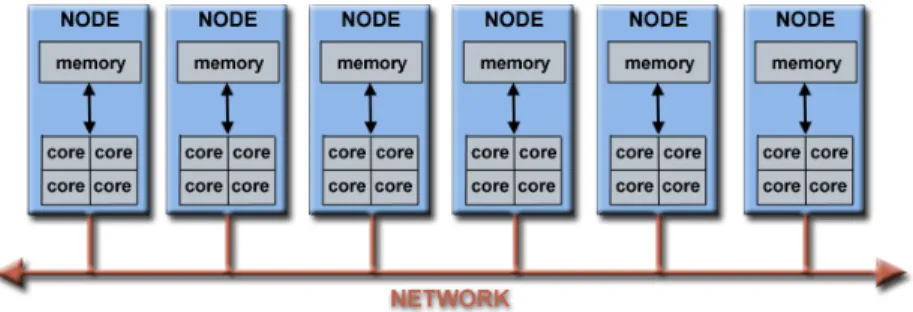
1 Parallel computing cluster . . . 3
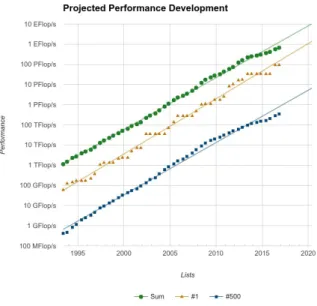
2 Projected performance development . . . 4
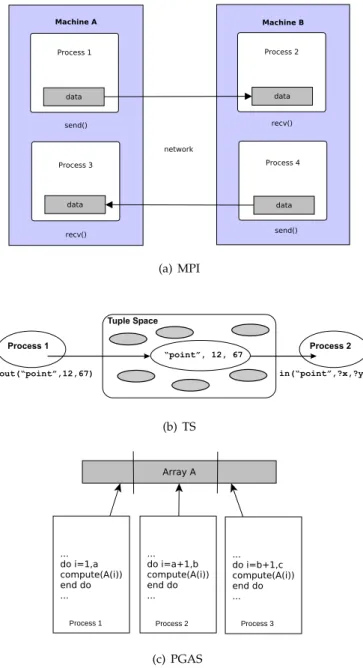
3 Programmer’s view of computation and memory . . . 6
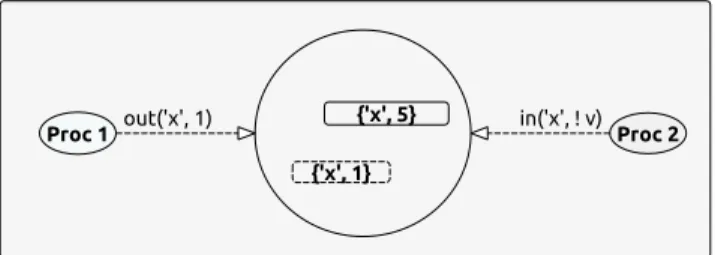
4 The Linda model . . . 12
5 Syntax of Klaim . . . 13
6 Operational semantics of Klaim . . . 16
7 A network of tuple spaces in Klaim . . . 17
8 Programmer’s view of NUMA architecture . . . 20
9 Overview of X10 activities, places and data distribution . . 21
10 Sequential consistency . . . 33
11 Two programs with a data race . . . 34
12 CPU caching . . . 36
13 Replicating data in RepliKlaim and SharedX10 with strong (a) and (b) weak guarantees . . . 38
14 Two RepliKlaim specifications . . . 39
15 Linearizable execution . . . 44
16 Sequentially consistent execution . . . 45
17 Syntax of RepliKlaim . . . 48
18 RepliKlaim transitions (1) . . . 51
19 RepliKlaim transitions (2) . . . 53
20 Structural congruence for RepliKlaim . . . 54
22 Operational semantics of RepliKlaim [2] . . . 56
23 Comparing three strategies in a scenario with 3 nodes . . . 64
24 Comparing three strategies in a scenario with 9 nodes . . . 65
25 Syntax of SharedX10 primitives for declaring shared vari-ablex . . . 68
26 Schematic view of replica allocation . . . 75
27 Generic example illustrating Rules 8-9 . . . 78
28 X10 Experiments: Performance comparison (1) . . . 91
29 X10 Experiments: Performance comparison (2) . . . 92
30 X10 Experiments: Performance comparison (3) . . . 93
31 X10 Experiments: Performance comparison (4) . . . 94
32 Graph representation . . . 97
33 Graph representation - with replicas . . . 98
34 Performance ofmgd no-replicasandmgd replicasat dif-ferent sizes of graph (shown along x-axis) on 8 hardware threads (1 cluster node). . . 111
35 Performances ofpr no-replicasat different sizes of graph (shown along x-axis) on 8, 16 and 24 hardware threads (HT).112 36 Performances of pr replicas at different sizes of graph (shown along x-axis) on 8, 16 and 24 hardware threads (HT).113 37 X10 Experiments: Scenario with 8 places . . . 120
List of Tables
1 Tuple evaluation function . . . 14
2 Pattern-matching predicates . . . 15
3 SharedX10 syntax . . . 73
4 Functionθ . . . 74
5 Evaluated programs . . . 108
6 Evaluation datasets . . . 110
7 Average performance speedup ofpr replicasoverpr no-replicas . . . 113
8 Programmability comparison between X10 and SharedX10 114 9 Programmability comparison between Klaim and RepliKlaim . . . 114
List of Listings
2.1 Simple graph processing . . . 18
2.2 Barrier synchronization . . . 18
2.3 Java-Klaim graph node processing . . . 19
2.4 Java-Klaim graph node processing with a barrier . . . 19
2.5 A distributed array creation . . . 23
2.6 Value copying . . . 24
2.7 Place-shifting via GlobalRef . . . 25
2.8 Graph processing . . . 26
2.9 Use of clocked finish and clocked async . . . 27
2.10 Sample grammar . . . 30
3.1 Count class in Java (1) . . . 37
3.2 Count class in Java (2) . . . 37
3.3 Count class in SharedX10 . . . 39
4.1 Implementation ofinw . . . 58
4.2 InUimplementation snippet . . . 59
4.3 OutUimplementation snippet . . . 59
4.4 Implementation ofins . . . 59
5.1 Example use of rvals statement . . . 76
5.2 Compare function . . . 82
5.3 Token class . . . 82
5.4 SharedX10 program snippet . . . 83
5.5 Transformed program snippet . . . 84
5.6 SharedX10 grammar snippet . . . 85
5.8 Program replicas in SharedX10 . . . 88
5.9 Program replicas in X10 . . . 89
5.10 Program no-replicas in SharedX10 . . . 90
5.11 Program no-replicas in X10 . . . 90 6.1 Case study I in X10 (1) . . . 98 6.2 Case study I in X10 (2) . . . 99 6.3 SharedX10 implementation (1) . . . 100 6.4 SharedX10 implementation (2) . . . 102 6.5 Klaim specification . . . 103 6.6 RepliKlaim specification . . . 104 6.7 X10 implementation . . . 106 6.8 SharedX10 implementation . . . 106 6.9 Klaim specification . . . 107 6.10 RepliKlaim specification . . . 108 appendix/C/figures/MaxDegreeX10.x10 . . . 129 appendix/C/figures/MaxDegreeShared.sx10 . . . 130 appendix/C/figures/MaxDegreeEncoded.x10 . . . 131 appendix/C/figures/MaxDegreeKlaim.java . . . 133 appendix/C/figures/MaxDegreeRKlaim.java . . . 134 appendix/C/figures/update.java . . . 135 appendix/C/figures/PageRankX10.x10 . . . 136 appendix/C/figures/PageRankShared.sx10 . . . 136 appendix/C/figures/PageRankEncoded.x10 . . . 137 appendix/C/figures/PageRankKlaim.java . . . 138 appendix/C/figures/PageRankRKlaim.java . . . 139 appendix/C/figures/updatePR.java . . . 140
Acknowledgements
First and foremost I would like to express my deep gratitude to my advisors, Professor Alberto Lluch Lafuente and Pro-fessor Rocco De Nicola, for sharing enthusiasm and insight into the subject, as well as help and guidance throughout the entire doctorate.
I am also grateful to the reviewers: Professor Christian W. Probst and Professor Francesco Tiezzi for their valuable com-ments and suggestions.
I owe a debt of gratitude to the following staff of IMT and DTU: Leonardo, Andrea, Sebastian, Simon and Bernd for their unfailing support and assistance in accessing computer clusters for the experimental evaluations.
I wish to thank to my colleagues and friends for the enjoyable working atmosphere and pleasant moments spent together. It has indeed been a great privilege to spend three years at IMT in a wonderful city such as Lucca.
Last but not least, a special thanks goes to my family and to L. for their encouragement, support and understanding.
Vita
September 2, 1986 Born, Belgrade, Serbia.
2005 - 2011 Degree in Mathematics, Average grade: 9.5 (out of 10), Department of Computer Science, Faculty of Mathematics,
University of Belgrade.
2011 - 2013 Designer of software systems, Power Symbol Technology.
2013 - 2017 PhD in Computer Science,
IMT School for Advances Studies, Lucca.
2015 - 2016 Visiting Research Student during 3 months, DTU Compute - Section for Formal Methods, Technical University of Denmark.
Publications
1. Y. Abd Alrahman, M. Andric, A. Beggiato, A. Lluch Lafuente. Can We Efficiently Check Concurrent Programs Under Relaxed Memory Models in Maude? InRewriting Logic and Its Applications - 10th International Workshop,
(WRLA), LNCS 21-41, Springer Vol. 8663, 2014.
2. M. Andric, R. De Nicola, A. Lluch Lafuente. Replica-Based High-Performance Tuple Space Computing. In Coordination Models and
Lan-guages - 17th IFIP WG 6.1 International Conference, (COORDINATION),
LNCS 3-18, Springer Vol. 9037, 2015.
3. M. Andric, R. De Nicola, A. Lluch Lafuente. Replicating Data for Better Performances inX10. InSemantics, Logics, and Calculi - Essays Dedicated to Hanne Riis Nielson and Flemming Nielson on the Occasion of Their 60th Birth-days, LNCS 236-251, Springer Vol. 9560, 2016.
Presentations
1. “Replica-Based High-Performance Tuple Space Computing”, 17th Interna-tional Conference on Coordination Models and Languages,Inria Grenoble Rhne-Alpes, Grenoble, France, June 2015.
2. “Replicating Data for Better Performances in X10”, 8th Swedish Workshop on Multi-Core Computing,Technical University of Denmark, Copenhagen, Denmark, November 2015.
Abstract
The cost of moving data is becoming a dominant factor for performance and energy efficiency in high-performance com-puting systems. To minimize data movement, applications have to consider data placement in order to optimize data transfer between processing units. To address this scenario, new compiler techniques, tools, libraries and programming abstractions are necessary for harnessing data locality. The goal of this thesis is to offer suitable solutions to the chal-lenging problems of data distribution and locality in large-scale high-performance computing. To this end, we have developed new programming primitives for twopartitioned data space languages, namely, Klaim and X10. Abstractions for partitions and data items are calledtuple spaces and tu-plesin Klaim, andplaces andobjects in X10. As a result, we designed two languages, RepliKlaim and SharedX10 which enrich Klaim and X10 with new primitives fordata sharing. Our approach aims at allowing programmers to specify and coordinate shared data and, specifically, to replicate shared data items while taking into account desired consistency properties. Programmers can exploit such flexible mecha-nisms to adapt data distribution and locality to the desired levels, e.g., to improve performance in terms of concurrency and data access. We investigate issues related to replica consistency and provide analysis of performance and pro-grammability, including several applications from large scale graph analytics.
Chapter 1
Introduction
1.1
Context and Overview
Data locality and consistency are identified as critical issues for guar-anteeing scalability, availability and good performances primarily in large-scale distributed systems such as cloud systems (SKQ13; CGB+06), and have recently gained the interest of the High-Performance Comput-ing (HPC) community (TKD+14; UNZ+16).
Data locality in distributed systems is typically improved via replica-tion. In early systems, the implied consistency level of replicas wasstrong consistency, while with the advent of highly scalable systems, the notion of consistency has been weakened. In fact, as captured by the CAP theo-rem (GL02), strong consistency of replicas, partition tolerance and avail-ability cannot be achieved at the same time. This has motivatedweak consistencymodels of replicated data, e.g.,eventual consistency(see opti-mistic data replication(SS05; BEH14)), in which local replicas can be modi-fied at any time, without immediate synchronization with other replicas, and it is only guaranteed that all replicas willeventuallyconverge to the same state. Weak consistency levels reduce the cost of synchronization and machine latency, however, they are not always sufficient to appli-cation developers. For instance, problems considered in the cloud
sys-tems community, such as reserving a seat on an airplane or withdrawing money from a bank account, require stronger guarantees. To address this challenge, the recent work in (BFLW12), inspired by (SPBZ11), proposes linguistic support for controlling data consistency in cloud applications and thus brings replica-awareness to the programming language level.
The concept of data locality is currently gaining a good deal of at-tention also in the HPC domain. Indeed, with the increasing rate of parallelism, the cost of moving data has become a dominant factor for performance, in term of execution time and energy efficiency of HPC systems. Moreover, the long-held programmability assumption such as cache-coherence is no longer attainable, hence programmers, to achieve the performance goals, are expected to manually orchestrate communi-cations between computational entities. As a result of these develop-ments, harnessing data locality has become a concern of fundamental importance for compiler and hardware experts, and also for program-ming language designers who need to come up with new models for the coming era of HPC systems.
In our view, programmers should be equipped with programming abstractions to carefully specify locality of shared data, in order to be able to specify the sharing pattern, that could, e.g., take advantage of replica-tion or rely on centralized data. In this work, we consider two levels of replica consistency, namely,strongandweakconsistency, corresponding to the notions oflinearizability andsequential consistency. Our approach considers replica-awareness at the programming language level. It has to be said that this is not a full novelty; for example CPU caching of shared data in multithreaded programs has led to the possibility ofdata racesand, consequently, to high-level programming abstractions that can guarantee safe access to shared data (e.g., thevolatileand synchronized constructs in Java).
In this thesis we present two languages, RepliKlaim and SharedX10, equipped with programming abstractions for specifying locality and consistency of shared data. They are based on Klaim (DNFP98) and X10 (CGS+05; X1017), respectively; two languages with apartitioned data space. Abstractions for partitions and data items are respectively called
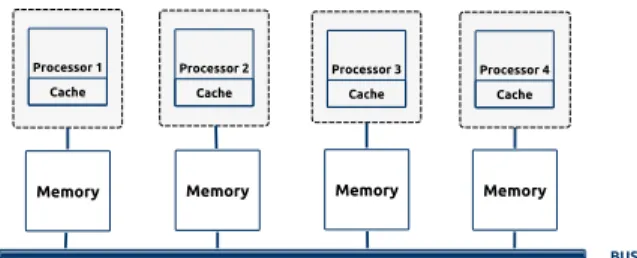
Figure 1:A schematic view of a parallel computing cluster
tuple spacesandtuplesin Klaim, andplacesandobjectsin X10. Our results include a number of experiments aimed at providing some performance related criteria for deciding whether to employ a specific sharing strat-egy. These performance measures are accompanied by two case studies from large-scale graph analytics to demonstrate programmability and ef-ficiency of our approach.
1.2
Background and Motivation
Parallel and distributed computing systems are used to solve more and more complex computational problems in HPC. Now, when more com-puting power is needed, one does not buy a faster uniprocessor but another processor or another thousand processors, and connects them with a high-speed communication network into the so-called High-Performance Computing Cluster (HPCC). This gives one whatever de-sired number of computer cycles but poses the problem of how to use those computer cycles effectively by dividing the workload into chunks that can be executed simultaneously.
The emerged HPCC structure in the present time is a Non-Uniform Cluster Computing(NUCC) system with nodes that consist of physically linked symmetric multiprocessor (SMP) cores with non-uniform mem-ory hierarchies, that are interconnected by horizontally scalable cluster configurations, as shown in Figure 1. According to the current forecasts,
Figure 2:Projected performance development
the number of cores on cutting-edge HPCC systems will soon be of the order of thousands, meaning that the order of parallelism continues to increase. Figure 2 shows the projected performance development for the top 500 supercomputers in the world growing linearly at least until 2020. The green dots represent the total performance, the orange trian-gles represent the performance of the current No.1 supercomputer and blue squares that of the machine on position 500 (as of November 2015). According to the forecast, by 2020 the fastest supercomputer will exe-cute at speed of 1 EFlop/s, while the slowest will exeexe-cute at speed of 1 PFlop/s, which translate respectively to1018 and1015 calculations per
second.
These developments have lead to an increased cost of data move-ments in terms of energy and computation (KS13). Several studies suggested that asynchronous computation, with reduced
communica-tion, is necessary to reduce those costs for large exascale cluster sys-tems (SDM11; WPC16). Consequently, programming models for these systems are required to be data-centric, i.e., they need to provide pro-gramming abstractions that describe how data are laid down and permit to perform asynchronous computations that are aware of data location.
From the programmer’s point of view, the key question is what pro-gramming model should be used to orchestrate concurrency and data sharing. The most straightforward model is the traditional Shared Mem-ory (SM) model, e.g., as offered by POSIX Threads (PThreads) over cache-coherent shared memory hardware. However, modern HPCC systems use distributed memory for scalability, hence sacrificing the programmability advantages of SM models. In contrast to SM, Mes-sage Passing (MP) libraries allow efficient implementations of parallel programs on distributed memory systems. Message Passing Interface (MPI) (OM15) isde factostandard for programming cluster systems, how-ever the design and development of MPI programs is intrinsically com-plex. The main drawback being that it requires the explicit management of the interaction between multiple processes and the coordination of data exchange; large data-structures that are conceptually unitary must be thought of as fragmented across different nodes.
The most notable proposals of programming models which aimed to resolve the tension between programmer’s desire for shared memory model and architect’s need to sacrifice cache-coherency for scalability include the Partitioned Global Address Space (PGAS) model and Dis-tributed Shared Memory (DSM). The PGAS has been proposed to per-mit programmers to think of a single computation running across mul-tiple processors, sharing a global address space and relying on zone-based memory management, and it has been implemented in several languages (EGS06; YSP+98; NR98; CCZ07). A notable form of DSM is the tuple space (TS) coordination model, which gained popularity due to the simplicity of its programming primitives. TS has been accompanied by many implementations (Bet03; BDP02; FAH99; Erl16; PyL16; jRe17) for distributed/parallel computing, including TUPLEWARE(Atk08) for programming HPCC systems.
(a) MPI
2 WCAT05
relying on a host language (e.g. C, C#, or Java) for expressing the computa-tional requirements of the application (this aspect is discussed in more detail in Section 1.2 below).
The Linda model comprises a conceptually shared memory store (calledtuple space) in which data is stored as records with typed fields (calledtuples). The tuple space is accessed using five simple operations2:
out Outputs a tuple from a process into the tuple space
in Removes a tuple from the tuple space and returns it to a process, blocking if a suitable tuple cannot be found
rd Returns a copy of a tuple from the tuple space to a process, blocking if a suitable tuple cannot be found
inp Non-blocking form of in — returns an indication of failure, rather than blocking if no suitable tuple can be found
rdp Non-blocking form ofrd
The input operations specify the tuple to be retrieved from the tuple space using a form of associative addressing in which some of the fields in the tuple (called anantituple, ortemplate, in this context) have their values defined. These are used to find a tuple with matching values for those fields. The remainder of the fields in the antituple are variables which are bound to the values in the retrieved tuple by the input operation (these fields are sometimes referred to as wildcards). In this way, information is transferred between two (or more) processes.
Fig. 1.A Simple One-to-One Communication Pattern
A simple one-to-one message communication between two processes can be expressed using a combination of outandin as shown in Fig. 1. In this case ("point", 12, 67)is the tuple being deposited in the tuple space by Process 1. The antituple,("point", ?x, ?y), consists of one defined field (i.e."point"), which will be used to locate a matching tuple, and two wildcard fields, denoted by a leading ?. The variablesx andy will be bound to the values 12 and 67 2A sixth operation,eval, used to create anactive tuple, was proposed in the original Linda model as a process creation mechanism, but can easily be synthesized from the other operations, with some support from the compiler and runtime system, and is not present in any of the commercial Java implementations of the Linda model.
(b) TS
Process 1 Process 2 Process 3
Powered by TCPDF (www.tcpdf.org)
(c) PGAS
Figure 3:Programmer’s view of computation and memory. Arrows repre-sent memory accesses.
Figure 3 shows programmer’s view of computation and memory in MPI, TS and PGAS. In MPI, computation is organized around a col-lection of processes that communicate by sending and receiving mes-sages. Data transfers require synchronous communication, i.e., a send operation must have a matching receive operation, and each process has to have a separate memory that is inaccessible to other processes (Fig-ure 1.3(a)). In TS model processes are meant to interact by exchang-ing messages (tuples) through a data repository calledtuple space (Fig-ure 1.3(b)). The PGAS model rests on the idea of apartitioned global address space; data structures can be allocated either privately (in lo-cal partitions) or globally (shared with other processes). Global data sets are typically organized into a common structure, such as a glob-ally distributed array, which allows processes to work collectively on the same data structure, while each process works on a different portion (Fig-ure 1.3(c)). Differently from MPI, the communication model underlying TS and PGAS is asynchronous.
To study abstractions for data sharing we wanted a minimal model that is close enough to the SM model to ensure programmability and with features to allow good performances in a distributed memory en-vironment. This criterion have led us to select two languages, namely X10 and Klaim. X10 has been proposed as a parallel object-oriented lan-guage and one of the first members of the second generation of PGAS languages, extending the PGAS model with notions for asynchrony and locality. Klaim is based on the idea of multiple tuple spaces (Gel89) with explicit information about the location of the nodes where each tuple space is allocated.
Both X10 and Klaim make information about data locality explicitly visible to the programmer who should control which data and processes are co-located. However, adjusting the data locality to the need of appli-cation may require significant efforts from the programmer.
X10 promotes locality awareness in the form of places which group activities(i.e., processes) and data local to the activities. Accesses to re-mote data, i.e., located at places different from the one of the execut-ing activity, must comply with the followexecut-ing points: (1) an activity must
spawn a remote activity orshiftto the place of the remote data, (2) remote data must be modified via specific cross-place references i.e., a reference to a data item at one place that can be shared with other places, and (3) the previous requirements apply tomutablebut not necessarily to im-mutabledata, which are additionally replicated by the runtime at each place that accesses the remote data.
Klaim’s equivalent for X10 place is a node on which a tuple space is allocated; the data management is simpler compared to that of X10, pri-marily due to the fact that, unlike the latter, Klaim does not consider the cost of data accesses at the linguistic level, i.e., the linguistic mechanisms for local and remote data accesses are the same.
1.3
Contributions and Organization
In our view, programmers should be equipped with suitable primitives to deal with locality of shared data in a natural and flexible way. More-over, efficient data management can be particularly challenging in pro-cessing applications with large volumes of data (HLH+11; LK14). To this
end, in this thesis we propose two languages with programming abstrac-tions for data sharing: the RepliKlaim language based on Klaim, and the SharedX10 language based on X10.
The thesis is organized into two parts.Part Iintroduces the main no-tions and tools we deal with in the thesis and it is structured into two chapters.Part IIdiscusses the contributions in three chapters. In partic-ular, the questions we address are following:
– What is a suitable programming abstraction to share data? We answer this question in Chapters 4 and 5 by providing extensions of Klaim and X10. In RepliKlaim, data sharing is based on replication, while SharedX10 features additional sharing strategy based on central-ized data locality. Furthermore, the granularity of consistency is at the level of an operation in RepliKlaim, while in SharedX10 it is at the level of a data item.
ap-proach aims at allowing programmers to specify and coordinate replication of shared data items by taking into account one of the two consistency properties, namelylinearizabilityandsequential con-sistency.
– What is the impact of proposed solutions for data sharing? We answer this question in Chapter 6 by conducting a performance and pro-grammability analysis on two case studies from large-scale graph analytics. We measure performance in term of execution time, an programmability in terms of lines of code.
Last but not least, the conclusions, introspections and perspectives of our work are presented in the final chapter of the thesis.
Part I
Chapter 2
Klaim, X10 and X
TEXT
In this chapter we introduce the programming languages Klaim and X10 in Sections 2.1 and 2.2, respectively. In particular, we detail on their pro-gramming models and main concepts that we refer to inPart IIto present contributions of the thesis, namely, RepliKlaim and SharedX10. The sec-tions introduce several code specificasec-tions which serve as a introduction to the real-world applications presented in Chapter 6. Final Section 2.3 gives an overview of Domain Specific Languages (DSLs) and the XTEXT framework for DSL development.
2.1
The Klaim Programming Language
Klaim (DNFP98) was proposed as a coordination language for code mo-bility, i.e., for specifying migratory applications in network program-ming. Essentially, Klaim consists of Linda (GC92) features for process communication and a set of operators for process building inspired by CCS (Mil89). As a coordination language, Klaim focuses on coordina-tion and communicacoordina-tion requirements of an applicacoordina-tion, while the com-putation should be expressed in an additional language, called thehost language(e.g. C, Java). For simplicity, in this section we present several code snippets using Java as a host language, hence we refer to them as Java-Klaim specifications.
Figure 4:A simple process communication expressed in the Linda model
The Linda model is based on a shared memory store calledtuple space in which data items are fields called tuples. There are four operations provided to access the tuple space:
• out- Inserts a tuple into the tuple space,
• in- Removes a tuple from the tuple space, and returns it to a pro-cess, if a matching tuple cannot be found the process is blocked,
• rd- Retrieves a copy of a matching tuple from a tuple space to a process, blocks if the tuple cannot be found, and
• eval- Inserts a tuple into the tuple space, unlike in the case ofout, a new concurrent process is created for evaluating the tuple. The input operations (rdandin) specifytemplateto retrieve a tuple from the tuple space using thepattern-matching. Some fields in the tem-plate have their values defined, often referred to asactual fields, which are used to find a tuple with matching values for those fields. Remaining fields in the template, calledformal fields, are variables which are bound to the values in the retrieved tuple by the input operation. In that way the information is transferred between processes.
A simple process communication can be expressed using outand
inas shown in the Figure 4. In this case (’x’, 1)is the tuple being deposited in the tuple space by Process 1. The template, (’x’, !v) consists of one defined field (i.e., ’x’) which will be used to find a matching tuple,
N ::= 0 | l:: [K, P] | N kN (networks)
K ::= ∅ | et | K, K (repositories)
P ::= nil (null process)
|A.P (action prefixing)
|P+P (choice)
|P |P (parallel composition)
A ::= out(t)@` | in(T)@`
| read(T)@`| eval(P)@` (actions)
t ::= e |P | `| t, t0 (tuples)
T ::= e |P | `|!x| T, T0 (templates)
Figure 5:Syntax of Klaim
and a variablev denoted by a leading!. As a result of matching, the variablevwill be nondeterministically bound to either 1 or 5 since tuple
(’x’, 5)in the tuple space is also matching the template. Other forms of communication, as well as synchronization, can easily be expressed using the four operations of the Linda model, as we show in examples in this section.
Klaim extends Linda with multiple tuple spaces, which are allocated to nodes or components of a network, whose configuration may even change dynamically due to new nodes being added or existing ones re-moved. Definition 1 introduces a formal specification of Klaim, which differs from the original specification given in (DNFP98) in several as-pects. In fact, we decided to choose a subset of Klaimwhich was mini-mal, yet sufficient to study the main programming abstractions we had in mind. Recursion, for example, is an orthogonal feature that would not have helped in our study.
Definition 1 (Klaim syntax) The syntax of Klaim is defined by the grammar of Figure 5, whereLis a set of locations (ranged over by`, `0, . . .),U is a set of basic values (ranged over byu, v, . . .),V is a set of value variables (ranged over byx, y, . . .),!Vdenotes the set binders over variables inV(i.e.!x,!y, . . .), T ⊆(U ∪ V)∗ is a set of tuples (ranged over byt, t0, . . .),ET ⊆ U∗ is a set
of evaluated tuples (ranged over byet,et0, . . .),T T ⊆ (U ∪ V∪!V)∗ is a set
of templates (ranged over byT, T0, . . .), andEX P is a set of value expressions (ranged over by e) built from values and value variables by using a set of opera-tors.
A Klaim specification is anetworkN, i.e. a possibly empty set of com-ponents, such that a component` :: [K, P]has a locality name`, a data repositoryK, and parallel processesP. In the original Klaim presenta-tion, each node is characterized by both a physical and logical locality re-lated by theallocation environmentwhich provides (partial) mapping from logical to physical localities. Such approach enables controlling visibility, i.e., by allowing processes from one node to access only nodes included in the image of its allocation environment. We simply assume that each node has a single and unique locality known at each other node of a network. Furthermore, we assume that the configuration of a network is static, hence we omit thenewlocconstruct for dynamic allocation of new nodes. In fact, we present only the minimal set of Klaim features that would allow us to study abstractions for data sharing.
Klaim tuples are sequences of actual fields (i.e., expressions, pro-cesses, localities) while templates are sequences of both actual and for-mal fields (these are denoted by ’!v’ wherevis a generic variable). Data repository is a collection of evaluated tuples according to the tuple eval-uation function in Table 1. In particular, the evaleval-uation function,TJK, uses evaluation mechanism,EJeK, which in turns applies on expressions e∈ EX P. TJeK = EJeK TJPK = P TJlK = l TJt, t0K = TJtK,TJt0K TJ!xK = !x
Table 1:Tuple evaluation function
Processes are created from thenilprocess, using the constructs for action prefixing(A.P),non-deterministic choice(P+P) andparallel execution
(P|P). The actions of Klaim are based on standard Linda primitives for tuple spaces which are additionally located, i.e., each operation has an additional@lpart to designate the target tuple space, whereselfis a distinguished locality which points to the local tuple space.
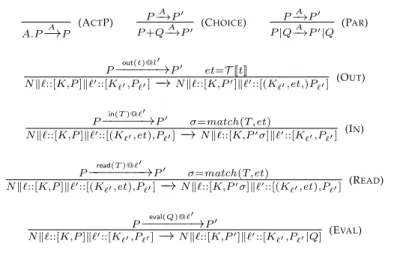
The operational semantics of Klaim presented in Figure 6 combines a structural operational semantics (SOS) style for collecting the process actions (rules ACTP, CHOICEand PAR) and reduction rules for the evo-lution of nets. The operational semantics of nets exploits an evaluation mechanism for tuples and a pattern-matching to select tuples in a tu-ple space. We use notationPσ whereσ = match(T, et), to indicate the
substitution ofTforetinP. The rules for defining the patter-matching predicate are reported in Table 2.
match(v, v) match(l, l) match(et1,et2) match(et2,et1) match(P, P) match(!x, v)
match(et1,et2)match(et3,et4) match((et1,et3),(et2,et4))
Table 2:Pattern-matching predicates
Reduction rule OUTadds a new (evaluated) tuple to the tuple space located atl’. As for the communication operationsin and read, we remark thatin(Rule IN) modifies the tuple space whilereaddoes not (READ), as matching tupleetremains at the componentl’. Rule EVAL describes a case in which a process is spawned at a componentl’.
A.P−→A P (ACTP) P A −→P0 P+Q−A→P0 (CHOICE) P−A→P0 P|Q−A→P0|Q (PAR) P out(t)@l 0 −−−−−→P0 et=TJtK Nk`::[K,P]k`0::[K `0,P`0]−→Nk`::[K,P0]k`0::[(K `0,et,)P`0] (OUT) P in(T)@` 0 −−−−−→P0 σ=match(T ,et) Nk`::[K,P]k`0::[(K `0,et),P`0]−→Nk`::[K,P0σ]k`0::[K`0,P`0] (IN) P read(T)@` 0 −−−−−−−→P0 σ=match(T ,et) Nk`::[K,P]k`0::[(K `0,et),P`0]−→Nk`::[K,P0σ]k`0::[(K`0,et),P`0] (READ) P eval(Q)@` 0 −−−−−−→P0 Nk`::[K,P]k`0::[K `0,P`0]−→Nk`::[K,P0]k`0::[K`0,P`0|Q] (EVAL)
Figure 6:Operational semantics of Klaim
Figure 7:A network of tuple spaces in Klaim
Figure 7 illustrates a network of two nodes, characterized by localities landl’, used by processes to address the target tuple spaces.
Tuples can be used as building blocks for encoding more complex information. For example, a graph can be represented as a series of tu-ples of the form:(’graphA’, 1, firstElement),(’graphA’, 2, secondElement), . . . , (’graphA’, m, mthElement). Each tuple models a graph node, the first field designates the corresponding graph name, the second stands for the node index in the graph, while the third is in this case generic, e.g. it can store some node property, such as node degree or the PageRank value, depending on the application.
Distribution of tuples across tuple spaces is controlled via the out
operation, e.g.out(’graphA’, i, ithElement)@lplaces the argu-ment tuple to the node with localityl. For example, assuming there are
mgraph nodes and nnetwork nodes associated with localitiesl1,. . . ,ln,
one can implement a block distribution via e.g., out(’graphA’, i, ithElement)@lh(i), where functionhcomputesimodulon. As a
re-sult, graph nodes will be allocated to tuple spaces in blocks of approxi-mately the same number (m/n) of elements.
Listing 2.1 illustrates read/write operations over a graph node. We use terms write and update interchangeably to refer to the operation which modifies the data. The operation atline 1reads the element, while the update operation has to be realized in two steps, first, tuple is withdrawn viain(line 2), followed by inserting a new tuple viaout
Listing 2.1:Simple graph processing
1 rd(’graphA’, i, ?x)@l; /* reads i-th element */
2 in(’graphA’, i, ?oldValue)@l;
3 out(’graphA’, i, newValue)@l; /* updates i-th element */
Klaim has no specific constructs for process synchronization, how-ever the synchronization can be implemented via set of instructions that each process should perform reaching the point of synchronization. For example, in barrier synchronization, each process within a group must wait at a specific point, called barrier, until all processes in the group reached it; then all can proceed. To implement barrier synchronization in Klaim, one process needs to execute in advanceout(’barrier’, n)@l, which places a tuple(’barrier’, n), usually called a synchro-nization token, to a specific tuple space, and where nis the number of processes. Coming to the point of synchronization each process performs the code fragment in Listing 2.2, which comprise the barrier function.
Listing 2.2:Barrier synchronization
1 in(’barrier’, ?val)@l;
2 out(’barrier’, val-1)@l;
3 rd(’barrier’, 0);
The barrier function consists of conceptually two phases. In the first phase, the process signals that it reached the barrier by updating the syn-chronization tuple (lines 1-2). If it was not the last process to reach the barrier, i.e.,valis greater that 0, then the process remains blocked in the second phase by therdoperation (line 3), until the last process reaches the barrier.
Finally, we present two code snippets in Listings 2.3 and 2.4, which illustrate the basic idea of graph processing we present in Chapter 6. We assume that the number of graph nodes is stored innand the number of iterations for the iterative step innumIter.
Listing 2.3:Java-Klaim graph node processing 1 for (i = 0; i < n; i = i + 1) 2 eval(compute(i)); 3 compute(i): 4 { 5 for (j = 0; j < numIter; j++) {
6 /* graph processing code*/
7 }
8 }
The main idea is thatnprocesses are spawned to evaluate in parallel thecomputefunction for different argument,i, indicating the index of a graph node. The body of the function simply specifies iterative com-putation in which node processing is realized. Snippet in Listing 2.4 in addition implements previously introduced barrier synchronization to ensure that each process proceeds at the same speed.
Listing 2.4:Java-Klaim graph node processing with a barrier
1 out(’barrier’, n)@l; 2 for (i = 0; i < n; i = i + 1) 3 eval(compute(i)); 4 compute(i): 5 { 6 for (j = 0; j < numIter; j++) { 7 in(’barrier’, ?val)@l;
8 out(’barrier’, val--)@l;
9
10 /* graph processing code*/
11
12 in(’barrier’, ?val)@l;
13 out(’barrier’, val++)@l;
14 rd(’barrier’, 0)@l;
15 }
Figure 8:Programmer’s view of NUMA architecture
2.2
The X10 Programming Language
X10 (CCS+14) is a programming language developed at IBM, and its design philosophy is based on a belief that prevailing configuration of the future high-end systems will consist of multi-core nodes with pos-sibly non-uniform memory access time (NUMA nodes) (illustrated in Figure 8) interconnected in scalable clusters calledNon-Uniform Cluster Computing(NUCC) systems. Four main goals set for X10 are to 1) be more productive than current models (X10 stands for ”ten times produc-tivity boost”), 2) exploit multiple levels of parallelism and non-uniform data access, 3) be suitable for multiple architectures and 4) support high levels of abstraction. Furthermore, X10 was created to combine ease of programming of object-oriented languages and efficiency of high-performance languages, targeting high-end computers supporting≈105
hardware threads and≈ 1015 operations per second (SBP+14). Using
the words of the designers, X10 was designed to“to increase programmer productivity for NUCC without compromising performance”.
X10 is built upon asynchronous partitioned global address space (AP-GAS) (SAB+10) that enriches PGAS with two main concepts: places, which provide an explicit mechanism for data and code locality, and asyncswhich allows forking a task, possibly at a remote place. Essen-tially, the PGAS model combines data locality (partitioning) of a dis-tributed memory model and global address space of a shared memory model, thus each processor has private memory for local data and shared
Figure 2: Overview ofX10Activities, Places and Partitioned Global Address Space (PGAS)
execution in parallel with the child thread, and may termi-nate prior to the child thread. Therefore it may not be available to catch exceptions thrown by the child thread.
The statementfinish SinX10converts global termina-tion to local terminatermina-tion.finish Sterminates locally (and globally) whenSterminates globally. IfSterminates nor-mally, thenfinish Sterminates normally andAcontinues execution with the next statement afterfinish S. Because finishrequires the parent activity to suspend, it is also a very natural collection point for exceptions thrown by chil-dren activities.X10requires that ifSor an activity spawned bySterminates abruptly, and all activities spawned by S terminate, thenfinish Sterminates abruptly and throws a single exception formed from the collection of all exceptions thrown bySor its spawned activities.
There is an implicitfinish statement surrounding the main program in anX10application. Exceptions thrown by this statement are caught by the runtime system and result in an error message printed on the console.
Example 2 (Copy, revisited)Consider Example 1. The finishon Line3ensures global termination of bothA1and A2; thus under normal executionA0advances to Line7only aftert.val is not null. A1 may terminate abruptly, e.g. with anOutOfMemoryExceptionthrown at Line4. This will causeA0to terminate abruptly with an exception thrown at Line3;A0will not progress to Line7.
3.3 Partitioned Global Address Space
X10has a global address space. This means that it is possible for any activity to create an object in such a way that any other activity has the potential to access it.2 The
address space is said to bepartitionedin that each mutable location and each activity is associated with exactly one place, and places do not overlap.
Ascalar objectinX10is allocated completely at a single place. In contrast, the elements of anarray(Section 3.4)
2In contrast, MPI processes have a local address space. An
object allocated by an MPI process is private to the process,
may be distributed across multiple places.
X10 supports a Globally Asynchronous Locally Syn-chronous(GALS) semantics [12] for reads/writes to mutable locations. Say that a mutable variable islocalfor an activity if it is located in the same place as the activity; otherwise it is remote. An activity may read/write only local vari-ables (this is called theLocality Rule), and it may do so synchronously. Any attempt by an activity to read/write a remote mutable variable results in aBadPlaceException. Within a place, activities operate on memory in a sequen-tially consistentfashion [38], that is, the implementation en-sures that each activity reads and writes a location in one in-divisible step, without interference with any other activity.3
However, an activity may read/write remote variables only by spawning activities at their place. Thus a place serves as acoherence boundaryin which all writes to same datum are observed in the same order by all activities in the same place. In contrast inter-place data accesses to remote vari-ables have weak ordering semantics. The programmer may explicitly enforce stronger guarantees by using sequencing constructs such asfinish, force(Section 3.8) or clocks (Section 3.6).
Example 3 (Copy, once again) Consider Example 1 again. Both the asyncs are necessary to avoid a BadPlaceException in any execution of the program with more than one place.
3.4 Arrays, Regions and Distributions
An array is associated with a (possibly multi-dimensional) set ofindex pointscalled itsregion. For instance, the re-gion[0:200,1:100]specifies a collection of two-dimensional points(i,j)withiranging from0to 200andjranging from1to100. Points are used in array index expressions to pick out a particular array element. Adistributionspecifies a place for each point in the region. Several built in distribu-tions are provided inX10, e.g. the constant distribution, a blockdistribution, ablockCyclicdistribution etc. Various
Figure 9:Overview of X10 activities, places and data distribution
memory for globally shared data.
The set of places is fixed before program execution. To set the num-ber of places, one needs to set a value toX10 NPLACES program envi-ronment variable prior to the program execution. The program starts executing inPlace.places()(0), other places can be addressed in a similar fashion by their integer ranks. An activity’s local place can be simply addressed by a keywordhere.
Figure 9 shows a schematic overview of the X10 programming mo-del. Each place hosts some data and runs a number of possibly dynam-ically created lightweight threads (i.e. activities). Data items in X10 can be mutable (var) or immutable (val), also calledvalues. X10 supports user-defined types, standard types (Boolean,Byte,Short,Char,Int,
Long, Float, Double,ComplexandString), functional literals and multi-dimensional arrays (DistArrays). For example,var i:Long = 0defines amutablevariableiof typeLongthat is initialized to0. Sim-ilarly,val j:Long = 0defines animmutablevariablejof type Long
initialized to zero. Unlike mutable data, immutable data cannot be re-assigned; for example, an attempt of assigning a new value, e.g., j = 1, would trigger a compile-time error. It is important to note that
though variablejis immutable, object it points to can be itself mutable, such asval j = new DataType()whereDataTypeis a user-defined class possibly with mutable methods. Moreover, immutable data are copied by the X10 runtime between places via mechanism calledvalue copying, while mutable data reside only at a place of allocation and need to be accessed via global referencesand place-shifting mechanism by re-mote activities. Both these concepts, i.e.,value copyingandplace-shifting via global referencesare in relation to our idea of data sharing, introduced in SharedX10, and we explain them in details further below. In fact, one of the main ideas behind data sharing is to hide the low-level details of orchestrating data accesses from the programmer.
X10 features function literals that can be assigned to a variable. In general, a function literal(x1:T1...xn:Tn)c:T => ecreates a
func-tion of type(x1:T1...xn:Tn)c:T, with the bodye and condition c
For example, a function literalval f:(x:Long){x!= 0} => Long = (x:Long){x!= 0} => (1/x), stored in valuef, computes inverse of long integerxif condition x != 0evaluates to true. We use this con-venient feature to specify a function literalcmpthat compares integer numbers inside a sorting function in Section 5.3.
DistArrays (distributed array) are used to spread globally shared data across places. DistArrayrelies on aDistobject for defining dis-tribution, i.e., mapping of elements to places.Distin turn uses aRegion
object that captures shape and dimensionality of the array. Furthermore, the region and distribution associated with an array are first-class con-structs, i.e., they can be used independently of arrays. It is worthwhile to mention that the distribution remains unchanged throughout the pro-gram’s execution.
As an example, region [0:50, 0:100] specifies a collection of two-dimensional points (i, j) where i ranges from 0 to 50 and j ranges from 0 to 100. Points are used in array to select a specific element in a possi-bly multi-dimensional grid, while distribution specifies a place for each point in the region. The two distributions that we use in the thesis are:
Unique distribution. Unique distribution maps elements to distinct places provided that there are sufficient places available, otherwise some points will be co-located. For example, distribution
Dist.makeUnique(Region.make(1...k))maps every point in a
1-dim region of k points to a distinct place of those available in the pro-gram.
Block distribution. Block distribution
(e.g. Dist.makeBlock(Region.make(1...k))) distributes ele-ments in the region in approximately even blocks over all places avail-able in the program.
Remaining distributions arecyclic, which cyclically distributes points, constant, which maps all points to a single place, and combinations of previous such as blockcyclic, blockblock and so on.
Each distribution may also specify an initializer function which ap-plies to all points in the region. Listing 2.5 shows a distributed array creation with the initializer function stored in a variable.
Listing 2.5:A distributed array creation
1 val ident = ([i]:Point(1)) => i;
2 val data:DistArray[Long] = DistArray.make[Long](Dist.
,→ makeUnique(Region.make(1,10), ident))
Thedatavariable stores a reference to an array of ten elements, such that each element is initialized to the value of its index via the initializer function stored inident. We use distribution promoted in this example when we present the SharedX10 encoding, in Section 5.3.
The main X10 construct for concurrency within a place is theasync
construct. The main form ofasyncisasync Sthat starts a new activ-ity to execute a statementSin the same place of the executing process. Remote execution is achieved by means of theatconstruct. For exam-ple, the activity that executesat(P) Sisplace-shifted, meaning that its execution is suspended in the current place and shifted to placePwhere
Swill be executed. After completion ofSthe control comes back to the current place, with the result ofS.
One needs to be careful when using theat(P) Sconstruct as it in-volves copying values and it can potentially lead to high costs as the values used in S (and depending objects) are copied to placeP. Such copying is calledvalue copingand it can be avoided by using global ref-erences (GlobalRefs) and place-shifting, as we will show in following examples.
Program in Listing 2.6 defines a variablexwhich stores an object of some generic classClassG (line 1), which should be updated with contributions from computations performed at each place. In particular, the enumeratorforloop in combination with theatconstruct ensures that thelocalCompute()function will be executed at each place and the obtained valuetwill be used to updatex.
Listing 2.6:Value copying
1 val x = new ClassG();
2 for (p in Place.places()) at(p) {
3 var t = localCompute();
4 x.add(t);
5 }
One may expect thatxdefined atline 1and used for reference at
line 4are pointers to the same object in memory, however, this is not the case. In particular, due to value copying thatatentails, there will be several replicas ofxcreated (one per each place), and each will be modified independently. As a result, the object stored inxat line 1
will not be modified in the scope ofat(p).
This behavior can be altered via global references, i.e., GlobalRef
objects, as variables reachable through GlobalRefs are ommitted in value copying. Therefore, to modify a value in computations that in-volve several places, one needs to define a global reference (line 2) and use theplace-shiftingoperation (line 5) as shown in the snippet in Listing 2.7.
Listing 2.7:Place-shifting via GlobalRef
1 val x = new DataObject(0);
2 val xRef = GlobalRef[DataObject](x);
3 for (p in Place.places()) at(p) {
4 var t = localCompute();
5 at(xRef.home) xRef().add(t);
6 }
In general,val ref = GlobalRef[T](v)creates a reference to a variablevof a generic typeTand stores it inref. Retrieval of the value is done viaref()and it demands place-shifting to the place wherevis allocated, i.e.,at(ref.home).
Parallelism across places is achieved by combiningasyncandatto spawn a new activity at a remote place, e.g. at(P) async Screates a new activity at placePto execute statement S. X10 provides several primitives for synchronizing concurrently executing activities. In partic-ular X10 featuresatomicblocks, thefinishstatement and theclock
construct.
There are two types of atomic blocks provided, i.e., the unconditional and conditional atomic block. The unconditional atomic block,atomic S, is used to guarantee execution of a statementSas if it was a single step with respect to other concurrently executing atomic blocks in the same place. The conditional atomic block provides the same guarantees for the execution of bodySwhich is additionally guarded with the con-ditionc. Any executing activity of such a statement gets suspended until the guard evaluates to true, moreover the checking of the guard and ex-ecution of bodySis done atomically. However, the guarantees given by the atomic blocks hold only if none of the three restrictions on bodyS
is violated: 1)Smust be sequential, i.e., must not spawn another activ-ity, 2)Smust execute at a single place and 3) Smust not use blocking statements.
finishconstruct provides a simple mechanism to synchronize ac-tivities. An activity that executesfinish Swill executeSand then be suspended until all the activities spawned by Sterminate. Moreover,
applied to synchronize activities across multiple places.
The underlying idea of theclockconstruct is based on a notion of phased computation. Each phase in such computation consists of a set of memory locations which are read and written by concurrently execut-ing activities whose termination signals the end of a phase, and each following phase starts with a new set of activities. Clocks may be explic-itly created by the programmer as instances ofx10.lang.Clockclass. However, it is more common to create clocks implicitly by theclocked finishconstruct. An activity getsregisteredto the generated clock when it is created by theclocked asyncconstruct. Synchronization occurs when an activity executes theClock.advanceAll()primitive; at that point the activity gets suspended until every registered activity have ex-ecutedClock.advanceAll()and then all activities are released. The clocks can be seen as a generalization of the classical barriers as activities may be registered to several clocks that work independently.
The following code listings are instrumental to introducing the case studies of Chapter 6. The main idea is parallel graph processing, in the fist code variant activities process at their speed, while in the second vari-ant the barrier synchronization is employed to ensure phased execution. Agraphis represented as a distributed array of nodes (GraphNode ob-jects), which are block-distributed across available places.
Listing 2.8:Graph processing
1 val graph:DistArray[GraphNode] = DistArray.make[GraphNode](
,→ Dist.makeBlock(Region.make(0, size-1)), (Point) =>
,→ new GraphNode());
2 /* graph instantiation code, e.g. via processing input
,→ file */
3 for (nodeId in graph) async
4 for (var i:Long = 0; i < numIter; i++)
5 at (graph.dist(nodeId)) graph(nodeId).compute();
To keep the presentation simple, we commented the code for instan-tiating such graph (line 2) in Listing 2.8, which includes processing an input file that records links between nodes, and storing the information
in correspondingGraphNodeelements ofgraph. Node computations are conceptually done in parallel by separate activities spawned by the
asyncconstruct atline 3. Each activity executes an iterativeforloop with a body that performs computation on a corresponding node object referenced viagraph(nodeId). We leave for now the size of the graph,
size, the number of iterations,numIter, and thecompute()function unspecified as we detail them in Chapter 6. The code variant which fea-turesclockconstructs to synchronize activities is shown in Listing 2.9. As one may notice, accessing a node requires a place-shifting operation to the place where the node is allocated (line 3).
Listing 2.9:Use of clocked finish and clocked async
1 clocked finish for (nodeId in graph) clocked async
2 for (var i:Long = 0; i < numIter; i++) {
3 at (graph.dist(nodeId)) graph(nodeId).computation();
4 Clock.advanceAll();
5 }
As we illustrated in the examples in this section, the low-level mecha-nism for data communication, such as activity place-shifting, is transpar-ent to X10 programmers. Moreover, the side-effect of theatconstruct, i.e., the value copying, entails hazard in terms of creating replicas which can be easily neglected by the programmer. The idea of SharedX10 is to introduce the concept of shared data as a first class primitive, so the programmer can specify how the data item is shared between places, with two options: via replication or centralized instance. Thus, the low-level details of data accesses are left to the implementation, i.e., activity place-shifting and replica consistency. We further detail the data sharing primitives in Section 5.1.
We conclude this introduction to X10 with the remark that X10 is still under development at IBM in collaboration with academia. There are two implementation available via source-to-source compilation to another language. The two provided runtime frameworks are named
Native X10andManaged X10that are respectively based on C++ and Java backends. The resulting C++ or Java program is then compiled
by either a specific C++ compiler to produce an executable or compiled to class files and then executed on a Java Virtual Machine (JVM). De-tailed performance model of X10 can be found in (GTC+11). The se-mantics of the language has been formalized in (SJ05) along with a re-silient version (CCS+13). A core calculus with X10’s main constructs
for parallelism is presented in (LP10). Cogumbreiro et al. developed Armus (CHMY15), a verification tool that detects barrier deadlocks for Java and X10 programs. Gligoric et al. attempted to develop a model checking tool (GMM12) for X10 based on the JAVAPATHFINDERtool for model checkingJava programs. A line of work focuses on compiling and porting programs to X10, specifically, (KH14) reports on compiling MATLABto X10 for high performance computing. The work in (GN15) presents a kernel benchmark suite implementing distributed algorithms in X10. A complete list of X10 related publications can be found online at the official website (IBM17).
2.3
Domain Specific Languages
The main goal when developing a programming language is to make programming more efficient. Ideally, one programming language should provide the suitable level of abstraction which allows solutions to be expressed naturally and hides unnecessary details. Furthermore, it should be expressive enough, should provide guarantees on the prop-erties which are important in the domain and it should also have precise semantics to enable formal reasoning about a program.
Domain Specific Languages (DSLs), according to (Bet11), are small languages dedicated to a particular aspect of a software system. Hence, DSLs are designed with an aim to improve programmers’ productivity in a particular domain compared to General Purpose Languages (GPLs) such as Java or C.
Implementing a DSL at least consists of a series of procedures which would allow one machine to performlexical analysis,syntax analysis or parsing, and finally interpret program or generate the code in another language.
In the lexical analysis, an input textual file representing the source code is decomposed into atomic elements ortokens which are of four types: keywords,identifiers,symbolsandliterals. For example, a variable declarationint value = 100;contains a keywordint, an identifier
value, a literal100and symbols ’;’ and ’=’. Lexical analysis is followed by the syntax analysis which for an input construct checks whether it respects the syntactic structure specified by the languagegrammar. The main idea of the grammar is to describe the concrete syntax and how it is mapped to an in-memory representation, i.e., the semantic model. This model is produced during parsing and it is called the Abstract Syn-tax Tree (AST). Upon successful completion of the previous phases, such program is ready to be interpreted or alternatively it can be used as in input to acode generatorto generate code in a different language.
2.3.1
The XTEXT
Framework
XTEXT(Xte16) is an open source framework for developing DSLs. Im-plementing a DSL starts with specifying the language grammar and can include additional specifications for program verification, code genera-tor or interpreter, type checking and scoping. XTEXTpromotes a Java-like programming language, Xtend, to write parts of a DSL implemen-tation. Additionally, XTEXTprovides integration of a DSL in the Eclipse Integrated Development Environment (IDE). The main advantages that come along with an IDE support aresyntax highlighting, that improves code visibility through coloring and formatting keywords, background parsing, which continuously checks the program syntax and marks er-rors,content assistant, which provides auto completing mechanism, and hyperlinking, which permits navigation between references in a program.
The Grammar Language
The grammar language of XTEXTis itself a DSL designed for describing other DSLs. Essentially, grammar specification of a languages establishes a connection between the language syntax and its semantic model.
The body of a grammar file is a list of grammarrules. For example, ruleID:
1 terminal ID:
2 (’ˆ’)?(’a’..’z’|’A’..’Z’|’_’) (’a’..’z’|’A’..’Z’|’_
,→ ’|’0’..’9’)*;
specifies that a tokenIDcan start with optional ”ˆ” character, fol-lowed by a letter or underscore, folfol-lowed by an arbitrary number of let-ters, underscores and numbers. Symbols *, + and ? indicate the cardi-nality of expressions in the brackets; operator * means zero or greater, + indicates one or greater, while ? indicates cardinality zero or one. If no operator is used the assumed cardinality is exactly one. RuleIDis a terminalrule in that it contains only elementary symbols, such as letters, numbers and other characters.
Apart from terminal rules, two other types of rules aredata typeand productionrules. Data type rules, like terminal rules, do not contain fea-ture assignments, but may use other rules. On the other hand, production rules contain one or more feature assignments and yield an instance in the AST of the parsed program.
Listing 2.10 shows a grammar snippet which defines two rules.
Listing 2.10:Sample grammar
1 grammar org.xtext.example.Sample
2 with org.eclipse.xtext.common.Terminals
3 Program:
4 (’package’ name = QualifiedName ’;’)?
5 classes += Class*
6 ;
7 QualifiedName: ID (’.’ ID)* ;
QualifiedNamerule exemplifies a data type rule, whileProgramis an example of a production rule as it contains a feature assignment, i.e.,
name = QualifiedName. Moreover, the first line declares the name of the language and of the grammar, while the second line states the use of the built-in grammarTerminalswhich defines basic rules, such as the
IDrule, which can be used in the grammar, as in the definition of the
QualifiedNamerule.
Each rule has areturn type. If it is not explicitly stated, it is implied that the type’s name equals the rule’s name. AsProgramis the starting rule, it defines the type of the root element of the syntax tree. Types of featuresnameandclassesare inferred from the right hand sides of as-signments and correspond respectively toQualifiedNameandClass. Moreover, operator += indicates a collection of zero or more objects of typeClassto be stored in featureclasses.
XTEXTallows declaration of cross-links in the grammar. Rule:
1 Variable:
2 ’var’ name = ID ’:’ type = [Type];
contains a cross-reference pointing to aType, meaning that for a fea-turetypeonly instances ofTypeare allowed. Cross-reference resolution involvesscoping. Typically, a DSL designer implementscopesthat define target candidates for the given cross-reference. Such references in the source code are validated during parsing. An additional feature toname
can be used to record a boolean value which captures is variable type is specified or not, as in the following:
1 Variable:
2 ’var’ name = ID (istyped ?=’:’ type = [Type])?;
Once a language grammar is defined, a DSL designer may specify an interpreter that works on the AST or a code generator to translate the one program to another or generate a configuration file.
Chapter 3
The Memory Consistency
Guarantees
Several concepts from the domain of memory models are essential for understanding our work on replica-aware programming in RepliKlaim and SharedX10. This chapter starts by providing a short introduction to the theory of the memory consistency models in Section 3.1. Section 3.2 presents a brief overview of the consistency guarantees in high-level gramming languages, and provides an example that promotes the pro-gramming styles introduced in RepliKlaim and SharedX10. Section 3.3 outlines several ubiquitous consistency models for replicated data in replicated systems(e.g., distributed systems with replicas), and presents formalizations of the two consistency models for replicated data sup-ported in RepliKlaim and SharedX10.
3.1
Overview
To reason on the behavior of a program one has to rely on thememory (consistency) modelfor the guarantees on results of their programs. More-over, the memory model for a multithreaded program specifies how memory actions (i.e., reads and writes) in a program will appear to ex-ecute to the programmer (MPA05a). In particular, the memory model
Implicit Memory Model
Sequential consistency (SC) [Lamport] Result of an execution appears as if
• All operations executed in some sequential order • Memory operations of each process in program order
No caches, no write buffers
MEMORY
P1
P2
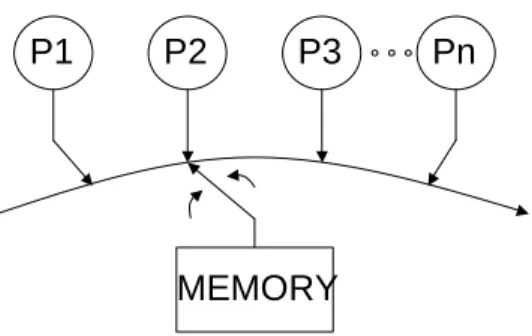
P3
Pn
Figure 10: Programmers’ view of memory and computation in a sequen-tially consistent system
specifies the values that a shared variable read in a multithreaded pro-gram is allowed to return.
The simplest model for reasoning issequential consistency (SC), de-fined in (Lam97), which states that the result of any execution is the same as if operations of all processors were executed in a sequential order, and operations of each individual processor appear in this sequence in the order specified by its program. Such model imposes two requirements: (1)write atomicity, that is, memory operations must execute atomically with respect to each other and (2)total program order, which means that program order is maintained between operations from individual pro-cessors.
Sequential consistency is arguably the most intuitive consistency mo-del as it can be seen as an extension of the uniprocessor momo-del to multi-processor. Figure 10 shows the programmers’ view of a sequentially con-sistency system. One can assume that each of the concurrently running threads accesses memory one at a time, as if there would be a dynamic switch that established an exclusive and temporary connection between the shared memory and a thread.
SC is easy for programmers to understand and adopt, but hampers the system performance (e.g., see discussion in (Sut05)). Indeed, the in-creasing demand for performance has lead hardware designers and com-piler constructors to develop sophisticated optimization techniques that