IMPROVING HADOOP PERFORMANCE BY USING
METADATA OF RELATED JOBS IN TEXT DATASETS
VIA ENHANCING MAPREDUCE WORKFLOW
Hamoud Alshammari
Under the Supervision of Dr. Hassan Bajwa
DISSERTATION
SUBMITTED IN PARTIAL FULFILMENT OF THE REQUIREMENTS FOR THE DEGREE OF DOCTOR OF PHILOSOPHY IN COMPUTER SCIENCE
AND ENGINEERING THE SCHOOL OF ENGINEERING
UNIVERSITY OF BRIDGEPORT CONNECTICUT
IMPROVING HADOOP PERFORMANCE BY USING
METADATA OF RELATED JOBS IN TEXT DATASETS
VIA ENHANCING MAPREDUCE WORKFLOW
Hamoud Alshammari
Committee Members
Name Signature Date
Dr. Hassan Bajwa ___________________________ ___________ Dr. JeongKyu Lee ___________________________ ___________ Dr. Navarun Gupta ___________________________ ___________ Dr. Miad Faezipour ___________________________ ___________ Dr. Xingguo Xiong ___________________________ ___________ Dr. Adrian Rusu ___________________________ ___________
Ph.D. Program Coordinator
Dr. Khaled M. Elleithy ___________________________ ___________Chairman, Computer Science and Engineering Department
Dr. Ausif Mahmood ___________________________ ___________
Dean, School of Engineering
IMPROVING HADOOP PERFORMANCE BY USING
METADATA OF RELATED JOBS IN TEXT DATASETS
VIA ENHANCING MAPREDUCE WORKFLOW
IMPROVING HADOOP PERFORMANCE BY USING
METADATA OF RELATED JOBS IN TEXT DATASETS
VIA ENHANCING MAPREDUCE WORKFLOW
ABSTRACT
Cloud Computing provides different services to the users with regard to processing data. One of the main concepts in Cloud Computing is BigData and BigData analysis. BigData is a complex, un-structured or very large size of data. Hadoop is a tool or an environment that is used to process BigData in parallel processing mode. The idea behind Hadoop is, rather than send data to the servers to process. Hadoop divides a job into small tasks and sends them to servers. These servers contain data, process the tasks and send the results back to the master node in Hadoop.
Hadoop contains some limitations that could be developed to have a higher performance in executing jobs. These limitations are mostly because of data locality in the cluster, jobs and tasks scheduling, CPU execution time, or resource allocations in Hadoop.
Data locality and efficient resource allocation remains a challenge in cloud computing MapReduce platform. We propose an enhanced Hadoop architecture that
reduces the computation cost associated with BigData analysis. At the same time, the proposed architecture addresses the issue of resource allocation in native Hadoop.
The proposed architecture provides an efficient distributed clustering approach for dedicated cloud computing environments. Enhanced Hadoop architecture leverages on NameNode’s ability to assign jobs tothe TaskTrakers (DataNodes) within the cluster. By adding controlling features to the NameNode, it can intelligently direct and assign tasks to the DataNodes that contain the required data.
Our focus is on extracting features and building a metadata table that carries information about the existence and the location of the data blocks in the cluster. This enables NameNode to direct the jobs to specific DataNodes without going through the whole data sets in the cluster. It should be noted that newly build lookup table is an addition to the metadata table that already exists in the native Hadoop. Our development is about processing real text in text data sets that might be readable such as books, or not readable such as DNA data sets. To test the performance of proposed architecture, we perform DNA sequence matching and alignment of various short genome sequences. Comparing with native Hadoop, proposed Hadoop reduced CPU time, number of read operations, input data size, and another different factors.
ACKNOWLEDGEMENTS
In the name of Allah most gracious most merciful, I thank him for everything I do and everyone he has allowed me to have in my life to help me in achieving my doctoral degree. I would like to start with my academic mentor Dr. Hassan Bajwa. I am grateful for his endless support; his guidance and leadership are qualities of true leader in the field. The commitment and dedication he provides to his advisees inspires me to be a leader in the field. His support has allowed me to reach this point and for that thank you.
Also, I would like to thank my Co-advisor Dr. Jeongkyu Lee for his support during my classes and research. A special appreciation goes to Dr. Khaled Elleithy for his support and direction during my study. To all my committee members, thank you for your points and directions that I have received from you to develop my work.
To my mother, I ask Allah to save you, give you the strength, and to live healthy during the rest of your life. I appreciate your patience and support during all of my life. To my wife and my kids Sari and Mariam I love you and ask Allah to save you and save our family. To my brothers, sisters, and friends I appreciate your support at all times and I wish you all the best in your lives.
TABLE OF CONTENTS
ABSTRACT ... iv
ACKNOWLEDGEMENTS ... vi
TABLE OF CONTENTS ... vii
LIST OF TABLES ... x
LIST OF FIGURES ... xi
CHAPTER 1: INTRODUCTION ... 1
1.1 What is BigData? ... 1
1.2 What are Hadoop and MapReduce? ... 2
1.3 What is MapReduce Job? ... 4
1.4 Comparison of Hadoop with Relational Database Management Systems – RDBMS ... 8
1.5 Hadoop for Bioinformatics Data ... 9
1.6 Research Problem and Scope ... 9
1.7 Motivation behind the Research ... 11
1.8 Potential Contributions of the Proposed Research ... 12
CHAPTER 2: LITERATURE SURVEY ... 13
2.1.2 Optimizing Jobs Scheduling Process ... 17
2.1.3 Optimizing Hadoop Memory and Cashing Data Control ... 20
2.2 Improving Data considerations in Cloud Computing ... 24
2.2.1 Improving performance Based on Data Type ... 24
2.2.2 Improving performance Based on Data Size ... 27
2.2.3 Improving performance Based on Data Location ... 29
2.3 Optimizing Cloud Computing Environment ... 35
2.4 Drawback of some solutions ... 40
CHAPTER 3: RESEARCH PLAN ... 41
3.1 Overview of Native Hadoop Architecture ... 41
3.1.1 Native Hadoop MapReduce Workflow ... 42
3.1.2 Overview of native Hadoop Performance ... 45
3.1.3 Hadoop MapReduce Limitations ... 48
3.2 Proposed Enhanced Hadoop Architecture ... 48
3.2.1 Common Job Blocks Table (CJBT) ... 49
3.2.2 End-User Interface ... 53
3.2.3 Enhanced Hadoop MapReduce Workflow ... 53
CHAPTER 4: IMPLEMENTATION AND TEST PLAN ... 57
4.1 Creating the Common Job Block Table (CJBT) ... 58
4.2 Designing User Interface (UI) ... 58
4.3 Proposed Solution Environment ... 58
4.5 Amazon Elastic MapReduce EMR experiments ... 60
CHAPTER 5: RESULTS ... 61
5.1 Comparing Native Hadoop with Enhanced Hadoop ... 61
5.1.1 HDFS: Number of Read Operations ... 62
5.1.2 CPU Processing Time ... 63
5.2 Comparing Amazon EMR with Enhanced Hadoop ... 66
5.2.1 Number of Read Operations Form HDFS and S3 ... 66
5.2.2 CPU Processing Time ... 67
5.2.3 Number of Bytes Read ... 68
CHAPTER 6: CONCLUSIONS ... 70
REFERENCES ... 73
LIST OF TABLES
Table 2.1 Improving in Job Scheduling, Execution Time, and Cashing Data 23 Table 2.2 Improving in Data Considerations in Cloud Computing 34
Table 2.3 Improving in Cloud Computing Environment 39
Table 3.1 Common Job Blocks Table components 50
Table 3.2 Likelihood of Random Nucleotides 52
Table 4.1 Common Job Block Table (DNA example) 59
Table 5.1 A List of Factors that we can use to Compare Between Native
LIST OF FIGURES
Figure 1.1 Overall MapReduce WordCount MapReduce Job 5
Figure 1.2 Native Hadoop Architecture 6
Figure 1.3 DataNodes and Task Assignment 7
Figure 2.1 Execution time of wordcount benchmark in SHadoop and the
standard Hadoop with different node numbers 15 Figure 2.2 Comparing in Execution time using Push-model between
(a) Standard Hadoop and (b) Proposed Hadoop in Map phase 16 Figure 2.3 Comparing in Execution time using Push-model between
(a) Standard Hadoop and (b) Proposed Hadoop in Reduce phase 16 Figure 2.4 Comparison of runtime (in hours) of the jobs between Capacity
and machine learning based algorithms 19
Figure 2.5 Cash system in Unbinding-Hadoop 22
Figure 2.6 New Hadoop Archive techniques that is presented in NHAR 28 Figure 2.7 Architecture of combining multiple small files into one large file 28 Figure 2.8 Number of Read Operations in Native and Proposed Hadoop 29
Figure 2.9 Map and Reduce-input heavy workload 31
Figure 2.10 Mean and range of the job processing times by repeating 5 times 32 Figure 2.11 Map and Reduce execution time of WordCount example 33
Figure 3.1 Native Hadoop MapReduce Architecture 44 Figure 3.2 Native Hadoop MapReduce Workflow Flowchart 45
Figure 3.3 Enhanced Hadoop MapReduce Architecture 54
Figure 3.4 Enhanced Hadoop MapReduce Workflow Flowchart 56 Figure 5.1 Number of read operations in Native Hadoop and Enhanced
Hadoop for the same job 62
Figure 5.2 CPU processing time in Native Hadoop and Enhanced Hadoop
for the same jobs 63
Figure 5.3 Number of read operations in Amazon EMR and Enhanced Hadoop
for the same jobs 66
Figure 5.4 CPU processing time in Amazon EMR and Enhanced Hadoop
for the same jobs 68
Figure 5.5 Number of Bytes Read in GB in Amazon EMR and Enhanced Hadoop
CHAPTER 1: INTRODUCTION
Human Genome Project is arguably the most important scientific project that has produced the most valuable dataset scientific community has ever seen. Translating the data to meaningful information requires substantial computational power and efficient algorithms to identifying the degree of similarities among multiple sequences [1]. Sequential data applications such as DNA sequence aligning usually require large and complex amounts of data processing and computational capabilities [2]. Efficiently targeting and scheduling of computational resources is also required to such complex problems [3]. Although, some of these data are readable by humane, it can be very complex to be understood and processed using the traditional techniques [3, 4]. Availability of open source and commercial cloud computing parallel processing platforms have opened new avenues to explore structured, semi-structured or unstructured genomic data [5]. Before we go any further, it is necessary to define certain definitions that are related to BigData, Hadoop and MapReduce.
1.1 What is BigData?
It is either relational database (Structured) such as stock market data or non-relational database (Semi-structured or Unstructured) such as social media data or DNA data sets. Usually, very large in size, BigData cannot be processed using traditional
processing techniques such as Relational Database Management Systems -RDBMS [6]. A survey that has been done explaining different studies that are exploring some issues in BigData, and it explains the 4V model of BigData.
4V’s of BigData are 1) Volume of the data, which means the data size, and we are talking about zetabyte these days. 2) Velocity, which means the speed of the data or streaming of the data. 3) Varity of the data, which means the data forms that different applications deal with such as sequence data, numeric data or binary data. 4) Veracity of the data, which means the uncertainty of the status of the data or how clear is the data to these applications [7].
Different challenges in BigData have been discussed in [8] and they are described as a technical challenges such as the physical storage that stores the BigData and reduce the redundancy. Also, the process of extracting the information, the cleaning the data is one challenge, data integration, data aggregation and representation.
1.2 What are Hadoop and MapReduce?
Hadoop is an Apache open-source software framework that is written in Java for distributed storage and distributed processing. It provides solutions for BigData processing and analysis. It has a file system that provides an interface between the users’ applications and the local file system, which is the Hadoop Distributed File System HDFS. Hadoop distributed File System assures reliable sharing of the resources for efficient data analysis [9].
The two main components of Hadoop are: (i) Hadoop Distributed File System (HDFS) that provides the data reliability (distributed storage) and (ii) the MapReduce that provides the system analysis (distributed processing) [9, 10]. Relying on the principle that “moving computation towards data is cheaper than moving data towards computation” [11], Hadoop employs HDFS to store large data files across the cluster. There are several reasons that make companies use Hadoop, some of them are it is an open source and can be run on commodity hardware, the initial cost savings are dramatic and continue to grow as your organizational data grows, and it has a robust Apache community behind it that continues to contribute to its advancement.
MapReduce provides stream reading access and runs tasks on a cluster of nodes and provides a data managing system for a distributed data storage system [12]. MapReduce algorithm has been used for applications such as generating search indexes, document clustering, access log analysis, and different other kinds of data analysis [13].
“Write-once and read-many” approach permits data files to be written only once in HDFS and then allows it to be read many times over with respect to the numbers of jobs [9]. During the writing process, Hadoop divides the data into blocks with a predefined block size. The blocks are then written and duplicated in the HDFS. The blocks can be duplicated a number of times based on a specific value which is 3 times by default [14].
In HDFS, the cluster that Hadoop is installed in is divided into two main components, which are (i) the master node called NameNode and (ii) the slaves called
of the files system including saving the data and directing the jobs to the appropriate DataNodes that store related application data [15]. DataNodes facilitates Hadoop MapReduce to process the jobs with streaming execution in a parallel processing environment [9, 16].
Running on the master node, JobTracker coordinates and deploys the applications to the DataNodes with TaskTracker services for execution and parallel processing [14]. Each task is executed in an available slot in a worker node, which is configured with a fixed number of map slots, and another fixed number of reduced slots. The input to MapReduce is in text format, so the data must be read as text files, and the output also is in text file format [9].
1.3 What is MapReduce Job?
A MapReduce job is an access and process-streaming job that splits the input dataset into independent chunks (blocks) and stores them in HDFS. It has two main tasks Map and Reduce, which are completely in parallel manner. Storing data in HDFS has many forms, one of them is a <Key, Value> concept to determine the given parameter and retrieve the required result as a value in the end of the whole job.
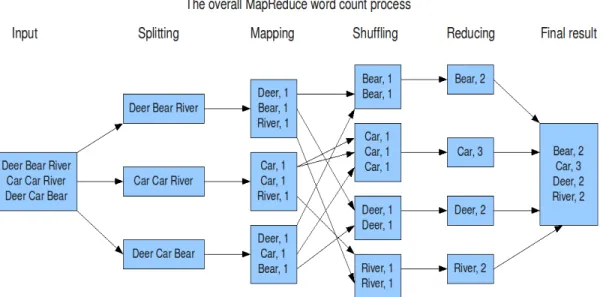
Figure 1.1 explains MapReduce example of wordcount as a common example to apply MapReduce in such unstructured data like books. As input file, it consists of sequence of strings that are separated by space, so we can consider the space as a delimiter that separate words.
Figure 1.1: Overall MapReduce WordCount MapReduce Job.
First step, Hadoop divides the data to blocks (Splitting phase). Then, Mapping phase dose <key, value> for each word (e.g. <Deer, 1>. Then, Shuffling phase collects the values of the same key to be in one intermediate result. After that, Reducing phase does the addition of the values to have one final value for each key. Finally, NameNode provides a final result that has all keys and their values as a one final result from the MapReduce job.
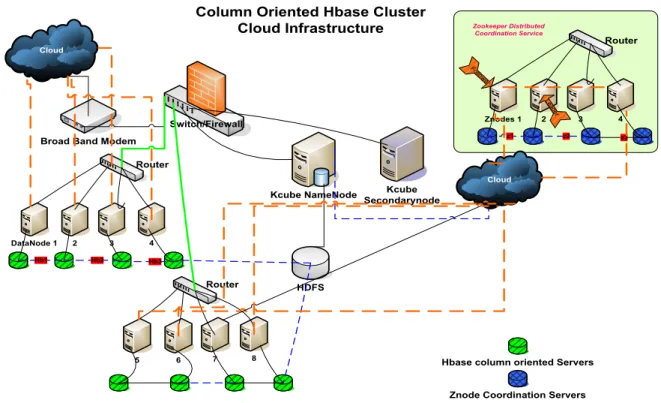
HDFS cluster is composed of a centralized indexing system called NameNode and its data processing units called DataNodes; together they form a unique distributed file system. NameNode plays an important role in supporting the Hadoop Distributed File System by maintaining a File-Based block index map; this map is responsible for locating all the blocks related to the HDFS. HDFS is the primary storage system. It creates multiple replicas of data blocks and is further responsible for distributing data blocks
Cloud Cloud 4 3 5 6 7 DataNode 1 2 8
Column Oriented Hbase Cluster Cloud Infrastructure
Switch/Firewall Broad Band Modem
Router Router HDFS Kcube Secondarynode Kcube NameNode Hb1 Hb2 Hb3
Hbase column oriented Servers
4 3 Znodes 1 2 Router z1 z2 z3 Le ad er Fo llow er Zookeeper Distributed Coordination Service
Znode Coordination Servers
Figure 1.2: Native Hadoop Architecture.
shows the native Hadoop architecture that gives an overview on Cloud Computing architecture too.
ZooKeeper is critical component of the infrastructure, it provides coordination and messaging across applications [18]. The ZooKeeper capabilities include naming, distributing synchronization, and group services. Hadoop framework leverages on large-scale data analysis by allocating data-blocks among distributed DataNodes.
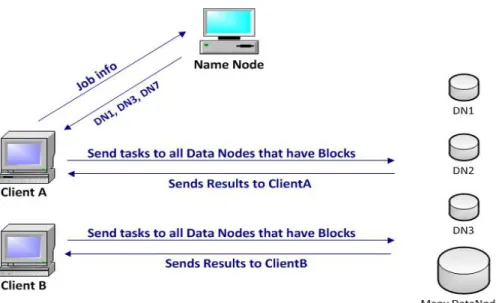
Hadoop Distributed File System shown in Figures 1.2 and 1.3 allows the distribution of the data set into many machines across the network that can be logically prepared for processing. HDFS adopted “Write-Once and Read-Many” model to store data in distributed DataNodes. NameNode is responsible for maintaining namespace hierarchy, managing data blocks and DataNodes mapping [19]. Once job information is
Figure 1.3: DataNodes and Task Assignment.
received from the client, NameNode provides a list of available data nodes for the job. NameNode maintains the list of available data nodes and is responsible for updating the index list when a DataNode is unavailable due to failure in hardware or network issues. A heartbeat is maintained between the NameNode and the DataNodes to check the keep-alive status and health of the HDFS [20]. Client writes data directly to the DataNode, this is shown in Figure 1.3.
HDFS is architected to have the block fault and replication tolerance. NameNode is the responsible for maintaining a healthy balance between disk processing on various DataNodes and has the ability to restore failed operations on the remote blocks. Data Locality is achieved through cloud file distribution, the file processing is done local to each machine, and any failed reads from the blocks are recovered through block replication.
The process of selecting the mappers and reducers is done by the JobTracker immediately after lunching a job [16, 21]. A client operating on the HDFS has network file transparency, and the distribution of blocks on different machines across the Cloud is transparent to the client. HDFS is oriented towards hardware transparency. Processing DataNodes can be commissioned or decommissioned dynamically without affecting the client.
1.4 Comparison of Hadoop with Relational Database Management Systems –RDBMS
Hadoop MapReduce has been the technology of choice for many data intensive applications such as email spam detections, web indexing, recommendation engines, predictions on weather and financial services. Though Relational Database Management Systems (RDBMS) can be used to implement these applications, Hadoop is a technology of choice due to its higher performance despite RDBMS’s higher Functionality [22].
RDBMS can process the data in real-time with high level of availability and consistency. Organizations such as banks, e-business and e-commerce websites employ RDMBS to provide reliable services. However, RDBMS does not work seamlessly with unstructured heterogeneous BigData and processing BigData can take a very long time.
On the other hand, scalable, high-performing massive parallel processing Hadoop platform can store and access petabytes of data on thousands of nodes in a cluster. Though comparing to RDMBS, processing of BigData is efficient in Hadoop. Hadoop and MapReduce is not intended for real-time processing [23]. The RDMBS and a Hadoop cluster can be complementary and coexist in the data warehouse together.
1.5 Hadoop for Bioinformatics Data
We are using the DNA sequence data sets as an example to test the proposed work and it is not the only data set that we can use but it is a very good data in terms of structured data and has high value in researches. While there is many applications other than Hadoop can handle the Bioinformatics data, Hadoop framework was primarily designed to handle unstructured data [24].
Bioinformatics tools such as (BLAST, FASTA etc) can process unstructured genomic data in parallel workflow [5]. Most of the users are not trained to modify the existing applications to incorporate parallelism effectively [25, 26]. Parallel processing is crucial in rapid sequencing of large unstructured dataset that can be both time-consuming and expensive. Aligning multiple sequences using sequence alignment algorithms remains a challenging problem due to quadratic increases in computation and memory limitation [27]. BLAST-Hadoop is one implementation of sequence aligning that uses Hadoop to implement BLAST in DNA sequences, and there is more information about this experiment in [1].
1.6 Research Problem and Scope
Searching for sequences or mutation of sequences in a large unstructured dataset can be both time-consuming and expensive. Sequence alignment algorithms are often used to align multiple sequences. Due to memory limitation, aligning more than three to four sequences is often not allowed by traditional alignment tools.
number of DataNodes are increased in the cluster. However, when we execute a MapReduce job in the same cluster for more one time, each time it takes the same amount of time. This study aims to present this problem and propose a solution that would improve the time involved in the execution of MapReduce jobs.
Many Big Data problems such as genomic data focus on similarities, sequences and sub-sequences searches. If a sub-sequence is found in specific blocks in a DataNode, sequence containing that sub-sequence can only exist in the same DataNode. Since current Hadoop Framework does not support caching of job execution metadata, it ignores the location of DataNode with sub-sequence and reads data from all DataNodes for every new job [28]. Shown in Figure 1.2, Client A and Client B are searching for similar sequence in BigData. Once Client A finds the sequence, Clint B will also go through the whole BigData again to find the same results. Since each job is independent, clients do not share results. Any client looking for Super sequence with sub-sequence that has already been searched will have to go through the BigData again. Thus the cost to perform the same job will stay the same each time. The outlines and the scope behind this research is as follows:
• Discuss the concept of BigData and the need to use new approaches to process it. • Overview of the type of data that Hadoop can process to get better result than the
traditional ways of computing.
• Discuss the architecture and workflow of existing Hadoop MapReduce algorithm and how users can develop their work based on the size of their data.
• Investigate and discuss the benefits and limitations of existing Hadoop MapReduce algorithm to come up with a possible solution on how to develop the MapReduce performance.
• Propose an enhancing process to the current Hadoop MapReduce to improve the performance by reducing the CPU execution time and power costs.
1.7 Motivation behind the Research
While there are many applications of Hadoop and BigData, Hadoop framework was primarily designed to handle unstructured data. Massive genomic data, driven by unprecedented technological advances in genomic technologies, have made genomics a computational research area. Next Generation Sequencing (NGS) technologies produce High Throughput Short Read (HTSR) data at a lower cost [29]. Scientists are using innovative computational tools that allow them rapid and efficient data analysis [30, 31] . DNA genome sequence consists of 24 chromosomes. The compositions of nucleotides in genomic data determine various traits such as personality, habits, and inherited characteristics of species [32]. Finding sequences, similarities in sequences, sub-sequences or mutation of sequences are important research areas in genomic and bioinformatics. Scientists need to find sub-sequences within chromosomes to determine either some diseases or proteins frequently [33]. Therefore, one of the important motivations is to speed up processing time like finding sequence process in DNA. The need to reduce different costs like those spent in power for the service provider, paying the users and data size for the computation process is also a pressing motivation.
1.8 Potential Contributions of the Proposed Research
Different research areas can use the current Hadoop architecture and may face the same problem frequently. Scientific data and others that employ the use of data sequence that need more jobs and processes may spend more time and power doing their research. This contribution is to improve the Hadoop MapReduce performance by enhancing the current one by getting the benefits from the related jobs that share some parameters with the new job.
Building tables that store some results from the jobs gives us ability to skip some steps either in reading the source data or do some processing on the shared parameters. In addition, by enhancing the Hadoop we can reduce processing time, data size to read and other parameters in Hadoop MapReduce environment.
CHAPTER 2: LITERATURE SURVEY
Hadoop is considered as a new technology that provides processing services for BigData issues in cloud computing, thus, research in this field is considered as a hot topic. Many studies have discussed and developed different ways to improve the Hadoop MapReduce performance from different considerations or aspects.
Cloud Computing is emerging as an increasingly valuable tool for processing large datasets. While several limitations such as bandwidth, security and cost have been mentioned in the past [2, 34], most of these approaches are only considering public cloud computing and ignores one of the most important features of cloud computing “ write-once and read-many”.
Many studies have discussed different solutions that can help to improve Hadoop performance. These improvements could be implemented in the two major components of Hadoop, which are MapReduce, which is the distributed parallel processing algorithm, and the HDFS, which is the distributed data storage in the cluster.
The first area of improving Hadoop performance is optimizing job scheduling and execution time in MapReduce jobs [35-46]. In this area of development, many studies have improved the Hadoop performance and they have achieved positive results, as we will discuss later on in our research. This part also includes optimizing the process of cashing data in the MapReduce job.
In addition, there are different studies that have focused on the data in cloud computing and improving its related issues such as data locality and type [11, 15, 25, 33, 47-52]. This part of the research focuses on the data based on data type or based on the data location. Other studies focused on the Cloud Computing environment that Hadoop works in and develops this environment to be more suitable for Hadoop [53-59].
In this part, we present a couple of these areas of research and discuss the important points that each one proposed in order to improve Hadoop performance as well as the studies’ limitations and results.
2.1 Optimizing Job Execution and Job Scheduling Processes
One of the important features of Hadoop is the process of MapReduce job scheduling and execution processes. Different studies have done some of improvements and have come up with good results based on some assumptions. We will discuss some of these studies as follows:
2.1.1 Optimizing Job Execution Process
Many applications need a quick response time with high performance to get high throughput especially for short jobs. So, one of the important features of the execution job is the MapReduce job response time. In SHadoop, this study proposed changing in MapReduce job performance by enhancing and optimizing the job and tasks execution mechanism [35].
The study developed the work by optimizing two parts of Hadoop workflow. First, they optimized the time cost of initialization and termination the job stages. Second,
they optimized the sending of the Heartbeats-based communication mechanism that communicates between the JobTracker and TaskTrackers on the cluster to have a developed mechanism that accelerates the task scheduling and execution performance.
The experiments show that, the developed Hadoop “SHadoop” has improved the execution performance by around 25% on average comparing with the native Hadoop without loosing the scalability and speedup especially for short jobs. The chart in Figure 2.1 explains the performance between standard Hadoop and developed Hadoop that is proposed in SHadoop:
The technique of optimizing the time of job initialization and termination is followed by [40] to develop Hadoop performance by speedup the setup and cleanup
Figure 2.1: Execution time of wordcount benchmark in SHadoop/StandardHadoop with different number of nodes.
(a) Standard Hadoop (b) Proposed Hadoop
Figure 2.2: Comparing in Execution time using Push-model between (a) Standard Hadoop and (b) Proposed Hadoop in Map phase.
(b) Proposed Hadoop (a) Standard Hadoop
Figure 2.3: Comparing in Execution time using Push-model between (a) Standard Hadoop and (b) Proposed Hadoop in Reduce phase.
tasks. This study, also, optimized the mechanism of assigning the tasks from pull-model to push-model.
The results from experiments show that the work speeds up the job execution time by 23% on average comparing with the standard Hadoop. The compression in the work shown in Figure 2.2 and Figure 2.3:
As shown in Figures 2.2 and 2.3, after further applying the optimization of the posh-model task assignment and instant message communication mechanisms, the total
job execution time is further shortened to 27 seconds for the map phase extension BLAST, and to 40 seconds for the reduce phase extension BLAST.
2.1.2 Optimizing Jobs Scheduling Process
Zookeeper [18] is one component of Hadoop ecosystem that is considered as a centralized control service that maintains a couple of services such as configuration information, naming, provides grouping information in the cluster, and job scheduling since it is one of the Hadoop configurable services.
Different studies have been discussed in a survey about MapReduce job scheduling algorithms [60]. In this work, the authors listed the most used scheduling algorithms that control the order and distribution of users, tasks, and jobs. So, by having better scheduling algorithms, we can improve Hadoop performance. Most of the proposed algorithms in that survey have been developed to meet some requirements under some circumstances and assumptions.
Job scheduling process in Hadoop follows the First-In First-Out (FIFO) algorithm, which may cause different weaknesses in Hadoop performance. Zaharia and others, provide some solutions to improve the job scheduling in Hadoop and they implied it to Facebook [38]. Some systems have services that allow for multiple users on the same system. In [38] the authors discuss job scheduling for multi-users on the system. This study is considered as one of the common studies in this section. The authors focused on sharing a MapReduce environment between many users and described that as attractive, because it enables sharing common large data between them. The traditional scheduling
algorithms perform a very poor process in MapReduce because of the data locality and dependency between map tasks and reduce tasks.
The study experimented with scheduling for MapReduce in Facebook with a 600-node multi-user data warehouse in Hadoop. Two techniques have been developed which, included delay scheduling and copy-compute splitting, this provided very good results, which improved the throughput and response time by many factors.
Different ideas have been discussed in [37] which is about having information about each task and node in the cluster, so the idea is to schedule algorithms for distributing the sources of Hadoop between nodes in the cluster. Improving the process by assigning and selecting best and most suitable task for the node. Consequently, the authors avoided the overloading on any node in the cluster and utilized maximum resources on the node to control and decrease the accessing rate between tasks for the resources. This reduces the job runtime process.
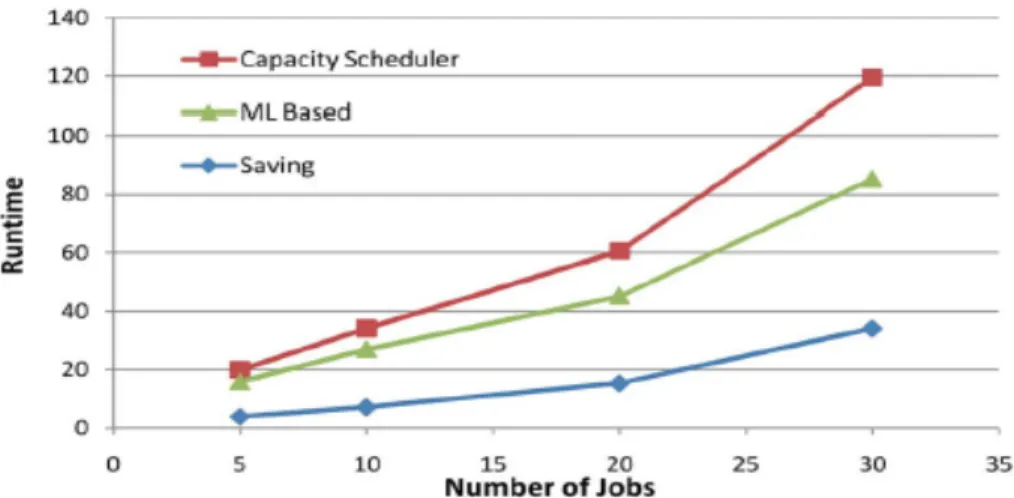
Also, in this paper, the authors discussed the ability of scheduling jobs on Hadoop by adding an algorithm for assigning features to jobs. Figure 2.4, shows the comparison between two algorithms that are applied in the cluster to show a decrease in the runtime of jobs. The amount of the saving in the runtime of the jobs increases as the number of jobs increase. Transferring data is one of the issues that paper [39] has discussed. While transferring data is considered as a cornerstone of the process, transferring un-necessary data can also be considered an important issue that we can manipulate. By placing the tasks on the nodes that carry the data, we can improve the performance, which means it is all about the locality of the input data.
Figure 2.4: Comparison of runtime (in hours) of the jobs between Capacity and machine learning based algorithms.
The authors in [39] integrated their work into FIFO, which is the default algorithm in Hadoop job scheduling and into Hadoop Fair Scheduling algorithm. Some comparisons have been done between the proposed technique in this study and the native and other proposed techniques. The experiment shows its results to the map tasks have highest data locality rate and lower response time.
Another way to reschedule the map tasks has been discussed in [41] which is about prediction and selection of the task who has the highest probability to be executed in a data node based on the location and select it to be the first in the list after calculating all map tasks probabilities and rescheduling them. After implementing the proposed solution, one of the results was that there was a 78% reduction of the map tasks processed without node locality, a 77% reduction in the network load caused by the tasks, and improved the performance of Hadoop MapReduce when comparing with the default task
MapReduce uses the parallel computing framework to execute the jobs within the cluster. Some of the tasks may become struggled somehow, which means they take long time to finish the whole job, and that affects the total cluster throughput. There are different approaches that deal with this kind of problem one of them is the Maximum Cost Performance (MCP) that is presented in [42] which improves the effectiveness of speculative execution significantly. To determine the slow task, this study provides a strategy by calculate the progress rate and the process bandwidth. Also, they predict the process speed and the remaining runtime by using exponentially weighted moving average (EWMA).
For the slow tasks, they need to choose a proper machine to store these tasks to run them. The proposed strategies and taking the data locality and data skew into consideration, they can choose the proper worker node for backup tasks. They execute different applications on a cluster contains about 30 physical machines, and the experiments show that MCP can run jobs up to 39% faster and improve the cluster throughput by up to 44 percent compared to Hadoop-0.21.
2.1.3 Optimizing Hadoop Memory and Cashing Data Control
Memory systems could have many issues that could be addressed to improve system performance. In Hadoop, Apache performs a centralized memory approach it is implemented to control the cashing and resources [43]. There are different approaches that discuss memory issues. ShmStreaming [44] introduces a Shared memory Streaming schema to provide lockless FIFO queue that connects Hadoop and external programs.
ShmStreaming claim that they have improved the performance by 20-30% comparing with native Hadoop streaming implementation.
Apache Hadoop supports centralized data cashing. However, some studies utilize a distributed cashing approach to improve Hadoop performance [36, 45]. The studies identified enhanced architecture of Hadoop as an advancement that would accelerate job execution time. The proposed solutions are the efforts to speed up the access to map tasks and reduce tasks by using distributed memory cache. By using the distributed cache memory, the process of shuffling data between tasks improves the performance of MapReduce jobs. This decreases the time that is spent transferring data and increases the utility of the cluster.
Another study that focuses on cashing data in memory is L. Lum et.al [46]. In this study, the researchers claim that all the data cannot be cached in the memory due to memory limitations, thus the cashed data should be selected only when needed to improve the performance of Hadoop. The proposed solution provides unbinding technology, which could delay the binding of the programs and data together until the real computation starts. With the strategy of cashing and prefetching, Hadoop can get higher performance.
Unbinding-Hadoop is the framework that this study provides to decide the input data for map tasks in the map start-up phase not at the job submission phase. Also, prefetching does the same development in performance comparing with native Hadoop. The Unbinding-Hadoop performs better results after some experiments and reduces the
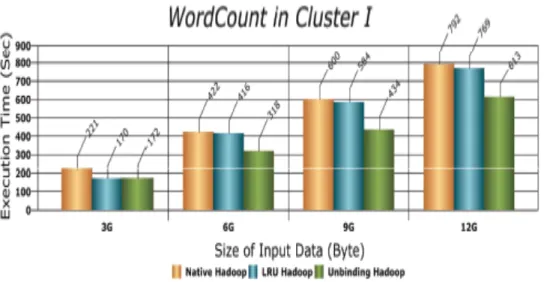
execution time by 40.2% for word-count application and by 29.2% for k-means algorithm as shown in Figure 2.5.
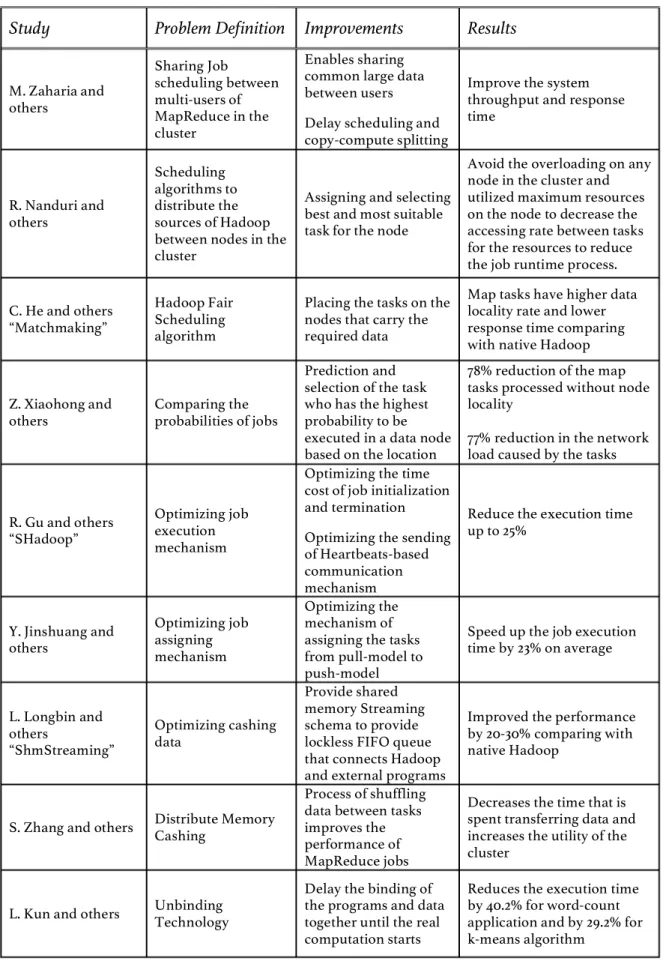
Table 2.1 shows a summary of comparisons between studies related to the improvement of Hadoop performance via developing the job execution time, job scheduling, and cashing data in the memory systems.
Table 2.1: Improvement in Job Scheduling, Execution Time, and Cashing Data
Study Problem Definition Improvements Results
M. Zaharia and others Sharing Job scheduling between multi-users of MapReduce in the cluster Enables sharing common large data between users Delay scheduling and copy-compute splitting
Improve the system throughput and response time R. Nanduri and others Scheduling algorithms to distribute the sources of Hadoop between nodes in the cluster
Assigning and selecting best and most suitable task for the node
Avoid the overloading on any node in the cluster and utilized maximum resources on the node to decrease the accessing rate between tasks for the resources to reduce the job runtime process. C. He and others
“Matchmaking”
Hadoop Fair Scheduling algorithm
Placing the tasks on the nodes that carry the required data
Map tasks have higher data locality rate and lower response time comparing with native Hadoop
Z. Xiaohong and
others Comparing the probabilities of jobs
Prediction and selection of the task who has the highest probability to be executed in a data node based on the location
78% reduction of the map tasks processed without node locality
77% reduction in the network load caused by the tasks
R. Gu and others “SHadoop”
Optimizing job execution mechanism
Optimizing the time cost of job initialization and termination Optimizing the sending of Heartbeats-based communication mechanism
Reduce the execution time up to 25% Y. Jinshuang and others Optimizing job assigning mechanism Optimizing the mechanism of assigning the tasks from pull-model to push-model
Speed up the job execution time by 23% on average L. Longbin and others “ShmStreaming” Optimizing cashing data Provide shared memory Streaming schema to provide lockless FIFO queue that connects Hadoop and external programs
Improved the performance by 20-30% comparing with native Hadoop
S. Zhang and others Distribute Memory Cashing
Process of shuffling data between tasks improves the performance of MapReduce jobs
Decreases the time that is spent transferring data and increases the utility of the cluster
2.2 Improving Data considerations in Cloud Computing
Location of the input data has been determined in current Hadoop to be located in different nodes in the cluster. Since there is a default value for duplication of the data, which is 3 times, Hadoop distributes the duplicated data into different nodes in different network racks.
This strategy helps for various reasons, one of which is for the false tolerant issue to have more reliability and scalability. However, the default data distribution location strategy causes some poor performance in terms of mapping and reducing tasks. In this section, we will discuss a couple of studies that introduce different strategies related to improving the Hadoop performance by controlling the data distribution location, type, and size strategies.
2.2.1 Improving performance Based on Data Type
SciHadoop [15] focuses on a specific type of data such as scientific data. The use of specific data in this work has made it incompatible with other data formats. Using native Hadoop for scientific data analysis is not an attractive choice due to the required format transformation and data management costs. SciHadoop presents a critical problem related to the proficiency and locality of the data in the Hadoop MapReduce cluster. In addition to the DataNodes, there can be physical location problems in a cluster [15, 49], SciHadoop discusses the problem that is associated with array-based scientific data.
SciHadoop leverages on strategic physical location of scientific data to reduce the data transfer, remote reads process, and unnecessary reads. SciHadoop uses location
based optimization techniques such as planned partitioning of the input data, during the earlier phases of the MapReduce job for specific data types. This allows avoiding unnecessary block scans by examining data dependencies in an executing query.
This paper proposes an idea, which applies some optimizations to allow the scientists to use logical queries that are executed as MapReduce jobs over array-based data models. The main goal of SciHadoop is to perform these three goals: reduce total data transfer, reduce remote reads, and reduce unnecessary reads. This paper explains how MapReduce works by explaining the concept of array-based data models, which is indeed the structure of the data when it gets formulated after the mapping phase and before “shuffle and sort” phase. Then the combine function comes after that to produce the final result of one map function to be sent to the reducer. The reducer receives many final results from different mappers to calculate the final result of the whole job. The paper states that the storage devices these days are actually built to store the data format of byte stream data models.
Two points that make the scientific data work against the efficiency of using MapReduce are the high-level data model and the interface to meet some particular problem domain (n-dimensional format). The second point is that this data hides some details. Processing the scientific data will be done using a scientific access library, which means the mappers focus on (interacts with) data using a formulated data model and that partition occurs on the logical-level of the data model.
approach formats the input data to be in one array, and second divides the logical input file to blocks. Each block is represented by a sub-array to make it easier to control. One of the drawbacks of this work is that formulating input data is done to meet the requirements of a single MapReduce job, so if there is another job to be done on the same file, we will have to reformat the data again.
The type of the input data might lead some researchers to develop a new algorithm or enhance the current one to make the accessing data process easier. One of the studies focuses on the binary data as source data for MapReduce algorithm that is read from HDFS. The authors in Bi-Hadoop [50] studied the degradation level in application performance. Bi-Hadoop develops an easy-to-use user interface, a caching subsystem in Hadoop and a binary-input aware task scheduler.
This study discusses the data locality for binary inputs, which shows to what extent the binary data is shared between multiple applications that use that data. The proposed problem is the distribution of that data and the overhead from data transfer that different applications produce when the tasks read the data. So, they proposed a developed solution to group the binary data to be close in the location of the tasks to reduce the overhead that was previously explained and assigns the tasks to the same compute node. Experiments show a 48% reduction in data read operations and up to 3.3x improvement in execution time than the native Hadoop.
A novel approach that is proposed for multiple sequence alignment using Hadoop [33] that proposes a time efficient approach for sequence alignment. It is discussed that
the dynamic feature in a sequence aligning in grid network using Hadoop. Due to scalability of Hadoop, this approach works perfectly in large-scale alignment problems.
Bidoop [25] discussed the benefits of applying Hadoop in bioinformatics data. It reports on its application to three relevant algorithms: BLAST, GSEA and GRAMMAR. The results show a very good performance using Hadoop due to some Hadoop features like scalability, computational efficiency and ease to maintenance.
Spatial data is one common data type that is used continuously. Authors in [61] proposed a very helpful solution by improving native Hadoop to a version that reads spatial data as two related numeric values for each location.
2.2.2 Improving performance Based on Data Size
Hadoop stores the metadata of the cluster on the NameNode that contains the blocks ID, location in the cluster, DataNodes, etc. Hadoop memory could run out and cause a slowdown in Hadoop performance when the metadata becomes large in size. Some studies provide solutions for this problem which is having a new archive system (NHAR) to improve the memory utilization for metadata and enhance the efficiency of accessing small files in HDFS [48] as shown in Figure 2.6. The experiments show that the access efficiency of small files in the new approach has been improved up to 85%.
Hadoop can perform a high degree of the performance processing of large size data files because the size of the blocks in HDFS usually is less that the source data size. However, if we have many small data files, Hadoop performance becomes less successful.
Figure 2.6: New Hadoop Archive technique that is presented in NHAR.
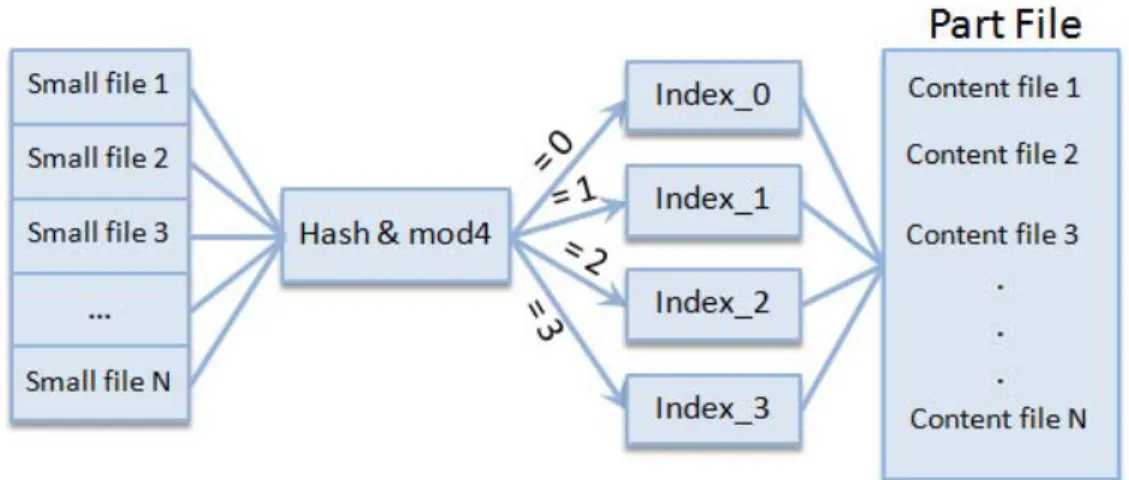
Figure 2.7: Architecture of combining multiple small files into one large file. In [62] the WebGIS source data files are very small in size and cause the problem that we have above mentioned here before. So, this study proposes a solution that they can combine multiple files to be in one source file then this source file can be divided into many blocks and works well. WebGIS files have different characteristics to support easy access pattern. Figure 2.7 shows the Architecture of the proposed design in [62].
The WebGIS study also shows that there are some improvements in number of read operations. The number of read operations for blocks that meet the parameter of the size of data block following the proposed system is less than the number of read operations for the same data in native Hadoop. Figure 2.8 shows the difference between the number of read operations in the proposed solution and native Hadoop:
2.2.3 Improving performance Based on Data Location
Transferring data is one of the issues that paper [39] has discussed. While transferring data is considered as a cornerstone of the process, transferring un-necessary data can also be considered an important issue that we can study. By placing the tasks on the nodes that carry the data, we can develop the performance, which means it is all about the locality of the input data.
The authors integrated their work into FIFO, which is the default algorithm in Hadoop job scheduling and into Hadoop fair scheduling. Some comparisons have been
completed between the proposed techniques in this study and native Hadoop. The experiment’s results show that map tasks have higher data locality rate and lower response time.
In [11], Hadoop data source locality is considered as one of the most important issue that is associated with the performance and costs of MapReduce. However, current Hadoop MapReduce workflow does not consider the locality of the data at requesting nodes during reducing the tasks. The Tasks Scheduler starts scheduling the tasks after a certain percentage, 5% by default, of mappers commit. That is when Hadoop starts early shuffling or scheduling the tasks on nodes. There is no consideration of data locality by JobTracker when early shuffling starts.
In this work, the authors propose a novel solution about the Locality-Aware Reduce Task Scheduler (LARTS) strategy. The idea behind LARTS is to defer the process of tasks scheduling until input data size is recognized. In comparison with native Hadoop, LARTS defers task scheduler by an average of 7% and up to 11.6%. To avoid scheduling delay, poor system utilization, and low degree of parallelism, LARTS employs a relaxation strategy and fragments some reduced tasks among several cluster nodes. LARTS improves node-local by 34.4%, rack-local by 0.32%, and off-rack traffic by 7.5%, on average, versus native Hadoop.
The discussion of locality issues is proposed in [47]. In this paper, the authors introduce a Hadoop MapReduce resource allocation system that enhances the performance of Hadoop MapReduce jobs by storing the datasets directly to the nodes that execute the MapReduce job. Thus there will not be any delay loading the data into the
Figure 2.9: Map and Reduce-input heavy workload.
nodes during the phase of copying data into HDFS Cloud. Optimum job mapper and reducers location is also discussed in this paper. It is also argued that the locality of the reducers is more important than the locality of the mappers.
Locality aware resource allocation reduces the network traffic generated in the cloud data center. Experimental results from a cluster of 20 nodes show reduction of job execution time by 50% and a decrease in the cross-rack network traffic by 70%.
The following charts in Figure 2.9 show the MapReduce input workload and compare random data placement and proposed algorithms in the paper [47].
They compared different techniques, which are as follows: • Locality-unaware VM Placement (LUAVP). • Map-locality aware VM placement (MLVP). • Reduce-locality aware VM placement (RLVP).
Another study has discussed the same point, which is reduce task location [51] and discussed the same idea about the degradation that might be caused because of fetching the intermediate data after map tasks. The proposed solution is about reducing the intermediate results fetching cost in MapReduce jobs by assigning the reduce tasks to the nodes that do the intermediate results and pick the low fetching cost. This study follows the optimum placement strategy for the threshold-base structure.
The experiments show that the proposed solution improves the performance of Hadoop MapReduce. Figure 2.10 shows one results:
In Hadoop, the distribution storage and datacenters located happens geographically in a Cloud Computing environment. In [52] Single-datacenter or multi-datacenters have been experimented in the same jobs to evaluate the location of the data in Cloud and to evaluate the system performance. Using a prediction-based system to predict the job location in this study reduces the error rate to be less than 5% and develops the execution time of Reduce phase by 48%.
Figure 2.11: Map and Reduce execution time of WordCount example.
Results in Figure 2.11 show the efficiency of the prediction in the Map phase comparing with the real execution time (a) and the time is very close. In (b) the Reduce phase execution time with optimizations is less than the native one that is without the optimizations [52].
Table 2.2 shows a summary of comparisons between studies related to the improvement of Hadoop performance via developing some data considerations in Cloud Computing, such as data locality and data size.
Study Problem Definition Improvements Results J. Buck and others “ SciHadoop” Formatting the scientific data to be in Array-based binary format
• Reduce transferred data
• Reduce remote reads
Reduce the data
transferred by 20% before submitting jobs Y. Xiao and others "Bi-Hadoop” Control distributing data and the overhead of data transfer to different nodes
Group the binary data to be close in the location of the tasks to reduce the overhead
48% reduction in data read operations Up to 3.3x improvement in execution time S. Leo and others “Bidoop” Applying Hadoop in bioinformatics data Formatting Data to be in a simple format to be processed using Hadoop
Good results on BLAST, GSEA and GRAMMAR
A. Eldawy "Spatialhadoop”
Applying Hadoop in spatial data such as GIS location x and y axis
Read two related numeric Data to be processed using Hadoop
Good results since the data is organized and formatted earlier M. Hammoud
and others “ LARTS”
Delay the process of tasks scheduling until input data size is recognized
Defers task scheduler by an average of 7% and up to 11.6% Improves node-local by 34.4% Rack-local by 0.32% Off-rack traffic by 7.5% on average B. Palanisamy and others "-ieus” Introduce a resource allocation system to enhance the performance of Hadoop jobs
Storing the datasets directly to the nodes that execute the MapReduce job
Reduce job execution time by 50%
Decrease the cross-rack network traffic by 70% Vorapongkitipu
n and others Small file accessing in Hadoop
Improve the memory utilization for metadata and enhance the efficiency of accessing small files in HDFS
Access efficiency of small files in the new approach has been improved up to 85%
L. Xuhui and others
WebGIS source data files are very small in size
Combine multiple files to be in one source file then this source file can be divided into many blocks
Improvements in number of read operations
2.3 Optimizing Cloud Computing Environment
Location of the data in Hadoop can perform big change in the performance. One of the studies discussed the reusing of the intermediate result of MapReduce between jobs [55]. This approach discussed the relation between jobs in MapReduce and the relationship between them to make them reuse the output of the intermediate related job. They discussed the jobs that are created by one of the ecosystem tools of Hadoop like Pig or Hive.
These tools allow users to write queries similar to sql queries then the tools’ compilers convert the queries to MapReduce jobs in java. These jobs are related, so some of them will not start until the previous ones finish. Usually, after job finishes its work, the intermediate results get deleted. The proposed solution here is about reusing these data for future work.
This study provides Restore system to store the intermediate data. It implements the Restore on top of Hadoop to improve the performance by speed up the execution time of the process. This approach provides benefits to the same jobs that have the same parameters to not be executed again and again. So, if we have different parameters, this approach does not support the improving the performance of Hadoop.
The authors in [53] introduce one important point, which is the role of Hadoop in some applications like web indexing, data mining and some simulations. Hadoop is considered as an open-source implementation that follows the parallel processing
Figure 2.12: EC2 Sort running times in heterogeneous cluster: Worst, best and average-case performance of LATE against Hadoop's scheduler and no speculation.
response time. One of the implicit assumptions of Hadoop is that the cluster is homogeneous which means the all nodes are similar in process, which affects the task scheduling process negatively.
Based on that assumption, Hadoop assigns the tasks linearly and decides when to re-execute the struggled tasks within the jobs. Figure 2.12 explains the three scenarios (Worst, Best and Average) of LATE comparing with native Hadoop:
Homogeneity assumption is not always the perfect way to assign tasks because of the nature of the clusters in reality. In this study, it shows that in a heterogeneous environment there might be a severe degradation in performance because of the homogeneity assumption. They developed a new algorithm for scheduling purposes named Longest Approximate Time to End (LATE), and they described it as it has a high robust to heterogeneity.
We can summarize the working of LATE as it determines the tasks that cause low performance in response time and execute these tasks first. They tested LATE in Amazon EC2 and the result showed a better performance then the native Hadoop.
The authors in [54] present a data placement strategy to improve Hadoop MapReduce performance in an homogeneous environment. The current Hadoop assumes that the nodes in the cluster are homogeneous in nature, and the locality of the data is also assumed as a data-local. Unfortunately, this assumption is not the case in virtualized data centers. So, heterogeneous environment can reduce the MapReduce performance.
The problem of load balance process has been addressed in [54] to give a good data load balance process in a heterogeneous environment by using data-intensive application running on the cluster. So, the results showed that the data placement process could improve the MapReduce performance by re-balancing data within the nodes before launching the data-intensive application. The dynamic heterogeneity for resource allocation is also discussed in [56].
Another study shows the importance of having the accessing process to the distributed data to be accessed from multiple-source streaming. Some of the DataNodes are located either in-rack or off-rack network topology, which may cause delay in accessing performance [57]. The study proposed a solution for that issue by having a circular buffer slice reader that enables data to be accessed by multiple tasks at the same time to be less static topology.
Another issue that is related to the data locality in the nodes has been discovered in [58] which is about the ability to determine the related data to the jobs that are located in the same node. The study identified that as a bottleneck of the workflow of MapReduce. CoHadoop is a proposed solution that gives the ability to the applications to control the location of the data to be stored in specific locations. CoHadoop gives some hints to the applications about the data that are related to the job, thus CoHadoop can do some preparation on the data, such as some joining operations. Then CoHadoop tries to collocate these file in some locations based on its choice.
CoHadoop can apply different operations such as aggregations, joining, indexing or grouping. The experiments show that the proposed solution provides a better collocation for some applications specially, which only have map tasks. CoHadoop++ is another study that adds some achievement to CoHadoop by selecting the nodes not randomly, so it provides load balance [59].
Improving Hadoop cloud architecture – named Enhanced Hadoop in a different published paper - also discusses one approach to improve Hadoop performance by following and catching the metadata of the related executed jobs on the same data sets [63]. Enhanced Hadoop reduced the size of read data by eliminating the unrelated data between the related jobs. It produced a very high improvement in Hadoop performance. Enhanced Hadoop focuses on the real text data type.
There are different studies that are being developed to improve the performance of Hadoop in order to reduce processing costs, reducing runtime, or increasing the efficiency. However, most of these solutions solve specific problems or cases under some
circumstances, so some companies still use the native Hadoop in their work. In addition, many companies and developers use NoSQL databases to administrate their work as a good choice alternative to Hadoop.
Table 2.3 shows a summary of comparisons between studies related to the improvement of Hadoop performance via developing some factors related to Cloud Computing environments such as homogeneity of the nodes in the cluster.
Study Definition Problem Improvements Results
I. Elghandour and others "ReStore” Reusing intermediate result of MapReduce between jobs
Provides restore system to store the intermediate
data
It implements the restore on top of Hadoop to improve the performance
by speeding up the execution time of the
process
Provides benefits to the jobs that have the same parameters
to not be executed again and again
If we have different parameters, this approach does not support
the performance M. Zaharia and others Degradation in Hadoop performance because of the homogeneity assumption Developed a new algorithm for scheduling purposes named Longest Approximate Time to
End (LATE) Determines the tasks that
cause low performance in response time and execute these tasks first
Tested LATE in Amazon EC2 and the result showed a better
performance then the native Hadoop J. Xie and others Heterogeneous environment can reduce the MapReduce performance
Have a good data load balance process in a heterogeneous environment by having data-intensive application running on the cluster
Improve the MapReduce performance by re-balancing data within the nodes before launching the data-intensive
application
M. Eltabakh related data to the Determine the
CoHadoop can do some
preparation on the data Provides better collocation for
2.4 Drawback of some solutions
Although many of the proposed solutions have been discussed and implemented perfectly either by using specific data or by applying them under some conditions, some of these solutions are not applicable as expected when they are being deployed in a real network such as Hadoop Cloud [64]. When applying such solutions, the runtime analysis and debugging of that process is not easy to be addressed and monitored by using the traditional approaches and techniques. The authors in [64] have discussed that issue and they provided a lightweight approach to cover the difference between pseudo and large-scale Cloud improvements. A couple of solutions are implemented to address specific problems especially those that are related to addressing the input data issue.
CHAPTER 3: RESEARCH PLAN
Based on the previous studies, improving Hadoop MapReduce performance can develop many issues like reducing the processing time of a job. In my research, I will focus on improving the MapReduce performance by enhancing the native Hadoop architecture. One of the important levels that research can improve is the locality of data. Many studies have improved the reading data process for mapping tasks by controlling the locality of the data within the cloud architecture either physically or logically as shown in literature survey section. However, some of these studies have some limitations and drawbacks as I discussed in chapter 2.
In my work, I represent a new Hadoop enhanced architecture that improves the reading data processes in mapping tasks, which reduces all stages that are related to the size of the data. For example, based on the data size, the default block size is 64Mb. We can calculate the number of all blocks that the system reads, so all related stages will work based on that number. Consequently, if we can reduce the number of blocks that the system read, we can improve Hadoop MapReduce performance.
3.1 Overview of Native Hadoop Architecture
In different studies, users focus on improving Hadoop performance and evaluate that by comparing their proposed solutions with the current one. In this section, we will discuss the native Hadoop workflow and its limitations in terms of the MapReduce algorithm performance. After that, we will propose our enhanced Hadoop MapReduce
workflow and compare the two architectures in terms of the developing MapReduce performance.
3.1.1 Native Hadoop MapReduce Workflow
In current Hadoop MapReduce architecture, the client first sends a job to the cluster administrator, which is the NameNode or the master of the cluster. Job can be sent either using Hadoop ecosystem (Query language such as Hive) or by writing Java code [65]. Before that, the data source files should be uploaded to the Hadoop Distributed File System by dividing the BigData into blocks that have the same size of data, usually 64 or 128 MB for each block. Then, these blocks are distributed among different Data Nodes within the cluster. Any job now has to have the name of the data file in HDFS, the source file of MapReduce code (e.g. Java file), and the name of the file that the result will be stored in also in HDFS.
Current Hadoop architecture follows the concept of “write-once and read-many”, so there is no ability to do any changes in the data source files in HDFS. Each job has the ability to access the data from all blocks. Therefore network bandwidth and latency is not a limitation in dedicated cloud, where data is written once and read many times. Many iterative computations utilize the architecture efficiently as the computations need to pass over the same data many times. Several research groups have also presented locality aware solutions to address the issue of latency while reading data from DataNodes.
Hadoop falls short of query optimization and reliability of conventional database systems. In the existing Hadoop MapReduce architecture, multiple jobs with the same data set work completely independent of each other. We also noticed that searching for