Scratchpad Memory Management
For Multicore Real-Time Embedded
Systems
bySaud Wasly
A thesis
presented to the University of Waterloo in fulfillment of the
thesis requirement for the degree of Doctor of Philosophy
in
Electrical and Computer Engineering
Waterloo, Ontario, Canada, 2018
c
Examining Committee Membership
The following served on the Examining Committee for this thesis. The decision of the Examining Committee is by majority vote.
External Examiner: Nathan W. Fisher Associate Professor
Department of Computer Science, Wayne State University
Supervisor: Rodolfo Pelizzoni Associate Professor
Department of Electrical and Computer Engineering, University of Waterloo
Internal Members: Hiren Patel
Associate Professor
Department of Electrical and Computer Engineering, University of Waterloo
Sebastian Fischmeister Associate Professor
Department of Electrical and Computer Engineering, University of Waterloo
Internal-External Member: Martin Karsten Associate Professor
Department of Computer Science, University of Waterloo
Author’s Declaration
This thesis consists of material all of which I authored or co-authored: see Statement of Contributions included in the thesis. This is a true copy of the thesis, including any required final revisions, as accepted by my examiners.
Statement of Contributions
A large part of the content in this dissertation has been previously disseminated through 8 papers [170,171,18, 159, 161, 173, 160, 172], either peer-reviewed or under submission. The use of the content from the listed publications in this dissertation has been approved by all co-authors. I am the first author, sole student author and main contributor in [170, 171, 173, 172]. I am a student co-author in [18, 159, 161, 160]; for these collaborative papers, I further highlight the extent of my contribution below.
The first main contribution in this dissertation is an execution and scheduling model for 3-phase real-time tasks to hide access latency to shared resources, such as main memory, through the use of a Direct Memory Access (DMA) engine. Section3.1 discusses the main concept of the proposed execution model, while Section3.2 presents a fixed-priority non-preemptive partitioned scheduling scheme based on the proposed model. The content of these sections is reproduced from [171]. The proposed scheduling scheme is extended in Section3.3 to handle software-based scheduling of the DMA engine, and in Section 3.4 to recover from soft memory errors. Content in these sections is reprinted from co-authored papers [159] and [161], respectively. In both cases, my main contribution was to develop the response time analysis of the proposed execution model (Sections IV-B, V, and VII-E in [159] and Sections IV-B, V, and VII-D in [161], which are reproduced in this dissertation). Chapter 4 presents the realization of the proposed scheme. Section 4.1 discusses the implementation on an FPGA platform. Some of the content of this section is reprinted from [170], specifically, Sections IV and V in [170]. Section4.2presents the implementation of the proposed system on a COTS platform, including a complete OS design. The content of this section is reprinted from co-authored papers [159,161]. I was principally responsible for the schedulability evaluation, presented in Subsection 4.2.3; the rest of the section is reproduced for the sake of completeness.
In Chapter 5, the scheduling scheme is extended to global scheduling. The content of this chapter is reprinted from co-authored paper [18], in which my contribution was to extend the scheduling policy (Section 5.2), bounding the schedule holes (Section 5.3.2), and conducting the evaluation (Section7.3).
In Chapter 6, an asynchronous inter-task communication model is presented. The content of this chapter is reprinted from co-authored paper [160], in which I was responsible for adapting the model in the proposed execution scheme, developing the worst-case latency analysis and conducting the evaluation, (Sections6.1,6.3, and 6.4).
Finally, Chapter7presents a new scheduling model for parallel tasks, bundled schedul-ing, and Chapter8presents a predictable inter-core NoC. The content of these chapters is reprinted from [172] and [173], respectively.
Abstract
Multicore systems will continue to spread in the domain of real-time embedded systems due to the increasing need for high-performance applications. This research discusses some of the challenges associated with employing multicore systems for safety critical real-time applications. Mainly, this work is concerned with providing: 1) efficient inter-core timing isolation for independent tasks, and 2) predictable task communication for communicat-ing tasks. Principally, we introduce a new task execution model, based on the 3-phase execution model, that exploits the Direct Memory Access (DMA) controllers available in modern embedded platforms along with ScratchPad Memories (SPMs) to enforce strong timing isolation between tasks. The DMA and the SPMs are explicitly managed to pre-load tasks from main memory into the local (private) scratchpad memories. Tasks are then executed from the local SPMs without accessing main memory. This model allows CPU execution to be overlapped with DMA loading/unloading operations from and to main memory. We show that by co-scheduling task execution on CPUs and using DMA to access memory and I/O, we can efficiently hide access latency to physical resources. In turn, this leads to significant improvements in system schedulability, compared to both the case of unregulated contention for access to physical resources, and to previous cache and SPM management techniques for real-time systems.
The presented SPM-centric scheduling algorithms and analyses cover single-core, par-titioned, and global real-time systems. The proposed scheme is also extended to support large tasks that do not fit entirely into the local SPM. Moreover, the schedulability analysis considers the case of recovering from transient soft errors (bit flips caused by a single event upset) in several levels of memories, that cannot be automatically corrected in hardware by the ECC unit. The proposed SPM-centric scheduling is integrated at the OS level; thus it is transparent to applications. The proposed scheme is implemented and evaluated on a FPGA platform and a Commercial-Off-The-Shelf (COTS) platform.
In regards to real-time task communication, two types of communication are consid-ered. 1) Asynchronous inter-task communication, between either sequential tasks (single-threaded) or parallel tasks (multi-(single-threaded). 2) Intra-task communication, where parallel threads of the same application exchange data. A new task scheduling model for par-allel tasks (Bundled Scheduling) is proposed to facilitate intra-task communication and reduce synchronization overheads. We show that the proposed bundled scheduling model can be applied to several parallel programming models, such as fork-join and DAG-based applications, leading to improved system schedulability. Finally, intra-task communication is governed by a predictable inter-core communication platform. Specifically, we propose HopliteRT, a lean and predictable Network-on-Chip that connects the private SPMs.
Acknowledgements
First and foremost, I am grateful to Allah for empowering me to complete this thesis. Without his help, I would not have the ability to reach this stage in my life.
I would like to seize this opportunity to thank all the people who made this dissertation possible and my Ph.D. a spectacular experience. My deepest gratitude goes to my advisor, Prof. Rodolfo Pellizzoni. It is hard to describe the uncountable ways in which Rodolfo impacted my life and career. He has shared with me his expertise and always provided constructive guidance. He involved me in exciting projects and valued my suggestions. I truly admire his technical depth and scientific rigorousness. All in all, he has been an irreplaceable advisor and continues to be a precious friend.
I am extremely grateful to the members of my thesis committee: Prof. Nathan Fisher, Prof. Hiren Patel, Prof. Sebastian Fischmeister, and Prof. Martin Karsten. Each of them has supported my work in a peculiar way. I thank Prof. Fisher for taking the time and serving as the external examiner. His feedback was significantly valuable. My encounter with Prof. Fischmeister was the initial trigger to gain interest in the field of real-time systems during my master. I enjoyed his course and admired his regard to the practical aspects of the field. The lectures of Prof. Patel in computer architecture were inspiring. I have learned a lot from his research vision and accurate definitions to research problems. I also have learned a lot from the expertise of Prof. Karsten in operating systems. My encounter with Prof. Karsten inspired me with several research ideas that ended up in this dissertation.
I extend my thanks and appreciation to my co-authors, Ahmed Alhammad, Nachiket Kapre, Rohan Tabish, Renato Mancuso, and Marco Caccamo, with whom I have always en-joyed discussing the research-related problems and received valuable feedback. My thanks also extend to Michael Guo, Muhammad Refaat, Anirudh Kaushik, and Mohamed Hassan, the colleagues who I sadly did not have a chance to write papers with, but their help and feedback are highly appreciated.
My time at Waterloo was made enjoyable due to the many friends who became a part of my life. Special thanks go to my close friend Ali Albishi, with whom I really enjoyed discussing different aspects of life. His enthusiastic personality has been motivational for me to proceed during the tough times.
I am grateful to King Abdulaziz University for their financial support. Without their support, I probably would not have the opportunity to attend a great school like the University of Waterloo.
Foremost, I thank my father, Mohammad, for his endless love and optimism and for being with me at all times with his prayers. You always encourage me to do the best in my life. I am also thankful to my deceased mother, Zara’ah, for rising and teaching me to be a good person. My thanks extend to my brothers and sisters who believed in my cause and always remembered me in their prayers.
I am thankful for my son, Mohammad, and my daughter, Jumanah, for shining our home with their beautiful smiles. My deepest and greatest thanks and gratefulness go to my wife, Hind, for her love, patience, and trust that I was doing the right thing. I could not have finished my Ph.D. without you.
Dedication
Indeed, my prayer, my rites of sacrifice, my living and my dying are for Allah , Lord of the worlds. [Quran 6:162]
To the ones I love:
To my parents, Mohammad and Zara’ah To my devoted and supportive wife, Hind To my hero son, Mohammed
Table of Contents
List of Tables xiii
List of Figures xiv
1 Introduction 1
1.1 Challenges with Multi-Core Systems . . . 2
1.1.1 Shared Resources and Contention . . . 3
1.1.2 Data Sharing in Parallel Tasks . . . 5
1.2 Scope and Contributions of This Work . . . 6
1.2.1 PART(I): Efficient Tasks Isolation . . . 7
1.2.2 PART(II): Predictable Tasks Communication . . . 10
1.3 Structure of the Dissertation . . . 13
2 Background and Related Work 14 2.1 Predictability and Timing Isolation in Multicore Systems . . . 14
2.1.1 Comparing the Architecture of SPM with Cache . . . 16
2.1.2 Cache Memory . . . 19
2.1.3 Scratchpad Memory . . . 22
2.1.4 Other Task Isolation Techniques . . . 26
2.2 Real-time Tasks Communication. . . 28
2.2.2 Memory Model . . . 31
2.2.3 Predictable Network On-Chip Architectures . . . 36
I
Efficient Task Isolation For Real-time Applications
38
3 Partitioned Scratchpad-Centric Scheduling of 3-Phase Real-time Tasks 39 3.1 System Model . . . 403.2 Case (I): Scheduling 3-Phase Tasks with Variable-size DMA Operations . . 44
3.2.1 Schedulability Analysis of The 3-Phase Tasks with Dynamic-size DMA Operations . . . 47
3.2.2 Analysis of Multi-Segment Tasks . . . 53
3.3 Case (II): Scheduling 3-Phase Tasks with Fixed-size DMA Operations . . . 58
3.3.1 Schedulability Analysis of The 3-Phase Tasks with Fixed-Size DMA Operations . . . 59
3.4 Fault-Tolerant Scheduling of 3-Phase Tasks . . . 65
3.4.1 Extending Schedulability Analysis for Error Recovery . . . 67
3.4.2 Response Time Calculation . . . 68
3.4.3 Accounting for Error Recovery . . . 69
3.5 Summary . . . 72
4 System Implementation 74 4.1 Implementation on an FPGA Platform . . . 74
4.1.1 Hardware Architecture . . . 75
4.1.2 Address Translation . . . 75
4.1.3 Software Implementation . . . 77
4.1.4 Evaluation . . . 79
4.2 Implementation on a COTS Platform . . . 90
4.2.2 OS Design . . . 93
4.2.3 Evaluation . . . 101
4.3 Summary . . . 109
5 Global Scratchpad-Centric Scheduling of 3-Phase Real-time Tasks 111 5.1 Task Model and Notations . . . 112
5.2 Scheduling Algorithm . . . 112
5.2.1 Scheduler Design . . . 114
5.3 Schedulability Analysis . . . 116
5.3.1 Bounding the Interfering Jobs . . . 117
5.3.2 Bounding the Individual Workload Ik(Ji) . . . 121
5.3.3 Bounding the Total Workload Ik(Γ) . . . 124
5.3.4 Bounding the Interference on a Problem Job . . . 126
5.3.5 Schedulability Condition . . . 127
5.4 Evaluation . . . 128
5.5 Summary . . . 133
II
Task Communication For Hard Real-time Applications
134
6 Inter-Task Communication with 3-Phase Task Model 135 6.1 The Proposed Inter-Task Communication Model . . . 1356.2 Implementation . . . 136
6.3 Bounding Communication Latency . . . 137
6.4 Evaluation . . . 138
7 Bundled Scheduling of Parallel Real-time Tasks 141
7.1 System Model . . . 144
7.1.1 The Scheduling Algorithm . . . 146
7.1.2 Programming Model . . . 147
7.2 Schedulability Analysis . . . 149
7.2.1 Bounding the Contribution. . . 152
7.2.2 Analysis for Multiple Bundles . . . 153
7.2.3 Tightening the Analysis . . . 157
7.2.4 Priority Assignment . . . 163
7.2.5 Discussion . . . 164
7.3 Evaluation . . . 165
7.4 Bundled Scheduling for the 3-Phase Task Model . . . 168
7.5 Summary . . . 173
8 Predictable Inter-core Communication 175 8.1 The Case for FPGA Overlay NoCs . . . 178
8.2 Background: Hoplite NoC Architecture . . . 179
8.3 Managing In-Flight Deflections . . . 181
8.4 Regulating Traffic Injection . . . 186
8.4.1 Token Bucket Regulator . . . 187
8.4.2 Analysis . . . 188
8.5 Evaluation . . . 197
8.6 Integrating Communication Time into Execution Time of Bundled Tasks . 200 8.7 Summary . . . 204
9 Conclusions 206 9.1 Limitations . . . 207
9.2 Future Directions . . . 209
List of Tables
3.1 Task’s Parameters. . . 44
4.1 Maximum operating frequency comparison . . . 80
4.2 Hardware resource comparison: in this specific implementation, each block RAM is 36 Kilobits (Kb). . . 80
4.3 Software Overheads . . . 81
4.4 Benchmarks Results . . . 82
4.5 Characteristics of Freescale MPC5777M SoC . . . 91
4.6 Details of OS Parameters . . . 102
4.7 Details of EEMBC Benchmarks. . . 105
4.8 Space Overhead of HW versus SW recovery . . . 107
4.9 Suitable Commercial Multicore COTS platforms . . . 110
5.1 Benchmarks . . . 130
8.1 Routing Function Table to support Real-Time extensions to Hoplite. PE injection has lowest priority and will stall on conflict. PE→E + W→S is not supported to avoid an extra select signal driving the multiplexers and doubling LUT cost by preventing fracturing a 6-LUT into 2×5-LUTs. . . . 185
8.2 FPGA costs for 64b router (4×4 NoC) with Vivado 2016.4 (Default settings) + Virtex-7 485T FPGA . . . 186
List of Figures
1.1 (A): access time to main memory is growing over proportionally with the number of contending cores. (B): the WCET is highly affected by the
in-terference caused by the parallel cores. . . 4
1.2 (A): Simplified hardware architecture. (B): Example schedule showing how tasks are executed on one core. . . 8
1.3 Illustration of the proposed system architecture with a predictable intercon-nect between private SPMs. . . 12
2.1 Generic multicore architecture, gray blocks might not be available in some systems . . . 15
2.2 SPM Architecture . . . 16
2.3 Direct-Mapped Cache Architecture (From [1]) . . . 17
2.4 Full Associative Cache Architecture (From [1]) . . . 18
3.1 Example schedule showing how tasks are executed to hide memory access latency. . . 41
3.2 Illustrative schedule for preemptive CPU execution . . . 45
3.3 Illustrative schedule for preemptive DMA operation . . . 46
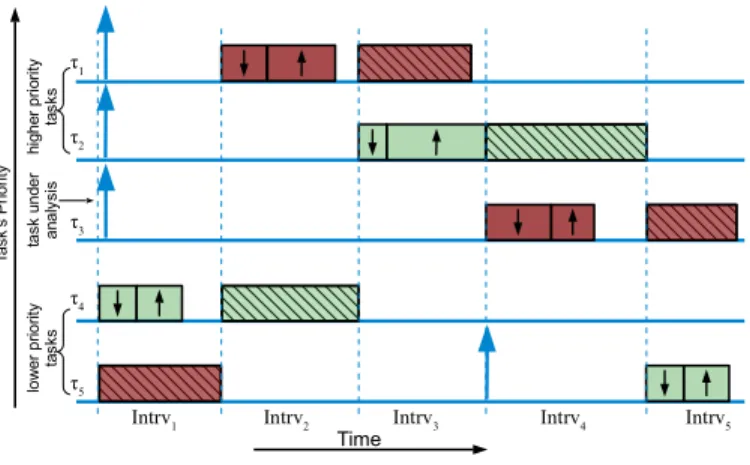
3.4 An illustrative schedule of a worst case response time of a task under analysis 49 3.5 Illustrative schedule of multi-interval tasks . . . 53
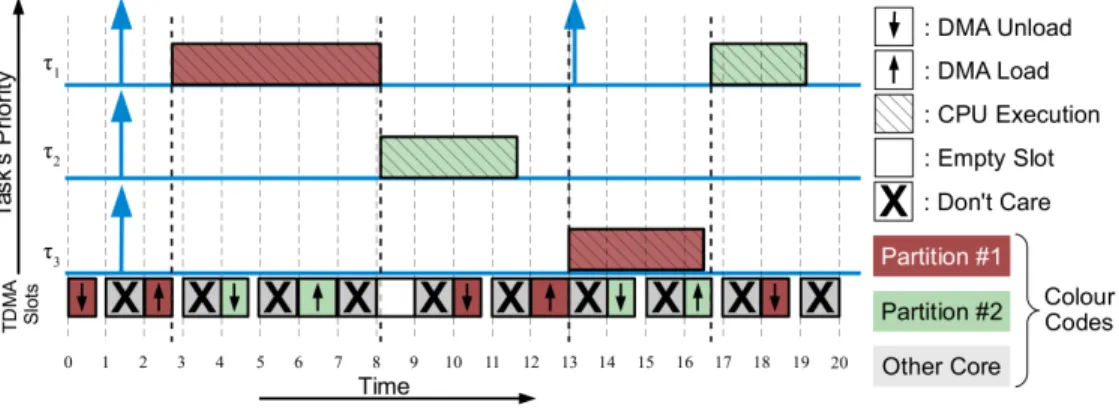
3.6 Scheduling CPU, DMA and local memory with fixed-size time slots . . . . 58
3.7 Example schedule, intervals are highlighted. . . 60
3.9 Task scheduling with illustration of error recovery mechanism . . . 67
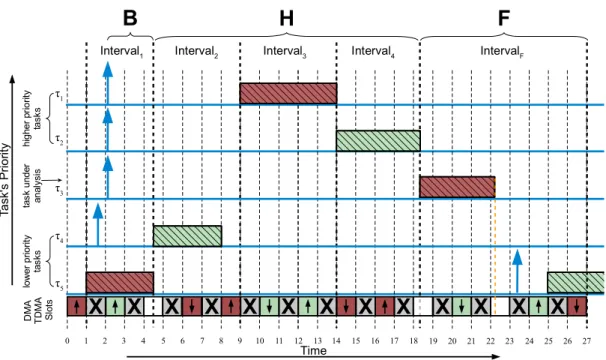
3.10 Example showing how H is extended by an induced interval due to error recovery prior to IntervalF . . . 71
4.1 System-Level Block Diagram . . . 76
4.2 RSMU Memory Translation . . . 77
4.3 The baseline hardware architecture with cache memory . . . 79
4.4 Execution time comparison between Cache and SPM: SPM1 runs at the same frequency as cache, SPM2 runs at 22% higher frequency . . . 83
4.5 Application execution speedup: SPM1 runs at the same frequency as cache, SPM2 runs at 22% higher frequency . . . 84
4.6 Single-core schedulability comparison between carousel and our approach . 85 4.7 Multi-interval single-core schedulability comparison between Carousel and our approach . . . 86
4.8 Single-interval 4-cores schedulability comparison between the three systems 87 4.9 Multi-interval 4-cores schedulability comparison between the three systems 87 4.10 Single-interval 8-cores schedulability comparison between the three systems 88 4.11 Multi-interval 8-cores schedulability comparison between the three systems 88 4.12 Each system’s tolerance to the degradation in memory speed @ 70% utiliza-tion with multi-interval tasks . . . 89
4.13 MPC5777M Block Diagram. . . 90
4.14 Block diagram of error handling circuitry.. . . 92
4.15 Interaction between I/O Core and Core 1 for task scheduling. . . 95
4.16 Experimental execution time for synthetic benchmarks. . . 103
4.17 Experimental execution time for EEMBC benchmarks. . . 104
4.18 Schedulability with SPM-based and traditional scheduling models. . . 108
4.19 Utilization degradation as a function of tasks periods . . . 109
5.1 An example of scheduling 6 jobs on 2 cores. . . 113
5.3 Carry-in limit for m=2. . . 119
5.4 The interfering jobs of tasks∈hep(k) with no carry-in, computation carry-in and memory carry-in. . . 120
5.5 Scheduling interval examples. . . 121
5.6 The computation phase of the problem job executes after Imax k .. . . 127
5.7 Our schedule on 4 cores showing 100% utilization. . . 129
5.8 Contention-based schedule on 4 cores showing 50% utilization. . . 129
5.9 2-cores schedulability comparison. . . 131
5.10 4-cores schedulability comparison. . . 131
5.11 8-cores schedulability comparison. . . 132
5.12 The scalability comparison of the WCRT bound.. . . 132
6.1 Worst-case communication latency between two tasks . . . 138
6.2 End-To-End communication Latency. . . 139
7.1 Illustrations of the negative impact on synchronized parallel threads if not co-scheduled at the same time . . . 142
7.2 Illustrations of how a fork-join parallel task can be scheduled according to different scheduling strategies . . . 143
7.3 Fork-join application and resulting bundled task. . . 147
7.4 DAG application and possible schedules. . . 148
7.5 Interfering caused by higher priority tasks. The up arrow denotes the arrival time of the task under analysis. . . 151
7.6 The maximum workload of task τi within a window of time t . . . 153
7.7 Worst-case contributions of interfering workloads. A: contributing to the first bundle. B: contributing to the second bundle. . . 157
7.8 Examples of lower-priority bundles’ ability to run . . . 160
7.9 Schedulability test of the compared analyses on 8 cores with respect to task set types . . . 166
7.10 Schedulability test of the compared analyses on 32 cores with respect to task set types . . . 168
7.11 Preemptive versus non-preemptive gang scheduling . . . 169
7.12 Deferred preemption versus synchronous deferred preemption in gang schedul-ing . . . 169
7.13 Example schedule of integrating bundles into the 3-phase execution model 171
8.1 System architecture with the proposed predictable interconnect between pri-vate SPMs. . . 176
8.2 Implementation choices for the Hoplite FPGA NoC Router. A LUT-economical version (left) is able to exploit fracturable Xilinx 6-LUTs to fit both 2:1 muxes into a single 6-LUT. The larger, higher-bandwidth version (right) needs 2 6-LUTs instead as the number of common inputs is lower than required to allow fracturing. . . 179
8.3 Endless deflection scenario where red packets from (0,0) → (3,3) are per-petually deflected by blue packets from (3,3) → (3,1). The red spaghetti is the flight path of one packet that gets trapped in the top-most ring of the NoC and never gets a chance to exit due to the bossy blue packets. . . 181
8.4 Proposed routing function arrangement for bounded in-flight latency. De-spite splitting the logic into 2× 5-LUTs (3:1 muxes), the same multiplexer select signals (with different interpretation) drive both multiplexers. This allows a compact 6-LUT implementation per bit. . . 182
8.5 Worst-Case path on Hoplite-RT for packet traversing from top-left PE (0,0) to bottom-right PE (3,3). The red packets will deflect N→E in each ring due to a conflicting flow (not shown). The blue packets previously had priority are now deflected in the top-most ring before delivery. . . 184
8.6 Unlucky client at (1,0) is swamped by client at (0,0) that has flooded the NoC with packets at full link bandwidth (one packet per cycle). Red packets from (0,0)→(x,y) are perpetually blocking the client exit at (1,0). This results in a waiting time of ∞ for packets at (1,0) . . . 186
8.7 Conceptual view of the Token Bucket regulator at the injection port of each NoC client. FPGA implementation cost is two cascaded counters (no actual memory is needed to store any tokens). The client can inject a packet into the NoC only when the NoC is ready and there is at least one token available in the Token Bucket. . . 187
8.8 Understanding interfering traffic flows at a client for determining the set of conflicting flows ΓCf. Dotted N → E is a deflected flow that will wrap around the X-ring and return at the W port. The P E →E (red flow) will interfere withW →E, and alsoW →S flow due to HopliteRT router limits. And, the P E→S flow (blue flow) will interfere withN →S, W →S, and the deflected N →E flows.. . . 190
8.9 Effect of Traffic Patterns on Worst-Case In-Flight Latency of the Workload at 100% injection rate. Worst-case analytical bounds (red) are easily vio-lated by baseline Hoplite. With HopliteRT we are always within the bound, and deliver superior worst-case latency for ALLTO1, TORNADO, RANDOM, and
LOCAL patterns. For TRANSPOSE, the persistent victimization of N → S
packets causes a slightly longer worst-case latency. . . 197
8.10 Effect of Injection Rate on Worst-Case In-Flight Latency of the RANDOM
Workload for 256 clients. At low injection rates, the NoC routing latencies are not very different, but as the NoC gets congested, HopliteRT starts to deliver improvements.. . . 198
8.11 The optimized bound versus the basic one on Worst-Case In-Flight Latency of RANDOM workload at 100% injection rate of 256 clients . . . 199
8.12 Comparing source queueing times for regulated vs. unregulated HopliteRT NoCs as a function of system size for the ALLTO1 traffic pattern. Regulated traffic offers much improved waiting times at the clients. . . 200
8.13 Comparing source queueing times for regulated vs. unregulated HopliteRT NoCs as a function of system size for the RANDOM traffic pattern. Again, regulated traffic offers better latency behavior, but bounds are much lower than the ALLTO1 pattern. . . 201
8.14 Effect of Injection Rate on Worst-Case Source-Queueing Latency of the
ALLTO1 workload for 16 clients. The E port can accept more packets due to the DOR routing policy; and furthermore be blocked by our LUT-constrained HopliteRT router. Above a certain injection rate, no bounds can be computed due to infeasible flow rates in the network. . . 202
8.15 Example of three different cases of bundles that does not suffer communica-tion interference . . . 203
8.16 HopliteRT node scheduling (A) and network partitioning (B) . . . 204
Chapter 1
Introduction
Real-time systems require predictable temporal behavior. The system schedules shared physical resources, such as CPU time, to execute tasks of different applications. An ap-plication is composed of one or more tasks [98]. Typically, tasks are recurrent: each task produces a potentially infinite sequence of jobs, activated either periodically or sporadi-cally. Applications in real-time systems are classified into safety-critical applications known as hard tasks and less-critical applications known as soft tasks. Each job of a hard task needs to finish its execution and produce its output before the expiration of a strict time (deadline); otherwise, the system might catastrophically fail. Medically-implanted pace-makers and airbag systems in a modern cars are examples of this class of applications. On the other hand, soft real-time tasks might suffer service degradation when a job exceeds the execution deadline. Examples of such soft-tasks include real-time communication in video conferencing. In this dissertation, we focus on hard real-time tasks.
In hard real-time systems, the collection of executed tasks (also known as a task set) requires timing validation. A task set is called feasible if it can be scheduled such that all jobs of all tasks meet their deadlines, under all permissible combinations of job-arrival sequences by the different tasks comprising the system. On a particular computing plat-form, the system of tasks is said to be A-schedulable with respect to a given scheduling algorithm A, if the algorithm A schedules the system such that all jobs of all tasks will meet all deadlines. A schedulability analysis for scheduling algorithm A accepts as input the specifications of a real-time system, and determines whether the system is A-schedulable or not. An schedulability analysis is said to be exact if it correctly identifies all A-schedulable systems, and sufficient if it may fail to identify some A-A-schedulable systems (it must guarantee, though, that all identified systems are indeed A-schedulable).
An important input to the schedulability analysis is the worst-case execution time (WCET) of each task. It is essential for the WCET estimate of a task to be safe; i.e., the upper bound of the execution time under all circumstances must be captured. While un-derestimating the WCET can lead to unsafe schedules (missed deadlines), overestimating the WCET can lead to a reduction in the system schedulability and leave the hardware underutilized. It is often desirable for the WCET estimate to be tight, i.e., close to the actual worst-case execution time. The tightness of WCET bounds can be highly affected by the underlying platform, including the hardware, the operating system (OS), and the application runtime environment adopted by the programming language. Predictability is an important and related term that indicates how tight the WCET estimate is. Specif-ically, [24] defines predictability as the ratio between the best-case and the worst-case behavior. That is, a component with constant-time behavior is 100% predictable, and this percentage decreases as the difference between the best-case and the worst-case behavior increases. Consequently, when any component in the system behaves in a less predictable manner, a safe but pessimistic performance assumption is needed to compensate for the less-predictable timing estimates. This pessimism can reduce the system utilization and prevents real-time engineers from exploiting the full performance of the hardware.
In the last decade, however, the popularity of multi-core chips has seen an uptrend in the domain of embedded computing. Modern emergent embedded systems, such as self-driving cars and Unmanned Aerial Vehicles (UAV), that heavily utilize parallel multi-threaded applications, such as machine learning, and computer vision, are driving an increasing performance demand in embedded computing in general and in real-time especially. This performance demand is answered by high-performance embedded multi-core chips. How-ever, the introduction of multi-core chips has a disruptive impact on the design of real-time systems: most of the existing design practices in the field cannot be directly applied to multi-core systems. Hence, platform selection for the design of modern safety-critical systems often involves outdated technological solutions or highly inefficient exploitation of current modern hardware [5], such as disabling all but one core. In response, this is driving researchers’ efforts to introduce new design methodologies and tools to overcome challenges with multi-core systems, in particular due to the presence of shared hardware resources that affect the predictability of the system.
1.1
Challenges with Multi-Core Systems
The introduction of multi-core systems in the real-time domain is relatively new com-pared to single core systems. Therefore, many challenges related to multi-core systems are
currently being addressed by the community. In this dissertation, we address two main challenges: 1) contention for access to shared physical resources, such as the memory sub-system of modern Multi-Processor Systems-on-Chip (MPSoC); and 2) the need for data sharing in real-time parallel applications.
1.1.1
Shared Resources and Contention
In industry, it is often the case that different components of the system are provided by several vendors and then integrated together. For more than three decades, a fundamental assumption of the schedulability analysis is that the WCET can be calculated on indi-vidual tasks in isolation, i.e., without considering the activity of other cores or hardware components. This simplifies the schedulability analysis of the complete system when tasks are running together. Unfortunately, this assumption is violated in multi-core systems. In a single core processor, tasks do not execute concurrently in a single core system, but rather sequentially, albeit they might be preempted. The sequential execution implies that a task has an exclusive access to all hardware resources such as caches, main memory, and I/Os; and no two tasks can access shared resources simultaneously. However, the situation is different in multi-core systems. Two tasks can run simultaneously on different cores and access shared resources at the same time, thus causing interference to each other. Con-sequently, the extensive sharing of hardware resources has made analyzing the temporal behavior of real-time applications running in parallel on multi-core systems one of the biggest challenges in the real-time domain today.
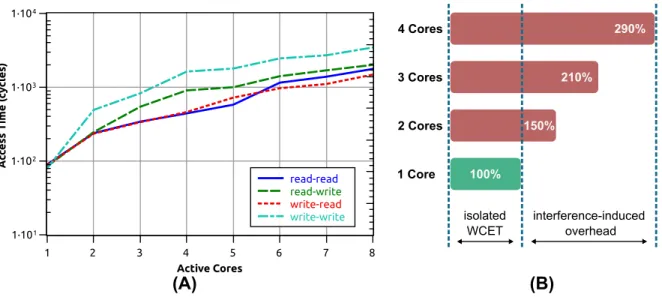
Figure1.1 depicts the implications of contended access to shared resources, main mem-ory in this case. The figure is based on results from slides presented during a keynote speech titled as ”Mixed-Criticality Systems - a Journey Embedded in Time and Space” byM. Paulitsch at 27th Euromicro Conference on Real-Time Systems (ECRTS15), 20151. The figure shows the performance degradation encountered by a set of concurrently run-ning synthetic benchmarks, designed to maximize delay due to inter-core interference on the Freescale P4080 eight-core MPSoC platform. Specifically, the execution time of the task under analysis is observed first when it runs alone, and then with an increasing number of applications running in parallel on other cores. Figure1.1(a) focus on showing the access time to main memory under four scenarios: when the task under analysis is preforming read operations and the interfering tasks are also performing read operations (”read-read”); and when the task under analysis is performing read operations and the interfering tasks are performing write operations (”read-write”); and so on for ”write-read” and ”write-write”.
1See the presented slides at
1 Core 3 Cores 4 Cores 2 Cores interference-induced overhead isolated WCET 290% 210% 150% 100% (B) A cc ess Time ( cy cles ) 1·101 1·102 1·103 1·104 Active Cores 1 2 3 4 5 6 7 8 read-read read-write write-read write-write (A)
Figure 1.1: (A): access time to main memory is growing over proportionally with the number of contending cores. (B): the WCET is highly affected by the interference caused by the parallel cores.
It can be observed that the access time to the shared main memory in this platform grows over-proportional to the number of active cores. This performance behavior greatly affects the WCET, which is depicted in Figure1.1(b). As it can be seen from the figure, with 4 contending cores, the execution time of the task under analysis is inflated by'3X. While the slowdown of memory access time is about '10X in the case of 4 contending cores, it only leads to'3X slowdown in total execution time. This is because, during typical task execution, a portion of the time is spent for computation-only operations that can progress in parallel and often hide the extra time required for non-blocking memory operations. This degraded-performance behavior is not unique to real-time platforms. It has also been shown in [181] that similar effects are observed by running SPEC CPU2006 applications on an Intel Xeon X3565 quad-core processor. The results show that the execution time of one application can increase by 56% compared to the execution time of the same application when run in isolation. Resource contention has also been acknowledged by certification authorities, and it represents a source of concern for the use of multi-core processors in avionics systems [5].
Task isolation can be spacial or temporal. Spacial isolation restricts the ability of software components to access specified hardware components, or subsets of memory re-sources. Spacial isolation improves system safety and security by limiting each application
or application class to a set of accessible resources with no interaction between unrelated components; i.e., an isolated faulty application cannot affect other applications. On the other hand, temporal isolation protects the timing behavior of the isolated application from other applications running in parallel on other cores; i.e., the performance of the application is independent of the behavior of the other running applications. While con-temporary OSs and COTS platforms are already equipped with advanced spacial isolation techniques, they do not provide extensive support to achieve strong temporal isolation among applications.
The current industry trend is to use Commercial-Off-The-Shelf (COTS) multi-core plat-forms to build hard real-time systems. Unfortunately, such platplat-forms are not designed to support real-time applications, but rather to optimize average-case performance. We argue that to construct a tight WCET analysis for real-time tasks executing in such platforms, the designer should obtain: 1) a detailed model of the hardware components, so that their behavior can be accurately captured; 2) a detailed characterization of all tasks in terms of their accesses to shared hardware resources. Unfortunately, this approach is not prac-tical for at least two main reasons. First, due to manufacturers’ intellectual property, the detailed models of the COTS hardware components are often not available or incomplete. Second, assuming accurate knowledge of the entire system workload also faces practical limitations. Particularly, as the number of parallel cores increases, the problem of exhaus-tively testing all the possible platform/workload configurations combinatorially explodes.
We argue that if tasks are allowed to access shared resources in an unregulated way, the resulting WCET estimates are typically so large as to be practically unusable. Instead, the platform should be engineered to achieve strong temporal isolation between cores, ei-ther through mechanisms at the hardware level, the software, or both (hardware-software co-design). Temporal isolation allows the designer to determine system schedulability by composing the WCET of individual tasks. A strong temporal isolation between running tasks would therefore significantly improve the WCET of the tasks and simplify the schedu-lability analysis of the system.
1.1.2
Data Sharing in Parallel Tasks
With the increased demand for high-performance real-time applications, such as autonomous driving and computer vision [158], real-time designers are looking at parallel applications. Therefore, the real-time community has developed parallel task models, where each task comprises a number of subtasks, i.e., threads. The threads can be activated on different computing nodes simultaneously to run in parallel, and usually share data. In the real-time
literature, applications are broadly categorized into single-threaded applications known as sequential tasks, and multi-threaded applications known as parallel tasks.
With the increasing demand for more single-application performance, several parallel programming models have been adopted for real-time parallel applications, such as the fork-join and the Directed Acyclic Graph (DAG) models. However, the strong demand for temporal isolation between sequential hard-real-time applications has delayed the adoption of multi-core systems. As discussed in the previous section, task isolation permits to safely utilize multi-core systems for real-time applications, improves predictability, and simplifies analysis. Unfortunately, the temporal isolation mechanisms used for sequential tasks cannot be applied to parallel tasks. This is because we cannot isolate the cores that are communicating. As a matter of fact, existing scheduling schemes for parallel real-time tasks assume no synchronization cost or data sharing. We argue that parallel applications need new scheduling models that relax the aforementioned assumptions and allow for predictable inter-core communication.
1.2
Scope and Contributions of This Work
The goal of this work is to provide a set of solutions at the hardware, software and analysis level, to increase the predictability of both sequential and parallel safety-critical real-time applications on multi-core systems. In contrast to other approaches that target COTS systems only, this work focuses on platform engineering and hardware/software co-design to achieve better predictable performance for safety-critical applications. Our design phi-losophy it to employ the knowledge of system workload that exists at the scheduling level, and pass required information down to the hardware level to optimize task execution. This methodology significantly simplifies the hardware design and the WCET analysis, at the cost of more complex scheduling policies.
More in details, we provide solutions to 1) avoid access contention to shared resources such as main memory and IO devices, 2) provide predictable access to local memory, and 3) provide predictable inter-core communication. In particular, at the hardware level, we consider Scratchpad Memory (SPM), instead of conventional caches, to implement the lo-cal memory for predictability reasons 2. Furthermore, we propose a lean and predictable Network-on-Chip (NoC) that governs inter-core communication. At the software level, we dynamically manage the local SPMs based on OS support, i.e., SPM management is trans-parent to the applications. This includes loading tasks into the local SPMs, unloading tasks
from the SPMs, and moving data between the local SPMs as needed. The contributions of this work are broadly divided into two parts, 1) task isolation and 2) task communication.
1.2.1
PART(I): Efficient Tasks Isolation
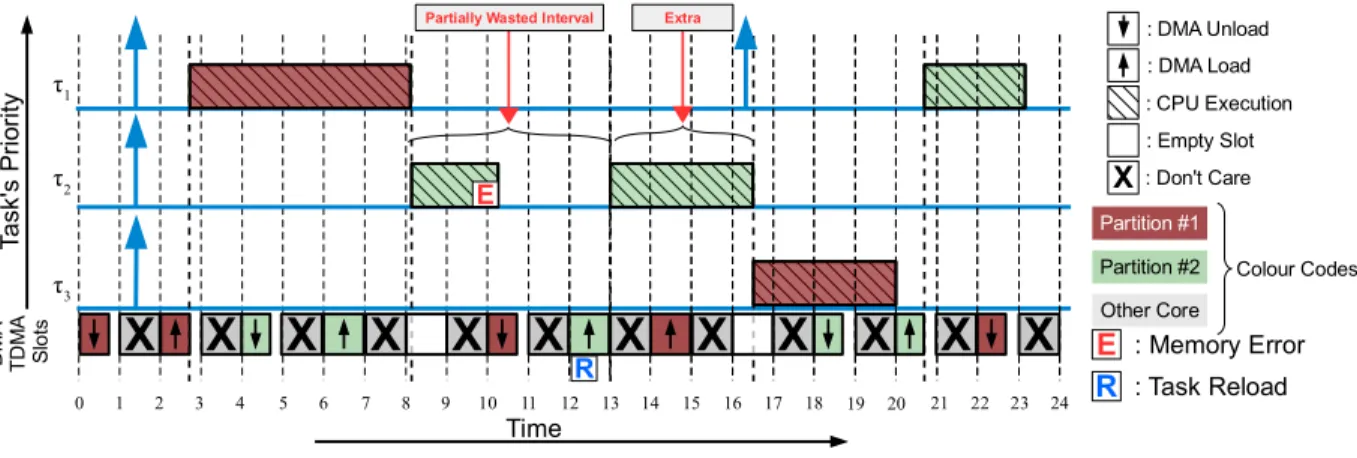
To achieve strong inter-core timing isolation, we propose to adopt a new task execution model based on the existing PRedictable Execution Model (PREM) presented in [128]. The work in [128] is a software solution that relies on compiler techniques to instrument a task’s code with extra instructions to divide the task into memory and execution phases. It does that by using the CPU to prefetch the required data into cache during the memory phase; while, in the execution phase, the task executes from cache and does not access the main memory. This execution model avoids contention by scheduling tasks to access to main memory while other tasks are in their execution phases. Unlike the original PREM, we propose to use a Direct Memory Access (DMA) controller to load tasks into the local SPM without stalling the CPU. Our model is based on hardware/software co-design and relies on dynamic management of the SPM as local memory.
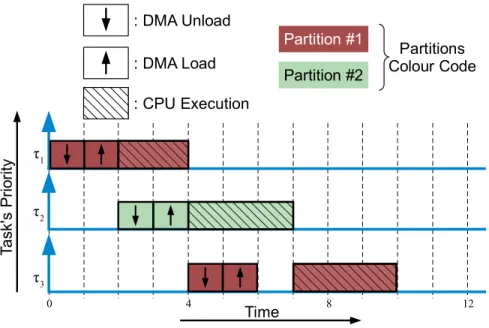
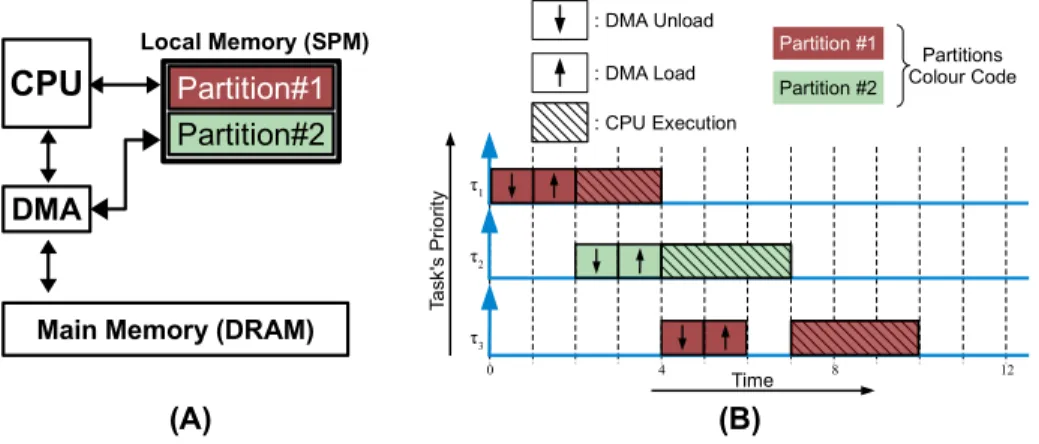
Figure 1.2 illustrates the main ideas behind the proposed execution model. Part (A)
shows a simplified illustration of the architectural requirements of the model. We assume that each core has access to a private SPM and a DMA controller. The SPM is dual ported to allow simultaneous access from the local CPU and the DMA: the CPU and the DMA can access different portions of the local memory concurrently without causing mutual interference. A task is loaded into the local SPM before execution, and the CPU does not need to access main memory while executing the task. Moreover, the SPM is divided into two partitions to allow the DMA to load a task into one partition while the CPU executes another task from the other partition simultaneously. Part (B) of the figure shows an arbitrary schedule of three tasks to illustrate the execution model.
Note that the described system can also be realized through caches. This is possible by applying cache partitioning techniques [155, 104] in systems that support cache lock-ing and cache stashlock-ing [7]. However, it is still unclear if the proposed scheme will be deterministic when both the CPU and the DMA are active simultaneously. In addition, caches are intended to be self-managed, and require more effort to be managed in software. On the other hand, scratchpad memories, in fact, is simpler to manage and have been proven to provide better energy consumption [28] and temporal isolation when compared to traditional caches [136, 110].
A task is divided into three phases, load, execution, and unload. As shown in the figure, the DMA is used to unload any previously loaded task in the targeted partition
Partition #1 : DMA Unload : DMA Load : CPU Execution Partitions Colour Code Ta sk 's P ri o rit y τ1 τ2 τ3 Partition #2 Time 0 4 8 12 CPU DMA
Main Memory (DRAM)
Local Memory (SPM)
Partition#1
Partition#2
(A) (B)
Figure 1.2: (A): Simplified hardware architecture. (B): Example schedule showing how tasks are executed on one core.
before loading a new task. After that, the task can be executed from the local memory with no interference. As depicted, due to the dual partitioning of the local memory, the CPU is kept busy most of the time and access latency to main memory is effectively hidden due to the overlap between executing a task from one partition while loading another task into the other partition. This desirable behavior of completely hiding the access latency to main memory can be observed as long as the execution time of a task is greater than or equal to the load time of the next scheduled task on the other partition in the SPM of the same core. When the execution time is smaller than the load time, the access latency is still partially hidden with an amount equal to the overlapped execution time. The proposed execution model can be applied to both sequential and parallel tasks. In the case of a parallel task, all code and data of the required threads of the task are loaded or unloaded to/from the SPM partitions together. Note that for communicating parallel tasks, we propose an orthogonal solution to handle inter-core communication as we discuss in Section1.2.2.
The proposed execution model provides four main benefits: 1) it avoids task interference due to contention for access to main memory. 2) It efficiently hides the access latency to main memory. 3) It efficiently utilizes the memory transfer bandwidth as it moves bigger contiguous blocks of data; in particular, sequential transfers in Dynamic RAM (DRAM) are significantly more efficient than random accesses. 4) It improves the tightness of the WCET analysis due to the improved predictability of the platform as tasks are executed out of the local SPMs only.
embedded platforms, such as the Freescale MPC5777M used in our implementation. In short, a dedicated I/O core receives data from I/O devices and buffers them in its local SPM without affecting the main memory bus. Upon task loading on an application core, we then program the DMA to move the needed I/O data from the local SPM of the I/O core to the targeted partition on the application core. Similarly, upon task unloading, we program the DMA to move the produced I/O data from the task’s partition on the application core to the corresponding buffer on the I/O core.
From a scheduling point of view, to avoid access contention to physical resources, we adopt a co-scheduling approach. We contribute several dynamic scheduling algorithms based on fixed-priority scheme for a set of sporadic real-time tasks, that efficiently co-schedule processor and DMA execution to hide memory access latency. The proposed algo-rithms target single-core, partitioned multi-core, and global multi-core scheduling schemes. We demonstrate that we improve processor utilization significantly compared to existing scratchpad and cache management systems in addition to contention-based systems.
The analysis is also extended to cover tasks with large memory-footprint that cannot entirely fit into the local SPM’s partition. In essence, a task can be split into multiple segments where each segment can fit into the local memory. The first segment is released like a normal task and the subsequent segment is released after the previous segment finishes. Jobs of the same task are assumed to produce the same number of segments and each segment inherits the priority of the producing task. Note that while a segment of a task is executed by the CPU, the DMA cannot load the next segment of the same task, since a latter segment might depend on a previous segment’s data.
Task-splitting is quite popular in practice and supported by several commercial tools. For instance, it is adopted in time-triggered architectures to mitigate the allocation problem of tasks to cycles [45]. The recent work in [132] shows how to break a program into non-preemptive segments through compiler analysis. Moreover, there has been a significant amount of work in literature that proposes techniques to manage the local memory of one task [53, 101, 25] for code and data, including stack and heap. Our focus in this work, therefore, is how to provide a timing guarantee for the scheduled jobs rather than showing how to divide a task into multiple segments.
In addition, a set of scheduling strategies are proposed to recover from detectable transient memory errors. Specifically, we describe how it is possible to recover from bit errors, in both main memory and scratchpad, that are detected but not corrected by the hardware logic via Error-Correcting Code (ECC). The strategy that we follow largely leverages the existing redundancy in the employed multi-phase task model. A minimum amount of additional redundancy is introduced to protect data that do not exist as multiple
copies in the original scheme. Schedulability analysis is extended to take into account the overhead introduced by the proposed recovery mechanisms. The proposed analysis considers different application recovery scenarios and isolates the critical path of the error-handling procedures, which often correspond to entire task re-execution. The result is a fault-tolerant scheduling framework for multi-phase real-time tasks.
The proposed approach has been realized in both an in-house FPGA-based architec-ture [170], and commercial embedded platform (Freescale MPC5777M) [159]. The execu-tion model and the SPM management logic are integrated at the OS level. In particular, through collaboration with the co-authors of [159], ERIKA3 [11] RTOS has been extended with a novel operating system design to exploit core specialization and low level resource management policies. To the best of our knowledge, this is the first OS that integrates a scratchpad-based task scheduling mechanism with a schedule-aware I/O subsystem.
The following list is a summary of the contributions in this part:
• SPM-centric system architecture with dynamic management at the OS level.
• Limiting task execution from local memory to enforce timing isolation between cores. • Extending the PREM execution model to allow for hiding access latency to shared
resource.
• A set of SPM-centric scheduling algorithms with sufficient schedulability analysis for partitioned and global task systems.
• Extending the schedulability analysis for tasks with large memory footprint that cannot fit entirely in the local memory.
• Extending the schedulability analysis to account for recovery from memory soft errors that cannot be directly corrected in hardware by the ECC unit.
• FPGA and COTS implementations of the proposed schemes.
1.2.2
PART(II): Predictable Tasks Communication
In regards to task communication, we considered two communication types, inter-task and intra-task communication. Inter-task communication addresses the communication
3Erika Enterprise is an open-source RTOS that features a small memory footprint and supports
between tasks, whether they are scheduled on the same core or on different cores. In this type of communication, we assume an asynchronous communication model. This means that the previously produced data, by a sender task, can be overwritten if it was not read by the receiver task before. In our proposed model, a sender task’s communication data is written to main memory during its unload phase. Similarly, any communication data required by a receiver task is loaded into SPM during its load phase. Therefore, this model does not require inter-core communication in our proposed SPM-centric system: the communication is performed via main memory during the loads and unloads phases of the tasks. This model of communication can be applied to both sequential and parallel tasks, since the communication is scheduled and performed by the DMA used to load/unload the tasks. The OS-level management and scheduling policies are extended to account for inter-task communication. We also provide analytical bounds on the worst-case communication latency for a chain of sender-receiver tasks.
On the other hand, intra-task communication is unique to parallel tasks. This type of communication involves data exchange between the simultaneously running threads of the same parallel task. To facilitate this type of communication, we propose to gang schedule the communicating threads: all currently active threads of the same parallel task are executed concurrently. This policy is motivated by two objectives: 1) to facilitate intra-task communication, and 2) to reduce the synchronization overhead, thus obtaining a more predictable execution of parallel real-time tasks.
Indeed, gang scheduling of parallel tasks has been proved to have significant per-formance benefits in many cases [60, 77, 150]. Gang scheduling for parallel real-time tasks [81, 55, 64] considers a rigid task model, where the number of threads required by an application is assumed to remain constant over its entire execution time. While the rigid model has the benefit of simplicity, it can incur a significant loss of performance by overestimating the computational demand of an application: many parallel applications change their required number of threads during execution.
Hence, we introduce a novel task model, which we call the bundled model, that supports gang scheduling of parallel threads without incurring undue pessimism in modeling the application’s demand. In this model, a real-time task is composed of a sequence of bundles, where each bundle is characterized by a known worst-case execution time (WCET) and number of required cores; successive bundles require different numbers of cores. All threads within a bundle are then gang scheduled. We show that the proposed bundled scheduling model can be applied to several existing parallel programming models, such as fork-join and DAG-based applications, and we derive a schedulability analysis for a set of sporadic bundled task based on fixed priorities.
Core 1 SPM HopliteRT NoC SPM SPM Controller System Bus Main Memory DMA Core m SPM Controller
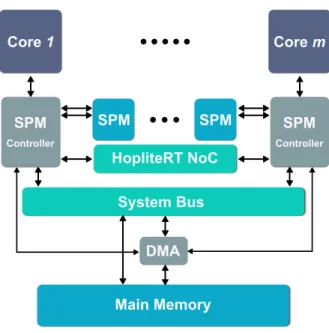
Figure 1.3: Illustration of the proposed system architecture with a predictable intercon-nect between private SPMs.
A remaining problem is how to bound the delay due to inter-core communication be-tween threads of the same parallel task. In this dissertation, we propose to employ a dedi-cated real-time inter-SPM interconnect, that can provide tight bounds on worst-case access delay. In this regards, we have developed HopliteRT, a lean and predictable deflection-based Network on Chip (NoC). We then compute the worst-case response time of a parallel task based on the composition of the WCET on the cores and the worst-case communica-tion time on the NoC. Figure 1.3 shows a simplified illustration of the considered system architecture. Note that we still rely on the main system bus for loading and unloading the tasks including inter-task communication as mentioned earlier; the inter-SPM NoC is only dedicated for intra-task communication. Note that, any interconnect with provable real-time bounds can be used instead of HopliteRT. However, aligning with our design philosophy, we are interested in reducing hardware cost, especially since HopliteRT is only targeting inter-core communications.
The following list is a summary of the contributions in this part:
• Asynchronous communication model for inter-task communication via main memory. • Bundled scheduling: a communication-aware scheduling model for parallel tasks with
intra-task communication.
• Sufficient schedulability analysis for bundled scheduling.
• Extending bundled scheduling for the proposed 3-phase execution model mentioned in PART(I).
• Inter-core real-time NoC with provable latency bounds.
1.3
Structure of the Dissertation
The reminder of this dissertation is organized as follows. First, Chapter 2 reviews the important background concepts and highlights the related work.
Part(I) of the dissertation includes Chapters 3, 4, and 5. Chapter 3 discusses the fundamental concepts of the proposed execution model and scheduling scheme. Specifically, in this chapter we show how to hide access latency to shared resources in partitioned systems, under different ways to handle DMA operations. We also show how to handle tasks with large memory footprint. In particular, we discuss the case of scheduling multi-segment tasks where the size of a task cannot entirely fit into the local SPM. Furthermore, we present an error recovery mechanism with respect to the proposed execution model. In Chapter4, we discuss the realization of the proposed approach on two different platforms: 1) a Xilinx FPGA platform using FreeRTOS [8]; and 2) a COTS platform using ERIKA RTOS [11]. Finally, in Chapter 5 we extend the proposed scheme to globally scheduled systems.
Part(II) of the dissertation includes Chapters 6, 7, and 8. Chapter 6 addresses the inter-task asynchronous communication model, while Chapter7presents our novel bundled scheduling model for real-time parallel tasks. In addition, in this chapter, we show how to integrate bundled scheduling with the proposed multi-phase execution model. Chapter 8
discusses inter-core communication and presents the proposed HopliteRT NoC. We also show how the communication latency of bundled parallel tasks can be bounded based on the proposed NoC design.
Finally, Chapter 9 concludes the work by discussing the limitations of the presented approaches, and providing an overview of possible extensions for this research.
Chapter 2
Background and Related Work
This chapter provides a background overview of important concepts required to better understand the work proposed in the following chapters. Following the same theme of the dissertation, we first overview important concepts and relevant recent works in regards to predictability and timing isolation of real-time tasks, for both cache and scratchpad-based systems. Afterwards, we discuss predictable task communication and related topics, in particular, scheduling of real-time parallel tasks and inter-core communication.
2.1
Predictability and Timing Isolation in Multicore
Systems
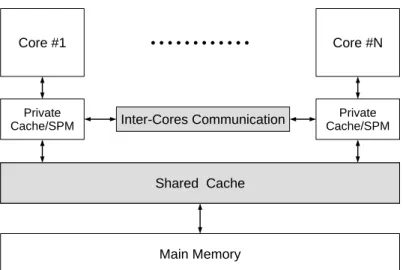
Modern embedded system platforms often incorporate a multicore processor, which is a chip that has more than one processing core. This is to satisfy the increasing demand for higher computing performance required by modern real-time applications [13]. These chips are also known as Chip Multi-Processors (CMP). The generic architecture of a multicore processor is as shown in Figure 2.1. Throughout this work, we use the terms core, CPU, and processor interchangeably. Note that the private local memory can be realized as cache or scratchpad memory. In this dissertation, we focus on using scratchpad architecture.
In real-time systems, schedulability analysis is based on the assumption of a fixed, known WCET for each task. There are two main approaches to estimate the WCET; static analysis methods and measurement-based methods. A static analysis method does not require the task to be actually executed on the hardware. The analysis instead takes the task’s code as input along with annotations from the user, finds the set of all possible
Private Cache/SPM Core #N Core #1 Shared Cache Main Memory Private Cache/SPM • • • • • • • • • • • • Inter-Cores Communication Shared Cache
Figure 2.1: Generic multicore architecture, gray blocks might not be available in some systems
control-flow paths through the task, combines control flows with a model of the hardware, and estimates an upper bound to the WCET of the task. However, the complex nature of modern multicore systems makes this type of analysis very difficult or even impossible due to the lack of precise knowledge about the hardware; and thus hardware modeling becomes inaccurate [99, 44]. Usually, the results of static analysis are pessimistic due to the imprecise assumptions they need to consider to model the hardware safely.
On the other hand, measurement-based methods can provide more optimistic (but not safe) WCET estimates without the need for a precise hardware modeling. Generally, the task is executed on the hardware for a set of inputs. After that, the distribution of the observed execution times is determined. However, measurement-based methods are not guaranteed to cover all possible execution paths. Consequently, the estimated WCET can be unsafe,i.e., less than the actual WCET. Modern tools often combine measurement and static analysis methods to improve the accuracy of the estimated WCET and provide safe bounds. For example, RapiTime [9] is a tool that uses a hybrid technique between static analysis and measurement. It basically uses measurement to time individual code blocks, while using analysis to determine the worst program execution path even if it was not executed during a specific run.
In contrast to analysis solutions, researchers also adopted another approach that tries to engineer the hardware and software platforms so that they become more predictable and easier to analyze. In such a case, WCET becomes easier to determine and tight bounds
can be achieved. Our research falls in this type of solutions: we focus on the design aspects of the embedded platforms, rather than WCET analysis. Among the issues that current multicore platforms impose on real-time systems are contention on shared resources such as main memory, system bus, and shared last-level cache. Even in the case of a private cache, tasks’ execution predictability can be affected by inter-task and intra-task conflicts. In what follows, we briefly compare the SPM and cache architectures, and review related works on cache and scratchpad systems. Also, we review other platform engineering techniques aimed at achieving predictability by enforcing timing isolation between cores.
2.1.1
Comparing the Architecture of SPM with Cache
Scratchpad memory (SPM) has received considerable attention in the embedded and real-time communities as an alternative to processor caches. Contrary to cache memory, scratchpad memory supports consistent and predictable access times. The SPM is also better than the cache in terms of area and power efficiency [28]. Figures2.2 and 2.3 com-pare the SPM and cache architectures. The SPM is a simpler digital circuit, and hence occupies smaller area and consumes less power. The on-chip memory (SPM and cache) is usually built using static RAM circuitry [76]. Static random-access memory (static RAM or SRAM) is a type of semiconductor memory that uses bistable latching circuitry (flip-flop) to store each bit.
D ec o d er 1-Word Wide N :1 M UX
Address Bus Selected Word
SRAM-Cell Array
Figure 2.2: SPM Architecture
The SPM memory, as shown in Figure2.2, is a simple memory circuit. From the archi-tectural prospective, accessing a memory word only requires a decoder and a multiplexer. Accessing memory and selecting a specific word is called indexing. During the access, the
target SRAM cells are selected and then read or written. On the other hand, the cache architecture is more complicated. It consists of multiple data memories, all of which are indexed at the same time [28]. In addition, valid-bit and tag arrays are indexed for each access, which consumes more power. Moreover, the selection of the addressed word is im-plemented in two levels. First, one word from each data memory is selected the same way used in the SPM (N:1 MUX). This selects the whole cache line. Second, the block offset (part of the address) determines which word is selected from the cache line. This multiple level selection mechanism makes cache memory slower than the scratchpad memory; and the cache uses more memory to store tags and valid bits.
Figure 2.3: Direct-Mapped Cache Architecture (From [1])
In the direct mapped cache, which is the simplest cache architecture, there is one comparator that compares the requested tag and the stored tag, to determine if the access is hit or miss. Associative caches are more complicated, thus slower than direct mapped cache. In fully-associative caches, as shown in Figure 2.4, the entire address is used as a tag. Therefore, one comparator is required for each cache line. The increased number of comparators in the associative cache negativity impacts the maximum clocking frequency of the system. However, associative cache has better overall system performance than the direct mapped cache as it reduces the conflict-miss rate. The set-associative cache is somewhere in between the direct mapped cache and the full associative cache in order to balance the trade-of between the clocking frequency and the conflict-miss rate. A study
by Banakar et el. [28] in the embedded domain compared energy, area and performance of both SPM and cache. The study indicated that SPM achieves better than cache almost on all compared counts.
Figure 2.4: Full Associative Cache Architecture (From [1])
Faster access, smaller area, lower power, and predictable access time make scratch-pad memories attractive for the embedded and real-time domains. However, SPMs are more difficult to manage. In many cases the application programmers need to do low-level programming in order to utilize the SPM. Thus, the programmers need to have some knowledge about the hardware platform they are working on. In multitasking systems, this becomes very difficult because programmers need to manage the SPM, and synchro-nize their work accordingly. Caches on the other hand are self managed at the hardware level and do not impact the software model. In other words, caches are transparent to programmers. Consequently, applications can be ported to new platforms more easily.
In the embedded system domain, there have been proposals for specialized memory structures that fall in between a cache and scratchpad. For example TickPad Memory (TPM) [86]. TPM has a dynamic hardware loading mechanism that is statically con-trolled. TickPAD stands for Tick Precise Allocation Device. Therefore, it is best suited for synchronous programming languages such as Esterel [37] and Pret-C [20] which sam-ple inputs at discrete instants of time and provide outputs at instants known as tick time. Based on the Timed Concurrent Control Flow Graph (TCCFG) created for the synchronous program, a tickPad allocation analysis is performed to obtain a configuration file that de-termines static allocation decisions for the TPM. At runtime, TPM automatically loads the right context at the right time. TPM generally aims to be more predictable than cache and easier to manage than SPM. However, TPM relies on a specialized synchronous
programming language and is limited to a single application scenario.
2.1.2
Cache Memory
Several well-developed cache analysis techniques have been proposed for single-core pro-cessors. These techniques analyze the interference due to intra-task and intra-core cache conflicts. The latter is known as cache related preemption delay (CRPD). The CPRD focuses on cache reload overhead due to preemptions while the intra-task analysis focuses on the cache conflicts within the same task assuming non-preemptive execution.
In existing multicore processors, the last-level cache is typically shared by multiple cores. This design has several merits such as increasing the cache utilization, reducing the complexity of cache coherency and facilitating a fast communication medium between cores. However, it is extremely difficult to accurately determine the cache miss rate because the cache content depends on the size, organization and replacement strategy of the cache in addition to the order of accesses. Shared caches in multicore processors are similar to caches in single core processors in that they all have inter/intra-task interference. In addition, when multiple cores share a cache, they can evict each other’s cache lines, resulting in a problem known as inter-core interference.
Unfortunately, single-core cache timing analysis techniques are not applicable to mul-ticore systems with shared caches. Inter-core interference is caused by tasks that can run in parallel and this requires analyzing all systems tasks. The analysis of non-shared caches has been already considered as a complex process and extending it to shared caches is even harder. In fact, the researchers in the community of WCET analysis [155] seem to agree that ”it will be extremely difficult, if not impossible, to develop analysis methods that can accurately capture the contention between multiple cores in a shared cache”.
A timing analysis technique for concurrently running software on multicores with shared caches was proposed by Liang et al. [95], which extend the work in [177]. This analysis targeted the inter-core cache evictions. In this work, the lifetime of all the tasks that concurrently run on multiple cores are determined and then the anticipated conflicts in LLC are computed. The analysis accounts for the cache accesses and use static analysis approaches to estimate tasks WCETs. Another work by Hardy et al. [70] aimed to tighten WCET estimate. This work is based on Hardy’s previous work [71]. In this work, the authors proposed a compile-time method to reduce shared cache interference for instruc-tions among cores. This work supports WCET estimates in multiple cache levels in the presence of inter-core interference. In addition, this work statically identifies code blocks
that are used only once during the execution enabling these blocks to bypass the cache. Consequently, a tighter WCET can be computed.
Probabilistic approach to analyze cache also has been introduced in the literature. Quinones et al. [139] explored the effect of using random cache replacement policy on hard real-time systems. They showed that by applying Probabilistic Timing Analysis (PTA), they were able to avoid the risk of the aforementioned cache-based unpredictable access time. Probabilistic Timing Analysis (PTA) has emerged as a solution to reduce the amount of information needed to provide tight WCET estimates. Nevertheless, it imposes new requirements on hardware design. For instance, before [84], only fully-associative random-replacement caches have been proven to fulfill the needs of PTA, but they are expensive in size and energy. As a solution Kosmidis et al. [84] have proposed a hardware design that im-plements random-replacement cache which allows set-associative and direct-mapped caches to be analyzed with PTA. There however exist other opinions in the real-time community regarding the use of PTA in real-time systems. For example, Reineke [140] showed that the probability of hits that are computed for PTA are not independent. Consequently, the convolution of Execution Time Profiles (ETP) is not possible with randomized caches and hence is not suggested to be used in real-time systems.
In contrast to timing analysis techniques where caches are used without restrictions, the approach of managed caches has the advantage to avoid complex analysis methods for estimating the cache behavior.
Cache Locking and Partitioning
Cache locking and partitioning are techniques to gain predictable access to the shared cache. By locking a cache-line, no replacement/eviction can occur on the content of that line until it is unlocked. Cache locking requires hardware support and it is only supported in some COTS platforms. Different platforms support different styles of locking. For example, lockdown by cacheline or by way. In addition, in multicore systems, there are some platforms that support lockdown by master (core) in which the locked cache-way by some-master cannot be altered by other masters. Among the platforms that support this feature are Nvidia Tegra-2 and Tegra-31, Xilinx Zynq-70002, and Samsung Exynos 44123. Similarly, cache partitioning provides exclusive access to a portion/partition of the
1 http://www.nvidia.ca/object/tegra-superchip.html 2 https://www.xilinx.com/products/silicon-devices/soc/zynq-7000.html 3https://www.samsung.com/semiconductor/minisite/exynos/products/mobileprocessor/ exynos-4-quad-4412/
![Figure 2.3: Direct-Mapped Cache Architecture (From [1])](https://thumb-us.123doks.com/thumbv2/123dok_us/9040609.2801867/35.918.233.700.402.712/figure-direct-mapped-cache-architecture-from.webp)