
Termination and Productivity
Printed and bound by company?, place? ISBN: number??
IPA Dissertation Series 2010-03
The work reported in this thesis has been carried out at the Vrije Uni-versiteit Amsterdam under the auspices of the research school IPA (In-stitute for Programming research and Algorithmics). The research was funded by the Netherlands Organization for Scientific Research (NWO) under the project name ’ Proving Equations for Cyclic Objects’ (ProvCyc) with the project number 612.000.423.
VRIJE UNIVERSITEIT
Termination and Productivity
ACADEMISCH PROEFSCHRIFT
ter verkrijging van de graad van Doctor aan de Vrije Universiteit Amsterdam, op gezag van de rector magnificus
Prof. Dr. L.M. Bouter in het openbaar te verdedigen ten overstaan van de promotiecommissie van de faculteit der Exacte Wetenschappen
op dinsdag 1 juni 2010 om 13.45 uur in de aula van de universiteit,
De Boelelaan 1105
door
J ¨org Endrullis geboren te Leipzig, Duitsland
Acknowledgements
First of all, I want to thank Jan Willem Klop and Roel de Vrijer, my supervisors. I am very grateful for their continued support throughout the last 4 years, for sharing their ideas with me, for listening and discussing my ideas, and leaving me the freedom to choose the direction of my research.Thanks to Jan Willem for his constant pursuit of enhancing the presentation of our results. Quoting Jan Willem: ’ One picture says more than one-thousand words. Ten pictures say more than ten-thousand words’. I very much enjoyed Jan Willem’s regular visits on Wednesday and Friday afternoons. During his visits we usually did not get much work done. Instead, Jan Willem was sharing his sheer uncountable set of ideas with us — ideas that kept us busy the remai-ning time of the week over the past years. I am very grateful for that, and hope that we will continue this tradition.
I am very grateful to Roel for his interest in our work, including the technical details of the results. Roel’s door stood always open for us; we could just walk in, and Roel was ready to discuss and help. I especially enjoyed Roel’s sense of humour, usually wrapping critical remarks into funny, ironic exaggerations. I also want to thank Roel for allowing me to work together with him on his ideas on reviving a nearly forgotten lemma of van Daalen.
I am very thankful to my colleagues at the Vrije Universiteit (VU) Amster-dam for creating a pleasant and inspiring work environment: Rena Bakhshi, Taolue Chen, Wan Fokkink, Clemens Grabmayer, Helle Hvid Hansen, Dimitri Hendriks, Maxim Hendriks, Ariya Isihara, Jan Willem Klop, Cynthia Kop, Fem-ke van Raamsdonk, Jan Rutten, Martijn Vermaat, Stefan Vijzelaar, and Roel de Vrijer. I very much enjoyed working in this great group.
I especially want to express my gratitude to Dimitri Hendriks and Clemens Grabmayer who turned out as my daily supervisors. Our fruitful cooperation resulted in several papers that are included in the thesis. I have learnt a lot from them, and hope to continue the collaboration in the future. I also thank my other co-authors Johannes Waldmann, Hans Zantema, Herman Geuvers, Dieter Hofbauer, Ariya Isihara, Jacob Grue Simonsen, and Jeroen Ketema.
Johannes Waldmann has been my master thesis supervisor, and introduced me to the subject of theoretical computer science. I am glad to have had the opportunity to attend his great lectures at the University of Leipzig. I am very thankful to Johannes for allowing me to work on match-bounded string rewri-ting as my master thesis subject, and for poinrewri-ting me to a PhD vacancy at the
valuable suggestions for improving this thesis: Vincent van Oostrom, Femke van Raamsdonk, Johannes Waldmann and Hans Zantema. Thanks for finding time to read my thesis during the busy teaching period and the Christmas holi-days, I truly appreciate it.
I very much enjoyed my time at NICTA, Australia, and thank Ansgar Fe-hnker and Rob van Glabbeek for making this visit possible, and also the other members of NICTA for creating a friendly and stimulating atmosphere.
Many thanks to all my friends, including L˘acr˘amioara As¸tef˘anoaei, Melanie Eijberts, Michael Große, Adam Koprowski, Robert Lokaiczyk, Georg Martius, Manja Marz, Alexandra Silva and Alexander Tunze.
Last by not least, I want to thank my family: my girlfriend (and soon wife) Rena Bakhshi, my brother Stefan Endrullis, and my parents Karin and Manfred Endrullis. Without their love and support this thesis would not have been pos-sible.
Contents
1 Introduction 1
1 Introduction . . . 3
2 Formalising Productivity . . . 5
3 Origin of the Chapters . . . 12
4 Preliminaries . . . 18 2 Matrix Interpretations 33 1 Introduction . . . 35 2 Preliminaries . . . 36 3 Monotone Algebras . . . 38 4 Matrix Interpretations . . . 41
5 Top Reduction and Dependency Pairs . . . 45
6 String Rewriting . . . 49
7 Implementation . . . 51
8 Performance Measurements . . . 56
9 Limitations and Reduction Lengths . . . 58
10 Conclusions . . . 61
3 From Outermost to Context-Sensitive Rewriting 65 1 Introduction . . . 67
2 Preliminaries . . . 73
3 Generalizing Models toC-models . . . 75
4 Static Context Extension . . . 78
5 Dynamic Context Extension . . . 80
6 Dynamic Labeling . . . 88
7 Constructing Suitable Algebras . . . 99
8 Minimizing Algebras . . . 103
9 Constructing Minimal and MaximalC-labelings . . . 104
10 Evaluation . . . 106 11 Discussion . . . 108 4 Local Termination 111 1 Introduction . . . 113 2 Preliminaries . . . 116 3 Local Termination . . . 117 III
6 Via Models from Local to Global Termination . . . 125
7 Starling and Owl . . . 127
8 The RFC Method . . . 133
9 Quasi-models for Local Termination . . . 135
10 Conclusion and Future Work . . . 140
5 Degrees of Undecidability in Term Rewriting 143 1 Introduction . . . 145
2 Preliminaries . . . 148
3 Translating Turing Machines . . . 153
4 Local Confluence . . . 154
5 Confluence . . . 156
6 Strong and Weak Normalization . . . 157
7 Dependency Pair Problems . . . 159
8 Dependency Pair Problems with Minimality Flag . . . 162
9 Conclusion and Future work . . . 163
6 Productivity of Stream Definitions 167 1 Introduction . . . 169
2 Infinitary Rewriting . . . 172
3 Recursive Stream Specifications . . . 178
4 Pebbleflow Nets . . . 182
5 Translating Stream Specifications into Nets . . . 186
6 Deciding Productivity . . . 187
7 Conclusion and Ongoing Research . . . 192
8 Technical Appendix . . . 193
7 Data-Oblivious Stream Productivity 203 1 Introduction . . . 205
2 Stream Specifications . . . 208
3 Data-Oblivious Analysis . . . 211
4 The Production Calculus . . . 214
5 Translation into Production Terms . . . 217
6 Deciding Data-Oblivious Productivity . . . 221
7 Conclusion and Further Work . . . 222
8 Proving Infinitary Normalization 225 1 Introduction . . . 227
2 Infinitary Rewriting . . . 229
3 Characterizations of LocalCVωand LocalSN∞. . . 231
4 Tree Automata . . . 237
5 Tree Automata as Certificates forSN∞ . . . 239
6 Improving Efficiency: Strict Certificates . . . 242
7 Examples and Tool . . . 245
9 Complexity of Fractran and Productivity 249 1 Introduction . . . 251
2 Fractran . . . 255
3 What is Productivity? . . . 259
4 Productivity for Lazy Stream Specifications isΠ02 . . . 266
Samenvatting 271
1
Introduction
1. INTRODUCTION 3
This dissertation is concerned with the topics termination and productivi-ty, which are both key aspects of program correctness. Termination is the pro-perty of programs to finish their computation within a finite amount of time. When infinite data is potentially processed, termination cannot be expected. For specifications of infinite data structures, e.g. as used in lazy functional pro-gramming languages, productivity captures the natural concept of (constructi-ve) well-definedness. The two counterparts productivity and termination are intimately linked to each other: a specification of an infinite data structure is productive if every finite prefix of the infinite structure can be evaluated in fi-nite time, that is, if the evaluation of this prefix terminates. We now briefly introduce both central topics.
1 Introduction
Termination
A program working on finite data is usually considered to be(totally) correctif it terminates (halts) in finite time and produces valid output (with respect to a given specification) for every valid input. Along with the increasing attention for program verification (as witnessed by the Turing Award 2007 [11]), we ha-ve seen an extensiha-ve deha-velopment of termination techniques for term rewriting over the past years. To mention a few: recursive path orders [16, 31], polynomial interpretations [27, 34, 30] with real or negative numbers [15, 33, 24], depend-ency pairs [6, 23], semantic labeling [46], matrix interpretations [25], and for context-sensitive TRSs [9, 3, 4, 22, 2, 5] (see further Section 4 for a brief intro-duction of context-sensitive rewriting). The tremendous progress in the field of automated termination analysis is indicated by the annual Termination Compe-tition [42] where the tools are compared by evaluating their performance on a large collection of TRSs, the Termination Problem Database (TPDB).
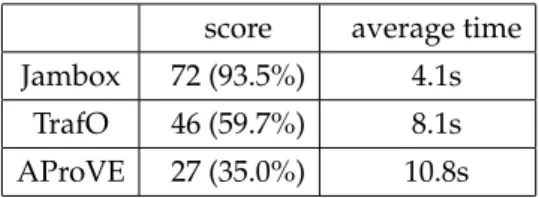
The termination part of this thesis is concerned with global, local, and ou-termost termination. In [25], a novel termination method for string rewriting systems (SRSs) has been presented, called thematrix method. We have extended this method to term rewriting systems, and implemented it in the termination prover Jambox [18]. The matrix method is very powerful. Using this method, Jambox scored2nd in category ’ TRSs’, and1st in the category ’ SRSs’ of the Ter-mination Competition of 2006 [42]. Taking into account that SRSs are just a special form of TRSs, Jambox has proven even more TRSs terminating than the long-standing winner Aprove [20]. By now (2009) the matrix method is incor-porated in all mainstream termination provers.
Outermost rewriting is a rewriting strategy where a redex occurrence may be contracted as long as it is not a proper subterm of another redex occurrence. This strategy is of special interest due to its application in functional programming (in particular, lazy evaluation), and the close connection with productivity. We
devise different transformations from TRSs to context-sensitive TRSs in such a way that termination of the target system implies outermost termination of the original system. As a result state-of-the-art termination methods for context-sensitive rewriting become available for proving termination of outermost re-writing. These transformations have been implemented in Jambox [18], making it the most successful tool for proving outermost termination in the Termination Competition of 2008 [42].
The usual study of termination is concerned with ’ global termination’, that is, termination for the set of all terms. However, termination and productivity area prioriproperties of individual terms or more generally of sets of terms; we call this thelocaltermination problem. Surprisingly, for term rewriting systems not many results are known about local termination. We do a first step in this direction by providing a complete characterisation of local termination in terms of monotone partialΣ-algebras, and local infinitary normalization in terms of continuous, weakly monotone, strictΣ-algebras.
Productivity
In the last two decades interest has grown towards infinite data, as witnessed by the application of type theory to infinite objects [14], and the emergence of coalgebraic techniques for infinite data types like streams [38]. While termina-tion cannot be expected when infinite data are processed, infinitary notermina-tions of termination become relevant. For programming with infinite structures, pro-ductivityis what termination with well-defined results is for programming with finite structures. For the correctness of programs dealing with such structures one must guarantee that every finite part of the infinite structure can be evalua-ted, that is, the specification of the infinite structure must be productive. In this thesis we focus on productivity of stream specifications. An example of a stream specification is shown in Figure 1.1.
M→0:zip(inv(M),tail(M))
tail(x:σ)→σ
zip(x:σ, τ)→x:zip(τ, σ)
inv(0:σ)→1:inv(σ)
inv(1:σ)→0:inv(σ)
Figuur 1.1:Stream specification of the Thue–Morse sequence.
The specification is indeed productive, evaluatingM, we obtain the Thue–Morse sequence in the limit:
2. FORMALISING PRODUCTIVITY 5
The usual analysis of productivity [44, 39, 14, 26, 40, 10], also adopted here, is a quantitative analysis that disregards the identity of data. We call such ap-proaches data-oblivious. We devise a method for proving productivity that is for a rich class of stream specifications provably optimal among all such data-oblivious approaches. This means that in order to improve on our algorithm one has to proceed in a data-aware fashion. At the time of writing this thesis, a first step in this direction has been done, see [48] by Raffelsieper and Zantema. There outermost termination is used for proving productivity.
Outline
The above introduction of productivity leaves space for different formalisations of the concept depending on the underlying notion of rewriting and the applied rewriting strategy. In Section 2 of this Introduction we introduce and discuss different formalisations ofproductivity. In Section 3 we give an overview of the papers contained in this thesis.
Section 4 is devoted to technical preliminaries, restricted to notions that al-ready play a role in this Introduction, and go beyond the very basics of term rewriting. We coverabstract rewriting systems(ARSs),strategies, in particular ou-termost rewriting, andinfinitary term rewriting.
In general, the chapters in this thesis are self-contained. For general reference and a more complete introduction to ARSs and term rewriting we mention [41, 29, 28].
2 Formalising Productivity
For programming with infinite structures, productivity is what termination with well-defined result is for programming with finite structures. Productivity cap-tures the intuitive notion of unlimited progress, of ’ working’ programs produ-cing defined values indefinitely.
In lazy functional programming languages like Haskell, Miranda or Clean the use of data structures, whose intended semantics is an infinite structure, is common practice. For the correctness of programs dealing with such struc-tures one must guarantee that every finite part of the infinite structure can be evaluated, that is, the specification of the infinite structure must be producti-ve. Programs dealing with such infinite structures can very well be terminating. For example, consider the terminating Haskell program ’prime’ implementing a version of Eratosthenes’ sieve:
prime n = primes !! (n-1) primes = sieve [2..]
sieve (n:xs) = n:(sieve (filter (\m -> m ‘mod‘ n /= 0) xs))
where prime n returns then-th prime number for every n ≥ 1. The func-tion prime is terminating, despite the fact that it contains a call to the
non-terminating functionprimeswhich, in the limit, rewrites to the infinite list of prime numbers in ascending order. To make this possible, the strategy with respect to which the terms are evaluated is crucial. Obviously, we cannot fully evaluateprimesbefore extracting then-th element. For this reason, lazy func-tional languages typically use a form of outermost-needed rewriting where only needed, finite parts of the infinite structure are evaluated.
The notion of ’ productivity’ (sometimes also referred to as ’ liveness’) was first mentioned by Dijkstra [17]. In the functional programming literature the notion of ’ productivity’ has arisen, initially in the pioneering work of Sijtsma [39], as a natural strengthening of what in our setting are the properties WN∞ and UN∞. Since then several papers [44, 39, 14, 26, 40, 10] have been devoted to criteria ensuring productivity.
Heuristics
A specification of an infinite structure is called productive if not only the defi-nition can be evaluated continually to build up a unique infinite normal form, but the resulting infinite expression is also meaningful in the sense that it is a constructor normal form. Here, a constructor normal form is a term solely built from constructor symbols: D(Σ) := {root(l) | l → r ∈ R}is the set ofdefined symbols, andC(Σ) :=Σ\D(Σ)is the set ofconstructor symbols.
For example, the following is a productive specification of the (infinite) stream of zeros:
zeros→0:zeros
Indeed, there exists only one maximal rewrite sequence from zeros and this ends in the infinite constructor normal form0:0:0:. . .. In finitary rewriting, a rewrite sequence is calledmaximalif it is infinite (has lengthω), or ends in a normal form. Here and later we say that a rewrite sequenceρ:t0→t1→t2→
. . .ends in a termsif eitherρis finite with its last term beings, orρis infinite and thensis the limit of the sequence of termsti, i.e.s=limi→∞ti.
Now, consider the following stream specification: J→0:1:even(J)
including the defining rules for the stream functions involved: even(x:σ)→x:odd(σ), odd(x:σ)→even(σ),
whereeven(odd) returns a stream consisting of the elements at its even (odd) positions. The infinite normal form of J is0:1:0:0:evenω, which is not a constructor normal form. For this reason, we say that the specification ofJ is not productive (although the specification is WN∞and even SN∞).
2. FORMALISING PRODUCTIVITY 7
We remark that interpreting the rewrite rules as equations (that is, replacing ’
→’ by ’=’), the system of equations has infinitely many solutions forJ. Howe-ver, productivity is not equivalent to unique solvability. This is illustrated by the following stream specification:
Z→h(Z) h(x:σ)→0:h(σ)
whereZis ranges over infinite streams. The stream of zeros0:0:0:. . .is the unique solution forZ. However, this solution cannot be obtained constructively by evaluating the specification:
Z→h(Z)→h(h(Z))→h(h(h(Z)))→. . .hω
The specification of Zis not productive. Although the specification has a uni-que solution, it is not defined. Productivity is a constructive form of well-definedness capturing the intuitive notion of well-well-definedness in systems with rewriting semantics such as term rewriting and functional programming.
Note that the above specification ofZcan easily be turned into a productive specification, e.g. by makinghmore ’ lazy’ (postponing the pattern matching):
Z→h(Z) h(σ)→0:h(tail(σ)) tail(x:σ)→σ
Formalising Different Notions of Productivity
The rather vague description above leaves open several choices that can be ma-de to obtain a more formal ma-definition. We explore several naturally arising choi-ces:
(i) productivity with respect to strategies, (ii) strong productivity, and
(iii) weak productivity.
The notions arise as analogues to normalization with respect to strategies, strong normalization and weak normalization in term rewriting. For an analysis of the degree of undecidability of these notions, see Chapter 9.
For formalising productivity we use the framework of infinitary rewriting re-stricted to rewrite sequences not exceeding lengthω. Then, if a rewrite sequence ends in a constructor normal form, it is guaranteed that every finite prefix will be evaluated (stable) after finitely many steps.
(i) Productivity with respect to Strategies
We propose to think of productivity as a property of individual termswith res-pect toa given rewrite strategy. This reflects the situation in functional program-ming, where expressions are evaluated according to a built-in strategy. In lazy
functional programming languages like Haskell and Clean, these strategies are usually based on a form of outermost-needed rewriting with a priority order on the rules (a strict order>on the rules, defining which rule has to be applied in case there are two rules applicable at some position).
The following is a slightly modified specification of the stream of zeros: zeros→0:id(zeros) id(σ)→σ (1.1) This specification is considered productive as well, although there are infini-te rewriinfini-te sequences that do not even end in a normal form, let alone in a constructor normal form: e.g. by unfolding zeros only we get the limit term
0 :id(0:id(0:id(. . .))). However, outermost-fair rewriting (see the definition
below) of the specification yields a constructor normal form in the limit. Definition 1. A redex occurrence in a termtis calledoutermostif it is not (strict-ly) contained inside another redex occurrence int.
Definition 2. A rewrite sequenceρ:t0→t1→. . .is calledoutermost-fair[41] if there is notncontaining an outermost redex which remains an outermost redex infinitely long (that is, which is never contracted).
A strategy is calledoutermost-fairif all rewrite sequences with respect to are outermost-fair.
Remark 3. Outermost-fair rewriting (that is, the class of all outermost-fair re-write sequences) is itself not a strategy, and also not a history-aware strategy (in the sense of strategies as defined in Section 4.1). Roughly speaking, if you consi-der a certain outermost redex, then every outermost-fair strategy has to enforce that this redex is reduced (i.e. is eliminated) or becomes non-outermost after a bounded number of steps. However, then there exists an outermost-fair rewrite sequence which leaves this redex untouched for a longer period of time. A pos-sibility to obtain outermost-fair rewriting as strategy is to generalise strategies to subsets of maximal, possibly infinite rewrite sequences.
In general, normal forms can only be reached by outermost-fair rewriting se-quences. For this reason it is a natural choice to consider productivity of terms with respect to outermost-fair strategies. However, for non-orthogonal rewrite systems outermost-fairness is not always sufficient. The following stream spe-cifications admits rewrite sequences to constructor normal form, but that also have divergent rewrite sequences:
maybe→0:maybe maybe→sink sink→sink (1.2) This example illustrates that, for non-orthogonal stream specifications we need more than outermost-fairness. The termmaybeis only productive with respect to strategies that always apply the first rule.
2. FORMALISING PRODUCTIVITY 9
Definition 4. A termtis calledproductive with respect to a strategy if all maxi-mal rewrite sequences starting fromtend in a constructor normal form.
We note that in the definition we do not restrict to outermost-fair strategies. If a termtis productive with respect to , then all rewrite sequences from
tare outermost-fair. Nevertheless, this does not imply that is (for all terms) an outermost-fair strategy. For example, the evaluation strategies employed in functional programming languages like Haskell are not outermost-fair; but they behave outermost-fair for a large class of terms.
In the case of non-deterministic strategies we require here that all maximal rewrite sequences end in a constructor normal form. Another possible choice could be to require only the existence of one such rewrite sequence (see ’ weak productivity’ below). However, we think that productivity should be a prac-tical notion. Productivity of a term should entail that arbitrary finite parts of the constructor normal form can indeed be obtained by rewriting. The mere requirement that a constructor normal form exists leaves open the possibility that such a normal form cannot be approximated to every finite precision in a computable way.
Orthogonal TRSs.For orthogonal TRSs outermost-fair (or fair) rewrite strate-gies are the natural choice for investigating productivity because they guaran-tee to find (the unique) infinitary constructor normal form whenever it exists (see [41]).
(ii) Strong Productivity
The notion of ’ strong productivity’ arises as the analogue of strong normaliza-tion in infinitary term rewriting. In contrast to strong normalizanormaliza-tion where all rewrite sequences are taken into account, for strong productivity we consider only outermost-fair rewrite sequences. The reason has already been mentioned above: only outermost-fair rewrite sequences can reach a constructor normal form. As a consequence, strong productivity is not a strengthening of produc-tivity with respect to strategies. It is, however, a strengthening of producproduc-tivity with respect to outermost-fair strategies.
Definition 5. A termtis calledstrongly productiveif all maximal outermost-fair rewrite sequences starting fromtend in a constructor normal form.
For examplezerosin (1.1) is strongly productive, whereas (1.2) is not.
(iii) Weak Productivity
A natural counterpart to strong productivity is the notion of ’ weak producti-vity’: the existence of a rewrite sequence to a constructor normal form. Here outermost-fairness does not need to be required, since rewrite sequences that reach normal forms are always outermost-fair.
Definition 6. A termtis calledweakly productiveif there exists a rewrite sequen-ce starting fromtthat ends in a constructor normal form.
For non-orthogonal TRSs the practical relevance of this definition is questio-nable since, in the absence of a computable strategy to reach normal forms, mere knowledge that a termtis productive typically does not help to find a construc-tor normal form oft. For orthogonal TRSs computable, normalising strategies exist, but then also all of the variants of productivity coincide.
Weak productivity only requires the existence of an arbitrary (maybe non-computable) rewrite sequence to a constructor normal form. This is the weakest possible notion of productivity if we understand productivity as reaching a me-aningful object by means of evaluation by rewriting. Both specification, (1.1) and (1.2), are weakly productive.
Productivity for Orthogonal TRSs
For orthogonal TRSs strong productivity, weak productivity and productivity with respect to outermost-fair strategies coincide. As already discussed, other strategies are not very reasonable since non-outermost-fair rewrite sequences cannot reach a constructor normal form. For orthogonal TRSs there always exist computable outermost-fair strategies, and whenever for a term there exists a constructor normal form, then it is unique and all outermost-fair rewrite se-quences will end in this unique constructor normal form.
As a consequence, for orthogonal TRST we simply sayT is productive for
tifT is strongly productive fort.
Definition 7. LetT be an orthogonal TRS, andta term. We sayT is productive fortifT is strongly productive fort.
This definition then coincides with weak productivity and productivity with respect to outermost-fair strategies:
Lemma 8. LetT be an orthogonal TRS andta possibly infinite term (t∈Ter∞(Σ,X),
see Section 4). Then the following properties are equivalent: (i) T is productive fort.
(ii) T is strongly productive fort. (iii) T is weakly productive fort.
(iv) T is productive fortwith respect to any outermost-fair strategy.
Bewijs. We have(i)⇒ (ii)by definition. The implication(ii) ⇒ (iii)follows from the existence of outermost-fair rewrite sequences. Moreover, the implica-tions(iii)⇒(iv)and(iv)⇒(i)hold, since outermost-fair rewriting is an infi-nitary normalising strategy for orthogonal rewrite systems (see [41, Chapters4
2. FORMALISING PRODUCTIVITY 11
Moreover, we note that orthogonal TRSs have the property UN∞(infinitary unique normal forms) [41], that is, whenever t n1 and t n2 for nor-mal formsn1and n2, thenn1 ≡ n2. As a consequence, for orthogonal TRSs the constructor normal form is uniquely defined, independent of the chosen (outermost-fair) evaluation strategy.
Remark 9. As a consequence of Lemma 8, termination and productivity with respect to outermost-fair rewriting are strongly related. A termtis productive if and only if for all depths n ∈ N, the evaluation oft (using outermost-fair rewriting) of the firstnconstructor levels oftterminates.
This connection has also been exploited in [48]. There, outermost terminati-on is used as approximatiterminati-on for outermost-fair terminatiterminati-on, and employed for proving ’ global’ productivity of all ground termsTer(Σ,∅).
Discussion
The Relation of Productivity with WN∞ and SN∞. Note that, productivity is a strengthening of WN∞and not of SN∞, that is, even for strong productivity we require only outermost-fair rewrite sequences to end in a normal form. Definiti-on 4 captures the intuitive notiDefiniti-on of well-definedness of specificatiDefiniti-ons of infinite structures in lazy functional programming languages like Haskell, Miranda or Clean. For example, consider the following Haskell program:
alt = tail(alt’) alt’ = 0:1:alt’
Here, alt is perfectly well-defined, rewriting to an infinite list in the limit. However, if we only unfoldalt’without reducingtail, we get
tail(0:1:0:1. . .)
afterωmany steps in the limit. Thus, although the stream constantaltin this system is SN∞ we have to use an outermost-fair strategy to obtain a construc-tor normal form ofaltwithinωmany steps. Another example is the Haskell program:
zeros = f(c) c = c
f(x) = 0:f(x)
The system is not SN∞, since the termf(c)rewrites to itself. Nevertheless, Haskell evaluates zerosto a list of zeros, infinite in the limit. The reason is the one mentioned above: every lazy functional programming language essen-tially uses some form of outermost-fair or outermost-needed rewriting strategy, also called ’ lazy evaluation’, see e.g. [35]. Thus,zerosis strongly productive (productive with respect to outermost-fair strategies).
Non-orthogonal TRSs.For non-orthogonal TRSs the constructor normal forms are not necessarily unique. This raises the question whether uniqueness of the constructor normal forms should be part of the definition of productivity. We consider a specification of the stream of random bits:
random→0:random random→1:random
Every rewrite sequence starting fromrandomends in a normal form. However, these normal forms are not unique. In fact, there are uncountably many of them. We have chosen for not including uniqueness of normal forms into the definition of productivity since these properties should be independent (like termination and confluence). By a result from [29] every orthogonal TRS has the infinitary unique normal forms property; we also have unique normal forms whenever employing a deterministic rewriting strategy.
3 Origin of the Chapters
The first four chapters included in this dissertation are concerned with termina-tion and finitary term rewriting; this covers
• the matrix method for proving termination,
• transformational methods for proving outermost termination, • an investigation of local termination, and
• a study of the computational complexity of different properties of term rewriting systems.
Afterwards, we move on with infinitary rewriting; in particular, • productivity of stream specifications,
• the study of data-oblivious productivity,
• methods for proving infinitary normalization, and • the complexity of Fractran and productivity.
Matrix Interpretations
for Proving Termination of Term Rewriting
We present a method for automatically proving termination of term rewriting. It is based on the well-known idea of interpretation of terms where every rewrite step causes a decrease, but instead of the usual natural numbers we use vectors of natural numbers, ordered by a particular non-total well-founded ordering. Function symbols are interpreted by linear mappings represented by matrices.
3. ORIGIN OF THE CHAPTERS 13
This method allows to prove termination and relative termination. A modifica-tion of the latter in which strict steps are only allowed at the top, turns out to be helpful in combination with the dependency pair transformation.
By bounding the dimension and the matrix coefficients, the search problem becomes finite. Our implementation transforms it to a boolean satisfiability pro-blem (SAT), to be solved by a state-of-the-art SAT solver.
The article included in this thesis is a slightly rewritten version of:
[P1] J ¨org Endrullis, Johannes Waldmann, and Hans Zantema. Matrix Interpre-tations for Proving Termination of Term Rewriting. Journal of Automated Reasoning, 40(2-3):195–220, 2008.
which is in turn an extension of:
[P2] J ¨org Endrullis, Johannes Waldmann, and Hans Zantema. Matrix Interpre-tations for Proving Termination of Term Rewriting. InProc. Conf. on Au-tomated Reasoning (IJCAR), volume 4130 ofLNCS, pages 574–588. Springer, 2006.
From Outermost to Context-Sensitive Rewriting
We define two transformations from term rewriting systems (TRSs) to context-sensitive TRSs in such a way that termination of the target system implies outer-most termination of the original system. In the transformation based on ’ context extension’, each outermost rewrite step is modelled by exactly one step in the transformed system. This transformation turns out to be complete for the class of left-linear TRSs. The second transformation is called ’ dynamic labeling’ and results in smaller sized context-sensitive TRSs. Here each modelled step is adjoi-ned with a small number of auxiliary steps.
As a result state-of-the-art termination methods for context-sensitive rewri-ting become available for proving termination of outermost rewrirewri-ting. Both transformations have been implemented in Jambox [18], making it the most successful tool in the category of outermost rewriting of the last edition of the annual termination competition.
The article included in this thesis is an extension of [P3] with the transformation ’ dynamic labeling’, and an experimental evalution of the transformations: [P3] J ¨org Endrullis and Dimitri Hendriks. From Outermost to Context-Sensitive
Rewriting. In Proc. Conf. on Rewriting Techniques and Applications (RTA), volume 5595 ofLNCS, pages 305–319. Springer, 2009. Best paper award.
Local Termination
The characterisation of termination using well-founded monotone algebras has been a milestone on the way to automated termination techniques, of which
we have seen an extensive development over the past years. Both the semantic characterisation and most known termination methods are concerned with glo-baltermination, uniformly of all the terms of a term rewriting system (TRS). In this paper we considerlocaltermination, of specific sets of terms within a given TRS.
The principal goal of this paper is generalising the semantic characterisation of global termination to local termination. This is made possible by admitting the well-founded monotone algebras to be partial.
The interest in local termination naturally arises in program verification, where one is interested only in sensible inputs, or just wants to characterise the set of inputs for which a program terminates. Local termination is also of inte-rest when dealing with a specific class of terms within a TRS that is known to be non-terminating, such as combinatory logic (CL) or a TRS encoding recursive program schemes or Turing machines.
We extend our approach to local, relative termination, and show how some of the well-known techniques for proving global termination, such as stepwise removal of rewrite rules and semantic labeling, can be adapted to the local case. We also describe transformations reducing local to global termination problems. The resulting techniques for proving local termination have in some cases alrea-dy been automated.
One of our applications concerns the characterisation of the terminating S-terms in CL as a regular language. This language had already been found in [45], via a tedious analysis of the reduction behaviour of S-terms. These findings have now been vindicated by a fully automated and verified proof.
The article included in this thesis is an extension of:
[P4] J ¨org Endrullis, Roel de Vrijer, and Johannes Waldmann. Local Termination. InProc. Conf. on Rewriting Techniques and Applications (RTA), volume 5595 of LNCS, pages 270–284. Springer, 2009.
In comparison with [P4] we show how the language of normalizing S-terms and a corresponding termination proof can be found fully automatically. Our method is applicable to TRSs for which strong and weak normalization coinci-de, that is, in particular orthogonal, non-erasing TRSs. Moreover, we include a section on the RFC-method. We transform local termination on the right-hand sides of forward closures to global termination of a labeled system. Then termi-nation of the latter sytem implies global termitermi-nation of the original TRS.
Degrees of Undecidability in Term Rewriting
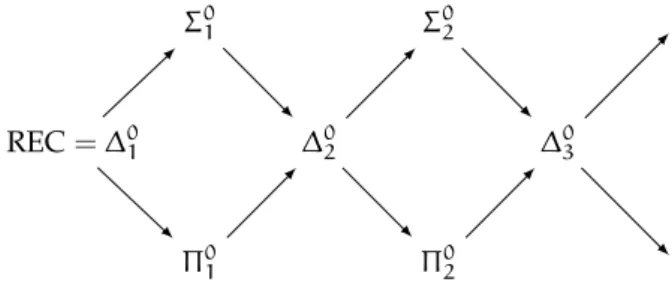
Undecidability of various properties of first order term rewriting systems is well-known. An undecidable property can be classified by the complexity of the formula defining it. This gives rise to a hierarchy of distinct levels of undecida-bility, starting from the arithmetical hierarchy classifying properties using first
3. ORIGIN OF THE CHAPTERS 15
order arithmetical formulas and continuing into the analytic hierarchy, where also quantification over function variables is allowed.
In this paper we consider properties of first order term rewriting systems and classify them in this hierarchy. Weak and strong normalization for single terms turn out to beΣ0
1-complete, while their uniform versions as well as dependency pair problems with minimality flag areΠ0
2-complete. We find that confluence is
Π02-complete both for single terms and uniform. Unexpectedly local confluence for ground terms turns out to be harder than local confluence for open terms. The former property isΠ02-complete while the latter isΣ01-complete (and thereby recursively enumerable).
The most surprising result is on dependency pair problems without mini-mality flag: we prove this to beΠ11-complete, which means that this property exceeds the arithmetical hierarchy and is essentially analytic.
The article included in this thesis is a slightly rewritten version of:
[P5] J ¨org Endrullis, Herman Geuvers, and Hans Zantema. Degrees of unde-cidability in rewriting. Technical Report abs/0902.4723, CoRR, February 2009.
A part of this technical report, in particular the results on (local) confluence for open terms and dependency pair problems, has been published as:
[P6] J ¨org Endrullis, Herman Geuvers, and Hans Zantema. Degrees of Undeci-dability in Term Rewriting. InProc. Conf. on Computer Science Logic (CSL), volume 5771 ofLNCS, pages 255–270. Springer, 2009.
Productivity of Stream Definitions
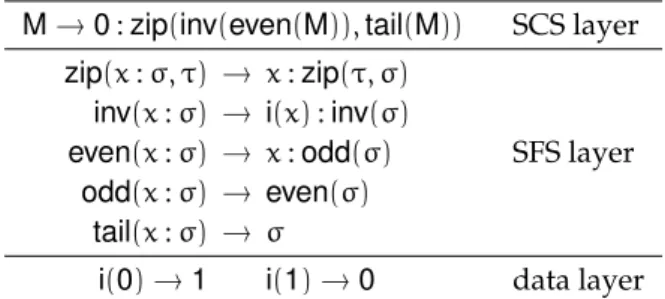
We show that productivity is decidable for a rich class of recursive stream defi-nitions that hitherto could not be handled automatically. Whereas productivity is undecidable for stream definitions in general, we show that it can be decided for ‘pure’ stream definitions. An example of a pure stream definition is shown in Figure 1.2.
M→0:zip(inv(even(M)),tail(M))
zip(x:σ, τ)→x:zip(τ, σ) even(x:σ)→x:odd(σ) tail(x:σ)→σ
inv(x:σ)→i(x) :inv(σ) odd(x:σ)→even(σ)
i(0)→1 i(1)→0
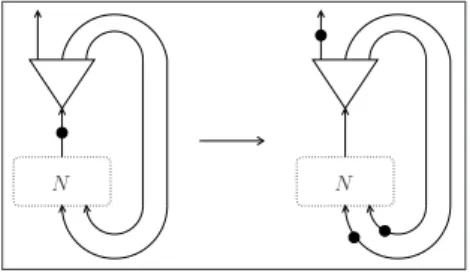
For every pure stream definition the process of its evaluation can be mo-delled by the dataflow of abstract stream elements, called ’ pebbles’, in a finite ’ pebbleflow net(work)’. And the production of a pebbleflow net associated with a pure stream definition, that is, the number of pebbles the net is able to produce at its output port, can be calculated by reducing nets to trivial nets.
The article included in this thesis is a slightly rewritten version of:
[P7] J ¨org Endrullis, Clemens Grabmayer, Dimitri Hendriks, Ariya Isihara, and Jan Willem Klop. Productivity of Stream Definitions. Theoretical Computer Science, 411(4–5):765–782, 2010.
which is in turn an extension of:
[P8] J ¨org Endrullis, Clemens Grabmayer, Dimitri Hendriks, Ariya Isihara, and Jan Willem Klop. Productivity of Stream Definitions. InProc. Conf. on Fun-damentals of Computation Theory (FCT), volume 4639 ofLNCS, pages 274– 287. Springer, 2007.
Data-Oblivious Stream Productivity
We are again concerned with productivity of specifications of infinite streams of data. In comparison to [P7] we drop all restrictions on the pattern matching in the left-hand sides of stream functions. For this generalised class of stream specifications productivity is no longer decidable, but we obtain sufficient con-ditions for productivity.
The common essence of all previous approaches [44, 39, 14, 26, 40, 10], al-so adopted here, is a quantitative analysis that disregards the identity of data, thus leading to approaches that we call data-oblivious. The above mentioned approaches employed data-oblivious reasoning (without using this name for it) to find sufficient criteria ensuring productivity, but did not aim at optimality. We present a method for proving productivity that is provably optimal among all such data-oblivious approaches. This means that in order to improve on our algorithm one has to proceed in a data-aware fashion.
At the time of writing this thesis, in [48], a data-aware approach for proving productivity has been proposed. This method employs outermost terminati-on for proving ’ global’ productivity of all ground termsTer(Σ,∅). To our best
knowledge, [48] is the first fruitfully automatable, data-aware method for pro-ving productivity.
The article included in this thesis is a slightly rewritten version of:
[P9] J ¨org Endrullis, Clemens Grabmayer, and Dimitri Hendriks. Data-oblivious Stream Productivity. InProc. Conf. on Logic for Programming, Artificial Intel-ligence, and Reasoning (LPAR), volume 5330 ofLNCS, pages 79–96. Springer, 2008.
3. ORIGIN OF THE CHAPTERS 17
Proving Infinitary Normalization
We investigate the notion of ’ infinitary strong normalization’ (SN∞), introduced in [29], the analogue of termination when rewriting infinite terms. A (possi-bly infinite) term is SN∞ if along every rewrite sequence each fixed position is rewritten only finitely often.
In [47], SN∞has been investigated as a system-wide property, i.e. SN∞for all terms of a given rewrite system. This global property frequently fails for trivial reasons. For example, in the presence of the collapsing ruletail(x:σ)→σ, the infinite termt=tail(0:t)rewrites to itself only.
We give a complete characterisation of the ’ local version’ of SN∞using inter-pretations into weakly monotone algebras (as employed in [47]). Actually, we strengthen this notion tocontinuousweakly monotone algebras (somewhat akin to [21]). We show that tree automata can be used as an automatable instance of our framework; an actual implementation has been made available.
The article included in this thesis is a slightly rewritten version of:
[P10] J ¨org Endrullis, Clemens Grabmayer, Dimitri Hendriks, Jan Willem Klop, and Roel de Vrijer. Proving Infinitary Normalization. InConf. on Types for Proofs and Programs (TYPES), Revised Selected Papers, volume 5497 ofLNCS, pages 64–82. Springer, 2009.
Complexity of Fractran and Productivity
Fractran [13] is a simple Turing-complete programming language invented by Conway. We prove that the question whether a Fractran program halts on all po-sitive integersn > 0isΠ0
2-complete. By encoding Fractran programs as specifi-cations of infinite lists, we establish that this notion of productivity with respect to strategies is Π02-complete even for a class of surprisingly simple specificati-ons. Therefore it is harder than termination of individual termsΣ01. In additi-on, we explore generalisations (weak and strong productivity) of the notion of productivity, and prove that their computational complexity is in the analytical hierarchy, thus exceeding the expressive power of first-order logic.
The article included in this thesis is a slightly rewritten version of:
[P11] J ¨org Endrullis, Clemens Grabmayer, and Dimitri Hendriks. Complexity of Fractran and Productivity. InProc. Conf. on Automated Deduction (CADE), volume 5663 ofLNAI, pages 371–387. Springer, 2009.
4 Preliminaries
4.1
Abstract Rewriting Systems
We give a brief introduction of abstract rewriting systems which closely follows the presentation of [41, Chapter 8] by van Oostrom and de Vrijer.
Definition 10. Anabstract rewriting system(ARS) is a quadruplehA, Φ,src,tgti
where Ais a set ofobjects,Φ is a set ofstepsand src : Φ → A,tgt : Φ → A
mappings calledsourceandtarget, respectively.
We employ symbols→,,(possibly indexed) to range over ARSs,a,b,
c, . . . ,x,y, . . . to range over objects, andϕ,ψ, . . . to range over steps. Figure 1.3 gives an intuitive rendering of ARSs with the two mapssrcandtgtfrom steps
Φto objectsA.
object src step tgt object
Figuur 1.3:Abstract rewriting system.
Ifϕis a step with sourcesrc(ϕ) =aand targettgt(ϕ) =bwe writeϕ: a→b
ora→ϕb. We then say thatϕis awitnessfor the existence of a step fromatob (that is, a witness for∃ϕ. a→ϕb).
Definition 11. Let→1 = hA1, Φ1,src1,tgt1i, and →2 = hA2, Φ2,src2,tgt2ibe ARSs. Then→1is called asub-ARSof→2, denoted→1⊆→2, ifA1⊆A2,Φ1⊆
Φ2, andsrc1andtgt1are the restrictions ofsrc2andtgt2toΦ1, respectively. Definition 12. An objecta∈Aof an ARS→=hA, Φ,src,tgtiis called anormal formif there exists no stepϕ∈Φsuch thatsrc(ϕ) =a.
Definition 13. Astrategyfor an ARS →is a sub-ARS of→with the same objects and normal forms.
Remark 14. A strategy for an ARS→ = hA, Φ,src,tgtipicks a subset of the steps. In Definition 13 we require that the strategy has the same normal forms as the ARS→. In other words, for every objectawhich is the source of some step, the strategy has to pick at least one stepϕwith sourcea.
We introduce labelings of ARSs which establish the basis of history-aware strategies. This technique allows for endowing objects with additional infor-mation which can be changed by the rewrite steps. In this way the rewriting history of an object can be recorded in its label and traced throughout rewriting. Labelings are bisimulations:
Definition 15. A relationBis a bisimulationbetween ARSs→1and →2if the objects and steps of→1are related to the objects and steps of→2, respectively, (that is,B⊆(A1×A2)∪(Φ1×Φ2)) such that the following two conditions hold:
4. PRELIMINARIES 19
(i) ifaBb, thenBrelates each step fromato some step ofb(forth) ∀aBb.(∀ϕ.src(ϕ) =a =⇒ ∃ψ.src(ψ) =b∧ϕBψ), and each step frombto some step froma(back)
∀aBb.(∀ψ.src(ψ) =b =⇒ ∃ϕ.src(ϕ) =a∧ϕBψ).
(ii) ifϕBψ, then the objects and targets of both steps are related (relator), that is:
∀ϕBψ.src(ϕ)Bsrc(ψ)∧tgt(ϕ)Btgt(ψ). We call related objectsbisimilar, see Figure 1.4.
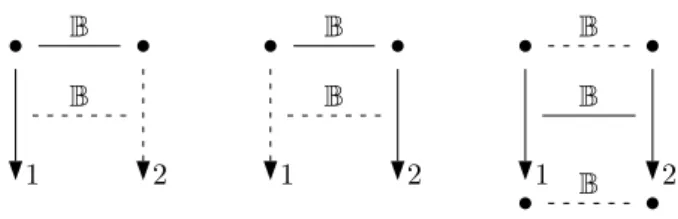
B B 1 2 B B 1 2 B B B 1 2
Figuur 1.4:Bisimulation: forth (left), back (middle), relator (right). A labeling is a special case of a bisimulation.
Definition 16. Alabelingof an ARS→1 = hA1, Φ1,src1,tgt1iis an ARS→2 = hA2, Φ2,src2,tgt2itogether with a bisimulationLbetween→1and→2for which the following conditions hold:
(i) for everya2∈A2there exists a uniquea1∈A1such thata1La2, and (ii) for everyϕ1:a1→1b1anda1La2there exists a uniqueϕ2:a2→1b2
such that ϕ1 L ϕ2. The correspondence must be bijective and we use L(a2, ϕ1), calleda2-labelofϕ1, to denote the stepϕ2which corresponds toa2andϕ1.
Arewrite labelingLconsists of a labelingLtogether with aninitial labeling func-tioni :A1→A2that maps objects of→1to bisimilar objects of→2.
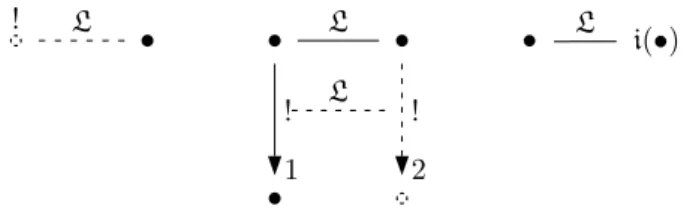
Pictorially the conditions of rewrite labelings can be rendered as in Figu-re 1.5.
That is, every labeled objecta2has an unique pre-imagea1, every stepϕ1 together with a labelinga2of its sourcesrc(ϕ1)uniquely determines the corres-ponding labeled step and every objecta1is related to its initial labelingi(a1).
! L L • i(•) L ! 1 ! 2 L
Figuur 1.5:Rewrite labeling: inversely functional, unique labeling, initial labeling.
Example 17. Figure 1.6 shows a rewrite labeling. Here→1=hA1, Φ1,src1,tgt1i where A1 = {a}, Φ1 = {ϕ, ψ} and the source and target of the steps ϕ and
ψ are a. Furthermore →2 = hA2, Φ2,src2,tgt2iwhere A2 = {aϕ, aψ},Φ2 = {ϕA, ϕB, ψA, ϕB}with sources and targets as depicted. Then the labelingL (bi-simulation) relates objects and steps as follows:
• on objectsaLaϕandaLaψ, and
• on stepsϕLϕA,ϕLϕB,ψLψAandψLψB. a aϕ aψ ϕ 1 ψ 1 2 ψB 2 ϕB 2 ϕA 2 ψA i
Figuur 1.6:Example of a rewrite labeling.
Intuitively the labeling ’ remembers’ which step has been applied. This allows for the introduction of history-aware strategies.
Definition 18. Ahistory-aware strategyfor an ARS→is defined as a strategy for a labelingLof→.
Definition 19. An ARS or a (history-aware) strategy is calleddeterministicif all its objects are the source of at most one step.
We remark that for the ARS→1from Example 17 (Figure 1.6) there exists no deterministic, history-free strategy that fairly alternates betweenϕ andψ. Such a strategy will either only consist ofϕ orψ(sinceais the only object of
→1). However, using the labeling from Figure 1.6 we can define a history-aware strategy that fairly alternates betweenϕandψ, see Figure 1.7.
4. PRELIMINARIES 21 aϕ aψ 2 ψ2 2 ϕ2
Figuur 1.7:History-aware strategy for the ARS from Figure 1.6.
4.2
Infinitary Term Rewriting
We give a brief introduction to infinitary term rewriting, the theoretical frame-work for our study of productivity of infinite objects such as streams, that are computed in an infinite timescale. Infinitary term rewritingis a natural extensi-on of ordinary, finitary rewriting, by allowing terms to have infinite branches, and admitting rewrite sequences to be transfinite, requiring convergence at each limit step. For further reading we refer the reader to [41, 29].
Infinite Terms
Infinite termscan be introduced in several ways: as partial mappings from the set of positionsN∗to the alphabet symbols of some signatureΣ, or by means of coinductive notions, or as the completion of the metric space of finite terms with the usual metric based on the familiar notion of distance that yields distance
2−(n+1) for a pair of terms that are identical up to and including levelnfrom
the root, but then have a difference (see Definition 20). In this complete metric space of finite and infinite terms we have the notion of Cauchy convergence. All of these notions of infinite terms turn out to be equivalent.
Canonical examples are infinite (term) trees, infinite streams of data, or infi-niteλ-terms. For infiniteλ-terms, see [8] for untyped infiniteλ-terms, and [1] for simply typed infiniteλ-terms. In mathematical and physical theories the use of such infinite objects is common-place in the form of infinite expansions and po-wer series. Inλ-calculus a particular class of infiniteλ-terms is known as B ¨ohm trees [7].
We introduce terms as partial mappings from the set of positionsN∗to sym-bols of the signatureΣ. LetN+ :=N\ {0}. We consider a finite or infinite term as a function on a prefix closed subset ofN∗+ taking values in a first-order
sig-nature, respecting the arity of symbols. AsignatureΣis a set of symbolsf, each equipped with an arity](f)∈N. LetX be a set of variables. Then, aterm overΣ
andXis a partial mapt:N∗+ Σ∪ X such that: (i) itsroott()is defined;
(ii) its domain is prefix closed: p ∈ dom(t)wheneverpi ∈ dom(t), for all p∈N∗+,i∈N+;
(iii) symbol arities define the number of immediate subterms: for allp∈ N∗+,
ift(p) ∈ X thenpi 6∈dom(t), for alli ∈N+, and ift(p) ∈Σthent(pi)∈
(Σ∪ X)iff1≤i≤](f).
The set of terms overΣand X is denoted by Ter∞(Σ,X). The set ofpositions Pos(t)of a termt ∈ Ter∞(Σ,X)is the domain of t. A termtis called finiteif the setPos(t)is finite. We writeTer(Σ,X)for the set of finite terms. We use the symbol≡to indicate syntactical equality of terms. For positionsp∈ Pos(t)we uset|pto denote thesubterm oftat positionp, defined byt|p(q) := t(pq)for all
q∈N∗+. Moreover, we writet[s]pfor the term obtained by replacing the subterm t|pat positionpintwiths.
Forf ∈Σand termsti ∈Ter∞(Σ,X)we writef(t1, . . . , t](f))to denote the termt∈Ter∞(Σ,X)that is defined byt() =f, andt(ip) =ti(p)for all1≤i≤ ](f)andp∈ N∗+. Forconstantsc ∈Σwe simply writecinstead ofc(). We use x, y, z, . . .to range over variables.
The standard metric on terms is:
Definition 20. On the set of termsTer∞(Σ,X)we define ametricdbyd(s, t) =0
whenevers≡t, andd(s, t) =2−kotherwise, wherek∈Nis the least length of all positionsp∈N∗+ such thats(p)6=t(p).
Infinite Rewriting Sequences
In ordinary, finitary, rewriting theory rewriting (reduction) sequences are just finite or infinite. This view is much more refined in infinitary rewriting, by allowing rewrite sequences of any countable ordinal length. The passage over limit ordinals is given by a strengthened notion of Cauchy convergence, called
’ strong convergence’.
Note that Cauchy convergence of reduction sequences is not yet sufficient to make a reduction sequence ’ connected’, as it should be; without extra require-ments it could jump at a limit stage to a totally unrelated term. So, we evidently have to impose the requirement of continuity that at a limit stageλthe reduction sequence proceeds with the limit of the prefix up toλ. Thus, e.g., in the reduc-tion sequencet0 → r1 → . . . tω → tω+1 → . . .the termtω equals limi→ωti (see [29] for several examples of transfinite reductions sequences).
Example 21. We consider the TRS consisting of the rules:
A→B(A) B(x)→C(x)
Starting from the termAwe first applyω-many times the first rule:
A→1B(A)→2B(B(A))→3B(B(B(A)))→4. . .
obtaining, in the limit, the infinite term B(B(B(. . .))) which we abbreviate by
4. PRELIMINARIES 23
second rule to the topmost (outermost) occurrence of a symbolB:
B(B(B(. . .)))→ωC(B(B(. . .)))→ω+1C(C(B(. . .)))→ω+2. . .
Note that the source of the step→ωcoincides with the limit of the terms limi→ωti. In this way we obtain a rewrite sequence:
A→ω·2C(C(C(. . .)))
of lengthω·2ending in the infinite normal formCω.
Strong convergence is Cauchy convergence with the extra requirement that the ’ activity’, that is the depth of the successive redex contractions ( ’ firings’) in a rewrite sequence, has to go deeper and deeper when approaching a limit or-dinal. For the rationale of this requirement and a more detailed introduction we refer to [28, 41]. Here we just mention the essential benefit of this requirement: it provides us with a natural notion of ’ descendant’ or ’ residual’, also in limit passages.
We formally introduce term rewriting systems and transfinite rewrite se-quences.
Definition 22. Aninfinitary term rewriting system (TRS)is a pairhΣ, Riconsisting of a signatureΣand a setRofruleswith finite left-hand sides such that for all rules`→r∈R,`is not a variable, and all variables inralso occur in`.
Asubstitutionis a mapσ : X → Ter∞(Σ,X). For termst ∈ Ter∞(Σ,X)and substitutionsσwe definetσas the result of replacing eachx∈ X intbyσ(x).
Formally, tσis defined, for allp ∈ N∗+, by: tσ(p) = σ(t(p0))(p1)if there exist
p0, p1 ∈ N∗+ such that p = p0p1 andt(p0) ∈ X, andtσ(p) = t(p), otherwise.
Lete
be a fresh symbol,e
6∈Σ∪ X. AcontextCis a term fromTer∞(Σ,X ∪{e
}) containing precisely one occurrence ofe
. ByC[s]we denote the termCσwhere
σ(e
) =sandσ(x) =xfor allx∈ X.
A TRST induces a rewrite relation on the set of (infinite) terms as follows. Definition 23. LetT be a TRS overΣ. For termss, t∈ Ter∞(Σ,X)andp∈ N∗+
we writes→T,ptif there is a rule`→r ∈R, a substitutionσand a contextC withC(p) =e
such thats≡C[`σ]andt≡C[rσ]. We writes→Rtif there exists a positionpsuch thats→T,pt.
A(strongly continuous) rewrite sequence of ordinal length α is a sequence of rewrite steps(tβ →T,pβ tβ+1)β<α such that for every limit ordinalλ < αwe
have that ifβapproachesλfrom below the following conditions hold: (i) the distanced(tβ, tλ)tends to0, and, moreover,
(ii) the depth of the rewrite action, i.e. the length of the positionpβ, tends to infinity.
The sequence is calledstrongly convergentif the conditions (i) and (ii) are fulfilled for every limit ordinal λ ≤ α. In this case we write t0 T tα, or t0 →α tα to explicitly indicate the lengthαof the sequence. Note that this ordinal will always be countable (see [29, 41]). In the sequel we will use the familiar fact that countable limit ordinals have cofinalityω.
A transfinite rewrite sequence that is not strongly convergent will be called divergent. Note that all proper initial segments of a divergent reduction are yet strongly convergent.
Orthogonal TRSs and Compression
The vast majority of TRSs we consider in this thesis are ’ orthogonal rewrite sys-tems’. These systems have been widely studied, and admit an extensive and elegant theory.
Definition 24. A TRS is calledorthogonalif all reduction rules are left-linear (no variable occurs twice in the left-hand side), and there are no critical pairs (see Definition 25).
The ’ critical pairs’ are the overlaps between the rules of a TRS:
Definition 25. LetT be a TRS, and letρ1 : `1 → r1andρ2 : `2 → r2be rules fromT. Thenρ1has a ’ critical pair’ withρ2if there exists a non-variable position
p ∈ Pos(`1), that is,`1(p) ∈Σ, such that`1|pand`2have a common instance. Letσandτbe substitutions for which`1|pσ≡`2τis the unique (up to renaming of variables) most general common instance. Without loss of generality letσbe minimal in the sense thatdom(Σ) =Var(`1|p)and let the variables introduced be fresh, that is,Var(`1|pσ)∩Var(`1[
e
]p) =∅. Thenh`1σ[r2τ]p, r1σiis calledcritical pair ofρ1withρ2. Note that`1σ[r2τ]p←`1σ→r1σ. A critical pairhs, tiis called trivialifs≡t.
In an orthogonal TRSs every transfinitely long rewrite sequence can be com-pressed, by a dove-tailing strategy of redex selection, to a rewrite sequence with the same begin and end point, but of length≤ω:
Lemma 26(Compression Lemma [41]). LetT be a left-linear TRS ands→α
T tbe a
strongly convergent rewrite sequence of lengthα. Then there exists a rewrite sequence
s→βT twithβ≤ω.
As a consequence, for orthogonal rewrite systems we can restrict to the sub-framework of infinitary rewriting where one only considers rewrite sequences of length not exceeding ω, the first infinite ordinal. Hence, whenever conve-nient, we can avoid the transfinite realm. Nevertheless, transfinite reductions frequently offer a more elegant way of studying the reduction behaviour of terms.
4. PRELIMINARIES 25
Example 27. Note that, for non-left-linear TRSs the lemma does not hold. For instance, consider the TRS:
f(x, x)→c a→s(a) b→s(b)
Then
f(a, b)→ωf(sω, sω)→c
inω+1steps. However, we do not havef(a, b)→≤ωc.
The Basic Properties
We briefly recall the basic properties pertaining to finite rewriting:
• CR is the Church–Rosser or confluence property, stating that every pair of coinitial reductions can be prolonged to a common reduct.
• UN is the immediate corollary to CR that ensures the uniqueness of nor-mal forms (terms without redexes): two finite reductions ending in nornor-mal forms, end in the same normal form.
• The property SN, strong normalization or termination, states that there are no infinite reductions, or rephrased, that every reduction must terminate eventually.
• Weak normalization (WN) states that there exists a reduction to normal form.
As is well-known, for orthogonal TRSs the properties CR and hence UN always hold, and this is even so for weakly orthogonal TRSs, where trivial critical pairs are allowed.
In the realm of infinitary reductions the finitary properties introduced abo-ve generalise to analogous notions CR∞, UN∞, SN∞, WN∞ indicated by the superscript∞:
• The property CR∞, infinitary Church–Rosser or infinitary confluence, sta-tes that infinitary reductions starting from the same (finite or infinite) term can be prolonged to a common reduct, using infinitary reductions. • The property UN∞, infinitary unique normal forms, states that two such
co-initial infinitary reductions cannot end in two different possibly infinite normal forms.
• Infinitary weak normalization, denoted WN∞, states that there exists an infinitary reduction to normal form.
The generalisation of SN to SN∞ is more subtle. Roughly speaking, it means that we are bound to find a normal form when we reduce, transfinitely, long enough:
• The property SN∞, infinitary strong normalization, states that there exists no (possibly transfinite) divergent rewrite sequence.
This entails that it is guaranteed that the reduction cannot ’ stagnate’ at some finite level. For a more precise discussion of this notion we refer to [29] or [41]. For the general background we mention that for orthogonal TRSs the property CR∞does not always hold, due to the possible presence of ’ collapsing’ reducti-on rules (they have as right-hand side a single variable). However, UN∞ does hold for orthogonal TRSs. Remarkably, for weakly orthogonal TRSs UN∞may fail. In [29] it is proved that the global versions of SN∞and WN∞, where ’ global’ means that they hold for all terms, are in fact equivalent, even without the con-dition of non-erasing rules (as the analogous equivalence for finite reductions requires).
Outermost Rewriting
Outermost rewriting is a rewriting strategy where a redex may be contracted as long as it is not a proper subterm of another redex occurrence. The main reason for studying outermost rewriting is its practical relevance: lazy functional pro-gramming languages like Miranda [43], Haskell [36] or Clean [37], are based on outermost rewriting as an evaluation strategy, and in implementations of rewri-te logic such as Maude [12] and CafeOBJ [19], ourewri-termost rewriting is an optional strategy.
Definition 28. A redex in a termtis calledoutermostif it is not (strictly) contai-ned inside another redex occurrence int.
Definition 29. Inoutermost rewriting, only outermost redexes may be contracted. Note that outermost rewriting is indeed a strategy: if a term is not in normal form, it contains some outermost redex.
Example 30. We consider the TRST consisting of the following rules:
a→f(a) f(x)→b
Clearly,T is not terminating, as witnessed by the infinite rewrite sequence:
a→f(a)→f(f(a))→f(f(f(a)))→. . .
However, the system is outermost terminating. Indeed, the second step in the rewrite sequence above is not an outermost step, since the contraction takes place inside another redex. The only (maximal) outermost rewrite sequence the termaadmits is:
BIBLIOGRAFIE 27
Context-Sensitive Rewriting
Context-sensitive rewriting [32] is a restriction on term rewriting where rewri-ting in some fixed arguments of function symbols is disallowed. For a more complete introduction to context-sensitive rewriting we refer to [32].
A mappingµ:Σ→2Nis called areplacement map (forΣ)if for all symbolsf∈
Σwe haveµ(f)⊆{1, . . . ,](f)}. When we define a replacement mapµ, the case for constantsa∈Σis left implicit, as we always haveµ(a) =∅.
Acontext-sensitive term rewriting system (µTRS)is a pairhT, µiconsisting of a TRST and a replacement mapµ. The set ofµ-replacing positionsPosµ(t)of a termt∈Ter(Σ,X)is defined by
Posµ(x) ={⊥} forx∈ X
Posµ(f(t1, . . . , tn)) ={⊥}∪{ip|i∈µ(f), p∈ Posµ(ti)} forf∈Σ In context-sensitive term rewriting only redexes atµ-replacing positions are con-tracted: we says µ-rewrites tot, and denote it bys→T,µ t, whenevers→T,pt withp∈ Posµ(s). For instance, consider the one-rule TRST:
a→cons(b, a)
and let µ be given by µ(cons) = {1}. Then, obviously T is non-terminating. On the other hand, the context-sensitive TRShT, µiis terminating, because the replacement map of the symbolconsallows rewriting only in its first argument.
Bibliografie
[1] K. Aehlig. A Finite Semantics of Simply-Typed Lambda Terms For Infinite Runs of Automata.Logical Methods in Computer Science, 3(3:1):1–23, 2007. [2] B. Alarc ´on, F. Emmes, C. Fuhs, Giesl J., R. Guti´errez, S. Lucas, P.
Schneider-Kamp, and R. Thiemann. Improving Context-Sensitive Dependency Pairs. InProc. Conf. on Logic for Programming, Artificial Intelligence and Reasoning (LPAR’08), volume 5330 ofLNCS, pages 636–651. Springer, 2008.
[3] B. Alarc ´on, R. Guti´errez, and S. Lucas. Context-Sensitive Dependency Pairs. InProc. Conf. on Foundations of Software Technology and Theoretical Com-puter Science (FST&TCS’06), volume 4337 ofLNCS, pages 297–308. Springer, 2006.
[4] B. Alarc ´on, R. Guti´errez, and S. Lucas. Improving the Context-Sensitive Dependency Graph. InProc. Conf. on Programming and Languages (PROLE 2006), volume 188 ofENTCS, pages 91–103. Elsevier, 2007.
[5] B. Alarc ´on and S. Lucas. Termination of Innermost Context-Sensitive Re-writing Using Dependency Pairs. InProc. Symp. on Frontiers of Combining Systems (FroCoS ’07), pages 73–87. Springer, 2007.
[6] T. Arts and J. Giesl. Termination of Term Rewriting Using Dependency Pairs.Theoretical Computer Science, 236:133–178, 2000.
[7] H.P. Barendregt.The Lambda Calculus, Its Syntax and Semantics, volume 103 ofStudies in Logic and the Foundation of Mathematics. Elsevier, 1984.
[8] H.P. Barendregt and J.W. Klop. Applications of Infinitary Lambda Calcu-lus. Information of Computation, 207(5):559–582, 2009. From Type Theory to Morphological Complexity: Special Issue dedicated to the 60th Birthday Anniversary of Giuseppe Longo.
[9] C. Borralleras, S. Lucas, and A. Rubio. Recursive Path Orderings can be Context-Sensitive. InProc. Conf. on Automated Deduction (CADE’02), volu-me 2392 ofLecture Notes in Artificial Intelligence, pages 314–331. Springer, 2002.
[10] W. Buchholz. A Term Calculus for (Co-)Recursive Definitions on Stream-like Data Structures. Annals of Pure and Applied Logic, 136(1-2):75–90, 2005. Festschrift on the occasion of Wolfram Pohlers’ 60th birthday.
[11] E.M. Clarke, E.A. Emerson, and J. Sifakis. A.M. Turing Award 2007 for their work in developing model checking into a highly effective verifica-tion technology, widely adopted in the hardware and software industries.
http://usacm.acm.org/usacm/weblog/index.php?p=572, 2007. [12] M. Clavel, S. Eker, P. Lincoln, and J. Meseguer. Principles of Maude.
ENT-CS, 4, 1996.
[13] J.H. Conway. Fractran: A Simple Universal Programming Language for Arithmetic. InOpen Problems in Communication and Computation, pages 4– 26. Springer, 1987.
[14] Th. Coquand. Infinite Objects in Type Theory. InProc. Workshop on Types for Proofs and Programs (TYPES), volume 806 ofLNCS, pages 62–78. Springer, 1994.
[15] N. Dershowitz. A Note on Simplification Orderings. Inf. Process. Lett., 9(5):212–215, 1979.
[16] N. Dershowitz. Orderings for term-rewriting systems.Theoretical Computer Science, 17:279–301, 1982.
[17] E.W. Dijkstra. On the Productivity of Recursive Definitions, 1980. Personal note EWD 749.
BIBLIOGRAFIE 29
[19] K. Futatsugi and A.T. Nakagawa. An Overview of CAFE Specification En-vironment — An Algebraic Approach for Creating, Verifying, and Main-taining Formal Specifications over Networks. InICFEM, pages 170–181, 1997.
[20] J. Giesl, R. Thiemann, P. Schneider-Kamp, and S. Falke. Automated ter-mination proofs with AProVE. InProc. Conf. on Rewriting Techniques and Applications (RTA), volume 3091 ofLNCS, pages 210–220. Springer, 2004. [21] J.A. Goguen, J.W. Thatcher, E.G. Wagner, and J.B. Wright. Initial Algebra
Semantics and Continuous Algebras.J. ACM, 24(1):68–95, 1977.
[22] R. Guti´errez, S. Lucas, and X. Urbain. Usable Rules for Context-Sensitive Rewrite Systems. In Proc. Conf. on Rewriting Techniques and Applications (RTA’08), volume 5117 ofLNCS, pages 126–141. Springer, 2008.
[23] N. Hirokawa and A. Middeldorp. Dependency Pairs Revisited. InProc. Conf. on Rewriting Techniques and Applications (RTA), volume 3091 ofLNCS, pages 249–268. Springer, 2004.
[24] N. Hirokawa and A. Middeldorp. Polynomial Interpretations with Negati-ve Coefficients. InProc. Conf. on Artificial Intelligence and Symbolic Computa-tion (AISC), volume 3249 ofLNCS, pages 185–198. Springer, 2004.
[25] D. Hofbauer and J. Waldmann. Proving Termination with Matrix Interpre-tations. InProc. Conf. on Rewriting Techniques and Applications (RTA), volume 4098, pages 328–342. Springer, 2006.
[26] J. Hughes, L. Pareto, and A. Sabry. Proving the Correctness of Reactive Systems Using Sized Types. InProc. Symp. on Principles of Programming Languages (POPL), pages 410–423. ACM, 1996.
[27] R. Iturriaga.Contributions to Mechanical Mathematics. PhD thesis, Carnegie-Mellon University, Pittsburgh, PA, USA, 1967.
[28] R. Kennaway, J.W. Klop, M.R. Sleep, and F.-J. de Vries. Transfinite Reduc-tions in Orthogonal Term Rewriting Systems. Information and Computation, 119(1):18–38, 1995.
[29] J.W. Klop and R.C. de Vrijer. Infinitary Normalizati-on. In We Will Show Them: Essays in Honour of Dov Gab-bay, volume 2, pages 169–192. College Publications, 2005.
ftp://ftp.cwi.nl/pub/CWIreports/SEN/SEN-R0516.pdf. [30] D. Lankford. On proving Term-Rewriting Systems are Noetherian.


![Figuur 6.9: The net translation [M] = µM.•([zip]([inv]([even](M)), [tail](M))) of M.](https://thumb-us.123doks.com/thumbv2/123dok_us/10211947.2924658/200.722.112.602.141.437/figuur-net-translation-m-µm-zip-inv-tail.webp)
