Report of
Investigation Task Force
on Statistical Data Quality Assurance
Contents __________________________________________________________________________________ Page Executive Summary I Chapter 1 Introduction 1 - Background
- Investigation Task Force on Statistical Data Quality Assurance
2 Work of the Task Force 4
- Introduction - Data Authenticity
- Data Quality Assurance System - Fieldwork Management System
3 Examination of Data Authenticity 9
- Introduction
- Authenticity of GHS Data
- Findings on Authenticity of GHS Data - Authenticity of LES Data
- Findings on Authenticity of LES Data - Authenticity of AEHS Data
- Findings on Authenticity of AEHS Data
- Conclusion on Authenticity of the Survey Data Examined
4 Data Quality Assurance System - Introduction
- Quality Assurance Measures in Key Statistical Processes - Response Rate and Proxy Reporting Rate – Implications on
Data Quality
- Decentralisation of GHS Fieldwork
- Conclusion on Data Quality Assurance System
Chapter
5 Fieldwork Management System
- Introduction
- Keeping of Daily Time Logs - Performance Appraisal System
- Management of Workload and Work Pressure - Decentralisation of GHS Fieldwork
- Communication of Field Officers with the Management - Conclusion on Fieldwork Management System
26
6 Conclusion
- Data Authenticity
- Quality Assurance System - Fieldwork Management System
31
Appendix
1-1 Membership List of the Investigation Task Force on Statistical Data Quality Assurance
A1
3-1 Verification of Data Collected from the General Household Survey A2
3-2 C&SD’s Response to the Media Report Regarding Enumeration Results of Sample Quarters in General Household Survey
A12
4-1 C&SD’s Quality Assurance Mechanism in Key Statistical Processes A14
5-1 Time Log System A17
Executive Summary
___________________________________________________________
Background
1 In January 2013, a local newspaper carried a series of reports sourced from a few field officers of Census and Statistics Department (C&SD) alleging that a significant proportion of frontline field officers had fabricated responses in the General Household Survey (GHS) in order to boost their output rates. Forgery of data for the Labour Earnings Survey (LES) and the Annual Earnings and Hours Survey (AEHS) was also mentioned. The issue was said to be related to the requirement for field officers to record fieldwork activities on the time log sheets which had added much pressure on field officers.
2 Considering the gravity of the above allegations, the Government established an Investigation Task Force on Statistical Data Quality Assurance (Task Force) on 10 January 2013 to examine the authenticity of statistical data and the existing data quality assurance mechanism.
3 The chairperson of the Task Force is the Commissioner for Census and Statistics, Mrs Lily Ou-Yang. Other members include two serving members of the Statistics Advisory Board, Professor Chan Ngai-hang and Mr Tse Kam-keung, as well as a former member, Mr Vincent Kwan Wing-shing, and Ms Reddy Ng Wai-lan (Principal Economist) representing the Government Economist.
4 The Terms of Reference of the Investigation Task Force are as follows :
(I) To examine the authenticity of data collected by field officers in the GHS and related surveys;
(II) To examine and assess the existing quality assurance mechanism in survey data collection, and to make recommendations on improvement measures; and
(III) To make recommendations for improving the fieldwork management system of surveys.
5 The Task Force adopted an evidence-based approach to examine the available facts and findings to ensure impartial and targeted investigation, and that conclusions and recommendations were made in an independent and objective manner. To this end, the Task Force relied on facts and data verification by external party and sources wherever possible.
6 During the investigation, the Task Force held a total of nine meetings and conducted five meetings with staff of C&SD, including field officers, statisticians and the Executive Committee of the C&SD Field Officers and Statistics Supervisors Amalgamated Association.
Terms of Reference (I) : To examine the authenticity of data collected by field officers in GHS and related surveys
Work of the Task Force
7 The Task Force focused on examining the data authenticity of GHS which was the major allegation. The Task Force also examined the results of the verification on data of LES and AEHS.
GHS
8 It was alleged that a significant proportion of field officers had fabricated responses to some questions in the GHS questionnaire in order to skip collecting data on some other questions. The Task Force considered that an independent and objective verification exercise should be undertaken within the time frame of the investigation. A survey research company in the private sector was commissioned to conduct an independent data verification on the December 2012 GHS data through telephone interviewing method, covering a sample of 900 household cases targeted at cases which were subject to a relatively high risk of mis-classification and misreporting, viz. households with economically inactive person(s) aged 15-59 or unemployed person(s) which were the categories of cases involved in the allegations.
9 The Task Force also reviewed the quality assurance system and process for GHS. Specifically, the Task Force had reviewed some quality assurance statistics for GHS and compared these statistics with similar ones based on the results of the independent verification checks.
10 Regarding the questions in the GHS involved in the allegation, the Task Force noted that 97.5% of the responses to these questions collected in GHS agreed entirely with those collected from the independent verification checks undertaken by the survey research company. Of these, data on marital status (99.2%) and usual place of work (96.1%) recorded in GHS were almost in full agreement with the checking results.
11 An overall rate of data inconsistency of 2.5% was observed in the independent verification checks, which was higher than that of 0.1% in the regular verification checks performed by C&SD. The inconsistencies mainly concentrated in the question on “whether respondent available for work in the 7 days before enumeration” related to the classification of economic activity status of a person, with the inconsistency rate in the independent verification checks being 11.5% as compared to 0.6% in C&SD’s quality checks. The Task Force noted that the inconsistency of this particular question occurred on both sides, in contrast to the allegation that the fabricated response would go one-sided in order to skip some questions.
12 The Task Force noted from the survey research company’s report that the data inconsistencies might be due to a number of factors such as respondents’ memory lapse in recalling what had happened some 2 months ago, respondents’ behaviour and attitude in answering the questions, imperfect interviewing skills and inadequate understanding of the relevant survey concepts of some field officers. The Task Force had an extensive deliberation on the findings of the independent verification checks and did not rule out the possibilities of certain inconsistencies attributable to individual field officers not strictly following the fieldwork guidelines, such as misapplying personal judgement to handle some of the questions in the questionnaire based on their knowledge/experience, or skipping some instructions in the guidelines.
13 To further address the allegation that some field officers of C&SD would circumvent supervisors’ review checks by falsifying the telephone number of respondents (e.g. by recording the same telephone number in different questionnaires), an in-house examination of the questionnaires for the February-December 2012 rounds of GHS was conducted. The Task Force noted that only less than 0.1% of the enumerated cases with same telephone number recorded were identified.
14 According to the information from the independent verification checks, 97.5% of the data agreed entirely with those in GHS, with only an inconsistency rate of 2.5%. The Task Force noted that given the limitations of the verification checks, the inconsistencies identified did not necessarily imply C&SD’s data concerned were in error. Nonetheless, even taking the inconsistencies into account and recompiling the seasonally adjusted unemployment rate for October-December 2012, the impact of the inconsistencies on the published unemployment rate was insignificant. 15 Regarding the allegation that field officers would falsify enumeration results of sub-divided flats as non-contact or unoccupied as the workload involved in enumerating such cases was considered to be much higher than that in other cases, the Task Force noted that additional workload of field officers arising from sub-divided units would be accounted for in staff output. The Task Force found it difficult in arriving at an evidence-based conclusion on the allegation and held the view that the issue of sub-divided flats should be further examined in the context of fieldwork management.
16 In the course of the investigation, the Task Force also received report from C&SD on the suggestion by a local newspaper issued in March 2013 that a significant number of field officers would falsify enumeration results of some sampled quarters as unoccupied in order to save enumeration time, as reflected by the relatively high proportion of unoccupied quarters in total sampled cases obtained from GHS (10.6% in 2012) when compared to the vacancy rate of private housing obtained from the Rating and Valuation Department (RVD) (4.62% during 2007-2011) and the drop of the former in the January 2013 round of GHS.
17 The Task force noted from C&SD that RVD’s vacancy rate and the proportion of unoccupied quarters obtained from GHS were not comparable owing to difference in definition and it was not a simple and easy task for field officers to make a clear distinction between unoccupied cases and non-contact ones owing to similarity of nature of the two categories. The Task Force considered that the information reinforced the views of the Task Force in paragraph 12 above.
Findings on Authenticity of GHS Data
18 Based on the findings of the independent verification checks and other related parameters and arguments provided by C&SD, the Task Force is of the view that there is not sufficient evidence showing the existence of systematic data fabrication in GHS.
19 After considering the results of the independent verification exercise and modificationsof data as might be required, the Task Force has not found convincing evidence to query the overall authenticity of the data collected inGHS.
20 Nonetheless, the Task Force considers the findings in this investigation point to scope for enhancement of C&SD’s quality assurance system and processes for GHS.
LES
21 It was alleged that some field officers had fabricated responses in the LES by means of asking loaded questions which had led respondents to indicate that wage rates were the same as in the preceding quarter, so that field officers could simply transcribe the data of the preceding quarter into the questionnaires. The Task Force examined the results of a separate verification of LES data, which was conducted by a different team of professional statisticians in C&SD in consideration of the need to ensure data confidentiality of business sector data. A random sample of data collected in the third quarter of 2012 round of LES was verified by the telephone interviewing method.
22 The Task Force also reviewed the quality assurance system for LES. Statistics of the regular quality assurance processes of LES were examined and compared with statistics based on results of the verification checks.
23 The Task Force noted that no data inconsistencies were detected in 116 (or 95.9%) of the 121 cases for which the verification was performed. Some imperfections in the data collection work were identified in the remaining 5 cases. While 3 of these cases involved some data inconsistencies, there was no objective evidence indicating that the inconsistencies were due to data fabrication. The Task Force also noted
that the proportion of data inconsistency cases (i.e. 3 out of 121 or 2.5%) was generally comparable to that of routine quality assurance checks in C&SD. Nevertheless, it was considered that there might still be room for further enhancement in the existing quality assurance system for LES.
24 The Task Force noted that the impact of the 3 inconsistent cases identified on the published figures on year-on-year rates of change in the nominal wage indices were unaffected.
Findings on Authenticity of LES Data
25 On the basis of the findings of the verification exercise, the Task Force is of the opinion that there is not sufficient evidence showing systematic data fabrication in LES.
AEHS
26 It was alleged that some field officers had fabricated responses in AEHS by duplicating the employee records from other completed returns for some partially completed cases. The Task Force examined the results of a separate verification of AEHS data, which was conducted by the above-mentioned team of professional statisticians. A sample of targeted data records (i.e. employee records with the same values for all data items on occupation, wage and working hours) in the dataset of the 2012 AEHS was verified through telephone interviewing method.
27 The Task Force also reviewed the quality assurance system for AEHS. Statistics of the regular quality assurance processes of the survey were examined and compared with statistics based on results of the verification checks.
28 The Task Force noted that for those cases where the checks were successfully completed, all the data verified were confirmed to be in order.
Findings on Authenticity of AEHS Data
29 On the basis of the findings of the verification exercise, the Task Force is of the opinion that there is not sufficient evidence showing systematic data fabrication in AEHS.
Conclusion
30 The Task Force concludes that there is not sufficient evidence to query the overall authenticity of the data collected in the three surveys. The Task Force considers that the quality of data collected from the three surveys is sufficiently sound to provide basic inputs for the compilation of the relevant statistical figures.
31 In view of the data inconsistencies noted in the verification checks and the increasing challenges faced by C&SD’s field officers in data collection work, the Task Force does not rule out the possibilities that individual field officers have not strictly followed the fieldwork guidelines, such as misapplying personal judgement to handle some of the questions in the questionnaire based on their knowledge/experience, or skipping some instructions in the guidelines. Hence, the Task Force is of the view that this points to the need for C&SD to calibrate and enhance across the board the quality assurance system. The deliberations and recommendations of the Task Force on this area are given under Terms of Reference (II) below.
Terms of Reference (II) : To examine and assess the existing quality assurance mechanism in survey data collection, and to make recommendations on the improvement measures
Work of the Task Force
32 The Task Force required C&SD to give a detailed account of the data quality assurance mechanism, in particular, on conceptual soundness of the mechanism, extent of benchmarking with international practices, robustness of the mechanism and presence of professionalism. On the basis of the information provided, the Task Force noted that C&SD’s quality assurance system followed international standards and practices generally.
33 The Task Force reviewed the quality assurance systems and routine quality assurance checks for GHS, LES and AEHS. During the review, the Task Force identified measures to strengthen and reinforce the existing quality assurance system in various dimensions, in particular on
identification of high-risk areas which might lead to
34 The Task Force noted that the decentralisation arrangement of GHS fieldwork introduced since 2003 (see Chapter 5, paragraphs 5.11-5.12 for a brief description of GHS decentralisation) had resulted in decentralisation of data quality control to different field teams. Based on the views reflected by some field officers, there was generally a lack of ownership of GHS among field officers. These two issues would present challenges in ensuring the quality of the GHS data, in terms of variations in execution of quality assurance processes in different field teams and lack of central supervision of the quality assurance processes. The Task Force expressed concern on the need to establish ownership explicitly with responsibilities well entrusted in the quality assurance processes. The Task Force was of the view that having a central party to oversee and coordinate the quality assurance of GHS would be desirable.
35 The Task Force also noted from both the management and staff of C&SD that the changes in social and economic environment had an adverse impact on the cooperation of respondents. Some field officers expressed that such changes posed great difficulties in data collection for household surveys. This was reflected in a general declining trend of response rate and an increasing rate of proxy reporting in GHS (see Chapter 4, paragraph 4.4 for a brief description of response rate and proxy reporting in GHS), which could impact data quality.
Conclusion
36 On the basis of the information provided, the Task Force noted that the existing quality assurance system in general followed international standards and practices. While in general the necessary processes are in place to control data quality, however, measures to strengthen and reinforce existing quality assurance system in various dimensions should be introduced.
37 The Task Force makes the following recommendations to strengthen the quality assurance system:
Recommendation (1): The Task Force recommends that C&SD should identify data categories vulnerable to mis-classification/error and data fabrication through cross-sectional and longitudinal analyses for close monitoring of data quality.
Recommendation (2): The Task Force recommends that a Departmental Committee be established to oversee and coordinate the quality assurance of GHS in order to further safeguard the quality of the survey data collected by the various field teams.
Recommendation (3): The Task Force recommends that C&SD should foster a sense of ownership in the mindset of all stakeholders involved in conducting GHS in order to further safeguard the quality of the GHS data.
Recommendation (4): The Task Force recommends that C&SD should conduct research studies to assess the impact of the declining response rate and increasing rate of proxy reporting on the GHS results.
Recommendation (5): The Task Force recommends that C&SD should consider introducing appropriate measures to raise public awareness of GHS and the work of C&SD in general with a view to enhancing the cooperation of respondents.
Terms of Reference (III) : To make recommendations for improving the fieldwork management system of surveys
Work of the Task Force
38 The Task Force examined various aspects of the fieldwork management system in C&SD, including the use of time logs in fieldwork management, performance appraisal system, workload and work pressure of field officers, decentralisation of data collection work in GHS and communication channels of field officers with the management.
39 The Task Force also conducted a series of meetings with field officers and staff association to better understand their views and comments on the current fieldwork management system. Notwithstanding that there were diversified views from field officers during these meetings, the Task Force noted that a number of field officers expressed concerns and grievances on some of the aforesaid aspects, particularly with regard to their discontent arising from the keeping of time logs, increasing workload and GHS decentralisation.
40 After extensive deliberation, the Task Force considered that the fieldwork management system encompassed a host of historical, complex and deep-seated issues which would need to be addressed in an integrated and coherent manner. While the Task Force saw some problems and certain scope for improvement in certain aspects, members generally found it difficult to grasp a complete picture of the issues involved within the limited time span of the investigation process of the Task Force.
Conclusion
41 The Task Force concludes that within the limited time span, it would not be possible to formulate a set of specific recommendations which would effectively resolve all the major problems and issues inherent in the fieldwork management system.
42 The Task Force makes the following recommendation regarding the existing fieldwork management system:
Recommendation (6): The Task Force recommends that a comprehensive review of the existing fieldwork management system should be conducted. The review should at least cover aspects relating to the keeping and checking of time logs, decentralisation of GHS fieldwork, workload and work pressure of field officers, communication channels, treatment of sub-divided flats and resource situation of C&SD.
Chapter 1 : Introduction
____________________________________________________________
Background
1.1 In January 2013, a local newspaper carried a series of reports sourced from a few field officers of Census and Statistics Department (C&SD) alleging that a significant proportion of frontline field officers had fabricated responses in the General Household Survey (GHS) in order to boost their output rates. Forgery of data for the Labour Earnings Survey (LES) and the Annual Earnings and Hours Survey (AEHS) was also mentioned.
1.2 In the media reports, it was said that some field officers indicated that C&SD’s requirement for recording work activities performed by field officers in the time log sheets had added much pressure on them and thus some field officers would fabricate answers in some surveys in order to achieve better output rates. The allegations were summarised below. (1) General Household Survey (GHS)
1.3 A significant proportion (about half) of field officers had fabricated responses to some questions in GHS in order to avoid collecting data on some other parts of the questionnaire (i.e. to skip some questions) and such forgery would lead to the underestimation of the unemployment rate and misclassification of marital status and usual place of work. These questions were related to the following aspects:
(a) whether the respondent was available for work in the 7 days before enumeration – If the respondent had not performed any work but was available for work in the 7 days before enumeration, another 12 questions had to be asked to ascertain his/her economic activity status. Thus, in such cases, some field officers would fabricate response to this question by stating that the respondent “was not available for work in the 7 days before enumeration”; (b) marital status and usual place of work – If the respondent was
“married but did not live with the spouse” or if the usual place of work was “outside Hong Kong”, supplementary information had to be collected. Thus, some field officers would fabricate
responses to these questions in order to skip some questions.
1.4 Besides, it was also alleged that some field officers would circumvent (i) enumeration work on sub-divided flats by falsifying the enumeration results of such cases as non-contact or unoccupied, and (ii) supervisors’ review checks by falsifying the telephone number of respondents.
1.5 In March, there was an additional allegation from that newspaper that the proportion of unoccupied quarters in GHS was high when compared with the vacancy rate compiled by the Rating and Valuation Department and that the former dropped in the January 2013 round of GHS. The press report suggested that this indicated the possibilities of falsification in enumeration results.
(2) Labour Earnings Survey (LES)
1.6 Some field officers had fabricated responses in LES by means of asking loaded questions which had led respondents to indicate that wage rates were the same as in the preceding quarter so that field officers could simply transcribe the data of the preceding quarter into the questionnaires. This would affect the accuracy of the wage index.
(3) Annual Earnings and Hours Survey (AEHS)
1.7 Some field officers had fabricated responses in AEHS by duplicating the employee records from other completed returns for some partially completed cases. This would affect the accuracy of the earnings and working hours statistics.
(4) Time log system
1.8 Some field officers indicated that forgery of data and time logs were directly related. They indicated that data recorded on the time logs were used to assess the performance aspect of “output”, which would in turn affect the promotion claim. The shorter the time required to finish the questionnaire, the higher the rating of performance would be.
Investigation Task Force on Statistical Data Quality Assurance
1.9 Considering the gravity of the above allegations, the Government established an Investigation Task Force on Statistical Data Quality Assurance (Task Force) on 10 January 2013 to examine the authenticity of statistical data and the existing data quality assurance mechanism.
1.10 The chairperson of the Task Force is the Commissioner for Census and Statistics, Mrs Lily Ou-Yang. Other members include two serving members of the Statistics Advisory Board, Professor Chan Ngai-hang and Mr Tse Kam-keung, as well as a former member, Mr Vincent Kwan Wing-shing, and Ms Reddy Ng Wai-lan (Principal Economist) representing the Government Economist. The member list is given in Appendix 1-1. 1.11 The Terms of Reference of the Investigation Task Force are as follows:
(I) To examine the authenticity of data collected by field officers in the GHS and related surveys;
(II) To examine and assess the existing quality assurance mechanism in survey data collection, and to make recommendations on improvement measures; and
(III) To make recommendations for improving the fieldwork management system of surveys.
Chapter 2 : Work of the Task Force
____________________________________________________________
Introduction
2.1 The Task Force was entrusted with the mission to examine the authenticity of statistical data, to assess the statistical quality assurance mechanism in survey data collection and to study the fieldwork management system of surveys with a view to making recommendations within the given time frame. In discharging the mission, the Task Force adopted an evidence-based approach to examine the available facts and findings to ensure impartial and targeted investigation, and that conclusions and recommendations would be made in an independent and objective manner. To this end, the Task Force relied on facts and data verification by external party and sources wherever possible. This Chapter summarises the approach taken by the Task Force in conducting the investigation.
2.2 During the investigation period, the Task Force held a total of nine meetings and five meetings with staff of C&SD. First and foremost, the Task Force deliberated on the approach and methodology of investigation into the data authenticity issue. The Task Force believed that the verification should be done in an independent and objective manner. The Task Force examined the documents on the statistical quality assurance mechanism established in survey data collection and fieldwork management system, and sought details from C&SD subject officers to clarify areas which deserved close scrutiny.
2.3 It is based on the systematic examination of the facts and findings collated in the course of the investigation that the Task Force made its conclusions and recommendations.
I. Data Authenticity
2.4 Considering the major issues of public concern, the Task Force discussed and decided that the General Household Survey (GHS), Labour Earnings Survey (LES) and Annual Earnings and Hours Survey (AEHS) be selected for examination of the authenticity of data collected by field officers. Having regard to the requirements that the verification be done
in an independent and objective manner within the time frame of the investigation, the Task force endorsed the adoption of the following methods for the three surveys in question.
(1) GHS
2.5 A special data verification exercise was to be conducted as follows:
(a) The exercise should be commissioned to a survey research company in the private sector to ensure full independence of the checking results. A total of 15 survey research companies (including survey research agencies of academic institutions and reputable survey research companies in the private sector) were invited to submit quotations.
(b) Given the exceptionally tight time frame, the Task Force considered that it was pragmatic yet still effective to conduct the verification checks by telephone interviewing and that the exercise covered a sample of 900 household cases. The checking should be targeted at cases which were subject to a relatively high risk of mis-classification and misreporting, viz. households with economically inactive person(s) aged 15-59 or unemployed person(s).
(c) To minimise respondent burden, the scope of the verification checks would focus on verifying the authenticity of data used for compiling the unemployment rate (i.e. data items related to “economic activity status”) and other major alleged data items including “marital status” and “usual place of work”.
(d) The sample for checking would be drawn from the December 2012 round of GHS to minimise possible memory lapse of the respondents as far as possible.
2.6 The selected survey research company completed the data verification exercise in the first week of February 2013 and presented the results to the Task Force. The Task Force examined the findings and observations of the exercise in detail and where applicable, required the survey research company to clarify details and supplement the contents of
the report. Details of the discussion are given in Chapter 3.
2.7 The Task Force was aware of the public concern on any possible behavioural abuse in data collection work. To address the concern, the Task Force advised C&SD to check whether there were any identical telephone numbers of responded households recorded in different questionnaires of GHS completed by field officers. Results of the checking are given in Chapter 3.
2.8 The Task Force also addressed the allegation related to the enumeration work in sub-divided flats. The Task Force asked C&SD to provide a factual account of the work arrangement to support the examination of the allegation. Details are given in Chapter 3.
(2) LES
2.9 The Task Force considered that a data verification exercise on a random sample of data collected in the third quarter of 2012 round of LES should be conducted to examine the validity of the allegation that cases with same wage rate as in the preceding quarter were not reflecting the actual situations. The Task Force accepted the view that business sector data were too sensitive such that it was not suitable for a private research company to conduct the checking, and agreed that a separate team comprising professional statisticians in C&SD was to conduct the verification check by telephone interviewing. The coverage of the exercise targeted at those cases where the data were the same as last quarter, but still included a small sample of other cases to provide the Task Force with a complete, balanced view of the whole situation. Results of the checking are given in Chapter 3.
(3) AEHS
2.10 The Task Force noted that in the dataset of the 2012 AEHS, there were very few dubious cases enumerated by individual field officers which involved employee records from different companies having the same set of data values. Notwithstanding this, the Task Force advised C&SD to conduct a data verification exercise to sample-check the suspicious data records to identify any data inconsistencies. As the checking also involved sensitive business sector data, the Task Force agreed that the exercise was to be carried out by the above-mentioned team of professional
statisticians. Results of the checking are given in Chapter 3.
2.11 Based on the information provided and the findings of the checks on data authenticity, the Task Force formed its views and made relevant recommendations. Details of the factual account and considerations are given in Chapter 3.
II. Data Quality Assurance System
2.12 The Task Force required C&SD to give a detailed account of the data quality assurance mechanism, in particular on conceptual soundness of the mechanism, extent of benchmarking with international practices, robustness of the mechanism and presence of professionalism. Specifically, C&SD was required to explain the quality assurance measures instituted in major statistical processes including data collection, data processing, treatment of non-responses and macro review.
2.13 The Task Force reviewed the quality assurance systems and routine quality assurance checks for GHS, LES and AEHS. The Task Force studied the time series of micro data of GHS with a view to checking the internal consistency of the data and identifying abnormalities.
2.14 The Task Force noted from both the management and staff of C&SD the changes in social and economic environment had an adverse impact on respondents’ cooperation and posed greater difficulties in data collection for household surveys. The Task Force examined the statistics which showed a general declining trend of response rate and an increasing rate of proxy reporting in GHS (see Chapter 4, paragraph 4.4 for a brief description of response rate and proxy reporting in GHS).
2.15 C&SD presented to the Task Force background information relating to the decentralisation arrangement of GHS fieldwork (see Chapter 5, paragraphs 5.11-5.12 for a brief description of GHS decentralisation). The Task Force noted that such arrangement to a certain extent had resulted in decentralisation of data quality control of GHS to individual field teams.
III. Fieldwork Management System
2.16 The Task Force required C&SD to give a detailed account of various aspect of the fieldwork management system including the use of time logs in fieldwork management, performance appraisal of field officers, workload and work pressure of field officers, decentralisation of data collection work in GHS, and communication channels of field officers with the management. Details of these issues are given in Chapter 5.
2.17 The information furnished the Task Force with the relevant background knowledge when Task Force members initiated a series of meetings with field officers (described in following paragraphs).
Meetings with C&SD Staff
2.18 To gain first-hand understanding of the views of C&SD staff on various specific issues on data collection and fieldwork management, the external members of the Task Force (including the representative of Government Economist) met with staff at different levels. These members had five meetings on 4 and 7 February 2013, including meetings with (i) Census and Survey Officer grade officers of various ranks (3 meetings in total), (ii) the Executive Committee of the C&SD Field Officers and Statistics Supervisors Amalgamated Association and (iii) selected Statistician grade officers in charge of GHS, LES and AEHS. Representatives of the Financial Services and the Treasury Bureau (FSTB) served as Secretary and Observer in these meetings.
2.19 The issues raised during these meetings included mainly the impact of the allegations in the news reports on field officers, increase in workload and difficulties encountered by frontline field officers in data collection, problems relating to the time log system and decentralisation of GHS fieldwork, and problems in managing temporary interviewers. Through these meetings, which revealed diverse opinions and expectations of field officers across different ranks, the Task Force members gained a general understanding of relevant issues and problems related to data collection and fieldwork management as perceived by the staff.
Chapter 3 : Examination of Data Authenticity
____________________________________________________________
Introduction
3.1 This Chapter presents the investigation methods to examine data authenticity of the General Household Survey (GHS), Labour Earnings Survey (LES) and Annual Earnings and Hours Survey (AEHS), the findings of the investigation, C&SD’s views and responses to these findings and the conclusions reached by the Task Force regarding data authenticity of the survey data.
Authenticity of GHS Data
3.2 The GHS1 is a sample survey which has been conducted on a continuous month-to-month basis since August 1981 to collect major social and labour force data such as the labour force, employment, unemployment and underemployment. A rotational replicate sample design is adopted in GHS such that households in half of the sampled quarters in the current month will be enumerated by different field officers three months later. Moreover, households in the majority of the sampled quarters in the second round of enumeration are enumerated by computer-assisted telephone interviews (CATI). Quality of data collected through CATI is controlled through real-time monitoring by field supervisors in the CATI centre. 3.3 In response to the allegation that a significant proportion of field officers had fabricated responses to some questions in GHS in order to skip collecting data on some other questions and that such forgery would lead to underestimation of the unemployment rate and mis-classification of marital status and usual place of work, an independent verification exercise was conducted to gauge the accuracy of the GHS data. To ensure full independence of the exercise, the Task Force decided to contract out the task to a survey research company in the private sector through an invited tender exercise. A total of 15 survey research companies (including survey research agencies of academic institutions and reputable survey research companies in the private sector) were invited to submit quotations.
1 Please refer to the C&SD Website for details of the survey methodology of GHS
(www.censtatd.gov.hk/hkstat/sub/sp200.jsp?productCode=B1050001).
3.4 Given the exceptionally tight time frame and taking into account considerations such as potential memory lapse of the respondents, the Task Force decided that 900 household cases enumerated in the latest round of GHS (i.e. December 2012) would be selected for data verification through telephone interviews. These cases were randomly selected from the targeted cases which were subject to a relatively high risk of mis-classification and misreporting of economic activity status, viz. households with economically inactive person(s) aged 15-59 or unemployed person(s) which were the categories of cases involved in the allegations. In particular, a higher proportion of cases was sampled from those households with economically inactive female(s) aged 25-59 and engaged in household duties, and households with unemployed person(s). 3.5 The 900 selected household cases (with 2 821 persons) represent 31% of the 2 865 targeted cases or 14% of the total number of enumerated cases. The questions in the GHS questionnaire involved in the allegations related to specific questions for determining the classification of economic activity status of a person, a question on marital status and a question on usual place of work. These were included in the verification exercise. 3.6 The Task Force also reviewed the quality assurance system and process for GHS. Specifically, the Task Force had reviewed some quality assurance statistics for GHS and compared these statistics with similar ones based on the results of the independent verification checks.
(1) Verification checks by independent party – Major findings
3.7 Details of the verification method and findings are presented in the report prepared by the survey research company in Appendix 3-1.
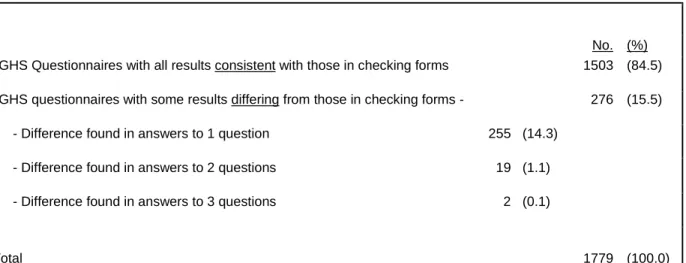
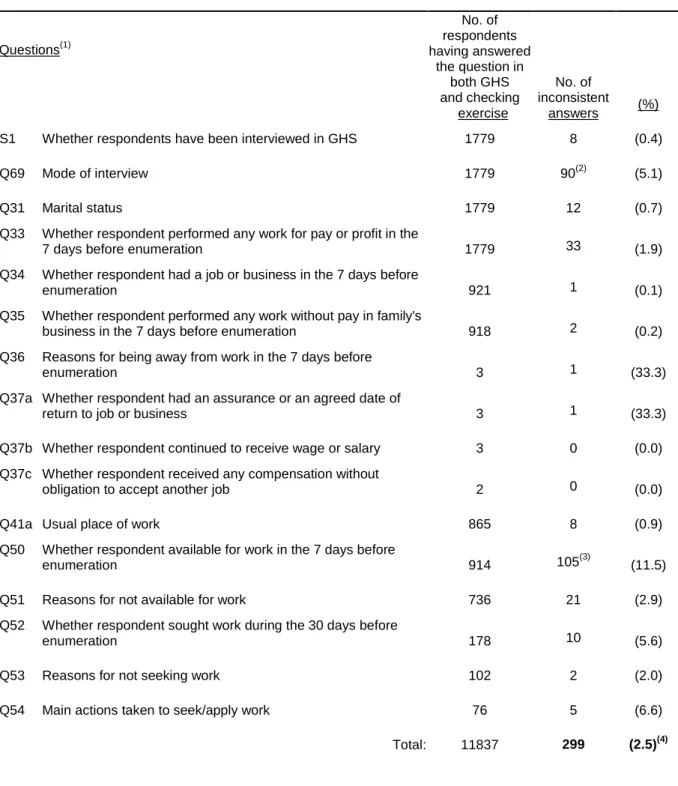
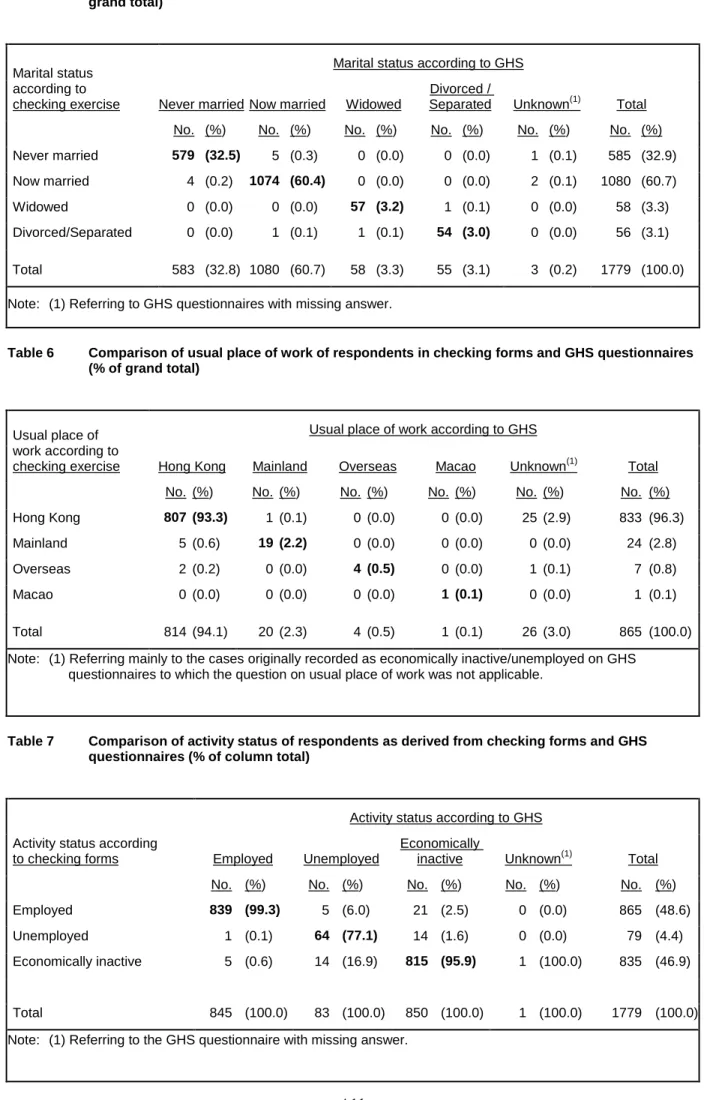
3.8 The Task Force noted that among the answers to the 11 837 questions directed to the 1 779 respondents successfully enumerated by the survey research company, 11 538 or 97.5% of the responses to these questions collected in GHS agreed entirely with those collected from the independent verification checks undertaken by the survey research company. Of these, data on marital status (99.2%) and usual place of work (96.1%) recorded in GHS were almost in full agreement with the checking results.
questions were observed. The overall rate of data inconsistency noted in the verification checks was higher than that in the regular verification checks performed by C&SD. Of the answers to the 11 837 questions successfully enumerated by the survey research company, 299 or 2.5% were found to be inconsistent with those in GHS as against an inconsistency rate of 0.1% in C&SD’s regular quality checks. In particular, a relatively higher proportion of inconsistencies was found in the answers to the question on “whether respondent available for work in the 7 days before enumeration”, amounting to 105 responses (11.5% of total) as against 0.6% in C&SD’s regular quality checks.
3.10 The Task Force noted the following responses of C&SD to the above observations.
(a) On the 299 inconsistent responses: In general, inconsistent outcome might occur in subsequent interviewing after a certain lapse of time2, with the extent of discrepancies increasing over time. The 2.5% inconsistency rate noted in the independent verification checks was not considered to be high given that the re-interviews were undertaken some two months after the GHS interviews. Moreover the inconsistencies mainly concentrated in the question on “whether respondent available for work in the 7 days before enumeration” related to the classification of economic activity status3 of a person which was subject to higher risk of respondents’ memory lapse.
(b) On the 105 inconsistent answers to the question on “whether respondent available for work in the 7 days before enumeration”: While the above explanations generally applied, it should also be pointed out that these 105 inconsistencies occurred on both sides, with 46 “No” in the verification exercise recorded as “Yes” in GHS and 59 the other way round. Specifically, for the resulting classification concerning unemployed and economically inactive
2 Experiences from overseas national statistical offices (e.g. results of a verification study conducted by
United Kingdom’s Office of National Statistics reported in their publication Guidelines for Measuring
Statistical Quality) also reveal that under the environment of a verification check by re-interviewing
the respondents, some inconsistencies between the answers provided in the original interview and the re-interview are expected. These may arise due to various reasons such as changed circumstances on the part of the respondents during the period between interviews and measurement errors due to the interviewers and respondents.
3 This refers to whether a person is employed, unemployed or economically inactive.
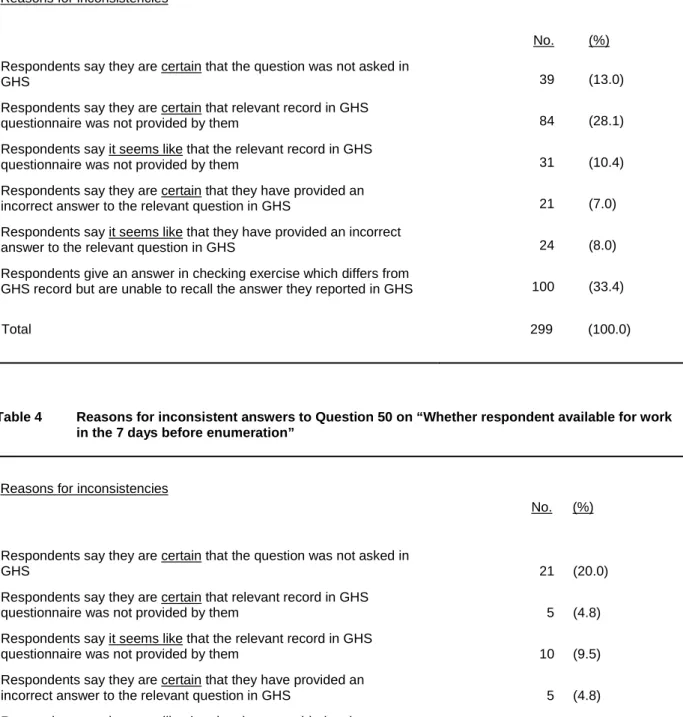
persons, 14 unemployed persons were classified as economically inactive in GHS, whereas 14 economically inactive persons were classified as unemployed. Moreover, for about half of the inconsistent cases, the respondents said that they were unable to recall the answer they provided earlier in GHS and another 17% of the respondents claimed that the earlier answers they provided were incorrect.
(c) On the higher inconsistency rate for the independent verification checks compared with C&SD’s regular verification checks: Re-interviewing checks were performed by C&SD as part of its standard checking on fieldwork data, with re-interviews conducted in a much shorter time lapse of around 7 days, thus resulting in a much smaller percentage of discrepancies of 0.1% being observed.
(d) Factors for the inconsistencies mentioned in the survey research company’s report: Inconsistencies in the answers between the first interview (by C&SD) and subsequent re-interview (by the survey research company) might be due to a number of factors such as respondents’ memory lapse (e.g. difficulty in recalling the details of answers to the questions referring to a specified time period some two months ago which the respondents normally had little concern), respondents’ behaviour and attitude in answering the questions, imperfect interviewing skills and inadequate understanding of the relevant survey concepts of some field officers. Given the various limitations of the verification checks, the inconsistencies identified did not necessarily imply that the GHS data concerned were in error.
3.11 Moreover, according to the survey research company’s findings, eight respondents (0.4%) said that they had not been interviewed by C&SD’s field officers. The Task Force noted the following responses of C&SD to the above findings.
(a) Nearly all respondents (99.6%) confirmed that they had been interviewed by field officers. Of the eight respondents claiming that they had not been interviewed, six were with all the data collected from GHS found to be consistent with those obtained by the survey research company, indicating that the chance of the
respondents not having been interviewed would be very low. In fact, one of the six respondents was subsequently confirmed to have been interviewed based on C&SD’s records4.
(b) Of the remaining two respondents who claimed not having been interviewed, one of them could be indirectly confirmed to have been interviewed5. The remaining case involved a respondent who resided with another household member who was confirmed to have been interviewed.
3.12 The Task Force then had intensive deliberations on the above observations regarding the findings of the independent verification checks and other related parameters and arguments provided by C&SD. The Task Force had particularly given due considerations to the following observations before arriving at a conclusion.
(a) The results of the verification checks closely tallied with those of GHS, with 97.5% of the responses to the questions collected in GHS agreed entirely with those collected from the independent verification checks.
(b) The Task Force noted from the survey research company’s report the possible factors accounting for the inconsistencies in the verification checks. Moreover, the Task Force considered that the possibilities of certain inconsistencies attributable to individual field officers not strictly following the fieldwork guidelines, such as misapplying personal judgement to handle some of the
questions in the questionnaire based on their
knowledge/experience, or skipping some instructions in the guidelines, could not be ruled out.
(c) Most of the inconsistencies revealed in the verification checks were likely due to respondents’ memory lapse during the
4 One of the respondents claimed that he had been interviewed by C&SD in August/September 2012
instead of December. However, based on further checking with C&SD’s records, it was found that the case was a new sample selected for the December 2012 round of GHS, and hence no interview had been conducted in August/September. This demonstrated the effect of memory lapse on the respondent.
5 This respondent (A) resided in the same household with another respondent (B) mentioned in footnote
(4). This was a 2-person household case with A’s information provided by B. Again, B’s memory lapse as mentioned in footnote (4) should be the main contributory factor for the inconsistency noted in A here.
re-interview some two months after the GHS interview.
(d) Given that the inconsistencies concerning unemployed and economically inactive persons occurred on both sides, the Task Force was of the view that the results were not consistent with the allegation that the fabricated responses would go one-sided involving mis-classification of unemployed persons as economically inactive person in order to skip some questions.
3.13 Taking into consideration all the above factors, the Task Force is of the view that the inconsistencies found by the survey research company were not sufficient to substantiate the allegation that a significant proportion of field officers had fabricated responses in order to skip some questions to ease their fieldwork burden. Nonetheless, the higher rate of inconsistencies in the independent verification checks compared with that of C&SD’s regular verification checks causes concern on the adequacy of quality assurance control and points to scope for enhancement of C&SD’s quality assurance system and processes for GHS.
(2) Verification checks by independent party – Impact on unemployment rate and other statistics
3.14 According to the information from the independent verification checks, 97.5% of the data agreed entirely with those in GHS, with only an inconsistency rate of 2.5%. The Task Force noted that given the limitations of the verification checks, the inconsistencies identified did not necessarily imply C&SD’s data concerned were in error. Nonetheless, even taking the inconsistencies into account and recompiling the seasonally adjusted unemployment rate for October-December 2012, the impact of the inconsistencies on the published unemployment rate was insignificant. .
3.15 The Task Force noted C&SD’s view that there would also be little impact on the statistics on economic activity status, marital status and usual place of work compiled from GHS. Similarly, the impact on other detailed statistics involving the above three variables would also be minimal.
(3) Other related analyses
Task Force had asked C&SD to conduct the following checks to identify any possible behavioural abuse in the GHS survey work as pinpointed in the allegations:
(i) Checking whether same contact telephone number was recorded in different questionnaires
3.17 To further address the allegation that some field officers would circumvent supervisors’ review checks by falsifying the telephone number of respondents (e.g. by recording the same telephone number in different questionnaires), an in-house examination of the questionnaires for the February-December 2012 rounds of GHS was conducted. The Task Force noted that the results revealed that just some 29 pairs of questionnaires and 1 group of 3 questionnaires (or 0.08% of the enumerated cases in total) each with same telephone number recorded were identified. The cases spread among 40 field officers without any dubious pattern.
(ii) Checking whether sub-divided flats had been enumerated properly 3.18 Regarding the allegation that field officers would falsify enumeration results of sub-divided flats as non-contact or unoccupied as the workload involved in enumerating such cases was considered to be much higher than that in other cases, the Task Force noted from C&SD that the workload of field officers had already been properly reflected in the fieldwork management statistics. Specifically, details of enumeration results of sampled households analysed by each field officer would be compiled for reference of supervisors after completion of each survey month. The Task Force noted C&SD’s view that additional workload of field officers arising from sub-divided flats had been accounted for in the assessment of staff output.
3.19 The Task Force also noted from C&SD that even if an independent verification exercise was to be conducted, it would be difficult to verify the enumeration results (i.e. whether successfully contacted or non-contact) of field officers for visits conducted some two months ago. Even if the outcome of the re-contact in the verification checks differed from that recorded in GHS, it would be difficult to confirm that there was fabrication of enumeration results simply because it would be totally valid to get different enumeration results for contacts made at different time points.
3.20 Thus, the Task Force found it difficult in arriving at an evidence-based conclusion on the allegation and held the view that the issue of sub-divided flats should be further examined in the context of fieldwork management.
(iii) Checking whether sampled quarters had been enumerated properly 3.21 In the course of the investigation, the Task Force also received report from C&SD on the suggestion by a local newspaper issued on 11 March 2013 that a significant number of field officers would falsify enumeration results of some sampled quarters as unoccupied in order to save enumeration time, as reflected by the relatively high proportion of unoccupied quarters in total sampled cases obtained from GHS (10.6% in 2012) when compared to the vacancy rate of private housing obtained from the Rating and Valuation Department (RVD) (4.62% during 2007-2011) and the drop of the former in the January round of 2013 GHS.
3.22 The Task Force noted C&SD’s response as given in Appendix 3-2 and considered that the information reinforced the views of the Task Force in paragraph 3.12(b) above.
Findings on Authenticity of GHS Data
3.23 Based on the findings of the independent verification checks and other related parameters and arguments provided by C&SD, the Task Force is of the view that there is not sufficient evidence showing the existence of systematic data fabrication in GHS.
3.24 After considering the results of the verification exercise and modifications of data as might be required, the Task Force has not found convincing evidence to query the overall authenticity of the data collected in GHS. The Task Force considers that the quality of data collected from GHS is sufficiently sound to provide basic inputs for the compilation of the relevant statistical figures.
3.25 Nonetheless, the Task Force considers the findings in this investigation point to scope for enhancement of C&SD’s quality assurance system and processes for GHS.
Authenticity of LES Data
3.26 The LES6 is an establishment survey conducted at quarterly intervals. Most of the sampled establishments are requested to participate in the survey for eight consecutive quarters. The major data items collected in the wage questionnaires are the number of employees and the weighted average wage rate for each selected occupation at or below supervisory level. The data obtained are mainly used for compiling the Nominal Wage Index. Data for the preceding quarter, where available, are provided to the field officers to facilitate data collection.
3.27 It was alleged that some field officers had fabricated responses in LES by means of asking loaded questions which had led respondents to indicate that wage rates were the same as in the preceding quarter so that field officers could simply transcribe the data of the preceding quarter into the questionnaires of the current quarter.
(1) Examination of questionnaires
3.28 The wage questionnaires completed in the latest round of LES (i.e. the third quarter of 2012) were examined. Of the 896 establishments enumerated in that quarter, 186 cases (21%) were found to have the same data as in the preceding quarter (referred to as “same as last quarter” or SALQ cases hereafter). They were either cases reported to have annual salary revision in months other than July to September or did not have a fixed salary revision month. Since it is not common for business undertakings, especially the small ones, to have staff movements every quarter and salary revision in the months from July to September, the Task Force considered it reasonable that the data obtained from some of the cases enumerated in the third quarter of 2012 remained unchanged when compared to those of the preceding quarter.
3.29 The proportions of SALQ cases in different rounds of LES were also examined by the Task Force and no anomaly was observed. Generally speaking, the proportion of SALQ cases is relatively lower in the first and second quarters of a year given that it is more common for business undertakings to have general salary revision in January and April.
6 Please refer to C&SD Website for details of survey methodology of LES
(www.censtatd.gov.hk/hkstat/sub/sp210.jsp?productCode=B1050009).
(2) Data verification exercise
3.30 Notwithstanding the above, the Task Force considered that a data verification exercise was to be conducted to counter-check the wage data collected in the third quarter of 2012. As companies usually regard their wage and business related data to be commercially sensitive information, the Task Force considered it not appropriate to contract out the task of verification to external parties. A separate team of professional statisticians of C&SD who were not direct supervisors of the field officers conducting LES was formed to conduct the checking by telephone interviewing method.
3.31 Since the allegation was mainly concerned with the SALQ cases, a 50% random sample of all the 186 SALQ cases covering all the field officers with SALQ cases in the third quarter of 2012 was selected for checking initially. The verification exercise was extended to cover a relatively small (8%) random sample of the non-SALQ cases in order to have a complete, balanced view of the whole situation.
3.32 A total of 150 cases (93 SALQ cases and 57 non-SALQ cases) were sampled for data verification. For each sampled case, about 25% of the occupational records in the questionnaire were selected for checking in consideration of the time constraints and respondent burden.
3.33 Of the 121 cases for which verification was successfully performed, no data inconsistencies were identified for 116 cases (or 95.9%) based on the data provided by the respondents during the verification checks.
3.34 For the remaining 5 cases, some imperfections in the data collection work were identified and 3 of them involved some inconsistency of survey data between those recorded on the questionnaires and those provided by the respondents during the verification checks. The Task Force deliberated on these findings and took into account the factors given in the following paragraphs in arriving at its conclusion.
3.35 First, the Task Force compared the proportion of cases with data inconsistencies identified (i.e. 3 out of 121 or 2.5%) in the verification checks with that of routine quality control checks performed by C&SD and
noted that the proportions were generally similar.
3.36 Second, the Task Force recognised that during the verification checks, some respondents claimed that they did not keep a record of the data provided to C&SD and could not recall whether the wage data being checked were actually provided by them during data collection by the field officers concerned. Moreover, some respondents indicated that it was out of their own initiative to ask the field officers to record in their questionnaires that there were no changes in the information provided to C&SD before.
3.37 Third, the Task Force also noted that if the data for the 3 inconsistent cases were to be revised based on the results of the verification checks, the magnitude of adjustment in the wage index for the relevant industry sections would be relatively small (in the range of -0.013% to +0.016%) and the overall Nominal Wage Index would not be affected. The impact on the year-on-year rates of change in the nominal wage indices was insignificant (in the range of -0.014 percentage point to +0.016 percentage point) and all the published figures on rates of change (which were rounded to one decimal place) were unaffected.
Findings on Authenticity of LES Data
3.38 Taking into account the above factors, the Task Force is of the opinion that there is not sufficient evidence showing systematic data fabrication in LES.
3.39 In the light of the few cases of inconsistencies identified in the verification exercise, the Task Force considers that there may be room for further improving the existing mechanism for assuring the data quality of LES.
Authenticity of AEHS Data
3.40 The AEHS7 collects data on the demographic characteristics (e.g. sex, age, education attainment), occupation, wage and working hours of
7 Please refer to C&SD Website for details of survey methodology of AEHS
(www.censtatd.gov.hk/hkstat/sub/sp210.jsp?productCode=B1050014).
some 60 000 employees randomly selected from 10 000 sampled business undertakings, with a view to providing comprehensive statistics on the level and distribution of wages, employment details and demographic profile of employees in Hong Kong.
3.41 It was alleged that some field officers had fabricated responses in the AEHS by duplicating the employee records from other completed returns for some partially completed cases.
(1) Examination of questionnaires
3.42 Unlike LES, there is no scope for copying data from the preceding round of survey in AEHS as field officers are not given any past data of the business undertakings sampled in the survey. Hence, the Task Force agreed that the investigation in respect of AEHS should focus on finding out whether some field officers might have fabricated the data by copying employee records from one questionnaire to another in the same survey round.
3.43 C&SD was asked to examine the most up-to-date 2012 AEHS dataset containing some 59 300 employee records. Specifically, the employee records from different business undertakings which were enumerated by the same field officer were matched, with a view to finding out whether any of them had identical data values. Two types of matching were carried out. First, employee records which had exactly the same values for all data items covering demographic information, wage and working hours were identified (Type I Matching). Second, data values for items on demographic information were allowed to be different, such that those records with exactly the same data values for occupation, wage and working hours were then picked out (i.e. Type II Matching).
3.44 It was found that there were 5 pairs of records involving 9 business undertakings under Type I Matching. As for Type II Matching, 142 distinct reporting patterns were found. A total of 3068 employee records from 152 business undertakings were involved, implying that there would be 164 (306 minus 142) employee records with similar data values as another record, representing less than 0.3% of the total number of employee records in the dataset.
8 Including 10 records identified from Type I Matching, which is a subset of Type II Matching.
(2) Data verification exercise
3.45 Similar to LES, the Task Force also considered it not appropriate to contract out the task of verification of the AEHS data to external parties. The data verification was conducted through telephone interviewing by the above-mentioned team of professional statisticians who were not the direct supervisors of the field officers collecting the AEHS data.
3.46 All the 10 employee records identified from Type I Matching and a 5% random sample of the records identified from Type II Matching were selected for data verification. No data inconsistencies were found during the verification checks.
Findings on Authenticity of AEHS Data
3.47 As no data inconsistencies were found in the verification checks, the Task Force is of the opinion that there is not sufficient evidence showing existence of systematic data fabrication in AEHS.
Conclusion on Authenticity of the Survey Data Examined
3.48 After considering the results of the verification checks and modifications of data as might be required, the Task Force concludes that there is not sufficient evidence to query the overall authenticity of the data collected in the three surveys. The Task Force considers that the quality of data collected from the three surveys is sufficiently sound to provide basic inputs for the compilation of the relevant statistical figures.
3.49 In view of the inconsistencies noted in the verification checks and the increasing challenges faced by C&SD’s field officers in data collection work, the Task Force does not rule out the possibilities that individual field officers have not strictly followed the fieldwork guidelines, such as misapplying personal judgement to handle some of the questions in the questionnaire based on their knowledge/experience, or skipping some instructions in the guidelines. Hence, the Task Force is of the view that this points to the need for C&SD to calibrate and enhance across the board the quality assurance system. The deliberations and recommendations of the Task Force on this area are given in Chapter 4.
Chapter 4 : Data Quality Assurance System
____________________________________________________________
Introduction
4.1 The Task Force required C&SD to give a detailed account of the existing data quality assurance mechanism, in particular, on conceptual soundness of the mechanism, extent of benchmarking with international practices, robustness of the mechanism and presence of professionalism. On the basis of the information provided, the Task Force noted that C&SD’s quality assurance system followed international standards and practices generally.
Quality Assurance Measures in Key Statistical Processes
4.2 A brief description of the quality assurance measures adopted by C&SD in data collection, data processing, imputation, macro review and the internal audit programme, which all have major impact on data quality and accuracy, are given in Appendix 4-1.
4.3 The Task Force reviewed the quality assurance systems and routine quality assurance checks, particularly in respect of the data collection and data validation/editing processes, for the General Household Survey (GHS), Labour Earnings Survey (LES) and Annual Earnings and Hours Survey (AEHS) in detail. An exploratory study on the time series of micro data of GHS was also conducted with a view to checking the internal consistency of the data and identifying abnormalities. Results of the study revealed that there were no obvious abnormalities in their past trend. During the study, the Task Force identified measures to strengthen and reinforce the existing quality assurance system in various dimensions, in particular on identification of high-risk areas which might lead to mis-classification/error.
Response Rate and Proxy Reporting Rate – Implications on Data Quality
4.4 The Task Force noted that there had been a gradual decrease in the response rate of GHS over time, from 88.9% in the fourth quarter (Q4)
of 2003 to 82.7% in Q4 2012. On the other hand, there had been an increase in the rate of proxy reporting1 in GHS, from 52.4% in Q4 2003 to 59.0% in Q4 2012.
4.5 C&SD explained that owing to the changing life style of people in Hong Kong, it had become increasingly more difficult for the field officers to contact respondents and collect their data. The Task Force noted that the declining trend in response rate was also generally observed in household surveys conducted by both the private survey research firms and educational institutions in Hong Kong.
4.6 C&SD also explained that there had been increasing difficulty in contacting all members of the sampled households, compounded by greater respondent burden as the GHS questionnaire had become more complicated over time. It was noted that the conditions under which proxy reporting was allowed had been clearly stated in the fieldwork guidelines for reference of field officers. Particularly, information pertaining to the non-contact household members concerned should be obtained from another household member capable of providing the information. This would avoid the high cost and extended time requirements that would be involved in repeated visits or telephone calls to obtain information directly from each household member. Similar proxy rate was also observed in household surveys of overseas national statistical offices2.
4.7 The Task Force noted that field officers shared similar concerns on the changes in social and economic environment which had an adverse impact on the cooperation of respondents and posed greater difficulties in data collection for GHS during their meetings with Task Force members in February 2013.
4.8 The Task Force noted that the response rate currently achieved in GHS was higher than that of household surveys conducted by other organisations and that the use of proxy reporting was considered acceptable from the statistical point of view. That said, the Task Force saw a need for C&SD to monitor the response rate and proxy reporting for
1
Proxy reporting is a commonly adopted data collection method in household surveys. It refers to the situation where the required information of a household member is provided by another household member capable of providing the information.
2 Proxy rate in household surveys of overseas national statistical offices ranged from some 34% (United
Kingdom) to 65% (Canada).