Print ISSN: 1596-2490, Electronic ISSN: 2545-5818
www.azojete.com.ng
ORIGINAL RESEARCH ARTICLE
INTERNET OF THINGS (IOT) CLOUD BASED MODEL FOR LOW COST DEMAND SIDE
MANAGEMENT INFRASTRUCTURE
O. K. Oyetola
1*, A. A. Okubanjo
1, A. A. Okandeji
2, O. O. Olaluwoye
1, P. O. Alao,
1and S. N. Ukagu
3(1Department of Electrical and Electronics Engineering, Olabisi Onabanjo University, Ago-Iwoye, Ogun State, Nigeria. 2Department of Electrical and Electronics Engineering, University of Lagos, Akoka, Lagos State, Nigeria 3Department of Electrical and Electronics Engineering, Igbinedion University, Okada, Edo State, Nigeria )
* Corresponding author’s email address: [email protected]
1.0 Introduction
Electricity as a form of energy is inevitable for human survival. As human activities increase and new technologies evolve, the importance of electricity cannot be over emphasized. The standard of living and per capital income of any nation largely depends on the availability and consumption of electricity (Oyedepo, 2012). As energy consumption is steadily increasing, there is a continuous demand to optimally increase the generation capacity. Increasing generation capacity often requires complex processes and control, with costly fuel and sophisticated equipment. This invariably leads to high tariff and billing system as well as an increase in greenhouse gas emission effects.
However, despite the significance attached to electricity, it is estimated that approximately 45% of the electricity generated in Nigeria is wasted or it cannot be accounted for. This is due to energy theft, unavailability of proper energy management policy, public illiteracy on the importance of electricity, and the need for efficient utilization of available energy (Omole et al., 2016). Nigeria’s electricity demand is growing faster than the country’s population. The electricity per capita of Nigeria, which is 137.2 KWh per capita, is one of the lowest in the world.
ARTICLE INFORMATION ABSTRACT
This paper presents a model for low cost demand side management infrastructure using cloud-based technology and internet of things to facilitate the implementation of smart grid in Nigeria. The electricity market has experienced a rapid increase in demand attributed to unprecedented growth in human population, urbanization, and industrialization. Accordingly, utilities are faced with the challenge of meeting daily energy demand. Research has shown that 45% of electricity generated are wasted or cannot be accounted for. Energy management is thus a major issue affecting the power sector of Nigeria. Efficient utilization of energy is therefore crucial for sustainable development both from an economic and ecological perspective. The proposed Smart, Low Cost and IoT-enabled power distribution board can be adopted and implemented as part of energy conservation measures to reduce energy demand in domestic building and mitigate the energy crisis in the country. With the IoT based smart board energy management, users can get personalized recommendation of actions for energy conservation and load shifting, and have control over the energy use and the billing system.
© 2019 Faculty of Engineering, University of Maiduguri, Nigeria. All rights reserved.
Submitted 21 March, 2019 Revised 17 July, 2019 Accepted 20 July, 2019 Keywords: Smart grid Demand Side Management cloud computing Internet of Thing.
Lighting constitutes about 18% of the total power generated as compared to 8 – 10% in developed countries (Adelakun et al., 2014). This can be attributed to lack of investment, combined with an asset life of 0250 or more years’ transformers, transmission and distribution networks and inability to use energy conservative policy measures to transform the power sector in Nigeria. To mitigate the problem of energy wastage and poor utilization of electricity, a proper demand side management (DSM) infrastructure must be implemented by utilities especially for commercial/residential users. It offers the promise of cutting costs for commercial customers, saving money for households, help utilities operate more efficiently, reduce frequent energy instability, save overhead cost of building backup plants, and to reduce emission of greenhouse gases(Cheng et al., 2016: Marinakis, 2018; Patel et al., 2016). DSM is a first-generation of smart grid technology and crucial to overall performance of smart grid systems(Eseosa et al., 2014). Installing smart grid technology in the Nigerian power sector has been identified to be full of myriad of challenges, one of which is dilapidation of existing infrastructures whose replacement and upgrade to meet 21st century energy demand is capital intensive (Vincent and Yusuf, 2014). With these known challenges, realizing full potential of smart grid technology could take several years in Nigeria. However, Internet of Things (IoT) and Cloud Technology can be employed to reduce the cost of installing grid technology to leverage DSM for domestic and commercial customers (Botta et al., 2015: Nazir, 2012).
IoT can be described as a system comprising many distinguishable components that are able to communicate through the internet, either amongst themselves or with end-user or other entities in the network (Vadimir and Mirjana, 2015). Thus, IoT is a system of interrelated computing devices, mechanical and digital machines provided with unique identifiers and the ability to transfer data over a network without requiring human or human-to-computer interaction. IoT therefore helps us to gain knowledge of the world around us. The utilities can benefit from different methodologies to manage the demanded energy by the users using IoT-enabled Power Distribution Board (PDB) that can be accessed, monitored and controlled remotely. They may utilize Demand Response (DR) or Direct Load Control (DLC) methodologies and send a signal to the customers in order to force them to reduce their energy consumption or schedule their consumption to another time when there is more supply. Conversely, the utilities may use an incentive-based methodology where they offer cheaper electricity rate for the time when there is more supply. This methodology is typically referred to as Time-of-Use (ToU) rate policy which is becoming common in many utilities.
The concept of Smart, Low Cost and IoT-enabled power distribution board (SLCDB) is relatively a new technology in the power sector. Intuitively, PDB is an electrical equipment which consist of necessary electrical components for connecting, controlling and protecting electric circuit in a building or premises. (A. Delhi Corporation, 2018). SLCDB facilitates real-time access to consumer power profile and energy demand for proper management and supply. In addition, SLCDB leads to making home automation and appliances smart, as DLC is possible remotely. Also, customers demand policy can be implemented and amended easily through the cloud. Considering the aforementioned challenges and possibilities, this paper presents a model for low cost DSM infrastructure using cloud based technology and IoT to facilitate implementation of smart grid in Nigeria and Sub-Sahara Africa. The architecture includes the use of Arduino Mega 2560 as a microcontroller, Relay module, Current and voltage sensors and Internet technologies.
2. Materials and Methods
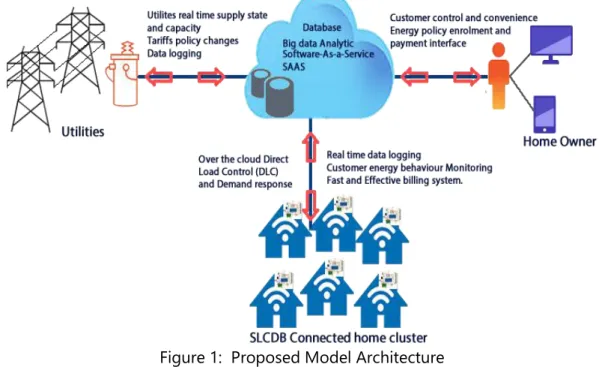
The proposed model for implementing DSM is to install SLCDB at the demand side for seamless control and monitoring of customer’s energy profile. As shown in Figure 1, each customer is connected to the cloud via SLCDB, designed to adjust electricity consumption based on existing policies enrolled by customers. Basically, this method effectively balances the electricity demand and supply chain without totally removing customers (especially residential) completely from the grid even when they are willing to adjust their demand during peak period. In our proposed model, the design of SLCDB is key to the performance of the system and as we focused on cost, convenience of installation and maintenance was also considered. In addition, SLCDB was developed to take control instructions over the cloud either from utilities or consumers.
Figure 1: Proposed Model Architecture
SLCDB is incorporated with different electrical and electronic devices connected in modules, with some algorithms running on the programming framework. Furthermore, this programming framework is equipped with an interface for connecting and controlling equipment, appliances and some other sensor devices. It also contains network interface for transmission and collection of data to execute some actions remotely via an internet protocol (IP) network address. Figure 2 shows a block diagram that illustrates the concept of this project. As shown in Figure 2, the project comprises of the regulated power supply, the Arduino mega board 2560 powered by DC supply, the relay module powered by 5v power supply, Ethernet module (ethernet shield w5100) which is mounted on the Arduino board and digital display (Blue LCD 1602). Hence, current sensors are connected to the relay module and to the home appliances. SLCDB serves as IoT sensor node, it detects the amount of power used in real time and send it over to the cloud.
Figure 2: Block diagram of SLCDB
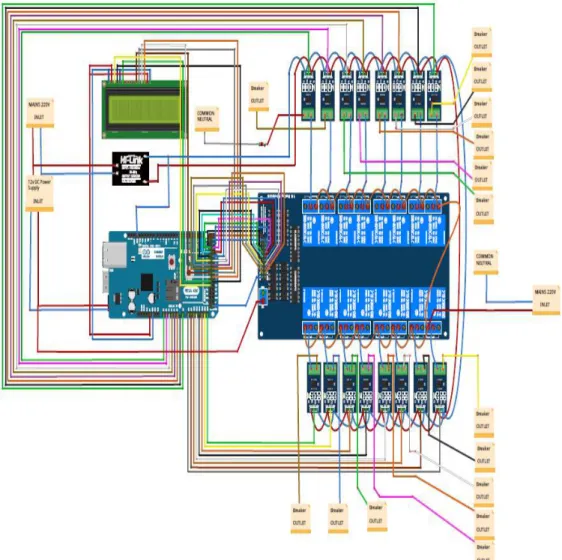
Figure 3 shows the schematic diagram of the SLCDB model implemented in a smart home. It is connected in such a way that the model monitors the energy profile, and ensure that no energy is wasted by remotely alerting the users on the status of the appliances through the cloud. The users can then remotely switch off the redundant appliances or utilities. Furthermore, the proposed model has a core advantage of shifting the electricity consumption to low cost time tariffs and save energy.
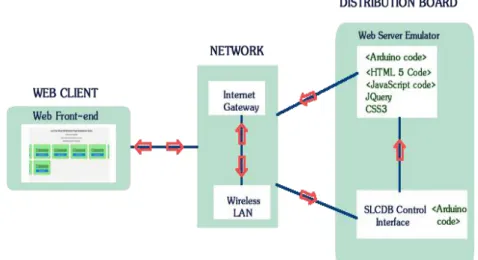
HTHL5 programing language to activate the web server and the Arduino, and also link up other components in the SLCDB. Figure 4 shows the detailed information of the programming and networking part of the system from the web client with a static IP address of 192.168.1.102, to the network containing the internet gateway and the wireless LAN, and to the smart, IoT-enabled power distribution board that has the Wed Server Emulator and the Control Interface in it. The Codes snippet developed for the web server Emulator and the control interface for the SLCDB model are as follows:
Figure 4: Programming Framework for SLCDB Web-Server Emulator
client=server.available(); if (client) {
boolean currentLineIsBlank = true; String HTTP_req = String(100);
int switchRelayNumber = -1; while (client.connected()) { delay(7); if(client.available()){ char c = client.read(); HTTP_req.concat(c); if (c == '\n' && currentLineIsBlank) { if (HTTP_req.indexOf("?relay") > 0) {
int startIndex =HTTP_req.indexOf('?'); int endIndex = HTTP_req.indexOf('=');
switchRelayNumber = (HTTP_req.substring(startIndex + 6, endIndex)).toInt(); int changeState = LOW;
startIndex = HTTP_req.indexOf("Switch+"); endIndex = HTTP_req.indexOf (" HTTP/1.1");
if ((HTTP_req.substring(startIndex + 7, endIndex)) == "OFF") { changeState = HIGH;
}
switchRelayState(switchRelayNumber, changeState); }
// send a standard http response header printOutHTLMCode();
}
if (Serial.available()) {
// read the most recent string
inputString = Serial.readStringUntil('\n');
String msg = getStringAt(inputString, ':', 0); if (msg == "SWITCH") { msg = getStringAt(inputString,':', 1);
int relayNumber = (msg).toInt(); msg = getStringAt(inputString, ':', 2); int state = (msg).toInt();
switchRelayState(relayNumber, state); } else if (msg == "READ") {
msg = getStringAt(inputString, ':',1); int relayNumber = (msg).toInt();
Serial.println("sensorCurrent[" + String(relayNumber) + "] = " + String(sensorCurrent[relayNumber], 5)); } } Control Interface SLCDB if (Serial.available()) {
// read the most recent string
inputString = Serial.readStringUntil('\n');
String msg = getStringAt(inputString, ':', 0); if (msg == "SWITCH") { msg = getStringAt(inputString,':', 1);
int relayNumber = (msg).toInt(); msg = getStringAt(inputString, ':', 2); int state = (msg).toInt();
switchRelayState(relayNumber, state); } else if (msg == "READ") {
msg = getStringAt(inputString, ':',1); int relayNumber = (msg).toInt();
Serial.println("sensorCurrent[" + String(relayNumber) + "] = " + String(sensorCurrent[relayNumber], 5));
} }
4. Results and Discussion 4.1 Phases and Implementation
This is the phase that involves the construction and testing of the Smart, Low Cost and IoT-enabled power distribution board. Figure 2 above shows how the various components in the smart board interact with each other. The stage is sub dived into phase 1, 2 and 3.
4.1.1 Phase 1
The Smart, Low Cost and IoT-enabled power distribution board, SLCBD was initially assembled and tested on the breadboard as shown in Figure 3 using a 9v battery as the power source. The SLCBD was further placed on a DC load with ACS712 current sensor connected in series and which was later connected to the Arduino to obtain the reading. The voltage sensor units consisting of a voltage transformer and 2 resistors of 10k ohms and 100k ohms were also tested.
4.1.2 Phase 2
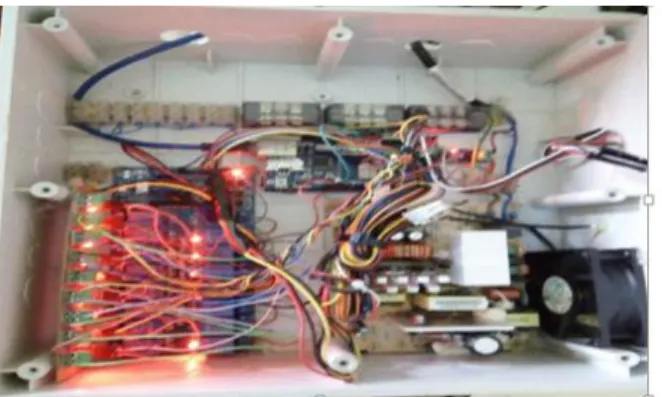
At the second stage, the relay was tested separately when placed on home appliances as a load. The developed smart board consists of 16 On/OFF relays as shown in figure 5. In this phase, the 16 relays can be controlled remotely whenever demand arises.
4.1.3 Phase 3
After obtaining the current reading, the W5100 Ethernet module connection to the Arduino was implemented and activated to establish communication over the internet via a Wi-Fi module. In the ethernet module, to establish a connection, the model is connected to a router with the use of RJ-45 as shown in figure 6, and the router uses Dynamic Host Configuration Protocol to dynamically assign an IP address for the system. A static IP address of 192.168.1.102 is dynamically assigned to the system, and this serves as a gateway to sign-in to the system and control the 16-relays. Also, the user Access Module was developed in this stage to grant access to the user for proper monitoring and controlling of the energy usage through switching ON/OFF relays remotely. Additionally, this phase also contains automated control units that coordinates the automatic switching of the load connected to the Smart, Low Cost and IoT-enabled power distribution board. A relay module is integrated into the smart board for the switching purpose, and the Arduino Mega2560 oversees the switching of the relay. Hence, the users switch off the devices that are not in use through ON/OFF relay to optimize energy cost and save energy. The developed Smart, Low Cost and IoT-enabled power distribution board is shown in Figure 5 and it is connected over the network through RJ45 and a Router as shown in figure 6.
Figure 6: RJ45 and a Router
Figure 7: SLCBD Graphical User Interface
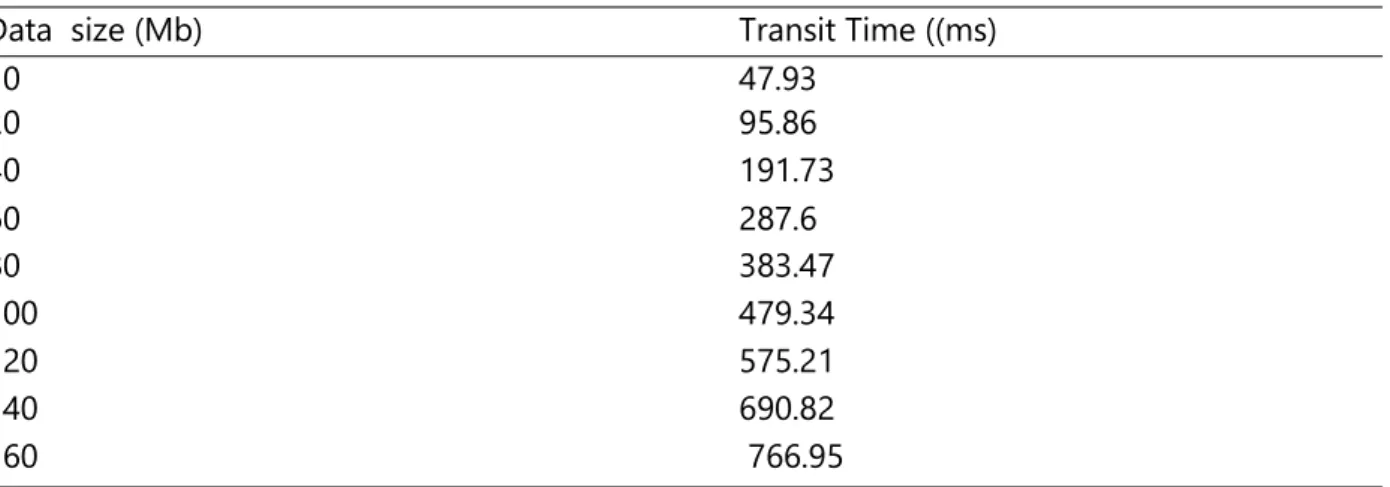
The data obtained from the Smart, Low Cost and IoT-enabled power distribution board are sent to the cloud which can be exploited in the future as big data, data mining, data storage and database management. Invariably, the data sent to the cloud can be later retrieved by the user to monitor the energy consumption profile and control the home appliances remotely in order to reduce outrageous electricity charges. However, data sent and received from the cloud always experience a delay, so the transit time of each data sent to the cloud is evaluated and recorded as shown in Table 1.
Table 1: Cloud Computing Data Size and its Transit Time
Data size (Mb) Transit Time ((ms)
10 47.93 20 95.86 40 191.73 60 287.6 80 383.47 100 479.34 120 575.21 140 690.82 160 766.95
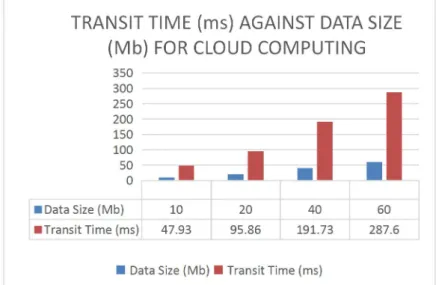
the pictorial view of the transit time, and the corresponding data size. From Figure 8, it is observed that the transit time increases with the data size.
Figure 8: Graph of Transit Time against Data Size for Cloud computing 5. Conclusion
IoT technology can contribute significantly to energy saving by monitoring and supporting the behavioral change of energy consumption pattern in a smart home. The proposed Smart, Low Cost and IoT-enabled power distribution board facilitates the awareness of energy end-users on how much energy is consumed monthly or yearly i.e., it provides an intelligent energy consumption information and also informs the energy users on the contribution they have made to the energy sector. By means of Smart, Low Cost and IoT-enabled power distribution board developed, users are able to monitor the load profile and develop energy consumption habit so as to save energy bill by optimally reducing the energy consumption at the peak of demand hour, when the home appliances are not in used. With this IoT based smart board energy management, the user can get personalized recommendation of actions for energy conservation and load shifting, and also have control over the energy used and the billing system. The proposed Smart, Low Cost and IoT-enabled power distribution board can be adopted and implemented as part of energy conservation measures to reduce energy demand in domestic building and mitigate the energy crisis in the country
Reference
Adelakun, AA., Adeyinka, A., Abdulkareem, AA. and Olowoleni, JO. 2014. Automatic Control and Monitoring of Electrical Energy Consumption Using PIR Sensor Module. International Journal of Scientific and Engineering Research, 5(5):493–496.
Botta, A., Donato, W., Donato, W. and De Persico, V. 2015. Integration of cloud computing and
Internet of Things:A survey. Future Generation Computer Systems, 56(3):1-56
https://doi.org/10.1016/j.future.2015.09.021.
Cheng, C., Peng, J., Liao, W. and Chang, C. 2016. Relationship between building hot water usage and energy and carbon reduction. Building Services Engineering Research and Technology, 37(6): 682–693. https://doi.org/10.1177/0143624416644483
Eseosa, O., Harcourt, P. and Harcourt, P. 2014. Improving Energy Consumption Using Demand Side Management System. International Journal of Science and Advanced Technology (ISSN 2221-8386), 4(10): 39–50.
Marinakis, V. and Doukas, H. 2018. An Advanced IoT-based System for Intelligent Energy Management in Buildings. Sensors, 18(2): 610-616.
Nazir, Mohsin. 2012. Cloud Computing: Overview and Current Research Challenges. IOSR Journal of Computer Engineering, 8(2): 14-22. 10.9790/0661/0811422.
Omole, OS. Akpobasah, D. and Atayero, AA. 2016. Development of a Smart , Low-cost and IoT-enabled System for Energy Management. In 3rd International Conference on African Development Issues (CU-ICADI) 150(1): 401–406. https://doi.org/10.13140/RG.2.1.3234.2643 Oyedepo, SO. 2012. Energy and sustainable development in Nigeria : the way forward. Energy, Sustainability and Society, 15(2): 1–17.
Patel, P., Patel, M., Panchal, V. and Nirmal, V. 2016. Home Automation Using Internet of Things. Imperial Journal of Interdisciplinary Research, 3(5): 648–651.
Vincent, EN. and Yusuf, SD. 2014. Integrating Renewable Energy and Smart Grid Technology into the Nigerian Electricity Grid System. Smart Grid and Renewable Energy, 05(9): 220–238. https://doi.org/10.4236/sgre.2014.59021