The Aquila Digital Community
The Aquila Digital Community
Dissertations
Spring 5-2016
Optimizing Workforce Performance: Perceived Differences of
Optimizing Workforce Performance: Perceived Differences of
Army Officer Critical Thinking Talent Across Level of Education
Army Officer Critical Thinking Talent Across Level of Education
Richard B. AyersUniversity of Southern Mississippi
Follow this and additional works at: https://aquila.usm.edu/dissertations
Part of the Cognitive Psychology Commons, Industrial and Organizational Psychology Commons, Leadership Studies Commons, Military and Veterans Studies Commons, Organizational Behavior and Theory Commons, Organization Development Commons, Performance Management Commons, Theory and Philosophy Commons, and the Training and Development Commons
Recommended Citation Recommended Citation
Ayers, Richard B., "Optimizing Workforce Performance: Perceived Differences of Army Officer Critical Thinking Talent Across Level of Education" (2016). Dissertations. 329.
https://aquila.usm.edu/dissertations/329
This Dissertation is brought to you for free and open access by The Aquila Digital Community. It has been accepted for inclusion in Dissertations by an authorized administrator of The Aquila Digital Community. For more
OF ARMY OFFICER CRITICAL THINKING TALENT ACROSS LEVEL OF EDUCATION
by
Richard Benedict Ayers
A Dissertation
Submitted to the Graduate School at The University of Southern Mississippi in Partial Fulfillment of the Requirements for the Degree of Doctor of Philosophy
ii
OPTIMIZING WORKFORCE PERFORMANCE: PERCEIVED DIFFERENCES OF ARMY OFFICER CRITICAL THINKING TALENT
ACROSS LEVEL OF EDUCATION by Richard Benedict Ayers
May 2016
The U.S. Army’s operating environment continues to become increasingly
complex and unpredictable, where U.S. technological advantage continues to erode. The complexities stem from the Army’s doctrinal assumption that the future operating
environment is unknown and constantly changing (Department of the Army [DA], 2014a). Diminishing technological advantage results in more reliance on soldiers’ cognitive capability and less on high technology weapons systems (McMaster, 2015).
A review of military literature shows extensive research on the importance of Army leaders to be talented critical thinkers (Fischer, Spiker, & Riedel, 2008, 2009; Gerras, 2008; Thomas & Gentzler, 2013). Human capital literature reveals that many college graduates do not possess the critical thinking skills required of the workforce (Laird, Seifert, Pascarella, Mayhew, & Blaich, 2014; Liu, Frankel & Roohr, 2014). Senior Army leaders identify critical thinking and problem solving as the most important outcomes of officer education, but they also maintain graduates of Army education institutions often lack these competencies (Hatfield, Steele, Riley, Keller-Glaze, & Fallesen, 2011).
Human capital theory (Becker, 1993) and human resource development theory (Swanson, 2001) form the theoretical framework of this study to measure the perceived
iii
and determine if differences exist between groups. The two groups in the sample consist of junior Army officers with (n = 50) and without (n = 50) a 4-year college degree. Both groups were administered the CCTDI and CCTST critical thinking instruments, and one-way MANOVAs calculated the effect of a 4-year degree on perceived level of critical thinking talent. No significant effect was indicated between groups on either CCTDI scores or CCTST scores.
This non-experimental, cross-sectional, explanatory study finds that 4-year degrees may not produce the critical thinking outcomes the Army expects. The Army can mitigate this through developing a critical thinking framework across the professional military education continuum as well as evaluating leader critical thinking talent during Army training events. Future considerations include larger samples across multiple Army installations and multiple branches.
RICHARD BENEDICT AYERS 2016
OPTIMIZING WORKFORCE PERFORMANCE: PERCEIVED DIFFERENCES OF ARMY OFFICER CRITICAL THINKING TALENT
ACROSS LEVEL OF EDUCATION
by
Richard Benedict Ayers
A Dissertation
Submitted to the Graduate School
and the Department of Human Capital Development at The University of Southern Mississippi in Partial Fulfillment of the Requirements for the Degree of Doctor of Philosophy Approved:
________________________________________________ Dr. Cyndi H. Gaudet, Committee Chair
Professor, Human Capital Development
________________________________________________ Dr. Heather M. Annulis, Committee Member
Professor, Human Capital Development
________________________________________________ Dr. Dale L. Lunsford, Committee Member
Assistant Professor, Human Capital Development
________________________________________________ Dr. H. Quincy Brown, Committee Member
Assistant Professor, Human Capital Development
________________________________________________ Dr. Karen S. Coats
Dean of the Graduate School
v
The long arduous journey of a dissertation requires tremendous support and patience not of the budding scholar, for it is they who volunteered and brought the work onto themselves. No, the support and patience come from those who find themselves on the journey as well. It is to these family members that this work is dedicated. To my brother who ventures through his own academic journey and should be finished very soon as well, I thank you for always understanding for all the times I had to cut our conversations short for the sake of this work. To my parents, who instilled in me at an early age the confidence to achieve lofty goals. To my second Mom Sigrid, for your unending encouragement and support, danke meiner lieben Mutti für alles sehr, Ich liebe dich! To my beautiful children who endured so many of my hours away from them, I thank you for your patient understanding about “some paper” that seems to take an
awfully long time to write. Finally, to my beautiful wife, whose love, patience, and support have given me the strength to put the work in each day. My copy editor, proof-reader, and motivator, with a keen sense of knowing when it was time for me to step away from the research and writing, you have had to manage so many things on your own, I cannot thank you enough. I continue to be amazed at your strength, and what you are able to accomplish. I love you, and without you, I could not have done it.
vi
This study would not have been possible without the dedicated support,
inspiration, and assistance from some remarkable people. As we say in the Army, leaders influence others through purpose, direction, and motivation— all of which I received at the right time and place. To my dissertation chair, Dr. Cyndi Gaudet, who was centrally important not only in this undertaking, but to my personal development as a scholar-practitioner. To my committee, Dr. Heather Annulis, Dr. Dale Lunsford, and Dr. H. Quincy Brown, thank you for you tireless and enduring support, assessment, advice, and timely, expert feedback. Special thanks to my colleagues in the HCD Program, whose open scholarly discourse, candid criticism, and persistent questioning all provided
invaluable insight and focus to this study. A sincere thank you and an intellectual debt to the warrior-scholar Lieutenant General H.R. McMaster, cited frequently in this study, and who, while leading cavalry troopers from a Black Hawk in the skies over Iraq, inspired me to begin this intellectual journey. To the warrior-scholars who, directly and
indirectly, provided me insight, opportunity, and invaluable examples of what is possible: General David Petraeus, Colonel John Dowd, Colonel David Lyle, Lieutenant Colonel Bill Skimmyhorn, Dr. Mel Anderson, (USAF), Dr. Don Snider (USA), and Dr. Thomas Sowell (USMC).
Disclaimer
The opinions expressed herein reflect the personal views of the author and not those of the United States Army or the United States Department of Defense.
vii ABSTRACT ... ii DEDICATION ...v ACKNOWLEDGMENTS ... vi LIST OF TABLES ... ix LIST OF ILLUSTRATIONS ...x LIST OF ABBREVIATIONS ... xi CHAPTER I. INTRODUCTION ...1 Background Statement of the Problem Purpose of the Study Research Objectives Conceptual Framework Significance of the Study Limitations Delimitations Definition of Key Terms Summary II. REVIEW OF RELEVANT LITERATURE ...21
Theoretical Framework Critical Thinking Theorists Developing Army Leaders Measuring Critical Thinking Talent Summary III. RESEARCH DESIGN AND METHODOLOGY ...65
Research Objectives Research Design Population and Sample Data Collection Procedure Threats to Study Validity Instrumentation
viii
IV. RESULTS ...88 Data Results
Summary
V. SUMMARY ...113 Junior Army Officer Demographics
Critical Thinking Disposition Critical Thinking Skill
Relationship Between Disposition and Skill Implications of Study Limitations
Recommendations for Future Research Summary
APPENDIXES ...127 REFERENCES ...136
ix Table
1. Level of Education of Active Duty Army Members ...50
2. Summary of Research Objectives Data Analysis Plan ...77
3. CCTDI Subscale Score Descriptions ...79
4. CCTST Subscale Score Descriptions ...82
5. Assumption of MANCOVA – CV to DV Correlation ...91
6. Tests of Normality for CCTDI Total and Subscale Scores ...93
7. Tests of Normality for CCTST Total and Subscale Scores ...93
8. CCTDI and CCTST Homogeneity of Variance ...95
9. Participant Demographics ...97
10. Descriptive Statistics of CCTDI Total Scores ...99
11. Descriptive Statistics of CCTDI Subscale Scores ...99
12. Descriptive Statistics of CCTST Total Scores ...101
13. Descriptive Statistics of CCTST Subscale Scores ...101
14. Results of Follow-Up ANOVAs of CCTDI Subscale Scores ...103
15. Results of Follow-Up ANOVAs of CCTST Subscale Scores ...105
16. 4-Year Degree Group Within-Group CCTDI-CCTST Correlation ...107
x Figure
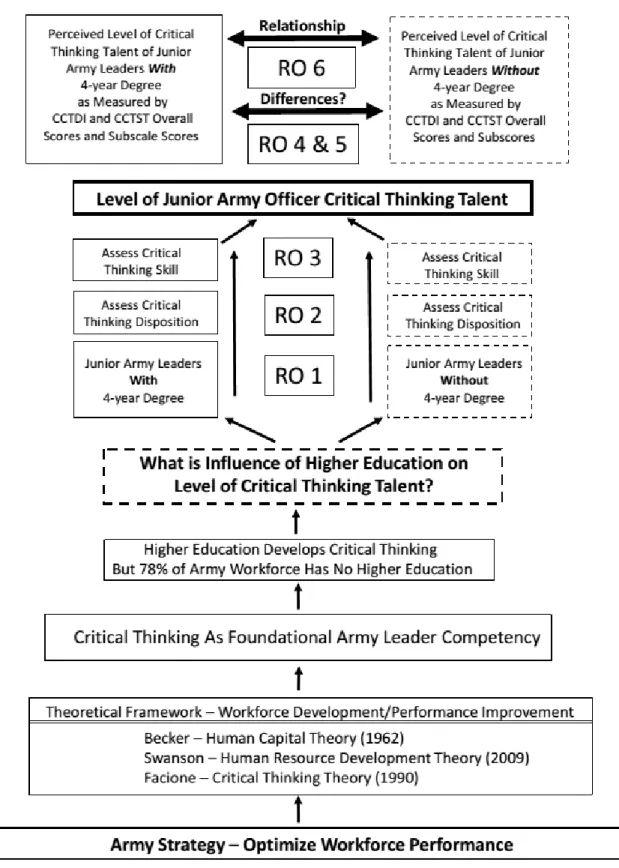
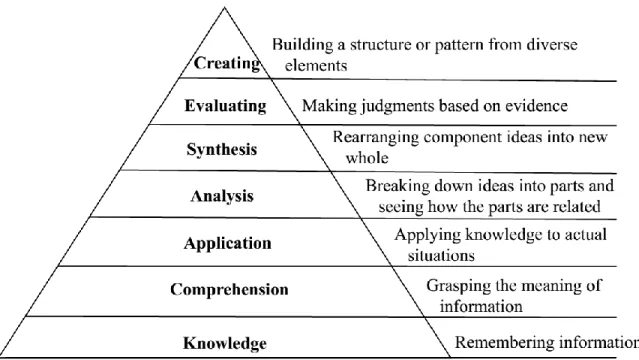
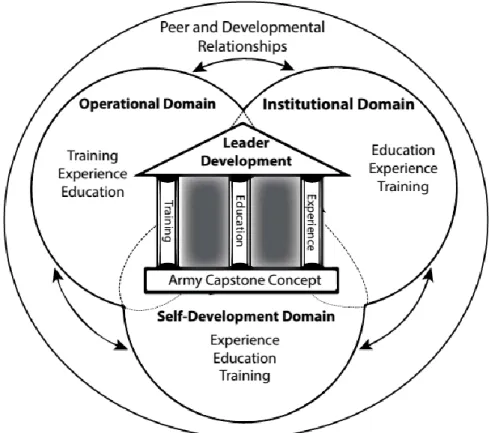
1. Conceptual Framework ...13 2. Levels of Learning Achievement ...45 3. The Army Leader Development Model ...55
xi
BOLC Basic Officer Leaders Course
CCTDI California Critical Thinking Disposition Inventory
CCTST California Critical Thinking Skills Test
DA Department of the Army
MANOVA Multivariate Analysis of Variance
CHAPTER I INTRODUCTION
The U.S. Department of the Army describes its future operating environment as highly complex, ambiguous, and full of uncertainty (Department of the Army [DA], 2014a). The complexities from the Army’s future operating environment stem from the assumptions that the future is unknowable and constantly changing (DA, 2014a), and much of war’s uncertainty stems from its human element (McMaster, 2015).
Policymakers in the United States (U.S.), like senior Army leaders, are unable to predict when and where the adversaries of the U.S. will pose a threat to national security.
Regardless of where a threat to U.S. national interest emerges across the globe, it is likely the Army will play a key role in the threat response. Army leaders are not politicians, but know war is an extension of politics and winning war is a political outcome (Davidson, 2010). This relationship between war and politics is not new for the Nation enters its wars with a desired end state that is favorable to regional or strategic interest (Schadlow, 2005). The Army must organize, equip, and train its workforce to create the conditions for sustainable political outcomes. The U.S. must often engage in war and other military operations to achieve national policy outcomes consistent with the Nation’s vital
interests. The Prussian military theorist Clausewitz wrote of this relationship in his 1832 work, On war (Clausewitz, Howard, & Paret, 1976), and professional military education students continue to study this work. The study of history develops military leaders in their ability to ask the right questions, but it is the understanding of the particular political implications of localized conflict that develops the answers (McMaster, 2015). Soldiers in future conflict must be prepared for a broad menu of mission sets against state and
non-state actors. This is a paradigm shift from what Army leaders faced in the past, and preparing for an unknown and complex operating environment will continue to challenge the ability of future Army leaders to develop ready organizations. Necessary to
appreciating the complexity of the Army’s future operating environment is a historical
understanding of how the Army previously prepared its workforce to meet the needs of the Nation.
Background
An example of what Army leaders faced in the previous operating environment occurred during the period of post-World War 2 to the early 1990s. This timeline frames the Cold War era, the period when the primary threat to U.S. national interest was the Soviet Union. Although beyond the scope of this research to describe Soviet policies during the Cold War Era, U.S. policymakers of the time showed deep concern for the Soviet nuclear threat as well as the threat of Soviet expansionism into Western Europe (Berle, 2015). The Soviet Union, along with its Warsaw Pact allies, continually prepared to confront Western forces on the plains of Western Europe, and remained a global threat (Fischer, 1997). The U.S. Army knew this familiar threat quite well. The U.S. Army during the Cold War period was educated in Soviet weapon systems’ capabilities and limitations, Soviet doctrine and strategy, troop strengths, and what languages they spoke (Mellenthin, Stolfi, & Sobik, 1984). During this era, U.S. soldiers would go to the field to participate in training exercises designed to defeat the primary threat to U.S. national interests, the Soviet army (Mellenthin et al., 1984). The end of the Cold War marked the beginning of a complicated foreign policy transition period for the United States. As an example, in 1993, U.S. president Bill Clinton remarked jokingly, “Gosh, I miss the Cold
War,” speaking to the stark divergence of the Cold War’s well-known enemy to the ambiguous situations he faced in the Balkans, Haiti, and Somalia (Devroy & Smith, 1993).
In contrast to the Cold War period, 21st century soldiers do not know what region of the globe they will go to next, nor do they necessarily know what they will do when they get there (Davidson, 2010). Army leaders will continue to find themselves engaged in situations that look dissimilar to those they have previously experienced and studied (Fischer et al., 2009). An ambiguous enemy contributes to the complexity of the Army’s future operating environment.
Future Operating Environment
The Soldiers on the future battlefield will progressively find themselves involved in diverse mission sets against persistent, adaptive, and difficult to identify enemies. Insurgents, terrorists, and other non-conventional, non-state actors continue to oppose the national interests of the United States (DA, 2014a), and the Army must be prepared to defeat them. The numerous failures in governance across the Middle East have
propagated violent extremism and have set the stage for persistent conflict (Cordesman & Khazai, 2014). Violence continues to propagate from Africa and central and southeast Asia, and with it are persistent threats against U.S. national interests (U.S. Department of State, 2014).
The Nation asks a great deal from its Army, and the Nation turns to the Army frequently to shape political outcomes (Davidson, 2010). Army leaders know one of their primary missions is to provide the Nation’s policymakers with strategic options.
civil authorities and stability operations, to offensive and defensive combat operations (DA, 2011). Success in complex military operations requires Army leaders’
understanding of complex problems before attempting to solve them, and Army leaders should possess the cognitive abilities to constantly adapt to, and assess, ever-changing situations (Cojocar, 2011). Some of the Nation’s most complex challenges originate with
the number of actors unconstrained by the moral and legal convictions of traditional military forces who continue to use violence to achieve their goals (Wardynski, Lyle, & Colarusso, 2009). Future Army leaders will require high levels of cognitive readiness, and they must be prepared to react to a diverse menu of potential global crises with intuitive decision-making (Fautua & Schatz, 2012). Decision-making and problem solving are cognitive processes that require a broad ability to think (Minda, 2015; Tümakaya, Aybek, & Aldağ, 2009). To understand the Army strategy to optimize cognitive performance through workforce development and performance improvement initiatives, a foundational understanding of human capital development concepts and theories is critical.
Theoretical Foundations of Human Capital Development
Army doctrine identifies the soldier as the key to gaining competitive advantage in the future, as opposed to high technology weapons (DA, 2014a; McMaster, 2015). Understanding the strategic goal of the Army to optimize human performance through its Human Dimension Concept (DA, 2014b) requires knowledge of the theoretical
foundations of workforce development and performance improvement. Education enhances cognitive capabilities (Ritchie, Bates, & Deary, 2015), and the most important investment in human capital is education (Becker, 1962, 1993). Human capital theory
asserts workforce productivity improves through investment in human capital (Becker, 1993). A foundational element of the Army strategy to develop its human capital is to raise the level of cognitive performance across the profession (DA, 2014b). Becker (1993) specifies, “investment in education and training are the most important human capital investments” (p. 17).
Building upon human capital theory (Becker, 1962, 1993), human resource development theory (Swanson, 2001) purports human resource development (HRD) is a practice of creating and using expert knowledge for improving workforce performance. Swanson (2001) asserts two major realms of practice support this theory. The first is organizational development; the second is training and development (Swanson, 2001). These two primary components of HRD focus on human expertise, which aligns closely with the Army’s goal of optimizing human performance (DA, 2014b). Within the two
elements of HRD, training and development develops human expertise, and organization development unleashes human expertise (Swanson & Holton, 2009). Swanson and Holton (2009) assert that “assessment of HRD successes or results can be categorized into the broad domains of learning and performance.” (p. 4) Learning and performance are essential elements of the leader development process (DA, 2013). Since complex problem solving and decision-making are indispensable traits for Army leaders, it is necessary to examine one of the foundational cognitive processes of those traits, critical thinking (Fisher, 2011; Kallet, 2014).
Definitions of critical thinking are numerous in the literature (Ennis, 1993; Facione, 1990; Halpern, 2001c; Paul & Elder, 2006). In its broadest definition, critical thinking is the cognitive, regulated, purposeful process of judgment about what to believe
or do (Giancarlo & Facione, 2001). This study follows the definition of critical thinking developed by Facione in the American Philosophical Association Delphi Report on Critical Thinking (Facione, 1990).
Methods of Developing Critical Thinking
Education literature is rich with research indicating one of the most important outcomes of higher education is critical thinking (Abrami et al., 2008; Behar-Hohenstein & Niu, 2011; Duron, Limbach, & Waugh, 2006; Facione, 1990; Halpern, 1999; Liu, Frankel & Roohr, 2014; Nusche, 2008; Paul & Elder, 2001; Pellegrino & Hilton, 2012; Tiruneh, Verburgh, & Elen, 2014). An important distinction in understanding critical thinking as a construct is that critical thinking is not analogous to cognitive ability or intelligence (Butler, 2012) for they are at best modestly related (Stanovich &West, 2008). Indeed, a critical thinker is not necessarily smart or clever but is one who engages in purposeful, reflective thought, and does so intentionally.
In the context of this research, critical thinking talent refers to both critical thinking disposition and critical thinking skill collectively, and this research determines the relationship between higher education and level of critical thinking talent. Critical thinking relates to the cognitive skills of self-regulation, interpretation, analysis,
evaluation, inference, and evaluation (Facione, 2015). Although critical thinking talent is an important goal within the military, critical thinking definitions are fragmented (Fischer et al., 2009). Cognitive psychology forms the theoretical foundation for critical thinking theory; however, critical thinking is an interdisciplinary field spanning philosophy, economics, mathematics, and education (Halpern, 2001c). Varying definitions of critical thinking exist in the literature, yet commonality exists across their foundational
principles, and critical thinking emerges as an important skill across numerous disciplines and fields of study (Fischer et al., 2009). One of the Army’s warfighting challenges is to develop agile and adaptive leaders capable of operating in uncertain environments. If the Army is to create agile and adaptive leaders, the Army must know the competencies agile and adaptive leaders must possess. The next section describes the competencies the Army identifies as critical for successful workforce performance.
The Army identifies critical thinking and problem solving as essential leader competencies (Allen & Gerras, 2009; DA, 2011, 2013; Fischer et al., 2008, 2009), and education literature defines critical thinking as one of the most important outcomes of higher education (Dietz & Schroeder, 2012; Tiruneh et al., 2014). Halpern (2003) asserts higher education could increase level of critical thinking talent. Research indicates college students often increase their critical thinking skill while in school; however, missing are specific factors contributing to this increase (Renaud & Murray, 2007). What is less evident in the literature is the level of critical thinking talent of college graduates relative to the level in non-college graduates in a similar work setting. To address this gap in the literature, the current study examines two groups of junior Army officers with different levels of education. Higher education institutions recognize the need to develop the critical thinking skills expected of the workforce, but colleges have demonstrated inconsistent success in producing graduates who are critical thinkers (Flores, Matkin, Burbach, Quinn, & Harding, 2012). Not all college graduates are as equally equipped to emerge from their higher education experience ready to engage in higher-level thought (Laird, Seifert, Pascarella, Mayhew, & Blaich, 2014). If higher education does not develop the cognitive processing skills required by Army leaders to observe problems
from varying perspectives with conflicting information, and still be able to make sound decisions, then the resulting gap will produce poor leaders (Flores et al., 2012). The Army currently lacks any foundational understanding of the level of critical thinking talent across its workforce, as well as measures that determine whether higher education develops critical thinking talent in its leaders. The concept of sending hundreds of thousands of Army personnel to civilian higher education institutions is not economically prudent. If the Army requires its leaders to possess critical thinking talent normally developed through higher education, then the Army could address gaps in critical thinking through its own professional military education institutions.
Army Professional Military Education
If the Army goal is to optimize cognitive performance, the Army’s internal education systems should prepare to enhance critical thinking in its leaders through education (Straus et al., 2014). The Department of Defense (2015) defines education across its services within the cognitive and affective domains of learning and utilizes Bloom’s (1956) Taxonomy of Learning Domains as a useful hierarchy for possible levels
of learning. Through this hierarchal perspective, the Chairman of the Joint Chiefs of Staff Instruction 1800.01E (2015) describes that the value of officer education is to “foster breadth of view, diverse perspectives, critical analysis, abstract reasoning, comfort
with ambiguity and uncertainty, and innovative thinking, particularly with respect to complex, non-linear problems” (p. A-1).
At key points during their careers, Army leaders develop their intellectual capital through progressive and sequential educational opportunities that help enhance their knowledge of war (DA, 2014d). To achieve desired critical thinking learning outcomes,
the Army needs a measure of the level of critical thinking talent across its workforce. If the Army desires its leaders to be talented critical thinkers, Army education institutions should be prepared to analyze the critical thinking construct to include examining the traits of successful critical thinkers. The measurement of critical thinking disposition and skill is important to identify strengths and weaknesses in students' cognitive capabilities (Facione, 2015). Much of the critical thinking literature discusses critical thinking in terms of higher-level thought, thinking about thinking, rational judgement, and concepts which educators can teach (Ennis, 1962; Facione, 2015; Halpern, 2003). The Army can facilitate cognitive behavioral changes most effectively in a classroom environment (Abrami et al., 2008). Since the Army seeks a behavioral change in its workforce through improved critical thinking, the Army could develop educational strategies to improve critical thinking talent across the Army learning continuum. An evidence-based measure of junior Army officer perceived level of critical thinking talent among college-educated and non-college college-educated soldiers can establish a framework for critical thinking curriculum design (McCarthy, Schuster, Zehr, & McDougal, 1999).
Statement of the Problem
Future armed-conflict will become increasingly complex due to a highly capable and elusive enemy (DA, 2014a). Future military budget reduction exacerbates the complexity of the future operating environment (Congressional Budget Office, 2011). The Army must prepare to face the Nation’s adversaries with a reduced workforce size coupled with a reduced budget, which creates substantial readiness challenges for the Army that result in more reliance on soldiers’ cognitive capability and less on high technology weapons systems (McMaster, 2015). The ability to execute mission
command, make sound decisions, and solve complex, ill-defined problems in a chaotic operating environment requires Army leaders to possess critical thinking talent (DA, 2011, 2012a). The Army specifies critical thinking as one of the most essential leader competencies, (DA, 2013; Gerras, 2008; Fischer et al., 2009; Schumm, Webb, Turek, Jones, & Ballard, 2010; Thomas & Gentzler, 2013). Nevertheless, broad assessment of Army leader critical thinking talent remains challenging.
One of the expected outcomes of higher education is producing graduates who are critical thinkers (Carmel & Yezierski, 2013; Denial, 2012). Senior Army leaders identify critical thinking and problem solving as the most important outcomes of officer
education, but literature reveals that graduates of Army education institutions often lack critical thinking and problem solving skills (Hatfield et al., 2011). If higher education is indeed the principal method by which one develops critical thinking talent, this may present the Army with an educational challenge. Since 78% of the Army’s workforce does not possess a college degree (Department of Defense [DoD], 2013), then the Army may need to develop strategies to address gaps in critical thinking through its own professional military education institutions. The level of soldier education across the Army varies extensively (DoD, 2013), and the Army currently does not assess the critical thinking talent of its leaders at any point along the leader development continuum. If the Army collects empirical data regarding the level of critical thinking talent of its leaders, the Army may then be able to design and implement leader development strategies which foster the improvement of cognitive skills, skills which the literature reveals can be developed through education (Facione, 2015; Halpern, 1998; Halpern & Nummedal, 1995). Without a framework to optimize cognitive performance through leader
development processes, the Army could unnecessarily delay its efforts to optimize human performance in the cognitive domain. This delay may introduce risk for the Army in achieving the level of cognitive readiness necessary for success in the future operating environment.
Purpose of the Study
The purpose of this study is to measure the perceived levels of critical thinking disposition and skill of two groups of junior Army officers with different levels of education, and determine if differences exist between groups. The Army identifies critical thinking talent as an essential leader competency (DA, 2013; Fischer et al., 2008, 2009; Williams, 2013), yet currently uses no evidence-based measure as a framework to develop critical thinking talent. Therefore, this study determines if perceived critical thinking differences exist between junior officers with a college degree and junior officers without a college degree. This data can inform future critical thinking education strategies for the Army.
Research Objectives
The objectives of this study focused on the assessment of critical thinking talent of junior Army officers. The primary research question is what are the levels of critical thinking disposition and skill of junior Army officers across level of education?
Additionally, in support of the primary research question, this study addresses the following research objectives (RO):
RO1: Describe the demographic characteristics of the sample in terms of level of education, age, and years of service.
RO2: Determine junior Army officers’ perceived level of critical thinking
disposition as measured by seven attributes that influence an individual’s capacity
to learn and apply critical thinking skills.
RO3: Determine junior Army officers’ perceived level of critical thinking skills as measured by seven core-reasoning skills needed for reflective decision-making. RO4: Determine differences in perceived critical thinking disposition across participant level of education.
RO5: Determine differences in perceived critical thinking skill across participant level of education.
RO6: Examine the within-group relationship between CCTDI scores and subscale scores with CCTST scores and subscale scores.
Conceptual Framework
The conceptual framework for this study illustrates the Army’s goal to optimize human performance in order to gain a competitive advantage; the goal’s relationship to the theoretical foundations supporting Army human capital development; the
identification of critical thinking as an essential Army leader competency, and the gap in knowledge of the level of Army critical thinking talent. The conceptual framework also depicts higher education as a foundational means to develop critical thinking (Denial, 2012) and varying education levels for the Army members. The conceptual framework further illustrates the intent of this study to measure critical thinking disposition and critical thinking skill of two groups of junior Army leaders with different levels of education. This study measures perceived levels of critical thinking talent across level of education and determines if differences exist between groups.
Significance of the Study
The number of studies examining critical thinking disposition and skill of Army officers is limited. This research measures junior Army officer critical thinking
disposition and critical thinking skill, and determines if differences exist between junior Army officers with a 4-year degree and junior officers without a 4-year degree. This study provides important insights regarding junior Army officer level of critical thinking talent. Data collected from this study informs future critical thinking curriculum
development and classroom instructional techniques, which can support the Army in its goal to achieve cognitive advantage. Human capital theory describes the investment in education as the most important investment to increase individual or workforce
productivity (Becker, 1993). A foundational understanding of the levels of critical thinking talent of Army leaders can inform critical thinking curriculum development for soldiers with varying levels of college education. Investing in critical thinking education can facilitate optimized cognitive performance (Facione, 2015; Halpern, 2001a) which can support the Army’s goal to retain cognitive advantage over the Nation’s adversaries.
Limitations
The purpose of discussing study limitations is to address potential gaps in the study’s design, instrumentation, researcher bias, and study population (Creswell, 2003).
Limitations of the study include the population of the study (junior Army officers), study scope, and data availability. This study determines perceived level of critical thinking talent of a small group (n = 100) of junior Army officers, which limits the generalizability to other populations. This study has the potential to increase educational development of
critical thinking talent by providing a foundational framework of the level of critical thinking talent of the Army’s workforce.
Delimitations
This study measures the perceived level of critical thinking talent of two groups of junior Army officers with different levels of education, and determines if differences exist between groups. Due to the numerous definitions of critical thinking across psychological, philosophical, and educational literature, this study recognizes the construct of critical thinking as defined by the American Philosophical Association Delphi Report on critical thinking (Facione, 1990), and thus utilizes two instruments designed from the Delphi consensus definition of critical thinking (Facione, 1990). Other delimitations of this study include the theoretical framework that critical thinking talent is measurable, and improves through education (Ennis, 1985; Halpern, 1998). This study limits the population of interest to junior Army officers at a large military post in the southeast.
Definition of Key Terms
The following definitions are relevant to the study. Terms relating to the
instruments used in this study are extracted directly from Insight Assessment (2015), the owner of the two instruments. Due to the numerous definitions in the literature for critical thinking, this study utilizes the definitions related to the critical thinking construct as defined below:
1. Critical thinking – “Purposeful, self-regulatory judgment, which results in interpretation, analysis, evaluation, and inference, as well as explanation of the
evidential, methodological, criteriological, or conceptual considerations upon which that judgment is based” (Facione, 1990, table 1, p. 3).
2. Critical thinking disposition – “Consistent internal motivations to act toward, or respond to persons, events, or circumstances in habitual, yet potentially malleable ways” (Facione, 2000, p. 6).
3. High-order Thinking Skills – Cognitive processes relating to the top three levels of Bloom’s six levels of intellectual behavior; analysis, synthesis, and
evaluation. Although continued research has produced literature that has
reordered the top two levels (Anderson & Krathwohl, 2001), their hierarchy is not significant for this definition.
4. Human Capital – Investments in education and training are investments in human capital, as one cannot separate them from the knowledge and skills they impart on the individual (Becker, 1993).
5. Reasoning skill – The ability to use reasoned judgment to consider evidence and concepts, and to use interpretation, analysis, inference, evaluation,
explanation, and self-regulation in decision-making (Facione, 1990).
6. Army Lieutenant – The members of one of the two sub-groups in this study are Lieutenants. Lieutenants are company-grade officers. The rank of Lieutenant is the entry-level rank for the majority of commissioned officers in the Army and lead small units consisting of 16-44 soldiers (DA, 2015c).
7. Army Warrant Officer – The members of one of the two sub-groups in this study are Warrant Officers. Warrant Officers are technically focused officers who
perform the primary duties of systems integrator, technical leader, and advisor (DA, 2015c).
The following definitions relate specifically to the California Critical Thinking Disposition Inventory. The seven subscales on the inventory describe the overall disposition one has toward using critical thinking in the formation of judgments about what to do or believe, and are defined below explicitly as outlined in the instrument (Insight Assessment, 2015a):
8. Truthseeking – “The habit of always desiring the best possible understanding of any given situation; it is following reasons and evidence where ever they may lead, even if they lead one to question cherished beliefs” (Insight Assessment, 2015a, para. 2).
9. Open-mindedness – “The tendency to allow others to voice views with which one may not agree. Open-minded people act with tolerance toward the opinions of others, knowing that often we all hold beliefs that make sense only from our own perspectives” (Insight Assessment, 2015a, para. 3).
10. Analyticity – “The tendency to be alert to what happens next. This is the habit of striving to anticipate both the good and the bad potential consequences or outcomes of situations, choices, proposals, and plans” (Insight Assessment, 2015a, para. 4).
11. Systematicity – “The tendency or habit of striving to approach problems in a disciplined, orderly, and systematic way” (Insight Assessment, 2015a, para. 5). 12. Confidence in reasoning – “The habitual tendency to trust reflective thinking to solve problems and to make decisions” (Insight Assessment, 2015a, para. 6).
13. Inquisitiveness – “Intellectual curiosity. It is the tendency to want to know things, even if they are not immediately or obviously useful. It is being curious and eager to acquire new knowledge and to learn the explanations for things even when the applications of that new learning are not immediately apparent” (Insight Assessment, 2015a, para. 7).
14. Maturity of judgment – “The habit of seeing the complexity of issues and yet striving to make timely decisions. “A person with maturity of judgment
understands that multiple solutions may be acceptable while yet appreciating the need to reach closure at times even in the absence of complete knowledge” (Insight Assessment, 2015a, para 8).
The following definitions relate specifically to the California Critical Thinking Skills Test. The seven subscales on the inventory describe the overall strength one has toward using critical thinking in the formation of judgments about what to do or believe, and are defined below explicitly as outlined in the instrument (Insight Assessment, 2015b):
15. Analysis – How people identify arguments, clarify meaning, and interpret significance.
16. Evaluation – how one assesses arguments and their credibility, as well as stating opinions and justifying methods.
17. Inference – refers to the ability to question evidence and draw conclusions. 18. Deduction – is “the assumed truth of the premises purportedly necessitates the truth of conclusion” (Insight Assessment, 2015b, para. 6). Conclusions are
19. Induction – means “an argument’s conclusion is purportedly warranted, but not necessitated by the assumed truth of its premises” (Insight Assessment, 2015b, para 7).
20. Interpretation – “skills used to determine the precise meaning and significance of a message or signal, whether it is a gesture, sign, set of data, written or spoken words, diagram, icon, or a chart or graph” (Insight Assessment, 2015b, para. 9).
21. Explanation – “Explanatory reasoning skills, when exercised prior to making a final decision about what to believe or what to do” explaining further that “strong explanatory skills enable people to discover, to test and to articulate the
reasons for beliefs, events, actions and decisions” (Insight Assessment, 2015b, para. 10).
Summary
The complexity of the Army’s future operating environment requires its leaders to
possess high-level cognitive skills as talented critical thinkers and problem solvers (Allen & Gerras, 2009; DA, 2011; Fischer et al., 2009). Reductions in the size of the Army’s workforce coupled with budget constraints create substantial challenges for the Army that will result in more reliance on soldiers’ cognitive capability and less on high technology
weapons systems (McMaster, 2015).
This chapter discussed the Army strategy to optimize cognitive performance through its Human Dimension Concept (DA, 2014b), and the role of critical thinking as an essential workforce competency. Robust research in education literature shows one of the most important outcomes of college education is critical thinking talent (Abrami et
al., 2008; Behar-Hohenstein & Niu, 2011; Duron et al., 2006; Facione, 1990; Halpern, 1999; Liu et al., 2014; Nusche, 2008; Paul & Elder, 2001; Pellegrino & Hilton, 2012; Tiruneh et al., 2014). However, most members of the Army workforce are not college graduates. The Army does not know if differences in critical thinking talent exist across levels of education. Understanding the level of critical thinking talent relative to level of education may optimize the creation of knowledge in the professional military education classroom, enhance higher-order thinking skills, improve reasoning and decision-making, and develop leaders who are better critical thinkers. These outcomes could then allow the Army to gain competitive advantage by optimizing cognitive human performance.
CHAPTER II
REVIEW OF RELEVANT LITERATURE
This purpose of this study was to measure the perceived levels of critical thinking talent of two groups of junior Army officers with different levels of education, and determined if differences exist between the two groups. This chapter provides a review of the relevant literature supporting the conceptual framework of the study. The review of literature includes an overview of workforce development and performance
improvement, the critical thinking construct applied to the current study, and methods the Army could use to develop critical thinking as an essential leader competency.
The Chairman of the Joint Chiefs of Staff, General Martin Dempsey, stated that throughout his forty-plus years of active military service, the world has never been more unstable and unpredictable (Garmone, 2015). The Army’s future operating environment will be ambiguous, complex, and chaotic (DA, 2014a). Army leaders will find
themselves in some of the most stressful, disordered, and dangerous environments imaginable, where killing and the prospect of death are frequently present (McMaster, 2015). The instinctive ability of military leaders to develop morally sound, yet
operationally prudent decisions through habit of mind is essential in such an operating environment. In order for Army education institutions to be prepared to develop critical thinking talent, the Army needs greater insight into the processes surrounding critical thinking development (Tsui, 2008).
Critical thinking literature describes improvement in critical thinking as a process which is slow in development (Halpern, 1998), and the average individual struggles to think critically (Lai, 2011). Critical thinking in higher education is a contentious topic
regarding its definition, ability to assess, and practical application (Liu et al., 2014). The literature addresses critical thinking as one of the fundamental outcomes of higher education (Abrami et al., 2008; Behar-Hohenstein & Niu, 2011; Duron et al., 2006; Facione, 1990; Halpern, 1999; Liu et al., 2014; Nusche, 2008; Paul & Elder, 2001; Pellegrino & Hilton, 2012; Tiruneh et al., 2014. The Army develops leaders through the processes of training, education, and experience (DA, 2013). Army leader development processes can improve soldiers’ cognitive abilities through developing critical thinking disposition and critical thinking skill (DA, 2014b). However, the Army has no data on the current level of soldiers’ critical thinking talent. Considerable data is available regarding higher education as a means to develop critical thinking, but research on alternative methods of developing critical thinking talent is sparse. Additionally, the Army has scarce data regarding the level of critical thinking talent between leaders with varying levels of education.
To examine these gaps in knowledge, this chapter will discuss the theoretical framework of workforce development and performance improvement, and how, through developing human capital, the Army can achieve competitive advantage through
optimized human performance. This chapter discusses critical thinking literature relevant to optimizing human performance, as well as prominent critical thinking theorists and their viewpoints on methods for developing critical thinking talent.
If the Army is to provide the Nation with multiple options to deliver sustainable national security outcomes, then the Army should have a robust capacity to win
decisively across a diverse set of mission requirements. This capacity to win requires Army leaders to be operationally adaptive, and critical thinking forms the foundation of
this adaptability (DA, 2012b). In order to accomplish future missions successfully, the Army must train and educate soldiers now, and do so well beyond levels of previous generations of soldiers. Army leaders need to be physically, cognitively, and socially prepared to win across a diverse mission set (DA, 2014b). The complexity from the future operating environment stems from the principle assumption that the future is unknown and constantly changing. However, within this complex environment the Army must engage determined, elusive, and increasingly capable enemies (DA, 2014a).
Current training and education initiatives set the stage for future battlefield success, and optimizing cognitive performance provides the Army with the foundational capability to meet a broader set of missions in the future.
Army leaders are not politicians, but they know war is an extension of politics, and winning war is a political outcome (Davidson, 2010). The United States engages in war and other military operations to achieve national policy goals. In the past two decades, the Army participated in numerous operations around the world that did not involve conventional large-scale warfare, and the Army expects this trend to continue (DA, 2014a). This situation places tremendous stress on Army leaders as it is
challenging to develop training and education strategies for a force that does not know where it is going and what it will do when it arrives (Davidson, 2010). It is the mission of the Army to provide options to the Joint Force and to present multiple dilemmas to the Nation’s adversaries (DA, 2014a).
In the future, potential adversaries of the United States will include non-state actors, violent extremist organizations, and non-uniformed militia groups. These adversaries continue to undermine security across regions, most notably in North Africa
and Middle East (JCS, 2015). These potential adversaries are aware of the capabilities of the U. S. military and its highly trained and well-equipped joint force. Much of the Nation’s military advantage in the 21stcentury lies within high-technology weapons systems. The Army cannot prepare for the future operating environment through an overreliance on technology (McMaster, 2015). The enemies of the United States will avoid large, conventional, force-on-force engagements, and will plan to engage the U.S. using asymmetric, unconventional methods to defeat U.S. technological advantage (McMaster, 2015). These methods include insurgent behavior, cyber-attacks, global positioning system signal disruption, terror tactics, and other internet-based propaganda and recruiting. Such techniques are difficult to counter, which creates challenges for military leaders in their development of concise military solutions to complex problems. The ability to distinguish between threats will continue to diminish in the future, due to the number of actors involved, the rapid adaptability of threats, and the complexities that surround adversaries (DA, 2012).
Stability operations is not a new mission set for the Army, but there is a mindset within the Army that stability and reconstruction operations are not the core missions of what the Army is supposed to do, but something the Army does in between major ground wars (Davidson, 2010). Army leaders recognize the Nation will continue to ask the Army to provide options for complex national security and foreign policy challenges. Army leaders acknowledge that civilians in the government are not always going to have the answers to complex political challenges, and it is up to the Army to describe its capacity and provide the civilian leadership with options (Davidson, 2010). Often military solutions to crises include operations other than war. Beyond engaging in land
warfare, Army doctrine prescribes preventing conflict as one option available to national policymakers, as is shaping the security environment (DA, 2012b). Achieving national security interests without war is the most desirable outcome (McMaster, 2015).
Preventing conflict and shaping the security environment, like direct ground combat, are missions requiring Army leaders to possess good judgement as well as the logic and reasoning skills essential to critical thinkers (Allen & Gerras, 2009).
A recent example of how the Army provides the Nation’s policymakers with options for preventing conflict is the 2014-2015 humanitarian relief mission in West Africa, where the U.S. Army provided forces in support of Ebola relief in the most adversely affected countries of Guinea, Liberia, and Sierra Leone. In October 2014, Western Africa was suffering from over 50 new cases of Ebola per day (Centers for Disease Control and Prevention [CDC], 2015). The CDC (2015) cites statistics, which estimated that for each 30-day delay in providing isolative treatment for Ebola patients, the number of new daily cases could triple. Between March 2014 and April 2015, an ongoing outbreak of Ebola affected an estimated 25,000 people, with over 10,000 deaths (CDC, 2015). This type of destabilizing health crisis has broad negative effect. A lack of intervention could potentially lead to a complete societal breakdown of the regions
affected. Had the U.S. Ebola crisis intervention not been instituted and transmission risks not been mitigated, the CDC estimated that somewhere between 500,000 to one million cases of Ebola would currently be active in Western Africa. It is very likely that the affected governments would begin to lose control of their respective countries, and their socio-economic structures might collapse. Historical analysis of the past 30 years shows this region of Africa would likely see warlords and other non-state actors exploit the gap
created by the failure of legitimate government, which would destabilize the region even further (Davidson, 2010). As one of the many agencies called upon to intervene, the U.S. Army deployed to Western Africa for Ebola relief efforts, and began operations upon arrival. The Army provided stability and security, as well as medical intervention and expertise, and averted a pandemic. This is one example of how the Army prevents
conflict on behalf of the Nation. Had these measures not taken place, the Army may have likely had to intervene later in a much different role, arguably one more militaristic in nature. One only has to look to the U.S. military responses to the crises during the 1990s in Somalia, Haiti, Bosnia-Herzegovina, and Kosovo to understand the level of complexity and uncertainty in operations other than war (Davidson, 2010). Humanitarian relief and peacekeeping missions can quickly transition to conflict, as was the case in Somalia in 1993. These are examples of the level of complexity Army leaders will continue to face in the future, examples that form the need for critically thinking leaders.
The Army’s future operating environment will not be linear. A lack of defined
linear boundaries on the future battlefield, such as a front line or a rear operations area, exacerbates complexity. Ambiguity can challenge sound decision-making, as Army leaders in ambiguous conditions must sift through personal bias, time constraints, and rushes to judgement in unclear circumstances. It is indeed the primary trait of an ill-defined problem to lack a distinct solution (Williams, 2013). Although challenging, Army leaders must operate within the ambiguity and complexity that characterize the full-spectrum operating environment, fully aware that imperfect information and limited situation awareness characterize their environment. Even while immersed in chaos, the Army requires its leaders to execute the art of command and the science of control in
order to seize, retain, and exploit the initiative to achieve desired outcomes (DA, 2012a). As strategic uncertainty grows, so must the cognitive demands of the Army soldier (DA, 2012c; McMaster, 2015). To develop competencies such as sound decision-making, reasoned judgment, and reflective thought, the Army can examine critical thinking and its relationship to chaotic military environments.
An important perspective in the practical application of the tenets of critical thinking is from Paparone (2014), who criticizes a purely intellectual viewpoint as the
logico-scientific approach to critical thinking. As a faculty member at the U.S. Army War College, Paparone (2014) noted that students’ observations and experiences in chaotic operating environments are unique, and require interpretation. Interpreting one’s observation and experience conflicts with the purely objective, scientific Paul and Elder (2014) model of critical thinking (Paparone, 2014). Making meaning of what is
happening in an uncertain environment is essential to sound decision-making, and critical thought is essential to interpreting meaning (Paparone, 2014). Army professionals must have the cognitive skills necessary to question thinking and notions that dissociate war from its political nature and assure winning through high technology systems (McMaster, 2015). Previous conflict found Army leaders with too little information available. In the future, Army leaders will find themselves overwhelmed with information, which creates new challenges for sound decision-making. As a method for gaining competitive advantage over the Nation’s’ adversaries, the Army is developing strategies to optimize
human performance. This study will examine the cognitive element of human performance optimization by measuring the critical thinking disposition and skill of junior Army officers relative to their level of college education.
Theoretical Framework
This study measured the critical thinking talent of two groups of junior Army officers, and determined if differences in levels of critical thinking talent exist between the two groups. The study drew upon human capital theory (Becker, 1962, 1993) to describe the Army’s strategy to optimize cognitive performance through investment in
the workforce. Human capital theory purports that one of the single most important investments made in human capital is investment in education (Becker, 1993). This study followed the framework of Becker’s (1993) economics-focused point of view in that the Army invests in leader education on the assumption that it will receive a return on investment in subsequent periods.
Optimizing human performance for making full use of expertise is a central tenet of human resource development theory (Swanson, 2008). In the scope of workforce development and performance improvement, human resource development theory is analogous to the Army strategy to optimize human performance. Swanson (2008) purports that overall performance improvement, from the individual to the organization, relies upon the training and development of individuals. An ideal relationship exists between developing soldiering skill and intellectual skill (Petraeus, 2007). Increasing the level of intellectual capital of the Army through training and education will require a focus on the subject of critical thinking. The definition of critical thinking developed by Facione (1990) with a panel of critical thinking theorists and experts through the Delphi method frames the critical thinking construct of this study.
Human Capital Theory
U.S. economist Gary Becker developed his theory of human capital through researching the estimated return to collegiate and high school education in the United States (Becker, 1962). The Army makes significant human and fiscal capital investment in executing its leader development strategy (Zaccaro et al., 2015). The Army model for leader development through education rests in students’ attending resident courses of instruction, based primarily on promotion to positions of higher rank and responsibility. When the Army selects leaders for promotion, these leaders expect to attend the requisite course of professional military education to prepare them for the requirements and responsibilities of their new rank. Examining Army leaders as a homogeneous workforce, this study utilized Becker’s (1993) framework that training and education provide the means for the Army to increase the future productivity of its workforce. This, in Becker’s (1962) view, is applying current resources against future returns. Since
workforce attrition is difficult to predict, knowing exactly who will leave the Army and when they will leave is nearly impossible, the Army generally educates everyone selected for promotion. Not all leaders selected for promotion attend in-residence courses.
Becker (1962), bases this increase in human capital through education on two conditions, as described by Wardynski et al. (2009):
This increase in human capital presupposes two conditions that are not always met: first, that the employees are good ones focused upon being as productive as possible; and second, that the employees are working within a competency area that aligns with their human capital. (p. 3)
The current Army promotion system assumes that the good ones, discussed by Wardynski et al. (2009) above, advance because they are indeed working within a competency area that aligns talents, and their demonstrated potential for increased
responsibility exceeds that of their peers (Wardynski et al., 2009). A holistic valuation of Army human capital programs includes methods to develop the cognitive, physical, and social components (DA, 2014c). Human capital theory purports that Army leaders who possess deeper levels of knowledge, skills, and behaviors will achieve higher
performance levels than those who possess lower performance levels (Ployhart & Moliterno, 2011; Wardynski et al., 2009). If investments in human capital raise a worker’s productivity (Becker, 1993), one must examine what it is the Army needs to produce. The Army states that leaders must be talented critical thinkers, decision makers, and problem solvers. One of the most effective methods of developing critical thinking skills is explicitly teaching them in the classroom (Abrami et al., 2008). The Army must teach cognitive processes at every level for the Army to gain cognitive advantage over the Nation’s adversaries. Human capital theory (Becker, 1993) guides this study to
inform the Army on how to develop critical thinking skills through education, as human capital theory maintains education is the most important investment in human capital.
Human Resource Development Theory
Building upon Becker’s economic perspective of human capital, human resource
development and its underlying theory (Swanson, 2001) examined economics as an essential element of human resource development theory. Sowell (2014) defined
economics as “both the study of the use of scarce resources that have alternative uses” (p. 2), and as “the study of consequences of various ways of allocating scarce resources that
have alternative uses” (p. 3). The total number of soldiers allowed in the Army at any given time is legislatively prescriptive, therefore human capital in the Army is indeed a scarce resource, and human capital is certainly a resource with alternative uses in a volunteer Army. All organizations (profit, nonprofit, & government) are economically based entities that require human resource development to maintain and improve their systems (Swanson & Holton, 2009). It is within this economic component that Swanson (2001) viewed human resource development as the efficient and effective utilization of limited resources to achieve organizational goals. Wardynski et al. (2009), echo this economic viewpoint, as they stated, “all people have talent which should be identified and liberated, and that they can dramatically and continuously extend their talent advantage if properly incentivized, developed, and employed.” (p. 4)
This research will explore the critical thinking talent of Army officers, a
population which economics identifies as a limited resource. Army officers, in economic terms, are a limited resource because U.S. law limits the number of officers authorized in the Army’s workforce, and promotions only come from within this limited population.
Scarce resources, including human resources, must have efficient and effective utilization in order to achieve organizational goals (Swanson, 2001). The Army, as in most
organizations, consists of people who provide the human expertise enabling the Army to accomplish its mission. In support of the Army strategy to optimize human performance, human resource development theory (Swanson, 2008) describes how the Army can fully optimize human performance by unleashing the expertise of its leaders. Utilizing expertise developed through investment supports Becker’s human capital theory in that the individual is not capital per se, but the capital lies in the value of what they are able to
intellectually or physically produce (Becker, 1993). Human resource development theory purports that “human resource development is a process that develops and unleashes human expertise for the purpose of improving performance” (Swanson & Holton, 2009, p. 99). Human resource development focuses on developing solutions to problems. The ability to solve complex problems transitions into the cognitive domain of critical thinking. Since this study measured levels of critical thinking talent, it is important to understand the theoretical foundations of critical thinking.
Critical Thinking Construct
This study reviewed critical thinking disposition and critical thinking skill, as necessary for talented critical thinking practice (Facione, 1990). Since the Army states that critical thinking is one of the most important competencies leaders must possess (Allen & Gerras, 2009; DA, 2011; Fischer et al., 2009), this study measured the perceived critical thinking disposition and skill of junior Army officers. In the
examination of both critical thinking disposition and critical thinking skill, it is necessary to review the construct of critical thinking pertinent to the current study.
The construct of critical thinking and associated skills is a topic of extensive research and continued debate. The debate centers on the various methods used to describe critical thinking relative to the context of the discipline. Within the human capital development domain, this section will focus on the various definitions of critical thinking, most of which extend from the two disciplines that encompass higher order thinking; philosophy and psychology (Halpern, 1998, 2001c; Lewis & Smith, 1993). These two disciplines frame both the potential of one to be a successful critical thinker, and the actual behavior of thinking critically. According to Snow (1964), these two
disciplines reflect the fields of the humanities (philosophy) and the sciences (psychology), both providing significant contributions to the field of higher order thinking (Lewis & Smith, 1993). These two disciplines capture the essence of what Facione (1990) describes as both the willingness and the ability to think critically. One may indeed have the cognitive skills necessary to develop and analyze arguments
(Facione, 1984); however, without the disposition to do so, critical thinking outcomes are less likely to emerge.
This study measured junior Army officer willingness to engage in critical thought as well as critical thinking skill. Although the literature contends that critical thinking, problem solving, and evaluation should not be used interchangeably (Beyer, 1985; Ennis, 1962; Facione, 1984; Lewis & Smith, 1993) and are distinctly different skills (Ennis, 1985; Facione, 1990; Halpern, 1998), none of these competencies can develop without a disposition to use them (Facione, 1990; Miller & Tucker, 2015; Tiwari, Lai, So, & Yuen, 2006). What the Army wants in leaders is the ability to engage in cognitive behaviors described by the critical thinking theorists. To discuss the habit of mind to engage in a broad spectrum of intellectual behaviors, the discussion below describes critical thinking talent according to major theorists in the field of critical thinking.
The U.S. Department of Education and the American Philosophical Association sponsored a two-year Delphi study in 1990 that sought a consensus, identifying the skills and dispositions that characterize critical thinking, and a means to assess critical thinking (Facione, 1990). The consensus definition of critical thinking developed by participants in the Delphi study identifies characteristics of the ideal critical thinker. These
inquiry” (Giancarlo & Facione, 2001, p. 31). These characteristics of the ideal critical thinker are the framework for the psychometrics utilized in the current research (Facione & Facione, 1992). The Department of Education and American Philosophical
Association Delphi report Consensus Statement (Facione, 1990) on critical thinking stated,
We understand critical thinking to be purposeful, self-regulatory judgment, which results in interpretation, analysis, evaluation, and inference, as well as explanation of the evidential, conceptual, methodological, criteriological, or contextual
considerations upon which that judgment is based. CT is essential as a tool of inquiry. Thus, educating good critical thinkers means working toward this ideal. It combines developing CT skills with nurturing those dispositions which
consistently yield useful insights and which are the basis of a rational and democratic society. (p. 3)
In the pursuit of developing leaders to think critically, it is essential to consider Army workforce members’ disposition to think critically, that is, the students’ state of cognitive readiness to engage in critical thought (P.A. Facione, Sanchez, Facione, & Gainen, 1995). A necessary element of enabling the development of higher-level thinking includes an examination of the habit of mind to engage in critical thought (Colucciello, 1999). In the context of this research, the term higher-order thinking skills loosely correlates with the top three levels of Bloom’s taxonomy (Bloom, 1984; Krathwohl, 2002), a relationship
discussed by Ennis (1985). Critical thinking ability is fundamentally different from one’s willingness to make critical thinking a habit of mind (Giancarlo & Facione, 2001;
but may not habitually use those skills. Researchers have examined critical thinking disposition for some time for its important relationship to critical thinking (Ennis, 1962; Miller & Tucker, 2015). Developing the willingness to engage in critical thought is fundamental to improving the use of critical thinking in the operating environment (Tiwari et al., 2006). This study focused on what Facione (1990) referred to as the willingness to think critically, or critical thinking disposition, and critical thinking skill. Army leaders must possess the trait described by Facione (1990), as the habit of mind to engage in purposeful, self-regulatory judgment. According to the Association of
American Colleges and Universities, one of the fundamental expectations of higher education is the development of critically thinking college graduates (AAC&U, 2011; Lampert, 2007; Liu et al., 2014). The Army plans to develop the cognitive skills necessary for its workforce to become effective critical thinkers through the Army Learning Concept.
Critical Thinking and the Army Learning Concept
In 2011, the Army adopted a new foundation for the development of soldier and leader learning, known as the Army Learning Concept 2015 (DA, 2011). This model transitions the methods in which the Army creates and transfers knowledge to students (DA, 2011). The Army will transition from instructor-led, lecture-style methods of instruction to a learner-centered, experiential methodology facilitated by subject matter experts (DA, 2011). This model fosters the higher level thinking skills necessary for critical thought and complex problem solving (DA 2011; Ennis, 1993). Instructional techniques such as action learning should also be considered by the Army for developing critical thinking talent in an organizational context (Yeo & Marquardt, 2015).