UC Santa Cruz
UC Santa Cruz Electronic Theses and Dissertations
Title
Efficient and Scalable Architectures for Persistent Memory Systems
Permalink
https://escholarship.org/uc/item/9gd24390
Author
Ogleari, Matheus Almeida
Publication Date
2019License
CC BY-NC-ND 4.0
Peer reviewed|Thesis/dissertation
UNIVERSITY OF CALIFORNIA SANTA CRUZ
EFFICIENT AND SCALABLE ARCHITECTURES FOR PERSISTENT MEMORY SYSTEMS
A dissertation submitted in partial satisfaction of the requirements for the degree of
DOCTOR OF PHILOSOPHY in COMPUTER ENGINEERING by Matheus Ogleari June 2019
The Dissertation of Matheus Ogleari is approved:
Professor Jishen Zhao, Co-Chair
Professor Ethan Miller, Co-Chair
Professor Matthew Guthaus
Copyright cby Matheus Ogleari
Table of Contents
List of Figures vi
List of Tables viii
Abstract ix Brief Biography xi Dedication xii Acknowledgments xiii 1 Introduction 1 1.1 Persistent Memory . . . 1 1.1.1 Prefetching . . . 2
1.1.2 Hardware Undo+Redo Logging . . . 3
1.2 Memory Networks . . . 4
1.3 Thesis Overview . . . 6
1.4 Collaboration, Funding, and Previous Publications . . . 8
2 Prefetching and Logging in Persistent Memory 10 2.1 Background and Prefetching . . . 11
2.1.1 Supporting Data Persistence in Memory . . . 11
2.1.2 Hardware Prefetching . . . 12
2.2 The Case for Prefetching . . . 13
2.3 eFetch Design Overview . . . 14
2.3.1 Persistent Write Tracking . . . 15
2.3.2 Redo Log Prefetching . . . 17
2.3.3 Undo Logging Triggered Prefetching . . . 18
2.3.4 Putting It All Together . . . 20
2.4 Implementing eFetch . . . 21
2.5 Prefetching and Persistent Memory Experiments . . . 24
2.5.2 Benchmarks . . . 25
2.6 eFetch Evaluation . . . 26
2.7 eFetch Hardware Overhead . . . 31
2.8 Discussion on Uncacheable Logging versus Cacheable Logging . . . 33
3 Steal but No Force: Efficient Hardware Undo+Redo Logging for Persistent Mem-ory Systems 34 3.1 Background on Persistent Memory and Logging . . . 35
3.1.1 Persistent Memory Write-order Control . . . 35
3.1.2 Why Undo+Redo Logging . . . 36
3.1.3 Why Undo+Redo Logging in Hardware . . . 38
3.2 Designing Undo+Redo Logging in Hardware . . . 39
3.2.1 Assumptions and Architecture Overview . . . 40
3.2.2 Hardware Logging (HWL) . . . 41
3.2.3 Decoupling Cache FWBs and Transaction Execution . . . 42
3.2.4 Instant Transaction Commits . . . 43
3.2.5 Putting It All Together . . . 43
3.2.6 Discussion . . . 45
3.3 Implementation Details . . . 46
3.3.1 Software Support . . . 46
3.3.2 Special Registers . . . 47
3.3.3 An Optional Volatile Log Buffer . . . 47
3.3.4 Cache Modifications . . . 48
3.3.5 Summary of Hardware Overhead . . . 49
3.3.6 Recovery . . . 50
3.4 Setup for Simulation . . . 51
3.5 Evaluating with Microbenchmarks and WHISPER . . . 52
3.5.1 Microbenchmark Results . . . 53
3.5.2 WHISPER Results . . . 57
3.6 Discussion on RISC-V and RDMA Networking . . . 57
3.6.1 RISC-V Support for Persistent Memory . . . 57
3.6.2 A Holistic Approach from Memory Bus to RDMA Network . . . 58
4 String Figure: A Scalable and Elastic Memory Network Architecture 60 4.1 The Case for Memory Networks . . . 61
4.1.1 Limitations of Commodity Server Memory Architectures . . . 61
4.1.2 Memory Network . . . 62
4.1.3 Challenges of Memory Network Design . . . 63
4.2 String Figure Topology and Design . . . 64
4.2.1 Network Topology Construction Scheme . . . 65
4.2.2 Routing Protocol . . . 69
4.2.3 Reconfigurable Memory Network . . . 70
4.3.1 Deadlock Avoidance . . . 72
4.3.2 Router Implementation and Reconfiguration . . . 73
4.3.3 Physical Implementation . . . 74
4.4 Proofs and Lemmas Used For String Figure . . . 76
4.5 Traffic Patterns and Experimental Setup . . . 78
4.5.1 RTL Simulation Framework . . . 78
4.5.2 Workloads . . . 81
4.6 String Figure Evaluation . . . 82
5 Related Work 86 5.1 Prefetching and Logging in Persistent Memory . . . 86
5.2 Logging and Persistent Memory . . . 88
5.3 RDMA and Memory Networks . . . 89
6 Conclusion 91 6.1 Thesis Summary and Contributions . . . 91
6.2 Future Work . . . 94
List of Figures
1.1 Expanding server memory demand. . . 5 2.1 High-level overview of eFetch and how it interacts with the rest of the system
and the application. . . 15 2.2 High-level flow chart for eFetch. Red highlighted regions shows added eFetch
functionality atop traditional hardware prefetcher design. . . 16 2.3 Redo log prefetching mechanism. (a) Example application (or system software)
codes without and with the proposed redo log prefetching mechanism. (b) A timeline that illustrates the saved time by using this mechanism. . . 18 2.4 Undo logging triggered prefetching . . . 19 2.5 An example of a log address buffer with address checking logic that produces a
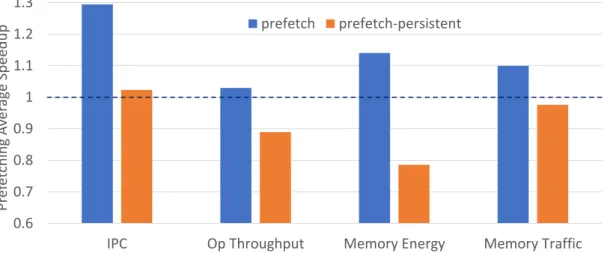
valid signal determining whether or not the prefetching request is even valid. . . 23 2.6 Sensitivity study showing the average speedup across all benchmarks between
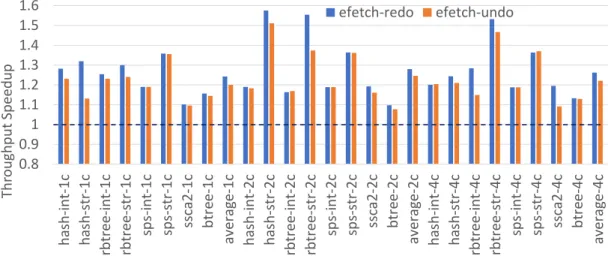
persistent and non-persistent applications. The over-prefetching of log data by the prefetcher in persistent memory applications is detrimental to its performance. 28 2.7 IPC speedup of microbenchmarks (normalized to the unsafe baseline, dashed line) 28 2.8 Operational throughput speedup of microbenchmarks (normalized to the unsafe
baseline, dashed line). . . 29 2.9 Dynamic energy reduction across all microbenchmarks (normalized to unsafe
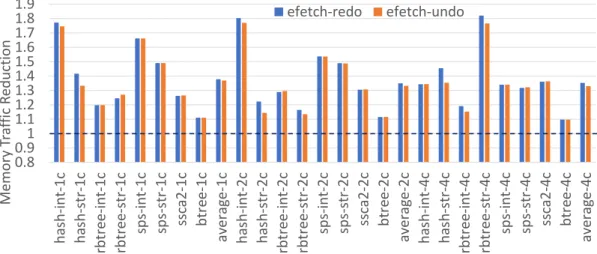
baseline, dashed line). . . 29 2.10 Memory write traffic reduction across all microbenchmarks (normalized to
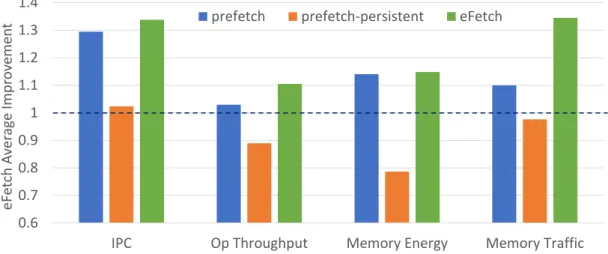
un-safe baseline, dashed line). . . 30 2.11 Shows the average improvement of eFetch across all benchmarks, shown in
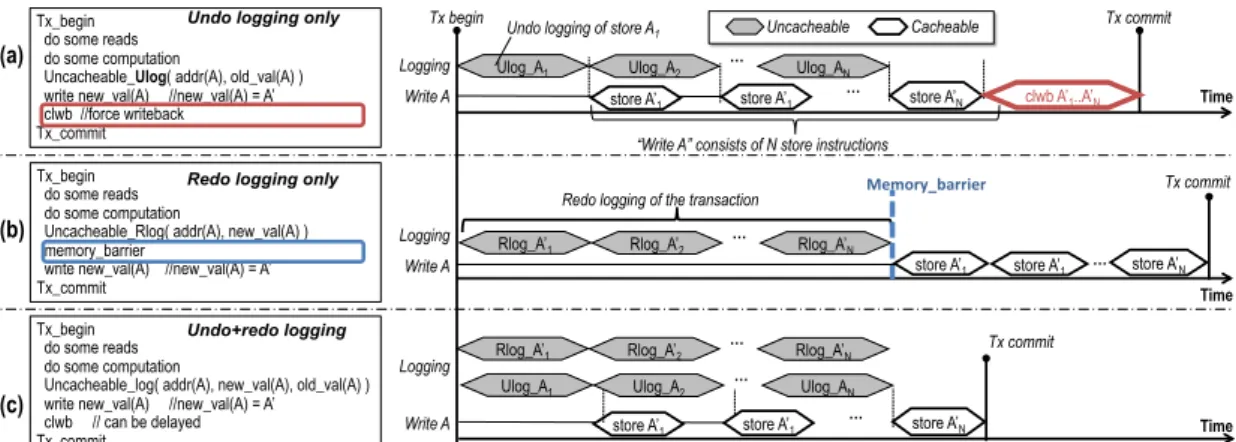
comparison with sensitivity study. . . 31 3.1 Comparison of executing a transaction in persistent memory with (a) undo
log-ging, (b) redo loglog-ging, and (c) both undo and redo logging. . . 35 3.2 Inefficiency of logging in software. . . 38 3.3 Overview of the proposed hardware logging in persistent memory. . . 39 3.4 Pseudocode example fortx beginandtx commit, where thread ID is
trans-action ID to perform one persistent transtrans-action per thread. . . 46 3.5 State machine in cache controller for FWB. . . 48
3.6 Transaction throughput speedup (higher is better), normalized tounsafe-base. . 54 3.7 Dynamic energy reduction (higher is better), normalized tounsafe-base(dashed
line). . . 54 3.8 Memory write traffic reduction (higher is better), normalized to unsafe-base
(dashed line). . . 54 3.9 IPC speedup (higher is better) and instruction count (lower is better),
normal-ized tounsafe-base. . . 55 3.10 Sensitivity studies of (a) system throughput with varying log buffer sizes and
(b) cache fwb frequency with various NVRAM log sizes. . . 56 3.11 WHISPER benchmark results, including IPC, dynamic memory energy
con-sumption, transaction throughput, and NVRAM write traffic, normalized to unsafe-base(the dashed line). . . 56 4.1 A disaggregated memory pool in a quad-socket server. Memory modules are
interconnected by a memory network shared by four processors. . . 62 4.2 An example of String Figure topology design with nine memory nodes (stacks)
and four-port routers. (a) String Figure topology. (b) Virtual space organization for random network generation. (c) Shortcuts generation for Node-0. (d) High-level design of a reconfigurable four-port router. . . 62 4.3 Algorithms for generating (a) balanced random topologies and (b) the used
bal-anced coordinate generation function Balbal-ancedCoordinateGen(), where D is circular distance defined in in the routing protocol. . . 66 4.4 Comparison of shortest path lengths. . . 68 4.5 Greedy routing protocol. (a) Circular distances (D) and minimum circular
dis-tances to Node-2 (M D) from Node-7 and Node-7’s neighbors. (b) Routing table entries (16 entries in total). . . 68 4.6 An example topology switch design. . . 71 4.7 Evaluated network topologies and configurations (“N” indicates unsupported
network scale). . . 78 4.8 (a) Average hop counts of various network designs as the number of memory
nodes increases. (b) Normalized energy-delay product (EDP) (the lower the better) with various workloads, when a certain amount of memory nodes are power gated off. . . 82 4.9 Network saturation points across various numbers of nodes. . . 83 4.10 Performance of traffic patterns at less than one thousand nodes. . . 84 4.11 Normalized (a) system throughput (higher is better) and (b) dynamic memory
energy (lower is better) with various real workloads. . . 85 6.1 Overview of changes to RISC-V. . . 95
List of Tables
2.1 Processor and memory configurations. . . 25
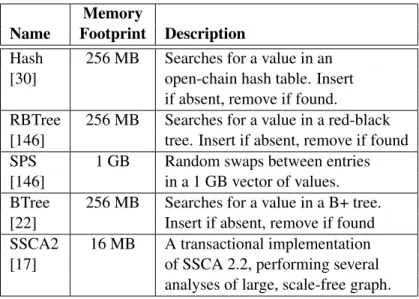
2.2 A list of evaluated microbenchmarks. . . 26
2.3 Summary of major hardware overhead. . . 32
3.1 Summary of major hardware overhead. . . 50
3.2 Processor and memory configurations. . . 51
3.3 A list of evaluated microbenchmarks. . . 52
4.1 System configuration. . . 78
4.2 Summary of network topology features and requirements. . . 78
4.3 Description of network traffic patterns. . . 79
Abstract
Efficient and Scalable Architectures for Persistent Memory Systems
by
Matheus Ogleari
Memory systems are evolving in a multitude of ways in state-of-the-art computer sys-tems and in computer architecture. The changes range from the low-level underlying technol-ogy used to implement memory, to the high-level ways in which memory systems are structured and organized. These changes have tremendous implications on the fundamental performance of computer systems because of how integral a role memory plays in the design of these tems. Traditionally, the memory hierarchy has been the bottleneck for how well computer sys-tems perform and the resources they consume. Computer architects face significant challenges in meeting the growing memory demands and efficiently integrating these new technologies. Computer architecture must adapt to these changes in a high-performance, cost-effective way. Modern problems require modern solutions.
This thesis proposes efficient architecture solutions for two primary contemporary developments in memory: persistent memory and memory networks. Persistent memory is a subset of nonvolatile memory with similar properties of storage systems. As such, it comes with not only many benefits, but also a number of challenges inherent to both storage systems but to new technologies in general. Similarly, memory networking shares similar properties to network on-chip as well as computer networking design. Persistent memory and memory networks can go hand in hand to implement high performance computing or database systems to meet the demands of current applications.
First this thesis tackles persistent memory and proposes a persistency-aware prefetcher design, eFetch. This design considers redo and undo logging, a commonly used technique in persistent memory systems. It capitalizes on memory access patterns and commonly used prefetching techniques to improve system performance. Development and analysis of this de-sign motivates this thesis to additionally investigate cacheable logging and the balance between software and hardware in addressing these challenges. Across various microbenchmarks, this
design achieves up to 1.33×IPC improvement, 1.24×higher throughput, a 1.39×reduction in dynamic memory energy consumption, and a 1.36×decrease in overall memory traffic.
Second, this thesis proposes an efficient undo+redo logging hardware mechanism for persistent memory that accommodates more recent advancements in persistent memory. It bet-ter leverages the existing underlying hardware. It also explores implementation in RISC-V and enables future research and hardware evaluation and experimentation in persistent memory. Evaluating this using both real workloads as well as microbenchmarks shows a significant im-provement in system throughput (up to 2.7×). It also reduces both dynamic energy (by up to 2.43×) and memory traffic.
Finally, this thesis addresses memory networks and the current problems in contend-ing with increascontend-ing memory application and server demands. This thesis establishes three pri-mary features for memory networks: scalability, arbitrary scale, and elasticity. As such, this thesis proposes String Figure, a memory network design and topology that attains three of these goals while still performing well against baseline or alternative memory network designs. String Figure competes with other memory network designs and out performs them in a number of network traffic patterns and real workloads.
Brief Biography
Matheus Almeida Ogleari was born on April 28, 1991 in Salvador, Brazil. He is the son of Arnaldo Ogleari and Gilka Ogleari. He has one older brother, Tamir Almeida. When Matheus was three years old, he and his family immigrated to the United States for a better life. Matheus and his family moved around a lot and lived in Florida, Oklahoma, and Pennsylvania. At a young age, Matheus got into computers and soon became the go-to IT guy for his family whenever they had technology problems. His interest in video games fueled this. By 1998, Matheus was on a Windows 98 computer playing card games with people over the internet and participating and moderating on IRC chat rooms, learning input commands and modifying scripts on the platform. In middle school, he began dabbling in game design and modifying maps and scripts for his favorite game at the time, Warcraft 3. This grew into an early interest in programming by the beginning of high school. Matheus attended Cornell University for his undergraduate studies where he majored in electrical and computer engineering with a minor in computer science. During the program, Matheus quickly became enamored with computer architecture. Matheus dabbled both with academic research via his summer 2011 research with Professor Christopher Batten, and with industry via his summer 2012 internship at Intel. His positive experience with Professor Batten and his group encouraged him to apply to graduate school. Matheus began his PhD at the University of California, Santa Cruz. He eventually joined the lab of his advisor, Professor Jishen Zhao. Under her guidance, Matheus learned about persistent memory and began exploring architecture solutions and projects that aligned with his interests. He also gained invaluable experience through collaboration with other research groups, as well as through his internships at Intel, Huawei, and Western Digital.
In his free time, Matheus enjoys playing board games and video games, watching movies, discussing politics, traveling, enjoying local cuisine, and spending time with friends. His favorite video games include Fallout: New Vegas, League of Legends, Super Smash Bros Ultimate, and The Legend of Zelda: Breath of the Wild. His favorite board games include Cos-mic Encounter, Spirit Island, Terraforming Mars, Twilight Struggle, and Star Wars: Rebellion. Matheus also has a passion for teaching. One day, he hopes to travel the world visiting many countries and eventually settle down to pursue one of his hobbies. Matheus is very grateful for his PhD experience and all those who were a part of it. It has been an unforgettable and indispensable experience.
I dedicate this to my family, the source of inspiration and motivation in my life and whom I always want to make proud.
Acknowledgments
I would like to acknowledge the tremendous contributions of my advisor and other professors I’ve worked with over the years as well as my sources of inspiration for pursuing my PhD degree. The technical contributions with more detailed acknowledgments of other collaborators are in Section 1.4. I want to use this section for personal thanks to them as well as the lasting friendships I’ve made as a graduate student.
I would like to thank Professor Christopher Batten at Cornell University for taking me under his wing when I was an undergraduate student. My experience doing research for him in his research group helped propel me into applying for a graduate PhD program. I also want to thank all the students and colleagues at Cornell and in Professor Batten’s group I’ve worked with or admired. Aadeetya Shreedhar, one of my longest and closest friends, I thank for always being there for me when I needed him, and for all the projects we worked on together over many long nights. Sean Clark, I thank for being friendly and approachable, and for joining me in exploring research as an undergraduate. Ji Kim, Derek Lockhart, and Shreesha Srinath, Professor Batten’s graduate students at the time, I thank for being role models of strong character and impeccable work ethic. They were inspiring examples of the graduate student I hoped to be one day.
I would like to thank Professor Jose Renau for his help and accepting me into the com-puter engineering PhD program at the University of California, Santa Cruz. I would like to thank all the students in Professor Renau’s lab for being accepting and friendly. Ehsan Ardestani, I thank for the opportunity to TA in his class as well as for the internship opportunity in his group at Huawei. Daphne Gorman, I thank for her continued friendship. Ramesh Jayaraman, I thank for his close friendship as well as for being a great reliable housemate for a large part of my PhD program.
I would like to thank my mentor and advisor, Professor Jishen Zhao, for accepting me into her lab and guiding me through the toughest years of my PhD. She’s helped me mature as both a researcher and a person. I thank her for pushing me through some of my lowest, most hopeless moments as well as through my happiest times. I want to continue to strive to be as hard working as she is. I appreciate her and all her efforts, my time in her research group has been unforgettable.
I want to thank all the students with whom I worked in Jishen’s group. I thank Xiao Liu, for being a good dependable friend and for being a good listener and support during hard
times. I thank Mengjie Li for his friendship and help in administering the lab at UC Santa Cruz. I thank Hengyu Zhao and Zixuan Wang for being good company in our lab.
I would like to thank Professor Ethan Miller, for giving me a place in his research group, providing funding, and for accommodating me and handling my administrative needs after my lab moved to UC San Diego. I also want to thank him for his indispensable contribution and insight for a number of the underlying ideas in my research. I also want to thank SSRC, the Storage Systems Research Center at UCSC for giving me a platform and supporting my research efforts through their effective resources. I would like to thank my other research collaborators as well: Xing Hu, Professor Chen Qian, and Ye Yu.
I would like to thank Professor Matthew Guthaus for being part of my PhD thesis, as well as advancement committee. I also thank him for his affability and wisdom at times when I needed it. I want to thank Riadul Islam, from Professor Guthaus’s lab, for being a good friend and fellow TA, as well as for helping to guide me through some of the nuances and logistical matters of the PhD program.
I would also like to thank Intel, Huawei, and Western Digital, the three companies that offered me internships during my PhD program. The industry experience I gained working at these companies and the exposure to being an engineer were crucial and kept me motivated to continue and complete my studies.
Last but definitely not least, I would like to thank my family for their love, support, and patience. Since I was young, my parents, Arnaldo and Gilka Ogleari, instilled in me a sense of importance in education. My older brother, Tamir Almeida, mentored me closely and guided me through the college application process. He shared with me his wisdom and experience I needed to help steer my academic career choices. I hope I go on to make them proud in my career and beyond.
In terms of funding, this thesis was supported in part by NSF grants 1652328, 1718158, 1829524, 1829525, NSF I/UCRC Center for Research on Storage Systems, SRC/DARPA Cen-ter for Research on Intelligence Storage and Processing-in-memory, and the SSRC Storage Systems Research Center.
Chapter 1
Introduction
The field of computer architecture has yielded tremendous achievement in advancing and improving technology for a large variety of applications and uses in daily life. With Moore’s Law coming to its end, architects are increasingly resorting to alternate ways to improve perfor-mance of computer systems. These alternatives include hardware acceleration and chip special-ization. These are able to achieve high performance and energy efficiency by directly targeting the specific application or class of applications. This is substantially more important with the advent of newer memory technologies. Memory systems have often been the bottleneck in the costs and performance of computer systems. The biggest question is how much improve-ment and optimization architects can exact from improveimprove-ments to hardware. The most optimal solutions require the deepest levels of understanding of the underlying microarchitecture.
1.1
Persistent Memory
Persistent memory presents a new tier of data storage components for future computer systems. By attaching Non-Volatile Random-Access Memories (NVRAMs) [24, 59, 124, 150] to the memory bus, persistent memory unifies memory and storage systems. NVRAM offers the fast load/store access of memory with the data recoverability of storage in a single device. Consequently, hardware and software vendors recently began adopting persistent memory tech-niques in their next-generation designs. Examples include Intel’s ISA and programming library support for persistent memory [57], ARM’s new cache write-back instruction [9], Microsoft’s storage class memory support in Windows OS and in-memory databases [29, 36], Red Hat’s
persistent memory support in the Linux kernel [99], and Mellanox’s persistent memory support over fabric [35].
Though promising, persistent memory fundamentally changes current memory and storage system design assumptions. Reaping its full potential is challenging. Previous persistent memory designs introduce large performance and energy overheads compared to native memory systems, without enforcing consistency [52, 102, 146]. A key reason is the write-order control used to enforce data persistence. Typical processors delay, combine, and reorder writes in caches and memory controllers to optimize system performance [54, 73, 109, 146]. However, most previous persistent memory designs employ memory barriers and forced cache backs (or cache flushes) to enforce the order of persistent data arriving at NVRAM. This write-order control is sub-optimal for performance and does not consider natural caching and memory scheduling mechanisms.
1.1.1 Prefetching
Most previous persistent memory designs focus on optimizing software-based logging algorithms to reduce the overhead of data persistence [30] [135] [89]. Several recent studies strive to reduce such overhead by optimizing hardware-based versioning and write-order con-trol mechanisms [146] [64] [85] [109] [148] [116] [73]. Yet the data persistence property obviates many basic assumptions of current memory architecture design, leading to significant degradation performance and energy efficiency. In particular, this thesis observes that the hard-ware prefetcher designs employed in commodity processors can substantially increase conflict misses in CPU caches when executing persistent memory applications. This is because tra-ditional prefetchers do not distinguish between the working data and the log. They tend to over-prefetching the non-reusable log blocks, which can kick the working data out of caches.
Moreover, this thesis identifies that substantial opportunities exist in exploiting intel-ligent hardware prefetcher design to optimize persistent memory performance. In particular, prefetching can be leveraged to parallelize and merge the memory requests to perform logging and working data updates. As a result, unnecessary memory access and data movement can be significantly reduced.
These issues and opportunities manifest in the use of persistent memory that archi-tects must rethink hardware prefetcher design to reap the full potential of persistent memory
technique. As such, this thesis proposes rethinking the hardware prefetcher design. This the-sis proposes a perthe-sistence-aware prefetcher design, eFetch1, which consists of persistent write tracking, redo log prefetching, and undo logging triggered prefetching mechanisms. eFetch adopts a special log address buffer, which stores the cache tags associated with the log memory addresses. Such memory address tracking prevents the over-prefetching that can stretch to the log. Furthermore, this thesis proposes two intelligent prefetching mechanisms, which lever-age prefetching to i) relax the ordering constraints between persistent memory access and ii) parallelize logging and working data updates in redo and undo log based systems, respectively.
1.1.2 Hardware Undo+Redo Logging
Several recent studies strive to relax write-order control in persistent memory sys-tems [73, 109, 146]. However, these studies either impose substantial hardware overhead by adding NVRAM caches in the processor [146] or fall back to low-performance modes once certain bookkeeping resources in the processor are saturated [73].
Agoalof this thesis is to design a high-performance persistent memory system with-out (i) an NVRAM cache or buffer in the processor, (ii) falling back to a low-performance mode, or (iii) interfering with the write reordering by caches and memory controllers. The key idea is to maintain data persistence with a combined undo+redo logging scheme in hardware.
Undo+redo logging stores both old (undo) and new (redo) values in the log during a persistent data update. It offers a key benefit: relaxing the write-order constraints on caching persistent data in the processor. This thesis shows that undo+redo logging can ensure data persistence without needing strict write-order control. As a result, the caches and memory controllers can reorder the writes like in traditional non-persistent memory systems (discussed in Section 3.1.2).
Previous persistent memory systems typically implementeitherundo or redo logging in software. However, high-performance software undo+redo logging in persistent memory is infeasible due to inefficiencies. First, software logging generates extra instructions in soft-ware, competing for limited hardware resources in the pipeline with other critical workload operations. Undo+redo logging can double the number of extra instructions over undo or redo
1
A system with nonvolatile main memory may also employ volatile DRAM, controlled by a separate memory controller. This work focuses on the case where persistent data updates need to be maintained in nonvolatile main memory, which is a common case in database and file system applications.
logging alone. Second, logging introduces extra memory traffic in addition to working data access [146]. Undo+redo logging would impose more than double extra memory traffic in software. Third, the hardware states of caches are invisible to software. As a result, software undo+redo logging, an idea borrowed from database mechanisms designed to coordinate with software-managed caches, can only conservatively coordinate with hardware caches. Finally, with multithreaded workloads, context switches by the operating system (OS) can interrupt the logging and persistent data updates. This can risk the data consistency guarantee in multi-threaded environment (Section 3.1.3 discusses this further).
Several prior works investigated hardware undo or redo logging separately [73, 97] (Section 5.2). These designs have similar challenges such as hardware and energy overheads [97], and slowdown due to saturated hardware bookkeeping resources in the processor [73]. Support-ing both undo and redo loggSupport-ing can further exacerbate the issues. Additionally, hardware log-ging mechanisms can eliminate the loglog-ging instructions in the pipeline, but the extra memory traffic generated from the log still exists.
To address these challenges, this thesis proposes a combined undo+redo logging scheme in hardware that allows persistent memory systems to relax the write-order control by leveraging existing caching policies. The design consists of two mechanisms. First, a
Hardware Logging (HWL)mechanism performs undo+redo logging by leveraging write-back
write-allocate caching policies [54] commonly used in processors. The HWL design causes a persistent data update to automatically trigger logging for that data. Whether a store generates an L1 cache hit or miss, its address, old value, and new value are all available in the cache hierarchy. As such, this design utilizes the cache block writes to update the log with word-size values. Second, this thesis proposes a cache Force Write-Back (FWB) mechanism to force write-backs of cached persistent working data in a much lower, yet more efficient frequency than in software models. This frequency depends only on the allocated log size and NVRAM write bandwidth, thus decoupling cache force write-backs from transaction execution.
1.2
Memory Networks
The volume of data has skyrocketed over the last decade, growing at a pace compa-rable to Moore’s Law [96]. This trend drives the popularity of big data analytics [19, 120], in-memory computing [45,137], deep learning [121,131,132], and server virtualization [19], which
0 2 4 6 2012 2013 2014 2015 2016 2017 Amazon EC2 Microsoft Azure Sc al e-u p C lo u d Se rv er Me m o ry C ap ac ity (T B ) cr1.8x r3.8x X1 X1e G5 S192 S192m S960 20TB X1e 16TB
Figure 1.1: Expanding server memory demand.
are frequently insatiable memory consumers. As a result, these applications demand a contin-uous expansion of server memory capacity and bandwidth to accommodate high-performance working data access. As shown in Figure 1.1, cloud server memory capacity has been rapidly growing since the debut of cloud service for in-memory computing [4, 20, 119].
Unfortunately, DRAM capacity scaling falls far behind the pace of the application demand with current DDRx based architectures [100]. One conventional solution to increasing server memory capacity is to add more CPU sockets to maintain additional memory channels. In commodity systems, each processor can support up to 2TB memory. As a result, EC2 1Xe adopts four CPU sockets to accommodate the 4TB memory capacity [20]. Azure S960 servers can adopt 20 Intel Xeon processors to accommodate 20TB of memory [4]. However, purchasing extra CPU sockets substantially increases the total system cost [144, 145]. The extra hardware cost adds significant, often nonlinear overheads to the system budget, making this solution unsustainable.
A promising technique to tackle these memory challenges is memory networking, whereby the server memory system consists of multiple 3D die-stacked memory nodes inter-connected by a high-speed network. The interinter-connected memory nodes form a disaggregated memory pool shared by processors from different CPU sockets in the server (Figure 4.1). Ide-ally, the memory network can enable more scalable performance and capacity than traditional DDRx-based memory systems, as shown by academia [67, 112, 144] and industry efforts from HPE [8] and IBM [130]. However, the memory network scalability relies on the scalability of the memory fabric that interconnects the memory nodes [112, 144].
Previous memory network designs investigated platforms with limited numbers of memory nodes. Scalability and flexibility were not considered in their the design goals. Given
that each memory node (a 3D memory stack) can offer 8GB capacity [144], state-of-the-art 4TB server memory system requires 512 memory nodes. Recent works have proposed optimizing NoC network topologies to support up to 128 memory nodes in integrated CPU+GPU (APU) systems [112]. However, the design partitions clusters of memory nodes to separate channels, where each processor can only access a subset of the memory space. State-of-the-art planar topologies [69, 70] offer high network throughput at a large scale. However, the number of required router ports and links increases as the network size grows, which imposes undesirable cost in routers integrated with memory nodes. The challenges of scaling up server memory capacity still remain.
Agoalof this thesis is also to design a high-performance, scalable, and flexible mem-ory network architecture that can support over a thousand interconnected memmem-ory nodes shared by processors in a cloud server. This memory network is designed around three primary design principles: scalability, arbitrary network sizing, and elasticity. These are discussed further in depth.
To achieve this, this thesis proposes String Figure, a scalable and elastic memory network archi-tecture that consists of three design components. First, this thesis proposes a network construc-tion scheme to efficiently generate random network topologies that interconnect an arbitrary number of memory nodes with high network throughput, near-optimal path lengths, and limited router ports. Second, this thesis develops an adaptive greedy routing protocol, which signif-icantly reduces the computation and storage overhead of routing in each router. Finally, this thesis proposes a network reconfiguration scheme, which allows the network scale, topology, and routing to change according to power management and design reuse requirement. Perfor-mance and energy experiments show that String Figure can interconnect up to 1296 memory nodes with significantly higher throughput and energy efficiency than previous designs, across various of synthetic and real workloads.
1.3
Thesis Overview
This thesis proposes three designs: eFetch, undo+redo hardware logging, and String Figure. This thesis goes in-depth on these designs, elaborating on the necessity of each in sequential chapters. At the end of each chapter, it also explains how these designs relate to each other and how this bridge was formed over the course of the research. In particular, the
sequence of these three designs also represents the growing scale and breadth of challenges associated with new memory technologies and techniques. EFetch starts with a system focusing on one aspect of a processor with persistent memory (a prefetcher). With hardware undo+redo logging, the entire system is considered with how best to deal with persistent memory accesses. With String Figure, the thesis expands to large scale memory systems and the interconnection of various nodes and memory subsystems across vast networks.
Chapter 2 details and describes the design for eFetch as well as the baseline assump-tions for persistent memory. Despite its breadth of research and underlying foundaassump-tions, there is still debate about what these assumptions should be. For example, should persistent mem-ory logs be cached? If not, how does a processor deal with uncacheable logs? Is this the most efficient way? How do other units within the processor deal with logging, a technique so commonly used in persistent memory? EFetch presents an early design for understanding and exploring the design space for persistent memory, and addressing the challenges that manifest in the performance gap between persistent and traditional memory systems.
Chapter 3 describes hardware undo+redo logging and its design. It represents the next step in evolution from eFetch. It more fully encompasses the entire chip and shifts persistent memory design focus less on software and more toward hardware. This chapter justifies this choice and presents an efficient and cost effective way to achieve this. It also further advocates for assumptions made from eFetch about the underlying persistent memory system and the implications for future work. In particular, it strives to expand persistent memory research into modern processors and computer systems like RISC-V. Additionally, this chapter brushes on additional requirements for persistent memory and changes needed in hardware when dealing with RDMA requests over networks to persistent memory.
Chapter 4 describes the design for String Figure, a scalable and elastic memory net-work design. This design was motivated by the necessity of optimally handling persistent mem-ory requests across networks via RDMA or other paradigms. String Figure takes this a step further, offering a topology and set of network design goals that meet the demands for large scale memory networks that are not just persistent or for persistent applications. The perfor-mance gains and features offered by String Figure benefits all memory systems, persistent or otherwise. It also
and memory networks. It solidifies the novelty and impact of the designs proposed in this thesis. Chapter 6 summarizes and elaborates on the contributions of this thesis, highlighting the potential for future work and research in these topics.
The primary contributions of this thesis are condensed as follows:
• This thesis identifies new performance and energy issues associated with current persis-tent memory systems and how persispersis-tent-aware prefetching can reduce data movement across the memory bus.
• This thesis enables efficient undo+redo logging for persistent memory systems in hard-ware using lightweight softhard-ware support and low complexity processor modifications. This relaxes write ordering constraints and addresses the challenges inherent to using both undo and redo logging together.
• This thesis constructs a memory network topology and design that is able to scale with very large number of nodes, support any number of nodes in its network without perfor-mance loss, and supports adding or removing nodes from its network at low cost without having to rebuild the entire system.
1.4
Collaboration, Funding, and Previous Publications
This thesis would not have been possible without the immense effort and dedication of all those involved in my publications. This includes professors as well as graduate and post-graduate students with whom I have had the pleasure of working. My advisor, Jishen Zhao, was a key collaborator in all my work by helping to iteratively evolve the ideas and key concepts behind the designs described in this paper. Her experience in persistent memory systems attributes to this. The framework from her previous work in persistent memory helped propel my own research. She also helped me organize and refine the narrative and how it is presented in this thesis. Professors Ethan Miller and Chen Qian at University of California, Santa Cruz provided invaluable insight and basis for the primary designs described in this thesis. Professor Miller’s expertise in storage systems and Professor Qian’s expertise in networking were strong foundations in this regard.
Collaborators from my and other research groups are also responsible for making this thesis possible. Mengjie Li in my group was a great resource in helping to study and learn
the effects of cacheable versus uncacheable logging in persistent memory. My work with Xing Hu at University of California, Santa Barbara sparked my interest in exploring RDMA and network design as another side of improving not only persistent memory performance but large memory systems in general. Ye Yu from the University of Kentucky (now Google) provided a starting framework from his Space Shuffle design that directly helped the development of String Figure. My exposure and contribution to work on processing-in-memory with Hengyu Zhao of my group emphasized the memory demands of modern applications for me which motivates String Figure. My invaluable internship opportunity at Western Digital thanks to my manager Martin Lueker-Boden opened up my work in persistent memory to RISC-V support and design exploration. The internship gave me access to industry-standard tools (like the Xilinx Zynq zc706 FPGA), support, and experience of an engineering company. Co-workers Tung Hoang, Pi-feng Chiu, and Christoph Hellwig helped guide me in this.
Two previous publications have contributed significantly to this thesis. My work on undo+redo logging [104] and String Figure [105] are the basis for Chapters 3 and 4, respec-tively. My collaboration with Xing Hu on Persistence Parallelism Optimization [55] contributed to the RDMA network discussion in Chapter 3. My collaboration with Mengjie Li on Logging in Persistent Memory [79] motivated and led to many design decisions throughout this thesis, discussed more in Chapter 2.
Chapter 2
Prefetching and Logging in Persistent
Memory
Persistent Memory functions as a hybrid of traditional storage systems with main memory. It combines the benefits of both worlds – the persistence of storage disks with the byte-addressability and load-store interface of main memory. It improves upon the emerging nonvolatile memory (NVRAM) technologies by persisting data with full integrity even dur-ing crashes and power outages. Yet, persistent memory systems impose additional memory accesses to maintain data persistence (a traditional storage property) in memory, by employ-ing multiversionemploy-ing mechanisms (e.g., loggemploy-ing) or copy-on-write mechanisms inherited from disk-based storage systems, such as databases and file systems. This chapter observes that such additional memory demand causes increased conflict misses with prefetched data in the cache, substantially hurting the performance of persistent memory applications. Furthermore, intelligent hardware prefetching can offer substantial opportunities in relaxing the performance constraint of persistent memory systems.
This the goal in this chapter is to achieve high-performance and energy-efficient hard-ware prefetching in persistent memory systems. This thesis proposes an efficient persistence-aware hardware prefetching mechanism, eFetch, which mitigates the performance and energy loss in persistent memory applications while leveraging prefetching to relax the ordering con-straints in log-based persistent memory systems. Evaluation across various persistent mem-ory applications demonstrates that this design leads to 1.33×IPC improvement, 1.24×higher
throughput, a 1.39×reduction in dynamic memory energy consumption, and a 1.36×decrease in overall memory traffic.
2.1
Background and Prefetching
Persistent memory bridges the the benefits of memory and storage. It allows data to be persisted directly through a fast load/store memory interface, obviating the performance and energy overhead of accessing slow storage components such as disks and flash. As such, systems incorporating persistent memory can offer promising data storage solutions for various computer systems, whether they be cloud systems, embedded, or mobile, which are expected to generate, process, and store increasingly large volumes of data despite operating with con-strained voltage/thermal margins or unreliable power sources.
2.1.1 Supporting Data Persistence in Memory
Persistent memory systems need to protect data integrity against partial or reordered writes to nonvolatile main memory (NV memory), despite crashes and power outages. Taking an example of inserting a node in a linked list stored in NV memory, write-back caches and memory controllers can reorder the writes; eventually, the pointer can be written into NV mem-ory before the node data. If the system loses power when the node data still remains in volatile CPU caches, the pointer becomes a dangling pointer and retains in NV memory across system reboots. As such, the linked list is broken and the inconsistent state will remain from that point on. To avoid this, persistent memory systems perform versioning and write-order control to ensure data persistence in memory.
Versioning can be implemented by two commonly-used methods: logging [135] [30] and copy-on-write [32]. Among the two, logging is an essential component in most database and file systems that are likely to run on persistent memory. Therefore, eFetch focuses on improving the performance and energy efficiency of log-based persistent memory systems.
Logging can be implemented asredo logging[135] [30],undo logging, or a combina-tion of both (i.e.,undo+redo logging) [95] [51]. Redo logging writes new data updates, along with their addresses, into a log before updating their original locations. If system loses power before logging is completed, persistent memory can always recover, using the intact original
data in memory. Some systems can employ undo logging, which instead writes old values of data into the log and updates the original data with new values. Many database systems adopt undo+redo logging [95] [51]. For example, ARIES [95] combines a physical redo logging with a logical undo logging process across transactions to ensure that the database can be recovered after crashes. Yet performing undo+redo logging through the memory bus can introduce sub-stantial performance overhead on top of the fast load/store interface. Therefore, most existing persistent system designs adopt either undo or redo logging. Most previous logging schemes can be categorized as write-ahead logging (WAL), e.g., they commit log records before updating corresponding original data. Recent studies show that write-behind logging (WBL), which up-dates data before committing to the log, can improve persistent memory performance in certain scenarios [44] [16].
In most previous persistent memory designs, the log is supposed to be used during system recovery; once a log entry is updated, it is not reused throughout applications execution. Therefore, most previous persistent memory systems do not cache the log. Write-order control enforces the order of log and original data updates arriving at NV memory. Otherwise, both types of updates can be simultaneously issued to NV memory; system crashes can interrupt these writes and leave both the log and the original data partially updated. Write-order control is enforced by a memory barrier between the writes to the log and writes to the original locations in memory. Such memory barriers are implemented by uncacheable writes or cache flush and memory fence instructions, such asclflush,clwb,mfence, andpcommit.
2.1.2 Hardware Prefetching
A hardware prefetcher is a hardware component used in microprocessors to speed up program execution by reducing the average memory access latency [39]. Modern microproces-sors run much faster than the main memory. Therefore, main memory accesses typically lead to stalled cycles on the microprocessor. Prefetching occurs when a processor requests data or instructions from main memory before it is actually needed. Once a prefetched data or instruc-tion comes back from memory, it is placed in the cache until it is accessed; reading the data or instruction from caches is much faster than if the microprocessor had to request it from main memory [46]. Yet the cache becomes populated more quickly and thus are more susceptible toconflict misses. This issue leads to a loss of overall performance by increasing the average
memory access latency (AMAL).
Current microprocessor designs adopt various hardware prefetching schemes, such as next-line prefetching, stride prefetching [46], locality-based prefetching [125], and Markov prefetching [62]. These are designed for conventional memory systems without data persistence support. This thesis studies the issues with traditional hardware prefetcher design in persistent memory systems and offers persistence-aware prefetching mechanisms that can work with var-ious prevvar-ious prefetcher designs.
2.2
The Case for Prefetching
This section discusses the reasons and motivation for pursuing performance speedups in prefetching for persistent memory systems.
The premise of prefetching is to generate values to populate the cache sooner, which can lead to additional cache hits (hence greater performance) in following memory accesses. Toward this end, most traditional hardware prefetchers exploit spatial locality by prefetching the addresses near the desired ones. Persistent memory systems typically allocate the log and temporarily data buffer in one or more contiguous regions in the physical address space. As a result, once the first data block of a log entry is accessed, hardware prefetchers can prefetch the subsequent data blocks. While persistent memory logs are not supposed to be cached (discussed in Section 2.1.1), hardware prefetchers can bring logs into caches. This thesis refers to this issue as over-prefetching of log data.
There are many prefetching algorithms designed for specific use cases or that target sets of applications. Prefetching policies are diverse and no single strategy has yet been pro-posed which provides optimal performance in all cases [133]. New prefetching techniques emerge with new technology and applications. Much how the emergence of newer applications with different memory access patterns have driven development of these techniques, so too does persistent memory. Persistent memory provides a new kind of predictable memory access pat-tern that can be used in new or existing code. Given this predictability, this thesis develops a prefetcher scheme fitting for these persistent applications.
The log is typically uncacheable because it has no reuse (Section 2.1.1); subsequent reads of the same data will need to wait until the working data is updated (shown in Figure 2.3(a) (the example code without redo log prefetching)). Yet new data values are actually already
per-sistent after redo log updates are completed. Therefore, the ordering constraint between working data updates and subsequent reads can be relaxed by allowing proactive reads from the redo log. However, redirecting the reads to the redo log can substantially complicate persistent memory design. As described in Section 2.3, eFetch allows such proactive reads without redirecting them.
Hardware Prefetching vs. Software Prefetching. Prior works have studied the differences
between hardware prefetching and software prefetching [28]. This study and [152] cite that software prefetching uses compile-time information to do complex analysis. However, hard-ware prefetching has the advantage of dynamic information. While both improve miss rates in caches through prefetching, software prefetching actually leads to a higher overhead cost. These types of study have laid the foundation for modern prefetching research and prefetcher designs. The policies used are typically implemented in hardware and are lightweight. This thesis uses the same motivation for pursuing hardware-based prefetching for the eFetch design.
2.3
eFetch Design Overview
Overview. This thesis proposes eFetch, a hardware prefetcher design that addresses the
afore-mentioned over-prefetching issue and exploits the opportunity of relaxing the ordering con-straint. This prefetching scheme can be used in persistent memory systems that adopt undo logging, redo logging, or both to enforce data persistence. EFetch introduces three novel de-sign principles to achieve this goal. First,persistent write trackingensures that the hardware prefetcher can distinguish the addresses of working data and log updates, such that it can em-ploy different prefetching policies for the two. Persistent write tracking effectively reduces the aforementioned over-prefetching issue. Second,redo log prefetching leverages prefetch-ing of the latest redo log updates to simultaneously accommodate workprefetch-ing data updates and enable proactive reads. Third,undo logging triggered prefetchingexploits the fact that work-ing data updates typically follow log updates to proactively startwork-ing workwork-ing data updates in caches. The redo log prefetching and undo logging triggered prefetching mechanisms leverage prefetcher’s support to relax the ordering constraint on persistent memory access; the two mech-anisms also stretches the persistent memory performance by reducing redundant data movement across the memory bus. The realization of these three principles improves system performance and reduces system energy consumption as evaluated in the results. Furthermore, eFetch also
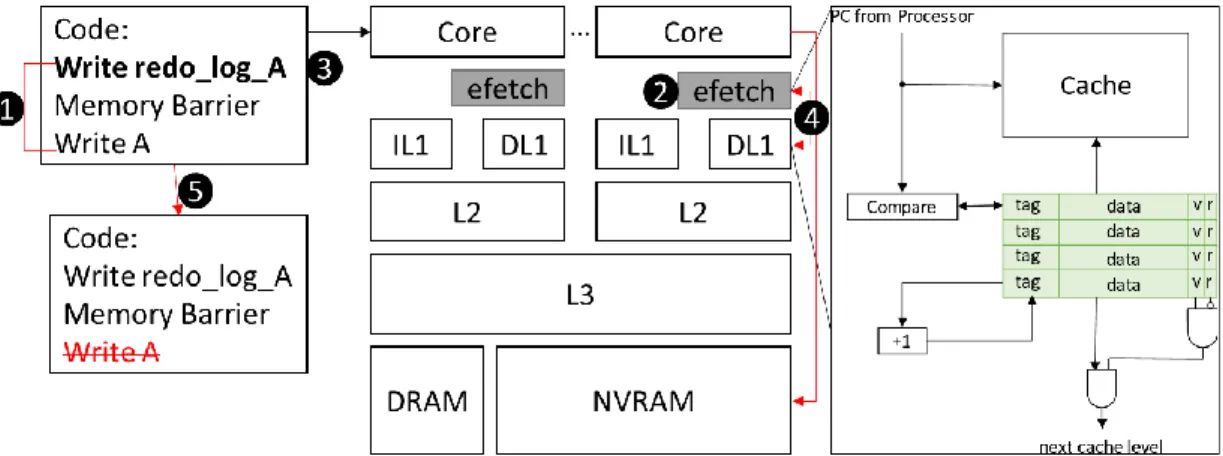
Figure 2.1: High-level overview of eFetch and how it interacts with the rest of the system and the application.
monitors the NV memory bandwidth utilization and prevents prefetching to interference with ordinary memory requests. Figure 2.1 depicts eFetch configuration. A step-by-step overview of how all mechanisms work together will be presented in Section 2.3.4.
2.3.1 Persistent Write Tracking
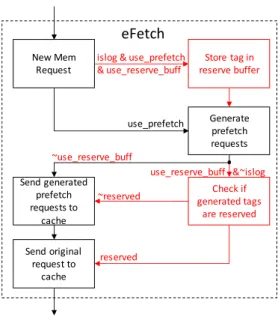
The goal to prevent traditional prefetching policies from prefetching non-reusable log updates. To achieve this, this thesis allows hardware prefetchers to identify the addresses of log updates. To this end, eFetch keeps track of the starting addresses of log updates by buffering the starting and the end addresses (virtual or physical addresses determined by which is used by the prefetcher) of each allocated log regions in NV memory. When the prefetcher initiates prefetching requests guided by traditional prefetching policies (e.g., next-line, stride, locality-based, Markov, etc.), it performs an “address check” against the buffered addresses. If the requesting address falls into a memory region for log, the prefetcher skips that request. Figure 2.2 summarizes this mechanism.
Making the Log Uncacheable.To comply with the persistence model described in Section 2.1,
there first needs to be a mechanism to allow detecting memory accesses into the log to prevent them from caching in the original request. To this end, this design employs a software inter-face (discussed in Section 2.4) that distinguishes log accesses from other memory accesses. This software interface is similar to the ones adopted in previous persistent memory system designs [135]. This way, the existence and location of the logs are known at compile-time. It
New Mem Request
islog & use_prefetch & use_reserve_buff Store tag in reserve buffer Generate prefetch requests Send generated prefetch requests to cache Check if generated tags are reserved use_prefetch use_reserve_buff &~islog ~use_reserve_buff ~reserved Send original request to cache reserved eFetch
Figure 2.2: High-level flow chart for eFetch. Red highlighted regions shows added eFetch functionality atop traditional hardware prefetcher design.
can pass along this information to the eFetch hardware. As such, load and store instructions associated with accessing the log will be flagged to be treated differently than working data access, bypassing the cache hierarchy. This prevents the log access from polluting the cache with additional conflict misses.
Address Tracking. For the log to be uncacheable, the system needs to have the knowledge
about its address in the memory space to prevent the cache from normally sending requests. This same mechanism can be used to identify when eFetch triggers. This trigger expands to the prefetcher to pass along the information of known log memory requests and the subsequent areas in memory. There can exist memory regions that share spatial locality with the log but not much else. Efetch does not prefetch these adjacent addresses because they tend to be isolated from the rest of the code, more specifically, from the desired persistent data structure. Further-more, the prefetcher is also aware of memory accesses preceding the log that could trigger any over-prefetching into the log.
While the eFetch persistent write tracking reduces performance and energy degrada-tion by ensuring that tradidegrada-tional prefetching policies are aware of log updates, eFetch performs one step further to leverage prefetching to improve the performance and energy of working data
access. The described write-tracking and address-tracking opens up for the next two mecha-nisms to work and improve persistent memory system performance.
2.3.2 Redo Log Prefetching
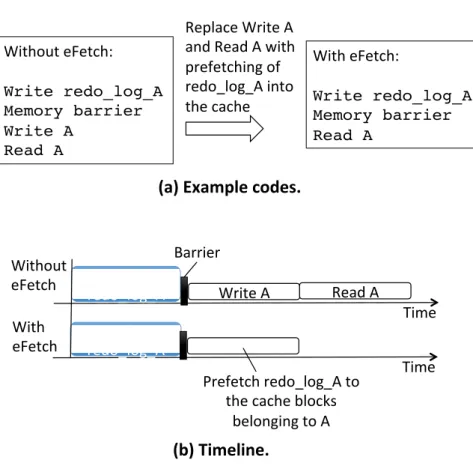
The key idea of this mechanism is to perform working data updates in cache and sub-sequent reads of the same data simultaneously with a single redo log prefetching (Figure 2.3). Efetch does not cache the redo log. Therefore, as shown in the figure, the CPU is supposed to issue new write requests to the working dataA. Depending on the size of dataA, the write can consists of one or several store instructions. Subsequent reads ofAneed to wait untilWrite A is performed. It is fine if the size of the data is small. But persistent memory systems can manipulate large data structures in databases and file systems, where waiting for Write A
and then performing Read Atake a long time. Instead of doing so, eFetch allows Read A
to start right afterWrite redo log Ais completed;Read Awill trigger the prefetching of redo log A from NV memory into the cache blocks that are supposed to store the working data
A. As such, eFetch leverages the redo log to update the working data without relying on the CPU to issue new requests; meanwhile, the subsequent read requests are serviced.
Accessing Data from Log.In most logging schemes, log updates rely on key-value information
for referencing updates done or to be done to the persistent data structure. To maintain such information, the redo log records the new value of that data element (to be “redone”) and the location of the actual persistent data item within the working data updated. These two values are coupled within a single log entry. The latter allows obtaining the address of the value of the working data and cache that data block instead of the block containing the log. This also allows us to use the address to trigger eFetch to prefetch additional members of the data into the cache. Doing so increases hits in the cache by having the data values and adjacent addresses already in the cache on future accesses. It also improves the performance of further log requests and updates, which rely on the same scheme during execution. As shown in Figure 2.3, in the case of a cache hit on the cache block containingAduring the redo log update ofA, no additional work is required aside from updating the value ofAwithin that block.
Shrinking Persistent Memory Footprint in Cache. There is an additional advantage to
ac-cessing data directly during the log update and caching that instead. A log update requires a key-value pair (two values) to store in memory. A regular persistent data item only requires
Without eFetch: Write redo_log_A Memory barrier Write A Read A With eFetch: Write redo_log_A Memory barrier Read A Time Write redo_log_A Write A Barrier Time Write redo_log_A Prefetch redo_log_A to the cache blocks
belonging to A Read A With eFetch Without eFetch Replace Write A and Read A with prefetching of redo_log_A into the cache
(a) Example codes.
(b) Timeline.
Figure 2.3: Redo log prefetching mechanism. (a) Example application (or system software) codes without and with the proposed redo log prefetching mechanism. (b) A timeline that illustrates the saved time by using this mechanism.
one value to store in memory and therefore also in the cache. By replacing memory requests to the log with those of the desired persistent structure, this design reduces the memory footprint of persistent memory in the cache. The original log request would store one value instead of two values, thus halving the memory footprint. Furthermore, accommodating a separate cache block to be used for the persistent data later after the log request is unnecessary. Instead, eFetch processes both the log request and the persistent memory access together, saving time as well as space in the cache to be used for accommodating more reusable data.
2.3.3 Undo Logging Triggered Prefetching
The idea of this mechanism is to proactively start working data updates, so that they complete earlier than usual in undo-log-based persistent memory. As shown in Figure 2.4, the
Write undo_log_A
Memory barrier
Write A
Time
Write
undo_log_A
Write A
Barrier
Time
Write
undo_log_A
Service cache misses of A
by prefetching
With
eFetch
Without
eFetch
Writes to the
cache blocks
The start of undo
logging triggers
prefetching
Figure 2.4: Undo logging triggered prefetching
level-1 (L1) cache needs to fetch dataAfrom lower levels, ifWrite Amisses in the cache; an working data update (Write A) therefore involves two steps: 1) servicing cache misses and 2) updating the cache blocks corresponding toA. EFetch proactively performs the first step by leveraging the observation that working data updates will follow undo log updates in WAL. In addition, prefetching would only load the data from lower levels in the memory hierarchy; it does not modify data values and therefore does not violate data persistence. EFetch leverages such observations to proactively trigger prefetching of working data. As illustrated in Fig-ure 2.4, the eFetch implementation ensFig-ures that subsequent writes to the fetched cache blocks corresponding toAare performed afterWrite undo log Ais written into NV memory.
Distinguishing Undo Log from Redo Log.From the perspective of the prefetcher in hardware,
there is no difference between an application that uses redo log and one that uses undo log. Both are uncacheable and require a reserved address space in which no prefetching can occur. However, the key difference is how many writes occur in hardware and whether the software still requires to execute write instructions update the working data. Efetch distinguishes between undo and redo log in its software interface. This is further discussed in Section 2.4. Unlike in the redo log case, the write cannot directly perform be performed to the working data (the main
persistent data structure), because the new data values are not yet available. Therefore, with undo logging, eFetch still requires the write A in the code to properly update the values.
Preemptive Cache Write-Allocate. Similar to the redo log, the undo log mechanism makes
use of the information packed with the update of the undo log request to expedite following requests to the persistent data structure. The difference with processing undo logs is that it is not yet known what the new value to write to the working data will be, only the old value (to be “undone”) is known. However, the undo log access is treated like the main data access. Like with redo logging, an undo log update provides the address of where the element in the working data will be placed. This address is used to preemptively fetch the cache block containing the working data from memory.
Normally in a cache, all write request misses must be write-allocated regardless, this is a standard property of most caches [108]. This cache block allocation typically occurs during cache misses on writes. If the subsequent write to the original data ends up missing in the cache, the cache will have to perform an allocate regardless. EFetch can start to perform the cache write-allocate process early. This leads to a significant reduction in the chance of a cache miss on the write to the working data, because the cache will already be allocated. This expedites the working data write requests and completes them sooner than usual. In the case of a cache hit during the initial log update cache request, no additional work is needed because the cache block containing the working data and its old value (the undo value) should already be in the cache. However, since eFetch treat this as an access to the working data, it will also prefetch additional address blocks related to this data as part of its prefetching algorithm.
2.3.4 Putting It All Together
Figure 2.1 illustrate a step-by-step overview of how all three mechanisms discussed in this section work together to implement eFetch.
1. A persistent memory update occurs in the code. This is denoted by the use of a redo or undo log call followed by a memory fence. This can be detected at compile time.
2. At all times during execution of the code, eFetch is running its prefetching policy (e.g., next-line, stride, locality-based, Markov, etc.). EFetch uses a reservation buffer check to determine which generated prefetch requests are for addresses in memory containing a the log. These requests are ignored.
3. There is an undo or redo log update in the code.
(a) If it is a redo log, code does not require an update to the persistent structure. (b) If it is an undo log, code looks similar to implementation without eFetch. 4. The undo or redo log update occurs.
(a) In either case, log update bypasses the cache and goes straight to NVRAM. This is triggered by the address of the store instructions lying within the address space of a log data structure.
(b) While requesting, eFetch detects the request belongs to a log and instead generates a cacheable request for the persistent member belonging to that log. For both forms of logging, eFetch obtains the address of this member from the provided entry. (c) If this new cacheable request hits in the undo log case, request and log update end
and no further work is required.
(d) If this new cacheable request hits in the redo log case, the cache block containing the persistent data value is updated with the new value, provided in the log entry. (e) If this new cacheable request misses in the cache in either log case, the processor
must allocate the block in the cache as per write-allocate policy.
(f) After write allocation, the fetch request will also write to that new cache block the new value provided with the log update if it is a redo log.
(g) eFetch generates additional memory requests according to its algorithm.
5. The write request to the persistent data structure occurs after the memory fence but only in the case of an undo log. It is not necessary in the redo case because the new value is already in the cache in the correct block.
2.4
Implementing eFetch
This section addresses implementation details of eFetch, including software interface, hardware prefetcher design (log address buffer, prefetching policies, and prefetching controller), and hardware memory barrier.
Software Interface. eFetch software interface provides software programmers or runtime li-braries (can be used in either case) with a way to define log and working data updates, and dependent reads. These are software hints that eFetch hardware takes to determine the appro-priate prefetching mechanisms. For example, eFetch uses a pair of log functions,redo log()
andundo log(), which defines redo and undo log updates, respectively. In redo-log-based
applications, software can leverage the redo log prefetchingmechanism by eliminating those working data updates followed by reads of the same data. An example is shown in Figure 2.3(a) (the example code with redo log prefetching). EFetch also provides software with an interface,
log alloc()andlog dealloc(), to allocate and deallocate redo/undo log entries.
Log Address Buffer.eFetch employs a log address buffer in the hardware prefetcher. Persistent
memory applications can allocate one or several consecutive memory regions to store the log. Furthermore, the log size can grow during application execution, creating new memory regions for log or growing size of a memory region. With its software interface, eFetch can receive corresponding hints on the change of the memory regions from software and adjusts the address buffering accordingly. The evaluation adopts a ten-entry buffer, which can accommodate the evaluated applications very well.
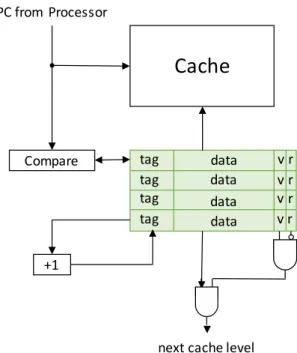
Figure 2.5 shows an example of a log address buffer with address checking logic that produces a valid signal determining whether or not the prefetching request is even valid. The logic shows an exhaustive check for the addresses, which is similar to a cache tag array of a fully-associative cache. Yet full-associativity is not very pragmatic for most cache designs. Ideally, the address check in the prefetcher needs to use the same associativity as the cache itself, because it is possible for the same tag to exist across multiple cache lines without there being a conflict miss. However, the hardware prefetcher does not have knowledge of the cache structure, so treating it as a fully-associative helps account for the worst-case scenario. However, if information about the cache’s structure was available to the prefetcher, this log address buffer could match its associativity when performing the address check. This would lead to even better performance than the evaluation shows.
Prefetching Policies.eFetch can employ various prefetching policies, such as next-line, stride,
locality-based, and Markov prefetching, with ordinary (not log updates, working data updates, or dependent reads) data accesses. The persistent write tracking only ensures that existing prefetching policies bypass the prefetching of memory regions for log. On top of the
prefetch-Cache
tag tag tag tag data data data data Compare PC from Processor +1next cache level r r r r v v v v
Figure 2.5: An example of a log address buffer with address checking logic that produces a valid signal determining whether or not the prefetching request is even valid.
ing policy used (which can be any of the various policies), eFetch performsredo log prefetching to manipulate log updates, working data updates, and dependent reads with redo-log-based per-sistent memory applications. If a perper-sistent memory application employs undo logging instead, eFetch performsundo logging triggered prefetchingon top of the prefetching policies used.
Prefetching Controller. The eFetch prefetching controller performs log address tracking; it
also initiates prefetching requests based on the prefetching policies used and determines the proposed prefetching mechanisms. Yet NV memory bandwidth is a critical resource for per-sistent memory application performance. Prefetching can hurt performance, if it interference with ordinary memory requests. Therefore, the eFetch prefetching controller monitors the NV memory bandwidth utilization, which is calculated as the ratio between the demanded mem-ory bandwidth and peak memmem-ory bandwidth. The eFetch prefetching controller calculates de-manded memory bandwidth by periodically sampling the hardware counter events such as NV memory reads and writes within a given time period. The peak memory bandwidth is known as memory bus frequency×bus width.
ser-vices L1 cache misses of working data updates before completing undo logging updates. How-ever, to ensure data persistence, writes to these prefetched cache blocks cannot be performed until after the undo logging updates are written into NV memory. As such, eFetch needs to adopt a hardware memory barrier between undo log updates and writes to the cache blocks of the working data. The hardware memory barrier is implemented in L1 cache controller. The controller will reject the writes to the prefetched cache blocks until it receives a signal from the memory controller, indicating that the log updates are already written into the NV memory. Note that low-level persistent memory instructions, such as Intel’spcommitcan ensure that the log writes arrive at NV memory by forcing them out of processor buffers.
2.5
Prefetching and Persistent Memory Experiments
This section describes the experiments and the tools needed to perform evaluation on eFetch.
2.5.1 Framework
This chapter uses McSimA+ [11] to simulate the systems described in the previous Design section. This simulator, although it has fewer configurationoptionsthan alternate sim-ulators, provides a simpler configuration interface. The source code is modular and flexible for modifying. It allows iterating more quickly on design ideas. Additionally, there is prior per-sistent memory research done with this simulator [148]. This reassures the confidence of the results.
The experiments configure the simulator to use a multi-core out-of-order processor, shown in Table 2.1. Each L1 cache has a 64-entry stride prefetcher. This means that itsdepth andstrideare 64. Note there is no L3 cache in this simulator, but the L2 is configured to match the Last Level Cache (LLC) of the corresponding processor. The prefetcher’s stride policy is not required for eFetch. Any prefetching policies may be used with eFetch’s mechanisms. Efetch uses stride because it is commonly used and can speedup the chosen persistent bench-marks. This is further discussed below and the effects of a standard stride prefetcher is shown in Section 2.6.