Hierarchical Multiobjective Stochastic Linear
Programming Problems Considering Both
Probability Maximization and Fractile
Optimization
Hitoshi Yano
Abstract—In this paper, we focus on hierarchical multiobjec-tive stochastic linear programming problems (HMOP) where multiple decision makers in a hierarchical organization have their own multiple objective linear functions together with common linear constraints. In order to deal with HMOP, a probability maximization model and a fractile optimization model are applied. By considering the conflict between permis-sible objective levels and permispermis-sible probability levels in such two models, it is assumed that each of the decision makers has fuzzy goals for permissible objective levels and permissible probability levels, and such fuzzy goals can be quantified by eliciting the membership functions. Through the fuzzy decision, such membership functions are integrated. In the integrated membership space, Pareto optimality concept is introduced. The interactive algorithm to obtain a satisfactory solution from among a Pareto optimal solution set is proposed on the basis of linear programming technique, in which the hierarchical decision structure is reflected by the decision power and the proper balance between permissible objective levels and the corresponding probability function is attained.
Index Terms—hierarchical multiobjective stochastic linear programming, decision power, a probability maximization model, a fractile optimization model, interactive decision mak-ing.
I. INTRODUCTION
The decision makers in practical hierarchical decision making situations often encounter two kinds of decision making processes, one is well known as a multi-level pro-gramming process and the other is the interactive decision making process [3]. The Stackelberg games are well-known as multilevel programming problems with multiple decision makers, in which the decision maker in each level makes his/her decision independently in order to optimize his/her own objective function [1], [9]. On the other hand, the interactive decision making process can be found in large scale hierarchical organizations such as multi-hierarchical companies, in which the decision maker in each level makes his/her decision through the interaction between the deci-sion makers and the lower level decideci-sion makers submit their own decision and then such decision is modified by the upper level decision makers with considerations of the overall benefits [3]. In order to deal with such an interactive decision making process, Lai [2], Shih et al.[8] and Lee et al.[3] introduced concepts of memberships of optimal-ities and degrees of decision powers and proposed fuzzy
Hitoshi Yano is with the Department of Social Sciences, School of Humanities and Social Sciences, Nagoya City University, 1, Yamanohata, Mizuho-cho, Mizuho-ku, Nagoya, 467-8501 Japan. This work was supported by JSPS KAKENHI(23510176).
approaches to obtain a satisfactory solution. As a natural extension of their approaches, Yano [10] proposed a fuzzy approach for hierarchical multiobjective linear programming problems. On the other hand, in the actual decision making situations, the decision makers often encounter difficulties to deal with vague information or uncertain data. Sakawa et al.[5],[6],[7] formulated multiobjective stochastic linear programming problems through a probability maximization model and a fractile optimization model, and proposed interactive algorithm to obtain a satisfactory solution from among a Pareto optimal solution set. Using a probability maximization model or a fractile optimization model, it is required for the decision maker to specify parameters called permissible objective levels or permissible probability levels in advance. However, it seems to be very difficult to specify such values in advance. In order to cope with such difficulties, Yano et al.[12] proposed fuzzy approaches to multiobjective stochastic linear programming problems, where the decision maker has fuzzy goals for permissible objective levels and permissible probability levels, and such fuzzy goals are quantified by eliciting the membership func-tions. Unfortunately, in the proposed method, it is assumed that the decision maker adopts the fuzzy decision [4] to obtain the satisfactory solution.
In this paper, we focus on hierarchical multiobjective stochastic linear programming problems [11], and propose an interactive algorithm to obtain a satisfactory solution from among a Pareto optimal solution set. In the proposed method, by considering the conflict between permissible objective levels and and permissible probability levels, the corresponding membership functions are integrated through the fuzzy decision. In the integrated membership space, Pareto optimal concept is introduced. In section II, hier-archical multiobjective programming problems through a probability maximization model is formulated. In section III, hierarchical multiobjective programming problems through a fractile optimization model is formulated. It is shown that the two kinds of formulations to obtain Pareto optimal solutions are same. In section IV, an interactive algorithm based on linear programming technique is proposed to obtain a satisfactory solution.
II. HIERARCHICALMULTIOBJECTIVESTOCHASTIC
LINEARPROGRAMMINGPROBLEMSTHROUGH A
PROBABILITYMAXIMIZATIONMODEL
We consider the following hierarchical multiobjective stochastic linear programming problem (HMOP), where each
IAENG International Journal of Applied Mathematics, 42:2, IJAM_42_2_04
of the decision makers (DMr, r= 1,· · ·, q) has his/her own
multiple objective linear functions together with common lin-ear constraints, and random variable coefficients are involved in each objective function.
[HMOP1]
first level decision maker : DM1 min
x∈Xz¯1(x) = (¯z11(x),· · ·,¯z1k1(x))
· · · ·
q-th level decision maker : DMq
min
x∈Xz¯q(x) = (¯zq1(x),· · ·,z¯qkq(x))
where x = (x1, x2,· · ·, xn) T
is n-dimensional decision column vector whose elements xi, i = 1,· · ·, n are
non-negative, X is a linear constraint set with respect to x. Each objective function of DMr, r = 1,· · ·, q is defined by
¯
zrℓ(x) =c¯rℓx+ ¯αrℓ,¯crℓ=c1rℓ+¯trℓc2rℓ,α¯rℓ=α1rℓ+¯trℓα2rℓ,
where¯crℓ, ℓ= 1,· · ·, kr arendimensional random variable
row vectors,α¯rℓ, ℓ= 1,· · ·, krare random variables, and¯trℓ
is a random variable whose cumulative distribution function
Trℓ(·) is assumed to be strictly monotone increasing and
continuous.
Similar to the formulations of multilevel linear program-ming problems proposed by Lee et al.[3], it is assumed that the upper level decision makers make their decisions with consideration of the overall benefits for the hierarchical or-ganization, although they can take priority for their objective functions over the lower level decision makers.
In order to deal with HMOP1, we adopt stochastic linear programming techniques. Using a probability maximization model [7], we substitute the minimization of the objective functionz¯rℓ(x)for the maximization of the probability that
¯
zrℓ(x)is less than or equal to a certain permissible objective
level frℓ. Such a probability prℓ(x, frℓ) can be defined as
follows.
prℓ(x, frℓ)
def
= Pr(ω|zrℓ(x, ω)≤frℓ), (1)
where Pr(·) denotes a probability measure, ω is an event, and zrℓ(x, ω) is a realization of the random objective
function z¯rℓ(x) under the occurrence of each elementary
event ω. Each of the decision makers (DMr, r = 1,· · ·, q)
subjectively specifies certain permissible objective levels fr= (fr1,· · ·, frkr), r= 1,· · ·, q,f = (f1,· · ·,fq).Then,
HMOP1 can be transformed into the following problem involving permissible objective levels as parameters.
[HMOP2(f)]
first level decision maker : DM1 max
x∈X(p11(x, f11),· · ·, p1k1(x, f1k1))
· · · ·
q-th level decision maker: DMq
max
x∈X(pq1(x, fq1),· · ·, pqkq(x, fqkq))
Under the assumption that c2
rℓx+α
2
rℓ > 0, r =
1,· · ·, q, ℓ= 1,· · ·, kr, the objective function prℓ(x, frℓ)in
HMOP1(f)is expressed as follows.
prℓ(x, frℓ) = Pr(ω|zrℓ(x, ω)≤frℓ)
= Trℓ
(
frℓ−(c1rℓx+α
1
rℓ)
c2
rℓx+α
2
rℓ
)
In HMOP2(f), each decision maker (DMr) seems to
prefer not only the less values of permissible objective levels fr, but also the larger values of the corresponding distribution functionsprℓ(x, frℓ), ℓ= 1,· · ·, kr. Since these
values conflict with each other, the less value of permissible objective level results in the less value of the corresponding probability function. Therefore, it is very important for each decision maker (DMr) to determine appropriate values of
permissible objective levels fr. Unfortunately, it seems to
be difficult for the decision maker to find appropriate values of permissible objective levels. In order to circumvent such difficulties, Yano et al. [12] proposed a fuzzy approach for multiobjective stochastic linear programming problems. From a similar point of view, instead of HMOP2(f), we consider the following multiobjective programming problem in which permissible objective levels are not constant values but the decision variables.
[HMOP3]
first level decision maker : DM1 max
x∈X,f1∈Rk1
(p11(x, f11),· · ·, p1k1(x, f1k1),−f11,· · ·,−f1k1)
· · · ·
q-th level decision maker: DMq
max x∈X,fq∈Rkq
(pq1(x, fq1),· · ·, pqkq(x, fqkq),−fq1,· · ·,−fqkq)
Considering the imprecise nature of the decision maker’s judgment, it is natural to assume that the decision maker have a fuzzy goal for each objective function in HMOP3. In this section, it is assumed that such a fuzzy goal can be quantified by eliciting a corresponding membership func-tion. Let us denote a membership function of prℓ(x, frℓ)
as µp˜rℓ(prℓ(x, frℓ)), and a membership function of frℓ as
µf˜
rℓ(frℓ)respectively. Then, HMOP3 can be transformed to
the following multiobjective programming problem.
[HMOP4]
first level decision maker : DM1
max x∈X,f1∈Rk1
(µp˜11(p11(x, f11)),· · ·, µp˜1k1
(p1k1(x, f1k1)), µf˜11(f11),· · ·, µf˜1k1 (f1k1))
· · · ·
q-th level decision maker: DMq
max x∈X,fq∈Rkq
(µp˜q1(pq1(x, fq1)),· · ·, µp˜qkq
(pqkq(x, fqkq)), µf˜q1(fq1),· · ·, µf˜qkq(fqkq))
Throughout this section, we make the following assumptions with respect to the membership functionsµp˜rℓ(prℓ(x, frℓ)),
µf˜rℓ(frℓ), r= 1,· · ·, q, ℓ= 1,· · ·, kr. Assumption 1.
µf˜rℓ(frℓ), r = 1,· · ·, q, ℓ= 1,· · ·, kr are strictly increasing
and continuous with respect topˆi, which is defined on the
interval[frℓmin, frℓmax]∈R1, whereµf˜rℓ(frℓ) = 0iffrℓ≥ frℓmax, andµf˜rℓ(frℓ) = 1 iff rℓ≤frℓmin.
Assumption 2.
µp˜rℓ(prℓ(x, frℓ)), r = 1,· · ·, q, ℓ = 1,· · ·, kr are strictly
decreasing and continuous with respect to prℓ(x, frℓ),
which is defined on the interval [prℓmin, prℓmax] ⊂ (0,1), where µp˜rℓ(prℓ(x, frℓ)) = 0 if prℓ(x, frℓ) ≤ prℓmin, and
µp˜rℓ(prℓ(x, frℓ)) = 1 ifprℓ(x, frℓ)≥prℓmax.
IAENG International Journal of Applied Mathematics, 42:2, IJAM_42_2_04
In order to determine these membership functions appro-priately, let us assume that the decision maker sets frℓmin, frℓmax prℓmin andprℓmax as follows.
At first, the decision maker specifies the parametersfrℓmin and frℓmax in his/her subjective manner, where frℓmin is sufficiently satisfactory maximum value and frℓmax is an acceptable maximum value, and sets the intervals Frℓ =
[frℓmin, frℓmax], r = 1,· · ·, q, ℓ = 1,· · ·, kr. prℓmax can be obtained by solving the following problem.
prℓmax def
= max
x∈Xprℓ(x, frℓmax) (2)
In order to obtain prℓmin, we first solve the problems, maxx∈Xprℓ(x, frℓmin), r = 1,· · ·, q, ℓ = 1,· · ·, kr. Let
xrℓ, r = 1,· · ·, q, ℓ = 1,· · ·, kr be the corresponding
optimal solution. Using the optimal solutions xrℓ, prℓmin can be obtained as follows.
prℓmin def
= min
s=1,···,q,t=1,···,ks,s̸=r,t̸=ℓ
prℓ(xst, frℓmin) (3)
It should be noted here that µp˜rℓ(prℓ(x, frℓ)) and
µf˜
rℓ(frℓ)are conflict each other for anyx∈X. Here, let us
assume that the decision maker adopts the fuzzy decision [4] in order to integrate both the membership functions
µp˜rℓ(prℓ(x, frℓ))andµf˜rℓ(frℓ). Then, the integrated
mem-bership function can be defined as follows.
µDprℓ(x, frℓ)
def
= min{µf˜rℓ(frℓ), µp˜rℓ(prℓ(x, frℓ))} (4)
Using the integrated membership functions µDprℓ(x, frℓ),
HMOP4 can be transformed into the following form.
[HMOP5]
first level decision maker : DM1 max
x∈X,f1ℓ∈R1,ℓ=1,···,k1
(
µDp11(x, f11),· · ·, µDp1k1(x, f1k1))
)
· · · ·
q-th level decision maker: DMq
max x∈X,fqℓ∈R1,ℓ=1,···,kq
(
µDpq1(x, fq1),· · ·, µDpqkq(x, fqkq))
)
In order to deal with HMOP5, we introduce a Dp-Pareto
optimal solution concept.
Definition 1.
x∗∈X, frℓ∗ ∈R1, r= 1,· · ·, q, ℓ= 1,· · ·, k
ris said to be a Dp-Pareto optimal solution to HMOP5, if and only if there
does not exist another x ∈X, frℓ ∈ R1, r = 1,· · ·, q, ℓ=
1,· · ·, kr such that µDprℓ(x, frℓ) ≥ µDprℓ(x∗, frℓ∗), r =
1,· · ·, q, ℓ= 1,· · ·, kr, with strict inequality holding for at
least one randℓ.
For generating a candidate of a satisfactory solution which is also Dp-Pareto optimal, each decision maker (DMr) is
asked to specify the reference membership values µˆr =
(ˆµr1,· · ·,µˆrkr)[4]. Once the reference membership values
are specified, the corresponding Dp-Pareto optimal solution
is obtained by solving the following minmax problem.
[MINMAX1(µˆ)]
min
x∈X,frℓ∈R1,r=1,···,q,ℓ=1,···,kr,λ∈Λ
λ (5)
subject to
ˆ
µrℓ−µp˜rℓ(prℓ(x, frℓ)) ≤λ, (6)
ˆ
µrℓ−µf˜
rℓ(frℓ) ≤λ, (7)
r= 1,· · ·, q, ℓ= 1,· · ·, kr
where
Λ = [ max
r=1,···,q,ℓ=1,···,kr
wr(ˆµrℓ−1) +δ,
min
r=1,···,q,ℓ=1,···,kr
wrµˆrℓ−δ].
whereδ is a sufficiently small positive constant.
It should be noted here that, in general, the optimal solution of MINMAX1(µ) does not reflect the hierarchicalˆ
structure between q decision makers where the upper level decision maker can take priority for his/her distribution functions over the lower level decision makers. In order to cope with such a hierarchical preference structure between
qdecision makers, we introduce the concept of the decision power [2]w = (w1,· · ·, wq), where ther-th level decision
maker (DMr) can specify the decision powerwr+1in his/her subjective manner and the last decision maker (DMq) has no
decision power. In order to reflect the hierarchical preference structure between multiple decision makers, the decision powers w = (w1,· · ·, wq) have to satisfy the following
inequality conditions.
w1= 1≥w2≥ · · · ≥wq−1≥wq >0 (8)
Then, the corresponding modified MINMAX1(µ) is refor-ˆ
mulated as follows.
[MINMAX2(µˆ,w)]
min
x∈X,frℓ∈R1,r=1,···,q,ℓ=1,···,kr,λ∈Λ
λ (9)
subject to
ˆ
µrℓ−µp˜rℓ(prℓ(x, frℓ)) ≤λ/wr, (10)
ˆ
µrℓ−µf˜rℓ(frℓ) ≤λ/wr, (11)
r= 1,· · ·, q, ℓ= 1,· · ·, kr
Since µp˜rℓ(prℓ(x, frℓ))is strictly monotone increasing and
continuous andc2
rℓx+α
2
rℓ >0, the constraint (10) can be
transformed as follows.
ˆ
µrℓ−µp˜rℓ(prℓ(x, frℓ))≤λ/wr, ⇔ prℓ(x, frℓ)≥µ−p˜rℓ1(ˆµrℓ−λ/wr), ⇔ Trℓ
(
frℓ−(c1rℓx+α
1
rℓ)
c2
rℓx+α2rℓ
)
≥µ−p˜1
rℓ(ˆµrℓ−λ/wr), ⇔ frℓ−(c1rℓx+α1rℓ)
≥Trℓ−1(µ−p˜1
rℓ(ˆµrℓ−λ/wr))·(c
2
rℓx+α
2
rℓ). (12)
whereµ−p˜1
rℓ(·)andT
−1
rℓ (·)are inverse functions with respect
to µp˜rℓ(·) and Trℓ(·) respectively. Moreover, it holds that
frℓ≤µ−f˜1
rℓ
(ˆµrℓ−λ/wr),becauseµf˜rℓ(frℓ)is strictly
mono-tone decreasing and continuous. As a result, the constraints (10) and (11) can be reduced to the following inequality where a permissible objective levelfrℓ is removed.
µ−˜1 frℓ
(ˆµrℓ−λ/wr)−(c1rℓx+α
1
rℓ)
≥Trℓ−1(µ−p˜1
rℓ(ˆµrℓ−λ/wr))·(c
2
rℓx+α
2
rℓ) (13)
Then, MINMAX2(µˆ,w) is equivalently transformed to the following problem.
[MINMAX3(µˆ,w)]
min
x∈X,λ∈Λλ (14)
subject to
IAENG International Journal of Applied Mathematics, 42:2, IJAM_42_2_04
µ−˜1 frℓ
(ˆµrℓ−λ/wr)−(c1rℓx+α
1
rℓ)
≥Trℓ−1(µ−p˜1
rℓ(ˆµrℓ−λ/wr))·(c
2
rℓx+α
2
rℓ) r= 1,· · ·, q, ℓ= 1,· · ·, kr (15)
It should be noted here that the constraints (15) can be reduced to a set of linear inequalities for some fixed value
λ ∈ Λ. This means that an optimal solution (x∗, λ∗) of MINMAX3(µˆ,w) is obtained by combined use of the bisection method with respect toλand the first-phase of the two-phase simplex method of linear programming.
The relationship between the optimal solution(x∗, λ∗)of MINMAX3(µˆ,w) and Dp-Pareto optimal solutions can be
characterized by the following theorem.
Theorem 1.
If (x∗, λ∗) is a unique optimal solution of MINMAX3(µˆ,w), thenx∗∈X,frℓ∗ =µ−˜1
frℓ
(ˆµrℓ−λ∗/wr), r= 1,· · ·, q, ℓ= 1,· · ·, kr is a Dp-Pareto optimal solution
to HMOP5. (Proof)
Since an optimal solution (x∗, λ∗) satisfies the constraints (15), it holds that
Trℓ
( µ−˜1
frℓ
(ˆµrℓ−λ∗/wr)−(c1rℓx∗+α
1
rℓ)
c2
rℓx∗+α
2
rℓ
)
=prℓ(x∗, µf−˜rℓ1(ˆµrℓ−λ∗/wr))
≥µ−p˜1
rℓ(ˆµrℓ−λ
∗/w
r), r= 1,· · ·, q, ℓ= 1,· · ·, kr.
Assume that x∗ ∈ X, frℓ∗ = (µ−˜1 frℓ
(ˆµrℓ − λ∗/wr), r = 1,· · ·, q, ℓ = 1,· · ·, kr is not a Dp-Pareto
opti-mal solution to HMOP5, then there exists x ∈ X frℓ, r = 1,· · ·, q, ℓ = 1,· · ·, kr such that µDprℓ(x, frℓ) =
min{µf˜rℓ(frℓ), µp˜rℓ(prℓ(x, frℓ))} ≥ µDprℓ(x∗, µ
−1 ˜
frℓ(ˆµrℓ−
λ∗/wr)) = ˆµrℓ−λ∗/wr, r = 1,· · ·, q, ℓ = 1,· · ·, kr, with
strict inequality holding for at least one r and ℓ. Then it holds that
µf˜rℓ(frℓ) ≥ µˆrℓ−λ∗/wr, (16) µp˜rℓ(prℓ(x, frℓ)) ≥ µˆrℓ−λ∗/wr, (17)
r = 1,· · ·, q, ℓ = 1,· · ·, kr. From the definition (1), the
inequalities (16) and (17) can be transformed into the in-equalities,frℓ≤µ−f˜rℓ1(ˆµrℓ−λ∗/wr), frℓ≥Trℓ−1(µ−
1 ˜
prℓ(ˆµrℓ−
λ∗/wr))· (c2rℓx+α
2
rℓ) + (c
1
rℓx+α
1
rℓ). This means that
there exists some x ∈ X such that µ−˜1
frℓ(ˆµrℓ−λ
∗/wr) ≥
Trℓ−1(µ−p˜1
rℓ(ˆµrℓ − λ
∗/wr))· (c2
rℓx+α
2
rℓ) + (c
1
rℓx +α
1
rℓ), r = 1,· · ·, q, ℓ = 1,· · ·, kr, which contradicts the fact
that x∗ ∈ X, λ∗ ∈ Λ is a unique optimal solution to MINMAX3(µˆ,w).
III. HIERARCHICALMULTIOBJECTIVESTOCHASTIC
LINEARPROGRAMMINGPROBLEMSTHROUGH A
FRACTILEOPTIMIZATIONMODEL
If we adopt a fractile optimization model [6] for HMOP1, we can convert HMOP1 to the following multiobjective programming problem.
[HMOP6(p)ˆ]
first level decision maker : DM1 min
x∈X,f1ℓ∈R1,ℓ=1,···,kr
(f11,· · ·, f1k1)
· · · ·
q-th level decision maker: DMq
min x∈X,fqℓ∈R1,ℓ=1,···,kq
(fq1,· · ·, fqkq)
subject to
prℓ(x, frℓ)≥pˆrℓ, r= 1,· · ·, q, ℓ= 1,· · ·, kr (18)
wherepˆr = (ˆpr1,· · ·,pˆrkr), r = 1,· · ·, q,pˆ= (pˆ1,· · ·,pˆq)
are vectors of permissible probability levels which are spec-ified by the decision maker (DMr, r = 1,· · ·, q) in his/her
subjective manner.
In HMOP6(p), the constraint (18) can be transformed intoˆ
the following form.
ˆ
prℓ ≤ prℓ(x, frℓ) =Trℓ
(
frℓ−(c1rℓx+α
1
rℓ)
c2
rℓx+α
2
rℓ
)
⇔ frℓ ≥ Trℓ−1(ˆprℓ)·(c2rℓx+α
2
rℓ) + (c
1
rℓx+α
1
rℓ)
Let us define the right-hand side of the above inequality as follows.
frℓ(x,pˆrℓ)
def
= Trℓ−1(ˆprℓ)·(c2rℓx+α
2
rℓ) + (c
1
rℓx+α
1
rℓ) (19)
Then, HMOP6(p)ˆ can be equivalently reduced to the follow-ing simple form.
[HMOP7(p)ˆ]
first level decision maker : DM1 min
x∈X (f11(x,pˆ11),· · ·, f1k1(x,pˆ1k1))
· · · ·
q-th level decision maker: DMq
min
x∈X (fq1(x,pˆq1),· · ·, fqkq(x,pˆqkq))
In order to deal with HMOP7(p), the decision makerˆ
must specify permissible probability levels pˆ in advance. However, in general, the decision maker seems to prefer not only the less value of the objective functionfrℓ(x,pˆrℓ)
but also the larger value of the permissible probability level ˆ
prℓ. From such a point of view, we consider the following
multiobjective programming problem which can be regarded as a natural extension of HMOP7(p).ˆ
[HMOP8]
first level decision maker : DM1 min
x∈X (f11(x,pˆ11),· · ·, f1k1(x,pˆ1k1),−pˆ11,· · ·,−pˆ1k1)
· · · ·
q-th level decision maker: DMq
min
x∈X (fq1(x,pˆq1),· · ·, fqkq(x,pˆqkq),−pˆq1,· · ·,−pˆqkq)
Considering the imprecise nature of the decision maker’s judgment, we assume that the decision maker has a fuzzy goal for each objective function in HMOP8. Such a fuzzy goal can be quantified by eliciting the corresponding mem-bership function. Let us denote a memmem-bership function of an objective functionfrℓ(x,pˆrℓ)as µf˜rℓ(frℓ(x,pˆrℓ)), and a
membership function of a permissible probability level pˆrℓ
asµ˜pˆrℓ(ˆprℓ)respectively. Then, HMOP8 can be transformed
as the following problem.
[HMOP9]
first level decision maker : DM1
max x∈X,pˆ1∈(0,1)k1
(
µf˜11(f11(x,pˆ11)),· · ·, µf˜
1k1 (f1k1
(x,pˆ1k1)), µ˜pˆ11(ˆp11),· · ·, µ˜pˆ1k1(ˆp1k1)
)
IAENG International Journal of Applied Mathematics, 42:2, IJAM_42_2_04
· · · ·
q-th level decision maker: DMq
max x∈X,pˆq∈(0,1)kq
(
µf˜q1(fq1(x,pˆq1)),· · ·, µf˜
qkq(fqkq
(x,pˆqkq)), µ˜pˆq1(ˆpq1),· · ·, µ˜pˆqkq(ˆpqkq)
)
Throughout this section, we make the following as-sumptions with respect to the membership functions
µfrℓ(frℓ(x,pˆrℓ)), µp˜ˆrℓ(ˆprℓ), r= 1,· · ·, q, ℓ= 1,· · ·, kr. Assumption 3.
µ˜pˆ
rℓ(ˆprℓ), r = 1,· · ·, q, ℓ= 1,· · ·, kr are strictly increasing
and continuous with respect to pˆrℓ, which is defined on the
interval [prℓmin, prℓmax] ⊂ (0,1), where µ˜pˆ
rℓ(ˆprℓ) = 0 if
ˆ
prℓ≤prℓmin, andµ˜pˆrℓ(ˆprℓ) = 1 ifpˆrℓ≥prℓmax.
Assumption 4.
µfrℓ(frℓ(x,pˆrℓ)), r = 1,· · ·, q, ℓ = 1,· · ·, kr are strictly
decreasing and continuous with respect tofrℓ(x,pˆrℓ), which
is defined on the interval [frℓmin, frℓmax] ∈ R1, where µfrℓ(frℓ(x,pˆrℓ)) = 0 if frℓ(x,pˆrℓ) ≥ frℓmax, and
µfrℓ(frℓ(x,pˆrℓ)) = 1 iffrℓ(x,pˆrℓ)≤frℓmin.
In order to determine these membership functions appro-priately, let us assume that the decision maker sets prℓmin, prℓmax frℓmin andfrℓmax as follows.
At first, the decision maker specifies the parametersprℓmin and prℓmax in his/her subjective manner, where prℓmin is an acceptable minimum value and prℓmax is a sufficiently satisfactory minimum value, and sets the intervals Prℓ =
[prℓmin, prℓmax], r = 1,· · ·, q, ℓ= 1,· · ·, kr. Corresponding
to the interval Prℓ, frℓmin can be obtained by solving the following linear programming problem.
frℓmin def
= min
x∈Xfrℓ(x, prℓmin) (20)
In order to obtain frℓmax, we first solve the following linear programming problems, minx∈Xfrℓ(x, prℓmax), r = 1,· · ·, q, ℓ= 1,· · ·, kr. Letxrℓ, r = 1,· · ·, q, ℓ= 1,· · ·, kr
be the above optimal solution. Using the optimal solutions xrℓ,frℓmax can be obtained as follows.
frℓmax def
= max
s=1,···,q,t=1,···,ks,s̸=r,t̸=ℓ
frℓ(xst,pˆrℓmax) (21)
It should be noted here that, from (19), µf˜rℓ(frℓ(x,pˆrℓ))
andµ˜pˆ
rℓ(ˆprℓ)are conflict each other for anyx∈X. Here,
let us assume that the decision maker adopts the fuzzy decision [4] in order to integrate both the membership func-tions µf˜rℓ(frℓ(x,pˆrℓ)) and µ˜pˆrℓ(ˆprℓ). Then, the integrated
membership function can be defined as follows.
µDfrℓ(x,pˆrℓ)
def
= min{µ˜pˆ
rℓ(ˆprℓ), µf˜rℓ(frℓ(x,pˆrℓ))} (22)
Using the membership functionsµDfrℓ(x,pˆrℓ), HMOP9 can
be transformed into the following form.
[HMOP10]
first level decision maker : DM1 max
x∈X,pˆ1ℓ∈(0,1),ℓ=1,···,k1
(
µDf11(x,pˆ11),· · ·, µDf1k 1
(x,pˆ1k1))
)
· · · ·
q-th level decision maker: DMq
max
x∈X,pˆqℓ∈(0,1),ℓ=1,···,kq
(
µDfq1(x,pˆq1),· · ·, µDfqkq(x,pˆqkq))
)
In order to deal with HMOP10, we introduce a Df-Pareto
optimal solution concept.
Definition 2.
x∗ ∈ X,pˆ∗rℓ ∈ (0,1), r = 1,· · ·, q, ℓ = 1,· · ·, kr is
said to be a Df-Pareto optimal solution to HMOP10, if
and only if there does not exist another x ∈ X,pˆrℓ ∈
(0,1), r= 1,· · ·, q, ℓ= 1,· · ·, kr such thatµDfrℓ(x,pˆrℓ)≥ µDfrℓ(x∗,pˆ∗rℓ) r = 1,· · ·, q, ℓ = 1,· · ·, kr, with strict
inequality holding for at least onerandℓ.
For generating a candidate of the satisfactory solution which is alsoDf-Pareto optimal, the decision maker is asked
to specify the reference membership values [4]. Similar to MINMAX2(µˆ,w) in the previous section, once the reference membership values µˆr = (ˆµr1,· · ·,µˆrkr)and the decision
power wr+1 are specified by each of the decision makers (DMr, r = 1,· · ·, q), the corresponding Df-Pareto optimal
solution is obtained by solving the following minmax prob-lem.
[MINMAX4(µˆ,w)]
min
x∈X,pˆrℓ∈(0,1),r=1,···,q,ℓ=1,···,kr,λ∈Λ
λ (23)
subject to
ˆ
µrℓ−µf˜
rℓ(frℓ(x,pˆrℓ)) ≤ λ/wr, (24)
ˆ
µrℓ−µ˜pˆrℓ(ˆprℓ) ≤ λ/wr, (25)
r= 1,· · ·, q, ℓ= 1,· · ·, kr
Because of c2rℓx+α2rℓ > 0, the constraints (24) can be transformed as follows.
ˆ
prℓ≤Trℓ
( µ−˜1
frℓ
(ˆµrℓ−λ/wr)−(c1rℓx+α
1
rℓ)
c2
rℓx+α2rℓ
) (26)
where µ−˜1 frℓ
(·) is an inverse function of µf˜rℓ(·). From the
constraints (25), it holds that pˆrℓ ≥ µ−˜pˆ1
rℓ
(ˆµrℓ −λ/wr),
where µ−˜1 ˆ
prℓ(·) is an inverse function of µ˜pˆrℓ(·). Therefore, the constraint (26) can be reduced to the following inequality where a permissible probability levelpˆrℓis disappeared.
µ−˜1 frℓ
(ˆµrℓ−λ/wr)−(c1rℓx+α
1
rℓ)
≥ Trℓ−1(µ−˜1 ˆ
prℓ(ˆµrℓ−λ/wr))·(c
2
rℓx+α
2
rℓ) (27)
Then, MINMAX4(µˆ,w) can be equivalently reduced to the following problem.
[MINMAX5(µˆ,w)]
min
x∈X,λ∈Λλ (28)
subject to
µ−˜1 frℓ
(ˆµrℓ−λ/wr)−(c1rℓx+α
1
rℓ)
≥ Trℓ−1(µ−˜1 ˆ
prℓ(ˆµrℓ−λ/wr))·(c
2
rℓx+α
2
rℓ), r= 1,· · ·, q, ℓ= 1,· · ·, kr (29)
It should be noted here that MINMAX5(µˆ,w) is same as MINMAX3(µˆ,w). Therefore, an optimal solution (x∗, λ∗) of MINMAX5(µˆ,w) can be obtained by combined use of the bisection method with respect toλand the first-phase of the two-phase simplex method of linear programming.
The relationship between the optimal solution(x∗, λ∗)of MINMAX5(µˆ,w) and Df-Pareto optimal solutions can be
characterized by the following theorem.
Theorem 2.
If x∗ ∈ X, λ∗ ∈ Λ is a unique optimal solution of MINMAX5(µˆ,w), then x∗ ∈ X,pˆ∗rℓ = µ−˜1
ˆ
prℓ(ˆµrℓ −
IAENG International Journal of Applied Mathematics, 42:2, IJAM_42_2_04
λ∗/wr)), r= 1,· · ·, q, ℓ= 1,· · ·, kr is aDf-Pareto optimal
solution. (Proof)
From (29), it holds that µˆrℓ − λ∗/wr ≤ µf˜rℓ(frℓ(x
∗, µ−1 ˜ˆ
prℓ(ˆµrℓ − λ
∗/wr))), r = 1,· · ·, q, ℓ =
1,· · ·, kr. Assume that x∗ ∈ X, µ−˜pˆ1
rℓ
(ˆµrℓ − λ∗/wr), r = 1,· · ·, q, ℓ = 1,· · ·, kr is not a Df
-Pareto optimal solution. Then, there exist x ∈ X,pˆrℓ, r = 1,· · ·, q, ℓ = 1,· · ·, kr such that µDfrℓ(x,pˆrℓ) = min{µ˜pˆrℓ(ˆprℓ), µf˜rℓ(frℓ(x,pˆrℓ)),} ≥ µDfrℓ(x∗, µp˜−ˆrℓ1(ˆµrℓ − λ
∗/w
r)) = µˆrℓ − λ∗/wr, r = 1,· · ·, q, ℓ= 1,· · ·, kr, strict inequality holding for at
least one randℓ. Then it holds that
µ˜pˆ
rℓ(ˆprℓ) ≥ µˆrℓ−λ
∗/w
r, (30) µf˜rℓ(frℓ(x,pˆrℓ)) ≥ µˆrℓ−λ∗/wr, (31) r = 1,· · ·, q, ℓ = 1,· · ·, kr. From the definition (19),
the inequalities (30) and (31) can be transformed into the inequalities, pˆrℓ ≥ µp˜−ˆrℓ1(ˆµrℓ − λ
∗/w
r),pˆrℓ ≤
Trℓ
(µ−1 ˜ frℓ( ˆµrℓ−λ
∗/w
r)−(c1rℓx∗+α1rℓ)
c2 rℓx∗+α
2 rℓ
)
. This means
that there exists some x ∈ X such that
µ−˜1 frℓ
(ˆµrℓ−λ∗/wr)−(c1rℓx+α
1
rℓ) ≥ T−
1
rℓ (µ−
1 ˜ˆ
prℓ(ˆµrℓ − λ∗/wr))·(c2rℓx+α
2
rℓ), r = 1,· · ·, q, ℓ= 1,· · ·, kr, which
contradicts the fact thatx∗∈X, λ∗∈Λis a unique optimal solution to MINMAX5(µˆ,w).
IV. ANINTERACTIVEALGORITHM
In this section, we propose an interactive algorithm to obtain a satisfactory solution of the decision maker from among Df-Pareto optimal solution set. Unfortunately, it
is not guaranteed that the optimal solution (x∗, λ∗) of MINMAX5(µˆ,w) is Df-Pareto optimal, if (x∗, λ∗) is not
unique. In order to guaranteeDf-Pareto optimality, we first
assume that ∑qr=1kr constraints (29) of MINMAX5(µˆ,w)
are active at the optimal solution (x∗, λ∗). If one of the constraints of (29) is inactive, i.e.,
µ−˜1 frℓ
(ˆµrℓ−λ∗/wr)−(c1rℓx∗+α
1
rℓ)
> Trℓ−1(µ−˜1 ˆ
prℓ(ˆµrℓ−λ
∗/w
r))·(c2rℓx∗+α
2
rℓ), (32)
we can convert the inactive constraint (32) into the active one by applying the bisection method, where
Grℓ(ˆµrℓ)
def = µ−˜1
frℓ
(ˆµrℓ−λ∗/wr)−frℓ(x∗, µ−˜pˆrℓ1(ˆµrℓ−λ
∗/w
r)).
[The bisection method for the inactive constraint] Step 1. SetqLrℓ←λ∗/wr,qRrℓ←λ∗/wr+ 1. Step 2. Setqrℓ←(qrℓL +q
R rℓ)/2.
Step 3. If Grℓ(qrℓ)>0 thenqLrℓ←qrℓ and go to Step 2,
else ifGrℓ(qrℓ)<0thenqrℓR ←qrℓand go to Step 2, else if Grℓ(qrℓ) = 0, then update the reference membership value
as µˆrℓ←qrℓ and stop.
For the optimal solution (x∗, λ∗) of MINMAX5(µˆ,w), where the active conditions of the constraints (29) are satisfied, we solve the Df-Pareto optimality test problem
formulated as follows.
[Test problem forDf-Pareto optimality]
max
x∈X,ϵrℓ≥0,r=1,···,q,ℓ=1,···,kr
w=
q
∑
r=1
kr
∑
ℓ=1
ϵrℓ (33)
subject to
Trℓ−1(µ−˜1 ˆ
prℓ(ˆµrℓ−λ
∗/w
r))·(c2rℓx+α
2
rℓ)
+(c1rℓx+α1rℓ) +ϵrℓ
= Trℓ−1(µ−˜1 ˆ
prℓ(ˆµrℓ−λ
∗/w
r))·(c2rℓx∗+α
2
rℓ)
+(c1rℓx∗+α1rℓ), r= 1,· · ·, q, ℓ= 1,· · ·, kr(34)
For the optimal solution of the above test problem, the following theorem holds.
Theorem 3.
Let xˇ ∈ X,ϵˇrℓ ≥ 0, r = 1,· · ·, q, ℓ = 1,· · ·, kr be an
optimal solution of the test problem (33)-(34). If w = 0, x∗∈X, µ−˜1
ˆ
prℓ(ˆµrℓ−λ
∗/wr), r= 1,· · ·, q, ℓ= 1,· · ·, kr is a
Df-Pareto optimal solution.
(Proof)
From the active conditions of the constraints (29), it holds that µˆrℓ − λ∗/wr = µf˜rℓ(frℓ(x
∗, µ−1 ˜ ˆ
prℓ(ˆµrℓ − λ∗/wr))), r = 1,· · ·, q, ℓ = 1,· · ·, kr. If x∗ ∈ X, µ−˜1
ˆ
prℓ(ˆµrℓ − λ
∗/wr), r = 1,· · ·, q, ℓ = 1,· · ·, kr is
not a Df-Pareto optimal solution, there exists some x ∈ X,pˆrℓ, r= 1,· · ·, q, ℓ= 1,· · ·, krsuch thatµDfrℓ(x,pˆrℓ) =
min{µ˜pˆ
rℓ(ˆprℓ), µf˜rℓ(frℓ(x,pˆrℓ))} ≥µDfrℓ(x
∗, µ−1 ˜ˆ
prℓ(ˆµrℓ− λ∗/wr)) = ˆµrℓ−λ∗/wr, r = 1,· · ·, q, ℓ= 1,· · ·, kr, with
strict inequality holding for at least onerandℓ. This means that the following inequalities hold.
µp˜ˆrℓ(ˆprℓ) ≥ µˆrℓ−λ∗/wr, (35) µf˜rℓ(frℓ(x,pˆrℓ)) ≥ µˆrℓ−λ
∗/w
r, (36)
r = 1,· · ·, q, ℓ = 1,· · ·, kr. This means that there exists
some x ∈ X, pˆrℓ, r = 1,· · ·, q, ℓ = 1,· · ·, kr such
that µ−˜1 frℓ
(ˆµrℓ−λ∗/wr)≥(c1rℓx+α1rℓ) +T−
1
rℓ (µ−
1 ˜ˆ
prℓ(ˆµrℓ− λ∗/wr))·(crℓ2x+α2rℓ). Because of the active conditions of
the constraints (29), it holds thatTrℓ−1(µ−˜1 ˆ
prℓ(ˆµrℓ−λ
∗/wr))·
(c2
rℓx∗+α2rℓ) + (c1rℓx∗+α1rℓ)≥T−
1
rℓ (µ−
1 ˜ ˆ
prℓ(ˆµrℓ−λ
∗/wr))·
(c2
rℓx+α2rℓ) + (c1rℓx+αrℓ1 ), r = 1,· · ·, q, ℓ = 1,· · ·, kr,
with strict inequality holding for at least one r andℓ. This contradicts the fact thatw= 0.
Now, following the above discussions, we can present the interactive algorithm in order to derive a satisfactory solution from among aDf-Pareto optimal solution set.
[An interactive algorithm]
Step 1: Each of the decision maker (DMr, r = 1,· · ·, q) sets his/her membership functions µ˜pˆ
rℓ(ˆprℓ), ℓ = 1,· · ·, kr
in his/her subjective manner.
Step 2: Corresponding to the membership functions
µ˜pˆ
rℓ(ˆprℓ), ℓ = 1,· · ·, kr, each of the decision maker
(DMr, r = 1,· · ·, q) sets his/her membership functions µf˜
rℓ(frℓ(x,pˆrℓ)), ℓ= 1,· · ·, kr.
Step 3: Set the initial reference membership values asµˆrℓ=
1, r= 1,· · ·, q, ℓ= 1,· · ·, kr, and the initial decision power
aswr= 1, r= 1,· · ·, q.
Step 4: Solve MINMAX5(µˆ,w) by combined use of the bisection method and the first-phase of the two-phase simplex method of linear programming. If the active condition of the constraints (29) is not satisfied at the optimal solution (x∗, λ∗), then the bisection method with respect to the refer-ence membership value is applied, andDf-Pareto optimality
test problem is solved.
IAENG International Journal of Applied Mathematics, 42:2, IJAM_42_2_04
Step 5: If each of the decision makers (DMr, r= 1,· · ·, q)
is satisfied with the current values of the Df-Pareto
opti-mal solution µDfrℓ(x∗,pˆ∗rℓ), ℓ = 1,· · ·, kr, where pˆ∗rℓ = µ−˜1
ˆ
prℓ(ˆµrℓ−λ
∗),then stop. Otherwise, let thes-th level
deci-sion maker (DMs) be the uppermost of the decision makers
who are not satisfied with the current values. Considering the current values of his/her membership functions, DMs
updates his/her decision powerws+1and/or his/her reference membership values µˆsℓ, ℓ = 1,· · ·, ks according to the
following two rules, and return to Step 4.
Rule 1 ws+1 must be set as ws+1 ≤ ws. After updating ws+1, ifws+1< wt, s+ 2≤t≤q,wt is replaced byws+1 (wt←ws+1).
Rule 2 Before updating DMs’s reference membership values ˆ
µsℓ, ℓ = 1,· · ·, ks, the other decision makers’ reference
membership values are fixed as the current values ( µˆrℓ ← µDfrℓ(x∗,pˆ∗rℓ), r= 1,· · ·, q, r̸=s, ℓ= 1,· · ·, kr ) .
V. A NUMERICALEXAMPLE
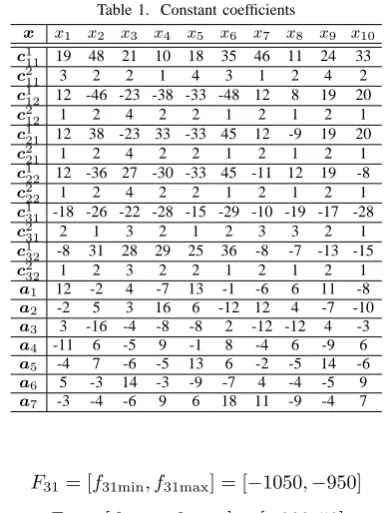
[image:7.595.328.521.52.309.2]In order to demonstrate the proposed method for HMOP1, we consider the following hierarchical two-objective stochas-tic linear programming problem under three hypothestochas-tical decision makers.
[HMOP1]
first level decision maker : DM1 min ¯z11(x) = (c111+ ¯t11c211)x+ (α
1
11+ ¯t11α211)
min ¯z12(x) = (c112+ ¯t12c212)x+ (α 1
12+ ¯t12α212)
second level decision maker : DM2 min ¯z21(x) = (c121+ ¯t21c221)x+ (α
1
21+ ¯t21α221)
min ¯z22(x) = (c122+ ¯t22c222)x+ (α122+ ¯t22α222)
third level decision maker : DM3 min ¯z31(x) = (c131+ ¯t31c231)x+ (α
1
31+ ¯t31α231)
min ¯z32(x) = (c132+ ¯t32c232)x+ (α 1
32+ ¯t32α232)
subject to x ∈ X def= {x ∈ R10 | a
ix ≤ bi, i =
1,· · ·,7,x≥0}
In HMOP1, x= (x1, x2,· · ·, x10)
T
is the decision column vector, ai, i = 1,· · ·,7, c1rℓ, c
2
rℓ, r = 1,2,3, ℓ = 1,2 are
the constant coefficient row vectors which are shown in Table 1, and α111 = −18, α211 = 5, α112 = −27, α212 = 6, α1
21 = −12, α221 = 3, α122 = −15, α222 = 4, α131 =
−10, α2
31 = 4, α132 =−27, α232 = 6. The right side of the constraints are b1 = 140, b2 = −220, b3 = −190, b4 = 75, b5 = −160, b6 = 130, b7 = 90. And trℓ(ω), r =
1,2,3, ℓ = 1,2 are Gaussian random variables defined as ¯
t11 ∼ N(4,22),¯t12 ∼ N(3,32),¯t21 ∼ N(3,12),t¯22 ∼ N(3,22),¯t
31∼N(3,22),t¯32∼N(3,32).
According to the proposed interactive algorithm, at Step 1, the individual minimum and maximum ofE(¯zrℓ(x)), r=
1,2,3, ℓ= 1,2are calculated. Considering such values, each decision maker (DMr) specifies the following intervals for µfrℓ(frℓ).
F11= [f11min, f11max] = [2000,2200]
F12= [f12min, f12max] = [400,700]
F21= [f21min, f21max] = [800,1000]
F22= [f22min, f22max] = [650,800]
Table 1. Constant coefficients
x x1 x2 x3 x4 x5 x6 x7 x8 x9 x10 c1
11 19 48 21 10 18 35 46 11 24 33 c2
11 3 2 2 1 4 3 1 2 4 2
c1
12 12 -46 -23 -38 -33 -48 12 8 19 20 c2
12 1 2 4 2 2 1 2 1 2 1
c1
21 12 38 -23 33 -33 45 12 -9 19 20 c221 1 2 4 2 2 1 2 1 2 1
c1
22 12 -36 27 -30 -33 45 -11 12 19 -8 c2
22 1 2 4 2 2 1 2 1 2 1
c131 -18 -26 -22 -28 -15 -29 -10 -19 -17 -28
c2
31 2 1 3 2 1 2 3 3 2 1
c1
32 -8 31 28 29 25 36 -8 -7 -13 -15 c2
32 1 2 3 2 2 1 2 1 2 1
a1 12 -2 4 -7 13 -1 -6 6 11 -8 a2 -2 5 3 16 6 -12 12 4 -7 -10 a3 3 -16 -4 -8 -8 2 -12 -12 4 -3 a4 -11 6 -5 9 -1 8 -4 6 -9 6 a5 -4 7 -6 -5 13 6 -2 -5 14 -6 a6 5 -3 14 -3 -9 -7 4 -4 -5 9 a7 -3 -4 -6 9 6 18 11 -9 -4 7
F31= [f31min, f31max] = [−1050,−950]
F32= [f32min, f32max] = [−200,50]
On these intervals, each hypothetical decision maker defines his/her membership functionsµfrℓ(frℓ), r= 1,2,3, ℓ= 1,2
(Step 1).
µfrℓ(frℓ) =
frℓ−frℓmax frℓmin−frℓmax
Corresponding to the intervalsFrℓ, r = 1,2,3, ℓ= 1,2, the
intervals forµprℓ(prℓ(x, frℓ))can be obtained by solving the
following problems.
prℓmax= max
x∈Xprℓ(x, frℓmax) prℓmin= min
s=1,2,3,t=1,2,s≠ r,t̸=ℓprℓ(xst, frℓmin)
where xst is the optimal solution of the problem
maxx∈Xprℓ(x, frℓmin), r = 1,2,3, ℓ = 1,2. Then, we obtain the following values.
[p11min, p11max] = [0.023,0.959]
[p12min, p12max] = [0.015,0.993]
[p21min, p21max] = [0.001,0.999]
[p22min, p22max] = [0.259,0.995],
[p31min, p31max] = [0.136,0.859]
[p32min, p32max] = [0.001,0.987]
On these intervals, each hypothetical decision maker sets his/her membership functions µprℓ(prℓ(x, frℓ)), r =
1,2,3, ℓ= 1,2 (Step 2).
µprℓ(prℓ(x, frℓ)) =
prℓmin−prℓ(x, frℓ) prℓmin−prℓmax
At Step 3, set the initial reference membership values as ˆ
µrℓ= 1, r= 1,2,3, ℓ= 1,2, and the initial decision powers
as wr = 1, r = 1,2,3. At Step 4, solve MINMAX3(µˆ,w)
by combined use of the bisection method with respect to λ
and the first-phase of the two-phase simplex method of linear programming.
[MINMAX3(µˆ,w)]
IAENG International Journal of Applied Mathematics, 42:2, IJAM_42_2_04
min x∈X,λ∈Λλ subject to
µ−˜1 frℓ
(ˆµrℓ−λ/wr)−(c1rℓx+α
1
rℓ)
≥Trℓ−1(µ−p˜1
rℓ(ˆµrℓ−λ/wr))·(c
2
rℓx+α
2
rℓ) r= 1,2,3, ℓ= 1,2
The correspondingDp-Pareto optimal solution is obtained as
µDprℓ(x∗, µ−f˜rℓ1(ˆµrℓ−λ∗/wr)) = 0.5452,
r = 1,2,3, ℓ = 1,2. For the optimal solution (x∗, λ∗), DM1 updates his/her decision power asw2= 0.8 in order to improve his/her own membership functions at the expense of the membership functions of the other decision makers (Step 5), and go back to Step 4. Then, the corresponding optimal solution is obtained as
µDp1ℓ(x
∗, µ−1 ˜
f1ℓ
(ˆµ1ℓ−λ∗/w1)) = 0.6059, ℓ= 1,2, and
µDprℓ(x∗, µ−f˜rℓ1
(ˆµrℓ−λ∗/wr)) = 0.5074,
r= 2,3, ℓ= 1,2. For this optimal solution, DM1is satisfied with the current values of the membership functions, but DM2is not satisfied with the current values. Therefore, DM2 updates his/her decision power asw3= 0.75and the optimal solution is obtained as
µDp1ℓ(x
∗, µ−1 ˜
f1ℓ
(ˆµ1ℓ−λ∗/w1)) = 0.6220, ℓ= 1,2,
µDp2ℓ(x∗, µ
−1 ˜
f2ℓ
(ˆµ2ℓ−λ∗/w2)) = 0.5275, ℓ= 1,2, and
µDp3ℓ(x∗, µ
−1 ˜
f3ℓ
(ˆµ3ℓ−λ∗/w3)) = 0.4960,
ℓ = 1,2. Since the decision makers (DM1 and DM2) are satisfied with current values of the membership functions, but the third level decision maker (DM3) is not satisfied with the current values. Therefore, DM3 updates his/her ref-erence membership values as (0.53,0.49) in order to improve
µDp31(x, f31) at the expense of µDp32(x, f32). Then, since the decision makers (DM1, DM2, and DM3) are satisfied with the corresponding optimal solution, stop the interactive processes.
VI. CONCLUSION
In this paper, we have proposed an interactive decision making method for hierarchical multiobjective stochastic linear programming problems to obtain a satisfactory solution from among a Pareto optimal solution set. In the proposed method, by considering the conflict between permissible objective levels and and permissible probability levels, the corresponding membership functions are integrated through the fuzzy decision. In the integrated membership space, the candidate of a satisfactory solution is obtained from among Pareto optimal solution set by updating the reference mem-bership values and/or the decision powers. In our proposed method, it is expected to obtain the satisfactory solution, in which the proper balance between permissible objective values and permissible probability levels are attained.
TABLE I INTERACTIVE PROCESSES
1 2 3 4
ˆ
µ11 1 1 1 0.6220
ˆ
µ12 1 1 1 0.6220
ˆ
µ21 1 1 1 0.5275
ˆ
µ22 1 1 1 0.5275
ˆ
µ31 1 1 1 0.53
ˆ
µ32 1 1 1 0.49
w1 1 1 1 1
w2 1 0.8 0.8 0.8
w3 1 0.8 0.75 0.75
µDp11(x ∗, f∗
11) 0.5452 0.6059 0.6220 0.6206
µDp12(x ∗, f∗
12) 0.5452 0.6059 0.6220 0.6206
µDp21(x ∗, f∗
21) 0.5452 0.5074 0.5275 0.5257
µDp22(x∗, f22∗) 0.5452 0.5074 0.5275 0.5257
µDp31(x∗, f31∗) 0.5452 0.5074 0.4960 0.5281
µDp32(x ∗, f∗
32) 0.5452 0.5074 0.4960 0.4881
f11∗ 2091 2079 2076 2076
f12∗ 536.4 518.2 513.4 513.8
f21∗ 891.0 898.5 894.5 894.9
f22∗ 718.2 723.9 720.9 721.1
f31∗ -1005 -1001 -999.6 -1003
f32∗ -86.30 -76.85 -74.00 -72.02
p11(x∗, f11∗) 0.5338 0.5907 0.6057 0.6044
p12(x∗, f12∗) 0.5484 0.6077 0.6235 0.6221
p21(x∗, f21∗) 0.5460 0.5083 0.5284 0.5266
p22(x∗, f22∗) 0.6603 0.6325 0.6473 0.6460
p31(x∗, f31∗) 0.5306 0.5032 0.4950 0.5182
p32(x∗, f32∗) 0.5393 0.5021 0.4908 0.4830
REFERENCES
[1] G.Anandalingam, A mathematical programming model of decentral-ized multi-Level systems, Journal of Operational Research Society, 39, pp. 1021-1033, 1988.
[2] Y.-J.Lai, Hierarchical optimization : a satisfactory solution, Fuzzy Sets
and Systems, 77, pp. 321-335, 1996.
[3] E.S.Lee and H.Shih, Fuzzy and Multi-level Decision Making, Springer, 2001.
[4] M.Sakawa, Fuzzy Sets and Interactive Multiobjective Optimization, Plenum Press, 1993.
[5] M.Sakawa, I.Nishizaki, H.Katagiri, Fuzzy Stochastic Multiobjective
Programming, Springer, 2011.
[6] M. Sakawa, Katagiri, and K. Kato, An Interactive Fuzzy Satisficing Method for Multiobjective Stochastic Programming Problems Using Fractile Optimization Model, The 10th IEEE International Conference on Fuzzy Systems 3, Melbourne, pp. 25-31, 2001.
[7] Sakawa, M., Kato, K. and Katagiri, H.: An Interactive Fuzzy Satis-ficing Method for Multiobjective Linear Programming Problems with Random Variable Coefficients Through a Probability Maximization Model, Fuzzy Sets and Systems, 146, pp.205-220, (2004).
[8] H.Shih, Y.-J. Lai and E.S.Lee, Fuzzy approach for multi-level pro-gramming problems, Computers and Operations Research, 23, pp. 73-91, 1996.
[9] U.-P.Wen and S.-T.Hsu, Linear bi-level programming problems - a review, Journal of Operational Research Society, 42, pp. 125-133, 1991.
[10] H.Yano, A Fuzzy Approach for Hierarchical Multiobjective Linear Programming Problems, Lecture Notes in Engineering and Computer
Science: Proceedings of The International MultiConference of En-gineers and Computer Scientists 2010, IMECS 2010, 17-19 March,
2010, Hong Kong, pp. 2098-2103.
[11] Yano, H.: Interactive Fuzzy Decision Making for Hierarchical Multi-objective Stochastic Linear Programming Problems, Lecture Notes in
Engineering and Computer Science: Proceedings of The International MultiConference of Engineers and Computer Scientists 2012, IMECS
2012, 14-16 March, Hong Kong, pp.1623-1628, (2012).
[12] H.Yano and K.Matsui, Two Fuzzy Approaches for Multiobjective Stochastic Programming and Multiobjective Fuzzy Random Linear Programming Through a Probability Maximization Model, IAENG
International Journal of Computer Science, Vol.38, No.3, pp.234-241
(2011).