All Rights Reserved Printed in USA NOTICE
The information in this document is subject to change without notice. AT&T assumes noresponsibilityforanyerrorsthatmayappearinthisdocument.
Table of Contents
Chapter 1: Introduction to the Guide
1-1Chapter 2: Overview of the Transport
Interface
2-1Introduction
2-1Modes of Service
2-3State Transitions
2-11Chapter 3: Connection-Mode Service
3-1Introduction
3-1Local Management
3-2Connection Establishment
3-10Data Transfer
3-18Connection Release
3-23Chapter 4: Connectionless-Mode Service
4-1Introduction
4-1Local Management
4-2Data Transfer
4-5Chapter 5: A Read/Write Interface
Introduction
write
read
Close
Chapter 6: Advanced Topics
Introduction
Asynchronous Execution Mode
Advanced Programming Example
Appendix A: State Transitions
Appendix B: Guidelines for Protocol
Independence
Appendix C: Examples
Glossary
Index
5-1
5-1
5-3
5-4
5-5
6-1
6-1
6-2
6-3
A-1
B-1
C-1
G-1
List of Figures
Figure 1-1: OSI Reference Model 1-1
Figure 2-1: Transport Interface 2-1
Figure 2-2: Channel Between User and Provider 2-4
Figure 2-3: Local Management Routines 2-6
Figure 2-4: Transport Connection 2-6
Figure 2-5: Connection Establishment Routines 2-7
Figure 2-6: Connection Mode Data Transfer Routines 2-8
Figure 2-7: Connection Release Routines 2-9
Figure 2-8: Connectionless-mode Data Transfer Routines 2-10
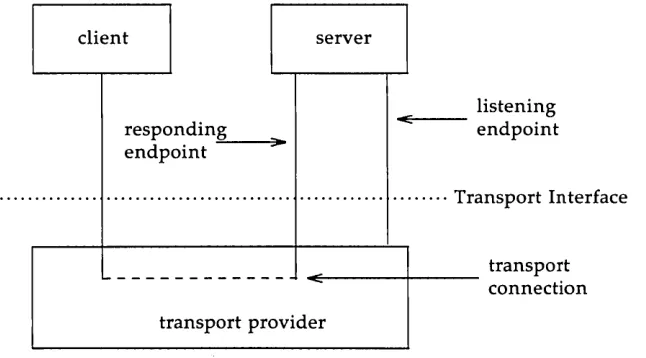
Figure 3-1: Listening and Responding Transport Endpoints 3-17
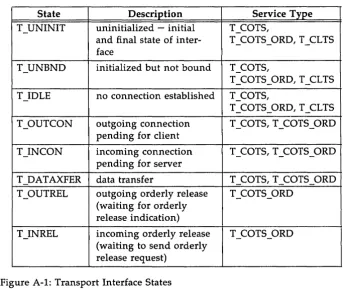
Figure A-I: Transport Interface States A-I
Figure A-2: Transport Interface Outgoing Events A-3
Figure A-3: Transport Interface Incoming Events A-4
Figure A-4: Common Local Management State Table A-6
Figure A-5: Connection less-Mode State Table A-7
Chapter 1: Introduction to the Guide
Background
Document Organization
Introduction to the Guide
This document provides detailed information, with various examples, on the UNIX system Transport Interface. This guide is intended for program-mers who require the services defined by this interface. Working
knowledge of UNIX system programming and data communication concepts is assumed. In particular, working knowledge of the Reference Model of Open Systems Interconnection (051) is required.
Background
To place the Transport Interface in perspective, a discussion of the 051 Reference Model is first presented. The Reference Model partitions net-working functions into seven layers, as depicted in Figure 1-1.
Layer 7 application
Layer 6 presentation
Layer 5 session
Layer 4 transport
Layer 3 network
Layer 2 data link
Layer 1 physical
Figure 1-1: 051 Reference Model
Layer 1 The physical layer is responsible for the transmission of raw data over a communication medium.
Layer 3 The network layer manages the operation of the network. In particular, it is responsible for the routing and management of data exchange between transport layer entities within the net-work.
Layer 4 The transport layer provides transparent data transfer services between session layer entities by relieving them from concerns of how reliable and cost-effective transfer of data is achieved.
Layer 5 The session layer provides the services needed by presentation layer entities that enable them to organize and synchronize their dialogue and manage their data exchange.
Layer 6 The presentation layer manages the representation of informa-tion that applicainforma-tion layer entities either communicate or refer-ence in their communication.
Layer 7 The application layer serves as the window between
corresponding application processes that are exchanging infor-mation.
A basic principle of the Reference Model is that each layer provides ser-vices needed by the next higher layer in a way that frees the upper layer from concern about how these services are provided. This approach simplifies the design of each particular layer.
Industry standards either have been or are being defined at each layer of the Reference Model. Two standards are defined at each layer: one that specifies an interface to the services of the layer, and one that defines the protocol by which services are provided. A service interface standard at any layer frees users of the service from details of how that layer's protocol is implemented, or even which protocol is used to provide the service.
The transport layer is important because it is the lowest layer in the Reference Model that provides the basic service of reliable, end-to-end data transfer needed by applications and higher layer protocols. In doing so, this layer hides the topology and characteristics of the underlying network from its users. More important, however, the transport layer defines a set of services common to layers of many contemporary protocol suites, including the International Standards Organization (ISO) protocols, the Transmission Control Protocol and Internet Protocol (TCP lIP) of the ARPANET, Xerox
Introduction to the Guide
A transport service interface, then, could enable applications and higher layer protocols to be implemented without knowledge of the underlying protocol suite. That is a principle goal of the UNIX system Transport Inter-face. Also, because an inherent characteristic of the transport layer is that it hides details of the physical medium being used, the Transport Interface offers both protocol and medium independence to networking applications and higher layer protocols.
The UNIX system Transport Interface was modeled after the industry standard ISO Transport Service Definition (ISO 8072). As such, it is
intended for those applications and protocols that require transport services. It is not intended to provide a generic networking interface for all UNIX system applications, but is a first step in providing networking services with UNIX System V. Because the Transport Interface provides reliable data transfer, and because its services are common to several protocol suites, many networking applications will find these services useful.
The Transport Interface is implemented as a user library using the STREAMS input/output mechanism. Therefore, many services available to STREAMS applications are also available to users of the Transport Interface. These services will be highlighted throughout this guide. The STREAMS Primer and STREAMS Programmer's Guide contain more detailed information on STREAMS for the interested reader.
Document Organization
This guide is organized as follows:
• Chapter 2, Overview of the Transport Interface, summarizes the basic set of services available to Transport Interface users and presents the background information needed for the remainder of the guide. • Chapter 3, Connection-Mode Service, describes the services associated
with connection-based (or virtual circuit) communication.
• Chapter 4, Connectionless-Mode Service, describes the services associ-ated with connectionless (or datagram) communication.
• Chapter 6, Advanced Topics, discusses important concepts that were not covered in earlier chapters. These include asynchronous event handling and processing of multiple, simultaneous connect requests.
• Appendix A, State Transitions, defines the allowable state transitions associated with the Transport Interface.
• Appendix B, Guidelines for Protocol Independence, establishes neces-sary guidelines for developing software that may run without change over any transport protocol developed for the Transport Interface.
• Appendix C, Examples, presents the full listing of each programming example used throughout the guide.
• The Glossary defines Transport Interface terms and acronyms used in this guide.
This guide describes the more important and common facilities of the Transport Interface, and is not meant to be exhaustive. Section 3N of the
Programmer's Reference Manual contains a complete description of each
Chapter 2: Overview of the Transport
Inter-face
Introduction
Modes of Service
Connection-Mode Service Local Management Connection Establishment Data Transfer
Connection Release
Connectionless-Mode Service
State Transitions
Introduction
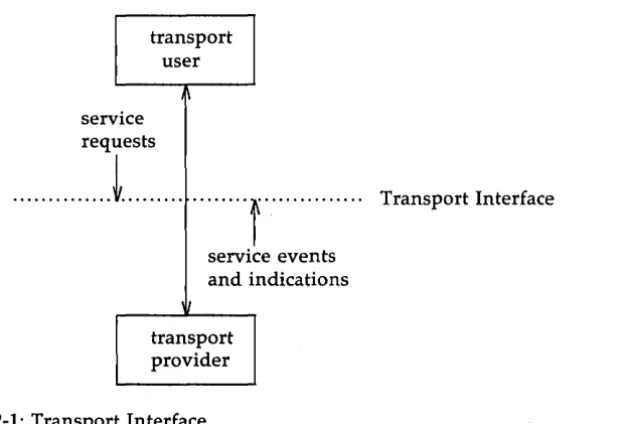
This chapter presents a high level overview of the services of the Tran-sport Interface, which supports the transfer of data between two user processes. Figure 2-1 illustrates the Transport Interface.
transport
ice serv req uests
user
\
L ...
... j
. .. . . Transport Interface servic e eventsndications and i
II
[image:15.453.91.402.133.345.2]transport provider
Figure 2-1: Transport Interface
The transport provider is the entity that provides the services of the Transport Interface, and the transport user is the entity that requires these services. An example of a transport provider is the ISO transport protocol, while a transport user may be a networking application or session layer pro-tocol.
The Network Services Library of UNIX System V includes a set of func-tions that support the services of the Transport Interface for user processes [see intro(3)]. These functions enable a user to initiate requests to the pro-vider and process incoming events. Programs using the Transport Interface can link the appropriate routines as follows:
Modes of Service
Two modes of service, connection-mode and connectionless-mode, are provided by the Transport Interface. Connection-mode is circuit-oriented and enables data to be transmitted over an established connection in a reli-able, sequenced manner. It also provides an identification mechanism that avoids the overhead of address resolution and transmission during the data transfer phase. This service is attractive for applications that require rela-tively long-lived, datastream-oriented interactions.
Connectionless-mode, in contrast, is message-oriented and supports data transfer in self-contained units with no logical relationship required among multiple units. This service requires only a preexisting association between the peer users involved, which determines the characteristics of the data to be transmitted. All the information required to deliver a unit of data (for example, the destination address) is presented to the transport provider, together with the data to be transmitted, in one service access (which need not relate to any other service access). Each unit of data transmitted is entirely self-contained. Connectionless-mode service is attractive for appli-cations that:
• involve short-term request/response interactions • exhibit a high level of redundancy
• are dynamically reconfigurable
• do not require guaranteed, in-sequence delivery of data
Connection-Mode Service
Local Management
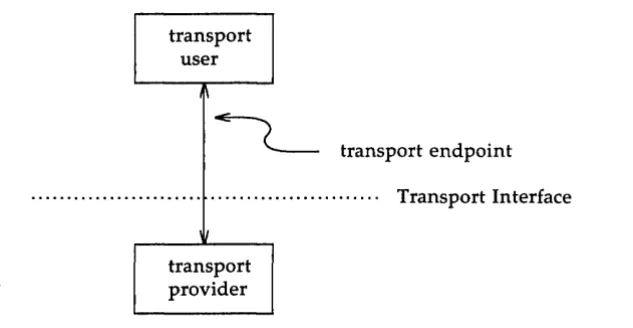
The local management phase defines local operations between a tran-sport user and a trantran-sport provider. For example, a user must establish a channel of communication with the transport provider, as illustrated in Fig-ure 2-2. Each channel between a transport user and transport provider is a unique endpoint of communication, and will be called the transport end-point. The t_open(3N) routine enables a user to choose a particular tran-sport provider that will supply the connection-mode services, and estab-lishes the transport endpoint.
transport user
~
[image:18.452.56.373.193.357.2]~
transport endpoint... ...
. . . .. . . Transport Interface~
transport provider
Figure 2-2: Channel Between User and Provider
Modes of Service
Command Description
t alloc Allocates Transport Interface data structures.
t bind Binds a transport address to a transport endpoint.
t close Closes a transport endpoint.
terror Prints a Transport Interface error message.
t free Frees structures allocated using t_alloc.
t.-Setinfo Returns a set of parameters associated with a particu-lar transport provider.
t.-Setstate Returns the state of a transport endpoint.
t look Returns the current event on a transport endpoint.
t_open Establishes a transport endpoint connected to a chosen transport provider.
t_optmgmt Negotiates protocol-specific options with the transport provider.
t_sync Synchronizes a transport endpoint with the transport provider.
[image:19.452.85.410.77.517.2]t unbind Unbinds a transport address from a transport end-point.
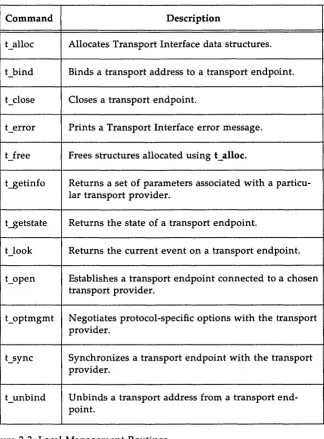
In addition to t_open and t_hind, several routines are available to sup-port local operations. Figure 2-3 summarizes all local management routines of the Transport Interface.
Connection Establishment
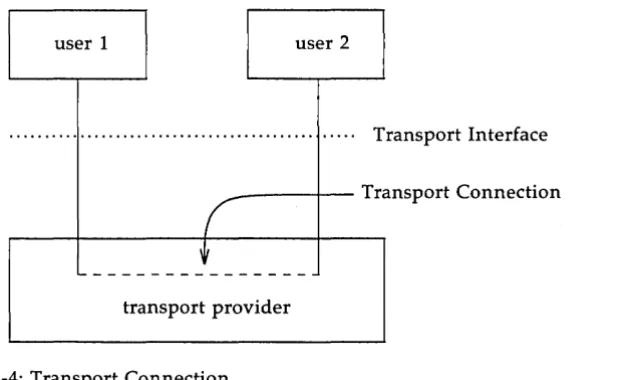
The connection establishment phase enables two users to create a con-nection, or virtual circuit, between them, as demonstrated in Figure 2-4.
user 1 user 2
... Transport Interface
r---i--
Transport Connection~
[image:20.452.65.381.169.359.2]---transport provider
Figure 2-4: Transport Connection
Modes of Service
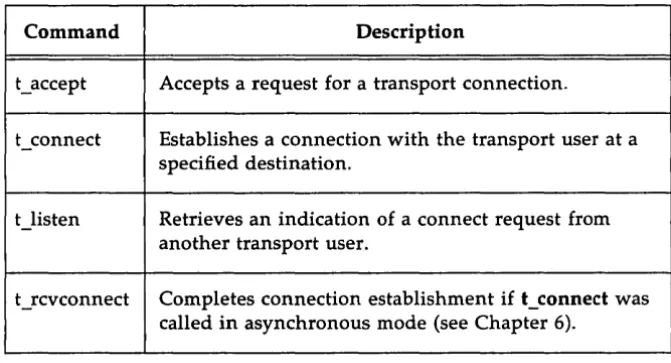
Figure 2-5 summarizes all routines available for establishing a transport connection.
Command Description
t_accept Accepts a request for a transport connection.
t_connect Establishes a connection with the transport user at a specified destination.
t_listen Retrieves an indication of a connect request from another transport user.
[image:21.453.67.403.108.289.2]t _rcvconnect Completes connection establishment if t_connect was called in asynchronous mode (see Chapter 6).
Data Transfer
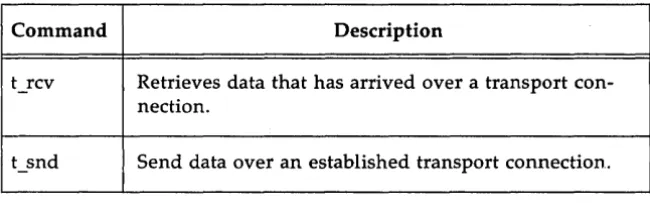
The data transfer phase enables users to transfer data in both directions over an established connection. Two routines, t_snd(3N) and t_rcv(3N), send and receive data over this connection. All data sent by a user is guaranteed to be delivered to the user on the other end of the connection in the order in which it was sent. Figure 2-6 summarizes the connection mode data transfer routines.
Command Description
t_rcv Retrieves data that has arrived over a transport con-nection.
[image:22.453.52.377.174.275.2]t snd Send data over an established transport connection.
Modes of Service
Connection Release
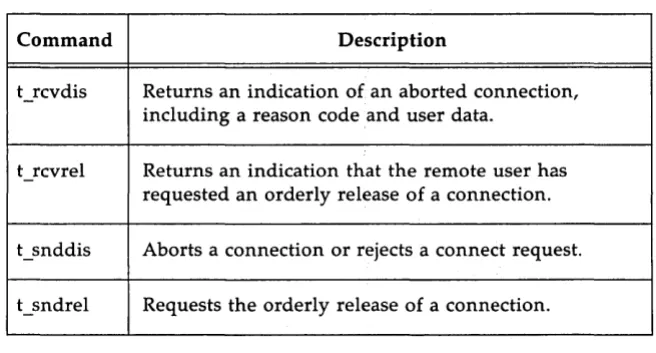
The connection release phase provides a mechanism for breaking an established connection. When you decide that the conversation should ter-minate, you can request that the provider release the transport connection. Two types of connection release are supported by the Transport Interface. The first is an abortive release, which directs the transport provider to release the connection immediately. Any previously sent data that has not yet reached the other transport user may be discarded by the transport pro-vider. The t_snddis(3N) routine initiates this abortive disconnect, and t_rcvdis(3N) processes the incoming indication of an abortive disconnect.
[image:23.451.72.400.273.449.2]All transport providers must support the abortive release procedure. In addition, some transport providers may also support an orderly release facil-ity that enables users to terminate commu~ication gracefully with no data loss. The functions t_sndrel(3N) and t_rcvrel(3N) support this capability. Figure 2-7 summarizes the connection release routines.
Command Description
t_rcvdis Returns an indication of an aborted connection, including a reason code and user data.
t rcvrel Returns an indication that the remote user has requested an orderly release of a connection.
t snddis Aborts a connection or rejects a connect request.
t_sndrel Requests the orderly release of a connection.
Connection less-Mode
Service
The connection less-mode transport service is characterized by two phases: local management and data transfer. The local management phase defines the same local operations described above for the connection-mode service.
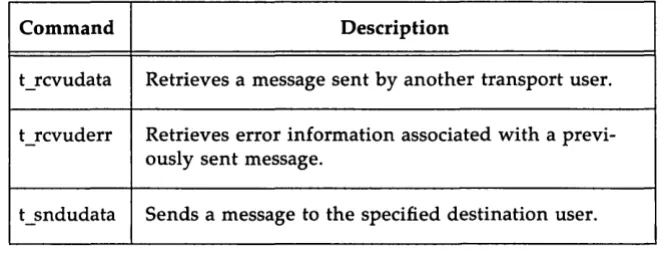
The data transfer phase enables a user to transfer data units (sometimes called datagrams) to the specified peer user. Each data unit must be accom-panied by the transport address of the destination user. Two routines, t_sndudata(3N) and t_rcvudata(3N) support this message-based data transfer facility. Figure 2-8 summarizes all routines associated with connectionless-mode data transfer.
Command Description
t rcvudata Retrieves a message sent by another transport user.
t rcvuderr Retrieves error information associated with a previ-ously sent message.
t sndudata Sends a message to the specified destination user.
[image:24.451.47.381.249.377.2]State Transitions
The Transport Interface has two components:
• the library routines that provide the transport services to users
• the state transition rules that define the sequence in which the tran-sport routines may be invoked
The state transition rules are presented in Appendix A of this guide in the form of state tables. The state tables define the legal sequence of library calls based on state information and the handling of events. These events include user-generated library calls, as well as provider-generated event indications.
Chapter 3: Connection-Mode Service
Introduction
3-1Local Management
3-2The Client 3-3
The Server 3-6
Connection Establishment
3-10The Client 3-10
Event Handling 3-12
The Server 3-13
Data Transfer
3-18The Client 3-19
The Server 3-20
Connection Release
3-23The Server 3-24
Introduction
This chapter describes the connection-mode service of the Transport Interface. As discussed in the previous chapter, the connection-mode ser-vice can be illustrated using a client-server paradigm. The important con-cepts of connection-mode service will be presented using two programming examples. The examples are related in that the first illustrates how a client establishes a connection to a server and then communicates with the server. The second example shows the server's side of the interaction. All exam-ples discussed in this guide are presented in their entirety in Appendix C.
Before the client and server can establish a transport connection, each must first establish a local channel (the transport endpoint) to the transport provider using t_open, and establish its identity (or address) using t_bind.
The set of services supported by the Transport Interface may not be implemented by all transport protocols. Each transport provider has a set of characteristics associated with it that determine the services it offers and the limits associated with those services. This information is returned to the user by t_open, and consists of the following:
addr maximum size of a transport address options tsdu etsdu connect discon servtype
maximum bytes of protocol-specific options that may be passed between the transport user and transport pro-vider
maximum message size that may be transmitted in either connection-mode or connectionless-mode
maximum expedited data message size that may be sent over a transport connection
maximum number of bytes of user data that may be passed between users during connection establishment maximum bytes of user data that may be passed between users during the abortive release of a connection
the type of service supported by the transport provider
The three service types defined by the Transport Interface are:
T _COTS The transport provider supports connection-mode service but does not provide the optional orderly release facil-ity.
T _COTS _ ORD The transport provider supports connection-mode service with the optional orderly release facility.
Local Management
Only one such service can be associated with the transport provider identified by t_open.
t_open returns the default provider characteristics associated with a tran-sport endpoint. However, some characteristics may change after an end-point has been opened. This will occur if the characteristics are associated with negotiated options (option negotiation is described later in this chapter). For example, if the support of expedited data transfer is a nego-tiated option, the value of this characteristic may change. t...,getinfo may be called to retrieve the current characteristics of a transport endpoint.
Once a user establishes a transport endpoint with the chosen transport provider, it must establish its identity. As mentioned earlier, t._bind accom-plishes this by binding a transport address to the transport endpoint. In addition, for servers, this routine informs the transport provider that the endpoint will be used to listen for incoming connect requests, also called connect indications.
An optional facility, t_optmgmt(3N), is also available during the local management phase. It enables a user to negotiate the values of protocol options with the transport provider. Each transport protocol is expected to define its own set of negotiable protocol options, which may include such information as Quality-of-Service parameters. Because of the protocol-specific nature of options, only applications written for a particular protocol environment are expected to use this facility.
The Client
#include <stdio.11> #include <tiuser.11> #include <fcntl.11>
#define SRV AIXR mrln( )
{
int fd; int nbytes; int flags
=
0;char bJ.f [ 1024] ;
/* server's well known address */
struct t _ call *sndcall;
extern int t _ errIX);
if «fd = t_ope:n("/dev/tivc", O_RIMR, NULL)) < 0)
t _ error ( "t _open failed");
exit(1);
if (t_bind(fd, NULL, NULL) < 0)
t _ error ( "t _bind failed");
exit(2) ;
The first argument to t_open is the pathname of a file system node that identifies the transport protocol that will supply the transport service. In this example, Idev/tivc is a STREAMS clone device node that identifies a generic, connection-based transport protocol [see clone(7)]. The clone dev-ice finds an available minor devdev-ice of the transport provider for the user. It
Local Management
• The transport address is an integer value that uniquely identifies each user.
• The transport provider supports the T_COTS_ORD service type, and the example will use the orderly release facility to release the connec-tion.
• User data may not be passed between users during either connection establishment or abortive release.
• The transport provider does not support protocol-specific options. Because these characteristics are not needed by the user, NULL is specified in the third argument to t_open. If the user needed a service other than T_COTS_ORD, another transport provider would be opened. An example of the T _ CLTS service invocation is presented in Chapter 4.
The return value of t_open is an identifier for the transport endpoint that will be used by all subsequent Transport Interface function calls. This identifier is actually a file descriptor obtained by opening the transport pro-tocol file [see open(2)]. The significance of this fact is highlighted in Chapter 5.
After the transport endpoint is created, the client calls t_hind to assign an address to the endpoint. The first argument identifies the transport end-point. The second argument describes the address the user would like to bind to the endpoint, and the third argument is set on return from t_hind to specify the address that the provider bound.
The address associated with a server's transport endpoint is important, because that is the address used by all clients to access the server. However, the typical client does not care what its own address is, because no other process will try to access it. That is the case in this example, where the second and third arguments to t_hind are set to NULL. A NULL second argument will direct the transport provider to choose an address for the user. A NULL third argument indicates that the user does not care what address was assigned to the endpoint.
with a transport function is a system error, t_errno will be set to TSYSERR, and errno will be set to the appropriate value.
The Server
The server in this example must take similar local management steps before communication can begin. The server must establish a transport endpoint through which it will listen for connect indications. The neces-sary definitions and local management steps are shown below:
#include <tiuser.h> #include <stropts.h> #include <fentl. h> #include <stdio. h> #include <signal.h>
#define DI~ -1
#define SEW AIJ:R 1 /* server's well known address */
int carm_fd;
extenl int t _ errIlO;
main (
{
int listen _ fd; / * listening transport endpoint */
struct t _bind *bini;
stiuct t _ call ~l;
if ((listen_fd = t_open("/d,ev/tivc", O_RmR, NUIL» < 0) { t _ error ( lit_open failed for listen _ fd") ;
exi.t( 1);
/*
* By assuming that the address is an integer value,
Local Management
continued
i f ((bind
=
(struct t_bind *)t_allce(1isten_fd, T_BmD, T_ALL»==
NULL) { t _ error ( lit_alIce of t _bind structure failed");exit(2) ;
bind->qlen = 1;
bind->addr.len = sizeof(int); *(int *)bind->addr.blf = SRV_AIDR; i f (t_bind(listen_fd, bind, bind) < 0)
t_error(lIt_bind failed for listen_fd");
exit(3) ;
1*
* was the correct address bound?
*1
if (*(int *)bind->addr.blf 1= SRV_ADDR)
fprintf(stderr, lit_bind bound wrong addresso);
exit(4) ;
struct t _bind {
}
struct netbuf addr;
unsigned qlen;
where addr describes the address to be bound, and qlen indicates the max-imum outstanding connect indications that may arrive at this endpoint. All Transport Interface structure and constant definitions are found in
<tiuser.h> .
The address is specified using a netbuf structure that contains the fol-lowing members:
struct netbuf {
unsigned int maxlen; unsigned int len; char *buf;
}
where buf points to a buffer containing the data, len specifies the bytes of data in the buffer, and maxlen indicates the maximum bytes the buffer can hold (and need only be set when data is returned to the user by a Transport Interface routine). For the t_bind structure, the data pointed to by buf identifies a transport address. It is expected that the structure of addresses will vary among each protocol implementation under the Transport Inter-face. The netbuf structure is intended to support any such structure.
Local Management
t_alloc(3N) is called to allocate the t_bind structure needed by t_bind. t_alloc takes three arguments. The first is a file descriptor that references a transport endpoint. This is used to access the characteristics of the transport provider [see t_open(3N)]. The second argument identifies the appropriate Transport Interface structure to be allocated. The third argument specifies which, if any, netbuf buffers should be allocated for that structure. T_ALL specifies that all netbuf buffers associated with the structure should be allo-cated, and will cause the addr buffer to be allocated in this example. The size of this buffer is determined from the transport provider characteristic that defines the maximum address size. The maxlen field of this netbuf structure will be set to the size of the newly allocated buffer by t_a11oc. The use of t_alloc will help ensure the compatibility of user programs with future releases of the Transport Interface.
The server in this example will process connect indications one at a time, so qlen is set to 1. The address information is then assigned to the newly allocated t_bind structure. This t_bind structure will be used to pass information to t_bind in the second argument, and also will be used to return information to the user in the third argument.
On return, the t_bind structure will contain the address that was bound to the transport endpoint. If the provider could not bind the requested address (perhaps because it had been bound to another transport endpoint), it will choose another appropriate address.
Each transport provider will manage its address space differently. Some transport providers may allow a single transport address to be bound to several transport endpoints, while others may require a unique address per endpoint. The Transport Interface supports either choice. Based on its address management rules, a provider will determine if it can bind the requested address. If not, it will choose another valid address from its address space and bind it to the transport endpoint.
The server must check the bound address to ensure that it is the one previ-ously advertised to clients. Otherwise, the clients will be unable to reach the server.
The connection establishment procedures highlight the distinction between clients and servers. The Transport Interface imposes a different set of procedures in this phase for each type of transport user. The client ini-tiates the connection establishment procedure by requesting a connection to a particular server using t_connect(3N). The server is then notified of the client's request by calling tJisten(3N). The server may either accept or reject the client's request. It will call t_accept(3N) to establish the connec-tion, or call t_snddis(3N) to reject the request. The client will be notified of the server's decision when t_connect completes.
The Transport Interface supports two facilities during connection estab-lishment that may not be supported by all transport providers. The first is the ability to transfer data between the client and server when establishing the connection. The client may send data to the server when it requests a connection. This data will be passed to the server by t_listen. Similarly, the server can send data to the client when it accepts or rejects the connec-tion. The connect characteristic returned by t_open determines how much data, if any, two users may transfer during connect establishment.
The second optional service supported by the Transport Interface during connection establishment is the negotiation of protocol options. The client may specify protocol options that it would like the transport provider and/or the remote user. The Transport Interface supports both local and remote option negotiation. As discussed earlier, option negotiation is inherently a protocol-specific function. Use of this facility is discouraged if
protocol independent software is a goal (see Appendix B).
The Client
Connection Establishment
1*
* By asSllI1ling" that the address is an integer value,
* this program may not run aver another protocol.
*1
if ((srrlcall = (struct t_call *)t_alloc(fd, T_CALL, T_ADIlR» == NUIL) t _ error ( lit _ alloc failed");
exit(3) ;
sndcall->addr.len
=
sizeof(int); *(int *)srrlcall->addr.buf=
SRVJuDR;if (t_connect(fd, sndcall, NULL) < 0) t_error(IIt_connect failed for fd");
exit(4) ;
The t_connect call establishes the connection with the server. The first argument to t_connect identifies the transport endpoint through which the connection is established, and the second argument identifies the destina-tion server. This argument is a pointer to a t_call structure, which has the following format:
struct t_call {
}
struct netbuf addr; struct netbuf opt; struct netbuf udata; int sequence;
addr identifies the address of the server, opt may be used to specify
protocol-specific options that the client would like to associate with the con-nection, and udata identifies user data that may be sent with the connect request to the server. The sequence field has no meaning for t_connect.
an appropriate netbu£ buffer should be allocated for the address. The server's address is then assigned to buf, and len is set accordingly.
The third argument to t_connect can be used to return information about the newly established connection to the user, and may retrieve any user data sent by the server in its response to the connect request. It is set to NULL by the client here to indicate that this information is not needed. The connection will be established on successful return of t _connect. If the server rejects the connect request, t_connect will fail and set t_errno to TLOOK.
Event Handling
The TLOOK error has special significance in the Transport Interface. Some Transport Interface routines may be interrupted by an unexpected asynchronous transport event on the given transport endpoint, and TLOOK notifies the user that an event has occurred. As such, TLOOK does not indi-cate an error with a Transport Interface routine, but the normal processing of that routine will not be performed because of the pending event. The events defined by the Transport Interface are listed here:
T LISTEN A request for a connection, called a connect indica-tion, has arrived at the transport endpoint.
T_CONNECT The confirmation of a previously sent connect request, called a connect confirmation, has arrived at the transport endpoint. The confirmation is gen-erated when a server accepts a connect request.
T DATA User data has arrived at the transport endpoint.
T_EXDATA Expedited user data has arrived at the transport
end-point. Expedited data will be discussed later in this chapter.
T_DISCONNECT A notification that the connection was aborted or that the server rejected a connect request, called a disconnect indication, has arrived at the transport endpoint.
Connection Establishment
The notification of an error in a previously sent datagram, called a unitdata error indication, has arrived at the transport endpoint (see Chapter 4).
As described in the state tables of Appendix
A,
it is possible in some states to receive one of several asynchronous events. The tJook(3N) rou-tine enables a user to determine what event has occurred if a TLOOK error is returned. The user can then process that event accordingly. In the exam-ple, if a connect request is rejected, the event passed to the client will be a disconnect indication. The client will exit if its request is rejected.The Server
Returning to the example, when the client calls t_connect, a connect indication will be generated on the server's listening transport endpoint. The steps required by the server to process the event are presented below. For each client, the server accepts the connect request and spawns a server process to manage the connection.
if «call = (struct t_ca11 *)t_allce(listen_fd, T_ CALL, T_ALL» == NULL) t _ error ( "t _alIce of t _call structure failed");
exit(S) ;
while (1) {
if (t_Iisten(listen_fd, call) < 0) {
t _ error ( "t _listen failed for listen _ fd") ;
exi.t(6) ;
if «conn_fd = accept_ca1I(listen_fd, call» 1= DISCONNECT) run_server(listen_fd);
arrives, the server calls accept_call to accept the connect request.
accept_call accepts the connection on an alternate transport endpoint (as discussed below) and returns the value of that endpoint. connJd is a global
variable that identifies the transport endpoint where the connection is esta-blished. Because the connection is accepted on an alternate endpoint, the server may continue listening for connect indications on the endpoint that was bound for listening. If the call is accepted without error, run_server will spawn a process to manage the connection.
The server allocates a t_call structure to be used by tJisten. The third argument to t_alloc, T_ALL, specifies that all necessary buffers should be allocated for retrieving the caller's address, options, and user data. As men-tioned earlier, the transport provider in this example does not support the transfer of user data during connection establishment, and also does not support any protocol options. Therefore, t_alloc will not allocate buffers for the user data and options. It must, however, allocate a buffer large enough to store the address of the caller. t_alloc determines the buffer size from the addr characteristic returned by t_open. The maxlen field of each netbuf
structure will be set to the size of the newly allocated buffer by t_alloc
(maxlen is 0 for the user data and options buffers).
Using the t_call structure, the server calls tJisten to retrieve the next connect indication. If one is currently available, it is returned to the server immediately. Otherwise, t_listen will block until a connect indication arrives.
The Transport Interface supports an asynchronous mode for such routines that will prevent a process from blocking. This feature is discussed in Chapter 6.
Connection Establishment
accept_call (listen _ fd, call) int listen _ fd;
int resfd;
if ((resfd
=
t_open("/dev/tivc", O_m-lR, NULL)) < 0) { t_error("t_open for reS}Xll'Xli.D3" fd failed"); exit(?) ;if (t_bind(resfd, NULL, NULL) < 0) {
t _ error ( "t _bind for reS}Xll'Xli.D3" fd failed"); exit(S) ;
i f (t_accept(listen_fd, resfd, call) < 0) {
if (t_errllO
==
TIOOK) { 1* IIIJSt be a disconnect *1 i f (t_rcvdis(listen_fd, NULL) < 0) {t _ error ( "t _ rcvdis failed for listen _ fd" ) ; exit(9);
if (t_close(resfd) < 0) {
t _ error ( "t _close failed for reS}Xll'Xli.D3" fd"); exit( 10);
1* go back up and listen for other calls *1
retur.n(DlSODNNECT);
t _ error ( "t _accept failed"); exit( 11);
retur.n(resfd) ;
established transport endpoint, resld, is used to accept the client's connect request.
The first two arguments of t_accept specify the listening transport end-point and the endend-point where the connection will be accepted respectively. A connection may be accepted on the listening endpoint. However, this would prevent other clients from accessing the server for the duration of that connection.
The third argument of t_accept points to the t_call structure associated with the connect indication. This structure should contain the address of the calling user and the sequence number returned by tJisten. The value of sequence has particular significance if the server manages multiple out-standing connect indications. Chapter 6 presents such an example. Also, the t_call structure should identify protocol options the user would like to specify, and user data that may be passed to the client. Because the tran-sport provider in this example does not support protocol options or the transfer of user data during connection establishment, the t_call structure returned by tJisten may be passed without change to t_accept.
For simplicity in the example, the server will exit if either the t_open or t_bind call fails. exit(2) will close the transport endpoint associated with IistenJd, causing the transport provider to pass a disconnect indication to the client that requested the connection. This disconnect indication notifies the client that the connection was not established; t_connect will fail, set-ting t_errno to TLOOK.
Connection Establishment
Figure 3-1 illustrates how the server establishes connections.
client
responding
~--:
....
~endpoint
server
listening
OIIIII!E=----endpoint
... Transport Interface
'---
... ::---+---- connection transporttransport provider
Figure 3-1: Listening and R~sponding Transport Endpoints
Once the connection has been established, both the client and server may begin transferring data over the connection using t_snd and tycv. In fact, the Transport Interface does not differentiate the client from the server from this point on. Either user may send and receive data, or release the connection. The Transport Interface guarantees reliable, sequenced delivery of data over an existing connection.
Two classes of data may be transferred over a transport connection: nor-mal and expedited. Expedited data is typically associated with information of an urgent nature. The exact semantics of expedited data are subject to the interpretations of the transport provider. Furthermore, all transport protocols do not support the notion of an expedited data class [see t_open(3N)].
All transport protocols support the transfer of data in byte stream mode, where "byte stream" implies no concept of message boundaries on data that is transferred over a connection. However, some transport protocols sup-port the preservation of message boundaries over a transsup-port connection. This service is supported by the Transport Interface, but
protocol-independent software must not rely on its existence.
The message interface for data transfer is supported by a special flag of t_snd and t_rcv called T_MORE. The messages, called Transport Service Data Units (TSDU), may be transferred betwe~n two transport users as dis-tinct units. The maximum size of a TSDU is a characteristic of the underly-ing transport protocol. This information is available to the user from t_open and t--&etinfo. Because the maximum TSDU size can be large (possi-bly unlimited), the Transport Interface enables a user to transmit a message in multIple units.
To send a message in multiple units over a transport connection, the user must set the T_MORE flag on every t_snd call except the last. This flag indicates that the user will send more data associated with the message in a subsequent call to t_snd. The last message unit should be transmitted with T_MORE turned off to indicate that this is the end of the TSDU.
Data Transfer
V
The T_MORE flag implies nothing about how the data may be packaged below the Transport Interface. Furthermore, it implies nothing about how the data may be delivered to the remote user. Each transport protocol, and each implementation of that protocol, may package and deliver the data differently.For example, if a user sends a complete message in a single call to t_snd, there is no guarantee that the transport provider will deliver the data in a single unit to the remote transport user. Similarly, a TSDU transmitted in two message units may be delivered in a single unit to the remote transport user. The message boundaries may only be preserved by noting the value of the T_MORE flag on t_snd and t_rev. This will guaran-tee that the receiving user will see a message with the same contents and message boundaries as was sent by the remote user.
The Client
Continuing with the client/server example, the server will transfer a log file to the client over the transport connection. The client receives this data and writes it to its standard output file. A byte stream interface is used by the client and server, where message boundaries (that is, the T __ MORE £lag) are ignored. The client receives data using the following instructions:
while «nbytes = t_rcv(fd, blf, 1024, &flags)) 1= -1) { if (fwrite(blf, 1, nbytes, stdout) < 0) {
fprintf(stderr, "fwrite failedo); exit(S);
indication or disconnect indication arrives, as will be discussed later in this chapter. If the fwrite(3S) call fails for any reason, the client will exit, thereby closing the transport endpoint. If the transport endpoint is closed (either by exit or t_close) when it is in the data transfer phase, the connec-tion will be aborted and the remote user will receive a disconnect indica-tion.
The Server
Looking now at the other side of the connection, the server manages its data transfer by spawning a child process to send the data to the client. The parent process then loops back to listen for further connect indications. run_server is called by the server to spawn this child process as follows:
carmrelease( )
{
1* conn_fd is global because needed here *1
if (t_look(conn_fd)
==
T_DlSOONNECT) { fprintf(stderr, "connection abortedo); exit( 12);1* else orderly release in:tication - I'lOr1Ml exit *1
exit(O) ;
run_server(listen_fd) int listen_fd;
{
int nbytes;
FILE * logfp;
char l:llf[ 1024] ;
switch (fork( ))
case -1:
1* file pointer to log file *1
perror( "fork failed"); exit(20) ;
default:
1* close conn_fd and then go up and listen again *1 if (t_close(cann_fd) < 0) {
return;
case 0:
1* close listen fd an:i do service *1
if (t_close(listen_fd) < 0) {
t_error("t_close failed for listen_fd"); exit(22);
if (( logfp = fopen( "logfile", "r")) == NULL) {
perror( "cannot open logfile"); exit(23) ;
signal (SIGOOLL, carmrelease);
if (ioctl(conn_fd, I_SETSIG, S_INPUT) < 0) {
perror( "ioctl 1_ SETSIG failed"); exit(24) ;
Data Transfer
continued
if (t_look(connJd) 1= 0) { 1* was disconnect already there? *1
fprintf(stderr, "t_look returned unexpected evento); exit(25);
while ((nbytes
=
fread(buf, 1, 1024, logfp)) > 0) if (t_snd(conn_fd, buf, nbytes, 0) < 0) {t _ error ( "t _ snd failed"); exit(26) ;
The server process reads 1024 bytes of the log file at a time and sends that data to the client using t_snd. but points to the start of the data buffer, and nbytes specifies the number of bytes to be transmitted. The fourth argu-ment is used to specify optional flags. Two flags are currently supported: T _EXPEDITED may be set to indicate that the data is expedited, and T_MORE may be set to define message boundaries when transmitting mes-sages over a connection. Neither flag is set by the server in this example.
If the user begins to flood the transport provider with data, the provider may exert back pressure to provide flow control. In such cases, t_snd will block until the flow control is relieved, and will then resume its operation. t_snd will not complete until nbyte bytes have been passed to the transport provider.
The t_snd routine does not look for a disconnect indication (signifying that the connection was broken) before passing data to the provider. Also, because the data traffic is flowing in one direction, the user will never look for incoming events. If, for some reason, the connection is aborted, the user should be notified because data may be lost. One option available to the user is to use tJook to check for incoming events before each t_snd call. A more efficient solution is the one presented in the example. The STREAMS I_SETSIG ioctl enables a user to request a signal when a given event occurs [see streamio(7) and signal(2)]. The STREAMS event of concern here is S_INPUT, which will cause a signal to be sent to the user if any input arrives on the Stream referenced by connJd. If a disconnect indication arrives, the signal catching routine (connrelease) will print an appropriate error message and then exit.
Connection Release
At any point during data transfer, either user may release the transport connection and end the conversation. As mentioned earlier, two forms of connection release are supported by the Transport Interface. The first, abor-tive release, breaks a connection immediately and may result in the loss of any data that has not yet reached the destination user. t_snddis may be called by either user to generate an abortive release. Also, the transport provider may abort a connection if a problem occurs below the Transport Interface. t snddis enables a user to send data to the remote user when aborting a connection. Although the abortive release is supported by all transport providers, the ability to send data when aborting a connection is not.
When the remote user is notified of the aborted connection, t_rcvdis must be called to retrieve the disconnect indication. This call will return a reason code that indicates why the connection was aborted, and will return any user data that may have accompanied the disconnect indication (if the abortive release was initiated by the remote user). This reason code is specific to the underlying transport protocol, and should not be interpreted by protocol-independent software.
The Server
The client-server example in this chapter assumes that the transport pro-vider does support the orderly release of a connection. When all the data has been transferred by the server, the connection may be released as fol-lows:
if (t_sndrel(conn_fd) < 0) { t _ error ( "t _ sn1rel failed");
exit(27) j
pause ( ); 1* until orderly release :indication arrives *1
The orderly release procedure consists of two steps by each user. The first user to complete data transfer may initiate a release using t_sndrel, as illus-trated in the example. This routine informs the client that no more data will be sent by the server. When the client receives such an indication, it may continue sending data back to the server if desired. When all data has been transferred, however, the client must also call t_sndrel to indicate that it is ready to release the connection. The connection will be releas.ed only after both users have requested an orderly release and received the
corresponding indication from the other user.
Connection Release
in connrelease will close the transport endpoint, thereby freeing the bound address for use by another user. If a user process wants to close a transport endpoint without exiting, it may call t_close.
The Client
The client's view of connection release is similar to that of the server. As mentioned earlier, the client continues to process incoming data until t_rcv fails. If the server releases the connection (using either t_snddis or t_sndrel), t_rcv will fail and set t_errno to TLOOK. The client then processes the connection release as follows:
if (t_rcvrel(fd) < 0) { t _ error ( "t _ rcvrel failed");
exi.t(6) ;
if (t_sndrel(fd) < 0) { t _ error ( "t _ sndrel failed");
exi.t(7) ;
exit(O) ;
t _ error ( "t _rev failed");
exi.t(8) ;
Chapter 4: Connectionless-Mode Service
Introduction
Local Management
Data Transfer
Datagram Errors
4-1
4-2
4-5
Introduction
This chapter describes the connection less-mode service of the Transport Interface. Connectionless-mode service is appropriate for short-term request / response interactions, such as transaction processing applications. Data are transferred in self-contained units with no logical relationship required among multiple units.
Just as with connection-mode service, the transport users must perform appropriate local management steps before data can be transferred. A user must choose the appropriate connectionless service provider using t_open and establish its identity using t_bind.
t_optmgmt may be used to negotiate protocol options that may be asso-ciated with the transfer of each data unit. As with the connection-mode ser-vice, each transport provider specifies the options, if any, that it supports. Option negotiation is therefore a protocol-specific activity.
In the example, the definitions and local management calls needed by the transaction server are as follows:
#include <stdio.11> #include <fentl.11> #include <tiuser.11>
#define SRV ~ 2
ma:in( )
{
int fd;
int flags;
struct t _bind *bind;
struct t_unitdata *ud;
struct t _ uderr *ud.err;
/* server's well known address */
if ((fd
=
t_open( "/dev/tidq", O}U~-m., NULL» < 0) {Local Management
continued
i f «bind = (stxuct t_bind *)t_alloc(fd, T_BIND, T_ADIR»
==
NULL) { t _ error ( lit _ alloc of t _bind structure failed II ) ;exit(2) ;
bind->addr • len = sizeof (int) ; *(int *)bind->addr.bJ.f
=
SRV_AIl:R; bind->qlen=
0;if (t_bind(fd, bind, bind) < 0) t _ error ( lit_bind failed");
exit(3) ;
1*
* is the bamd address oorrect?
*1
if (*(int *)bind->addr.bJ.f 1= SRV_ACCR) { fprintf (stderr , lit_bind bamd wrong addresso);
exit(4) ;
• The transport address is an integer value that uniquely identifies each user.
• The transport provider supports the T_CLTS service type (connection-less transport service, or datagram).
• The transport provider does not support any protocol-specific options.
The connectionless server also binds a transport address to the end-point, so that potential clients may identify and access the server. At_bind structure is allocated using t_aBoc, and the but and len fields of the address are set accordingly.
One important difference between the connection-mode server and this connectionless-mode server is that the qlen field of the t_bind structure has no meaning for connection less-mode service. That is because all users are capable of receiving datagrams once they have bound an address. The Transport Interface defines an inherent client-server relationship between two users while establishing a transport connection in the connection-mode service. However, no such relationship exists in the connectionless-mode service. It is the context of this example, not the Transport Interface, that defines one user as a server and another as a client.
Data Transfer
Once a user has bound an address to the transport endpoint, datagrams may be sent or received over that endpoint. Each outgoing message is accompanied by the address of the destination user. In addition, the Tran-sport Interface enables a user to specify protocol options that should be associated with the transfer of the data unit (for example, transit delay). As discussed earlier, each transport provider defines the set of options, if any, that may accompany a datagram. When the datagram is passed to the desti-nation user, the associated protocol options may be returned as well.
The following sequence of calls illustrates the data transfer phase of the connection less-mode server:
if «ud = (struct t_unitdata *)t_alloc(fd, T_UNIIDATA, T_ALL)) == NULL) t_error("t_alloc of t_unitdata structure failed");
exit(5) ;
if ((uderr = (struct t_uderr *)t_alloc(fd, T_UDERROR, T_ALL)) == NULL) { t_error("t_alloc of t_uderr structure failed");
exit(6) ;
while (1)
if (t_rcvudata(fd, ud, &flags) < 0) {
i f (t _ errno == 'l'UXK) {
1*
* Error on previalSly sent datagram
*1
if (t_rcvuderr(fd, uderr) < 0) {
exit(?) ;
fprintf(stderr, "bad datagram, error
=
redo, uderr->error) ;query (
{
1*
t _ error ( "t _ rcvudata failed");
exit(S);
* Qlery( ) processes the request and places the
* response in OO->udata.nlf, setting ud->udata.len *1
query(OO) ;
if (t_srrludata(fd, 00, 0) < 0) t _ error ( "t _ srrludata failed");
exit(9);
1* Merely a stub for simplicity *1
continued
The server must first allocate a t_unitdata structure for storing datagrams, which has the following format:
struct t _ unitdata {
struct netbuf addr; struct netbuf opt; stru.ct netbuf udata;
}
addr holds the source address of incoming datagrams and the destination
address of outgoing datagrams, opt identifies any protocol options associated
Data Transfer
to hold any possible incoming values. As described in the previous chapter, the T_ALL argument to t_alloc will ensure this and will set the maxlen field
of each netbuf structure accordingly. Because the provider does not support protocol options in this example, no options buffer will be allocated, and
maxlen will be set to zero in the netbuf structure for options. A t_uderr
structure is also allocated by the server for processing any datagram errors, as will be discussed later in this chapter.
The transaction server loops forever, receiving queries, processing the queries, and responding to the clients. It first calls t_rcvudata to receive the next query. t_rcvudata will retrieve the next available incoming datagram. If none is currently available, t_rcvudata will block, waiting for a datagram to arrive. The second argument of t_rcvudata identifies the t_unitdata structure where the datagram should be stored.
The third argument, flags, must point to an integer variable and may be
set to T_MORE on return from t_rcvudata to indicate that the user's udata
buffer was not large enough to store the full datagram. In this case, subse-quent calls to t_rcvudata will retrieve the remainder of the datagram. Because t_alloc allocates a udata buffer large enough to store the maximum
datagram size, the transaction server does not have to check the value of
flags.
If a datagram is received successfully, the transaction server calls the
query routine to process the request. This routine will store the response in
the structure pointed to by ud, and will set ud-
>
udata.len to indicate thenumber of bytes in the response. The source address returned by t_rcvudata in ud-
>
addr will be used as the destination address byl_sndudata.
If the transport provider cannot process a datagram that was passed to it by t_sndudata, it will return a unit data error event, T_UDERR, to the user. This event includes the destination address and options associated with the datagram, plus a protocol-specific error value that describes what may be wrong with the datagram. The reason a datagram could not be processed is protocol-specific. One reason may be that the transport provider could not interpret the destination address or options. Each transport protocol is expected to specify all reasons for which it is unable to process a datagram.
The unit data error indication is not necessarily intended to indicate success or failure in delivering the datagram to the specified destination. The tran-sport protocol decides how the indication will be used. Remember, the connectionless service does not guarantee reliable delivery of data.
The transaction server will be notified of this error event when it attempts to receive another datagram. In this case, t_rcvudata will fail, set-ting t_errno to TLOOK. If TLOOK is set, the only possible event is T_UDERR, so the server calls t_rcvuderr to retrieve the event. The second argument to t_rcvuderr is the t_uderr structure that was allocated earlier. This structure is filled in by t_rcvuderr and has the following format:
struct t _ uderr { struct netbuf addr; struct netbuf opt; long error;
}
where addr and opt identify the destination address and protocol options as
specified in the bad datagram, and error is a protocol-specific error code that.
Chapter 5: A Read/Write Interface
Introduction
write
read
Close
5-1
5-3
5-4
Introduction
A user may wish to establish a transport connection and then exec(2) an existing user program such as cat(l) to process the data as it arrives over the connection. However, existing programs use read(2) and write(2) for their input/output needs. The Transport Interface does not directly support a read/write interface to a transport provider, but one is available with UNIX System V. This interface enables a user to issue read and write calls over a transport connection that is in the data transfer phase. This chapter describes the read/write interface to the connection-mode service of the Transport Interface. This interface is not available with the connection less-mode service.
The read/write interface is presented using the client example of Chapter 3 with some minor modifications. The clients are identical until the data transfer phase is reached. At that point, this client will use the read/write interface and cat(l) to process incoming data. cat can be run without change over the transport connection. Only the differences between this client and that of the example in Chapter 3 are shown below.
#include <stropts. 11>
1*
* Same local management and connection
* establishment steps. *1
if (ioctl(fd, I_PUSH, "tirdwr") < 0) {
perror( "I_PUSH of tirdwr failed");
exit(S) ;
close(O) ; dup(fd);
execl( "!bin/cat", "!bin/cat", 0); perror( "execl of !bin/cat failed");
The client invokes the read/write interface by pushing the tirdwr(7) module onto the Stream associated with the transport endpoint where the connection was established [see I_PUSH in streamio(7)]. This module con-verts the Transport Interface above the transport provider into a pure read/write interface. With the module in place, the client calls close(2) and dup(2) to establish the transport endpoint as its standard input file, and uses /bin/ cat to process the input. Because the transport endpoint identifier is a file descriptor, the facility for duping the endpoint is available to users.
Because the Transport Interface has been implemented using STREAMS, the facilities of this character input/output mechanism can be used to pro-vide enhanced user services. By pushing the tirdwr module above the tran-sport provider, the user's interface is effectively changed. The semantics of read and write must be followed, and message boundaries will not be preserved.
V
The lirdwr module may only be pushed onto a Stream when the transportendpoint is in the data transfer phase. Once the module is pushed, the user may not call any Transport Interface routines. If a Transport Interface routine is invoked, tirdwr will generate a fatal protocol error, EPROTO, on that Stream, rendering it unusable. Furthermore, if the user pops the tirdwr module off the Stream [see I_POP in streamio(7)], the transport con-nection will be aborted.
write
read may be used to retrieve data that has arrived over the transport connection. The tirdwr module will pass data through to the user from the transport provider. However, any other event or indication passed to the user from the provider will be processed by tirdwr as follows:
• read cannot process expedited data because it cannot distinguish expedited data from normal data for the user. If an expedited data indication is received, tirdwr will generate a fatal protocol error, EPROTO, on that Stream. This error will cause further system calls to fail. You must therefore be aware that you should not communicate with a process that is sending expedited data.
• If an abortive disconnect indication is received, tirdwr will discard the indication and generate a STREAMS hangup condition on that Stream. Subsequent read calls will retrieve any remaining data, and then read will return zero for all further calls (indicating end-of-file). • If an orderly release indication is received, tirdwr will discard the
indication and deliver a zero-length STREAMS message to the user. As described in read(2), this notifies the user of end-of-file by return-ing 0 to the user.
Close
With tirdwr on a Stream, the user can send and receive data over a tran-sport connection for the duration of that connection. Either user may ter-minate the connection by closing the file descriptor associated with the transport endpoint or by popping the tirdwr module off the Stream. In either case, tirdwr will take the following actions:
• If an orderly release indication had previously been received by tirdwr, an orderly release request will be passed to the transport pro-vider to complete the orderly release of the connection. The remote user, who initiated the orderly release procedure, will receive the expected indication when data transfer completes.
• If a disconnect indication had previously been received by tirdwr, no special action is taken.
• If neither an orderly release indication nor disconnect indication had previously been received by tirdwr, a disconnect request will be passed to the transport provider to abortively release the connection. • If an error had previously occurred on the Stream and a disconnect
indication has not been received by tirdwr, a disconnect request will be passed to the transport provider.
Chapter 6: Advanced Topics
Introduction
Asynchronous Execution Mode
Advanced Programming Example
6-1
6-2
Introduction
Many Transport Interface library routines may block waiting for an incoming event or the relaxation of flow control. However, some time-critical applications should not block for any reason. Similarly, an applica-tion may wish to do local processing while waiting for some asynchronous transport interface event.
Support for asynchronous processing of Transport Interface events is available to applications using a combination of the STREAMS asynchro-nous features and the non-blocking mode of the Transport Interface library routines. Earlier examples in this guide have illustrated the use of the STREAMS poll system call and the I_SETSIG ioctl command for processing events in an asynchronous manner.
In addition, each Transport Interface routine that may block waiting for some event can be run in a special non-blocking mode. For example, tJisten will normally block, waiting for a connect indication. However, a server can periodically poll a transport endpoint for existing connect indica-tions by calling tJisten in the non-blocking (or asynchronous) mode. The asynchronous mode is enabled by setting 0 _NDELAY on the file descriptor. This can be set as a flag on t_open, or by calling fcntl(2) before calling the Transport Interface routine. fcntl can be used to enable or disable this mode at any time. All programming examples illustrated throughout this guide use the default, synchronous mode of processing.
Advanced Programming Example
The following example demonstrates two important concepts. The first is a server's ability to manage multiple outstanding connect indications. The second is an illustration of the ability to write event-driven software using the Transport Interface and the STREAMS system call interface.
The server example