The BECauSE Corpus 2.0: Annotating Causality and Overlapping
Relations
Jesse Dunietz
Computer Science Department Carnegie Mellon University Pittsburgh, PA 15213, USA
Lori Levin and Jaime Carbonell Language Technologies Institute
Carnegie Mellon University Pittsburgh, PA 15213, USA
{lsl,jgc}@cs.cmu.edu
Abstract
Language of cause and effect captures an essential component of the semantics of a text. However, causal language is also intertwined with other semantic relations, such as temporal precedence and correla-tion. This makes it difficult to determine when causation is the primary intended meaning. This paper presents BECauSE 2.0, a new version of the BECauSE corpus with exhaustively annotated expressions of causal language, but also seven semantic re-lations that are frequently co-present with causation. The new corpus shows high inter-annotator agreement, and yields in-sights both about the linguistic expressions of causation and about the process of anno-tating co-present semantic relations.
1 Introduction
We understand our world in terms of causal net-works – phenomena causing, enabling, or prevent-ing others. Accordprevent-ingly, the language we use is full of references to cause and effect. In the Penn Discourse Treebank (PDTB; Prasad et al., 2008), for example, over 12% of explicit discourse con-nectives are marked as causal, as are nearly 26% of implicit discourse relationships. Recognizing causal assertions is thus invaluable for semantics-oriented applications, particularly in domains such as finance and biology where interpreting these assertions can help drive decision-making.
In addition to being ubiquitous, causation is of-ten co-present with related meanings such as tempo-ral order (cause precedes effect) and hypotheticals (the if causes thethen). This paper presents the Bank of Effects and Causes Stated Explicitly (BE-CauSE) 2.0, which offers insight into these over-laps. As in BECauSE 1.0 (Dunietz et al., 2015, in
press), the corpus contains annotations for causal language. It also includes annotations for seven commonly co-present meanings when they are ex-pressed using constructions shared with causality.
To deal with the wide variation in linguistic ex-pressions of causation (see Neeleman and Van de Koot, 2012; Dunietz et al., 2015), BECauSE draws on the principles of Construction Grammar (CxG; Fillmore et al., 1988; Goldberg, 1995). CxG posits that the fundamental units of language are construc-tions– pairings of meanings with arbitrarily simple or complex linguistic forms, from morphemes to structured lexico-syntactic patterns.
Accordingly, BECauSE admits arbitrary con-structions as the bearers of causal relationships. As long as there is at least one fixed word, any conventionalized expression of causation can be annotated. By focusing on causallanguage– con-ventionalized expressions of causation – rather than real-world causation, BECauSE largely sidesteps the philosophical question of what is truly causal. It is not concerned, for instance, with whether there is a real-world causal relationship withinflu virus
(virus causes flu) ordelicious bacon pizza(bacon causes deliciousness); neither is annotated.
Nonetheless, some of the same overlaps and am-biguities that make real-world causation so hard to circumscribe seep into the linguistic domain, as well. Consider the following examples (with causal constructions in bold, CAUSES in small
caps, andeffectsin italics):
(1) After I DRANK SOME WATER, I felt much
better.
(2) As VOTERS GET TO KNOW MR. ROMNEY BETTER,his poll numbers will rise.
(3) THE MORE HE COMPLAINED, the less his
captors fed him.
(4) THE RUN ONBEARSTERNScreateda crisis.
(5) THEIRAQI GOVERNMENTwilllet
tative Hall visit next week.
Each sentence conveys a causal relation, but pig-gybacks it on a related relation type. (1) uses a temporal relationship to suggest causality. (3) em-ploys a correlative construction, and (2) contains elements of both time and correlation in addition to causation. (4), meanwhile, is framed as bring-ing somethbring-ing into existence, and (5) suggests both permission and enablement.
Most semantic annotation schemes have required that each token be assigned just one meaning. BE-CauSE 1.0 followed this policy, as well, but this resulted in inconsistent handling of cases like those above. For example, the meaning ofletvaries from “allow to happen” (clearly causal) to “verbalize per-mission” (not causal) to shades of both. These overlaps made it difficult for annotators to decide when to annotate such cases as causal.
The contributions of this paper are threefold. First, we present a new version of the BECauSE corpus, which offers several improvements over the original. Most importantly, the updated corpus includes annotations for seven different relation types that overlap with causality: temporal, cor-relation, hypothetical, obligation/permission, cre-ation/termination, extremity/sufficiency, and text. Overlapping relations are tagged for any con-struction that can also be used to express a causal relationship. The improved scheme yields high inter-annotator agreement. Second, using the new corpus, we derive intriguing evidence about how meanings compete for linguistic machinery. Fi-nally, we discuss the issues that the annotation ap-proach does and does not solve. Our observations suggest lessons for future annotation projects in semantic domains with fuzzy boundaries between categories.
2 Related Work
Several annotation schemes have addressed ele-ments of causal language. Verb resources such as VerbNet (Schuler, 2005) and PropBank (Palmer et al., 2005) include verbs of causation. Likewise, preposition schemes (e.g., Schneider et al., 2015, 2016) include some purpose- and explanation-related senses. None of these, however, unifies all linguistic realizations of causation into one frame-work; they are concerned with specific classes of words, rather than the semantics of causality.
FrameNet (Ruppenhofer et al., 2016) is closer in spirit to BECauSE, in that it starts from meanings
and catalogs/annotates a wide variety of lexical items that can express those meanings. Our work differs in several ways. First, FrameNet represents causal relationships through a variety of unrelated frames (e.g., CAUSATIONand THWARTING) and
frame roles (e.g., PURPOSEand EXPLANATION).
As with other schemes, this makes it difficult to treat causality in a uniform way. (The ASFALDA French FrameNet project recently proposed a reor-ganized frame hierarchy for causality, along with more complete coverage of French causal lexical units [Vieu et al., 2016]. Merging their frame-work into mainline FrameNet would mitigate this issue.) Second, FrameNet does not allow a lex-ical unit to evoke more than one frame at a time (although SALSA [Burchardt et al., 2006], the Ger-man FrameNet, does allow this).
The Penn Discourse Treebank includes causal-ity under its hierarchy of contingency relations. Notably, PDTB does allow annotators to mark dis-course relations as both causal and something else. However, it is restricted to discourse relations; it excludes other realizations of causal relationships (e.g., verbs and many prepositions), as well as PUR -POSE relations, which are not expressed as
dis-course connectives. BECauSE 2.0 can be thought of as an adaptation of PDTB’s multiple-annotation approach. Instead of focusing on a particular type of construction (discourse relations) and annotating all the meanings it can convey, we start from a par-ticular meaning (causality), find all constructions that express it, and annotate each instance in the text with all the meanings it expresses.
of causing, preventing, and enabling.
2.1 BECauSE 1.0
Our work is of course most closely based on BE-CauSE 1.0. Its underlying philosophy is to annotate any form ofcausal language – conventionalized linguistic mechanisms used to appeal to cause and effect. Thus, the scheme is not concerned with what real-world causal relationships hold, but rather with what relationships are presented in the text. It de-fines causal language as “any construction which presents one event, state, action, or entity as pro-moting or hindering another, and which includes at least one lexical trigger.” Each annotation consists of acausespan; aneffectspan; and acausal con-nective, the possibly discontinuous lexical items that express the causal relationship (e.g.,because of oropens the way for).
3 Extensions and Refactored Guidelines in BECauSE 2.0
This update to BECauSE improves on the original in several ways. Most importantly, as mentioned above, the original scheme precluded multiple co-present relations. Tagging a connective as causal was taken to mean that it was primarily express-ing causation, and not temporal sequence or per-mission. (In fact, temporal expressions that were intended to suggest causation were explicitly ex-cluded.) Based on the new annotations, there were 210 instances in the original corpus where multiple relations were present and annotators had to make an arbitrary decision.1The new scheme extends the
previous one to include these overlapping relations. Second, although the first version neatly handled many different kinds of connectives, adjectives and nouns were treated in a less general way. Verbs, adverbs, conjunctions, prepositions, and complex constructions typically have two natural slots in the construction. For example, thebecause con-struction can be schematized asheffecti because
hcausei, and the causative construction present in
so loud it hurtashso causei(that)heffecti. Adjective and noun connectives, however, do not offer such natural positions forhcauseiandheffecti. In the following example, BECauSE 1.0 would annotate the connective as marked in bold: the
1This is the total number, in the new corpus, of instances
that are annotated with both causal and overlapping relations and which would have been ambiguous under the 1.0 guide-lines – i.e., the guideguide-lines did not either explictly exclude them or deem them always causal.
cause ofher illnesswasdehydration. But this is an unparsimonious account of the causal construction: the copula and preposition do not contribute to the causal meaning, and other language could be used to tie the connective to the arguments. For instance, it would be equally valid to sayher illness’ cause was dehydration, or eventhe chart listed her illness’ cause as dehydration. The new corpus addresses this by annotating just the noun or adjective as the connective (e.g.,cause), and letting the remaining argument realization language vary. A number of connectives were similarly refactored to make them simpler and more consistent.
Finally, version 1.0 struggled with the distinction between the causing event and the causing agent. For example, inI caused a commotion by shattering a glass, either the agent (I) or the agent’s action (shattering a glass) could plausibly be annotated as the cause. The guidelines for version 1.0 suggested that the true cause is the action, so the agent should be annotated as the cause only when no action is described. (In such cases, the agent would be considered metonymic for the action.) However, given the scheme’s focus on constructions, it seems odd to say that the arguments to the construction change when abyclause is added.
The new scheme solves this by labeling the agent as the cause in both cases, but adding a MEANS
argument for cases where both an agent and their action are specified.2
4 BECauSE 2.0 Annotation Scheme
4.1 Basic Features of Annotations
The second version of the BECauSE corpus retains the philosophy and most of the provisions of the first, with the aforementioned changes.
To circumscribe the scope of the annotations, we follow BECauSE 1.0 in excluding causal rela-tionships with no lexical trigger (e.g.,He left. He wasn’t feeling well.); connectives that lexicalize the means or result of the causation (e.g.,kill or
convince); and connectives that underspecify the nature of the causal relationship (e.g.,linked to).
2Another possibility would have been to divvy up causes
As in BECauSE 1.0, the centerpiece of each in-stance of causal language is thecausal connective. The connective is not synonymous with the causal construction; rather, it is a lexical proxy indicating the presence of the construction. It consists of all words present in every use of the construction. For example, the bolded words inenoughmoneyforus
toget bywould be marked as the connective. An-notators’ choices of what to include as connectives were guided by aconstructicon, a catalog of con-structions specified to a human-interpretable level of precision (but not precise enough to be machine-interpretable). The constructicon was updated as needed throughout the annotation process.
In addition to the connective, each instance in-cludescauseandeffect spans. (Either the cause or the effect may be absent, as in a passive or in-finitive.) BECauSE 2.0 also introduces themeans argument, as mentioned above. Means arguments are annotated when an agent is given as the cause, but the action taken by that agent is also explicitly described, or would be but for a passive or infini-tive. They are marked only when expressed as a
byorviaclause, a dependent clause (e.g.,Singing loudly, she caused winces all down the street), or a handful of other conventional devices. If any of an instance’s arguments consists of a bare pro-noun, including a relativizing pronoun such asthat, a coreference link is added back to its antecedent (assuming there is one in the same sentence).
The new scheme distinguishes three types of causation, each of which has slightly different se-mantics: CONSEQUENCE, in which the cause
nat-urally leads to the effect; MOTIVATION, in which
some agent perceives the cause, and therefore con-sciously thinks, feels, or chooses something; and PURPOSE, in which an agent chooses the effect
because they desire to make the cause true. Unlike BECauSE 1.0, the new scheme does not include evidentiary uses of causal language, such asShe met him previously, because she recognized him yesterday. These were formerly tagged as INFER -ENCE. We eliminated them because unlike other
categories of causation, they are not strictly causal, and unlike other overlapping relations, they never also express true causation; they constitute a differ-ent sense ofbecause.
The scheme also distinguishes positive causation (FACILITATE) from inhibitory causation (INHIBIT);
see Dunietz et al. (2015) for full details.
Examples demonstrating all of these categories
are shown in Table 1.
4.2 Annotating Overlapping Relations
The constructions used to express causation over-lap with many other semantic domains. For ex-ample, theif/thenlanguage of hypotheticals and thesohadjectiveiconstruction of extremity have become conventionalized ways of expressing cau-sation, usually in addition to their other meanings. In this corpus, we annotate the presence of these overlapping relations, as well.
A connective is annotated an instance of either causal language or a non-causal overlapping rela-tion whenever it is used in a sense and construcrela-tion thatcancarry causal meaning. The operational test for this is whether the word sense and linguistic structure allow it to be coerced into a causal inter-pretation, and the meaning is either causal or one of the relation types below.
Consider, for example, the connectivewithout. It is annotated in cases likewithout your support, the campaign will fail. However, annotators ignored uses likewe left without saying goodbye, because in this linguistic context,withoutcannot be coerced into a causal meaning. Likewise, we includeif as a HYPOTHETICALconnective, but notsuppose that,
because the latter cannot indicate causality. All overlapping relations are understood to hold between an ARGC and an ARGE. When annotating
a causal instance, ARGC and ARGE refer to the
cause and effect, respectively. When annotating a non-causal instance, ARGC and ARGE refer to the
arguments that would be cause and effect if the in-stance were causal. For example, in a TEMPORAL
relation, ARGC would be the earlier argument and
ARGE would be the later one.
The following overlapping relation types are an-notated:
• TEMPORAL: when the causal construction
ex-plicitly foregrounds a temporal order between two arguments (e.g.,once,after) or simultaneity (e.g.,as,during).
• CORRELATION: when the core meaning of the
causal construction is that ARGC and ARGE
vary together (e.g.,as,the more. . . the more. . .). • HYPOTHETICAL: when the causal construction
explicitly imagines that a questionable premise is true, then establishes what would hold in the world where it is (e.g.,if. . . then. . .).
• OBLIGATION/PERMISSION: when ARGE
FACILITATE INHIBIT
CONSEQUENCE We are in serious economic troublebecause of
INADEQUATE REGULATION. crisesTHE NEW REGULATIONS. shouldpreventfuture
MOTIVATION WE DON’T HAVE MUCH TIME, so let’s move
quickly. THE COLDkeptmefromgoing outside.
PURPOSE Coach them in handling complaintsso thatTHEY
[image:5.595.73.525.65.145.2]CAN RESOLVE PROBLEMS IMMEDIATELY. (Not possible)
Table 1: Examples of every allowed combination of the three types of causal language and the two degrees of causation (with connectivesin bold,CAUSESin small caps, andeffectsin italics).
is presented as some norm, rule, or entity with power that is requiring, permitting, or forbidding ARGE to be performed (e.g.,requirein the legal
sense,permit).
• CREATION/TERMINATION: when the
construc-tion frames the relaconstruc-tionship as an entity or cir-cumstance being brought into existence or termi-nated (e.g.,generate,eliminate).
• EXTREMITY/SUFFICIENCY: when the causal
construction also expresses an extreme or suf-ficient/insufficient position of some value on a scale (e.g.,so. . . that. . .,sufficient. . . to. . .). • CONTEXT: when the construction clarifies the
conditions under which the effect occurs (e.g,.
with,without,whenin non-temporal uses). For instance,With supplies running low, we didn’t even make a fire that night.
All relation types present in the instance are marked. For example,so offensive that I leftwould be annotated as both causal (MOTIVATION) and
EXTREMITY/SUFFICIENCY. When causality is not
present in a use of a sometimes-causal construction, the instance is annotated as NON-CAUSAL, and the
overlapping relations present are marked.
It can be difficult to determine when language that expresses one of these relationships was also in-tended to convey a causal relationship. Annotators used a variety of questions to assess an ambiguous instance, largely based on Grivaz (2010):
• The “why” test: After reading the sentence, could a reader reasonably be expected to answer a “why” question about the potential effect argu-ment? If not, it is not causal.
• The temporal order test:Is the cause asserted to precede the effect? If not, it is not causal. • The counterfactuality test: Would the effect
have been just as probable to occur or not occur had the cause not happened? If so, it is not causal.
• The ontological asymmetry test: Could you
just as easily claim the cause and effect are re-versed? If so, it is not causal.
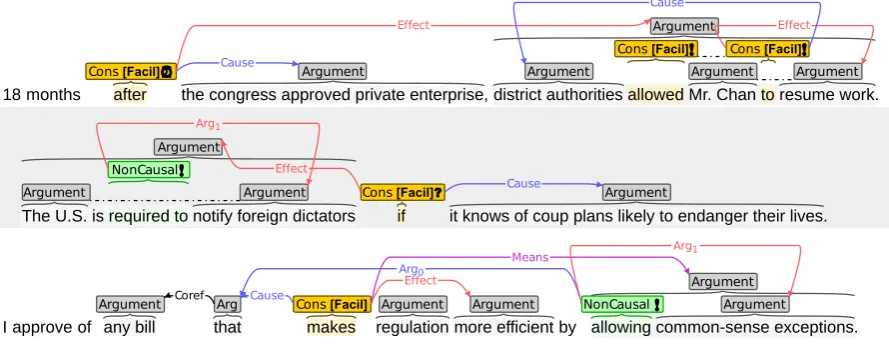
• The linguistic test: Can the sentence be rephrased as “It is because (of)X thatY” or “XcausesY?” If so, it is likely to be causal. Figure 1 showcases several fully-annotated sen-tences that highlight the key features of the new BECauSE scheme, including examples of overlap-ping relations.
5 BECauSE 2.0 Corpus
5.1 Data
The BECauSE 2.0 corpus3is an expanded version
of the dataset from BECauSE 1.0. It consists of: • 59 randomly selected articles from the year 2007
in the Washington section of the New York Times corpus (Sandhaus, 2008)
• 47 documents randomly selected4from sections
2-23 of the Penn Treebank (Marcus et al., 1994) • 679 sentences5 transcribed from Congress’
Dodd-Frank hearings, taken from the NLP Un-shared Task in PoliInformatics 2014 (Smith et al., 2014)
• 10 newspaper documents (Wall Street Jour-nal and New York Times articles, totalling 547 sentences) and 2 journal documents (82 sentences) from the Manually Annotated Sub-Corpus (MASC; Ide et al., 2010)
The first three sets of documents are the same dataset that was annotated for BECauSE 1.0. 5.2 Inter-Annotator Agreement
Inter-annotator agreement was calculated between the two primary annotators on a sample of 260 3Publicly available, along with the constructicon, at
https://github.com/duncanka/BECauSE.
4We excluded WSJ documents that were either earnings
reports or corporate leadership/structure announcements, as both tended to be merely short lists of names/numbers.
5The remainder of the document was not annotated due to
18 months after the congress approved private enterprise, district authorities allowed Mr. Chan to resume work.
The U.S. is required to notify foreign dictators if it knows of coup plans likely to endanger their lives.
I approve of any bill that makes regulation more efficient by allowing common-sense exceptions. Cons[Facil]⏰ Argument Argument Argument
Cons[Facil]❗ Cons[Facil]❗
Argument
Argument
Cause
Effect Effect
Cause
Argument Argument
NonCausal❗
Argument
Cons[Facil]? Cause Argument
Effect Arg1
Argument Arg Cons[Facil] Argument Argument NonCausal❗ Argument Argument
Cause
Coref
Effect Arg0
Means Arg1
Figure 1: Several example sentences annotated inBRAT(Stenetorp et al., 2012). The question mark indicates a hypothetical, the clock symbol indicates a temporal relation, and the thick exclamation point indicates obligation/permission.
Causal Overlapping Connective spans (F1) 0.77 0.89
Relation types (κ) 0.70 0.91 Degrees (κ) 0.92 (n/a)
[image:6.595.77.522.70.242.2]Cause/ARGC spans (%) 0.89 0.96 Cause/ARGC spans (J) 0.92 0.97 Cause/ARGC heads (%) 0.92 0.96 Effect/ARGE spans (%) 0.86 0.84 Effect/ARGE spans (J) 0.93 0.92 Effect/ARGE heads (%) 0.95 0.89
Table 2: Inter-annotator agreement for the new version of BECauSE.κindicates Cohen’s kappa;Jindicates the average Jaccard index, a measure of span overlap; and % indicates per-cent agreement of exact matches. Eachκand argument score was calculated only for instances with matching connectives. An argument’s head was determined automatically by pars-ing the sentence with version 3.5.2 of the Stanford Parser (Klein and Manning, 2003) and taking the highest dependency node in the argument span.
Means arguments were not included in this evaluation, as they are quite rare – there were only two in the IAA dataset, one of which was missed by one annotator and the other of which was missed by both. Both annotators agreed with these two means arguments once they were pointed out.
sentences, containing 98 causal instances and 82 instances of overlapping relations (per the first au-thor’s annotations). Statistics appear in Table 2.
Overall, the results show substantially improved connective agreement. F1 for causal connectives
is up to 0.77, compared to 0.70 in BECauSE 1.0. (The documents were drawn from similar sources and containing connectives of largely similar com-plexity as the previous IAA set.) The improvement suggests that the clearer guidelines and the over-lapping relations made decisions less ambiguous, although some of the difference may be due to chance differences in the IAA datasets. Agreement
on causal relation types is somewhat lower than in version 1.0 – 0.7 instead of 0.8 (possibly because more instances are annotated in the new scheme, which tends to reduceκ) – but it is still high. Unsur-prisingly, most of the disagreements are between CONSEQUENCE and MOTIVATION. Degrees are
close to full agreement; the only disagreement ap-pears to have been a careless error. Agreement on argument spans is likewise quite good.
For overlapping relations, only agreement on ARGEs is lower than for causal relations; all other
metrics are significantly higher. The connective
F1 score of 0.89 is especially promising, given the apparent difficulty of deciding which uses of connectives likewithorwhencould plausibly be coerced to a causal meaning.
5.3 Corpus Statistics and Analysis
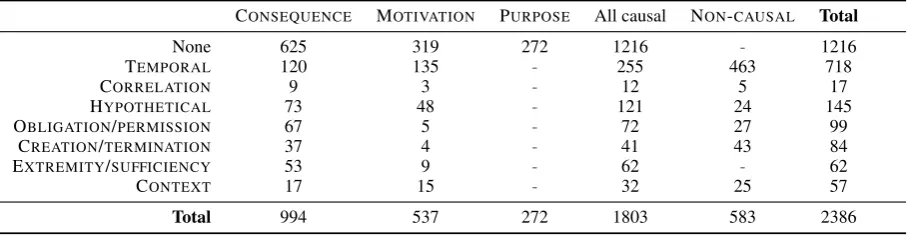
The corpus contains a total of 5380 sentences, among which are 1803 labeled instances of causal language. 1634 of these, or 90.7%, include both cause and effect arguments. 587 – about a third – involve overlapping relations. The corpus also includes 583 non-causal overlapping relation anno-tations. The frequency of both causal and overlap-ping relation types is shown in Table 3.
A few caveats about these statistics: first, PUR -POSE annotations do not overlap with any of the
categories we analyzed. However, this should not be interpreted as evidence that they have no over-laps. Rather, they seem to inhabit a different part of the semantic space. PURPOSEdoes share some
language with origin/destination relationships (e.g.,
CONSEQUENCE MOTIVATION PURPOSE All causal NON-CAUSAL Total
None 625 319 272 1216 - 1216
TEMPORAL 120 135 - 255 463 718
CORRELATION 9 3 - 12 5 17
HYPOTHETICAL 73 48 - 121 24 145
OBLIGATION/PERMISSION 67 5 - 72 27 99
CREATION/TERMINATION 37 4 - 41 43 84
EXTREMITY/SUFFICIENCY 53 9 - 62 - 62
CONTEXT 17 15 - 32 25 57
[image:7.595.72.527.63.181.2]Total 994 537 272 1803 583 2386
Table 3: Statistics of various combinations of relation types. Note that there are 9 instances of TEMPORAL+CORRELATIONand 3 instances of TEMPORAL+CONTEXT. This makes the bottom totals less than the sum of the rows.
Second, the numbers do not reflect all construc-tions that express, e.g., temporal or correlative rela-tionships – only those that can be used to express causality. Thus, it would be improper to conclude that over a third of temporals are causal; many kinds of temporal language simply were not in-cluded. Similarly, the fact that all annotated EX -TREMITY/SUFFICIENCYinstances are causal is an
artifact of only annotating uses with a complement clause, such asso loud I felt it;so loudon its own could never be coerced to a causal interpretation.
Several conclusions and hypotheses do emerge from the relation statistics. Most notably, causal-ity has thoroughly seeped into the temporal and hypothetical domains. Over 14% of causal expres-sions are piggybacked on temporal relations, and nearly 7% are expressed as hypotheticals. This is consistent with the close semantic ties between these domains: temporal order is a precondition for a causal relationship, and often hypotheticals are interesting specifically because of the conse-quences of the hypothesized condition. The extent of these overlaps speaks to the importance of cap-turing overlapping relations for causality and other domains with blurry boundaries.
Another takeaway is that most hypotheticals that are expressed as conditionals are causal. Not all hy-potheticals are included in BECauSE (e.g.,suppose thatis not), but all conditional hypotheticals are6:
any conditional could express a causal relationship in addition to a hypothetical one. In principle, non-causal hypotheticals could be more common, such asif he comes, he’ll bring his wifeorif we must cry, let them be tears of laughter. It appears, how-ever, that the majority of conditional hypotheticals
6We did not annotateeven if as a hypothetical, since it
seems to be a specialized concessive form of the construction. However, this choice does not substantially change the conclu-sion: even including instances ofeven if, 77% of conditional hypotheticals would still be causal.
(84%) in fact carry causal meaning.
Finally, the data exhibit a surprisingly strong preference for framing causal relations in terms of agents’ motivations: nearly 45% of causal in-stances are expressed as MOTIVATION or PUR -POSE. Of course, the data could be biased towards
events involving human agents; many of the docu-ments are about politics and economics. Still, it is intriguing that many of the explicit causal relation-ships are not just about, say, politicians’ economic decisions having consequences, but about why the agents made the choices they did. It is worth inves-tigating further to determine whether there really is a preference for appeals to motivation even when they are not strictly necessary.
6 Lessons Learned
Our experience suggests several lessons about an-notating multiple overlapping relations. First, it clearly indicates that a secondary meaning can be evoked without losing any of the original mean-ing. In terms of the model of prototypes and radial categories (Lewandowska-Tomaszczyk, 2007), the conventional model for blurriness between cate-gories, an instance can simultaneously be prototyp-ical for one type of relation and radial for another. For instance,the rulingallowsthe policetoenter your homeis a prototypical example a permission relationship. However, it is also a radial example of enablement (a form of causation): prototypical enablement involves a physical barrier being re-moved, whereasallowindicates the removal of a normative barrier.
would be impractical to simply pull all of these second-order domains into the annotation scheme; the project would quickly grow to encompass the entire language. If possible, the best solution is to dissect the overlapping domain into a more detailed typology, and only include the parts that directly overlap with the target domain. If this is not doable, the domain may need to be excluded altogether.
For example, we attempted to introduce a TOPIC
relation type to cover cases likeThe President is fuming overrecent media reportsor They’re an-gry about the equipment we broke (both clearly causal). Unfortunately, opening up the entire do-main of topic relations turned out to be too broad and confusing. For example, it is hard to tell which of the following are even describing the same kind of topic relationship, never mind which ones can also be causal: foughtoverhis bad behavior (be-havior caused fighting);foughtovera teddy bear
(fought for physical control);worriedaboutbeing late; worried that I might be late; I’m skeptical
regardingthe code’s robustness. We ultimately de-termined that teasing apart this domain would have to be out of scope for this work.
7 Contributions and Lingering Difficulties
Our approach leaves open several questions about how to annotate causal relations and other semanti-cally blurry relations.
First, it does not eliminate the need for binary choices about whether a given relation is present; our annotators must still mark each instance as either indicating causation or not. Likewise for each of the overlapping relations. Yet some cases suggest overtones of causality or correlation, but are not prototypically causal or correlative. These cases still necessitate making a semi-abitrary call. The ideal solution would somehow acknowledge the continuous nature of meaning – that an expres-sion can indicate a relationship that is not causal, entirely causal, slightly causal, or anywhere in be-tween. But it is hard to imagine how such a contin-uous representation would be annotated in practice. Second, some edge cases remain a challenge for our new scheme. Most notably, we did not examine every semantic domain sharing some overlap with causality. Relations we did not address include: • Origin/destination (as mentioned in §5.3; e.g.,
the sparksfromthe fire,towardthat goal) • Topic (see§6)
• Componential relationships (e.g.,As part ofthe building’s liquidation, other major tenants will also vacate the premises)
• Evidentiary basis (e.g.,We went to warbased onbad intelligence)
• Having a role (e.g.,Asan American citizen, I do not want to see the President fail)
• Placing in a position (e.g.,This moveputsthe American peopleatrisk)
These relations were omitted due to the time and effort it would have taken to determine whether and when to classify them as causal. We leave untangling their complexities for future work.
Other cases proved difficult because they seem to imply a causal relationship in each direction. The class of constructions indicating necessary pre-conditions was particularly troublesome. These constructions are typified by the sentence(Forus)
tosucceed, we allhave tocooperate. (Other vari-ants use different language to express the modality of obligation, such asrequireornecessary.) On the one hand, the sentence indicates that cooper-ation enables success. On the other hand, it also suggests that the desire for success necessitates the cooperation.7 We generally take the enablement
relationship to be the primary meaning, but this is not an entirely satisfying account of the semantics.
Despite the need for further investigation of these issues, our attempt at extending causal lan-guage annotations to adjacent semantic domains was largely a success. We have demonstrated that it is practical and sometimes helpful to annotate all linguistic expressions of a semantic relationship, even when they overlap with other semantic rela-tions. We were able to achieve high inter-annotator agreement and to extract insights about how differ-ent meanings compete for constructions. We hope that the new corpus, our annotation methodology and the lessons it provides, and the observations about linguistic competition will all prove useful to the research community.
7Necessary precondition constructions are thus similar to
References
Steven Bethard, William J Corvey, Sara Klingen-stein, and James H. Martin. 2008. Building a corpus of temporal-causal structure. In Proceed-ings of LREC 2008, pages 908–915.
Aljoscha Burchardt, Katrin Erk, Anette Frank, An-drea Kowalski, Sebastian Pad´o, and Manfred Pinkal. 2006. The SALSA corpus: a German cor-pus resource for lexical semantics. In Proceed-ings of the 5th International Conference on Lan-guage Resources and Evaluation (LREC-2006). Association for Computational Linguistics. Jesse Dunietz, Lori Levin, and Jaime Carbonell.
2015. Annotating causal language using corpus lexicography of constructions. InThe 9th Lin-guistic Annotation Workshop held in conjunction with NAACL 2015, pages 188–196.
Jesse Dunietz, Lori Levin, and Jaime Carbonell. in press. Automatically tagging constructions of causation and their slot-fillers. Transactions of the Association for Computational Linguistics. Charles J. Fillmore, Paul Kay, and Mary Catherine
O’Connor. 1988. Regularity and idiomaticity in grammatical constructions: The case of let alone.
Language, 64(3):501–538.
Adele Goldberg. 1995. Constructions: A Construc-tion Grammar Approach to Argument Structure. Chicago University Press.
C´ecile Grivaz. 2010. Human judgements on cau-sation in French texts. InProceedings of LREC 2010. European Languages Resources Associa-tion (ELRA).
Nancy Ide, Christiane Fellbaum, Collin Baker, and Rebecca Passonneau. 2010. The manually an-notated sub-corpus: A community resource for and by the people. InProceedings of the 48th Annual Meeting of the Association for Computa-tional Linguistics, pages 68–73. Association for Computational Linguistics.
Dan Klein and Christopher D. Manning. 2003. Ac-curate unlexicalized parsing. InProceedings of the 41st Annual Meeting on Association for Com-putational Linguistics-Volume 1, pages 423–430. Association for Computational Linguistics. Barbara Lewandowska-Tomaszczyk. 2007.
Pol-ysemy, prototypes, and radial categories. The Oxford handbook of cognitive linguistics, pages 139–169.
Mitchell Marcus, Grace Kim, Mary Ann Marcinkiewicz, Robert MacIntyre, Ann Bies, Mark Ferguson, Karen Katz, and Britta Schas-berger. 1994. The Penn Treebank: Annotating predicate argument structure. InProceedings of the Workshop on Human Language Technology, HLT ’94, pages 114–119. Association for Com-putational Linguistics, Stroudsburg, PA, USA. Paramita Mirza and Sara Tonelli. 2014. An
analy-sis of causality between events and its relation to temporal information. InProceedings of COL-ING, pages 2097–2106.
Nasrin Mostafazadeh, Alyson Grealish, Nathanael Chambers, James Allen, and Lucy Vanderwende. 2016. CaTeRS: Causal and temporal relation scheme for semantic annotation of event struc-tures. InProceedings of the 4th Workshop on Events: Definition, Detection, Coreference, and Representation, pages 51–61. Association for Computational Linguistics.
Ad Neeleman and Hans Van de Koot. 2012. The Theta System: Argument Structure at the Inter-face, chapter The Linguistic Expression of Cau-sation, pages 20–51. Oxford University Press. Tim O’Gorman, Kristin Wright-Bettner, and
Martha Palmer. 2016. Richer Event Descrip-tion: Integrating event coreference with tempo-ral, causal and bridging annotation. Computing News Storylines, page 47.
Martha Palmer, Daniel Gildea, and Paul Kingsbury. 2005. The Proposition Bank: An annotated cor-pus of semantic roles. Computational Linguis-tics, 31(1):71–106.
Rashmi Prasad, Nikhil Dinesh, Alan Lee, Eleni Miltsakaki, Livio Robaldo, Aravind Joshi, and Bonnie Webber. 2008. The Penn Discourse Tree-Bank 2.0. In Nicoletta Calzolari, Khalid Choukri, Bente Maegaard, Joseph Mariani, Jan Odijk, Ste-lios Piperidis, and Daniel Tapias, editors, Pro-ceedings of LREC 2008. European Language Resources Association (ELRA), Marrakech, Mo-rocco.
Josef Ruppenhofer, Michael Ellsworth, Miriam RL Petruck, Christopher R. Johnson, Jan Scheffczyk, and Collin F. Baker. 2016. FrameNet II: Ex-tended theory and practice.
Nathan Schneider, Jena D. Hwang, Vivek Srikumar, Meredith Green, Abhijit Suresh, Kathryn Con-ger, Tim O’Gorman, and Martha Palmer. 2016. A corpus of preposition supersenses. In Pro-ceedings of the 10th Linguistic Annotation Work-shop held in conjunction with ACL 2016 (LAW-X 2016), pages 99–109. Association for Computa-tional Linguistics.
Nathan Schneider, Vivek Srikumar, Jena D. Hwang, and Martha Palmer. 2015. A hierarchy with, of, and for preposition supersenses. In Proceed-ings of The 9th Linguistic Annotation Workshop, pages 112–123. Association for Computational Linguistics, Denver, Colorado, USA.
Karin K. Schuler. 2005. VerbNet: A Broad-Coverage, Comprehensive Verb Lexicon. Ph.D. thesis, University of Pennsylvania, Philadelphia, PA. AAI3179808.
Noah A. Smith, Claire Cardie, Anne L. Washing-ton, and John Wilkerson. 2014. Overview of the 2014 NLP unshared task in poliinformatics. In
Proceedings of the ACL 2014 Workshop on Lan-guage Technologies and Computational Social Science.
Pontus Stenetorp, Sampo Pyysalo, Goran Topi´c, Tomoko Ohta, Sophia Ananiadou, and Jun’ichi Tsujii. 2012. BRAT: a web-based tool for NLP-assisted text annotation. InProceedings of the Demonstrations at the 13th Conference of the European Chapter of the Association for Compu-tational Linguistics, pages 102–107. Association for Computational Linguistics.