Predicting Target Language CCG Supertags Improves Neural Machine
Translation
Maria N˘adejde1 and Siva Reddy1 and Rico Sennrich1 and Tomasz Dwojak1,2 Marcin Junczys-Dowmunt2 and Philipp Koehn3 and Alexandra Birch1
1School of Informatics, University of Edinburgh
2Adam Mickiewicz University
3Dep. of Computer Science, Johns Hopkins University
{m.nadejde,siva.reddy, rico.sennrich, a.birch}@ed.ac.uk {t.dwojak,junczys}@amu.edu.pl,[email protected]
Abstract
Neural machine translation (NMT) mod-els are able to partially learn syntactic in-formation from sequential lexical informa-tion. Still, some complex syntactic phe-nomena such as prepositional phrase at-tachment are poorly modeled. This work aims to answer two questions: 1) Does explicitly modeling target language syntax help NMT? 2) Is tight integration of words and syntax better than multitask training? We introduce syntactic information in the form of CCG supertags in the decoder, by interleaving the target supertags with the word sequence. Our results on WMT data show that explicitly modeling target-syntax improves machine translation qual-ity for German→English, a high-resource pair, and for Romanian→English, a
low-resource pair and also several syntactic phenomena including prepositional phrase attachment. Furthermore, a tight cou-pling of words and syntax improves trans-lation quality more than multitask training. By combining target-syntax with adding source-side dependency labels in the em-bedding layer, we obtain a total improve-ment of 0.9 BLEU for German→English and 1.2BLEUfor Romanian→English. 1 Introduction
Sequence-to-sequence neural machine translation (NMT) models (Sutskever et al.,2014;Cho et al., 2014b;Bahdanau et al.,2015) are state-of-the-art on a multitude of language-pairs (Sennrich et al., 2016a;Junczys-Dowmunt et al.,2016). Part of the appeal of neural models is that they can learn to implicitly model phenomena which underlie high quality output, and some syntax is indeed
cap-tured by these models. In a detailed analysis, Bentivogli et al. (2016) show that NMT signifi-cantly improves over phrase-based SMT, in par-ticular with respect to morphology and word or-der, but that results can still be improved for longer sentences and complex syntactic phenomena such as prepositional phrase (PP) attachment. Another study byShi et al.(2016) shows that the encoder layer of NMT partially learns syntactic informa-tion about the source language, however complex syntactic phenomena such as coordination or PP attachment are poorly modeled.
Recent work which incorporates additional source-side linguistic information in NMT mod-els (Luong et al., 2016; Sennrich and Haddow, 2016) show that even though neural models have strong learning capabilities, explicit features can still improve translation quality. In this work, we examine the benefit of incorporating global syn-tactic information on the target-side. We also ad-dress the question of how best to incorporate this information. For language pairs where syntac-tic resources are available on both the source and target-side, we show that approaches to incorpo-rate source syntax and target syntax are comple-mentary.
We propose a method for tightly coupling words and syntax by interleaving the target syntactic rep-resentation with the word sequence. We compare this to loosely coupling words and syntax using a multitask solution, where the shared parts of the model are trained to produce either a target se-quence of words or supertags in a similar fashion to Luong et al.(2016).
We use CCG syntactic categories (Steedman, 2000), also known assupertags, to represent syn-tax explicitly. Supertags provide global syntac-tic information locally at the lexical level. They encode subcategorization information, capturing short and long range dependencies and
ments, and also tense and morphological as-pects of the word in a given context. Consider the sentence in Figure 1. This sentence con-tains two PP attachments and could lead to sev-eral disambiguation possibilities (“in” can attach to “Netanyahu” or “receives”, and “of” can at-tach to “capital”, “Netanyahu” or “receives”). These alternatives may lead to different trans-lations in other languages. However the su-pertag((S[dcl]\NP)/PP)/NPof“receives”
indi-cates that the preposition“in” attaches to the verb, and the supertag(NP\NP)/NPof“of” indicates
that it attaches to “capital”, thereby resolving the ambiguity.
Our research contributions are as follows:
• We propose a novel approach to integrating tar-get syntax at word level in the decoder, by in-terleaving CCG supertags in the target word se-quence.
• We show that the target language syntax im-proves translation quality for German→English
and Romanian→English as measured by BLEU. Our results suggest that a tight coupling of target words and syntax (by interleaving) improves translation quality more than the decoupled signal from multitask training.
• We show that incorporating source-side
linguis-tic information is complimentary to our method, further improving the translation quality.
• We present a fine-grained analysis of SNMT
and show consistent gains for different linguis-tic phenomena and sentence lengths.
2 Related work
Syntax has helped in statistical machine trans-lation (SMT) to capture dependencies between distant words that impact morphological agree-ment, subcategorisation and word order (Galley et al., 2004;Menezes and Quirk,2007;Williams and Koehn,2012;Nadejde et al.,2013;Sennrich, 2015; Nadejde et al., 2016a,b; Chiang, 2007). There has been some work in NMT on modeling source-side syntax implicitly or explicitly. Kalch-brenner and Blunsom (2013); Cho et al. (2014a) capture the hierarchical aspects of language im-plicitly by using convolutional neural networks, while Eriguchi et al.(2016) use the parse tree of the source sentence to guide the recurrence and attention model in tree-to-sequence NMT. Luong
et al. (2016) co-train a translation model and a source-side syntactic parser which share the en-coder. Our multitask models extend their work to attention-based NMT models and to predict-ing target-side syntax as the secondary task. Sen-nrich and Haddow (2016) generalize the embed-ding layer of NMT to include explicit linguistic features such as dependency relations and part-of-speech tags and we use their framework to show source and target syntax provide complementary information.
Applying more tightly coupled linguistic fac-tors on the target for NMT has been previously investigated.Niehues et al.(2016) proposed a fac-tored RNN-based language model for re-scoring an n-best list produced by a phrase-based MT sys-tem. In recent work, Mart´ınez et al. (2016) im-plemented a factored NMT decoder which gener-ated both lemmas and morphological tags. The two factors were then post-processed to gener-ate the word form. Unfortungener-ately no real gain was reported for these experiments. Concurrently with our work,Aharoni and Goldberg(2017) pro-posed serializing the target constituency trees and Eriguchi et al.(2017) model target dependency re-lations by augmenting the NMT decoder with a RNN grammar (Dyer et al.,2016). In our work, we use CCG supertags which are a more compact representation of global syntax. Furthermore, we do not focus on model architectures, and instead we explore the more general problem of includ-ing target syntax in NMT: comparinclud-ing tightly and loosely coupled syntactic information and show-ing source and target syntax are complementary.
Previous work on integrating CCG supertags in factored phrase-based models (Birch et al.,2007) made strong independence assumptions between the target word sequence and the CCG categories. In this work we take advantage of the expressive power of recurrent neural networks to learn repre-sentations that generate both words and CCG su-pertags, conditioned on the entire lexical and syn-tactic target history.
3 Modeling Syntax in NMT
Source-side
BPE: Obama receives Net+ an+ yahu in the capital of USA
IOB: O O B I E O O O O O
CCG: NP ((S[dcl]\NP)/PP)/NP NP NP NP PP/NP NP/N N (NP\NP)/NP NP Target-side
[image:3.595.311.526.585.728.2]NP Obama ((S[dcl]\NP)/PP)/NP receives NP Net+ an+ yahu PP/NP in NP/Nthe N capital (NP\NP)/NP of NP USA
Figure 1: Source and target representation of syntactic information in syntax-aware NMT.
captures long range dependencies using long-term memory, short-term memory is cheap and reliable. Supertags can help by allowing the model to rely more on local information (short-term) and not having to rely heavily on long-term memory.
Consider a decoder that has to generate the fol-lowing sentences:
1. What(S[wq]/(S[q]/N P))/N city is(S[q]/P P)/N P
the Taj Mahal in?
2. WhereS[wq]/(S[q]/N P) is(S[q]/N P)/N P the Taj
Mahal?
If the decoding starts with predicting “What”, it is ungrammatical to omit the preposition “in”, and if the decoding starts with predicting “Where”, it is ungrammatical to predict the preposition. Here the decision to predict “in” depends on the first word, a long range dependency. However if we rely on CCG supertags, the supertags of both these sequences look very different. The supertag
(S[q]/PP)/NP for the verb “is” in the first sen-tence indicates that a preposition is expected in fu-ture context. Furthermore it is likely to see this particular supertag of the verb in the context of
(S[wq]/(S[q]/NP))/Nbut it is unlikely in the
con-text ofS[wq]/(S[q]/NP). Therefore a succession
of local decisions based on CCG supertags will result in the correct prediction of the preposition in the first sentence, and omitting the preposition in the second sentence. Since the vocabulary of CCG supertags is much smaller than that of possi-ble words, the NMT model will do a better job at generalizing over and predicting the correct CCG supertags sequence.
CCG supertags also help during encoding if they are given in the input, as we saw with the case of PP attachment in Figure 1. Translation of the correct verb form and agreement can be improved with CCG since supertags also encode tense, morphology and agreements. For exam-ple, in the sentence “It is going to rain”, the su-pertag (S[ng]\NP[expl])/(S[to]\NP) of “going”
indicates the current word is a verb in continuous form looking for an infinitive construction on the right, and an expletive pronoun on the left.
We explore the effect of target-side syntax by using CCG supertags in the decoder and by com-bining these with source-side syntax in the en-coder, as follows.
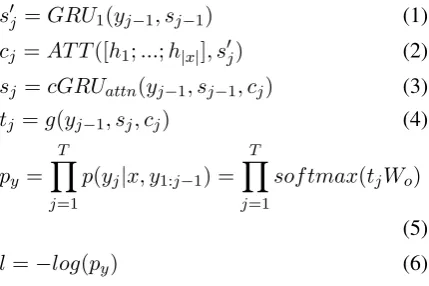
Baseline decoder The baseline decoder archi-tecture is a conditional GRU with attention (cGRUattn) as implemented in the Nematus
toolkit (Sennrich et al., 2017). The decoder is a recursive function computing a hidden statesj at
each time stepj ∈ [1, T]of the target recurrence.
This function takes as input the previous hidden state sj−1, the embedding of the previous target word yj−1 and the output of the attention model
cj. The attention model computes a weighted sum
over the hidden states hi = [−→hi;←h−i] of the
bi-directional RNN encoder. The function g
com-putes the intermediate representationtjand passes
this to asoftmaxlayer which first applies a linear transformation (Wo) and then computes the
prob-ability distribution over the target vocabulary. The training objective for the entire architecture is min-imizing the discrete cross-entropy, therefore the loss lis the negative log-probability of the refer-ence sentrefer-ence.
s0j =GRU1(yj−1, sj−1) (1)
cj =AT T([h1;...;h|x|], s0j) (2)
sj =cGRUattn(yj−1, sj−1, cj) (3) tj =g(yj−1, sj, cj) (4)
py = T
Y
j=1
p(yj|x, y1:j−1) =
T
Y
j=1
sof tmax(tjWo)
(5)
l=−log(py) (6)
st-3 st-2 st-1 st
NP Obama ((S\NP)/PP)/NP receives
h1 h2 h3 …. hT
αt,1
αt,2 αt,3
αt,T
x1 x2 x3 x4
+
s't-1 s't
NP ((S\NP)/PP)/NP
h1 h2 h3 …. hT
αt,1
x1 x2 x3
st-1 st
Obama receives
αt,2 αt,3 αt,T
+ βt,1 +
βt,2
βt,3 βt,T
x4
[image:4.595.93.458.78.214.2]a) b)
Figure 2: Integrating target syntax in the NMT decoder: a) interleaving and b) multitasking.
strategies of coupling the CCG supertags with the translated words in the decoder: interleaving and multitasking with shared encoder. In Figure2we represent graphically the differences between the two strategies and in the next paragraphs we for-malize them.
• Interleaving In this paper we propose a tight integration in the decoder of the syntactic rep-resentation and the surface forms. Before each word of the target sequence we include its su-pertag as an extra token. The new target se-quencey0 will have the length2T, whereT is
the number of target words. With this represen-tation, a single decoder learns to predict both the target supertags and the target words ditioned on previous syntactic and lexical con-text. We do not make changes to the baseline NMT decoder architecture, keeping equations (1) - (6) and the corresponding set of parame-ters unchanged. Instead, we augment the tar-get vocabulary to include both words and CCG supertags. This results in a shared embedding space and the following probability of the target sequencey0, wherey0jcan be either a word or a
tag:
y0 =ytag1 , y1word, ...., yTtag, ywordT (7)
py0 =
2T
Y
j
p(y0j|x, y1:0 j−1) (8)
At training time we pre-process the target se-quence to add the syntactic annotation and then split only the words into byte-pair-encoding
(BPE) (Sennrich et al., 2016b) sub-units. At
testing time we delete the predicted CCG su-pertags to obtain the final translation. Figure1 gives an example of the target-side representa-tion in the case of interleaving. The supertag
NPcorresponding to the wordNetanyahuis in-cluded only once before the three BPE subunits
Net+ an+ yahu.
• Multitasking – shared encoder A loose
cou-pling of the syntactic representation and the sur-face forms can be achieved by co-training a translation model with a secondary prediction task, in our case CCG supertagging. In the mul-titask framework (Luong et al., 2016) the en-coder part is shared while the deen-coder is dif-ferent for each of the prediction tasks: transla-tion and tagging. In contrast to Luong et al., we train a separate attention model for each task and perform multitask learning with tar-get syntax. The two decoders take as input the same source context, represented by the en-coder’s hidden stateshi = [−→hi;←h−i]. However,
each task has its own set of parameters associ-ated with the five components of the decoder:
GRU1,AT T,cGRUatt,g,sof tmax.
Further-more, the two decoders may predict a different number of target symbols, resulting in target se-quences of different lengthsT1andT2. This re-sults in two probability distributions over sep-arate target vocabularies for the words and the tags:
pwordy = T1
Y
j
p(yjword|x, yword1:j−1) (9)
ptagy = T2
Y
k
The final loss is the sum of the losses for the two decoders:
l=−(log(pyword) +log(ptagy )) (11)
We use EasySRL to label the English side of the parallel corpus with CCG supertags1instead of using a corpus with gold annotations as in Luong et al.(2016).
Source-side syntax – shared embedding While our focus is on target-side syntax, we also exper-iment with including source-side syntax to show that the two approaches are complementary.
Sennrich and Haddowpropose a framework for including source-side syntax as extra features in the NMT encoder. They extend the model of Bah-danau et al. by learning a separate embedding for several source-side features such as the word itself or its part-of-speech. All feature embeddings are concatenated into one embedding vector which is used in all parts of the encoder model instead of the word embedding. When modeling the source-side syntactic information, we include the CCG supertags or dependency labels as extra features. The baseline features are the subword units ob-tained using BPE together with the annotation of the subword structure using IOB format by mark-ing if a symbol in the text forms the beginnmark-ing (B), inside (I), or end (E) of a word. A separate tag (O) is used if a symbol corresponds to the full word. The word level supertag is replicated for each BPE unit. Figure1gives an example of the source-side feature representation.
4 Experimental Setup and Evaluation 4.1 Data and methods
We train the neural MT systems on all the parallel data available at WMT16 (Bojar et al., 2016) for the German↔English and Romanian↔English language pairs. The English side of the train-ing data is annotated with CCG lexical tags2 us-ing EasySRL (Lewis et al., 2015) and the avail-able pre-trained model3. Some longer sentences cannot be processed by the parser and therefore we eliminate them from our training and test data. We report the sentence counts for the filtered data
1We use the same data and annotations for the
interleav-ingapproach.
2The CCG tags include features such as the verb tense
(e.g. [ng] for continuous form) or the sentence type (e.g. [pss] for passive).
3https://github.com/uwnlp/EasySRL
train dev test
DE-EN 4,468,314 2,986 2,994
[image:5.595.328.504.62.104.2]RO-EN 605,885 1,984 1,984
Table 1: Number of sentences in the training, de-velopment and test sets.
sets in Table1. Dependency labels are annotated with ParZU (Sennrich et al.,2013) for German and SyntaxNet (Andor et al.,2016) for Romanian.
All the neural MT systems are attentional encoder-decoder networks (Bahdanau et al.,2015) as implemented in the Nematus toolkit (Sennrich et al.,2017).4 We use similar hyper-parameters to those reported by (Sennrich et al.,2016a;Sennrich and Haddow,2016) with minor modifications: we used mini-batches of size 60 and Adam optimizer (Kingma and Ba,2014). We select the best single models according toBLEUon the development set and use the four best single models for the ensem-bles.
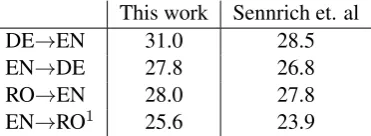
To show that we report results over strong base-lines, table2compares the scores obtained by our baseline system to the ones reported in Sennrich et al. (2016a). We normalize diacritics5 for the English→Romanian test set. We did not remove
or normalize Romanian diacritics for the other ex-periments reported in this paper. Our baseline sys-tems are generally stronger than Sennrich et al. (2016a) due to training with a different optimizer for more iterations.
This work Sennrich et. al
DE→EN 31.0 28.5
EN→DE 27.8 26.8
RO→EN 28.0 27.8
EN→RO1 25.6 23.9
Table 2: Comparison of baseline systems in this work and in Sennrich et al. (2016a). Case-sensitiveBLEUscores reported over newstest2016 withmteval-13a.perl.1Normalized diacritics.
During training we validate our models with BLEU(Papineni et al.,2002) on development sets: newstest2013 for German↔English and news-dev2016 for Romanian↔English. We evaluate the
systems on newstest2016 test sets for both
lan-4https://github.com/rsennrich/nematus
5There are different encodings for letters with
[image:5.595.325.511.493.561.2]guage pairs and use bootstrap resampling (Riezler and Maxwell,2005) to test statistical significance. We computeBLEUwith multi-bleu.perlover tok-enized sentences both on the development sets, for early stopping, and on the test sets for evaluating our systems.
Words are segmented into sub-units that are learned jointly for source and target using BPE (Sennrich et al.,2016b), resulting in a vocabulary size of 85,000. The vocabulary size for CCG su-pertags was 500.
For the experiments with source-side features we use the BPE sub-units and the IOB tags as baseline features. We keep the total word em-bedding size fixed to 500 dimensions. We allo-cate 10 dimensions for dependency labels when using these as source-side features and when us-ing source-side CCG supertags we allocate 135 di-mensions.
The interleavingapproach to integrating target syntax increases the length of the target sequence. Therefore, at training time, when adding the CCG supertags in the target sequence we increase the maximum length of sentences from 50 to 100. On average, the length of English sentences for new-stest2013 in BPE representation is 22.7, while the average length when adding the CCG supertags is 44. Increasing the length of the target recurrence results in larger memory consumption and slower training.6. At test time, we obtain the final trans-lation by post-processing the predicted target se-quence to remove the CCG supertags.
4.2 Results
In this section, we first evaluate the syntax-aware NMT model (SNMT) with target-side CCG su-pertags as compared to the baseline NMT model described in the previous section (Bahdanau et al., 2015;Sennrich et al., 2016a). We show that our proposed method for tightly coupling target syn-tax viainterleaving, improves translation for both German→English and Romanian→English while
the multitasking framework does not. Next, we show that SNMT with target-side CCG supertags can be complemented with source-side dependen-cies, and that combining both types of syntax brings the most improvement. Finally, our exper-iments with source-side CCG supertags confirm that global syntax can improve translation either
6Roughly 10h30 per 100,000 sentences (20,000 batches)
for SNMT compared to 6h for NMT.
as extra information in the encoder or in the de-coder.
Target-side syntax We first evaluate the impact of target-side CCG supertags on overall transla-tion quality. In Table 3 we report results for German→English, a high-resource language pair,
and for Romanian→English, a low-resource lan-guage pair. We report BLEU scores for both the best single models and ensemble models. How-ever, we will only refer to the results with ensem-ble models since these are generally better.
The SNMT system with target-side
syntax improves BLEU scores by 0.9
for Romanian→English and by 0.6 for
German→English. Although the training data for German→English is large, the CCG supertags
still improve translation quality. These results suggest that the baseline NMT decoder benefits from modeling the global syntactic information locally via supertags.
Next, we evaluate whether there is a benefit to tight coupling between the target word sequence and syntax, as apposed to loose coupling. We compare our method ofinterleaving the CCG su-pertags with multitasking, which predicts target CCG supertags as a secondary task. The results in Table3show that the multitask approach does not improve BLEU scores for German→English, which exhibits long distance word reordering. For Romanian→English, which exhibits more local word reordering, multitasking improves BLEUby 0.6 relative to the baseline. In contrast, the inter-leavingapproach improves translation quality for both language pairs and to a larger extent. There-fore, we conclude that a tight integration of the tar-get syntax and word sequence is important. Con-ditioning the prediction of words on their corre-sponding CCG supertags is what sets SNMT apart from the multitasking approach.
Ini-German→English Romanian→English
model syntax strategy single ensemble single ensemble
NMT - - 31.0 32.1 28.1 28.4
SNMT target – CCG interleaving 32.0 32.7* 29.2 29.3**
Multitasking target – CCG shared encoder 31.4 32.0 28.4 29.0*
SNMT source – dep shared embedding 31.4 32.2 28.2 28.9
+ target – CCG + interleaving 32.1 33.0** 29.1 29.6**
Table 3: Experiments with target-side syntax for German→English and Romanian→English. BLEU scores reported for baseline NMT, syntax-aware NMT (SNMT) and multitasking. The SNMT system is also combined with source dependencies. Statistical significance is indicated with * p < 0.05and ** p <0.01, when comparing against the NMT baseline.
tially, we had intended to use global syntax on the source-side as well for German→English,
how-ever the German CCG tree-bank is still under de-velopment.
From the results in Table 3 we first ob-serve that for German→English the source-side dependency labels improve BLEU by only 0.1, while Romanian→English sees an improvement
of 0.5. Source-syntax may help more for Romanian→English because the training data is smaller and the word order is more similar be-tween the source and target languages than it is for German→English.
For both language pairs, target-syntax im-proves translation quality more than source-syntax. However, target-syntax is complemented by source-syntax when used together, leading to a final improvement of 0.9 BLEU points for German→English and 1.2 BLEU points for Romanian→English.
Finally, we show that CCG supertags are also an effective representation of global-syntax when used in the encoder. In Table 4 we present re-sults for using CCG supertags as source-syntax in the embedding layer. Because we have CCG annotations only for English, we reverse the translation directions and report BLEU scores for English→German and English→Romanian. The BLEUscores reported are for the ensemble models over newstest2016.
For English→German BLEU increases by 0.7 points and for English→Romanian by 0.5 points.
In contrast, Sennrich and Haddow (2016) obtain an improvement of only 0.2 for English→German using dependency labels which encode only the grammatical function of words. These results con-firm that representing global syntax in the en-coder provides complementary information that
model syntax EN→DE EN→RO
NMT - 28.3 25.6
[image:7.595.80.516.62.162.2]SNMT source – CCG 29.0* 26.1*
Table 4: Results for English→German and English→Romanian with source-side syntax. The
SNMT system uses the CCG supertags of the source words in the embedding layer. *p <0.05.
the baseline NMT model is not able to learn from the source word sequence alone.
4.3 Analyses by sentence type
In this section, we make a finer grained analysis of the impact of target-side syntax by looking at a breakdown ofBLEUscores with respect to differ-ent linguistic constructions and sdiffer-entence lengths7. We classify sentences into different linguis-tic constructions based on the CCG supertags that appear in them, e.g., the presence of cate-gory (NP\NP)/(S/NP) indicates a subordinate
construction. Figure 3 a) shows the difference in BLEU points between the syntax-aware NMT system and the baseline NMT system for the following linguistic constructions: coordination
(conj), control and raising(control), prepositional phrase attachment(pp), questions and subordinate clauses (subordinate). In the figure we use the symbol “*” to indicate that syntactic information is used on the target (eg. de-en*), or both on the source and target (eg. *de-en*). We report the number of sentences for each category in Table5. With target-syntax, we see consistent im-provements across all linguistic constructions for Romanian→English and across all butcontrol and raisingfor German→English. In particular, the
in-7Document-levelBLEUis computed over each subset of
[image:7.595.306.528.252.293.2]a) b)
Figure 3: Difference inBLEUpoints between SNMT and NMT, relative to baseline NMT scores, with respect to a) linguistic constructs and b) sentence lengths. The numbers attached to the bars represent theBLEUscore for the baseline NMT system. The symbol * indicates that syntactic information is used on the target (eg. de-en*), or both on the source and target (eg. *de-en*)
sub. qu. pp contr. conj
RO↔EN 742 90 1,572 415 845
DE↔EN 936 114 2,321 546 1,129
Table 5: Sentence counts for different linguistic constructions.
crease inBLEUscores for theprepositional phrase andsubordinateconstructions suggests that target word order is improved.
For German→English, there is a small
de-crease in BLEU for the control and raising con-structions when using target-syntax alone. How-ever, source-syntax adds complementary informa-tion to target-syntax, resulting in a small improve-ment for this category as well. Moreover, com-bining source and target-syntax increases trans-lation quality across all linguistic constructions as compared to NMT and SNMT with target-syntax alone. For Romanian→English, combin-ing source and target-syntax brcombin-ings an additional improvement of 0.7 for subordinate constructs and 0.4 forprepositional phrase attachment. For German→English, on the same categories, there is
an additional improvement of 0.4 and 0.3 respec-tively. Overall,BLEUscores improve by more than 1BLEUpoint for most linguistic constructs and for
both language pairs.
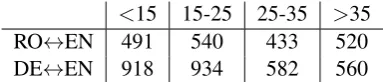
Next, we compare the systems with respect to sentence length. Figure3b) shows the difference in BLEU points between the syntax-aware NMT system and the baseline NMT system with respect to the length of the source sentence measured in BPE sub-units. We report the number of sentences for each category in Table6.
<15 15-25 25-35 >35
RO↔EN 491 540 433 520
DE↔EN 918 934 582 560
Table 6: Sentence counts for different sentence lengths.
With target-syntax, we see consistent improvements across all sentence lengths for Romanian→English and across all but
[image:8.595.320.512.505.546.2]lin-DE - EN Question
Source Oder wollen Sie herausfinden ,¨uberwas andere reden ? Ref. Or do you want to find out what others are talkingabout? NMT Or would you like to find outaboutwhat others are talkingabout?
SNMT Or do you want to find out whatN P/(S[dcl]/N P)others are(S[dcl]\N P)/(S[ng]\N P)talking(S[ng]\N P)/P PaboutP P/N P?
DE - EN Subordinate
Source ...dass die Polizei jetzt sagt , ..., und dass Lamb in seinem NotrufPrentiss zwar als seine Frau bezeichnete... Ref. ...that police are now saying ..., and that while Lambreferred to Prentiss as his wifein the 911 call ... NMT ...police are now saying ..., and that in his emergency callPrentiss he called his wife...
SNMT ...police are now saying ..., and that lamb , in his emergency call ,described((S[dcl]\N P)/P P)/N PPrentiss as his wife....
Figure 4: Comparison of baseline NMT and SNMT with target syntax for German→English.
guistic phenomena. However, when using both source and target syntax, the effect on short sen-tences disappears. For Romanian→English there
is also a large improvement on short sentences when combining source and target syntax: 2.9 BLEU points compared to the NMT baseline and 1.2 BLEU points compared to SNMT with target-syntax alone.
With both source and target-syntax, translation quality increases across all sentence lengths as compared to NMT and SNMT with target-syntax alone. For German→English sentences that are more than 35 words, we see again the effect of increasing the target sequence by adding CCG supertags. Target-syntax helps, however BLEU improves by only 0.4, compared to 0.9 for sen-tences between 15 and 35 words. With both source and target syntax, BLEU improves by 0.8 for sentences with more than 35 words. For Romanian→English we see a similar result for sentences with more than 35 words: target-syntax improves BLEU by 0.6, while combining source and target syntax improves BLEU by 0.8. These results confirm as well that source-syntax adds complementary information to target-syntax and mitigates the problem of increasing the target se-quence.
4.4 Discussion
Our experiments demonstrate that target-syntax improves translation for two translation directions: German→English and Romanian→English. Our
proposed method predicts the target words to-gether with their CCG supertags.
Although the focus of this paper is not im-proving CCG tagging, we can also measure that SNMT is accurate at predicting CCG supertags. We compare the CCG sequence predicted by the SNMT models with that predicted by EasySRL
and obtain the following accuracies: 93.2 for Romanian→English, 95.6 for German→English, 95.8 for German→English with both source and
target syntax.8
We conclude by giving a couple of examples in Figure 4 for which the SNMT system with tar-get syntax produced more grammatical transla-tions than the baseline NMT system.
In the example DE-EN Question the baseline NMT system translates the preposition “¨uber”
twice as “about”. The SNMT system with tar-get syntax predicts the correct CCG supertag for
“what” which expects to be followed by a sen-tence and not a preposition: NP/(S[dcl]/NP).
Therefore the SNMT correctly re-orders the preposition“about”at the end of the question.
In the exampleDE-EN Subordinate the base-line NMT system fails to correctly attach “Pren-tiss” as an object and “his wife” as a modifier to the verb “called (bezeichnete)” in the subor-dinate clause. In contrast the SNMT system pre-dicts the correct sub-categorization frame of the verb“described”and correctly translates the en-tire predicate-argument structure.
5 Conclusions
This work introduces a method for modeling ex-plicit target-syntax in a neural machine transla-tion system, by interleaving target words with their corresponding CCG supertags. Earlier work on syntax-aware NMT mainly modeled syntax in the encoder, while our experiments suggest model-ing syntax in the decoder is also useful. Our re-sults show that a tight integration of syntax in the decoder improves translation quality for both
8The multitasking model predicts a different number of
German→English and Romanian→English lan-guage pairs, more so than a loose coupling of tar-get words and syntax as in multitask learning. Fi-nally, by combining our method for integrating target-syntax with the framework ofSennrich and Haddow (2016) for source-syntax we obtain the most improvement over the baseline NMT system: 0.9BLEUfor German→English and 1.2BLEUfor Romanian→English. In particular, we see large
improvements for longer sentences involving syn-tactic phenomena such as subordinate and coordi-nate clauses and prepositional phrase attachment. In future work, we plan to evaluate the impact of target-syntax when translating into a morpho-logically rich language, for example by using the Hindi CCGBank (Ambati et al.,2016).
Acknowledgements
We thank the anonymous reviewers for their com-ments and suggestions. This project has received funding from the European Union’s Horizon 2020 research and innovation programme under grant agreements 644402 (HimL), 644333 (SUMMA) and 645452 (QT21).
References
Roee Aharoni and Yoav Goldberg. 2017. Towards string-to-tree neural machine translation. In Pro-ceedings of the 55th Annual Meeting of the Associa-tion for ComputaAssocia-tional Linguistics (Volume 2: Short Papers), Vancouver, Canada. Association for Com-putational Linguistics.
Bharat Ram Ambati, Tejaswini Deoskar, and Mark Steedman. 2016. Hindi CCGbank: CCG Treebank from the Hindi Dependency Treebank. InLanguage Resources and Evaluation.
Daniel Andor, Chris Alberti, David Weiss, Aliaksei Severyn, Alessandro Presta, Kuzman Ganchev, Slav Petrov, and Michael Collins. 2016. Globally nor-malized transition-based neural networks. In Pro-ceedings of the 54th Annual Meeting of the Associa-tion for ComputaAssocia-tional Linguistics (Volume 1: Long Papers), pages 2442–2452, Berlin, Germany. Asso-ciation for Computational Linguistics.
Dzmitry Bahdanau, Kyunghyun Cho, and Yoshua Ben-gio. 2015. Neural machine translation by jointly learning to align and translate. In Proceedings of the International Conference on Learning Represen-tations (ICLR).
Luisa Bentivogli, Arianna Bisazza, Mauro Cettolo, and Marcello Federico. 2016. Neural versus phrase-based machine translation quality: a case study. In Proceedings of the 2016 Conference on Empirical
Methods in Natural Language Processing, EMNLP 2016, Austin, Texas, USA, November 1-4, 2016, pages 257–267.
Alexandra Birch, Miles Osborne, and Philipp Koehn. 2007. Ccg supertags in factored statistical machine translation. In Proceedings of the Second Work-shop on Statistical Machine Translation, StatMT ’07, pages 9–16, Stroudsburg, PA, USA. Associa-tion for ComputaAssocia-tional Linguistics.
Ondˇrej Bojar, Rajen Chatterjee, Christian Federmann, Yvette Graham, Barry Haddow, Matthias Huck, Antonio Jimeno Yepes, Philipp Koehn, Varvara Logacheva, Christof Monz, Matteo Negri, Aure-lie Neveol, Mariana Neves, Martin Popel, Matt Post, Raphael Rubino, Carolina Scarton, Lucia Spe-cia, Marco Turchi, Karin Verspoor, and Marcos Zampieri. 2016. Findings of the 2016 conference on machine translation. InProceedings of the First Conference on Machine Translation, pages 131– 198, Berlin, Germany. Association for Computa-tional Linguistics.
David Chiang. 2007. Hierarchical phrase-based trans-lation.Comput. Linguist., 33(2):201–228.
Kyunghyun Cho, Bart van Merrienboer, Dzmitry Bah-danau, and Yoshua Bengio. 2014a. On the proper-ties of neural machine translation: Encoder–decoder approaches. InProceedings of SSST-8, Eighth Work-shop on Syntax, Semantics and Structure in Statisti-cal Translation, pages 103–111, Doha, Qatar. Asso-ciation for Computational Linguistics.
Kyunghyun Cho, Bart van Merri¨enboer, C¸a˘glar G¨ulc¸ehre, Dzmitry Bahdanau, Fethi Bougares, Hol-ger Schwenk, and Yoshua Bengio. 2014b. Learning phrase representations using rnn encoder–decoder for statistical machine translation. InProceedings of the 2014 Conference on Empirical Methods in Nat-ural Language Processing (EMNLP), pages 1724– 1734, Doha, Qatar. Association for Computational Linguistics.
Chris Dyer, Adhiguna Kuncoro, Miguel Ballesteros, and Noah A. Smith. 2016. Recurrent neural network grammars. InProceedings of the 2016 Conference of the North American Chapter of the Association for Computational Linguistics: Human Language Technologies, pages 199–209, San Diego, Califor-nia. Association for Computational Linguistics.
Akiko Eriguchi, Kazuma Hashimoto, and Yoshimasa Tsuruoka. 2016. Tree-to-sequence attentional neu-ral machine translation. InProceedings of the 54th Annual Meeting of the Association for Computa-tional Linguistics (Volume 1: Long Papers), pages 823–833, Berlin, Germany. Association for Compu-tational Linguistics.
55th Annual Meeting of the Association for Compu-tational Linguistics (Volume 2: Short Papers), Van-couver, Canada. Association for Computational Lin-guistics.
Michel Galley, Mark Hopkins, Kevin Knight, and Daniel Marcu. 2004. What’s in a translation rule? In Proceedings of Human Language Tech-nologies: Conference of the North American Chap-ter of the Association of Computational Linguistics, HLT-NAACL ’04.
Marcin Junczys-Dowmunt, Tomasz Dwojak, and Hieu Hoang. 2016. Is Neural Machine Translation Ready for Deployment? A Case Study on 30 Translation Directions. InProceedings of the IWSLT 2016.
Nal Kalchbrenner and Phil Blunsom. 2013. Recurrent continuous translation models. In Proceedings of the 2013 Conference on Empirical Methods in Natu-ral Language Processing, pages 1700–1709, Seattle, Washington, USA. Association for Computational Linguistics.
Diederik Kingma and Jimmy Ba. 2014. Adam: A method for stochastic optimization. arXiv preprint arXiv:1412.6980.
Mike Lewis, Luheng He, and Luke Zettlemoyer. 2015. Joint a* ccg parsing and semantic role labelling. In Empirical Methods in Natural Language Process-ing.
Minh-Thang Luong, Quoc V Le, Ilya Sutskever, Oriol Vinyals, and Lukasz Kaiser. 2016. Multi-task se-quence to sese-quence learning. In Proceedings of International Conference on Learning Representa-tions (ICLR 2016).
Mercedes Garc´ıa Mart´ınez, Lo¨ıc Barrault, and Fethi Bougares. 2016. Factored Neural Machine Trans-lation Architectures. InInternational Workshop on Spoken Language Translation (IWSLT’16).
Arul Menezes and Chris Quirk. 2007. Using depen-dency order templates to improve generality in trans-lation. InProceedings of the Second Workshop on Statistical Machine Translation, pages 1–8.
Maria Nadejde, Alexandra Birch, and Philipp Koehn. 2016a. Modeling selectional preferences of verbs and nouns in string-to-tree machine translation. In Proceedings of the First Conference on Machine Translation, pages 32–42, Berlin, Germany. Asso-ciation for Computational Linguistics.
Maria Nadejde, Alexandra Birch, and Philipp Koehn.
2016b. A neural verb lexicon model with
source-side syntactic context for string-to-tree ma-chine translation. In Proceedings of the Interna-tional Workshop on Spoken Language Translation (IWSLT).
Maria Nadejde, Philip Williams, and Philipp Koehn. 2013. Edinburgh’s Syntax-Based Machine Transla-tion Systems. InProceedings of the Eighth Work-shop on Statistical Machine Translation, pages 170– 176, Sofia, Bulgaria.
Jan Niehues, Thanh-Le Ha, Eunah Cho, and Alex Waibel. 2016. Using factored word representation in neural network language models. In Proceed-ings of the First Conference on Machine Translation, Berlin, Germany.
Kishore Papineni, Salim Roukos, Todd Ward, and Wei-Jing Zhu. 2002. Bleu: A method for automatic eval-uation of machine translation. In Proceedings of the 40th Annual Meeting on Association for Com-putational Linguistics, ACL ’02, pages 311–318, Stroudsburg, PA, USA. Association for Computa-tional Linguistics.
Stefan Riezler and John T. Maxwell. 2005. On some pitfalls in automatic evaluation and significance test-ing for mt. In Proceedings of the ACL Workshop on Intrinsic and Extrinsic Evaluation Measures for Machine Translation and/or Summarization, pages 57–64, Ann Arbor, Michigan. Association for Com-putational Linguistics.
Rico Sennrich. 2015. Modelling and Optimizing on Syntactic N-Grams for Statistical Machine Transla-tion. Transactions of the Association for Computa-tional Linguistics, 3:169–182.
Rico Sennrich, Orhan Firat, Kyunghyun Cho, Alexan-dra Birch, Barry Haddow, Julian Hitschler, Marcin Junczys-Dowmunt, Samuel L¨aubli, Antonio Valerio Miceli Barone, Jozef Mokry, and Maria Nadejde. 2017. Nematus: a toolkit for neural machine trans-lation. InProceedings of the Software Demonstra-tions of the 15th Conference of the European Chap-ter of the Association for Computational Linguistics, pages 65–68, Valencia, Spain. Association for Com-putational Linguistics.
Rico Sennrich and Barry Haddow. 2016. Linguistic input features improve neural machine translation. InProceedings of the First Conference on Machine Translation, pages 83–91, Berlin, Germany.
Rico Sennrich, Barry Haddow, and Alexandra Birch. 2016a. Edinburgh neural machine translation sys-tems for wmt 16. In Proceedings of the First Conference on Machine Translation, pages 371– 376, Berlin, Germany. Association for Computa-tional Linguistics.
Rico Sennrich, Barry Haddow, and Alexandra Birch. 2016b. Neural machine translation of rare words with subword units. InProceedings of the 54th An-nual Meeting of the Association for Computational Linguistics (Volume 1: Long Papers), Berlin, Ger-many. Association for Computational Linguistics.
Re-sources for German Dependency Parsing, POS-tagging, and Morphological Analysis. In Proceed-ings of the International Conference Recent Ad-vances in Natural Language Processing 2013, pages 601–609, Hissar, Bulgaria.
Xing Shi, Inkit Padhi, and Kevin Knight. 2016. Does string-based neural mt learn source syntax? In Pro-ceedings of the 2016 Conference on Empirical Meth-ods in Natural Language Processing, pages 1526– 1534, Austin, Texas. Association for Computational Linguistics.
Mark Steedman. 2000. The syntactic process, vol-ume 24. MIT Press.
Ilya Sutskever, Oriol Vinyals, and Quoc V. Le. 2014. Sequence to sequence learning with neural net-works. In Proceedings of the 27th International Conference on Neural Information Processing Sys-tems, NIPS’14, pages 3104–3112.