Using External Resources and Joint Learning for Bigram Weighting
in ILP-Based Multi-Document Summarization
Chen Li1, Yang Liu1, Lin Zhao2
1Computer Science Department, The University of Texas at Dallas Richardson, Texas 75080, USA
2Research and Technology Center, Robert Bosch LLC Palo Alto, California 94304, USA
{chenli,[email protected]} {[email protected]}
Abstract
Some state-of-the-art summarization systems use integer linear programming (ILP) based methods that aim to maximize the important concepts covered in the summary. These con-cepts are often obtained by selecting bigrams from the documents. In this paper, we improve such bigram based ILP summarization meth-ods from different aspects. First we use syn-tactic information to select more important bi-grams. Second, to estimate the importance of the bigrams, in addition to the internal features based on the test documents (e.g., document frequency, bigram positions), we propose to extract features by leveraging multiple exter-nal resources (such as word embedding from additional corpus, Wikipedia, Dbpedia, Word-Net, SentiWordNet). The bigram weights are then trained discriminatively in a joint learn-ing model that predicts the bigram weights and selects the summary sentences in the ILP framework at the same time. We demonstrate that our system consistently outperforms the prior ILP method on different TAC data sets, and performs competitively compared to other previously reported best results. We also con-ducted various analyses to show the contribu-tions of different components.
1 Introduction
Extractive summarization is a sentence selection problem: identifying important summary sentences from one or multiple documents. Many methods have been developed for this problem, including su-pervised approaches that use a classifier to predict
whether or not a sentence is in the summary, or un-supervised methods such as graph-based approaches to rank the sentences. Recently global optimiza-tion methods such as integer linear programming (ILP) have been shown to be quite powerful for this task. For example, Gillick et al. (2009) used ILP to achieve the best result in the TAC 09 summa-rization task. The core idea of this summasumma-rization method is to select the summary sentences by maxi-mizing the sum of the weights of the language con-cepts that appear in the summary. Bigrams are often used as these language concepts because Gillick et al. (2009) stated that the bigrams gave consistently better performance than unigrams or trigrams for a variety of ROUGE measures. The association be-tween the language concepts and sentences serves as the constraints. This ILP method is formally rep-resented as below (see (Gillick et al., 2009) for more details):
max Piwici (1)
s.t. sjOccij ≤ci (2)
P
jsjOccij ≥ci (3)
P
jljsj ≤L (4)
ci∈ {0,1} ∀i (5)
sj ∈ {0,1} ∀j (6)
ciandsj are binary variables that indicate the
pres-ence of a concept and a sentpres-ence respectively. lj
is the sentence length andLis maximum length of the generated summary. wi is a concept’s weight
andOccij means the occurrence of conceptiin
sen-tencej. Inequalities (2)(3) associate the sentences
and concepts. They ensure that selecting a sen-tence leads to the selection of all the concepts it con-tains, and selecting a concept only happens when it is present in at least one of the selected sentences.
In such ILP-based summarization methods, how to determine the concepts and measure their weights is the key factor impacting the system performance. Intuitively, if we can successfully identify the im-portant key bigrams to use in the ILP system, or as-sign large weights to those important bigrams, the system generated summary sentences will contain as many important bigrams as possible. The oracle ex-periment in (Gillick et al., 2008) showed that if they just use the bigrams extracted from human generated summaries as the input of the ILP system, much bet-ter ROUGE scores can be obtained than using the automatically selected bigrams.
In this paper, we adopt the ILP summarization framework, but make improvement from three as-pects. First, we use the part-of-speech tag and constituent parse information to identify important bigram candidates: bigrams from base NP (noun phrases) and bigrams containing verbs or adjectives. This bigram selection method allows us to keep the important bigrams and filter useless ones. Second, to estimate the bigrams’ weights, in addition to using information from the test documents, such as doc-ument frequency, syntactic role in a sentence, etc., we utilize a variety of external resources, including a corpus of news articles with human generated sum-maries, Wiki documents, description of name en-tities from DBpedia, WordNet, and SentiWordNet. Discriminative features are computed based on these external resources with the goal to better represent the importance of a bigram and its semantic similar-ity with the given query. Finally, we propose to use a joint bigram weighting and sentence selection pro-cess to train the feature weights. Our experimental results on multiple TAC data sets show the competi-tiveness of our proposed methods.
2 Related Work
Optimization methods have been widely used in extractive summarization lately. McDonald (2007) first introduced the sentence level ILP for summa-rization. Later Gillick et al. (2009) revised it to concept-based ILP, which is similar to the
Bud-geted Maximal Coverage problem in (Khuller et al., 1999). The concept-based ILP system performed very well in the TAC 2008 and 2009 summariza-tion task (Gillick et al., 2008; Gillick et al., 2009). After that, the global optimization strategy attracted increasing attention in the summarization task. Lin and Bilmes (2010) treated the summarization task as a maximization problem of submodular functions. Davis et al. (2012) proposed an optimal combina-torial covering algorithm combined with LSA to measure the term weight for extractive summariza-tion. Takamura and Okumura (2009) also defined the summarization problem as a maximum cover-age problem and used a branch-and-bound method to search for the optimal solution. Li et al. (2013b) used the same ILP framework as (Gillick et al., 2009), but incorporated a supervised model to es-timate the bigram frequency in the final summary.
Similar optimization methods are also widely used in the abstractive summarization task. Martins and Smith (2009) leveraged ILP technique to jointly select and compress sentences for multi-document summarization. A novel summary guided sentence compression was proposed by (Li et al., 2013a) and it successfully improved the summarization perfor-mance. Woodsend and Lapata (2012) and Li et al. (2014) both leveraged constituent parser trees to help sentence compression, which is also modeled in the optimization framework. But these kinds of work involve using complex linguistic information, often based on syntactic analysis.
query. Similarly terminological databases have been exploited to encode the salience of candidate key phrases in scientific papers (Lopez and Romary, 2010). In summarization, external information has also been used to measure word salience. Some TAC systems like (Kumar et al., 2010; Jia et al., 2010) used Wiki as an important external resource to measure the words’ importance, which helped im-prove the summarization results. Hong and Nenkova (2014) introduced a supervised model for predicting word importance that incorporated a rich set of fea-tures. Tweets information is leveraged by (Wei and Gao, 2014) to help generate news highlights.
In this paper our focus is on choosing useful bi-grams and estimating accurate weights to use in the concept-based ILP methods. We explore many ex-ternal resources to extract features for bigram candi-dates, and more importantly, propose to estimate the feature weights in a joint process via structured per-ceptron learning that optimizes summary sentence selection.
3 Summarization System
In this study we use the ILP-based summarization framework (Formulas 1-6) that tries to maximize the weights of the selected concepts (bigrams) under the summary length constraint. Our focus is on better selection of the bigrams and estimation of the bi-gram weights. We use syntax tree and POS of tokens to help filter some useless bigrams. Then supervised methods are applied to predict the bigram weights. The rich set of features we use is introduced in Sec-tion 4. In the following we describe how to select important bigrams and how the feature weights are trained.
3.1 Bigram Selection
In (Gillick et al., 2009), bigrams whose docu-ment frequency is higher than a predefined thresh-old (df=3 in previous work) are used as the concepts in the ILP model. The weight for these bigrams in the ILP optimization objective function (Formula 1) is simply set as their document frequency. Although this setting has been demonstrated to be quite effec-tive, its gap with the oracle experiment (using bi-grams that appear in the human summaries) is still very large, suggesting potential gains by using better
bigrams/concepts in the ILP optimization method. Details are described in (Gillick et al., 2009).
In this paper, rather than considering all the bi-grams, we propose to utilize syntactic information to help select important bigrams. Intuitively bigrams containing content words carry more topic related information. As proven in (Klavans and Kan, 1998), nouns, verbs, and adjectives were indeed beneficial in document analysis. Therefore we focus on choos-ing bigrams containchoos-ing these words. First, we use a bottom-up strategy to go through the constituent parse tree and identify the ‘NP’ nodes in the low-est level of the tree. Then all the bigrams in these base NPs are kept as candidates. Second, we find the verbs and adjectives from the sentence based on the POS tags, and construct bigrams by concatenat-ing the previous or the next word of that verb or ad-jective. If these bigrams are not included in those already found from the base NPs, they are added to the bigram candidates. After the above filtering, we further drop bigrams if both words are stop words, as previous work in (Gillick et al., 2009).
3.2 Weight Training
We propose to train the feature weights in a joint learning fashion. In the ILP summarization frame-work, we use the following new objective function:
max Pi(θ·f(bi))ci (7)
We replace thewi in Formula 1 with a vector inner
product of bigram features and their corresponding weights. Constraints remain the same as those in Formula 2 to 6.
To train the model (feature weights), we leverage structured perceptron strategy (Collins, 2002) to up-date the feature weights whenever the hypothesis of-fered by the ILP decoding process is incorrect. Bi-nary class labels are used for bigrams in the learning process, that is, we only consider whether a bigram is in the system generated summary or human sum-maries, not their term or document frequency. Dur-ing perceptron trainDur-ing, a fixed learnDur-ing rate is used and parameters are averaged to prevent overfitting.
4 Features for Bigrams
the test documents, and features extracted from ex-ternal resources. The goal is to better predict the importance of a bigram, which we expect will help the ILP module better determine whether to include the bigram in the summary.
4.1 Internal Features
These features are generated from the provided test documents (note our task is multi-document summa-rization, and there is a given query topic. See Sec-tion 5 for the descripSec-tion of tasks and data).
• Frequency of the bigram in the entire set.
• Frequency of the bigram in related sentences.1 • Document frequency of the bigram in the entire
set.
• Is this bigram in the first 1/2/3 sentence?
• Is this bigram in the last 1/2/3 sentence?
• Similarity with the topic title, calculated by the number of common tokens in these two strings, divided by the length of the longer string.
4.2 Importance Score based on Language Models
The idea is to train two language models (LMs), one from the original documents, and the other one from the summaries, and compare the likelihood of a bi-gram generated by these two LMs, which can indi-cate how often a bigram is used in a summary. Sim-ilar to previous work in (Hong and Nenkova, 2014), we leveraged The New York Times Annotated Cor-pus (LDC Catalog No: LDC2008T19), which has the original news articles and human generated ab-stracts. We build two language models, from the news articles and the corresponding summaries re-spectively. We used about 160K abstract-original pairs. The KL scores for a bigram are defined as follows:
KL(LMA|LMO)(b) =P rA(b)∗lnP rP rA(b) O(b) (8)
KL(LMO|LMA)(b) =P rO(b)∗lnP rP rO(b) A(b) (9)
1Note that we do not use all the sentences in the ILP module. The ‘relevant’ sentences are those that have at least one bigram with document frequency larger than or equal to three.
where (LMA) and (LMO) are the LMs from the
abstracts and the original news articles. Note that one difference from (Hong and Nenkova, 2014) is that we calculate these scores for a bigram, not a word. As (Hong and Nenkova, 2014) showed, a higher value from the score in Formula 8 means the words are favored in the summaries, and vice verse in Formula 9. In addition to the above fea-tures, we also include the likelihood P rA(b) and
P rO(b) based on the two LMs, and the absolute
and relative difference between them: P rA(b) −
P rO(b), P rA(b)/P rO(b).
4.3 Similarity based on Word Embedding Representation
Given the recent success of the continuous represen-tation for words, we propose to use an unsupervised method to induce dense real-valued low dimensional word embedding, and then use the inner product as a measure of semantic similarity between two strings. In the word embedding model, every word can be represented by a vector ~w. We define the similar-ity between two sequencesS1 = x1, x2, ...xk and
sequenceS2 = y1, y2, ...yl as the average pairwise
similarity between any two words in them:
Sim(S1, S2) =
Pk
i=1Plj=1~xi·~yj
k∗l (10)
Based on such word embedding models, we de-rive two similarity features: (1) similarity between a bigram and the topic query, and (2) similarity be-tween a bigram and top-k most frequent unigrams in this topic. We trained two word embedding mod-els, from the abstract and news article collections in the New York Times Annotated Corpus, and thus have two sets of the above similarity features. We use the continuous bag-of-words model introduced by (Mikolov et al., 2013), and the tool word2vec2to
obtain the word embeddings.
4.4 Similarity based on WordNet3
Similar to the above method, here we still focus on measuring the similarity between a bigram and the topic query, but based on WordNet. We use WordNet to identify the synonyms of nouns, verbs,
and adjectives from each bigram and the query of the topic. Then every bigram and sentence can be represented as a bag of synonyms of the original words. Finally based on these synonyms we lever-age the following four similarity measurements: Lin Similarity (Lin, 1998), Wu-Palmer Similarity (Wu and Palmer, 1994), Jiang-Conrath Similarity (Jiang and Conrath, 1997), and Resnik Similarity (Resnik, 1995). These four similarity measurements are all implemented in the NLTK toolkit4. We expect that
these features would improve the estimation accu-racy because they can overcome the ambiguity and the diversity of the vocabulary.
4.5 Importance based on Wikipedia
Wikipedia is a very popular resource used in many different tasks. In order to obtain more precise ex-ternal information from Wikipedia for our task, we collect the articles from Wikipedia by two steps. If the query is already the title of a wiki page, we will not further gather other wiki pages for this topic. Otherwise, we first search for the wiki pages for the given topic query and description (if avail-able) using Google advanced search function to find pages from http://en.wikipedia.org/. For each re-turned wiki page, we further calculate its similarity between its abstract and the test documents’ top k frequent words. We select 3 most similar pages as the external Wiki resource for this topic. For these wikipages, we split into two parts: abstract and con-tent.5 The features are the following: For each
bi-gram, we collect its tf*idf score from the abstract and content part respectively, and the average tf*idf value of the unigrams in the bigram candidate. In ad-dition, we design two boolean features that represent whether a bigram is the top-k most frequent ones in the abstract or the content part of the Wikepages.
4.6 DBpedia6for Extending Name Entity
DBpedia is a crowd-sourced community effort to ex-tract structured information from Wikipedia and its Spotlight Service7is an entity linking tool to connect
4http://www.nltk.org/
5Every Wikipage has a table of contents. The part before that is considered as abstract and the part after that is the content of that page.
6http://dbpedia.org/About
7 http://blog.dbpedia.org/2014/07/21/dbpedia-spotlight-v07-released/
free text to DBpedia through the recognition and dis-ambiguation of entities and concepts from the DB-pedia Knowledge Base. We use this service to ex-tract the entity from each sentence, and if the recog-nized entity is also identified as a named entity by Stanford CoreNLP8, we use this entity’s DBpedia
abstract content to extend the bigrams. For exam-ple, in the bigram ‘Kashmir area’, the word ‘Kash-mir’ is recognized as an entity by both (Stanford CoreNLP and DBpedia Spotlight service), then we use the description for ‘Kashmir’ from DBpedia9to
extend this bigram, and calculate the cosine similar-ity between this description and the topic query and top-k most frequent unigrams in the documents.
4.7 Sentiment Feature from SentiWordNet10
SentiWordNet (Baccianella et al., 2010) is an exten-sion on WordNet and it further assigns to each synset of WordNet three sentiment scores: positivity, neg-ativity, objectivity. The sentiment score of a bigram is the average score of the two words in the bigram. To sum up, the features we use include the in-ternal features, and exin-ternal ones derived from vari-ous resources: news article corpus with summaries, Wikipeida, DBpedia, WordNet and SentiWordNet. Some external features represent the inherent im-portance of bigrams. For example, features ex-tracted from the news article corpus and wikipedia are used to represent how often bigrams are used in summary/abstract compared to the entire document. Some external features are used to better compute semantic similarity, for example, features from the word embedding methods, DBpedia, and WordNet.
5 Experiments
5.1 Data and Experiment Setup
We evaluate our methods using several recent TAC data sets, from 2008 to 2011. The TAC summa-rization task is to generate at most 100 words sum-maries from 10 documents for a given topic query
8http://nlp.stanford.edu/software/corenlp.shtml
9The Indian subcontinent is a southerly region of Asia, mostly situated on the Indian Plate and projecting southward into the Indian Ocean. Definitions of the extent of the Indian subcontinent differ but it usually includes the core lands of In-dia, Pakistan, and Bangladesh
consisting of a title and more detailed description (this is unavailable in 2010 and 2011 data). When evaluating on one TAC data set, we use the data from the other three years as the training set. All the summaries are evaluated using ROUGE (Lin, 2004; Owczarzak et al., 2012). In all of our ex-periments, we use Stanford CoreNLP toolkit to to-kenize the sentences, extract name entities and POS tags. Berkeley Parser (Petrov et al., 2006) is used to get the constituent parse tree for every sentence. An academic free solver11does all the ILP decoding. 5.2 Results and Analysis
5.2.1 Summarization Results
Table 1 shows the ROUGE-2 results of our pro-posed joint system, the ICSI system (which uses document frequency threshold to select bigram con-cepts and uses df as weights), the best performing system in the NIST TAC evaluation, and the state of the art performance we could find. The result of our proposed method is statistically significantly better than that of ICSI ILP (p< 0.05 based on paired t-test). It is also statistically significantly (p< 0.05) better than that of TAC Rank1 except 2011, and previous best in 2008 and 2010. The 2011 previ-ous best results from (Ng et al., 2012) involve some rule-based sentence compression, which improves the ROUGE value. If we apply the same or similar rule-based sentence compression on our results, and the ROUGE-2 of our proposed method improves to 14.38.
2008 2009 2010 2011
ICSI ILP 10.23 11.60 10.03 12.71
TAC Rank1 10.38 12.16 9.57 13.44
Previous Best 10.76† 12.46† 10.8‡ 13.93∗
Proposed Method 11.84 12.77 11.78 13.97
Table 1: ROUGE-2 summarization results.†is from (Li
et al., 2013b),‡is from (Davis et al., 2012), and∗is from (Ng et al., 2012).
5.2.2 The Effect of Bigram Selection
In our experiments, the document frequency threshold used to filter the bigrams is 3, the same as that in (Gillick et al., 2009), in order to make a bet-ter comparison with previous work. Figure 1 shows
11http://www.gurobi.com
the percentage of the correct bigrams (those in the human reference summaries) by our proposed selec-tion method and the original ICSI system which just used document frequency based selection. We can see that our selection method yields a higher per-cent of the correctly chosen bigrams. Since our pro-posed method is slightly aggressive when filtering bigrams, the absolute number of the correct bigrams decreased. However, our filtering method success-fully removes more useless bigrams, resulting in a higher percentage of the correct bigrams.
Table 2 shows the summarization results when us-ing different bigrams: the method used in the ICSI ILP system, that is, document frequency based se-lection/filtering and our selection method. Both of them use document frequency as the bigram weight in the ILP summarization module. The results show that just by changing the input bigrams, our method has already outperformed the ICSI system, which means the selection of bigram indeed has an impact on summarization results.
20 22 24 26 28 30 32 34
2008 2009 2010 2011 ICSI System
ICSI System
P
erc
en
tag
e
(%
)
P
erc
en
tag
e
(%
)
ICSI System
[image:6.612.328.517.375.507.2]ICSI System Proposed System
Figure 1: Percentage of correct bigrams in the selected bigrams from ICSI and our proposed system.
[image:6.612.326.523.589.633.2]2008 2009 2010 2011 ICSI ILP 10.23 11.60 10.03 12.71 Ours 10.26 11.65 10.25 12.75
5.2.3 The Effect of Features
Next we evaluate the contributions of different features. We show results for four experiments: (i) use just one type of features; (ii) combine the in-ternal features with features from just one exin-ternal resource; (iii) incrementally add external resources one by one; (iv) leave out each feature type.
Table 3 shows the ROUGE-2 results when we only apply one type of features. First, we can see that the system with the internal features has already outperformed the baseline which used document fre-quency as the weight. It shows that the other cho-sen internal features (beyond document frequency) are useful. Second, when we use the features from only one external resource, the results from some resources are competitive compared to that from the system using internal features. In particular, when using the LM scores, Wiki or Word Embedding fea-tures, the results are slightly better than the inter-nal features. Using DBpedia or SentiWordNet has worse results than the internal features. This is because the SentiWordNet features themselves are not very discriminative. For DBpedia, since it only has feature values for the bigrams containing name entities, it will only assign weights for those bi-grams. Therefore, only considering DBpedia fea-tures means that the ILP decoder would prefer to choose bigrams that are name entities with positive weights.
2008 2009 2010 2011 Internal 10.40 11.76 10.42 12.91 LM 10.58 11.86 10.48 12.94 Word Embedding 10.67 11.96 10.58 13.02 Wikipedia 10.61 11.90 10.52 13.00 DBpedia 8.35 9.85 9.46 11.00 WordNet 10.39 11.76 10.40 12.86 SentiwordNet 9.90 10.80 10.08 12.50
Table 3: ROUGE-2 results using one feature type.
Table 4 shows the results when combining the in-ternal features with features from one exin-ternal re-source. We can see that the features from Word Em-bedding model outperform others, suggesting the ef-fectiveness of this semantic similarity measure. Fea-tures from the LM scores and Wiki are also quite useful. Wiki pages are extracted for the test topic
itself, therefore they provide topic relevant back-ground information. The LM score features are ex-tracted from large amounts of news article data, and are good representation of the general importance of bigrams for the test domain. In contrast, Word-Net information is collected from a more general as-pect, which may not be a very good choice for this task. Also notice that even though the features from DBpedia and sentiwordnet do not perform well by themselves, after the combination with internal fea-tures, there is significant improvement. This proves that the features from DBpedia and sentiwordnet provide additional information not captured by the internal features from the documents.
2008 2009 2010 2011 Internal 10.40 11.76 10.42 12.91 +LM 10.76 12.03 10.80 13.11 +Word Embedding 10.92 12.12 10.85 13.24 +Wikipedia 10.81 12.08 10.76 13.17 +WordNet 10.68 11.96 10.71 12.99 +SentiwordNet 10.60 11.96 10.63 12.96 +DBpedia 10.69 12.00 10.70 13.07
Table 4: ROUGE-2 results using internal features com-bined with features from just one external resource.
Table 5 shows the results when adding features one by one. The order is based on its individual im-pact when combined with internal features. The re-sults show that Wiki, LM and DBpedia features give more improvement than WordNet and SentiWord-Net features. This shows the different impact of the external resources. We can see there is consistent improvement when more features are added.
2008 2009 2010 2011 1: Internal 10.92 12.12 10.85 13.24 +Word Embedding
2: 1+Wiki 11.22 12.25 11.15 13.47 3: 2+LM 11.41 12.41 11.37 13.68 4: 3+DBpedia 11.65 12.60 11.61 13.77 5: 4+WordNet 11.75 12.67 11.70 13.90 6: 5+SentiWordNet 11.84 12.77 11.78 13.97
Table 5: ROUGE-2 results using features incrementally combined.
excluded and the system uses all the other features. This set of experiments again shows that the external features like Word Embedding model based on large corpus and Wiki resource are very useful. Without using them, the system has the biggest performance degradation compared to the best result.
[image:8.612.331.519.69.201.2]2008 2009 2010 2011 -Internal 11.34 12.41 11.42 13.71 -Word Embedding 11.29 12.25 11.36 13.55 -Wiki 11.35 12.38 11.38 13.58 -LM 11.40 12.39 11.42 13.61 -DBpedia 11.50 12.47 11.47 13.71 -WordNet 11.67 12.64 11.64 13.80 -SentiWordNet 11.75 12.67 11.70 13.90
Table 6: ROUGE-2 results when leaving out each feature type.
5.2.4 Distribution of Correct Bigrams After Feature Weighting
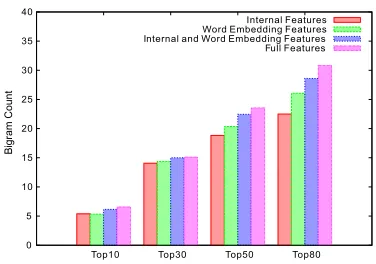
In the next experiment we analyze the distribu-tion of the correct bigrams from the ranked bigrams using different features in order to better evaluate their impact on bigram weighting. We rank all the bigrams in descending order according to the esti-mated weight, then calculate the number of correct bigrams (i.e., the bigrams in human generated sum-mary) in Top10, 30, 50 and 80. The more correct bigrams appear on the top of the list, the better our features estimate the importance of the bigrams. We conducted this experiment using four systems: the system only with internal features, only with Word Embedding features, with combination of internal and Word Embedding features, and with all the fea-tures. Figure 2 shows the results of this experi-ment on TAC 2008 data. The pattern is similar on the other three years’ data. The results show that systems with better ROUGE-2 value indeed can as-sign higher weights to correct bigrams, allowing the ILP decoding process to select these bigrams, which leads to a better sentence selection.
5.2.5 Joint Learning Results
Finally we evaluate the effectiveness of our pro-posed joint learning approach. For comparison, we implement a pipeline method, where we use the bi-gram’s document frequency as the target value to train a regression model, and during testing use the
0 5 10 15 20 25 30 35 40
Top10 Top30 Top50 Top80 Internal Features Word Embedding Features Internal and Word Embedding Features Full Features
B
igr
am
C
ou
nt
Figure 2: Distribution of correct bigrams in Top-n weighted bigrams from four systems.
model’s predicted value as the weight in the ILP framework. Table 7 compares the results using the joint learning method and this pipeline approach. We only show the results using the system with all the features due to limited space. We can see that our joint method outperforms the pipeline system based on ROUGE-2 measurement, indicating that weights are better learned in the joint process that takes into account both bigram and sentence selection.
System 2008 2009 2010 2011 Pipeline System 11.60 12.64 11.56 13.65 Joint Model 11.84 12.77 11.78 13.97
Table 7: ROUGE-2 results using different training strate-gies.
6 Conclusions
[image:8.612.77.302.151.257.2]far from being solved. Our analysis revealed that there are at least three points worth mentioning. First, using external resources contributes to the im-proved performance of our method compared to oth-ers that only use internal features. Second, em-ploying and designing sophisticated features, espe-cially those that encode background knowledge or semantic relationship like the word embedding fea-tures from a large corpus we used, will enable lan-guage concepts to be distinguished more easily in the presence of a large number of candidates. Third, one limitation of the use of the external resources is that they are not always available, such as the pairwise news articles along with the human gener-ated summaries, and the relevant Wiki pages. While much recent work has focused on algorithmic de-velopment, the summarization task needs to have a deeper “understanding” of a document in order to reach the next level of performance. Such an un-derstanding can be facilitated by the incorporation of background knowledge, which can lead to signif-icant summarization performance improvement, as demonstrated in this study.
Acknowledgments
We thank the anonymous reviewers for their detailed and insightful comments on earlier drafts of this pa-per. The work is partially supported by NSF award IIS-0845484 and DARPA Contract No. FA8750-13-2-0041. Any opinions, findings, and conclusions or recommendations expressed are those of the authors and do not necessarily reflect the views of the fund-ing agencies.
References
Stefano Baccianella, Andrea Esuli, and Fabrizio Sebas-tiani. 2010. Sentiwordnet 3.0: An enhanced lexical resource for sentiment analysis and opinion mining. In
Proceedings of LREC.
Michael Collins. 2002. Discriminative training meth-ods for hidden markov models: Theory and
experi-ments with perceptron algorithms. InProceedings of
EMNLP.
Sashka T. Davis, John M. Conroy, and Judith D. Schlesinger. 2012. Occams - an optimal combina-torial covering algorithm for multi-document
summa-rization. InProceedings of ICDM.
Dan Gillick, Benoit Favre, and Dilek Hakkani-Tur. 2008.
The ICSI summarization system at tac 2008. In
Pro-ceedings of TAC.
Dan Gillick, Benoit Favre, Dilek Hakkani-Tur, Berndt Bohnet, Yang Liu, and Shasha Xie. 2009. The
ICSI/UTD summarization system at tac 2009. In
Pro-ceedings of TAC.
Kazi Saidul Hasan and Vincent Ng. 2014. Automatic keyphrase extraction: A survey of the state of the art. InProceedings of ACL.
Kai Hong and Ani Nenkova. 2014. Improving the esti-mation of word importance for news multi-document
summarization. InProceedings of EACL.
Houping Jia, Xiaojiang Huang, Tengfei Ma, Xiaojun Wan, and Jianguo Xiao. 2010. Pkutm participation at
tac 2010 rte and summarization track. InProceedings
of TAC.
Jay J Jiang and David W Conrath. 1997. Semantic simi-larity based on corpus statistics and lexical taxonomy.
arXiv preprint cmp-lg/9709008.
Samir Khuller, Anna Moss, and Joseph Seffi Naor. 1999.
The budgeted maximum coverage problem.
Informa-tion Processing Letters.
Judith L. Klavans and Min-Yen Kan. 1998. Role of verbs
in document analysis. InProceedings of the ACL.
Niraj Kumar, Kannan Srinathan, and Vasudeva Varma. 2010. An effective approach for aesop and guided
summarization task. InProceedings of TAC.
Chen Li, Fei Liu, Fuliang Weng, and Yang Liu. 2013a. Document summarization via guided sentence
com-pression. InProceedings of the EMNLP.
Chen Li, Xian Qian, and Yang Liu. 2013b. Using super-vised bigram-based ilp for extractive summarization. InProceedings of ACL.
Chen Li, Yang Liu, Fei Liu, Lin Zhao, and Fuliang Weng. 2014. Improving multi-documents summarization by sentence compression based on expanded constituent
parse trees. InProceedings of EMNLP.
Hui Lin and Jeff Bilmes. 2010. Multi-document sum-marization via budgeted maximization of submodular
functions. InProceedings of NAACL.
Dekang Lin. 1998. An information-theoretic definition
of similarity. InProceedings of ICML.
Chin-Yew Lin. 2004. Rouge: a package for automatic
evaluation of summaries. InProceedings of ACL.
Patrice Lopez and Laurent Romary. 2010. Humb: Au-tomatic key term extraction from scientific articles in
grobid. InProceedings of the international workshop
on semantic evaluation.
Andre F. T. Martins and Noah A. Smith. 2009. Summa-rization with a joint model for sentence extraction and
compression. InProceedings of the ACL Workshop
Ryan McDonald. 2007. A study of global inference
al-gorithms in multi-document summarization. In
Pro-ceedings of ECIR.
Olena Medelyan, Eibe Frank, and Ian H Witten. 2009. Human-competitive tagging using automatic
keyphrase extraction. InProceedings of the EMNLP.
Tomas Mikolov, Kai Chen, Greg Corrado, and Jeffrey Dean. 2013. Efficient estimation of word
represen-tations in vector space. Proceedings of Workshop at
ICLR.
Jun-Ping Ng, Praveen Bysani, Ziheng Lin, Min-Yen Kan, and Chew-Lim Tan. 2012. Exploiting category-specific information for multi-document
summariza-tion. InProceedings of COLING.
Karolina Owczarzak, John M. Conroy, Hoa Trang Dang, and Ani Nenkova. 2012. An assessment of the ac-curacy of automatic evaluation in summarization. In
Proceedings of Workshop on Evaluation Metrics and System Comparison for Automatic Summarization. Slav Petrov, Leon Barrett, Romain Thibaux, and Dan
Klein. 2006. Learning accurate, compact, and
inter-pretable tree annotation. InProceedings of
COLING-ACL.
Philip Resnik. 1995. Using information content to
eval-uate semantic similarity in a taxonomy.arXiv preprint
cmp-lg/9511007.
Hiroya Takamura and Manabu Okumura. 2009. Text summarization model based on maximum coverage
problem and its variant. InProceedings of EACL.
Zhongyu Wei and Wei Gao. 2014. Utilizing microblogs
for automatic news highlights extraction. In
Proceed-ings of COLING.
Kristian Woodsend and Mirella Lapata. 2012. Multiple aspect summarization using integer linear
program-ming. InProceedings of EMNLP-CoNLL.
Zhibiao Wu and Martha Palmer. 1994. Verbs semantics
and lexical selection. InProceedings of ACL.