HITSZ-ICRC: Exploiting Classification Approach for Answer Selection
in Community Question Answering
Yongshuai Hou, Cong Tan, Xiaolong Wang Yaoyun Zhang, Jun Xu and Qingcai Chen Key Laboratory of Network Oriented Intelligent Computation
Department of Computer Science and Technology Harbin Institute of Technology Shenzhen Graduate School
HIT Campus, The University Town of Shenzhen, Shenzhen, 518055, China
{yongshuai.hou, viptancong}@gmail.com, [email protected] {xiaoni5122, hit.xujun,qingcai.chen}@gmail.com
Abstract
This paper describes the participation of the HITSZ-ICRC team on the Answer Selection Challenge in SemEval-2015. Our team parti-cipated in English subtask A, English subtask B and Arabic task. Two approaches, ensemble learning and hierarchical classification were proposed for answer selection in each task. Bag-of-words features, lexical features and non-textual features were employed. For the Arabic task, features were extracted from both Arabic data and English data that translated from the Arabic data. Evaluation demonstrat-ed that the proposdemonstrat-ed methods were effective, achieving a macro-averaged F1 of 56.41% (rank 2nd) in English subtask A, 53.60 % (rank 3rd) in English subtask B and 67.70% (rank 3rd) in Arabic task, respectively.
1 Introduction
In recent years, community question answering (CQA) systems are becoming more and more pop-ular on the Internet. By using CQA system, a user can post his/her question on CQA portal and re-ceive answers from other users. All users can post questions and answers on CQA portal freely. Al-though it makes CQA users to get answers easily, the answer quality evaluation becomes a challenge for questions with multiple answers. To reduce the inconvenient in going through plenty of candidate answers, it makes sense to evaluate the quality of answers and select high-quality answers automati-cally for CQA systems. As a consequently, the task of answer quality evaluation and answer selection
in CQA have attracted more and more attention in recent years (Arai and Handayani, 2013; Shah and Pomerantz, 2010; Agichtein et al., 2008).
The Answer Selection in CQA challenge was opened as one new task in SemEval-2015: SemEv-al-2015 Task 3 (Màrquez et al., 2015). It created a venue and provided annotated datasets for re-searchers to compare their methods for answer se-lection in CQA. This challenge consisted of Subtask A and Subtask B. Subtask A required par-ticipant system to classify answers as relevant, po-tentially useful and bad for each question. Subtask B required participant system to decide whether the answer to a YES_NO question should be Yes, No or Unsure based on the answer list. Subtask A was offered for two languages: English and Arabic. Data for the two languages was in different data set format. In remainder of this paper, Subtask A in English is abbreviated to English subtask A, Sub-task A in Arabic is abbreviated to Arabic Sub-task and Subtask B in English is abbreviated to English sub-task B.
HITSZ-ICRC team participated in English sub-task A, English subsub-task B and Arabic sub-task. This paper describes the ensemble learning method and hierarchical classification method proposed for each subtask in SemEval-2015 Task 3.
2 Methods for Answer Classification
Different classification methods were tried by pre-vious researchers for answer evaluation, prediction and selection in CQA. Jeon et al. (2006) designed a framework using non-textual features, most of which were user profile features, to predict the document quality and tried the framework on CQA.
Shah and Pomerantz (2010) used text, user infor-mation and answer rank features to evaluate and predict answer quality. Arai and Handayani (2013) tried non-textual features mainly include no-content features of text to train models to predict answer quality in CQA. For SemEval-2015 Task 3, we proposed ensemble learning method and hierar-chical classification method to classify answers for each task.
2.1 English subtask A
English subtask A required participant system to classify each answer of test questions as definitely relevant (good), potentially useful (potential) or bad (bad, dialog, non-English and other).
Features employed to train classifiers for Eng-lish subtask A include:
Word length features: length of the max length word, average word length.
Word number features: word number, capital word number, polite word number, word “yes” number, word “no” number, word “thank” num-ber.
Punctuation features: question mark number, exclamation mark number.
Sentence features: average sentence length, sentence number.
Part-of-speech features: noun word number and ratio, verb word number and ratio, pronoun word number and ratio, WH word number and ra-tio.
Name entity feature: number of name entity. Content tag features: number of web link and number of image link contained in content.
The 7 groups features in the upper list were ex-tracted separately on questions and answers.
Answer position in Answer list: whether the answer is first, whether the answer is last.
User id features: whether user id of answer is the question user id, whether the user id of pre-vious answer is question user id, whether the user id of next answer is question user id.
Answer and question correlative features: number and ratio of same n-gram terms between answer and question, cosine similarity between answer body and question body, KL distance be-tween answer body and question body.
Class tag features: QCATEGORY tag of ques-tion, QTYPE tag of question.
Frequent n-gram term features: frequent uni-gram terms, biuni-gram terms and triuni-gram terms.
Two methods were proposed to classify answers for English subtask A: (1) two-level hierarchical classification: classifying answers as good_potential and bad_dialog in the first level; classifying good_potential answers as good and potential, classifying bad_dialog answers as bad and dialog separately in the second level; (2) en-semble learning: training and choosing top N best classifiers based on cross validation on training data, then using the N classifiers to vote final result.
2.2 English subtask B
The English subtask B required participant system to give “Yes”, “No” or “Unsure” answer directly to a YES_NO question based on its candidate answers.
Evidence to answer YES_NO question is the yes/no opinion of each good answer in answer list. YES_NO question answering can be split into three steps: first, finding out good answers from candi-date answers; second, classifying each good an-swer into yes, no or unsure based on its opinion; third, summarizing final answer for YES_NO ques-tion according to opinions of all good answers.
Given a YES_NO question, recognizing good answers can be achieved with the classifiers trained in English subtask A; final answer is pre-dicted based on the comparison between the num-ber of yes class answers and the number of no class answers in answer list of the question. So the re-maining task for YES_NO question answering is good answer classification according to the opinion. Two methods were proposed for answer opinion classification: (1) piping the best performance clas-sifier for answer selection and the best clasclas-sifier for answer opinion classification; (2) classifying answers of YES_NO question into 5 classes with single classifier: yes, no, unsure, bad and dialogue.
Feature extraction for English subtask A was same as English subtask A. Features employed were selected according to gain ratio. We proposed ensemble learning method for the answer classifi-cation in English subtask B.
2.3 Arabic task
Dataset for Arabic task is in Arabic. The task re-quired participant system to classify answers of question into definitely relevant (direct), potential-ly useful (related) and bad (irrelevant).
was ineffective for Arabic task; “WH word num-ber” cannot be extracted on Arabic data. To get more effective features, the dataset for Arabic task was translated to English by Google Translate1, and feature extraction was done on both original Arabic data and English data translated from origi-nal Arabic data.
Features extracted for answer classification in Arabic task include:
Word length features: length of the max length word, average word length.
Word number feature: number of words. Punctuation features: question mark number, exclamation mark number.
Sentence features: average sentence length, sentence number.
The features in the upper list were extracted separately on answers and questions.
Answer and question correlative features: number and ratio of same n-gram terms, cosine similarity between answer and question body, KL distance between answer and question body.
Name entity feature: number of name entity in answer.
Frequent n-gram term features: frequent uni-gram, bigram terms and trigram terms in Arabic data and English data.
Features were extracted only on translated Eng-lish data in the following 2 groups:
Word number features in English: all capital word number, polite word number, word “yes” number, word “no” number.
Part-of-speech features: noun word number and ratio, verb word number and ratio, pronoun word number and ratio, WH word number and ra-tio.
Methods proposed for Arabic task include: (1) two-level hierarchical classification method: classi-fying answers as irrelevant and not irrelevant in the first level and classifying not irrelevant an-swers as direct and related in the second level; (2) ensemble learning method: training and choosing top N best classifiers and using the results of those classifiers to vote final result.
3 Data Sets
Data sets used for classifiers training includes the training and development data provided. No exter-nal data was used for classifiers training.
1
http://translate.google.com
For English task, CQA-QL corpus (Màrquez et al., 2015) was provided. This corpus was gotten from the Qatar Living Forum2 and was filtered and annotated manually. Questions in the corpus were labeled into GENERAL and YES_NO class in QTYPE dimension, and yes, no, unsure and Not Applicable class in QGOLD_YN dimension. An-swers were labeled into Good, Potential, Bad, Di-alogue, Not English and Other class in CGOLD dimension, and Yes, No, Unsure and Not Applica-ble class in CGOLD_YN dimension.
For Arabic task, Fatwa corpus (Màrquez et al., 2015) was provided, which was manually processed and annotated on source data from the Fatwa website3. Answers in this corpus were la-beled into direct, related, and irrelevant class. The irrelevant class answers for each question were random selected from answers of other questions.
4 Results Evaluation
Some toolkits were employed to extract features and train classifiers. NLTK (Bird et al., 2009) was used to extract features, include part-of-speech of question and answer, frequent n-gram terms, co-sine similarity and so on. WEKA (Hall et al., 2009) toolkit was used to do feature selection and clas-sifier training and choosing. LIBSVM (Chang and Lin, 2011) and LIBLINEAR (Fan et al., 2008) were used to train SVM classifier. Scikit-learn toolkit (Pedregosa et al., 2011) was used to train classifiers.
We submitted 3 formal results for each subtask including English subtask A, English subtask B and Arabic task following task result submission requests: 1 primary result as team official result, 2 contrastive results to compare effects of different methods.
4.1 Measures
The official metric to evaluate results is the macro-averaged F1-score (Màrquez et al., 2015), which is calculated as:
1
1 1
NumC i i
F
macro F
NumC
(1)where NumC is the number of class in test set, F1i
is the F1 value for class i in test set. F1 value is calculated as:
2
http://www.qatarliving.com/forum
3
2
1 P R
F
P R
(2)
where P and R is the precision and recall of test results for a class in test set.
The total accuracy for test result is used as sec-ondary metric for results comparison, which is cal-culated as:
totalRighNum Accuracy
totalTestCaseNum
(3)
4.2 Results of English subtask A
Official evaluation on English subtask A was dif-ferent to other task. In CQA-QL corpus, all an-swers were labeled in fine-grained labels which include 6 classes: good, bad, potential, dialogue, “not English”and other. But in official evaluation, the macro-F1 score was calculated based on the coarse-grained labels which include 3 classes: good, bad, potential. The class dialogue, “not Eng-lish”and other were merged with class bad.
We considered English subtask A as a 5-class (good, potential, bad, dialogue, and “not English”) classification problem. The answers in “not Eng-lish” class were firstly recognized by toolkit Lan-guage Detection (Shuyo, 2010). Other answers were classified with methods we proposed.
The evaluation results for English subtask A submissions are shown in table 1.
Submission Macro F1 Accuracy primary 56.41 68.67 contrastive1 56.44 69.43 contrastive2 55.22 67.91
Table 1. Macro F1 and accuracy of English subtask A.
The primary submission was gotten by two-level hierarchical classification method: in the first level, answers were classified into good_potential and bad_dialogue. In the second level, good_potential answers and bad_dialogue answers were classified separately: good_potential answers were classified into good and potential, bad_dialogue answers were classified into bad and dialogue. The classifi-ers used here were SVM which were trained using toolkit LIBLINEAR.
In contrastive1 submission, two-level hierar-chical classification method was used, and a spe-cial ensemble learning method was designed for potential answers classifying. The potential class answers were classified using ensemble learning method in the first level. The other 3 classes
an-swers were classified in the second level. The en-semble learning method for potential answers clas-sification using 5 binary classifiers: 3 good-potential classifiers trained using different training data; 1 bad-potential classifier and 1 dialogue-potential classifier. The training data for good-potential classifiers was gotten by random splitting good answers into 3 parts. Classifiers used for the contrastive1 submission were SVM trained with toolkit LIBLINEAR.
Steps for getting the contrastive2 submission were similar to the primary submission. The differ-ence was that the first level classifier was trained using Random Forest algorithm (Breiman, 2001). The training data good-potential classifier was re-sampled to balance the instance distribution be-tween good and potential class.
Features employed for English subtask A in-cludes 4044 features: the top 4000 frequent n-gram terms and the top 44 maximum gain ratio features of all the features described in section 2.1 except the “Frequent n-gram term features”.
4.3 Results of English subtask B
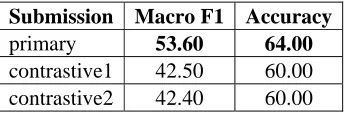
Three submissions were submitted for English sub-task B including primary submission, contrastive1 submission and contrastive2 submission. The eval-uation results are presented in table 2.
[image:4.612.338.513.415.473.2]Submission Macro F1 Accuracy primary 53.60 64.00 contrastive1 42.50 60.00 contrastive2 42.40 60.00
Table 2. Macro F1 and accuracy of English subtask B.
valida-tion on training data. Features employed for the primary submission include 187 features, which were the top 187 maximum gain ratio features of the 4400 features used in English task A.
The contrastive1 submission and contrastive2 submission were based on the good answers in English subtask A primary submission. Only good answers of YES_NO question in subtask A primary submission were classified in CGOLD_YN dimen-sion. Good answers of YES_NO question were classified into: yes, no and unsure.
For the contrastive1 submission, good class an-swers were classified with ensemble learning me-thod. Classifiers used for the ensemble learning method included the top 5 best classifiers for an-swer classification in CGOLD_YN dimension: SMO, Random Forest, DMNBtext, Logistic Re-gression and LMT (logistic model tree) (Sumner et al., 2005).
For the contrastive2 submission, only classifier LMT, which was the best classifier of all classifi-ers tried based on 10 folds cross validation results on training data, was used to classify good answers.
Features employed for the contrastive1 and con-trastive2 submission include 110 features, which were the top 110 maximum gain ratio features of the 4400 features used in English task A.
4.4 Results of Arabic task
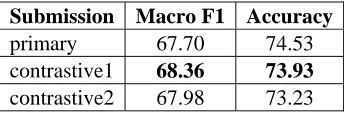
Answers were classified into 3 classes in Arabic task: direct, related, and irrelevant. Evaluation results for Arabic task are presented in table 3.
The primary submission was gotten by ensemble learning method using 3 classifiers. The classifiers were top 3 classifiers chosen based on 10 folds cross validation results on training data: SMO, REPTree (decision/regression tree) and J48graft (grafted C4.5 decision tree) (Webb, 1999).
[image:5.612.103.276.538.595.2]Submission Macro F1 Accuracy primary 67.70 74.53 contrastive1 68.36 73.93 contrastive2 67.98 73.23
Table 3. Macro F1 and accuracy of Arabic task.
The contrastive1 submission was gotten by two-level hierarchical classification method: in the first level, answers were classified into irrelevant and not irrelevant; in the second level, not irrelevant answers were classified into direct and related. All classifiers were trained using SMO algorithm.
The contrastive2 submission was gotten only by SMO classifier. The SMO classifier was trained as multi-class classifier to classify answers into direct, related and irrelevant.
Features employed for Arabic task include 5049 features: the top 5000 frequent n-gram terms and the top 49 maximum gain ratio features of all the features described in section 2.3 except “Frequent n-gram term features”.
5 Discussion
In English subtask A, performance of the submis-sion contrastive1, the hierarchical classification method result, was better than other submissions. The performance of hierarchical classification me-thod was also better than other submission in Arab-ic task. This shows that the hierarchArab-ical classification method is effective for answer selec-tion task.
The performances on different class varied from each other remarkable for English subtask A and Arabic task as shown in table 4. It is difficult to distinguish the potentially useful class answers for all classification methods that have been tried. Analysis on feature extraction showed that, most features were extracted to judge whether the an-swer was good or bad, but few features were ex-tracted to judge whether the answer was potentially useful.
Submission Class P R F1
English subtask A contrastive1
Good 78.02 79.74 78.87 Bad 80.6 66.01 72.58 Pot. 14.04 24.55 17.86 English
subtask B primary
Yes 80 80 80
No 28.57 50 36.36 Unsure 66.67 33.33 44.44
Arabic task contrastive1
direct 62.4 74.88 68.08 Irrel. 85.14 83.33 84.23 related 57.07 49.1 52.78
Table 4. Detailed evaluation results (P, R and F1) of the best performance result for each task.
im-pact on final answer accuracy for YES_NO ques-tion. The one-step classification method can avoid the cascade error for Yes_NO questions answering.
We compared performance of SVM classifier using bag-of-word features, non-bag-of-word fea-tures and all feafea-tures for English subtask A, sub-task B and Arabic sub-task on macro-F1 scores. The results are shown in table 5.
Task bow non_bow bow+non_bow Subtask A 0.39 0.48 0.50 Subtask B 0.42 0.64 0.68 Arabic Task 0.36 0.35 0.42
Table 5. Macro F1 of SVM classifier using bag-of-word features, non-bag-of-word features and all features.
Feature set bag-of-words (bow) includes Fre-quent n-gram term features described in section 2.1 and 2.3. Feature set non-bag-of-words (non_bow) includes other features described in section 2.1 and 2.3 which were specially designed for answer selection task. Set bow+non_bow in-cludes all features in set bow and non_bow.
The performance of the classifier using bow+non_bow features is better than using the other two sets features in isolation, which means bow set features and non_bow set features are ef-fective to improve performance of answer classifi-er if used both. The contribution of diffclassifi-erent sets is different on different tasks. Performance of non_bow (44 features for English data and 49 fea-tures for Arabic data) is better than bow (4000 for English and 5000 for Arabic) on Answer Selection task. It shows the features specially extracted for answer selection are more effective. But perfor-mance of non_bow (22 features) is worse than bow (165 features) on YES_NO questions answering. The reason is that the non_bow features are not designed for opinion recognition. It shows that de-signing special features for opinion recognition for task B is necessary.
6 Conclusions and Future Work
In this paper, we presented multi-classifier ensem-ble method and hierarchical classification method proposed for each subtask in SemEval-2015 Task 3. Experimental results demonstrated that the pro-posed classification methods were effective in both English and Arabic subtasks.
In the next stage, syntax feature and deep se-mantic feature will be exploited to further improve
the performance of our approaches. Besides, more effective features for potential answers classifica-tion will also be explored.
Acknowledgments
The authors thank Daniel Cer and all the anonym-ous reviewers for their insightful comments for this paper.
This work was supported in part by the National Natural Science Foundation of China (61272383, 61173075 and 61203378), the Strategic Emerging Industry Development Special Funds of Shenzhen
(ZDSY20120613125401420 and JCYJ20120613151940045) and the Key Basic
Re-search Foundation of Shenzhen (JC201005260118A).
References
Chih-Chung Chang and Chih-Jen Lin. 2011. LIBSVM: A library for support vector machines. ACM Trans-actions on Intelligent Systems and Technology, 2(3):1-27.
Chirag Shah and Jefferey Pomerantz. 2010. Evaluating and Predicting Answer Quality in Community QA. In Proceedings of the 33rd International ACM SIGIR Conference on Research and Development in Infor-mation Retrieval, 411-418, Geneva, Switzerland, 19-23 July.
Eugene Agichtein, Carlos Castillo, Debora Donato, Aristides Gionis, and Gilad Mishne. 2008. Finding High-quality Content in Social Media. In Proceed-ings of the 2008 International Conference on Web Search and Data Mining, 183-194, Palo Alto, Cali-fornia, USA, 11-12 February.
Fabian Pedregosa, Gaël Varoquaux, Alexandre Gram-fort, Vincent Michel, Bertrand Thirion, Olivier Grisel, Mathieu Blondel, Peter Prettenhofer, Ron Weiss, Vincent Dubourg, Jake Vanderplas, Alexandre Pas-sos, David Cournapeau, Matthieu Brucher, Matthieu Perrot, and Édouard Duchesnay. 2011. Scikit-learn: Machine Learning in Python. The Journal of Ma-chine Learning Research, 12:2825-2830.
Geoffrey I Webb. 1999. Decision tree grafting from the all-tests-but-one partition. In Proceedings of the Six-teenth International Joint Conference on Artificial Intelligence, 2:702-707, San Francisco, California, USA.
Jiang Su, Harry Zhang, Charles X Ling, and Stan Mat-win. 2008. Discriminative parameter learning for Bayesian networks. In Proceedings of the 25th inter-national conference on Machine learning, 1016-1023, Helsinki, Finland.
of the 29th Annual International ACM SIGIR Confe-rence on Research and Development in Information Retrieval, 228-235, Seattle, Washington, USA, 6-11 August.
Kohei Arai and Anik Nur Handayani. 2013. Predicting quality of answer in collaborative Q/A community. Society and culture, 2(3):21-25.
Leo Breiman. 2001. Random forests. Machine learning, 45(1):5-32.
Lluís Màrquez, James Glass, Walid Magdy, Alessandro Moschitti, Preslav Nakov, and Bilal Randeree. 2015. SemEval-2015 Task 3: Answer Selection in Commu-nity Question Answering. In Proceedings of the 9th International Workshop on Semantic Evaluation (SemEval 2015), Denver, Colorado, USA.
Marc Sumner, Eibe Frank, and Mark Hall. 2005. Speed-ing up logistic model tree induction. In Knowledge Discovery in Databases: PKDD 2005, 3721:675-683. Mark Hall, Eibe Frank, Geoffrey Holmes, Bernhard
Pfahringer, Peter Reutemann, and Ian H. Witten. 2009. The WEKA Data Mining Software: An Update. ACM SIGKDD Explorations Newsletter, 11(1):10-18. Nakatani Shuyo. 2010. Language Detection Library for
Java.
Rong-En Fan, Kai-Wei Chang, Cho-Jui Hsieh, Xiang-Rui Wang, and Chih-Jen Lin. 2008. LIBLINEAR: A Library for Large Linear Classification. The Journal of Machine Learning Research, 9:1871-1874. Sathiya Sathiya Keerthi, Shirish Krishnaj Shevade,
Chi-ru Bhattacharyya, and K. R. K. Murthy. 2001. Im-provements to Platt’s SMO Algorithm for SVM Classifier Design. Neural Computation, 13(3):637-649.
Saskia Le Cessie and Johannes C Van Houwelingen. 1992. Ridge estimators in logistic regression. Applied statistics, 191-201.