Toward automatic improvement of language produced by non-native
language learners
Mathias Creutz Eetu Sj¨oblom
Department of Digital Humanities Faculty of Arts
University of Helsinki
Unioninkatu 40, FI-00014 University of Helsinki, Finland {mathias.creutz, eetu.sjoblom}@helsinki.fi
Abstract
It is important for language learners to practice speaking and writing in realistic scenarios. The learners also need feed-back on how to express themselves better in the new language. In this paper, we per-form automatic paraphrase generation on language-learner texts. Our goal is to de-vise tools that can help language learners write more correct and natural sounding sentences. We use a pivoting method with a character-based neural machine transla-tion system trained on subtitle data to para-phrase and improve learner texts that con-tain grammatical errors and other types of noise. We perform experiments in three languages: Finnish, Swedish and English. We experiment with monolingual data as well as error-augmented monolingual and bilingual data in addition to parallel subti-tle data during training. Our results show that our baseline model trained only on parallel bilingual data sets is surprisingly robust to different types of noise in the source sentence, but introducing artificial errors can improve performance. In addi-tion to error correcaddi-tion, the results show promise for using the models to improve fluency and make language-learner texts more idiomatic.
1 Introduction
It is difficult to express oneself well in a new language. Language students can learn grammar and vocabulary by filling in blanks in carefully prepared exercise sentences, but the students also need to practice speaking and writing in realistic
This work is licensed under a Creative Commons Attri-bution 4.0 International Licence. Licence details: http: //creativecommons.org/licenses/by/4.0/
scenarios. When students write their own texts, they need corrective feedback. We are interested in finding out to what extent computers can pro-vide the necessary corrections, a task tradition-ally performed by human teachers. However, hu-man teachers are not always available and the stu-dents will want to carry on using the language out-side the language class. A tool helping language learners to produce more correct and more natu-ral sounding expressions can enhance the learning process and encourage the students to use the new language in real situations. In addition, findings since the 1980s suggest that language students that receive corrective feedback from computers rather than human teachers learn better and perceive the feedback as more neutral and encouraging (Beh-jat, 2011).
In this paper, we study automatic paraphras-ing methods on sentences produced by learners of three languages: Finnish, Swedish and English. A paraphrase is an alternate way of expressing a meaning using other words than in the original ut-terance, such as the sentence pair:“Why don’t you watch your mouth?”↔“Take care what you say.”
Our goal is to discover to what extent we can improve the spelling, grammar and naturalness of text written by non-native language users. We are not primarily interested in creating spell or grammar checkers, but we are interested in see-ing whether it is possible to make “noisy” non-standard sentences sound more natural. Non-native users may be struggling to find fluent, nat-ural sounding idiomatic expressions. Paraphrase generation may be a way to “translate” sentences produced by language learners to sentences that are grammatically correct and sound more authen-tic to native speakers.
non-native language user, we propose an alternon-native, corrected sentence. The proposed sentence can differ significantly, or not at all, from the original sentence, depending on the quality of the original input. By comparing the original and altered sen-tence, the language learner can identify errors and learn new expressions.
Our work is closely related to the field of gram-matical error correction (GEC), although our focus is broader. We are not only interested ingrammar, but also in fluency and naturalness in a broader sense. Furthermore, the concepts oferrorand cor-rectionare too narrow, in our opinion, since we are interested in better, or more effective, ways of con-veying a message.
Nonetheless, from our point of view, GEC can provide us with useful data sets, methods, as well as evaluation guidelines and metrics. Dahlmeier et al. (2013) introduce the NUCLE corpus, which was used in the CoNLL-2014 shared task on Grammatical Error Correction (Ng et al., 2014). NUCLE is an annotated corpus of English texts written by non-native English speakers. Twenty-eight error types have been annotated manu-ally, such as incorrect preposition or verb tense. Napoles et al. (2017) present JFLEG, an English parallel corpus incorporating fluency edits, in or-der not only to correct grammatical errors but also make the original text more native sounding. Anastasopoulos et al. (2019) add Spanish transla-tions to the JFLEG corpus.
Grammatical error correction systems are typi-cally evaluated using metrics that compare the cor-rections suggested by the system to a set of gold standard corrections. The MaxMatch (M2) algo-rithm (Dahlmeier and Ng, 2012) matches the sys-tem output to the gold standard and computes the sequence of edit operations that has maximal over-lap with the gold standard annotation. This set of corrections is then scored using the F1 measure. In the CoNLL-2014 shared task (Ng et al., 2014), the M2 scorer is revised. In order to emphasize the precision of the suggested corrections twice as much as recall, the F0.5 measure is used in-stead ofF1. Felice and Briscoe (2015) propose an-other metric, the I measure, which addresses some shortcomings ofM2, such as not distinguising be-tween not proposing an edit versus proposing the wrong edit. Napoles et al. (2015) develop the Gen-eralized Language Evaluation Understanding met-ric (GLEU) inspired by BLEU (Papineni et al.,
2002), which seems to correlate better with the hu-man ranking than the F and I measures.
When it comes to methods utilized in GEC, a broad range of approaches exist. The partici-pants in the CoNLL-2014 shared task (Ng et al., 2014) propose systems based on classifiers (Na¨ıve Bayes, averaged perceptron, maximum entropy), statistical language models, phrase-based and fac-tored translation models, rule-based approaches, as well as combinations of these methods. More recently, machine translation has been the pre-dominant framework. Sentences containing er-rors are translated into corrected sentences. Neu-ral machine translation (NMT) geneNeu-rally requires large amounts of training data and has been shown to be sensitive to noisy data (Belinkov and Bisk, 2018). Therefore approaches have been suggested where “noise” of the desired characteristics are incorporated in the training data, such that the system learns to remove the noise in the transla-tion (Belinkov and Bisk, 2018; Michel and Neu-big, 2018; Anastasopoulos et al., 2019). Com-bining neural machine translation with statistical machine translation (SMT) is also claimed to pro-duce better results (Grundkiewicz and Junczys-Dowmunt, 2018). Furthermore, GEC can be stud-ied as a low-resource machine translation task, where in addition to adding source-side noise other techniques are used: domain adaptation, a GEC-specific training-objective, transfer learning with monolingual data, and ensembling of inde-pendently trained GEC models and language mod-els (Junczys-Dowmunt et al., 2018), noisy chan-nel models (Flachs et al., 2019) and unsupervised SMT (Katsumata and Komachi, 2019).
models are evaluated using qualitative analysis and manual annotation, and the results are de-scribed in Section 5. Finally we conclude with a discussion in Section 6.
2 Data
We test our models on genuine text produced by non-native language learners. For training we use a large collection of subtitles.
2.1 Test data
As our test data we use parts of the YKI Cor-pus.1 The corpus has been compiled from the ex-aminations of the Finnish National Certificates of Language Proficiency, which is a language testing system for adults. Examinations can be taken in nine languages: English, Finnish, German, Ital-ian, North Sami, RussItal-ian, Spanish, and Swedish. There are three test levels (basic, intermediate and advanced), which offer six levels of proficiency (1–2, 3–4, 5–6). The corpus contains data from all nine languages and levels. The YKI corpus is in-tended for research purposes. Access is provided by request.2
For each of our languages of study (Finnish, Swedish, and English) we have extracted the texts produced by twelve different language learners at random.3 We have used the so-called “new ma-terial (2011–)”. The learners are on proficiency levels 1–2 and the writing assignments given to them are on the basic level. The texts in the data represent the genres “informal letter or message”, “formal letter or message”, “opinion”, “feedback” and “announcement”. Examples of three texts in the data are shown in Table 1. The full ex-tracted Finnish set contains 376 unique sentences, Swedish 332, and English 315. The data sets do not contain corrected versions of the sentences.
The backgrounds of the learners of Finnish and Swedish are quite diverse, whereas the English data is produced by a more homogeneous group of people. The Finnish learners consist of nine women and three men. Their native languages are: Russian (3), English (2), Chinese (2), German (1), Spanish (1), Turkish (1), and other (2). Among
1
http://yki-korpus.jyu.fi/?lang=en 2E-mail:[email protected]
3
The participant IDs are: fi: 75798, 75946, 76023, 76030, 76354, 76357, 76361, 76362, 76365, 80504, 85081, 86465; sv: 70094, 70096, 70489, 72570, 72919, 76606, 76686, 76757, 76758, 76759, 77974, 77975; en: 68079, 68112, 69336, 69632, 69635, 69874, 72098, 72099, 72262, 76537, 76705, 77616.
the Swedish learners there are ten women and two men. Their native languages are: Finnish (3), En-glish (2), Estonian (2), Russian (1), French (1), German (1), Thai (1), and other (1). The English learners consist of eight men and four women. Eleven are native Finnish speakers and one is a Swedish speaker.
2.2 Training data
Our models are trained on data extracted from sub-titles from movies and TV episodes. Large num-bers of subtitles have been collected from http: //www.opensubtitles.org/ and aligned across
languages to produce the OpenSubtitles corpus (Lison and Tiedemann, 2016; Lison et al., 2018). We have used the parallel subcorpora English– Finnish (23 million sentence pairs), English– Swedish (15 million sentence pairs), and Finnish– Swedish (12 million sentence pairs). These cor-pora allow us to train multilingual machine trans-lation systems between the three languages, but it is also possible to perform so-called “zero-shot” translation from one language to itself.
The style of the subtitle data is not a perfect match for our test data. However, the conversa-tional nature of subtitles make them suitable for modeling dialogues and everyday colloquial lan-guage (Lison et al., 2018). Our test data is pro-duced by language learners at a basic level, who are mostly trying to express themselves in every-day language. In that sense it makes sense to use OpenSubtitles as training data. Furthermore, the subtitles are not restricted to a narrow genre or do-main. The movies and TV series span from light-hearted productions for toddlers to historic dra-mas targeting older audiences, involving quite var-ied and distinct vocabulary (Paetzold and Specia, 2016).
Moi Maija: Min¨a olen kiinassa lomamatkalla. Olen ollut Kiinassa kahden viikoon. Min¨a jo k¨avi monissa kaupungissa. Se oli tosi mukavaa matkaa. Tavataan paljon yst¨avi¨a. Olen sy¨onyt paljon kiinalaista herkuiset yst¨avi¨ani mukaan. Tosi hauskaa! Min¨a viel¨a haluan k¨aym¨a¨an Shanghaissa ja ostan jotaikin Shanghaista. Toivottavasti, n¨ahd¨a¨an pian! Terveisin, Matti
Hejsan Tove! Nu har jag ¨antligen kommit till mitt nya stad Vaasa. Jag m˚ar verkligen bra men litet tr¨ott ¨ar jag. Flyttningen till bostaden tog fyra timmar och de var tv˚a m¨an som hj¨alpte mig att b¨ara tunna m¨obler. Bostaden ¨ar ljus och h¨ar finns stora f¨onster som ger dagljus till rummet. Det finns tv˚a rum, k¨ok och WC, 56m allts˚a ganska stor lokalen ˚at mig. Kom och h¨alsa mig n¨asta m˚anad. Vi ska ringa. Varma h¨alsningar ˚at er alla, Maija
Dear Bob! Thank you for a gift. It was beatufull! You still remember even we haven’t met for long time. We celebreat with family our home. Parents, brothers, sisters were there. Family things... We had one thing which I don’t Forget never. We take a photo where were Mum and Dad, both sisters and my brother all together the one picture! All peoples same place. Awsome. Please visit to us Bob. I would like to see You very soon! Yours, Matti
Table 1: Examples of three texts of the genre “informal letter” from the YKI Corpus (fi, sv, en). All of these particular three texts contain errors, but in comparison the Swedish text seems to be on the most advanced level, followed by English and Finnish. Despite the errors the texts are intelligible.
3 Model and Training
We adopt the neural machine translation (NMT) approach to paraphrase generation, using a stan-dard decoder architecture. In an encoder-decoder model, the encoder maps an input sen-tence to a sequence of continuous vectors. The decoder then generates an output sentence based on the vector representations. Multiple different encoder and decoder choices can be used in the overall encoder-decoder architecture. Architec-tures based on recurrent neural networks (Luong et al., 2015) or self-attention (Vaswani et al., 2017) are the most common.
For our experiments, we choose the Trans-former model by Vaswani et al. (2017). The Transformer has achieved state-of-the-art results in NMT and has found wide use in different sequence-to-sequence problems. It is based solely on self-attention within the encoder and the de-coder, as well as attention between the encoder and the decoder, discarding the recurrent connec-tions found in many earlier NMT architectures (Bahdanau et al., 2014; Luong et al., 2015). We train all our models as character-based models in an attempt to make the models more robust to ty-pos and other noise present in the data. For train-ing the multiltrain-ingual models, we follow Johnson et al. (2017) by prefixing each source sentence with a target-language flag.
The hyperparameter choices for the
Trans-former model follow the recommended setup of OpenNMT-py (Klein et al., 2017), which we use for all experiments. We use 6 layers in both the encoder and the decoder, hidden states and charac-ter embeddings with 512 dimensions with separate embeddings for the encoder and decoder, 8 atten-tion heads, and a feed-forward network with 2048 dimensions within the layers. We use a dropout probability of 0.1 between layers. All models are trained for 300k steps or until convergence, with a validation score as the convergence criterion. We use the Adam optimizer (Kingma and Ba, 2014) with a learning rate of 0.0001 and a token batch size of 4096. At inference time we use beam search with beam size 12 to produce the outputs.
4 Experiments
We perform experiments on translation models trained in five different setups. All setups are built on our baseline model, which can translate from any of the three languages Finnish, Swedish or En-glish to any of the same three languages.
4.1 Baseline model trained on bitexts
this model to produce paraphrases in two ways:
i) Zero-shot translation within the same lan-guage: For instance, the model translates from Finnish to Finnish although it has never seen train-ing data where both the source and target sentence have been Finnish sentences. However, the train-ing data does contain Finnish source and target sentences, but always aligned with a sentence in another language.
ii) Pivoting via a second language: The source sentence is translated into another language and then back to the source language. For example, a Finnish sentence is translated into English and then back to Finnish.
4.2 Baseline + Clones
As the baseline model does not see monolingual data during training, paraphrases have to be gen-erated either using zero-shot translation or pivot-ing. Because zero-shot translation generally suf-fers from lower performance compared to lan-guage pairs seen during training, we attempt to im-prove the model by adding monolingual data. We do this by simply using copies of sentences from the OpenSubtitles training sets in addition to the full parallel data. We randomly sample 10 million sentences per language and use the same sentence as the source and target during training.
4.3 Baseline + Opusparcus
Because we are interested in generating fluent and natural paraphrases for the input sentences, we also experiment using paraphrase pairs as mono-lingual data instead of cloned sentences. In this case the model sees alternative ways of formu-lating sentences, phrases and lexical items. An example of an English source/target pair is: “He believes in you.” ↔ “He has faith in you.” Our paraphrase pairs come from the Opusparcus para-phrase corpus. We use 20 million pairs for En-glish, 3.5 million for Finnish, and 1.8 million for Swedish. These data set sizes have been shown to perform well in a paraphrase detection task in earlier work (Sj¨oblom et al., 2018).
4.4 Baseline + Error-augmented monolingual data
The OpenSubtitles data consists of mostly clean sentences and proper language, although some noise, such as misspellings or optical character recognition errors, is present (Tiedemann, 2016).
This is in contrast to our test data, where the ma-jority of sentences contain errors. In our fourth setup we introduce artificial noise to our train-ing data in an attempt to improve performance on noisy test sentences. We sample one million sen-tences for each language from the OpenSubtitles data, and for each sentence generate an erroneous pair using two types of errors: 1) Typos are in-troduced by randomly deleting a character from a word, swapping two adjacent characters, inserting an extra character or duplicating a character. 2) In-flection errors are introduced by randomly chang-ing the inflection of a noun or a verb within the sentence using the UralicNLP toolkit for Finnish (H¨am¨al¨ainen, 2019) and HFST tools for English and Swedish (Lind´en et al., 2013). We randomly introduce 1–3 errors from either category to each sentence. The erroneous sentence is used as the source and the original as the target during train-ing. Examples 1 and 2 show source sentences with typos and inflection errors respectively, with the corresponding correct targets:
1. Aetaskuussa n¨ak¨oj¨a¨anvoittsa tikarrin saap-paassa. → Ase taskussa n¨ak¨oj¨a¨an voittaa tikarin saappaassa.
2. After sheattacks you, perhaps you had see
her?→After she attacked you, perhaps you have seen her?
4.5 Baseline + Error-augmented bilingual data
Finally, in an attempt to improve the pivot-based method without monolingual data, we augment bilingual data for all language pairs with errors. We sample one million sentences pairs for each language pair, and use the same sentence pairs for both translation directions. The pipeline for gener-ating the erroneous data is identical to the previous setup. The source sentences contain artificially in-troduced errors, whereas the target sentences are correct, as in: ”I had to gotthe biggerone’s.”→
”Piti saada isompi.”
5 Evaluation
5.1 Qualitative evaluation
As expected, the baseline model (Section 4.1) per-forms poorly in a zero-shot translation scenario. The model is generally unable to produce a para-phrase with the same semantic content as the source sentence, and many of the produced sen-tences contain artifacts that can be traced back to one of the other languages, and the multilingual nature of the model. Examples of such artifacts are producing mixed language or incorrectly translat-ing false friends, such as: “Siin¨a on Teid¨an per-heen valokuva.” →“Siin¨a on er¨a¨anfamiljen val-okuva.”, “Thank you for a gift.” → “Thank you for apoison.” (The Swedish word forfamilyhas been inserted into a Finnish sentence, and the En-glish wordgiftmeans poison in Swedish.)
Pivoting through another language works better as the model now only needs to translate between language pairs explicitly trained on. Examples of the intermediate steps (pivot languages) and the final paraphrases can be seen in Table 2. Many of the errors in the original source sentences have been corrected, although some sentences retain in-correct sentence structure or word forms from the source. Distortion of the source sentence seman-tics can also be seen in some cases. In the pivot scenario we also deal with the problem of com-pounding errors because of the two separate trans-lation steps.
We now turn to the models trained on monolin-gual data in addition to bilinmonolin-gual parallel data. A general trend emerges with all three models where monolingual data was used (Sections 4.2, 4.3, and 4.4). The models will most of the time simply copy the source, including the errors present in the sentence. While this is somewhat expected of the model where clones were used, it is surprising that even the model with paraphrase data exhibits this behavior. The Opusparcus paraphrase corpus does not contain pairs with identical source and target sentences. The error-augmented monolingual data seems to aid in correcting some typographical er-rors in the source sentences but does not correct bad inflection to the same extent. The sentence structure of the generated paraphrase is generally identical to that of the source sentence: ”I wiss
that you move the otherplaseand you can sleep very well” → ”I wish that you move the other place and you can sleep very well”
Guided by the results from pivot-based methods and the attempts to use monolingual data in
train-ing, our final setup incorporates error-augmented bilingual data instead of monolingual data (Sec-tion 4.5). A look at the generated phrases does not reveal consistent improvements over the base-line model, as shown in Table 3. The basebase-line model already corrects most typos, and while there are examples of phrases where the baseline model generates an incorrect word or inflection and the error-augmented model a correct one, the converse is true in other cases. We will compare the quality of the two models using manual annotations in the next section.
5.2 Manual annotation
Based on the qualitative assessment in the previ-ous section, we have chosen to manually anno-tate paraphrases generated by two models using the pivot-based method. The models selected for annotation are the baseline model as well as the model with added error-augmented bilingual data. Annotators were shown one sentence pair at a time. The annotation task was to compare the orig-inal sentence to the generated paraphrase and as-sess the correctness and semantic adequacy of the parapahrase using a single four-grade scale. The annotation categories were the following: 1 (Bad paraphrase, erroneous language), 2 (Mostly bad paraphrase, multiple errors), 3 (Mostly good para-phrase, minor errors), and 4 (Good parapara-phrase, correct language).
For English and Finnish, two independent an-notations were collected for each paraphrase. The inter-annotator agreement as measured by Cohen’s Kappa is 0.43 (Moderate) for English and 0.50 (Moderate) for Finnish. Only one person anno-tated Swedish and consequently no inter-annotator agreement score can be calculated.
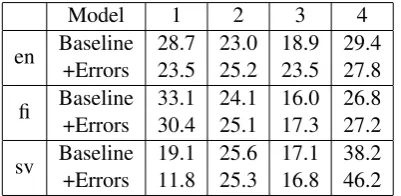
The manual annotation results are shown in Ta-ble 4. The results show an overall trend of the error augmented model performing better. For all lan-guages the percentage of phrases annotated as 1 decreases, that is, the models generate less com-pletely incorrect paraphrases. On the other end of the scale, the percentage of phrases annotated as category 4 decreases slightly for English, in-creases very slightly for Finnish, and inin-creases significantly for Swedish.
6 Discussion and Conclusion
Hey, Mary. I’m in China on vacation. I’ve been in China in two weeks. I already went to many towns. It was a really nice trip. Meet a lot of friends. I’ve eaten a lot of Chinese friends with my delicious friends. That’s really funny! I still want to go to Shanghai and buy something from Shanghai. I hope I’ll see you soon! Hello, Matt.
→
Hei, Mary. Olen Kiinassa lomalla. Olen ollut Kiinassa kahden viikon p¨a¨ast¨a. K¨avin jo monissa kaupungeissa. Se oli mukava matka. T¨ass¨a on paljon yst¨avi¨a. Olen sy¨onyt paljon kiinalaisia yst¨avi¨ani. Todella hauskaa! Haluan yh¨a ostaa jotain Shanghailta. Toivottavasti n¨aen sinut pian! Hei, Matt.
Hi, Tove! Now I’ve finally come to my new city Vaasa. I’m really fine, but I’m a little tired. The moving to the house took four hours and they were two men who helped me carry thin furniture. The house is light and here are big windows that
give daylight to the room. There are two rooms, kitchen and kitchen, 56 metres of the local for me. Come and tell me next month. We’re gonna call. Warm greetings for all of you. Maija.
→
Hej, Tove! Nu har jag ¨antligen kommit till min nya stad Vaasa. Jag m˚ar bra, men jag ¨ar lite tr¨ott. Att flytta till huset tog fyra timmar och de var tv˚a m¨an som hj¨alpte mig att b¨ara tunna m¨obler. Huset ¨ar ljust och h¨ar ¨ar stora f¨onster som ger dagsljus till rummet. Det finns tv˚a rum, k¨ok och k¨ok , 56 meter f¨or mig. Kom och ber¨atta n¨asta m˚anad. Vi ringer. Varma h¨alsningar f¨or er alla. Maja.
Hyv¨a Bob! Kiitos lahjasta. Se oli hienoa! Muistat viel¨akin, ettemme ole tavanneet pitk¨a¨an. Juhlimme perhett¨amme.
Vanhemmat, veljet, siskot olivat siell¨a. Perheasioita... Meill¨a oli yksi asia, jota en koskaan unohda. Otamme kuvan, miss¨a ¨aiti ja is¨a olivat, molemmat siskoni ja veljeni yhdess¨a. Kaikki ihmiset samaan paikkaan. Mahtavaa. K¨ayk¨a¨a Bobin luona. Haluaisin n¨ahd¨a sinut pian! Sinun, Matti.
→
Good Bob! Thank you for the gift. That was great! You still remember we haven’t met long. We’re celebrating our family. Parents, brothers, sisters were there. Family things. We had one thing I’ll never forget. We’ll take a picture where Mom and Dad were, both my sisters and my brother together. All people in the same place. That’s great. Go to Bob’s. I ’d like to see you soon! Yours, Matti.
Table 2: Illustration of the baseline pivoting method for the three source texts in Table 1. The Finnish and Swedish texts have been translated to English (in small font) and back to Finnish and Swedish (in larger font). The English text has been translated to Finnish (small font) and back to English (larger font).
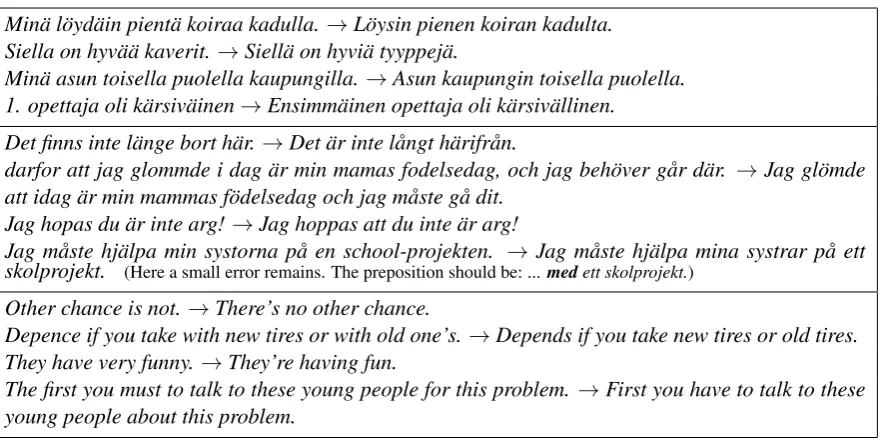
out-of-domain parallel data can effectively correct a multitude of different error types in text without the explicit modeling of these errors. Some further examples of corrected errors are shown in Table 5.
This is an important finding, as language is complex and hard to handle successfully in a “silo manner”, fixing typos, grammar and naturalness isolated from each other in separate steps. We ini-tially had an idea of using existing proofing tools (spell checkers) in a preprocessing phase. How-ever, many errors are not unambiguously spelling mistakes, as they may produce valid word forms, but which are wrong in context. We also con-sidered an “oracle” approach for comparison, in which we would fix all the typos manually before applying our automatic methods, but it turned out difficult to decide what exactly were plain typos
and how far the “oracle” would stretch.
We have chosen character-based models in order for these models to be less sensitive to noisy data. Using full words or longer word fragments would introduce numerous out-of-vocabulary words, when words in source sen-tences contain spelling mistakes. Comparing to Google Translate (Table 6) it seems that Google is more sensitive to noise related to typos and largely leaves such errors unfixed (for instance, the “En-glish” wordsbeatufullandawsome).
lan-Hello, Mary. I’m on a vacation. I’ve been in China in two weeks. I already went to many cities. It was a really nice journey. Meet a lot of friends. I’ve eaten a lot of Chinese friends with me. That’s really funny. I want to go to Shanghai and buy something about Shanghai. Hopefully, I’ll see you soon! Hello, Matt.
→
Hei, Mary. Olen lomalla. Olen ollut Kiinassa kahden viikon p¨a¨ast¨a. Menin jo moneen kaupunkiin. Se oli mukava matka. Tavataan paljon yst¨avi¨a. Olen sy¨onyt paljon kiinalaisia yst¨avi¨a kanssani. Todella hauskaa. Haluan menn¨a Shanghaihin ostamaan jotain Shanghaista. Toivottavasti n¨ahd¨a¨an pian. Hei, Matt.
Hey, Tove! Now I’ve finally come to my new town Vaasa. I’m really good, but I’m tired. The movement to the residence took four hours and they were two men who helped me wear thin furniture. The residence is light and here are big
windows that give daylight to the room. There’s two rooms, kitchen and WC, so there’s pretty big local for me. Come and tell me next month. We’re gonna call. Hot greetings for all of you. Maija
→
Tove! Nu har jag ¨antligen kommit till min nya stad Vaasa. Jag ¨ar verkligen bra, men jag ¨ar tr¨ott. R¨orelsen tog fyra timmar och de var tv˚a m¨an som hj¨alpte mig att b¨ara m¨obler. Bostaden ¨ar ljus och h¨ar ¨ar stora f¨onster som ger dagsljus till rummet. Det finns tv˚a rum, k¨ok och WC, s˚a det finns ganska stort lokalt f¨or mig. Kom och ber¨atta n¨asta m˚anad. Vi ringer. Varma h¨alsningar f¨or er alla. Maija
Rakas Bob! Kiitos lahjasta. Se oli h¨amm¨astytt¨av¨a¨a! Muistat viel¨a, ettemme ole tavanneet pitk¨a¨an aikaan. Juhlimme perheemme kanssa. Vanhemmat, veljet, siskot olivat siell¨a. Perheasioita... Meill¨a oli yksi asia, jota en unohda. Otamme kuvan, jossa ¨aiti ja is¨a olivat, molemmat siskot ja veljeni yhdess¨a yhdess¨a kuvassa! Kaikki ihmiset samassa paikassa.
Mahtavaa. K¨ay luonamme, Bob. Haluaisin n¨ahd¨a sinut pian! Sinun, Matti.
→
[image:8.595.82.283.562.660.2]Dear Bob ! Thank you for the gift. It was amazing! You remember that we haven’t met in a long time. We’re celebrating with our family. Parents, brothers, sisters were there. Family things... We had one thing I won’t forget. We’ll take a picture where Mom and Dad were, both sisters and my brothers in one picture! All people in the same place. That’s great. Come to us, Bob. I’d like to see you soon! Yours, Matti.
Table 3: Illustration of the baseline pivoting method augmented with artificial errors for the three source texts in Table 1. The Finnish and Swedish texts have been translated to English (in small font) and back to Finnish and Swedish (in larger font). The English text has been translated to Finnish (small font) and back to English (larger font).
Model 1 2 3 4
en Baseline 28.7 23.0 18.9 29.4 +Errors 23.5 25.2 23.5 27.8
fi Baseline 33.1 24.1 16.0 26.8 +Errors 30.4 25.1 17.3 27.2
sv Baseline 19.1 25.6 17.1 38.2 +Errors 11.8 25.3 16.8 46.2
Table 4: Manual annotation results for the Base-line model and the BaseBase-line model with error-augmented bilingual data (+Errors). Proportion [%] of generated sentences annotated as one of the four categories.
guages, with English improving the least and Swedish the most. Differences in translation qual-ity between the different language pairs can be a contributing factor, as there is the least amount of Swedish data for training, which may explain the proportionally larger benefit of additional train-ing data. However, we also note that the degree of inter-annotator agreement is rather low, which may call for clearer annotation guidelines in the future.
investi-Min¨a l¨oyd¨ain pient¨a koiraa kadulla.→L¨oysin pienen koiran kadulta. Siella on hyv¨a¨a kaverit.→Siell¨a on hyvi¨a tyyppej¨a.
Min¨a asun toisella puolella kaupungilla.→Asun kaupungin toisella puolella. 1. opettaja oli k¨arsiv¨ainen→Ensimm¨ainen opettaja oli k¨arsiv¨allinen.
Det finns inte l¨ange bort h¨ar.→Det ¨ar inte l˚angt h¨arifr˚an.
darfor att jag glommde i dag ¨ar min mamas fodelsedag, och jag beh¨over g˚ar d¨ar. →Jag gl¨omde att idag ¨ar min mammas f¨odelsedag och jag m˚aste g˚a dit.
Jag hopas du ¨ar inte arg! →Jag hoppas att du inte ¨ar arg!
Jag m˚aste hj¨alpa min systorna p˚a en school-projekten. → Jag m˚aste hj¨alpa mina systrar p˚a ett skolprojekt. (Here a small error remains. The preposition should be:...medett skolprojekt.)
Other chance is not. →There’s no other chance.
Depence if you take with new tires or with old one’s.→Depends if you take new tires or old tires. They have very funny.→They’re having fun.
[image:9.595.81.525.59.279.2]The first you must to talk to these young people for this problem.→First you have to talk to these young people about this problem.
Table 5: Examples of successful corrections of sentences in the test data. These translations have been produced using the baseline pivoting approach. Typical errors in the Finnish input are incorrect inflections, incorrect word choices and omissions of umlauts. Similar errors occur in the Swedish data with additional challenges related to word order, agreement and foreign words. The native language of the authors of the English sentences is revealed by the Finnish sentence structure of the English sentences.
gations into how monolingual data could be used effectively to circumvent the need for pivoting and increase performance.
In addition to fixing obvious grammatical er-rors in source sentences, we find cases where our model introduces fluency edits. This can be seen, for instance, in more idiomatic choices of words: it is typical for non-native Swedish speakers to use the verbfinna, which resemblesto findin En-glish and means the same thing, but a more nat-ural choice would be the verb hitta. Our models do changefinnatohitta. Similarly, the Finnish ex-pressionmenn¨a takaisin(go back) is replaced by
palata(return).
Together our results show promise for using a standard NMT approach to improving and para-phrasing noisy language learner text. As test data we have used Finnish, Swedish and English por-tions of the YKI corpus, which to our knowledge have not been studied in this setting before, and could be of special interest to a Nordic audience. As far as computer-assisted language learning is concerned, we find the fluency edits introduced by the models especially encouraging. The mod-els go beyond simple grammatical error-correction and can help language learners improve their skills toward more fluent and native-like language pro-duction. We believe that our approach is
partic-ularly beneficial to more advanced learners, who want to be able to use their new language more au-tonomously, in situations where no human teacher is available.
Acknowledgment
The authors wish to acknowledge CSC, the Finnish IT Center for Science, for providing the computational resources needed to carry out the experiments in this study.
References
Antonios Anastasopoulos, Alison Lui, Toan Nguyen, and David Chiang. 2019. Neural machine transla-tion of text from non-native speakers. In
Proceed-ings of NAACL-HLT 2019, pages 3070–3080,
Min-neapolis, Minnesota.
Dzmitry Bahdanau, Kyunghyun Cho, and Yoshua Ben-gio. 2014. Neural machine translation by jointly learning to align and translate. arXiv preprint arXiv:1409.0473.
Fatemeh Behjat. 2011. Teacher correction or word pro-cessors: Which is a better option for the improve-ment of EFL students writing skill? Journal of
Lan-guage Teaching and Research, 2(6):1430–1434.
Moi Mai: Olen Kiinan loma-matka. Olen ollut Kiinassa kaksi viikoonia. Menin jo moniin kaupunkeihin. Se oli todella mukava matka. N¨ahd¨a¨an paljon yst¨avi¨a. Olen sy¨onyt paljon kiinalaisia yst¨avi¨a herkuisetiin. Todella hauskaa! Haluan edelleen k¨ayd¨a Shanghaissa ja ostaa jotain Shanghaissa. Toivottavasti n¨ahd¨a¨an pian! Yst¨av¨allisin terveisin Matti
Hejsan Tove! Nu har jag ¨antligen kommit till min nya stad Vaasa. Jag k¨anner mig v¨aldigt bra men lite tr¨ott ¨ar jag. Flyttet
till hemmet tog fyra timmar och de var tv˚a m¨an som hj¨alpte mig att b¨ara tunna m¨obler. Boendet ¨ar ljust och h¨ar finns stora f¨onster som ger dagsljus till rummet. Det finns tv˚a rum, k¨ok och toalett, 56 m s˚a ganska stort rum f¨or mig. Kom och se mig n¨asta m˚anad. Vi ringer. Varma h¨alsningar till er alla Maija
Good Bob! Thank you for the gift. It was beatufull! You still remember that we haven’t met for a long time. We celebrate with our family with our family. Parents, brothers, sisters were there. Family matters ... We had one thing I would never
forget. We take a photo of mother and father, both sisters and brothers together in one picture! All nations in the same place. Awsome. Visit us Bob. I’d like to see you soon! You, Matti
Table 6: Applying the pivoting method using Google Translate (as of June, 2019). The Finnish and Swedish texts have been translated to English and then back. The English text has been translated to Finnish and back. In comparison to our own results in Tables 2 and 3 it is not obvious which method is the most effective, as Google Translate does not seem to cope well with errors in the source sentences.
Mathias Creutz. 2018. Open Subtitles Paraphrase Cor-pus for Six Languages. InProceedings of the 11th International Conference on Language Resources
and Evaluation (LREC 2018), Miyazaki, Japan.
Eu-ropean Language Resources Association (ELRA).
Daniel Dahlmeier and Hwee Tou Ng. 2012. Better evaluation for grammatical error correction. In2012 Conference of the North American Chapter of the Association for Computational Linguistics: Human
Language Technologies, pages 568–572, Montreal,
Canada.
Daniel Dahlmeier, Hwee Tou Ng, and Siew Mei Wu. 2013. Building a large annotated corpus of learner English: The NUS corpus of learner English. In
Proceedings of the Eighth Workshop on Innova-tive Use of NLP for Building Educational
Applica-tions, pages 22–31, Atlanta, Georgia. Association
for Computational Linguistics.
Mariano Felice and Ted Briscoe. 2015. Towards a stan-dard evaluation method for grammatical error de-tection and correction. InHuman Language Tech-nologies: The 2015 Annual Conference of the North
American Chapter of the ACL, pages 578–587,
Den-ver, Colorado.
Simon Flachs, Oph´elie Lacroix, and Anders Søgaard. 2019. Noisy channel for low resource grammatical error correction. In Proceedings of the Fourteenth Workshop on Innovative Use of NLP for Building Educational Applications, pages 191–196, Florence, Italy. Association for Computational Linguistics.
Roman Grundkiewicz and Marcin Junczys-Dowmunt. 2018. Near human-level performance in grammati-cal error correction with hybrid machine translation.
In Proceedings of NAACL-HLT 2018, pages 284–
290, New Orleans, Louisiana.
Mika H¨am¨al¨ainen. 2019. UralicNLP: An NLP library for Uralic languages. Journal of Open Source Soft-ware, 4(37):1345.
Melvin Johnson, Mike Schuster, Quoc V Le, Maxim Krikun, Yonghui Wu, Zhifeng Chen, Nikhil Thorat, Fernanda Vi´egas, Martin Wattenberg, Greg Corrado, et al. 2017. Google’s multilingual neural machine translation system: Enabling zero-shot translation.
Transactions of the Association for Computational Linguistics, 5:339–351.
Marcin Junczys-Dowmunt, Roman Grundkiewicz, Shubha Guha, and Kenneth Heafield. 2018. Ap-proaching neural grammatical error correction as a low-resource machine translation task. In
Proceed-ings of NAACL-HLT 2018, page 595606, New
Or-leans, Louisiana.
Satoru Katsumata and Mamoru Komachi. 2019. (Al-most) unsupervised grammatical error correction us-ing synthetic comparable corpus. InProceedings of the Fourteenth Workshop on Innovative Use of NLP
for Building Educational Applications, pages 134–
138, Florence, Italy. Association for Computational Linguistics.
Diederik P Kingma and Jimmy Ba. 2014. Adam: A method for stochastic optimization. arXiv preprint arXiv:1412.6980.
Guillaume Klein, Yoon Kim, Yuntian Deng, Jean Senellart, and Alexander M. Rush. 2017. Open-NMT: Open-source toolkit for neural machine trans-lation. InProc. ACL.
Pierre Lison and J¨org Tiedemann. 2016. OpenSub-titles2016: Extracting large parallel corpora from movie and TV subtitles. InProceedings of the 10th International Conference on Language Resources and Evaluation (LREC 2016), Portoroˇz, Slovenia.
Pierre Lison, J¨org Tiedemann, and Milen Kouylekov. 2018. OpenSubtitles2018: Statistical Rescoring of Sentence Alignments in Large, Noisy Parallel Cor-pora. In Proceedings of the 11th International Conference on Language Resources and Evaluation
(LREC 2018), Miyazaki, Japan. European Language
Resources Association (ELRA).
Minh-Thang Luong, Hieu Pham, and Christopher D Manning. 2015. Effective approaches to attention-based neural machine translation. arXiv preprint
arXiv:1508.04025.
Paul Michel and Graham Neubig. 2018. MTNT: A testbed for machine translation of noisy text. In Pro-ceedings of the 2018 Conference on Empirical Meth-ods in Natural Language Processing.
Courtney Napoles, Keisuke Sakaguchi, Matt Post, and Joel Tetreault. 2015. Ground truth for grammati-cal error correction metrics. InProceedings of the 53rd Annual Meeting of the Association for Compu-tational Linguistics and the 7th International Joint Conference on Natural Language Processing (Short Papers), pages 588–593, Beijing, China.
Courtney Napoles, Keisuke Sakaguchi, and Joel Tetreault. 2017. JFLEG: A fluency corpus and benchmark for grammatical error correction. In Pro-ceedings of the 15th Conference of the European Chapter of the Association for Computational Lin-guistics, volume 2.
Hwee Tou Ng, Siew Mei Wu, Ted Briscoe, Christian Hadiwinoto, Raymond Hendy Susanto, and Christo-pher Bryant. 2014. The CoNLL-2014 shared task on grammatical error correction. InProceedings of the Eighteenth Conference on Computational
Natu-ral Language Learning: Shared Task, pages 1–14.
Gustavo Henrique Paetzold and Lucia Specia. 2016. Collecting and exploring everyday language for pre-dicting psycholinguistic properties of words. In Pro-ceedings of COLING 2016, the 26th International Conference on Computational Linguistics: Techni-cal Papers, pages 669–1679, Osaka, Japan.
Kishore Papineni, Salim Roukos, Todd Ward, and Wei-Jing Zhu. 2002. BLEU: a method for automatic evaluation of machine translation. In Proceedings of the 40th Annual Meeting of the Association for
Computational Linguistics (ACL), pages 311–318,
Philadelphia, Pennsylvania.
Eetu Sj¨oblom, Mathias Creutz, and Mikko Aulamo. 2018. Paraphrase detection on noisy subtitles in six languages. In Proceedings of W-NUT at EMNLP, Brussels, Belgium.
J¨org Tiedemann. 2016. Finding alternative translations in a large corpus of movie subtitles. InProceedings of the 10th International Conference on Language
Resources and Evaluation (LREC 2016), Portoroˇz,
Slovenia.